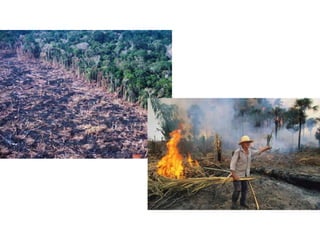
Slash and Burn
• The term ‘Slash and Burn’ farming relates to an
old agricultural practice that has historically been used throughout
most of the world. It is a method which quickly creates open land
through the cutting and burning of forests and woodlands to create
fields for agriculture, or pasture for livestock.
• This method also creates - what was otherwise a very poor soil - a
soil that is rich in available plant nutrients, but this is only due to
the introduction of the burned plant material back into the soil.
Unfortunately - under normal cultivation – this newly released
fertility quickly declines and the land is often abandoned
• The biggest problem of using ‘slash and burn’ in tropical rainforests
is the large scale erosion that usually occurs afterwards.
• This means that any small remaining amounts of nutrients are
washed away causing the phenomenon known as ‘desertification’ -
this is when no growth of any type may happen for generations.
Mining
• Beneath rainforests there often lies a wealth of natural resources in
the form of mineral and gold deposits.
• Often people involved in small scale gold mining use mercury to
extract the gold. Mercury is banned in Indonesia but is readily
available for purchase by individuals. As well as damaging people's
health, the mercury used goes on to pollute river systems
• Large areas of forest in Indonesia are protected by law against any
prospecting or open cast mining, although new rules do allow
underground mining in protected areas.
• Brazil has the world's largest iron ore mine and has rich reserves of
other metals such as zinc, nickel, tin and aluminium. It is possible
that some of its forests may be opened up for mineral exploration.
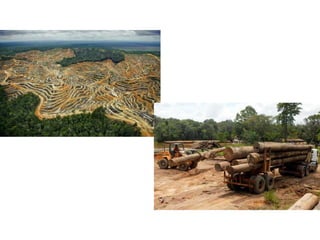
Logging
• Once an area of forest is cleared, it will probably never recover.
When a 35 metre tree is cut down, it can crush up to 17 smaller
trees as it crashes to the ground. There may be only two or three
trees that can be sold in an area of forest the size of two football
pitches.
• In West Africa, almost 90% of the rainforest has been destroyed and
now the logging is spreading to Central Africa.
• As more rainforest is cut down, it became easier to hunt animals as
their habitats get smaller. In Africa apes such as gorillas and other
animals are hunted for bushmeat to be sold by roadsides and in the
markets.
• An estimated 70 - 80% of logging in Brazil and Indonesia is
illegal. About 1/10 of wood used in the timber trade worldwide is
illegal.
Roads and Transport
• The construction of roads to access logging, oil, and mining
sites in the rainforest opens vast stretches of forest to
exploitation by people without a place to live or earn
money, and who are responsible for the majority of
rainforest destruction today One of the most famous
projects is the Trans-Amazonian highway in Brazil, which
opened up Roraima state to widespread invasion and
deforestation by miners and loggers which further damages
the land and animals habitats
• A new road project in South America that links Amazon
outposts in Brazil to Pacific Ocean ports in Peru is of great
concern to environmentalists and indigenous-rights groups.
The road has already been linked to a surge in illegal
logging and mining. The project was completed in 2011.
Cattle Farming
• Brazil is the world’s largest exporter of beef with
more cattle (204 million) than people (200 million
in 2013)! After logging and/or burning of the
rainforest, cleared land is sold to local farmers for
cattle grazing.
• 80% of deforested areas in Brazil are used for
cattle ranching and are the greatest source of
carbon emissions in Brazil. Not only that but the
cattle naturally produce large quantities of
methane, another “greenhouse gas”
approximately 26 times more effective than CO2
Hydroelectric Dams
• This renewable “green” source of energy, ironically is to blame for some
environmental destruction,
• Unfortunately, the building of hydro-electric dams often results in major
flooding which harms wildlife and can change the eco-system of the river
downstream. Wood rotting underwater also releases carbon dioxide and
methane greenhouse gases.
• The Xingu river is the site of the world's third largest hydro-electric dam, the
Belo Monte project where 310 square miles (500 square km) will be
flooded. Many indigenous people such as the Kayapo Indians are concerned
about the potential loss of land.
• The big companies and governments who propose these developments of the
rainforest usually offer incentives for the affected people such as jobs, schools
and clinics. In many cases, promised compensation is not delivered.
Cash Crops (Palm Oil!)
• Have you heard of palm oil? It is used in bread, cereals, chocolates, pizzas,
cleaning products, chewing gum and even shampoo.
• Sometimes land is cleared so that it can be replanted with valuable cash
crops such as the oil palm plant, which produces palm oil.
• Indonesia produces 90% of the world's palm oil and aims to double its
production by 2020. Palm oil production is such a huge business in
Malaysia and Indonesia that the latter has gained the title of “World’s
Fastest Rainforest Destroyer” in the Guiness Book of World Records!
• Valuable trees are harvested and the rest are burnt to clear the land for
the farming of palm oil. As the soil’s fertility does not last forever, the
people at the head of logging companies avoid bankruptcy by buying up
new areas of forest.
• In burning the rainforests Indonesia is also burning the peatlands below
which store masses of carbon. This makes Indonesia the country with the
3rd largest carbon footprint in the world, when deforestation is taken into
account!
Uses and threats (1)

Uses and threats (1)

  • 1.
    Slash and Burn •The term ‘Slash and Burn’ farming relates to an old agricultural practice that has historically been used throughout most of the world. It is a method which quickly creates open land through the cutting and burning of forests and woodlands to create fields for agriculture, or pasture for livestock. • This method also creates - what was otherwise a very poor soil - a soil that is rich in available plant nutrients, but this is only due to the introduction of the burned plant material back into the soil. Unfortunately - under normal cultivation – this newly released fertility quickly declines and the land is often abandoned • The biggest problem of using ‘slash and burn’ in tropical rainforests is the large scale erosion that usually occurs afterwards. • This means that any small remaining amounts of nutrients are washed away causing the phenomenon known as ‘desertification’ - this is when no growth of any type may happen for generations.
  • 3.
    Mining • Beneath rainforeststhere often lies a wealth of natural resources in the form of mineral and gold deposits. • Often people involved in small scale gold mining use mercury to extract the gold. Mercury is banned in Indonesia but is readily available for purchase by individuals. As well as damaging people's health, the mercury used goes on to pollute river systems • Large areas of forest in Indonesia are protected by law against any prospecting or open cast mining, although new rules do allow underground mining in protected areas. • Brazil has the world's largest iron ore mine and has rich reserves of other metals such as zinc, nickel, tin and aluminium. It is possible that some of its forests may be opened up for mineral exploration.
  • 5.
    Logging • Once anarea of forest is cleared, it will probably never recover. When a 35 metre tree is cut down, it can crush up to 17 smaller trees as it crashes to the ground. There may be only two or three trees that can be sold in an area of forest the size of two football pitches. • In West Africa, almost 90% of the rainforest has been destroyed and now the logging is spreading to Central Africa. • As more rainforest is cut down, it became easier to hunt animals as their habitats get smaller. In Africa apes such as gorillas and other animals are hunted for bushmeat to be sold by roadsides and in the markets. • An estimated 70 - 80% of logging in Brazil and Indonesia is illegal. About 1/10 of wood used in the timber trade worldwide is illegal.
  • 7.
    Roads and Transport •The construction of roads to access logging, oil, and mining sites in the rainforest opens vast stretches of forest to exploitation by people without a place to live or earn money, and who are responsible for the majority of rainforest destruction today One of the most famous projects is the Trans-Amazonian highway in Brazil, which opened up Roraima state to widespread invasion and deforestation by miners and loggers which further damages the land and animals habitats • A new road project in South America that links Amazon outposts in Brazil to Pacific Ocean ports in Peru is of great concern to environmentalists and indigenous-rights groups. The road has already been linked to a surge in illegal logging and mining. The project was completed in 2011.
  • 9.
    Cattle Farming • Brazilis the world’s largest exporter of beef with more cattle (204 million) than people (200 million in 2013)! After logging and/or burning of the rainforest, cleared land is sold to local farmers for cattle grazing. • 80% of deforested areas in Brazil are used for cattle ranching and are the greatest source of carbon emissions in Brazil. Not only that but the cattle naturally produce large quantities of methane, another “greenhouse gas” approximately 26 times more effective than CO2
  • 11.
    Hydroelectric Dams • Thisrenewable “green” source of energy, ironically is to blame for some environmental destruction, • Unfortunately, the building of hydro-electric dams often results in major flooding which harms wildlife and can change the eco-system of the river downstream. Wood rotting underwater also releases carbon dioxide and methane greenhouse gases. • The Xingu river is the site of the world's third largest hydro-electric dam, the Belo Monte project where 310 square miles (500 square km) will be flooded. Many indigenous people such as the Kayapo Indians are concerned about the potential loss of land. • The big companies and governments who propose these developments of the rainforest usually offer incentives for the affected people such as jobs, schools and clinics. In many cases, promised compensation is not delivered.
  • 13.
    Cash Crops (PalmOil!) • Have you heard of palm oil? It is used in bread, cereals, chocolates, pizzas, cleaning products, chewing gum and even shampoo. • Sometimes land is cleared so that it can be replanted with valuable cash crops such as the oil palm plant, which produces palm oil. • Indonesia produces 90% of the world's palm oil and aims to double its production by 2020. Palm oil production is such a huge business in Malaysia and Indonesia that the latter has gained the title of “World’s Fastest Rainforest Destroyer” in the Guiness Book of World Records! • Valuable trees are harvested and the rest are burnt to clear the land for the farming of palm oil. As the soil’s fertility does not last forever, the people at the head of logging companies avoid bankruptcy by buying up new areas of forest. • In burning the rainforests Indonesia is also burning the peatlands below which store masses of carbon. This makes Indonesia the country with the 3rd largest carbon footprint in the world, when deforestation is taken into account!