consulting | research | contracting
User-Centered Design With Pragmatic Personas
Pavel Dabrytski and Angie Doyle
2
how do you
identify what to
build ?
3
FUBU
for us by us
4
FMBU
for me by you
(product owner in scrum/XP)
5
MSU
making *things* up
6
FTBU
for them by you
(user centered design)
7
user role
a grouping of users of a
product based on a shared set
of tasks or functions they need
to perform, or common needs
they need to fulfill
8
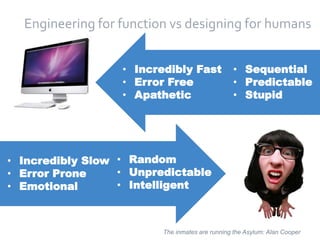
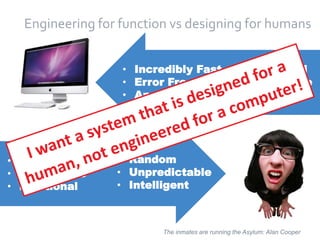
Engineering for function vs designing for humans
• Incredibly Fast
• Error Free
• Apathetic
• Sequential
• Predictable
• Stupid
• Incredibly Slow
• Error Prone
• Emotional
• Random
• Unpredictable
• Intelligent
The inmates are running the Asylum: Alan Cooper
9
Engineering for function vs designing for humans
• Incredibly Fast
• Error Free
• Apathetic
• Sequential
• Predictable
• Stupid
• Incredibly Slow
• Error Prone
• Emotional
• Random
• Unpredictable
• Intelligent
The inmates are running the Asylum: Alan Cooper
10
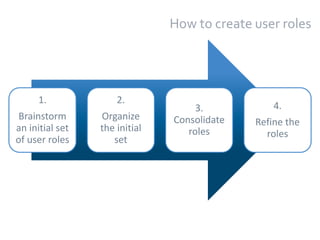
How to create user roles
1.
Brainstorm
an initial set
of user roles
2.
Organize
the initial
set
3.
Consolidate
roles
4.
Refine the
roles
11
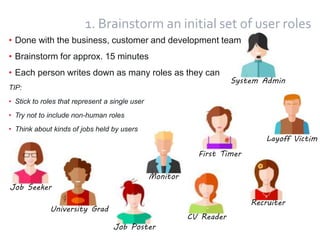
1. Brainstorm an initial set of user roles
• Done with the business, customer and development team
• Brainstorm for approx. 15 minutes
• Each person writes down as many roles as they can
TIP:
• Stick to roles that represent a single user
• Try not to include non-human roles
• Think about kinds of jobs held by users
Job Seeker
First Timer
Layoff Victim
Monitor
Job Poster
CV Reader
Recruiter
System Admin
University Grad
12
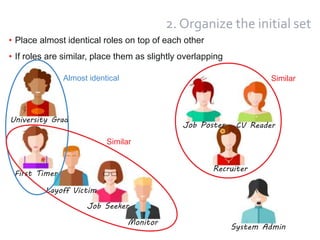
2. Organize the initial set
• Place almost identical roles on top of each other
• If roles are similar, place them as slightly overlapping
Almost identical
Similar
Job Seeker
First Timer
Layoff Victim
Monitor
Job Poster CV Reader
Recruiter
System Admin
University Grad
Similar
13
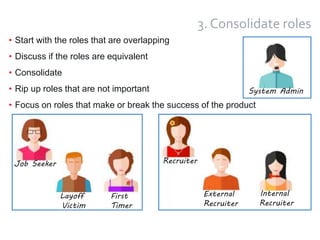
3. Consolidate roles
• Start with the roles that are overlapping
• Discuss if the roles are equivalent
• Consolidate
• Rip up roles that are not important
• Focus on roles that make or break the success of the product
Job Seeker
Layoff
Victim
First
Timer
Recruiter
System Admin
External
Recruiter
Internal
Recruiter
14
Decide who’s using
• As a team, agree on the user roles to be used for your product
• Remember to:
1. Brainstorm the initial set
2. Organize the initial set into similar roles
3. Consolidate the roles
15
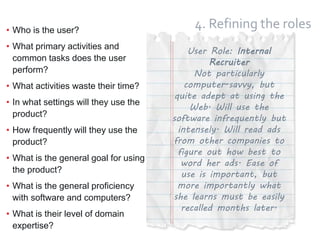
4. Refining the roles• Who is the user?
• What primary activities and
common tasks does the user
perform?
• What activities waste their time?
• In what settings will they use the
product?
• How frequently will they use the
product?
• What is the general goal for using
the product?
• What is the general proficiency
with software and computers?
• What is their level of domain
expertise?
User Role: Internal
Recruiter
Not particularly
computer-savvy, but
quite adept at using the
Web. Will use the
software infrequently but
intensely. Will read ads
from other companies to
figure out how best to
word her ads. Ease of
use is important, but
more importantly what
she learns must be easily
recalled months later.
16
Refine who’s using
As a team, create a detailed definition for 3 of the user roles
identified.
17
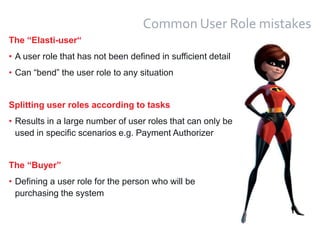
Common User Role mistakes
The “Elasti-user“
• A user role that has not been defined in sufficient detail
• Can “bend” the user role to any situation
Splitting user roles according to tasks
• Results in a large number of user roles that can only be
used in specific scenarios e.g. Payment Authorizer
The “Buyer”
• Defining a user role for the person who will be
purchasing the system
18
persona
is a type or archetype that
describes in a realistic fashion
key attributes, behaviours and
attitudes of your users
*is not a synonym for “user”
19
Why personas?
•Conversation starter
•Get rid of generic user/generic customer
•Bring users to life and make them “sticky”
•Get people to focus
•Shift from feature bucket to user-centered
design
20
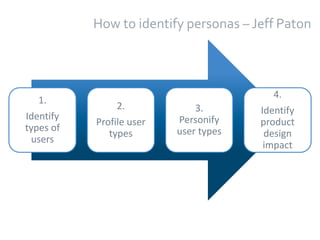
How to identify personas – Jeff Paton
1.
Identify
types of
users
2.
Profile user
types
3.
Personify
user types
4.
Identify
product
design
impact
21
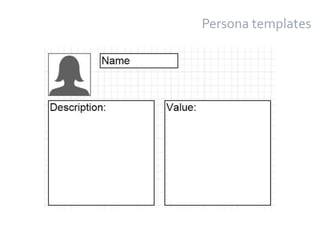
Persona templates
22
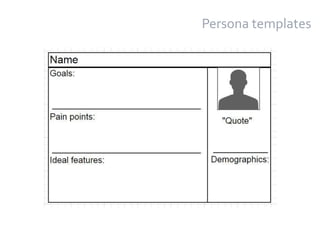
Persona templates
23
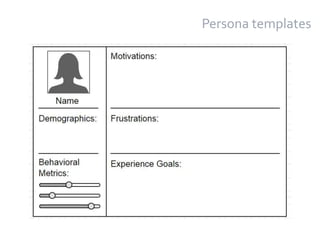
Persona templates
24
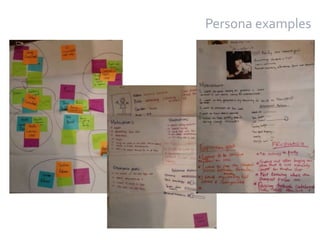
Persona examples
25
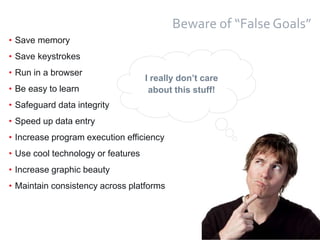
Beware of “False Goals”
• Save memory
• Save keystrokes
• Run in a browser
• Be easy to learn
• Safeguard data integrity
• Speed up data entry
• Increase program execution efficiency
• Use cool technology or features
• Increase graphic beauty
• Maintain consistency across platforms
I really don’t care
about this stuff!
26
Create a pragmatic persona
As a team, create one pragmatic persona for your product
27
Common Persona mistakes
The Generic Persona
• Traits common to most users
• Trying to be everything to everyone
Personas that separate
• Real user ignored in favour of persona
• Insufficient market and demographic
research done
More than 3 primary personas
• You are trying to do too much at once
28
extreme persona
is a persona laying on the edge
of your user base
29
Use extreme persona to write user stories
As a team, think of a feature your extreme persona desires, that might be
valuable to other users. Write a user story for it.
As a <persona>
I want <functionality>
So that <benefit>

User-Centered Design with Pragmatic Personas

  • 1.
    consulting | research| contracting User-Centered Design With Pragmatic Personas Pavel Dabrytski and Angie Doyle
  • 2.
    2 how do you identifywhat to build ?
  • 3.
  • 4.
    4 FMBU for me byyou (product owner in scrum/XP)
  • 5.
  • 6.
    6 FTBU for them byyou (user centered design)
  • 7.
    7 user role a groupingof users of a product based on a shared set of tasks or functions they need to perform, or common needs they need to fulfill
  • 8.
    8 Engineering for functionvs designing for humans • Incredibly Fast • Error Free • Apathetic • Sequential • Predictable • Stupid • Incredibly Slow • Error Prone • Emotional • Random • Unpredictable • Intelligent The inmates are running the Asylum: Alan Cooper
  • 9.
    9 Engineering for functionvs designing for humans • Incredibly Fast • Error Free • Apathetic • Sequential • Predictable • Stupid • Incredibly Slow • Error Prone • Emotional • Random • Unpredictable • Intelligent The inmates are running the Asylum: Alan Cooper
  • 10.
    10 How to createuser roles 1. Brainstorm an initial set of user roles 2. Organize the initial set 3. Consolidate roles 4. Refine the roles
  • 11.
    11 1. Brainstorm aninitial set of user roles • Done with the business, customer and development team • Brainstorm for approx. 15 minutes • Each person writes down as many roles as they can TIP: • Stick to roles that represent a single user • Try not to include non-human roles • Think about kinds of jobs held by users Job Seeker First Timer Layoff Victim Monitor Job Poster CV Reader Recruiter System Admin University Grad
  • 12.
    12 2. Organize theinitial set • Place almost identical roles on top of each other • If roles are similar, place them as slightly overlapping Almost identical Similar Job Seeker First Timer Layoff Victim Monitor Job Poster CV Reader Recruiter System Admin University Grad Similar
  • 13.
    13 3. Consolidate roles •Start with the roles that are overlapping • Discuss if the roles are equivalent • Consolidate • Rip up roles that are not important • Focus on roles that make or break the success of the product Job Seeker Layoff Victim First Timer Recruiter System Admin External Recruiter Internal Recruiter
  • 14.
    14 Decide who’s using •As a team, agree on the user roles to be used for your product • Remember to: 1. Brainstorm the initial set 2. Organize the initial set into similar roles 3. Consolidate the roles
  • 15.
    15 4. Refining theroles• Who is the user? • What primary activities and common tasks does the user perform? • What activities waste their time? • In what settings will they use the product? • How frequently will they use the product? • What is the general goal for using the product? • What is the general proficiency with software and computers? • What is their level of domain expertise? User Role: Internal Recruiter Not particularly computer-savvy, but quite adept at using the Web. Will use the software infrequently but intensely. Will read ads from other companies to figure out how best to word her ads. Ease of use is important, but more importantly what she learns must be easily recalled months later.
  • 16.
    16 Refine who’s using Asa team, create a detailed definition for 3 of the user roles identified.
  • 17.
    17 Common User Rolemistakes The “Elasti-user“ • A user role that has not been defined in sufficient detail • Can “bend” the user role to any situation Splitting user roles according to tasks • Results in a large number of user roles that can only be used in specific scenarios e.g. Payment Authorizer The “Buyer” • Defining a user role for the person who will be purchasing the system
  • 18.
    18 persona is a typeor archetype that describes in a realistic fashion key attributes, behaviours and attitudes of your users *is not a synonym for “user”
  • 19.
    19 Why personas? •Conversation starter •Getrid of generic user/generic customer •Bring users to life and make them “sticky” •Get people to focus •Shift from feature bucket to user-centered design
  • 20.
    20 How to identifypersonas – Jeff Paton 1. Identify types of users 2. Profile user types 3. Personify user types 4. Identify product design impact
  • 21.
  • 22.
  • 23.
  • 24.
  • 25.
    25 Beware of “FalseGoals” • Save memory • Save keystrokes • Run in a browser • Be easy to learn • Safeguard data integrity • Speed up data entry • Increase program execution efficiency • Use cool technology or features • Increase graphic beauty • Maintain consistency across platforms I really don’t care about this stuff!
  • 26.
    26 Create a pragmaticpersona As a team, create one pragmatic persona for your product
  • 27.
    27 Common Persona mistakes TheGeneric Persona • Traits common to most users • Trying to be everything to everyone Personas that separate • Real user ignored in favour of persona • Insufficient market and demographic research done More than 3 primary personas • You are trying to do too much at once
  • 28.
    28 extreme persona is apersona laying on the edge of your user base
  • 29.
    29 Use extreme personato write user stories As a team, think of a feature your extreme persona desires, that might be valuable to other users. Write a user story for it. As a <persona> I want <functionality> So that <benefit>

Editor's Notes

  • #3 They are the people who will be using your system Note: This is different to a customer role (who is purchasing the system)
  • #4 They are the people who will be using your system Note: This is different to a customer role (who is purchasing the system)
  • #5 They are the people who will be using your system Note: This is different to a customer role (who is purchasing the system)
  • #6 They are the people who will be using your system Note: This is different to a customer role (who is purchasing the system)
  • #7 They are the people who will be using your system Note: This is different to a customer role (who is purchasing the system)
  • #8 They are the people who will be using your system
  • #15 Do on the flipchart, so we can correct
  • #17 Do on the flipchart, so we can correct
  • #18 ADD A PICTURE
  • #19 They are the people who will be using your system Note: This is different to a customer role (who is purchasing the system)
  • #20 They are the people who will be using your system Note: This is different to a customer role (who is purchasing the system)
  • #21 They are the people who will be using your system Note: This is different to a customer role (who is purchasing the system)
  • #22 They are the people who will be using your system Note: This is different to a customer role (who is purchasing the system)
  • #23 They are the people who will be using your system Note: This is different to a customer role (who is purchasing the system)
  • #24 They are the people who will be using your system Note: This is different to a customer role (who is purchasing the system)
  • #27 Create on flipchart paper Provide pictures of possible personas (A5)
  • #29 Can also touch on negative persona i.e. who we are not building for
  • #30 Create on flipchart paper Provide pictures of possible personas (A5)