User Stories
Agile requirement gathering
By Shukla, Aditya PMP, PMI-ACP, CSM, CSPO, SPC, SCPM, SA
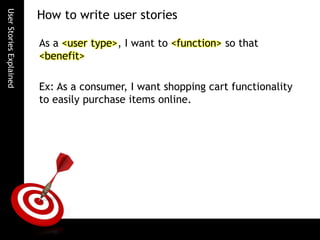
As a <user type>, I want to <function> so that <benefit>
UserStoriesExplained
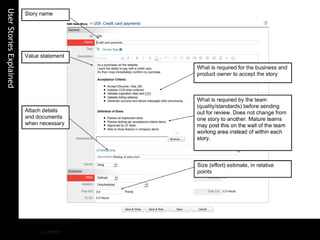
 The tests that confirm the story's satisfactory completion
What is a user story?
 The conversations that happen during backlog grooming
and iteration planning to solidify the details
 The brief description of the need
A user story represents a small piece of business value that a team
can deliver in an iteration. While traditional requirements (like
use cases) try to be as detailed as possible, a user story is defined
incrementally, in three stages:
UserStoriesExplained
SO……
User stories are not just small snippets of text. Each user story is
composed of three aspects:
 Written description of the story, used for planning
and as a reminder
 Conversations about the story that serve to flesh
out the details of the story
 Tests that convey and document details that can
be used to determine when a story is complete
UserStoriesExplained
Why use user stories?
 Keep yourself expressing business value
 Avoid introducing detail too early that would
prevent design options and inappropriately lock
developers into one solution
 Avoid the appearance of false completeness and
clarity
 Get to small enough chunks that invite negotiation
and movement in the backlog
 Leave the technical functions to the architect,
developers, testers, and …
UserStoriesExplained
As a <user type>, I want to <function> so that
<benefit>
Ex: As a consumer, I want shopping cart functionality
to easily purchase items online.
How to write user stories
UserStoriesExplained
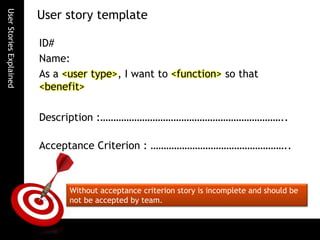
ID#
Name:
As a <user type>, I want to <function> so that
<benefit>
Description :……………………………………………………………..
Acceptance Criterion : ……………………………………………..
User story template
Without acceptance criterion story is incomplete and should be
not be accepted by team.
UserStoriesExplained
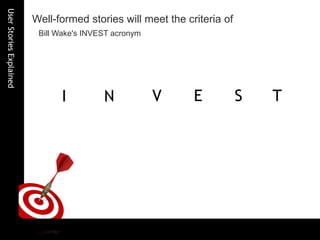
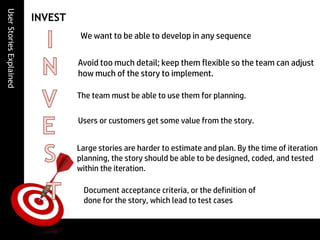
Well-formed stories will meet the criteria of
Bill Wake's INVEST acronym
I N V E S T
UserStoriesExplained
Users or customers get some value from the story.
INVEST
We want to be able to develop in any sequence
Avoid too much detail; keep them flexible so the team can adjust
how much of the story to implement.
Large stories are harder to estimate and plan. By the time of iteration
planning, the story should be able to be designed, coded, and tested
within the iteration.
Document acceptance criteria, or the definition of
done for the story, which lead to test cases
The team must be able to use them for planning.
UserStoriesExplained
 Too formal or too much detail
 Technical tasks masquerading as stories
 Skipping the conversation
 No acceptance criterion
AVOID
UserStoriesExplained
Example
Too broad
A team member can view iteration status.
Too detailed
•A team member can view a table of stories with rank, name, size,
package, owner, and status.
•A team member can click a red button to expand the table to include
detail, which lists all the tasks, with rank, name, estimate, owner,
status.
UserStoriesExplained
Example
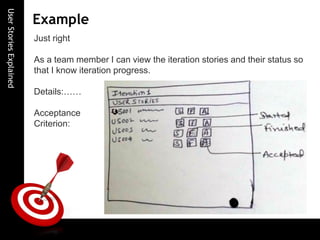
Just right
As a team member I can view the iteration stories and their status so
that I know iteration progress.
Details:……
Acceptance
Criterion:
UserStoriesExplained
Consumption / Usage
Final thoughts
Creation
Maintenance
User Stories Applied: For Agile Software Development by Mike Cohn
Not Use-Cases (more..)
UserStoriesExplained

User stories explained

  • 1.
    User Stories Agile requirementgathering By Shukla, Aditya PMP, PMI-ACP, CSM, CSPO, SPC, SCPM, SA As a <user type>, I want to <function> so that <benefit>
  • 2.
    UserStoriesExplained  The teststhat confirm the story's satisfactory completion What is a user story?  The conversations that happen during backlog grooming and iteration planning to solidify the details  The brief description of the need A user story represents a small piece of business value that a team can deliver in an iteration. While traditional requirements (like use cases) try to be as detailed as possible, a user story is defined incrementally, in three stages:
  • 3.
    UserStoriesExplained SO…… User stories arenot just small snippets of text. Each user story is composed of three aspects:  Written description of the story, used for planning and as a reminder  Conversations about the story that serve to flesh out the details of the story  Tests that convey and document details that can be used to determine when a story is complete
  • 4.
    UserStoriesExplained Why use userstories?  Keep yourself expressing business value  Avoid introducing detail too early that would prevent design options and inappropriately lock developers into one solution  Avoid the appearance of false completeness and clarity  Get to small enough chunks that invite negotiation and movement in the backlog  Leave the technical functions to the architect, developers, testers, and …
  • 5.
    UserStoriesExplained As a <usertype>, I want to <function> so that <benefit> Ex: As a consumer, I want shopping cart functionality to easily purchase items online. How to write user stories
  • 6.
    UserStoriesExplained ID# Name: As a <usertype>, I want to <function> so that <benefit> Description :…………………………………………………………….. Acceptance Criterion : …………………………………………….. User story template Without acceptance criterion story is incomplete and should be not be accepted by team.
  • 7.
  • 8.
    UserStoriesExplained Well-formed stories willmeet the criteria of Bill Wake's INVEST acronym I N V E S T
  • 9.
    UserStoriesExplained Users or customersget some value from the story. INVEST We want to be able to develop in any sequence Avoid too much detail; keep them flexible so the team can adjust how much of the story to implement. Large stories are harder to estimate and plan. By the time of iteration planning, the story should be able to be designed, coded, and tested within the iteration. Document acceptance criteria, or the definition of done for the story, which lead to test cases The team must be able to use them for planning.
  • 10.
    UserStoriesExplained  Too formalor too much detail  Technical tasks masquerading as stories  Skipping the conversation  No acceptance criterion AVOID
  • 11.
    UserStoriesExplained Example Too broad A teammember can view iteration status. Too detailed •A team member can view a table of stories with rank, name, size, package, owner, and status. •A team member can click a red button to expand the table to include detail, which lists all the tasks, with rank, name, estimate, owner, status.
  • 12.
    UserStoriesExplained Example Just right As ateam member I can view the iteration stories and their status so that I know iteration progress. Details:…… Acceptance Criterion:
  • 13.
    UserStoriesExplained Consumption / Usage Finalthoughts Creation Maintenance User Stories Applied: For Agile Software Development by Mike Cohn Not Use-Cases (more..)
  • 14.