25MARCH, 2017
GOVT. POST GRADUATE COLLEGE MANDIAN
COURSE TITLE: PROTIOMICS
TOPIC: USER MANUAL
ASSIGNMENT NO: 01
SUBMITTED TO: SIR RIZWAN
SUBMITTED BY: SOBAN HARIS
DATE OF SUBMISSION: 24 MARCH, 2017
25MARCH, 2017
➢ InterProscan
InterProScan is a sequence analysis application (nucleotide and protein sequences) that combines
different protein signature recognition methods into one resource. Signature database are vital
tools for identifying distant relationships in novel sequences and hence for inferring protein
function. InterPro is an integrated documentation resource for protein families, domains and
functional sites, which amalgamates the efforts of the PROSITE, Pfam and proDom database
projects. Each interpro entry includes a function description, annotation, literature, references
and links back to the relevant member databases. Release 2.0 of interPro (October 2000) contain
over 3000 entries, representing families, domains repeats and sites of post-translational
modification encoded by a total 6804 different regular expressions, profiles fingerprints and
Hidden Markov Models. Each interPro entry lists all the matches against SWISS-PROT and
TrEMBL (more than1 000 000 hits from 462 500 proteins in SWISS-PROT and TrEMBL).
➢ Steps to use Interproscan Database
Following are the steps that are useful for the beginners to use the database
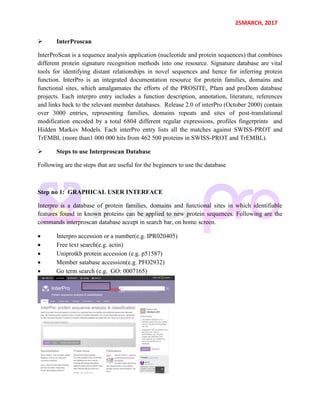
Step no 1: GRAPHICAL USER INTERFACE
Interpro is a database of protein families, domains and functional sites in which identifiable
features found in known proteins can be applied to new protein sequences. Following are the
commands interproscan database accept in search bar, on home screen.
• Interpro accession or a number(e.g. IPR020405)
• Free text search(e.g. actin)
• Uniprotkb protein accession (e.g. p51587)
• Member satabase accession(e.g. PFO2932)
• Go term search (e.g. GO: 0007165)
25MARCH, 2017
Step no 2: Put your query question against any protein in the search bar and click on the search
button.
.
Step no 3: we can also analyze our protein sequence by simply put our protein sequence in the
sequence search bar.
25MARCH, 2017
Step no 4: The results will be displayed after the search; here we completely analyze our
protein. We know about the length of the amino acids in the sequence including family of the
protein and conserved site as well. Including these we can download our results in different
formats like TSV, XML, FASTA, SVG, and GFF3.
Step no 5: Results also include residues which are present in our protein sequence
25MARCH, 2017
Step no 6: conserved sites include additional information related to that protein including
description it include proteins matches, domain architectures, species, structure as well as
literature.
Step no 7: By click on prosite link given on the right side in conserved search, we enter into the
additional information which include numerical results for uniprot/swiss-prot and contain
553’941 sequences. It also tells us about the taxonomic range and cross references e.g. clustal
format, color etc.
25MARCH, 2017
Step no 8: We can go through notes related to our protein these notes are updates and contain
information related to our protein such as protein active site, its conserved site as well as binding
site. It also contains member database information.
Step no 9: we can download and install the latest version of interproscan with complete
documentation from home screen. This database contains both 64 bit and 32bit of versions.
Additional information is also stored in this download path.
25MARCH, 2017
SUMMARY:
InterProscan is a database which integrates together predictive information about proteins'
function from a number of partner resources, giving an overview of the families that a protein
belongs to and the domains and sites it contains.
Users who have novel nucleotide or protein sequences that they wish to functionally characterize
can use the software package InterProScan to run the scanning algorithms from the InterProscan
database in an integrated way. Sequences are submitted in FASTA format, matches against all of
the required member database's signatures are calculated and the results are then output in a
variety of formats.
END NOTE:
I try my best to make this user manual easy for interproscan database. This is suitable for those
who did not use this database before. After complete study of this manual one can easily play the
interproscan database.

User manual

  • 1.
    25MARCH, 2017 GOVT. POSTGRADUATE COLLEGE MANDIAN COURSE TITLE: PROTIOMICS TOPIC: USER MANUAL ASSIGNMENT NO: 01 SUBMITTED TO: SIR RIZWAN SUBMITTED BY: SOBAN HARIS DATE OF SUBMISSION: 24 MARCH, 2017
  • 2.
    25MARCH, 2017 ➢ InterProscan InterProScanis a sequence analysis application (nucleotide and protein sequences) that combines different protein signature recognition methods into one resource. Signature database are vital tools for identifying distant relationships in novel sequences and hence for inferring protein function. InterPro is an integrated documentation resource for protein families, domains and functional sites, which amalgamates the efforts of the PROSITE, Pfam and proDom database projects. Each interpro entry includes a function description, annotation, literature, references and links back to the relevant member databases. Release 2.0 of interPro (October 2000) contain over 3000 entries, representing families, domains repeats and sites of post-translational modification encoded by a total 6804 different regular expressions, profiles fingerprints and Hidden Markov Models. Each interPro entry lists all the matches against SWISS-PROT and TrEMBL (more than1 000 000 hits from 462 500 proteins in SWISS-PROT and TrEMBL). ➢ Steps to use Interproscan Database Following are the steps that are useful for the beginners to use the database Step no 1: GRAPHICAL USER INTERFACE Interpro is a database of protein families, domains and functional sites in which identifiable features found in known proteins can be applied to new protein sequences. Following are the commands interproscan database accept in search bar, on home screen. • Interpro accession or a number(e.g. IPR020405) • Free text search(e.g. actin) • Uniprotkb protein accession (e.g. p51587) • Member satabase accession(e.g. PFO2932) • Go term search (e.g. GO: 0007165)
  • 3.
    25MARCH, 2017 Step no2: Put your query question against any protein in the search bar and click on the search button. . Step no 3: we can also analyze our protein sequence by simply put our protein sequence in the sequence search bar.
  • 4.
    25MARCH, 2017 Step no4: The results will be displayed after the search; here we completely analyze our protein. We know about the length of the amino acids in the sequence including family of the protein and conserved site as well. Including these we can download our results in different formats like TSV, XML, FASTA, SVG, and GFF3. Step no 5: Results also include residues which are present in our protein sequence
  • 5.
    25MARCH, 2017 Step no6: conserved sites include additional information related to that protein including description it include proteins matches, domain architectures, species, structure as well as literature. Step no 7: By click on prosite link given on the right side in conserved search, we enter into the additional information which include numerical results for uniprot/swiss-prot and contain 553’941 sequences. It also tells us about the taxonomic range and cross references e.g. clustal format, color etc.
  • 6.
    25MARCH, 2017 Step no8: We can go through notes related to our protein these notes are updates and contain information related to our protein such as protein active site, its conserved site as well as binding site. It also contains member database information. Step no 9: we can download and install the latest version of interproscan with complete documentation from home screen. This database contains both 64 bit and 32bit of versions. Additional information is also stored in this download path.
  • 7.
    25MARCH, 2017 SUMMARY: InterProscan isa database which integrates together predictive information about proteins' function from a number of partner resources, giving an overview of the families that a protein belongs to and the domains and sites it contains. Users who have novel nucleotide or protein sequences that they wish to functionally characterize can use the software package InterProScan to run the scanning algorithms from the InterProscan database in an integrated way. Sequences are submitted in FASTA format, matches against all of the required member database's signatures are calculated and the results are then output in a variety of formats. END NOTE: I try my best to make this user manual easy for interproscan database. This is suitable for those who did not use this database before. After complete study of this manual one can easily play the interproscan database.