Modeling User Interactions in
Online Social Networks
to solve real problems
Seokchan (Channy) Yun and Hong-Gee Kim
Biomedical Knowledge Engineering Laboratory
Seoul National University, Korea
Asian Workshop of
Social Web and Interoperability
ASWC 2009
Dec. 7th , Shanghai, China
Agenda
• Introduction
– Some approaches for Social Semantic Web
• Challenges
– Finding the definition of online friends and interaction
between users
• Survey of social interaction in real SNS
– Twitter and Me2day
• Result and Discussion
• Conclusion and Future plan
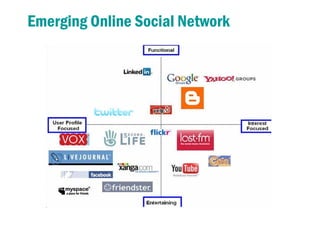
Emerging Online Social Network
• New opportunities for social science
– Explicit and implicit social network information
– Large scale and dynamic data sets
– Different modalities (profiles, email, IM, Twitter…)
• Challenges
– Friend on the Web = Friend in reality?
– Heterogeneity and quality of data
– Time and space complexity
– Ethical and legal challenges
– Complex interaction = Centrality in reality?
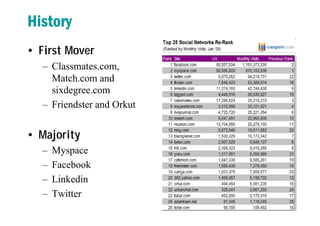
History
• First Mover
– Classmates.com,
Match.com and
sixdegree.com
– Friendster and Orkut
• Majority
– Myspace
– Facebook
– Linkedin
– Twitter
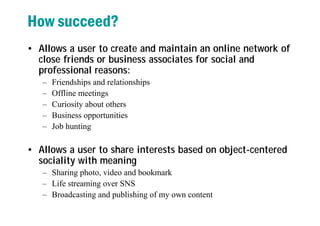
How succeed?
• Allows a user to create and maintain an online network of
close friends or business associates for social and
professional reasons:
– Friendships and relationships
– Offline meetings
– Curiosity about others
– Business opportunities
– Job hunting
• Allows a user to share interests based on object-centered
sociality with meaning
– Sharing photo, video and bookmark
– Life streaming over SNS
– Broadcasting and publishing of my own content
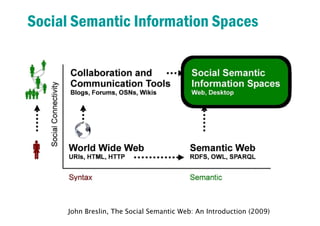
Social Semantic Information Spaces
John Breslin, The Social Semantic Web: An Introduction (2009)
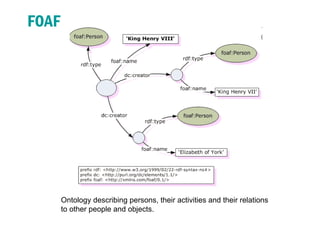
FOAF
Ontology describing persons, their activities and their relations
to other people and objects.
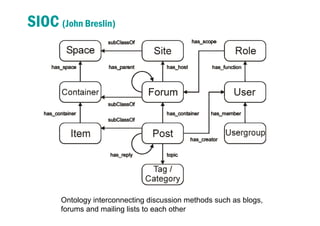
SIOC (John Breslin)
Ontology interconnecting discussion methods such as blogs,
forums and mailing lists to each other
10
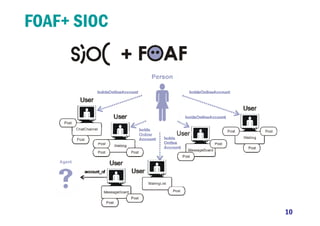
FOAF+ SIOC
11
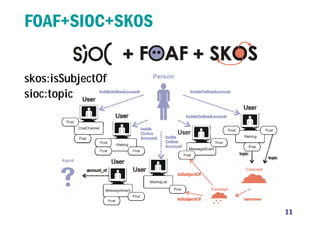
FOAF+SIOC+SKOS
skos:isSubjectOf
sioc:topic
Tripartite Social Ontology (Peter Mica)
• A graph model of ontologies based on tripartite
graphs of actors, concepts and instances
– Actors: users
– Concepts: tags
– Instances: objects
• Emergent semantics
– General idea: observe semantics in the way agents interact
(use concepts)
• Bottom-up ontologies
• Semantics = syntax + statistics
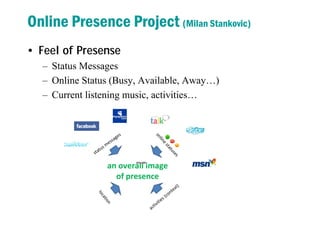
Online Presence Project (Milan Stankovic)
• Feel of Presense
– Status Messages
– Online Status (Busy, Available, Away…)
– Current listening music, activities…
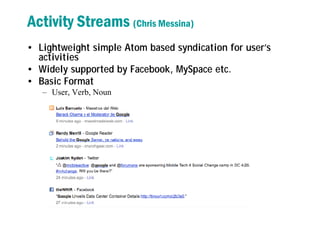
Activity Streams (Chris Messina)
• Lightweight simple Atom based syndication for user’s
activities
• Widely supported by Facebook, MySpace etc.
• Basic Format
– User, Verb, Noun
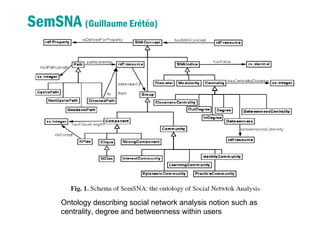
SemSNA (Guillaume Erétéo)
Ontology describing social network analysis notion such as
centrality, degree and betweenness within users
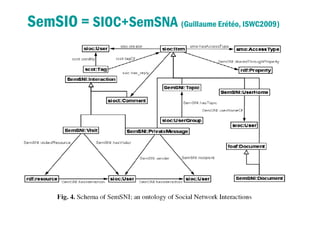
SemSIO = SIOC+SemSNA (Guillaume Erétéo, ISWC2009)
Limitations
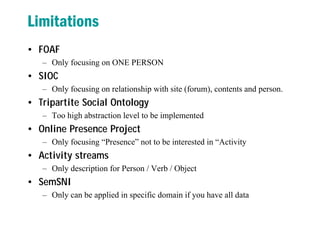
• FOAF
– Only focusing on ONE PERSON
• SIOC
– Only focusing on relationship with site (forum), contents and person.
• Tripartite Social Ontology
– Too high abstraction level to be implemented
• Online Presence Project
– Only focusing “Presence” not to be interested in “Activity
• Activity streams
– Only description for Person / Verb / Object
• SemSNI
– Only can be applied in specific domain if you have all data
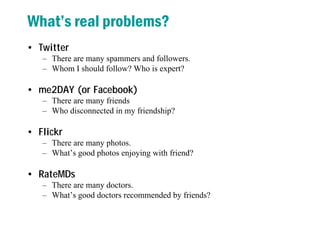
What’s real problems?
• Twitter
– There are many spammers and followers.
– Whom I should follow? Who is expert?
• me2DAY (or Facebook)
– There are many friends
– Who disconnected in my friendship?
• Flickr
– There are many photos.
– What’s good photos enjoying with friend?
• RateMDs
– There are many doctors.
– What’s good doctors recommended by friends?
Remained Question in real world?
If you’re not Twitter, you cannot do anything.
How about semantically dealing with real social web?
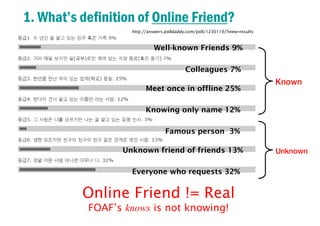
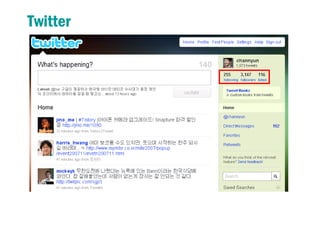
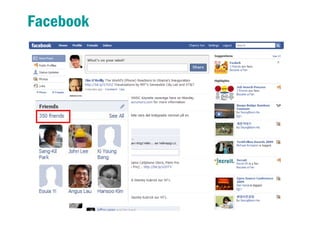
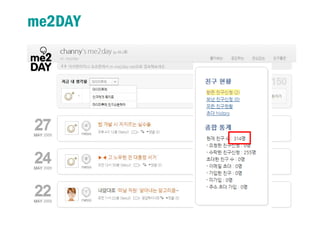
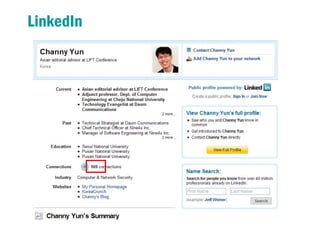
1. What’s definition of Online Friend?
Online Friend != Real
FOAF’s knows is not knowing!
Well-known Friends 9%
Colleagues 7%
Meet once in offline 25%
Knowing only name 12%
Famous person 3%
Unknown friend of friends 13%
Everyone who requests 32%
Known
Unknown
http://answers.polldaddy.com/poll/1230119/?view=results
Twitter
Facebook
me2DAY
LinkedIn
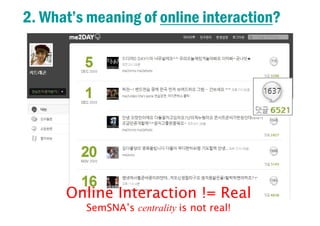
2. What’s meaning of online interaction?
Online Interaction != Real
SemSNA’s centrality is not real!
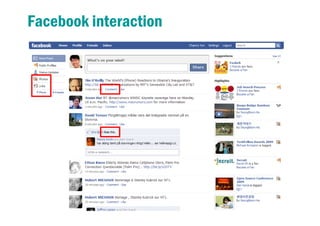
Facebook interaction
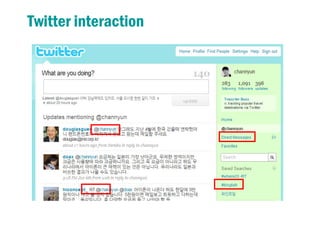
Twitter interaction
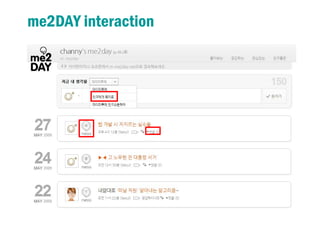
me2DAY interaction
Challenges
• Online friends and interaction are not real
because there are no limits of time and space.
• It’s hard to find degree of user relationship.
– Coupling-decoupling between users (high vs. weak) by
time change
• We have to consider the difference of each online
interaction to measure proper centrality and
betweenness.
Approach
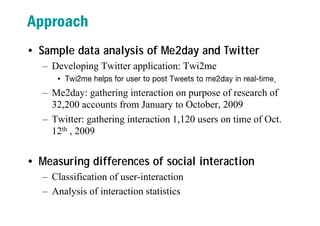
• Sample data analysis of Me2day and Twitter
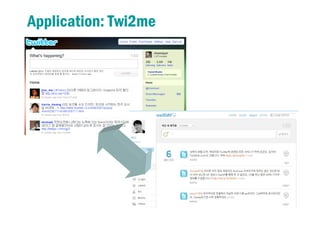
– Developing Twitter application: Twi2me
• Twi2me helps for user to post Tweets to me2day in real-time.
– Me2day: gathering interaction on purpose of research of
32,200 accounts from January to October, 2009
– Twitter: gathering interaction 1,120 users on time of Oct.
12th , 2009
• Measuring differences of social interaction
– Classification of user-interaction
– Analysis of interaction statistics
Application: Twi2me
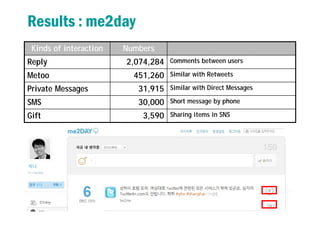
Results : me2day
NumbersKinds of interaction
Sharing items in SNS3,590Gift
Short message by phone30,000SMS
Similar with Direct Messages31,915Private Messages
Similar with Retweets451,260Metoo
Comments between users2,074,284Reply
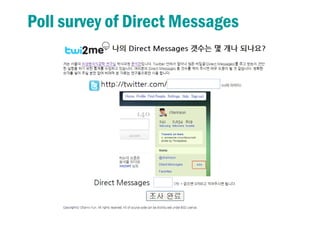
Poll survey of Direct Messages
Result: Twitter
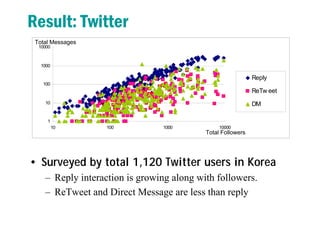
• Surveyed by total 1,120 Twitter users in Korea
– Reply interaction is growing along with followers.
– ReTweet and Direct Message are less than reply
1
10
100
1000
10000
10 100 1000 10000
Reply
ReTw eet
DM
Total Messages
Total Followers
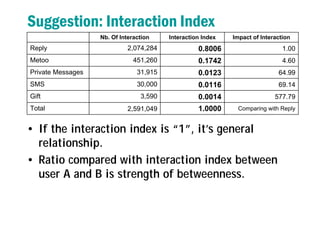
Suggestion: Interaction Index
• If the interaction index is “1”, it’s general
relationship.
• Ratio compared with interaction index between
user A and B is strength of betweenness.
Comparing with Reply1.00002,591,049Total
577.790.00143,590Gift
69.140.011630,000SMS
64.990.012331,915Private Messages
4.600.1742451,260Metoo
1.000.80062,074,284Reply
Impact of InteractionInteraction IndexNb. Of Interaction
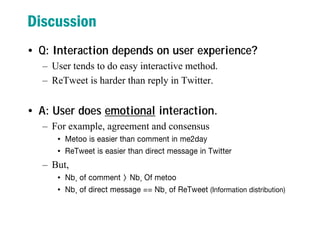
Discussion
• Q: Interaction depends on user experience?
– User tends to do easy interactive method.
– ReTweet is harder than reply in Twitter.
• A: User does emotional interaction.
– For example, agreement and consensus
• Metoo is easier than comment in me2day
• ReTweet is easier than direct message in Twitter
– But,
• Nb. of comment > Nb. Of metoo
• Nb. of direct message == Nb. of ReTweet (Information distribution)
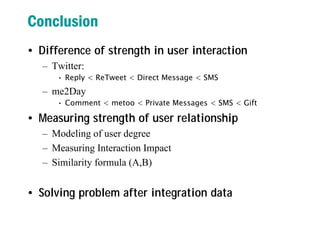
Conclusion
• Difference of strength in user interaction
– Twitter:
• Reply < ReTweet < Direct Message < SMS
– me2Day
• Comment < metoo < Private Messages < SMS < Gift
• Measuring strength of user relationship
– Modeling of user degree
– Measuring Interaction Impact
– Similarity formula (A,B)
• Solving problem after integration data
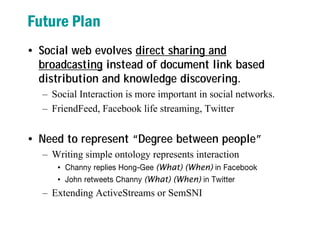
Future Plan
• Social web evolves direct sharing and
broadcasting instead of document link based
distribution and knowledge discovering.
– Social Interaction is more important in social networks.
– FriendFeed, Facebook life streaming, Twitter
• Need to represent “Degree between people”
– Writing simple ontology represents interaction
• Channy replies Hong-Gee (What) (When) in Facebook
• John retweets Channy (What) (When) in Twitter
– Extending ActiveStreams or SemSNI
• Who disconnected in my friendship on me2DAY?
– Gathering me2day activities
– Measuring interaction factor and coupling degree
• Distance = # of interaction/ time interval
• Priority = normalized value for each interactions
– Evaluation with user’s reaction for alert
• “Why don’t you contact this person because it’s long time not to contact
by you?”
• Whom I should follow? Who is expert in Twitter?
– Gathering twitter activities
– Measuring interaction factor and coupling-degree
– Evaluation with user’s reaction for recommendation
Q&A
channy@snu.ac.kr
http://www.creation.net
Twitter: @channyun

User interaction-social media-100102032820-phpapp01

  • 1.
    Modeling User Interactionsin Online Social Networks to solve real problems Seokchan (Channy) Yun and Hong-Gee Kim Biomedical Knowledge Engineering Laboratory Seoul National University, Korea Asian Workshop of Social Web and Interoperability ASWC 2009 Dec. 7th , Shanghai, China
  • 2.
    Agenda • Introduction – Someapproaches for Social Semantic Web • Challenges – Finding the definition of online friends and interaction between users • Survey of social interaction in real SNS – Twitter and Me2day • Result and Discussion • Conclusion and Future plan
  • 3.
  • 4.
    • New opportunitiesfor social science – Explicit and implicit social network information – Large scale and dynamic data sets – Different modalities (profiles, email, IM, Twitter…) • Challenges – Friend on the Web = Friend in reality? – Heterogeneity and quality of data – Time and space complexity – Ethical and legal challenges – Complex interaction = Centrality in reality?
  • 5.
    History • First Mover –Classmates.com, Match.com and sixdegree.com – Friendster and Orkut • Majority – Myspace – Facebook – Linkedin – Twitter
  • 6.
    How succeed? • Allowsa user to create and maintain an online network of close friends or business associates for social and professional reasons: – Friendships and relationships – Offline meetings – Curiosity about others – Business opportunities – Job hunting • Allows a user to share interests based on object-centered sociality with meaning – Sharing photo, video and bookmark – Life streaming over SNS – Broadcasting and publishing of my own content
  • 7.
    Social Semantic InformationSpaces John Breslin, The Social Semantic Web: An Introduction (2009)
  • 8.
    FOAF Ontology describing persons,their activities and their relations to other people and objects.
  • 9.
    SIOC (John Breslin) Ontologyinterconnecting discussion methods such as blogs, forums and mailing lists to each other
  • 10.
  • 11.
  • 12.
    Tripartite Social Ontology(Peter Mica) • A graph model of ontologies based on tripartite graphs of actors, concepts and instances – Actors: users – Concepts: tags – Instances: objects • Emergent semantics – General idea: observe semantics in the way agents interact (use concepts) • Bottom-up ontologies • Semantics = syntax + statistics
  • 13.
    Online Presence Project(Milan Stankovic) • Feel of Presense – Status Messages – Online Status (Busy, Available, Away…) – Current listening music, activities…
  • 14.
    Activity Streams (ChrisMessina) • Lightweight simple Atom based syndication for user’s activities • Widely supported by Facebook, MySpace etc. • Basic Format – User, Verb, Noun
  • 15.
    SemSNA (Guillaume Erétéo) Ontologydescribing social network analysis notion such as centrality, degree and betweenness within users
  • 16.
    SemSIO = SIOC+SemSNA(Guillaume Erétéo, ISWC2009)
  • 17.
    Limitations • FOAF – Onlyfocusing on ONE PERSON • SIOC – Only focusing on relationship with site (forum), contents and person. • Tripartite Social Ontology – Too high abstraction level to be implemented • Online Presence Project – Only focusing “Presence” not to be interested in “Activity • Activity streams – Only description for Person / Verb / Object • SemSNI – Only can be applied in specific domain if you have all data
  • 18.
    What’s real problems? •Twitter – There are many spammers and followers. – Whom I should follow? Who is expert? • me2DAY (or Facebook) – There are many friends – Who disconnected in my friendship? • Flickr – There are many photos. – What’s good photos enjoying with friend? • RateMDs – There are many doctors. – What’s good doctors recommended by friends?
  • 19.
    Remained Question inreal world? If you’re not Twitter, you cannot do anything. How about semantically dealing with real social web?
  • 20.
    1. What’s definitionof Online Friend? Online Friend != Real FOAF’s knows is not knowing! Well-known Friends 9% Colleagues 7% Meet once in offline 25% Knowing only name 12% Famous person 3% Unknown friend of friends 13% Everyone who requests 32% Known Unknown http://answers.polldaddy.com/poll/1230119/?view=results
  • 21.
  • 22.
  • 23.
  • 24.
  • 25.
    2. What’s meaningof online interaction? Online Interaction != Real SemSNA’s centrality is not real!
  • 26.
  • 27.
  • 28.
  • 29.
    Challenges • Online friendsand interaction are not real because there are no limits of time and space. • It’s hard to find degree of user relationship. – Coupling-decoupling between users (high vs. weak) by time change • We have to consider the difference of each online interaction to measure proper centrality and betweenness.
  • 30.
    Approach • Sample dataanalysis of Me2day and Twitter – Developing Twitter application: Twi2me • Twi2me helps for user to post Tweets to me2day in real-time. – Me2day: gathering interaction on purpose of research of 32,200 accounts from January to October, 2009 – Twitter: gathering interaction 1,120 users on time of Oct. 12th , 2009 • Measuring differences of social interaction – Classification of user-interaction – Analysis of interaction statistics
  • 31.
  • 32.
    Results : me2day NumbersKindsof interaction Sharing items in SNS3,590Gift Short message by phone30,000SMS Similar with Direct Messages31,915Private Messages Similar with Retweets451,260Metoo Comments between users2,074,284Reply
  • 33.
    Poll survey ofDirect Messages
  • 34.
    Result: Twitter • Surveyedby total 1,120 Twitter users in Korea – Reply interaction is growing along with followers. – ReTweet and Direct Message are less than reply 1 10 100 1000 10000 10 100 1000 10000 Reply ReTw eet DM Total Messages Total Followers
  • 35.
    Suggestion: Interaction Index •If the interaction index is “1”, it’s general relationship. • Ratio compared with interaction index between user A and B is strength of betweenness. Comparing with Reply1.00002,591,049Total 577.790.00143,590Gift 69.140.011630,000SMS 64.990.012331,915Private Messages 4.600.1742451,260Metoo 1.000.80062,074,284Reply Impact of InteractionInteraction IndexNb. Of Interaction
  • 36.
    Discussion • Q: Interactiondepends on user experience? – User tends to do easy interactive method. – ReTweet is harder than reply in Twitter. • A: User does emotional interaction. – For example, agreement and consensus • Metoo is easier than comment in me2day • ReTweet is easier than direct message in Twitter – But, • Nb. of comment > Nb. Of metoo • Nb. of direct message == Nb. of ReTweet (Information distribution)
  • 37.
    Conclusion • Difference ofstrength in user interaction – Twitter: • Reply < ReTweet < Direct Message < SMS – me2Day • Comment < metoo < Private Messages < SMS < Gift • Measuring strength of user relationship – Modeling of user degree – Measuring Interaction Impact – Similarity formula (A,B) • Solving problem after integration data
  • 38.
    Future Plan • Socialweb evolves direct sharing and broadcasting instead of document link based distribution and knowledge discovering. – Social Interaction is more important in social networks. – FriendFeed, Facebook life streaming, Twitter • Need to represent “Degree between people” – Writing simple ontology represents interaction • Channy replies Hong-Gee (What) (When) in Facebook • John retweets Channy (What) (When) in Twitter – Extending ActiveStreams or SemSNI
  • 39.
    • Who disconnectedin my friendship on me2DAY? – Gathering me2day activities – Measuring interaction factor and coupling degree • Distance = # of interaction/ time interval • Priority = normalized value for each interactions – Evaluation with user’s reaction for alert • “Why don’t you contact this person because it’s long time not to contact by you?” • Whom I should follow? Who is expert in Twitter? – Gathering twitter activities – Measuring interaction factor and coupling-degree – Evaluation with user’s reaction for recommendation
  • 40.