Useful Definitions
A Fortiori Analysis
In decision theory, an analysis
made to intentionally favour
alternative solutions when
compared to the solution
adjudged as best. The
alternative is deliberately
weighted to make them look
better. If the adjudged-best
solution still remains the best,
its position as the likely
choice is further
strengthened. „A Fortiori‟ is
Latin for, „even more so‟ or
„more conclusively‟.
Knowledge
1. The state or fact of knowing.
2. Familiarity, awareness, or
understanding gained
through experience or
study.
3. The sum or range of what has
been perceived, discovered, or
learned.
4. Learning; erudition: teachers
of great knowledge.
5. Specific information about
something.
6. Carnal knowledge.
Leadership
Has been described as “a process
of influence in which one person
can enlist the aid and support of
others in the accomplishment of a
common task”. Other in-depth
definitions of leadership have also
emerged.
Leadership is "organizing a group of
people to achieve a common goal".
The leader may or may not have
any formal authority. Studies of
leadership have produced theories
involving traits, situational
interaction, function, behaviour,
power, vision and
values, charisma, and intelligence,
among others. Somebody whom
people follow: somebody who
guides or directs others.
Transformational leadership
Enhances the motivation, morale,
and performance of followers
through a variety of
mechanisms. These include
connecting the follower's sense
of identity and self to the
project and the collective
identity of the organization;
being a role model for followers
that inspires them and makes
them interested; challenging
followers to take greater
ownership for their work, and
understanding the strengths
and weaknesses of followers, so
the leader can align followers
with tasks that enhance their
performance.
Global Leadership
 Is the interdisciplinary study of the key
elements that future leaders in all
realms of the personal
experience should acquire to effectively
familiarize themselves with
the psychological,
physiological, geographical, geopolitical
, anthropological and sociological
effects of globalization.
Global leadership occurs when an
individual or individuals navigate
collaborative efforts of different
stakeholders through environmental co
mplexity towards a vision by leveraging
a global mindset. As a result of trends,
starting with
colonialism and perpetuated by the
increase in mass media, innovation, a
host of meaningful new concerns
face mankind; consisting of but not
limited to: human
enterprises toward peace, international
business design, and significant shifts
in geopolitical paradigms.
A goal
 Is a desired result a person or
a system envisions, plans and
commits to achieve a personal
or organizational desired end-
point in some sort of assumed
development. Many people
endeavour to reach goals within
a finite time by
setting deadlines.
It is roughly similar to purpose or
aim, the anticipated result
which guides reaction, or
an end, which is an object,
either a physical object or
an abstract object, that
has intrinsic value.
Value
Denotes something's degree of
importance, with the aim of
determining what action or life
is best to do or live
(Deontology), or at least
attempt to describe the value of
different actions (Axiology). It
may be described as treating
actions themselves as abstract
objects, putting value to them.
It deals with right conduct and
good life, in the sense that a
highly, or at least relatively
highly, valuable action may be
regarded as ethically "good"
(adjective sense), and an action
of low, or at least relatively low,
value may be regarded as
"bad".
Mindset
In decision theory and general
systems theory, a mindset is
a set of assumptions, methods,
or notations held by one or
more people or groups of
people that is so established
that it creates a powerful
incentive within these people or
groups to continue to adopt or
accept prior behaviours,
choices, or tools. This
phenomenon is also sometimes
described as mental inertia,
"groupthink", or a "paradigm",
and it is often difficult to
counteract its effects upon
analysis and decision making
processes.
Culture
 Is a modern concept based on a term
first used in classical antiquity by the
Roman orator, Cicero: "cultura animi".
The term "culture "appeared first in its
current sense in Europe in the 18th and
19th centuries, to connote a process of
cultivation or improvement, as in
agriculture or horticulture. In the 19th
century, the term developed to refer
first to the betterment or refinement of
the individual, especially
through education, and then to the
fulfilment of national aspirations or
ideals. In the mid-19th century, some
scientists used the term "culture" to
refer to a universal human capacity.
For the German non positivist
sociologist Georg Simmer, culture
referred to "the cultivation of
individuals through the agency of
external forms which have been
objectified in the course of history".
Communication
 From Latin "communis",
meaning to share) is the activity of
conveying information through the
exchange of thoughts, messages, or
information, as by speech, visuals,
signals, writing, or behaviour. It is
the meaningful exchange of
information between two and a
group of person.
One definition of communication is
“any act by which one person gives
to or receives from person
information about that person's
needs, desires, perceptions,
knowledge, or affective states.
Communication may be intentional
or unintentional, may involve
conventional or unconventional
signals, may take linguistic or non-
linguistic forms, and may occur
through spoken or other modes
Absorption Costing
 A method of costing a product
in which all fixed and variable
costs are apportioned to cost
centres where they are
accounted for using absorption
rates. This method ensures that
all incurred costs are recovered
from the selling price of a good
or service. Also called full
absorption costing. See also
costing, marginal.
Account
1. Accounting: Chronological record of
changes in the value of an entity's assets,
liabilities, and the owners' equity; each of
which is represented by a separate page in
the ledger. See also accounting equation
and accounts.
2. Banking: Continuing financial relationship
between a bank and a customer, in which
deposits and debts are held and processed
within a framework of established rules
and procedures.
3. Commerce: On-going contractual
relationship between a buyer and seller
whereby payment for goods received is
made at a later time (usually 30 days). See
also charge account and open account.
4. Law: Obligation of each party to a contract
or partnership to account to other(s) for
amounts received or due.
5. Services: Client of an advertising,
brokerage, consulting, marketing, or
public relations firm.
Accounting Bases
 Assumptions, methods,
and procedures that
constitute accounting
policies of a firm.
Account Reconcilement
 Comparing an account statement
(or bank statement) with one's
own accounting records, to detect
any discrepancies that may
indicate leakage of cash, slack
accounting controls, or an error.
Account Payee Only
 Words added to the
crossing on a check to
ensure that check is paid
only into the account of
the entity to whom the
check is made out. This
step makes a check a
non-negotiable
instrument, and provides
protection against its
fraudulent conversion.
The words 'not
negotiable' have the
same effect.
Accounting Fraud
 The intentional misrepresentation
or alteration of accounting records
regarding sales, revenues, expenses
and other factors for a profit
motive such as inflating company
stock values, obtaining more
favourable financing or avoiding
debt obligations. Employees who
commit accounting fraud at the
request of their employers are
subject to personal criminal
prosecution.
Accounting System
 Organized set of manual and
computerized accounting methods,
procedures, and controls established to
gather, record, classify, analyze,
summarize, interpret, and present
accurate and timely financial data for
management decisions.
Accounting Policies
 Principles, rules and procedures
selected, and consistently followed, by
the management of an organization
(the accounting entity) in preparing
and reporting the financial statements.
Accounting policies deal specifically
with matters such as consolidation of
accounts, depreciation methods,
goodwill, inventory pricing, and
research and development costs.
Accounting policies must be disclosed
in the annual financial statements. See
also summary of significant accounting
policies.
Accounting Principles
Board
 Board of the American
Institute of Certified
Public Accountants
(AICPA), the original
publisher of GAAP.
Replaced by Financial
Accounting Standards
Board In 1973.
Activity Based Costing (ABC)
 Cost accounting approach concerned
with matching costs with activities
(called cost drivers) that cause those
costs. It is a more sophisticated kind of
absorption-costing and replaces labour
based costing system. ABC states that
(1) products consume activities, (2) it is
the activities (and not the products)
that consume resources, (3) activities
are the cost drivers, and (4) that
activities are not necessarily based on
the volume of production. Instead of
allocating costs to cost centres (such as
manufacturing, marketing, finance),
ABC allocates direct and indirect costs
to activities such as processing an
order, attending to a customer
complaint, or setting up a machine. A
subset of activity based management
(ABM), it enables management to
better understand (a) how and where
the firm makes a profit, (b) indicates
where money is being spent and (c)
which areas have the greatest potential
for cost reduction. Developed by
professors Robert Kaplan and Robin
Cooper of Harvard University in late
1980's.
Accounts Payable (A/P)
 Unpaid bills. Accounts that
are owed to suppliers (trade
creditors) as distinguished
from accrued interest, rent,
salaries, taxes, and other such
accounts. Accounts payable
are shown under current
(short-term) liabilities in the
balance sheet. Lenders and
investors examine the
relationship of these accounts
to the firm‟s purchases in
order to judge the soundness
of its day to day financial
management.
Accounts Receivable (A/R)
 Sales made but not paid-for
by the customers (trade
debtors). Accounts receivables
are shown as current (short-
term) assets in a balance
sheet and are, in fact,
unsecured promises by
customers to pay in the
future. These sums are a key
factor in determining a firm's
liquidity and may be
discounted used in raising a
short-term bank loan, or sold
to a factor. A provision is
usually made in the accounts
of a firm to offset
uncollectible accounts
receivable (bad debts) as
losses.
Accounts Payable (A/P)
to Sales Ratio
 Relationship between
unpaid suppliers' bills and
the sales revenue in an
accounting period. It is
considered high if it
approaches 1.0 and, in
some industries, may be a
sign that the firm is having
liquidity problems.
Formula: Total accounts
payable ÷ Sales revenue.
Accounts Receivable
(A/R) Turnover
 Ratio that shows the
relationship between
unpaid credit sales to total
credit sales. It indicates, in
general, the effectiveness
(or lack of it) of a firm's
credit policies and cash
collection efforts. Formula:
Outstanding accounts
receivable (in an
accounting period) ÷ credit
sales revenue (in the same
period). Also called
receivable turnover.
Accounts Receivable
(A/R) to Sales Ratio
 Shows the relationship
between unpaid sales and
the total sales revenue. It is
considered high if it is near
to 1.0, because that means
a significant amount of
cash is tied up with the
slow paying customers.
Formula: Total accounts
receivable (outstanding in
an accounting period) ÷
sales revenue (in the same
period).
Accounts Receivable
(A/R) Turnover
 Ratio that shows the
relationship between
unpaid credit sales to total
credit sales. It indicates, in
general, the effectiveness
(or lack of it) of a firm's
credit policies and cash
collection efforts. Formula:
Outstanding accounts
receivable (in an
accounting period) ÷ credit
sales revenue (in the same
period). Also called
receivable turnover.
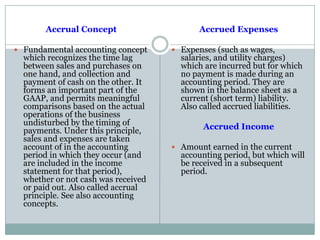
Accrual Concept
 Fundamental accounting concept
which recognizes the time lag
between sales and purchases on
one hand, and collection and
payment of cash on the other. It
forms an important part of the
GAAP, and permits meaningful
comparisons based on the actual
operations of the business
undisturbed by the timing of
payments. Under this principle,
sales and expenses are taken
account of in the accounting
period in which they occur (and
are included in the income
statement for that period),
whether or not cash was received
or paid out. Also called accrual
principle. See also accounting
concepts.
Accrued Expenses
 Expenses (such as wages,
salaries, and utility charges)
which are incurred but for which
no payment is made during an
accounting period. They are
shown in the balance sheet as a
current (short term) liability.
Also called accrued liabilities.
Accrued Income
 Amount earned in the current
accounting period, but which will
be received in a subsequent
period.
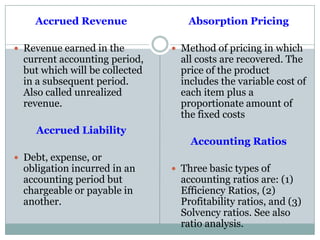
Accrued Revenue
 Revenue earned in the
current accounting period,
but which will be collected
in a subsequent period.
Also called unrealized
revenue.
Accrued Liability
 Debt, expense, or
obligation incurred in an
accounting period but
chargeable or payable in
another.
Absorption Pricing
 Method of pricing in which
all costs are recovered. The
price of the product
includes the variable cost of
each item plus a
proportionate amount of
the fixed costs
Accounting Ratios
 Three basic types of
accounting ratios are: (1)
Efficiency Ratios, (2)
Profitability ratios, and (3)
Solvency ratios. See also
ratio analysis.
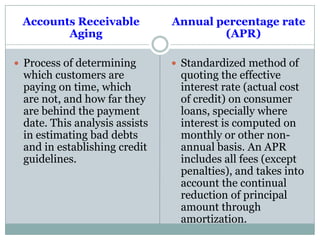
Accounts Receivable
Aging
 Process of determining
which customers are
paying on time, which
are not, and how far they
are behind the payment
date. This analysis assists
in estimating bad debts
and in establishing credit
guidelines.
Annual percentage rate
(APR)
 Standardized method of
quoting the effective
interest rate (actual cost
of credit) on consumer
loans, specially where
interest is computed on
monthly or other non-
annual basis. An APR
includes all fees (except
penalties), and takes into
account the continual
reduction of principal
amount through
amortization.
Activity Based
Budgeting (ABB)
 Resource allocation
based on relationship
between activities and
costs, and which
provides greater detail
on overheads than the
normal financial
budgeting. See also
activity based costing.
Ad Valorem
 Method for charging a
duty, fee, or tax
according to the value of
goods and services,
instead of by a fixed rate,
or by weight or quantity.
Latin for, [according] to
the value.
Annual Percentage Yield
(APY)
 Standardized method for
quoting compounded
interest earned on a
deposit account or
investment. In computing
APY, it is assumed the
funds will remain on fixed
deposit or invested for a
full 365-day period.
Annual Report
 Presentation of a firm's
audited accounts for the
preceding year, as required
in corporate legislation. In
addition to the auditor's
report, an annual report
commonly includes (1)
management's review of
the operations of the firm
and its future prospects, (2)
balance sheet, (3) income
statement (profit and loss
account), (4) cash flow
statement, and other
supporting documents.
Also called annual
accounts.
Appraisal
1. Impartial analysis and evaluation
conducted according to established
criteria to determine the
acceptability, merit, or worth of an
item.
2. Evaluation by a qualified appraiser
to (1) assess the current market
value of a property, (2) estimate
the extent of damage to an insured
property and cost of repairs, or (3)
determine if a total loss occurred.
A written appraisal is usually a key
requirement when a property is
bought, sold, insured, or
mortgaged. It is required also
when a claim is filed for
compensation for damage or
destruction of the insured
property. See also appraisal value.
3. Alternative term for valuation.
Asset Value per Share
 Net value of the total assets of a
firm divided by the number of
issued (outstanding) common
stock or ordinary shares of the
firm. It is a theoretical indicator of
the portion of assets attributable to
each share in case the firm is
liquidated. Formula: Total net
asset value ÷ Number of
outstanding shares.
Asset valuation
 Determination of the
value of capital assets or
fixed assets, they value at
which they should be
shown in their owner's
balance sheet.
Balanced Budget
 Government budget where the
current expenditure equals
current revenue. Most
government budgets are
unbalanced almost always on
the expense side, purportedly
to spur growth and reduce
unemployment by creating
demand with additional money
supply.
Balance Sheet
 A condensed statement that shows the
financial position of an entity on a specified
date (usually the last day of an accounting
period).
 Among other items of information, a balance
sheet states (1) what assets the entity owns,
(2) how it paid for them, (3) what it owes (its
liabilities), and (4) what is the amount left
after satisfying the liabilities. Balance sheet
data is based on a fundamental accounting
equation (assets = liabilities + owners'
equity), and is classified under subheadings
such as current assets, fixed assets, current
liabilities, Long-term Liabilities. With
income statement and cash flow statement, it
comprises the set of documents
indispensable in running a business. An
audited balance sheet is often demanded by
investors, lenders, suppliers, and taxation
authorities; and is usually required by law. To
be considered valid, a balance sheet must
give a true and fair view of an organization's
state of affairs, and must follow the
provisions of GAAP in its preparation. Also
called statement of condition, statement of
financial condition, or statement of financial
position.
Bank Reconciliation
 Analysis and adjustment
of differences between
the cash balance shown
on a bank statement, and
the amount shown in the
account holder's records.
This matching process
involves making
allowances for checks
issued but not yet
presented, and for checks
deposited but not yet
cleared or credited. And,
if discrepancies persist,
finding the cause and
bringing the records into
agreement.
Basic Earnings per
Share (EPS)
 A measure of a
company's performance
calculated by dividing its
net earnings by its total
number of outstanding
shares. Also referred to
as simply Earnings Per
Share or EPS. Compare
to diluted earnings per
share; EBITDA.
Basic Earnings Power
 Ratio that indicates basic
profitability of assets and is
useful in comparing firms
with different degree of
leverage. Formula: Earnings
Before interest and tax ÷
Total assets.
Basic Financial Statements
 Accounting reports compiled
in conformity with the
provisions of GAAP, and
necessary for the fair
evaluation of operations of an
entity. For businesses, the
balance sheet, income
statement (profit and loss
account), and the cash-flow
statement make up the set of
basic financial
Basis of Accounting
 Method used to determine
when revenues and expenses
(with associated assets and
liabilities) are recognized in
the accounts of a firm, and
reported in its financial
statements. In accrual basis
accounting, for example,
revenues are recognized when
earned and expenses are
recognized when incurred,
whether or not any cash is
received or paid. In cash basis
accounting, however,
revenues and expenses are
recognized only when cash is
received or paid, irrespective
of the timing of actual sales or
purchases.
Amortization
 1. Accounting: Preferred term for the
apportionment (charging or writing off)
of the cost of an intangible asset as an
operational cost over the asset's
estimated useful life. It is identical to
depreciation, the preferred term for
tangible assets. The purpose of both
terms is to (1) reflect reduction in the
book value of the asset due to usage
and/or obsolescence, (2) spread a large
expenditure proportionately over a
fixed period, and thereby (3) reduce the
taxable income (not the actual or cash
income) of a firm. In effect, it is a
process by which invested capital of a
firm is recovered by gradual sale of the
firm's asset(s) to its customers over the
years.
 2. Banking: Gradual repayment of a
loan in equal (or nearly equal)
instalments which include portions of
interest and principal amounts. See
also level payment amortization.
Analysis of Alternatives (AOA)
 Evaluation of different choices
available for achieving an objective,
usually requiring cost-benefit analysis,
life cycle costing, and sensitivity
analysis. Also called alternative
analysis.
Analysis of Variances (ANOVA)
 1. General: Statistical technique for
determining the degree of difference or
similarity between two or more groups
of data. It is based on the comparison
of the average value of a common
component.
 2. Accounting: Investigation of causes
of difference between actual costs and
estimated or standard costs.
 3. Quality control: Methodology
employed in determining if the
variance between the mean in different
sets of observations is greater than
what may be attributable to chance.
Annual audit
 An annual review of the
financial records of an
organization, such as a
business, a non-profit
group, or a government
agency. The audit may
check the accuracy of
records, compliance with
accounting methods, and
the soundness of
financial practices,
including internal
control
Annual Basis
 Mathematical technique
employed in converting
figures for a period of
less-than or more-than
one year to a twelve-
month period.
Annual Budget
 A budget that is prepared
to coincide with a
calendar or fiscal year.
Balance sheet ratios
 Comparisons of balance
sheet items to gain
insight into the (1)
changes in the financial
position, (2)
strength/weakness of the
financial position, and
(3) relationship between
different items. Two
basic balance sheet ratios
are the debt ratio (total
debt ÷ total assets) and
debt to equity ratio (total
debt ÷ total equity).
Budgeted cost of work
performed (BCWP)
 In construction industry,
total of the budgeted
costs of the activities
(that make up a job or
project) completed to-
date, or on any given
date. Also called
achieved cost or earned
value. See also actual
cost of work performed.
Budgeted Cost of Work
Scheduled (BCWS)
In construction industry, sum of
the budgeted costs for all
planned work scheduled to be
completed to-date, or on any
given date.
Budgeting
 Process of expressing
quantified resource
requirements (amount of
capital, amount of material,
number of people) into time-
phased goals and milestones.
Capacity Cost
 A fixed expense for a
company that will provide for
or increase business
operations. The costs do not
usually change with
production levels. In order for
a business to function it must
incur these expenses
regardless of how much or
how little business is actually
being done. The costs can be
reduced or avoided only if the
business locations are closed
or due to outsourcing of work.
Examples of capacity costs
may include lease payments,
machine/equipment
depreciation, insurance,
utilities, and insurance costs.
Capacity Overhead
Expense
 Costs such as depreciation,
insurance, property tax,
rent, associated with
having a manufacturing or
storage facility.
Capacity Utilization Rate
 Percentage of the
production capacity (of a
firm, industry, or industrial
sector) actually used for
production during a
month, quarter, year. Also
called operating ratio.
Capital Employed
 Total capital harnessed in a
firm's fixed and current
assets. Viewed from the
funding side, it equals
stockholders' funds (equity
capital) plus long-term
liabilities (loan capital).
Viewed from the asset side,
it equals fixed assets plus
working assets.
Capital Efficiency
 The relationship between
how many expenses are
incurred by the company to
how much money is used to
manufacture a good or
service.
Capital Growth
 Profit made on an
investment or purchase
of an asset, measured by
the increase in its market
value over the invested
amount or cost price.
Also called capital
appreciation.
Capital Reserve
 A resource created by the
accumulated capital
surplus (not revenue
surplus) of an
organization, such as by
an upward revaluation of
its assets to reflect their
current market value
after appreciation.
Allocating such sums to
capital reserve means
they are permanently
invested and will not be
paid as dividends.
Capitalization Ratios
 Ratios that express each
component of a firm's
capital (common stock or
ordinary share, preferred
stock or preference shares,
other equities, and debt) as
a percentage of its total
capitalization. These ratios
are used in analyzing the
firm's capital structure.
Cash Ratio
 Comparison of cash plus
cash equivalents to current
liabilities. Also called
liquidity ratio, it is a
refinement of quick ratio
and indicates the extent to
which the readily available
funds can pay off the
current liabilities. Formula:
(Cash + cash equivalents) ÷
Current liabilities.
Cash Value Added (CVA)
 A measurement of the
amount of cash generated
from operations minus the
cash flow demands for the
same period.
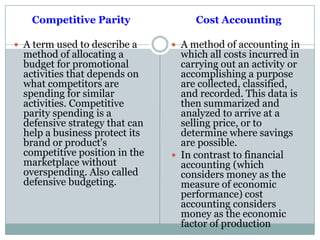
Competitive Parity
 A term used to describe a
method of allocating a
budget for promotional
activities that depends on
what competitors are
spending for similar
activities. Competitive
parity spending is a
defensive strategy that can
help a business protect its
brand or product's
competitive position in the
marketplace without
overspending. Also called
defensive budgeting.
Cost Accounting
 A method of accounting in
which all costs incurred in
carrying out an activity or
accomplishing a purpose
are collected, classified,
and recorded. This data is
then summarized and
analyzed to arrive at a
selling price, or to
determine where savings
are possible.
 In contrast to financial
accounting (which
considers money as the
measure of economic
performance) cost
accounting considers
money as the economic
factor of production
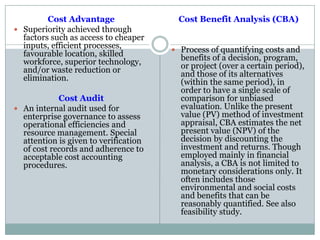
Cost Advantage
 Superiority achieved through
factors such as access to cheaper
inputs, efficient processes,
favourable location, skilled
workforce, superior technology,
and/or waste reduction or
elimination.
Cost Audit
 An internal audit used for
enterprise governance to assess
operational efficiencies and
resource management. Special
attention is given to verification
of cost records and adherence to
acceptable cost accounting
procedures.
Cost Benefit Analysis (CBA)
 Process of quantifying costs and
benefits of a decision, program,
or project (over a certain period),
and those of its alternatives
(within the same period), in
order to have a single scale of
comparison for unbiased
evaluation. Unlike the present
value (PV) method of investment
appraisal, CBA estimates the net
present value (NPV) of the
decision by discounting the
investment and returns. Though
employed mainly in financial
analysis, a CBA is not limited to
monetary considerations only. It
often includes those
environmental and social costs
and benefits that can be
reasonably quantified. See also
feasibility study.
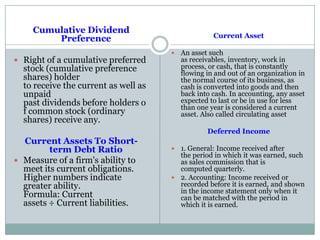
Cumulative Dividend
Preference
 Right of a cumulative preferred
stock (cumulative preference
shares) holder
to receive the current as well as
unpaid
past dividends before holders o
f common stock (ordinary
shares) receive any.
Current Assets To Short-
term Debt Ratio
 Measure of a firm's ability to
meet its current obligations.
Higher numbers indicate
greater ability.
Formula: Current
assets ÷ Current liabilities.
Current Asset
 An asset such
as receivables, inventory, work in
process, or cash, that is constantly
flowing in and out of an organization in
the normal course of its business, as
cash is converted into goods and then
back into cash. In accounting, any asset
expected to last or be in use for less
than one year is considered a current
asset. Also called circulating asset
Deferred Income
 1. General: Income received after
the period in which it was earned, such
as sales commission that is
computed quarterly.
 2. Accounting: Income received or
recorded before it is earned, and shown
in the income statement only when it
can be matched with the period in
which it is earned.
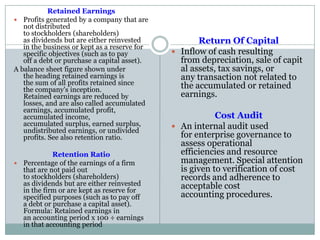
Retained Earnings
 Profits generated by a company that are
not distributed
to stockholders (shareholders)
as dividends but are either reinvested
in the business or kept as a reserve for
specific objectives (such as to pay
off a debt or purchase a capital asset).
A balance sheet figure shown under
the heading retained earnings is
the sum of all profits retained since
the company's inception.
Retained earnings are reduced by
losses, and are also called accumulated
earnings, accumulated profit,
accumulated income,
accumulated surplus, earned surplus,
undistributed earnings, or undivided
profits. See also retention ratio.
Retention Ratio
 Percentage of the earnings of a firm
that are not paid out
to stockholders (shareholders)
as dividends but are either reinvested
in the firm or are kept as reserve for
specified purposes (such as to pay off
a debt or purchase a capital asset).
Formula: Retained earnings in
an accounting period x 100 ÷ earnings
in that accounting period
Return Of Capital
 Inflow of cash resulting
from depreciation, sale of capit
al assets, tax savings, or
any transaction not related to
the accumulated or retained
earnings.
Cost Audit
 An internal audit used
for enterprise governance to
assess operational
efficiencies and resource
management. Special attention
is given to verification of cost
records and adherence to
acceptable cost
accounting procedures.
Propriety Theory
 A theory that states assets
and liabilities are
the responsibility of the business
owner.
In The Black
 A slang phrase referring to
a company that will have
enough revenue to cover operatin
g expenses.
In The Red
 A slang phrase referring to
a company that is burdened
by operating expenses and is
unable to generate revenue.
Management
 The organization
and coordination of the
activities of a business in order
to achieve defined objectives.
Management is often included as
a factor of production along
with machines, materials,
and money. Management
comprises planning, organizing, s
taffing, leading or directing,
and controlling an organization (
a group of one or more people or
entities) or effort for the purpose
of accomplishing a goal.
Resourcing encompasses the
deployment and manipulation
of human resources,
financial resources, technologica
l resources, and natural
resources.
Process management
 Is the application
of knowledge, skills, tools,
techniques and systems to
define, visualize, measure,
control, report and improve
processes with the goal to
meet customer requiremen
ts profitably. It can be
differentiated
from program
management in that
program management is
concerned with managing a
group of inter-dependent
projects.
Waste Management:
 Prices whereby consumers
use purchasing decisions to
communicate to product
manufacturers that they
prefer environmentally
sound products packaged
with the least amount of
waste, made from recycled
or recyclable materials, and
containing no hazardous
substances.
Cost Management
Management of cost relat
ed activities achieved by
collecting, analyzing,
evaluating, and reporting
cost information used
for budgeting, estimating, f
orecasting,
and monitoring costs.
FEMA declaration
process
 The procedure used
to obtain assistance
through the U.S.
Federal Emergency Manag
ement Agency. When a
state experiences a catastro
phe such as an earthquake
or a flood, the governor
may ask the president to
declare the event a disaster.
This declaration makes the
state eligible to receive a
variety of relief efforts from
the federal government.
Knowledge
 is a familiarity with someone or
something, which can
include facts,
information, descriptions,
or skills acquired
through experience or education.
It can also refer to the theoretical
or practical understanding of a
subject. It also said to be related
to the capacity of
acknowledgement in human
beings.
Skills
 A skill is the learned capacity or
ability to carry out pre-
determined results often with the
minimum outlay of time, energy,
or both. In other words the
abilities that one possesses. Skills
can often be divided into
domain-general and domain-
specific skills.
Competence (or competency)
 is the ability of an individual to
do a job properly. A competency
is a set of defined behaviours that
provide a structured guide
enabling the identification,
evaluation and development of
the behaviours in individual
employees.
Capabilities
 refers to the knowledge of
converting the 'knowledge' into a
desired result. In other words,
the extent of new possibilities of
knowing and doing things out of
a given 'knowledge' is called
'capability'.
Learning
 Measurable and relatively
permanent change in behaviour
through experience, instruction,
or study.
Whereas individual learning is
selective, group learning is
essentially political its outcomes
depend largely on power playing
in the group. Learning itself
cannot be measured; learning is
"detection and correction of
error" where an error means "any
mismatch between our intentions
and what actually happens."
Training
 Organized activity aimed at
imparting information and/or i
nstructions
to improve the recipient's perfor
mance or to help him or her
attain
a required level of knowledge or s
kill
Leadership
 means "organizing a group of
people to achieve a common
goal". The leader may or may not
have any formal authority.
Studies of leadership have
produced theories involving
traits, situational interaction,
function, behaviour, power,
vision and values, charisma, and
intelligence, among others.
Somebody whom people follow:
somebody who guides or directs
others.
Human Relationship
 A discipline within resource
management which addresses
interpersonal behaviours. Factor
s that are considered
include leadership; communicati
on; team building;
and negotiation, facilitation
and mediation abilities.
Communication
 Two-way process of reaching
mutual
understanding, in
which participants not
only exchange (encode-
decode) information, news, ideas
and feelings but
also create and share meaning.
In general, communication is
a means of connecting people
or places. In business, it is
a key function of management--
an organization cannot operate
without communication
between levels, departments
and employees.
Corporate Governance
 the framework of rules and practi
ces by which a board of
directors ensures accountability,
fairness, and transparency in
a company's relationship with its
all stakeholders (financiers, custo
mers, management, employees, g
overnment, and the community).
 The corporate
governance framework consists
explicit and implicit
contracts between
the company and the
stakeholders
for distribution of responsibilitie
s, rights,
and rewards, procedures for
reconciling the sometimes
conflicting interests of
stakeholders in accordance with
their duties, privileges, and roles,
and procedures for proper
supervision, control,
and information-flows to serve as
a system of checks-and-balances.
Graduation
 is the action of receiving or
conferring an academic or the
ceremony that is sometimes
associated, where students
become graduates. Before the
graduation, candidates are
referred to as grad ands. The date
of graduation is often
called graduation day. The
graduation itself is also called
commencement, convocation or i
nvocation.
Mindset
 In decision theory and general
systems theory, a mindset is
a set of assumptions, methods, or
notations held by one or more
people or groups of people that is
so established that it creates a
powerful incentive within these
people or groups to continue to
adopt or accept prior behaviours,
choices, or tools.
Six Sigma
 seeks to improve the quality of
process outputs by identifying
and removing the causes of
defects (errors) and
minimizing variability in
manufacturing and business
processes. It uses a set of
management methods,
including statistical methods,
and creates a special
infrastructure of people within
the organization who are experts
in these very complex methods.
Superior goods
 make up a larger proportion of
consumption as income rises,
and therefore are a type of goods
in consumer theory. Such a good
must possess two economic
characteristics: it must be scarce,
and, along with that, it must have
a high price.
Marketing
 is the process of communicating
the value of a product or service
to customers, for the purpose of
selling the product or service. It
is a critical business function for
attracting customers. It is the
process of communicating the
value of a product or service
through positioning to
customers. Marketing can be
looked at as an organizational
function and a set of processes
for creating, delivering and
communicating value to
customers, and managing
customer relationships in ways
that also benefit the organisation
and its shareholders. Marketing
is the science of choosing target
markets through market analysis
and market segmentation, as well
as understanding consumer
buying behaviour and providing
superior customer value.
Finance
 Is the study of how people
allocate their assets over time
under conditions of certainty and
uncertainty. A key point in
finance, which affects decisions,
is the time value of money, which
states that a unit of currency
today is worth more than the
same unit of currency tomorrow.
Finance aims to price assets
based on their risk level, and
expected rate of return. Finance
can be broken into three different
sub categories: finance,
corporate and personal finance.
Work environment
 Location where
a task is completed. When
pertaining to a place
of employment, the work
environment involves the
physical geographical location
as well as the immediate
surroundings of
the workplace, such as
a construction site or office bu
ilding. Typically involves
other factors relating to the
place of employment, such as
the quality of the air, noise
level, and
additional perks and benefits
of employment such
as free child care or unlimited
coffee, or adequate parking.
Supply Chain
 Entire network of entities,
directly or indirectly
interlinked and
interdependent in serving the
same consumer or customer.
It comprises of vendors that s
upply raw material, producers
who convert
the material into products, wa
rehouses that store, distributi
on centres that deliver to
the retailers, and retailers
who bring the product to the
ultimate user.
Total Productive
Maintenance (TPM)
 Methodology designed to
ensure that
every machine in
a production
process always performs
its required task and
its output rate is never
disrupted.
Improvements
 Additions to
or enhancements of raw
land or a building that
normally increase its
usefulness and value, and
are intended to
remain attached or
annexed as drains, drives,
sewers, sidewalks, streets,
trees, etc.
Innovation
 Is the development of new
values through solutions
that meet new
requirements, inarticulate
needs, or old customer and
market needs in value
adding new ways. This is
accomplished through
more
effective products, processe
s, services, technologies,
or ideas that are readily
available to markets,
governments, and society.
Improvements
 Additions to
or enhancements of raw
land or a building that
normally increase its
usefulness and value, and are
intended to
remain attached or annexed
as drains, drives, sewers,
sidewalks, streets, trees, etc.
Quality control (QC)
 An aspect of the quality
assurance process that
consists
of activities employed in
detection
and measurement of
the variability in
the characteristics of output a
ttributable to the production
system, and includes
corrective responses.
Ethics
 also known as moral
philosophy, is a branch of
philosophy that involves
systematizing, defending, and
recommending concepts of
right and wrong conduct.
Ethics is a complement to
Aesthetics in the philosophy
field of Axiology. In
philosophy, ethics studies the
moral behaviour in humans,
and how one should act.
Ethics may be divided into
four major areas of study.
Environment
 The sum total of all surroundi
ngs of a living organism,
including natural forces and
other living things,
which provide conditions for
development and growth as
well as of danger and damage.
Change
 To alter; to make different; to
cause to pass from one state t
o another; as, to change the p
osition, character,
or appearance of a thing; to c
hange the countenance. To gi
ve and take reciprocally; to ex
change; followed by with; as, t
o change place, or hats, or mo
ney, with another.
Self Assessment
 is the first step of the career
planning process. It is the
process of gathering
information about you in
order to make an informed
career decision. A self
assessment should include a
look at the following: values,
interests, personality, and
skills.
Lean Manufacturing
 Lean enterprise, or lean
production, often simply
 "Lean," is a production
practice that considers the
expenditure of resources for
any goal other than the
creation of value for the end
customer to be wasteful, and
thus a target for elimination.
Working from the perspective
of the customer who
consumes a product or
service, "value" is defined as
any action or process that a
customer would be willing to
pay for.
Value adding process
 Set of quality
control activities which
transform an input into
an output that is valuable
to internal and/or external
customers of
an organization.
Kaizen
 Japanese term for a
gradual approach to ever
higher standards
in quality enhancement an
d waste reduction, through
small but continual
improvements involving
everyone from
the chief executive to the
lowest level workers.
Popularized by Mosaki
Imai in his books 'Kaizen:
The Key To
Japan's competitive Succes
s.'
Source:
www.businessdictionary.com

Useful definitions

  • 1.
  • 2.
    A Fortiori Analysis Indecision theory, an analysis made to intentionally favour alternative solutions when compared to the solution adjudged as best. The alternative is deliberately weighted to make them look better. If the adjudged-best solution still remains the best, its position as the likely choice is further strengthened. „A Fortiori‟ is Latin for, „even more so‟ or „more conclusively‟. Knowledge 1. The state or fact of knowing. 2. Familiarity, awareness, or understanding gained through experience or study. 3. The sum or range of what has been perceived, discovered, or learned. 4. Learning; erudition: teachers of great knowledge. 5. Specific information about something. 6. Carnal knowledge.
  • 3.
    Leadership Has been describedas “a process of influence in which one person can enlist the aid and support of others in the accomplishment of a common task”. Other in-depth definitions of leadership have also emerged. Leadership is "organizing a group of people to achieve a common goal". The leader may or may not have any formal authority. Studies of leadership have produced theories involving traits, situational interaction, function, behaviour, power, vision and values, charisma, and intelligence, among others. Somebody whom people follow: somebody who guides or directs others. Transformational leadership Enhances the motivation, morale, and performance of followers through a variety of mechanisms. These include connecting the follower's sense of identity and self to the project and the collective identity of the organization; being a role model for followers that inspires them and makes them interested; challenging followers to take greater ownership for their work, and understanding the strengths and weaknesses of followers, so the leader can align followers with tasks that enhance their performance.
  • 4.
    Global Leadership  Isthe interdisciplinary study of the key elements that future leaders in all realms of the personal experience should acquire to effectively familiarize themselves with the psychological, physiological, geographical, geopolitical , anthropological and sociological effects of globalization. Global leadership occurs when an individual or individuals navigate collaborative efforts of different stakeholders through environmental co mplexity towards a vision by leveraging a global mindset. As a result of trends, starting with colonialism and perpetuated by the increase in mass media, innovation, a host of meaningful new concerns face mankind; consisting of but not limited to: human enterprises toward peace, international business design, and significant shifts in geopolitical paradigms. A goal  Is a desired result a person or a system envisions, plans and commits to achieve a personal or organizational desired end- point in some sort of assumed development. Many people endeavour to reach goals within a finite time by setting deadlines. It is roughly similar to purpose or aim, the anticipated result which guides reaction, or an end, which is an object, either a physical object or an abstract object, that has intrinsic value.
  • 5.
    Value Denotes something's degreeof importance, with the aim of determining what action or life is best to do or live (Deontology), or at least attempt to describe the value of different actions (Axiology). It may be described as treating actions themselves as abstract objects, putting value to them. It deals with right conduct and good life, in the sense that a highly, or at least relatively highly, valuable action may be regarded as ethically "good" (adjective sense), and an action of low, or at least relatively low, value may be regarded as "bad". Mindset In decision theory and general systems theory, a mindset is a set of assumptions, methods, or notations held by one or more people or groups of people that is so established that it creates a powerful incentive within these people or groups to continue to adopt or accept prior behaviours, choices, or tools. This phenomenon is also sometimes described as mental inertia, "groupthink", or a "paradigm", and it is often difficult to counteract its effects upon analysis and decision making processes.
  • 6.
    Culture  Is amodern concept based on a term first used in classical antiquity by the Roman orator, Cicero: "cultura animi". The term "culture "appeared first in its current sense in Europe in the 18th and 19th centuries, to connote a process of cultivation or improvement, as in agriculture or horticulture. In the 19th century, the term developed to refer first to the betterment or refinement of the individual, especially through education, and then to the fulfilment of national aspirations or ideals. In the mid-19th century, some scientists used the term "culture" to refer to a universal human capacity. For the German non positivist sociologist Georg Simmer, culture referred to "the cultivation of individuals through the agency of external forms which have been objectified in the course of history". Communication  From Latin "communis", meaning to share) is the activity of conveying information through the exchange of thoughts, messages, or information, as by speech, visuals, signals, writing, or behaviour. It is the meaningful exchange of information between two and a group of person. One definition of communication is “any act by which one person gives to or receives from person information about that person's needs, desires, perceptions, knowledge, or affective states. Communication may be intentional or unintentional, may involve conventional or unconventional signals, may take linguistic or non- linguistic forms, and may occur through spoken or other modes
  • 7.
    Absorption Costing  Amethod of costing a product in which all fixed and variable costs are apportioned to cost centres where they are accounted for using absorption rates. This method ensures that all incurred costs are recovered from the selling price of a good or service. Also called full absorption costing. See also costing, marginal. Account 1. Accounting: Chronological record of changes in the value of an entity's assets, liabilities, and the owners' equity; each of which is represented by a separate page in the ledger. See also accounting equation and accounts. 2. Banking: Continuing financial relationship between a bank and a customer, in which deposits and debts are held and processed within a framework of established rules and procedures. 3. Commerce: On-going contractual relationship between a buyer and seller whereby payment for goods received is made at a later time (usually 30 days). See also charge account and open account. 4. Law: Obligation of each party to a contract or partnership to account to other(s) for amounts received or due. 5. Services: Client of an advertising, brokerage, consulting, marketing, or public relations firm.
  • 8.
    Accounting Bases  Assumptions,methods, and procedures that constitute accounting policies of a firm. Account Reconcilement  Comparing an account statement (or bank statement) with one's own accounting records, to detect any discrepancies that may indicate leakage of cash, slack accounting controls, or an error. Account Payee Only  Words added to the crossing on a check to ensure that check is paid only into the account of the entity to whom the check is made out. This step makes a check a non-negotiable instrument, and provides protection against its fraudulent conversion. The words 'not negotiable' have the same effect.
  • 9.
    Accounting Fraud  Theintentional misrepresentation or alteration of accounting records regarding sales, revenues, expenses and other factors for a profit motive such as inflating company stock values, obtaining more favourable financing or avoiding debt obligations. Employees who commit accounting fraud at the request of their employers are subject to personal criminal prosecution. Accounting System  Organized set of manual and computerized accounting methods, procedures, and controls established to gather, record, classify, analyze, summarize, interpret, and present accurate and timely financial data for management decisions. Accounting Policies  Principles, rules and procedures selected, and consistently followed, by the management of an organization (the accounting entity) in preparing and reporting the financial statements. Accounting policies deal specifically with matters such as consolidation of accounts, depreciation methods, goodwill, inventory pricing, and research and development costs. Accounting policies must be disclosed in the annual financial statements. See also summary of significant accounting policies.
  • 10.
    Accounting Principles Board  Boardof the American Institute of Certified Public Accountants (AICPA), the original publisher of GAAP. Replaced by Financial Accounting Standards Board In 1973. Activity Based Costing (ABC)  Cost accounting approach concerned with matching costs with activities (called cost drivers) that cause those costs. It is a more sophisticated kind of absorption-costing and replaces labour based costing system. ABC states that (1) products consume activities, (2) it is the activities (and not the products) that consume resources, (3) activities are the cost drivers, and (4) that activities are not necessarily based on the volume of production. Instead of allocating costs to cost centres (such as manufacturing, marketing, finance), ABC allocates direct and indirect costs to activities such as processing an order, attending to a customer complaint, or setting up a machine. A subset of activity based management (ABM), it enables management to better understand (a) how and where the firm makes a profit, (b) indicates where money is being spent and (c) which areas have the greatest potential for cost reduction. Developed by professors Robert Kaplan and Robin Cooper of Harvard University in late 1980's.
  • 11.
    Accounts Payable (A/P) Unpaid bills. Accounts that are owed to suppliers (trade creditors) as distinguished from accrued interest, rent, salaries, taxes, and other such accounts. Accounts payable are shown under current (short-term) liabilities in the balance sheet. Lenders and investors examine the relationship of these accounts to the firm‟s purchases in order to judge the soundness of its day to day financial management. Accounts Receivable (A/R)  Sales made but not paid-for by the customers (trade debtors). Accounts receivables are shown as current (short- term) assets in a balance sheet and are, in fact, unsecured promises by customers to pay in the future. These sums are a key factor in determining a firm's liquidity and may be discounted used in raising a short-term bank loan, or sold to a factor. A provision is usually made in the accounts of a firm to offset uncollectible accounts receivable (bad debts) as losses.
  • 12.
    Accounts Payable (A/P) toSales Ratio  Relationship between unpaid suppliers' bills and the sales revenue in an accounting period. It is considered high if it approaches 1.0 and, in some industries, may be a sign that the firm is having liquidity problems. Formula: Total accounts payable ÷ Sales revenue. Accounts Receivable (A/R) Turnover  Ratio that shows the relationship between unpaid credit sales to total credit sales. It indicates, in general, the effectiveness (or lack of it) of a firm's credit policies and cash collection efforts. Formula: Outstanding accounts receivable (in an accounting period) ÷ credit sales revenue (in the same period). Also called receivable turnover.
  • 13.
    Accounts Receivable (A/R) toSales Ratio  Shows the relationship between unpaid sales and the total sales revenue. It is considered high if it is near to 1.0, because that means a significant amount of cash is tied up with the slow paying customers. Formula: Total accounts receivable (outstanding in an accounting period) ÷ sales revenue (in the same period). Accounts Receivable (A/R) Turnover  Ratio that shows the relationship between unpaid credit sales to total credit sales. It indicates, in general, the effectiveness (or lack of it) of a firm's credit policies and cash collection efforts. Formula: Outstanding accounts receivable (in an accounting period) ÷ credit sales revenue (in the same period). Also called receivable turnover.
  • 14.
    Accrual Concept  Fundamentalaccounting concept which recognizes the time lag between sales and purchases on one hand, and collection and payment of cash on the other. It forms an important part of the GAAP, and permits meaningful comparisons based on the actual operations of the business undisturbed by the timing of payments. Under this principle, sales and expenses are taken account of in the accounting period in which they occur (and are included in the income statement for that period), whether or not cash was received or paid out. Also called accrual principle. See also accounting concepts. Accrued Expenses  Expenses (such as wages, salaries, and utility charges) which are incurred but for which no payment is made during an accounting period. They are shown in the balance sheet as a current (short term) liability. Also called accrued liabilities. Accrued Income  Amount earned in the current accounting period, but which will be received in a subsequent period.
  • 15.
    Accrued Revenue  Revenueearned in the current accounting period, but which will be collected in a subsequent period. Also called unrealized revenue. Accrued Liability  Debt, expense, or obligation incurred in an accounting period but chargeable or payable in another. Absorption Pricing  Method of pricing in which all costs are recovered. The price of the product includes the variable cost of each item plus a proportionate amount of the fixed costs Accounting Ratios  Three basic types of accounting ratios are: (1) Efficiency Ratios, (2) Profitability ratios, and (3) Solvency ratios. See also ratio analysis.
  • 16.
    Accounts Receivable Aging  Processof determining which customers are paying on time, which are not, and how far they are behind the payment date. This analysis assists in estimating bad debts and in establishing credit guidelines. Annual percentage rate (APR)  Standardized method of quoting the effective interest rate (actual cost of credit) on consumer loans, specially where interest is computed on monthly or other non- annual basis. An APR includes all fees (except penalties), and takes into account the continual reduction of principal amount through amortization.
  • 17.
    Activity Based Budgeting (ABB) Resource allocation based on relationship between activities and costs, and which provides greater detail on overheads than the normal financial budgeting. See also activity based costing. Ad Valorem  Method for charging a duty, fee, or tax according to the value of goods and services, instead of by a fixed rate, or by weight or quantity. Latin for, [according] to the value.
  • 18.
    Annual Percentage Yield (APY) Standardized method for quoting compounded interest earned on a deposit account or investment. In computing APY, it is assumed the funds will remain on fixed deposit or invested for a full 365-day period. Annual Report  Presentation of a firm's audited accounts for the preceding year, as required in corporate legislation. In addition to the auditor's report, an annual report commonly includes (1) management's review of the operations of the firm and its future prospects, (2) balance sheet, (3) income statement (profit and loss account), (4) cash flow statement, and other supporting documents. Also called annual accounts.
  • 19.
    Appraisal 1. Impartial analysisand evaluation conducted according to established criteria to determine the acceptability, merit, or worth of an item. 2. Evaluation by a qualified appraiser to (1) assess the current market value of a property, (2) estimate the extent of damage to an insured property and cost of repairs, or (3) determine if a total loss occurred. A written appraisal is usually a key requirement when a property is bought, sold, insured, or mortgaged. It is required also when a claim is filed for compensation for damage or destruction of the insured property. See also appraisal value. 3. Alternative term for valuation. Asset Value per Share  Net value of the total assets of a firm divided by the number of issued (outstanding) common stock or ordinary shares of the firm. It is a theoretical indicator of the portion of assets attributable to each share in case the firm is liquidated. Formula: Total net asset value ÷ Number of outstanding shares.
  • 20.
    Asset valuation  Determinationof the value of capital assets or fixed assets, they value at which they should be shown in their owner's balance sheet. Balanced Budget  Government budget where the current expenditure equals current revenue. Most government budgets are unbalanced almost always on the expense side, purportedly to spur growth and reduce unemployment by creating demand with additional money supply. Balance Sheet  A condensed statement that shows the financial position of an entity on a specified date (usually the last day of an accounting period).  Among other items of information, a balance sheet states (1) what assets the entity owns, (2) how it paid for them, (3) what it owes (its liabilities), and (4) what is the amount left after satisfying the liabilities. Balance sheet data is based on a fundamental accounting equation (assets = liabilities + owners' equity), and is classified under subheadings such as current assets, fixed assets, current liabilities, Long-term Liabilities. With income statement and cash flow statement, it comprises the set of documents indispensable in running a business. An audited balance sheet is often demanded by investors, lenders, suppliers, and taxation authorities; and is usually required by law. To be considered valid, a balance sheet must give a true and fair view of an organization's state of affairs, and must follow the provisions of GAAP in its preparation. Also called statement of condition, statement of financial condition, or statement of financial position.
  • 21.
    Bank Reconciliation  Analysisand adjustment of differences between the cash balance shown on a bank statement, and the amount shown in the account holder's records. This matching process involves making allowances for checks issued but not yet presented, and for checks deposited but not yet cleared or credited. And, if discrepancies persist, finding the cause and bringing the records into agreement. Basic Earnings per Share (EPS)  A measure of a company's performance calculated by dividing its net earnings by its total number of outstanding shares. Also referred to as simply Earnings Per Share or EPS. Compare to diluted earnings per share; EBITDA.
  • 22.
    Basic Earnings Power Ratio that indicates basic profitability of assets and is useful in comparing firms with different degree of leverage. Formula: Earnings Before interest and tax ÷ Total assets. Basic Financial Statements  Accounting reports compiled in conformity with the provisions of GAAP, and necessary for the fair evaluation of operations of an entity. For businesses, the balance sheet, income statement (profit and loss account), and the cash-flow statement make up the set of basic financial Basis of Accounting  Method used to determine when revenues and expenses (with associated assets and liabilities) are recognized in the accounts of a firm, and reported in its financial statements. In accrual basis accounting, for example, revenues are recognized when earned and expenses are recognized when incurred, whether or not any cash is received or paid. In cash basis accounting, however, revenues and expenses are recognized only when cash is received or paid, irrespective of the timing of actual sales or purchases.
  • 23.
    Amortization  1. Accounting:Preferred term for the apportionment (charging or writing off) of the cost of an intangible asset as an operational cost over the asset's estimated useful life. It is identical to depreciation, the preferred term for tangible assets. The purpose of both terms is to (1) reflect reduction in the book value of the asset due to usage and/or obsolescence, (2) spread a large expenditure proportionately over a fixed period, and thereby (3) reduce the taxable income (not the actual or cash income) of a firm. In effect, it is a process by which invested capital of a firm is recovered by gradual sale of the firm's asset(s) to its customers over the years.  2. Banking: Gradual repayment of a loan in equal (or nearly equal) instalments which include portions of interest and principal amounts. See also level payment amortization. Analysis of Alternatives (AOA)  Evaluation of different choices available for achieving an objective, usually requiring cost-benefit analysis, life cycle costing, and sensitivity analysis. Also called alternative analysis. Analysis of Variances (ANOVA)  1. General: Statistical technique for determining the degree of difference or similarity between two or more groups of data. It is based on the comparison of the average value of a common component.  2. Accounting: Investigation of causes of difference between actual costs and estimated or standard costs.  3. Quality control: Methodology employed in determining if the variance between the mean in different sets of observations is greater than what may be attributable to chance.
  • 24.
    Annual audit  Anannual review of the financial records of an organization, such as a business, a non-profit group, or a government agency. The audit may check the accuracy of records, compliance with accounting methods, and the soundness of financial practices, including internal control Annual Basis  Mathematical technique employed in converting figures for a period of less-than or more-than one year to a twelve- month period. Annual Budget  A budget that is prepared to coincide with a calendar or fiscal year.
  • 25.
    Balance sheet ratios Comparisons of balance sheet items to gain insight into the (1) changes in the financial position, (2) strength/weakness of the financial position, and (3) relationship between different items. Two basic balance sheet ratios are the debt ratio (total debt ÷ total assets) and debt to equity ratio (total debt ÷ total equity). Budgeted cost of work performed (BCWP)  In construction industry, total of the budgeted costs of the activities (that make up a job or project) completed to- date, or on any given date. Also called achieved cost or earned value. See also actual cost of work performed.
  • 26.
    Budgeted Cost ofWork Scheduled (BCWS) In construction industry, sum of the budgeted costs for all planned work scheduled to be completed to-date, or on any given date. Budgeting  Process of expressing quantified resource requirements (amount of capital, amount of material, number of people) into time- phased goals and milestones. Capacity Cost  A fixed expense for a company that will provide for or increase business operations. The costs do not usually change with production levels. In order for a business to function it must incur these expenses regardless of how much or how little business is actually being done. The costs can be reduced or avoided only if the business locations are closed or due to outsourcing of work. Examples of capacity costs may include lease payments, machine/equipment depreciation, insurance, utilities, and insurance costs.
  • 27.
    Capacity Overhead Expense  Costssuch as depreciation, insurance, property tax, rent, associated with having a manufacturing or storage facility. Capacity Utilization Rate  Percentage of the production capacity (of a firm, industry, or industrial sector) actually used for production during a month, quarter, year. Also called operating ratio. Capital Employed  Total capital harnessed in a firm's fixed and current assets. Viewed from the funding side, it equals stockholders' funds (equity capital) plus long-term liabilities (loan capital). Viewed from the asset side, it equals fixed assets plus working assets. Capital Efficiency  The relationship between how many expenses are incurred by the company to how much money is used to manufacture a good or service.
  • 28.
    Capital Growth  Profitmade on an investment or purchase of an asset, measured by the increase in its market value over the invested amount or cost price. Also called capital appreciation. Capital Reserve  A resource created by the accumulated capital surplus (not revenue surplus) of an organization, such as by an upward revaluation of its assets to reflect their current market value after appreciation. Allocating such sums to capital reserve means they are permanently invested and will not be paid as dividends.
  • 29.
    Capitalization Ratios  Ratiosthat express each component of a firm's capital (common stock or ordinary share, preferred stock or preference shares, other equities, and debt) as a percentage of its total capitalization. These ratios are used in analyzing the firm's capital structure. Cash Ratio  Comparison of cash plus cash equivalents to current liabilities. Also called liquidity ratio, it is a refinement of quick ratio and indicates the extent to which the readily available funds can pay off the current liabilities. Formula: (Cash + cash equivalents) ÷ Current liabilities. Cash Value Added (CVA)  A measurement of the amount of cash generated from operations minus the cash flow demands for the same period.
  • 30.
    Competitive Parity  Aterm used to describe a method of allocating a budget for promotional activities that depends on what competitors are spending for similar activities. Competitive parity spending is a defensive strategy that can help a business protect its brand or product's competitive position in the marketplace without overspending. Also called defensive budgeting. Cost Accounting  A method of accounting in which all costs incurred in carrying out an activity or accomplishing a purpose are collected, classified, and recorded. This data is then summarized and analyzed to arrive at a selling price, or to determine where savings are possible.  In contrast to financial accounting (which considers money as the measure of economic performance) cost accounting considers money as the economic factor of production
  • 31.
    Cost Advantage  Superiorityachieved through factors such as access to cheaper inputs, efficient processes, favourable location, skilled workforce, superior technology, and/or waste reduction or elimination. Cost Audit  An internal audit used for enterprise governance to assess operational efficiencies and resource management. Special attention is given to verification of cost records and adherence to acceptable cost accounting procedures. Cost Benefit Analysis (CBA)  Process of quantifying costs and benefits of a decision, program, or project (over a certain period), and those of its alternatives (within the same period), in order to have a single scale of comparison for unbiased evaluation. Unlike the present value (PV) method of investment appraisal, CBA estimates the net present value (NPV) of the decision by discounting the investment and returns. Though employed mainly in financial analysis, a CBA is not limited to monetary considerations only. It often includes those environmental and social costs and benefits that can be reasonably quantified. See also feasibility study.
  • 32.
    Cumulative Dividend Preference  Rightof a cumulative preferred stock (cumulative preference shares) holder to receive the current as well as unpaid past dividends before holders o f common stock (ordinary shares) receive any. Current Assets To Short- term Debt Ratio  Measure of a firm's ability to meet its current obligations. Higher numbers indicate greater ability. Formula: Current assets ÷ Current liabilities. Current Asset  An asset such as receivables, inventory, work in process, or cash, that is constantly flowing in and out of an organization in the normal course of its business, as cash is converted into goods and then back into cash. In accounting, any asset expected to last or be in use for less than one year is considered a current asset. Also called circulating asset Deferred Income  1. General: Income received after the period in which it was earned, such as sales commission that is computed quarterly.  2. Accounting: Income received or recorded before it is earned, and shown in the income statement only when it can be matched with the period in which it is earned.
  • 33.
    Retained Earnings  Profitsgenerated by a company that are not distributed to stockholders (shareholders) as dividends but are either reinvested in the business or kept as a reserve for specific objectives (such as to pay off a debt or purchase a capital asset). A balance sheet figure shown under the heading retained earnings is the sum of all profits retained since the company's inception. Retained earnings are reduced by losses, and are also called accumulated earnings, accumulated profit, accumulated income, accumulated surplus, earned surplus, undistributed earnings, or undivided profits. See also retention ratio. Retention Ratio  Percentage of the earnings of a firm that are not paid out to stockholders (shareholders) as dividends but are either reinvested in the firm or are kept as reserve for specified purposes (such as to pay off a debt or purchase a capital asset). Formula: Retained earnings in an accounting period x 100 ÷ earnings in that accounting period Return Of Capital  Inflow of cash resulting from depreciation, sale of capit al assets, tax savings, or any transaction not related to the accumulated or retained earnings. Cost Audit  An internal audit used for enterprise governance to assess operational efficiencies and resource management. Special attention is given to verification of cost records and adherence to acceptable cost accounting procedures.
  • 34.
    Propriety Theory  Atheory that states assets and liabilities are the responsibility of the business owner. In The Black  A slang phrase referring to a company that will have enough revenue to cover operatin g expenses. In The Red  A slang phrase referring to a company that is burdened by operating expenses and is unable to generate revenue. Management  The organization and coordination of the activities of a business in order to achieve defined objectives. Management is often included as a factor of production along with machines, materials, and money. Management comprises planning, organizing, s taffing, leading or directing, and controlling an organization ( a group of one or more people or entities) or effort for the purpose of accomplishing a goal. Resourcing encompasses the deployment and manipulation of human resources, financial resources, technologica l resources, and natural resources.
  • 35.
    Process management  Isthe application of knowledge, skills, tools, techniques and systems to define, visualize, measure, control, report and improve processes with the goal to meet customer requiremen ts profitably. It can be differentiated from program management in that program management is concerned with managing a group of inter-dependent projects. Waste Management:  Prices whereby consumers use purchasing decisions to communicate to product manufacturers that they prefer environmentally sound products packaged with the least amount of waste, made from recycled or recyclable materials, and containing no hazardous substances.
  • 36.
    Cost Management Management ofcost relat ed activities achieved by collecting, analyzing, evaluating, and reporting cost information used for budgeting, estimating, f orecasting, and monitoring costs. FEMA declaration process  The procedure used to obtain assistance through the U.S. Federal Emergency Manag ement Agency. When a state experiences a catastro phe such as an earthquake or a flood, the governor may ask the president to declare the event a disaster. This declaration makes the state eligible to receive a variety of relief efforts from the federal government.
  • 37.
    Knowledge  is afamiliarity with someone or something, which can include facts, information, descriptions, or skills acquired through experience or education. It can also refer to the theoretical or practical understanding of a subject. It also said to be related to the capacity of acknowledgement in human beings. Skills  A skill is the learned capacity or ability to carry out pre- determined results often with the minimum outlay of time, energy, or both. In other words the abilities that one possesses. Skills can often be divided into domain-general and domain- specific skills. Competence (or competency)  is the ability of an individual to do a job properly. A competency is a set of defined behaviours that provide a structured guide enabling the identification, evaluation and development of the behaviours in individual employees. Capabilities  refers to the knowledge of converting the 'knowledge' into a desired result. In other words, the extent of new possibilities of knowing and doing things out of a given 'knowledge' is called 'capability'.
  • 38.
    Learning  Measurable andrelatively permanent change in behaviour through experience, instruction, or study. Whereas individual learning is selective, group learning is essentially political its outcomes depend largely on power playing in the group. Learning itself cannot be measured; learning is "detection and correction of error" where an error means "any mismatch between our intentions and what actually happens." Training  Organized activity aimed at imparting information and/or i nstructions to improve the recipient's perfor mance or to help him or her attain a required level of knowledge or s kill Leadership  means "organizing a group of people to achieve a common goal". The leader may or may not have any formal authority. Studies of leadership have produced theories involving traits, situational interaction, function, behaviour, power, vision and values, charisma, and intelligence, among others. Somebody whom people follow: somebody who guides or directs others. Human Relationship  A discipline within resource management which addresses interpersonal behaviours. Factor s that are considered include leadership; communicati on; team building; and negotiation, facilitation and mediation abilities.
  • 39.
    Communication  Two-way processof reaching mutual understanding, in which participants not only exchange (encode- decode) information, news, ideas and feelings but also create and share meaning. In general, communication is a means of connecting people or places. In business, it is a key function of management-- an organization cannot operate without communication between levels, departments and employees. Corporate Governance  the framework of rules and practi ces by which a board of directors ensures accountability, fairness, and transparency in a company's relationship with its all stakeholders (financiers, custo mers, management, employees, g overnment, and the community).  The corporate governance framework consists explicit and implicit contracts between the company and the stakeholders for distribution of responsibilitie s, rights, and rewards, procedures for reconciling the sometimes conflicting interests of stakeholders in accordance with their duties, privileges, and roles, and procedures for proper supervision, control, and information-flows to serve as a system of checks-and-balances.
  • 40.
    Graduation  is theaction of receiving or conferring an academic or the ceremony that is sometimes associated, where students become graduates. Before the graduation, candidates are referred to as grad ands. The date of graduation is often called graduation day. The graduation itself is also called commencement, convocation or i nvocation. Mindset  In decision theory and general systems theory, a mindset is a set of assumptions, methods, or notations held by one or more people or groups of people that is so established that it creates a powerful incentive within these people or groups to continue to adopt or accept prior behaviours, choices, or tools. Six Sigma  seeks to improve the quality of process outputs by identifying and removing the causes of defects (errors) and minimizing variability in manufacturing and business processes. It uses a set of management methods, including statistical methods, and creates a special infrastructure of people within the organization who are experts in these very complex methods. Superior goods  make up a larger proportion of consumption as income rises, and therefore are a type of goods in consumer theory. Such a good must possess two economic characteristics: it must be scarce, and, along with that, it must have a high price.
  • 41.
    Marketing  is theprocess of communicating the value of a product or service to customers, for the purpose of selling the product or service. It is a critical business function for attracting customers. It is the process of communicating the value of a product or service through positioning to customers. Marketing can be looked at as an organizational function and a set of processes for creating, delivering and communicating value to customers, and managing customer relationships in ways that also benefit the organisation and its shareholders. Marketing is the science of choosing target markets through market analysis and market segmentation, as well as understanding consumer buying behaviour and providing superior customer value. Finance  Is the study of how people allocate their assets over time under conditions of certainty and uncertainty. A key point in finance, which affects decisions, is the time value of money, which states that a unit of currency today is worth more than the same unit of currency tomorrow. Finance aims to price assets based on their risk level, and expected rate of return. Finance can be broken into three different sub categories: finance, corporate and personal finance.
  • 42.
    Work environment  Locationwhere a task is completed. When pertaining to a place of employment, the work environment involves the physical geographical location as well as the immediate surroundings of the workplace, such as a construction site or office bu ilding. Typically involves other factors relating to the place of employment, such as the quality of the air, noise level, and additional perks and benefits of employment such as free child care or unlimited coffee, or adequate parking. Supply Chain  Entire network of entities, directly or indirectly interlinked and interdependent in serving the same consumer or customer. It comprises of vendors that s upply raw material, producers who convert the material into products, wa rehouses that store, distributi on centres that deliver to the retailers, and retailers who bring the product to the ultimate user.
  • 43.
    Total Productive Maintenance (TPM) Methodology designed to ensure that every machine in a production process always performs its required task and its output rate is never disrupted. Improvements  Additions to or enhancements of raw land or a building that normally increase its usefulness and value, and are intended to remain attached or annexed as drains, drives, sewers, sidewalks, streets, trees, etc. Innovation  Is the development of new values through solutions that meet new requirements, inarticulate needs, or old customer and market needs in value adding new ways. This is accomplished through more effective products, processe s, services, technologies, or ideas that are readily available to markets, governments, and society.
  • 44.
    Improvements  Additions to orenhancements of raw land or a building that normally increase its usefulness and value, and are intended to remain attached or annexed as drains, drives, sewers, sidewalks, streets, trees, etc. Quality control (QC)  An aspect of the quality assurance process that consists of activities employed in detection and measurement of the variability in the characteristics of output a ttributable to the production system, and includes corrective responses. Ethics  also known as moral philosophy, is a branch of philosophy that involves systematizing, defending, and recommending concepts of right and wrong conduct. Ethics is a complement to Aesthetics in the philosophy field of Axiology. In philosophy, ethics studies the moral behaviour in humans, and how one should act. Ethics may be divided into four major areas of study. Environment  The sum total of all surroundi ngs of a living organism, including natural forces and other living things, which provide conditions for development and growth as well as of danger and damage.
  • 45.
    Change  To alter;to make different; to cause to pass from one state t o another; as, to change the p osition, character, or appearance of a thing; to c hange the countenance. To gi ve and take reciprocally; to ex change; followed by with; as, t o change place, or hats, or mo ney, with another. Self Assessment  is the first step of the career planning process. It is the process of gathering information about you in order to make an informed career decision. A self assessment should include a look at the following: values, interests, personality, and skills. Lean Manufacturing  Lean enterprise, or lean production, often simply  "Lean," is a production practice that considers the expenditure of resources for any goal other than the creation of value for the end customer to be wasteful, and thus a target for elimination. Working from the perspective of the customer who consumes a product or service, "value" is defined as any action or process that a customer would be willing to pay for.
  • 46.
    Value adding process Set of quality control activities which transform an input into an output that is valuable to internal and/or external customers of an organization. Kaizen  Japanese term for a gradual approach to ever higher standards in quality enhancement an d waste reduction, through small but continual improvements involving everyone from the chief executive to the lowest level workers. Popularized by Mosaki Imai in his books 'Kaizen: The Key To Japan's competitive Succes s.'
  • 47.