Examination of Urine
Purpose
 Urine contains important metabolic information
 Urine is cheap, simple, & readily available
 General evaluation of health
 Diagnosis of disease or disorders of the
kidneys or urinary tract
 Diagnosis of other systemic disease that affect
kidney function
 Monitoring of patients with diabetes
 Screening for drug abuse (eg. Sulfonamide or
aminoglycosides)
Collection of urine specimens
 The first voided morning urine (most
concentrated) - qualitative
 Random urine (routine)
 24hrs sample- quantitative
 Mid-stream clean catch (MSCC) (for urine
culture)- UTI
 Post prandial sample-D.M
Attention
 Need to be examined within 1 hour
24 hour urine sample
1. For quantitative estimation of proteins
2. For estimation of vanillyl mandelic acid, 5-
hydroxyindole acetic acid, metanephrines
3. For detection of AFB in urine
4. For detection of microalbuminuria
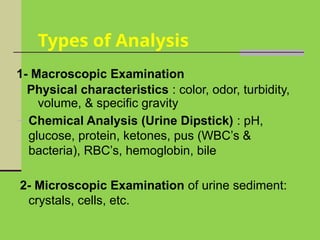
1- Macroscopic Examination
Physical characteristics : color, odor, turbidity,
volume, & specific gravity
− Chemical Analysis (Urine Dipstick) : pH,
glucose, protein, ketones, pus (WBC’s &
bacteria), RBC’s, hemoglobin, bile
2- Microscopic Examination of urine sediment:
crystals, cells, etc.
Types of Analysis
Physical examination
 Volume
 Color
 Odour
 Reaction or urinary pH
 Specific gravity
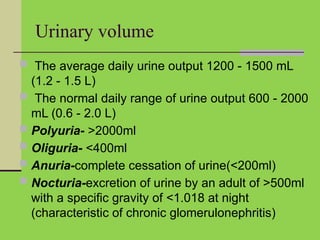
Urinary volume
 The average daily urine output 1200 - 1500 mL
(1.2 - 1.5 L)
 The normal daily range of urine output 600 - 2000
mL (0.6 - 2.0 L)
 Polyuria- >2000ml
 Oliguria- <400ml
 Anuria-complete cessation of urine(<200ml)
 Nocturia-excretion of urine by an adult of >500ml
with a specific gravity of <1.018 at night
(characteristic of chronic glomerulonephritis)
Causes of polyuria > 2000ml
 Diabetes mellitus
 Diabetes insipidus
 Polycystic kidney
 Chronic renal failure
 Diuretics
 Intravenous saline/glucose
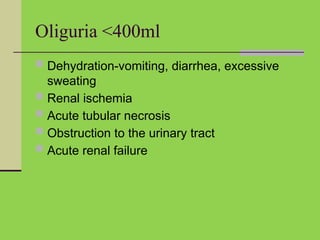
Oliguria <400ml
 Dehydration-vomiting, diarrhea, excessive
sweating
 Renal ischemia
 Acute tubular necrosis
 Obstruction to the urinary tract
 Acute renal failure
Urine Color and Clarity
 Urine color and clarity can indicate what
substances may be present in urine.
 Confirmation of suspected substances is obtained
during the chemical and microsopic examination.
Urine Color
 Normal urine color ranges from pale yellow to deep
amber — the result of a pigment called urochrome
 Most changes in urine color are harmless and
temporary and may be due to:
 Certain foods – beets may turn urine red
 Dyes in foods/drinks
 Supplements – vitamins
 Prescription drugs
Abnormal colors of urine & possible causes
 Unusual urine color can indicate an infection or
serious illness .
 Colourless- dilution, diabetes mellitus,
diabetes insipidus, diuretics
1. Milky- genitourinary tract infection
2. Orange-fever, excessive sweating, bilirubin
3. Red-beetroot ingestion,haematuria
4. Brown/ black- alkaptunuria, melanin
 Green - bile, Pseudomonas bacteria
Examples of Urine Color
Urine Clarity
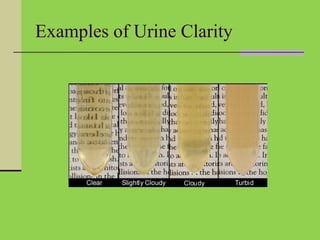
 Urine clarity refers to how clear the urine is.
 Terms used: clear, transparent, slightly
cloudy, cloudy, or turbid.
 “Normal” urine can be clear or cloudy.
 The clarity of the urine is not as important as
the substance that is causing the urine to be
cloudy.
 Turbidity - “cloudiness” due to
particulate matter
suspended in urine
Urine Clarity
 Substances that cause cloudiness but that are not
considered unhealthy include:
 mucous,
 sperm and prostatic fluid,
 cells from the skin,
 normal urine crystals, and
 contaminants (like body lotions and powders).
 Other substances that can make urine cloudy (such
as red blood cells, white blood cells, or bacteria)
indicate a condition that requires attention.
Examples of Urine Clarity
Odour
 Normal= aromatic due to the volatile fatty
acids
 Standing (“old”) urine takes on an ammonia
odor due to urea-splitting bacterial
 Foul, offensive: Old specimen, pus or
inflammation
− Sweet: Glucose
− Fruity: Ketones

urine_analysis -urine _ analysis.pptx

  • 1.
  • 2.
    Purpose  Urine containsimportant metabolic information  Urine is cheap, simple, & readily available  General evaluation of health  Diagnosis of disease or disorders of the kidneys or urinary tract  Diagnosis of other systemic disease that affect kidney function  Monitoring of patients with diabetes  Screening for drug abuse (eg. Sulfonamide or aminoglycosides)
  • 3.
    Collection of urinespecimens  The first voided morning urine (most concentrated) - qualitative  Random urine (routine)  24hrs sample- quantitative  Mid-stream clean catch (MSCC) (for urine culture)- UTI  Post prandial sample-D.M Attention  Need to be examined within 1 hour
  • 4.
    24 hour urinesample 1. For quantitative estimation of proteins 2. For estimation of vanillyl mandelic acid, 5- hydroxyindole acetic acid, metanephrines 3. For detection of AFB in urine 4. For detection of microalbuminuria
  • 5.
    1- Macroscopic Examination Physicalcharacteristics : color, odor, turbidity, volume, & specific gravity − Chemical Analysis (Urine Dipstick) : pH, glucose, protein, ketones, pus (WBC’s & bacteria), RBC’s, hemoglobin, bile 2- Microscopic Examination of urine sediment: crystals, cells, etc. Types of Analysis
  • 6.
    Physical examination  Volume Color  Odour  Reaction or urinary pH  Specific gravity
  • 7.
    Urinary volume  Theaverage daily urine output 1200 - 1500 mL (1.2 - 1.5 L)  The normal daily range of urine output 600 - 2000 mL (0.6 - 2.0 L)  Polyuria- >2000ml  Oliguria- <400ml  Anuria-complete cessation of urine(<200ml)  Nocturia-excretion of urine by an adult of >500ml with a specific gravity of <1.018 at night (characteristic of chronic glomerulonephritis)
  • 8.
    Causes of polyuria> 2000ml  Diabetes mellitus  Diabetes insipidus  Polycystic kidney  Chronic renal failure  Diuretics  Intravenous saline/glucose
  • 9.
    Oliguria <400ml  Dehydration-vomiting,diarrhea, excessive sweating  Renal ischemia  Acute tubular necrosis  Obstruction to the urinary tract  Acute renal failure
  • 10.
    Urine Color andClarity  Urine color and clarity can indicate what substances may be present in urine.  Confirmation of suspected substances is obtained during the chemical and microsopic examination.
  • 11.
    Urine Color  Normalurine color ranges from pale yellow to deep amber — the result of a pigment called urochrome  Most changes in urine color are harmless and temporary and may be due to:  Certain foods – beets may turn urine red  Dyes in foods/drinks  Supplements – vitamins  Prescription drugs
  • 12.
    Abnormal colors ofurine & possible causes  Unusual urine color can indicate an infection or serious illness .  Colourless- dilution, diabetes mellitus, diabetes insipidus, diuretics 1. Milky- genitourinary tract infection 2. Orange-fever, excessive sweating, bilirubin 3. Red-beetroot ingestion,haematuria 4. Brown/ black- alkaptunuria, melanin  Green - bile, Pseudomonas bacteria
  • 13.
  • 14.
    Urine Clarity  Urineclarity refers to how clear the urine is.  Terms used: clear, transparent, slightly cloudy, cloudy, or turbid.  “Normal” urine can be clear or cloudy.  The clarity of the urine is not as important as the substance that is causing the urine to be cloudy.  Turbidity - “cloudiness” due to particulate matter suspended in urine
  • 15.
    Urine Clarity  Substancesthat cause cloudiness but that are not considered unhealthy include:  mucous,  sperm and prostatic fluid,  cells from the skin,  normal urine crystals, and  contaminants (like body lotions and powders).  Other substances that can make urine cloudy (such as red blood cells, white blood cells, or bacteria) indicate a condition that requires attention.
  • 16.
  • 17.
    Odour  Normal= aromaticdue to the volatile fatty acids  Standing (“old”) urine takes on an ammonia odor due to urea-splitting bacterial  Foul, offensive: Old specimen, pus or inflammation − Sweet: Glucose − Fruity: Ketones