Urban Agents Adaptive City Knowledge and Autonomous Agents Steve Guerin Fabio Carrera April 22, 2009
Born in Venice, Italy  BSEE and MSCS @ WPI  PhD @ MIT Urban Information Systems and Planning  Teaching @ WPI and MIT Director of Venice and Boston Project Centers Founder and Director of City Lab (WPI) Planning Board in Spencer, MA Consultant to municipalities Bio Fabio Carrera
City Knowledge The 6 Tools Birth Certificates  Data Farming The Long Tail of Small Cities  Presentation Outline
Promotes   the transformation of  municipalities from  hunter-gatherers  of urban data  to  farmers  of municipal information City Knowledge
Municipalities are the  locus  of change Cities = Structures + Activities Reality = Backlog + Future Change Space Is the Glue Middle-out = Top-down + Bottom-up Government only has 6 tools for implementation and data collection The Premises of CK
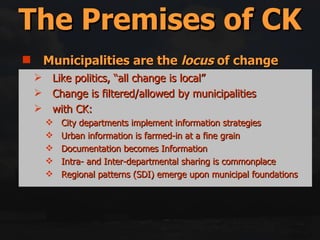
Municipalities are the  locus  of change Cities = Structures + Activities Reality = Backlog + Future Change Space Is the Glue Middle-out = Top-down + Bottom-up Government only has 5 (or so) tools for implementation The Premises of CK Like politics, “all change is local” Change is filtered/allowed by municipalities with CK: City departments implement information strategies Urban information is farmed-in at a fine grain Documentation becomes Information Intra- and Inter-departmental sharing is commonplace Regional patterns (SDI) emerge upon municipal foundations
Municipalities are the  locus  of change Cities = Structures + Activities Reality = Backlog + Future Change Space Is the Glue Middle-out = Top-down + Bottom-up Government only has 5 (or so) tools for implementation The Premises of CK “ The Fundamental problem is to decide what the form of a human settlement consists of  […]  […] the chosen ground is the spatiotemporal distribution of human actions and the physical things which are the context of those actions […]”.   Lynch,  Good City Form , p. 48  Structures are more stable and permanent Structural change can be captured as it occurs Activities are more dynamic and fickle Activities can be frozen in time and space (snapshots) with CK: Information about structures is routinely updated Activities are “spatialized” Activities are periodically frozen
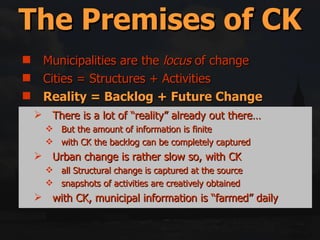
Municipalities are the  locus  of change Cities = Structures + Activities Reality = Backlog + Future Change Space Is the Glue Middle-out = Top-down + Bottom-up Government only has 5 (or so) tools for implementation The Premises of CK There is a lot of “reality” already out there… But the amount of information is finite with CK the backlog can be completely captured Urban change is rather slow so, with CK all Structural change is captured at the source snapshots of activities are creatively obtained  with CK, municipal information is “farmed” daily
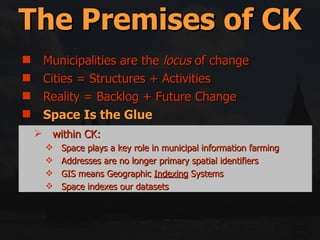
Municipalities are the  locus  of change Cities = Structures + Activities Reality = Backlog + Future Change Space Is the Glue Middle-out = Top-down + Bottom-up Government only has 5 (or so) tools for implementation The Premises of CK within CK: Space plays a key role in municipal information farming Addresses are no longer primary spatial identifiers GIS means Geographic  Indexing  Systems Space indexes our datasets
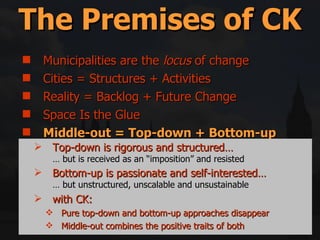
Municipalities are the  locus  of change Cities = Structures + Activities Reality = Backlog + Future Change Space Is the Glue Middle-out = Top-down + Bottom-up Government only has 5 (or so) tools for implementation The Premises of CK Top-down is rigorous and structured… … but is received as an “imposition” and resisted Bottom-up is passionate and self-interested… … but unstructured, unscalable and unsustainable with CK: Pure top-down and bottom-up approaches disappear Middle-out combines the positive traits of both
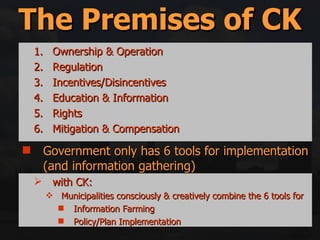
Municipalities are the  locus  of change Cities = Structures + Activities Reality = Backlog + Future Change Space Is the Glue Middle-out = Top-down + Bottom-up Government only has 6 tools for implementation (and information gathering) The Premises of CK Ownership & Operation Regulation Incentives/Disincentives Education & Information Rights Mitigation & Compensation with CK: Municipalities consciously & creatively combine the 6 tools for Information Farming  Policy/Plan Implementation
Presentation in 2007 Santa Fe Institute WPI Connection Nicholas De Monchaux Redfish – Steve Guerin The  WPI Santa Fe Project Center City Knowledge and Santa Fe
Ownership and Operation Regulation Incentives/Disincentives Education and Information Right swapping Mitigation and Compensation 6 Tools of Gov.’t applied to Data Farming
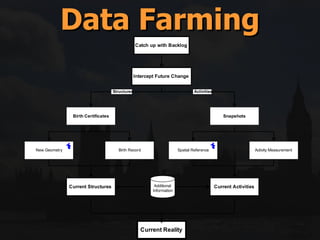
Ownership and Operation Regulation Incentives/Disincentives Education and Information Right swapping Mitigation and Compensation 6 Tools of Gov.’t whereby municipalities… Adopt internal mechanisms to farm THEIR OWN data Emphasize Information in Standard Operating Procedures Extract Informational Returns from all internal processes Change “job descriptions” for personnel to include information Catch up with their own “backlog” Intercept all future internal change as it happens applied to Data Farming
Ownership and Operation Regulation Incentives/Disincentives Education and Information Right swapping Mitigation and Compensation 6 Tools of Gov.’t applied to Data Farming whereby municipalities… Make informational Returns part of their regulations Force outside entities to provide information (for free) Change submission requirements (permits, plans…) Modify maintenance and management contracts Institute yearly renewals for data updates Apply regulations to capture backlog as well Invent creative ways to acquire datasets Become “validators” instead of “collectors”
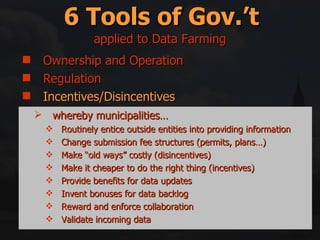
Ownership and Operation Regulation Incentives/Disincentives Education and Information Right swapping Mitigation and Compensation 6 Tools of Gov.’t applied to Data Farming whereby municipalities… Routinely entice outside entities into providing information Change submission fee structures (permits, plans…) Make “old ways” costly (disincentives) Make it cheaper to do the right thing (incentives) Provide benefits for data updates Invent bonuses for data backlog Reward and enforce collaboration Validate incoming data
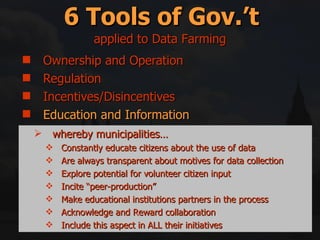
Ownership and Operation Regulation Incentives/Disincentives Education and Information Right swapping Mitigation and Compensation 6 Tools of Gov.’t applied to Data Farming whereby municipalities… Constantly educate citizens about the use of data Are always transparent about motives for data collection Explore potential for volunteer citizen input Incite “peer-production” Make educational institutions partners in the process Acknowledge and Reward collaboration Include this aspect in ALL their initiatives
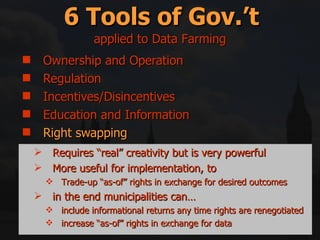
Ownership and Operation Regulation Incentives/Disincentives Education and Information Right swapping Mitigation and Compensation 6 Tools of Gov.’t applied to Data Farming Requires “real” creativity but is very powerful More useful for implementation, to Trade-up “as-of” rights in exchange for desired outcomes in the end municipalities can… include informational returns any time rights are renegotiated increase “as-of” rights in exchange for data
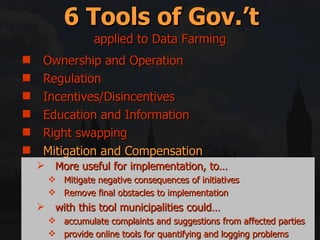
Ownership and Operation Regulation Incentives/Disincentives Education and Information Right swapping Mitigation and Compensation 6 Tools of Gov.’t applied to Data Farming More useful for implementation, to… Mitigate negative consequences of initiatives Remove final obstacles to implementation with this tool municipalities could… accumulate complaints and suggestions from affected parties provide online tools for quantifying and logging problems
City Knowledge The 6 Tools Birth Certificates   Data Farming The Long Tail of Small Cities  Presentation Outline
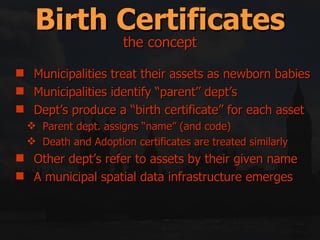
Birth Certificates Municipalities treat their assets as newborn babies Municipalities identify “parent” dept’s Dept’s produce a “birth certificate” for each asset  Parent dept. assigns “name” (and code) Death and Adoption certificates are treated similarly Other dept’s refer to assets by their given name A municipal spatial data infrastructure emerges the concept
 
City Knowledge The 6 Tools Birth Certificates  Data Farming The Long Tail of Small Cities  Presentation Outline
Data Farming
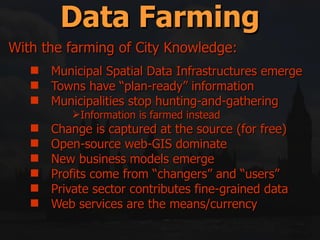
Municipal Spatial Data Infrastructures emerge Towns have “plan-ready” information Municipalities stop hunting-and-gathering Information is farmed instead Change is captured at the source (for free) Open-source web-GIS dominate New business models emerge Profits come from “changers” and “users” Private sector contributes fine-grained data Web services are the means/currency Data Farming With the farming of City Knowledge:
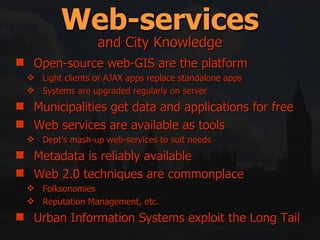
Web-services Open-source web-GIS are the platform Light clients or AJAX apps replace standalone apps Systems are upgraded regularly on server Municipalities get data and applications for free Web services are available as tools Dept’s mash-up web-services to suit needs Metadata is reliably available Web 2.0 techniques are commonplace Folksonomies Reputation Management, etc. Urban Information Systems exploit the Long Tail and City Knowledge
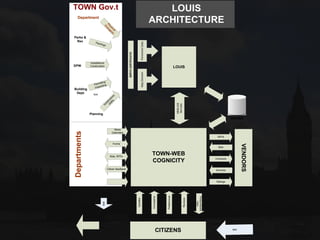
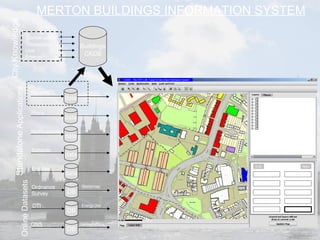
MERTON BUILDINGS INFORMATION SYSTEM Standalone  Applications DB DB DB Ordnance  Survey DTI ONS Online Datasets Permits Plans Notifications Ownership Use Construction Energy City  Knowledge Mastermap Energy Use Demographics Schools Estates Analysis… New Edit Uses… buildings roads parks schools churches industries orthos hydrology boundaries Energy… Maintenance… Leases… Repairs… Notifications… Contracts… Permits… Inspections… public buildings council estates businesses orthophotos roads CHP plants 50 m LOUIS – The CITY LAB  “Local On-line Urban Information System” data data Buildings CKDB data data data
City Knowledge The 6 Tools Birth Certificates  Data Farming The Long Tail of Small Cities   Presentation Outline
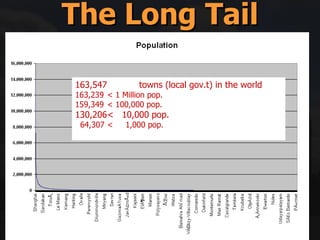
The Long Tail 163,547  towns (local gov.t) in the world 163,239 < 1 Million pop. 159,349 < 100,000 pop. 130,206 <  10,000 pop. 64,307 <  1,000 pop.
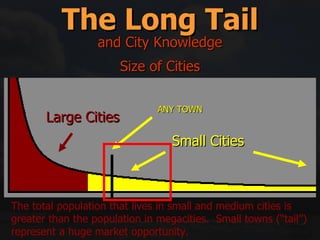
The Long Tail and City Knowledge Size of Cities Large Cities Small Cities The total population that lives in small and medium cities is greater than the population in megacities.  Small towns (“tail”) represent a huge market opportunity. ANY TOWN
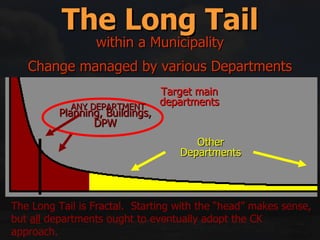
The Long Tail Change managed by various Departments Planning, Buildings, DPW Other Departments The Long Tail is Fractal.  within a Municipality Target main departments ANY DEPARTMENT The Long Tail is Fractal.  Starting with the “head” makes sense, but  all  departments ought to eventually adopt the CK approach.
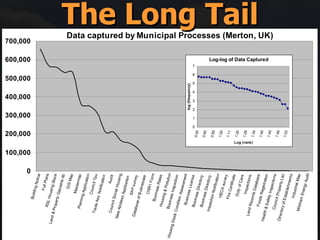
The Long Tail
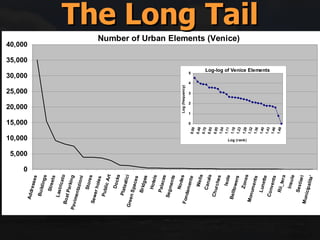
The Long Tail
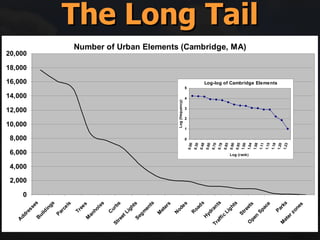
The Long Tail
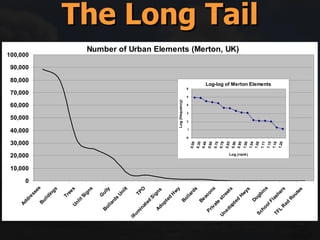
The Long Tail
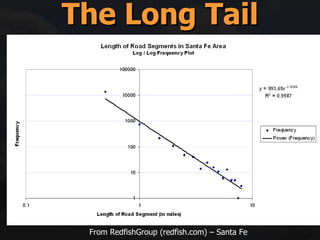
The Long Tail From RedfishGroup (redfish.com) – Santa Fe
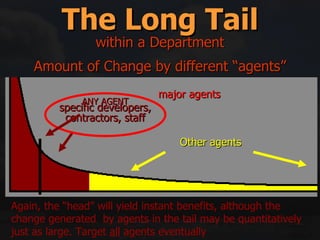
The Long Tail Amount of Change by different “agents” specific developers, contractors, staff Other agents Again, the “head” will yield instant benefits, although the change generated  by agents in the tail may be quantitatively just as large. Target  all  agents eventually major agents within a Department ANY AGENT
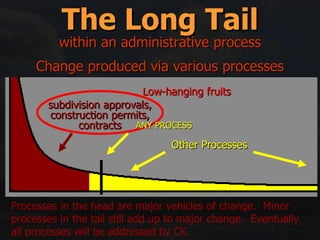
The Long Tail Change produced via various processes subdivision approvals, construction permits, contracts Other Processes Processes in the head are major vehicles of change.  Minor processes in the tail still add up to major change.  Eventually all processes will be addressed by CK. within an administrative process Low-hanging fruits ANY PROCESS
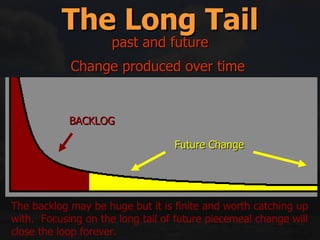
The Long Tail Change produced over time  BACKLOG Future Change The backlog may be huge but it is finite and worth catching up with.  Focusing on the long tail of future piecemeal change will close the loop forever. past and future
Municipal Spatial Data Infrastructures flourish Departments farm their “data plots” The 6 tools make data farming perpetual/free Fine-grain is achieved routinely Backlog is completely captured  Change is intercepted as it happens Technologies automate/facilitate data collection Web-services enable intra-/inter-dept. sharing Information is treated like an infrastructure In Summary
More about CK [email_address] http://www.wpi.edu/~carrera/Publications/Publications.html http://www.wpi.edu/~carrera/MIT/dissertation.html

Urban agents

  • 1.
    Urban Agents AdaptiveCity Knowledge and Autonomous Agents Steve Guerin Fabio Carrera April 22, 2009
  • 2.
    Born in Venice,Italy BSEE and MSCS @ WPI PhD @ MIT Urban Information Systems and Planning Teaching @ WPI and MIT Director of Venice and Boston Project Centers Founder and Director of City Lab (WPI) Planning Board in Spencer, MA Consultant to municipalities Bio Fabio Carrera
  • 3.
    City Knowledge The6 Tools Birth Certificates Data Farming The Long Tail of Small Cities Presentation Outline
  • 4.
    City Knowledge The6 Tools Birth Certificates Data Farming The Long Tail of Small Cities Presentation Outline
  • 5.
    Promotes the transformation of municipalities from hunter-gatherers of urban data to farmers of municipal information City Knowledge
  • 6.
    Municipalities are the locus of change Cities = Structures + Activities Reality = Backlog + Future Change Space Is the Glue Middle-out = Top-down + Bottom-up Government only has 6 tools for implementation and data collection The Premises of CK
  • 7.
    Municipalities are the locus of change Cities = Structures + Activities Reality = Backlog + Future Change Space Is the Glue Middle-out = Top-down + Bottom-up Government only has 5 (or so) tools for implementation The Premises of CK Like politics, “all change is local” Change is filtered/allowed by municipalities with CK: City departments implement information strategies Urban information is farmed-in at a fine grain Documentation becomes Information Intra- and Inter-departmental sharing is commonplace Regional patterns (SDI) emerge upon municipal foundations
  • 8.
    Municipalities are the locus of change Cities = Structures + Activities Reality = Backlog + Future Change Space Is the Glue Middle-out = Top-down + Bottom-up Government only has 5 (or so) tools for implementation The Premises of CK “ The Fundamental problem is to decide what the form of a human settlement consists of […] […] the chosen ground is the spatiotemporal distribution of human actions and the physical things which are the context of those actions […]”. Lynch, Good City Form , p. 48 Structures are more stable and permanent Structural change can be captured as it occurs Activities are more dynamic and fickle Activities can be frozen in time and space (snapshots) with CK: Information about structures is routinely updated Activities are “spatialized” Activities are periodically frozen
  • 9.
    Municipalities are the locus of change Cities = Structures + Activities Reality = Backlog + Future Change Space Is the Glue Middle-out = Top-down + Bottom-up Government only has 5 (or so) tools for implementation The Premises of CK There is a lot of “reality” already out there… But the amount of information is finite with CK the backlog can be completely captured Urban change is rather slow so, with CK all Structural change is captured at the source snapshots of activities are creatively obtained with CK, municipal information is “farmed” daily
  • 10.
    Municipalities are the locus of change Cities = Structures + Activities Reality = Backlog + Future Change Space Is the Glue Middle-out = Top-down + Bottom-up Government only has 5 (or so) tools for implementation The Premises of CK within CK: Space plays a key role in municipal information farming Addresses are no longer primary spatial identifiers GIS means Geographic Indexing Systems Space indexes our datasets
  • 11.
    Municipalities are the locus of change Cities = Structures + Activities Reality = Backlog + Future Change Space Is the Glue Middle-out = Top-down + Bottom-up Government only has 5 (or so) tools for implementation The Premises of CK Top-down is rigorous and structured… … but is received as an “imposition” and resisted Bottom-up is passionate and self-interested… … but unstructured, unscalable and unsustainable with CK: Pure top-down and bottom-up approaches disappear Middle-out combines the positive traits of both
  • 12.
    Municipalities are the locus of change Cities = Structures + Activities Reality = Backlog + Future Change Space Is the Glue Middle-out = Top-down + Bottom-up Government only has 6 tools for implementation (and information gathering) The Premises of CK Ownership & Operation Regulation Incentives/Disincentives Education & Information Rights Mitigation & Compensation with CK: Municipalities consciously & creatively combine the 6 tools for Information Farming Policy/Plan Implementation
  • 13.
    Presentation in 2007Santa Fe Institute WPI Connection Nicholas De Monchaux Redfish – Steve Guerin The WPI Santa Fe Project Center City Knowledge and Santa Fe
  • 14.
    Ownership and OperationRegulation Incentives/Disincentives Education and Information Right swapping Mitigation and Compensation 6 Tools of Gov.’t applied to Data Farming
  • 15.
    Ownership and OperationRegulation Incentives/Disincentives Education and Information Right swapping Mitigation and Compensation 6 Tools of Gov.’t whereby municipalities… Adopt internal mechanisms to farm THEIR OWN data Emphasize Information in Standard Operating Procedures Extract Informational Returns from all internal processes Change “job descriptions” for personnel to include information Catch up with their own “backlog” Intercept all future internal change as it happens applied to Data Farming
  • 16.
    Ownership and OperationRegulation Incentives/Disincentives Education and Information Right swapping Mitigation and Compensation 6 Tools of Gov.’t applied to Data Farming whereby municipalities… Make informational Returns part of their regulations Force outside entities to provide information (for free) Change submission requirements (permits, plans…) Modify maintenance and management contracts Institute yearly renewals for data updates Apply regulations to capture backlog as well Invent creative ways to acquire datasets Become “validators” instead of “collectors”
  • 17.
    Ownership and OperationRegulation Incentives/Disincentives Education and Information Right swapping Mitigation and Compensation 6 Tools of Gov.’t applied to Data Farming whereby municipalities… Routinely entice outside entities into providing information Change submission fee structures (permits, plans…) Make “old ways” costly (disincentives) Make it cheaper to do the right thing (incentives) Provide benefits for data updates Invent bonuses for data backlog Reward and enforce collaboration Validate incoming data
  • 18.
    Ownership and OperationRegulation Incentives/Disincentives Education and Information Right swapping Mitigation and Compensation 6 Tools of Gov.’t applied to Data Farming whereby municipalities… Constantly educate citizens about the use of data Are always transparent about motives for data collection Explore potential for volunteer citizen input Incite “peer-production” Make educational institutions partners in the process Acknowledge and Reward collaboration Include this aspect in ALL their initiatives
  • 19.
    Ownership and OperationRegulation Incentives/Disincentives Education and Information Right swapping Mitigation and Compensation 6 Tools of Gov.’t applied to Data Farming Requires “real” creativity but is very powerful More useful for implementation, to Trade-up “as-of” rights in exchange for desired outcomes in the end municipalities can… include informational returns any time rights are renegotiated increase “as-of” rights in exchange for data
  • 20.
    Ownership and OperationRegulation Incentives/Disincentives Education and Information Right swapping Mitigation and Compensation 6 Tools of Gov.’t applied to Data Farming More useful for implementation, to… Mitigate negative consequences of initiatives Remove final obstacles to implementation with this tool municipalities could… accumulate complaints and suggestions from affected parties provide online tools for quantifying and logging problems
  • 21.
    City Knowledge The6 Tools Birth Certificates Data Farming The Long Tail of Small Cities Presentation Outline
  • 22.
    Birth Certificates Municipalitiestreat their assets as newborn babies Municipalities identify “parent” dept’s Dept’s produce a “birth certificate” for each asset Parent dept. assigns “name” (and code) Death and Adoption certificates are treated similarly Other dept’s refer to assets by their given name A municipal spatial data infrastructure emerges the concept
  • 23.
  • 24.
    City Knowledge The6 Tools Birth Certificates Data Farming The Long Tail of Small Cities Presentation Outline
  • 25.
  • 26.
    Municipal Spatial DataInfrastructures emerge Towns have “plan-ready” information Municipalities stop hunting-and-gathering Information is farmed instead Change is captured at the source (for free) Open-source web-GIS dominate New business models emerge Profits come from “changers” and “users” Private sector contributes fine-grained data Web services are the means/currency Data Farming With the farming of City Knowledge:
  • 27.
    Web-services Open-source web-GISare the platform Light clients or AJAX apps replace standalone apps Systems are upgraded regularly on server Municipalities get data and applications for free Web services are available as tools Dept’s mash-up web-services to suit needs Metadata is reliably available Web 2.0 techniques are commonplace Folksonomies Reputation Management, etc. Urban Information Systems exploit the Long Tail and City Knowledge
  • 28.
    MERTON BUILDINGS INFORMATIONSYSTEM Standalone Applications DB DB DB Ordnance Survey DTI ONS Online Datasets Permits Plans Notifications Ownership Use Construction Energy City Knowledge Mastermap Energy Use Demographics Schools Estates Analysis… New Edit Uses… buildings roads parks schools churches industries orthos hydrology boundaries Energy… Maintenance… Leases… Repairs… Notifications… Contracts… Permits… Inspections… public buildings council estates businesses orthophotos roads CHP plants 50 m LOUIS – The CITY LAB “Local On-line Urban Information System” data data Buildings CKDB data data data
  • 29.
    City Knowledge The6 Tools Birth Certificates Data Farming The Long Tail of Small Cities Presentation Outline
  • 30.
    The Long Tail163,547 towns (local gov.t) in the world 163,239 < 1 Million pop. 159,349 < 100,000 pop. 130,206 < 10,000 pop. 64,307 < 1,000 pop.
  • 31.
    The Long Tailand City Knowledge Size of Cities Large Cities Small Cities The total population that lives in small and medium cities is greater than the population in megacities. Small towns (“tail”) represent a huge market opportunity. ANY TOWN
  • 32.
    The Long TailChange managed by various Departments Planning, Buildings, DPW Other Departments The Long Tail is Fractal. within a Municipality Target main departments ANY DEPARTMENT The Long Tail is Fractal. Starting with the “head” makes sense, but all departments ought to eventually adopt the CK approach.
  • 33.
  • 34.
  • 35.
  • 36.
  • 37.
    The Long TailFrom RedfishGroup (redfish.com) – Santa Fe
  • 38.
    The Long TailAmount of Change by different “agents” specific developers, contractors, staff Other agents Again, the “head” will yield instant benefits, although the change generated by agents in the tail may be quantitatively just as large. Target all agents eventually major agents within a Department ANY AGENT
  • 39.
    The Long TailChange produced via various processes subdivision approvals, construction permits, contracts Other Processes Processes in the head are major vehicles of change. Minor processes in the tail still add up to major change. Eventually all processes will be addressed by CK. within an administrative process Low-hanging fruits ANY PROCESS
  • 40.
    The Long TailChange produced over time BACKLOG Future Change The backlog may be huge but it is finite and worth catching up with. Focusing on the long tail of future piecemeal change will close the loop forever. past and future
  • 41.
    Municipal Spatial DataInfrastructures flourish Departments farm their “data plots” The 6 tools make data farming perpetual/free Fine-grain is achieved routinely Backlog is completely captured Change is intercepted as it happens Technologies automate/facilitate data collection Web-services enable intra-/inter-dept. sharing Information is treated like an infrastructure In Summary
  • 42.
    More about CK[email_address] http://www.wpi.edu/~carrera/Publications/Publications.html http://www.wpi.edu/~carrera/MIT/dissertation.html

Editor's Notes