Baruch
Summer
Interns
2015
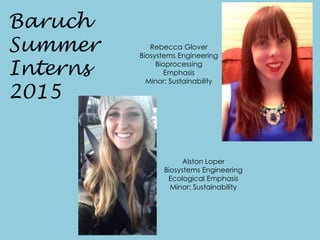
Rebecca Glover
Biosystems Engineering
Bioprocessing
Emphasis
Minor: Sustainability
Alston Loper
Biosystems Engineering
Ecological Emphasis
Minor: Sustainability
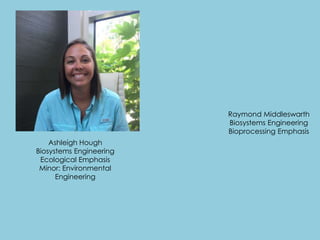
Ashleigh Hough
Biosystems Engineering
Ecological Emphasis
Minor: Environmental
Engineering
Raymond Middleswarth
Biosystems Engineering
Bioprocessing Emphasis
Internship Objectives
• gain experience with field
work, lab work and
analyses of data
• characterize baseline
water quantity and water
quality data for an
engineered pond-
wetland system and a
“natural” wetland system
• deploy sampling and
monitoring instruments for
storm sampling
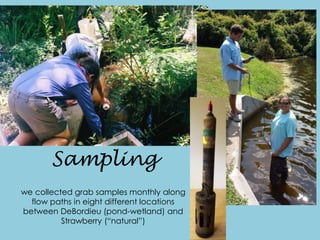
Sampling
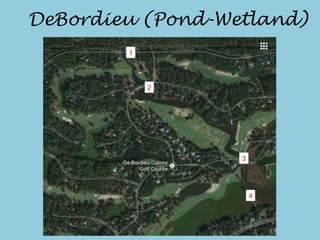
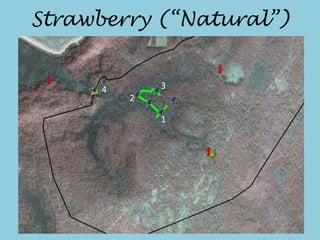
we collected grab samples monthly along
flow paths in eight different locations
between DeBordieu (pond-wetland) and
Strawberry (“natural”)
DeBordieu (Pond-Wetland)
Strawberry (“Natural”)
4
1
2
3
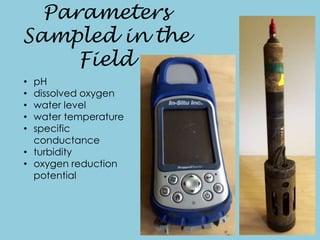
Parameters
Sampled in the
Field
• pH
• dissolved oxygen
• water level
• water temperature
• specific
conductance
• turbidity
• oxygen reduction
potential
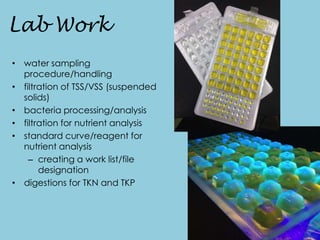
Lab Work
• water sampling
procedure/handling
• filtration of TSS/VSS (suspended
solids)
• bacteria processing/analysis
• filtration for nutrient analysis
• standard curve/reagent for
nutrient analysis
– creating a work list/file
designation
• digestions for TKN and TKP
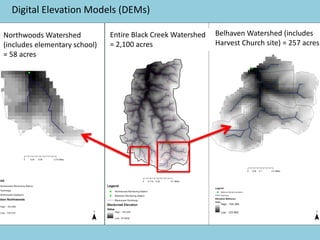
Digital Elevation Models (DEMs)
Entire Black Creek Watershed
= 2,100 acres
Northwoods Watershed
(includes elementary school)
= 58 acres
Belhaven Watershed (includes
Harvest Church site) = 257 acres
0.0
0.1
0.2
0.3
0.4
0.5
0.6
0.1 0.3 0.5 1.0
PredictedRunoffVolume(in.)
Simulated Rainfall (in.)
0.0
0.1
0.2
0.3
0.4
0.5
0.6
0.1 0.3 0.5 1.0
PredictedRunoffVolume(in.)
Simulated Rainfall (in.)
0.0
0.1
0.2
0.3
0.4
0.5
0.6
0.1 0.3 0.5 1.0
PredictedRunoffVolume(in.)
Simulated Rainfall (in.)
0.0
0.1
0.2
0.3
0.4
0.5
0.6
0.1 0.3 0.5 1.0
PredictedRunoffVolume(in.)
Simulated Rainfall (in.)
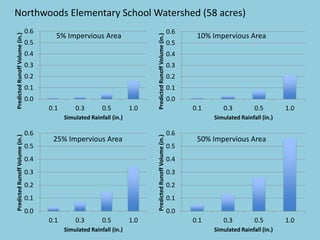
5% Impervious Area
25% Impervious Area 50% Impervious Area
10% Impervious Area
Northwoods Elementary School Watershed (58 acres)
UPIC Internship 2015

UPIC Internship 2015

  • 1.
    Baruch Summer Interns 2015 Rebecca Glover Biosystems Engineering Bioprocessing Emphasis Minor:Sustainability Alston Loper Biosystems Engineering Ecological Emphasis Minor: Sustainability
  • 2.
    Ashleigh Hough Biosystems Engineering EcologicalEmphasis Minor: Environmental Engineering Raymond Middleswarth Biosystems Engineering Bioprocessing Emphasis
  • 3.
    Internship Objectives • gainexperience with field work, lab work and analyses of data • characterize baseline water quantity and water quality data for an engineered pond- wetland system and a “natural” wetland system • deploy sampling and monitoring instruments for storm sampling
  • 4.
    Sampling we collected grabsamples monthly along flow paths in eight different locations between DeBordieu (pond-wetland) and Strawberry (“natural”)
  • 5.
  • 6.
  • 7.
    Parameters Sampled in the Field •pH • dissolved oxygen • water level • water temperature • specific conductance • turbidity • oxygen reduction potential
  • 8.
    Lab Work • watersampling procedure/handling • filtration of TSS/VSS (suspended solids) • bacteria processing/analysis • filtration for nutrient analysis • standard curve/reagent for nutrient analysis – creating a work list/file designation • digestions for TKN and TKP
  • 9.
    Digital Elevation Models(DEMs) Entire Black Creek Watershed = 2,100 acres Northwoods Watershed (includes elementary school) = 58 acres Belhaven Watershed (includes Harvest Church site) = 257 acres
  • 13.
    0.0 0.1 0.2 0.3 0.4 0.5 0.6 0.1 0.3 0.51.0 PredictedRunoffVolume(in.) Simulated Rainfall (in.) 0.0 0.1 0.2 0.3 0.4 0.5 0.6 0.1 0.3 0.5 1.0 PredictedRunoffVolume(in.) Simulated Rainfall (in.) 0.0 0.1 0.2 0.3 0.4 0.5 0.6 0.1 0.3 0.5 1.0 PredictedRunoffVolume(in.) Simulated Rainfall (in.) 0.0 0.1 0.2 0.3 0.4 0.5 0.6 0.1 0.3 0.5 1.0 PredictedRunoffVolume(in.) Simulated Rainfall (in.) 5% Impervious Area 25% Impervious Area 50% Impervious Area 10% Impervious Area Northwoods Elementary School Watershed (58 acres)

Editor's Notes

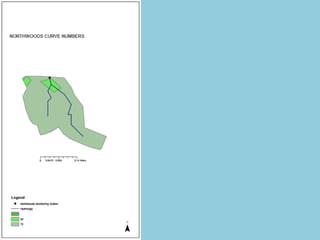
  • #10 We performed watershed hydrology modeling using HEC-HMS (pronounced “HECK H M S”) for small subwatersheds in the headwater areas of the larger Black Creek watershed. These drainage areas included the proposed sites of Low Impact Development practices – Northwoods Elementary (left) and Harvest Church (right). Digital elevation models (DEMs) that were generated in ArcGIS ArcHydro are shown for each. This was the first step toward flow routing determination and accumulation for runoff predictions under varying impervious cover scenarios.
  • #14 This slide shows HEC-HMS (pronounced “HECK H M S”) runoff modeling results for the Northwoods Elementary School Watershed (xx acres). Each graph shows rainfall amounts ranging from 0.1 to 1.0 inches (x-axis) with predicted runoff volumes on the y-axis (also in inches, which is volume of runoff divided by the watershed area). Scenarios for different impervious cover area percentages (5, 10, 25, and 50%) are given. You will notice the increase in runoff as impervious areas increase. For comparison, look at 1.0 inch of rainfall for all four scenarios (5 to 50% IC) as runoff increases from approx. 0.15 in. to 0.2 in. to 0.33 in. to 0.55 in. You can also think about this in terms of percentage of rainfall as runoff (e.g. for the 25% scenario, 0.33% of 1.0 in. of rainfall is discharged from the watershed). We are still working on Belhaven – it’s a little more complex of a watershed! We also had issues with the monitoring data for each but are working to resolve these and we will calibrate and validate these results before the project ends in a few months…