Who would the audience be for
your media product?
&
How did you attract/address
your audience?
by Molly Jackson
My target audience was originally from the age of 25 to 50 due to my theme
that I included in my film such as the theme of terrorism,which many
teenagers may not be able to fully understand. This therefore meant there
was a bigger chance of a young audience not understanding my film.
Whereas my target audience would be able to identify with the topics such
as bombing and war. Furthermore,his is the age range who are most likely
to watch thrillers. Luckily, a reasonable percentage who answered my pre-
production questionnaire were in my target audience and stated that they
did watch thrillers. However, I made my film have a certificate of the age 15
as I didn’t involve the topic of rape or sexual activity. However, the film
would include mild bad language and mild aspects of violence - during the
end scene, as the man kills the girl. This also allowed audiences which
were not in my original target audience view my film, hopefully gaining a
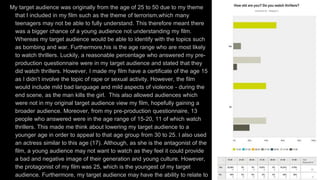
broader audience. Moreover, from my pre-production questionnaire, 13
people who answered were in the age range of 15-20, 11 of which watch
thrillers. This made me think about lowering my target audience to a
younger age in order to appeal to that age group from 30 to 25. I also used
an actress similar to this age (17). Although, as she is the antagonist of the
film, a young audience may not want to watch as they feel it could provide
a bad and negative image of their generation and young culture. However,
the protagonist of my film was 25, which is the youngest of my target
audience. Furthermore, my target audience may have the ability to relate to
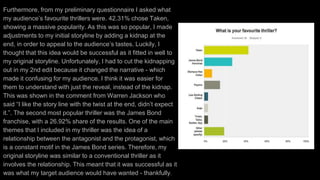
Furthermore, from my preliminary questionnaire I asked what
my audience’s favourite thrillers were. 42.31% chose Taken,
showing a massive popularity. As this was so popular, I made
adjustments to my initial storyline by adding a kidnap at the
end, in order to appeal to the audience’s tastes. Luckily, I
thought that this idea would be successful as it fitted in well to
my original storyline. Unfortunately, I had to cut the kidnapping
out in my 2nd edit because it changed the narrative - which
made it confusing for my audience. I think it was easier for
them to understand with just the reveal, instead of the kidnap.
This was shown in the comment from Warren Jackson who
said “I like the story line with the twist at the end, didn’t expect
it.”. The second most popular thriller was the James Bond
franchise, with a 26.92% share of the results. One of the main
themes that I included in my thriller was the idea of a
relationship between the antagonist and the protagonist, which
is a constant motif in the James Bond series. Therefore, my
original storyline was similar to a conventional thriller as it
involves the relationship. This meant that it was successful as it
was what my target audience would have wanted - thankfully.
From the questionnaire, I had more ideas in how to
attract and appeal to my audience, such as the love
affair and the kidnap, which were seen as traditional
thriller conventions, showing that my audience enjoyed
regular and accomplished thrillers. This meant my thriller
would have to be the same in themes and motifs.
However I subverted some conventions by using the
young girl as the antagonist in order to challenge the
stereotype. The male was the protagonist, which would
appeal to some male audiences, yet it may not have
appealed to some female audiences as it creates the
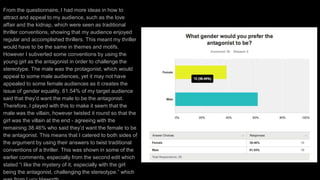
issue of gender equality. 61.54% of my target audience
said that they’d want the male to be the antagonist.
Therefore, I played with this to make it seem that the
male was the villain, however twisted it round so that the
girl was the villain at the end - agreeing with the
remaining 38.46% who said they’d want the female to be
the antagonist. This means that I catered to both sides of
the argument by using their answers to twist traditional
conventions of a thriller. This was shown in some of the
earlier comments, especially from the second edit which
stated “i like the mystery of it, especially with the girl
being the antagonist, challenging the stereotype.” which
On each of my edits, leading up to my final edit, I made my audience respond to my attempts
in comments. In total I received 30 comments, in which were all helpful. One of the main
recurring comments was on the darkness of the flashbacks. I had them quite dark in the
first edit because I thought it added an extra sense of mystery and a darker tone to the
activity, however my audience thought they needed to be lighter. Therefore, each edit I did,
I brightened up the flashbacks until they suited my audience - which wasn’t until the final
edit. This then weakened the original idea as it didn’t have that dark and sinister tone that I
initially wanted the shots to have. The aspect of shaky shots also occurred throughout my
edits. I initially wanted to use a handheld camera for the majority of the film to add a sense
of realism, to make it more thrilling for my audience. However my audience didn’t sense the
emphasis on realism, which therefore meant that my attempt to do this failed. This meant
that I had to refilm a number of shots and stabilise others during the editing process.
Luckily, my audience said that it was easy to distinguish the shots from the modern day
sequence and the flashbacks. This was due to the use of the black and white filter, which I
took the idea from Casino Royale. This was shown in the comment from Harriet Cameron:
“I also like the narrative of the opening as it is easy to distinguish between the modern day
and the flashbacks.” My audience also seemed to enjoy the use of the ticking and the
countdown, especially in my first edit, an example of this was Liam Johnson’s comment: “I
liked the use of the ticking noise in the background and the way you constantly cut back to
it showing that it’s not going away.” This therefore caused me to take the ticking aspect all
Furthermore, my audience also commented saying that they didn’t understand the relationship
between the two characters, making me cut and refilm the ending, so it was more clearer to the
audience. This then changed my original ideas of the plot, because the relationship between the two
characters was going to be explained in the actual rest of the film. One of the main comments that
stood out about this aspect was Talloulah Matthews’ “it is a bit unclear of what the plot line is and the
relationship between them”, therefore resulting in me cutting and refilming the ending in order to make
it more understandable for the audience. On the second edit, my audience only really mentioned that
the flashbacks had to brightened up again - which luckily was already on my to do list. My third edit
saw positive comments about the new close ups that I added in and refilmed as they helped to make it
“clear now that the girl is meant to be more innocent” - Will Godfrey. For my penultimate edit, Harriet
Cameron suggested that I should then change the way my titles appeared. To change the titles, I used
a different effect and font for each different aspect of making the film. For example, I used a different
font and transition for the role of director, to the actors of the film. My original idea was to make the
titles just appear on screen for the sense of simplicity, and not to distract the audience away from the
action on screen. However, as it was seen to ‘jar’ the audience, I had to completely change and adapt
them to my audience. After changing my titles, I found they worked more smoothly. In my final
audience comments, it was seen that they worked much better for the audience, which was seen in
the comment from Amanda Jackson: “I also like the titles, the set including the cast titles are good, I
like the rippling effect.” Overall, my audience feedback was really helpful as it was also the same
audience who answered my pre-production questionnaires.

Who would the audience be for your media product and how did you attract/address them?

  • 1.
    Who would theaudience be for your media product? & How did you attract/address your audience? by Molly Jackson
  • 2.
    My target audiencewas originally from the age of 25 to 50 due to my theme that I included in my film such as the theme of terrorism,which many teenagers may not be able to fully understand. This therefore meant there was a bigger chance of a young audience not understanding my film. Whereas my target audience would be able to identify with the topics such as bombing and war. Furthermore,his is the age range who are most likely to watch thrillers. Luckily, a reasonable percentage who answered my pre- production questionnaire were in my target audience and stated that they did watch thrillers. However, I made my film have a certificate of the age 15 as I didn’t involve the topic of rape or sexual activity. However, the film would include mild bad language and mild aspects of violence - during the end scene, as the man kills the girl. This also allowed audiences which were not in my original target audience view my film, hopefully gaining a broader audience. Moreover, from my pre-production questionnaire, 13 people who answered were in the age range of 15-20, 11 of which watch thrillers. This made me think about lowering my target audience to a younger age in order to appeal to that age group from 30 to 25. I also used an actress similar to this age (17). Although, as she is the antagonist of the film, a young audience may not want to watch as they feel it could provide a bad and negative image of their generation and young culture. However, the protagonist of my film was 25, which is the youngest of my target audience. Furthermore, my target audience may have the ability to relate to
  • 3.
    Furthermore, from mypreliminary questionnaire I asked what my audience’s favourite thrillers were. 42.31% chose Taken, showing a massive popularity. As this was so popular, I made adjustments to my initial storyline by adding a kidnap at the end, in order to appeal to the audience’s tastes. Luckily, I thought that this idea would be successful as it fitted in well to my original storyline. Unfortunately, I had to cut the kidnapping out in my 2nd edit because it changed the narrative - which made it confusing for my audience. I think it was easier for them to understand with just the reveal, instead of the kidnap. This was shown in the comment from Warren Jackson who said “I like the story line with the twist at the end, didn’t expect it.”. The second most popular thriller was the James Bond franchise, with a 26.92% share of the results. One of the main themes that I included in my thriller was the idea of a relationship between the antagonist and the protagonist, which is a constant motif in the James Bond series. Therefore, my original storyline was similar to a conventional thriller as it involves the relationship. This meant that it was successful as it was what my target audience would have wanted - thankfully.
  • 4.
    From the questionnaire,I had more ideas in how to attract and appeal to my audience, such as the love affair and the kidnap, which were seen as traditional thriller conventions, showing that my audience enjoyed regular and accomplished thrillers. This meant my thriller would have to be the same in themes and motifs. However I subverted some conventions by using the young girl as the antagonist in order to challenge the stereotype. The male was the protagonist, which would appeal to some male audiences, yet it may not have appealed to some female audiences as it creates the issue of gender equality. 61.54% of my target audience said that they’d want the male to be the antagonist. Therefore, I played with this to make it seem that the male was the villain, however twisted it round so that the girl was the villain at the end - agreeing with the remaining 38.46% who said they’d want the female to be the antagonist. This means that I catered to both sides of the argument by using their answers to twist traditional conventions of a thriller. This was shown in some of the earlier comments, especially from the second edit which stated “i like the mystery of it, especially with the girl being the antagonist, challenging the stereotype.” which
  • 5.
    On each ofmy edits, leading up to my final edit, I made my audience respond to my attempts in comments. In total I received 30 comments, in which were all helpful. One of the main recurring comments was on the darkness of the flashbacks. I had them quite dark in the first edit because I thought it added an extra sense of mystery and a darker tone to the activity, however my audience thought they needed to be lighter. Therefore, each edit I did, I brightened up the flashbacks until they suited my audience - which wasn’t until the final edit. This then weakened the original idea as it didn’t have that dark and sinister tone that I initially wanted the shots to have. The aspect of shaky shots also occurred throughout my edits. I initially wanted to use a handheld camera for the majority of the film to add a sense of realism, to make it more thrilling for my audience. However my audience didn’t sense the emphasis on realism, which therefore meant that my attempt to do this failed. This meant that I had to refilm a number of shots and stabilise others during the editing process. Luckily, my audience said that it was easy to distinguish the shots from the modern day sequence and the flashbacks. This was due to the use of the black and white filter, which I took the idea from Casino Royale. This was shown in the comment from Harriet Cameron: “I also like the narrative of the opening as it is easy to distinguish between the modern day and the flashbacks.” My audience also seemed to enjoy the use of the ticking and the countdown, especially in my first edit, an example of this was Liam Johnson’s comment: “I liked the use of the ticking noise in the background and the way you constantly cut back to it showing that it’s not going away.” This therefore caused me to take the ticking aspect all
  • 6.
    Furthermore, my audiencealso commented saying that they didn’t understand the relationship between the two characters, making me cut and refilm the ending, so it was more clearer to the audience. This then changed my original ideas of the plot, because the relationship between the two characters was going to be explained in the actual rest of the film. One of the main comments that stood out about this aspect was Talloulah Matthews’ “it is a bit unclear of what the plot line is and the relationship between them”, therefore resulting in me cutting and refilming the ending in order to make it more understandable for the audience. On the second edit, my audience only really mentioned that the flashbacks had to brightened up again - which luckily was already on my to do list. My third edit saw positive comments about the new close ups that I added in and refilmed as they helped to make it “clear now that the girl is meant to be more innocent” - Will Godfrey. For my penultimate edit, Harriet Cameron suggested that I should then change the way my titles appeared. To change the titles, I used a different effect and font for each different aspect of making the film. For example, I used a different font and transition for the role of director, to the actors of the film. My original idea was to make the titles just appear on screen for the sense of simplicity, and not to distract the audience away from the action on screen. However, as it was seen to ‘jar’ the audience, I had to completely change and adapt them to my audience. After changing my titles, I found they worked more smoothly. In my final audience comments, it was seen that they worked much better for the audience, which was seen in the comment from Amanda Jackson: “I also like the titles, the set including the cast titles are good, I like the rippling effect.” Overall, my audience feedback was really helpful as it was also the same audience who answered my pre-production questionnaires.