#2 SLIDE 1 [INTRODUCTION]
[THANK YOU]
– Invited to talk
[HONOURED]
– to be given the opportunity with share our ideas at this event
[WHO WE ARE]
– Software Engineering Consultants at Ordnance Survey
Mentoring, software development and testing
Working with customers and stakeholders in agile teams
Providing consultancy on engineering improvement across the organisation
#3 SLIDE 2 [DISCLAIMER]
[PERSPECTIVE]
Software engineer’s perspective
[INSIGHTS]
How business analysis can profoundly affect software delivery and outcomes
Business analysis can directly influence what software is built AND how it is built
[NATURE OF AGILE DEVELOPMENT]
Identifying needs vs. building to requirements can have a significant effect
Difficult to identify customer needs. Easy to build software that diverts from those needs
Software engineering practices can help us to identify value
Business analysts should work with teams iteratively to discover value and deliver iteratively
#4 SLIDE 3 [THE IMPORTANCE OF BUSINESS ANALYSIS]
[SUCCESS]
Ongoing business analysis provides the team with a direction to steer towards customer value.
Costs and time minimised
Software can cope with changing requirements or priorities
[DANGER]
Business analysis diverts the team away from truly valuable software
Increase costs and time building the wrong thing
Divert the customer away from building the next more important thing – opportunity cost
Upfront business analysis does not cope with changing priorities and value discovery
Software cannot cope with changing requirements and priorities
#5 SLIDE 4 [DELIVERY TEAM AS STAKEHOLDERS]
[PROXY]
Business analyst acts as a proxy for many conflicting interests and priorities
Delivery teams want to build high quality software with real value
[COLLABORATION]
Continuous prioritisation and collaboration with the team is crucial
Customer NEEDS will change constantly
[TWO-WAY INFLUENCE]
Legacy software, systems and interfaces can influence analysis
HOW needs are described can influence how software gets built
#6 SLIDE 5 [VALUABLE SOFTWARE vs. WHAT’S ASKED FOR]
[NEEDS]
Hard to discover
What is truly valuable?
How do we know what is valuable?
Can we measure value?
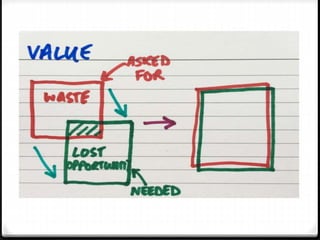
[WHAT IS ASKED FOR]
Typically has some overlap with what is valuable
[WASTE AND LOST OPPORTUNITIES]
If needs (value) and what is asked for don’t align we get waste and lost opportunities
[ALIGNMENT]
Constantly moving target to align needs with what is asked for
Alignment requires continuous prioritisation and delivery
#7 SLIDE 6 [INVEST]
[CHARACTERISTICS OF A GOOD USER STORY]
MNEMONIC created by Bill Wake. Many people know about INVEST for user stories. Takes real discipline to apply.
I – Independent
– Stories should not overlap or depend on each other. They should lead to independently deliverable features
N – Negotiable
Should exist purely in the problem space and can always be rewritten and changed
V – Valuable
Should deliver REAL value to the end user. Not necessarily what is initially asked for
E – Estimable
Is there enough supporting information so that it can be estimated to provide predictability
S – Small
Small stories complement an iterative approach. Discover value by describing needs in small pieces.
T – Testable
- How does a development team know they have met the customer’s NEEDS?
#8 SLIDE 7 [TANGLED STORIES]
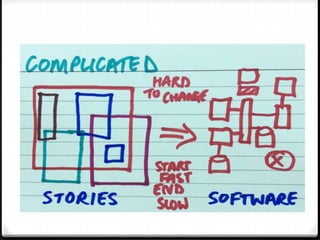
[COMPLICATED]
[STORIES]
Stories that overlap, depend on each other or exist in an artificial hierarchy
Mixture of large and small stories
Mixture of valuable and low value stories
Stories that are hard to test due to poor understanding and dependencies
[SOFTWARE]
Complicated software usually results due to poor overall understanding of NEEDS
Software delivered in order with late integration and high technical risk
Projects usually start fast and get slower over time
High cost to change
#9 SLIDE 8 [UNTANGLED STORIES]
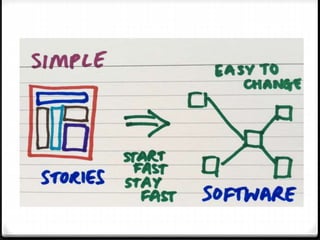
[SIMPLE]
[STORIES]
Stories that can be delivered independently
Stories that are small so that they can be delivered frequently
Stories that can be tested simply so they can be released early
Stories that have been identified as valuable
[SOFTWARE]
Small components relating to isolated, identified needs
Loose coupling with evolving interfaces
Software that is easy to change based on changing needs
#10 SLIDE 9 [HOW DO STORIES BECOME TANGLED?]
How might business analysis take us along the path to tangled stories and unnecessarily complicated software?
#11 SLIDE 10 [ABSTRACTION IN TO COMPONENT TEAMS]
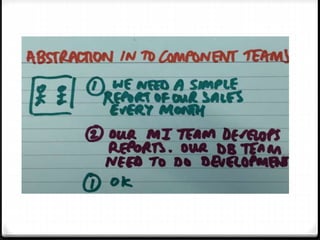
[ORGANISATIONAL ANTIPATTERN]
Stories are immediately divided by component team
Each team has an independent backlog and set of priorities
Teams have lost the original purpose
Organise people into feature teams and have everyone necessary to do the work
#12 SLIDE 11 [ABSTARCTION IN TO COMPONENT TEAMS]
[ORGANISATIONAL ANTIPATTERN]
[FEATURE TEAMS]
Feature teams understand the whole problem and sense of urgency
More likely to deliver simple solutions
[COMPONENT TEAMS]
Component teams divide the work
Customer become disengaged – work focuses on the organisational design and alignment
Separate backlogs and sense of urgency
#13 SLIDE 12 [ABSTARCTION IN TO COMPONENT TEAMS]
[ORGANISATIONAL ANTIPATTERN]
Component teams reinforce architectural patterns
Conway’s Law – more likely to design software to reflect our organisational structure
Constant problem of alignment and integration
Complication increases
Testing becomes harder as more functionality is handled in fewer components
#14 SLIDE 13 [ABSTARCTION IN TO COMPONENT TEAMS]
[ORGANISATIONAL ANTIPATTERN]
[FEATURE TEAMS]
Aligned with sense of urgency
More likely to design the simplest solution to the problem
Not aligned with the organisational structure –write software without organisational constraints
Have everyone in the team necessary to solve the problem
More likely to deliver early and often
#15 SLIDE 14 [ABSTRACTION IN TO DESIGN]
[EARLY ABSTRACTION IN TO DESIGN/SOLUTION SPACE]
Can occur during analysis
[EXAMPLE]
Three customers independently NEED to compare data
Could be described with independent stories and delivered early
Early abstraction in analysis introduces a dependency between all the stories
“Central comparer” – now describes a lower value need and has increased complication
#16 SLIDE 15 [ABSTRACTION IN TO DESIGN]
[EARLY ABSTRACTION IN TO DESIGN/SOLUTION SPACE]
Treating needs simply and iteratively – more likely to design simple software
Early abstraction in analysis to design – likely to introduce premature generalisation
Increases difficulty in testing and development
Causes late integration of many components
#17 SLIDE 16 [ABSTRACTION IN TO DESIGN]
[EARLY ABSTRACTION IN TO DESIGN/SOLUTION SPACE]
Tester begins to focus on testing the consequences of the design rather than the need
Typically becomes driven by integrated tests
Project dominated by integration and logic problems
Original customer need has been reduced in significance
[T] - Harder to test, getting harder
[I] - Three customers may have to wait for the comparer to be completed - dependency
[E] - Difficult to estimate when all the work will be done
[N] – Customers have less ability to negotiate their original need
[V] – “Comparer” has lower value
[S] – Comparer may have increased the size of the development effort
#18 SLIDE 17 [ABSTRACTION IN TO DESIGN]
[EXAMPLE]
[BUSINESS ANALYSIS]
Customer has a NEED to know the currency of their data
Business analysis constrained by existing contract/interface – output in blocks
Increased complication for customer – based on a legacy system
Need expressed through requirement expressed through design/architecture
Customer reluctantly agrees
#19 SLIDE 18 [ABSTRACTION IN TO DESIGN]
[EXAMPLE]
[SOFTWARE DELIVERY]
Development concentrates on delivering to the design
Less effort spent delivering the need in a simple manner
Testing concentrates on the contract/interface – based on functionality rather than customer value
Effort spent testing compliance with the design
#20 SLIDE 19 [ABSTRACTION IN TO DESIGN]
[EXAMPLE]
[SOFTWARE DELIVERY]
Testing becomes focused on the contract/interface
Delivery team has lost its understanding of customer value
Tangled stories -- Increasing development costs on low-value tests
#21 SLIDE 20 [ABSTRACTION IN TO DESIGN]
[EXAMPLE]
[SOFTWARE DELIVERY]
Testing really should be concentrating on the customer need
Currency of the data
Untangled stories – tests for customer value
#22 SLIDE 21 [ACCIDENTAL COMPLICATION]
[INTRODUCING UNNECESSARY COMPLICATION]
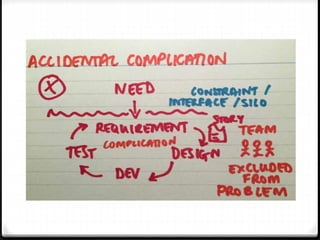
Original customer need/value converted into a requirement converted in to a design
Contracts/interfaces are 2nd class requirements
Delivery team was excluded from an initial understanding of the problem
Development to contracts reinforces the life of those contracts – software increasingly harder to change
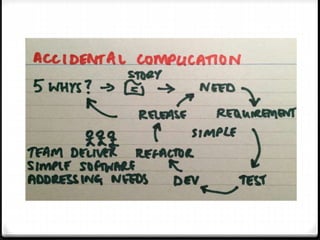
[ESSENTIAL COMPLICATION]
Derive value through test-driven development
Base acceptance criteria on stories and deliver first-class requirements
#23 SLIDE 22 [ACCIDENTAL COMPLICATION]
[INTRODUCING UNNECESSARY COMPLICATION]
Needs immediately converted to requirements representing the current contract/interface
Probably because an interface was created early
Current contract offers the delivery team no chance to offer improvements/changes based on problem
Less opportunity to find a quick, simple, small, testable, independent solution to the customer’s problem
Introduces unnecessary complication and work based on the design or interface or silo
#24 SLIDE 23 [ACCIDENTAL COMPLICATION]
[INTRODUCING UNNECESSARY COMPLICATION]
[HOW SHOULD IT HAVE BEEN DONE?]
Discover true customer needs with ‘5 Why’s’
#25 SLIDE 24 [WHEN SHOULD WE ABSRACT OUR ANALYSIS IN TO DESIGN?]
- Deliver software components with a single responsibility to address an isolated need
- Abstract software design when these needs have been fulfilled
- Independent software components express the true need by this point
#26 SLIDE 26 [TAKEAWAY]
[SPOTTING TANGLED STORIES]
Focus concentrates on understanding the design rather than the customer need
Stories are organised by component team
Stories are organised by legacy software system or contract/interface
Stories mix the problem space with the solution space
Abstracted designs accumulate functionality – becomes harder to test over time
Customer doesn’t recognise the work – unengaged – only understands business need
#27 SLIDE 27 [TAKEAWAY]
[SPOTTING UNTANGLED STORIES]
Discover value through 5 Whys?
Keep backlogs small – requirements ROT – more likely to deliver backlog vs need
Stories should describe the original problem
Ensure the team is fully engaged with the problem – discover simple solutions
Small, independent, testable stories that can released easily
Customer is more likely to remain engaged
#28
SLIDE 28 [THANK YOU]
Thank you
Hope you have found our talk interesting and useful
Any questions?