Unlocking value with
Ecosystem analysis
2
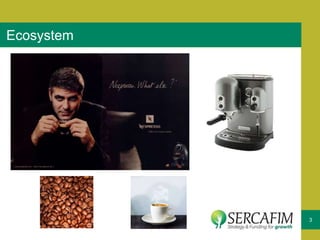
Ecosystem
3
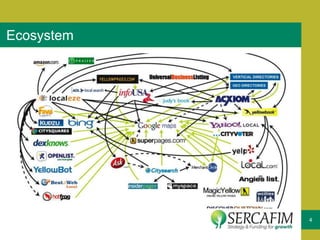
Ecosystem
4
Ecosystem
5
Ecosystem
A business ecosystem is a dynamic structure of interconnected
organizations that depend on each other for mutual survival.
6
Ecosystem: Entities
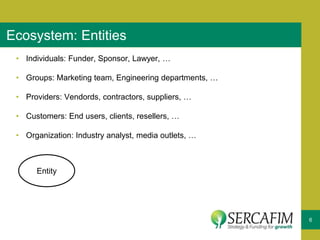
• Individuals: Funder, Sponsor, Lawyer, …
• Groups: Marketing team, Engineering departments, …
• Providers: Vendords, contractors, suppliers, …
• Customers: End users, clients, resellers, …
• Organization: Industry analyst, media outlets, …
Entity
7
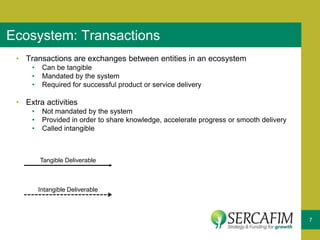
Ecosystem: Transactions
• Transactions are exchanges between entities in an ecosystem
• Can be tangible
• Mandated by the system
• Required for successful product or service delivery
• Extra activities
• Not mandated by the system
• Provided in order to share knowledge, accelerate progress or smooth delivery
• Called intangible
Tangible Deliverable
Intangible Deliverable
8
Ecosystem: Value networks
• A set of roles and interactions that generate a specific business, economic
or social good
• F.e.
• Equipment repairs in a electrical utility
• Medicare system
• Property & casualty insurance
9
Mapping your Business Ecosystem
Roles
• List at least 15 roles played in your ecosystem.
• Don’t worry about specifics; Focus on types
Get
specific
• Write down some specific examples of each role
• Jog your thinking when you return to the map in the future.
Draw roles
• Start by drawing one circle for each role on your map
• Make sure there’s enough room between them
• You may wish to space those that you believe have more interaction
closer together
10
Mapping your Business Ecosystem
Tell the story
• Tell the story of how roles interact in the ecosystem
• Start with the customer
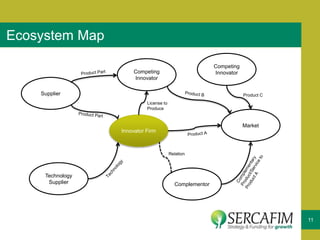
• Draw arrows between entities to show the flow of transactions
Analyze your
ecosystem
• Look at your ecosystem map and analyze what you see.
Use your
ecosystem map
• Orienting new employees to your company / department
• Demonstrating the value of a potential partnership to others in your company or
ecosystem
• Giving you a quick view of the environment you need to monitor for disruptive changes
and opportunties
11
Ecosystem Map
Innovator Firm
Market
Competing
Innovator
Complementor
Competing
Innovator
Supplier
Technology
Supplier
License to
Produce
Product C
Relation
12
Business model
A Business Model spells out the core logic through which the firm creates
and captures value from its ecosystem analysis.
13
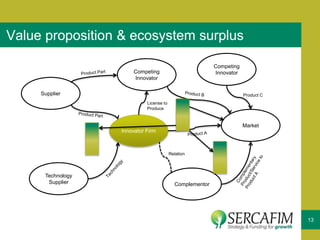
Value proposition & ecosystem surplus
Innovator Firm
Market
Competing
Innovator
Complementor
Competing
Innovator
Supplier
Technology
Supplier
License to
Produce
Product C
Relation
14
Business logic within the ecosystem
• Plot the ecosystem of roles relevant to your company
• Conduct a use case analysis of your opportunity within this ecosystem
• Understand how your opportunity creates customer and producer surplus
in the ecosystem
• Pain points relevant to your opportunity
• Leverage potential
• Iterate until you have a business model for your opportunity that
• Maximizes value created in the ecosystem
• Maximizes value captures for your company
• Deals with the roles’ pain points
• Leverage the players that are willing to use their power to speed up the
opportunity adoption
• Have a business model roadmap
15
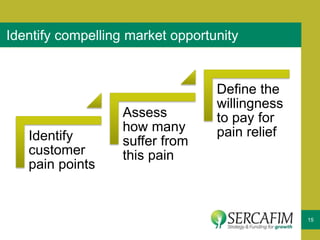
Identify compelling market opportunity
Identify
customer
pain points
Assess
how many
suffer from
this pain
Define the
willingness
to pay for
pain relief
16
Manage the roadmap
Backup
18
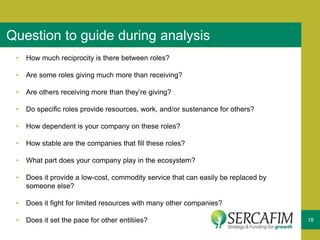
Question to guide during analysis
• How much reciprocity is there between roles?
• Are some roles giving much more than receiving?
• Are others receiving more than they’re giving?
• Do specific roles provide resources, work, and/or sustenance for others?
• How dependent is your company on these roles?
• How stable are the companies that fill these roles?
• What part does your company play in the ecosystem?
• Does it provide a low-cost, commodity service that can easily be replaced by
someone else?
• Does it fight for limited resources with many other companies?
• Does it set the pace for other entitiies?

Unlock value with business ecosystem analysis

  • 1.
  • 2.
  • 3.
  • 4.
  • 5.
    5 Ecosystem A business ecosystemis a dynamic structure of interconnected organizations that depend on each other for mutual survival.
  • 6.
    6 Ecosystem: Entities • Individuals:Funder, Sponsor, Lawyer, … • Groups: Marketing team, Engineering departments, … • Providers: Vendords, contractors, suppliers, … • Customers: End users, clients, resellers, … • Organization: Industry analyst, media outlets, … Entity
  • 7.
    7 Ecosystem: Transactions • Transactionsare exchanges between entities in an ecosystem • Can be tangible • Mandated by the system • Required for successful product or service delivery • Extra activities • Not mandated by the system • Provided in order to share knowledge, accelerate progress or smooth delivery • Called intangible Tangible Deliverable Intangible Deliverable
  • 8.
    8 Ecosystem: Value networks •A set of roles and interactions that generate a specific business, economic or social good • F.e. • Equipment repairs in a electrical utility • Medicare system • Property & casualty insurance
  • 9.
    9 Mapping your BusinessEcosystem Roles • List at least 15 roles played in your ecosystem. • Don’t worry about specifics; Focus on types Get specific • Write down some specific examples of each role • Jog your thinking when you return to the map in the future. Draw roles • Start by drawing one circle for each role on your map • Make sure there’s enough room between them • You may wish to space those that you believe have more interaction closer together
  • 10.
    10 Mapping your BusinessEcosystem Tell the story • Tell the story of how roles interact in the ecosystem • Start with the customer • Draw arrows between entities to show the flow of transactions Analyze your ecosystem • Look at your ecosystem map and analyze what you see. Use your ecosystem map • Orienting new employees to your company / department • Demonstrating the value of a potential partnership to others in your company or ecosystem • Giving you a quick view of the environment you need to monitor for disruptive changes and opportunties
  • 11.
  • 12.
    12 Business model A BusinessModel spells out the core logic through which the firm creates and captures value from its ecosystem analysis.
  • 13.
    13 Value proposition &ecosystem surplus Innovator Firm Market Competing Innovator Complementor Competing Innovator Supplier Technology Supplier License to Produce Product C Relation
  • 14.
    14 Business logic withinthe ecosystem • Plot the ecosystem of roles relevant to your company • Conduct a use case analysis of your opportunity within this ecosystem • Understand how your opportunity creates customer and producer surplus in the ecosystem • Pain points relevant to your opportunity • Leverage potential • Iterate until you have a business model for your opportunity that • Maximizes value created in the ecosystem • Maximizes value captures for your company • Deals with the roles’ pain points • Leverage the players that are willing to use their power to speed up the opportunity adoption • Have a business model roadmap
  • 15.
    15 Identify compelling marketopportunity Identify customer pain points Assess how many suffer from this pain Define the willingness to pay for pain relief
  • 16.
  • 17.
  • 18.
    18 Question to guideduring analysis • How much reciprocity is there between roles? • Are some roles giving much more than receiving? • Are others receiving more than they’re giving? • Do specific roles provide resources, work, and/or sustenance for others? • How dependent is your company on these roles? • How stable are the companies that fill these roles? • What part does your company play in the ecosystem? • Does it provide a low-cost, commodity service that can easily be replaced by someone else? • Does it fight for limited resources with many other companies? • Does it set the pace for other entitiies?