Summary
In this tutorial, you will see how components add functionality to GameObjects. The
component you will see in action here, the RigidBody Component, lets a GameObject
behave like a physical object instead of floating in space. In this tutorial, you will:
● Position the Main Camera to display action in the Game view.
● Explore the relationship between GameObjects and components.
● Identify specific components in the Inspector window.
● Add physical properties to a 3D GameObject by applying the RigidBody component
and setting its properties.
● Enter Play mode to preview a Scene in the Game view.
● Experiment with 3D physics in Unity.
1.Overview
Components add behaviors and functionality to a GameObject. You have
used the Transform Component — and that is just the beginning! In this
tutorial, you will add another component, the RigidBody Component, which
gives a GameObject physical properties so that it can interact with gravity
and other GameObjects. You will also position the Main Camera to watch
how a GameObject responds to gravity in 3D.
2.Before you begin
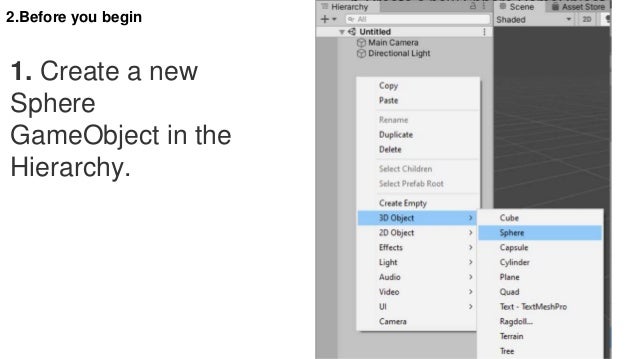
1. Create a new
Sphere
GameObject in the
Hierarchy.
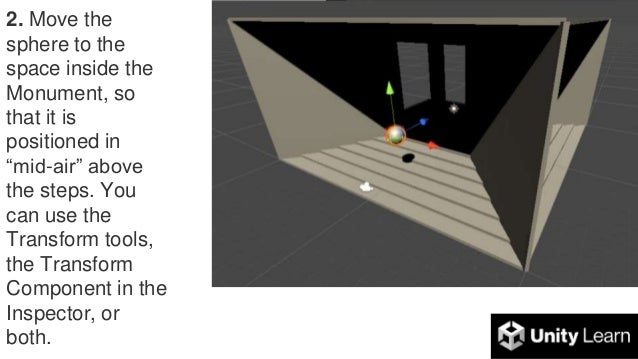
2. Move the
sphere to the
space inside the
Monument, so
that it is
positioned in
“mid-air” above
the steps. You
can use the
Transform tools,
the Transform
Component in the
Inspector, or
both.
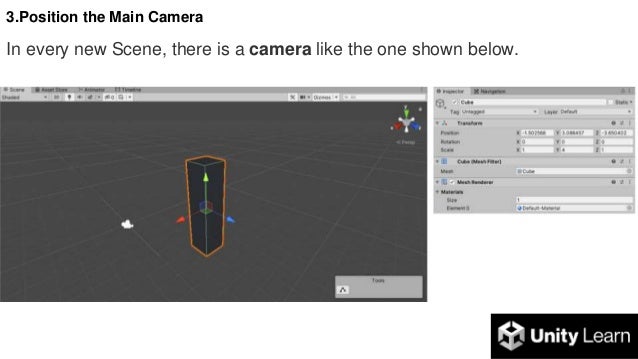
3.Position the Main Camera
In every new Scene, there is a camera like the one shown below.
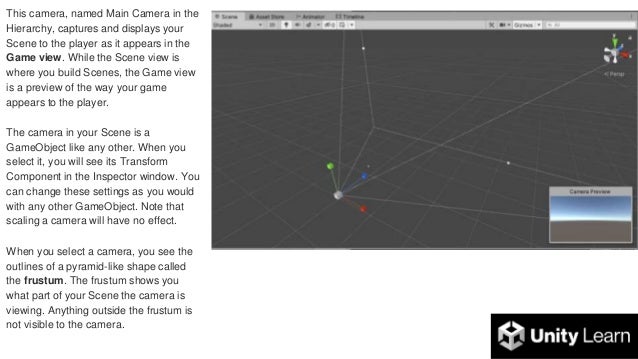
This camera, named Main Camera in the
Hierarchy, captures and displays your
Scene to the player as it appears in the
Game view. While the Scene view is
where you build Scenes, the Game view
is a preview of the way your game
appears to the player.
The camera in your Scene is a
GameObject like any other. When you
select it, you will see its Transform
Component in the Inspector window. You
can change these settings as you would
with any other GameObject. Note that
scaling a camera will have no effect.
When you select a camera, you see the
outlines of a pyramid-like shape called
the frustum. The frustum shows you
what part of your Scene the camera is
viewing. Anything outside the frustum is
not visible to the camera.
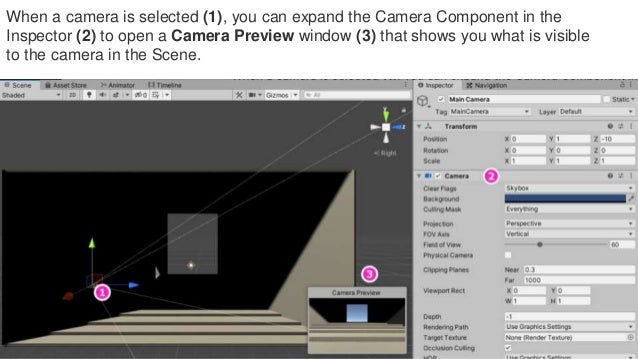
When a camera is selected (1), you can expand the Camera Component in the
Inspector (2) to open a Camera Preview window (3) that shows you what is visible
to the camera in the Scene.
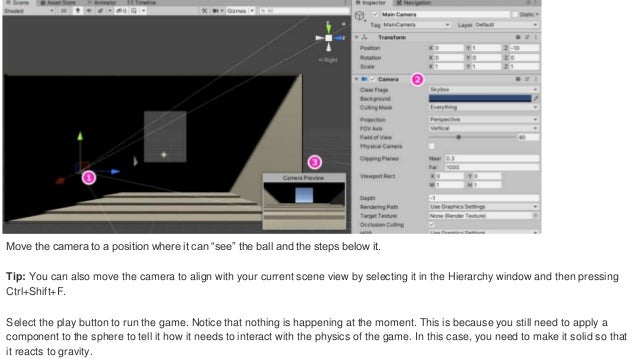
Move the camera to a position where it can “see” the ball and the steps below it.
Tip: You can also move the camera to align with your current scene view by selecting it in the Hierarchy window and then pressing
Ctrl+Shift+F.
Select the play button to run the game. Notice that nothing is happening at the moment. This is because you still need to apply a
component to the sphere to tell it how it needs to interact with the physics of the game. In this case, you need to make it solid so that
it reacts to gravity.
4.Make the sphere solid
Remember when you created a sphere that was inside a cube? Objects in the physical
world don’t exist inside other objects that way, but in a Unity Scene, by default,
GameObjects don’t have mass or respond to gravity. To make a GameObject behave
like a real-world physical object, you can give it physical properties by adding a
RigidBody Component.
To add the RigidBody Component to the Sphere GameObject:
1. In the Hierarchy window, select the Sphere.
2. Select the Add Component button in the Inspector window.
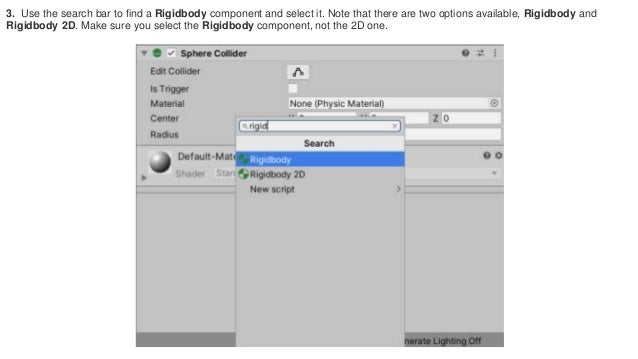
3. Use the search bar to find a Rigidbody component and select it. Note that there are two options available, Rigidbody and
Rigidbody 2D. Make sure you select the Rigidbody component, not the 2D one.
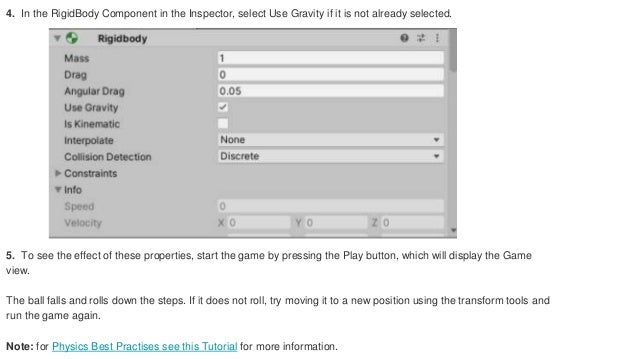
4. In the RigidBody Component in the Inspector, select Use Gravity if it is not already selected.
5. To see the effect of these properties, start the game by pressing the Play button, which will display the Game
view.
The ball falls and rolls down the steps. If it does not roll, try moving it to a new position using the transform tools and
run the game again.
Note: for Physics Best Practises see this Tutorial for more information.
5.Experiment with falling
GameObjects
Try variations of this exercise. Move the Sphere GameObject and the Main Camera to get the results you want. More things to try:
● Add more spheres with RigidBody Components at varying heights.
● Add other primitives and see how they behave.
● Drop objects in different places.
● Rotate the Monument GameObject.
One thing to note is that you can change the properties, values and position of a selected GameObject while the game is running,
but when the game is stopped all values will revert back to what they were before the game was started. This is useful to test
different parameters during runtime, but if you want the changes to be permanent, you need to make the changes while the game is
stopped.

Unity - Add components to 3D GameObjects

  • 1.
    Summary In this tutorial,you will see how components add functionality to GameObjects. The component you will see in action here, the RigidBody Component, lets a GameObject behave like a physical object instead of floating in space. In this tutorial, you will: ● Position the Main Camera to display action in the Game view. ● Explore the relationship between GameObjects and components. ● Identify specific components in the Inspector window. ● Add physical properties to a 3D GameObject by applying the RigidBody component and setting its properties. ● Enter Play mode to preview a Scene in the Game view. ● Experiment with 3D physics in Unity.
  • 2.
    1.Overview Components add behaviorsand functionality to a GameObject. You have used the Transform Component — and that is just the beginning! In this tutorial, you will add another component, the RigidBody Component, which gives a GameObject physical properties so that it can interact with gravity and other GameObjects. You will also position the Main Camera to watch how a GameObject responds to gravity in 3D.
  • 3.
    2.Before you begin 1.Create a new Sphere GameObject in the Hierarchy.
  • 4.
    2. Move the sphereto the space inside the Monument, so that it is positioned in “mid-air” above the steps. You can use the Transform tools, the Transform Component in the Inspector, or both.
  • 5.
    3.Position the MainCamera In every new Scene, there is a camera like the one shown below.
  • 6.
    This camera, namedMain Camera in the Hierarchy, captures and displays your Scene to the player as it appears in the Game view. While the Scene view is where you build Scenes, the Game view is a preview of the way your game appears to the player. The camera in your Scene is a GameObject like any other. When you select it, you will see its Transform Component in the Inspector window. You can change these settings as you would with any other GameObject. Note that scaling a camera will have no effect. When you select a camera, you see the outlines of a pyramid-like shape called the frustum. The frustum shows you what part of your Scene the camera is viewing. Anything outside the frustum is not visible to the camera.
  • 7.
    When a camerais selected (1), you can expand the Camera Component in the Inspector (2) to open a Camera Preview window (3) that shows you what is visible to the camera in the Scene.
  • 8.
    Move the camerato a position where it can “see” the ball and the steps below it. Tip: You can also move the camera to align with your current scene view by selecting it in the Hierarchy window and then pressing Ctrl+Shift+F. Select the play button to run the game. Notice that nothing is happening at the moment. This is because you still need to apply a component to the sphere to tell it how it needs to interact with the physics of the game. In this case, you need to make it solid so that it reacts to gravity.
  • 9.
    4.Make the spheresolid Remember when you created a sphere that was inside a cube? Objects in the physical world don’t exist inside other objects that way, but in a Unity Scene, by default, GameObjects don’t have mass or respond to gravity. To make a GameObject behave like a real-world physical object, you can give it physical properties by adding a RigidBody Component. To add the RigidBody Component to the Sphere GameObject: 1. In the Hierarchy window, select the Sphere. 2. Select the Add Component button in the Inspector window.
  • 10.
    3. Use thesearch bar to find a Rigidbody component and select it. Note that there are two options available, Rigidbody and Rigidbody 2D. Make sure you select the Rigidbody component, not the 2D one.
  • 11.
    4. In theRigidBody Component in the Inspector, select Use Gravity if it is not already selected. 5. To see the effect of these properties, start the game by pressing the Play button, which will display the Game view. The ball falls and rolls down the steps. If it does not roll, try moving it to a new position using the transform tools and run the game again. Note: for Physics Best Practises see this Tutorial for more information.
  • 12.
    5.Experiment with falling GameObjects Tryvariations of this exercise. Move the Sphere GameObject and the Main Camera to get the results you want. More things to try: ● Add more spheres with RigidBody Components at varying heights. ● Add other primitives and see how they behave. ● Drop objects in different places. ● Rotate the Monument GameObject. One thing to note is that you can change the properties, values and position of a selected GameObject while the game is running, but when the game is stopped all values will revert back to what they were before the game was started. This is useful to test different parameters during runtime, but if you want the changes to be permanent, you need to make the changes while the game is stopped.