What is Software?
The product that software professionals build and then
support over the long term.
Software encompasses:
(1)instructions (computer programs) that when
executed provide desired features, function, and
performance;
(2)that enable the programs to adequately store and
manipulate information and
(3)(3)that describes the operation and use of the
programs.
2
Software products
• Generic products
• Stand-alone systems that are marketed and sold to any customer
who wishes to buy them.
• Examples - PC software such as editing, graphics programs,
project management tools; CAD software; software for specific
markets such as appointments systems for dentists.
• Customized products
• Software that is commissioned by a specific customer to meet
their own needs.
• Examples - embedded control systems, air traffic control
software, traffic monitoring systems.
3
Why Software is Important?
• The economies of ALL developed nations are dependent on
software.
• More and more systems are software controlled ( transportation,
medical, telecommunications, military, industrial, entertainment,)
• Software engineering is concerned with theories, methods and tools
for professional software development.
• Expenditure on software represents a
significant fraction of GNP in all developed countries.
Software costs
• Software costs often dominate computer system costs. The
costs of software on a PC are often greater than the hardware
cost.
• Software costs more to maintain than it does to develop. For
systems with a long life, maintenance costs may be several
times development costs.
• Software engineering is concerned with cost-effective
software
development.
Features of Software?
• Its characteristics that make it different from other things human being
build.
Features of such logical system:
• Software is developed or engineered, it is not manufactured in the
classical sense which has quality problem.
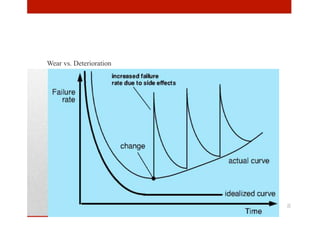
• Software doesn’t "wear out.” but it deteriorates (due to change). Hardware
has bathtub curve of failure rate ( high failure rate in the beginning, then drop to
steady state, then cumulative effects of dust, vibration, abuse occurs).
• Although the industry is moving toward component-based construction
(e.g. standard screws and off-the-shelf integrated circuits), most
software continues to be custom-built. Modern reusable components
encapsulate data and processing into software parts to be reused by
different programs. E.g. graphical user interface, window, pull-down
menus in library etc.
6
Wear vs. Deterioration
7
1. System software: such as compilers, editors, file management utilities
2. Application software: stand-alone programs for specific needs.
3. Engineering/scientific software: Such as automotive stress analysis,
molecular biology, orbital dynamics.
4. Embedded software resides within a product or system. (key pad
control of a microwave oven, digital function of dashboard display in a car)
5. Product-line software focus on a limited marketplace to address
mass consumer market. (word processing, graphics, database management)
6. WebApps (Web applications) network centric software.
sophisticated computing environments with remote database and
business applications.
7. AI software uses non-numerical algorithm to solve complex
problem. Robotics, expert system, pattern recognition game playing
Software (Types) Applications
• Open world computing- pervasive, ubiquitous, distributed computing
due to wireless networking. How to allow mobile devices, personal
computer, enterprise system to communicate across vast network.
• Netsourcing-the Web as a computing engine. How to architect simple
and sophisticated applications to target end-users worldwide.
• Open source-”free” source code open to the computing community (a
blessing, but also a potential curse!)
• Also ...
• Data mining
• Grid computing
• Cognitive machines
• Software for nanotechnologies
Software-New Categories
• Legacy software are older programs that are
developed decades ago.
• The quality of legacy software is poor because it has-
• inextensible design,
• complex code,
• poor and nonexistent documentation,
• test cases and
• results that are not achieved.
LEGACY SOFTWARE
LEGACY SOFTWARE
As time passes legacy systems evolve due to following
reasons:
• The software must be
• adapted to meet the needs of new computing
environment or technology.
• enhanced to implement new business requirements.
• extended to make it interoperable with more modern
systems or database.
• Re-architected to make it viable within a network
environment
Importance of Software Engineering
• More and more, individuals and society rely on advanced
software systems.
• We need to be able to produce reliable and trustworthy
systems economically and quickly.
• It is usually cheaper, in the long run, to use software
engineering methods and techniques.
• The majority of costs are the costs of changing the
software after it has gone into use.
• Definition of Engineering:
• Application of science, tools and methods to
find cost effective solution to problems.
• What is software engineering?
• Software engineering is an engineering
discipline that is concerned with all aspects of
software production.
Introduction to software Engineering
The seminal definition[Fritz Bauer]:
[Software engineering is] the establishment and use of
sound engineering principles in order to obtain
economically software that is reliable and works
efficiently on real machines.
The IEEE definition:
Software Engineering: (1) The application of a
systematic, disciplined, quantifiable approach to the
development, operation, and maintenance of software;
that is, the application of engineering to software.
(2) The study of approaches as in (1).
Software Engineering Definition
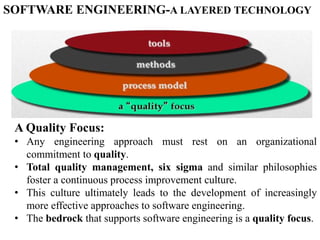
A Quality Focus:
• Any engineering approach must rest on an organizational
commitment to quality.
• Total quality management, six sigma and similar philosophies
foster a continuous process improvement culture.
• This culture ultimately leads to the development of increasingly
more effective approaches to software engineering.
• The bedrock that supports software engineering is a quality focus.
SOFTWARE ENGINEERING-A LAYERED TECHNOLOGY
Process Layer: The foundation for software engineering.
• Software Engineering process is the glue that holds the
technology layers together and enables rational and
timely development of computer software.
• Process defines a framework (KPA)-
• basis for management control of Software Projects,
• the context for applying technical methods,
• works products ( like models, documents, data, reports, forms
etc.) are produced,
• milestones are established,
• quality is ensured and
• change is properly managed.
SOFTWARE ENGINEERING-A LAYERED TECHNOLOGY
Methods:
• Methods provide the technical- how to‘s for building software.
• Methods includes task such as -communication, requirements
analysis, design modeling, program construction, testing and
support.
Tools:
• Software Engineering tools provide automated or semi-
automated support for the process and the methods.
• Tools are integrated so that information created by one tool can be
used by another,
• A system(tool) for the support of software development is called
computer-aided software engineering(CASE).
SOFTWARE ENGINEERING-A LAYERED TECHNOLOGY
• A process is a collection of activities, actions and tasks
that are performed when some work product is to be
created.
• An activity: such as communication with stakeholders
is applied to all applications.
• An action: such as architecture design consists of set of
tasks.
• Task: focuses on small but well defined objectives.
Software Process
A Generic Process framework
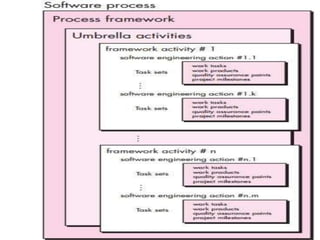
• Establishes the foundation for a complete
software process.
• Identifies a number of framework
activities applicable to all software projects
• Also include a set of umbrella activities
that are applicable across the entire
software process.
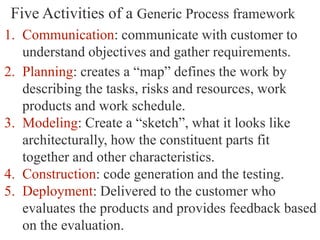
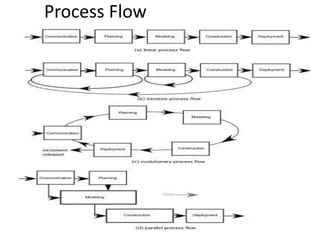
1. Communication: communicate with customer to
understand objectives and gather requirements.
2. Planning: creates a “map” defines the work by
describing the tasks, risks and resources, work
products and work schedule.
3. Modeling: Create a “sketch”, what it looks like
architecturally, how the constituent parts fit
together and other characteristics.
4. Construction: code generation and the testing.
5. Deployment: Delivered to the customer who
evaluates the products and provides feedback based
on the evaluation.
Five Activities of a Generic Process framework
Process Flow
Umbrella Activities
Umbrella Activities help team to manage and control progress,
quality, change, and risk.
• Software project tracking and control: assess progress
against the plan and take actions to maintain the
schedule.
• Risk management: assesses risks that may affect the
outcome and quality of product.
• Software quality assurance: defines and conduct
activities to ensure quality.
• Technical reviews: assesses work products to uncover
and remove errors before going to the next activity.
Umbrella Activities
• Measurement: define and collects process, project,
and product measures, to ensure stakeholder’s needs
are met.
• Software configuration management: manage the
effects of change throughout the software process.
• Reusability management: defines criteria for work
product reuse and establishes mechanism to achieve
reusable components.
• Work product preparation and production: create
work products such as models, documents, logs,
forms and lists.

Java learn from basic part chapter_01 short notes to understand the java quickly .pptx

  • 1.
    What is Software? Theproduct that software professionals build and then support over the long term. Software encompasses: (1)instructions (computer programs) that when executed provide desired features, function, and performance; (2)that enable the programs to adequately store and manipulate information and (3)(3)that describes the operation and use of the programs. 2
  • 2.
    Software products • Genericproducts • Stand-alone systems that are marketed and sold to any customer who wishes to buy them. • Examples - PC software such as editing, graphics programs, project management tools; CAD software; software for specific markets such as appointments systems for dentists. • Customized products • Software that is commissioned by a specific customer to meet their own needs. • Examples - embedded control systems, air traffic control software, traffic monitoring systems. 3
  • 3.
    Why Software isImportant? • The economies of ALL developed nations are dependent on software. • More and more systems are software controlled ( transportation, medical, telecommunications, military, industrial, entertainment,) • Software engineering is concerned with theories, methods and tools for professional software development. • Expenditure on software represents a significant fraction of GNP in all developed countries.
  • 4.
    Software costs • Softwarecosts often dominate computer system costs. The costs of software on a PC are often greater than the hardware cost. • Software costs more to maintain than it does to develop. For systems with a long life, maintenance costs may be several times development costs. • Software engineering is concerned with cost-effective software development.
  • 5.
    Features of Software? •Its characteristics that make it different from other things human being build. Features of such logical system: • Software is developed or engineered, it is not manufactured in the classical sense which has quality problem. • Software doesn’t "wear out.” but it deteriorates (due to change). Hardware has bathtub curve of failure rate ( high failure rate in the beginning, then drop to steady state, then cumulative effects of dust, vibration, abuse occurs). • Although the industry is moving toward component-based construction (e.g. standard screws and off-the-shelf integrated circuits), most software continues to be custom-built. Modern reusable components encapsulate data and processing into software parts to be reused by different programs. E.g. graphical user interface, window, pull-down menus in library etc. 6
  • 6.
  • 7.
    1. System software:such as compilers, editors, file management utilities 2. Application software: stand-alone programs for specific needs. 3. Engineering/scientific software: Such as automotive stress analysis, molecular biology, orbital dynamics. 4. Embedded software resides within a product or system. (key pad control of a microwave oven, digital function of dashboard display in a car) 5. Product-line software focus on a limited marketplace to address mass consumer market. (word processing, graphics, database management) 6. WebApps (Web applications) network centric software. sophisticated computing environments with remote database and business applications. 7. AI software uses non-numerical algorithm to solve complex problem. Robotics, expert system, pattern recognition game playing Software (Types) Applications
  • 8.
    • Open worldcomputing- pervasive, ubiquitous, distributed computing due to wireless networking. How to allow mobile devices, personal computer, enterprise system to communicate across vast network. • Netsourcing-the Web as a computing engine. How to architect simple and sophisticated applications to target end-users worldwide. • Open source-”free” source code open to the computing community (a blessing, but also a potential curse!) • Also ... • Data mining • Grid computing • Cognitive machines • Software for nanotechnologies Software-New Categories
  • 9.
    • Legacy softwareare older programs that are developed decades ago. • The quality of legacy software is poor because it has- • inextensible design, • complex code, • poor and nonexistent documentation, • test cases and • results that are not achieved. LEGACY SOFTWARE
  • 10.
    LEGACY SOFTWARE As timepasses legacy systems evolve due to following reasons: • The software must be • adapted to meet the needs of new computing environment or technology. • enhanced to implement new business requirements. • extended to make it interoperable with more modern systems or database. • Re-architected to make it viable within a network environment
  • 11.
    Importance of SoftwareEngineering • More and more, individuals and society rely on advanced software systems. • We need to be able to produce reliable and trustworthy systems economically and quickly. • It is usually cheaper, in the long run, to use software engineering methods and techniques. • The majority of costs are the costs of changing the software after it has gone into use.
  • 12.
    • Definition ofEngineering: • Application of science, tools and methods to find cost effective solution to problems. • What is software engineering? • Software engineering is an engineering discipline that is concerned with all aspects of software production. Introduction to software Engineering
  • 13.
    The seminal definition[FritzBauer]: [Software engineering is] the establishment and use of sound engineering principles in order to obtain economically software that is reliable and works efficiently on real machines. The IEEE definition: Software Engineering: (1) The application of a systematic, disciplined, quantifiable approach to the development, operation, and maintenance of software; that is, the application of engineering to software. (2) The study of approaches as in (1). Software Engineering Definition
  • 14.
    A Quality Focus: •Any engineering approach must rest on an organizational commitment to quality. • Total quality management, six sigma and similar philosophies foster a continuous process improvement culture. • This culture ultimately leads to the development of increasingly more effective approaches to software engineering. • The bedrock that supports software engineering is a quality focus. SOFTWARE ENGINEERING-A LAYERED TECHNOLOGY
  • 15.
    Process Layer: Thefoundation for software engineering. • Software Engineering process is the glue that holds the technology layers together and enables rational and timely development of computer software. • Process defines a framework (KPA)- • basis for management control of Software Projects, • the context for applying technical methods, • works products ( like models, documents, data, reports, forms etc.) are produced, • milestones are established, • quality is ensured and • change is properly managed. SOFTWARE ENGINEERING-A LAYERED TECHNOLOGY
  • 16.
    Methods: • Methods providethe technical- how to‘s for building software. • Methods includes task such as -communication, requirements analysis, design modeling, program construction, testing and support. Tools: • Software Engineering tools provide automated or semi- automated support for the process and the methods. • Tools are integrated so that information created by one tool can be used by another, • A system(tool) for the support of software development is called computer-aided software engineering(CASE). SOFTWARE ENGINEERING-A LAYERED TECHNOLOGY
  • 17.
    • A processis a collection of activities, actions and tasks that are performed when some work product is to be created. • An activity: such as communication with stakeholders is applied to all applications. • An action: such as architecture design consists of set of tasks. • Task: focuses on small but well defined objectives. Software Process
  • 18.
    A Generic Processframework • Establishes the foundation for a complete software process. • Identifies a number of framework activities applicable to all software projects • Also include a set of umbrella activities that are applicable across the entire software process.
  • 20.
    1. Communication: communicatewith customer to understand objectives and gather requirements. 2. Planning: creates a “map” defines the work by describing the tasks, risks and resources, work products and work schedule. 3. Modeling: Create a “sketch”, what it looks like architecturally, how the constituent parts fit together and other characteristics. 4. Construction: code generation and the testing. 5. Deployment: Delivered to the customer who evaluates the products and provides feedback based on the evaluation. Five Activities of a Generic Process framework
  • 21.
  • 22.
    Umbrella Activities Umbrella Activitieshelp team to manage and control progress, quality, change, and risk. • Software project tracking and control: assess progress against the plan and take actions to maintain the schedule. • Risk management: assesses risks that may affect the outcome and quality of product. • Software quality assurance: defines and conduct activities to ensure quality. • Technical reviews: assesses work products to uncover and remove errors before going to the next activity.
  • 23.
    Umbrella Activities • Measurement:define and collects process, project, and product measures, to ensure stakeholder’s needs are met. • Software configuration management: manage the effects of change throughout the software process. • Reusability management: defines criteria for work product reuse and establishes mechanism to achieve reusable components. • Work product preparation and production: create work products such as models, documents, logs, forms and lists.

Editor's Notes

  • #21 These five framework activities can be used to all software development regardless of the application domain, size of the project, complexity of the efforts etc, though the details will be different in each case. For many software projects, these framework activities are applied iteratively as a project progresses. Each iteration produces a software increment that provides a subset of overall software features and functionality.