Unit II
Linear Data Structures Using
Sequential Organization
Sequential Organization, Linear Data Structure Using Sequential Organization, Array as
an Abstract Data Type, Memory Representation and Address Calculation, Inserting an
element into an array, Deleting an element, Multidimensional Arrays, Two-dimensional
arrays, n- dimensional arrays, Concept of Ordered List, Single Variable Polynomial,
Representation using arrays, Polynomial as array of structure, Polynomial addition,
Polynomial multiplication, Sparse Matrix, Sparse matrix representation, Sparse matrix
addition, Transpose of sparse matrix, String Manipulation Using Array.
Case Study- Use of sparse matrix in Social Networks and Maps
Sequential Organization
• Organization of data within the computer
memory is linear i.e. each element has unique
successor.
• Direct or Random access to any element is the
major advantage of sequential organization.
• Sequential organization makes it possible to
access any element in the data structure
randomly in constant time O(1).
Sequential Organization
• Example : Arrays
• Array is an ordered set of objects.
• data structure that stores data of similar type at
consecutive memory locations.
• e.g. int A[5]; // A is an array of size 5
• It will allocate 5 consecutive memory locations
for the array A. Each element of array can be
accessed by referring to its index.
Linear data structure
• The term “linear” means “belonging to a line”
• A Linear data structure consists of elements
which are ordered i.e. in a line.
• The elements form a sequence such that there
is a first element, second, …… and last
element.
• Thus, the elements of a linear data structure
have a one-one relationship.
• Examples : array, list.
Arrays
• An array is a finite ordered set of homogenous
elements.
– Finite : There are a specific number of elements in the
array.
– Ordered : The elements are arranged so that there is a
first element, second, and so on.
– Homogenous : All the elements are of the same type.
• Mathematically, an array can be considered as a
set of pairs- (index, value). For each index, there
is an associated value. This means that, there is a
one-to-one mapping or correspondence between
the set of indices and the set of values.
Primitive Operations on Arrays
1. Create : Creating a new array : This needs the
information regarding the type of data objects
and the number of data objects to be stored.
2. Store(array, index, value) : Store a value at
particular position : This needs the name of the
array, the position in the array and the value to
be stored at that position.
3. Retrieve ( array, index ) : Retrieve a value at a
particular position : This operation requires the
array name and an index and it returns the
corresponding value.
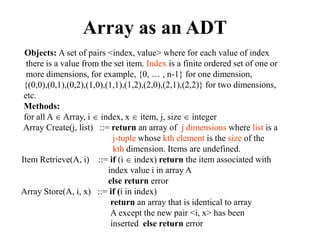
Objects: A set of pairs <index, value> where for each value of index
there is a value from the set item. Index is a finite ordered set of one or
more dimensions, for example, {0, … , n-1} for one dimension,
{(0,0),(0,1),(0,2),(1,0),(1,1),(1,2),(2,0),(2,1),(2,2)} for two dimensions,
etc.
Methods:
for all A  Array, i  index, x  item, j, size  integer
Array Create(j, list) ::= return an array of j dimensions where list is a
j-tuple whose kth element is the size of the
kth dimension. Items are undefined.
Item Retrieve(A, i) ::= if (i  index) return the item associated with
index value i in array A
else return error
Array Store(A, i, x) ::= if (i in index)
return an array that is identical to array
A except the new pair <i, x> has been
inserted else return error
Array as an ADT
Array Implementation
• A single dimension array is created as :
– <data type> <array name> [size] ;
• Example
– int A[5];
• The array is implemented as a constant pointer to
the array elements.
• The elements are stored in consecutive memory
locations. The address of the first element is
called the base address.
Memory Representation
• The lower bound of array starts at 0 and upper bound is (size-1 )
• The operation store is implemented as :
– arrayname[position] = value ;
– e.g. A[2] = 30;
• The operation extract is implemented as :
– arrayname[position]
– e.g. num = A[2];
• Any reference to element A[i] is converted to a pointer notation
as
– A[i] = i[A] = *(A + i)
Address Calculation
• Address of A[i] = Base Address + i * element size
• E.g.
• Address of A[3] = 2000 + 3 * sizeof(int)
= 2000 + 3 * 4
= 2012
Operations on Arrays
• Inserting an element into an array
• Deleting an element from the array
• Inserting an element into an sorted array
• Merging two sorted arrays
Multidimensional Arrays
• When each array element is another array, it is
called a multidimensional array.
• Example:
– int M[3][5];
– declares M as an array containing 3 elements each of
which is an array containing 5 elements.
• An element of this array is accessed by specifying two
indices. Such an array is called a two-dimensional array.
• M is said to have 3 rows and 5 columns. The rows
are numbered 0 to 2 and columns are numbered 0
to 4.
Multidimensional Arrays
• An array can have more than two dimensions.
For example, a three dimensional array may be
declared as :
– int M[2][3][4];
– M is an array containing 2 two-dimensional arrays,
each having 3 rows and 4 columns.
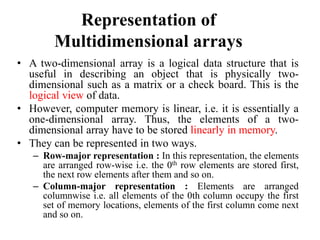
Representation of
Multidimensional arrays
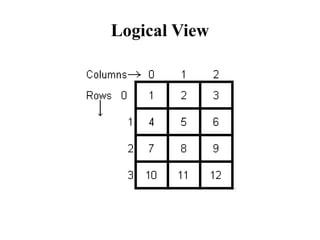
• A two-dimensional array is a logical data structure that is
useful in describing an object that is physically two-
dimensional such as a matrix or a check board. This is the
logical view of data.
• However, computer memory is linear, i.e. it is essentially a
one-dimensional array. Thus, the elements of a two-
dimensional array have to be stored linearly in memory.
• They can be represented in two ways.
– Row-major representation : In this representation, the elements
are arranged row-wise i.e. the 0th row elements are stored first,
the next row elements after them and so on.
– Column-major representation : Elements are arranged
columnwise i.e. all elements of the 0th column occupy the first
set of memory locations, elements of the first column come next
and so on.
Logical View
Physical View
Address Calculation
For an array int M[R][C]; where R = number of rows and C = number of
columns , the location of an element M[i][j] in the array can be calculated as :
Address of M[i][j] = Base Address + i * C * Element size + j * Element size
= Base Address + ( i * C + j ) * Element size
Example :
Address of M[1][2] = 2000 + ( 1 * 3 + 2 ) * sizeof (int)
= 2000 + 5 * 2
= 2010
Address Calculation
For an array int M[R][C]; where R = number of rows and C = number of
columns , the location of an element M[i][j] in the array can be calculated as :
Address of M[i][j] = Base Address + j * R * Element size + i * Element size
= Base Address + ( j * R + i ) * Element size
Example :
Address of M[1][2] = 2000 + ( 2 * 4 + 1 ) * sizeof (int)
= 2000 + 9 * 2
= 2018
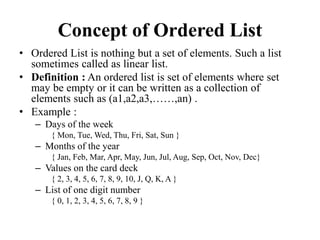
Concept of Ordered List
• Ordered List is nothing but a set of elements. Such a list
sometimes called as linear list.
• Definition : An ordered list is set of elements where set
may be empty or it can be written as a collection of
elements such as (a1,a2,a3,……,an) .
• Example :
– Days of the week
{ Mon, Tue, Wed, Thu, Fri, Sat, Sun }
– Months of the year
{ Jan, Feb, Mar, Apr, May, Jun, Jul, Aug, Sep, Oct, Nov, Dec}
– Values on the card deck
{ 2, 3, 4, 5, 6, 7, 8, 9, 10, J, Q, K, A }
– List of one digit number
{ 0, 1, 2, 3, 4, 5, 6, 7, 8, 9 }
Ordered List
• Operations on ordered list
1. Finding the length of the list.
2. Retrieving the ith element from the list.
3. Display of list
4. Searching a particular element from the list.
5. Insertion of any element in the list.
6. Deletion of any element from the list.
• Applications of Ordered List
Polynomial Representation
Stacks
Queues, etc.
Thank you

DSA Unit II array.pptx

  • 1.
    Unit II Linear DataStructures Using Sequential Organization Sequential Organization, Linear Data Structure Using Sequential Organization, Array as an Abstract Data Type, Memory Representation and Address Calculation, Inserting an element into an array, Deleting an element, Multidimensional Arrays, Two-dimensional arrays, n- dimensional arrays, Concept of Ordered List, Single Variable Polynomial, Representation using arrays, Polynomial as array of structure, Polynomial addition, Polynomial multiplication, Sparse Matrix, Sparse matrix representation, Sparse matrix addition, Transpose of sparse matrix, String Manipulation Using Array. Case Study- Use of sparse matrix in Social Networks and Maps
  • 2.
    Sequential Organization • Organizationof data within the computer memory is linear i.e. each element has unique successor. • Direct or Random access to any element is the major advantage of sequential organization. • Sequential organization makes it possible to access any element in the data structure randomly in constant time O(1).
  • 3.
    Sequential Organization • Example: Arrays • Array is an ordered set of objects. • data structure that stores data of similar type at consecutive memory locations. • e.g. int A[5]; // A is an array of size 5 • It will allocate 5 consecutive memory locations for the array A. Each element of array can be accessed by referring to its index.
  • 4.
    Linear data structure •The term “linear” means “belonging to a line” • A Linear data structure consists of elements which are ordered i.e. in a line. • The elements form a sequence such that there is a first element, second, …… and last element. • Thus, the elements of a linear data structure have a one-one relationship. • Examples : array, list.
  • 5.
    Arrays • An arrayis a finite ordered set of homogenous elements. – Finite : There are a specific number of elements in the array. – Ordered : The elements are arranged so that there is a first element, second, and so on. – Homogenous : All the elements are of the same type. • Mathematically, an array can be considered as a set of pairs- (index, value). For each index, there is an associated value. This means that, there is a one-to-one mapping or correspondence between the set of indices and the set of values.
  • 6.
    Primitive Operations onArrays 1. Create : Creating a new array : This needs the information regarding the type of data objects and the number of data objects to be stored. 2. Store(array, index, value) : Store a value at particular position : This needs the name of the array, the position in the array and the value to be stored at that position. 3. Retrieve ( array, index ) : Retrieve a value at a particular position : This operation requires the array name and an index and it returns the corresponding value.
  • 7.
    Objects: A setof pairs <index, value> where for each value of index there is a value from the set item. Index is a finite ordered set of one or more dimensions, for example, {0, … , n-1} for one dimension, {(0,0),(0,1),(0,2),(1,0),(1,1),(1,2),(2,0),(2,1),(2,2)} for two dimensions, etc. Methods: for all A  Array, i  index, x  item, j, size  integer Array Create(j, list) ::= return an array of j dimensions where list is a j-tuple whose kth element is the size of the kth dimension. Items are undefined. Item Retrieve(A, i) ::= if (i  index) return the item associated with index value i in array A else return error Array Store(A, i, x) ::= if (i in index) return an array that is identical to array A except the new pair <i, x> has been inserted else return error Array as an ADT
  • 8.
    Array Implementation • Asingle dimension array is created as : – <data type> <array name> [size] ; • Example – int A[5]; • The array is implemented as a constant pointer to the array elements. • The elements are stored in consecutive memory locations. The address of the first element is called the base address.
  • 9.
    Memory Representation • Thelower bound of array starts at 0 and upper bound is (size-1 ) • The operation store is implemented as : – arrayname[position] = value ; – e.g. A[2] = 30; • The operation extract is implemented as : – arrayname[position] – e.g. num = A[2]; • Any reference to element A[i] is converted to a pointer notation as – A[i] = i[A] = *(A + i)
  • 10.
    Address Calculation • Addressof A[i] = Base Address + i * element size • E.g. • Address of A[3] = 2000 + 3 * sizeof(int) = 2000 + 3 * 4 = 2012
  • 11.
    Operations on Arrays •Inserting an element into an array • Deleting an element from the array • Inserting an element into an sorted array • Merging two sorted arrays
  • 12.
    Multidimensional Arrays • Wheneach array element is another array, it is called a multidimensional array. • Example: – int M[3][5]; – declares M as an array containing 3 elements each of which is an array containing 5 elements. • An element of this array is accessed by specifying two indices. Such an array is called a two-dimensional array. • M is said to have 3 rows and 5 columns. The rows are numbered 0 to 2 and columns are numbered 0 to 4.
  • 13.
    Multidimensional Arrays • Anarray can have more than two dimensions. For example, a three dimensional array may be declared as : – int M[2][3][4]; – M is an array containing 2 two-dimensional arrays, each having 3 rows and 4 columns.
  • 14.
    Representation of Multidimensional arrays •A two-dimensional array is a logical data structure that is useful in describing an object that is physically two- dimensional such as a matrix or a check board. This is the logical view of data. • However, computer memory is linear, i.e. it is essentially a one-dimensional array. Thus, the elements of a two- dimensional array have to be stored linearly in memory. • They can be represented in two ways. – Row-major representation : In this representation, the elements are arranged row-wise i.e. the 0th row elements are stored first, the next row elements after them and so on. – Column-major representation : Elements are arranged columnwise i.e. all elements of the 0th column occupy the first set of memory locations, elements of the first column come next and so on.
  • 15.
  • 16.
  • 17.
    Address Calculation For anarray int M[R][C]; where R = number of rows and C = number of columns , the location of an element M[i][j] in the array can be calculated as : Address of M[i][j] = Base Address + i * C * Element size + j * Element size = Base Address + ( i * C + j ) * Element size Example : Address of M[1][2] = 2000 + ( 1 * 3 + 2 ) * sizeof (int) = 2000 + 5 * 2 = 2010
  • 18.
    Address Calculation For anarray int M[R][C]; where R = number of rows and C = number of columns , the location of an element M[i][j] in the array can be calculated as : Address of M[i][j] = Base Address + j * R * Element size + i * Element size = Base Address + ( j * R + i ) * Element size Example : Address of M[1][2] = 2000 + ( 2 * 4 + 1 ) * sizeof (int) = 2000 + 9 * 2 = 2018
  • 19.
    Concept of OrderedList • Ordered List is nothing but a set of elements. Such a list sometimes called as linear list. • Definition : An ordered list is set of elements where set may be empty or it can be written as a collection of elements such as (a1,a2,a3,……,an) . • Example : – Days of the week { Mon, Tue, Wed, Thu, Fri, Sat, Sun } – Months of the year { Jan, Feb, Mar, Apr, May, Jun, Jul, Aug, Sep, Oct, Nov, Dec} – Values on the card deck { 2, 3, 4, 5, 6, 7, 8, 9, 10, J, Q, K, A } – List of one digit number { 0, 1, 2, 3, 4, 5, 6, 7, 8, 9 }
  • 20.
    Ordered List • Operationson ordered list 1. Finding the length of the list. 2. Retrieving the ith element from the list. 3. Display of list 4. Searching a particular element from the list. 5. Insertion of any element in the list. 6. Deletion of any element from the list. • Applications of Ordered List Polynomial Representation Stacks Queues, etc.
  • 21.