1
io1071 Construeren/inleiding
ME 53– Engineering Metrology
Lesson 3
Comparators
Comparator is an instrument or device
for comparing something measurable
(e.g. lengths, distances, tints of colors,
etc.) with a reference or standard.
2
io1071 Construeren/inleiding
ME 53– Engineering Metrology
Types of Comparators
➢ Depending upon the method of magnification,
the comparators are classified as:
▪ Mechanical Comparators
▪ Electrical Comparators
▪ Optical Comparators
▪ Pneumatic Comparators
▪ Fluid Displacement Comparators.
Comparators …
3
io1071 Construeren/inleiding
ME 53– Engineering Metrology
Type #1: Mechanical Comparators:
▪ A mechanical comparator employs mechanical means (for
example, lever, gear system etc.) to get the magnification.
Its manufacturing requires high degree of skill and
accuracy. The magnification of mechanical comparator
ranges from 250 to 1000.
Different types of mechanical comparators are:
▪ 1. Dial Indicators.
▪ 2. Lever Comparators.
▪ 3. Sigma Comparators.
▪ 4. Johanson Mikro kator.
▪ 5. Read type Comparators.
Comparators …
4
io1071 Construeren/inleiding
ME 53– Engineering Metrology
Dial Indicators
➢ A dial indicator is simplest type of mechanical comparator.
It is very versatile and sensitive instrument. It uses gear
system together with a rack and pinion.
Comparators …
5
io1071 Construeren/inleiding
ME 53– Engineering Metrology
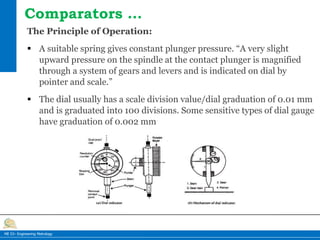
The Principle of Operation:
▪ A suitable spring gives constant plunger pressure. “A very slight
upward pressure on the spindle at the contact plunger is magnified
through a system of gears and levers and is indicated on dial by
pointer and scale.”
▪ The dial usually has a scale division value/dial graduation of 0.01 mm
and is graduated into 100 divisions. Some sensitive types of dial gauge
have graduation of 0.002 mm
Comparators …
6
io1071 Construeren/inleiding
ME 53– Engineering Metrology
The dial indicator is used for:
➢ Determining the error in geometrical
form, say, taper, roundness, ovality etc.
➢ Determining the errors is surfaces, say
alignment, Parallelism, squareness etc.
➢ Used for comparison of two heights or
distance within small limits
➢ Used for compression and tension
testing of materials
Practical Application:
Examples of real-life
applications include usage
in checking:
▪ the trueness of milling
machine arbors.
▪ the parallelism of shape
machine ram with
surface.
▪ the alignment of lathe
machine centers by using
a bar between centers.
Comparators …
7
io1071 Construeren/inleiding
ME 53– Engineering Metrology
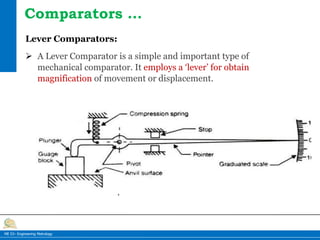
Lever Comparators:
➢ A Lever Comparator is a simple and important type of
mechanical comparator. It employs a ‘lever’ for obtain
magnification of movement or displacement.
Comparators …
8
io1071 Construeren/inleiding
ME 53– Engineering Metrology
Principle of Operation:
➢ The Principle of operation of lever type comparator is shown below.
A pile of slip gauges of standard dimension is first placed to anvil
surface, below the plunger and the pointer set to zero.
➢ The object to be measured is then placed on the anvil surface below
plunger by removing the pile of slip gauges.
➢ If there is any difference in size, the plunger moves up and down.
These plunger movements are magnified, by lever and deflect the
pointer on a graduated scale.
Comparators …
9
io1071 Construeren/inleiding
ME 53– Engineering Metrology
Comparators …
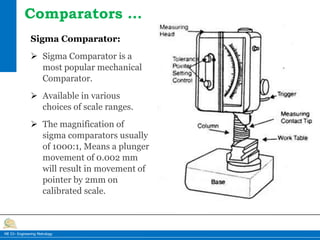
Sigma Comparator:
➢ Sigma Comparator is a
most popular mechanical
Comparator.
➢ Available in various
choices of scale ranges.
➢ The magnification of
sigma comparators usually
of 1000:1, Means a plunger
movement of 0.002 mm
will result in movement of
pointer by 2mm on
calibrated scale.
10
io1071 Construeren/inleiding
ME 53– Engineering Metrology
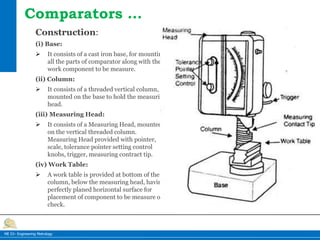
Construction:
(i) Base:
➢ It consists of a cast iron base, for mounting
all the parts of comparator along with the
work component to be measure.
(ii) Column:
➢ It consists of a threaded vertical column,
mounted on the base to hold the measuring
head.
(iii) Measuring Head:
➢ It consists of a Measuring Head, mounted
on the vertical threaded column.
Measuring Head provided with pointer,
scale, tolerance pointer setting control
knobs, trigger, measuring contract tip.
(iv) Work Table:
➢ A work table is provided at bottom of the
column, below the measuring head, having
perfectly planed horizontal surface for
placement of component to be measure or
check.
Comparators …
11
io1071 Construeren/inleiding
ME 53– Engineering Metrology
Construction:
(v) Vertical Spindle:
➢ Measuring head carries a vertical spindle
which is mounted on two flat steel springs.
The spindle works inside fixed guides
attached to the back plate of the head.
This arrangement provides a frictionless
movement of the spindle. Springs provide
a resistant pressure on the spindle.
(vi) Measuring Contact Tip:
➢ A measuring contact tip is fitted with a
shank and shank is fitted to spindle.
(vii) A Stop:
➢ A stop is suitably provided in the assembly
to restrict the spindle movement at lowest
position of the scale.
(viii) A Trigger:
➢ A trigger lever projects outside the
measuring head. This is incorporate in the
mechanism for elevating the measuring
contact when required.
Comparators …
12
io1071 Construeren/inleiding
ME 53– Engineering Metrology
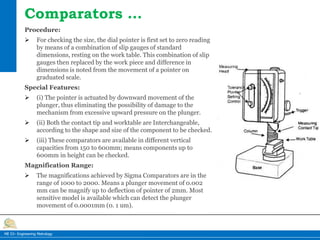
Procedure:
➢ For checking the size, the dial pointer is first set to zero reading
by means of a combination of slip gauges of standard
dimensions, resting on the work table. This combination of slip
gauges then replaced by the work piece and difference in
dimensions is noted from the movement of a pointer on
graduated scale.
Special Features:
➢ (i) The pointer is actuated by downward movement of the
plunger, thus eliminating the possibility of damage to the
mechanism from excessive upward pressure on the plunger.
➢ (ii) Both the contact tip and worktable are Interchangeable,
according to the shape and size of the component to be checked.
➢ (iii) These comparators are available in different vertical
capacities from 150 to 600mm; means components up to
600mm in height can be checked.
Magnification Range:
➢ The magnifications achieved by Sigma Comparators are in the
range of 1000 to 2000. Means a plunger movement of 0.002
mm can be magnify up to deflection of pointer of 2mm. Most
sensitive model is available which can detect the plunger
movement of 0.0001mm (0. 1 um).
Comparators …
13
io1071 Construeren/inleiding
ME 53– Engineering Metrology
Advantages of Mechanical Comparators:
(i) Low Cost:
➢ These instruments are usually cheaper than
other types of comparators.
(ii) No Electricity is needed:
➢ These instruments do not required any
external source of power supply or air as in
the case of pneumatic or electrical
comparators. Hence outside sources do not
affect the accuracy of the comparator.
(iii) Linear Scale:
➢ These installments usually have linear scale,
which is easy to read.
(iv) Easy to Handle:
➢ These installments are usually robust and
compact so easy to handle.
(v) Suitable for Workshop:
➢ These instruments are portable and can be
issued from store keeper in workshop.
Comparators …
Disadvantages of Mechanical Comparators:
(i) Friction :
➢ Due to more moving linkages.
(ii) Inertia :
➢ They have more inertia. Hence these
instruments are very sensitive to vibrations.
(iii) Less :
➢ They have low accuracy due to friction and
high inertia.
(iv) Wear, Play, Backlash:
➢ Wear, play, backlash or dimensional
inaccuracy in the device used will also be
magnified. This increases the error in
measurement.
(v) Range is Limited:
➢ They have limited range of measurement, as
the pointer moves over a fixed scale.
(vi) Parallax Error:
➢ They are affected with error due to parallax as
the pointer moves over a fixed scale.
14
io1071 Construeren/inleiding
ME 53– Engineering Metrology
Type # 2. Electrical Comparators:
➢ An Electrical comparator employs electrical means to get the
magnification. In this comparator the movement of the measuring
contact plunger is converted into an electrical signal.
➢ The electrical signal is recorded by an instrument which is then
calibrated in terms of plunger movement.
Comparators …
15
io1071 Construeren/inleiding
ME 53– Engineering Metrology
Construction:
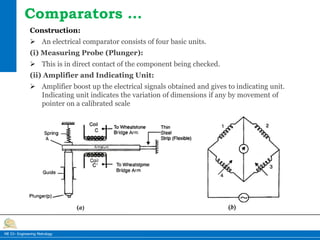
➢ An electrical comparator consists of four basic units.
(i) Measuring Probe (Plunger):
➢ This is in direct contact of the component being checked.
(ii) Amplifier and Indicating Unit:
➢ Amplifier boost up the electrical signals obtained and gives to indicating unit.
Indicating unit indicates the variation of dimensions if any by movement of
pointer on a calibrated scale
Comparators …
16
io1071 Construeren/inleiding
ME 53– Engineering Metrology
Construction:
(iii) Power Unit:
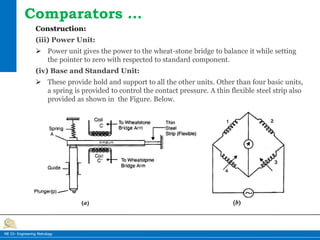
➢ Power unit gives the power to the wheat-stone bridge to balance it while setting
the pointer to zero with respected to standard component.
(iv) Base and Standard Unit:
➢ These provide hold and support to all the other units. Other than four basic units,
a spring is provided to control the contact pressure. A thin flexible steel strip also
provided as shown in the Figure. Below.
Comparators …
17
io1071 Construeren/inleiding
ME 53– Engineering Metrology
Working Principle:
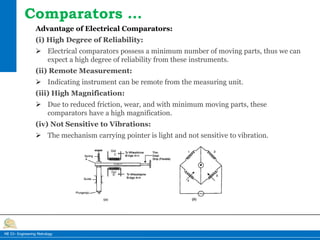
➢ The principle of operation of an electrical comparator is shown in Fig. below an
armature supported on thin flexible steel strip is suspended between two coils C
and C. When the distance of the armature from two coils is equal, the Wheatstone
bridge is balanced and no current flows through the galvanometer.
➢ Little movement of the measuring plunger unbalances the bridge resulting in the
flow of current through the galvanometer. Galvanometer scale is calibrated to give
the movements of the plunger.
Comparators …
18
io1071 Construeren/inleiding
ME 53– Engineering Metrology
Magnification:
➢ Electrical comparators are available to read up to 0.0001mm with magnification
ranging between 1100-18,000. Some most sensitive electrical comparators
available with magnification of 40,000 or higher.
Special Features:
➢ Could also be supplied with indicators, which would give out a signal if the
component being checked lies below or above the standard dimensions. The
signal from the indicator may either be colored lamps or a buzzer sound.
Comparators …
19
io1071 Construeren/inleiding
ME 53– Engineering Metrology
Advantage of Electrical Comparators:
(i) High Degree of Reliability:
➢ Electrical comparators possess a minimum number of moving parts, thus we can
expect a high degree of reliability from these instruments.
(ii) Remote Measurement:
➢ Indicating instrument can be remote from the measuring unit.
(iii) High Magnification:
➢ Due to reduced friction, wear, and with minimum moving parts, these
comparators have a high magnification.
(iv) Not Sensitive to Vibrations:
➢ The mechanism carrying pointer is light and not sensitive to vibration.
Comparators …
20
io1071 Construeren/inleiding
ME 53– Engineering Metrology
Disadvantages of Electrical Comparators:
(i) High Cost:
➢ These instruments usually more expensive than the mechanical comparators.
(ii) External Power Source:
➢ These instruments require an external agency to operate i.e., a.c. electric supply
Thus the fluctuation in voltage or frequency may affect the accuracy of
measurement.
(iii) Heating of Coils:
➢ Heating of coils in the system may cause to alter the calibration.
(iv) Fixed Scale:
➢ If only a fixed scale in used with a moving pointer then with high magnifications,
a small range is obtained.
Comparators …
21
io1071 Construeren/inleiding
ME 53– Engineering Metrology
Type # 3. Optical Comparators:
➢ There is no pure optical comparator
but large magnification is obtained by
use of optical principle in optical
comparators.
➢ A mechanical instrument also
contributes quite a lot for the overall
magnification. Hence sometimes it is
referred as ‘Mech-optical comparator’.
➢ Magnification in case of optical
comparators is obtained with the help
of light beams which has an advantage
of being straight and weightless.
Optical comparators have their own
built in light source.
Comparators …
22
io1071 Construeren/inleiding
ME 53– Engineering Metrology
Working Principle :
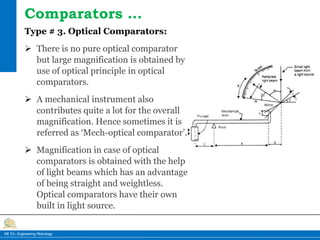
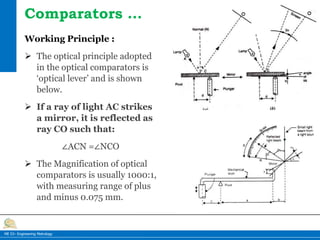
➢ The optical principle adopted
in the optical comparators is
‘optical lever’ and is shown
below.
➢ If a ray of light AC strikes
a mirror, it is reflected as
ray CO such that:
∠ACN =∠NCO
➢ The Magnification of optical
comparators is usually 1000:1,
with measuring range of plus
and minus 0.075 mm.
Comparators …
23
io1071 Construeren/inleiding
ME 53– Engineering Metrology
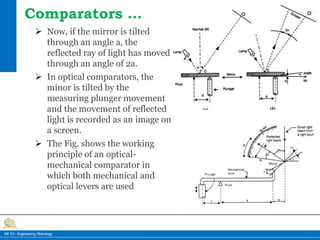
➢ Now, if the mirror is tilted
through an angle a, the
reflected ray of light has moved
through an angle of 2a.
➢ In optical comparators, the
minor is tilted by the
measuring plunger movement
and the movement of reflected
light is recorded as an image on
a screen.
➢ The Fig. shows the working
principle of an optical-
mechanical comparator in
which both mechanical and
optical levers are used
Comparators …
24
io1071 Construeren/inleiding
ME 53– Engineering Metrology
Advantages of Optical Comparators:
1. High Accuracy:
➢ These comparators have usually a few
moving linkage and hence are not
subjected to wear tear, and much
friction and give high accuracy.
2. High Range:
➢ These comparators have a scale which
can be made past a datum line and thus
have high range.
3. High Magnification:
➢ The Magnification is usually high.
4. No Inertia:
➢ A beam of light is used for
magnification which has no inertia.
5. Parallax Errors:
➢ Parallax error is not there.
Comparators …
Disadvantages of Optical Comparators:
1. Costly:
➢ Optical comparators are costly than other
types like mechanical and electrical
comparators.
2. Size:
➢ The size of the optical comparator is large.
3. Need Source of Light:
➢ Optical comparators require the electric supply
to operate the source of light.
4. Heating of Instrument:
➢ Heating from source of light affects the
accuracy of the measurement.
5. Need of Dark Room:
➢ Dark room is required to take readings easily
and properly.
6. Reading not Convenient:
➢ Taking readings continuously through the eye-
piece in not convenient.
25
io1071 Construeren/inleiding
ME 53– Engineering Metrology
Type # 4. Pneumatic
Comparators:
➢ Pneumatic Comparators uses
air as a means of
magnification in metrology.
(… was originally developed
for the calibration of
carburetors).
➢ The first application was the
checking of the bores of
motor-car cylinder blocks.
➢ Now it is almost used in
production shop for this
purpose.
Comparators …
26
io1071 Construeren/inleiding
ME 53– Engineering Metrology
Working Principle:
➢ The Pneumatic Comparator is
based on Bernoulli’s theory.
The principle of working of a
➢ Pneumatic comparator is
shown in figure. Air at a low,
but constant pressure, ps, is
supplied through a small jet ‘c’
into an intermediate chamber
and then pass through a second
orifice gauging jet ‘G’ to
atmosphere.
Comparators …
27
io1071 Construeren/inleiding
ME 53– Engineering Metrology
Working Principle:
➢ The object whose dimensions is
to be checked is placed below the
gauging jet as shown.
➢ The amount of air escaping
through gap between work piece
‘p’ and gauging jet ‘G’ will depend
upon the gap h. The gap h will
affect the intermediate pressure
recorded by the manometer “M”.
➢ If the gap ‘h’ is large, pressure
recorded would be small. If the
gap ‘h’ is small, pressure would
be higher.
Comparators …
28
io1071 Construeren/inleiding
ME 53– Engineering Metrology
Working Principle:
➢ The gap ‘h’ initially set with the
help of known standard usually
slips gauges. The component
whose dimensions to be
checked is placed by removing
the slip gauges.
➢ If the component has variation
in size than the gap ‘h’ will
increased or decreased. This
will cause to change in
intermediate pressure, and will
change in the manometer
reading. The manometer is
calibrated to read linear scale.
Comparators …
29
io1071 Construeren/inleiding
ME 53– Engineering Metrology
Magnification:
➢ A high order of magnification is
possible because no physical
contact is made to the part
being checked.
➢ The Magnification possible
with this type of comparator is
as high as 30,000: 1, but are
usually about 10,000: 1.
Comparators …
30
io1071 Construeren/inleiding
ME 53– Engineering Metrology
Uses and Applications:
➢ Applied to internal and
external diameter
measurements,
➢ thickness measurements.
➢ They can also be applied to
check the concentricity of
angular parts, depth of blind
holes, parallelism flatness,
hole centre distance, etc.
Comparators …
31
io1071 Construeren/inleiding
ME 53– Engineering Metrology
Advantages of Pneumatic Comparators:
1. High Accuracy:
➢ Since the part to be checked does not
comes in contact of measuring probe and
hence no wear takes place on the gauging
probe. Also this incorporates very less
number of moving parts thus less friction
and less inertia will leads to high accuracy.
2. Higher Magnification:
➢ A high as 30,000:1 magnification can be
achieved with pneumatic comparators.
3. Cleaning of Dust:
➢ Jet of air helps in cleaning the dust, if any,
from the component being measured.
4. Checking of Surface Positions:
➢ Pneumatic comparators are the best
means for determining the ovality,
straightness, flatness, squareness,
roundness, taperness and circular bores.
Comparators …
Disadvantages of Pneumatic
Comparators:
1. Need of Auxiliary Equipment’s:
➢ Pneumatic comparators require
auxiliary equipment for their proper
functioning, like accurate pressure
regulator.
2. Non-Uniform Scale:
➢ The scale of Pneumatic Comparators
is generally not uniform.
3. Not Portable:
➢ The whole apparatus is not portable.
4. Effect of Temp:
➢ Humidity and surface roughness:
Pneumatic Comparators are
sensitive to temperature and
humidity changes. Their accuracy
will also affected by the surface
roughness of component being
checked.
32
io1071 Construeren/inleiding
ME 53– Engineering Metrology
Type # 5. Fluid
Displacement Comparators:
➢ Fluid displacement comparators
work on the principle of
displacement of fluid. These
comparators find only limited
applications in metrology.
Working Principle:
➢ The operation depends upon the
displacement of fluid from the
large section of the comparator to
the relatively smaller section of the
comparator with displacement of
the feeler or plunger.
Comparators …
33
io1071 Construeren/inleiding
ME 53– Engineering Metrology
Type # 5. Fluid
Displacement Comparators:
Working Principle:
➢ The component to be checked is
placed below the measuring plunger.
➢ If there is any deviation in size of the
component, the diaphragm deflects a
small quantity of fluid.
➢ This small quantity of deflected fluid
raises fluid in capillary tube.
➢ A scale is available with the capillary
tube with indicates the limit points of
fluid raised or lowered.
Comparators …
34
io1071 Construeren/inleiding
ME 53– Engineering Metrology
End…

Unit_II_-_Lesson_3_Linear_and_Angular_Measurements.pdf

  • 1.
    1 io1071 Construeren/inleiding ME 53–Engineering Metrology Lesson 3 Comparators Comparator is an instrument or device for comparing something measurable (e.g. lengths, distances, tints of colors, etc.) with a reference or standard.
  • 2.
    2 io1071 Construeren/inleiding ME 53–Engineering Metrology Types of Comparators ➢ Depending upon the method of magnification, the comparators are classified as: ▪ Mechanical Comparators ▪ Electrical Comparators ▪ Optical Comparators ▪ Pneumatic Comparators ▪ Fluid Displacement Comparators. Comparators …
  • 3.
    3 io1071 Construeren/inleiding ME 53–Engineering Metrology Type #1: Mechanical Comparators: ▪ A mechanical comparator employs mechanical means (for example, lever, gear system etc.) to get the magnification. Its manufacturing requires high degree of skill and accuracy. The magnification of mechanical comparator ranges from 250 to 1000. Different types of mechanical comparators are: ▪ 1. Dial Indicators. ▪ 2. Lever Comparators. ▪ 3. Sigma Comparators. ▪ 4. Johanson Mikro kator. ▪ 5. Read type Comparators. Comparators …
  • 4.
    4 io1071 Construeren/inleiding ME 53–Engineering Metrology Dial Indicators ➢ A dial indicator is simplest type of mechanical comparator. It is very versatile and sensitive instrument. It uses gear system together with a rack and pinion. Comparators …
  • 5.
    5 io1071 Construeren/inleiding ME 53–Engineering Metrology The Principle of Operation: ▪ A suitable spring gives constant plunger pressure. “A very slight upward pressure on the spindle at the contact plunger is magnified through a system of gears and levers and is indicated on dial by pointer and scale.” ▪ The dial usually has a scale division value/dial graduation of 0.01 mm and is graduated into 100 divisions. Some sensitive types of dial gauge have graduation of 0.002 mm Comparators …
  • 6.
    6 io1071 Construeren/inleiding ME 53–Engineering Metrology The dial indicator is used for: ➢ Determining the error in geometrical form, say, taper, roundness, ovality etc. ➢ Determining the errors is surfaces, say alignment, Parallelism, squareness etc. ➢ Used for comparison of two heights or distance within small limits ➢ Used for compression and tension testing of materials Practical Application: Examples of real-life applications include usage in checking: ▪ the trueness of milling machine arbors. ▪ the parallelism of shape machine ram with surface. ▪ the alignment of lathe machine centers by using a bar between centers. Comparators …
  • 7.
    7 io1071 Construeren/inleiding ME 53–Engineering Metrology Lever Comparators: ➢ A Lever Comparator is a simple and important type of mechanical comparator. It employs a ‘lever’ for obtain magnification of movement or displacement. Comparators …
  • 8.
    8 io1071 Construeren/inleiding ME 53–Engineering Metrology Principle of Operation: ➢ The Principle of operation of lever type comparator is shown below. A pile of slip gauges of standard dimension is first placed to anvil surface, below the plunger and the pointer set to zero. ➢ The object to be measured is then placed on the anvil surface below plunger by removing the pile of slip gauges. ➢ If there is any difference in size, the plunger moves up and down. These plunger movements are magnified, by lever and deflect the pointer on a graduated scale. Comparators …
  • 9.
    9 io1071 Construeren/inleiding ME 53–Engineering Metrology Comparators … Sigma Comparator: ➢ Sigma Comparator is a most popular mechanical Comparator. ➢ Available in various choices of scale ranges. ➢ The magnification of sigma comparators usually of 1000:1, Means a plunger movement of 0.002 mm will result in movement of pointer by 2mm on calibrated scale.
  • 10.
    10 io1071 Construeren/inleiding ME 53–Engineering Metrology Construction: (i) Base: ➢ It consists of a cast iron base, for mounting all the parts of comparator along with the work component to be measure. (ii) Column: ➢ It consists of a threaded vertical column, mounted on the base to hold the measuring head. (iii) Measuring Head: ➢ It consists of a Measuring Head, mounted on the vertical threaded column. Measuring Head provided with pointer, scale, tolerance pointer setting control knobs, trigger, measuring contract tip. (iv) Work Table: ➢ A work table is provided at bottom of the column, below the measuring head, having perfectly planed horizontal surface for placement of component to be measure or check. Comparators …
  • 11.
    11 io1071 Construeren/inleiding ME 53–Engineering Metrology Construction: (v) Vertical Spindle: ➢ Measuring head carries a vertical spindle which is mounted on two flat steel springs. The spindle works inside fixed guides attached to the back plate of the head. This arrangement provides a frictionless movement of the spindle. Springs provide a resistant pressure on the spindle. (vi) Measuring Contact Tip: ➢ A measuring contact tip is fitted with a shank and shank is fitted to spindle. (vii) A Stop: ➢ A stop is suitably provided in the assembly to restrict the spindle movement at lowest position of the scale. (viii) A Trigger: ➢ A trigger lever projects outside the measuring head. This is incorporate in the mechanism for elevating the measuring contact when required. Comparators …
  • 12.
    12 io1071 Construeren/inleiding ME 53–Engineering Metrology Procedure: ➢ For checking the size, the dial pointer is first set to zero reading by means of a combination of slip gauges of standard dimensions, resting on the work table. This combination of slip gauges then replaced by the work piece and difference in dimensions is noted from the movement of a pointer on graduated scale. Special Features: ➢ (i) The pointer is actuated by downward movement of the plunger, thus eliminating the possibility of damage to the mechanism from excessive upward pressure on the plunger. ➢ (ii) Both the contact tip and worktable are Interchangeable, according to the shape and size of the component to be checked. ➢ (iii) These comparators are available in different vertical capacities from 150 to 600mm; means components up to 600mm in height can be checked. Magnification Range: ➢ The magnifications achieved by Sigma Comparators are in the range of 1000 to 2000. Means a plunger movement of 0.002 mm can be magnify up to deflection of pointer of 2mm. Most sensitive model is available which can detect the plunger movement of 0.0001mm (0. 1 um). Comparators …
  • 13.
    13 io1071 Construeren/inleiding ME 53–Engineering Metrology Advantages of Mechanical Comparators: (i) Low Cost: ➢ These instruments are usually cheaper than other types of comparators. (ii) No Electricity is needed: ➢ These instruments do not required any external source of power supply or air as in the case of pneumatic or electrical comparators. Hence outside sources do not affect the accuracy of the comparator. (iii) Linear Scale: ➢ These installments usually have linear scale, which is easy to read. (iv) Easy to Handle: ➢ These installments are usually robust and compact so easy to handle. (v) Suitable for Workshop: ➢ These instruments are portable and can be issued from store keeper in workshop. Comparators … Disadvantages of Mechanical Comparators: (i) Friction : ➢ Due to more moving linkages. (ii) Inertia : ➢ They have more inertia. Hence these instruments are very sensitive to vibrations. (iii) Less : ➢ They have low accuracy due to friction and high inertia. (iv) Wear, Play, Backlash: ➢ Wear, play, backlash or dimensional inaccuracy in the device used will also be magnified. This increases the error in measurement. (v) Range is Limited: ➢ They have limited range of measurement, as the pointer moves over a fixed scale. (vi) Parallax Error: ➢ They are affected with error due to parallax as the pointer moves over a fixed scale.
  • 14.
    14 io1071 Construeren/inleiding ME 53–Engineering Metrology Type # 2. Electrical Comparators: ➢ An Electrical comparator employs electrical means to get the magnification. In this comparator the movement of the measuring contact plunger is converted into an electrical signal. ➢ The electrical signal is recorded by an instrument which is then calibrated in terms of plunger movement. Comparators …
  • 15.
    15 io1071 Construeren/inleiding ME 53–Engineering Metrology Construction: ➢ An electrical comparator consists of four basic units. (i) Measuring Probe (Plunger): ➢ This is in direct contact of the component being checked. (ii) Amplifier and Indicating Unit: ➢ Amplifier boost up the electrical signals obtained and gives to indicating unit. Indicating unit indicates the variation of dimensions if any by movement of pointer on a calibrated scale Comparators …
  • 16.
    16 io1071 Construeren/inleiding ME 53–Engineering Metrology Construction: (iii) Power Unit: ➢ Power unit gives the power to the wheat-stone bridge to balance it while setting the pointer to zero with respected to standard component. (iv) Base and Standard Unit: ➢ These provide hold and support to all the other units. Other than four basic units, a spring is provided to control the contact pressure. A thin flexible steel strip also provided as shown in the Figure. Below. Comparators …
  • 17.
    17 io1071 Construeren/inleiding ME 53–Engineering Metrology Working Principle: ➢ The principle of operation of an electrical comparator is shown in Fig. below an armature supported on thin flexible steel strip is suspended between two coils C and C. When the distance of the armature from two coils is equal, the Wheatstone bridge is balanced and no current flows through the galvanometer. ➢ Little movement of the measuring plunger unbalances the bridge resulting in the flow of current through the galvanometer. Galvanometer scale is calibrated to give the movements of the plunger. Comparators …
  • 18.
    18 io1071 Construeren/inleiding ME 53–Engineering Metrology Magnification: ➢ Electrical comparators are available to read up to 0.0001mm with magnification ranging between 1100-18,000. Some most sensitive electrical comparators available with magnification of 40,000 or higher. Special Features: ➢ Could also be supplied with indicators, which would give out a signal if the component being checked lies below or above the standard dimensions. The signal from the indicator may either be colored lamps or a buzzer sound. Comparators …
  • 19.
    19 io1071 Construeren/inleiding ME 53–Engineering Metrology Advantage of Electrical Comparators: (i) High Degree of Reliability: ➢ Electrical comparators possess a minimum number of moving parts, thus we can expect a high degree of reliability from these instruments. (ii) Remote Measurement: ➢ Indicating instrument can be remote from the measuring unit. (iii) High Magnification: ➢ Due to reduced friction, wear, and with minimum moving parts, these comparators have a high magnification. (iv) Not Sensitive to Vibrations: ➢ The mechanism carrying pointer is light and not sensitive to vibration. Comparators …
  • 20.
    20 io1071 Construeren/inleiding ME 53–Engineering Metrology Disadvantages of Electrical Comparators: (i) High Cost: ➢ These instruments usually more expensive than the mechanical comparators. (ii) External Power Source: ➢ These instruments require an external agency to operate i.e., a.c. electric supply Thus the fluctuation in voltage or frequency may affect the accuracy of measurement. (iii) Heating of Coils: ➢ Heating of coils in the system may cause to alter the calibration. (iv) Fixed Scale: ➢ If only a fixed scale in used with a moving pointer then with high magnifications, a small range is obtained. Comparators …
  • 21.
    21 io1071 Construeren/inleiding ME 53–Engineering Metrology Type # 3. Optical Comparators: ➢ There is no pure optical comparator but large magnification is obtained by use of optical principle in optical comparators. ➢ A mechanical instrument also contributes quite a lot for the overall magnification. Hence sometimes it is referred as ‘Mech-optical comparator’. ➢ Magnification in case of optical comparators is obtained with the help of light beams which has an advantage of being straight and weightless. Optical comparators have their own built in light source. Comparators …
  • 22.
    22 io1071 Construeren/inleiding ME 53–Engineering Metrology Working Principle : ➢ The optical principle adopted in the optical comparators is ‘optical lever’ and is shown below. ➢ If a ray of light AC strikes a mirror, it is reflected as ray CO such that: ∠ACN =∠NCO ➢ The Magnification of optical comparators is usually 1000:1, with measuring range of plus and minus 0.075 mm. Comparators …
  • 23.
    23 io1071 Construeren/inleiding ME 53–Engineering Metrology ➢ Now, if the mirror is tilted through an angle a, the reflected ray of light has moved through an angle of 2a. ➢ In optical comparators, the minor is tilted by the measuring plunger movement and the movement of reflected light is recorded as an image on a screen. ➢ The Fig. shows the working principle of an optical- mechanical comparator in which both mechanical and optical levers are used Comparators …
  • 24.
    24 io1071 Construeren/inleiding ME 53–Engineering Metrology Advantages of Optical Comparators: 1. High Accuracy: ➢ These comparators have usually a few moving linkage and hence are not subjected to wear tear, and much friction and give high accuracy. 2. High Range: ➢ These comparators have a scale which can be made past a datum line and thus have high range. 3. High Magnification: ➢ The Magnification is usually high. 4. No Inertia: ➢ A beam of light is used for magnification which has no inertia. 5. Parallax Errors: ➢ Parallax error is not there. Comparators … Disadvantages of Optical Comparators: 1. Costly: ➢ Optical comparators are costly than other types like mechanical and electrical comparators. 2. Size: ➢ The size of the optical comparator is large. 3. Need Source of Light: ➢ Optical comparators require the electric supply to operate the source of light. 4. Heating of Instrument: ➢ Heating from source of light affects the accuracy of the measurement. 5. Need of Dark Room: ➢ Dark room is required to take readings easily and properly. 6. Reading not Convenient: ➢ Taking readings continuously through the eye- piece in not convenient.
  • 25.
    25 io1071 Construeren/inleiding ME 53–Engineering Metrology Type # 4. Pneumatic Comparators: ➢ Pneumatic Comparators uses air as a means of magnification in metrology. (… was originally developed for the calibration of carburetors). ➢ The first application was the checking of the bores of motor-car cylinder blocks. ➢ Now it is almost used in production shop for this purpose. Comparators …
  • 26.
    26 io1071 Construeren/inleiding ME 53–Engineering Metrology Working Principle: ➢ The Pneumatic Comparator is based on Bernoulli’s theory. The principle of working of a ➢ Pneumatic comparator is shown in figure. Air at a low, but constant pressure, ps, is supplied through a small jet ‘c’ into an intermediate chamber and then pass through a second orifice gauging jet ‘G’ to atmosphere. Comparators …
  • 27.
    27 io1071 Construeren/inleiding ME 53–Engineering Metrology Working Principle: ➢ The object whose dimensions is to be checked is placed below the gauging jet as shown. ➢ The amount of air escaping through gap between work piece ‘p’ and gauging jet ‘G’ will depend upon the gap h. The gap h will affect the intermediate pressure recorded by the manometer “M”. ➢ If the gap ‘h’ is large, pressure recorded would be small. If the gap ‘h’ is small, pressure would be higher. Comparators …
  • 28.
    28 io1071 Construeren/inleiding ME 53–Engineering Metrology Working Principle: ➢ The gap ‘h’ initially set with the help of known standard usually slips gauges. The component whose dimensions to be checked is placed by removing the slip gauges. ➢ If the component has variation in size than the gap ‘h’ will increased or decreased. This will cause to change in intermediate pressure, and will change in the manometer reading. The manometer is calibrated to read linear scale. Comparators …
  • 29.
    29 io1071 Construeren/inleiding ME 53–Engineering Metrology Magnification: ➢ A high order of magnification is possible because no physical contact is made to the part being checked. ➢ The Magnification possible with this type of comparator is as high as 30,000: 1, but are usually about 10,000: 1. Comparators …
  • 30.
    30 io1071 Construeren/inleiding ME 53–Engineering Metrology Uses and Applications: ➢ Applied to internal and external diameter measurements, ➢ thickness measurements. ➢ They can also be applied to check the concentricity of angular parts, depth of blind holes, parallelism flatness, hole centre distance, etc. Comparators …
  • 31.
    31 io1071 Construeren/inleiding ME 53–Engineering Metrology Advantages of Pneumatic Comparators: 1. High Accuracy: ➢ Since the part to be checked does not comes in contact of measuring probe and hence no wear takes place on the gauging probe. Also this incorporates very less number of moving parts thus less friction and less inertia will leads to high accuracy. 2. Higher Magnification: ➢ A high as 30,000:1 magnification can be achieved with pneumatic comparators. 3. Cleaning of Dust: ➢ Jet of air helps in cleaning the dust, if any, from the component being measured. 4. Checking of Surface Positions: ➢ Pneumatic comparators are the best means for determining the ovality, straightness, flatness, squareness, roundness, taperness and circular bores. Comparators … Disadvantages of Pneumatic Comparators: 1. Need of Auxiliary Equipment’s: ➢ Pneumatic comparators require auxiliary equipment for their proper functioning, like accurate pressure regulator. 2. Non-Uniform Scale: ➢ The scale of Pneumatic Comparators is generally not uniform. 3. Not Portable: ➢ The whole apparatus is not portable. 4. Effect of Temp: ➢ Humidity and surface roughness: Pneumatic Comparators are sensitive to temperature and humidity changes. Their accuracy will also affected by the surface roughness of component being checked.
  • 32.
    32 io1071 Construeren/inleiding ME 53–Engineering Metrology Type # 5. Fluid Displacement Comparators: ➢ Fluid displacement comparators work on the principle of displacement of fluid. These comparators find only limited applications in metrology. Working Principle: ➢ The operation depends upon the displacement of fluid from the large section of the comparator to the relatively smaller section of the comparator with displacement of the feeler or plunger. Comparators …
  • 33.
    33 io1071 Construeren/inleiding ME 53–Engineering Metrology Type # 5. Fluid Displacement Comparators: Working Principle: ➢ The component to be checked is placed below the measuring plunger. ➢ If there is any deviation in size of the component, the diaphragm deflects a small quantity of fluid. ➢ This small quantity of deflected fluid raises fluid in capillary tube. ➢ A scale is available with the capillary tube with indicates the limit points of fluid raised or lowered. Comparators …
  • 34.
    34 io1071 Construeren/inleiding ME 53–Engineering Metrology End…