3day inservvice course
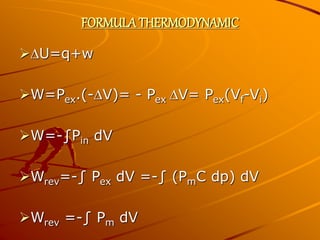
FORMULA THERMODYNAMIC
U=q+w
W=Pex.(-V)= - Pex V= Pex(Vf-Vi)
W=-∫Pin dV
Wrev=-∫ Pex dV =-∫ (PmC dp) dV
Wrev =-∫ Pm dV
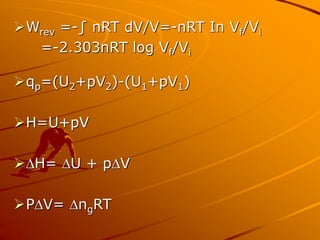
Wrev =-∫ nRT dV/V=-nRT In Vf/Vi
=-2.303nRT log Vf/Vi
qp=(U2+pV2)-(U1+pV1)
H=U+pV
H= U + pV
PV= ngRT
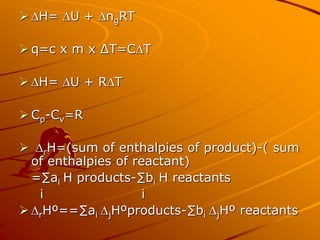
 H= U + ngRT
 q=c x m x ∆T=CT
 H= U + RT
 Cp-Cv=R
 rH=(sum of enthalpies of product)-( sum
of enthalpies of reactant)
=∑ai H products-∑bi H reactants
i i
 rHº==∑ai jHºproducts-∑bi jHº reactants
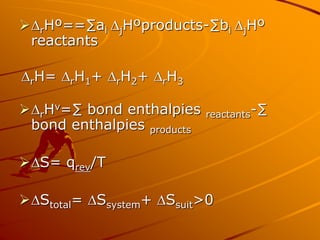
rHº==∑ai jHºproducts-∑bi jHº
reactants
rH= rH1+ rH2+ rH3
rHv=∑ bond enthalpies reactants-∑
bond enthalpies products
S= qrev/T
Stotal= Ssystem+ Ssuit>0
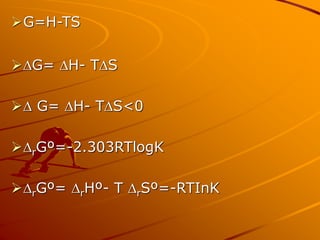
G=H-TS
G= H- TS
 G= H- TS<0
rGº=-2.303RTlogK
rGº= rHº- T rSº=-RTInK
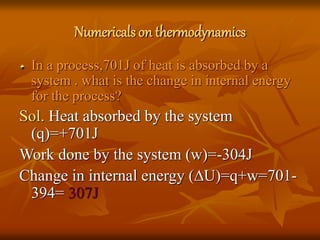
Numericals on thermodynamics
In a process,701J of heat is absorbed by a
system . what is the change in internal energy
for the process?
Sol. Heat absorbed by the system
(q)=+701J
Work done by the system (w)=-304J
Change in internal energy (∆U)=q+w=701-
394= 307J
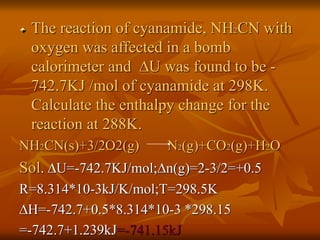
The reaction of cyanamide, NH2CN with
oxygen was affected in a bomb
calorimeter and ∆U was found to be -
742.7KJ /mol of cyanamide at 298K.
Calculate the enthalpy change for the
reaction at 288K.
NH2CN(s)+3/2O2(g) N2(g)+CO2(g)+H2O
Sol. ∆U=-742.7KJ/mol;∆n(g)=2-3/2=+0.5
R=8.314*10-3kJ/K/mol;T=298.5K
∆H=-742.7+0.5*8.314*10-3 *298.15
=-742.7+1.239kJ=-741.15kJ
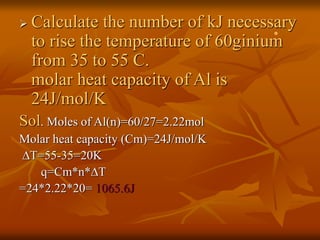
 Calculate the number of kJ necessary
to rise the temperature of 60ginium
from 35 to 55 C.
molar heat capacity of Al is
24J/mol/K
Sol. Moles of Al(n)=60/27=2.22mol
Molar heat capacity (Cm)=24J/mol/K
∆T=55-35=20K
q=Cm*n*∆T
=24*2.22*20= 1065.6J
Calculate the enthalpy change on freezing of
1.0 mol of water at -10 C to ice at-10C
.∆fus=6.03kJ /mol at 0 C. Cp[H2o(l)]=75.3J
/mol/k :Cp[H2o(s)]=36.8J /mol/K .
Sol. The freezing process is represented as
H2O(l) H2O(s) T1=-10 C =263.15K;
T2=0 C=273.15K;∆T=T2-T1=10K
Now according to Kirchoff’s equation ,
(∆H2-∆H1)/T2-T1=Cp (ice)-Cp (water)
(-6030-∆H1)/10=36.8-75.3
-6030-∆H1=10*38.5
∆H1= 5625J /mol
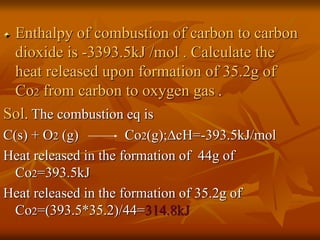
Enthalpy of combustion of carbon to carbon
dioxide is -3393.5kJ /mol . Calculate the
heat released upon formation of 35.2g of
Co2 from carbon to oxygen gas .
Sol. The combustion eq is
C(s) + O2 (g) Co2(g);∆cH=-393.5kJ/mol
Heat released in the formation of 44g of
Co2=393.5kJ
Heat released in the formation of 35.2g of
Co2=(393.5*35.2)/44=314.8kJ
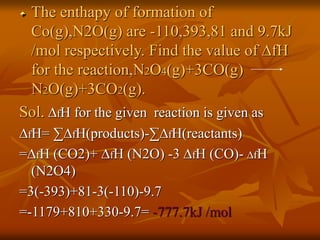
The enthapy of formation of
Co(g),N2O(g) are -110,393,81 and 9.7kJ
/mol respectively. Find the value of ∆fH
for the reaction,N2O4(g)+3CO(g)
N2O(g)+3CO2(g).
Sol. ∆fH for the given reaction is given as
∆fH= ∑∆fH(products)-∑∆fH(reactants)
=∆fH (CO2)+ ∆fH (N2O) -3 ∆fH (CO)- ∆fH
(N2O4)
=3(-393)+81-3(-110)-9.7
=-1179+810+330-9.7= -777.7kJ /mol
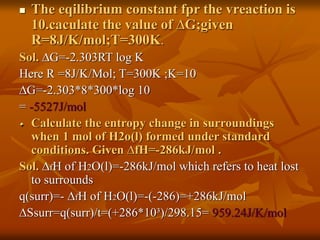
 The eqilibrium constant fpr the vreaction is
10.caculate the value of ∆G;given
R=8J/K/mol;T=300K.
Sol. ∆G=-2.303RT log K
Here R =8J/K/Mol; T=300K ;K=10
∆G=-2.303*8*300*log 10
= -5527J/mol
Calculate the entropy change in surroundings
when 1 mol of H2o(l) formed under standard
conditions. Given ∆fH=-286kJ/mol .
Sol. ∆fH of H2O(l)=-286kJ/mol which refers to heat lost
to surrounds
q(surr)=- ∆fH of H2O(l)=-(-286)=+286kJ/mol
∆Ssurr=q(surr)/t=(+286*10³)/298.15= 959.24J/K/mol
Fir the reaction;2A(g)+B(g) 2D(g)
∆U298=-10.5kJ and ∆S=-44.1J
Calculate ∆G298 for the reaction and predict
whether the reaction is spontaneous or not.
Sol. ∆H= ∆U+ ∆n(g)RT
∆ n(g)=2- ∆ 3=-1mol;T=298K; U=10.5kJ
R=8.314kJ/K/mol
∆H=-10.5+[-1*8.314*10-³*298]
=12.298kJ
∆G= ∆H-T∆S
=-12.978-298*0.044
=+0.134kJ/mol
Since ∆G is positive, the reaction is spontaneous
∆
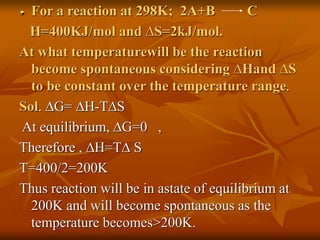
For a reaction at 298K; 2A+B C
H=400KJ/mol and ∆S=2kJ/mol.
At what temperaturewill be the reaction
become spontaneous considering ∆Hand ∆S
to be constant over the temperature range.
Sol. ∆G= ∆H-T∆S
At equilibrium, ∆G=0 ,
Therefore , ∆H=T∆ S
T=400/2=200K
Thus reaction will be in astate of equilibrium at
200K and will become spontaneous as the
temperature becomes>200K.

unit-6-thermodynamics.ppt

  • 1.
  • 2.
    FORMULA THERMODYNAMIC U=q+w W=Pex.(-V)= -Pex V= Pex(Vf-Vi) W=-∫Pin dV Wrev=-∫ Pex dV =-∫ (PmC dp) dV Wrev =-∫ Pm dV
  • 3.
    Wrev =-∫ nRTdV/V=-nRT In Vf/Vi =-2.303nRT log Vf/Vi qp=(U2+pV2)-(U1+pV1) H=U+pV H= U + pV PV= ngRT
  • 4.
     H= U+ ngRT  q=c x m x ∆T=CT  H= U + RT  Cp-Cv=R  rH=(sum of enthalpies of product)-( sum of enthalpies of reactant) =∑ai H products-∑bi H reactants i i  rHº==∑ai jHºproducts-∑bi jHº reactants
  • 5.
    rHº==∑ai jHºproducts-∑bi jHº reactants rH=rH1+ rH2+ rH3 rHv=∑ bond enthalpies reactants-∑ bond enthalpies products S= qrev/T Stotal= Ssystem+ Ssuit>0
  • 6.
    G=H-TS G= H- TS G= H- TS<0 rGº=-2.303RTlogK rGº= rHº- T rSº=-RTInK
  • 7.
    Numericals on thermodynamics Ina process,701J of heat is absorbed by a system . what is the change in internal energy for the process? Sol. Heat absorbed by the system (q)=+701J Work done by the system (w)=-304J Change in internal energy (∆U)=q+w=701- 394= 307J
  • 8.
    The reaction ofcyanamide, NH2CN with oxygen was affected in a bomb calorimeter and ∆U was found to be - 742.7KJ /mol of cyanamide at 298K. Calculate the enthalpy change for the reaction at 288K. NH2CN(s)+3/2O2(g) N2(g)+CO2(g)+H2O Sol. ∆U=-742.7KJ/mol;∆n(g)=2-3/2=+0.5 R=8.314*10-3kJ/K/mol;T=298.5K ∆H=-742.7+0.5*8.314*10-3 *298.15 =-742.7+1.239kJ=-741.15kJ
  • 9.
     Calculate thenumber of kJ necessary to rise the temperature of 60ginium from 35 to 55 C. molar heat capacity of Al is 24J/mol/K Sol. Moles of Al(n)=60/27=2.22mol Molar heat capacity (Cm)=24J/mol/K ∆T=55-35=20K q=Cm*n*∆T =24*2.22*20= 1065.6J
  • 10.
    Calculate the enthalpychange on freezing of 1.0 mol of water at -10 C to ice at-10C .∆fus=6.03kJ /mol at 0 C. Cp[H2o(l)]=75.3J /mol/k :Cp[H2o(s)]=36.8J /mol/K . Sol. The freezing process is represented as H2O(l) H2O(s) T1=-10 C =263.15K; T2=0 C=273.15K;∆T=T2-T1=10K Now according to Kirchoff’s equation , (∆H2-∆H1)/T2-T1=Cp (ice)-Cp (water) (-6030-∆H1)/10=36.8-75.3 -6030-∆H1=10*38.5 ∆H1= 5625J /mol
  • 11.
    Enthalpy of combustionof carbon to carbon dioxide is -3393.5kJ /mol . Calculate the heat released upon formation of 35.2g of Co2 from carbon to oxygen gas . Sol. The combustion eq is C(s) + O2 (g) Co2(g);∆cH=-393.5kJ/mol Heat released in the formation of 44g of Co2=393.5kJ Heat released in the formation of 35.2g of Co2=(393.5*35.2)/44=314.8kJ
  • 12.
    The enthapy offormation of Co(g),N2O(g) are -110,393,81 and 9.7kJ /mol respectively. Find the value of ∆fH for the reaction,N2O4(g)+3CO(g) N2O(g)+3CO2(g). Sol. ∆fH for the given reaction is given as ∆fH= ∑∆fH(products)-∑∆fH(reactants) =∆fH (CO2)+ ∆fH (N2O) -3 ∆fH (CO)- ∆fH (N2O4) =3(-393)+81-3(-110)-9.7 =-1179+810+330-9.7= -777.7kJ /mol
  • 13.
     The eqilibriumconstant fpr the vreaction is 10.caculate the value of ∆G;given R=8J/K/mol;T=300K. Sol. ∆G=-2.303RT log K Here R =8J/K/Mol; T=300K ;K=10 ∆G=-2.303*8*300*log 10 = -5527J/mol Calculate the entropy change in surroundings when 1 mol of H2o(l) formed under standard conditions. Given ∆fH=-286kJ/mol . Sol. ∆fH of H2O(l)=-286kJ/mol which refers to heat lost to surrounds q(surr)=- ∆fH of H2O(l)=-(-286)=+286kJ/mol ∆Ssurr=q(surr)/t=(+286*10³)/298.15= 959.24J/K/mol
  • 14.
    Fir the reaction;2A(g)+B(g)2D(g) ∆U298=-10.5kJ and ∆S=-44.1J Calculate ∆G298 for the reaction and predict whether the reaction is spontaneous or not. Sol. ∆H= ∆U+ ∆n(g)RT ∆ n(g)=2- ∆ 3=-1mol;T=298K; U=10.5kJ R=8.314kJ/K/mol ∆H=-10.5+[-1*8.314*10-³*298] =12.298kJ ∆G= ∆H-T∆S =-12.978-298*0.044 =+0.134kJ/mol Since ∆G is positive, the reaction is spontaneous ∆
  • 15.
    For a reactionat 298K; 2A+B C H=400KJ/mol and ∆S=2kJ/mol. At what temperaturewill be the reaction become spontaneous considering ∆Hand ∆S to be constant over the temperature range. Sol. ∆G= ∆H-T∆S At equilibrium, ∆G=0 , Therefore , ∆H=T∆ S T=400/2=200K Thus reaction will be in astate of equilibrium at 200K and will become spontaneous as the temperature becomes>200K.