Voltage Stability
Contents
• Comparison of angle and voltage stability.
• Reactive power flow and voltage collapse.
• Mathematical formulation of voltage stability
problem.
• Voltage stability analysis.
• Prevention of voltage collapse.
Introduction
“Power system stability is the ability of an electric power
system, for a given initial operating condition, to regain a state
of operating equilibrium after being subjected to a physical
disturbance, with most of the system variables bounded so that
practically the entire system remains intact”
Introduction
Voltage Stability
“It is the ability of the system to maintain steady state voltages
at all the system buses when subjected to a disturbance. If the
disturbance is large then it is called as large-disturbance
voltage stability and if the disturbance is small it is called as
small-disturbance voltage stability”
Comparison of angle and voltage stability
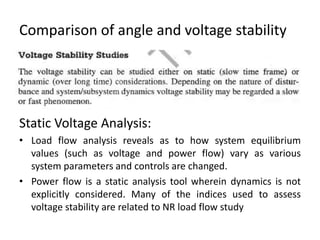
Static Voltage Analysis:
• Load flow analysis reveals as to how system equilibrium
values (such as voltage and power flow) vary as various
system parameters and controls are changed.
• Power flow is a static analysis tool wherein dynamics is not
explicitly considered. Many of the indices used to assess
voltage stability are related to NR load flow study
Comparison of angle and voltage stability
counter measures to avoid voltage instablilty are:
1. Generator terminal voltage increase (only limited control
possible)
2. Increase of generator transformer tap
3. Reactive power injection at appropriate locations
4. Load-end OLTC blocking
5. Strategic load shedding (on occurrence of undervoltage)
Reactive power flow and voltage collapse
• Long Transmission Lines
• Radial Transmission Lines
• Shortage of Local Reactive Power
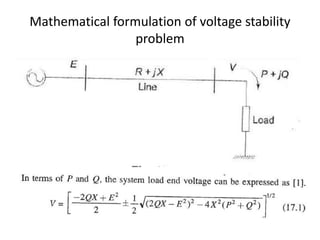
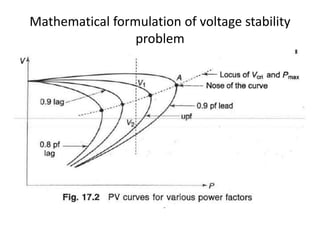
Mathematical formulation of voltage stability
problem
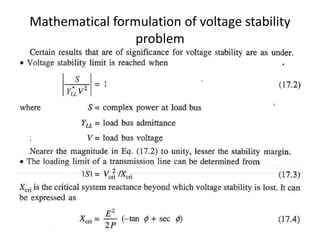
Mathematical formulation of voltage stability
problem
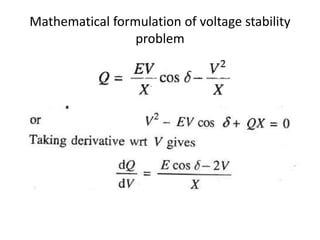
Mathematical formulation of voltage stability
problem
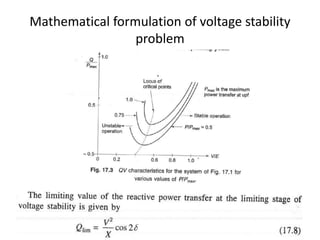
Mathematical formulation of voltage stability
problem
Mathematical formulation of voltage stability
problem
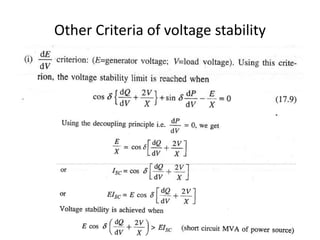
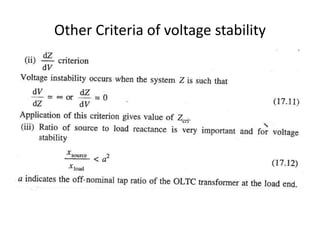
Other Criteria of voltage stability
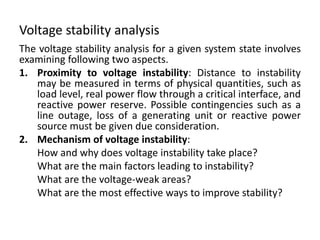
Voltage stability analysis
The voltage stability analysis for a given system state involves
examining following two aspects.
1. Proximity to voltage instability: Distance to instability
may be measured in terms of physical quantities, such as
load level, real power flow through a critical interface, and
reactive power reserve. Possible contingencies such as a
line outage, loss of a generating unit or reactive power
source must be given due consideration.
2. Mechanism of voltage instability:
How and why does voltage instability take place?
What are the main factors leading to instability?
What are the voltage-weak areas?
What are the most effective ways to improve stability?
Prevention of voltage collapse
• Application of reactive power compensating
devices.
• control of network voltage and generator reactive
output
• Coordination of protections/controls
• Control of transformer tap changers
• Under voltage load shedding
• Operators' role

unit-5.pptx

  • 1.
  • 2.
    Contents • Comparison ofangle and voltage stability. • Reactive power flow and voltage collapse. • Mathematical formulation of voltage stability problem. • Voltage stability analysis. • Prevention of voltage collapse.
  • 3.
    Introduction “Power system stabilityis the ability of an electric power system, for a given initial operating condition, to regain a state of operating equilibrium after being subjected to a physical disturbance, with most of the system variables bounded so that practically the entire system remains intact”
  • 4.
  • 5.
    Voltage Stability “It isthe ability of the system to maintain steady state voltages at all the system buses when subjected to a disturbance. If the disturbance is large then it is called as large-disturbance voltage stability and if the disturbance is small it is called as small-disturbance voltage stability”
  • 6.
    Comparison of angleand voltage stability Static Voltage Analysis: • Load flow analysis reveals as to how system equilibrium values (such as voltage and power flow) vary as various system parameters and controls are changed. • Power flow is a static analysis tool wherein dynamics is not explicitly considered. Many of the indices used to assess voltage stability are related to NR load flow study
  • 7.
    Comparison of angleand voltage stability counter measures to avoid voltage instablilty are: 1. Generator terminal voltage increase (only limited control possible) 2. Increase of generator transformer tap 3. Reactive power injection at appropriate locations 4. Load-end OLTC blocking 5. Strategic load shedding (on occurrence of undervoltage)
  • 8.
    Reactive power flowand voltage collapse • Long Transmission Lines • Radial Transmission Lines • Shortage of Local Reactive Power
  • 9.
    Mathematical formulation ofvoltage stability problem
  • 10.
    Mathematical formulation ofvoltage stability problem
  • 11.
    Mathematical formulation ofvoltage stability problem
  • 12.
    Mathematical formulation ofvoltage stability problem
  • 13.
    Mathematical formulation ofvoltage stability problem
  • 14.
    Other Criteria ofvoltage stability
  • 15.
    Other Criteria ofvoltage stability
  • 16.
    Voltage stability analysis Thevoltage stability analysis for a given system state involves examining following two aspects. 1. Proximity to voltage instability: Distance to instability may be measured in terms of physical quantities, such as load level, real power flow through a critical interface, and reactive power reserve. Possible contingencies such as a line outage, loss of a generating unit or reactive power source must be given due consideration. 2. Mechanism of voltage instability: How and why does voltage instability take place? What are the main factors leading to instability? What are the voltage-weak areas? What are the most effective ways to improve stability?
  • 17.
    Prevention of voltagecollapse • Application of reactive power compensating devices. • control of network voltage and generator reactive output • Coordination of protections/controls • Control of transformer tap changers • Under voltage load shedding • Operators' role