1
Orientation to Computing-I
L T P :2 0 0
www.lpu.in Lovely Professional University
Unit-1 (Computer Languages)
• Machine Language
• Assembly Language
• High Level Language
• Steps in development of a Program
• Compilation and Execution
• Compiler
• Interpreter
• Assembler
2
www.lpu.in Lovely Professional University
3
www.lpu.in Lovely Professional University
MACHINE LANGUAGE
• Machine language is a low-level language made up of binary numbers or
bits that a computer can understand.
• It is also known as machine code or object code and is extremely tough to
comprehend.
• The only language that the computer understands is machine language. All
programmes and programming languages, such as Swift and C++, produce
or run programmes in machine language before they are run on a
computer.
• When a specific task, even the smallest process executes, machine
language is transported to the system processor. Computers are only able
to understand binary data as they are digital devices.
4
www.lpu.in Lovely Professional University
MACHINE LANGUAGE
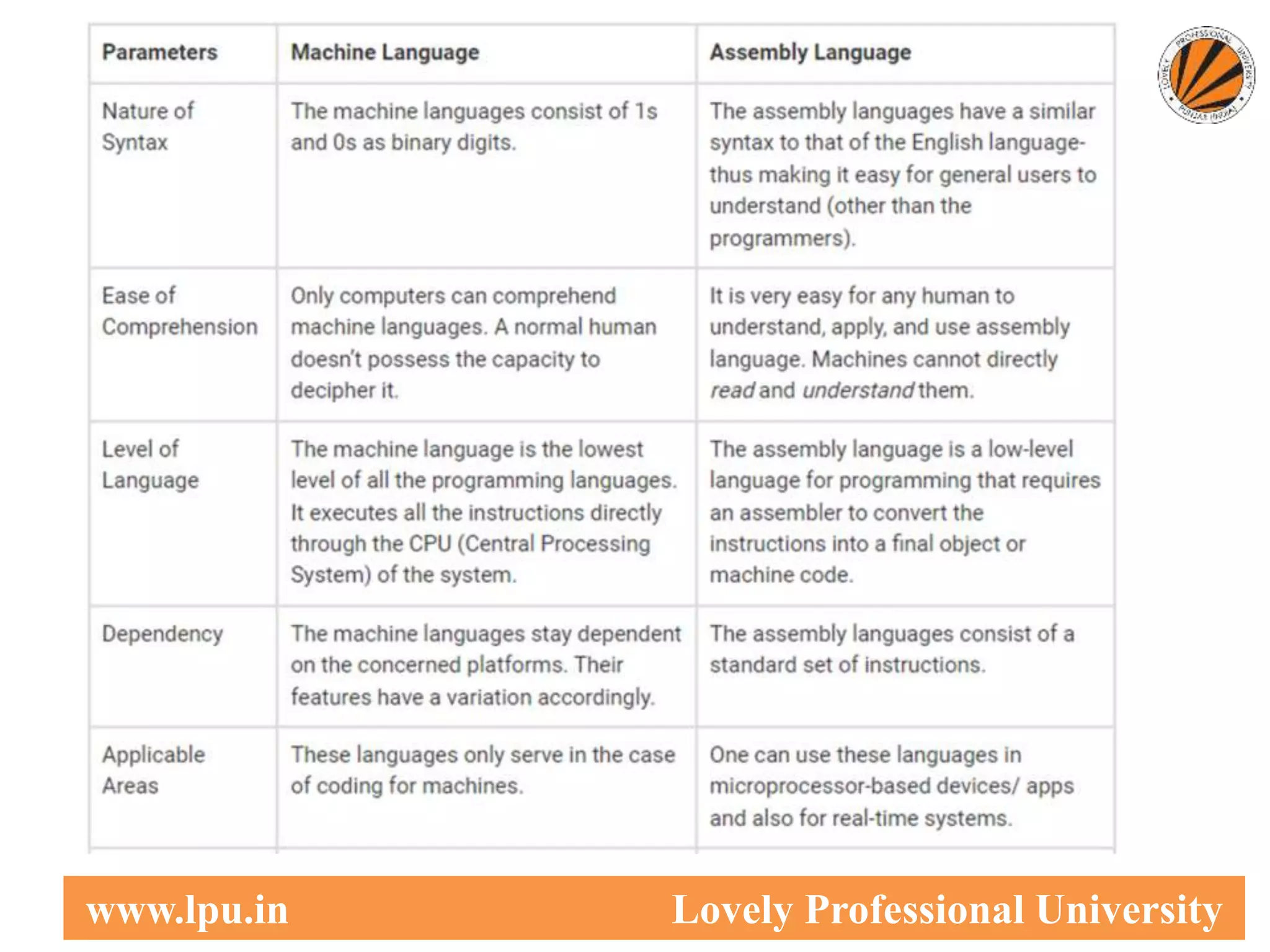
• Machine languages consist of strings of numbers ultimately reduced to
1's and 0's. The computer responds to these numbers by performing
different operations.
• Each computer can directly understand only one language—its own
machine language. With machine language a programmer can instruct a
computer to perform its most fundamental operations.
• Programs written in machine language are not portable, that is, they may
not be run on other computers with different machine languages.
• Machine language programs are easy for computers to understand, but,
for people, machine language programming is tedious work susceptible
to error.
5
www.lpu.in Lovely Professional University
ASSEMBLY LANGUAGE
• In computer programming, assembly language (or assembler language, or
symbolic machine code), is any low-level programming language with a very
strong correspondence between the instructions in the language and the
architecture's machine code instructions.
What does assembly code do?
• Assembly code is converted into executable machine code by a utility program
referred to as an assembler.
• The conversion process is referred to as assembly, as in assembling the source
code. The computational step when an assembler is processing a program is
called assembly time.
6
www.lpu.in Lovely Professional University
High Level Languages
• A HIGH-LEVEL LANGUAGE (HLL) is A programming language such as
C, FORTRAN, or pascal that enables a programmer to write programs that
are more or less independent of a particular type of computer.
• Such languages are considered high-level because they are closer to human
languages and further from machine languages
7
www.lpu.in Lovely Professional University
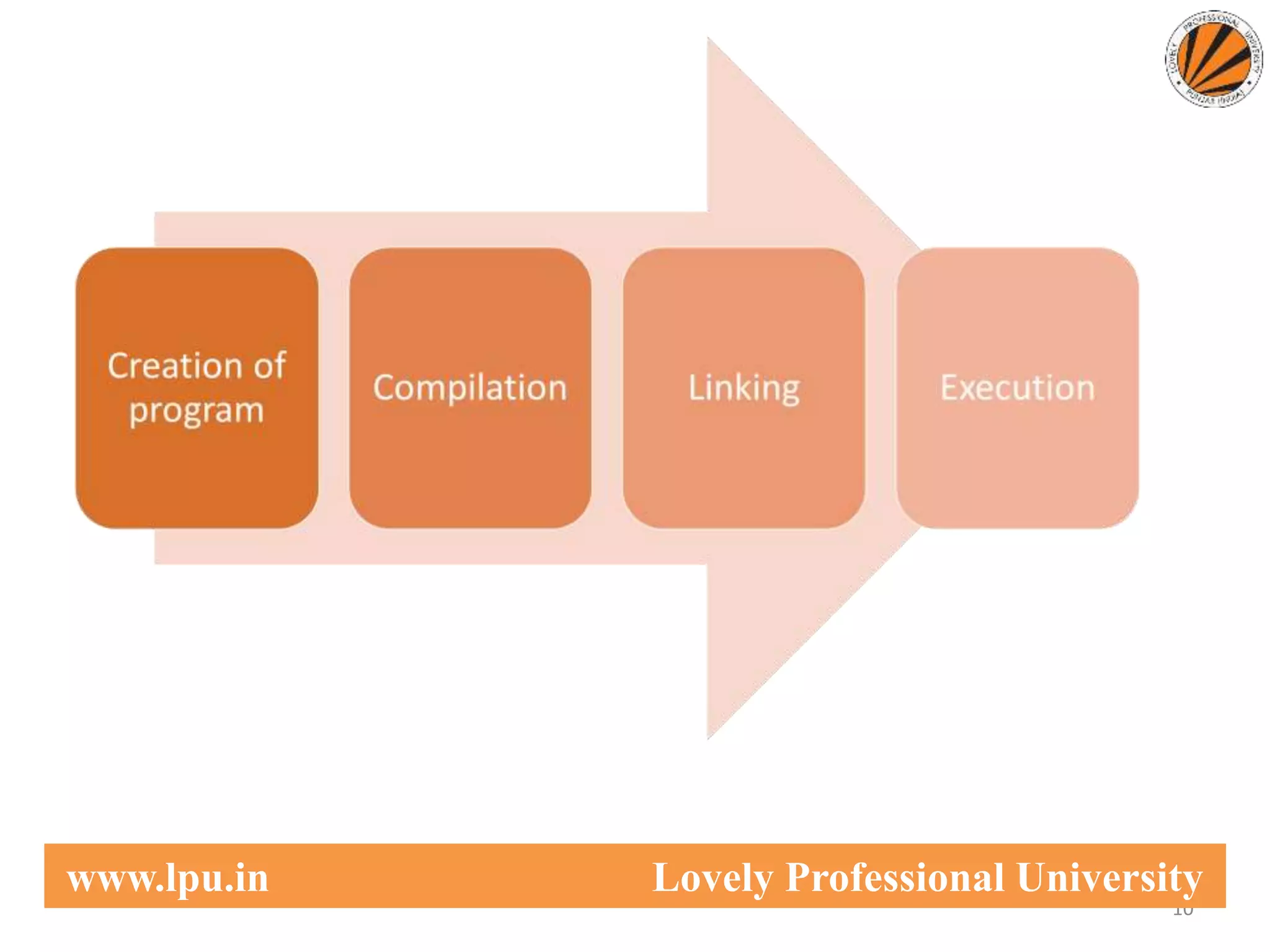
Steps in development
8
www.lpu.in Lovely Professional University
Work Flow
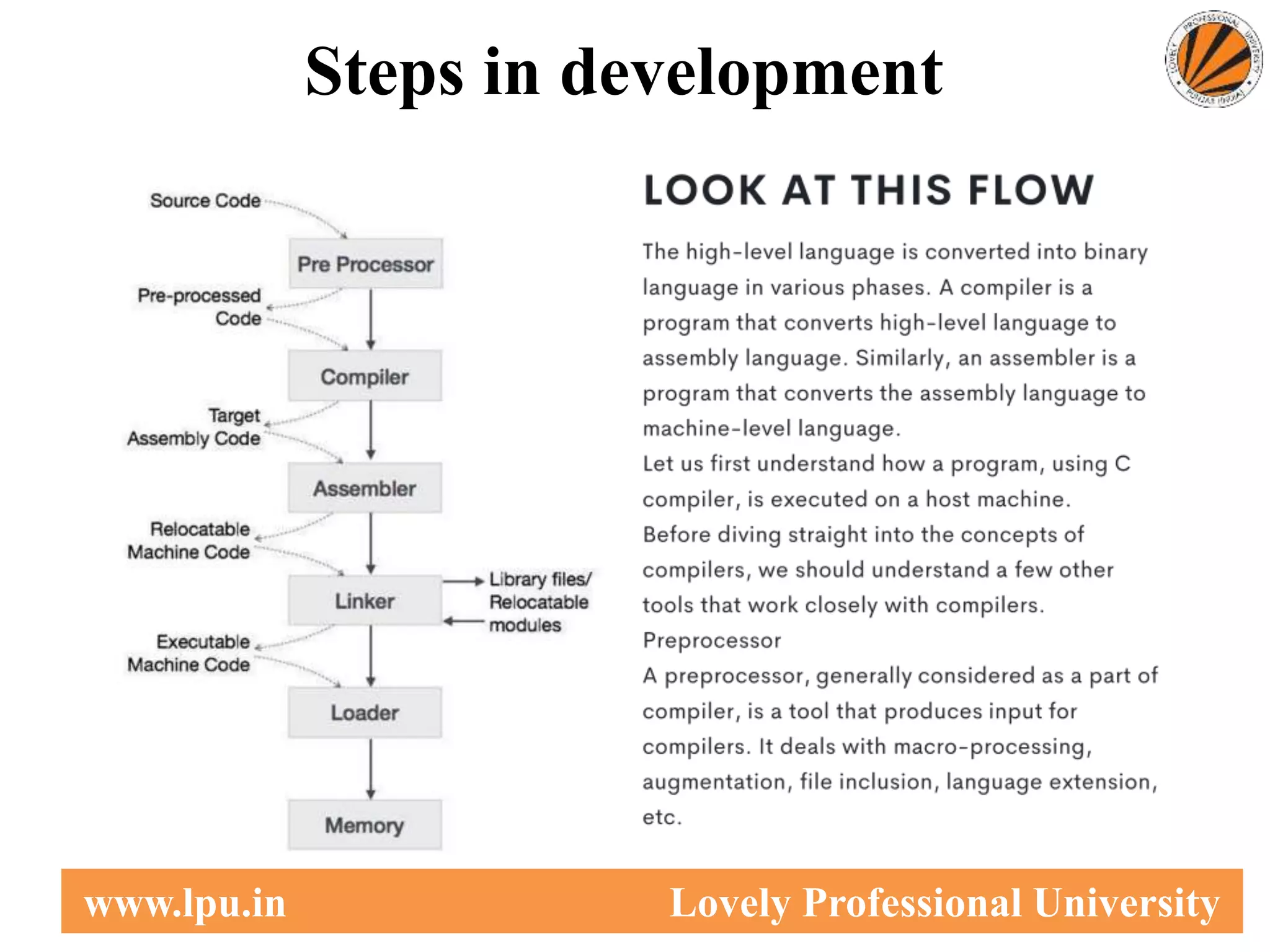
• U S E R W R I T E S A P R O G R A M I N C L A N G U A G E
( H I G H - L E V E L L A N G U A G E ) .
• T H E C C O M P I L E R , C O M P I L E S T H E P R O G R A M
A N D T R A N S L AT E S I T TO A S S E M B LY P R O G R A M
( L O W- L E V E L L A N G U A G E ) .
• A N A S S E M B L E R T H E N T R A N S L AT E S T H E
A S S E M B LY P R O G R A M I N TO M A C H I N E C O D E
( O B J E C T ) .
• A L I N K E R TO O L I S U S E D TO L I N K A L L T H E
PA RT S O F T H E P R O G R A M TO G E T H E R F O R
E X E C U T I O N ( E X E C U TA B L E M A C H I N E C O D E ) .
• A L O A D E R L O A D S A L L O F T H E M I N TO M E M O RY
A N D T H E N T H E P R O G R A M I S E X E C U T E D .
9
www.lpu.in Lovely Professional University
10
www.lpu.in Lovely Professional University
Compiler
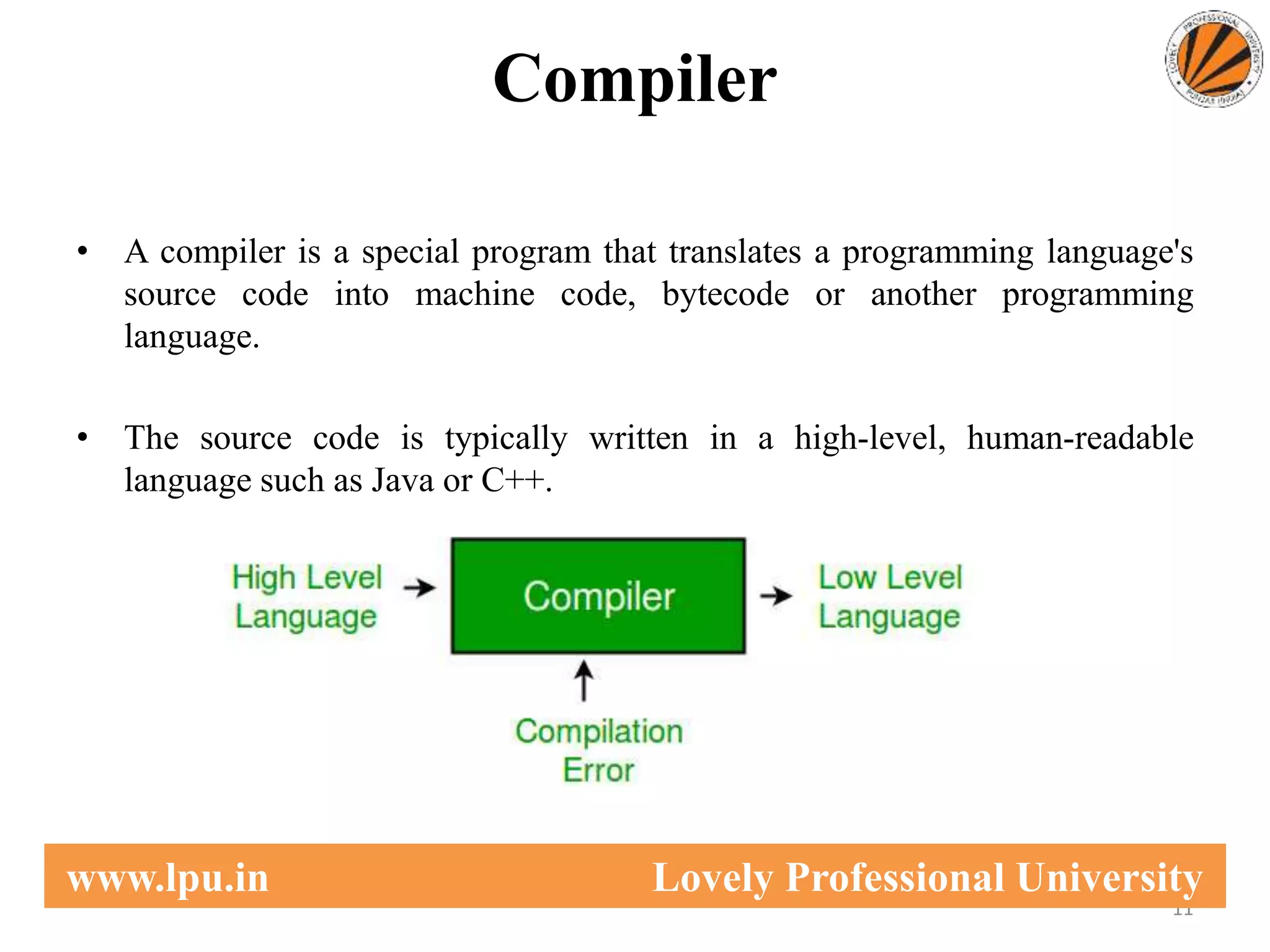
• A compiler is a special program that translates a programming language's
source code into machine code, bytecode or another programming
language.
• The source code is typically written in a high-level, human-readable
language such as Java or C++.
11
www.lpu.in Lovely Professional University
Interpreter
• An interpreter, like a compiler, translates high-level
language into low-level machine language. The
difference lies in the way they read the source code or
input.
• A compiler reads the whole source code at once, creates
tokens, checks semantics, generates intermediate code,
executes the whole program and may involve many
passes.
• In contrast, an interpreter reads a statement from the
input, converts it to an intermediate code, executes it,
then takes the next statement in sequence. If an error
occurs, an interpreter stops execution and reports it.
whereas a compiler reads the whole program even if it
encounters several errors.
12
www.lpu.in Lovely Professional University
Assembler
• An assembler translates assembly language programs into machine code.
• The output of an assembler is called an object file, which contains a
combination of machine instructions as well as the data required to place
these instructions in memory.
• An assembler is a type of computer program that interprets software
programs written in assembly language into machine language, code and
instructions that can be executed by a computer.
• An assembler enables software and application developers to access,
operate and manage a computer's hardware architecture and components
13
www.lpu.in Lovely Professional University

Unit1 Part2 1.ppt

  • 1.
    1 Orientation to Computing-I LT P :2 0 0 www.lpu.in Lovely Professional University
  • 2.
    Unit-1 (Computer Languages) •Machine Language • Assembly Language • High Level Language • Steps in development of a Program • Compilation and Execution • Compiler • Interpreter • Assembler 2 www.lpu.in Lovely Professional University
  • 3.
    3 www.lpu.in Lovely ProfessionalUniversity MACHINE LANGUAGE • Machine language is a low-level language made up of binary numbers or bits that a computer can understand. • It is also known as machine code or object code and is extremely tough to comprehend. • The only language that the computer understands is machine language. All programmes and programming languages, such as Swift and C++, produce or run programmes in machine language before they are run on a computer. • When a specific task, even the smallest process executes, machine language is transported to the system processor. Computers are only able to understand binary data as they are digital devices.
  • 4.
    4 www.lpu.in Lovely ProfessionalUniversity MACHINE LANGUAGE • Machine languages consist of strings of numbers ultimately reduced to 1's and 0's. The computer responds to these numbers by performing different operations. • Each computer can directly understand only one language—its own machine language. With machine language a programmer can instruct a computer to perform its most fundamental operations. • Programs written in machine language are not portable, that is, they may not be run on other computers with different machine languages. • Machine language programs are easy for computers to understand, but, for people, machine language programming is tedious work susceptible to error.
  • 5.
    5 www.lpu.in Lovely ProfessionalUniversity ASSEMBLY LANGUAGE • In computer programming, assembly language (or assembler language, or symbolic machine code), is any low-level programming language with a very strong correspondence between the instructions in the language and the architecture's machine code instructions. What does assembly code do? • Assembly code is converted into executable machine code by a utility program referred to as an assembler. • The conversion process is referred to as assembly, as in assembling the source code. The computational step when an assembler is processing a program is called assembly time.
  • 6.
  • 7.
    High Level Languages •A HIGH-LEVEL LANGUAGE (HLL) is A programming language such as C, FORTRAN, or pascal that enables a programmer to write programs that are more or less independent of a particular type of computer. • Such languages are considered high-level because they are closer to human languages and further from machine languages 7 www.lpu.in Lovely Professional University
  • 8.
    Steps in development 8 www.lpu.inLovely Professional University
  • 9.
    Work Flow • US E R W R I T E S A P R O G R A M I N C L A N G U A G E ( H I G H - L E V E L L A N G U A G E ) . • T H E C C O M P I L E R , C O M P I L E S T H E P R O G R A M A N D T R A N S L AT E S I T TO A S S E M B LY P R O G R A M ( L O W- L E V E L L A N G U A G E ) . • A N A S S E M B L E R T H E N T R A N S L AT E S T H E A S S E M B LY P R O G R A M I N TO M A C H I N E C O D E ( O B J E C T ) . • A L I N K E R TO O L I S U S E D TO L I N K A L L T H E PA RT S O F T H E P R O G R A M TO G E T H E R F O R E X E C U T I O N ( E X E C U TA B L E M A C H I N E C O D E ) . • A L O A D E R L O A D S A L L O F T H E M I N TO M E M O RY A N D T H E N T H E P R O G R A M I S E X E C U T E D . 9 www.lpu.in Lovely Professional University
  • 10.
  • 11.
    Compiler • A compileris a special program that translates a programming language's source code into machine code, bytecode or another programming language. • The source code is typically written in a high-level, human-readable language such as Java or C++. 11 www.lpu.in Lovely Professional University
  • 12.
    Interpreter • An interpreter,like a compiler, translates high-level language into low-level machine language. The difference lies in the way they read the source code or input. • A compiler reads the whole source code at once, creates tokens, checks semantics, generates intermediate code, executes the whole program and may involve many passes. • In contrast, an interpreter reads a statement from the input, converts it to an intermediate code, executes it, then takes the next statement in sequence. If an error occurs, an interpreter stops execution and reports it. whereas a compiler reads the whole program even if it encounters several errors. 12 www.lpu.in Lovely Professional University
  • 13.
    Assembler • An assemblertranslates assembly language programs into machine code. • The output of an assembler is called an object file, which contains a combination of machine instructions as well as the data required to place these instructions in memory. • An assembler is a type of computer program that interprets software programs written in assembly language into machine language, code and instructions that can be executed by a computer. • An assembler enables software and application developers to access, operate and manage a computer's hardware architecture and components 13 www.lpu.in Lovely Professional University