Application of the alphabet of lines
In this unit we are going to look at lines, which are an
important part of drawing.
Drawing is a graphic language used by engineers and
draughts persons.
It is made up of symbols, dimension, notes and
different types of lines which transmit meaning.
Unit2
• Written language has letters of the alphabet to form
words and sentences. The language of drawing uses
a number of different types of lines, called the
alphabet of lines, to transmit the meaning of a
drawing.
When you execute an engineering drawing, you
should always keep the following in mind:
i. Correctness
ii. Accuracy
iii. Speed
iv. Correct layout of the drawings on a drawing sheet.
Study objectives
After studying this unit, you should be able to draw and identify the
following lines:
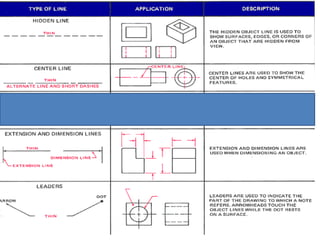
(1) Object lines
(2) Centre lines
(3) Dimension lines
(4) Extension lines
(5) Leader lines
(6) Hidden lines
(7) Dashed lines
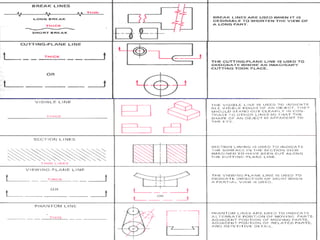
(8) Break or Cutting Line
(9) section lines
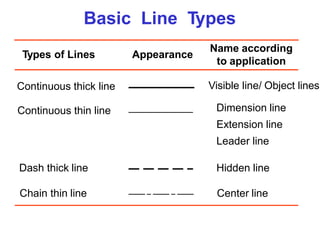
Basic Line Types
Name according
to application
Types of Lines Appearance
Continuous thick line Visible line/ Object lines
Continuous thin line Dimension line
Extension line
Leader line
Dash thick line Hidden line
Chain thin line Center line
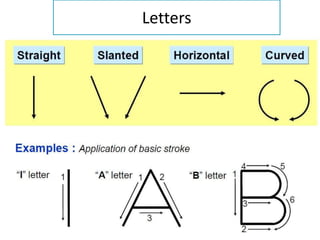
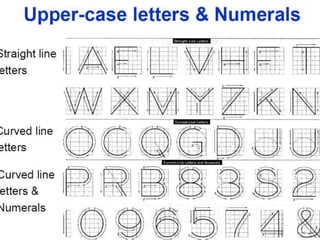
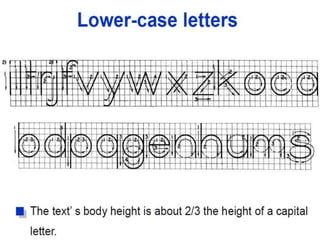
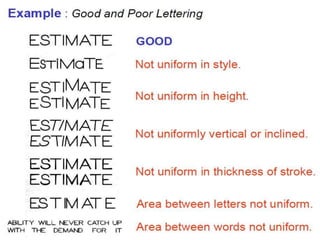
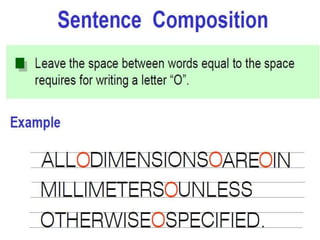
Letters
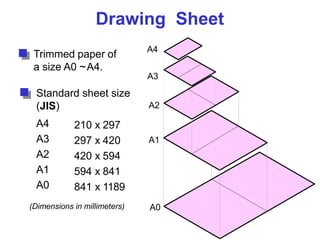
Drawing Sheet
Trimmed paper of
a size A0 ~A4.
Standard sheet size
(JIS)
A4
A3
A2
A1
A0
210 x 297
297 x 420
420 x 594
594 x 841
841 x 1189
A4
A3
A2
A1
A0
(Dimensions in millimeters)
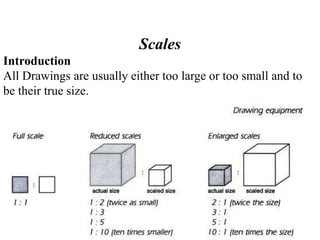
Scales
Introduction
All Drawings are usually either too large or too small and to
be their true size.
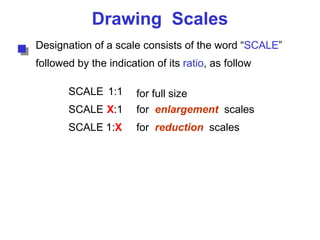
Drawing Scales
Designation of a scale consists of the word “SCALE”
followed by the indication of its ratio, as follow
SCALE 1:1
SCALE X:1
SCALE 1:X
for full size
for enlargement scales
for reduction scales
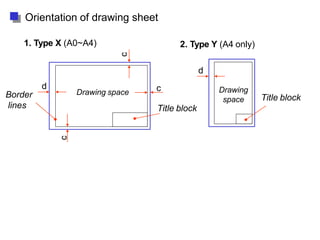
Drawing space Drawing
space
Title block
d
d
c
c
c
Border
lines
1. Type X (A0~A4) 2. Type Y (A4 only)
Orientation of drawing sheet
Title block
Unit Two Drawing.pptx

Unit Two Drawing.pptx

  • 1.
    Application of thealphabet of lines In this unit we are going to look at lines, which are an important part of drawing. Drawing is a graphic language used by engineers and draughts persons. It is made up of symbols, dimension, notes and different types of lines which transmit meaning. Unit2
  • 2.
    • Written languagehas letters of the alphabet to form words and sentences. The language of drawing uses a number of different types of lines, called the alphabet of lines, to transmit the meaning of a drawing. When you execute an engineering drawing, you should always keep the following in mind: i. Correctness ii. Accuracy iii. Speed iv. Correct layout of the drawings on a drawing sheet.
  • 3.
    Study objectives After studyingthis unit, you should be able to draw and identify the following lines: (1) Object lines (2) Centre lines (3) Dimension lines (4) Extension lines (5) Leader lines (6) Hidden lines (7) Dashed lines (8) Break or Cutting Line (9) section lines
  • 4.
    Basic Line Types Nameaccording to application Types of Lines Appearance Continuous thick line Visible line/ Object lines Continuous thin line Dimension line Extension line Leader line Dash thick line Hidden line Chain thin line Center line
  • 7.
  • 12.
    Drawing Sheet Trimmed paperof a size A0 ~A4. Standard sheet size (JIS) A4 A3 A2 A1 A0 210 x 297 297 x 420 420 x 594 594 x 841 841 x 1189 A4 A3 A2 A1 A0 (Dimensions in millimeters)
  • 13.
    Scales Introduction All Drawings areusually either too large or too small and to be their true size.
  • 14.
    Drawing Scales Designation ofa scale consists of the word “SCALE” followed by the indication of its ratio, as follow SCALE 1:1 SCALE X:1 SCALE 1:X for full size for enlargement scales for reduction scales
  • 15.
    Drawing space Drawing space Titleblock d d c c c Border lines 1. Type X (A0~A4) 2. Type Y (A4 only) Orientation of drawing sheet Title block