1
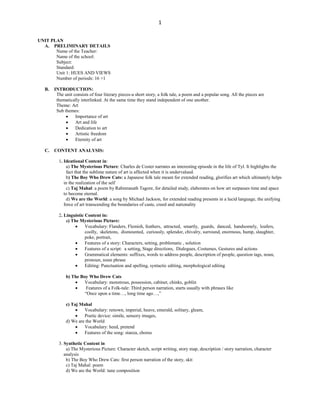
UNIT PLAN
A. PRELIMINARY DETAILS
Name of the Teacher:
Name of the school:
Subject:
Standard:
Unit 1: HUES AND VIEWS
Number of periods: 16 +1
B. INTRODUCTION:
The unit consists of four literary pieces-a short story, a folk tale, a poem and a popular song. All the pieces are
thematically interlinked. At the same time they stand independent of one another.
Theme: Art
Sub themes:
 Importance of art
 Art and life
 Dedication to art
 Artistic freedom
 Eternity of art
C. CONTENT ANALYSIS:
1. Ideational Content in:
a) The Mysterious Picture: Charles de Coster narrates an interesting episode in the life of Tyl. It highlights the
fact that the sublime nature of art is affected when it is undervalued.
b) The Boy Who Drew Cats: a Japanese folk tale meant for extended reading, glorifies art which ultimately helps
in the realization of the self
c) Taj Mahal: a poem by Rabinranath Tagore, for detailed study, elaborates on how art surpasses time and space
to become eternal.
d) We are the World: a song by Michael Jackson, for extended reading presents in a lucid language, the unifying
force of art transcending the boundaries of caste, creed and nationality
2. Linguistic Content in:
a) The Mysterious Picture:
 Vocabulary: Flanders, Flemish, feathers, attracted, smartly, guards, danced, handsomely, loafers,
coolly, skeletons, dismounted, curiously, splendor, chivalry, surround, enormous, hump, slaughter,
poke, portrait,
 Features of a story: Characters, setting, problematic , solution
 Features of a script: a setting, Stage directions, Dialogues, Costumes, Gestures and actions
 Grammatical elements: suffixes, words to address people, description of people, question tags, noun,
pronoun, noun phrase
 Editing: Punctuation and spelling, syntactic editing, morphological editing
b) The Boy Who Drew Cats
 Vocabulary: monstrous, possession, cabinet, chinks, goblin
 Features of a Folk-tale: Third person narration, starts usually with phrases like
“Once upon a time…, long time ago…,”
c) Taj Mahal
 Vocabulary: renown, imperial, heave, emerald, solitary, gleam,
 Poetic device: simile, sensory images,
d) We are the World
 Vocabulary: heed, pretend
 Features of the song: stanza, chorus
3. Synthetic Content in
a) The Mysterious Picture: Character sketch, script writing, story map, description / story narration, character
analysis
b) The Boy Who Drew Cats: first person narration of the story, skit
c) Taj Mahal: poem
d) We are the World: tune composition
2
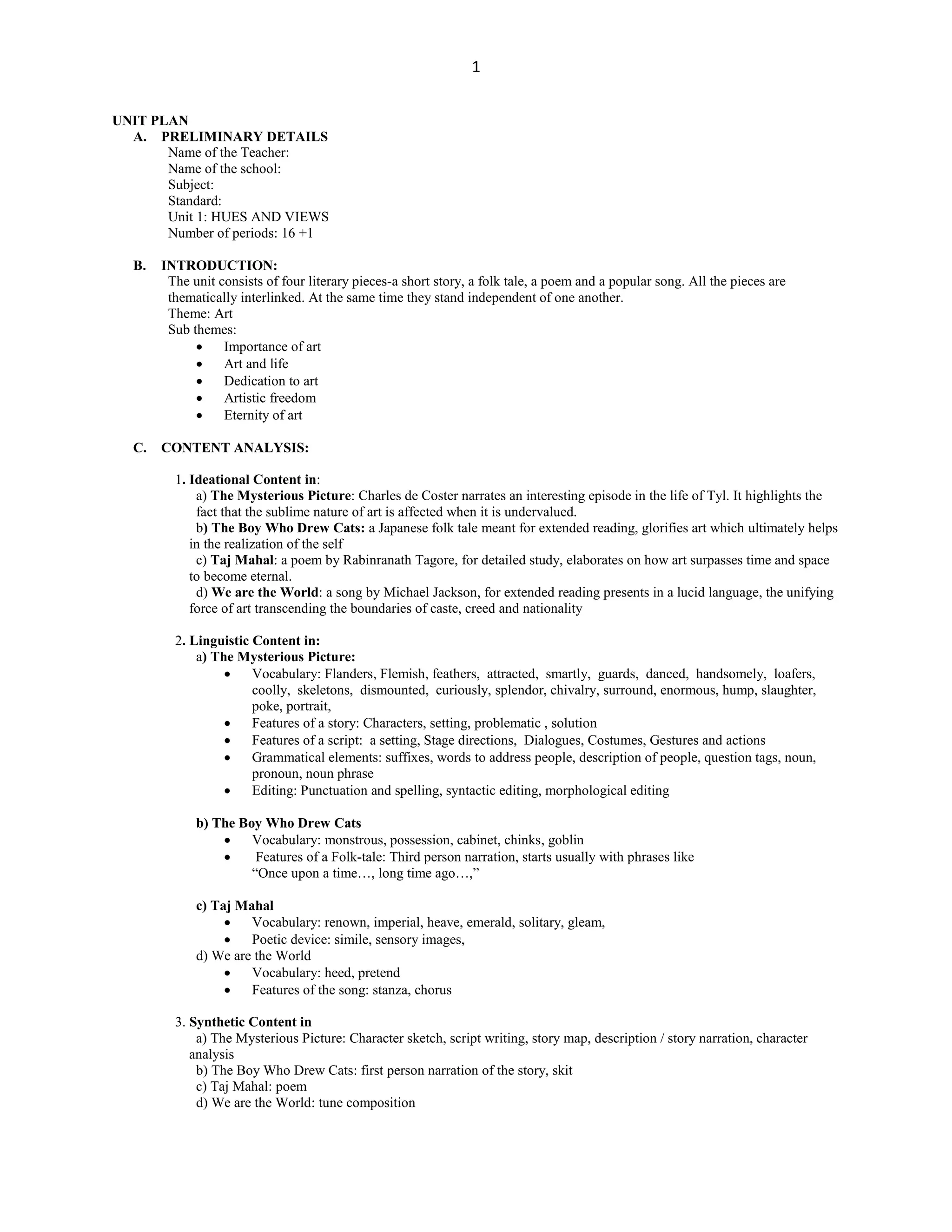
D. LEARNING OUTCOMES:
The learner will be able to:
1. Read and understand a prose text.
2. Enrich vocabulary by identifying the meaning of words from the context.
3. Refer to a dictionary or glossary to find the meaning of unfamiliar words
4. Communicate effectively in the target language
5. Enhance creative and critical thinking
6. Gather ideas on poetic craft and poetic elements like simile and images
7. Express opinions and share feelings with other learners
8. Identify language elements like suffixes, noun phrases, question tags, etc. and use them in different
situations
9. Construct language discourses like narrative, conversation, character sketch, story map, etc.
E. PREREQUISITES:
 Familiarity with artistic work and its impact on human lives
 Familiarity with different kinds of genres
F. BODY OF THE UNIT PLAN
Sl.
No.
Learning
Outcomes
Content outline Learning Activity Learning
Strategy/Material
Durat
ion
Evaluation
Strategy
1. 1, 2, 3, 4, 5
& 8
1.The Mysterious Picture
 Paragraphs 1-3
 Paragraphs 4-9
 Paragraphs 10-
15
-silent reading by
learners
-loud reading by
teacher
-loud reading by
students
-engaging learners
in some kind of
information gap
activities
-collaboration with
learners
-presentation of
ideas
-refinement of ideas
in groups
Discussion
Group/Pair work
Picture
Composition
8
perio
ds
-Question-
answering
sessions
-Quizzes
-
Information
gap
activities
-
Information
transfer
activities
-Portfolio
Assessment
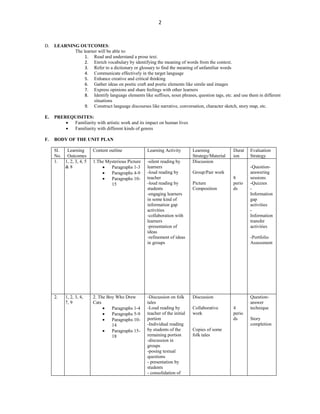
2. 1, 2, 3, 4,
7, 9
2. The Boy Who Drew
Cats
 Paragraphs 1-4
 Paragraphs 5-9
 Paragraphs 10-
14
 Paragraphs 15-
18
-Discussion on folk
tales
-Loud reading by
teacher of the initial
portion
-Individual reading
by students of the
remaining portion
-discussion in
groups
-posing textual
questions
- presentation by
students
- consolidation of
Discussion
Collaborative
work
Copies of some
folk tales
4
perio
ds
Question-
answer
technique
Story
completion
3
answers by the
teacher
3. 2, 3, 4, 5,
6, 7, 9
3. Taj Mahal -Discussion on topic
-Loud reading by
teacher
-silent reading by
students
-understanding
vocabulary through
referring the
glossary
-collaborative
reading by students
-sharing of ideas in
groups
-answering textual
questions in groups
-presentation and
refinement of
answers
Discussion
Pair-work
Group refinement
2
perio
ds
Poem
preparation
Quizzing
Question-
answer
technique
4. 2, 4, 7, 9 4.We are the World -Listening to the
song
- silent reading by
students
-Collaborative
reading
-answering textual
questions
Audio/video
presentation
Group work
Discussion
2
perio
ds
Question-
answer
technique
G. UNIT TEST

UNIT PLAN.docx

  • 1.
    1 UNIT PLAN A. PRELIMINARYDETAILS Name of the Teacher: Name of the school: Subject: Standard: Unit 1: HUES AND VIEWS Number of periods: 16 +1 B. INTRODUCTION: The unit consists of four literary pieces-a short story, a folk tale, a poem and a popular song. All the pieces are thematically interlinked. At the same time they stand independent of one another. Theme: Art Sub themes:  Importance of art  Art and life  Dedication to art  Artistic freedom  Eternity of art C. CONTENT ANALYSIS: 1. Ideational Content in: a) The Mysterious Picture: Charles de Coster narrates an interesting episode in the life of Tyl. It highlights the fact that the sublime nature of art is affected when it is undervalued. b) The Boy Who Drew Cats: a Japanese folk tale meant for extended reading, glorifies art which ultimately helps in the realization of the self c) Taj Mahal: a poem by Rabinranath Tagore, for detailed study, elaborates on how art surpasses time and space to become eternal. d) We are the World: a song by Michael Jackson, for extended reading presents in a lucid language, the unifying force of art transcending the boundaries of caste, creed and nationality 2. Linguistic Content in: a) The Mysterious Picture:  Vocabulary: Flanders, Flemish, feathers, attracted, smartly, guards, danced, handsomely, loafers, coolly, skeletons, dismounted, curiously, splendor, chivalry, surround, enormous, hump, slaughter, poke, portrait,  Features of a story: Characters, setting, problematic , solution  Features of a script: a setting, Stage directions, Dialogues, Costumes, Gestures and actions  Grammatical elements: suffixes, words to address people, description of people, question tags, noun, pronoun, noun phrase  Editing: Punctuation and spelling, syntactic editing, morphological editing b) The Boy Who Drew Cats  Vocabulary: monstrous, possession, cabinet, chinks, goblin  Features of a Folk-tale: Third person narration, starts usually with phrases like “Once upon a time…, long time ago…,” c) Taj Mahal  Vocabulary: renown, imperial, heave, emerald, solitary, gleam,  Poetic device: simile, sensory images, d) We are the World  Vocabulary: heed, pretend  Features of the song: stanza, chorus 3. Synthetic Content in a) The Mysterious Picture: Character sketch, script writing, story map, description / story narration, character analysis b) The Boy Who Drew Cats: first person narration of the story, skit c) Taj Mahal: poem d) We are the World: tune composition
  • 2.
    2 D. LEARNING OUTCOMES: Thelearner will be able to: 1. Read and understand a prose text. 2. Enrich vocabulary by identifying the meaning of words from the context. 3. Refer to a dictionary or glossary to find the meaning of unfamiliar words 4. Communicate effectively in the target language 5. Enhance creative and critical thinking 6. Gather ideas on poetic craft and poetic elements like simile and images 7. Express opinions and share feelings with other learners 8. Identify language elements like suffixes, noun phrases, question tags, etc. and use them in different situations 9. Construct language discourses like narrative, conversation, character sketch, story map, etc. E. PREREQUISITES:  Familiarity with artistic work and its impact on human lives  Familiarity with different kinds of genres F. BODY OF THE UNIT PLAN Sl. No. Learning Outcomes Content outline Learning Activity Learning Strategy/Material Durat ion Evaluation Strategy 1. 1, 2, 3, 4, 5 & 8 1.The Mysterious Picture  Paragraphs 1-3  Paragraphs 4-9  Paragraphs 10- 15 -silent reading by learners -loud reading by teacher -loud reading by students -engaging learners in some kind of information gap activities -collaboration with learners -presentation of ideas -refinement of ideas in groups Discussion Group/Pair work Picture Composition 8 perio ds -Question- answering sessions -Quizzes - Information gap activities - Information transfer activities -Portfolio Assessment 2. 1, 2, 3, 4, 7, 9 2. The Boy Who Drew Cats  Paragraphs 1-4  Paragraphs 5-9  Paragraphs 10- 14  Paragraphs 15- 18 -Discussion on folk tales -Loud reading by teacher of the initial portion -Individual reading by students of the remaining portion -discussion in groups -posing textual questions - presentation by students - consolidation of Discussion Collaborative work Copies of some folk tales 4 perio ds Question- answer technique Story completion
  • 3.
    3 answers by the teacher 3.2, 3, 4, 5, 6, 7, 9 3. Taj Mahal -Discussion on topic -Loud reading by teacher -silent reading by students -understanding vocabulary through referring the glossary -collaborative reading by students -sharing of ideas in groups -answering textual questions in groups -presentation and refinement of answers Discussion Pair-work Group refinement 2 perio ds Poem preparation Quizzing Question- answer technique 4. 2, 4, 7, 9 4.We are the World -Listening to the song - silent reading by students -Collaborative reading -answering textual questions Audio/video presentation Group work Discussion 2 perio ds Question- answer technique G. UNIT TEST