Querying Relational Data Database
Languages
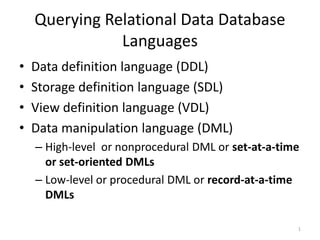
• Data definition language (DDL)
• Storage definition language (SDL)
• View definition language (VDL)
• Data manipulation language (DML)
– High-level or nonprocedural DML or set-at-a-time
or set-oriented DMLs
– Low-level or procedural DML or record-at-a-time
DMLs
1
DDL
• Once the design of a database is completed
and a DBMS is chosen to implement the
database, the first order of the day is to
specify conceptual and internal schemas for
the database and any mappings between the
two.
• In many DBMSs where no strict separation of
levels is maintained, one language, called the
data definition language (DDL), is used by the
DBA and by database designers to define
both schemas.
2
SDL
• In DBMSs where a clear separation is
maintained between the conceptual and
internal levels, the DDL is used to specify the
conceptual schema only.
• Another language, the storage definition
language (SDL), is used to specify the internal
schema.
• The mappings between the two schemas may
be specified in either one of these languages.
3
VDL
• For a true three-schema architecture, we
would need a third language, the view
definition language (VDL), to specify user
views and their mappings to the conceptual
schema, but in most DBMSs the DDL is used to
define both conceptual and external schemas.
4
DML
• Once the database schemas are compiled and
the database is populated with data, users
must have some means to manipulate the
database.
• Typical manipulations include retrieval,
insertion, deletion, and modification of the
data.
• The DBMS provides a data manipulation
language (DML) for these purposes.
5
Types of DML
• A high-level or nonprocedural DML can be used on its
own to specify complex database operations in a
concise manner. High-level DMLs, such as SQL, can
specify and retrieve many records in a single DML
statement and are hence called set-at-a-time or set-
oriented DMLs.
• A low-level or procedural DML typically retrieves
individual records or objects from the database and
processes each separately. Low-level DMLs are also
called record-at-a-time DMLs because of this property.
6
Comprehensive integrated language
• In current DBMSs, the preceding types of
languages are usually not considered distinct
languages; rather, a comprehensive integrated
language is used that includes constructs for
conceptual schema definition, view definition,
and data manipulation.
• A typical example of a comprehensive database
language is the SQL relational database language,
which represents a combination of DDL, VDL, and
DML, as well as statements for constraint
specification and schema evolution.
7

UNIT II Lecture 3 Querying Relational Data Database Languages.pptx

  • 1.
    Querying Relational DataDatabase Languages • Data definition language (DDL) • Storage definition language (SDL) • View definition language (VDL) • Data manipulation language (DML) – High-level or nonprocedural DML or set-at-a-time or set-oriented DMLs – Low-level or procedural DML or record-at-a-time DMLs 1
  • 2.
    DDL • Once thedesign of a database is completed and a DBMS is chosen to implement the database, the first order of the day is to specify conceptual and internal schemas for the database and any mappings between the two. • In many DBMSs where no strict separation of levels is maintained, one language, called the data definition language (DDL), is used by the DBA and by database designers to define both schemas. 2
  • 3.
    SDL • In DBMSswhere a clear separation is maintained between the conceptual and internal levels, the DDL is used to specify the conceptual schema only. • Another language, the storage definition language (SDL), is used to specify the internal schema. • The mappings between the two schemas may be specified in either one of these languages. 3
  • 4.
    VDL • For atrue three-schema architecture, we would need a third language, the view definition language (VDL), to specify user views and their mappings to the conceptual schema, but in most DBMSs the DDL is used to define both conceptual and external schemas. 4
  • 5.
    DML • Once thedatabase schemas are compiled and the database is populated with data, users must have some means to manipulate the database. • Typical manipulations include retrieval, insertion, deletion, and modification of the data. • The DBMS provides a data manipulation language (DML) for these purposes. 5
  • 6.
    Types of DML •A high-level or nonprocedural DML can be used on its own to specify complex database operations in a concise manner. High-level DMLs, such as SQL, can specify and retrieve many records in a single DML statement and are hence called set-at-a-time or set- oriented DMLs. • A low-level or procedural DML typically retrieves individual records or objects from the database and processes each separately. Low-level DMLs are also called record-at-a-time DMLs because of this property. 6
  • 7.
    Comprehensive integrated language •In current DBMSs, the preceding types of languages are usually not considered distinct languages; rather, a comprehensive integrated language is used that includes constructs for conceptual schema definition, view definition, and data manipulation. • A typical example of a comprehensive database language is the SQL relational database language, which represents a combination of DDL, VDL, and DML, as well as statements for constraint specification and schema evolution. 7