Translation Methods
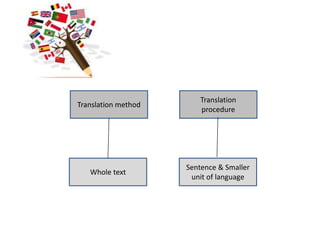
Translation method
Translation
procedure
Whole text
Sentence & Smaller
unit of language
Translation Methods
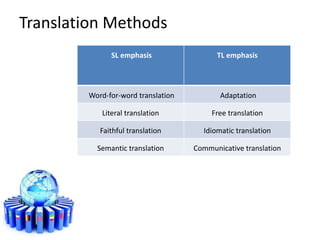
SL emphasis TL emphasis
Word-for-word translation Adaptation
Literal translation Free translation
Faithful translation Idiomatic translation
Semantic translation Communicative translation
Translation Methods
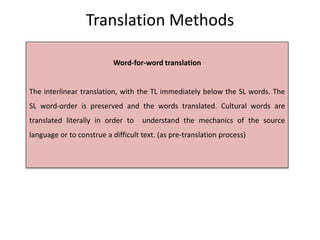
Word-for-word translation
The interlinear translation, with the TL immediately below the SL words. The
SL word-order is preserved and the words translated. Cultural words are
translated literally in order to understand the mechanics of the source
language or to construe a difficult text. (as pre-translation process)
Translation Methods
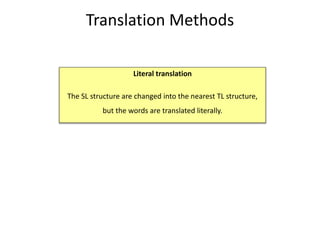
Literal translation
The SL structure are changed into the nearest TL structure,
but the words are translated literally.
Translation Methods
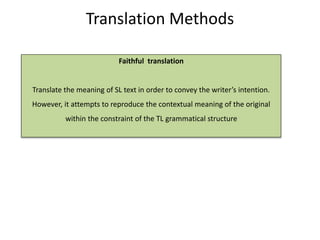
Faithful translation
Translate the meaning of SL text in order to convey the writer’s intention.
However, it attempts to reproduce the contextual meaning of the original
within the constraint of the TL grammatical structure
Translation Methods
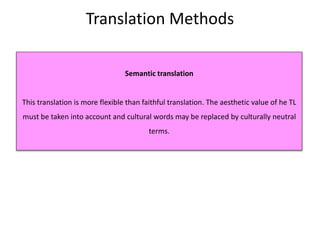
Semantic translation
This translation is more flexible than faithful translation. The aesthetic value of he TL
must be taken into account and cultural words may be replaced by culturally neutral
terms.
Translation Methods
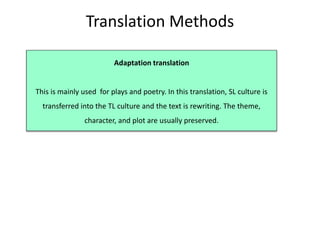
Adaptation translation
This is mainly used for plays and poetry. In this translation, SL culture is
transferred into the TL culture and the text is rewriting. The theme,
character, and plot are usually preserved.
Translation Methods
Free translation
The content of original text is not preserved. It tends to
paraphrase the original text, and uses the forms that are
easier to understand.
Translation Methods
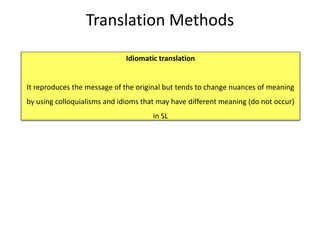
Idiomatic translation
It reproduces the message of the original but tends to change nuances of meaning
by using colloquialisms and idioms that may have different meaning (do not occur)
in SL
Translation Methods
Communicative translation
It attempts to render the exact contextual meaning of the original
in such a way that both language and content are readily
acceptable and comprehensible to the readership.
Ini kali tidak ada yang mencari
cinta.
Diantara gedung, rumah tua, pada
cerita tiang serta temali. Kapal,
perahu tidak berlaut, mengembus
diri dalam memeprcaya mau
berpaut
(Kapolah, 1990)
1.
This time there is no one looking for love.
Among the sheds, olld houses, near the tale of
the mast and riggings. Ships and boats have
not gone to sea, are puffing themselves (out) in
the believe (they) will be unified.
2.
This time no one’s looking for love. Between
the sheds, the old house, in the make believe
of poles and ropes. A boat, a prau without
water puff and blows, thinking there is
something it can catch
What translation method are used in this poem?
Which one is better? Give the reason
Unit-5.-Translation-Methods-fix.. Bbvvpptx

Unit-5.-Translation-Methods-fix.. Bbvvpptx

  • 1.
  • 2.
  • 3.
    Translation Methods SL emphasisTL emphasis Word-for-word translation Adaptation Literal translation Free translation Faithful translation Idiomatic translation Semantic translation Communicative translation
  • 4.
    Translation Methods Word-for-word translation Theinterlinear translation, with the TL immediately below the SL words. The SL word-order is preserved and the words translated. Cultural words are translated literally in order to understand the mechanics of the source language or to construe a difficult text. (as pre-translation process)
  • 5.
    Translation Methods Literal translation TheSL structure are changed into the nearest TL structure, but the words are translated literally.
  • 6.
    Translation Methods Faithful translation Translatethe meaning of SL text in order to convey the writer’s intention. However, it attempts to reproduce the contextual meaning of the original within the constraint of the TL grammatical structure
  • 7.
    Translation Methods Semantic translation Thistranslation is more flexible than faithful translation. The aesthetic value of he TL must be taken into account and cultural words may be replaced by culturally neutral terms.
  • 8.
    Translation Methods Adaptation translation Thisis mainly used for plays and poetry. In this translation, SL culture is transferred into the TL culture and the text is rewriting. The theme, character, and plot are usually preserved.
  • 9.
    Translation Methods Free translation Thecontent of original text is not preserved. It tends to paraphrase the original text, and uses the forms that are easier to understand.
  • 10.
    Translation Methods Idiomatic translation Itreproduces the message of the original but tends to change nuances of meaning by using colloquialisms and idioms that may have different meaning (do not occur) in SL
  • 11.
    Translation Methods Communicative translation Itattempts to render the exact contextual meaning of the original in such a way that both language and content are readily acceptable and comprehensible to the readership.
  • 12.
    Ini kali tidakada yang mencari cinta. Diantara gedung, rumah tua, pada cerita tiang serta temali. Kapal, perahu tidak berlaut, mengembus diri dalam memeprcaya mau berpaut (Kapolah, 1990) 1. This time there is no one looking for love. Among the sheds, olld houses, near the tale of the mast and riggings. Ships and boats have not gone to sea, are puffing themselves (out) in the believe (they) will be unified. 2. This time no one’s looking for love. Between the sheds, the old house, in the make believe of poles and ropes. A boat, a prau without water puff and blows, thinking there is something it can catch What translation method are used in this poem? Which one is better? Give the reason