HUMAN RESOURCE PLANNING
HumanResource Planning or manpower planning
may be viewed as foreseeing the human resource
requirement of an organization and the future
supply of human resource. In the absence of HR
planning an organization may become the victim
of excessive manpower or deficient supply of
manpower.
4.
According to EricW. Vetter, ‘Manpower planning is
the process by which management determines how
the organization should move from its current
manpower position to its desired manpower.’
Coleman has defined human resource or manpower
planning as, ‘the process of determination of
manpower requirements and means of meeting the
requirements in order to carry out the integrated
plan of the organization.’
5.
HR planning isa strategy for acquisition, utilization,
improvement and reservation of company’s
manpower resources. It has the following
characteristics :
i) It is a continuous and never ending process.
ii) It ensures proper utilization of manpower.
iii) It is a comprehensive process which involves
various aspects of manpower management.
6.
IMPORTANCE OF HUMANRESOURCE PLANNING
1. Obtaining the best employees
2. Defining future manpower need
3. Coping with changes
4. Smooth conduct of work
5. Replacement of personnel
6. Meeting the need of expansion programmes
7. Strike a balance between surplus and shortage of
personnel
8. Meeting the challenges of changing technology
7.
PROCESS OF HRPLANNING
The human resource planning involves the following steps :
• Analysing the Organisational Plan- The process of HR
plan should start with analyzing the organizational plan
such as production plan, sales plan, financial plan,
expansion plan etc. Detailed programme should be
formulated on the basis of unit-wise plan.
9.
• Forecasting theover all human resource requirements -
At this stage the existing job design and job analysis may thoroughly be reviewed
keeping in view the future capabilities, knowledge and skills of present
employees. This is known as demand forecasting.
Demand forecasting must consider several factors– both external as well as
internal.
The external factors are economic climate, competition, laws and regulatory
requirements, changes in technology, social factors, demographic factors etc.
Internal factors include budget constraints, production level, new products and
services, organization structure etc. One important aspect of demand forecasting
is the forecasting of quality of human resources in addition to quantity.
10.
HR DEMAND FORECASTING
Humanresource (HR) demand forecasting is the process of
estimating the future quantity and quality of people
required. The basis of the forecast must be the annual
budget and long-term corporate plan, translated into
activity levels for each function and department.
11.
FACTORS AFFECTING HRDEMAND FORECASTING
Human Resource Demand Forecasting depends on several
factors, some of which are given below.
• Employment trends;
• Replacement needs;
• Productivity;
• Absenteeism; and
• Expansion and growth
12.
Forecasting Techniques
HR Forecastingtechniques vary from simple to sophisticated ones.
Before describing each technique, it may be stated that organizations
generally follow more than one technique. The techniques are:
• Ratio-trend analysis
• Regression analysis
• Delphi technique
13.
1. Ratio-trend Analysis-This is the quickest HR
forecasting technique. The technique involves
studying past ratios, say, between the number of
workers and sales in an organization and
forecasting future ratios, making some
allowance or changes in the organization or its
methods.
14.
Example of ratio-trendanalysis –
Production of Units : 5,000
No. of Workers : 100
Ratio : 100:5000 = 0.02
Estimated Production : 8,000
No. of Workers required : 8000 × 0.02 = 160
15.
Ques-1 Production ofUnits : 29,000
No. of Workers : 1490
Ratio : ?
Estimated Production : 87,650
No. of Workers required : ?
Ques-2 Production of Units : 39876
No. of Workers : 3403
Ratio : ?
Estimated Production : 67980
No. of Workers required : ?
16.
Ques-1 Production ofUnits : 29,000
No. of Workers : 1490
Ratio : .05
Estimated Production : 87,650
No. of Workers required : 4503
Ques-2 Production of Units : 39876
No. of Workers : 3403
Ratio : .08
Estimated Production : 67980
No. of Workers required : 5801
17.
Ques-3 Production ofUnits : 12405
No. of Workers : 340
Ratio : ?
Estimated Production : 17,670
No. of Workers required : ?
Ques-4 Production of Units : 8456
No. of Workers : 909
Ratio : ?
Estimated Production : 34004
No. of Workers required : ?
18.
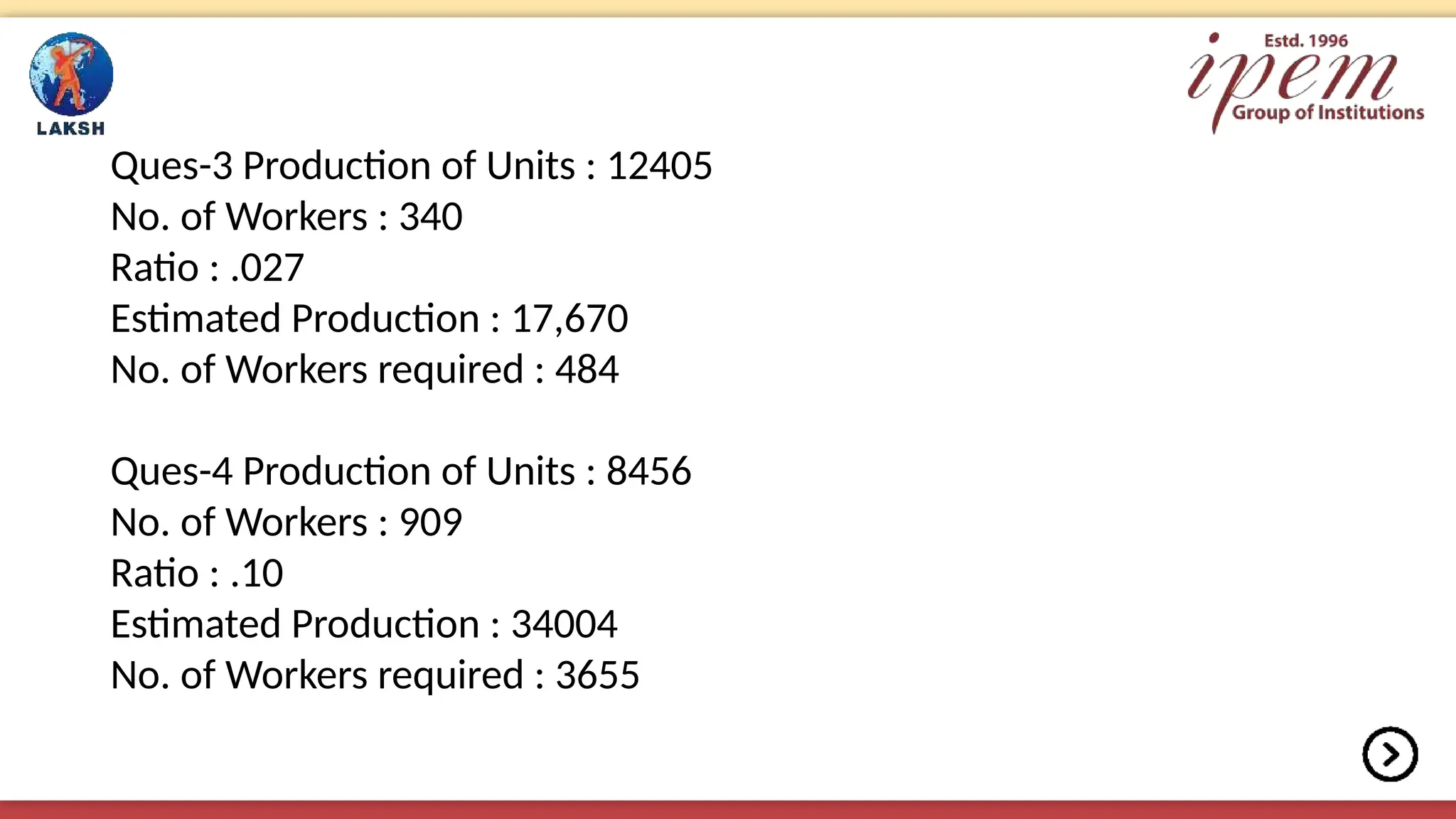
Ques-3 Production ofUnits : 12405
No. of Workers : 340
Ratio : .027
Estimated Production : 17,670
No. of Workers required : 484
Ques-4 Production of Units : 8456
No. of Workers : 909
Ratio : .10
Estimated Production : 34004
No. of Workers required : 3655
19.
Ques-5 Production ofUnits : 4005
No. of Workers : 740
Ratio : ?
Estimated Production : 20,590
No. of Workers required : ?
Ques-6 Production of Units : 9346
No. of Workers : 708
Ratio : ?
Estimated Production : 67590
No. of Workers required : ?
20.
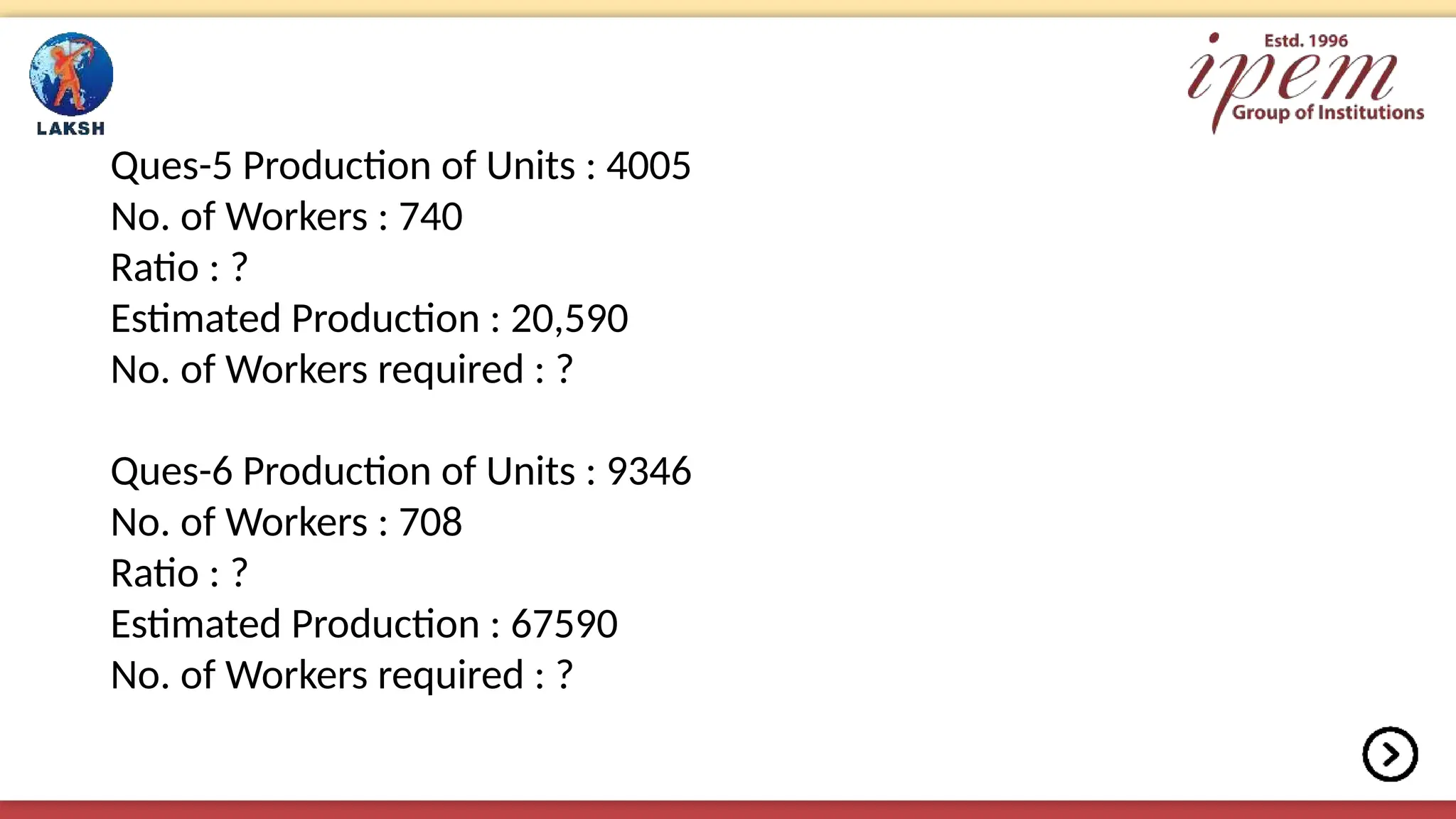
Ques-5 Production ofUnits : 4005
No. of Workers : 740
Ratio : .18
Estimated Production : 20,590
No. of Workers required : 3804
Ques-6 Production of Units : 9346
No. of Workers : 708
Ratio : .07
Estimated Production : 67590
No. of Workers required : 5120
21.
2. Regression AnalysisThis is similar to ratio-trend
analysis in that forecast is based on the relationship
between sales volume and employee size. However,
regression analysis is more statistically sophisticated. A
firm first draws a diagram depicting the relationship
between sales and workforce size. It then calculates
regression line – a line that cuts right through the center
of the points on the diagram. By observing the regression
line, one can find out number of employees required at
each volume of sales.
23.
Minimum requirement torun the plant (A)= 79.44
Regression of co-efficient(B)= 7.78
Production target(x)= 120
Y=A+Bx
Minimum requirement to run the plant= 139.7
Regression of co-efficient= 6.09
Production target(x)= 340
Y=A+Bx
24.
Minimum requirement torun the plant (A)= 59.04
Regression of co-efficient(B)= 8.08
Production target(x)= 100
Y=A+Bx
Minimum requirement to run the plant= 924.2
Regression of co-efficient= 7.89
Production target(x)= 1000
Y=A+Bx
25.
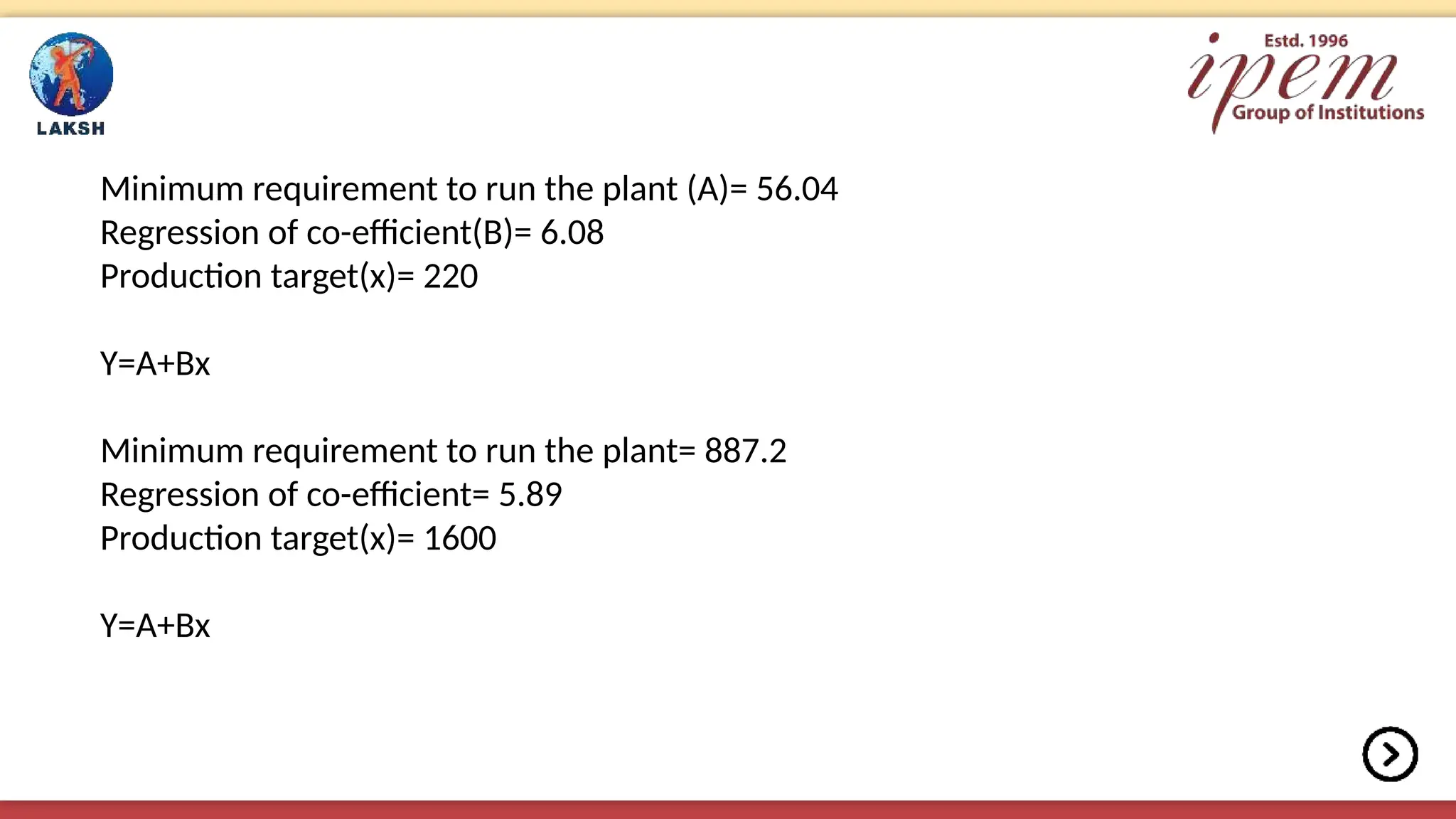
Minimum requirement torun the plant (A)= 56.04
Regression of co-efficient(B)= 6.08
Production target(x)= 220
Y=A+Bx
Minimum requirement to run the plant= 887.2
Regression of co-efficient= 5.89
Production target(x)= 1600
Y=A+Bx
26.
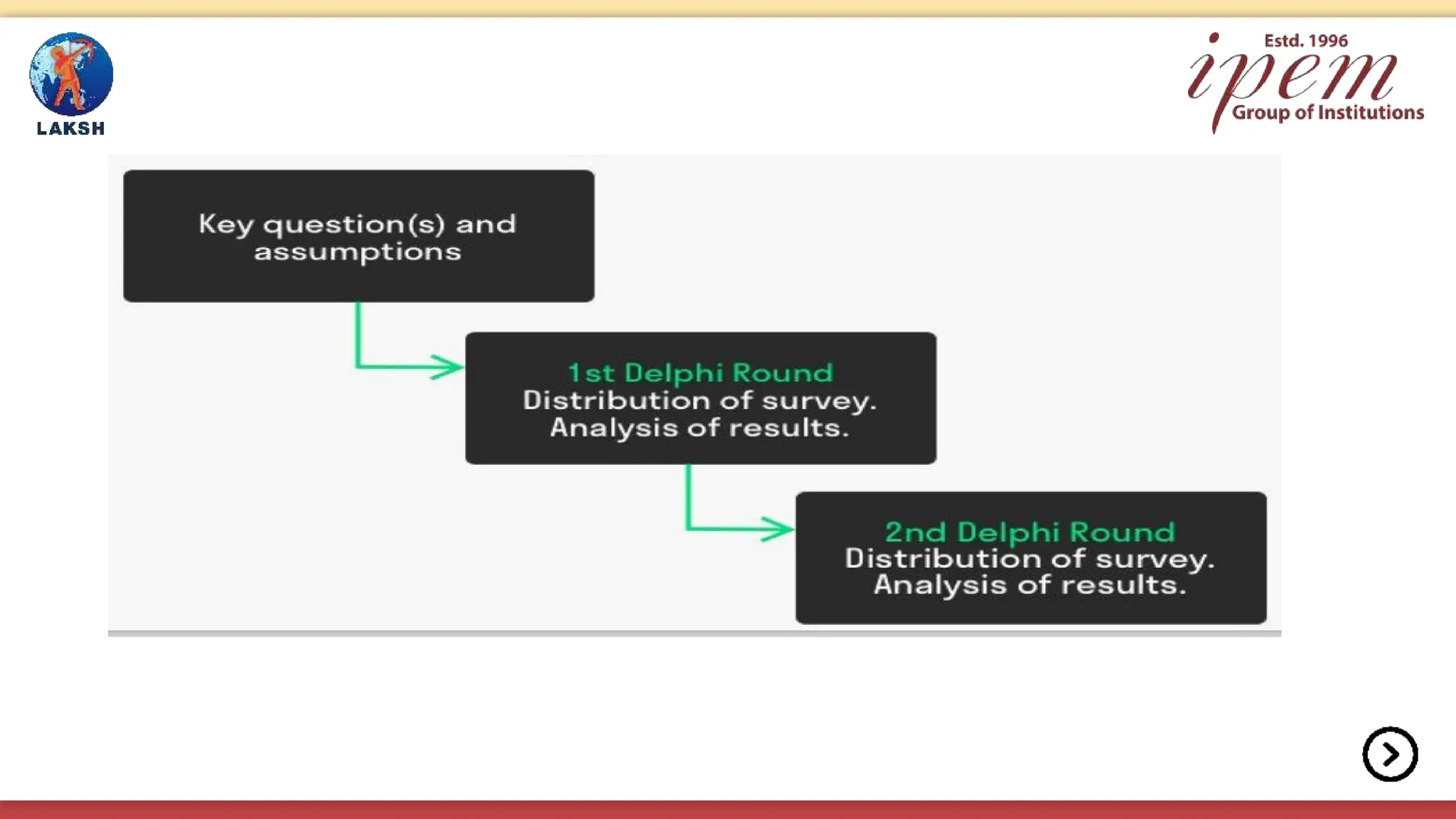
3. Delphi TechniquesDelphi Technique Named after the ancient Greek
Oracle at the city of Delphi, the Delphi technique is a method of
forecasting personnel needs. It solicits estimates of personnel needs
from a group of experts, usually managers. The human resource
planning (HRP) experts act as intermediaries, summarize the various
responses and report the findings back to the experts. The experts are
surveyed again after they receive this feedback. Summaries and surveys
are repeated until the experts’ opinions begin to agree. The agreement
reached is the forecast of the personnel needs. The distinguishing
feature of the Delphi technique is the absence of interaction among
experts
28.
HR Supply ForecastingIntroduction -
Human Resource supply forecasting is the process of
estimating availability of human resource followed after
demand for testing of human resource.
Supply forecasting means to make an estimation of supply of
human resources taking into consideration the analysis of
current human resources inventory and future availability
29.
For forecasting supplyof human resource we need
to consider internal and external supply.
• Internal supply of human resource available by
way of transfers, promotions, retired employees &
recall of laid-off employees, etc.
• Source of external supply of human resource is
availability of Labor force in the market and new
recruitment.
30.
EXTERNAL FACTORS AFFECTINGHR SUPPLY
FORECASTING -
External supply of human resource depends on some factors
mentioned below.
• literacy rate of nation.
• rate of population
• industry and expected growth rate and levels
• technological development.
• compensation system based on education, experience, skill
and age.
31.
INTERNAL FACTORS AFFECTINGHR SUPPLY
FORECASTING - Internal supply of human resource
depends on some factors mentioned below.
• Organizational features
• Productivity
• Rates of promotion, demotion, transfer and
Turnover
Supply Forecasting :The first step of forecasting the
future supply of human resources is to obtain the data
and information about the present human resource
inventory. The data relating to present human resource
inventory are to be collected department-wise,
designation wise, age-wise, gender-wise, salary, grade
etc. After analyzing the present human resource
inventory the potential losses and potential additions
are to be adjusted.
35.
1. Trend analysis
•Trend analysis involves collecting and evaluating data to identify patterns of
information that might impact the future.
• By examining the trends of the past, the HR department can predict the
effect of the same activity on the future of the organization, because it is
assumed that these patterns will remain stable.
• A method of forecasting that assumes past trends and ratios in employee
movement are stable and indicative of future trends and ratios in employee
movement.
• One of the simplest methods of forecasting future HR supply.
For example, an organization reviewing historical data may realize that every
year, approximately five percent of their staff retire, six percent resign, and
three percent are dismissed.
• Using a simple trend analysis, future HR supply forecasts can be established
by assuming an average reduction in internal HR supply of 14 percent per
year.
36.
2. Replacement chart
•A chart used to estimate vacancies in higher level jobs and identify
how potential HR supply can fill these vacancies via internal
movements from lower levels jobs.
• Replacement charts provide identification of potential
replacements for vacancies within an organization.
• A comprehensive replacement chart will include information
regarding possible replacements for vertical or horizontal
movement.
• Generally, a replacement chart includes information about
employees’ performance, readiness to fill the position, and
education.
38.
3. Succession Planning
•Determining the internal Labor supply calls for a detailed
analysis of how many people are currently in various job
categories or have specific skills within the organization.
• The planner then modifies this analysis to reflect changes
expected in the near future as a result of retirements,
promotions, transfers, voluntary turnover, and terminations
40.
Estimating the nethuman resource requirements : Net
human resource requirement in terms of number and
components are to be determined in relation to the overall
human resource requirements. The difference between
the overall human resource requirements and future
supply of human resources is to be found out.
41.
Action plan forre-deployment, redundancy and
retrenchment : If future surplus is estimated, the
organization has to plan for redeployment, redundancy etc.
Employees can be re-deployed in other jobs where the deficit
of the employees is estimated. The organization should also
plan for training before re-deployment of employees.
42.
Focus future supplyfrom all sources : If deficit is estimated in any
department, management has to forecast the future supply of human
resources from various sources like competitive firms, employment
exchanges, labor market, educational and training institutes,
advertisement etc.
Action plan for recruitment and deployment : The management may
prefer internal candidates and plan for promotion, transfer, training
etc. If suitable candidates are not available internally, plan should be
prepared for recruitment and deployment from external sources.
43.
Modify the organizationalplan : If future
supply of human resources from all the
external sources is estimated to be
inadequate, the manpower planner has to
suggest the management to alter or modify
the organizational plan
44.
FACTORS INFLUENCING HRPLANNING
HR planning is the process by which an organization ensures that it has
the right number and the right kind of people in the right places in the
right time. HR planning is influenced by the following factors :
• Skill Shortage : Despite vast unemployment, there is a acute
shortage of skilled manpower. This makes it necessary to make
effective manpower plan and retain people.
• Government Controls : Government controls and changes in laws
with regard to working conditions, hours of works, casual labor etc.
make the organizations aware of the need for systematic manpower
planning.
45.
Technological Advancement :Rapid changes in production process,
marketing method and management techniques have exercised
tremendous influence on job contents. They cause problems regarding
redundancy, re-training and re-deployment. All these make it necessary
to plan manpower needs systematically.
Demographic Change : The changing profile of the workforce in terms
of literacy, social background, male-female ratio etc. call for careful
planning of manpower
46.
Impact of PressureGroups : In today’s context, various
pressure groups such as trade unions, politicians, social
organizations etc. exercise considerable influence on
management. These also call for systematic planning of
manpower.
Organizational Changes : The nature and pace of change of
organizational environment, activities and structure effect
manpower requirements
47.
Company Strategies :Company’s policies and strategies
relating to expansion, diversification, alliances etc. determine
the human resource demand in terms of quality and quantity.
International factors : International factors like the demand for
and supply of human resources in various countries as well as
mobility of labor affect the human resource policy
48.
Job Analysis :Fundamentally, human resource plan is
based on job analysis, job description and job
specification. Thus, the job analysis determines the kind
of employees required.
Time Horizons : Companies with a stable competitive
environment can plan for human resources for a long-
term period, whereas firms with unstable competitive
environment should plan for a short-term
49.
ESSENTIALS FOR SUCCESSFULHR PLANNING
There are certain fundamental principles that make human
resource planning effective. These are as follows :
Integration with organizational plans : Human resource
planning must be integrated with the organizational plans and
objectives to be successful. Moreover, there should also be a
good channel of communication between the organizational
planners and the human resource planners for successful
human resource planning.
50.
Period of manpowerplanning : The period of manpower
planning should have a connection with the needs and
circumstances of the enterprise. The size and structure of an
enterprise as well as the anticipated changes must be taken
into consideration while going for manpower planning.
Proper organization : It is necessary to organize the planning
function properly in order to make it successful. It is advisable
to have a separate cell or constitute a committee within the
human resource department in order to provide adequate
focus and to coordinate the planning work at various levels.
51.
Support of topmanagement : The top management should give full
support and co-operation to make the manpower planning effective.
The support of top management facilitates the process of getting
necessary resources, cooperation and other things as per
requirement to make the planning successful.
52.
BARRIERS TO HRPLANNING
The human resource planners face various problems while formulating
human resource plans. The major problems or barriers are discussed as
follows :
Resistance by employers and employees : Many of the employers in
India today don’t have faith in adopting manpower planning as a
strategy to achieve corporate objectives. Resistance from employees
and unions is, of course, of far greater intensity than that of the
employers. Unions look at manpower planning as labor reduction
devices
53.
Under-utilization of manpower: The greater obstacle in
the case of manpower planning is the fact that industries
in general are not making use of their manpower to the
optimum degree. Once planning starts, it encounters
heavy odds in stepping up the utilization.
54.
Lack of educationand skilled labor : The extent of illiteracy and the
slow pace of development of skilled categories account for low
productivity in the labor force. Low productivity has implications for
manpower planning.
Uncertainties : Uncertainties are quite prominent in human resource
practices in India due to absenteeism, seasonal employment, labor
turnover etc. Further, the uncertainties in the industrial scene like
technological change and marketing conditions also cause
imperfections in human resource planning. The uncertainties make
HRP less reliable.
55.
Inadequacies of InformationSystem : Information system regarding
human resources has not yet fully developed in Indian industries due to
low status given to the personnel department and less importance
attached to HRP. Further, reliable data and information about economy,
labor market etc. are not available.
High rate of executive turnover : In many companies executive turnover is
growing at a faster rate that their sales turnover. Today, a young MBA from
any prestigious institution is in a hurry to become Managing Director in
the shortest possible time. There are several other reasons for the
increase in executive turnover.
56.
Conflict between long-termand short-term HRP : Another source
from where ineffectiveness in HRP emerges is the conflict between
long-term and short-term HRP. In long-term HRP, the organization
has flexibility by matching its human resources and jobs. But in
short term HRP, some ad-hoc arrangement is required. This affects
the entire human resource management process.
Inappropriate HR information system : The effectiveness of HRP
depends on the timely availability of relevant information
regarding various factors to be considered in formulating human
resource plans. If the HR information system has not been well
developed in an organization, the projections for future may not
be accurate. Sometimes, these projections become more
frustrating than the nonexistence of such projections.
57.
CONCEPT AND CONTENTOF JOB ANALYSIS
Job analysis is the process of gathering information about jobs for
the purpose of manpower planning. Human resource planning
involves the study of the type of people required for a job as well as
determining the nature of the job to be done. Job analysis facilitates
human resource planning by providing necessary details in terms of
the finding the right type of people to do the concerned job. It is a
detailed and systematic study involving the collection of necessary
facts for defining the nature of work to be done and the essential
qualities and skills to do the respective jobs.
58.
According to EdwinB. Flippo, “Job analysis is the process
of studying and collecting information relating to the
operations and responsibilities of a specific job.”
According to S.P. Robbins & D.A. De Cenzo, “Job analysis
is the systematic exploration of activities within a job. It
is a basic technical procedure. One that is used to define
the duties, responsibilities and accountabilities of a job.”
Thus what is seen is that the process of job analysis
results in two types of data: (i) job description, and (ii)
job specification.
59.
Job description isall about the tasks and
responsibilities in a job, the duties, machines or
tools, working conditions and associated hazards of a
job.
Job specification, on the other hand, gives the
detailed capabilities of the job-holder for doing a job
in terms of education, training, experience,
judgement and skills.
60.
Contents Of JobAnalysis
The data from job analysis would be used for variety of purpose. The
Job analysis study attempts to provide information in seven basic areas.
They are as follows :
1. Job Identification : It includes the job title including the code
number, if any
2. Distinctive or Significant Character of the job: It includes location of
the job, supervision, hazards and discomfort etc.
3. Duties and responsibilities of the workers : It includes the specific
operation and tasks relating to timing and importance,
responsibilities for others, for property, for funds etc.
61.
4. Materials andequipment the worker uses : It includes
analysis of materials and equipment used by worker like
metals, plastics, yarn, electronic machine, computer etc.
5. How the job is performed : Here emphasis is given on
the nature of operations and may specify such operations
as handling, feeding, removing, drilling and many others.
62.
6. Required PersonalQualities : It includes
experience, training, physical strength, mental
capabilities, aptitude, social skills etc.
7. Job Relationship : It includes analysis of the
opportunities for advancement, pattern of
promotion, essential co-operation etc.
MEANING OF JOBDESIGN
The term ‘job design’ refers to the way the tasks
are combined to form a complete job. It can be
defined as building the specifications of the
position, contents, method and relationships of
the job so as to meet with various technological
and organizational requirements as well as meet
the personal needs job holders.
66.
PURPOSE OF JOBDESIGN
□ to meet the organizational requirements such as higher
productivity, operational efficiency, quality of product/service,
etc.;
□ to satisfy the needs of the individual employees like interest,
challenge, achievement or accomplishment, etc.; and
□ to integrate the needs of the individual with the organizational
requirements.
67.
FACTORS INFLUENCING EFFECTIVEJOB
DESIGN
• The volume of work - it will determine by and large the
number of jobs.
• The complexity of the work - to be carried out, both in terms
of its variety or breadth and its technical difficulty or depth.
• The work processes involved -It might be desirable for one
person to be involved in an entire process, or the work flows may
be such that the work process has to be divide between several
different people.
• The nature of the people currently employed in the
organization-The extent to which jobs can be redesigned
depend largely on the kind of people employed
68.
The sequenceof flows in the process- the succession of events and
their timings affect how the work can be organized. Where activities
are carried out over a longer period, this is likely to be the cause of
greater complexity.
The timescales - where immediate responses are required, specific jobs
may have to be earmarked to provide such responses. Work requiring
longer planning horizons is likely to be more complex and needs
therefore to be done at a higher level.
The geographical scattering of the organization’s activities .
The involvement of other parts of the organization in the overall
process- there may be a need for extensive communication and
coordination and the design of jobs should take account of the way this
is to be achieved.
69.
APPROACHES TO JOBDESIGN
Basically there are two approaches to job designs which are based
upon two different postulations about people. The first approach
entails fitting people to jobs. It is based upon the assumption
that people can be adapted to any work situation.
Thus employee attitudes towards the job are ignored and jobs are
designed to produce maximum economic and technological
efficiency.
In contrast , the second approach entails fitting jobs to people.
Is based upon the assumption that people are underutilized at the
work and they desire more challenges and responsibility. Techniques
such as job rotation, job enlargement etc. are used while designing
jobs according to the second alternative.
70.
Job Rotation
Job designinvolves periodic assignment of an employee to completely
different sets of job activities. As traditionally used, job rotation is low in both
impact and complexity because it typically moves employees from one routine
job to another.
Advantages:
□ It is an effective way to develop multiple skills in employees, which benefits
the organization while creating greater job interest and career options for the
employee.
□ Job rotation may be of considerable benefit if it is part of a larger redesign
effort and/or it is used as a training and development approach to develop
various employee competencies and prepare employees for advancement.
□ At times, it may be used to control the problem of repetitive stress injuries by
moving people among jobs that require different physical movements.
71.
Job Enlargement
Job enlargementcombines into one job with two or more tasks which are to be
performed. Sometimes it is called “ horizontal loading” as all tasks involve the
same level of responsibility .The job enlargement approach often has positive
effects on employee effectiveness. However, some employees view job
enlargement as just adding more routine, repetitive tasks to their already boring
job. Other employees regard it as eliminating their ability to perform their jobs
almost automatically.
Advantages:
Job enlargement and job rotation approaches are useful in many work settings.
One of their biggest advantages is that :
□ They offer a form of training.
□ They allow workers to learn more than one task, thus increasing their value
to the employer.
□ As they allow workers to perform many tasks, they can be used more
flexibly as circumstances require.
72.
Job Enrichment
Frederick Herzberg,the advocate of two-factor theory, cautioned that jobs designed according to
rules of simplification, enlargement, and rotation can’t be expected to be highly motivational for the
workers. He instead suggested a clear and distinct job design alternative called “job enrichment”.
Job enrichment seeks to add profundity to a job by giving workers more control, responsibility,
and freedom of choice over how their job is performed. It occurs when the work itself is more
challenging, when achievement is encouraged, when there is prospect for growth, and when
responsibility, feedback, and recognition are provided. Nonetheless, employees are the final judges
of what enriches their jobs.
Herzberg developed the following set of principles for the enrichment of jobs:
□ removing some controls while retaining accountability;
□ increasing personal accountability for work;
73.
□assigning each workera complete unit work with a clear start and
end point;
□granting additional authority and freedom to workers;
□making periodic reports directly available to workers rather than to
supervisors only;
□the introduction for new and more difficult tasks into the job;
□encouraging the development of expertise by assigning individuals
to specialized tasks.
74.
RECRUITMENT IN HRM
Recruitmentin Human Resource Management (HRM)
involves the process of attracting, selecting, and hiring
qualified individuals for job positions within an
organization. It is a crucial aspect of HRM as it ensures
that the right candidates are identified and brought on
board to meet the organization's staffing needs.
75.
Here are somekey steps and considerations in the
recruitment process:
• Job Analysis
• Sourcing Candidates
• Screening and Selection
• Background Checks and References
• Decision-making and Offer
• Onboarding
76.
HIRING METHODS OFRECRUITMENT
When it comes to hiring methods in recruitment, organizations employ various
approaches to attract and select candidates. Here are some commonly used hiring
methods:
• Internal Hiring
• External Hiring
• Job Advertisements
• Recruitment Agencies
• Employee Referrals
• Networking
• Campus Recruitment
• Online Job Portals
• Social Media Recruitment
77.
EMPLOYEE SELECTION
Employee selectionis the process of evaluating and choosing the most suitable
candidates from a pool of applicants for a specific job position within an
organization. It involves assessing candidates' qualifications, skills, experience, and
potential to determine their fit for the role and the organization.
78.
PROCESS OF EMPLOYEESELECTION
The process of employee selection involves several steps to identify and choose the
most qualified and suitable candidates for a job position within an organization.
Here is a general outline of the employee selection process:
• Define Job Requirements
• Application Screening
• Pre-Employment Assessments
• Interviews
a. Initial Screening Interviews
b. In-Person or Virtual Interviews
c. Behavioural Interviews
• Background Checks
• Reference Checks
• Decision-making
• Job Offer
• Onboarding
79.
RECENT TRENDS INRECRUITMENT
Recruitment practices continue to evolve with the changing dynamics of
the job market and advancements in technology. Here are some recent
trends in recruitment:
• Artificial Intelligence (AI) and Automation- AI is being used to
automate various aspects of the recruitment process, such as resume
screening, candidate sourcing, and interview scheduling. AI-powered
chatbots are also utilized for initial candidate interactions and
answering frequently asked questions.
• Video Interviews: With the rise of remote work and virtual
communication, video interviews have become more prevalent. They
save time and costs associated with in-person interviews and enable
organizations to reach candidates globally.
80.
Employer Branding: Companiesare focusing on building and promoting their
employer brand to attract top talent. They highlight their company culture, values,
and employee experiences through various channels, including social media,
company websites, and online review platforms.
81.
Mobile Recruiting: Mobiledevices are now a primary means of accessing the
internet, and candidates expect a mobile-friendly application process. Companies
are optimizing their career websites and application processes for mobile devices to
enhance the candidate experience.
Skill-based Hiring: Some organizations are shifting their focus from traditional
qualifications to skills-based hiring. They prioritize candidates with relevant skills
and potential, rather than solely relying on formal education or specific job titles.
Virtual Job Fairs and Online Networking: Virtual job fairs and online networking
events are gaining popularity as they allow employers to connect with a larger pool
of candidates without the limitations of physical location. These events enable real-
time interactions and facilitate efficient candidate sourcing.
82.
These trends highlightthe importance of technology,
candidate experience, diversity, data-driven decision-
making, and adaptability in the evolving landscape of
recruitment. Employers are continually exploring
innovative approaches to attract, assess, and retain top
talent in a competitive job market.
83.
WORK MEASUREMENT
Work measurementmay be defined as “the art of observing and
recording the time required to do each detailed element of an
Industrial activity/operation.”
The term industrial activity includes mental, manual, and
machining operations, where
(i) Mental time includes time taken by the operator to think
over some alternative operations.
84.
(ii) Manual timeconsists of three types of operations i.e.
related to the handling of materials, handling of tools,
and handling of machines.
(iii) Machining time includes time taken by the machines
in performing the requisite operations.
Thus time study standardizes the time taken by the
average worker to perform these operations.
85.
Objectives of WorkMeasurement:
The main objectives of work measurement are the
followings:
(1) Target time for each job can be scientifically estimated, with
this estimate realistic schedules and manpower requirements can
be prepared.
(2) Sound comparison of alternative methods is possible by
comparing their basic times.
(3) Useful wage incentive schemes can be formulated on the basis
of target times.
(4) In can lead to proper balancing of the work distribution.
86.
(5) It canhelp to analyze the activities for performing a
job with the view to eliminate or reduce unnecessary or
repetitive operations so that human effort can be
minimized.
(6) To standardize the efficient method of performing
operations.
(7) To standardize conditions for efficient performance.
(8) To determine the man and machine ratio for effective
and efficient utilization of both.
87.
Work Study: Meaning,Objectives and
Types
Meaning of Work Study:
According to ILO — International Labour Organisation —
work study is “a term used to embrace the
techniques of method study and work
measurement which are employed to ensure the
best possible use of human and material
resources in carrying out a specified activity.” In
other words, “work study is a tool or technique of
management involving the analytical study of a job or
operation.” Work study helps to increase productivity.
88.
Objectives of WorkStudy:
(i) Work study brings higher productivity;
(ii) Work study improves the existing method of work for which
cost becomes lower;
(iii) It eliminates wasteful elements;
(iv) It sets the standard of performance;
(v) It helps to use plants and human more effectively;
(vi) It improves by saving in time and loss of material also.
89.
Steps Involved inWork Study:
The steps of work study are:
(i) It selects the jobs which are to be studied;
(ii) It examines critically the recorded facts which are already
done;
(iii) It records from direct observations all the matters which are
happened;
(iv) It defines a new method;
(v) It also installs the new method;
(vi) It also maintains the new standard;
(vii) It develops the most economic and appropriate methods;
(viii) It measures the work content in the method, that is selected
and computes a standard time.
90.
Types of WorkStudy:
1. Method Study:
According to ILO, method study is “the systematic
recording, analysis and critical examination of
existing and proposed ways of doing work and
the development and application of easier and
more effective method”. In short, it is a systematic
procedure to analyse the work to eliminate unnecessary
operations.
91.
Objectives:
The objectives ofmethod study are:
(i) It improves the proper utilisation of manpower,
machine and materials;
(ii) It also improves the factory layout, work place, etc.;
(iii) It also improves the process and procedure;
(iv) It develops better physical working environment;
(v) It reduces undesirable fatigue.
92.
The steps ofmethod study are:
(i) At first select the proper work which are to be studied;
(ii) Record all the facts of existing method;
(iii) Examine the facts very critically;
(iv) Develop the most practical, economic, and effective
method;
(v) Install the method and the same should be
maintained.
93.
2. Time AndMotion Study:
According to ILO, Time Study means “a technique for
determining as accurately as possible from a
limited number of observations the time
necessary to carry out a given activity at a
different standard of performance”.
94.
‘Time Study’ meansthe determination of standard
time that is taken by a worker of average ability
under normal working conditions for performing a
job.
But ‘Motion Study’ determines the correct method
of doing a job to avoid wasteful movements, for
which the workers are unnecessarily tired.
95.
Steps:
1. Time andMotion studies eliminate wasteful movements;
2. They examine the proposed method critically and determine the most
effective one;
3. They determine for each element having a stop-watch;
4. They record all the parts of a job which are done by the existing method;
5. They install the method as standard one;
6. They critically observe the workers who are engaged with the work;
7. They assess the proper speed of the operator who is working.
96.
ERGONOMICS
Ergonomics can beunderstood as the science
of creating or designing devices and equipment
that are fit for the human body and enhance
the activity performed. The term ergonomics
came by the derivation of two Greek words
'ergon' which means work and 'nomoi' which
means natural laws.
TRAINING
Training refers toacquiring specific knowledge and skills for a
particular job or task. It is usually a short-term activity
concerned with improving an employee’s current job
performance. It includes formal training courses, on-the-job
training, or coaching sessions.
111.
Types of TrainingMethods
Below are seven of the best types of employee training
methods:
1.Case Studies
2.Coaching
3.E-Learning
4.Instructor-Led Training
5.Interactive Training
6.On-the-Job Training
7.Video-Based Training
133.
Internal Mobility
Internal Mobilityis necessary to match the employee’s
skill and requirements with the requirements of the job
and those of the organization continuously.
Purposes of Internal Mobility
1.To improve the effectiveness of the organization
2.To maximize employee efficiency
3.To ensure discipline and
4.To adopt organizational changes
136.
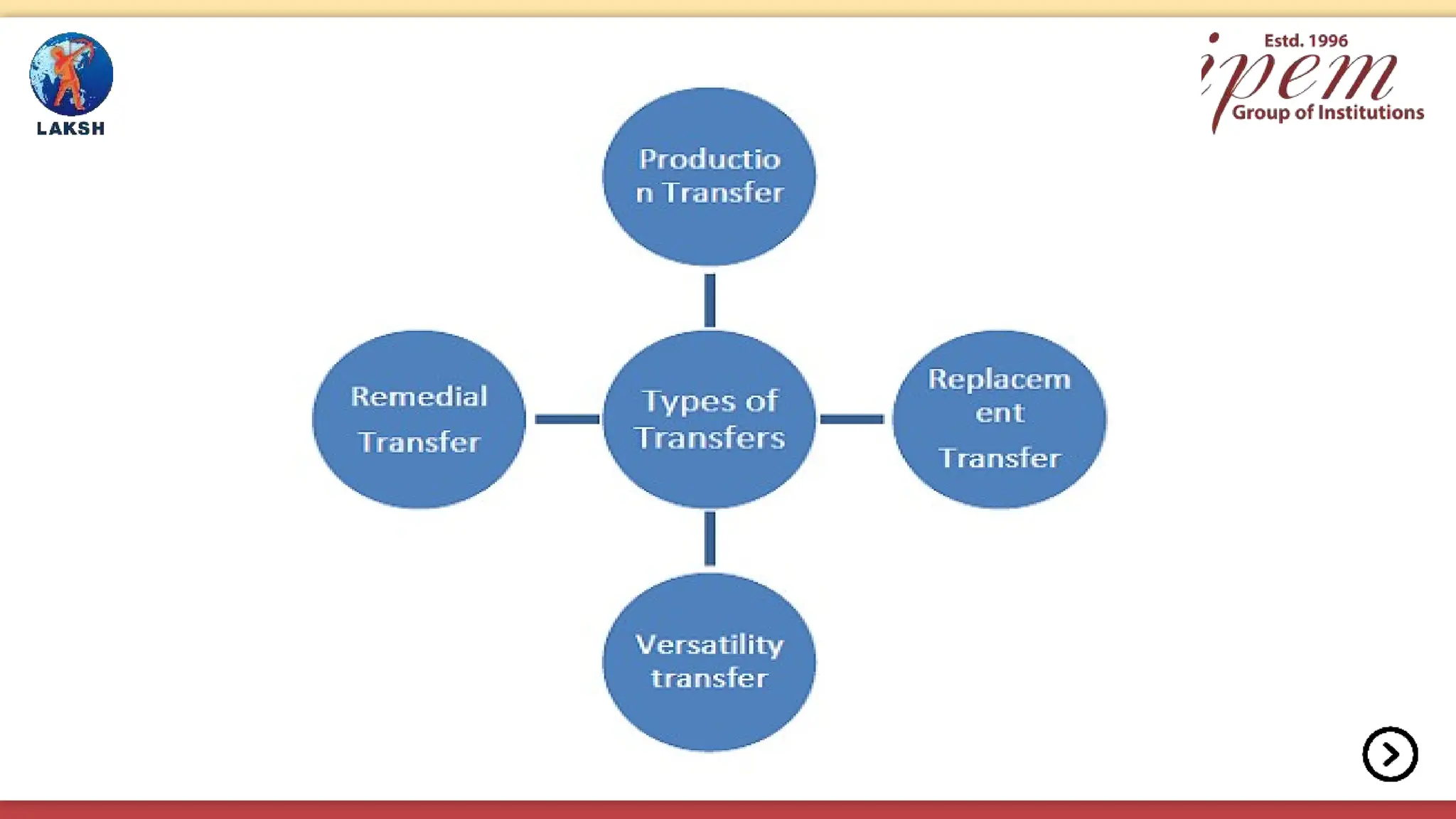
Production transfer
Transfers fromjobs in which labor requirements are
declining to jobs in which they are increasing
(through resignation or otherwise) are called
production transfers.
This type of transfer is made to avoid the lay-off of
efficient employees by providing them with
alternative positions in the same organization.
137.
Replacement transfer
These aretransfers in which a long-service employee
is transferred to a similar job where he replaces or
“bumps” an employee with shorter service. This type
of transfer is made when all operations are declining
but management wants to retain the long-service
employee as long as possible.
138.
Versatility transfer
The versatilitytransfer (better called ‘rotation’) is for the
purpose of providing management with a more versatile
group of employees.
This type of transfer will increase the versatility of the
employee by shifting him from one job to another. The
employee gets an opportunity for varied job experience. This
helps the employee through job enlargement.
139.
Remedial transfer
These transfersare made to remedy the situation.
Remedial transfers provide management with a
procedure whereby an unsatisfactory placement can
be corrected. Initial placement might be faulty or the
type of job might not suit his health. In such cases the
worker would benefit by transfer to a different kind of
work.
140.
Benefits of transfers
•Improveemployee skills
•Remedy faulty placement decisions
•Prepare the employee for challenging future
•Improve employee satisfaction
•Improve employee-employer relations.
141.
Problems with transfers
•Inconvenientto employees.
•Employees may or may not fit in the new location
•Shifting of experienced hands may affect productivity
•Discriminatory transfer may affect employee
satisfaction.
144.
Promotion is anupward movement of employees in the
organization to another job, higher in the organization’s
hierarchy. In the new job, the employee finds a change in
salary, status, responsibility, and grade of job or designation.
In contrast to promotion when the salary of an employee is
increased without a corresponding change in the job-grade, it
is known as ‘upgrading’. But when promotion does not result
in a change in pay, it is called ‘dry promotion’. Promotion is a
method of internal mobility.
145.
Bases of promotion
Organizationsadopt different bases of promotion
depending on their nature, size, managerial policy
etc. The well-established bases of promotion are
seniority and merit.
146.
Seniority based promotion
Ifseniority is the bases for promotion, an employee with the
longest period of service will get promoted, irrespective of
whether he is competent or not.
Advantages
•It is easy to administer.
•It is easy to measure the length of service and judge the
seniority.
•With the base of seniority there is no scope for favoritism,
discrimination and subjective judgement.
•By seniority everyone is sure of getting promotion one day.
•Subordinates are more willing to work under an older boss
who has given many years of service to the company.
147.
Disadvantages
•The learning capabilitiesof senior (older) employees may
diminish.
•It de-motivates the younger and more competent employees
and it results in more employee turnover.
•The organization is deprived of external talent which is very
necessary due to technological advancements and multi-
culture organisation.
•Judging seniority is highly difficult as problems like job
seniority, company seniority, regional seniority, service in
different organizations, trainee experience, research
experience, etc., will crop up.
148.
Merit or competence-basedpromotion
Merit based promotion occur when an employee is
promoted because of superior performance in the
current job. Merit means an individual’s knowledge,
skills, abilities as measured from his educational
qualifications, experience, training, and past
employment record.
149.
Advantages
•Promotion by meritis a reward to encourage those employees who
make a successful effort to increase their knowledge or skill and who
maintain a high level of productivity.
•It helps the employer to focus on talented employees recognize their
talent and reward their contributions.
•Efficiency is encouraged, recognized and rewarded.
•Competent people are retained as better prospects are open to them.
•It inspires other employees to improve their standards of performance
through active participation in all activities and putting in more efforts.
150.
Disadvantages
•It is noteasy to measure merit. Personal prejudices, biases, and union
pressures may come in the way of promoting the best performer.
•When young employees get ahead of senior employees in the
organization this creates frustration among senior employees .They feel
insecure and may also quit the organization.
•The past performance may not guarantee future success of an
employee.
•Loyalty and length of service is not properly rewarded