52
Chapter 3
Instruction Set and addressing
modes
8085 Instruction
Since the 8085 is an 8-bit device it can have up to 28 (256)
instructions.
 However, the 8085 only uses 246 combinations that represent a total of 74
instructions.
 Most of the instructions have more than one format.
These instructions can be grouped into five different groups
Data Transfer Operations
Arithmetic Operations
Logic Operations
Branch Operations
Machine Control Operations
Instruction Formats
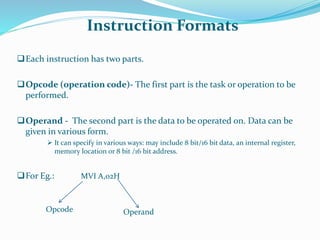
Each instruction has two parts.
Opcode (operation code)- The first part is the task or operation to be
performed.
Operand - The second part is the data to be operated on. Data can be
given in various form.
 It can specify in various ways: may include 8 bit/16 bit data, an internal register,
memory location or 8 bit /16 bit address.
For Eg.: MVI A,02H
Opcode Operand
Instruction word Size
An instruction is assembled in binary form(0,1) known as machine code or opcode.
Due to different ways of specifying data or operand the machine code are not same for
all the instruction
The size of an instruction signifies how much memory space is required to load an
instruction in the memory.8085 instructions are of following sizes:
One-byte or one word Instructions: opcode and operand in 8 bits
only i.e. one byte. Operand(s) are internal register and are coded into the
instruction.
e.g. MOV, ADD, ANA, SUB, ORA etc.
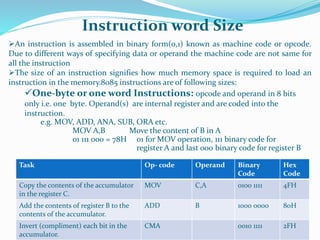
MOV A,B Move the content of B in A
01 111 000 = 78H 01 for MOV operation, 111 binary code for
register A and last 000 binary code for register B
Task Op- code Operand Binary
Code
Hex
Code
Copy the contents of the accumulator
in the register C.
MOV C,A 0100 1111 4FH
Add the contents of register B to the
contents of the accumulator.
ADD B 1000 0000 80H
Invert (compliment) each bit in the
accumulator.
CMA 0010 1111 2FH
Instruction Format or Size….Cont…
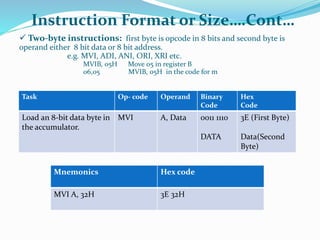
 Two-byte instructions: first byte is opcode in 8 bits and second byte is
operand either 8 bit data or 8 bit address.
e.g. MVI, ADI, ANI, ORI, XRI etc.
MVIB, 05H Move 05 in register B
06,05 MVIB, 05H in the code for m
Task Op- code Operand Binary
Code
Hex
Code
Load an 8-bit data byte in
the accumulator.
MVI A, Data 0011 1110
DATA
3E (First Byte)
Data(Second
Byte)
Mnemonics Hex code
MVI A, 32H 3E 32H
Instruction Format or Size….Cont…
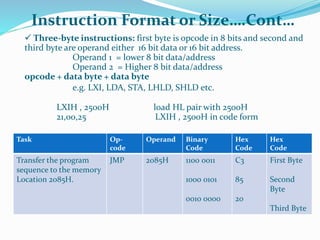
 Three-byte instructions: first byte is opcode in 8 bits and second and
third byte are operand either 16 bit data or 16 bit address.
Operand 1 = lower 8 bit data/address
Operand 2 = Higher 8 bit data/address
opcode + data byte + data byte
e.g. LXI, LDA, STA, LHLD, SHLD etc.
LXIH , 2500H load HL pair with 2500H
21,00,25 LXIH , 2500H in code form
Task Op-
code
Operand Binary
Code
Hex
Code
Hex
Code
Transfer the program
sequence to the memory
Location 2085H.
JMP 2085H 1100 0011
1000 0101
0010 0000
C3
85
20
First Byte
Second
Byte
Third Byte
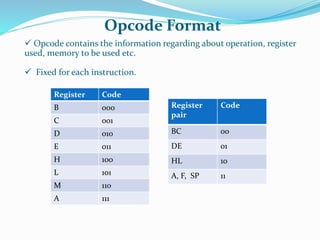
Opcode Format
 Opcode contains the information regarding about operation, register
used, memory to be used etc.
 Fixed for each instruction.
Register
pair
Code
BC 00
DE 01
HL 10
A, F, SP 11
Register Code
B 000
C 001
D 010
E 011
H 100
L 101
M 110
A 111
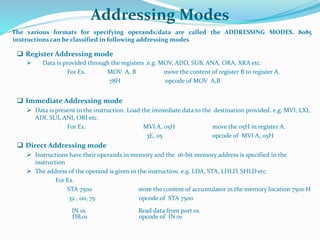
Addressing Modes
The various formats for specifying operands/data are called the ADDRESSING MODES. 8085
instructions can be classified in following addressing modes
 Register Addressing mode
 Data is provided through the registers .e.g. MOV, ADD, SUB, ANA, ORA, XRA etc.
For Ex. MOV A, B move the content of register B to register A.
78H opcode of MOV A,B
 Immediate Addressing mode
 Data is present in the instruction. Load the immediate data to the destination provided. e.g. MVI, LXI,
ADI, SUI, ANI, ORI etc.
For Ex. MVI A, 05H move the 05H in register A.
3E, 05 opcode of MVI A, 05H
 Direct Addressing mode
 Instructions have their operands in memory and the 16-bit memory address is specified in the
instruction
 The address of the operand is given in the instruction. e.g. LDA, STA, LHLD, SHLD etc.
For Ex.
STA 7500 store the content of accumulator in the memory location 7500 H
32 , 00, 75 opcode of STA 7500
IN 01 Read data from port 01.
DB,01 opcode of IN 01
Addressing Modes…..Cont…
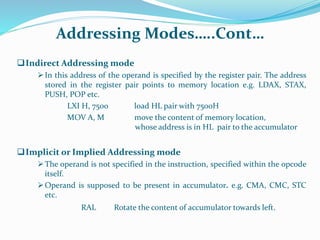
Indirect Addressing mode
In this address of the operand is specified by the register pair. The address
stored in the register pair points to memory location e.g. LDAX, STAX,
PUSH, POP etc.
LXI H, 7500 load HL pair with 7500H
MOV A, M move the content of memory location,
whose address is in HL pair to the accumulator
Implicit or Implied Addressing mode
The operand is not specified in the instruction, specified within the opcode
itself.
Operand is supposed to be present in accumulator. e.g. CMA, CMC, STC
etc.
RAL Rotate the content of accumulator towards left.
Instruction Set
 Since the 8085 is an 8-bit device it can have up to 28 (256)
instructions.
 However, the 8085 only uses 246 combinations that represent a
total of 74 instructions.
 Most of the instructions have more than one format.
These instructions can be grouped into five different groups:
 Data Transfer Operations
 Arithmetic Operations
 Logic Operations
 Branch Operations
 Machine Control Operations
Instruction Set…..cont….
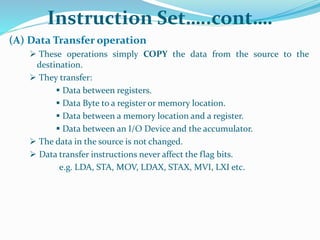
(A) Data Transfer operation
 These operations simply COPY the data from the source to the
destination.
 They transfer:
 Data between registers.
 Data Byte to a register or memory location.
 Data between a memory location and a register.
 Data between an I/O Device and the accumulator.
 The data in the source is not changed.
 Data transfer instructions never affect the flag bits.
e.g. LDA, STA, MOV, LDAX, STAX, MVI, LXI etc.
Instruction Set…..cont….
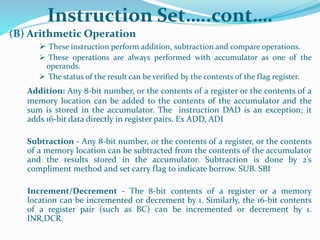
(B) Arithmetic Operation
 These instruction perform addition, subtraction and compare operations.
 These operations are always performed with accumulator as one of the
operands.
 The status of the result can be verified by the contents of the flag register.
Addition: Any 8-bit number, or the contents of a register or the contents of a
memory location can be added to the contents of the accumulator and the
sum is stored in the accumulator. The instruction DAD is an exception; it
adds 16-bit data directly in register pairs. Ex ADD, ADI
Subtraction - Any 8-bit number, or the contents of a register, or the contents
of a memory location can be subtracted from the contents of the accumulator
and the results stored in the accumulator. Subtraction is done by 2’s
compliment method and set carry flag to indicate borrow. SUB. SBI
Increment/Decrement - The 8-bit contents of a register or a memory
location can be incremented or decrement by 1. Similarly, the 16-bit contents
of a register pair (such as BC) can be incremented or decrement by 1.
INR,DCR.
Instruction Set… Cont….
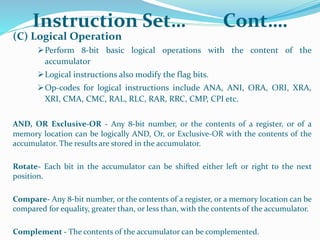
(C) Logical Operation
Perform 8-bit basic logical operations with the content of the
accumulator
Logical instructions also modify the flag bits.
Op-codes for logical instructions include ANA, ANI, ORA, ORI, XRA,
XRI, CMA, CMC, RAL, RLC, RAR, RRC, CMP, CPI etc.
AND, OR Exclusive-OR - Any 8-bit number, or the contents of a register, or of a
memory location can be logically AND, Or, or Exclusive-OR with the contents of the
accumulator. The results are stored in the accumulator.
Rotate- Each bit in the accumulator can be shifted either left or right to the next
position.
Compare- Any 8-bit number, or the contents of a register, or a memory location can be
compared for equality, greater than, or less than, with the contents of the accumulator.
Complement - The contents of the accumulator can be complemented.
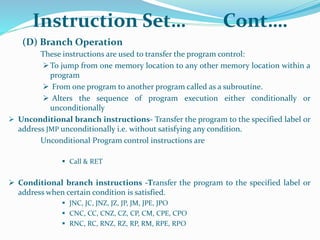
(D) Branch Operation
These instructions are used to transfer the program control:
To jump from one memory location to any other memory location within a
program
 From one program to another program called as a subroutine.
 Alters the sequence of program execution either conditionally or
unconditionally
 Unconditional branch instructions- Transfer the program to the specified label or
address JMP unconditionally i.e. without satisfying any condition.
Unconditional Program control instructions are
 Call & RET
 Conditional branch instructions -Transfer the program to the specified label or
address when certain condition is satisfied.
 JNC, JC, JNZ, JZ, JP, JM, JPE, JPO
 CNC, CC, CNZ, CZ, CP, CM, CPE, CPO
 RNC, RC, RNZ, RZ, RP, RM, RPE, RPO
Instruction Set… Cont….
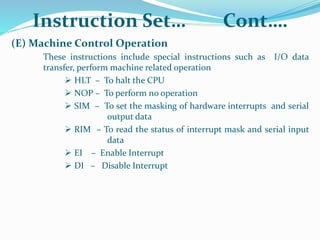
(E) Machine Control Operation
These instructions include special instructions such as I/O data
transfer, perform machine related operation
 HLT – To halt the CPU
 NOP – To perform no operation
 SIM – To set the masking of hardware interrupts and serial
output data
 RIM – To read the status of interrupt mask and serial input
data
 EI – Enable Interrupt
 DI – Disable Interrupt
Instruction Set… Cont….
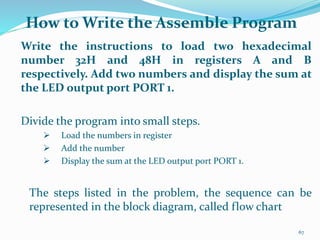
How to Write the Assemble Program
Write the instructions to load two hexadecimal
number 32H and 48H in registers A and B
respectively. Add two numbers and display the sum at
the LED output port PORT 1.
Divide the program into small steps.
 Load the numbers in register
 Add the number
 Display the sum at the LED output port PORT 1.
The steps listed in the problem, the sequence can be
represented in the block diagram, called flow chart
67
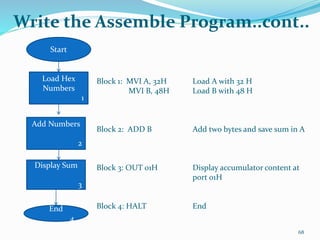
Write the Assemble Program..cont..
68
Start
Load Hex
Numbers
1
Add Numbers
2
Display Sum
3
End
4
Block 1: MVI A, 32H Load A with 32 H
MVI B, 48H Load B with 48 H
Block 2: ADD B Add two bytes and save sum in A
Block 3: OUT 01H Display accumulator content at
port 01H
Block 4: HALT End
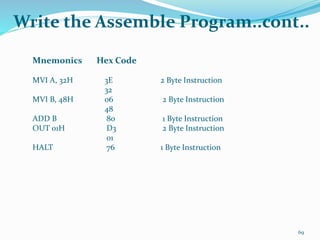
Write the Assemble Program..cont..
69
Mnemonics Hex Code
MVI A, 32H 3E 2 Byte Instruction
32
MVI B, 48H 06 2 Byte Instruction
48
ADD B 80 1 Byte Instruction
OUT 01H D3 2 Byte Instruction
01
HALT 76 1 Byte Instruction
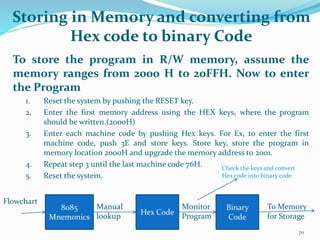
Storing in Memory and converting from
Hex code to binary Code
To store the program in R/W memory, assume the
memory ranges from 2000 H to 20FFH. Now to enter
the Program
1. Reset the system by pushing the RESET key.
2. Enter the first memory address using the HEX keys, where the program
should be written.(2000H)
3. Enter each machine code by pushing Hex keys. For Ex, to enter the first
machine code, push 3E and store keys. Store key, store the program in
memory location 2000H and upgrade the memory address t0 2001.
4. Repeat step 3 until the last machine code 76H.
5. Reset the system.
70
8085
Mnemonics
Hex Code
Binary
Code
Flowchart
Manual
lookup
Monitor
Program
To Memory
for Storage
Check the keys and convert
Hex code into binary code
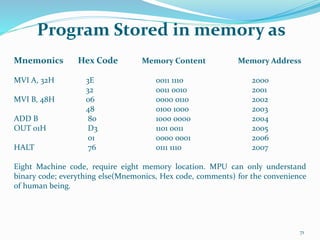
Program Stored in memory as
71
Mnemonics Hex Code Memory Content Memory Address
MVI A, 32H 3E 0011 1110 2000
32 0011 0010 2001
MVI B, 48H 06 0000 0110 2002
48 0100 1000 2003
ADD B 80 1000 0000 2004
OUT 01H D3 1101 0011 2005
01 0000 0001 2006
HALT 76 0111 1110 2007
Eight Machine code, require eight memory location. MPU can only understand
binary code; everything else(Mnemonics, Hex code, comments) for the convenience
of human being.
Executing the Program
To execute the program, we need to tell the MPU
where the program begins by entering the memory
address 2000H.
 Push the execute Key, so MPU loads 2000H in PC.
 PC is transferred from the monitor program to our program.
 MPU begin to read the one machine cycle at a time, when it
fetches the complete instruction, it execute that instruction.
 For Eg. When it fetches the machine code stored in 2000 and
2001H and execute the instruction MVI A, 32H , thus load 32H in
register A.
 Continue to execute the instruction until it fetches the HLT
instruction.
72
How Does a MPU differentiate between
data and instruction code
MPU is a sequential machine. When the system is turns on, it
begins the execution of the code in memory. Now the question
is that how does the MPU differentiate between code and
data when both are binary numbers.
 MPU interprets the first byte , it fetches as an opcode.
 When the MPU is reset its PC is reset to 0000H. fetches the first
code from the location 0000H but in our example the memory
location is 2000H.
 From the previous program it fetches the 3EH .when it decode that
code it know that it is a two byte instruction. so it assume that
second code 32H is data.
 But if we forget to enter 32H and enter the next code 06H, instead
it , so MPU load 06H in the accumulator and interpret the next
code 48H as an opcode. And continue the execution in sequence.
We may get a totally unexpected result.
73

Unit 2 Instruction set.pdf

  • 1.
    52 Chapter 3 Instruction Setand addressing modes
  • 2.
    8085 Instruction Since the8085 is an 8-bit device it can have up to 28 (256) instructions.  However, the 8085 only uses 246 combinations that represent a total of 74 instructions.  Most of the instructions have more than one format. These instructions can be grouped into five different groups Data Transfer Operations Arithmetic Operations Logic Operations Branch Operations Machine Control Operations
  • 3.
    Instruction Formats Each instructionhas two parts. Opcode (operation code)- The first part is the task or operation to be performed. Operand - The second part is the data to be operated on. Data can be given in various form.  It can specify in various ways: may include 8 bit/16 bit data, an internal register, memory location or 8 bit /16 bit address. For Eg.: MVI A,02H Opcode Operand
  • 4.
    Instruction word Size Aninstruction is assembled in binary form(0,1) known as machine code or opcode. Due to different ways of specifying data or operand the machine code are not same for all the instruction The size of an instruction signifies how much memory space is required to load an instruction in the memory.8085 instructions are of following sizes: One-byte or one word Instructions: opcode and operand in 8 bits only i.e. one byte. Operand(s) are internal register and are coded into the instruction. e.g. MOV, ADD, ANA, SUB, ORA etc. MOV A,B Move the content of B in A 01 111 000 = 78H 01 for MOV operation, 111 binary code for register A and last 000 binary code for register B Task Op- code Operand Binary Code Hex Code Copy the contents of the accumulator in the register C. MOV C,A 0100 1111 4FH Add the contents of register B to the contents of the accumulator. ADD B 1000 0000 80H Invert (compliment) each bit in the accumulator. CMA 0010 1111 2FH
  • 5.
    Instruction Format orSize….Cont…  Two-byte instructions: first byte is opcode in 8 bits and second byte is operand either 8 bit data or 8 bit address. e.g. MVI, ADI, ANI, ORI, XRI etc. MVIB, 05H Move 05 in register B 06,05 MVIB, 05H in the code for m Task Op- code Operand Binary Code Hex Code Load an 8-bit data byte in the accumulator. MVI A, Data 0011 1110 DATA 3E (First Byte) Data(Second Byte) Mnemonics Hex code MVI A, 32H 3E 32H
  • 6.
    Instruction Format orSize….Cont…  Three-byte instructions: first byte is opcode in 8 bits and second and third byte are operand either 16 bit data or 16 bit address. Operand 1 = lower 8 bit data/address Operand 2 = Higher 8 bit data/address opcode + data byte + data byte e.g. LXI, LDA, STA, LHLD, SHLD etc. LXIH , 2500H load HL pair with 2500H 21,00,25 LXIH , 2500H in code form Task Op- code Operand Binary Code Hex Code Hex Code Transfer the program sequence to the memory Location 2085H. JMP 2085H 1100 0011 1000 0101 0010 0000 C3 85 20 First Byte Second Byte Third Byte
  • 7.
    Opcode Format  Opcodecontains the information regarding about operation, register used, memory to be used etc.  Fixed for each instruction. Register pair Code BC 00 DE 01 HL 10 A, F, SP 11 Register Code B 000 C 001 D 010 E 011 H 100 L 101 M 110 A 111
  • 8.
    Addressing Modes The variousformats for specifying operands/data are called the ADDRESSING MODES. 8085 instructions can be classified in following addressing modes  Register Addressing mode  Data is provided through the registers .e.g. MOV, ADD, SUB, ANA, ORA, XRA etc. For Ex. MOV A, B move the content of register B to register A. 78H opcode of MOV A,B  Immediate Addressing mode  Data is present in the instruction. Load the immediate data to the destination provided. e.g. MVI, LXI, ADI, SUI, ANI, ORI etc. For Ex. MVI A, 05H move the 05H in register A. 3E, 05 opcode of MVI A, 05H  Direct Addressing mode  Instructions have their operands in memory and the 16-bit memory address is specified in the instruction  The address of the operand is given in the instruction. e.g. LDA, STA, LHLD, SHLD etc. For Ex. STA 7500 store the content of accumulator in the memory location 7500 H 32 , 00, 75 opcode of STA 7500 IN 01 Read data from port 01. DB,01 opcode of IN 01
  • 9.
    Addressing Modes…..Cont… Indirect Addressingmode In this address of the operand is specified by the register pair. The address stored in the register pair points to memory location e.g. LDAX, STAX, PUSH, POP etc. LXI H, 7500 load HL pair with 7500H MOV A, M move the content of memory location, whose address is in HL pair to the accumulator Implicit or Implied Addressing mode The operand is not specified in the instruction, specified within the opcode itself. Operand is supposed to be present in accumulator. e.g. CMA, CMC, STC etc. RAL Rotate the content of accumulator towards left.
  • 10.
    Instruction Set  Sincethe 8085 is an 8-bit device it can have up to 28 (256) instructions.  However, the 8085 only uses 246 combinations that represent a total of 74 instructions.  Most of the instructions have more than one format. These instructions can be grouped into five different groups:  Data Transfer Operations  Arithmetic Operations  Logic Operations  Branch Operations  Machine Control Operations
  • 11.
    Instruction Set…..cont…. (A) DataTransfer operation  These operations simply COPY the data from the source to the destination.  They transfer:  Data between registers.  Data Byte to a register or memory location.  Data between a memory location and a register.  Data between an I/O Device and the accumulator.  The data in the source is not changed.  Data transfer instructions never affect the flag bits. e.g. LDA, STA, MOV, LDAX, STAX, MVI, LXI etc.
  • 12.
    Instruction Set…..cont…. (B) ArithmeticOperation  These instruction perform addition, subtraction and compare operations.  These operations are always performed with accumulator as one of the operands.  The status of the result can be verified by the contents of the flag register. Addition: Any 8-bit number, or the contents of a register or the contents of a memory location can be added to the contents of the accumulator and the sum is stored in the accumulator. The instruction DAD is an exception; it adds 16-bit data directly in register pairs. Ex ADD, ADI Subtraction - Any 8-bit number, or the contents of a register, or the contents of a memory location can be subtracted from the contents of the accumulator and the results stored in the accumulator. Subtraction is done by 2’s compliment method and set carry flag to indicate borrow. SUB. SBI Increment/Decrement - The 8-bit contents of a register or a memory location can be incremented or decrement by 1. Similarly, the 16-bit contents of a register pair (such as BC) can be incremented or decrement by 1. INR,DCR.
  • 13.
    Instruction Set… Cont…. (C)Logical Operation Perform 8-bit basic logical operations with the content of the accumulator Logical instructions also modify the flag bits. Op-codes for logical instructions include ANA, ANI, ORA, ORI, XRA, XRI, CMA, CMC, RAL, RLC, RAR, RRC, CMP, CPI etc. AND, OR Exclusive-OR - Any 8-bit number, or the contents of a register, or of a memory location can be logically AND, Or, or Exclusive-OR with the contents of the accumulator. The results are stored in the accumulator. Rotate- Each bit in the accumulator can be shifted either left or right to the next position. Compare- Any 8-bit number, or the contents of a register, or a memory location can be compared for equality, greater than, or less than, with the contents of the accumulator. Complement - The contents of the accumulator can be complemented.
  • 14.
    (D) Branch Operation Theseinstructions are used to transfer the program control: To jump from one memory location to any other memory location within a program  From one program to another program called as a subroutine.  Alters the sequence of program execution either conditionally or unconditionally  Unconditional branch instructions- Transfer the program to the specified label or address JMP unconditionally i.e. without satisfying any condition. Unconditional Program control instructions are  Call & RET  Conditional branch instructions -Transfer the program to the specified label or address when certain condition is satisfied.  JNC, JC, JNZ, JZ, JP, JM, JPE, JPO  CNC, CC, CNZ, CZ, CP, CM, CPE, CPO  RNC, RC, RNZ, RZ, RP, RM, RPE, RPO Instruction Set… Cont….
  • 15.
    (E) Machine ControlOperation These instructions include special instructions such as I/O data transfer, perform machine related operation  HLT – To halt the CPU  NOP – To perform no operation  SIM – To set the masking of hardware interrupts and serial output data  RIM – To read the status of interrupt mask and serial input data  EI – Enable Interrupt  DI – Disable Interrupt Instruction Set… Cont….
  • 16.
    How to Writethe Assemble Program Write the instructions to load two hexadecimal number 32H and 48H in registers A and B respectively. Add two numbers and display the sum at the LED output port PORT 1. Divide the program into small steps.  Load the numbers in register  Add the number  Display the sum at the LED output port PORT 1. The steps listed in the problem, the sequence can be represented in the block diagram, called flow chart 67
  • 17.
    Write the AssembleProgram..cont.. 68 Start Load Hex Numbers 1 Add Numbers 2 Display Sum 3 End 4 Block 1: MVI A, 32H Load A with 32 H MVI B, 48H Load B with 48 H Block 2: ADD B Add two bytes and save sum in A Block 3: OUT 01H Display accumulator content at port 01H Block 4: HALT End
  • 18.
    Write the AssembleProgram..cont.. 69 Mnemonics Hex Code MVI A, 32H 3E 2 Byte Instruction 32 MVI B, 48H 06 2 Byte Instruction 48 ADD B 80 1 Byte Instruction OUT 01H D3 2 Byte Instruction 01 HALT 76 1 Byte Instruction
  • 19.
    Storing in Memoryand converting from Hex code to binary Code To store the program in R/W memory, assume the memory ranges from 2000 H to 20FFH. Now to enter the Program 1. Reset the system by pushing the RESET key. 2. Enter the first memory address using the HEX keys, where the program should be written.(2000H) 3. Enter each machine code by pushing Hex keys. For Ex, to enter the first machine code, push 3E and store keys. Store key, store the program in memory location 2000H and upgrade the memory address t0 2001. 4. Repeat step 3 until the last machine code 76H. 5. Reset the system. 70 8085 Mnemonics Hex Code Binary Code Flowchart Manual lookup Monitor Program To Memory for Storage Check the keys and convert Hex code into binary code
  • 20.
    Program Stored inmemory as 71 Mnemonics Hex Code Memory Content Memory Address MVI A, 32H 3E 0011 1110 2000 32 0011 0010 2001 MVI B, 48H 06 0000 0110 2002 48 0100 1000 2003 ADD B 80 1000 0000 2004 OUT 01H D3 1101 0011 2005 01 0000 0001 2006 HALT 76 0111 1110 2007 Eight Machine code, require eight memory location. MPU can only understand binary code; everything else(Mnemonics, Hex code, comments) for the convenience of human being.
  • 21.
    Executing the Program Toexecute the program, we need to tell the MPU where the program begins by entering the memory address 2000H.  Push the execute Key, so MPU loads 2000H in PC.  PC is transferred from the monitor program to our program.  MPU begin to read the one machine cycle at a time, when it fetches the complete instruction, it execute that instruction.  For Eg. When it fetches the machine code stored in 2000 and 2001H and execute the instruction MVI A, 32H , thus load 32H in register A.  Continue to execute the instruction until it fetches the HLT instruction. 72
  • 22.
    How Does aMPU differentiate between data and instruction code MPU is a sequential machine. When the system is turns on, it begins the execution of the code in memory. Now the question is that how does the MPU differentiate between code and data when both are binary numbers.  MPU interprets the first byte , it fetches as an opcode.  When the MPU is reset its PC is reset to 0000H. fetches the first code from the location 0000H but in our example the memory location is 2000H.  From the previous program it fetches the 3EH .when it decode that code it know that it is a two byte instruction. so it assume that second code 32H is data.  But if we forget to enter 32H and enter the next code 06H, instead it , so MPU load 06H in the accumulator and interpret the next code 48H as an opcode. And continue the execution in sequence. We may get a totally unexpected result. 73