ECONOMICS
MBA (UNIT 1)
What Is Economics?
 Artha-Money/Income
 Shastra- Body of knowledge
 Economics – Body of knowledge which deals
with the management of money
2
Introduction
 The word Economics is derived from the Greek words “OIKONOMIA”
which means household management .
 Man is bundle of desires. Goods and services satisfy these wants. But almost
all the goods are scarce. To produce goods - land, labour, capital and
organization are needed. Economic problem arises because of scarcity.
 Economics is a social science.
 It is called “social” because it studies mankind of society. It
deals with aspects of human behavior.
 It is called “science” since it studies social problems from a
scientific point of view.
3
What Is Economics?
 Economics is the branch of knowledge concerned with the
production, distribution, and consumption of goods
and services. It studies how individuals, businesses,
governments, and nations make choices on allocating
resources to satisfy their wants and needs, trying to
determine how these groups should organize and
coordinate efforts to achieve maximum output.
4
EConomic Activities
1. Consumption: Extracting utility from goods and
services.
2. Production: Production of goods and services
which posses utility.
3. Exchange: means buying and selling of goods and
services. It is link between consumer and
producer.
4. Distribution: Distribution is the way total output,
income, or wealth is distributed among individuals
or among the factors of production (such as
labour, land, and capital).
5
Definitions
Father of Economics Adam Smith in
his book “An Enquiry into the Nature
and Cause of Wealth of Nation”. In
1776” defined economics is the study
of nature and cause of national wealth.
Alfred Marshall in his book
“Principles of Economic Science-
1890” defined Economics is the study
of man kind in the ordinary business
of life.
6
BRANCHEs of Economics
Economics can generally be broken down
into macroeconomics, which concentrates on the
behavior of the aggregate economy,
and microeconomics, which focuses on individual
consumers and businesses
7
Macroeconomics
 Macroeconomics word derived from the Greek
word “Macros” which means “Large”.
 Macroeconomics is a branch of
economics dealing with the performance,
structure, behavior, and decision-making of
an economy as a whole.
8
microeconomics
 Microeconomics word derived from the Greek
word “Micros” which means “Small”.
 Microeconomics is a branch of economics that
studies the behavior of individuals and firms in
making decisions regarding the allocation
of scarce resources and the interactions among
these individuals and firms.
9
Managerial Economics
Managerial economics deals with the
application of the economic concepts,
theories, tools, and methodologies to solve
practical problems in a business. In other
words, managerial economics is the
combination of economics theory and
managerial theory. It helps the manager in
decision-making and acts as a link between
practice and theory.
10
 Spencer and Siegleman defined managerial Economics as “the
integration of economic theory with business practice for
the purpose of facilitating decision making and forward
planning of management” managerial economics helps the
managers to analyze the problems faced by the business unit and to
take vital decisions.
 They have to choose from among a number of possible alternatives.
 They have to choose that course of action by which the available
resources are most efficiently used.
 Cristopor I Savage and John R Small opinioned that “managerial
economics is some thing that concerned with business
efficiency”.
 In the words of Michael Baye,” Managerial Economics is the
study of how to direct scares resources in a way that
mostly effectively achieves a managerial goal”.
11
NATURE/CHARACTERSTICS of Managerial economics
1) Managerial economics is Micro economic in character.
Because it studies the problems of a business firm,
not the entire economy.
2) Managerial economics largely uses the body of economic
concepts and principles which is known as “Theory of the
Firm” or “Economics of the firm”.
3) Managerial economics is pragmatic. It is purely practical
oriented. So Managerial economics considers the
particular environment of a firm or business for
decision making.
12
4) Managerial economics is normative rather than positive
economics (descriptive economics). Managerial
economics is prescriptive to solve particular
business problem by giving importance to firms
aim and objectives.
5) Macro economics is also useful to managerial
economics since it provides intelligent
understanding of the environment in which the
business is operating.
6) It is management oriented.
13
Objectives and Uses /importance of managerial Economics
The basic objective of managerial economics is to analyze the economic
problems faced by the business. The other objectives are:
1. To integrate economic theory with business practice.
2. To apply economic concepts and principles to solve business problems.
3. To allocate the scares resources in the optimal manner.
4. To make all-round development of a firm.
5. To minimize risk and uncertainty.
6. To helps in demand and sales forecasting.
7. To help in profit maximization.
8. To help to achieve the other objectives of the firm like industry
leadership, expansion implementation of policies etc...
14
 Importance: In order to solve the problems of decision making, data are to
be collected and analyzed in the light of business objectives. Managerial
economics provides help in this area. The importance of managerial
economics maybe relies in the following points:
1.It provides tool and techniques for managerial decision making.
2.It gives answers to the basic problems of business management.
3.It supplies data for analysis and forecasting.
4.It provides tools for demand forecasting and profit planning.
5.It guides the managerial economist.
6.It helps in formulating business policies.
7.It assists the management to know internal and external factors influence the
business.
15
Scope of Managerial Economics
 The scope of managerial economics refers to its area of study. Scope of
Managerial Economics is wider than the scope of Business Economics in the
sense that while managerial economics dealing the decisional
problems of both business and non business organizations,
business economics deals only the problems of business
organizations.
 Managerial economics gives solution to the problems of non profit
organizations like schools, hospital etc., also.
16
The following aspects may be said to generally fall under managerial
economics:
1. Demand analysis and Forecasting: The demands for the
firms product would change in response to change in price,
consumer’s income, his taste etc. which are the determinants of
demand. A study of the determinants of demand is necessary for
forecasting future demand of the product.
2. Cost analysis: Estimation of cost is an essential part of
managerial problems. The factors causing variation of cost must
be found out and allowed for it management to arrive at cost
estimates. This will helps for more effective planning and sound
pricing practices.
3. Pricing Decisions: The firms aim to profit which depends upon
the correctness of pricing decisions. The pricing is an important
area of managerial economics. Theories regarding price fixation
helps the firm to solve the price fixation problems.
17
4. Profit Analysis: Business firms working for profit and it is an
important measure of success. But firms working under conditions
of uncertainty. Profit planning become necessary under the
conditions of uncertainty.
5. Capital budgeting: The business managers have to take very
important decisions relating to the firms capital investment. The
manager has to calculate correctly the profitability of investment
and to properly allocate the capital. Success of the firm depends
upon the proper analysis of capital project and selecting the best
one.
6. Production and supply analysis: Production analysis is
narrower in scope than cost analysis. Production analysis is
proceeds in physical terms while cost analysis proceeds in
monetary term. Important aspects of supply analysis are; supply
schedule, curves and functions, law of supply, elasticity of supply
and factors influencing supply…
18
Difference between Economics and Managerial Economics
19
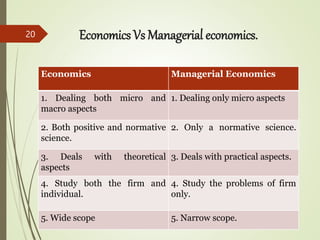
Economics Vs Managerial economics.
Economics Managerial Economics
1. Dealing both micro and
macro aspects
1. Dealing only micro aspects
2. Both positive and normative
science.
2. Only a normative science.
3. Deals with theoretical
aspects
3. Deals with practical aspects.
4. Study both the firm and
individual.
4. Study the problems of firm
only.
5. Wide scope 5. Narrow scope.
20
Relevance of managerial
economics in business decisions
Helpful in Chalking Out Business
Policies
Help in Business Planning
Helpful in Cost Control
Useful in Coordination of Business
Activities
Useful In Demand forecasting
Helpful in Profit Planning and Control
21
Helpful for Business Prediction
Helpful in Price Determination
Useful in Understanding the
Mechanism of Economic System
Gives the Right Direction
Maintaining of Costs
Distribute Profit
22
Fundamental Principles
of Managerial Economics
23
OPPORTUNITY COST:
Cost of next best alternative.
A benefit, profit, or value of something that must be given up to
acquire or achieve something in terms of other goods or services.
When economists use the word “cost,” we usually mean opportunity
cost.
Since every resource (land, money, time, etc.) can be put to
alternative uses, every action, choice, or decision has an associated
opportunity cost.
Opportunity costs are fundamental costs in economics, and are used
in computing cost benefit analysis of a project.
Such costs, however, are not recorded in the account books but are
recognized in decision making by computing the cash outlays and
their resulting profit or loss.
24
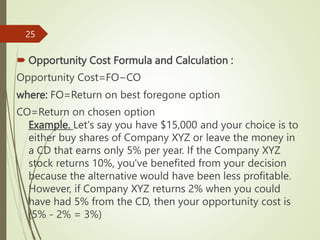
 Opportunity Cost Formula and Calculation :
​Opportunity Cost=FO−CO
where: FO=Return on best foregone option
CO=Return on chosen option​
Example. Let's say you have $15,000 and your choice is to
either buy shares of Company XYZ or leave the money in
a CD that earns only 5% per year. If the Company XYZ
stock returns 10%, you've benefited from your decision
because the alternative would have been less profitable.
However, if Company XYZ returns 2% when you could
have had 5% from the CD, then your opportunity cost is
(5% - 2% = 3%)
25
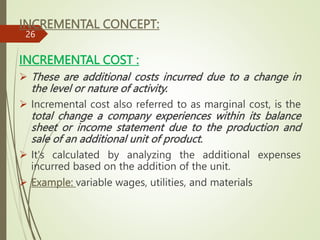
INCREMENTAL CONCEPT:
INCREMENTAL COST :
 These are additional costs incurred due to a change in
the level or nature of activity.
 Incremental cost also referred to as marginal cost, is the
total change a company experiences within its balance
sheet or income statement due to the production and
sale of an additional unit of product.
 It's calculated by analyzing the additional expenses
incurred based on the addition of the unit.
 Example: variable wages, utilities, and materials
26
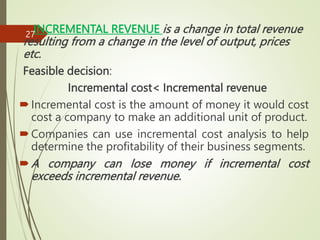
INCREMENTAL REVENUE is a change in total revenue
resulting from a change in the level of output, prices
etc.
Feasible decision:
Incremental cost< Incremental revenue
Incremental cost is the amount of money it would cost
cost a company to make an additional unit of product.
Companies can use incremental cost analysis to help
determine the profitability of their business segments.
A company can lose money if incremental cost
exceeds incremental revenue.
27
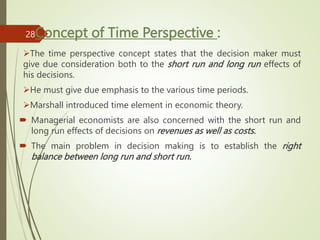
Concept of Time Perspective :
The time perspective concept states that the decision maker must
give due consideration both to the short run and long run effects of
his decisions.
He must give due emphasis to the various time periods.
Marshall introduced time element in economic theory.
 Managerial economists are also concerned with the short run and
long run effects of decisions on revenues as well as costs.
 The main problem in decision making is to establish the right
balance between long run and short run.
28
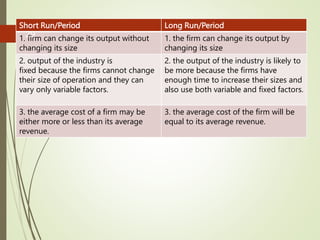
Short Run/Period Long Run/Period
1. firm can change its output without
changing its size
1. the firm can change its output by
changing its size
2. output of the industry is
fixed because the firms cannot change
their size of operation and they can
vary only variable factors.
2. the output of the industry is likely to
be more because the firms have
enough time to increase their sizes and
also use both variable and fixed factors.
3. the average cost of a firm may be
either more or less than its average
revenue.
3. the average cost of the firm will be
equal to its average revenue.
29
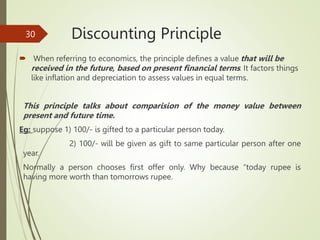
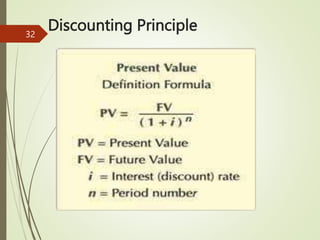
Discounting Principle
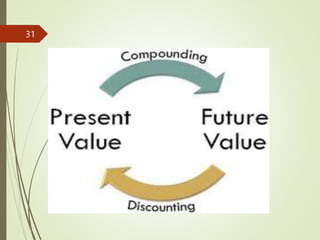
 When referring to economics, the principle defines a value that will be
received in the future, based on present financial terms. It factors things
like inflation and depreciation to assess values in equal terms.
This principle talks about comparision of the money value between
present and future time.
Eg: suppose 1) 100/- is gifted to a particular person today.
2) 100/- will be given as gift to same particular person after one
year.
Normally a person chooses first offer only. Why because “today rupee is
having more worth than tomorrows rupee.
30
31
Discounting Principle
32
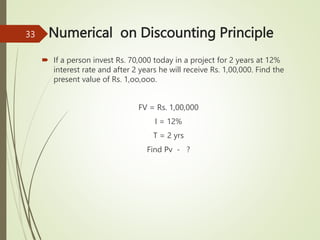
Numerical on Discounting Principle
 If a person invest Rs. 70,000 today in a project for 2 years at 12%
interest rate and after 2 years he will receive Rs. 1,00,000. Find the
present value of Rs. 1,oo,ooo.
FV = Rs. 1,00,000
I = 12%
T = 2 yrs
Find Pv - ?
33
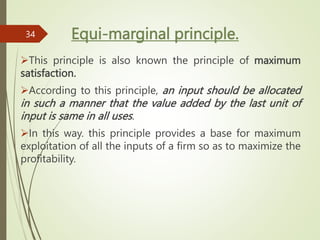
Equi-marginal principle.
This principle is also known the principle of maximum
satisfaction.
According to this principle, an input should be allocated
in such a manner that the value added by the last unit of
input is same in all uses.
In this way. this principle provides a base for maximum
exploitation of all the inputs of a firm so as to maximize the
profitability.
34
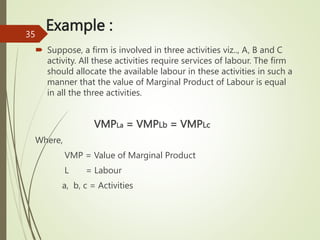
Example :
 Suppose, a firm is involved in three activities viz.., A, B and C
activity. All these activities require services of labour. The firm
should allocate the available labour in these activities in such a
manner that the value of Marginal Product of Labour is equal
in all the three activities.
VMPLa = VMPLb = VMPLc
Where,
VMP = Value of Marginal Product
L = Labour
a, b, c = Activities
35
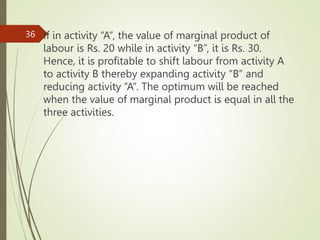
 If in activity “A”, the value of marginal product of
labour is Rs. 20 while in activity “B”, it is Rs. 30.
Hence, it is profitable to shift labour from activity A
to activity B thereby expanding activity “B” and
reducing activity “A”. The optimum will be reached
when the value of marginal product is equal in all the
three activities.
36
UTILITY ANALYSIS
Cont….
37
THANK YOU !
38

UNIT 1 ECONOMICS FOR POSTGRADUATES.pptx

  • 1.
  • 2.
    What Is Economics? Artha-Money/Income  Shastra- Body of knowledge  Economics – Body of knowledge which deals with the management of money 2
  • 3.
    Introduction  The wordEconomics is derived from the Greek words “OIKONOMIA” which means household management .  Man is bundle of desires. Goods and services satisfy these wants. But almost all the goods are scarce. To produce goods - land, labour, capital and organization are needed. Economic problem arises because of scarcity.  Economics is a social science.  It is called “social” because it studies mankind of society. It deals with aspects of human behavior.  It is called “science” since it studies social problems from a scientific point of view. 3
  • 4.
    What Is Economics? Economics is the branch of knowledge concerned with the production, distribution, and consumption of goods and services. It studies how individuals, businesses, governments, and nations make choices on allocating resources to satisfy their wants and needs, trying to determine how these groups should organize and coordinate efforts to achieve maximum output. 4
  • 5.
    EConomic Activities 1. Consumption:Extracting utility from goods and services. 2. Production: Production of goods and services which posses utility. 3. Exchange: means buying and selling of goods and services. It is link between consumer and producer. 4. Distribution: Distribution is the way total output, income, or wealth is distributed among individuals or among the factors of production (such as labour, land, and capital). 5
  • 6.
    Definitions Father of EconomicsAdam Smith in his book “An Enquiry into the Nature and Cause of Wealth of Nation”. In 1776” defined economics is the study of nature and cause of national wealth. Alfred Marshall in his book “Principles of Economic Science- 1890” defined Economics is the study of man kind in the ordinary business of life. 6
  • 7.
    BRANCHEs of Economics Economicscan generally be broken down into macroeconomics, which concentrates on the behavior of the aggregate economy, and microeconomics, which focuses on individual consumers and businesses 7
  • 8.
    Macroeconomics  Macroeconomics wordderived from the Greek word “Macros” which means “Large”.  Macroeconomics is a branch of economics dealing with the performance, structure, behavior, and decision-making of an economy as a whole. 8
  • 9.
    microeconomics  Microeconomics wordderived from the Greek word “Micros” which means “Small”.  Microeconomics is a branch of economics that studies the behavior of individuals and firms in making decisions regarding the allocation of scarce resources and the interactions among these individuals and firms. 9
  • 10.
    Managerial Economics Managerial economicsdeals with the application of the economic concepts, theories, tools, and methodologies to solve practical problems in a business. In other words, managerial economics is the combination of economics theory and managerial theory. It helps the manager in decision-making and acts as a link between practice and theory. 10
  • 11.
     Spencer andSiegleman defined managerial Economics as “the integration of economic theory with business practice for the purpose of facilitating decision making and forward planning of management” managerial economics helps the managers to analyze the problems faced by the business unit and to take vital decisions.  They have to choose from among a number of possible alternatives.  They have to choose that course of action by which the available resources are most efficiently used.  Cristopor I Savage and John R Small opinioned that “managerial economics is some thing that concerned with business efficiency”.  In the words of Michael Baye,” Managerial Economics is the study of how to direct scares resources in a way that mostly effectively achieves a managerial goal”. 11
  • 12.
    NATURE/CHARACTERSTICS of Managerialeconomics 1) Managerial economics is Micro economic in character. Because it studies the problems of a business firm, not the entire economy. 2) Managerial economics largely uses the body of economic concepts and principles which is known as “Theory of the Firm” or “Economics of the firm”. 3) Managerial economics is pragmatic. It is purely practical oriented. So Managerial economics considers the particular environment of a firm or business for decision making. 12
  • 13.
    4) Managerial economicsis normative rather than positive economics (descriptive economics). Managerial economics is prescriptive to solve particular business problem by giving importance to firms aim and objectives. 5) Macro economics is also useful to managerial economics since it provides intelligent understanding of the environment in which the business is operating. 6) It is management oriented. 13
  • 14.
    Objectives and Uses/importance of managerial Economics The basic objective of managerial economics is to analyze the economic problems faced by the business. The other objectives are: 1. To integrate economic theory with business practice. 2. To apply economic concepts and principles to solve business problems. 3. To allocate the scares resources in the optimal manner. 4. To make all-round development of a firm. 5. To minimize risk and uncertainty. 6. To helps in demand and sales forecasting. 7. To help in profit maximization. 8. To help to achieve the other objectives of the firm like industry leadership, expansion implementation of policies etc... 14
  • 15.
     Importance: Inorder to solve the problems of decision making, data are to be collected and analyzed in the light of business objectives. Managerial economics provides help in this area. The importance of managerial economics maybe relies in the following points: 1.It provides tool and techniques for managerial decision making. 2.It gives answers to the basic problems of business management. 3.It supplies data for analysis and forecasting. 4.It provides tools for demand forecasting and profit planning. 5.It guides the managerial economist. 6.It helps in formulating business policies. 7.It assists the management to know internal and external factors influence the business. 15
  • 16.
    Scope of ManagerialEconomics  The scope of managerial economics refers to its area of study. Scope of Managerial Economics is wider than the scope of Business Economics in the sense that while managerial economics dealing the decisional problems of both business and non business organizations, business economics deals only the problems of business organizations.  Managerial economics gives solution to the problems of non profit organizations like schools, hospital etc., also. 16
  • 17.
    The following aspectsmay be said to generally fall under managerial economics: 1. Demand analysis and Forecasting: The demands for the firms product would change in response to change in price, consumer’s income, his taste etc. which are the determinants of demand. A study of the determinants of demand is necessary for forecasting future demand of the product. 2. Cost analysis: Estimation of cost is an essential part of managerial problems. The factors causing variation of cost must be found out and allowed for it management to arrive at cost estimates. This will helps for more effective planning and sound pricing practices. 3. Pricing Decisions: The firms aim to profit which depends upon the correctness of pricing decisions. The pricing is an important area of managerial economics. Theories regarding price fixation helps the firm to solve the price fixation problems. 17
  • 18.
    4. Profit Analysis:Business firms working for profit and it is an important measure of success. But firms working under conditions of uncertainty. Profit planning become necessary under the conditions of uncertainty. 5. Capital budgeting: The business managers have to take very important decisions relating to the firms capital investment. The manager has to calculate correctly the profitability of investment and to properly allocate the capital. Success of the firm depends upon the proper analysis of capital project and selecting the best one. 6. Production and supply analysis: Production analysis is narrower in scope than cost analysis. Production analysis is proceeds in physical terms while cost analysis proceeds in monetary term. Important aspects of supply analysis are; supply schedule, curves and functions, law of supply, elasticity of supply and factors influencing supply… 18
  • 19.
    Difference between Economicsand Managerial Economics 19
  • 20.
    Economics Vs Managerialeconomics. Economics Managerial Economics 1. Dealing both micro and macro aspects 1. Dealing only micro aspects 2. Both positive and normative science. 2. Only a normative science. 3. Deals with theoretical aspects 3. Deals with practical aspects. 4. Study both the firm and individual. 4. Study the problems of firm only. 5. Wide scope 5. Narrow scope. 20
  • 21.
    Relevance of managerial economicsin business decisions Helpful in Chalking Out Business Policies Help in Business Planning Helpful in Cost Control Useful in Coordination of Business Activities Useful In Demand forecasting Helpful in Profit Planning and Control 21
  • 22.
    Helpful for BusinessPrediction Helpful in Price Determination Useful in Understanding the Mechanism of Economic System Gives the Right Direction Maintaining of Costs Distribute Profit 22
  • 23.
  • 24.
    OPPORTUNITY COST: Cost ofnext best alternative. A benefit, profit, or value of something that must be given up to acquire or achieve something in terms of other goods or services. When economists use the word “cost,” we usually mean opportunity cost. Since every resource (land, money, time, etc.) can be put to alternative uses, every action, choice, or decision has an associated opportunity cost. Opportunity costs are fundamental costs in economics, and are used in computing cost benefit analysis of a project. Such costs, however, are not recorded in the account books but are recognized in decision making by computing the cash outlays and their resulting profit or loss. 24
  • 25.
     Opportunity CostFormula and Calculation : ​Opportunity Cost=FO−CO where: FO=Return on best foregone option CO=Return on chosen option​ Example. Let's say you have $15,000 and your choice is to either buy shares of Company XYZ or leave the money in a CD that earns only 5% per year. If the Company XYZ stock returns 10%, you've benefited from your decision because the alternative would have been less profitable. However, if Company XYZ returns 2% when you could have had 5% from the CD, then your opportunity cost is (5% - 2% = 3%) 25
  • 26.
    INCREMENTAL CONCEPT: INCREMENTAL COST:  These are additional costs incurred due to a change in the level or nature of activity.  Incremental cost also referred to as marginal cost, is the total change a company experiences within its balance sheet or income statement due to the production and sale of an additional unit of product.  It's calculated by analyzing the additional expenses incurred based on the addition of the unit.  Example: variable wages, utilities, and materials 26
  • 27.
    INCREMENTAL REVENUE isa change in total revenue resulting from a change in the level of output, prices etc. Feasible decision: Incremental cost< Incremental revenue Incremental cost is the amount of money it would cost cost a company to make an additional unit of product. Companies can use incremental cost analysis to help determine the profitability of their business segments. A company can lose money if incremental cost exceeds incremental revenue. 27
  • 28.
    Concept of TimePerspective : The time perspective concept states that the decision maker must give due consideration both to the short run and long run effects of his decisions. He must give due emphasis to the various time periods. Marshall introduced time element in economic theory.  Managerial economists are also concerned with the short run and long run effects of decisions on revenues as well as costs.  The main problem in decision making is to establish the right balance between long run and short run. 28
  • 29.
    Short Run/Period LongRun/Period 1. firm can change its output without changing its size 1. the firm can change its output by changing its size 2. output of the industry is fixed because the firms cannot change their size of operation and they can vary only variable factors. 2. the output of the industry is likely to be more because the firms have enough time to increase their sizes and also use both variable and fixed factors. 3. the average cost of a firm may be either more or less than its average revenue. 3. the average cost of the firm will be equal to its average revenue. 29
  • 30.
    Discounting Principle  Whenreferring to economics, the principle defines a value that will be received in the future, based on present financial terms. It factors things like inflation and depreciation to assess values in equal terms. This principle talks about comparision of the money value between present and future time. Eg: suppose 1) 100/- is gifted to a particular person today. 2) 100/- will be given as gift to same particular person after one year. Normally a person chooses first offer only. Why because “today rupee is having more worth than tomorrows rupee. 30
  • 31.
  • 32.
  • 33.
    Numerical on DiscountingPrinciple  If a person invest Rs. 70,000 today in a project for 2 years at 12% interest rate and after 2 years he will receive Rs. 1,00,000. Find the present value of Rs. 1,oo,ooo. FV = Rs. 1,00,000 I = 12% T = 2 yrs Find Pv - ? 33


  • 34.
    Equi-marginal principle. This principleis also known the principle of maximum satisfaction. According to this principle, an input should be allocated in such a manner that the value added by the last unit of input is same in all uses. In this way. this principle provides a base for maximum exploitation of all the inputs of a firm so as to maximize the profitability. 34
  • 35.
    Example :  Suppose,a firm is involved in three activities viz.., A, B and C activity. All these activities require services of labour. The firm should allocate the available labour in these activities in such a manner that the value of Marginal Product of Labour is equal in all the three activities. VMPLa = VMPLb = VMPLc Where, VMP = Value of Marginal Product L = Labour a, b, c = Activities 35
  • 36.
     If inactivity “A”, the value of marginal product of labour is Rs. 20 while in activity “B”, it is Rs. 30. Hence, it is profitable to shift labour from activity A to activity B thereby expanding activity “B” and reducing activity “A”. The optimum will be reached when the value of marginal product is equal in all the three activities. 36
  • 37.
  • 38.

Editor's Notes

  • #21 Positive economics is objective and fact based, Ex. Air is a mixture of gases. 2. India is an overpopulated country. while normative economics is subjective and value based. Ex. India should spend more money on defence. Free education should be given to the poor.