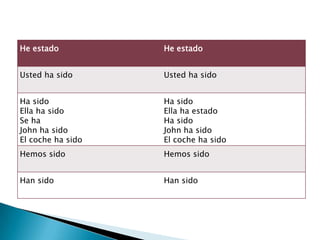
He estado          He estado


Usted ha sido      Usted ha sido


Ha sido            Ha sido
Ella ha sido       Ella ha estado
Se ha              Ha sido
John ha sido       John ha sido
El coche ha sido   El coche ha sido
Hemos sido         Hemos sido


Han sido           Han sido
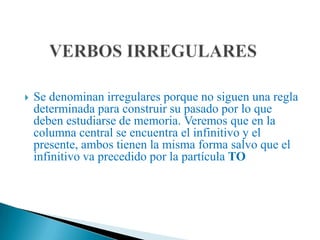
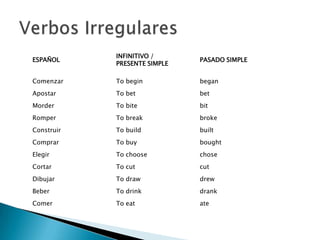
   Se denominan irregulares porque no siguen una regla
    determinada para construir su pasado por lo que
    deben estudiarse de memoria. Veremos que en la
    columna central se encuentra el infinitivo y el
    presente, ambos tienen la misma forma salvo que el
    infinitivo va precedido por la partícula TO
                                            .
INFINITIVO /
ESPAÑOL                       PASADO SIMPLE
            PRESENTE SIMPLE

Comenzar    To begin          began
Apostar     To bet            bet
Morder      To bite           bit
Romper      To break          broke
Construir   To build          built
Comprar     To buy            bought
Elegir      To choose         chose
Cortar      To cut            cut
Dibujar     To draw           drew
Beber       To drink          drank
Comer       To eat            ate
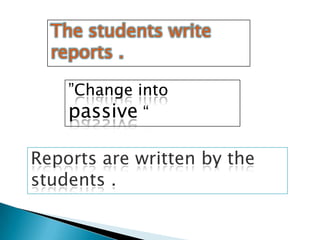
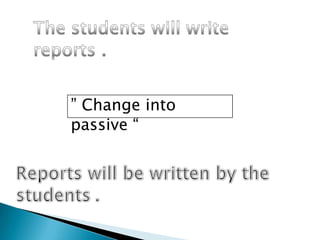
The students write
  reports .

    ”Change into
    passive “

Reports are written by the
students .
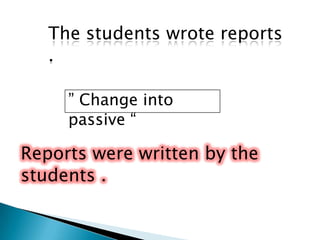
The students wrote reports
   .

     ” Change into
     passive “

Reports were written by the
students .
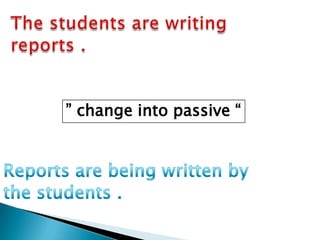
” Change into
passive “
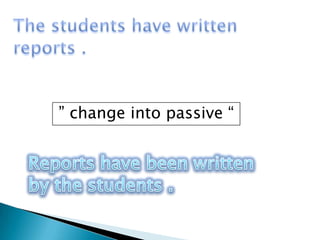
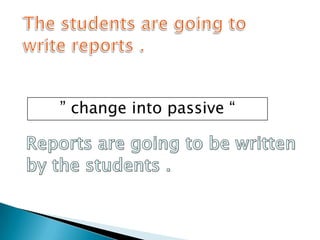
” change into passive “
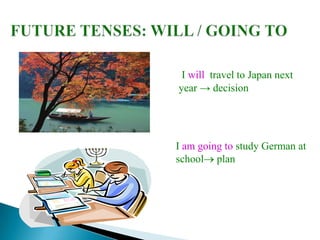
I will travel to Japan next
year → decision


I am going to study German at
school plan
The Simple Future has two different forms in English: "will"
and "be going to." Although the two forms can sometimes be
used interchangeably, they often express two very different
meanings as mentioned before.


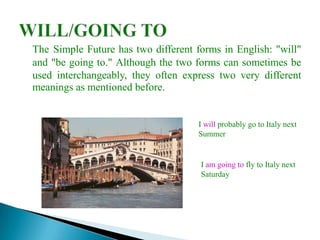
                                     I will probably go to Italy next
                                     Summer


                                     I am going to fly to Italy next
                                     Saturday
Affirmative:         I will travel to Madrid in October

Interrogative : Will you travel by bus?

Negative :            I will not travel - won’t

Will you travel by train or by bus?
I won’t travel by bus I will probably travel by train
1- Instant decisions: Ok, I’ll see you on Friday
2- Predictions based in what we think: It will
 rain in the evening


3- Promises and offers: Don’t worry, I’ll go and
 buy some food for you
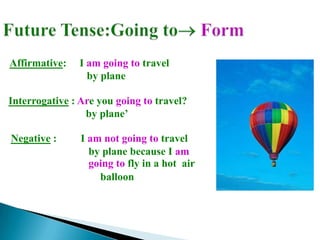
Affirmative:   I am going to travel
                 by plane

Interrogative : Are you going to travel?
                 by plane’

Negative :      I am not going to travel
                  by plane because I am
                  going to fly in a hot air
                    balloon
1- Future plans and intentions: I'm going to buy a new
 laptop computer next week


2- Predictions based in what we can see at the moment:
  Look at that car! it is going to crash into the lamp post
TIME EXPRESSIONS:
 Tomorrow, next week, next month, next year,


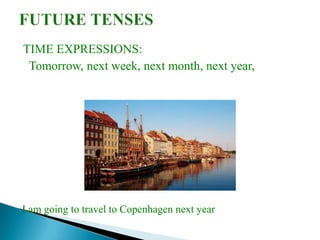
I am going to travel to Copenhagen next year
A: Why are you holding a piece of paper?
 B: I …………………….. (write) a letter to my friends back home in Texas
 A: I'm about to fall asleep. I need to wake up!
 B: I (get)………………… you a cup of coffee.
 We are so excited about our trip next month to France. We
………………………. (visit) Paris, Nice and Grenoble.
 I think he …………………. (be) the next British Prime Minister.
The simple present and present progressive are also used to express
future time. These are often used used in connection with schedules.

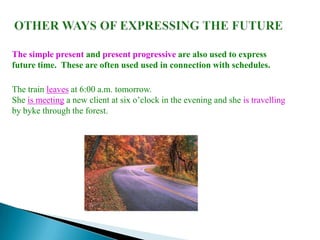
The train leaves at 6:00 a.m. tomorrow.
She is meeting a new client at six o’clock in the evening and she is travelling
by byke through the forest.
This tense is used to describe an event or action that will
occur over a period of time at a specific point in the future.


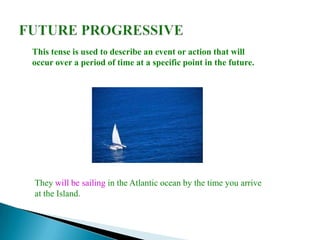
They will be sailing in the Atlantic ocean by the time you arrive
at the Island.
This tense is used to describe an event or action that will be
completed before another event or time in the future.


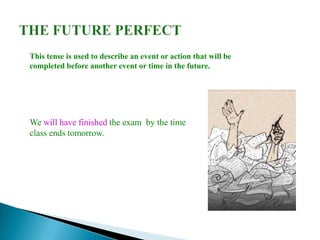
We will have finished the exam by the time
class ends tomorrow.

Unidad 4

  • 3.
    He estado He estado Usted ha sido Usted ha sido Ha sido Ha sido Ella ha sido Ella ha estado Se ha Ha sido John ha sido John ha sido El coche ha sido El coche ha sido Hemos sido Hemos sido Han sido Han sido
  • 5.
    Se denominan irregulares porque no siguen una regla determinada para construir su pasado por lo que deben estudiarse de memoria. Veremos que en la columna central se encuentra el infinitivo y el presente, ambos tienen la misma forma salvo que el infinitivo va precedido por la partícula TO .
  • 6.
    INFINITIVO / ESPAÑOL PASADO SIMPLE PRESENTE SIMPLE Comenzar To begin began Apostar To bet bet Morder To bite bit Romper To break broke Construir To build built Comprar To buy bought Elegir To choose chose Cortar To cut cut Dibujar To draw drew Beber To drink drank Comer To eat ate
  • 8.
    The students write reports . ”Change into passive “ Reports are written by the students .
  • 9.
    The students wrotereports . ” Change into passive “ Reports were written by the students .
  • 10.
  • 11.
    ” change intopassive “
  • 12.
    ” change intopassive “
  • 13.
    ” change intopassive “
  • 14.
    I will travelto Japan next year → decision I am going to study German at school plan
  • 15.
    The Simple Futurehas two different forms in English: "will" and "be going to." Although the two forms can sometimes be used interchangeably, they often express two very different meanings as mentioned before. I will probably go to Italy next Summer I am going to fly to Italy next Saturday
  • 16.
    Affirmative: I will travel to Madrid in October Interrogative : Will you travel by bus? Negative : I will not travel - won’t Will you travel by train or by bus? I won’t travel by bus I will probably travel by train
  • 17.
    1- Instant decisions:Ok, I’ll see you on Friday 2- Predictions based in what we think: It will rain in the evening 3- Promises and offers: Don’t worry, I’ll go and buy some food for you
  • 18.
    Affirmative: I am going to travel by plane Interrogative : Are you going to travel? by plane’ Negative : I am not going to travel by plane because I am going to fly in a hot air balloon
  • 19.
    1- Future plansand intentions: I'm going to buy a new laptop computer next week 2- Predictions based in what we can see at the moment: Look at that car! it is going to crash into the lamp post
  • 20.
    TIME EXPRESSIONS: Tomorrow,next week, next month, next year, I am going to travel to Copenhagen next year
  • 21.
    A: Why areyou holding a piece of paper? B: I …………………….. (write) a letter to my friends back home in Texas A: I'm about to fall asleep. I need to wake up! B: I (get)………………… you a cup of coffee. We are so excited about our trip next month to France. We ………………………. (visit) Paris, Nice and Grenoble. I think he …………………. (be) the next British Prime Minister.
  • 22.
    The simple presentand present progressive are also used to express future time. These are often used used in connection with schedules. The train leaves at 6:00 a.m. tomorrow. She is meeting a new client at six o’clock in the evening and she is travelling by byke through the forest.
  • 23.
    This tense isused to describe an event or action that will occur over a period of time at a specific point in the future. They will be sailing in the Atlantic ocean by the time you arrive at the Island.
  • 24.
    This tense isused to describe an event or action that will be completed before another event or time in the future. We will have finished the exam by the time class ends tomorrow.