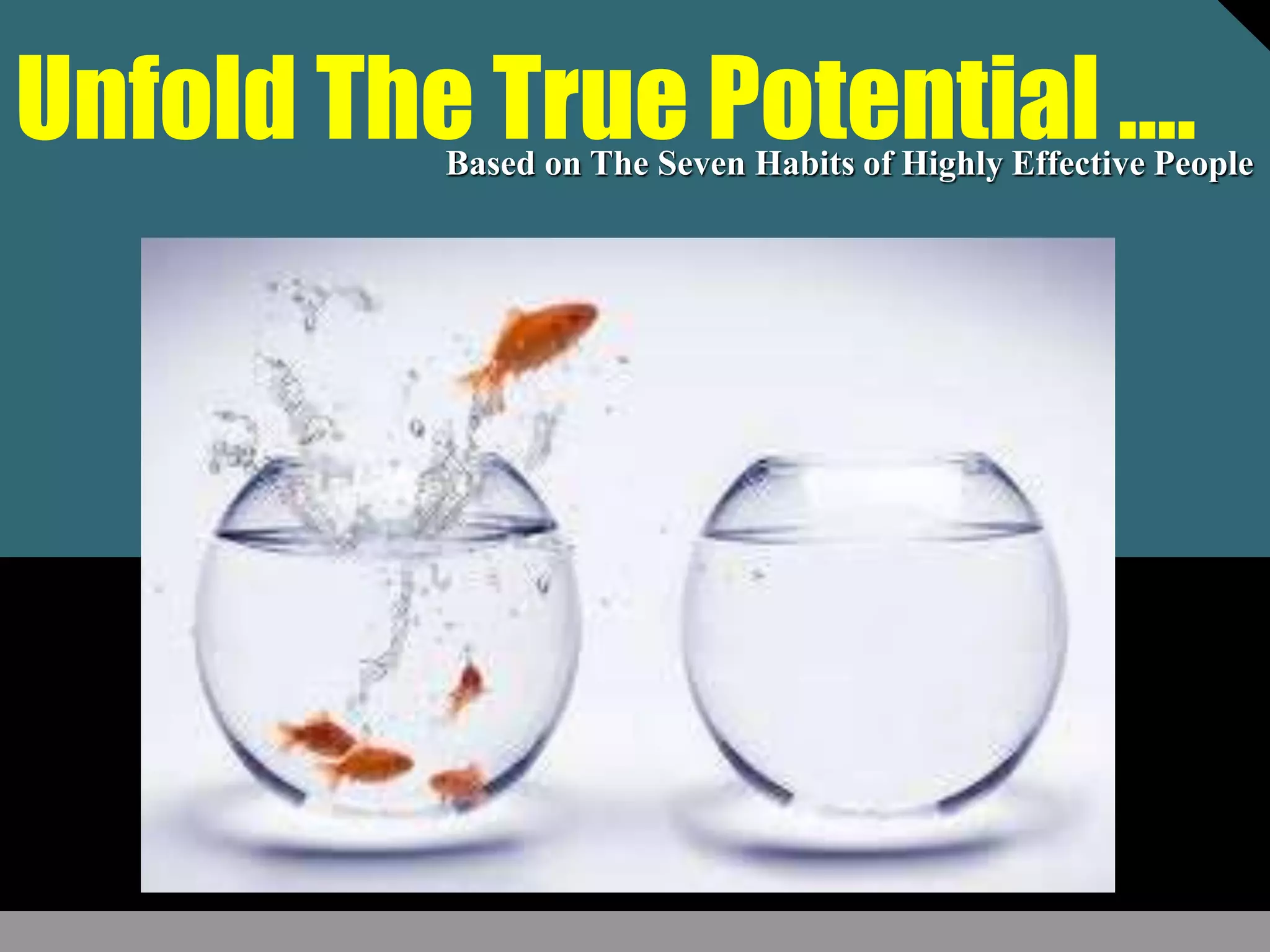
Unfold The True Potential ….Based on The Seven Habits of Highly Effective People
Desire
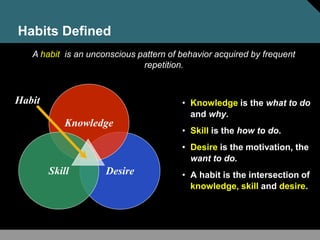
Habits Defined
• Knowledge is the what to do
and why.
• Skill is the how to do.
• Desire is the motivation, the
want to do.
• A habit is the intersection of
knowledge, skill and desire.
Knowledge
Skill
Habit
A habit is an unconscious pattern of behavior acquired by frequent
repetition.
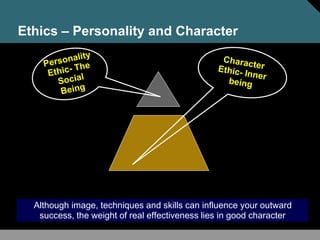
Ethics – Personality and Character
Although image, techniques and skills can influence your outward
success, the weight of real effectiveness lies in good character
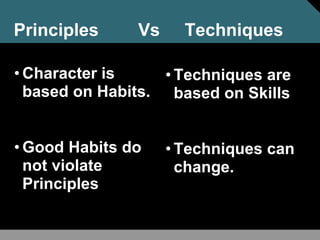
Principles Vs Techniques
• Character is
based on Habits.
• Good Habits do
not violate
Principles
• Techniques are
based on Skills
• Techniques can
change.
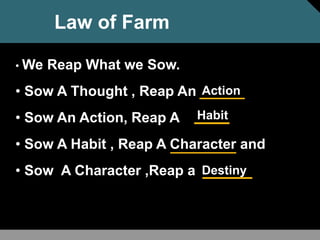
Law of Farm
• We Reap What we Sow.
• Sow A Thought , Reap An
• Sow An Action, Reap A
• Sow A Habit , Reap A Character and
• Sow A Character ,Reap a
Action
Habit
Destiny
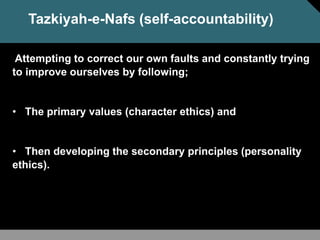
Attempting to correct our own faults and constantly trying
to improve ourselves by following;
• The primary values (character ethics) and
• Then developing the secondary principles (personality
ethics).
Tazkiyah-e-Nafs (self-accountability)
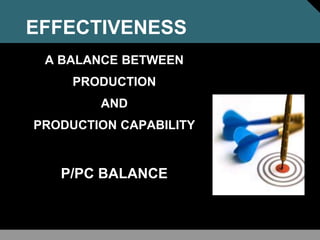
A BALANCE BETWEEN
PRODUCTION
AND
PRODUCTION CAPABILITY
P/PC BALANCE
EFFECTIVENESS
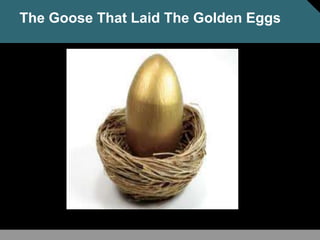
The Goose That Laid The Golden Eggs
we need to be careful not to ignore our
•Health
•Family
•Relaxation and
• Religious activities
by spending too much time and activity
on work( Production).
The Goose That Laid The Golden Eggs
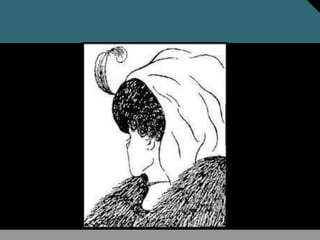
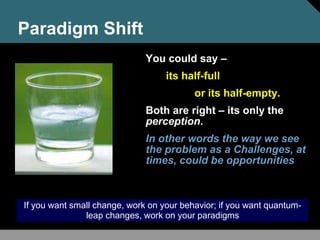
Paradigm Shift
You could say –
its half-full
or its half-empty.
Both are right – its only the
perception.
In other words the way we see
the problem as a Challenges, at
times, could be opportunities
If you want small change, work on your behavior; if you want quantum-
leap changes, work on your paradigms
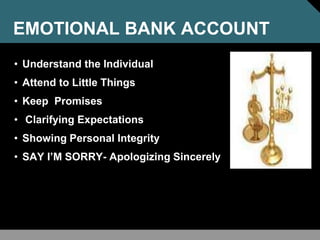
EMOTIONAL BANK ACCOUNT
• Understand the Individual
• Attend to Little Things
• Keep Promises
• Clarifying Expectations
• Showing Personal Integrity
• SAY I’M SORRY- Apologizing Sincerely
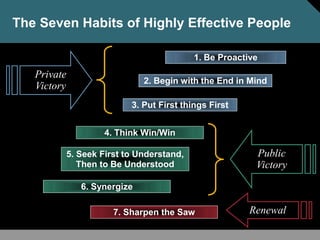
The Seven Habits of Highly Effective People
1. Be Proactive
2. Begin with the End in Mind
3. Put First things First
4. Think Win/Win
5. Seek First to Understand,
Then to Be Understood
6. Synergize
7. Sharpen the Saw
Private
Victory
Public
Victory
Renewal
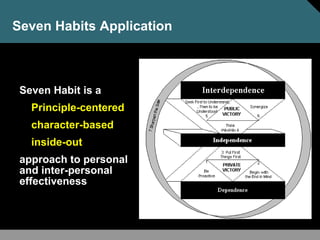
Seven Habits Application
Seven Habit is a
Principle-centered
character-based
inside-out
approach to personal
and inter-personal
effectiveness
Habit 1: Be Proactive
The Habit of
Personal Vision
The Seven Habits of Highly Effective People
Habit 1: Be Proactive
Recognizing that I have the
freedom and ability to
choose how I respond to
whatever happens to me!
Habit 1: Be Proactive
(Principle of Personal Vision)
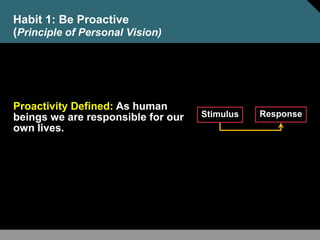
Proactivity Defined: As human
beings we are responsible for our
own lives.
Stimulus Response
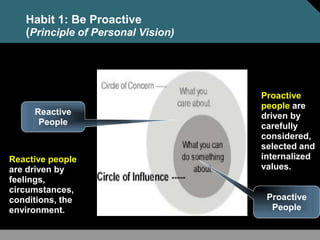
Reactive
People
Proactive
People
Reactive people
are driven by
feelings,
circumstances,
conditions, the
environment.
Proactive
people are
driven by
carefully
considered,
selected and
internalized
values.
Habit 1: Be Proactive
(Principle of Personal Vision)
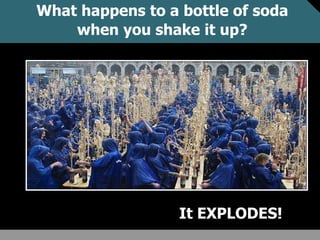
What happens to a bottle of soda
when you shake it up?
It EXPLODES!
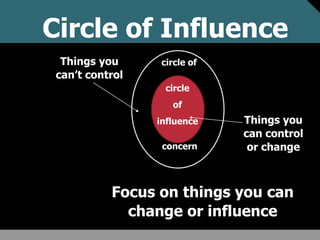
circle
of
influence
circle of
concern
Focus on things you can
change or influence
Circle of Influence
Things you
can’t control
Things you
can control
or change
If you could “carry the weather
with you”….
you could have a
good day no matter
what comes your way.
Habit 1: Be Proactive
(Principle of Personal Vision)
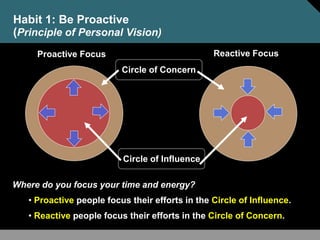
Where do you focus your time and energy?
• Proactive people focus their efforts in the Circle of Influence.
• Reactive people focus their efforts in the Circle of Concern.
Circle of Influence
Circle of Concern
Proactive Focus Reactive Focus
Habit 1: Be Proactive
(Principle of Personal Vision)
Habit 2: Begin with the end in
Mind
•The Habit of
Personal
Leadership
The Seven Habits of Highly Effective People
Habit 2: Begin with the end in
Mind
If you don’t know where
you are going, how will
you know when you get
there?
The Seven Habits of Highly Effective People
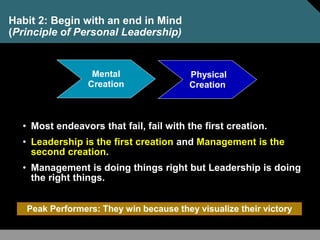
Habit 2: Begin with an end in Mind
(Principle of Personal Leadership)
• Most endeavors that fail, fail with the first creation.
• Leadership is the first creation and Management is the
second creation.
• Management is doing things right but Leadership is doing
the right things.
Mental
Creation
Physical
Creation
Peak Performers: They win because they visualize their victory
Habit 3: Put First Things First
•The Habit of
Personal
Management
The Seven Habits of Highly Effective People
Habit 3: Put First Things First
Organize and execute
around priorities.
The Seven Habits of Highly Effective People
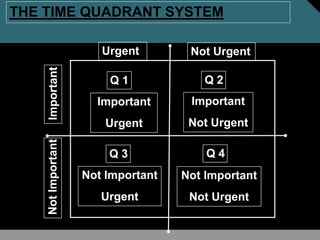
Urgent Not UrgentNotImportantImportant
Q 1
Important
Urgent
Q 3
Not Important
Urgent
Q 2
Important
Not Urgent
Q 4
Not Important
Not Urgent
THE TIME QUADRANT SYSTEM
Habit 3: Put First Things First
(Principles of Personal Management)
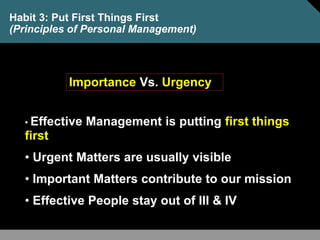
• Effective Management is putting first things
first
• Urgent Matters are usually visible
• Important Matters contribute to our mission
• Effective People stay out of III & IV
Importance Vs. Urgency
Habit 3: Put First Things First
Exercise…….
The Seven Habits of Highly Effective People
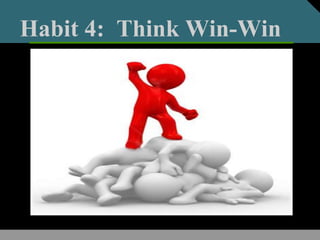
Habit 4: Think Win-Win
The Habit of Mutual
Benefit
Habit 4: Think Win-Win
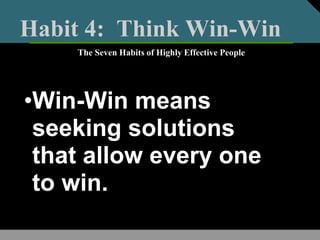
•Win-Win means
seeking solutions
that allow every one
to win.
The Seven Habits of Highly Effective People
Habit 4: Think Win-Win
•Successful relationships
are built on a win-win
foundation.
The Seven Habits of Highly Effective People
Habit 4: Think Win-Win
A Win-Win character
consists of three traits:
•Integrity
•Maturity
•Abundance Mentality
The Seven Habits of Highly Effective People
Habit 5: Seek First to Understand
then to be Understood
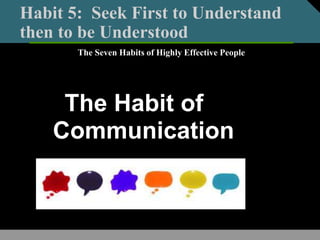
The Habit of
Communication
The Seven Habits of Highly Effective People
Habit 5: Seek First to Understand
then to be Understood
The deepest need of
the human soul is
to be understood.
The Seven Habits of Highly Effective People
Habit 5: Seek First to Understand
•To truly
understand, we
must listen to more
than words
The Seven Habits of Highly Effective People
Habit 5: Seek First to Understand
•Empathy is
listening with the
eyes and the
“heart.”
The Seven Habits of Highly Effective People
The one who listens does the most work, not the one who speaks
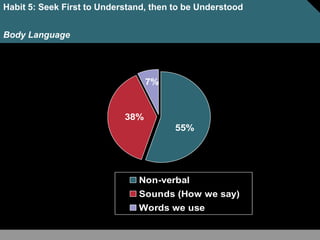
7%
38%
55%
Non-verbal
Sounds (How we say)
Words we use
Habit 5: Seek First to Understand, then to be Understood
Body Language
Mirror, Mirror
To be a good listener, mirror
back what someone says.
Repeat back in your own words
what the person is saying
Empathic Listening Skills
The key to listening is listen with the eyes and the heart
Habit 6: Synergize
• The Habit of
creative
Cooperation
Habit 6: Synergize
(Principles of Creative Communication)
The term synergy comes from
the Greek word syn-ergos
means “working together"
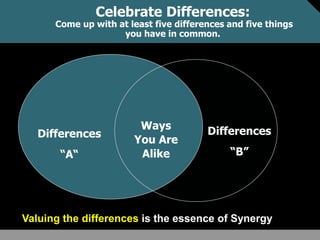
Celebrate Differences:
Come up with at least five differences and five things
you have in common.
Ways
You Are
Alike
Differences
“B”
Differences
“A“
Valuing the differences is the essence of Synergy
Habit 6: Synergize
(Principles of Creative Communication)
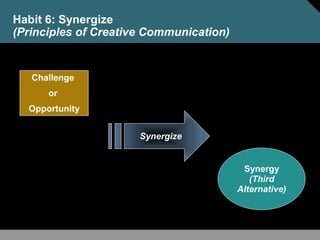
Synergize
Challenge
or
Opportunity
Synergy
(Third
Alternative)
Habit 6: Synergize
•Synergy means one
plus one equals
three or more.
The Habit of Creative Cooperation
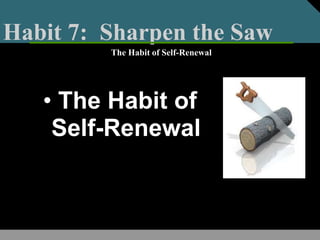
Habit 7: Sharpen the Saw
• The Habit of
Self-Renewal
The Habit of Self-Renewal
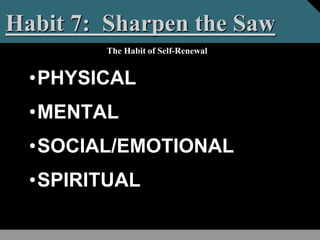
•PHYSICAL
•MENTAL
•SOCIAL/EMOTIONAL
•SPIRITUAL
Habit 7: Sharpen the Saw
The Habit of Self-Renewal
Habit 7 : Sharpen the Saw
• Self-reflection gives you the ability to know
when to sharpen your saw.
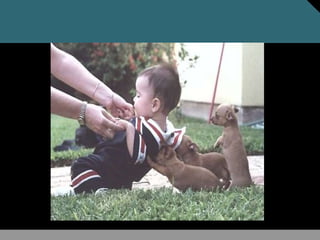
• You need to know when and how to
sharpen your saw. And sometimes you
need help from the most unlikely of
helpers……
7 Habits of Highly Effective People
• Habit 1 Be Proactive
• Habit 2 Begin With The End in Mind
• Habit 3 Put First Things First
• Habit 4 Think Win-win
• Habit 5 Seek First to Understand, Then to Be
Understood
• Habit 6 Synergize
• Habit 7 Sharpen the Saw
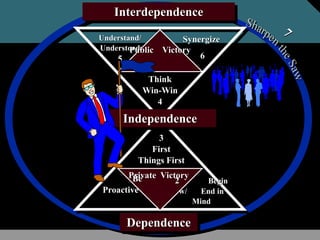
Private Victory
Interdependence
Dependence
Independence
Understand/
Understood
5
Synergize
6
Think
Win-Win
4
3
First
Things First
1 Be
Proactive
2 Begin
w/ End in
Mind
Public Victory

Unfold the true potential

  • 1.
    Unfold The TruePotential ….Based on The Seven Habits of Highly Effective People
  • 3.
    Desire Habits Defined • Knowledgeis the what to do and why. • Skill is the how to do. • Desire is the motivation, the want to do. • A habit is the intersection of knowledge, skill and desire. Knowledge Skill Habit A habit is an unconscious pattern of behavior acquired by frequent repetition.
  • 4.
    Ethics – Personalityand Character Although image, techniques and skills can influence your outward success, the weight of real effectiveness lies in good character
  • 5.
    Principles Vs Techniques •Character is based on Habits. • Good Habits do not violate Principles • Techniques are based on Skills • Techniques can change.
  • 6.
    Law of Farm •We Reap What we Sow. • Sow A Thought , Reap An • Sow An Action, Reap A • Sow A Habit , Reap A Character and • Sow A Character ,Reap a Action Habit Destiny
  • 7.
    Attempting to correctour own faults and constantly trying to improve ourselves by following; • The primary values (character ethics) and • Then developing the secondary principles (personality ethics). Tazkiyah-e-Nafs (self-accountability)
  • 8.
    A BALANCE BETWEEN PRODUCTION AND PRODUCTIONCAPABILITY P/PC BALANCE EFFECTIVENESS
  • 9.
    The Goose ThatLaid The Golden Eggs
  • 10.
    we need tobe careful not to ignore our •Health •Family •Relaxation and • Religious activities by spending too much time and activity on work( Production). The Goose That Laid The Golden Eggs
  • 12.
    Paradigm Shift You couldsay – its half-full or its half-empty. Both are right – its only the perception. In other words the way we see the problem as a Challenges, at times, could be opportunities If you want small change, work on your behavior; if you want quantum- leap changes, work on your paradigms
  • 13.
    EMOTIONAL BANK ACCOUNT •Understand the Individual • Attend to Little Things • Keep Promises • Clarifying Expectations • Showing Personal Integrity • SAY I’M SORRY- Apologizing Sincerely
  • 14.
    The Seven Habitsof Highly Effective People 1. Be Proactive 2. Begin with the End in Mind 3. Put First things First 4. Think Win/Win 5. Seek First to Understand, Then to Be Understood 6. Synergize 7. Sharpen the Saw Private Victory Public Victory Renewal
  • 15.
    Seven Habits Application SevenHabit is a Principle-centered character-based inside-out approach to personal and inter-personal effectiveness
  • 16.
    Habit 1: BeProactive The Habit of Personal Vision The Seven Habits of Highly Effective People
  • 17.
    Habit 1: BeProactive Recognizing that I have the freedom and ability to choose how I respond to whatever happens to me!
  • 18.
    Habit 1: BeProactive (Principle of Personal Vision) Proactivity Defined: As human beings we are responsible for our own lives. Stimulus Response
  • 19.
    Reactive People Proactive People Reactive people are drivenby feelings, circumstances, conditions, the environment. Proactive people are driven by carefully considered, selected and internalized values. Habit 1: Be Proactive (Principle of Personal Vision)
  • 20.
    What happens toa bottle of soda when you shake it up? It EXPLODES!
  • 21.
    circle of influence circle of concern Focus onthings you can change or influence Circle of Influence Things you can’t control Things you can control or change
  • 22.
    If you could“carry the weather with you”…. you could have a good day no matter what comes your way.
  • 23.
    Habit 1: BeProactive (Principle of Personal Vision) Where do you focus your time and energy? • Proactive people focus their efforts in the Circle of Influence. • Reactive people focus their efforts in the Circle of Concern. Circle of Influence Circle of Concern Proactive Focus Reactive Focus
  • 24.
    Habit 1: BeProactive (Principle of Personal Vision)
  • 25.
    Habit 2: Beginwith the end in Mind •The Habit of Personal Leadership The Seven Habits of Highly Effective People
  • 26.
    Habit 2: Beginwith the end in Mind If you don’t know where you are going, how will you know when you get there? The Seven Habits of Highly Effective People
  • 27.
    Habit 2: Beginwith an end in Mind (Principle of Personal Leadership) • Most endeavors that fail, fail with the first creation. • Leadership is the first creation and Management is the second creation. • Management is doing things right but Leadership is doing the right things. Mental Creation Physical Creation Peak Performers: They win because they visualize their victory
  • 28.
    Habit 3: PutFirst Things First •The Habit of Personal Management The Seven Habits of Highly Effective People
  • 29.
    Habit 3: PutFirst Things First Organize and execute around priorities. The Seven Habits of Highly Effective People
  • 30.
    Urgent Not UrgentNotImportantImportant Q1 Important Urgent Q 3 Not Important Urgent Q 2 Important Not Urgent Q 4 Not Important Not Urgent THE TIME QUADRANT SYSTEM
  • 31.
    Habit 3: PutFirst Things First (Principles of Personal Management) • Effective Management is putting first things first • Urgent Matters are usually visible • Important Matters contribute to our mission • Effective People stay out of III & IV Importance Vs. Urgency
  • 32.
    Habit 3: PutFirst Things First Exercise……. The Seven Habits of Highly Effective People
  • 33.
    Habit 4: ThinkWin-Win The Habit of Mutual Benefit
  • 34.
  • 35.
    Habit 4: ThinkWin-Win •Win-Win means seeking solutions that allow every one to win. The Seven Habits of Highly Effective People
  • 36.
    Habit 4: ThinkWin-Win •Successful relationships are built on a win-win foundation. The Seven Habits of Highly Effective People
  • 37.
    Habit 4: ThinkWin-Win A Win-Win character consists of three traits: •Integrity •Maturity •Abundance Mentality The Seven Habits of Highly Effective People
  • 38.
    Habit 5: SeekFirst to Understand then to be Understood The Habit of Communication The Seven Habits of Highly Effective People
  • 39.
    Habit 5: SeekFirst to Understand then to be Understood The deepest need of the human soul is to be understood. The Seven Habits of Highly Effective People
  • 40.
    Habit 5: SeekFirst to Understand •To truly understand, we must listen to more than words The Seven Habits of Highly Effective People
  • 41.
    Habit 5: SeekFirst to Understand •Empathy is listening with the eyes and the “heart.” The Seven Habits of Highly Effective People The one who listens does the most work, not the one who speaks
  • 42.
    7% 38% 55% Non-verbal Sounds (How wesay) Words we use Habit 5: Seek First to Understand, then to be Understood Body Language
  • 43.
    Mirror, Mirror To bea good listener, mirror back what someone says. Repeat back in your own words what the person is saying Empathic Listening Skills The key to listening is listen with the eyes and the heart
  • 44.
    Habit 6: Synergize •The Habit of creative Cooperation
  • 45.
    Habit 6: Synergize (Principlesof Creative Communication) The term synergy comes from the Greek word syn-ergos means “working together"
  • 46.
    Celebrate Differences: Come upwith at least five differences and five things you have in common. Ways You Are Alike Differences “B” Differences “A“ Valuing the differences is the essence of Synergy
  • 47.
    Habit 6: Synergize (Principlesof Creative Communication) Synergize Challenge or Opportunity Synergy (Third Alternative)
  • 48.
    Habit 6: Synergize •Synergymeans one plus one equals three or more. The Habit of Creative Cooperation
  • 49.
    Habit 7: Sharpenthe Saw • The Habit of Self-Renewal The Habit of Self-Renewal
  • 50.
  • 51.
    Habit 7 :Sharpen the Saw • Self-reflection gives you the ability to know when to sharpen your saw. • You need to know when and how to sharpen your saw. And sometimes you need help from the most unlikely of helpers……
  • 53.
    7 Habits ofHighly Effective People • Habit 1 Be Proactive • Habit 2 Begin With The End in Mind • Habit 3 Put First Things First • Habit 4 Think Win-win • Habit 5 Seek First to Understand, Then to Be Understood • Habit 6 Synergize • Habit 7 Sharpen the Saw
  • 54.