UNFIL-
TERED
16 DAYS. SEVEN FLIGHTS.
TWO CITIES. TWO CONFERENCES.
ONE OR TWO BEERS.
MILLIONS OF IDEAS.
RYAN
GOSLING
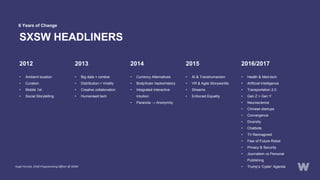
SXSW HEADLINERS
2012 2013 2014 2015 2016/2017
• Ambient location
• Curation
• Mobile 1st
• Social Storytelling
• Big data + context
• Distribution > Virality
• Creative collaboration
• Humanised tech
• Currency Alternatives
• Body/brain hacks/history
• Integrated interactive
intuition
• Paranoia → Anonymity
• AI & Transhumanism
• VR & Agile Storyworlds
• Streams
• Enforced Equality
• Health & Med-tech
• Artificial Intelligence
• Transportation 2.0
• Gen Z > Gen Y
• Neuroscience
• Chinese startups
• Convergence
• Diversity
• Chatbots
• TV Reimagined
• Fear of Future Robot
• Privacy & Security
• Journalism vs Personal
Publishing
• Trump’s ‘Cyber’ AgendaHugh Forrest, Chief Programming Officer @ SXSW
6 Years of Change
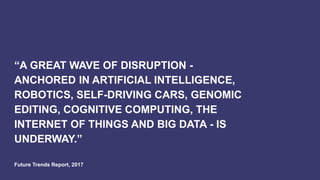
“A GREAT WAVE OF DISRUPTION -
ANCHORED IN ARTIFICIAL INTELLIGENCE,
ROBOTICS, SELF-DRIVING CARS, GENOMIC
EDITING, COGNITIVE COMPUTING, THE
INTERNET OF THINGS AND BIG DATA - IS
UNDERWAY.”
Future Trends Report, 2017
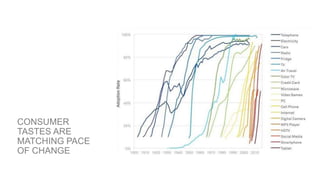
CONSUMER
TASTES ARE
MATCHING PACE
OF CHANGE
“EVERYTHING HAS TO HAVE A PURPOSE, A
PLACE IN YOUR EXPERIENCE”
ADOBE, 2017
SO ‘MURICA…
WHAT’S NEXT?
THE RISE
OF THE
__MACHINES
EXPERIENCE
__IS KING
IT’ S TIME FOR
THE RISE OF __THE
MACHINES
AIMAKING YOU SMARTER
MACHINE
__LEARNING
HELPING YOU CHANGE
DON’T BE SCARED. THEY ARE
HERE TO HELP.
THE ULTIMATE EXPERIENCE
MAKING IT EASIER
TO CONNECT
THE NEXT FRONTIER
YOU HAVE TO CHANGE THE WAY YOU
SPEAK TO
__HUMANS
STORY
TELLING
HAS CHANGED FOREVER
CONTEXTUAL
__ENGAGMENT
BE RELEVANT.
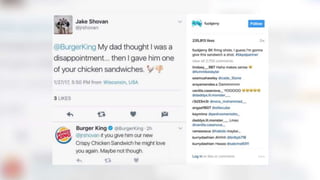
MEMES
__KILL ADS
A NEW WAVE OF ENGAGEMENT
YOU’RE DEALING WITH HUMANS
ARE NOW FOLLOWERS
ARE NOW WE
NO REAL SURPRISE BUT…
EXPERIENCE IS
__YOUR BUSINESS
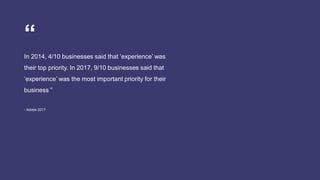
In 2014, 4/10 businesses said that ‘experience’ was
their top priority. In 2017, 9/10 businesses said that
‘experience’ was the most important priority for their
business ”
- Adobe 2017
“
CONVER
GENCE
BLENDING DIGITAL & PHYSICAL
REAL TIME
__CHANGE
KNOW YOUR HUMANS
NOWDON’T WAIT, DO IT NOW
CONTEXTSTART BY ASKING THE
RIGHT QUESTIONS
IS YOUR BRAND, USE IT
BUYING ‘SILVER BULLETS’

Unflitered: SXSW & Adobe Summit

Editor's Notes

  • #6 We look at the last 7 years and we see some interesting things: Disappointments (beacons: weren’t you going to change everything; Body/brain hacks) Standards (Mobile 1st, Curation, Distribution via platforms) Mysteries (Crypto-currencies, big data, AI) The last 2 years start to tell a different story: Convergence A critical mass of emerging technologies are starting to converge, finding advanced uses beyond initial testing and applied research - machine learning MATURATION Fringe technologies and trends have matured and their proliferation across new sectors have had significant implications on the way we live (transportation, cities, politics, work)
  • #7 More tech than ever. More tech trends in 2017 than previous years. SXSW is an amalgam of different tech conversations and trends, making it difficult to discern any one theme between its opposing narratives. YET, amongst the volume of trends there is an interesting story developing around the number of emergent technologies that are tipping over and scaling into mass markets. Their impending impact will significantly reshape the world around us - specifically how consumers behave and how brands interact with them.


  • #8 Technology adoption curves are accelerating over time Frequency of “gamechanging” tech is increasing So, not only is the amount of tech accelerating, but consumer tastes and behaviours are also matching this pace
  • #9 More tech than ever. More tech trends in 2017 than previous years. SXSW is an amalgam of different tech conversations and trends, making it difficult to discern any one theme between its opposing narratives. YET, amongst the volume of trends there is an interesting story developing around the number of emergent technologies that are tipping over and scaling into mass markets. Their impending impact will significantly reshape the world around us - specifically how consumers behave and how brands interact with them.
  • #12 Why: Why should you care? Why will it make a difference?
  • #13 Why: Why should you care? Why will it make a difference?
  • #14 Why: Why should you care? Why will it make a difference?
  • #15 Why: Why should you care? Why will it make a difference?
  • #16 Why: Why should you care? Why will it make a difference?
  • #17 Why: Why should you care? Why will it make a difference?
  • #18 Opportunity: Bots will help tie ecosystems together for brands (serve up content, replace apps) Strengthen relationship between users and brands (personalisation, convenience) Brand awareness > Customer service (Burberry, MeCheck from Match.com)
  • #19 Why: Why should you care? Why will it make a difference?
  • #20 Why: Why should you care? Why will it make a difference?
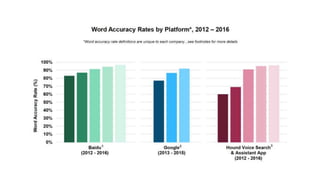
  • #21 Increasing Accuracy Is Driving Growth In Voice UI
  • #22 Why: Why should you care? Why will it make a difference?
  • #23 Why: Why should you care? Why will it make a difference?
  • #24 The stories we tell each other and how we experience stories? The rise of VR & AR will change storytelling: Linear + Closed → Non-linear and open New considerations around inputs, participation and context will be opened
  • #25 Why: Why should you care? Why will it make a difference?
  • #26 http://espncms.com/performance-stories/beats/beats-case-study.html
  • #27 Why. Why should you care. Why will it make a difference
  • #28 Why. Why should you care. Why will it make a difference
  • #29 Why. Why should you care. Why will it make a difference
  • #30 Why. Why should you care. Why will it make a difference
  • #31 Why. Why should you care. Why will it make a difference
  • #32 Why. Why should you care. Why will it make a difference
  • #33 The economic effects are more pronounced in companies where design is firmly rooted in both internal and external design investments. With regard to the companies’ position on the Design Ladder, a higher placement on the Design Ladder is associated with a positive effect on gross earnings and a clear positive effect on exports.
  • #34 Why. Why should you care. Why will it make a difference
  • #35 Why. Why should you care. Why will it make a difference
  • #36 DON’T WAIT, START (LEARNING) NOW The best companies embrace change. They are front-footed in nature. Companies must continue to skill up and get involved early which keeps them ahead of the competition and keeps them level with rapidly changing consumer tastes. If you wait too long to see if the platform has been “proven out”, it can sometimes be too late. Getting in early helps you build the learning curve and teaches you valuable lessons so you can stay ahead of the competition (find out what works for you and your audiences) In the past, we’ve seen marketers excel at being more experimental, be on the edge with new channels and formats on FB Live, Snapchat, etc
  • #37 Needed to fix broken incubators (UNICEF identified that first 3 years matter most in the war against Child Mortality) Asked the right questions:” What are the parts in small towns that everyone has?” (Not, “how can we fix the existing solution?” Use of Toyota parts because that’s what everyone in the village had (The NeoNurture baby incubator by Design That Matters is made out of car parts.)
  • #38 Why. Why should you care. Why will it make a difference
  • #39 There are no shortcuts, don’t try and buy them. If your data is a mess, you CRM platform shot, your CMS non existent and you team all over the place, you need to fix it and fast. Because that stuff is all yesterday, the stuff that we are talking about is happening today. You better be ready, you will get rolled over. Fix your BAU. Use it. Move on
  • #40 Why. Why should you care. Why will it make a difference
  • #41 How we will harness these technologies with new skills and teams Need for more diversity Creativity and productivity will be continue to be maximised within environments that promote diverse backgrounds, opinions and approaches to traditional problems Going to see a lot of new: Organisational structures Team skillsets Collaboration process
  • #42 Netflix is a good reflection of this new type of teams and skills. Microservices approach over at Netflix. One positive—and somewhat unintended—consequence of moving to microservices: team structure and output mirrors the services that are delivered. (00:52) Microservices allow for quick and independent innovation. "We want our teams and services to be tightly aligned, but loosely coupled," Marsh says. (01:29)
  • #43 Disney Exploring new technologies like machine learning, chatbots and invisible interfaces (i.e. Amazon Echo) require Disney to continuously iterate across multiple versions as the technology matures, but the long term benefits outweigh the short-term hiccups that come with experimenting with new technology. Levi’s Google ATAP and Levi’s came together to make Project Jacquard — or simply the first Google Trucker Jacket. It’s the first wearable tech that looks wearable yet has product features integrated into the jacket that allows you to interact with maps, messaging and phone calls via gestures with your jacket. The invisibility of tech in the jacket is a prime example of this trust. Google engineers admit that their first instinct is to make the sensors and conductive yarn highly visible on the garment. Levi’s, staying true to the nature of the garment and the requirements of the wearer, pushed back and fought for the tech to be invisible and stay purposeful to the garment’s design (i.e. help riders be more ‘present’ and not distracted when they rode, while still looking cool). Levi’s designers embraced processes common to tech in the process and built in testing and iteration phases for the garment, after it had gone into market. Product testing before launch is common for fashion designers, but rarely have they sought out user feedback and user data post-launch to iterate and evolve the product design.
  • #44 Disney Exploring new technologies like machine learning, chatbots and invisible interfaces (i.e. Amazon Echo) require Disney to continuously iterate across multiple versions as the technology matures, but the long term benefits outweigh the short-term hiccups that come with experimenting with new technology. Levi’s Google ATAP and Levi’s came together to make Project Jacquard — or simply the first Google Trucker Jacket. It’s the first wearable tech that looks wearable yet has product features integrated into the jacket that allows you to interact with maps, messaging and phone calls via gestures with your jacket. The invisibility of tech in the jacket is a prime example of this trust. Google engineers admit that their first instinct is to make the sensors and conductive yarn highly visible on the garment. Levi’s, staying true to the nature of the garment and the requirements of the wearer, pushed back and fought for the tech to be invisible and stay purposeful to the garment’s design (i.e. help riders be more ‘present’ and not distracted when they rode, while still looking cool). Levi’s designers embraced processes common to tech in the process and built in testing and iteration phases for the garment, after it had gone into market. Product testing before launch is common for fashion designers, but rarely have they sought out user feedback and user data post-launch to iterate and evolve the product design.
  • #45 Why. Why should you care. Why will it make a difference
  • #46 ALL OF THIS MEANS NOTHING WITHOUT YOUR CUSTOMERS, BE THEY INTERNAL OR EXTERNAL. THEY ARE YOU NORTHSTAR, YOUR FOCUS, YOUR EVERYTHING. WORK WITH THEM TO SOLVE CHALLENGES, WORK WITH THEM TO DELIVER VALUE. DON’T BUY TECH FOR TECH SAKE, BY A CAPABILITY, OR ANSWER TO A CHALLNENGE.