UNEP FI Guide to
                      Banking & Sustainability


                                     t
                                  en by
                               tement ion
                        P  Sta itm itut
                                   t    e
                     NE omm l Ins nabl
                    U C
                              ia   ai
                     of anc Sust nt
                      Fin ) on pme
                       (FI velo
                        De
R A M M E
PROG
N V I R O N M ENT


                                            U
                                            Understanding and
E


                                            I
                                            Implementing Sustainability
ATI O N S


                                            i
                                            in your Bank based on
                                            t
                                            the UNEP Statement of
                                            C
                                            Commitment by Financial
N


                                            I
                                            Institutions on Sustainable
N ITE D


                                            D
                                            Development
U


                                            O
                                            October 2011
Copyright © United Nations Environment Programme, 2011


The report and the contents of the report remain the sole property of the UNEP
Finance Initiative. None of the information contained and provided in the report may
be modified, reproduced, distributed, disseminated, sold, published, broadcasted or
circulated, in whole or in part, in any form or by any means, electronic or mechanical,
including photocopying, or the use of any information storage and retrieval system,
without the express written permission from the UNEP FI secretariat based in Geneva
or the appropriate affiliate or partner. The content of the report, including but not limited
to text, photographs, graphics, illustrations and artwork, and names, logos, trademarks
and service marks, remain the property of UNEP FI or its affiliates or contributors or
partners and are protected by copyright, trademark and other laws.


Disclaimer Notice
The information contained in the report is meant for informational purposes only and
is subject to change without notice. The content of the report is provided with the
understanding that the authors and publishers are not herein engaged to render advice
on legal, economic, or other professional issues and services.


Subsequently, UNEP FI is also not responsible for the content of web sites and
information resources that may be referenced in the report. The access provided to
these sites does not constitute an endorsement by UNEP FI of the sponsors of the
sites or the information contained therein. Unless expressly stated otherwise, the
opinions, findings, interpretations and conclusions expressed in the report are those
of the various contributors to the report and do not necessarily represent the views
of UNEP FI or the member institutions of the UNEP FI partnership, UNEP, the United
Nations or its Member States.


While we have made every attempt to ensure that the information contained in the
report has been obtained from reliable and up-to-date sources, the changing nature
of statistics, laws, rules and regulations may result in delays, omissions or inaccuracies
in information contained in this report. As such, UNEP FI makes no representations as
to the accuracy or any other aspect of information contained in this report.


UNEP FI is not responsible for any errors or omissions, or for any decision made or action
taken based on information contained in this report or for any consequential, special or
similar damages, even if advised of the possibility of such damages.


All information in this report is provided ‘as is’, with no guarantee of completeness,
accuracy, timeliness or of the results obtained from the use of this information,
and without warranty of any kind, expressed or implied, including, but not
limited to warranties of performance, merchantability and fitness for
a particular purpose. The information and opinions contained in
the report are provided without any warranty of any kind, either
expressed or implied.                                                                    UNEP promotes
                                                                                environmentally sound practices
Layout and print by:                                                          globally and in its own activities. This
Instaprint, Geneva, Switzerland
                                                                         publication is printed on 100% recycled paper,
Tel. +41 (0)22 300 4584
info@instaprint.ch                                                         using vegetable - based inks and other eco-
                                                                       friendly practices. Our distribution policy aims to
                                                                                 reduce UNEP’s carbon footprint.
UNEP FI Guide to
Banking & Sustainability
Understanding and
Implementing Sustainability
in your Bank based on
the UNEP Statement of
Commitment by Financial
Institutions on Sustainable
Development


October 2011
Table of Contents
                    Foreword                                                                                                                          7

                    How to use this Guide                                                                                                             9
                    Navigating the Guide’s Illustrations and Call-out Boxes                                                                          10
                    Finding what’s relevant to you depending on your role                                                                            11

                    UNEP FI Guide to Banking & Sustainability                                                                                        12

                    UNEP Statement of Commitment by Financial Institutions on
                    Sustainable Development - An Interpretation                                                                                      12

                    Section One - Commitment to Sustainable Development
                    1.1     sustainable development as sound business management                                                                     13
                    1.2     enabling conditions of sustainable finance                                                                                13
                    1.3     role of the finance sector in achieving sustainable development                                                           14
                    1.4     institutional commitment                                                                                                 14
                    1.5     emerging issues                                                                                                          17

                    Section Two - Sustainability Management
                    2.1     precautionary approach                                                                                                   18
                    2.2     compliance and integration                                                                                               19
                    2.3     risk management                                                                                                          19
                    2.4     environmental management                                                                                                 22
                    2.5     on-going learning and improvement                                                                                        24
                    2.6     monitoring progress against goals                                                                                        25
                    2.7     products & services                                                                                                      25

                    Section Three - Public Awareness and Communication
                    3.1     reporting                                                                                                                28
                    3.2     supporting customers                                                                                                     28
                    3.3     stakeholder engagement                                                                                                   29
                    3.4     liaison with UNEP                                                                                                        30
                    3.5     advocacy                                                                                                                 30
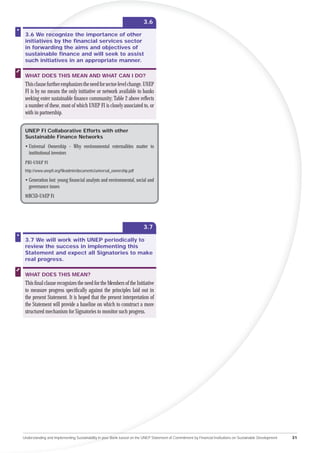
                    3.6     further sustainable finance initiatives                                                                                   31
                    3.7     implementation of the Statement                                                                                          31

                    Annexes
                    IA  Background to the UNEP Statement of Commitment by
                        Financial Institutions on Sustainable Development                                                                            32
                    IB  UNEP Statement of Commitment by Financial Institutions (FI)
                        on Sustainable Development                                                                                                   33
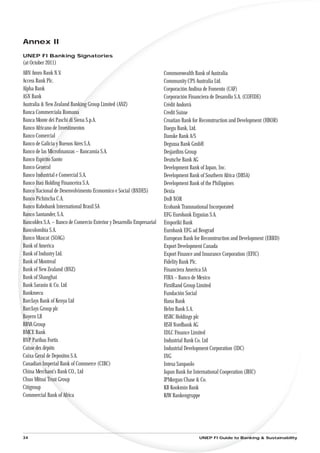
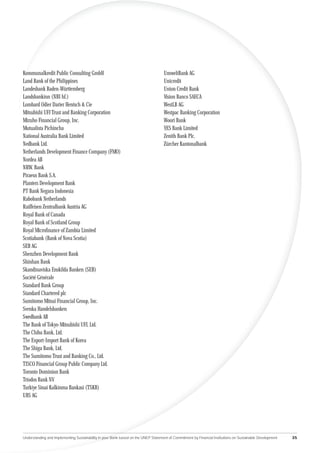
                    II  UNEP FI Signatory Members                                                                                                    34
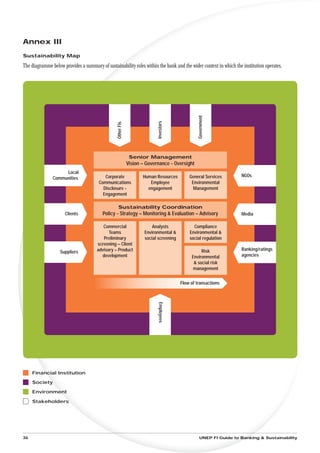
                    III Sustainability Map                                                                                                           36

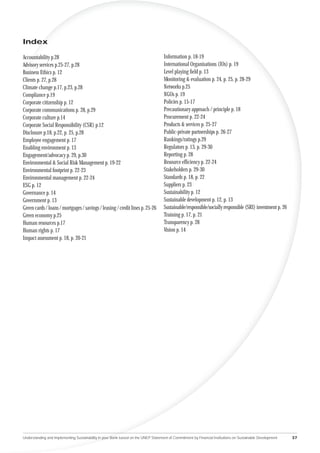
                    Index                                                                                                                            37

                    About the UNEP FI Banking Commission                                                                                             38


Understanding and Implementing Sustainability in your Bank based on the UNEP Statement of Commitment by Financial Institutions on Sustainable Development   5
Foreword

                    In 2009, a new operational structure for the United Nations Environmental Programme Finance Initiative
                    (UNEP FI) was agreed by its Members, to ensure that all Signatories be provided with appropriate fora and
                    platforms for engaging with co-Signatories on relevant topics and platforms. An essential element to this
                    restructuring was the creation of the Industry Commissions, for banking, insurance and investment respectively.
                    During its first year of existence in 2010, the Banking Commission identified as one core area for action, the
                    need to provide explicit guidance to the banking community regarding the meaning and implementation of
                    sustainability for different groups of practitioners across banking operations, especially for institutions and/or
                    employees new to the topic.
                    Members of the Banking Commission were keen to offer newcomers and pioneers in the sustainable finance
                    arena a comprehensive, yet simple starting and reference point, something which two of UNEP FI’s Regional
                    Task Forces, the Central & Eastern European Group and the Latin American Task Force, had already started to
                    work on. Moreover, the overall sustainability scene was maturing.
                    Indeed, while the Principles for Responsible Investment (PRI) and the nascent Principles for Sustainable
                    Insurance provided the investment and insurance audiences with a corpus of guidelines and benchmarks for
                    pursuing the sustainability agenda in their respective businesses, the banking audience remained confronted
                    with a variety of standards, ranging from the Equator Principles to a number of more local approaches, in a
                    variety of different countries.
                    With these needs and developments in mind, the Commission Board resolved to develop a Guide to Banking &
                    Sustainability, based directly on the UNEP Statement of Commitment by Financial Institutions on Sustainable
                    Development.
                    It is our hope that the Guide you presently hold will serve a number of purposes:
                    • Offer UNEP FI’s banking members a clear and practical interpretation of the UNEP Statement, and how to
                      comply with the Statement in the specific context of banking.
                    • Provide all banks seeking to embark upon (or further advance on) the long road to sustainability with a
                      baseline standard.
                    • Forward an explanation of UNEP FI and Signatories’ vision according to the banking and sustainability
                      agenda, to the broader community of stakeholders.
                    It is our belief that the UNEP Statement, as the only United Nations standard specifically aimed at the finance
                    sector, offers a unique foundation for all banks in their efforts to drive sustainability issues.


                    The Co-Chairs, UNEP FI Banking Commission
                    Dag Arne Kristensen                     Kim Brand                                Laura Celia Méndez Herrera
                    Executive Vice President                Director, Environmental Affairs          Special Advisor
                    External Relations                      Scotiabank                               FIRA
                    DnB Nor
                    Harry Papageorgiou                      Madeleine Ronquest                       Anindya Datta
                    Head, Environment & Quality             Head, Environmental and Social           President & Chief Marketing Officer
                    Office                                   Risk Management, Climate                 YES BANK Ltd.
                    Eurobank EFG                            Change, Occupational Health
                                                            and Safety
                                                            FirstRand Group Ltd


Understanding and Implementing Sustainability in your Bank based on the UNEP Statement of Commitment by Financial Institutions on Sustainable Development   7
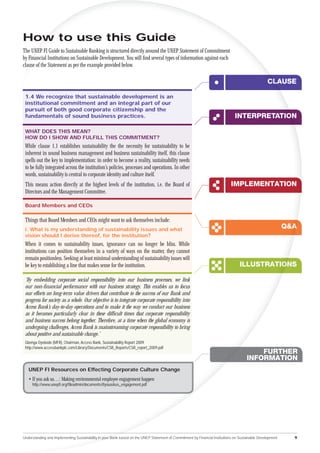
How to use this Guide
The UNEP FI Guide to Sustainable Banking is structured directly around the UNEP Statement of Commitment
by Financial Institutions on Sustainable Development. You will find several types of information against each
clause of the Statement as per the example provided below.

                                                                                                                                                   CLAUSE

 1.4 We recognize that sustainable development is an
 institutional commitment and an integral part of our
 pursuit of both good corporate citizenship and the
 fundamentals of sound business practices.                                                                                     INTERPRETATION
                                                                                                                                        A OON

 WHAT DOES THIS MEAN?
 HOW DO I SHOW AND FULFILL THIS COMMITMENT?
 While clause 1.1 establishes sustainability the the necessity for sustainability to be
 inherent in sound business management and business sustainability itself, this clause
 spells out the key to implementation: in order to become a reality, sustainability needs
 to be fully integrated across the institution’s policies, processes and operations. In other
 words, sustainability is central to corporate identity and culture itself.
 This means action directly at the highest levels of the institution, i.e. the Board of                                      IMPLEMENTATION
 Directors and the Management Committee.

 Board Members and CEOs

 Things that Board Members and CEOs might want to ask themselves include:
 i. What is my understanding of sustainability issues and what
                                                                                                                                                            Q&A
                                                                                                                                                              A
 vision should I derive thereof, for the institution?
 When it comes to sustainability issues, ignorance can no longer be bliss. While
 institutions can position themselves in a variety of ways on the matter, they cannot
 remain positionless. Seeking at least minimal understanding of sustainability issues will
 be key to establishing a line that makes sense for the institution.                                                              ILLUSTRATIONS
                                                                                                                                            O

 ‘By embedding corporate social responsibility into our business processes, we link
 our non-financial performance with our business strategy. This enables us to focus
 our efforts on long-term value drivers that contribute to the success of our Bank and
 progress for society as a whole. Our objective is to integrate corporate responsibility into
 Access Bank’s day-to-day operations and to make it the way we conduct our business
 as it becomes particularly clear in these difficult times that corporate responsibility
 and business success belong together. Therefore, at a time when the global economy is
 undergoing challenges, Access Bank is mainstreaming corporate responsibility to bring
 about positive and sustainable change.’
 Gbenga Oyebode (MFR), Chairman, Access Bank, Sustainability Report 2009
 http://www.accessbankplc.com/Library/Documents/CSR_Reports/CSR_report_2009.pdf
                                                                                                                                          FURTHER
                                                                                                                                      INFORMATION
   UNEP FI Resources on Effecting Corporate Culture Change
   • If you ask us…: Making environmental employee engagement happen
     http://www.unepfi.org/fileadmin/documents/ifyouaskus_engagement.pdf


Understanding and Implementing Sustainability in your Bank based on the UNEP Statement of Commitment by Financial Institutions on Sustainable Development     9
Navigating the Guide’s
Illustrations and Call-out Boxes
List of Illustrations
Illustrations of current practice in a number of UNEP FI Member institutions are embedded throughout the text. Illustrations are categorised below
according to the geographic scope of their activities, independently of their area(s) of specialisation (retail, corporate, investment, savings, private,
etc.), with the exception of development banks (local and international).

Global banks                                                                    Regional banks
Banco Itaú Holding Financeira S.A., Brazil p.23                                 Access Bank Plc., Nigeria p. 14
Bank of America p. 15 and 23                                                    BMCE Bank, Morocco p. 13
Barclays Group plc, UK p.17                                                     Canadian Imperial Bank of Commerce (CIBC) p. 23
BBVA Group, Spain p. 16 and 23                                                  DnB NOR, Norway p. 30
Citigroup, USA p.23                                                             EFG Eurobank Ergasias S.A., Greece p. 14 and 24
HSBC Holdings plc, UK p. 17 and 24                                              FirstRand Group Ltd., South Africa p. 12 and 21
Royal Bank of Canada p. 16, 26 and 29                                           National Australia Bank Ltd. p. 23 and 27
Scotiabank, Canada p. 27                                                        Piraeus Bank S.A., Greece p. 18 and 29
Société Générale, France p. 15 and 30                                           Santander Brazil p. 21 and 22
Standard Chartered plc, UK p. 20                                                Toronto Dominion Bank, Canada p. 17
The Bank of Tokyo-Mitsubishi UFJ, Ltd., Japan p. 14 and 26                      UniCredit Bank Austria p. 19

Development Banks                                                               Local banks
Bancoldex S.A. – Banco de Comercio Exterior y Desarrollo Empresarial,           Banca Commerciala Romana, Romania p. 20
Colombia p.26                                                                   Banco de Galicia y Buenos Aires S.A., Argentina p. 14
Corporacion Andina de Fomento (CAF), Latin America p. 26                        Industrial Bank Co. Ltd., China p. 18, 21, 24 and 25
Development Bank of the Philippines p.26                                        Mutualista Pichincha, Ecuador p. 15
European Bank for Reconstruction and Development (EBRD) p. 21                   The Sumitomo Trust and Banking Co., Ltd., Japan p.15
Export Finance and Insurance Corporation (EFIC), Australia p. 20                YES BANK Ltd., India p. 26
FIRA – Banco de Mexico p. 26
KfW Bankengruppe, Germany p. 26
Netherlands Development Finance Company (FMO) p. 16, 21 and 30
Nordic Investment Bank (NIB), Scandinavia p. 16                                 Note: There are many more illustrations of Members’ sustainability practices than
PT Bank Negara Indonesia p. 29                                                  those contained here. The extracts contained in this Guide seek to offer a sample of
Turkiye Sinai Kalkinma Bankasi (TSKB), Turkey p. 15                             current strategies and approaches, with no claim to comprehensiveness in any form.


List of Call-out Boxes
Definititions & Sources                                                          What the Multilateral /Bilateral Banks
What’s in a Name? A few Definitions p.12                                         are doing ...
United Nations Protect, Respect and Remedy Framework for Business and           Corporacion Andina de Fomento (CAF), Latin America p. 26
Human Rights p. 17                                                              European Bank for Reconstruction and Development (EBRD) p. 21
The Precautionary Principle p. 18                                               KfW Bankengruppe, Germany p. 26
Green Economy p. 25                                                             Netherlands Development Finance Company (FMO) p. 16, 21 and 30

Standards & Guidelines                                                          Stakeholders
International Standards & Guidelines p. 18                                      Banks, Regulators & Sustainability p. 13
The Equator Principles p. 20                                                    IOs and NGOs p. 19
Further Useful Standards for Risk Decision-making ... p. 22                     Sustainability Networks p. 25
Measuring the Carbon Footprint p. 23                                            Rankers & Raters p. 29
UNEP Mercury Programme p. 30                                                    UNEP FI Collaborative Efforts with other Sustainable Finance Networks p. 31

Building up Sustainability Capacity                                             UNEP FI Resources
Of Sustainability and Sustainability Policies p. 16                             Effecting Corporate Culture Change p.17
Of Sustainability and ESRM Systems p.20                                         Risk p. 22
Of Sustainability and Environmental Management Systems p. 24                    Green Financing p.27
Of Sustainability and Sustainability Reporting p. 28                            Sustainability Reporting p. 28


10                                                                                                    UNEP FI Guide to Banking & Sustainability
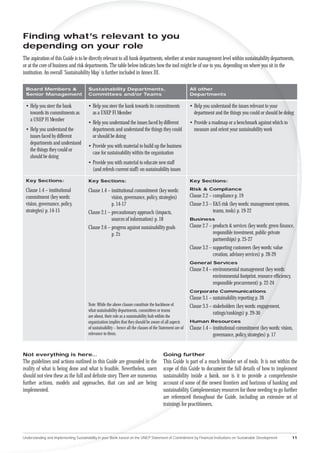
Finding what’s relevant to you
depending on your role
The aspiration of this Guide is to be directly relevant to all bank departments, whether at senior management level within sustainability departments,
or at the core of business and risk departments. The table below indicates how the tool might be of use to you, depending on where you sit in the
institution. An overall ‘Sustainability Map’ is further included in Annex III.

 Board Members &                       Sustainability Departments,                                         All other
 Senior Management                     Committees and/or Teams                                             Departments

 • Help you steer the bank             • Help you steer the bank towards its commitments                   • Help you understand the issues relevant to your
   towards its commitments as            as a UNEP FI Member                                                 department and the things you could or should be doing
                                                                                                                                                                 n
   a UNEP FI Member
                                       • Help you understand the issues faced by different                 • Provide a roadmap or a benchmark against which to
 • Help you understand the               departments and understand the things they could                    measure and orient your sustainability work
   issues faced by different             or should be doing
   departments and understand
                                       • Provide you with material to build up the business
   the things they could or
                                         case for sustainability within the organisation
   should be doing
                                       • Provide you with material to educate new staff
                                         (and refresh current staff) on sustainability issues
 Key Sections:                         Key Sections:                                                       Key Sections:

 Clause 1.4 – institutional            Clause 1.4 – institutional commitment (key words:                   Risk & Compliance
 commitment (key words:                             vision, governance, policy, strategies)                Clause 2.2 – compliance p. 19
 vision, governance, policy,                        p. 14-17                                               Clause 2.3 – E&S risk (key words: management systems,
 strategies) p. 14-15                  Clause 2.1 – precautionary approach (impacts,                                    teams, tools) p. 19-22
                                                    sources of information) p. 18                          Business
                                       Clause 2.6 – progress against sustainability goals                  Clause 2.7 – products & services (key words: green finance,
                                                    p. 25                                                               responsible investment, public-private
                                                                                                                        partnerships) p. 25-27
                                                                                                           Clause 3.2 – supporting customers (key words: value
                                                                                                                        creation, advisory services) p. 28-29
                                                                                                           General Services
                                                                                                           Clause 2.4 – environmental management (key words:    s:
                                                                                                                        environmental footprint, resource efficiency,
                                                                                                                                                             ci
                                                                                                                        responsible procurement) p. 22-24
                                                                                                           Corporate Communications
                                                                                                           Clause 3.1 – sustainability reporting p. 28
                                       Note: While the above clauses constitute the backbone of            Clause 3.3 – stakeholders (key words: engagegement,
                                       what sustainability departments, committees or teams
                                                                                                                        ratings/rankings) p. 29-30
                                       are about, their role as a sustainability hub within the
                                       organization implies that they should be aware of all aspects       Human Resources
                                       of sustainability – hence all the clauses of the Statement are of   Clause 1.4 – institutional commitmen (key words: vision,
                                                                                                                                             ment
                                       relevance to them.                                                               governance, policy, strategies) p. 17
                                                                                                                                            str


Not everything is here…                                                                   Going further
The guidelines and actions outlined in this Guide are grounded in the                     This Guide is part of a much broader set of tools. It is not within the
reality of what is being done and what is feasible. Nevertheless, users                   scope of this Guide to document the full details of how to implement
should not view these as the full and definite story. There are numerous                   sustainability inside a bank, nor is it to provide a comprehensive
further actions, models and approaches, that can and are being                            account of some of the newest frontiers and horizons of banking and
implemented.                                                                              sustainability. Complementary resources for those needing to go further
                                                                                          are referenced throughout the Guide, including an extensive set of
                                                                                          trainings for practitioners.


Understanding and Implementing Sustainability in your Bank based on the UNEP Statement of Commitment by Financial Institutions on Sustainable Development              11
UNEP Statement of Commit mitment by Financial
    Institutions on Sustainab
                          nable Development –
                      1
    An Interpretation
    We members of the Financial Services Sector
                                      e                                                            “As we have seen all too recently, when banks fail, the economic
    recognize that economic deve   velopment needs
                                   ve                                                              stability of nations and indeed the entire global financial system are
    to be compatible with huma welfare and a
                                man
                                ma                                                                 threatened. This has brought the issue of “sustainability” into sharp
    healthy environment. To igo ignore this is to risk                                             focus…. sustainability has been considered somewhat of a “soft”
    increasing social, environmental and financial
                           vir
                             r                                                                     topic until fairly recently, an addendum to the normal course of
    costs. We further receco
                          cognize that sustainable                                                 running a business and relying too heavily on anecdotal evidence
    development is the collective responsibility
                       he
                        e                                                                          rather than measurable benchmarks. This approach is now a thing of
    of governments, businesses and individuals.
                     ,                                                                             the past… sustainable economic development is not a luxury, but a
    We are committed to working collectively
                  ttt
                                                                                                   requirement to strategically position our economy for this century.”
    toward common sustainability goals.
                moo
                                                                                                   Mr Sizwe Nxasana
                                                                                                   CEO, First Rand Limited
    WHAT DOES THIS MEAN?
           ES
            S
    The Statemen preamble establishes the recognition of financial
              ment’s
    institutions (FI),on the basic principles of sustainable development
              ns’
    as the con
            onceptual framework for their sustainability efforts.
    HOW IS IT RELEVANT TO MY INSTITUTION?
      W
    Within this conceptual framework, the business drivers for
       hin
    susta
       tainability are numerous and compelling: compliance with
    env
     nvironmental and social laws/regulations; cost savings/efficiency;
    fin
    financial risk mitigation; new business opportunities; and reputation/
    im
    image/branding management.


      What’s in a name? A few Definitions
      While this Guide is constructed upon the concept of sustainability, as                      United Nations Global Compact Who Cares Wins Series, 2004-2008
      derived from the Bruntland Commission’s definition of sustainable                            http://www.unglobalcompact.org/Issues/financial_markets/index.html
      development, a number of other terms are commonly used to encapsulate                       Corporate Social Responsibility
      FI’s approaches to issues, such as the environment and society, which have                  The origins of Corporate Social Responsibility (CSR) terminology are closer
      not traditionally been at the heart of FI operations.                                       to the corporate sector itself, with a distinct focus on the concerns, needs and
      Sustainability                                                                              expectations of society. As such CSR addresses the integration of issues of
      The Brundtland Commission, convened by the United Nations in 1983,                          concern to society in companies’ business operations and their interaction
      produced the report Our Common Future, which established the widely                         with stakeholders, on a voluntary basis.
      accepted definition of sustainable development as “Meeting the needs of the                  Social Responsibilities of the Businessman, Howard Bowen, 1953.
      present without compromising the ability of future generations to meet their
      own needs.” The definition is supported by the equally widely acknowledged                   Corporate Citizenship
      three pillars: economic, social and environmental development.                              Corporate Citizenship is a concept close to CSR but perhaps preferred by
                                                                                                  some (and especially in North America) for its more intimate connection
      Sustainability has since become a generic concept utilized in a variety                     to the communities directly surrounding the corporation. Corporate
      of domains, to support the worldview that economic, social and                              Citizenship strives to meet the social, cultural and environmental
      en
      environmental issues are fundamentally interlinked and must therefore                       responsibilities with the community wherein which the institution seeks a
      be considered in unison.
       e                                                                                          license to operate, as well as economic and financial responsibilities to its
      http://
          ://www.un-documents.net/wced-ocf.htm                                                    shareholders or immediate stakeholders.
      ESG                                                                                         Business Ethics
      ESG is a generic term usually traced back to the initial work of United
                g                                                                                 Business Ethics is an approach founded more closely on ethical and moral
      Nations Glob Compact on financial markets and sustainability issues,
                 obal                                                                             beliefs: what is the right (or wrong) thing to do? When the actions of
      now widely used in capital markets/by investors. ESG (environmental,                        individuals and firms, in the pursuit of self-interest and profits, adversely
      social and governan factors are considered as a subset of non-financial
                      nance)                                                                      affect others, it is an ethical imperative to exercise appropriate constraint.
                                                                                                                                                                              t.
      performance indicators which serve to evaluate corporate behaviour and
                         tors,
      determine the future financial performance of companies.
                            nan


1     See Annex IA and IB respectively for an uncommented version of the Statement and a brief history of the Statement. A list of Banking Signatories to the Statement
      (as at October 2011) is available in Annex II.

12                                                                                                                       UNEP FI Guide to Banking & Sustainability
CLAUSE

 1. Com
     ommitment to                                                                                                                                  INTERPRETATION
                                                                                                                                                            A

    Su
    Sustainable Development                                                                                                                       IMPLEMENTATION

                                                                                                                                                                   Q&A


                                                                               1.1                                                                  ILLUSTRATIONS

                                                                                                                                                          FURTHER
                                                                                                                                                      INFORMATION
                                                                                                                                                       N
 1.1 We regard sustainable development -
 defined as development that meets the needs
 of the present without compromising the
 ability of future generations to meet their
 own needs - as a fundamental aspect of
 sound business management.                                                           Banks, Regulators & Sustainability
                                                                                      Brazil
 WHAT DOES THIS MEAN?                                                                 In 2009, the Brazilian banking association, Febraban, signed an agreement,
 This implies that Signatories consider ‘good business’ and                           the Green Protocol (Protocolo Verde), with their Environment Ministry.
 ‘sustainable business’ to be one and the same thing; over time,                      Commitments made under the Protocol include the promotion of green/
 unsustainable business cannot be good business and vice versa.                       social financing, ESRM, internal environmental management, and
 Business, (whether their own, their peers’, their clients’ or their                  awareness-raising. A set of indicators on compliance with the Protocol
 suppliers’) should be placed in the context of the broader needs of                  were developed jointly by the banks, the government and NGOs, under the
                                                                                      auspices of the banking association. Banks have started to report on the
 society and the environment.
                                                                                      basis of the indicators.
                                                                                      http://www.febraban.org.br/protocoloverde/
 “Over the years, BMCE Bank [Morocco] has undergone a strategic
 restructuring in the field of sustainable development, recognising                    Bangladesh
 that the challenges it faced were better dealt with not only by giving               In January 2011, the Central Bank of Bangladesh took a proactive step
 back to the community and the environment, but by incorporating                      in promoting the management of environmental and social issues by
 such considerations into its methods of doing business. BMCE has                     the country’s financial sector, by issuing a set of Environmental Risk
 thus taken a further step in separating sustainability in finance from                Management Guidelines for Banks and Financial Institutions and a further
 philanthropy in society, recognising that both are complementary                     set of Policy guidelines for Green Banking in Bangladesh. These now make
 constituents of the bank’s commitment to its shareholders, stakeholders              it obligatory for banks to address environmental and social issues in their
                                                                                      lending processes, develop internal frameworks, introduce sector-specific
 and local citizenry.”
                                                                                      policies, train staff and start reporting on environmental and social issues.
                                                                                                                                                                 s.
 Financial Times (FT), FT Sustainability Banking Awards: Shortlists in other
 categories. June 2 2010                                                              http://www.bangladesh-bank.org/aboutus/regulationguideline/guidelist.php).
 http://www.ft.com/intl/cms/s/0/80b26f5e-675c-11df-a932-00144feab49a.                 China
 html#axzz1XAJeXe1M
                                                                                      In 2007, the People’s Bank of China (Central Bank), the China Ban       anking
                                                                                      Regulatory Commission and the Ministry of Environmental Protec        ection of
                                                                                      China jointly launched the Green Credit Policy. The Policy urge FIs to
                                                                                                                                                           ges
                                                                               1.2    integrate environmental issues in their activities, especially in the form of
                                                                                                                                                         th
                                                                                      withdrawing lending from high-pollution and high energy co      consumption
 1.2 We believe that sustainable development                                          industries while facilitating financial support to green indus ustries. Chinese
 is best achieved by allowing markets to                                              banks have since then been actively seeking to understand environmental
                                                                                                                                                 nd
 work within an appropriate framework of                                              issues and their implications, with a view to implementing this policy.
                                                                                                                                               ing
 cost efficient regulations and economic                                               http://english.mep.gov.cn/News_service/media_news/2007
                                                                                                                                          0712/
 instruments. Governments have a leadership                                           t20071217_114997.htm
 role in establishing and enforcing long-term                                         UK
 priorities and values.                                                               The Carbon Reduction Commitment (CRC) Energy Efficiency Scheme,
                                                                                                                                  C)
                                                                                      which is a mandatory carbon emissions reporting and pricing scheme
                                                                                                                               ns
 WHAT DOES THIS MEAN?                                                                 covering all organisations using more than 6,000MWh of electricity per year,
                                                                                                                            tha
                                                                                      came into force in the UK in April 20 The Scheme aims to significantly
                                                                                                                        l 2010.
 This clause points to the policy and regulatory frameworks that are                  reduce UK carbon emissions not covered by other pieces of legislation. Its
 necessary in order for FIs in general, and Signatories in particular, to             primary focus is to reduce emissions in non-energy intensive sectors. This
                                                                                                                   em
 attain sustainability goals. It reinforces the notion that sustainable               complements the role of the Climate Change Agreements and the European
                                                                                                                th
 development is a multi-stakeholder process in which a core role for                  Union Emissions Trading Scheme, which are directed primarily at energy-
                                                                                                         Trad
 governments is to strive to establish a level-playing field for all, and              intensive organis
                                                                                                    anisations. The Scheme was further amended in October 2010.
 to provide an enabling environment for FIs to fully play their role in               http://www
                                                                                             www.carbontrust.co.uk/policy-legislation/business-public-sector/pages/
 the achievement of sustainable development.                                          carbon
                                                                                       arbon-reduction-commitment.aspx


Understanding and Implementing Sustainability in your Bank based on the UNEP Statement of Commitment by Financial Institutions on Sustainable Development             13
1.3

1.3 We regard financial institutions to                                        B
                                                                              Board Members and CEOs
                                                                              Bo
be important contributors to sustainable
development, through their interaction with
                                         ith
                                          t                                   Things that Board Members and CEOs might want to ask themselves
other economic sectors and consumers and
                                      rs
                                       s                                      include:
through their own financing, investment and
                                   me
trading activities.                                                           i. What is my understanding of sustainability
                                                                              issues and what vision should I derive thereof,
                                                                              for the institution?
WHAT DOES THIS MEAN?
                                                                              When it comes to sustainability issues, ignorance can no longer
This clause further establishes the unique - though not exclusive
                                   eu                                         be bliss. While institutions can position themselves in a variety of
- responsibility of the financial sector in contributing towards
                              cial                                            ways on the matter, they cannot remain positionless. Seeking at
sustainable development, and points to the importance of engaging
                           nd                                                 least minimal understanding of sustainability issues will be key to
with other economic players
                        yers.                                                 establishing a line that makes sense for the institution.
“The financial sector h r holds a key function in society, being as it is at   ‘By embedding corporate social responsibility into our business
the core of all saving investment and lending activities, whether for
                    ings,                                                     processes, we link our non-financial performance with our business
individuals, comp mpanies, governments or other entities. As a result,        strategy. This enables us to focus our efforts on long-term value
financial institu
               titutions need to consider and define their objectives in       drivers that contribute to the success of our Bank and progress for
the broader context of society, and as a member of the community they
             co                                                               society as a whole. Our objective is to integrate corporate responsibility
service. Resp
           esponsible finance further requires financial institutions to        into Access Bank’s day-to-day operations and to make it the way we
be keenly aware of the constant changes around them, so as to be
         ly                                                                   conduct our business as it becomes particularly clear in these difficult
able to meet societies expectations.”
        m                                                                     times that corporate responsibility and business success belong
Banco Galicia, Argentina, Sustainability Report 2010.
       G                                                                      together. Therefore, at a time when the global economy is undergoing
http://w
     //www.galiciasustentable.com/GaliciaSustentable/Informe_RSC/BG_
Inform
    rme2010.pdf
                                                                              challenges, Access Bank is mainstreaming corporate responsibility to
                                                                              bring about positive and sustainable change.’
We [financial institutions] can for example, (1) support the activities        Gbenga Oyebode (MFR), Chairman, Access Bank, Sustainability Report 2009
of corporations and organizations that are actively engaged in CSR            http://www.accessbankplc.com/Library/Documents/CSR_Reports/CSR_
a
activities, (2) encourage corporations to shift their activities in a         report_2009.pdf
p
positive direction to realize a sustainable society, and (3) act as the
institutional host or entity for efforts to create a better society.          ii. What governance structures should be put in
The Bank of Tokyo-Mitsubishi UFJ, Japan, CSR Report 2007
                                                                              place to enact this vision?
                                                                              Sustainability is a complex, cross-cutting set of issues, that needs to be
                                                                              understood and managed by all of the bank’s departments. Finding hard
                                                                              and soft governance structures that will hold all the pieces together is
                                                                       1.4
                                                                              key. Some banks have set up dedicated sustainability teams, while others
1.4 We recognize that sustainable                                             have embedded sustainability responsibilities directly into traditional
development is an [institutional] commitment                                  management functions. To-date experience seems to show that there is
and an integral part of our pursuit of                                        no silver bullet – each institution needs to find its own setup.
both good corporate citizenship and the
fundamentals of sound business practices.                                     Eurobank EFG, Greece
                                                                              At Eurobank, all environmental issues are entrusted to a specially-designated
                                                                              environmental committee, chaired by the General Manager of Operations,
W
WHAT DOES THIS MEAN?
HOW DO I SHOW AND FULFILL THIS                                                Technology & Organization. The Environmental Committee comprises
COMMITMENT?                                                                   the heads of all units involved in the implementation of environmental
                                                                              policy, so that the environmental management policies and actions are
Wh
While clause 1.1 establishes the necessity for sustainability to be           strategically coordinated.
inhe in sound business management and business sustainability
   herent
itself, this clause spells out the key to implementation: in order to
    lf,                                                                       The Bank’s Environment Office was further established in 2004, and is
                                                                              responsible for the consistent and integrated day-to-day management of
become a reality, sustainability needs to be fully integrated across
      me
                                                                              the procedures for implementing the environmental policy and achieving
the institu
         titution’s policies, processes and operations. In other words,       its targets. Moreover, the Group has appointed environmental officers in
sustainabili is central to corporate identity and culture itself.
            ility                                                             all divisions with business activities that have significant direct or indirect
This means action directly at the highest levels of the institution; the
            acti                                                              impact on the environment, as well as in the branches. The Environmental     l
Board of Directors and the Management Committee.
                 rs a                                                         Officers are responsible for the smooth implementation of the Environmenta  tal
                                                                              Management System and the monitoring of the relevant indicators.
                                                                              http://www.eurobank.gr/online/home/generic.aspx?id=16&lang=en&mid=


14                                                                                                UNEP FI Guide to Banking & Sustainability
Mutualista Pichincha, Ecuador
         ta                                                                           Senior Managers
 Mutualista Pichincha sees Corporate Social Responsibility (CSR) as a
           ta
 distinct way of doing business and as a form of corporate culture. It believes
       ct w                                                                           Further points Senior Managers may wish to reflect on, include:
                                                                                                                                 r
 that such a CSR culture can only be achieved with a firm decision from the
      su
 high levels of the institution, a cross-cutting approach that involves all
   ghest                                                                              iv. How is our vision on sustainabilit issues
                                                                                                                          lity
                                                                                                                            ty
 ar
 areas of the institution, and the appointment of staff to plan, implement and        captured in our institutional policies??
 o
 oversee CSR strategies on constant basis.                                            Current global practice shows the development and use of policies that
 Based on this belief, there is no CSR department at Mutualista Pichincha.            specifically address sustainability issues. Embedding sust ustainability
 Instead, leaders (usually at managerial level) have been designated for              directly within existing strategic and operational policies can further
                                                                                                                                                   an
 each area of work (e.g. Corporate Governance, Stakeholder Relations,                 be viewed as a clear indication of institutional culture shifting
                                                                                                                                                     sh
 Environment, Human Resources, Human Rights, Society, Corporate                       towards sustainability.
 Responsibility, etc.). Each leader is responsible for raising awareness on
 the institution’s CSR objectives and ensuring that they are met, thereby             • Sustainability issues are integrated directly in the Vision/Mission on,
 ensuring that these are absorbed by all employees.                                     and/or Values and Principles statements of the organisation
 A CSR Committee, led by the Chair of the Board of Directors and the CEO
                                                                                      • Sustainability issues are addressed as a broad cross-cutting
 provides general oversight.                                                            institutional policy
 http://www.mutualistapichincha.com/mupi/memoria2010/                                 • Separate policies address different sustainability issues (e.g. climate
 MemoriaSostenibilidad2010.htm                                                          change, human rights, etc.)
 Sumitomo Mitsui Trust Holdings, Inc., Japan
 The commitment of Sumitomo Mitsui Trust Holdings, Inc. to the principles             Industrial Development Bank of Turkey , Turkey
 of sustainable development are embodied in its group-wide sustainability             Industrial Development Bank of Turkey’s (TSKB) reflection on environmental,
 policy. Based on the policy, a CSR committee was established with a cross-           social and climate change issues was first defined in its environmental policy
 company mandate to ensure that the entire group maintains a unified                   in 2006. TSKB structured its sustainability approach around four dimensions:
 direction in the promotion of CSR. The President of Sumitomo Mitsui Trust            minimizing environmental and social risks arising from lending activities
 Holdings, Inc. serves as the Committee’s Chairman. Each business unit has            (i.e. managing external environmental impacts of TSKB); defining,
 its specific responsibilities, where the corporate banking unit looks after           controlling and reducing internal environmental impacts of TSKB arising
 environmental screening of loans; the asset management unit provides                 from operational services (systematic management of electricity, water,
 sustainable investment funds such as the China stock SRI fund and an SRI             natural gas usage, paper consumption and CO2 emission); emphasizing
 fund which specializes in biodiversity issues; and, the real estate unit which       products and services of TSKB on sustainable banking (financing renewable
 offers consulting services on environmentally-friendly property.                     energy, energy efficiency and environment investments); and, informing all
                                                                                      the bank’s stakeholders on a continuous basis and encouraging them to      o
 http://smth.jp/en/csr/management/index.html
                                                                                      actively participate in the processes (increasing awareness on environment
                                                                                                                                                               nt,
 Bank of America                                                                      encouraging stakeholders to participate in the combat against climate    a
 Bank of America’s Board of Directors regularly reviews and evaluates                 change and promoting low-carbon economy). The bank’s approach has
 important risks and opportunities faced by the company, which can include            been recognised by the Financial Times-International Finance Corporation
                                                                                                                                                             a
 social and environmental factors and issues. There are well-established              Sustainable Banking Awards, in the Emerging Markets Category, in 2008,
 processes for the board to execute these responsibilities, including the             2009 and 2010.
 creation of board committees such as the Enterprise Risk and Audit                   http://www.tskb.com/images/PartDocuments/CevreselBankacilikveTSKB.pdf
                                                                                                                                                      B
 Committees. The annual proxy process allows shareholders to highlight
 social and environmental concerns to the board and management.                       Société Générale, France
                                                                                      Société Générale has established Environmental and Social (E&S) General
                                                                                                                                                        (E
 http://webmedia.bankofamerica.com/aheadbankofamerica/v4/video_files/
 CSR/Bank%20of%20America%202010%20Corporate%20Social%20                               Principles and sector policies which are in line with its comm  mmitments. They
 Responsibility%20Report.pdf                                                          stem from the legal and regulatory framework applicab to the bank’s
                                                                                                                                                    able
                                                                                      activities, as well as from the voluntary initiatives it has joined and to which
                                                                                                                                                 s jo
 iii. What else can I do?                                                             it has adhered. These E&S principles apply to all the banking and financial
                                                                                                                                                ba
                                                                                      services provided by the Group worldwide.
 Strive to establish a sense of belief. In many cases policies and
                                                                                      http://csr.societegenerale.com/home-page/vision-ch
                                                                                                                                      challenges-and-commitments/
 strategies will be better received if top management is seen as engaged,             our-commitments/environmental-social-general-g-guidelines-for-business-
 and fully convinced on the importance of sustainability issues. This                 engagement
 will provide extra legitimacy and authority for the institution to be
 properly mobilized and for corporate culture to evolve.


Understanding and Implementing Sustainability in your Bank based on the UNEP Statement of Commitment by Financial Institutions on Sustainable Development           15
Of Sustainability and Sustainability Policies                                       vi.
                                                                                    vi In the case of international banks: does
                                                                                    our policy (or policies) cover our branches/
Sustainability policies enable each institution to provide its own, distinct
                                                                           stinct
                                                                                    subsidiaries/holdings abroad, and if not have
account of how it relates to environmental and social issues and the actions
                                                                      he a          local policies been established?
it is committed to taking, in relation to these issues. As such, each account
                                                                h, ea
will be different. However, if your institution is just getting started (or
                                                          t get                     Banks operating in a variety of locations face the challenge of defining
embarking on a revision), remember to think about...ut....                          and implementing sustainability concerns in an equal variety of ways.
                                                                                    While establishing a global policy may be possible, current practice
Terminology
Terms such as Sustainability, CSR, ESG ... most options will enable the
                                      G                                             suggests that locally-adapted and -driven approaches are important.
institution to address most sustainabili issues, but which will suit its
                                    bility
culture, style and image best?                                                      BBVA Group, Spain
                                                                                    BBVA´s Corporate Responsibility (CR) policy is approved by the Board
Scope                                                                               of Directors, while the CR department is responsible for managing and
How much of the institution’s operations will the policy cover? How about
                           on’s                                                     coordinating it. A Global CR and Reputation Committee formulates and
subsidiaries, branches or holdings – or financial intermediaries in the case
                          h                                                         monitors CR policy and programmes. This body is made up of the executive
of second-tier banks?                                                               managers of the Group’s main areas of business and support, and is chaired
Commitments                                                                         by the Brand and Communication manager (who is in turn a member of
What will the insti
                 stitution commit to? Policy developers need to think about         the Bank’s Management Committee).
specific aims an objectives, as well as means to achieve these, and the
               and
                                                                                    Each of the countries where the Group has a significant presence, has also
indicators that will enable the institution to measure success.
             at
                                                                                    created a Corporate Responsibility and Reputation (CRR) committee, with
Building- internal support
       g-up                                                                         representatives from each of the local business areas, chaired by the Country
Policy dev evelopers need to ensure the text truly espouses the vision and          Manager, who is the Bank’s CEO in each country. At the close of 2010, there
aspiratio of senior management while seeking a formulation that the
         ions                                                                       were local CRR committees in Spain and Portugal, Mexico, Argentina,
institut as a whole will be able to identify with; engaging key staff and
      ution                                                                         Colombia, Chile, Peru, Venezuela, Paraguay and Uruguay.
overa employee base is important.
     all
                                                                                    Workshops designed to promote strategic reflection on CRR were held
Co
 ommunicating externally                                                            in 2010 in Spain and Portugal, Argentina, Chile, Colombia, Peru and
Wh
Who needs to know and how will you tell them?                                       Venezuela. Those participating included the main managers of the Group’s
R
Revisions                                                                           various business areas. The aim was to ground concepts and look for greater
T
Think ahead. How will you monitor the uptake and implementation of the              synergies in developing new CR initiatives.
policy and how will that inform the timing and process of your next revision?       http://bancaparatodos.com/en/informacion-de-responsabilidad-corporativa-2010/
                                                                                    principios-politicas-grupos-de-interes/principios-politicas-gobierno-de-la-
                                                                                    responsabilidad-corporativa/


v. How does the sustainability policy (and/                                         vii. For second-tier banks and other banks with
or related policies) translate into concrete                                        operations through financial intermediaries:
objectives and strategies?                                                          how does our policy (or policies) extend to these
                                                                                    financial partners and/or clients?
Supporting tools, such as action plans, mid-term strategies and
roadmaps, can be helpful to provide direction on the exact actions to               Second-tier and public banks face the challenge of operating both
be undertaken within the bank in order to live up to its sustainability             directly with clients and indirectly through financial intermediaries.
commitments. The more specific these are (i.e. to different                          Due thought should be given to the sustainability implications that
departments), the more deeply the sustainability culture is likely to               derive from these two separate roles.
permeate.
                                                                                    Nordic Investment Bank
                                                                                    The Nordic Investment Bank’s environmental policy and guidelines include
Royal Bank of Canada
                                                                                    a section specifically on financial intermediaries. The section spells out the
T
The Royal Bank of Canada (RBC) Environmental Blueprint is a
co
comprehensive framework that contains the Bank’s environmental policy,
its priority environmental issues, its objectives and its commitments to            What the Multilateral/Bilateral Banks are doing…
action RBC’s objectives are: to reduce its environmental footprint; to lend
    on.
                                                                                    FMO
respons
      nsibly; to offer clients green products and services; and, to promote
environm
       nmental sustainability both within the organization and the                  FMO’s sustainability policy underpins the commitment to an investment
communiti in which it does business.
          ities                                                                     approach that ensures that the costs of economic development do not
                                                                                    fall disproportionately on those who are poor or vulnerable, that natural
www.rbc.com/e
          m/environment
                                                                                    resources are managed efficiently and sustainably, and that environmental
                                                                                    degradation is avoided or mitigated.
                                                                                    FMO’s E&S Policy focuses specifically on addressing E&S issues in financi
                                                                                                                                                          cing
                                                                                    decisions. Within FMO, these E&S requirements are fully integrated in each
                                                                                                                                                        n
                                                                                    and every step of the internal process manual.
                                                                                    http://www.fmo.nl/smartsite.dws?id=44


16                                                                                                     UNEP FI Guide to Banking & Sustainability
1.5

 Bank’s expectat and procedures vis-a-vis these intermediaries, including
             ctations                                                                 1.5 We recognize that the sustainable
                                                                                                            t th
 its environm
           onmental review procedure, whereby the Bank reviews the FIs’               development agenda is becbeco
                                                                                                                 ecoming increasingly
 capacitie to handle the environmental aspects of their lending operations.
        ties                                                                          inter-linked with humanitarian and social
                                                                                                                   an
 http://
     ://www.nib.int/about_nib/environment/environmental_policy_guidelines             issues as the global environment agenda
                                                                                                                     ent
                                                                                      broadens and as climate change brings greater
                                                                                                                         br
 v
 viii. How is/are our policy/ies communicated
                                                                                      developmental and security challenges.
                                                                                                                          nge
 and promoted inside the bank? What strategies
 are put in place overall to stimulate employee                                       WHAT DOES THIS MEAN
 engagement on sustainability issues? To what
                                                                                      The complexity of sustainability issues has led an increasing number
 extent is the Human Resources Department
 involved in these efforts?                                                           of FIs to develop issue-specific policies, strategies and actions that
                                                                                                                                                     ns
                                                                                      enable them to better manage exposure and impacts, whether their  th
 Current staff
                                                                                      own or that of their clients and/or other stakeholder groups.
 • Issuing of newsletters and company intranets
 • Organizing of special events (e.g. Earth Day)                                      HSBC Group, UK
 • Training                                                                           Led by the belief that climate change will continue to impact its clients and
                                                                                      operations, HSBC has taken a number of actions to tackle the issues. These
 • Contests and challenges                                                            include the following: (i) the establishment of the HSBC Climate Change Centre
 • Creation of dedicated/special teams to drive environmental employee                of Excellence, which investigates the likely economic risks and opportunities of
   engagement initiatives                                                             climate change for the financial markets; (ii) being committed to financing
 • Providing enabling conditions to make it simpler for employees to                  the ‘climate business’ sector and what they believe, will be the low carbon
                                                                                      technologies of the future, including low carbon energy production and energy
   make environmentally friendly choices in the workplace (recycling,
                                                                                      efficiency; (iii) launching the HSBC Global Climate Change Benchmark Index,
   co-commuting, etc.)
                                                                                      which lists companies focused on developing solutions to combat the effects of
 • Recognising efforts and accomplishments (HR-based awards/                          climate change across many business sectors; (iv) setting challenging targets
   reward systems)                                                                    to reduce the carbon emissions resulting from its operations; (v) working in
 • Identifying and discouraging inadequate performance                                partnership with leading NGOs and engaging HSBC employees in understanding
                                                                                      and taking action to address climate change.
 Recruitment
                                                                                      http://www.hsbc.com/1/2/sustainability/protecting-the-environment/climate-change
 • Inclusion of sustainability criteria in standard ToRs
                                                                                      Barclays
 • Active search for sustainability-related profiles and skills
                                                                                      Barclays aims to always operate in accordance with the Universal Declaration     n
                                                                                      of Human Rights, among other international standards. Barclays Statement         nt
 TD Bank, Canada
                                                                                      on Human Rights outlines the issue’s relevance to its employment policies and   n
 TD has developed two parallel programmes in which employees from
                                                                                      practices, its supply chain screening and management and the responsible use ofe
 two different sections of the bank take over the responsibility for raising
                                                                                      its products and services. The institution helped the development of the busin
                                                                                                                                                                   iness
 awareness about environmental issues, thereby enhancing the level of
                                                                                      and human rights agenda through its membership in key organizations, such as
                                                                                                                                                                 u
 employee engagement across the organisation.
                                                                                      UNEP FI and the Business Leaders Initiative on Human Rights. It also provides
                                                                                                                                                               pr
 Retail operations: Volunteers called Green Coordinators are responsible              guidance for its lending and relationship managers on how to include advice on
                                                                                                                                                              ad
 for raising employee awareness about environmental issues within their               integrating human rights issues into their assessment of financial tran
                                                                                                                                                           ansactions.
 branches. They are also the one-stop shop for information regarding the              http://group.barclays.com/Citizenship/The-way-we-do-business/Huma
                                                                                                                                                     man-rights
 bank’s environmental initiatives and given that they are at the frontline of
 the bank’s operations, they are able to reach out to the customer base and
 inform them about the bank’s environmental credentials.                              United Nations Protect, Respect and Remedy’
                                                                                                                          Re
                                                                                      Framework for Business and Human Rights
 Business units and sub-units: Green Ambassadors champion environmental
 programmes and identify mechanisms for involving employees in the                    http://www.reports-and-materials.org/Ruggie-report-7-Ap
                                                                                                                                           Apr-2008.pdf
 realization of the organisation’s environmental strategy. Green Ambassadors          The framework proposed by United Nations Special Representative John
                                                                                                                                   Spe
 also possess the ability to convene green working committees and to                  Ruggie, at the Human Rights Council in June 2008, is based on three pillars:
                                                                                                                                e 20
 strategise and pursue the implementation of their own ideas.
                                                                                      • the state duty to protect against human rights abuses by third parties,
                                                                                                                                 man
 http://www.tdcanadatrust.com/greenbanking/index.jsp
                                                                                        including business
                                                                                      • the corporate responsibility to respect human rights
                                                                                                                         resp
 UNEP FI Resources on Effecting Corporate                                             • greater access by victims to effective remedy, both judicial and non-judicial
                                                                                                                   o eff
 Culture Change
                                                                                      In March 2011 Ruggie issued the report Guiding Principles in Business
                                                                                                          ie i
 • If you ask us: Making environmental employee engagement happen                     and Human Rights: Implementing the United Nations “Protect, Respect
                                                                                                    ghts:
 http://www.unepfi.org/fileadmin/documents/ifyouaskus_engagement.pdf                    and Remedy” Framework.
                                                                                               dy” F
                                                                                      http://www
                                                                                             www.business-humanrights.org/media/documents/ruggie/ruggie-guiding-
                                                                                      principles-21-mar-2011.pdf
                                                                                      princ

                                                                                      Both documents were unanimously endorsed by the Human Rights Council.


Understanding and Implementing Sustainability in your Bank based on the UNEP Statement of Commitment by Financial Institutions on Sustainable Development              17
2. Sustainability                                                                   In
                                                                                    International Standards & Guidelines
   Management                                                                       • The International Organization for Standards (ISO) 14000
                                                                                      series provides an internationally recognized norm that defines what should
                                                                                      be done in order to establish an effective environmental management
                                                                                      system (EMS).
                                                                                    http://www.iso.org/iso/iso_14000_essentials

                                                                                    • The Eco-Management and Audit Scheme (EMAS) established
                                                                                      by the European Union acknowledges companies, organizations and
                                                                                      administrations that are legally compliant, operate an EMS, and report
                                                                                      on their environmental performance as per the EMAS requirements.
                                                                                    http://ec.europa.eu/environment/emas/index_en.htm
                                                                          2.1       • ISO 26000 was released in November 2010 to provide guidelines for Social
                                                                                      Responsibility.
2.1 We suppor a precautionary approach to
              ort
               rt
                                                                                    http://www.iso.org/iso/social_responsibility
environmental and social issues, which strives
             ta
              a
to anticipate and prevent potential negative
          at
           t
impacts on the environment and society.
          n
                                                                                    ii. Where do we get our information on
WHAT DOES THIS MEAN AND HOW DO I PUT THIS                                           sustainability issues and how do we keep track
INTO PRACTICE?                                                                      of burning issues? Are we engaging with some of
                                                                                    the key players who hold such information first
In the context of the banking sector, the precautionary approach
       e                                                                            hand, both on the local and region/global level?
implie exercising prudence in business activities and operations, so
     lies
                                                                                    Needless to say, in today’s world, information is everywhere. Current
as to try to avoid causing negative impacts on the environment and
                                                                                    practice reveals the importance of liaising and even engaging with key
soc Knowledge and access to information are defining elements
  ciety.
                                                                                    government and civil society players to build up the knowledge and access
tow
 owards fulfilling this commitment, through the corresponding due
                                                                                    to information that will enable proper sustainability management.
d
diligence and risk management mechanisms.
                                                                                    • Governments - Consultation and liaison on relevant environmental/
                                                                                      social legislation, licenses and fines)
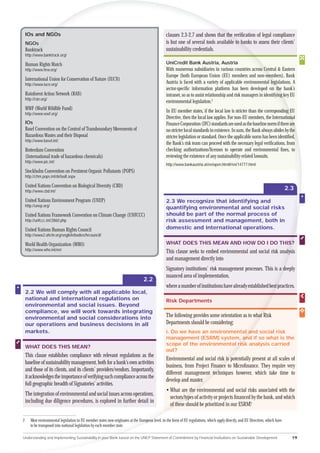
The Precautionary Approach as per Principle 15
of the Rio Declaration                                                              • International Organisations – Consultation and engagement on
                                                                                      relevant international norms and trends
One of the primary foundations of the precautionary principle, and globally
accepted definitions, results from the work of the 1992 “Earth Summit” and           • NGOs – Consultation and collaboration on understanding and
the resulting ‘Rio Declaration’, which stipulates:                                    integrating sustainability issues
“In order to protect the environment, the precautionary approach shall              • Media – Ongoing tracking of spotlight issues in the press, on TV,
be widely applied by States according to their capabilities. Where there are          internet sites and blogs, etc.
threats of serious or irreversible damage, lack of full scientific certainty shall
not be used as a reason for postponing cost-effective measures to prevent           Industrial Bank of China
environmental degradation.”                                                         The Industrial Bank (IB) makes constant use of the environmental
                                                                                    information made available by the Chinese government. For instance, IB
http://www.unep.org/Documents.Multilingual/Default.asp?documentid=78&artic
leid=1163                                                                           follows the news on breaches of environmental rules published on China’s
                                                                                    Information Disclosure System, which it then compares to its client list, so
                                                                                    as to take appropriate risk management measures.
                                                                                    http://www.cib.com.cn/netbank/en/Sustainability/Environmental_and_Social_
Sustainability Heads and Departments                                                Risk_Management/Sustainable_Finance_Policy/20090721_1.html

                                                                                    Piraeus Bank, Greece
A few questions sustainability heads and departments may want to
    w                                                                               Piraeus Bank has established a long-standing relationship with the major
think about:
      a                                                                             national and international environmental non-governmental organisations
                                                                                    (NGOs) operating in Greece. These NGOs provide insight and expertise on
i. Have we systematically identified our direct and
      ew                                                                            sustainability and environmental management issues. Piraeus Bank has also
indirect impacts on the environment and society?
       t m
                                                                                    partnered with NGOs in projects supported by the European Union under the LIFE
Proper identification of both direct (operational footprint) and
             tific                                                                   funding instrument for managing environmental impacts and environmental       al
indirect (products and services) impacts is a key first step for
                ucts                                                                risks (GREENbanking4Life and climabiz projects). Additionally, the Ban      ank
sustainability manageagement based on the precautionary principle. A                employs an environmental lawyer with the main task to follow internation  ional
number of internationally recognised standards and guidelines offer
                        ally                                                        organisations and agreements regarding environmental and social issue assues,
guidance on how to identify impacts, as well as how to develop and
                            ify i                                                   well as relevant legislation (national, European and international) and provide
                                                                                                                                                         nd
                                                                                    input for developing new strategies within the Bank.
continuously improve environment  mental/social performance.
                                                                                    http://www.piraeusbank.gr/ecportal.asp?id=296932&lang=2&nt=
                                                                                                                                            nt=98%20&sid=


18                                                                                                       UNEP FI Guide to Banking & Sustainability
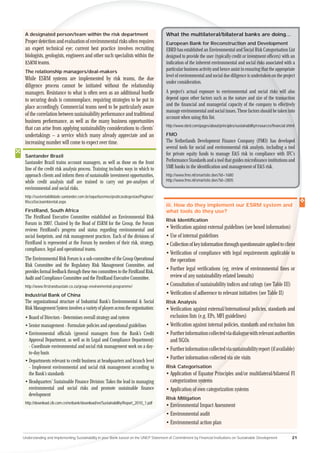
IOs and NGOs
            NG                                                                                     clauses 2.3-2.7 and shows that the v cation of legal compliance
                                                                                                                                     he verifi
    NGOs                                                                                           is but one of several tools available to b
                                                                                                                                          o banks to assess their clients’
    Banktra
         rack                                                                                      sustainability credentials.
    http://
         //www.banktrack.org/

    Hu
    Human Rights Watch                                                                             UniCredit Bank Austria, Austria
    h
    http://www.hrw.org/                                                                            With numerous subsidiaries in various countries across Central & Eastern
                                                                                                                                                               Ce
                                                                                                   Europe (both European Union (EU) members and non-mem           embers), Bank
    International Union for Conservation of Nature (IUCN)
    http://www.iucn.org/
                                                                                                   Austria is faced with a variety of applicable environmental legi  gislations. A
                                                                                                   sector-specific information platform has been developed on the bank’s he
    Rainforest Action Network (RAN)                                                                intranet, so as to assist relationship and risk managers in identifying k EU
                                                                                                                                                                         g key
    http://ran.org/
                                                                                                   environmental legislation.2
    WWF (World Wildlife Fund)                                                                      In EU member states, if the local law is stricter than the corresponding EU
    http://www.wwf.org/
                                                                                                   Directive, then the local law applies. For non-EU members, the International a
    IOs                                                                                            Finance Corporation (IFC) standards are used as the baseline norm if there aree
    Basel Convention on the Control of Transboundary Movements of                                  no stricter local standards in existence. In sum, the Bank always abides by the
    Hazardous Wastes and their Disposal                                                            stricter legislation or standard. Once the applicable norm has been identified,
    http://www.basel.int/
                                                                                                   the Bank’s risk team can proceed with the necessary legal verifications, from
    Rotterdam Convention                                                                           checking authorizations/licenses to operate and environmental fines, to
    (International trade of hazardous chemicals)                                                   reviewing the existence of any sustainability-related lawsuits.
    http://www.pic.int/
                                                                                                   http://www.bankaustria.at/en/open.html#/en/14777.html
    Stockholm Convention on Persistent Organic Pollutants (POPS)
    http://chm.pops.int/default.aspx

    United Nations Convention on Biological Diversity (CBD)
    http://www.cbd.int/
                                                                                                                                                                                     2.3

    United Nations Environment Program (UNEP)                                                      2.3 We recognize that identifying and
    http://unep.org/                                                                               quantifying environmental and social risks
    United Nations Framework Convention on Climate Change (UNFCCC)                                 should be part of the normal process of
    http://unfccc.int/2860.php                                                                     risk assessment and management, both in
    United Nations Human Rights Council                                                            domestic and international operations.
    http://www2.ohchr.org/english/bodies/hrcouncil/

    World Health Organization (WHO)                                                                WHAT DOES THIS MEAN AND HOW DO I DO THIS?
                                                                                                                                          S
    http://www.who.int/en/                                                                         This clause seeks to embed environmental and social risk analys
                                                                                                                                                                ysis
                                                                                                   and management directly into
                                                                                                   Signatory institutions’ risk management processes. This is a de
                                                                                                                                                                deeply
                                                                                                   nuanced area of implementation,
                                                                                   2.2
                                                                                                   where a number of institutions have already established best practices.
                                                                                                                                                              tp
    2.2 We will comply with all applicable local,
    national and international regulations on                                                      Risk Departments
    environmental and social issues. Beyond
    compliance, we will work towards integrating
    environmental and social considerations into                                                   The following provides some orientation as to what Risk
                                                                                                                                                   at R
    our operations and business decisions in all                                                   Departments should be considering:
    markets.                                                                                       i. Do we have an environmental and social risk
                                                                                                                                   an
                                                                                                   management (ESRM) system, and if so what is the
                                                                                                                                an
                                                                                                   scope of the environmental risk analysis carried
                                                                                                                               is
    WHAT DOES THIS MEAN?
                                                                                                   out?
    This clause establishes compliance with relevant regulations as the
                                                                                                   Environmental and social risk is potentially present at all scales of
                                                                                                                                  sp
    baseline of sustainability management, both for a bank’s own activities
                                                                                                   business, from Project Finance to Microfinance. They require very
                                                                                                                              nce
    and those of its clients, and its clients’ providers/vendors. Importantly,
                                                                                                   different management techniques however, which take time to
                                                                                                                           tech
    it acknowledges the importance of verifying such compliance across the
                                                                                                   develop and master.
    full geographic breadth of Signatories’ activities.
                                                                                                   • What are the en
                                                                                                                   e environmental and social risks associated with the
    The integration of environmental and social issues across operations,
                                                                                                     sectors/type of activity or projects financed by the bank, and which
                                                                                                             /types
    including due diligence procedures, is explored in further detail in
                                                                                                     of these should be prioritized in our ESRM?
                                                                                                      f thes

2      Most environmental legislation in EU member states now originates at the European level, in the form of EU regulations, which apply directly, and EU Directives, which have
       to be transposed into national legislation by each member state.

Understanding and Implementing Sustainability in your Bank based on the UNEP Statement of Commitment by Financial Institutions on Sustainable Development                              19
• Should certain sectors/activities be excluded altogether from                   as
                                                                                  assessing clients’ E&S and reputational risk performance.
  financing?                                                                       The Bank is currently enhancing its internal processes for identifying and
• Does our ESRM enable us to address the cumulative environm  onmental            mitigating E&S risk across its SME business. This work will include rolling
  and social risks of the activities and projects we finance especially
                                                        ance,                     the existing position statements to SME customers, and developing ESRA
  in smaller operations, for instance at small and medium enterprises
                                                    med                           tools specially adapted to SMEs.
  (SME), retail or even microfinance level?                                        http://www.standardchartered.com/sustainability/positions-statements/en/index.html

• How does our ESRM look at specific sustainability issues such as
                                           sus                                    EFIC, Australia
  climate change, biodiversity, human rights – both at a client level
                                        an                                        Australia’s Export Finance and Insurance Corporation (EFIC) has a Policy
  and at a portfolio level?                                                       and Procedure mandate for environmental and social review of transactions
                                                                                  that detail how it implements its corporate value to “uphold best-practice
• Does our ESRM assess both the impact on the environment and
                               th                                                 environmental and social standards in the transactions we [EFIC] support”.
  society by the client (pollu
                            ollution, threat to natural habitats, health          The Policy and Procedure applies to all of EFIC’s transactions. The Policy
  and safety concerns for communities and employees), and potential
                         or c                                                     and Procedure also describes EFIC’s public reporting of transactions and
  impacts of the enviro
                      ironment and society on the client (flooding and             the institution’s commitment to have the application of the Policy and
  other severe weath events, alternation of vital ecosystem services,
                   ather                                                          Procedure externally audited every two years.
  community perc erceptions, traditions, etc.)?                                   http://www.efic.gov.au/corp-responsibility/envr-responsibility/Pages/default.aspx
• In the case of international institutions, does the analysis extend to          Banca Commercia Romana, Romania
  branches/s/subsidiaries/holdings abroad and/or do these run their               In 2003, the European Bank for Reconstruction and Development (EBRD)]
  own man anagement systems?                                                      and IFC became shareholders of the Banca Commercia Romana (BCR),
• In the case of second-tier banks, does the analysis extend to the
        e                                                                         bringing about profound changes with regard to sustainability issues.
  opera
      rations of the bank’s financial intermediaries?                              Currently BCR’s environmental procedures cover all of its lending activities:
                                                                                  corporate, SMEs and micro-clients.
                                                                                  www.bcr.ro
The Equator Principles
 he                                                                               (in Romanian only)

Th Equator Principles (EPs) are a credit risk management framework for
  he
de
determining, assessing and managing environmental and social risk in              Of Sustainability and ESRM Systems
p
project finance transactions.                                                      ESRM systems come in different hues and colours, however a beginner’s
The EPs are adopted voluntarily by FIs and are applied where total project        guide to ESRM might look as follows:
capital costs exceed $10 million.                                                 ES Risk Identification
Based on the IFC Performance Standards on social and environmental                What are the potential risks associated with the client/ the client’s
sustainability and on the World Bank Group Environmental, Health, and             undertaking?
Safety Guidelines, the EPs are intended to serve as a common baseline             ES Risk Analysis
and framework for the implementation by each adopting institution of its          How real are these potential risks and how might they impact the bank?
own internal, social and environmental policies, procedures and standards
                                                                                  ES Risk Categorisation
related to its project financing activities.
                                                                                  Based on the analysis, what category (between proceed without qualifications,
http://www.equator-principles.com/                                                proceed with qualifications, don’t proceed) does the transaction fall into?
                                                                                  ES Risk Mitigation
                                                                                  For transactions requiring mitigation measures, what will these be?
Standard Chartered, UK                                                            ES Risk Monitoring
Standard Chartered evaluates and mitigates social and environmental risks         How will the bank monitor that the mitigation measures are effectively
across its lending, debt, capital markets activities, project finance, principal   being enacted?
finance and advisory work. As a signatory to the Equator Principles, the
b
bank assesses and classifies environmental and social risk as set out in           International organisations, NGOs, Multilateral and Bilateral Finance
the principles. In addition, potential business deals are reviewed against
 he                                                                               institutions have developed a wealthy corpus of guidelines and tools on how
the Bank’s 14 position statements covering sectors with high risk for             to set up an ESRM, including the IFC’s FIRST for Sustainability dedicated
enviro
    ronmental or social impact. The Bank currently has position statements        website. See also UNEP FI training at the end of this section.
on child labour, climate change, gaming and gambling and water among
       ld                                                                         http://firstforsustainability.org/homepage.php
others. As a signatory to the Climate Principles, Standard Chartered reports
on its progre against engaging clients and mitigating the impact their
            gress
business has on climate change.
Standard Chartered has developed sector-specific risk assessment tools,
                 red                                                              ii. Who implements the system?
comprising a series of questions related to a client’s operations and ability
                       q                                                          A meaningful ESRM system will require the involvement of both t  h the
to manage environmental and social risks. These tools, known collectively
                        tal                                                       risk department and the bank’s relationship managers / deal-ma makers.
as ESRA, are sector-specific in line with the Bank’s position statements. They
                               li                                                 Staff across the credit process need a baseline understanding of ES
                                                                                                                                               ing
are designed to provide relationshi managers and credit officers in the
                                  nship
                                                                                  risk and its materiality for the institution – this calls fo ongoing
                                                                                                                                            for
Bank’s wholesale banking business with an adaptable yet simple means of
                                                                                  awareness-raising and capacity-building.

20                                                                                                     UNEP FI Guide to Banking & Sustainability
A designate person/team within the risk department
         ated                                                                         What the multilateral/bilate
                                                                                                               ateral banks are doing…
 Proper detection and evaluation of environmental risks often requires
        dete                                                                          European Bank for Reconstruction and Development
                                                                                                                    on
 an expe technical eye; current best practice involves recruiting
      xpert                                                                           EBRD has established an Environmental and Socia Risk Categorisation List
                                                                                                                                       ocial
 biolo
    logists, geologists, engineers and other such specialists within the              designed to provide the user (typically credit or investm officers) with an
                                                                                                                                           estment
 ESR teams.
  SRM                                                                                 indication of the inherent environmental and social risk associated with a
                                                                                                                                              isks
 T
 The relationship managers/deal-makers
                                                                                      particular business activity and hence assist in ensuring that the appropriate
                                                                                                                                                 hat
                                                                                      level of environmental and social due diligence is undertaken o the project
                                                                                                                                                     n on
 While ESRM systems are implemented by risk teams, the due
                                                                                      under consideration.
 diligence process cannot be initiated without the relationship
 managers. Resistance to what is often seen as an additional hurdle                   A project’s actual exposure to environmental and social risks will also
 to securing deals is commonplace, requiring strategies to be put in                  depend upon other factors such as the nature and size of the transasaction
 place accordingly. Commercial teams need to be particularly aware                    and the financial and managerial capacity of the company to effectiv  tively
                                                                                      manage environmental and social issues. These factors should be taken into
                                                                                                                                                             n
 of the correlation between sustainability performance and traditional
                                                                                      account when using this list.
 business performance, as well as the many business opportunities
                                                                                      http://www.ebrd.com/pages/about/principles/sustainability/resources/financial.shtml
 that can arise from applying sustainability considerations to clients’
 undertakings – a service which many already appreciate and an                        FMO
 increasing number will come to expect over time.                                     The Netherlands Development Finance Company (FMO) has developed
                                                                                      several tools for social and environmental risk analysis, including a tool
 Santander Brazil                                                                     for private equity funds to manage E&S risk in compliance with IFC’s
 Santander Brazil trains account managers, as well as those on the front              Performance Standards and a tool that guides microfinance institutions and
 line of the credit risk analysis process. Training includes ways in which to         SME banks in the identification and management of E&S risk.
 approach clients and inform them of sustainable investment opportunities,            http://www.fmo.nl/smartsite.dws?id=1680
 while credit analysis staff are trained to carry out pre-analyses of                 http://www.fmo.nl/smartsite.dws?id=2805
 environmental and social risks.
 http://sustentabilidade.santander.com.br/oquefazemos/praticasdegestao/Paginas/
 RiscoSocioambiental.aspx
                                                                                      iii. How do they implement our ESRM system and
 FirstRand, South Africa                                                              what tools do they use?
 The FirstRand Executive Committee established an Environmental Risk
                                                                                      Risk Identification
 Forum in 2007. Chaired by the Head of ESRM for the Group, the Forum
 reviews FirstRand’s progress and status regarding environmental and                  • Verification against external guidelines (see boxed information)
 social footprints, and risk management practices. Each of the divisions of           • Use of internal guidelines
 FirstRand is represented at the Forum by members of their risk, strategy,            • Collection of key information through questionnaire applied to client
                                                                                                                                                           n
 compliance, legal and operational teams.
                                                                                      • Verification of compliance with legal requirements applicable to  e
 The Environmental Risk Forum is a sub-committee of the Group Operational               the operation
 Risk Committee and the Regulatory Risk Management Committee, and
 provides formal feedback through these two committees to the FirstRand Risk,
                                                                                      • Further legal verifications (eg. review of environmental fines or
                                                                                                                                                      ne
 Audit and Compliance Committee and the FirstRand Executive Committee.                  review of any sustainability-related lawsuits)
 http://www.firstrandsustain.co.za/group-environmental-programme/                      • Consultation of sustainability indices and ratings (see Tab III)
                                                                                                                                                 able
 Industrial Bank of China                                                             • Verification of adherence to relevant initiatives (see Tabl II)
                                                                                                                                                ble
 The organizational structure of Industrial Bank’s Environmental & Social             Risk Analysis
 Risk Management System involves a variety of players across the organisation:        • Verification against external/international policies, standards and
                                                                                                                                             s,
 • Board of Directors - Determines overall strategy and system                          exclusion lists (e.g. EPs, MFI guidelines)
 • Senior management - Formulate policies and operational guidelines                  • Verification against internal policies, standards and exclusion lists
                                                                                                                                      rds
 • Environmental officials (general managers from the Bank’s Credit                    • Further information collected via dialogue with relevant authorities
                                                                                                                                   ew
   Approval Department, as well as its Legal and Compliance Department)                 and NGOs
   - Coordinate environmental and social risk management work on a day-
                                                                                      • Further information collected via susta
                                                                                                                            ustainability report (if available)
   to-day basis
                                                                                      • Further information collected via site visits
                                                                                                                         ia
 • Departments relevant to credit business at headquarters and branch level
   - Implement environmental and social risk management according to                  Risk Categorisation
   the Bank’s standards                                                               • Application of Equator Principles and/or multilateral/bilateral FI
                                                                                                              r Pr
 • Headquarters’ Sustainable Finance Division: Takes the lead in managing               categorization system
                                                                                                          tems
   environmental and social risks and promote sustainable finance                      • Application of own categorization systems
                                                                                                       ow
   development
                                                                                      Risk Mitig
                                                                                            itigation
 http://download.cib.com.cn/netbank/download/en/Sustainability/Report_2010_1.pdf
                                                                                      • Envir
                                                                                        Environmental Impact Assessment
                                                                                      • Environmental audit
                                                                                      • Environmental action plan

Understanding and Implementing Sustainability in your Bank based on the UNEP Statement of Commitment by Financial Institutions on Sustainable Development             21
• Public consultation and disclosure plan
Risk Monitoring
• Monitoring, evaluating and reporting of client performanc and
                                                       mance
  compliance against agreed action plans


Further Useful Standards for Risk Decision-
                               sk
making ...
Banks that are involved in commodity finance may find the documents and
                                    y n
resources produced by the following standard-setting institutions useful to
                                 ng
guide their credit decisions:
                                                                                                                                                2.4
• Palm oil - Roundtable on Sustainable Palm Oil (RSPO)
                         nS
     http://www.rspo.org/                                                        2.4 We will endeavour to pursue the best
• Seafood - Marine Stew
                    tewardship Council (MSC)                                     practice in environmental management,
     http://www.msc.org/
                      g/?set_language=en                                         including energy and water efficiency,
                                                                                 recycling and waste reduction. We will seek
• Soy - Roundtabl on Responsible Soy association (RTRS)
              able                                                               to form business relations with customers,
     http://www.res
                 esponsiblesoy.org/
                                                                                 partners, suppliers and subcontractors
• Sugar - Bet Sugar Cane Initiative
           etter                                                                 who follow similarly high environmental
     http://www
             ww.bonsucro.com/
                                                                                 standards.
• Wood - Forest Stewardship Council (FSC)
     http://w
          //www.fsc.org/
                                                                                 WHAT DOES THIS MEAN AND HOW DO I DO THIS?
                                                                                 This clause requires Signatories to ‘walk the talk’ in terms of their
                                                                                 direct impacts on the environment and society, that is to say, the
iv. D we ensure consistency vis-a-vis our clients
    Do              i t      i     i       li t
                                                                                 impacts stemming from their facilities and employees.
based on ESRM results?
  a
E
ESRM systems yield valuable information and decisions vis-a-vis                  Sustainability Teams and General Support Teams
clients/potential clients – but this information may not always be
appropriately circulated and acted upon.
                                                                                 Sustainability Teams and General Support Teams should track some
                                                                                 of the issues outlined below:
S t d B il
Santander Brazil
Since 2010 Santander Brazil’s Compliance department includes                     i. Do we measure the environmental footprint of
environmental and social factors in its analysis of new client applications      our facilities and what measures are being taken
(including individuals). This involves the Compliance department doing           to diminish this footprint?
due diligence not simply on issues such as money laundering and terrorism,       Measuring impact and establishing targets
but also looking into any precedents of slave labour, or illegal logging. This   Key measurements that will help track the bank’s impact on
additional screening is applied to all the bank’s clients.
                                                                                 ecosystems, communities and the climate:
http://www.santander.com.br/document/wps/Indicadores_de_Sustentabilidade.pdf
                                                                                 • Emissions (CO2 and other GHG gases)
                                                                                 • Energy consumption
 UNEP FI Risk Resources:
                                                                                 • Water consumption
 Environmental Risk Briefings by Sector
 http://www.unepfi.org/signatories/toolkit/index.html                             • Paper consumption
 T
 Training on Environmental & Social Risk Analysis:                               • Waste
 - One day introductory workshop
   O                                                                             • Environmentally/socially certified procurement
 - Three week online course
   Th
                                                                                 Strategies for Resource Efficiency
 - One and a half day risk research workshop
    ne
 http://w
       /www.unepfi.org/training/risk_workshop/index.html                          • Emissions management (reduce and where not possible, offset) by
 http://ww
        www.unepfi.org/training/risk_training/index.html                            measures such as tele-/videoconferencing, green commuting and
 Reports on Water-related Risk
       s                                                                           other approaches to reducing business travel
 Half full or half empty?
              ha                                                                 • Energy consumption reduction strategies (optimized use of daylight,
 http://www.unepfi.org/fileadmin/documents/half_full_half_empty.pdf
               pfi
                                                                                   motion-sensitive lighting, energy efficient equipment, etc.)
 Chief Liquidity Series - Issue 1: Agribusiness
                   ries                                                          • Water consumption reduction and recycling programmes
 http://www.unepfi.org/fileadmin/documents/chief_liquidity1_01.pdf
                      file
                                                                                 • Green printing (use of recycled/chlorine-free paper, double-s
                                                                                                                                               e-sided
 Chief Liquidity Series - Issue 2: Power Sector
                             ue 2
 http://www.unepfi.org/fileadmin/do
                              /documents/chief_liquidity2_01.pdf                   printing, soy-based inks)
 Human Rights Online Tool                                                        • Waste management (recycling and appropriate disposal)sal)
 http://www.unepfi.org/humanrightstoolkit/


22                                                                                                UNEP FI Guide to Banking & Sustainability
Measuring the Carbon Footprint
        ng                                                                            Specific actions taken under the progra rogramme include: the installation of
 World B
       Business Council for Sustainable Development /                                 videoconferencing facilities; reducing the need for physical movement and
                                                                                                                                  e nee
 World Resources Institute Greenhouse Gas Protocol
     d                                                                                consequently of greenhouse gas emissions; the modernization of a Data
 The Green Housegas (GHG)Protocol Initiative was launched to develop a
     eG                                                                               Center infrastructure and the substitution of comput monitors at the end
                                                                                                                                         puter
 set of practices that companies can use to account for, and report on, their
   t                                                                                  of their useful life for the more efficient LCD models; and the correct disposal
                                                                                                                                              nd
 G
 GHG emissions.                                                                       of obsolete electronic equipment.
                                                                                      http://ww2.itau.com.br/sustentabilidade/_/no-seu-dia-a-dia/sustent
                                                                                                                                                      ntabilidade-na-
 The GHG Protocol categorizes direct and indirect emissions into three broad          pratica/cases.aspx?pagina=case-ti-verde
 scopes
 Scope 1 – all direct GHG emissions                                                   Green/responsible procurement

 Scope 2 - indirect GHG emissions from consumption of purchased electricity,          • Purchase of environmentally friendly products and equipment (e.g.
                                                                                                                                                    t(
 heat or steam.                                                                         recycled materials, paper from sustainably managed forests, etc.
                                                                                                                                                      c.)
 Scope 3 - Other indirect emissions, such as the extraction and production
                                                                                      • Consideration of the environmental performance of suppliers      rs,
 of purchased materials and fuels, transport-related activities in vehicles not         distributors and subcontractors
 owned or controlled by the reporting entity, electricity-related activities (e.g.
 transmission and distribution losses) not covered in Scope 2, outsourced             National Australia Bank
 activities, waste disposal, etc.                                                     National Australia Bank (NAB) aspires to educate, influence and support
                                                                                      its supply chain and improve its sustainability performance through
 http://www.wbcsd.org/templates/TemplateWBCSD1/layout.asp?type=p&MenuId=
 Mjc3&doOpen=1&ClickMenu=LeftMenu                                                     procurement. NAB introduced the Supplier Sustainability Program in
                                                                                      Australia in 2008 and has been working to introduce NAB’s Supplier
                                                                                      Sustainability Principles into new contracts with key suppliers. In Australia,
                                                                                      the Supplier Sustainability Principles have been incorporated into more
 Bank of America                                                                      than 150 supplier contracts.
 As one of the world’s largest financial institutions with operations in more          http://www.nabgroup.com/0,,100401,00.html
 than 40 countries, Bank of America is committed to making its operations
 more environmentally sound through the reduction of emissions,                       CIBC, Canada
 consumption, and waste, and by working with its suppliers to help                    When CIBC purchases a particular product, it takes associated environmental
 accomplish those goals.                                                              impacts into account, such as the way in which the product was designed
                                                                                      and manufactured. When acquiring services that might have an adverse
 The company’s goal to reduce its global greenhouse gas emissions by an               environmental impact, it encourages responsible conduct from suppliers so
 aggregate 30% over 2004 levels, and its paper procurement policies, which            as to minimize their ecological footprint.
 curtail the virgin wood fibre content of the paper it purchases, are two
 examples of this commitment. Additionally, Bank of America is helping                It is also committed to working with suppliers that share its level of
 its employees reduce their emissions through a programme that provides               commitment to the environment and those that take into consideration    o
 a US$3,000 reimbursement to employees who buy a new hybrid, natural gas              energy efficiency, the sustainable use of natural resources, recycling, the
 or electric vehicle.                                                                 appropriate management of toxic substances, product re-use, environmen
                                                                                                                                                           ental
                                                                                      certifications, and environmental certifications.
 The company is aiming to have 20 percent of its corporate workplace real
                                                                                      http://www.cibc.com/ca/inside-cibc/environment/policies/procurement.htm
                                                                                                                                                           tml
 estate portfolio certified under the U.S. Green Building Council’s LEED(R)
 (Leadership in Energy and Environmental Design) rating system by 2015.
                                                                                      Green buildings
 Currently 11 percent of the company’s workplace portfolio, 13.2 million
 square feet, is comprised of LEED -certified space, the most notable example          • Environmental criteria in the administration/maint     ntenance of
 being the Bank of America Tower in New York, which is the first Platinum                properties (e.g. environmentally-friendly deterge    gents/cleaning
 Core and Shell Certified high rise office building in the world.                         products)
 http://environment.bankofamerica.com/                                                • Environmental criteria in the remodelling/retrofitting of properties
                                                                                                                                       ofi
 BBVA, Spain                                                                            (e.g. energy or water saving devices)
 BBVA has devised the Global Eco-efficiency Plan 2008-2012, which includes:            • Environmental criteria in the selection and design of new properties
                                                                                                                                   dd
 a 2% reduction in energy use, a 7% reduction in water, a 10% reduction                 (e.g. energy savings via better usage of daylight, emissions
                                                                                                                               age
 in paper and a 20% reduction in CO2 emissions (objectives per employee),               reductions via the use of renewable energies)
                                                                                                                             en
 in addition to a 20% increase of people working in buildings with the ISO
 14001 certification.                                                                  Citigroup, United States of America
                                                                                                                  A
 http://bancaparatodos.com/en/informacion-de-responsabilidad-corporativa-2010/        In April 2009, as part of its goal to reduce its greenhouse gas emissions
 banca-responsable/medio-ambiente/                                                    10 per cent below 2005 levels by 2011, Citi announced that it had become
                                                                                                                vels
 Itau-Unibanco, Brazil                                                                the first company in the world with more than 100 LEED-certified retail
 Itau-Unibanco’s Green Information Technology (IT) Program rests on four              branch offices. By 2010, Citi counted LEED certification for 185 projects
                                                                                                       y 20
 pillars: the life cycle of products, energy efficiency, the green workplace and       across nine coun
                                                                                                  countries, while more than 60 Citi-managed buildings in the
 green applications. It is worth pointing out that the IT area is responsible         U.S. had earned the ENERGY STAR label. In addition, these performance
                                                                                             d ea
 for approximately 50% of the electric energy consumed by the entire holding          benchm
                                                                                       enchmarking tools were extended to a further 4,500+ facilities globally.
 company.


Understanding and Implementing Sustainability in your Bank based on the UNEP Statement of Commitment by Financial Institutions on Sustainable Development          23
Due to the conservation program’s success, in 2010 Citi announced a                  Ki
                                                                                     Kingdom), using intelligent software to automatically power down personal
second round of goals to include additional reductions, as well as categories
                                                                          ies        computers and the micro-generation of energy using solar panels and wind
of impact on water and waste. Citi’s goal of reducing carbon by 25% by               turbines (Brazil, France, Malta, Mexico, United Kingdom).
2015 has allowed Citi to work with the Clinton Climate Initiative explore
                                                               ative,                http://www.hsbc.com/1/2/sustainability/protecting-the-environment/footprint-
alternative energy solutions, help create alternative energy markets, and
                                                         ergy                        management
embed ‘green’ language into its property leases in the effort to ingrain
                                                    n th
sustainability directly into all of it operations.                                   iii. How do we monitor and act on performance?
http://www.citi.com/citi/citizen/assets/pdf/citi.pdf
                                                  df                                 • Regular monitoring of performance against established targets
                                                                                     • Internal auditing of performance
Environmental Employee Eng
                        ngagement
• Awareness-raising campaigns
                           ns                                                        • External validation of performance
                                                                                     • Quest for further actions and innovation to extend the scope and
• Active involvement of em employees in setting up, implementing
                                                                                       depth of environmental management
  and championing environmental management strategies (e.g.
                       env
  volunteers, ‘green teams’, etc.)
                     te
                                                                                     Eurobank EFG, Greece
                                                                                     Environmental performance is annually verified by an accredited auditor
Of Sustaina
          ability and Environmental Management                                       at Eurobank. An internal audit scheme is also in place, coordinated by the
Systems                                                                              Environment Office. Environmental indicators are collected on a semi-
                                                                                     annual basis, so that achievements against targets are adequately monitored
Key steps towards corporate eco-efficiency:
       ps                                                                            and corrective and preventive actions are duly initiated.
• You cann manage what you do not measure - establish your current
         nnot
                                                                                     http://www.eurobank.gr/online/home/generic.aspx?id=16&lang=en&mid=
  eco-efficiency profile to find out what consumption levels are and where
       ffi
  your main opportunities are.
     rm
• Set reduction/mitigation targets for the institution – these should be time-
    t
  bo
   ound.
• Establish an action plan to achieve the targets – roles and responsibilities
  E
  should be clearly defined.
• Monitor progress against the targets, and communicate them.
• Continue to look for further opportunities for improvement.
UNEP FI and its training partners have made available a three-week online
course on how to implement internal eco-efficiency.                                                                                                            2.5
http://www.unepfi.org/training/ecoef_training/index.html
                                                                                     2.5 We intend to update our practices
                                                                                     periodically to incorporate relevant
                                                                                     developments in sustainability management.
                                                                                     We encourage the industry to undertake
ii. What is the scope of our measurements,
                                                                                     research accordingly.
policies and targets?
• Corporate buildings
                                                                                     WHAT DOES THIS MEAN?
• Branches and subsidiaries
                                                                                     This clause acknowledges the evolving nature of sustainability issues,
• Holdings                                                                           particularly with regards to our understanding and management of
• Outsourced services                                                                the issues. Signatories are invited to remain critical and observant.
                                                                                     Seeking and obtaining information is critical; to this effect, industry
H
HSBC Group, United Kingdom                                                           and/or stakeholder alliances and initiatives are important activities
As part of its effort to protect the environment, HSBC has established a series of
   p                                                                                 in which to invest resources.
envir
    ironmental targets to be met on an annual basis, involving the reduction
of wast CO2 emissions, and energy and water consumption. HSBC has
     aste,
                                                                                     Industrial Bank of China
separate targets for data centres, paper consumption and business air travel.
        et
                                                                                     IB considers research to be highly important. The Bank actively participates
The purpos of the targets is to drive efficiency, reduce its operational impact
           ose
                                                                                     in research and policy-making projects undertaken by regulatory
on the enviro  ronment and generate cost savings. Performance is measured
                                                                                     institutions. For example, IB made suggestions based on its own experience
annually, and Chief Operating Officers are accountable for environmental
                  Ch
                                                                                     of sustainable finance and green credit, while participating in the China na
performance throug targets in their annual performance scorecards.
                    ough
                                                                                     Banking Regulatory Commission’s and the Ministry of Environmenta        ntal
The group has different programmes aimed at improving its environmental
                     nt p                                                            Protection’s research projects on topics such as green credit and, ESR SRM.
efficiency wherever it has a p
                        s presence around the world. These programmes                Also, in 2010, IB cooperated with other authors to publish a book on the
include improving the energy efficiency of its data centres, ensuring
                             rgy                                                     Equator Principles (Equator Principles—Banking Sector Best Prac for
                                                                                                                                                      ractice
new buildings achieve leading environmental performance standards
                                 en                                                  Sustainable Development) which was the first book of its kind in China.
                                                                                                                                                  ind
(Argentina, Canada, China, Egypt, Hong Kong, India, Mexico, USA, United
                                    ng K

24                                                                                                       UNEP FI Guide to Banking & Sustainability
2.7

 Sustainab
        ability Networks                                                              2.7 We recognize the need for the financial
                                                                                                            nee
 Busines
      ess                                                                             services sector to adapt and develop
                                                                                                               an
 Interna
      national Chamber of Commerce (ICC)                                              products and services which will promote the
                                                                                                                 c w
 (Com
   ommission on Environment and Energy)                                               principles of sustainable development.
                                                                                                                   elo
                                                                                                                    lop
 http
   tp://www.iccwbo.org/id1293/index.html

 In
 International Corporate Governance Network (ICGN)                                    WHAT DOES THIS MEAN AND HOW DO I DO THIS?
                                                                                                                   O
 http://www.icgn.org/                                                                 In this allusion to the gradual transition towards a gree more
                                                                                                                                              reener,
 The Business of a Better World (BSR)                                                 sustainable economy, Signatories are compelled to orie new rient
 http://www.bsr.org/en/                                                               business lines and products towards activities which, by the very
                                                                                                                                                   heir
 United Nations Global Compact                                                        nature, provide a net benefit to society and the environment.
 http://www.unglobalcompact.org/

 World Business Council for Sustainable Development (WBCSD)
 http://www.wbcsd.org/templates/TemplateWBCSD5/layout.asp?MenuID=1
                                                                                      Green Economy

 Finance                                                                              “A Green economy is one that results in improved human well-being and       d
 Carbon Markets and Investors Association (CMIA)                                      social equity, while significantly reducing environmental risks and ecological
 http://www.cmia.net/default.aspx                                                     scarcities. In its simplest expression, a green economy can be thought of as
                                                                                      one which is low carbon, resource efficient and socially inclusive.”
 The Carbon Principles
 http://carbonprinciples.org/                                                         UNEP Green Economy Initiative
                                                                                      http://www.unep.org/greeneconomy
 The Climate Group
 http://www.theclimategroup.org/

 The Equator Principles
 http://www.equator-principles.com/                                                   Business Units and Product Development Teams
 The Principles for Responsible Investment
 http://www.unpri.org/                                                                Representatives from Business Units and Product Development
 United Nations Environment Program Finance Initiative (UNEP FI)                      Teams should be thinking about the following:
 http://www.unepfi.org/                                                                i. Which ones of our business units are
                                                                                      providing products and services geared towards
                                                                                      sustainability issues?
                                                                                      Retail banking
                                                                                      • Green credit cards
                                                                                      • Green savings accounts
                                                                        2.6
                                                                                      • Green loans
 2.6 We recognize the need to conduct regular                                         • Green mortgages
 internal reviews and to measure our progress
 against our sustainability goals.                                                    Industrial Bank of China
                                                                                      IB has developed a number of green products and services, includi Energy
                                                                                                                                                     ding
                                                                                      Conservation and Emission Reduction Project Loans, Integra Carbon
                                                                                                                                                  grated
 WHAT DOES THIS MEAN?
                                                                                      Financing Services, a Low-Carbon Credit Card, Green Wealth Management
                                                                                                                                                 th
 This clause encourages Signatories to establish proper monitoring                    Services, and Green Financial Leasing Services.
 and evaluating functions and processes. Such reviews are key to                      http://download.cib.com.cn/netbank/download/en/Sustainability
                                                                                                                                                ity/Report_2010_1.pdf
 ensuring continued improvements and innovation, and also form the
 basis for the institution’s communication with different stakeholder                 SME to Corporate lending
 groups.                                                                              • Green/social/responsible credit lines
 A few things Sustainability Departments and Senior Management                        • Green Leasing
 might want to consider:                                                              • Environmental advisory services
 • Regularity of internal reviews
 • Scope of reviews (do we review everything each time?)
 • Coordination of reviews with related tasks such as reporting and
   disclosure
 • Communication of review results (what is communicated to which
   audiences and in what way)
 • Responsibility for review oversight (in line with sustainability
   governance structures)


Understanding and Implementing Sustainability in your Bank based on the UNEP Statement of Commitment by Financial Institutions on Sustainable Development          25
FIRA, Mexico                                                                         Ye
                                                                                     Yes Bank, India
FIRA seeks to promote green projects by a four-pronged approach:                     Yes Bank has set up a specialised investment advisory, the Sustainable
                                                                                     Investment Banking division, which promotes investments in clean
• Financing: specially designed financial products, assistance to fin
                                                                o nancial
                                                                                     technology, renewable energy, water management, and distributed energy,
  intermediaries
                                                                                     especially amongst the SME sector. The Bank also acts as the Exclusive
• Risk management: long term guarantees, as well as awareness-raising
                                                         a                           Country Advisor for a number of partnerships with foreign private equity
  and training for financial intermediaries                                           firms, including a collaboration seeking investments across India, Sri
• Carbon markets: shared transaction costs for greater and faster access
                                            or g                                     Lanka, Nepal and Bangladesh. Finally, the Bank has initiated a socially
• Awareness-raising and training: green projects and technologies
                                        pro                                          and environmentally responsible equity investment programme, Tatva,
                                                                                     which is actively looking to invest equity in early-stage, small-and-growing
By offering both financing solutions and technical assistance services, FIRA’s
                                     s an                                            enterprises that profitably deliver a positive ‘people and planet’ impact.
value proposal on green projects rests on increased returns and lower risk levels.
                                  ests
                                                                                     http://www.yesbank.in/index.jsp?navigationUrl=%2FYES+Bank+Repository%2Fe
www.fira.gob.mx                                                                       n%2FAbout+us%2FResponsible+Banking%2FSustainable+Investment+Banking
The Bank of Tokyo-M
                o-Mitsubishi UFJ, Japan
The Bank of Tokyo-Mi Mitsubishi UFJ (BTMU) is moving ahead with the
                                                                                     What the Multilateral/Bilateral Banks are doing…
development of produ and services to SME customers working to reduce
                   ducts
the impact on the environment. In September 2008, BTMU launched the
                 e                                                                   Corporacion Andina de Fomento, Latin America
ECO Accreditatio Support Loan, which provides ¥100,000 in financing
               ion                                                                   Corporacion Andina de Fomento (CAF) has established a special programme,
for customers who have already acquired ECO accreditation from an
            rs                                                                       BioCAF, specifically designed to promote the conservation and sustainable
independent body or have declared their intent to do so.
         nt                                                                          use of ecosystems, natural and genetic resources and biodiversity. Three core
                                                                                     lines of action from have been defined under the programme:
BTMU also offers Yukatsuryoku eco-action business loans, which come with
          so
preferent interest rates for customers that have acquired ISO 14001 or
        ntial                                                                        • Conservation initiatives for ecosystems and species in the region
EcoActi 21 certification. For SME customers that have acquired Eco-stage
       tion                                                                          • Compensation and/or payments for environmental services for the
enviro
     ronmental certification, the Bank also provides the Eco Stage Bond,                conservation of the ecosystems that generate these services
a ba
   bank-guaranteed private placement bond with reduced fees for bond                 • Biodiversity and genetic resource markets (bio-commerce and
issu
   uance.                                                                              biotechnology)
ht
 ttp://www.mufg.jp/english/csr/csrreport/2007/pdffile/all_e.pdf
                                                                                     http://www.caf.com/view/index.asp?ms=9
B
Bancoldex, Colombia                                                                  (in Spanish only)
Bancoldex has created a sustainable development credit line. The line aims           KfW Bankengruppe, Germany
to provide companies with financing for all projects and undertakings                 KfW has established the KfW Carbon Fund, a procurement platform
seeking to prevent and mitigate their environmental impacts.                         for project-based carbon credits issued under the flexible mechanisms
http://www.bancoldex.com/contenido/contenido.aspx?catID=339&conID=2914               of the Kyoto Protocol (the Clean Development Mechanism and Joint
                                                                                     Implementation ).
Royal Bank of Canada
In 2010, RBC expanded the depth and breadth of green advice to clients,              Through the fund, KfW supports climate protection projects worldwide. By
highlighted by the launch of the online RBC Greening Your Business                   purchasing emission reduction certificates, the Bank seeks to give projects
Advice Centre. The Advice Centre provides free resources and tools to help           an additional source of funding, while also promoting the transfer of
companies transition to more environmentally sustainable business models.            modern technologies to developing countries.
http://www.rbcroyalbank.com/commercial/advice/greening-your-business/                A further aim pursued by the Fund is to enable enterprises taking part in
Development Bank of the Philippines                                                  the procurement programmes to meet their obligations under the European
One of the Development Bank of the Philippines’ (DBP) CSR programs                   trading scheme.
is the DBP Forest Program where the Bank partners with civil society                 http://www.kfw.de/kfw/en/KfW_Group/Sustainability_and_Climate_Protection/
organizations, local government units, state universities & colleges in              KfW-Carbon_Fund/index.jsp
reforesting critical watershed areas. At the heart of this effort, is an approach
w
whereby the forest projects financed by the bank offer rural communities
liv
 ivelihood opportunities, while at the same time restoring habitat for wildlife.
                                                                                     ii. Who are our key allies when it comes to
http:
   p://www.dbp.ph/about.php?cat=63
                                                                                     developing/offering green products and services?

Projec Finance
    ect                                                                              Although environmental awareness continues to grow in the general
• Involvem in green infrastructure projects (e.g. renewable energies)
       vement                                                                        public, most environmental markets remain timid. Making use of,
                                                                                     or even encouraging the development of, public-private financing
Investmen banking
       ent
                                                                                     mechanisms can make a big difference. NGOs can further play a
• Environment advisory services
           ental
                                                                                     positive role in this process.
• Sustainable/resp
               esponsible/socially responsible (SRI) investments
• Carbon finance and emissions trading
                   nd e
• Green bonds


26                                                                                                      UNEP FI Guide to Banking & Sustainability
National Australia Bank
          Au
 In Novembe 2010, NAB entered a partnership with Low Carbon Australia
         mber
 (a gover
       vernment enterprise) and Eureka Funds Management to establish
 its Environmental Upgrade Loan. The Loan offers financing solutions for
     Env
 ener efficiency retrofits of commercial buildings, as a way of assisting
  nergy
 bu
 businesses to reduce their energy usage, energy costs and carbon emissions.
 http://www.lowcarbonaustralia.com.au/media-release/australian-carbon-trust-
 first-energy-efficiency-program-investments-announced


 iii. How have we sought to further add value
 for our clients by helping them to detect
 sustainability opportunities in the projects they
 finance with us?
 Green financing products and services imply that clients are
 specifically seeking funding for a green activity or project. Yet the
 reality is that most green business opportunities lie embedded in
 normal activities, and more often than not, may not have been
 detected by the client. Developing the capacity to advise on such
 opportunities can prove key to developing this new and growing
 market.

 “This is a growing marketplace that needs financial participants
 with expertise to provide value-added solutions for producers and
 consumers of energy who are sensitive to the management of their
 carbon footprints.”
 Jeff King, Managing Director and Head, Environmental Markets
 Scotiabank, Canada


  UNEP FI Resources on ‘Green Financing’
  • Green Financial Products and Services: Current Trends and Future
    Opportunities in North America
  http://www.unepfi.org/fileadmin/documents/greenprods_01.pdf

  Energy Efficiency and the Finance Sector
  http://www.unepfi.org/fileadmin/documents/Energy_Efficiency.pdf

  • Green Buildings and the Finance Sector - An Overview of Financial
    Institution Involvement in Green Buildings in North America
  http://www.unepfi.org/fileadmin/documents/greenbuildings.pdf

  • Catalysing low carbon growth in developing economies - Public Finance
    Mechanisms to scale up private sector investment in climate solutions
  http://www.unepfi.org/fileadmin/documents/catalysing_lowcarbon_growth.pdf


Understanding and Implementing Sustainability in your Bank based on the UNEP Statement of Commitment by Financial Institutions on Sustainable Development   27
3. Public Awareness and
   Communication


                                                                    3.1       Of Sustainability & Sustainability Reporting

3.1 We recommend that financial institutions
                              an                                              Sustainability reporting remains voluntary but has come a long way, with
develop and publish a statement of their
                           at
                            t                                                 widely accepted standards rapidly establishing themselves.
sustainability policy and periodically report
                       ndd                                                    Global Reporting Initiative
on the steps they have taken to promote
                      ve                                                      The Global Reporting Initiative (GRI) provides a comprehensive sustainability
the integration of env
                    en
                     nvironmental and social                                  reporting framework that is widely used around the world and across industries.
considerations into their operations.
                 nto
                  t                                                           Sector supplements have further been developed, following GRI’s traditional
                                                                              consensus-seeking, multi-stakeholder process, whereby participants are
WHAT DOES THIS MEAN AND HOW DO I DO THIS?
           H                                                                  drawn from global business, civil society, labor, academic and professional
                                                                              institutions. The Finance Sector Supplement was co-developed with UNEP FI.
This clause sugges that Signatories engage in transparency, public
               gests
disclosure and accountability.
               a                                                              http://www.globalreporting.org/ReportingFramework/SectorSupplements/
                                                                              FinancialServices/

Senior Management, Sustainability Teams and
       Ma                                                                     Carbon Disclosure Project
Corpora Communications
      rat
       ate                                                                    Over 3,000 organizations in some 60 countries around the world have their
                                                                              greenhouse gas emissions, water management and climate change strategies
                                                                              measured and disclosed through the Carbon Disclosure Project , in order
Things for Senior Management, Sustainability Teams and Corporate
    gs                                                                        that they can set reduction targets and make performance improvements.
Comm
  mmunications to think about include:                                        This data is made available for use by institutional investors, corporations,
i. What does our reporting cover?                                             policymakers and their advisors.
• Policies and action plans
  P                                                                           www.cdproject.net/

• Governance and oversight                                                    The reporting scene continues to evolve rapidly, with increasing attention
• Roles and responsibilities within the institution                           placed on moving from voluntary to mandatory disclosure, as well as
                                                                              the notion of ‘integrated’ reporting, whereby financial and sustainability
• Integration of sustainability criteria in processes and operations (e.g.    reporting could be blended into one.
  risk analysis, provision of environmental products and services)
                                                                              International Integrated Reporting Committee
• Internal environmental management & employee well-being                     The mission of the International Integrated Reporting Committee (IIRC),
• Communication and engagement with stakeholders                              an international cross-section of leaders from the corporate, investment,
                                                                              accounting, securities, regulatory, academic and standard-setting sectors,
• Community work
                                                                              as well as civil society, is to create a globally accepted, integrated, reporting
• Philanthropy                                                                framework which brings together financial, environmental, social and
                                                                              governance information in a clear, concise, consistent and comparable
ii. What is the scope of our reporting?                                       format. The aim is to help with the development of more comprehensive
• Corporate operations                                                        and comprehensible information about organisations, prospective as well
                                                                              as retrospective, to meet the needs of a more sustainable, global economy.
• Branches/subsidiaries
                                                                              http://www.theiirc.org/
• Holdings

iii. How is our reporting verified?
 i
• Internal auditing                                                                                                                                     3.2
• External verification
  E
                                                                              3.2 We are committed to share relevant
                                                                              information with customers, as appropriate,
UNEP FI Resources on Sustainability Reporting:
   P                                                                          so that they may strengthen their own
• If You Ask Us… Understanding Corporate Sustainability Disclosure Requests
          sk                                                                  capacity to reduce environmental and social
     http://www.u
              w.unepfi.org/fileadmin/documents/if_you_ask_us.pdf                risk and promote sustainable development.
• Sustainability Management and Reporting: Benefits for Financial
                 M
  Institutions in Deve
                   eveloping and Emerging Economies                           WHAT DOES THIS MEAN?
     http://www.unepfi.org/fileadmin/documents/smr_benefits_dec2006_01.pdf
                        g/fi
                                                                              Although this clause is closely related to clause 2.3 on ESRM, the core
                                                                                                                                               ec
UNEP FI Member Reports can be viewed on the Corporate Register website:       message it conveys is that sustainability issues need to becom part
                                                                                                                                            ome
www.corporateregister.com
                                                                              and parcel of banks’ value proposition towards their clients.
                                                                                                                                         nts.


28                                                                                                 UNEP FI Guide to Banking & Sustainability
Piraeus Bank, Greece
         Ban                                                                          Rankers & Raters
 As an exten
           tension of its risk management strategy, Piraeus Bank provides             Rating agencies
 consultin and financing services to clients who wish to follow a more
       lting                                                                          Asset4 Good (Thomson Reuters)
 sustain
     ainable path in their business decisions. The Bank holds road shows
                                                                                      http://thomsonreuters.com/products_services/financial/con
                                                                                                                                            ontent_update/content_
 in major cities throughout Greece and runs a green business portal to help
    m
                                                                                      overview/content_esg/
 en
 enterprises adapt to climate change. Furthermore, it has constructed an
 e
 e-tool to be used by businesses that are interested in receiving advice from         CoValence Ethical Quote
 the Bank on the costs of the economic impact of climate change at sector             http://www.covalence.ch/
 and enterprise levels and on how to change their business strategy in order          Global 100 Most Sustainable Corporations in the World
 to mitigate climate change risks or take advantage of opportunities.                 http://www.global100.org/
 (www.climabiz.gr)                                                                    MSCI ESG Rankings
                                                                                      http://www.msci.com/products/esg/

                                                                                      Oekom
                                                                                      http://www.oekom-research.com/index_en.php

                                                                                      Vigeo
                                                                                      http://www.vigeo.com/csr-rating-agency/
                                                                        3.3
                                                                                      Indexes
 3.3 We will foster openness and dialogue                                             Dow Jones Sustainability Index (DJSI) in collaboration with Sustainable
 relating to sustainability matters                                                   Asset Management (SAM)
                                                                                      http://www.sustainability-index.com/
 with relevant stakeholders, including
 shareholders, employees, customers,                                                  Ethibel Sustainability Index in collaboration with S&P’s
 regulators, policy-makers and the public.                                            http://www.ethibel.org/subs_e/4_index/main.html

                                                                                      FTSE4GOOD in collaboration with EIRIS
 WHAT DOES THIS MEAN AND WHAT CAN I DO                                                http://www.ftse.com/Indices/FTSE4Good_Index_Series/index.jsp
 ABOUT IT?                                                                            Índice de Sustentabilidade Empresarial (ISE) in collaboration with FGV
 There is more to communicating about sustainability than just                        http://www.bmfbovespa.com.br/indices/ResumoIndice.
                                                                                      aspx?Indice=ISE&idioma=pt-br
 sustainability reports. Things for Senior Management, Sustainability
 Teams, and Corporate Communications to further think about are:                      JSE’s Socially Responsible Investment (SRI) Index in collaboration with
                                                                                      the University of Stellenbosch Business School (USB)
                                                                                      http://www.jse.co.za/About-Us/SRI/Introduction_to_SRI_Index.aspx
 Senior Management, Sustainability Teams and
 Corporate Communications

                                                                                      iii. How do we engage with our stakeholders?
 i. Who are our stakeholders?
 • Clients                                                                            • Seeking feedback and guidance on existing, future and/or poten
                                                                                                                                                    ential
                                                                                        sustainability policies, procedures and activities (dedicated web
                                                                                                                                                    d
 • Investors                                                                            interfaces and/or mailboxes, dialogue & consultation meetings,
                                                                                                                                                 me
 • Employees                                                                            surveys for employees, clients and suppliers)
 • Non-governmental environmental organizations                                       • Providing guidance and feedback on broader sus
                                                                                                                                    ustainability
 • Local communities                                                                    frameworks (e.g. policy and regulation)
 • Unions                                                                             • Promoting community relations and broader societ engagement
                                                                                                                                         ietal
 • Government                                                                           (e.g via special outreach and/or awareness-raisin events)
                                                                                                                                      sing
 • Academia
                                                                                      Royal Bank of Canada
 • Other FIs
                                                                                      RBC engages with a range of stakeholders and peers in an open and proactive way
                                                                                                                                         ers
 • Companies/industry                                                                 on environmental issues that affect its clients,, businesses and the communities
                                                                                                                                        b
 • Suppliers                                                                          in which it operates. This is done in a num of ways such as conducting
                                                                                                                                 number
 • Media/press                                                                        independent and co-operative research to identify and better understand
                                                                                                                             rch
                                                                                      emerging environmental issues; consulting with clients, governments and
                                                                                                                        con
                                                                                      non-governmental organization when developing policies; participating in
                                                                                                                     on
 ii. Do we keep track of stakeholders’ perception
                                                                                      industry, professional and community associations; and providing donations
                                                                                                                 co
 of our institution and its sustainability
                                                                                      and sponsorship to enviro
                                                                                                           nvironmental organizations and causes.
 performance?
                                                                                      www.rbc.com/enviro
                                                                                                   nvironment/oversight-responsibility-and-reporting.html
 • What do our sustainability rankings/ratings look like?
                                                                                      Bank Negara Indonesia
                                                                                           Ne
 • What is our media coverage like on sustainability issues?                          Part of Bank Negara Indonesia’s (BNI) objectives is to support community
                                                                                        art
 • Are we being targeted by activist NGOs?                                            welfare, improve the environment and support the implementation of
                                                                                      transparent and responsible business practices. In seeking to fulfill these


Understanding and Implementing Sustainability in your Bank based on the UNEP Statement of Commitment by Financial Institutions on Sustainable Development           29
3.4

objectives, BNI has pursued an open-dialogue strategy with policy and               3.4 We will work with the United Nations
regulatory authorities in Indonesia. For instance, as the Central Bank  nk          Environment Programme (UNEP) to further
of Indonesia aims to establish green banking regulation/guidelines in
                                                                 elines             the principles and goals of this Statement,
near future, BNI has provided active assistance in the process. A series of
                                                             ss.                    and seek UNEP’s active support in providing
seminars/workshops/briefing sessions are taking place to further engage
                                                           f                        relevant information relating to sustainable
local commercial banks on the subject.                                              development.
http://www.bni.co.id/

Société Générale, France                                                            WHAT DOES THIS MEAN?
Société Générale set up a CSR Internation Business Game in 2006. Each
                                       ational                                      While the importance of access to information and staying abreast
year, students from universities, busin and engineering schools all over
                                   usiness                                          of sustainability issues and management best practice has already
the world take part to promote their projects dedicated to the implementation
                                heir                                                been stressed, this clause highlights the existence of valuable data at
of innovative CSR practices in the banking sector. The aim of this training
                               nt                                                   the heart of the partnership that is UNEP FI; UNEP is the repository
game is to raise awareness of students on environmental and social issues
                             so
                                                                                    of a wealth of relevant information on topics as varied as carbon
concerning responsible banking practices. In the first part of the game they
                          ba
attend e-learning cour and workshops on different CSR topics. In the
                       urses
                                                                                    emissions, pollutants control and environmental governance.
second part they hav to design a CSR project and submit it to a grand jury
                    ave
that ultimately awards the best among them.
                 aw                                                                 United Nations Environmental Programme
http://csr.societeg
                tegenerale.com/home-page/social-and-environmental-policy/core-      Mercury Programme
priorities-of-the
               he-group-s-hr-policy/ongoing-recruitment-drives/citizen-act-a-the-
responsible-b-business-game-from-societe-generale                                   One of various programmes run by the UNEP Chemicals Branch, the Mercury
                                                                                    Programme has issued a variety of technical publications on the risks
DnB NO Norway
     OR,
                                                                                    associated to different uses of the metal and some of the existing alternatives.
DnB NO has a long tradition of involving its employees in voluntary
         OR
work. For instance, it has established a partnership with the Norwegian Red
        F                                                                           http://www.unep.org/hazardoussubstances/Mercury/PrioritiesforAction/
                                                                                    ArtisanalandSmallScaleGoldMining/Reports/tabid/4489/language/en-US/Default.aspx
Cross, whereby a pool of volunteers is built-up among employees, who then
     s,
enga in a diversity of voluntary activities. The bank has also developed a
   gage
financial literacy course for the Red Cross to be used by the organisation’s
 na
be
beneficiaries (e.g. single parents, refugees and more).
A further initiative gives employees with long-term sickness absence an
opportunity to work for an NGO, still paid by DnB NOR, as a gradual way                                                                                      3.5
back to work.
                                                                                    3.5 We will encourage other financial
https://www.dnbnor.no/about-us/csr/support-and-cooperation.html                     institutions to support this Statement.
                                                                                    We are committed to share with them our
                                                                                    experiences and knowledge in order to
What the Multilateral/Bilateral FIs are doing …
                                                                                    extend best practices.
IFC & FMO Country-wide approaches
FMO in collaboration with IFC and other DFI partners have started to
                                                                                    WHAT DOES THIS MEAN AND WHAT CAN I DO?
implement a new strategy to catalyse sector-wide engagement for sustainable
finance and to build local capacity. In selected countries, FIs and relevant         Signatories to the Statement understand that their individual
government authorities come together at the highest management level to             sustainability performance hinges not just on the quality of their
drive a locally owned sustainability agenda.                                        policies and management, but on that of the entire financial services
http://www.fmo.nl/smartsite.dws?id=16906                                            sector. It is therefore of the essence to foster the adherence of FIs to a
                                                                                    common set of principles and guidelines.
In Nigeria following a successful CEO roundtable in September 2011, the
Central Bank governor and several chief executives of commercial banks
h
have committed to creating a level playing field for sustainable banking             Senior Management & Sustainability Teams
ac
across the banking sector. A series of processes have already been kick-
star by the banks to establish a national standard on lending and E&S
  arted                                                                             Senior Management & Sustainability Teams may wish to consider a
mananagement that would be applicable to all FIs operating in the country.          number of means and actions:
http://w
       www.fmo.nl/smartsite.dws?id=17035
                                                                                    • UNEP FI Signatory Member status referenced in corporate
                                                                                      communications
                                                                                    • UNEP FI Signatory Member status referenced in sustainability reports
                                                                                    • Peer-to-peer interaction on sustainability issues, including UNEP P
                                                                                      FI Membership


30                                                                                                      UNEP FI Guide to Banking & Sustainability
3.6

 3.6 We recognize the importance of other
           re
 initiatives by the financial services sector
       tiv
        i
 in for
     orwarding the aims and objectives of
     or
 sust
    stainable finance and will seek to assist
 su
  uch initiatives in an appropriate manner.

 WHAT DOES THIS MEAN AND WHAT CAN I DO?
 This clause further emphasizes the need for sector-level change. UNEP
 FI is by no means the only initiative or network available to banks
 seeking enter sustainable finance community; Table 2 above reflects
 a number of these, most of which UNEP FI is closely associated to, or
 with in partnership.


 UNEP FI Collaborative Efforts with other
 Sustainable Finance Networks
 • Universal Ownership - Why environmental externalities matter to
   institutional investors
 PRI-UNEP FI
 http://www.unepfi.org/fileadmin/documents/universal_ownership.pdf

 • Generation lost: young financial analysts and environmental, social and
   governance issues
 WBCSD-UNEP FI


                                                                        3.7

 3.7 We will work with UNEP periodically to
 review the success in implementing this
 Statement and expect all Signatories to make
 real progress.

 WHAT DOES THIS MEAN?
 This final clause recognizes the need for the Members of the Initiative
 to measure progress specifically against the principles laid out in
 the present Statement. It is hoped that the present interpretation of
 the Statement will provide a baseline on which to construct a more
 structured mechanism for Signatories to monitor such progress.


Understanding and Implementing Sustainability in your Bank based on the UNEP Statement of Commitment by Financial Institutions on Sustainable Development   31
Annex IA

Background to the UNEP FI Statement


The concept of the UNEP Finance Initiative was launched in 1991 when a small group of commercial banks, including
Deutsche Bank, HSBC Holdings, Natwest, Royal Bank of Canada, and Westpac, joined forces with UNEP to catalyse the
banking industry’s awareness of the environmental agenda. In May 1992, in the run up to the Rio Summit that year, the
UNEP Statement by Banks on the Environment and Sustainable Development was launched in New York, and the
Banking Initiative was formed.
In 1995, UNEP joined forces with a group of leading insurance and reinsurance companies, including General Accident,
Gerling Global Re, National Provident, Storebrand, Sumitomo Marine, & Fire, Swiss Re, as well as pension funds, to launch
the UNEP Statement of Environmental Commitment by the Insurance Industry. In 1997, the Insurance Industry
Initiative (III) was formed to fund research activities, and to sponsor awareness meetings and workshops and the annual
regular meetings of the Initiative.
This same year, the UNEP Statement by Banks on the Environment and Sustainable Development was redrafted to
become the UNEP Statement by Financial Institutions on the Environment & Sustainable Development, in order to
broaden its appeal to the wider financial services sector At this stage, the Banking Initiative was renamed the Financial
Institutions Initiative (FII).
From 1999, both the Financial Institutions Initiative (FII) and Insurance Industry Initiative (III) started to work more
closely together on issues of mutual interest, and at the 2003 Annual General Meeting in Geneva, the UNEP Financial
Institutions Initiative (FII) and the UNEP Insurance Industry Initiative (III) agreed to merge, forming one Initiative to be
known as the UNEP Finance Initiative.
In 2010, so as to duly reflect the common governance grounding of the Initiative, the UNEP Statement by Financial
Institutions on the Environment & Sustainable Development and the UNEP Statement of Environmental Commitment
by the Insurance Industry were merged into a single Statement, the UNEP Statement of Commitment by Financial
Institutions on Sustainable Development, finalized in 2011.
The present Guide to Banking & Sustainability is based on the latter 2011 Statement.


32                                                                                             UNEP FI Guide to Banking & Sustainability
Annex IB

UNEP Statement of Commitment by Financial Institutions (FI)
on Sustainable Development
We members of the Financial Services Sector recognize that                       2.4 We will endeavor to pursue the best practice in environmental
economic development needs to be compatible with human welfare                         management, including energy and water efficiency, recycling
and a healthy environment. To ignore this is to risk increasing                        and waste reduction. We will seek to form business relations
social, environmental and financial costs. We further recognize                         with customers, partners, suppliers and subcontractors who
that sustainable development is the collective responsibility of                       follow similarly high environmental standards.
governments, businesses and individuals. We are committed to
                                                                                 2.5 We intend to update our practices periodically to incorporate
working collectively toward common sustainability goals.
                                                                                       relevant developments in sustainability management. We
1.    Commitment to Sustainable                                                        encourage the industry to undertake research accordingly.
      Development                                                                2.6 We recognize the need to conduct regular internal reviews and
1.1 We regard sustainable development - defined as development                          to measure our progress against our sustainability goals.
      that meets the needs of the present without compromising the               2.7 We recognize the need for the financial services sector to adapt
      ability of future generations to meet their own needs - as a                     and develop products and services which will promote the
      fundamental aspect of sound business management.                                 principles of sustainable development.
1.2 We believe that sustainable development is best achieved by
                                                                                 3. Public Awareness and Communication
      allowing markets to work within an appropriate framework
      of cost efficient regulations and economic instruments.                     3.1 We recommend that financial institutions develop and publish
      Governments have a leadership role in establishing and                           a statement of their sustainability policy and periodically report
      enforcing long-term priorities and values.                                       on the steps they have taken to promote the integration of
                                                                                       environmental and social considerations into their operations.
1.3 We regard financial institutions to be important contributors
      to sustainable development, through their interaction with                 3.2 We are committed to share relevant information with
      other economic sectors and consumers and through their own                       customers, as appropriate, so that they may strengthen their
      financing, investment and trading activities.                                     own capacity to reduce environmental and social risk and
                                                                                       promote sustainable development.
1.4 We recognize that sustainable development is an institutional
      commitment and an integral part of our pursuit of both good                3.3 We will foster openness and dialogue relating to sustainability
      corporate citizenship and the fundamentals of sound business                     matters with relevant stakeholders, including shareholders,
      practices.                                                                       employees, customers, regulators, policy-makers and the
                                                                                       public.
1.5 We recognize that the sustainable development agenda is
      becoming increasingly inter-linked with humanitarian and social            3.4 We will work with the United Nations Environment
      issues as the global environment agenda broadens and as climate                  Programme (UNEP) to further the principles and goals of
      change brings greater developmental and security challenges.                     this Statement, and seek UNEP’s active support in providing
                                                                                       relevant information relating to sustainable development.
2. Sustainability Management
                                                                                 3.5 We will encourage other financial institutions to support
2.1 We support a precautionary approach to environmental and                           this Statement. We are committed to share with them our
      social issues, which strives to anticipate and prevent potential                 experiences and knowledge in order to extend best practices.
      negative impacts on the environment and society.
                                                                                 3.6 We recognize the importance of other initiatives by the
2.2 We will comply with all applicable local, national and                             financial services sector in forwarding the aims and objectives
      international regulations on environmental and social                            of sustainable finance and will seek to assist such initiatives in
      issues. Beyond compliance, we will work towards integrating                      an appropriate manner.
      environmental and social considerations into our operations
      and business decisions in all markets.                                     3.7 We will work with UNEP periodically to review the success in
                                                                                       implementing this Statement and expect all Signatories to
2.3 We recognize that identifying and quantifying environmental                        make real progress.
      and social risks should be part of the normal process of
      risk assessment and management, both in domestic and
      international operations.


Understanding and Implementing Sustainability in your Bank based on the UNEP Statement of Commitment by Financial Institutions on Sustainable Development   33
Annex II
UNEP FI Banking Signatories
(at October 2011)
ABN Amro Bank N.V.                                                     Commonwealth Bank of Australia
Access Bank Plc.                                                       Community CPS Australia Ltd.
Alpha Bank                                                             Corporación Andina de Fomento (CAF)
ASN Bank                                                               Corporación Financiera de Desarollo S.A. (COFIDE)
Australia & New Zealand Banking Group Limited (ANZ)                    Crèdit Andorrà
Banca Commerciala Romana                                               Credit Suisse
Banca Monte dei Paschi di Siena S.p.A.                                 Croatian Bank for Reconstruction and Development (HBOR)
Banco Africano de Investimentos                                        Daegu Bank, Ltd.
Banco Comercial                                                        Danske Bank A/S
Banco de Galicia y Buenos Aires S.A.                                   Degussa Bank GmbH
Banco de las Microfinanzas – Bancamia S.A.                              Desjardins Group
Banco Espírito Santo                                                   Deutsche Bank AG
Banco General                                                          Development Bank of Japan, Inc.
Banco Industrial e Comercial S.A.                                      Development Bank of Southern Africa (DBSA)
Banco Itaú Holding Financeira S.A.                                     Development Bank of the Philippines
Banco Nacional de Desenvolvimento Economico e Social (BNDES)           Dexia
Banco Pichincha C.A.                                                   DnB NOR
Banco Rabobank International Brasil SA                                 Ecobank Transnational Incorporated
Banco Santander, S.A.                                                  EFG Eurobank Ergasias S.A.
Bancoldex S.A. – Banco de Comercio Exterior y Desarrollo Empresarial   Emporiki Bank
Bancolombia S.A.                                                       Eurobank EFG ad Beograd
Banco Muscat (SOAG)                                                    European Bank for Reconstruction and Development (EBRD)
Bank of America                                                        Export Development Canada
Bank of Industry Ltd.                                                  Export Finance and Insurance Corporation (EFIC)
Bank of Montreal                                                       Fidelity Bank Plc.
Bank of New Zealand (BNZ)                                              Financiera America SA
Bank of Shanghai                                                       FIRA – Banco de Mexico
Bank Sarasin & Co. Ltd                                                 FirstRand Group Limited
Bankmecu                                                               Fundación Social
Barclays Bank of Kenya Ltd                                             Hana Bank
Barclays Group plc                                                     Helm Bank S.A.
Bayern LB                                                              HSBC Holdings plc
BBVA Group                                                             HSH Nordbank AG
BMCE Bank                                                              IDLC Finance Limited
BNP Paribas Fortis                                                     Industrial Bank Co. Ltd
Caisse des dépôts                                                      Industrial Development Corporation (IDC)
Caixa Geral de Depositos S.A.                                          ING
Canadian Imperial Bank of Commerce (CIBC)                              Intesa Sanpaolo
China Merchant’s Bank CO., Ltd                                         Japan Bank for International Cooperation (JBIC)
Chuo Mitsui Trust Group                                                JPMorgan Chase & Co.
Citigroup                                                              KB Kookmin Bank
Commercial Bank of Africa                                              KfW Bankengruppe


34                                                                                     UNEP FI Guide to Banking & Sustainability
Kommunalkredit Public Consulting GmbH                                               UmweltBank AG
Land Bank of the Philippines                                                        Unicredit
Landesbank Baden-Württemberg                                                        Union Credit Bank
Landsbankinn (NBI hf.)                                                              Vision Banco SAECA
Lombard Odier Darier Hentsch & Cie                                                  WestLB AG
Mitsubishi UFJ Trust and Banking Corporation                                        Westpac Banking Corporation
Mizuho Financial Group, Inc.                                                        Woori Bank
Mutualista Pichincha                                                                YES Bank Limited
National Australia Bank Limited                                                     Zenith Bank Plc.
Nedbank Ltd.                                                                        Zürcher Kantonalbank
Netherlands Development Finance Company (FMO)
Nordea AB
NRW. Bank
Piraeus Bank S.A.
Planters Development Bank
PT Bank Negara Indonesia
Rabobank Netherlands
Raiffeisen Zentralbank Austria AG
Royal Bank of Canada
Royal Bank of Scotland Group
Royal Microfinance of Zambia Limited
Scotiabank (Bank of Nova Scotia)
SEB AG
Shenzhen Development Bank
Shinhan Bank
Skandinaviska Enskilda Banken (SEB)
Société Générale
Standard Bank Group
Standard Chartered plc
Sumitomo Mitsui Financial Group, Inc.
Svenka Handelsbanken
Swedbank AB
The Bank of Tokyo-Mitsubishi UFJ, Ltd.
The Chiba Bank, Ltd.
The Export-Import Bank of Korea
The Shiga Bank, Ltd.
The Sumitomo Trust and Banking Co., Ltd.
TISCO Financial Group Public Company Ltd.
Toronto Dominion Bank
Triodos Bank NV
Turkiye Sinai Kalkinma Bankasi (TSKB)
UBS AG


Understanding and Implementing Sustainability in your Bank based on the UNEP Statement of Commitment by Financial Institutions on Sustainable Development   35
Annex III
Sustainability Map

The diagramme below provides a summary of sustainability roles within the bank and the wider context in which the institution operates.


                                                                                                 Government
                                                                           Investors
                                                 Other FIs


                                                              Senior Management
                                                             Vision – Governance - Oversight
                    Local
                                          Corporate                 Human Resources         General Services       NGOs
               Communities
                                       Communications                  Employee              Environmental
                                         Disclosure -                 engagement              Management
                                         Engagement

                                                  Sustainability Coordination
                     Clients             Policy - Strategy – Monitoring & Evaluation – Advisory                    Media

                                         Commercial                      Analysts             Compliance
                                            Teams                    Environmental &        Environmental &
                                         Preliminary                 social screening       social regulation
                                      screening – Client
                                      advisory – Product                                          Risk             Ranking/ratings
                   Suppliers
                                        development                                          Environmental         agencies
                                                                                              & social risk
                                                                                              management


                                                                                        Flow of transactions
                                                                           Employees


     Financial Institution

     Society

     Environment

     Stakeholders


36                                                                                                UNEP FI Guide to Banking & Sustainability
Index

Accountability p.28                                                                 Information p. 18-19
Advisory services p.25-27, p.28                                                     International Organisations (IOs) p. 19
Business Ethics p. 12                                                               Level playing field p. 13
Clients p. 27, p.28                                                                 Monitoring & evaluation p. 24, p. 25, p. 28-29
Climate change p.17, p.23, p.28                                                     Networks p.25
Compliance p.19                                                                     NGOs p. 19
Corporate citizenship p. 12                                                         Policies p. 15-17
Corporate communications p. 28, p.29                                                Precautionary approach / principle p. 18
Corporate culture p.14                                                              Procurement p. 22-24
Corporate Social Responsibility (CSR) p.12                                          Products & services p. 25-27
Disclosure p.18, p.22, p. 25, p.28                                                  Public-private partnerships p. 26-27
Employee engagement p. 17                                                           Rankings/ratings p.29
Enabling environment p. 13                                                          Regulators p. 13, p. 29-30
Engagement/advocacy p. 29, p.30                                                     Reporting p. 28
Environmental & Social Risk Management p. 19-22                                     Resource efficiency p. 22-24
Environmental footprint p. 22-23                                                    Stakeholders p. 29-30
Environmental management p. 22-24                                                   Standards p. 18, p. 22
ESG p. 12                                                                           Suppliers p. 23
Governance p. 14                                                                    Sustainability p. 12
Government p. 13                                                                    Sustainable development p. 12, p. 13
Green cards / loans / mortgages / savings / leasing / credit lines p. 25-26         Sustainable/responsible/socially responsible (SRI) investment p. 26
Green economy p.25                                                                  Training p. 17, p. 21
Human resources p.17                                                                Transparency p. 28
Human rights p. 17                                                                  Vision p. 14
Impact assessment p. 18, p. 20-21


Understanding and Implementing Sustainability in your Bank based on the UNEP Statement of Commitment by Financial Institutions on Sustainable Development   37
About the UNEP FI Banking Commission


     Banking institutions represent the clear majority of UNEP FI’s Membership.
     Launched in 2010, the UNEP FI Banking Commission provides a common platform for all Members
     whose core activity lies in the banking business.
     The role of the Commission is to promote the mainstreaming of sustainability best practice across the
     global banking sector.
     The Commission’s approach to sustainable banking involves three core components:
     • Risk - systematic identification, analysis and management of ESG risks in banking operations with the
       goal of avoiding and mitigating environmental impacts, while reducing risk and increasing business
       performance and enhancing long-term company value;
     • Green products & services - understanding the evolving needs of society and markets and developing
       sustainability-oriented products and services accordingly, so as to support the transition to a more
       resource-efficient and low-carbon economy;
     • Environmental Management - consistent environmental management across the organizations
       facilities, ranging from energy efficiency and waste reduction to supply chain management and
       employee engagement, with a view to ‘lead by example’ and promote change in overall corporate
       culture.
     To-date, the Commission’s core areas of focus have been the development of the present Guide, and the
     coordination of an extensive Training Programme for banking practitioners.


     Project Team
     Head of Unit: Paul Clements-Hunt
     Project Leader: Careen Abb
     Project Assistant: Ana Mie Hirogoshi Reis

     The Project Team would like to thank the Banking Members of
     UNEP FI for their orientation and support.


     Contact
     banking@unepfi .org


38                                                                                UNEP FI Guide to Banking & Sustainability
About the UNEP Finance Initiative

The United Nations Environment Programme
Finance Initiative (UNEP FI) is a strategic                 www.unep.org
public-private partnership between UNEP
                                                        United Nations Environment Programme
and the global financial sector. UNEP FI                      P.O. Box 30552 Nairobi, Kenya
works closely with 200 financial institutions                       Tel.: 254 20 62 1234
                                                                   Fax: 254 20 62 3927
that are Signatories to the UNEP Statement                     E-mail: cpiinfo@unep.org
of Commitment by Financial Institutions
on Sustainable Development, and a range
of partner organisations, to develop and
promote linkages between sustainability
and financial performance.

Through a comprehensive work programme,
regional activities, training and research,
UNEP FI carries out its mission to identify,
promote and realise the adoption of best
sustainability practice at all levels of financial
institution operations.

About the UNEP FI Guide to
Banking & Sustainability

The UNEP FI Guide to Sustainable Banking
provides a clause-by-clause explanation
of the UNEP Statement of Commitment
by Financial Institutions on Sustainable
Development, seeking both to shed further
light on the meaning of individual clauses,
and to provide guidance on how banking
institutions might seek to apply them in
their day-to-day operations. The Guide
further provides illustrations of current
practice within UNEP FI Signatory banks, and
references to key resources.


UNEP Finance Initiative
International Environment House
15, Chemin des Anémones
CH-1219 Châtelaine, Geneva
Switzerland

Tel: (41) 22 917 8178
Fax: (41) 22 796 9240

Email: fi @unep.ch
www.unepfi.org                                       UNEP job number: DTI/1458/GE

Unep fi guide

  • 1.
    UNEP FI Guideto Banking & Sustainability t en by tement ion P Sta itm itut t e NE omm l Ins nabl U C ia ai of anc Sust nt Fin ) on pme (FI velo De R A M M E PROG N V I R O N M ENT U Understanding and E I Implementing Sustainability ATI O N S i in your Bank based on t the UNEP Statement of C Commitment by Financial N I Institutions on Sustainable N ITE D D Development U O October 2011
  • 2.
    Copyright © UnitedNations Environment Programme, 2011 The report and the contents of the report remain the sole property of the UNEP Finance Initiative. None of the information contained and provided in the report may be modified, reproduced, distributed, disseminated, sold, published, broadcasted or circulated, in whole or in part, in any form or by any means, electronic or mechanical, including photocopying, or the use of any information storage and retrieval system, without the express written permission from the UNEP FI secretariat based in Geneva or the appropriate affiliate or partner. The content of the report, including but not limited to text, photographs, graphics, illustrations and artwork, and names, logos, trademarks and service marks, remain the property of UNEP FI or its affiliates or contributors or partners and are protected by copyright, trademark and other laws. Disclaimer Notice The information contained in the report is meant for informational purposes only and is subject to change without notice. The content of the report is provided with the understanding that the authors and publishers are not herein engaged to render advice on legal, economic, or other professional issues and services. Subsequently, UNEP FI is also not responsible for the content of web sites and information resources that may be referenced in the report. The access provided to these sites does not constitute an endorsement by UNEP FI of the sponsors of the sites or the information contained therein. Unless expressly stated otherwise, the opinions, findings, interpretations and conclusions expressed in the report are those of the various contributors to the report and do not necessarily represent the views of UNEP FI or the member institutions of the UNEP FI partnership, UNEP, the United Nations or its Member States. While we have made every attempt to ensure that the information contained in the report has been obtained from reliable and up-to-date sources, the changing nature of statistics, laws, rules and regulations may result in delays, omissions or inaccuracies in information contained in this report. As such, UNEP FI makes no representations as to the accuracy or any other aspect of information contained in this report. UNEP FI is not responsible for any errors or omissions, or for any decision made or action taken based on information contained in this report or for any consequential, special or similar damages, even if advised of the possibility of such damages. All information in this report is provided ‘as is’, with no guarantee of completeness, accuracy, timeliness or of the results obtained from the use of this information, and without warranty of any kind, expressed or implied, including, but not limited to warranties of performance, merchantability and fitness for a particular purpose. The information and opinions contained in the report are provided without any warranty of any kind, either expressed or implied. UNEP promotes environmentally sound practices Layout and print by: globally and in its own activities. This Instaprint, Geneva, Switzerland publication is printed on 100% recycled paper, Tel. +41 (0)22 300 4584 info@instaprint.ch using vegetable - based inks and other eco- friendly practices. Our distribution policy aims to reduce UNEP’s carbon footprint.
  • 3.
    UNEP FI Guideto Banking & Sustainability Understanding and Implementing Sustainability in your Bank based on the UNEP Statement of Commitment by Financial Institutions on Sustainable Development October 2011
  • 5.
    Table of Contents Foreword 7 How to use this Guide 9 Navigating the Guide’s Illustrations and Call-out Boxes 10 Finding what’s relevant to you depending on your role 11 UNEP FI Guide to Banking & Sustainability 12 UNEP Statement of Commitment by Financial Institutions on Sustainable Development - An Interpretation 12 Section One - Commitment to Sustainable Development 1.1 sustainable development as sound business management 13 1.2 enabling conditions of sustainable finance 13 1.3 role of the finance sector in achieving sustainable development 14 1.4 institutional commitment 14 1.5 emerging issues 17 Section Two - Sustainability Management 2.1 precautionary approach 18 2.2 compliance and integration 19 2.3 risk management 19 2.4 environmental management 22 2.5 on-going learning and improvement 24 2.6 monitoring progress against goals 25 2.7 products & services 25 Section Three - Public Awareness and Communication 3.1 reporting 28 3.2 supporting customers 28 3.3 stakeholder engagement 29 3.4 liaison with UNEP 30 3.5 advocacy 30 3.6 further sustainable finance initiatives 31 3.7 implementation of the Statement 31 Annexes IA Background to the UNEP Statement of Commitment by Financial Institutions on Sustainable Development 32 IB UNEP Statement of Commitment by Financial Institutions (FI) on Sustainable Development 33 II UNEP FI Signatory Members 34 III Sustainability Map 36 Index 37 About the UNEP FI Banking Commission 38 Understanding and Implementing Sustainability in your Bank based on the UNEP Statement of Commitment by Financial Institutions on Sustainable Development 5
  • 7.
    Foreword In 2009, a new operational structure for the United Nations Environmental Programme Finance Initiative (UNEP FI) was agreed by its Members, to ensure that all Signatories be provided with appropriate fora and platforms for engaging with co-Signatories on relevant topics and platforms. An essential element to this restructuring was the creation of the Industry Commissions, for banking, insurance and investment respectively. During its first year of existence in 2010, the Banking Commission identified as one core area for action, the need to provide explicit guidance to the banking community regarding the meaning and implementation of sustainability for different groups of practitioners across banking operations, especially for institutions and/or employees new to the topic. Members of the Banking Commission were keen to offer newcomers and pioneers in the sustainable finance arena a comprehensive, yet simple starting and reference point, something which two of UNEP FI’s Regional Task Forces, the Central & Eastern European Group and the Latin American Task Force, had already started to work on. Moreover, the overall sustainability scene was maturing. Indeed, while the Principles for Responsible Investment (PRI) and the nascent Principles for Sustainable Insurance provided the investment and insurance audiences with a corpus of guidelines and benchmarks for pursuing the sustainability agenda in their respective businesses, the banking audience remained confronted with a variety of standards, ranging from the Equator Principles to a number of more local approaches, in a variety of different countries. With these needs and developments in mind, the Commission Board resolved to develop a Guide to Banking & Sustainability, based directly on the UNEP Statement of Commitment by Financial Institutions on Sustainable Development. It is our hope that the Guide you presently hold will serve a number of purposes: • Offer UNEP FI’s banking members a clear and practical interpretation of the UNEP Statement, and how to comply with the Statement in the specific context of banking. • Provide all banks seeking to embark upon (or further advance on) the long road to sustainability with a baseline standard. • Forward an explanation of UNEP FI and Signatories’ vision according to the banking and sustainability agenda, to the broader community of stakeholders. It is our belief that the UNEP Statement, as the only United Nations standard specifically aimed at the finance sector, offers a unique foundation for all banks in their efforts to drive sustainability issues. The Co-Chairs, UNEP FI Banking Commission Dag Arne Kristensen Kim Brand Laura Celia Méndez Herrera Executive Vice President Director, Environmental Affairs Special Advisor External Relations Scotiabank FIRA DnB Nor Harry Papageorgiou Madeleine Ronquest Anindya Datta Head, Environment & Quality Head, Environmental and Social President & Chief Marketing Officer Office Risk Management, Climate YES BANK Ltd. Eurobank EFG Change, Occupational Health and Safety FirstRand Group Ltd Understanding and Implementing Sustainability in your Bank based on the UNEP Statement of Commitment by Financial Institutions on Sustainable Development 7
  • 9.
    How to usethis Guide The UNEP FI Guide to Sustainable Banking is structured directly around the UNEP Statement of Commitment by Financial Institutions on Sustainable Development. You will find several types of information against each clause of the Statement as per the example provided below. CLAUSE 1.4 We recognize that sustainable development is an institutional commitment and an integral part of our pursuit of both good corporate citizenship and the fundamentals of sound business practices. INTERPRETATION A OON WHAT DOES THIS MEAN? HOW DO I SHOW AND FULFILL THIS COMMITMENT? While clause 1.1 establishes sustainability the the necessity for sustainability to be inherent in sound business management and business sustainability itself, this clause spells out the key to implementation: in order to become a reality, sustainability needs to be fully integrated across the institution’s policies, processes and operations. In other words, sustainability is central to corporate identity and culture itself. This means action directly at the highest levels of the institution, i.e. the Board of IMPLEMENTATION Directors and the Management Committee. Board Members and CEOs Things that Board Members and CEOs might want to ask themselves include: i. What is my understanding of sustainability issues and what Q&A A vision should I derive thereof, for the institution? When it comes to sustainability issues, ignorance can no longer be bliss. While institutions can position themselves in a variety of ways on the matter, they cannot remain positionless. Seeking at least minimal understanding of sustainability issues will be key to establishing a line that makes sense for the institution. ILLUSTRATIONS O ‘By embedding corporate social responsibility into our business processes, we link our non-financial performance with our business strategy. This enables us to focus our efforts on long-term value drivers that contribute to the success of our Bank and progress for society as a whole. Our objective is to integrate corporate responsibility into Access Bank’s day-to-day operations and to make it the way we conduct our business as it becomes particularly clear in these difficult times that corporate responsibility and business success belong together. Therefore, at a time when the global economy is undergoing challenges, Access Bank is mainstreaming corporate responsibility to bring about positive and sustainable change.’ Gbenga Oyebode (MFR), Chairman, Access Bank, Sustainability Report 2009 http://www.accessbankplc.com/Library/Documents/CSR_Reports/CSR_report_2009.pdf FURTHER INFORMATION UNEP FI Resources on Effecting Corporate Culture Change • If you ask us…: Making environmental employee engagement happen http://www.unepfi.org/fileadmin/documents/ifyouaskus_engagement.pdf Understanding and Implementing Sustainability in your Bank based on the UNEP Statement of Commitment by Financial Institutions on Sustainable Development 9
  • 10.
    Navigating the Guide’s Illustrationsand Call-out Boxes List of Illustrations Illustrations of current practice in a number of UNEP FI Member institutions are embedded throughout the text. Illustrations are categorised below according to the geographic scope of their activities, independently of their area(s) of specialisation (retail, corporate, investment, savings, private, etc.), with the exception of development banks (local and international). Global banks Regional banks Banco Itaú Holding Financeira S.A., Brazil p.23 Access Bank Plc., Nigeria p. 14 Bank of America p. 15 and 23 BMCE Bank, Morocco p. 13 Barclays Group plc, UK p.17 Canadian Imperial Bank of Commerce (CIBC) p. 23 BBVA Group, Spain p. 16 and 23 DnB NOR, Norway p. 30 Citigroup, USA p.23 EFG Eurobank Ergasias S.A., Greece p. 14 and 24 HSBC Holdings plc, UK p. 17 and 24 FirstRand Group Ltd., South Africa p. 12 and 21 Royal Bank of Canada p. 16, 26 and 29 National Australia Bank Ltd. p. 23 and 27 Scotiabank, Canada p. 27 Piraeus Bank S.A., Greece p. 18 and 29 Société Générale, France p. 15 and 30 Santander Brazil p. 21 and 22 Standard Chartered plc, UK p. 20 Toronto Dominion Bank, Canada p. 17 The Bank of Tokyo-Mitsubishi UFJ, Ltd., Japan p. 14 and 26 UniCredit Bank Austria p. 19 Development Banks Local banks Bancoldex S.A. – Banco de Comercio Exterior y Desarrollo Empresarial, Banca Commerciala Romana, Romania p. 20 Colombia p.26 Banco de Galicia y Buenos Aires S.A., Argentina p. 14 Corporacion Andina de Fomento (CAF), Latin America p. 26 Industrial Bank Co. Ltd., China p. 18, 21, 24 and 25 Development Bank of the Philippines p.26 Mutualista Pichincha, Ecuador p. 15 European Bank for Reconstruction and Development (EBRD) p. 21 The Sumitomo Trust and Banking Co., Ltd., Japan p.15 Export Finance and Insurance Corporation (EFIC), Australia p. 20 YES BANK Ltd., India p. 26 FIRA – Banco de Mexico p. 26 KfW Bankengruppe, Germany p. 26 Netherlands Development Finance Company (FMO) p. 16, 21 and 30 Nordic Investment Bank (NIB), Scandinavia p. 16 Note: There are many more illustrations of Members’ sustainability practices than PT Bank Negara Indonesia p. 29 those contained here. The extracts contained in this Guide seek to offer a sample of Turkiye Sinai Kalkinma Bankasi (TSKB), Turkey p. 15 current strategies and approaches, with no claim to comprehensiveness in any form. List of Call-out Boxes Definititions & Sources What the Multilateral /Bilateral Banks What’s in a Name? A few Definitions p.12 are doing ... United Nations Protect, Respect and Remedy Framework for Business and Corporacion Andina de Fomento (CAF), Latin America p. 26 Human Rights p. 17 European Bank for Reconstruction and Development (EBRD) p. 21 The Precautionary Principle p. 18 KfW Bankengruppe, Germany p. 26 Green Economy p. 25 Netherlands Development Finance Company (FMO) p. 16, 21 and 30 Standards & Guidelines Stakeholders International Standards & Guidelines p. 18 Banks, Regulators & Sustainability p. 13 The Equator Principles p. 20 IOs and NGOs p. 19 Further Useful Standards for Risk Decision-making ... p. 22 Sustainability Networks p. 25 Measuring the Carbon Footprint p. 23 Rankers & Raters p. 29 UNEP Mercury Programme p. 30 UNEP FI Collaborative Efforts with other Sustainable Finance Networks p. 31 Building up Sustainability Capacity UNEP FI Resources Of Sustainability and Sustainability Policies p. 16 Effecting Corporate Culture Change p.17 Of Sustainability and ESRM Systems p.20 Risk p. 22 Of Sustainability and Environmental Management Systems p. 24 Green Financing p.27 Of Sustainability and Sustainability Reporting p. 28 Sustainability Reporting p. 28 10 UNEP FI Guide to Banking & Sustainability
  • 11.
    Finding what’s relevantto you depending on your role The aspiration of this Guide is to be directly relevant to all bank departments, whether at senior management level within sustainability departments, or at the core of business and risk departments. The table below indicates how the tool might be of use to you, depending on where you sit in the institution. An overall ‘Sustainability Map’ is further included in Annex III. Board Members & Sustainability Departments, All other Senior Management Committees and/or Teams Departments • Help you steer the bank • Help you steer the bank towards its commitments • Help you understand the issues relevant to your towards its commitments as as a UNEP FI Member department and the things you could or should be doing n a UNEP FI Member • Help you understand the issues faced by different • Provide a roadmap or a benchmark against which to • Help you understand the departments and understand the things they could measure and orient your sustainability work issues faced by different or should be doing departments and understand • Provide you with material to build up the business the things they could or case for sustainability within the organisation should be doing • Provide you with material to educate new staff (and refresh current staff) on sustainability issues Key Sections: Key Sections: Key Sections: Clause 1.4 – institutional Clause 1.4 – institutional commitment (key words: Risk & Compliance commitment (key words: vision, governance, policy, strategies) Clause 2.2 – compliance p. 19 vision, governance, policy, p. 14-17 Clause 2.3 – E&S risk (key words: management systems, strategies) p. 14-15 Clause 2.1 – precautionary approach (impacts, teams, tools) p. 19-22 sources of information) p. 18 Business Clause 2.6 – progress against sustainability goals Clause 2.7 – products & services (key words: green finance, p. 25 responsible investment, public-private partnerships) p. 25-27 Clause 3.2 – supporting customers (key words: value creation, advisory services) p. 28-29 General Services Clause 2.4 – environmental management (key words: s: environmental footprint, resource efficiency, ci responsible procurement) p. 22-24 Corporate Communications Clause 3.1 – sustainability reporting p. 28 Note: While the above clauses constitute the backbone of Clause 3.3 – stakeholders (key words: engagegement, what sustainability departments, committees or teams ratings/rankings) p. 29-30 are about, their role as a sustainability hub within the organization implies that they should be aware of all aspects Human Resources of sustainability – hence all the clauses of the Statement are of Clause 1.4 – institutional commitmen (key words: vision, ment relevance to them. governance, policy, strategies) p. 17 str Not everything is here… Going further The guidelines and actions outlined in this Guide are grounded in the This Guide is part of a much broader set of tools. It is not within the reality of what is being done and what is feasible. Nevertheless, users scope of this Guide to document the full details of how to implement should not view these as the full and definite story. There are numerous sustainability inside a bank, nor is it to provide a comprehensive further actions, models and approaches, that can and are being account of some of the newest frontiers and horizons of banking and implemented. sustainability. Complementary resources for those needing to go further are referenced throughout the Guide, including an extensive set of trainings for practitioners. Understanding and Implementing Sustainability in your Bank based on the UNEP Statement of Commitment by Financial Institutions on Sustainable Development 11
  • 12.
    UNEP Statement ofCommit mitment by Financial Institutions on Sustainab nable Development – 1 An Interpretation We members of the Financial Services Sector e “As we have seen all too recently, when banks fail, the economic recognize that economic deve velopment needs ve stability of nations and indeed the entire global financial system are to be compatible with huma welfare and a man ma threatened. This has brought the issue of “sustainability” into sharp healthy environment. To igo ignore this is to risk focus…. sustainability has been considered somewhat of a “soft” increasing social, environmental and financial vir r topic until fairly recently, an addendum to the normal course of costs. We further receco cognize that sustainable running a business and relying too heavily on anecdotal evidence development is the collective responsibility he e rather than measurable benchmarks. This approach is now a thing of of governments, businesses and individuals. , the past… sustainable economic development is not a luxury, but a We are committed to working collectively ttt requirement to strategically position our economy for this century.” toward common sustainability goals. moo Mr Sizwe Nxasana CEO, First Rand Limited WHAT DOES THIS MEAN? ES S The Statemen preamble establishes the recognition of financial ment’s institutions (FI),on the basic principles of sustainable development ns’ as the con onceptual framework for their sustainability efforts. HOW IS IT RELEVANT TO MY INSTITUTION? W Within this conceptual framework, the business drivers for hin susta tainability are numerous and compelling: compliance with env nvironmental and social laws/regulations; cost savings/efficiency; fin financial risk mitigation; new business opportunities; and reputation/ im image/branding management. What’s in a name? A few Definitions While this Guide is constructed upon the concept of sustainability, as United Nations Global Compact Who Cares Wins Series, 2004-2008 derived from the Bruntland Commission’s definition of sustainable http://www.unglobalcompact.org/Issues/financial_markets/index.html development, a number of other terms are commonly used to encapsulate Corporate Social Responsibility FI’s approaches to issues, such as the environment and society, which have The origins of Corporate Social Responsibility (CSR) terminology are closer not traditionally been at the heart of FI operations. to the corporate sector itself, with a distinct focus on the concerns, needs and Sustainability expectations of society. As such CSR addresses the integration of issues of The Brundtland Commission, convened by the United Nations in 1983, concern to society in companies’ business operations and their interaction produced the report Our Common Future, which established the widely with stakeholders, on a voluntary basis. accepted definition of sustainable development as “Meeting the needs of the Social Responsibilities of the Businessman, Howard Bowen, 1953. present without compromising the ability of future generations to meet their own needs.” The definition is supported by the equally widely acknowledged Corporate Citizenship three pillars: economic, social and environmental development. Corporate Citizenship is a concept close to CSR but perhaps preferred by some (and especially in North America) for its more intimate connection Sustainability has since become a generic concept utilized in a variety to the communities directly surrounding the corporation. Corporate of domains, to support the worldview that economic, social and Citizenship strives to meet the social, cultural and environmental en environmental issues are fundamentally interlinked and must therefore responsibilities with the community wherein which the institution seeks a be considered in unison. e license to operate, as well as economic and financial responsibilities to its http:// ://www.un-documents.net/wced-ocf.htm shareholders or immediate stakeholders. ESG Business Ethics ESG is a generic term usually traced back to the initial work of United g Business Ethics is an approach founded more closely on ethical and moral Nations Glob Compact on financial markets and sustainability issues, obal beliefs: what is the right (or wrong) thing to do? When the actions of now widely used in capital markets/by investors. ESG (environmental, individuals and firms, in the pursuit of self-interest and profits, adversely social and governan factors are considered as a subset of non-financial nance) affect others, it is an ethical imperative to exercise appropriate constraint. t. performance indicators which serve to evaluate corporate behaviour and tors, determine the future financial performance of companies. nan 1 See Annex IA and IB respectively for an uncommented version of the Statement and a brief history of the Statement. A list of Banking Signatories to the Statement (as at October 2011) is available in Annex II. 12 UNEP FI Guide to Banking & Sustainability
  • 13.
    CLAUSE 1. Com ommitment to INTERPRETATION A Su Sustainable Development IMPLEMENTATION Q&A 1.1 ILLUSTRATIONS FURTHER INFORMATION N 1.1 We regard sustainable development - defined as development that meets the needs of the present without compromising the ability of future generations to meet their own needs - as a fundamental aspect of sound business management. Banks, Regulators & Sustainability Brazil WHAT DOES THIS MEAN? In 2009, the Brazilian banking association, Febraban, signed an agreement, This implies that Signatories consider ‘good business’ and the Green Protocol (Protocolo Verde), with their Environment Ministry. ‘sustainable business’ to be one and the same thing; over time, Commitments made under the Protocol include the promotion of green/ unsustainable business cannot be good business and vice versa. social financing, ESRM, internal environmental management, and Business, (whether their own, their peers’, their clients’ or their awareness-raising. A set of indicators on compliance with the Protocol suppliers’) should be placed in the context of the broader needs of were developed jointly by the banks, the government and NGOs, under the auspices of the banking association. Banks have started to report on the society and the environment. basis of the indicators. http://www.febraban.org.br/protocoloverde/ “Over the years, BMCE Bank [Morocco] has undergone a strategic restructuring in the field of sustainable development, recognising Bangladesh that the challenges it faced were better dealt with not only by giving In January 2011, the Central Bank of Bangladesh took a proactive step back to the community and the environment, but by incorporating in promoting the management of environmental and social issues by such considerations into its methods of doing business. BMCE has the country’s financial sector, by issuing a set of Environmental Risk thus taken a further step in separating sustainability in finance from Management Guidelines for Banks and Financial Institutions and a further philanthropy in society, recognising that both are complementary set of Policy guidelines for Green Banking in Bangladesh. These now make constituents of the bank’s commitment to its shareholders, stakeholders it obligatory for banks to address environmental and social issues in their lending processes, develop internal frameworks, introduce sector-specific and local citizenry.” policies, train staff and start reporting on environmental and social issues. s. Financial Times (FT), FT Sustainability Banking Awards: Shortlists in other categories. June 2 2010 http://www.bangladesh-bank.org/aboutus/regulationguideline/guidelist.php). http://www.ft.com/intl/cms/s/0/80b26f5e-675c-11df-a932-00144feab49a. China html#axzz1XAJeXe1M In 2007, the People’s Bank of China (Central Bank), the China Ban anking Regulatory Commission and the Ministry of Environmental Protec ection of China jointly launched the Green Credit Policy. The Policy urge FIs to ges 1.2 integrate environmental issues in their activities, especially in the form of th withdrawing lending from high-pollution and high energy co consumption 1.2 We believe that sustainable development industries while facilitating financial support to green indus ustries. Chinese is best achieved by allowing markets to banks have since then been actively seeking to understand environmental nd work within an appropriate framework of issues and their implications, with a view to implementing this policy. ing cost efficient regulations and economic http://english.mep.gov.cn/News_service/media_news/2007 0712/ instruments. Governments have a leadership t20071217_114997.htm role in establishing and enforcing long-term UK priorities and values. The Carbon Reduction Commitment (CRC) Energy Efficiency Scheme, C) which is a mandatory carbon emissions reporting and pricing scheme ns WHAT DOES THIS MEAN? covering all organisations using more than 6,000MWh of electricity per year, tha came into force in the UK in April 20 The Scheme aims to significantly l 2010. This clause points to the policy and regulatory frameworks that are reduce UK carbon emissions not covered by other pieces of legislation. Its necessary in order for FIs in general, and Signatories in particular, to primary focus is to reduce emissions in non-energy intensive sectors. This em attain sustainability goals. It reinforces the notion that sustainable complements the role of the Climate Change Agreements and the European th development is a multi-stakeholder process in which a core role for Union Emissions Trading Scheme, which are directed primarily at energy- Trad governments is to strive to establish a level-playing field for all, and intensive organis anisations. The Scheme was further amended in October 2010. to provide an enabling environment for FIs to fully play their role in http://www www.carbontrust.co.uk/policy-legislation/business-public-sector/pages/ the achievement of sustainable development. carbon arbon-reduction-commitment.aspx Understanding and Implementing Sustainability in your Bank based on the UNEP Statement of Commitment by Financial Institutions on Sustainable Development 13
  • 14.
    1.3 1.3 We regardfinancial institutions to B Board Members and CEOs Bo be important contributors to sustainable development, through their interaction with ith t Things that Board Members and CEOs might want to ask themselves other economic sectors and consumers and rs s include: through their own financing, investment and me trading activities. i. What is my understanding of sustainability issues and what vision should I derive thereof, for the institution? WHAT DOES THIS MEAN? When it comes to sustainability issues, ignorance can no longer This clause further establishes the unique - though not exclusive eu be bliss. While institutions can position themselves in a variety of - responsibility of the financial sector in contributing towards cial ways on the matter, they cannot remain positionless. Seeking at sustainable development, and points to the importance of engaging nd least minimal understanding of sustainability issues will be key to with other economic players yers. establishing a line that makes sense for the institution. “The financial sector h r holds a key function in society, being as it is at ‘By embedding corporate social responsibility into our business the core of all saving investment and lending activities, whether for ings, processes, we link our non-financial performance with our business individuals, comp mpanies, governments or other entities. As a result, strategy. This enables us to focus our efforts on long-term value financial institu titutions need to consider and define their objectives in drivers that contribute to the success of our Bank and progress for the broader context of society, and as a member of the community they co society as a whole. Our objective is to integrate corporate responsibility service. Resp esponsible finance further requires financial institutions to into Access Bank’s day-to-day operations and to make it the way we be keenly aware of the constant changes around them, so as to be ly conduct our business as it becomes particularly clear in these difficult able to meet societies expectations.” m times that corporate responsibility and business success belong Banco Galicia, Argentina, Sustainability Report 2010. G together. Therefore, at a time when the global economy is undergoing http://w //www.galiciasustentable.com/GaliciaSustentable/Informe_RSC/BG_ Inform rme2010.pdf challenges, Access Bank is mainstreaming corporate responsibility to bring about positive and sustainable change.’ We [financial institutions] can for example, (1) support the activities Gbenga Oyebode (MFR), Chairman, Access Bank, Sustainability Report 2009 of corporations and organizations that are actively engaged in CSR http://www.accessbankplc.com/Library/Documents/CSR_Reports/CSR_ a activities, (2) encourage corporations to shift their activities in a report_2009.pdf p positive direction to realize a sustainable society, and (3) act as the institutional host or entity for efforts to create a better society. ii. What governance structures should be put in The Bank of Tokyo-Mitsubishi UFJ, Japan, CSR Report 2007 place to enact this vision? Sustainability is a complex, cross-cutting set of issues, that needs to be understood and managed by all of the bank’s departments. Finding hard and soft governance structures that will hold all the pieces together is 1.4 key. Some banks have set up dedicated sustainability teams, while others 1.4 We recognize that sustainable have embedded sustainability responsibilities directly into traditional development is an [institutional] commitment management functions. To-date experience seems to show that there is and an integral part of our pursuit of no silver bullet – each institution needs to find its own setup. both good corporate citizenship and the fundamentals of sound business practices. Eurobank EFG, Greece At Eurobank, all environmental issues are entrusted to a specially-designated environmental committee, chaired by the General Manager of Operations, W WHAT DOES THIS MEAN? HOW DO I SHOW AND FULFILL THIS Technology & Organization. The Environmental Committee comprises COMMITMENT? the heads of all units involved in the implementation of environmental policy, so that the environmental management policies and actions are Wh While clause 1.1 establishes the necessity for sustainability to be strategically coordinated. inhe in sound business management and business sustainability herent itself, this clause spells out the key to implementation: in order to lf, The Bank’s Environment Office was further established in 2004, and is responsible for the consistent and integrated day-to-day management of become a reality, sustainability needs to be fully integrated across me the procedures for implementing the environmental policy and achieving the institu titution’s policies, processes and operations. In other words, its targets. Moreover, the Group has appointed environmental officers in sustainabili is central to corporate identity and culture itself. ility all divisions with business activities that have significant direct or indirect This means action directly at the highest levels of the institution; the acti impact on the environment, as well as in the branches. The Environmental l Board of Directors and the Management Committee. rs a Officers are responsible for the smooth implementation of the Environmenta tal Management System and the monitoring of the relevant indicators. http://www.eurobank.gr/online/home/generic.aspx?id=16&lang=en&mid= 14 UNEP FI Guide to Banking & Sustainability
  • 15.
    Mutualista Pichincha, Ecuador ta Senior Managers Mutualista Pichincha sees Corporate Social Responsibility (CSR) as a ta distinct way of doing business and as a form of corporate culture. It believes ct w Further points Senior Managers may wish to reflect on, include: r that such a CSR culture can only be achieved with a firm decision from the su high levels of the institution, a cross-cutting approach that involves all ghest iv. How is our vision on sustainabilit issues lity ty ar areas of the institution, and the appointment of staff to plan, implement and captured in our institutional policies?? o oversee CSR strategies on constant basis. Current global practice shows the development and use of policies that Based on this belief, there is no CSR department at Mutualista Pichincha. specifically address sustainability issues. Embedding sust ustainability Instead, leaders (usually at managerial level) have been designated for directly within existing strategic and operational policies can further an each area of work (e.g. Corporate Governance, Stakeholder Relations, be viewed as a clear indication of institutional culture shifting sh Environment, Human Resources, Human Rights, Society, Corporate towards sustainability. Responsibility, etc.). Each leader is responsible for raising awareness on the institution’s CSR objectives and ensuring that they are met, thereby • Sustainability issues are integrated directly in the Vision/Mission on, ensuring that these are absorbed by all employees. and/or Values and Principles statements of the organisation A CSR Committee, led by the Chair of the Board of Directors and the CEO • Sustainability issues are addressed as a broad cross-cutting provides general oversight. institutional policy http://www.mutualistapichincha.com/mupi/memoria2010/ • Separate policies address different sustainability issues (e.g. climate MemoriaSostenibilidad2010.htm change, human rights, etc.) Sumitomo Mitsui Trust Holdings, Inc., Japan The commitment of Sumitomo Mitsui Trust Holdings, Inc. to the principles Industrial Development Bank of Turkey , Turkey of sustainable development are embodied in its group-wide sustainability Industrial Development Bank of Turkey’s (TSKB) reflection on environmental, policy. Based on the policy, a CSR committee was established with a cross- social and climate change issues was first defined in its environmental policy company mandate to ensure that the entire group maintains a unified in 2006. TSKB structured its sustainability approach around four dimensions: direction in the promotion of CSR. The President of Sumitomo Mitsui Trust minimizing environmental and social risks arising from lending activities Holdings, Inc. serves as the Committee’s Chairman. Each business unit has (i.e. managing external environmental impacts of TSKB); defining, its specific responsibilities, where the corporate banking unit looks after controlling and reducing internal environmental impacts of TSKB arising environmental screening of loans; the asset management unit provides from operational services (systematic management of electricity, water, sustainable investment funds such as the China stock SRI fund and an SRI natural gas usage, paper consumption and CO2 emission); emphasizing fund which specializes in biodiversity issues; and, the real estate unit which products and services of TSKB on sustainable banking (financing renewable offers consulting services on environmentally-friendly property. energy, energy efficiency and environment investments); and, informing all the bank’s stakeholders on a continuous basis and encouraging them to o http://smth.jp/en/csr/management/index.html actively participate in the processes (increasing awareness on environment nt, Bank of America encouraging stakeholders to participate in the combat against climate a Bank of America’s Board of Directors regularly reviews and evaluates change and promoting low-carbon economy). The bank’s approach has important risks and opportunities faced by the company, which can include been recognised by the Financial Times-International Finance Corporation a social and environmental factors and issues. There are well-established Sustainable Banking Awards, in the Emerging Markets Category, in 2008, processes for the board to execute these responsibilities, including the 2009 and 2010. creation of board committees such as the Enterprise Risk and Audit http://www.tskb.com/images/PartDocuments/CevreselBankacilikveTSKB.pdf B Committees. The annual proxy process allows shareholders to highlight social and environmental concerns to the board and management. Société Générale, France Société Générale has established Environmental and Social (E&S) General (E http://webmedia.bankofamerica.com/aheadbankofamerica/v4/video_files/ CSR/Bank%20of%20America%202010%20Corporate%20Social%20 Principles and sector policies which are in line with its comm mmitments. They Responsibility%20Report.pdf stem from the legal and regulatory framework applicab to the bank’s able activities, as well as from the voluntary initiatives it has joined and to which s jo iii. What else can I do? it has adhered. These E&S principles apply to all the banking and financial ba services provided by the Group worldwide. Strive to establish a sense of belief. In many cases policies and http://csr.societegenerale.com/home-page/vision-ch challenges-and-commitments/ strategies will be better received if top management is seen as engaged, our-commitments/environmental-social-general-g-guidelines-for-business- and fully convinced on the importance of sustainability issues. This engagement will provide extra legitimacy and authority for the institution to be properly mobilized and for corporate culture to evolve. Understanding and Implementing Sustainability in your Bank based on the UNEP Statement of Commitment by Financial Institutions on Sustainable Development 15
  • 16.
    Of Sustainability andSustainability Policies vi. vi In the case of international banks: does our policy (or policies) cover our branches/ Sustainability policies enable each institution to provide its own, distinct stinct subsidiaries/holdings abroad, and if not have account of how it relates to environmental and social issues and the actions he a local policies been established? it is committed to taking, in relation to these issues. As such, each account h, ea will be different. However, if your institution is just getting started (or t get Banks operating in a variety of locations face the challenge of defining embarking on a revision), remember to think about...ut.... and implementing sustainability concerns in an equal variety of ways. While establishing a global policy may be possible, current practice Terminology Terms such as Sustainability, CSR, ESG ... most options will enable the G suggests that locally-adapted and -driven approaches are important. institution to address most sustainabili issues, but which will suit its bility culture, style and image best? BBVA Group, Spain BBVA´s Corporate Responsibility (CR) policy is approved by the Board Scope of Directors, while the CR department is responsible for managing and How much of the institution’s operations will the policy cover? How about on’s coordinating it. A Global CR and Reputation Committee formulates and subsidiaries, branches or holdings – or financial intermediaries in the case h monitors CR policy and programmes. This body is made up of the executive of second-tier banks? managers of the Group’s main areas of business and support, and is chaired Commitments by the Brand and Communication manager (who is in turn a member of What will the insti stitution commit to? Policy developers need to think about the Bank’s Management Committee). specific aims an objectives, as well as means to achieve these, and the and Each of the countries where the Group has a significant presence, has also indicators that will enable the institution to measure success. at created a Corporate Responsibility and Reputation (CRR) committee, with Building- internal support g-up representatives from each of the local business areas, chaired by the Country Policy dev evelopers need to ensure the text truly espouses the vision and Manager, who is the Bank’s CEO in each country. At the close of 2010, there aspiratio of senior management while seeking a formulation that the ions were local CRR committees in Spain and Portugal, Mexico, Argentina, institut as a whole will be able to identify with; engaging key staff and ution Colombia, Chile, Peru, Venezuela, Paraguay and Uruguay. overa employee base is important. all Workshops designed to promote strategic reflection on CRR were held Co ommunicating externally in 2010 in Spain and Portugal, Argentina, Chile, Colombia, Peru and Wh Who needs to know and how will you tell them? Venezuela. Those participating included the main managers of the Group’s R Revisions various business areas. The aim was to ground concepts and look for greater T Think ahead. How will you monitor the uptake and implementation of the synergies in developing new CR initiatives. policy and how will that inform the timing and process of your next revision? http://bancaparatodos.com/en/informacion-de-responsabilidad-corporativa-2010/ principios-politicas-grupos-de-interes/principios-politicas-gobierno-de-la- responsabilidad-corporativa/ v. How does the sustainability policy (and/ vii. For second-tier banks and other banks with or related policies) translate into concrete operations through financial intermediaries: objectives and strategies? how does our policy (or policies) extend to these financial partners and/or clients? Supporting tools, such as action plans, mid-term strategies and roadmaps, can be helpful to provide direction on the exact actions to Second-tier and public banks face the challenge of operating both be undertaken within the bank in order to live up to its sustainability directly with clients and indirectly through financial intermediaries. commitments. The more specific these are (i.e. to different Due thought should be given to the sustainability implications that departments), the more deeply the sustainability culture is likely to derive from these two separate roles. permeate. Nordic Investment Bank The Nordic Investment Bank’s environmental policy and guidelines include Royal Bank of Canada a section specifically on financial intermediaries. The section spells out the T The Royal Bank of Canada (RBC) Environmental Blueprint is a co comprehensive framework that contains the Bank’s environmental policy, its priority environmental issues, its objectives and its commitments to What the Multilateral/Bilateral Banks are doing… action RBC’s objectives are: to reduce its environmental footprint; to lend on. FMO respons nsibly; to offer clients green products and services; and, to promote environm nmental sustainability both within the organization and the FMO’s sustainability policy underpins the commitment to an investment communiti in which it does business. ities approach that ensures that the costs of economic development do not fall disproportionately on those who are poor or vulnerable, that natural www.rbc.com/e m/environment resources are managed efficiently and sustainably, and that environmental degradation is avoided or mitigated. FMO’s E&S Policy focuses specifically on addressing E&S issues in financi cing decisions. Within FMO, these E&S requirements are fully integrated in each n and every step of the internal process manual. http://www.fmo.nl/smartsite.dws?id=44 16 UNEP FI Guide to Banking & Sustainability
  • 17.
    1.5 Bank’s expectatand procedures vis-a-vis these intermediaries, including ctations 1.5 We recognize that the sustainable t th its environm onmental review procedure, whereby the Bank reviews the FIs’ development agenda is becbeco ecoming increasingly capacitie to handle the environmental aspects of their lending operations. ties inter-linked with humanitarian and social an http:// ://www.nib.int/about_nib/environment/environmental_policy_guidelines issues as the global environment agenda ent broadens and as climate change brings greater br v viii. How is/are our policy/ies communicated developmental and security challenges. nge and promoted inside the bank? What strategies are put in place overall to stimulate employee WHAT DOES THIS MEAN engagement on sustainability issues? To what The complexity of sustainability issues has led an increasing number extent is the Human Resources Department involved in these efforts? of FIs to develop issue-specific policies, strategies and actions that ns enable them to better manage exposure and impacts, whether their th Current staff own or that of their clients and/or other stakeholder groups. • Issuing of newsletters and company intranets • Organizing of special events (e.g. Earth Day) HSBC Group, UK • Training Led by the belief that climate change will continue to impact its clients and operations, HSBC has taken a number of actions to tackle the issues. These • Contests and challenges include the following: (i) the establishment of the HSBC Climate Change Centre • Creation of dedicated/special teams to drive environmental employee of Excellence, which investigates the likely economic risks and opportunities of engagement initiatives climate change for the financial markets; (ii) being committed to financing • Providing enabling conditions to make it simpler for employees to the ‘climate business’ sector and what they believe, will be the low carbon technologies of the future, including low carbon energy production and energy make environmentally friendly choices in the workplace (recycling, efficiency; (iii) launching the HSBC Global Climate Change Benchmark Index, co-commuting, etc.) which lists companies focused on developing solutions to combat the effects of • Recognising efforts and accomplishments (HR-based awards/ climate change across many business sectors; (iv) setting challenging targets reward systems) to reduce the carbon emissions resulting from its operations; (v) working in • Identifying and discouraging inadequate performance partnership with leading NGOs and engaging HSBC employees in understanding and taking action to address climate change. Recruitment http://www.hsbc.com/1/2/sustainability/protecting-the-environment/climate-change • Inclusion of sustainability criteria in standard ToRs Barclays • Active search for sustainability-related profiles and skills Barclays aims to always operate in accordance with the Universal Declaration n of Human Rights, among other international standards. Barclays Statement nt TD Bank, Canada on Human Rights outlines the issue’s relevance to its employment policies and n TD has developed two parallel programmes in which employees from practices, its supply chain screening and management and the responsible use ofe two different sections of the bank take over the responsibility for raising its products and services. The institution helped the development of the busin iness awareness about environmental issues, thereby enhancing the level of and human rights agenda through its membership in key organizations, such as u employee engagement across the organisation. UNEP FI and the Business Leaders Initiative on Human Rights. It also provides pr Retail operations: Volunteers called Green Coordinators are responsible guidance for its lending and relationship managers on how to include advice on ad for raising employee awareness about environmental issues within their integrating human rights issues into their assessment of financial tran ansactions. branches. They are also the one-stop shop for information regarding the http://group.barclays.com/Citizenship/The-way-we-do-business/Huma man-rights bank’s environmental initiatives and given that they are at the frontline of the bank’s operations, they are able to reach out to the customer base and inform them about the bank’s environmental credentials. United Nations Protect, Respect and Remedy’ Re Framework for Business and Human Rights Business units and sub-units: Green Ambassadors champion environmental programmes and identify mechanisms for involving employees in the http://www.reports-and-materials.org/Ruggie-report-7-Ap Apr-2008.pdf realization of the organisation’s environmental strategy. Green Ambassadors The framework proposed by United Nations Special Representative John Spe also possess the ability to convene green working committees and to Ruggie, at the Human Rights Council in June 2008, is based on three pillars: e 20 strategise and pursue the implementation of their own ideas. • the state duty to protect against human rights abuses by third parties, man http://www.tdcanadatrust.com/greenbanking/index.jsp including business • the corporate responsibility to respect human rights resp UNEP FI Resources on Effecting Corporate • greater access by victims to effective remedy, both judicial and non-judicial o eff Culture Change In March 2011 Ruggie issued the report Guiding Principles in Business ie i • If you ask us: Making environmental employee engagement happen and Human Rights: Implementing the United Nations “Protect, Respect ghts: http://www.unepfi.org/fileadmin/documents/ifyouaskus_engagement.pdf and Remedy” Framework. dy” F http://www www.business-humanrights.org/media/documents/ruggie/ruggie-guiding- principles-21-mar-2011.pdf princ Both documents were unanimously endorsed by the Human Rights Council. Understanding and Implementing Sustainability in your Bank based on the UNEP Statement of Commitment by Financial Institutions on Sustainable Development 17
  • 18.
    2. Sustainability In International Standards & Guidelines Management • The International Organization for Standards (ISO) 14000 series provides an internationally recognized norm that defines what should be done in order to establish an effective environmental management system (EMS). http://www.iso.org/iso/iso_14000_essentials • The Eco-Management and Audit Scheme (EMAS) established by the European Union acknowledges companies, organizations and administrations that are legally compliant, operate an EMS, and report on their environmental performance as per the EMAS requirements. http://ec.europa.eu/environment/emas/index_en.htm 2.1 • ISO 26000 was released in November 2010 to provide guidelines for Social Responsibility. 2.1 We suppor a precautionary approach to ort rt http://www.iso.org/iso/social_responsibility environmental and social issues, which strives ta a to anticipate and prevent potential negative at t impacts on the environment and society. n ii. Where do we get our information on WHAT DOES THIS MEAN AND HOW DO I PUT THIS sustainability issues and how do we keep track INTO PRACTICE? of burning issues? Are we engaging with some of the key players who hold such information first In the context of the banking sector, the precautionary approach e hand, both on the local and region/global level? implie exercising prudence in business activities and operations, so lies Needless to say, in today’s world, information is everywhere. Current as to try to avoid causing negative impacts on the environment and practice reveals the importance of liaising and even engaging with key soc Knowledge and access to information are defining elements ciety. government and civil society players to build up the knowledge and access tow owards fulfilling this commitment, through the corresponding due to information that will enable proper sustainability management. d diligence and risk management mechanisms. • Governments - Consultation and liaison on relevant environmental/ social legislation, licenses and fines) The Precautionary Approach as per Principle 15 of the Rio Declaration • International Organisations – Consultation and engagement on relevant international norms and trends One of the primary foundations of the precautionary principle, and globally accepted definitions, results from the work of the 1992 “Earth Summit” and • NGOs – Consultation and collaboration on understanding and the resulting ‘Rio Declaration’, which stipulates: integrating sustainability issues “In order to protect the environment, the precautionary approach shall • Media – Ongoing tracking of spotlight issues in the press, on TV, be widely applied by States according to their capabilities. Where there are internet sites and blogs, etc. threats of serious or irreversible damage, lack of full scientific certainty shall not be used as a reason for postponing cost-effective measures to prevent Industrial Bank of China environmental degradation.” The Industrial Bank (IB) makes constant use of the environmental information made available by the Chinese government. For instance, IB http://www.unep.org/Documents.Multilingual/Default.asp?documentid=78&artic leid=1163 follows the news on breaches of environmental rules published on China’s Information Disclosure System, which it then compares to its client list, so as to take appropriate risk management measures. http://www.cib.com.cn/netbank/en/Sustainability/Environmental_and_Social_ Sustainability Heads and Departments Risk_Management/Sustainable_Finance_Policy/20090721_1.html Piraeus Bank, Greece A few questions sustainability heads and departments may want to w Piraeus Bank has established a long-standing relationship with the major think about: a national and international environmental non-governmental organisations (NGOs) operating in Greece. These NGOs provide insight and expertise on i. Have we systematically identified our direct and ew sustainability and environmental management issues. Piraeus Bank has also indirect impacts on the environment and society? t m partnered with NGOs in projects supported by the European Union under the LIFE Proper identification of both direct (operational footprint) and tific funding instrument for managing environmental impacts and environmental al indirect (products and services) impacts is a key first step for ucts risks (GREENbanking4Life and climabiz projects). Additionally, the Ban ank sustainability manageagement based on the precautionary principle. A employs an environmental lawyer with the main task to follow internation ional number of internationally recognised standards and guidelines offer ally organisations and agreements regarding environmental and social issue assues, guidance on how to identify impacts, as well as how to develop and ify i well as relevant legislation (national, European and international) and provide nd input for developing new strategies within the Bank. continuously improve environment mental/social performance. http://www.piraeusbank.gr/ecportal.asp?id=296932&lang=2&nt= nt=98%20&sid= 18 UNEP FI Guide to Banking & Sustainability
  • 19.
    IOs and NGOs NG clauses 2.3-2.7 and shows that the v cation of legal compliance he verifi NGOs is but one of several tools available to b o banks to assess their clients’ Banktra rack sustainability credentials. http:// //www.banktrack.org/ Hu Human Rights Watch UniCredit Bank Austria, Austria h http://www.hrw.org/ With numerous subsidiaries in various countries across Central & Eastern Ce Europe (both European Union (EU) members and non-mem embers), Bank International Union for Conservation of Nature (IUCN) http://www.iucn.org/ Austria is faced with a variety of applicable environmental legi gislations. A sector-specific information platform has been developed on the bank’s he Rainforest Action Network (RAN) intranet, so as to assist relationship and risk managers in identifying k EU g key http://ran.org/ environmental legislation.2 WWF (World Wildlife Fund) In EU member states, if the local law is stricter than the corresponding EU http://www.wwf.org/ Directive, then the local law applies. For non-EU members, the International a IOs Finance Corporation (IFC) standards are used as the baseline norm if there aree Basel Convention on the Control of Transboundary Movements of no stricter local standards in existence. In sum, the Bank always abides by the Hazardous Wastes and their Disposal stricter legislation or standard. Once the applicable norm has been identified, http://www.basel.int/ the Bank’s risk team can proceed with the necessary legal verifications, from Rotterdam Convention checking authorizations/licenses to operate and environmental fines, to (International trade of hazardous chemicals) reviewing the existence of any sustainability-related lawsuits. http://www.pic.int/ http://www.bankaustria.at/en/open.html#/en/14777.html Stockholm Convention on Persistent Organic Pollutants (POPS) http://chm.pops.int/default.aspx United Nations Convention on Biological Diversity (CBD) http://www.cbd.int/ 2.3 United Nations Environment Program (UNEP) 2.3 We recognize that identifying and http://unep.org/ quantifying environmental and social risks United Nations Framework Convention on Climate Change (UNFCCC) should be part of the normal process of http://unfccc.int/2860.php risk assessment and management, both in United Nations Human Rights Council domestic and international operations. http://www2.ohchr.org/english/bodies/hrcouncil/ World Health Organization (WHO) WHAT DOES THIS MEAN AND HOW DO I DO THIS? S http://www.who.int/en/ This clause seeks to embed environmental and social risk analys ysis and management directly into Signatory institutions’ risk management processes. This is a de deeply nuanced area of implementation, 2.2 where a number of institutions have already established best practices. tp 2.2 We will comply with all applicable local, national and international regulations on Risk Departments environmental and social issues. Beyond compliance, we will work towards integrating environmental and social considerations into The following provides some orientation as to what Risk at R our operations and business decisions in all Departments should be considering: markets. i. Do we have an environmental and social risk an management (ESRM) system, and if so what is the an scope of the environmental risk analysis carried is WHAT DOES THIS MEAN? out? This clause establishes compliance with relevant regulations as the Environmental and social risk is potentially present at all scales of sp baseline of sustainability management, both for a bank’s own activities business, from Project Finance to Microfinance. They require very nce and those of its clients, and its clients’ providers/vendors. Importantly, different management techniques however, which take time to tech it acknowledges the importance of verifying such compliance across the develop and master. full geographic breadth of Signatories’ activities. • What are the en e environmental and social risks associated with the The integration of environmental and social issues across operations, sectors/type of activity or projects financed by the bank, and which /types including due diligence procedures, is explored in further detail in of these should be prioritized in our ESRM? f thes 2 Most environmental legislation in EU member states now originates at the European level, in the form of EU regulations, which apply directly, and EU Directives, which have to be transposed into national legislation by each member state. Understanding and Implementing Sustainability in your Bank based on the UNEP Statement of Commitment by Financial Institutions on Sustainable Development 19
  • 20.
    • Should certainsectors/activities be excluded altogether from as assessing clients’ E&S and reputational risk performance. financing? The Bank is currently enhancing its internal processes for identifying and • Does our ESRM enable us to address the cumulative environm onmental mitigating E&S risk across its SME business. This work will include rolling and social risks of the activities and projects we finance especially ance, the existing position statements to SME customers, and developing ESRA in smaller operations, for instance at small and medium enterprises med tools specially adapted to SMEs. (SME), retail or even microfinance level? http://www.standardchartered.com/sustainability/positions-statements/en/index.html • How does our ESRM look at specific sustainability issues such as sus EFIC, Australia climate change, biodiversity, human rights – both at a client level an Australia’s Export Finance and Insurance Corporation (EFIC) has a Policy and at a portfolio level? and Procedure mandate for environmental and social review of transactions that detail how it implements its corporate value to “uphold best-practice • Does our ESRM assess both the impact on the environment and th environmental and social standards in the transactions we [EFIC] support”. society by the client (pollu ollution, threat to natural habitats, health The Policy and Procedure applies to all of EFIC’s transactions. The Policy and safety concerns for communities and employees), and potential or c and Procedure also describes EFIC’s public reporting of transactions and impacts of the enviro ironment and society on the client (flooding and the institution’s commitment to have the application of the Policy and other severe weath events, alternation of vital ecosystem services, ather Procedure externally audited every two years. community perc erceptions, traditions, etc.)? http://www.efic.gov.au/corp-responsibility/envr-responsibility/Pages/default.aspx • In the case of international institutions, does the analysis extend to Banca Commercia Romana, Romania branches/s/subsidiaries/holdings abroad and/or do these run their In 2003, the European Bank for Reconstruction and Development (EBRD)] own man anagement systems? and IFC became shareholders of the Banca Commercia Romana (BCR), • In the case of second-tier banks, does the analysis extend to the e bringing about profound changes with regard to sustainability issues. opera rations of the bank’s financial intermediaries? Currently BCR’s environmental procedures cover all of its lending activities: corporate, SMEs and micro-clients. www.bcr.ro The Equator Principles he (in Romanian only) Th Equator Principles (EPs) are a credit risk management framework for he de determining, assessing and managing environmental and social risk in Of Sustainability and ESRM Systems p project finance transactions. ESRM systems come in different hues and colours, however a beginner’s The EPs are adopted voluntarily by FIs and are applied where total project guide to ESRM might look as follows: capital costs exceed $10 million. ES Risk Identification Based on the IFC Performance Standards on social and environmental What are the potential risks associated with the client/ the client’s sustainability and on the World Bank Group Environmental, Health, and undertaking? Safety Guidelines, the EPs are intended to serve as a common baseline ES Risk Analysis and framework for the implementation by each adopting institution of its How real are these potential risks and how might they impact the bank? own internal, social and environmental policies, procedures and standards ES Risk Categorisation related to its project financing activities. Based on the analysis, what category (between proceed without qualifications, http://www.equator-principles.com/ proceed with qualifications, don’t proceed) does the transaction fall into? ES Risk Mitigation For transactions requiring mitigation measures, what will these be? Standard Chartered, UK ES Risk Monitoring Standard Chartered evaluates and mitigates social and environmental risks How will the bank monitor that the mitigation measures are effectively across its lending, debt, capital markets activities, project finance, principal being enacted? finance and advisory work. As a signatory to the Equator Principles, the b bank assesses and classifies environmental and social risk as set out in International organisations, NGOs, Multilateral and Bilateral Finance the principles. In addition, potential business deals are reviewed against he institutions have developed a wealthy corpus of guidelines and tools on how the Bank’s 14 position statements covering sectors with high risk for to set up an ESRM, including the IFC’s FIRST for Sustainability dedicated enviro ronmental or social impact. The Bank currently has position statements website. See also UNEP FI training at the end of this section. on child labour, climate change, gaming and gambling and water among ld http://firstforsustainability.org/homepage.php others. As a signatory to the Climate Principles, Standard Chartered reports on its progre against engaging clients and mitigating the impact their gress business has on climate change. Standard Chartered has developed sector-specific risk assessment tools, red ii. Who implements the system? comprising a series of questions related to a client’s operations and ability q A meaningful ESRM system will require the involvement of both t h the to manage environmental and social risks. These tools, known collectively tal risk department and the bank’s relationship managers / deal-ma makers. as ESRA, are sector-specific in line with the Bank’s position statements. They li Staff across the credit process need a baseline understanding of ES ing are designed to provide relationshi managers and credit officers in the nship risk and its materiality for the institution – this calls fo ongoing for Bank’s wholesale banking business with an adaptable yet simple means of awareness-raising and capacity-building. 20 UNEP FI Guide to Banking & Sustainability
  • 21.
    A designate person/teamwithin the risk department ated What the multilateral/bilate ateral banks are doing… Proper detection and evaluation of environmental risks often requires dete European Bank for Reconstruction and Development on an expe technical eye; current best practice involves recruiting xpert EBRD has established an Environmental and Socia Risk Categorisation List ocial biolo logists, geologists, engineers and other such specialists within the designed to provide the user (typically credit or investm officers) with an estment ESR teams. SRM indication of the inherent environmental and social risk associated with a isks T The relationship managers/deal-makers particular business activity and hence assist in ensuring that the appropriate hat level of environmental and social due diligence is undertaken o the project n on While ESRM systems are implemented by risk teams, the due under consideration. diligence process cannot be initiated without the relationship managers. Resistance to what is often seen as an additional hurdle A project’s actual exposure to environmental and social risks will also to securing deals is commonplace, requiring strategies to be put in depend upon other factors such as the nature and size of the transasaction place accordingly. Commercial teams need to be particularly aware and the financial and managerial capacity of the company to effectiv tively manage environmental and social issues. These factors should be taken into n of the correlation between sustainability performance and traditional account when using this list. business performance, as well as the many business opportunities http://www.ebrd.com/pages/about/principles/sustainability/resources/financial.shtml that can arise from applying sustainability considerations to clients’ undertakings – a service which many already appreciate and an FMO increasing number will come to expect over time. The Netherlands Development Finance Company (FMO) has developed several tools for social and environmental risk analysis, including a tool Santander Brazil for private equity funds to manage E&S risk in compliance with IFC’s Santander Brazil trains account managers, as well as those on the front Performance Standards and a tool that guides microfinance institutions and line of the credit risk analysis process. Training includes ways in which to SME banks in the identification and management of E&S risk. approach clients and inform them of sustainable investment opportunities, http://www.fmo.nl/smartsite.dws?id=1680 while credit analysis staff are trained to carry out pre-analyses of http://www.fmo.nl/smartsite.dws?id=2805 environmental and social risks. http://sustentabilidade.santander.com.br/oquefazemos/praticasdegestao/Paginas/ RiscoSocioambiental.aspx iii. How do they implement our ESRM system and FirstRand, South Africa what tools do they use? The FirstRand Executive Committee established an Environmental Risk Risk Identification Forum in 2007. Chaired by the Head of ESRM for the Group, the Forum reviews FirstRand’s progress and status regarding environmental and • Verification against external guidelines (see boxed information) social footprints, and risk management practices. Each of the divisions of • Use of internal guidelines FirstRand is represented at the Forum by members of their risk, strategy, • Collection of key information through questionnaire applied to client n compliance, legal and operational teams. • Verification of compliance with legal requirements applicable to e The Environmental Risk Forum is a sub-committee of the Group Operational the operation Risk Committee and the Regulatory Risk Management Committee, and provides formal feedback through these two committees to the FirstRand Risk, • Further legal verifications (eg. review of environmental fines or ne Audit and Compliance Committee and the FirstRand Executive Committee. review of any sustainability-related lawsuits) http://www.firstrandsustain.co.za/group-environmental-programme/ • Consultation of sustainability indices and ratings (see Tab III) able Industrial Bank of China • Verification of adherence to relevant initiatives (see Tabl II) ble The organizational structure of Industrial Bank’s Environmental & Social Risk Analysis Risk Management System involves a variety of players across the organisation: • Verification against external/international policies, standards and s, • Board of Directors - Determines overall strategy and system exclusion lists (e.g. EPs, MFI guidelines) • Senior management - Formulate policies and operational guidelines • Verification against internal policies, standards and exclusion lists rds • Environmental officials (general managers from the Bank’s Credit • Further information collected via dialogue with relevant authorities ew Approval Department, as well as its Legal and Compliance Department) and NGOs - Coordinate environmental and social risk management work on a day- • Further information collected via susta ustainability report (if available) to-day basis • Further information collected via site visits ia • Departments relevant to credit business at headquarters and branch level - Implement environmental and social risk management according to Risk Categorisation the Bank’s standards • Application of Equator Principles and/or multilateral/bilateral FI r Pr • Headquarters’ Sustainable Finance Division: Takes the lead in managing categorization system tems environmental and social risks and promote sustainable finance • Application of own categorization systems ow development Risk Mitig itigation http://download.cib.com.cn/netbank/download/en/Sustainability/Report_2010_1.pdf • Envir Environmental Impact Assessment • Environmental audit • Environmental action plan Understanding and Implementing Sustainability in your Bank based on the UNEP Statement of Commitment by Financial Institutions on Sustainable Development 21
  • 22.
    • Public consultationand disclosure plan Risk Monitoring • Monitoring, evaluating and reporting of client performanc and mance compliance against agreed action plans Further Useful Standards for Risk Decision- sk making ... Banks that are involved in commodity finance may find the documents and y n resources produced by the following standard-setting institutions useful to ng guide their credit decisions: 2.4 • Palm oil - Roundtable on Sustainable Palm Oil (RSPO) nS http://www.rspo.org/ 2.4 We will endeavour to pursue the best • Seafood - Marine Stew tewardship Council (MSC) practice in environmental management, http://www.msc.org/ g/?set_language=en including energy and water efficiency, recycling and waste reduction. We will seek • Soy - Roundtabl on Responsible Soy association (RTRS) able to form business relations with customers, http://www.res esponsiblesoy.org/ partners, suppliers and subcontractors • Sugar - Bet Sugar Cane Initiative etter who follow similarly high environmental http://www ww.bonsucro.com/ standards. • Wood - Forest Stewardship Council (FSC) http://w //www.fsc.org/ WHAT DOES THIS MEAN AND HOW DO I DO THIS? This clause requires Signatories to ‘walk the talk’ in terms of their direct impacts on the environment and society, that is to say, the iv. D we ensure consistency vis-a-vis our clients Do i t i i li t impacts stemming from their facilities and employees. based on ESRM results? a E ESRM systems yield valuable information and decisions vis-a-vis Sustainability Teams and General Support Teams clients/potential clients – but this information may not always be appropriately circulated and acted upon. Sustainability Teams and General Support Teams should track some of the issues outlined below: S t d B il Santander Brazil Since 2010 Santander Brazil’s Compliance department includes i. Do we measure the environmental footprint of environmental and social factors in its analysis of new client applications our facilities and what measures are being taken (including individuals). This involves the Compliance department doing to diminish this footprint? due diligence not simply on issues such as money laundering and terrorism, Measuring impact and establishing targets but also looking into any precedents of slave labour, or illegal logging. This Key measurements that will help track the bank’s impact on additional screening is applied to all the bank’s clients. ecosystems, communities and the climate: http://www.santander.com.br/document/wps/Indicadores_de_Sustentabilidade.pdf • Emissions (CO2 and other GHG gases) • Energy consumption UNEP FI Risk Resources: • Water consumption Environmental Risk Briefings by Sector http://www.unepfi.org/signatories/toolkit/index.html • Paper consumption T Training on Environmental & Social Risk Analysis: • Waste - One day introductory workshop O • Environmentally/socially certified procurement - Three week online course Th Strategies for Resource Efficiency - One and a half day risk research workshop ne http://w /www.unepfi.org/training/risk_workshop/index.html • Emissions management (reduce and where not possible, offset) by http://ww www.unepfi.org/training/risk_training/index.html measures such as tele-/videoconferencing, green commuting and Reports on Water-related Risk s other approaches to reducing business travel Half full or half empty? ha • Energy consumption reduction strategies (optimized use of daylight, http://www.unepfi.org/fileadmin/documents/half_full_half_empty.pdf pfi motion-sensitive lighting, energy efficient equipment, etc.) Chief Liquidity Series - Issue 1: Agribusiness ries • Water consumption reduction and recycling programmes http://www.unepfi.org/fileadmin/documents/chief_liquidity1_01.pdf file • Green printing (use of recycled/chlorine-free paper, double-s e-sided Chief Liquidity Series - Issue 2: Power Sector ue 2 http://www.unepfi.org/fileadmin/do /documents/chief_liquidity2_01.pdf printing, soy-based inks) Human Rights Online Tool • Waste management (recycling and appropriate disposal)sal) http://www.unepfi.org/humanrightstoolkit/ 22 UNEP FI Guide to Banking & Sustainability
  • 23.
    Measuring the CarbonFootprint ng Specific actions taken under the progra rogramme include: the installation of World B Business Council for Sustainable Development / videoconferencing facilities; reducing the need for physical movement and e nee World Resources Institute Greenhouse Gas Protocol d consequently of greenhouse gas emissions; the modernization of a Data The Green Housegas (GHG)Protocol Initiative was launched to develop a eG Center infrastructure and the substitution of comput monitors at the end puter set of practices that companies can use to account for, and report on, their t of their useful life for the more efficient LCD models; and the correct disposal nd G GHG emissions. of obsolete electronic equipment. http://ww2.itau.com.br/sustentabilidade/_/no-seu-dia-a-dia/sustent ntabilidade-na- The GHG Protocol categorizes direct and indirect emissions into three broad pratica/cases.aspx?pagina=case-ti-verde scopes Scope 1 – all direct GHG emissions Green/responsible procurement Scope 2 - indirect GHG emissions from consumption of purchased electricity, • Purchase of environmentally friendly products and equipment (e.g. t( heat or steam. recycled materials, paper from sustainably managed forests, etc. c.) Scope 3 - Other indirect emissions, such as the extraction and production • Consideration of the environmental performance of suppliers rs, of purchased materials and fuels, transport-related activities in vehicles not distributors and subcontractors owned or controlled by the reporting entity, electricity-related activities (e.g. transmission and distribution losses) not covered in Scope 2, outsourced National Australia Bank activities, waste disposal, etc. National Australia Bank (NAB) aspires to educate, influence and support its supply chain and improve its sustainability performance through http://www.wbcsd.org/templates/TemplateWBCSD1/layout.asp?type=p&MenuId= Mjc3&doOpen=1&ClickMenu=LeftMenu procurement. NAB introduced the Supplier Sustainability Program in Australia in 2008 and has been working to introduce NAB’s Supplier Sustainability Principles into new contracts with key suppliers. In Australia, the Supplier Sustainability Principles have been incorporated into more Bank of America than 150 supplier contracts. As one of the world’s largest financial institutions with operations in more http://www.nabgroup.com/0,,100401,00.html than 40 countries, Bank of America is committed to making its operations more environmentally sound through the reduction of emissions, CIBC, Canada consumption, and waste, and by working with its suppliers to help When CIBC purchases a particular product, it takes associated environmental accomplish those goals. impacts into account, such as the way in which the product was designed and manufactured. When acquiring services that might have an adverse The company’s goal to reduce its global greenhouse gas emissions by an environmental impact, it encourages responsible conduct from suppliers so aggregate 30% over 2004 levels, and its paper procurement policies, which as to minimize their ecological footprint. curtail the virgin wood fibre content of the paper it purchases, are two examples of this commitment. Additionally, Bank of America is helping It is also committed to working with suppliers that share its level of its employees reduce their emissions through a programme that provides commitment to the environment and those that take into consideration o a US$3,000 reimbursement to employees who buy a new hybrid, natural gas energy efficiency, the sustainable use of natural resources, recycling, the or electric vehicle. appropriate management of toxic substances, product re-use, environmen ental certifications, and environmental certifications. The company is aiming to have 20 percent of its corporate workplace real http://www.cibc.com/ca/inside-cibc/environment/policies/procurement.htm tml estate portfolio certified under the U.S. Green Building Council’s LEED(R) (Leadership in Energy and Environmental Design) rating system by 2015. Green buildings Currently 11 percent of the company’s workplace portfolio, 13.2 million square feet, is comprised of LEED -certified space, the most notable example • Environmental criteria in the administration/maint ntenance of being the Bank of America Tower in New York, which is the first Platinum properties (e.g. environmentally-friendly deterge gents/cleaning Core and Shell Certified high rise office building in the world. products) http://environment.bankofamerica.com/ • Environmental criteria in the remodelling/retrofitting of properties ofi BBVA, Spain (e.g. energy or water saving devices) BBVA has devised the Global Eco-efficiency Plan 2008-2012, which includes: • Environmental criteria in the selection and design of new properties dd a 2% reduction in energy use, a 7% reduction in water, a 10% reduction (e.g. energy savings via better usage of daylight, emissions age in paper and a 20% reduction in CO2 emissions (objectives per employee), reductions via the use of renewable energies) en in addition to a 20% increase of people working in buildings with the ISO 14001 certification. Citigroup, United States of America A http://bancaparatodos.com/en/informacion-de-responsabilidad-corporativa-2010/ In April 2009, as part of its goal to reduce its greenhouse gas emissions banca-responsable/medio-ambiente/ 10 per cent below 2005 levels by 2011, Citi announced that it had become vels Itau-Unibanco, Brazil the first company in the world with more than 100 LEED-certified retail Itau-Unibanco’s Green Information Technology (IT) Program rests on four branch offices. By 2010, Citi counted LEED certification for 185 projects y 20 pillars: the life cycle of products, energy efficiency, the green workplace and across nine coun countries, while more than 60 Citi-managed buildings in the green applications. It is worth pointing out that the IT area is responsible U.S. had earned the ENERGY STAR label. In addition, these performance d ea for approximately 50% of the electric energy consumed by the entire holding benchm enchmarking tools were extended to a further 4,500+ facilities globally. company. Understanding and Implementing Sustainability in your Bank based on the UNEP Statement of Commitment by Financial Institutions on Sustainable Development 23
  • 24.
    Due to theconservation program’s success, in 2010 Citi announced a Ki Kingdom), using intelligent software to automatically power down personal second round of goals to include additional reductions, as well as categories ies computers and the micro-generation of energy using solar panels and wind of impact on water and waste. Citi’s goal of reducing carbon by 25% by turbines (Brazil, France, Malta, Mexico, United Kingdom). 2015 has allowed Citi to work with the Clinton Climate Initiative explore ative, http://www.hsbc.com/1/2/sustainability/protecting-the-environment/footprint- alternative energy solutions, help create alternative energy markets, and ergy management embed ‘green’ language into its property leases in the effort to ingrain n th sustainability directly into all of it operations. iii. How do we monitor and act on performance? http://www.citi.com/citi/citizen/assets/pdf/citi.pdf df • Regular monitoring of performance against established targets • Internal auditing of performance Environmental Employee Eng ngagement • Awareness-raising campaigns ns • External validation of performance • Quest for further actions and innovation to extend the scope and • Active involvement of em employees in setting up, implementing depth of environmental management and championing environmental management strategies (e.g. env volunteers, ‘green teams’, etc.) te Eurobank EFG, Greece Environmental performance is annually verified by an accredited auditor Of Sustaina ability and Environmental Management at Eurobank. An internal audit scheme is also in place, coordinated by the Systems Environment Office. Environmental indicators are collected on a semi- annual basis, so that achievements against targets are adequately monitored Key steps towards corporate eco-efficiency: ps and corrective and preventive actions are duly initiated. • You cann manage what you do not measure - establish your current nnot http://www.eurobank.gr/online/home/generic.aspx?id=16&lang=en&mid= eco-efficiency profile to find out what consumption levels are and where ffi your main opportunities are. rm • Set reduction/mitigation targets for the institution – these should be time- t bo ound. • Establish an action plan to achieve the targets – roles and responsibilities E should be clearly defined. • Monitor progress against the targets, and communicate them. • Continue to look for further opportunities for improvement. UNEP FI and its training partners have made available a three-week online course on how to implement internal eco-efficiency. 2.5 http://www.unepfi.org/training/ecoef_training/index.html 2.5 We intend to update our practices periodically to incorporate relevant developments in sustainability management. We encourage the industry to undertake ii. What is the scope of our measurements, research accordingly. policies and targets? • Corporate buildings WHAT DOES THIS MEAN? • Branches and subsidiaries This clause acknowledges the evolving nature of sustainability issues, • Holdings particularly with regards to our understanding and management of • Outsourced services the issues. Signatories are invited to remain critical and observant. Seeking and obtaining information is critical; to this effect, industry H HSBC Group, United Kingdom and/or stakeholder alliances and initiatives are important activities As part of its effort to protect the environment, HSBC has established a series of p in which to invest resources. envir ironmental targets to be met on an annual basis, involving the reduction of wast CO2 emissions, and energy and water consumption. HSBC has aste, Industrial Bank of China separate targets for data centres, paper consumption and business air travel. et IB considers research to be highly important. The Bank actively participates The purpos of the targets is to drive efficiency, reduce its operational impact ose in research and policy-making projects undertaken by regulatory on the enviro ronment and generate cost savings. Performance is measured institutions. For example, IB made suggestions based on its own experience annually, and Chief Operating Officers are accountable for environmental Ch of sustainable finance and green credit, while participating in the China na performance throug targets in their annual performance scorecards. ough Banking Regulatory Commission’s and the Ministry of Environmenta ntal The group has different programmes aimed at improving its environmental nt p Protection’s research projects on topics such as green credit and, ESR SRM. efficiency wherever it has a p s presence around the world. These programmes Also, in 2010, IB cooperated with other authors to publish a book on the include improving the energy efficiency of its data centres, ensuring rgy Equator Principles (Equator Principles—Banking Sector Best Prac for ractice new buildings achieve leading environmental performance standards en Sustainable Development) which was the first book of its kind in China. ind (Argentina, Canada, China, Egypt, Hong Kong, India, Mexico, USA, United ng K 24 UNEP FI Guide to Banking & Sustainability
  • 25.
    2.7 Sustainab ability Networks 2.7 We recognize the need for the financial nee Busines ess services sector to adapt and develop an Interna national Chamber of Commerce (ICC) products and services which will promote the c w (Com ommission on Environment and Energy) principles of sustainable development. elo lop http tp://www.iccwbo.org/id1293/index.html In International Corporate Governance Network (ICGN) WHAT DOES THIS MEAN AND HOW DO I DO THIS? O http://www.icgn.org/ In this allusion to the gradual transition towards a gree more reener, The Business of a Better World (BSR) sustainable economy, Signatories are compelled to orie new rient http://www.bsr.org/en/ business lines and products towards activities which, by the very heir United Nations Global Compact nature, provide a net benefit to society and the environment. http://www.unglobalcompact.org/ World Business Council for Sustainable Development (WBCSD) http://www.wbcsd.org/templates/TemplateWBCSD5/layout.asp?MenuID=1 Green Economy Finance “A Green economy is one that results in improved human well-being and d Carbon Markets and Investors Association (CMIA) social equity, while significantly reducing environmental risks and ecological http://www.cmia.net/default.aspx scarcities. In its simplest expression, a green economy can be thought of as one which is low carbon, resource efficient and socially inclusive.” The Carbon Principles http://carbonprinciples.org/ UNEP Green Economy Initiative http://www.unep.org/greeneconomy The Climate Group http://www.theclimategroup.org/ The Equator Principles http://www.equator-principles.com/ Business Units and Product Development Teams The Principles for Responsible Investment http://www.unpri.org/ Representatives from Business Units and Product Development United Nations Environment Program Finance Initiative (UNEP FI) Teams should be thinking about the following: http://www.unepfi.org/ i. Which ones of our business units are providing products and services geared towards sustainability issues? Retail banking • Green credit cards • Green savings accounts 2.6 • Green loans 2.6 We recognize the need to conduct regular • Green mortgages internal reviews and to measure our progress against our sustainability goals. Industrial Bank of China IB has developed a number of green products and services, includi Energy ding Conservation and Emission Reduction Project Loans, Integra Carbon grated WHAT DOES THIS MEAN? Financing Services, a Low-Carbon Credit Card, Green Wealth Management th This clause encourages Signatories to establish proper monitoring Services, and Green Financial Leasing Services. and evaluating functions and processes. Such reviews are key to http://download.cib.com.cn/netbank/download/en/Sustainability ity/Report_2010_1.pdf ensuring continued improvements and innovation, and also form the basis for the institution’s communication with different stakeholder SME to Corporate lending groups. • Green/social/responsible credit lines A few things Sustainability Departments and Senior Management • Green Leasing might want to consider: • Environmental advisory services • Regularity of internal reviews • Scope of reviews (do we review everything each time?) • Coordination of reviews with related tasks such as reporting and disclosure • Communication of review results (what is communicated to which audiences and in what way) • Responsibility for review oversight (in line with sustainability governance structures) Understanding and Implementing Sustainability in your Bank based on the UNEP Statement of Commitment by Financial Institutions on Sustainable Development 25
  • 26.
    FIRA, Mexico Ye Yes Bank, India FIRA seeks to promote green projects by a four-pronged approach: Yes Bank has set up a specialised investment advisory, the Sustainable Investment Banking division, which promotes investments in clean • Financing: specially designed financial products, assistance to fin o nancial technology, renewable energy, water management, and distributed energy, intermediaries especially amongst the SME sector. The Bank also acts as the Exclusive • Risk management: long term guarantees, as well as awareness-raising a Country Advisor for a number of partnerships with foreign private equity and training for financial intermediaries firms, including a collaboration seeking investments across India, Sri • Carbon markets: shared transaction costs for greater and faster access or g Lanka, Nepal and Bangladesh. Finally, the Bank has initiated a socially • Awareness-raising and training: green projects and technologies pro and environmentally responsible equity investment programme, Tatva, which is actively looking to invest equity in early-stage, small-and-growing By offering both financing solutions and technical assistance services, FIRA’s s an enterprises that profitably deliver a positive ‘people and planet’ impact. value proposal on green projects rests on increased returns and lower risk levels. ests http://www.yesbank.in/index.jsp?navigationUrl=%2FYES+Bank+Repository%2Fe www.fira.gob.mx n%2FAbout+us%2FResponsible+Banking%2FSustainable+Investment+Banking The Bank of Tokyo-M o-Mitsubishi UFJ, Japan The Bank of Tokyo-Mi Mitsubishi UFJ (BTMU) is moving ahead with the What the Multilateral/Bilateral Banks are doing… development of produ and services to SME customers working to reduce ducts the impact on the environment. In September 2008, BTMU launched the e Corporacion Andina de Fomento, Latin America ECO Accreditatio Support Loan, which provides ¥100,000 in financing ion Corporacion Andina de Fomento (CAF) has established a special programme, for customers who have already acquired ECO accreditation from an rs BioCAF, specifically designed to promote the conservation and sustainable independent body or have declared their intent to do so. nt use of ecosystems, natural and genetic resources and biodiversity. Three core lines of action from have been defined under the programme: BTMU also offers Yukatsuryoku eco-action business loans, which come with so preferent interest rates for customers that have acquired ISO 14001 or ntial • Conservation initiatives for ecosystems and species in the region EcoActi 21 certification. For SME customers that have acquired Eco-stage tion • Compensation and/or payments for environmental services for the enviro ronmental certification, the Bank also provides the Eco Stage Bond, conservation of the ecosystems that generate these services a ba bank-guaranteed private placement bond with reduced fees for bond • Biodiversity and genetic resource markets (bio-commerce and issu uance. biotechnology) ht ttp://www.mufg.jp/english/csr/csrreport/2007/pdffile/all_e.pdf http://www.caf.com/view/index.asp?ms=9 B Bancoldex, Colombia (in Spanish only) Bancoldex has created a sustainable development credit line. The line aims KfW Bankengruppe, Germany to provide companies with financing for all projects and undertakings KfW has established the KfW Carbon Fund, a procurement platform seeking to prevent and mitigate their environmental impacts. for project-based carbon credits issued under the flexible mechanisms http://www.bancoldex.com/contenido/contenido.aspx?catID=339&conID=2914 of the Kyoto Protocol (the Clean Development Mechanism and Joint Implementation ). Royal Bank of Canada In 2010, RBC expanded the depth and breadth of green advice to clients, Through the fund, KfW supports climate protection projects worldwide. By highlighted by the launch of the online RBC Greening Your Business purchasing emission reduction certificates, the Bank seeks to give projects Advice Centre. The Advice Centre provides free resources and tools to help an additional source of funding, while also promoting the transfer of companies transition to more environmentally sustainable business models. modern technologies to developing countries. http://www.rbcroyalbank.com/commercial/advice/greening-your-business/ A further aim pursued by the Fund is to enable enterprises taking part in Development Bank of the Philippines the procurement programmes to meet their obligations under the European One of the Development Bank of the Philippines’ (DBP) CSR programs trading scheme. is the DBP Forest Program where the Bank partners with civil society http://www.kfw.de/kfw/en/KfW_Group/Sustainability_and_Climate_Protection/ organizations, local government units, state universities & colleges in KfW-Carbon_Fund/index.jsp reforesting critical watershed areas. At the heart of this effort, is an approach w whereby the forest projects financed by the bank offer rural communities liv ivelihood opportunities, while at the same time restoring habitat for wildlife. ii. Who are our key allies when it comes to http: p://www.dbp.ph/about.php?cat=63 developing/offering green products and services? Projec Finance ect Although environmental awareness continues to grow in the general • Involvem in green infrastructure projects (e.g. renewable energies) vement public, most environmental markets remain timid. Making use of, or even encouraging the development of, public-private financing Investmen banking ent mechanisms can make a big difference. NGOs can further play a • Environment advisory services ental positive role in this process. • Sustainable/resp esponsible/socially responsible (SRI) investments • Carbon finance and emissions trading nd e • Green bonds 26 UNEP FI Guide to Banking & Sustainability
  • 27.
    National Australia Bank Au In Novembe 2010, NAB entered a partnership with Low Carbon Australia mber (a gover vernment enterprise) and Eureka Funds Management to establish its Environmental Upgrade Loan. The Loan offers financing solutions for Env ener efficiency retrofits of commercial buildings, as a way of assisting nergy bu businesses to reduce their energy usage, energy costs and carbon emissions. http://www.lowcarbonaustralia.com.au/media-release/australian-carbon-trust- first-energy-efficiency-program-investments-announced iii. How have we sought to further add value for our clients by helping them to detect sustainability opportunities in the projects they finance with us? Green financing products and services imply that clients are specifically seeking funding for a green activity or project. Yet the reality is that most green business opportunities lie embedded in normal activities, and more often than not, may not have been detected by the client. Developing the capacity to advise on such opportunities can prove key to developing this new and growing market. “This is a growing marketplace that needs financial participants with expertise to provide value-added solutions for producers and consumers of energy who are sensitive to the management of their carbon footprints.” Jeff King, Managing Director and Head, Environmental Markets Scotiabank, Canada UNEP FI Resources on ‘Green Financing’ • Green Financial Products and Services: Current Trends and Future Opportunities in North America http://www.unepfi.org/fileadmin/documents/greenprods_01.pdf Energy Efficiency and the Finance Sector http://www.unepfi.org/fileadmin/documents/Energy_Efficiency.pdf • Green Buildings and the Finance Sector - An Overview of Financial Institution Involvement in Green Buildings in North America http://www.unepfi.org/fileadmin/documents/greenbuildings.pdf • Catalysing low carbon growth in developing economies - Public Finance Mechanisms to scale up private sector investment in climate solutions http://www.unepfi.org/fileadmin/documents/catalysing_lowcarbon_growth.pdf Understanding and Implementing Sustainability in your Bank based on the UNEP Statement of Commitment by Financial Institutions on Sustainable Development 27
  • 28.
    3. Public Awarenessand Communication 3.1 Of Sustainability & Sustainability Reporting 3.1 We recommend that financial institutions an Sustainability reporting remains voluntary but has come a long way, with develop and publish a statement of their at t widely accepted standards rapidly establishing themselves. sustainability policy and periodically report ndd Global Reporting Initiative on the steps they have taken to promote ve The Global Reporting Initiative (GRI) provides a comprehensive sustainability the integration of env en nvironmental and social reporting framework that is widely used around the world and across industries. considerations into their operations. nto t Sector supplements have further been developed, following GRI’s traditional consensus-seeking, multi-stakeholder process, whereby participants are WHAT DOES THIS MEAN AND HOW DO I DO THIS? H drawn from global business, civil society, labor, academic and professional institutions. The Finance Sector Supplement was co-developed with UNEP FI. This clause sugges that Signatories engage in transparency, public gests disclosure and accountability. a http://www.globalreporting.org/ReportingFramework/SectorSupplements/ FinancialServices/ Senior Management, Sustainability Teams and Ma Carbon Disclosure Project Corpora Communications rat ate Over 3,000 organizations in some 60 countries around the world have their greenhouse gas emissions, water management and climate change strategies measured and disclosed through the Carbon Disclosure Project , in order Things for Senior Management, Sustainability Teams and Corporate gs that they can set reduction targets and make performance improvements. Comm mmunications to think about include: This data is made available for use by institutional investors, corporations, i. What does our reporting cover? policymakers and their advisors. • Policies and action plans P www.cdproject.net/ • Governance and oversight The reporting scene continues to evolve rapidly, with increasing attention • Roles and responsibilities within the institution placed on moving from voluntary to mandatory disclosure, as well as the notion of ‘integrated’ reporting, whereby financial and sustainability • Integration of sustainability criteria in processes and operations (e.g. reporting could be blended into one. risk analysis, provision of environmental products and services) International Integrated Reporting Committee • Internal environmental management & employee well-being The mission of the International Integrated Reporting Committee (IIRC), • Communication and engagement with stakeholders an international cross-section of leaders from the corporate, investment, accounting, securities, regulatory, academic and standard-setting sectors, • Community work as well as civil society, is to create a globally accepted, integrated, reporting • Philanthropy framework which brings together financial, environmental, social and governance information in a clear, concise, consistent and comparable ii. What is the scope of our reporting? format. The aim is to help with the development of more comprehensive • Corporate operations and comprehensible information about organisations, prospective as well as retrospective, to meet the needs of a more sustainable, global economy. • Branches/subsidiaries http://www.theiirc.org/ • Holdings iii. How is our reporting verified? i • Internal auditing 3.2 • External verification E 3.2 We are committed to share relevant information with customers, as appropriate, UNEP FI Resources on Sustainability Reporting: P so that they may strengthen their own • If You Ask Us… Understanding Corporate Sustainability Disclosure Requests sk capacity to reduce environmental and social http://www.u w.unepfi.org/fileadmin/documents/if_you_ask_us.pdf risk and promote sustainable development. • Sustainability Management and Reporting: Benefits for Financial M Institutions in Deve eveloping and Emerging Economies WHAT DOES THIS MEAN? http://www.unepfi.org/fileadmin/documents/smr_benefits_dec2006_01.pdf g/fi Although this clause is closely related to clause 2.3 on ESRM, the core ec UNEP FI Member Reports can be viewed on the Corporate Register website: message it conveys is that sustainability issues need to becom part ome www.corporateregister.com and parcel of banks’ value proposition towards their clients. nts. 28 UNEP FI Guide to Banking & Sustainability
  • 29.
    Piraeus Bank, Greece Ban Rankers & Raters As an exten tension of its risk management strategy, Piraeus Bank provides Rating agencies consultin and financing services to clients who wish to follow a more lting Asset4 Good (Thomson Reuters) sustain ainable path in their business decisions. The Bank holds road shows http://thomsonreuters.com/products_services/financial/con ontent_update/content_ in major cities throughout Greece and runs a green business portal to help m overview/content_esg/ en enterprises adapt to climate change. Furthermore, it has constructed an e e-tool to be used by businesses that are interested in receiving advice from CoValence Ethical Quote the Bank on the costs of the economic impact of climate change at sector http://www.covalence.ch/ and enterprise levels and on how to change their business strategy in order Global 100 Most Sustainable Corporations in the World to mitigate climate change risks or take advantage of opportunities. http://www.global100.org/ (www.climabiz.gr) MSCI ESG Rankings http://www.msci.com/products/esg/ Oekom http://www.oekom-research.com/index_en.php Vigeo http://www.vigeo.com/csr-rating-agency/ 3.3 Indexes 3.3 We will foster openness and dialogue Dow Jones Sustainability Index (DJSI) in collaboration with Sustainable relating to sustainability matters Asset Management (SAM) http://www.sustainability-index.com/ with relevant stakeholders, including shareholders, employees, customers, Ethibel Sustainability Index in collaboration with S&P’s regulators, policy-makers and the public. http://www.ethibel.org/subs_e/4_index/main.html FTSE4GOOD in collaboration with EIRIS WHAT DOES THIS MEAN AND WHAT CAN I DO http://www.ftse.com/Indices/FTSE4Good_Index_Series/index.jsp ABOUT IT? Índice de Sustentabilidade Empresarial (ISE) in collaboration with FGV There is more to communicating about sustainability than just http://www.bmfbovespa.com.br/indices/ResumoIndice. aspx?Indice=ISE&idioma=pt-br sustainability reports. Things for Senior Management, Sustainability Teams, and Corporate Communications to further think about are: JSE’s Socially Responsible Investment (SRI) Index in collaboration with the University of Stellenbosch Business School (USB) http://www.jse.co.za/About-Us/SRI/Introduction_to_SRI_Index.aspx Senior Management, Sustainability Teams and Corporate Communications iii. How do we engage with our stakeholders? i. Who are our stakeholders? • Clients • Seeking feedback and guidance on existing, future and/or poten ential sustainability policies, procedures and activities (dedicated web d • Investors interfaces and/or mailboxes, dialogue & consultation meetings, me • Employees surveys for employees, clients and suppliers) • Non-governmental environmental organizations • Providing guidance and feedback on broader sus ustainability • Local communities frameworks (e.g. policy and regulation) • Unions • Promoting community relations and broader societ engagement ietal • Government (e.g via special outreach and/or awareness-raisin events) sing • Academia Royal Bank of Canada • Other FIs RBC engages with a range of stakeholders and peers in an open and proactive way ers • Companies/industry on environmental issues that affect its clients,, businesses and the communities b • Suppliers in which it operates. This is done in a num of ways such as conducting number • Media/press independent and co-operative research to identify and better understand rch emerging environmental issues; consulting with clients, governments and con non-governmental organization when developing policies; participating in on ii. Do we keep track of stakeholders’ perception industry, professional and community associations; and providing donations co of our institution and its sustainability and sponsorship to enviro nvironmental organizations and causes. performance? www.rbc.com/enviro nvironment/oversight-responsibility-and-reporting.html • What do our sustainability rankings/ratings look like? Bank Negara Indonesia Ne • What is our media coverage like on sustainability issues? Part of Bank Negara Indonesia’s (BNI) objectives is to support community art • Are we being targeted by activist NGOs? welfare, improve the environment and support the implementation of transparent and responsible business practices. In seeking to fulfill these Understanding and Implementing Sustainability in your Bank based on the UNEP Statement of Commitment by Financial Institutions on Sustainable Development 29
  • 30.
    3.4 objectives, BNI haspursued an open-dialogue strategy with policy and 3.4 We will work with the United Nations regulatory authorities in Indonesia. For instance, as the Central Bank nk Environment Programme (UNEP) to further of Indonesia aims to establish green banking regulation/guidelines in elines the principles and goals of this Statement, near future, BNI has provided active assistance in the process. A series of ss. and seek UNEP’s active support in providing seminars/workshops/briefing sessions are taking place to further engage f relevant information relating to sustainable local commercial banks on the subject. development. http://www.bni.co.id/ Société Générale, France WHAT DOES THIS MEAN? Société Générale set up a CSR Internation Business Game in 2006. Each ational While the importance of access to information and staying abreast year, students from universities, busin and engineering schools all over usiness of sustainability issues and management best practice has already the world take part to promote their projects dedicated to the implementation heir been stressed, this clause highlights the existence of valuable data at of innovative CSR practices in the banking sector. The aim of this training nt the heart of the partnership that is UNEP FI; UNEP is the repository game is to raise awareness of students on environmental and social issues so of a wealth of relevant information on topics as varied as carbon concerning responsible banking practices. In the first part of the game they ba attend e-learning cour and workshops on different CSR topics. In the urses emissions, pollutants control and environmental governance. second part they hav to design a CSR project and submit it to a grand jury ave that ultimately awards the best among them. aw United Nations Environmental Programme http://csr.societeg tegenerale.com/home-page/social-and-environmental-policy/core- Mercury Programme priorities-of-the he-group-s-hr-policy/ongoing-recruitment-drives/citizen-act-a-the- responsible-b-business-game-from-societe-generale One of various programmes run by the UNEP Chemicals Branch, the Mercury Programme has issued a variety of technical publications on the risks DnB NO Norway OR, associated to different uses of the metal and some of the existing alternatives. DnB NO has a long tradition of involving its employees in voluntary OR work. For instance, it has established a partnership with the Norwegian Red F http://www.unep.org/hazardoussubstances/Mercury/PrioritiesforAction/ ArtisanalandSmallScaleGoldMining/Reports/tabid/4489/language/en-US/Default.aspx Cross, whereby a pool of volunteers is built-up among employees, who then s, enga in a diversity of voluntary activities. The bank has also developed a gage financial literacy course for the Red Cross to be used by the organisation’s na be beneficiaries (e.g. single parents, refugees and more). A further initiative gives employees with long-term sickness absence an opportunity to work for an NGO, still paid by DnB NOR, as a gradual way 3.5 back to work. 3.5 We will encourage other financial https://www.dnbnor.no/about-us/csr/support-and-cooperation.html institutions to support this Statement. We are committed to share with them our experiences and knowledge in order to What the Multilateral/Bilateral FIs are doing … extend best practices. IFC & FMO Country-wide approaches FMO in collaboration with IFC and other DFI partners have started to WHAT DOES THIS MEAN AND WHAT CAN I DO? implement a new strategy to catalyse sector-wide engagement for sustainable finance and to build local capacity. In selected countries, FIs and relevant Signatories to the Statement understand that their individual government authorities come together at the highest management level to sustainability performance hinges not just on the quality of their drive a locally owned sustainability agenda. policies and management, but on that of the entire financial services http://www.fmo.nl/smartsite.dws?id=16906 sector. It is therefore of the essence to foster the adherence of FIs to a common set of principles and guidelines. In Nigeria following a successful CEO roundtable in September 2011, the Central Bank governor and several chief executives of commercial banks h have committed to creating a level playing field for sustainable banking Senior Management & Sustainability Teams ac across the banking sector. A series of processes have already been kick- star by the banks to establish a national standard on lending and E&S arted Senior Management & Sustainability Teams may wish to consider a mananagement that would be applicable to all FIs operating in the country. number of means and actions: http://w www.fmo.nl/smartsite.dws?id=17035 • UNEP FI Signatory Member status referenced in corporate communications • UNEP FI Signatory Member status referenced in sustainability reports • Peer-to-peer interaction on sustainability issues, including UNEP P FI Membership 30 UNEP FI Guide to Banking & Sustainability
  • 31.
    3.6 3.6 Werecognize the importance of other re initiatives by the financial services sector tiv i in for orwarding the aims and objectives of or sust stainable finance and will seek to assist su uch initiatives in an appropriate manner. WHAT DOES THIS MEAN AND WHAT CAN I DO? This clause further emphasizes the need for sector-level change. UNEP FI is by no means the only initiative or network available to banks seeking enter sustainable finance community; Table 2 above reflects a number of these, most of which UNEP FI is closely associated to, or with in partnership. UNEP FI Collaborative Efforts with other Sustainable Finance Networks • Universal Ownership - Why environmental externalities matter to institutional investors PRI-UNEP FI http://www.unepfi.org/fileadmin/documents/universal_ownership.pdf • Generation lost: young financial analysts and environmental, social and governance issues WBCSD-UNEP FI 3.7 3.7 We will work with UNEP periodically to review the success in implementing this Statement and expect all Signatories to make real progress. WHAT DOES THIS MEAN? This final clause recognizes the need for the Members of the Initiative to measure progress specifically against the principles laid out in the present Statement. It is hoped that the present interpretation of the Statement will provide a baseline on which to construct a more structured mechanism for Signatories to monitor such progress. Understanding and Implementing Sustainability in your Bank based on the UNEP Statement of Commitment by Financial Institutions on Sustainable Development 31
  • 32.
    Annex IA Background tothe UNEP FI Statement The concept of the UNEP Finance Initiative was launched in 1991 when a small group of commercial banks, including Deutsche Bank, HSBC Holdings, Natwest, Royal Bank of Canada, and Westpac, joined forces with UNEP to catalyse the banking industry’s awareness of the environmental agenda. In May 1992, in the run up to the Rio Summit that year, the UNEP Statement by Banks on the Environment and Sustainable Development was launched in New York, and the Banking Initiative was formed. In 1995, UNEP joined forces with a group of leading insurance and reinsurance companies, including General Accident, Gerling Global Re, National Provident, Storebrand, Sumitomo Marine, & Fire, Swiss Re, as well as pension funds, to launch the UNEP Statement of Environmental Commitment by the Insurance Industry. In 1997, the Insurance Industry Initiative (III) was formed to fund research activities, and to sponsor awareness meetings and workshops and the annual regular meetings of the Initiative. This same year, the UNEP Statement by Banks on the Environment and Sustainable Development was redrafted to become the UNEP Statement by Financial Institutions on the Environment & Sustainable Development, in order to broaden its appeal to the wider financial services sector At this stage, the Banking Initiative was renamed the Financial Institutions Initiative (FII). From 1999, both the Financial Institutions Initiative (FII) and Insurance Industry Initiative (III) started to work more closely together on issues of mutual interest, and at the 2003 Annual General Meeting in Geneva, the UNEP Financial Institutions Initiative (FII) and the UNEP Insurance Industry Initiative (III) agreed to merge, forming one Initiative to be known as the UNEP Finance Initiative. In 2010, so as to duly reflect the common governance grounding of the Initiative, the UNEP Statement by Financial Institutions on the Environment & Sustainable Development and the UNEP Statement of Environmental Commitment by the Insurance Industry were merged into a single Statement, the UNEP Statement of Commitment by Financial Institutions on Sustainable Development, finalized in 2011. The present Guide to Banking & Sustainability is based on the latter 2011 Statement. 32 UNEP FI Guide to Banking & Sustainability
  • 33.
    Annex IB UNEP Statementof Commitment by Financial Institutions (FI) on Sustainable Development We members of the Financial Services Sector recognize that 2.4 We will endeavor to pursue the best practice in environmental economic development needs to be compatible with human welfare management, including energy and water efficiency, recycling and a healthy environment. To ignore this is to risk increasing and waste reduction. We will seek to form business relations social, environmental and financial costs. We further recognize with customers, partners, suppliers and subcontractors who that sustainable development is the collective responsibility of follow similarly high environmental standards. governments, businesses and individuals. We are committed to 2.5 We intend to update our practices periodically to incorporate working collectively toward common sustainability goals. relevant developments in sustainability management. We 1. Commitment to Sustainable encourage the industry to undertake research accordingly. Development 2.6 We recognize the need to conduct regular internal reviews and 1.1 We regard sustainable development - defined as development to measure our progress against our sustainability goals. that meets the needs of the present without compromising the 2.7 We recognize the need for the financial services sector to adapt ability of future generations to meet their own needs - as a and develop products and services which will promote the fundamental aspect of sound business management. principles of sustainable development. 1.2 We believe that sustainable development is best achieved by 3. Public Awareness and Communication allowing markets to work within an appropriate framework of cost efficient regulations and economic instruments. 3.1 We recommend that financial institutions develop and publish Governments have a leadership role in establishing and a statement of their sustainability policy and periodically report enforcing long-term priorities and values. on the steps they have taken to promote the integration of environmental and social considerations into their operations. 1.3 We regard financial institutions to be important contributors to sustainable development, through their interaction with 3.2 We are committed to share relevant information with other economic sectors and consumers and through their own customers, as appropriate, so that they may strengthen their financing, investment and trading activities. own capacity to reduce environmental and social risk and promote sustainable development. 1.4 We recognize that sustainable development is an institutional commitment and an integral part of our pursuit of both good 3.3 We will foster openness and dialogue relating to sustainability corporate citizenship and the fundamentals of sound business matters with relevant stakeholders, including shareholders, practices. employees, customers, regulators, policy-makers and the public. 1.5 We recognize that the sustainable development agenda is becoming increasingly inter-linked with humanitarian and social 3.4 We will work with the United Nations Environment issues as the global environment agenda broadens and as climate Programme (UNEP) to further the principles and goals of change brings greater developmental and security challenges. this Statement, and seek UNEP’s active support in providing relevant information relating to sustainable development. 2. Sustainability Management 3.5 We will encourage other financial institutions to support 2.1 We support a precautionary approach to environmental and this Statement. We are committed to share with them our social issues, which strives to anticipate and prevent potential experiences and knowledge in order to extend best practices. negative impacts on the environment and society. 3.6 We recognize the importance of other initiatives by the 2.2 We will comply with all applicable local, national and financial services sector in forwarding the aims and objectives international regulations on environmental and social of sustainable finance and will seek to assist such initiatives in issues. Beyond compliance, we will work towards integrating an appropriate manner. environmental and social considerations into our operations and business decisions in all markets. 3.7 We will work with UNEP periodically to review the success in implementing this Statement and expect all Signatories to 2.3 We recognize that identifying and quantifying environmental make real progress. and social risks should be part of the normal process of risk assessment and management, both in domestic and international operations. Understanding and Implementing Sustainability in your Bank based on the UNEP Statement of Commitment by Financial Institutions on Sustainable Development 33
  • 34.
    Annex II UNEP FIBanking Signatories (at October 2011) ABN Amro Bank N.V. Commonwealth Bank of Australia Access Bank Plc. Community CPS Australia Ltd. Alpha Bank Corporación Andina de Fomento (CAF) ASN Bank Corporación Financiera de Desarollo S.A. (COFIDE) Australia & New Zealand Banking Group Limited (ANZ) Crèdit Andorrà Banca Commerciala Romana Credit Suisse Banca Monte dei Paschi di Siena S.p.A. Croatian Bank for Reconstruction and Development (HBOR) Banco Africano de Investimentos Daegu Bank, Ltd. Banco Comercial Danske Bank A/S Banco de Galicia y Buenos Aires S.A. Degussa Bank GmbH Banco de las Microfinanzas – Bancamia S.A. Desjardins Group Banco Espírito Santo Deutsche Bank AG Banco General Development Bank of Japan, Inc. Banco Industrial e Comercial S.A. Development Bank of Southern Africa (DBSA) Banco Itaú Holding Financeira S.A. Development Bank of the Philippines Banco Nacional de Desenvolvimento Economico e Social (BNDES) Dexia Banco Pichincha C.A. DnB NOR Banco Rabobank International Brasil SA Ecobank Transnational Incorporated Banco Santander, S.A. EFG Eurobank Ergasias S.A. Bancoldex S.A. – Banco de Comercio Exterior y Desarrollo Empresarial Emporiki Bank Bancolombia S.A. Eurobank EFG ad Beograd Banco Muscat (SOAG) European Bank for Reconstruction and Development (EBRD) Bank of America Export Development Canada Bank of Industry Ltd. Export Finance and Insurance Corporation (EFIC) Bank of Montreal Fidelity Bank Plc. Bank of New Zealand (BNZ) Financiera America SA Bank of Shanghai FIRA – Banco de Mexico Bank Sarasin & Co. Ltd FirstRand Group Limited Bankmecu Fundación Social Barclays Bank of Kenya Ltd Hana Bank Barclays Group plc Helm Bank S.A. Bayern LB HSBC Holdings plc BBVA Group HSH Nordbank AG BMCE Bank IDLC Finance Limited BNP Paribas Fortis Industrial Bank Co. Ltd Caisse des dépôts Industrial Development Corporation (IDC) Caixa Geral de Depositos S.A. ING Canadian Imperial Bank of Commerce (CIBC) Intesa Sanpaolo China Merchant’s Bank CO., Ltd Japan Bank for International Cooperation (JBIC) Chuo Mitsui Trust Group JPMorgan Chase & Co. Citigroup KB Kookmin Bank Commercial Bank of Africa KfW Bankengruppe 34 UNEP FI Guide to Banking & Sustainability
  • 35.
    Kommunalkredit Public ConsultingGmbH UmweltBank AG Land Bank of the Philippines Unicredit Landesbank Baden-Württemberg Union Credit Bank Landsbankinn (NBI hf.) Vision Banco SAECA Lombard Odier Darier Hentsch & Cie WestLB AG Mitsubishi UFJ Trust and Banking Corporation Westpac Banking Corporation Mizuho Financial Group, Inc. Woori Bank Mutualista Pichincha YES Bank Limited National Australia Bank Limited Zenith Bank Plc. Nedbank Ltd. Zürcher Kantonalbank Netherlands Development Finance Company (FMO) Nordea AB NRW. Bank Piraeus Bank S.A. Planters Development Bank PT Bank Negara Indonesia Rabobank Netherlands Raiffeisen Zentralbank Austria AG Royal Bank of Canada Royal Bank of Scotland Group Royal Microfinance of Zambia Limited Scotiabank (Bank of Nova Scotia) SEB AG Shenzhen Development Bank Shinhan Bank Skandinaviska Enskilda Banken (SEB) Société Générale Standard Bank Group Standard Chartered plc Sumitomo Mitsui Financial Group, Inc. Svenka Handelsbanken Swedbank AB The Bank of Tokyo-Mitsubishi UFJ, Ltd. The Chiba Bank, Ltd. The Export-Import Bank of Korea The Shiga Bank, Ltd. The Sumitomo Trust and Banking Co., Ltd. TISCO Financial Group Public Company Ltd. Toronto Dominion Bank Triodos Bank NV Turkiye Sinai Kalkinma Bankasi (TSKB) UBS AG Understanding and Implementing Sustainability in your Bank based on the UNEP Statement of Commitment by Financial Institutions on Sustainable Development 35
  • 36.
    Annex III Sustainability Map Thediagramme below provides a summary of sustainability roles within the bank and the wider context in which the institution operates. Government Investors Other FIs Senior Management Vision – Governance - Oversight Local Corporate Human Resources General Services NGOs Communities Communications Employee Environmental Disclosure - engagement Management Engagement Sustainability Coordination Clients Policy - Strategy – Monitoring & Evaluation – Advisory Media Commercial Analysts Compliance Teams Environmental & Environmental & Preliminary social screening social regulation screening – Client advisory – Product Risk Ranking/ratings Suppliers development Environmental agencies & social risk management Flow of transactions Employees Financial Institution Society Environment Stakeholders 36 UNEP FI Guide to Banking & Sustainability
  • 37.
    Index Accountability p.28 Information p. 18-19 Advisory services p.25-27, p.28 International Organisations (IOs) p. 19 Business Ethics p. 12 Level playing field p. 13 Clients p. 27, p.28 Monitoring & evaluation p. 24, p. 25, p. 28-29 Climate change p.17, p.23, p.28 Networks p.25 Compliance p.19 NGOs p. 19 Corporate citizenship p. 12 Policies p. 15-17 Corporate communications p. 28, p.29 Precautionary approach / principle p. 18 Corporate culture p.14 Procurement p. 22-24 Corporate Social Responsibility (CSR) p.12 Products & services p. 25-27 Disclosure p.18, p.22, p. 25, p.28 Public-private partnerships p. 26-27 Employee engagement p. 17 Rankings/ratings p.29 Enabling environment p. 13 Regulators p. 13, p. 29-30 Engagement/advocacy p. 29, p.30 Reporting p. 28 Environmental & Social Risk Management p. 19-22 Resource efficiency p. 22-24 Environmental footprint p. 22-23 Stakeholders p. 29-30 Environmental management p. 22-24 Standards p. 18, p. 22 ESG p. 12 Suppliers p. 23 Governance p. 14 Sustainability p. 12 Government p. 13 Sustainable development p. 12, p. 13 Green cards / loans / mortgages / savings / leasing / credit lines p. 25-26 Sustainable/responsible/socially responsible (SRI) investment p. 26 Green economy p.25 Training p. 17, p. 21 Human resources p.17 Transparency p. 28 Human rights p. 17 Vision p. 14 Impact assessment p. 18, p. 20-21 Understanding and Implementing Sustainability in your Bank based on the UNEP Statement of Commitment by Financial Institutions on Sustainable Development 37
  • 38.
    About the UNEPFI Banking Commission Banking institutions represent the clear majority of UNEP FI’s Membership. Launched in 2010, the UNEP FI Banking Commission provides a common platform for all Members whose core activity lies in the banking business. The role of the Commission is to promote the mainstreaming of sustainability best practice across the global banking sector. The Commission’s approach to sustainable banking involves three core components: • Risk - systematic identification, analysis and management of ESG risks in banking operations with the goal of avoiding and mitigating environmental impacts, while reducing risk and increasing business performance and enhancing long-term company value; • Green products & services - understanding the evolving needs of society and markets and developing sustainability-oriented products and services accordingly, so as to support the transition to a more resource-efficient and low-carbon economy; • Environmental Management - consistent environmental management across the organizations facilities, ranging from energy efficiency and waste reduction to supply chain management and employee engagement, with a view to ‘lead by example’ and promote change in overall corporate culture. To-date, the Commission’s core areas of focus have been the development of the present Guide, and the coordination of an extensive Training Programme for banking practitioners. Project Team Head of Unit: Paul Clements-Hunt Project Leader: Careen Abb Project Assistant: Ana Mie Hirogoshi Reis The Project Team would like to thank the Banking Members of UNEP FI for their orientation and support. Contact banking@unepfi .org 38 UNEP FI Guide to Banking & Sustainability
  • 40.
    About the UNEPFinance Initiative The United Nations Environment Programme Finance Initiative (UNEP FI) is a strategic www.unep.org public-private partnership between UNEP United Nations Environment Programme and the global financial sector. UNEP FI P.O. Box 30552 Nairobi, Kenya works closely with 200 financial institutions Tel.: 254 20 62 1234 Fax: 254 20 62 3927 that are Signatories to the UNEP Statement E-mail: cpiinfo@unep.org of Commitment by Financial Institutions on Sustainable Development, and a range of partner organisations, to develop and promote linkages between sustainability and financial performance. Through a comprehensive work programme, regional activities, training and research, UNEP FI carries out its mission to identify, promote and realise the adoption of best sustainability practice at all levels of financial institution operations. About the UNEP FI Guide to Banking & Sustainability The UNEP FI Guide to Sustainable Banking provides a clause-by-clause explanation of the UNEP Statement of Commitment by Financial Institutions on Sustainable Development, seeking both to shed further light on the meaning of individual clauses, and to provide guidance on how banking institutions might seek to apply them in their day-to-day operations. The Guide further provides illustrations of current practice within UNEP FI Signatory banks, and references to key resources. UNEP Finance Initiative International Environment House 15, Chemin des Anémones CH-1219 Châtelaine, Geneva Switzerland Tel: (41) 22 917 8178 Fax: (41) 22 796 9240 Email: fi @unep.ch www.unepfi.org UNEP job number: DTI/1458/GE