GRI REPORT
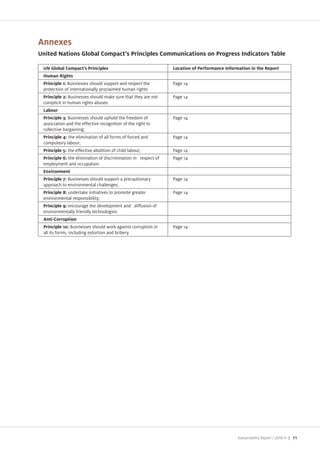
                         2010-2011

             Sustainability
                    Report

                    Sustainable Threads
2010-2011
Sustainability Report
ABOUT US
 ABOUT US


                               About Us

                                     About this Report                                    3

                                     Statement from the Executive Board                4

                                      ompan         ro le

                                     SLN With Numbers                                     8

                               Our Approach to Sustainability                         10

                                     Corporate Governance                             11

                                     Vision and Mission                               12

                                     Sustainabilit in the Suppl Chain                 12

                                     Compan Goals                                     1

                               Stakeholder Engagement                                 18

                                      ur Sta eholders and ialo ue rocess              1

                                      ur rimar Sta eholders                           1

                                      eterminin our riorities                         21

                               Economic Performance                                   22

                                     Mana ement Approach to our Economic mpact        23

                                     Economic ata                                     2

                               Product Responsibility                                 31

                               Social Performance                                     36

                                     Mana ement Approach to our Social mpact          3

                                      ur Suppl Chain and Contract Manufacturer olic   41

                                     Emplo ee ealth and Safet                         43

                               Environmental Performance                              48

                                     Mana ement Approach to our Environmental mpact   4

                                     Waste Mana ement                                     2

                                     Water se

                                     Ener      se                                         8

                                     Carbon ootprint                                      3

                                     Water ootprint

                               GRI Index                                              66

                                     Annexes                                              1


 2 | Sustainability Report /
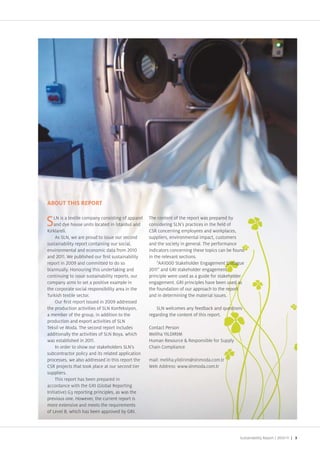
LN is a textile company consisting of apparel
      N      tex il
                xtile             onsisting
                                     sis         p re     The content of the report was prepared by
                                                           h co n              eport a p par d by
    a dye hou
    and dye house units located in stanbul and
                                   e in st       l an     considering SLN s practices in the eld of
                                                           o siderin
                                                                d n                 e           l f
   r lareli
     lare i
       reli                                               CSR
                                                          CSR concerning employees and wor places,
                                                                                             or places,
     A L
     As SLN, we are pr ud t issue our seco
                  e      pro d to i s          cond
                                               coo        suppliers, environmental impact, customers
                                                                                         c u omers
sustaina i ty epo containing
sustainability report containin our social,
   st nabi t                   a                          and the society in general The performance
                                                                                                rm
env ronm ntal n economic
environmental and economic data from
 nvi onm                                                  indicators concerning these topics can be fou d
                                                                                            s n e foun
and
and         We publ shed our rst sustainability
                    ublis    our s                        in the relevant sections
repo
report in
   port             and comm te
                    and committed to do so                    “AA       Sta eholder Engagement ialogue
                                                                                                     alog
biannual y onou ing this
biannually onouring th s underta ing and
  annually         nour                                         and GRI sta eholder engagement   nt
                                                                                                  t
c ntinui to s u
continuing to issue sustainability reports, our
      n                     ta                            principle were used as a guide for sta eholder
                                                                                                     od
compan aims to
compan aims to set a positive example in
       any ms                                             engagement GRI principles have been used as    as
the porat s
the corporate social responsibility area in the
             a                                            the foundation of our approach to the report
                                                                                                    ep rt
T s textile
Tur ish textil sector                                     and in determining the material issues
                                                                                            s
       ur rs
       ur rst report issued in           addressed
the production activities of SLN onfe siyon,
the produc                                                    SLN welcomes any feedbac and questions
                                                                        m     y       b    an uestion
a member of the group, in addition to the
  member                                                  regarding the content of this report
                                                                         o e o i r port     rt
production and
production an export activities of SLN
            n
Te si ve Moda The second report includes
 e sil e Moda     a                                       Contact Person
                                                             n      rs n
                                                                     s
a dition y
additionally the activities of SLN Boya, which            Meliha IL IRIM
                                                            e ha L RI
                                                               ha
was estab ished n
was established in                                         uman Resource Responsible for Supply
                                                             ma Resource
                                                                    sourr  esponsib e or u pl
                                                                             ponsible
                                                                              o sb
      n order to show ou sta eho e s SLN s
         rder to show our a holder SLN
              r                                           Chai Comp ia e
                                                          Chain Compliance
                                                           h i     mpli
subcontractor policy and its related application
   b o t acto p licy
              tor        y     its elatt   pplic t on
                                              li
processes, we also addressed in this report the
         es        also ddressed in this epor the
                            ress         s    ort         mail meli yildir
                                                          mail meliha yildirim slnmoda com tr
                                                            i    l     ildi    slnmo com
                                                                                 nmod
                                                                                 nm
CSR pro ects that too place at our second tier
  S r ects h too a at u econd tie
               s                                    ier   Web Address www slnmoda com tr
                                                           e Address www nmo a com
                                                                d              moda
supplier
suppliers
   ppliers
     T s epor a b n repared n
     This report has been prepared in
                 r                pare
accordan e t h
accordance with the GR Global Reporting
   c ance                       Global Repor n
                                  o a      o
Initiative)
Initiative) G3 reporting principles, as was the
 nitia i
     a             eporting rinciples,
                     porti      ncip e       a h
previous ne
previous one owever, the current report is
        us            wever the cur en eport i
                          ve he urre
more
more te s
more extensive and meets the requirements
                        d ets h requirem t
                                      e uire
                                           eme
of Level B, which has been approved by GRI
 f Level wh c ha been ppro e by GRI
     evel
     ev                has           rove        RI


                                                                                                        Sustainability Report /   | 3
ABOUT US
 ABOUT US

                                                                                            We integrated our sustainable business model
    STATEMENT FROM                                                                     with our innovative product and service approach,
                                                                                       staying loyal to all ethical values.
    THE EXECUTIVE BOARD                                                                     In this process, we were attentive to
                                                                                       develop our shareholder dialogue and to ful l
                               Esteemed shareholders,                                  our reassurances to the primary shareholder
                                                                                       groups. “Empowering internal communication
                                   he global nancial crisis experienced in             in collaboration with S GEP, English language
                               T                seriously a ected all industries
                               overall, along with the textile industry in which we
                                                                                       education within the scope of life long
                                                                                       education programs, “Shareholder Attendance
                               operate as SLN.                                         in collaboration with Marmara niversity are
                                    This challenging period indicated that we          examples of signi cant social pro ects within
                               have to create a new road map, strengthening               reporting term.
                               our proactive, permanent and universal values                We assured that our contract manufacturers,
                               both globally and on country basis. The balance of      who hold a signi cant part in our chain of supply,
                               production and consumption needs to be carefully        participate in many social pro ects and acquire
                               reviewed, and all the negative e ects originated in     awareness together with us.
                               this period have to be collaboratively assessed in           In order to determine our impact on the
                               a transparent and accountable way by the whole          environment, we added the new Water ootprint
                               chain of shareholders.                                  measurements in this term in addition to the
                                    In order to obtain a nancially sustainable         Carbon ootprint measurements that we launched
                               state, we need to have an ethical and accountable       in 2      .
                               attitude to the other shareholders. This is the most         In 2 1 11, we also maintained the Plain
                               signi cant ey element to create a successful            Production LEAN Program that we launched in
                               business model. In line with this, we need to adopt            . We reached a production e ciency of %
                               the act of contributing to the solutions of social,     as SLN Te stil ve onfe siyon, reali ing our goal for
                               environmental and economic problems in the              the pro ect.
                               community as a primary corporate responsibility.             In order to integrate our most important
                                    At SLN, we are striving to implement the           product of supply, the dyed fabric production
                               principle of sustainability successfully to the whole   into the company, we performed our dye house
                               company, in order to have a sustainable state and       investment in the start of       . It too more time
                               to share our in uences with all our shareholders.       than planned to form company values and a sense
                               We now that sustainability is a critical strategic      of quality for the dye house unit, adapting it to
                               element that plays a signi cant part to shape our       the SLN Te stil in the desired conditions. Involving
                               future.                                                 challenges both in terms of cost and time planning,
                                    We are sharing with you our report of              this process was completed to the end of         .
                               performance and sustainability e orts, the rst of       After the integration of the dye house unit, the
                               which was in         and the second of which is in      integrated production unit was formed. We believe
                                          . ur goal is to convey our administrative,   that this change will bring us advantages both in
                               environmental and social performance along with         service and price.
                               our innovative management approach to you, our               At SLN, our most signi cant goal for the
                               esteemed shareholders.                                  upcoming years is to maintain our current customer
                                                                                       portfolio and add new brand customers to it.
                                                                                            We hope that this report containing our
                                                                                       sustainability performance from            will be
                                                                                       a guide for you in terms of our sustainability
                                                                                       approach and practices. Our report for this term has
                                                                                       been prepared again according to GRI principles
                                                                                       on a B level with an extended scope. GC Principles
                                                                                       were ta en as guidelines to determine the scope of
                                                                                       extension.

                                                                                       Sincerely
                                                                                       Selin G r
                                                                                       SLN Te stil ve onfe siyon CEO


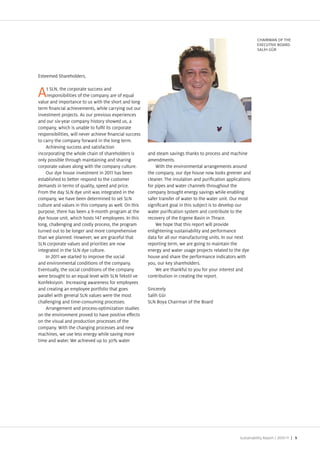
  C AIRWOMAN O T E
  E EC TIVE BOAR
  SEL N G R


 4 | Sustainability Report /
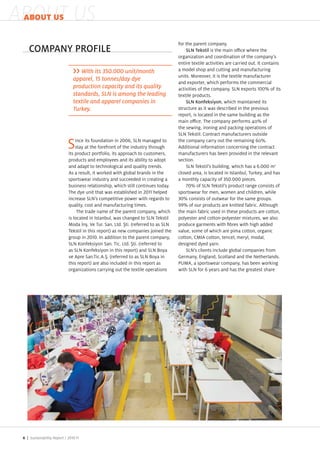
C AIRMAN O T E
                                                                                                               E EC TIVE BOAR
                                                                                                               SAL G R


Esteemed Shareholders,

     t SLN, the corporate success and
A    responsibilities of the company are of equal
value and importance to us with the short and long
term nancial achievements, while carrying out our
investment pro ects. As our previous experiences
and our six year company history showed us, a
company, which is unable to ful l its corporate
responsibilities, will never achieve nancial success
to carry the company forward in the long term.
    Achieving success and satisfaction
incorporating the whole chain of shareholders is       and steam savings than s to process and machine
only possible through maintaining and sharing          amendments.
corporate values along with the company culture.           With the environmental arrangements around
    Our dye house investment in         has been       the company, our dye house now loo s greener and
established to better respond to the customer          cleaner. The insulation and puri cation applications
demands in terms of quality, speed and price.          for pipes and water channels throughout the
  rom the day SLN dye unit was integrated in the       company brought energy savings while enabling
company, we have been determined to set SLN            safer transfer of water to the water unit. Our most
culture and values in this company as well. On this    signi cant goal in this sub ect is to develop our
purpose, there has been a month program at the         water puri cation system and contribute to the
dye house unit, which hosts       employees. In this   recovery of the Ergene Basin in Thrace.
long, challenging and costly process, the program          We hope that this report will provide
turned out to be longer and more comprehensive         enlightening sustainability and performance
than we planned. owever, we are graceful that          data for all our manufacturing units. In our next
SLN corporate values and priorities are now            reporting term, we are going to maintain the
integrated in the SLN dye culture.                     energy and water usage pro ects related to the dye
    In       we started to improve the social          house and share the performance indicators with
and environmental conditions of the company.           you, our ey shareholders.
Eventually, the social conditions of the company           We are than ful to you for your interest and
were brought to an equal level with SLN Te stil ve     contribution in creating the report.
  onfe siyon. Increasing awareness for employees
and creating an employee portfolio that goes           Sincerely
parallel with general SLN values were the most         Salih G r
challenging and time consuming processes.              SLN Boya Chairman of the Board
    Arrangement and process optimi ation studies
on the environment proved to have positive e ects
on the visual and production processes of the
company. With the changing processes and new
machines, we use less energy while saving more
time and water. We achieved up to 3 % water


                                                                                                     Sustainability Report /   | 5
ABOUT US
 ABOUT US

                                                                                      for the parent company.
    COMPANY PROFILE                                                                       SLN Tekstil is the main o ce where the
                                                                                      organi ation and coordination of the company s
                                                                                      entire textile activities are carried out. It contains
                                    With its 350.000 unit/month                       a model shop and cutting and manufacturing
                                                                                      units. Moreover, it is the textile manufacturer
                                 apparel, 15 tonnes/day dye
                                                                                      and exporter, which performs the commercial
                                 production capacity and its quality                  activities of the company. SLN exports         % of its
                                 standards, SLN is among the leading                  textile products.
                                 textile and apparel companies in                         SLN Konfeksiyon, which maintained its
                                 Turkey.                                              structure as it was described in the previous
                                                                                      report, is located in the same building as the
                                                                                      main o ce. The company performs 4 % of
                                                                                      the sewing, ironing and pac ing operations of
                                                                                      SLN Te stil. Contract manufacturers outside
                                   ince its foundation in        , SLN managed to     the company carry out the remaining %.
                               S   stay at the forefront of the industry through
                               its product portfolio, its approach to customers,
                                                                                      Additional information concerning the contract
                                                                                      manufacturers has been provided in the relevant
                               products and employees and its ability to adopt        section.
                               and adapt to technological and quality trends.             SLN Te stil s building, which has a .         m2
                               As a result, it wor ed with global brands in the       closed area, is located in Istanbul, Tur ey, and has
                               sportswear industry and succeeded in creating a        a monthly capacity of        .     pieces.
                               business relationship, which still continues today.           % of SLN Te stil s product range consists of
                               The dye unit that was established in         helped    sportswear for men, women and children, while
                               increase SLN s competitive power with regards to          % consists of outwear for the same groups.
                               quality, cost and manufacturing times.                    % of our products are nitted fabric. Although
                                    The trade name of the parent company, which       the main fabric used in these products are cotton,
                               is located in Istanbul, was changed to SLN Te stil     polyester and cotton polyester mixtures, we also
                               Moda n . Ve Tur. San. Ltd. ti. referred to as SLN      produce garments with bres with high added
                               Te stil in this report) as new companies oined the     value, some of which are pima cotton, organic
                               group in        . In addition to the parent company,   cotton, CMIA cotton, tencel, meryl, modal,
                               SLN onfe siyon San. Tic. Ltd. ti. referred to          designed dyed yarn.
                               as SLN onfe siyon in this report) and SLN Boya             SLN s clients include global companies from
                               ve Apre San.Tic.A. . referred to as SLN Boya in        Germany, England, Scotland and the Netherlands.
                               this report) are also included in this report as       P MA, a sportswear company, has been wor ing
                               organi ations carrying out the textile operations      with SLN for years and has the greatest share


 6 | Sustainability Report /
of production. SLN has been wor ing with Tommy               There are various factories from di erent
  il ger for years, Lyle and Scott for 3 years,          industries in the L leburga B y kkar t ran
Leassig for years, Gaastra and 1 for years,              region, where the plant is located. Textile,
and Thomas Pink for one year. We have added              energy, glass, machinery and chemicals are
Christian ior and Museum among our customers             the leading industries. Although the energy
in      . Since all our clients are global brands, SLN   industry contributes signi cantly to the region s
exports apparel to di erent countries upon their         economy, textile industry has the highest
request. We frequently export our products to            number of employees %). As a member of
Germany, Scotland, Netherlands and England.              the textile industry, SLN Boya contributes to the
     SLN Boya oined the group at the beginning           development of the region with its      employees.
of      . It is a knitted fabric and chemical nish           Agriculture plays a very important role in the
unit founded in B y kkar t ran town of rklareli          economy of the region and provides % of the
   L leburga Region. After frequent changes of            obs, whereas workmanship accounts for % of
ownership, the dye house became a member of              the obs. Trade comes third with %.
the SLN group in          .                                  The total number of employees in the group
      yed knitted fabric is manufactured at the          is    . People work in SLN Tekstil, in SLN
dye house, which has a knitted fabric dyeing               onfeksiyon and       in SLN Boya.
machinery park. All kinds of knitted fabric mostly
cotton, polyester and cotton polyester mixtures)
are dyed and chemically nished in these
machines.
     SLN Boya is a       % contract dyeing house.
Customers supply the raw fabric, while the dye
house is solely responsible for the dyeing. Its
biggest client is SLN Tekstil, which utili es %
of its capacity. Likewise As Tekstil, Erse Tekstil,
Celion, rma and ns Tekstil are among the 3
textile manufacturers SLN Boya works with of
                                                             MEMBERSHIPS
these companies are passive. All of its customers
                                                             Memberships of SLN Tekstil ve Konfeksiyon
are textile companies, which manufacture ready
                                                              stanbul Textile and Garment Exporters Association      T B
to wear garments. Some of them are exporters,
                                                              stanbul Chamber of Industry SO
like SLN, while other sell their products only in
                                                              stanbul Chamber of Commerce TO
Turkey.
                                                             Memberships of SLN Boya
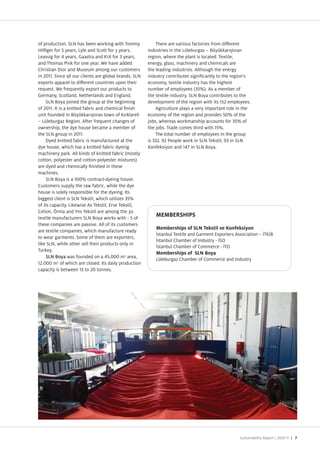
     SLN Boya was founded on a .             m2 area,
                                                             L leburga Chamber of Commerce and Industry
   .     m2 of which are closed. Its daily production
capacity is between to            tonnes.


                                                                                                      Sustainability Report /   | 7
ABOUT US
 ABOUT US

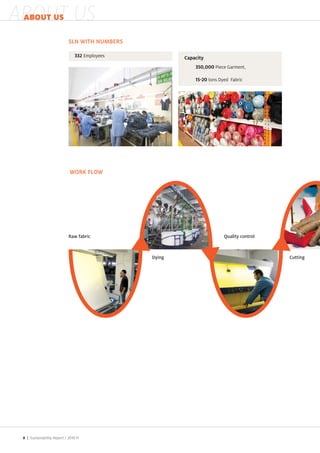
                               SLN WITH NUMBERS

                                     Employees            Capacity
                                                                       Piece Garment,

                                                                     tons yed abric


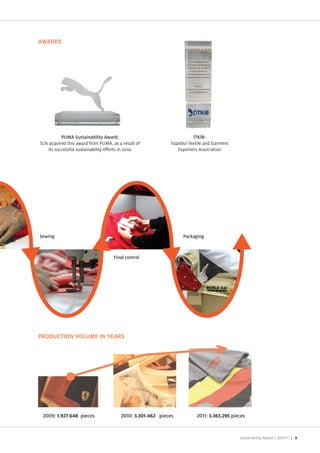
                               WORK FLOW


                               Raw fabric                                  Quality control


                                                  Dying                                      Cutting


 8 | Sustainability Report /
AWARDS


           PUMA Sustainability Award;
SLN acquired this award from P MA, as a result of        stanbul Textile and Garment
    its successful sustainability e orts in 2 1             Exporters Association


Sewing                                                        Packaging


                                    Final control


PRODUCTION VOLUME IN YEARS


                   pieces                           pieces                             pieces


                                                                                          Sustainability Report /   | 9
OUR APPROACH TO SUSTAINABILITY
 OUR APPROACH TO SUSTAINABILITY


                                MISSION

                                              VALUES
                      VISION


                                SUPPLY
                                 CHAIN
               SUSTAINABILITY
                                             RISK
                                          MANAGEMENT


 10 | Sustainability Report /
CORPORATE GOVERNANCE

A    board of directors consisting of three
     shareholders manages SLN companies. The
board is made up of Salih G r, the chairman, Selin
                                                               material topics the board of directors addresses.
                                                                  In the monthly management review meetings
                                                               held with the participation of managers of the
G r and Serkan G r. All members of the board                   company, the company s internal procedures
are actively involved in the management of the                 are examined and issues and goals concerning
company and strictly responsible for sustainability            sustainability, marketing, production, personnel and
related issues.                                                technical details are discussed. Supplier evaluation
   The board of directors meets on a monthly                   activities are conducted with the participation of
basis and inspects the functionality of the internal           the managers of relevant departments.
supervision procedures of the three companies.                    In the meetings of the board of directors
They evaluate the performance potentials, risks and            held twice a year, the goals of the company are
opportunities relating to the goals of the company.            evaluated, the resources are assessed within
   Promotion of the company in domestic and                    the framework of foreseen risks and potential
foreign markets, analysis of potential customers,              opportunities, and the company investments are
and resource management are also among the                     determined.


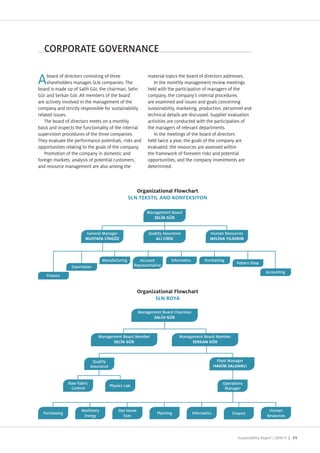
                                                              Management Board


                         General Manager                       Quality Assurance                   Human Resources


                                  Manufacturing            Account         Informatics          Purchaising
                                                                                                                 Pattern Shop
                 Exportation                            Representative
                                                                                                                                  Accounting
    Finance


                                                         Management Board Chairman


                                 Management Board Member                       Management Board Member


                              Quality                                                                  Plant Manager
                             Assurance


                Raw Fabric                                                                                Operations
                                         Physics Lab.
                 Control                                                                                   Manager


                      Machinery              Dye House                                                                              Human
  Purchaising                                                       Planning             Informatics          Finance
                       Energy                  Exec                                                                                Resources


                                                                                                                 Sustainability Report /       | 11
OUR APPROACH TO SUSTAINABILITY
 OUR APPROACH TO SUSTAINABILITY

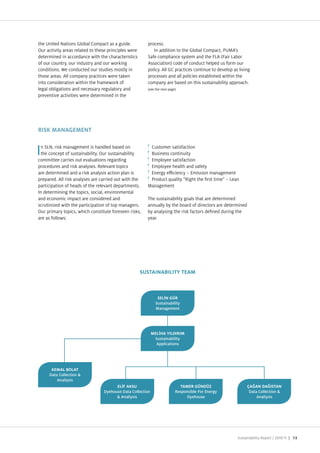
    VISION AND MISSION


                   To become the most                                To generate sustainable
        widely known and preferred                    value for our stakeholders by focusing      Service and quality oriented
        sportswear manufacturer in Turkey.            on our social, environmental and            Employee satisfaction
                                                      economic impact and by using our            Ethical and reliable production
                                                      innovative production approach which         lexible and innovative approach
                                                      treasures superior quality.                 Responsible corporate citi enship
                                                      To keep the customer satisfaction at        Built to last
                                                      the highest level possible through our
                                                      customer oriented working system,
                                                      and to manufacture products with
                                                      the highest added value and the best
                                                      quality in the shortest time possible.


    SUSTAINABILITY IN THE SUPPLY CHAIN
    Sustainability Topics


       Corporate Governance                          Occupational health and safety             Energy e ciency

       Customer s requests        sustainable        Internal communication and                 Climate changes     Carbon
       production                                    organi ation                               Emission
                                                                                                Water use    water treatment
        Sub supplier management                      Contract manufacturer management
                                                                                                systems

                                                       ialogue with stakeholders                Waste management

                                                     Local employment

                                                     Relations with universities


                            O    ur vision to be the most popular and preferred
                                 sportswear manufacturer in the Turkish textile
                            market forced us to understand the developments
                                                                                   played an important role in the development of this
                                                                                   understanding in our company.
                                                                                      We are aware that in order for social
                            in the global business world and to investigate        responsibility to ourish in our company, we need
                            common practices. We are very well aware of            to understand all of our social, environmental and
                            the fact that SLN is a company within the global       economic impact, which do or will exist. To this
                            production process. In addition to the uality          end, we are making every e ort to develop various
                              Time Cost triangle, SLN is a company with            practices to carry out our responsibilities to all our
                            organi ational responsibility which is essential for   key stakeholders and to achieve an ethical and
                            the continuity of its business. This is a process,     transparent production as part of our corporate
                            which must be undertaken and put into practice.        culture.
                            Our main client P MA s expectations and requests          In preparing SLN s Sustainability Policy, we used


 12 | Sustainability Report /
the nited Nations Global Compact as a guide.           process.
Our activity areas related to these principles were       In addition to the Global Compact, P MA s
determined in accordance with the characteristics      Safe compliance system and the LA air Labor
of our country, our industry and our working           Association) code of conduct helped us form our
conditions. We conducted our studies mostly in         policy. All GC practices continue to develop as living
those areas. All company practices were taken          processes and all policies established within the
into consideration within the framework of             company are based on this sustainability approach.
legal obligations and necessary regulatory and          see the next page)
preventive activities were determined in the


RISK MANAGEMENT


In SLN, risk management is handled based on
 the concept of sustainability. Our sustainability
committee carries out evaluations regarding
                                                        Customer satisfaction
                                                        Business continuity
                                                        Employee satisfaction
procedures and risk analyses. Relevant topics           Employee health and safety
are determined and a risk analysis action plan is       Energy e ciency Emission management
prepared. All risk analyses are carried out with the    Product quality “Right the rst time Lean
participation of heads of the relevant departments.    Management
In determining the topics, social, environmental
and economic impact are considered and                 The sustainability goals that are determined
scrutini ed with the participation of top managers.    annually by the board of directors are determined
Our primary topics, which constitute foreseen risks,   by analysing the risk factors de ned during the
are as follows                                         year.


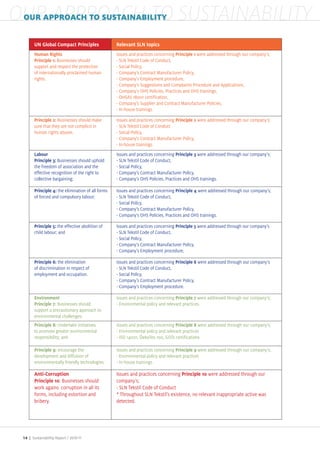
                                                            Sustainability
                                                            Management


                                                            Sustainability
                                                             Applications


     Data Collection &
         Analiysis

                                 Dyehouse Data Collection                Responsible For Energy              Data Collection &
                                       & Analiysis                             Dyehouse                          Analiysis


                                                                                                      Sustainability Report /    | 13
OUR APPROACH TO SUSTAINABILITY
 OUR APPROACH TO SUSTAINABILITY


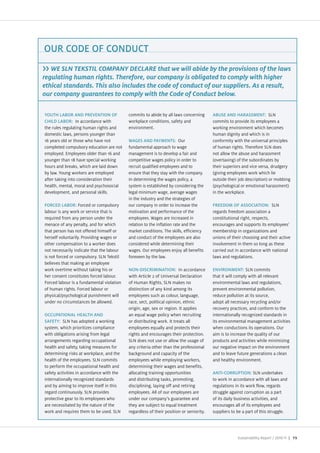
                                                    Issues and practices concerning           were addressed through our company s
                    Businesses should                 SLN Tekstil Code of Conduct,
       support and respect the protection             Social Policy,
       of internationally proclaimed human            Company s Contract Manufacturer Policy,
       rights.                                        Company s Employment procedure,
                                                      Company s Suggestions and Complaints Procedure and Applications,
                                                      Company s O S Policies, Practices and O S trainings,
                                                      O SAS 18 1 certification,
                                                      Company s Supplier and Contract Manufacturer Policies,
                                                      In house trainings.

                     Businesses should make         Issues and practices concerning           were addressed through our company s
        sure that they are not complicit in           SLN Tekstil Code of Conduct
        human rights abuses.                          Social Policy,
                                                      Company s Contract Manufacturer Policy,
                                                      In house trainings.
                                                    Issues and practices concerning           were addressed through our company s
                     Businesses should uphold         SLN Tekstil Code of Conduct,
        the freedom of association and the            Social Policy,
        effective recognition of the right to         Company s Contract Manufacturer Policy,
        collective bargaining                         Company s O S Policies, Practices and O S trainings.

                     the elimination of all forms   Issues and practices concerning           were addressed through our company s
        of forced and compulsory labour               SLN Tekstil Code of Conduct,
                                                      Social Policy,
                                                      Company s Contract Manufacturer Policy,
                                                      Company s O S Policies, Practices and O S trainings.

                     the effective abolition of     Issues and practices concerning           were addressed through our company s
        child labour and                              SLN Tekstil Code of Conduct,
                                                      Social Policy,
                                                      Company s Contract Manufacturer Policy,
                                                      Company s Employment procedure,

                     the elimination                Issues and practices concerning           were addressed through our company s
        of discrimination in respect of               SLN Tekstil Code of Conduct,
        employment and occupation.                    Social Policy,
                                                      Company s Contract Manufacturer Policy,
                                                      Company s Employment procedure.

                                                    Issues and practices concerning             were addressed through our company s
                    Businesses should                 Environmental policy and relevant practices.
        support a precautionary approach to
        environmental challenges
                     Undertake initiatives          Issues and practices concerning             were addressed through our company s
        to promote greater environmental              Environmental policy and relevant practices
        responsibility and                            ISO 14 1, ekoTex 1 , GOTs certifications

                   encourage the                    Issues and practices concerning             were addressed through our company s
        development and diffusion of                  Environmental policy and relevant practices
        environmentally friendly technologies.        In house trainings.

                                                    Issues and practices concerning               were addressed through our
                     Businesses should              company s
       work agains corruption in all its              SLN Tekstil Code of Conduct
       forms, including extortion and                 Throughout SLN Tekstil s existence, no relevant inappropriate active was
       bribery.                                     detected.


 14 | Sustainability Report /
OUR CODE OF CONDUCT
   WE SLN TEKSTIL COMPANY DECLARE that we will abide by the provisions of the laws
regulating human rights. Therefore, our company is obligated to comply with higher
ethical standards. This also includes the code of conduct of our suppliers. As a result,
our company guarantees to comply with the Code of Conduct below.

YOUTH LABOR AND PREVENTION OF               commits to abide by all laws concerning      ABUSE AND HARASSMENT: SLN
CHILD LABOR: In accordance with             workplace conditions, safety and             commits to provide its employees a
the rules regulating human rights and       environment.                                 working environment which becomes
domestic laws, persons younger than                                                      human dignity and which is in
1 years old or those who have not           WAGES AND PAYMENTS: Our                      conformity with the universal principles
completed compulsory education are not      fundamental approach to wage                 of human rights. Therefore SLN does
employed. Employees older than 1 and        management is to develop a fair and          not allow the abuse and harassment
younger than 18 have special working        competitive wages policy in order to          overtaxing) of the subordinates by
hours and breaks, which are laid down       recruit qualified employees and to           their superiors and vice versa, drudgery
by law. oung workers are employed           ensure that they stay with the company.       giving employees work which lie
after taking into consideration their       In determining the wages policy, a           outside their ob description) or mobbing
health, mental, moral and psychosocial      system is established by considering the      psychological or emotional harassment)
development, and personal skills.           legal minimum wage, average wages            in the workplace.
                                            in the industry and the strategies of
FORCED LABOR: orced or compulsory           our company in order to increase the         FREEDOM OF ASSOCIATION: SLN
labour is any work or service that is       motivation and performance of the            regards freedom association a
required from any person under the          employees. Wages are increased in            constitutional right, respects,
menace of any penalty, and for which        relation to the inflation rate and the       encourages and supports its employees
that person has not offered himself or      market conditions. The skills, efficiency    membership in organi ations and
herself voluntarily. Providing wages or     and conduct of the employees are also        unions of their choosing and their active
other compensation to a worker does         considered while determining their           involvement in them so long as these
not necessarily indicate that the labour    wages. Our employees en oy all benefits      carried out in accordance with national
is not forced or compulsory. SLN Tekstil    foreseen by the law.                         laws and regulations.
believes that making an employee
work overtime without taking his or         NON-DISCRIMINATION: In accordance            ENVIRONMENT: SLN commits
her consent constitutes forced labour.      with Article 2 of Universal eclaration       that it will comply with all relevant
  orced labour is a fundamental violation   of uman Rights, SLN makes no                 environmental laws and regulations,
of human rights. orced labour or            distinction of any kind among its            prevent environmental pollution,
physical psychological punishment will      employees such as colour, language,          reduce pollution at its source,
under no circumstances be allowed.          race, sect, political opinion, ethnic        adopt all necessary recycling and or
                                            origin, age, sex or region. It applies       recovery practices, and conform to the
OCCUPATIONAL HEALTH AND                     an equal wage policy when recruiting         internationally recogni ed standards in
SAFETY: SLN has adopted a working           or distributing work. It treats all          its environmental management activities
system, which prioriti es compliance        employees equally and protects their         when conductions its operations. Our
with obligations arising from legal         rights and encourages their protection.      aim is to increase the quality of our
arrangements regarding occupational         SLN does not use or allow the usage of       products and activities while minimi ing
health and safety, taking measures for      any criteria other than the professional     our negative impact on the environment
determining risks at workplace, and the     background and capacity of the               and to leave future generations a clean
health of the employees. SLN commits        employees while employing workers,           and healthy environment.
to perform the occupational health and      determining their wages and benefits,
safety activities in accordance with the    allocating training opportunities            ANTI-CORRUPTION: SLN undertakes
internationally recogni ed standards        and distributing tasks, promoting,           to work in accordance with all laws and
and by aiming to improve itself in this     disciplining, laying off and retiring        regulations in its work flow, regards
regard continuously. SLN provides           employees. All of our employees are          struggle against corruption as a part
protective gear to its employees who        under our company s guarantee and            of its daily business activities, and
are necessitated by the nature of the       they are sub ect to equal treatment          encourages all of its employees and
work and requires them to be used. SLN      regardless of their position or seniority.   suppliers to be a part of this struggle.


                                                                                                      Sustainability Report /       | 15
OUR APPROACH TO SUSTAINABILITY
 OUR APPROACH TO SUSTAINABILITY


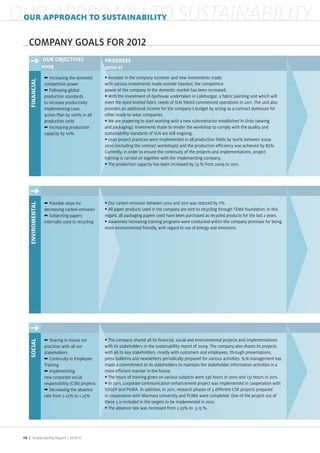
                 Increasing the domestic       Increase in the company turnover and new investments made
              competitive power              with various investments made outside stanbul, the competitive
                  ollowing global            power of the company in the domestic market has been increased.
              production standards             With the investment of dyehouse undertaken in L leburga , a fabric painting unit which will
              to increase productivity       meet the dyed knitted fabric needs of SLN Tekstil commenced operations in 2011. The unit also
              Implementing Lean              provides an additional income for the company s budget by acting as a contract dyehouse for
              action Plan by 1 % in all      other ready to wear companies.
              production units                 We are prapering to start working with a new subcontractor established in Ordu sewing
                 Increasing production       and packaging). Invesments made to render the workshop to comply with the quality and
              capacity by 10%                sustainability standards of SLN are still ongoing.
                                               Lean pro ect practices were implemented in all production fields by 100% between 200
                                             2010 including the contract workshops) and the production efficiency was achieved by 8 %.
                                             Currently, in order to ensure the continuity of the pro ects and implementations, pro ect
                                             training is carried on together with the implementing company.
                                               The production capacity has been increased by 3 % from 200 to 2011.


                 Possible steps for            Our carbon emission between 2 1 and 2 11 was reduced by %.
              decreasing carbon emission       All paper products used in the company are sent to recycling through TEMA foundation. In this
                 Sub ecting papers           regard, all packaging papers used have been purchased as recycled products for the last 2 years.
              internally used to recycling     Awareness increasing training programs were conducted within the company promises for being
                                             more environmental friendly, with regard to use of energy and emissions.


                 Sharing in house est          The company shared all its financial, social and environmental pro ects and implementations
              practices with all our         with its stakeholders in the sustainability report of 2  . The company also shares its pro ects
              stakeholders                   with all its key stakeholders, mostly with customers and employees, through presentations,
                 Continuity in Employee      press bulletins and newsletters periodically prepared for various activities. SLN management has
              Training                       made a commitment to its stakeholders to maintain the stakeholder information activities in a
                 Implementing                more efficient manner in the future.
              new corporate social             The hours of training given on various sub ects were 23 hours in 2 1 and 13 hours in 2 11.
              responsibility CSR) pro ects     In 2 11, corporate communication enhancement pro ect was implemented in cooperation with
                   ecreasing the absence     SOGEP and PUMA. In addition, in 2 11, research phases of 3 different CSR pro ects prepared
              rate from 2.2 % to 1.2 %       in cooperation with Marmara University and PUMA were completed. One of the pro ect out of
                                             these 3 is included in the targets to be implemented in 2 12.
                                               The absence rate was increased from 2.2 % to 3.1 %.


 16 | Sustainability Report /
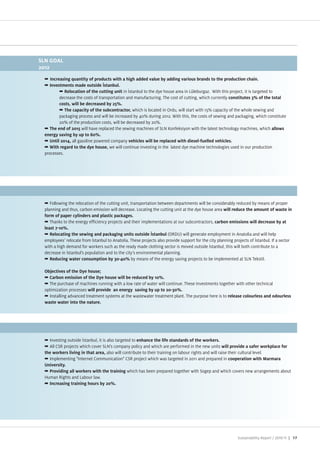
in stanbul to the dye house area in L leburga . With this pro ect, it is targeted to
        decrease the costs of transportation and manufacturing. The cost of cutting, which currently

                                                which is located in Ordu, will start with 1 % capacity of the whole sewing and
        packaging process and will be increased by 40% during 2012. With this, the costs of sewing and packaging, which constitute
        20% of the production costs, will be decreased by 20%.
                   will have replaced the sewing machines of SLN onfeksiyon with the latest technology machines, which

               all gasoline powered company
                                   we will continue investing in the latest dye machine technologies used in our production
processes.


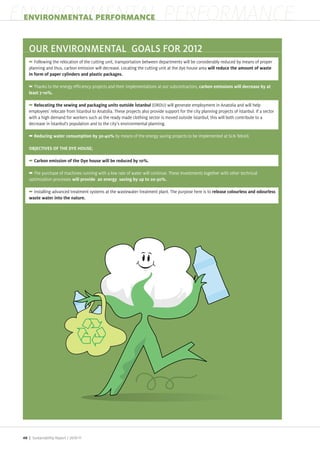
    ollowing the relocation of the cutting unit, transportation between departments will be considerably reduced by means of proper
planning and thus, carbon emission will decrease. Locating the cutting unit at the dye house area

  Thanks to the energy efficiency pro ects and their implementations at our subcontractors,

                                                                    OR U) will generate employment in Anatolia and will help
employees relocate from stanbul to Anatolia. These pro ects also provide support for the city planning pro ects of stanbul. If a sector
with a high demand for workers such as the ready made clothing sector is moved outside stanbul, this will both contribute to a
decrease in stanbul s population and to the city s environmental planning.
                                               by means of the energy saving pro ects to be implemented at SLN Tekstil.


  The purchase of machines running with a low rate of water will continue. These Investments together with other technical
optimi ation processes
  Installing advanced treatment systems at the wastewater treatment plant. The purpose here is to


  Investing outside stanbul, it is also targeted to
  All CSR pro ects which cover SLN s company policy and which are performed in the new units
                                   also will contribute to their training on labour rights and will raise their cultural level.
  Implementing Internet Communication CSR pro ect which was targeted in 2011 and prepared in

                                               which has been prepared together with Sogep and which covers new arrangements about
 uman Rights and Labour law.


                                                                                                                Sustainability Report /   | 17
STAKEHOLDER ENGAGEMENT
 STAKEHOLDER ENGAGEMENT


                           "We accept that Stakeholder engagement is as crucial to an organization's
                                                sustainability and success."
                                                        – Selin Gür


 18 | Sustainability Report /
OUR STAKEHOLDERS AND DIALOGUE PROCESS
  n order to improve our report with regards               In preparing our report, we rst contacted the
I to stakeholder engagement, we used the
international standard AA1000 Stakeholder
                                                       appropriate key stakeholders through methods
                                                       determined previously. The data obtained through
  ialogue 2011 as a guide, in addition to the GRI      our dialogues with them were evaluated by the
stakeholder engagement principle.                      sustainability committee and the possible risks
     The underlying principle behind the AA1000        and opportunities for our company were taken
Stakeholder Engagement Standard represents a           into consideration. As a result, the material topics
process carried out by the organi ation in order       included in this report were determined. We hope
to facilitate the e ective implementation of           to have met the requests and expectations of our
the stakeholder engagement process through             stakeholders with the topics we included in our
appropriate methods and analyses. As a                 report as a result of the stakeholder dialogue.
result, during the stakeholder analyses of the
organi ations, stakeholder expectations, which         OUR PRIMARY STAKEHOLDERS
must be strategically prioriti ed, are determined.     As SLN, we are always trying to improve our
This method prevents the organi ation from             position within the Turkish textile industry. We are
allocating resources to irrelevant areas. Moreover,    aware of the fact that it is very important to be in
it also assists the development of strategies, which   a permanent dialogue with our key stakeholders
meet the primary expectations of the society, which    which are a ected by the activities, products and
is a very important stakeholder in it and which        services of our company and which also a ect the
generally includes the consumer customer group.        implementation of our corporate strategies and
The bene ts of a company arise from ful lling its      formation of our goals through their own actions.
corporate responsibilities, e ciently allocating its        The processes which were initiated as a result
resources, and by creating a corporate image in the    of the dialogues with our main stakeholders and
eyes of its stakeholders, which honours its social,    which are mentioned in our previous report are still
environmental and economic responsibilities.           being implemented. In order to strengthen these
     AA1000 standard achieved great success with       dialogues we carried out a more e ective dialogue
respect to CSR applications. It is the only standard   process by means of the AA1000SES principles in
which many corporations use as a reference in the      this reporting period.
stakeholder engagement CSR applications.                    Below are our key stakeholders, which were
     We aimed three fundamental principles within      determined according to the standards and our
the scope of AA1000                                    methods of dialogue.
     1.    Stakeholder Engagement                          The key stakeholders were determined through
     2.    Prioriti ing                                annual meetings, top management meetings,
     3.    Responsiveness                              department meetings and employee trainings by


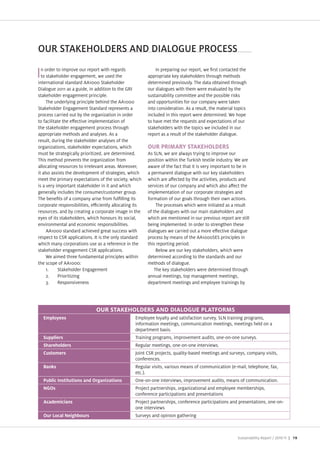
                                                Employee loyalty and satisfaction survey, SLN training programs,
                                                information meetings, communication meetings, meetings held on a
                                                department basis.
                                                Training programs, improvement audits, one on one surveys.
                                                Regular meetings, one on one interviews.
                                                 oint CSR pro ects, quality based meetings and surveys, company visits,
                                                conferences.
                                                Regular visits, various means of communication e mail, telephone, fax,
                                                etc.).
                                                One on one interviews, improvement audits, means of communication.
                                                Pro ect partnerships, organi ational and employee memberships,
                                                conference participations and presentations
                                                Pro ect partnerships, conference participations and presentations, one on
                                                one interviews
                                                Surveys and opinion gathering


                                                                                                      Sustainability Report /   | 19
STAKEHOLDER ENGAGEMENT
 STAKEHOLDER ENGAGEMENT

                            taking into consideration SLN s economic, social      Dialogue with Customers
                            and environmental interactions. Accordingly,          SLN is continuously in dialogue with PUMA,
                            we determined our key stakeholders to be our          its main client, through the CSR pro ects they
                            employees, customers and suppliers, as in the         organi e together. These pro ects constitute the
                            previous year. The other stakeholders who are also    most e ective means of communication between
                            part of SLN Tekstil s group of stakeholders are       PUMA and SLN. Moreover, in house and supplier
                            shareholders, public institutions and organi ations   improvement pro ects improvement pro ects
                             municipalities, tax o ces), NGOs, banks,             applied for product quality, social elements, etc.)
                            local community and academicians with equal           also enable regular communication with the
                            importance. iversity of our dialogues acted as a      customers and constitute a feedback mechanism
                            driving force in measuring the expectations and       which a ects the determination of the topics
                            needs of our stakeholders.                            of the reports. In addition to this, customer
                                                                                  oriented meetings, conferences, customer surveys
                            Dialogue with Employees                                which address CSR topics) and general means
                            Selin G r, chairwoman of the board, adopted one       of communication telephone, e mail, fax, etc.)
                            on one interviews with the personnel or managers      are other methods used in the dialogue with the
                            or direct reporting as methods of communication in    customers.
                            order to evaluate the comments received from lower
                            levels of the corporate hierarchy more e ciently.     Dialogue with Suppliers
                               All SLN employees are able to communicate          Through our CSR activities, performed in order to
                            their requests, suggestions and opinions to top       improve social and environmental conditions, we
                            management during regular personnel meetings,         stay in touch with our main suppliers contract
                            through worker s representatives, or by means of      manufacturers, dye house). Their periodical
                            suggestion complaint boxes placed around the          feedbacks are communicated to SLN regularly. In
                            production areas. Moreover, they can communicate      addition to this, one on one surveys conducted
                            their feedback directly to top management during      during reporting provide feedback from both the
                            meetings and trainings held periodically.             main suppliers i.e. contract manufacturers) and the


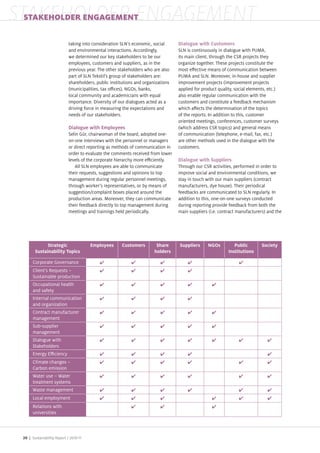
       Corporate Governance
       Client s Requests
       Sustainable production
       Occupational health
       and safety
       Internal communication
       and organi ation
       Contract manufacturer
       management
       Sub supplier
       management
        ialogue with
       Stakeholders
       Energy E ciency
       Climate changes
       Carbon emission
       Water use – Water
       treatment systems
       Waste management
       Local employment
       Relations with
       universities


 20 | Sustainability Report /
secondary suppliers raw material suppliers).           provide the most efficient feedback regarding these
   In the following sections of our report, we used    topics were developed with reference to the topics
quotes from the personnel who has been working         determined as a result of the preliminary surveys. As
with SLN and who had signi cant experiences,           such, stakeholder feedback mechanisms were formed.
by taking into consideration the trainings and           At the last stage, stakeholders feedback was
workshops it participated in and the surveys. We       analysed in detail and the environmental, social and
believe that the reader will be able to understand     economic topics, which were most relevant to the
the report from the viewpoint of an SLN employee.      company, were included in the report.
     ialogues which re ect the views and thoughts           When determining the material topics, the
of our other key stakeholders customers, suppliers     Global Compact principles, the national laws and
and NGOs) are cited in the following sections of       the topics related to the industry were considered.
this report.                                           In this context,
                                                         Topics which directly a ect SLN s performance
DETERMINING OUR PRIORITIES                             and which are signi cant for key stakeholders were
GRI principles were used in forming the basis of our   selected as rst material topics
reporting approach and in determining the material       Topics which are signi cant to our key
topics.                                                stakeholders and which are regarded highly by the
  Potential material topics were determined            society were selected as second material topics
through preliminary meetings and workshops,              Topics which did not a ect our performance
which the sustainability committee held in the         directly and which were not regarded by our key
company within the scope of the GRI prioriti ing       stakeholders to be material, but might constitute
test. The top management approved the topics           a risk in the future within the framework of
afterwards.                                            sustainability, were determined to be third material
  Stakeholder dialogue platforms that would            topics.


                                                                                                     Sustainability Report /   | 21
ECONOMIC PERFORMANCE
 ECONOMIC PERFORMANCE


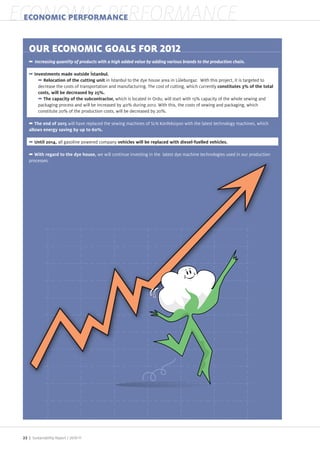
        Increasing quantity of products with a high added value by adding various brands to the production chain.


                                             in stanbul to the dye house area in L leburga . With this pro ect, it is targeted to
          decrease the costs of transportation and manufacturing. The cost of cutting, which currently

                                                 which is located in Ordu, will start with 1 % capacity of the whole sewing and
          packaging process and will be increased by 40% during 2012. With this, the costs of sewing and packaging, which
          constitute 20% of the production costs, will be decreased by 20%.

                            will have replaced the sewing machines of SLN onfeksiyon with the latest technology machines, which


                      all gasoline powered company

                                          we will continue investing in the latest dye machine technologies used in our production
    processes.


 22 | Sustainability Report /
Exporters Associations), the industry s export
MANAGEMENT                                             figures decreased by 1 , % in comparison with
                                                       the previous year. espite this loss, the industry
APPROACH TO OUR                                        maintained its position as the second largest
                                                       export industry right behind the automotive sector,
ECONOMIC IMPACT                                        which suffered a 31,8% decrease in exports.
                                                           Turkey s general export decreased by 23% in
TEXTILE AND APPAREL INDUSTRY IN                        200 , whereas industrial export decreased by
                                                       2 , %. Starting from October 2010, however, the
TURKEY
                                                       effects of the economic crisis and other factors
                                                       that damaged our export started to decline.
       hen assessed together, textile and apparel          In this context, developments in the global
W      industry is the fifth biggest industry in
Turkey in terms of gross domestic product, their
                                                       market conditions, the domestic production costs
                                                       and the course of the exchange rate are the main
share in the manufacturing industry and total          factors that affect the apparel industry s export
industry production, exportation, their nominal        performance. Today, Turkish Textile and Apparel
foreign exchange contribution to economy,              Industry is the driving force of Turkish economy
employment, investments, openness and                  with the employment it provides and its monthly
macroeconomic industries. Textile and apparel          export income that exceeds 1 billion US . In
industries provide 10% of Turkey s gross domestic      addition, ready to wear and apparel industry was
product.                                               the second greatest export industry in 2011, behind
    With the abolition of quotas applied to textile    automotive, which increased its export by 20,4%
and apparel products after 200 and China s             in the anuary September 2011 period. espite the
export on the rise, the textile and apparel industry   shrinkage in the EU countries, which constitute
started to go through a restructuring period. In       80% of its exports, the apparel export is expected
200 , textile industry s share in manufacturing        to reach US 1 billion in 2012 with the help of
industry was 10, % while apparel s share was           the exchange rate. owever, it is also asserted by
  ,4%. Textile production decreased by 12% in          taking into consideration the crisis expectations
comparison to previous year, whereas apparel           that the industry may preserve its current status
production decreased by 1 , %. In 200 , the share      instead of growing.
of apparel and ready to wear export in general             The problems which plague the textile and
export was 1 % but it dropped to 1 % in 200 and        apparel industry in Turkey are high financing
to %12 in 2008. Textile s share in general export      and energy costs, overcapacity, underground
dropped from % to %.                                   production, lack of branding and the weakness in
    The regression in the apparel industry, which      the capital structures of the companies. owever,
suffered a 2,1% decrease in 2008 a first since         the industry en oys certain advantages as well,
1    ), continued in 200 when the global crisis        which are short delivery times, proximity to target
shrunk the world economy considerably.                 markets, wide range of products, a developed
    According to T B stanbul Textile and Apparel       textile and finishing industry, to name a few.


                                                                                                   Sustainability Report /   | 23
ECONOMIC PERFORMANCE
 ECONOMIC PERFORMANCE

                            OUR ECONOMIC PERFORMANCE                                through a si able budget, constitutes a risk for SLN
                                                                                    since it is a different branch of business with costs
                            The fundamental policy of our company commits           higher than those in the apparel manufacturing.
                            to achieving sustainable economic growth through          owever, despite its setbacks, it also offers SLN
                            a flexible and transparent production, while            many advantages by making it an integrated plant
                            managing a client portfolio that contains leading       that can be closely monitored by the management
                            global brands.                                          of our company.
                                SLN contributes to the economy significantly in         There are no significant economic challenges
                            the geographical areas it carries out its operations    or risks in the apparel industry where SLN
                             i.e. stanbul, L leburga – B y kkar t ran).             operates. This is partly due to the fact that SLN is
                                The employment we create with our average           doing business with few but loyal clients, which
                            3.800.000 pcs year apparel and 4. 00 tonnes             are leaders in their respective sectors. Reliable
                            year dyed fabric capacity has a positive influence      clientele constitutes a very important economic
                            on the region s economy.                                stability factor for SLN.
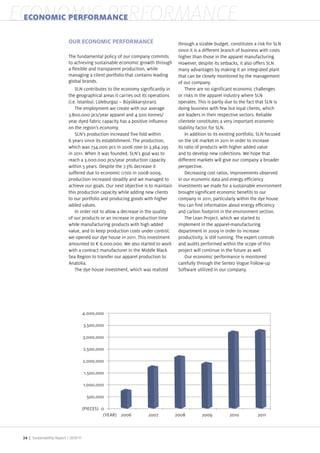
                                SLN s production increased five fold within             In addition to its existing portfolio, SLN focused
                               years since its establishment. The production,       on the U market in 2011 in order to increase
                            which was 34.000 pcs in 200 rose to 3.3 4.2             its ratio of products with higher added value
                            in 2011. When it was founded, SLN s goal was to         and to develop new collections. We hope that
                            reach a 3.000.000 pcs year production capacity          different markets will give our company a broader
                            within years. espite the .3% decrease it                perspective.
                            suffered due to economic crisis in 2008 200 ,                 ecreasing cost ratios, improvements observed
                            production increased steadily and we managed to         in our economic data and energy efficiency
                            achieve our goals. Our next ob ective is to maintain    investments we made for a sustainable environment
                            this production capacity while adding new clients       brought significant economic benefits to our
                            to our portfolio and producing goods with higher        company in 2011, particularly within the dye house.
                            added values.                                             ou can find information about energy efficiency
                                In order not to allow a decrease in the quality     and carbon footprint in the environment section.
                            of our products or an increase in production time           The Lean Pro ect, which we started to
                            while manufacturing products with high added            implement in the apparel manufacturing
                            value, and to keep production costs under control,      department in 200 in order to increase
                            we opened our dye house in 2011. This investment        productivity, is still running. The expert controls
                            amounted to        .000.000. We also started to work    and audits performed within the scope of this
                            with a contract manufacturer in the Middle Black        pro ect will continue in the future as well.
                            Sea Region to transfer our apparel production to            Our economic performance is monitored
                            Anatolia.                                               carefully through the Sente Vogue ollow up
                                The dye house investment, which was reali ed        Software utili ed in our company.


                                  4,000,000

                                   3,500,000

                                   3,000,000

                                   2,500,000

                                   2,000,000

                                   1,500,000

                                   1,000,000

                                     500,000

                                  (PIECES) 0
                                            (YEAR) 2006             2007           2008         2009          2010           2011


 24 | Sustainability Report /
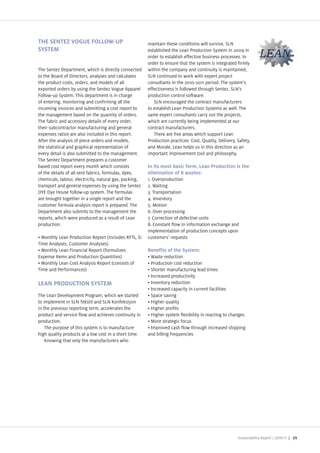
THE SENTEZ VOGUE FOLLOW-UP                              maintain these conditions will survive, SLN
SYSTEM                                                  established the Lean Production System in 2009 in
                                                        order to establish effective business processes. In
                                                        order to ensure that the system is integrated firmly
The Sente epartment, which is directly connected        within the company and continuity is maintained,
to the Board of irectors, analyses and calculates       SLN continued to work with expert pro ect
the product costs, orders, and models of all            consultants in the 2010 2011 period. The system s
exported orders by using the Sente Vogue Apparel        effectiveness is followed through Sente , SLN s
 ollow up System. This department is in charge          production control software.
of entering, monitoring and confirming all the             SLN encouraged the contract manufacturers
incoming invoices and submitting a cost report to       to establish Lean Production Systems as well. The
the management based on the quantity of orders.         same expert consultants carry out the pro ects,
The fabric and accessory details of every order,        which are currently being implemented at our
their subcontractor manufacturing and general           contract manufacturers.
expenses ratios are also included in this report.          There are five areas which support Lean
After the analysis of piece orders and models,          Production practices Cost, uality, elivery, Safety,
the statistical and graphical representation of         and Morale. Lean helps us in this direction as an
every detail is also submitted to the management.       important improvement tool and philosophy.
The Sente epartment prepares a customer
based cost report every month which consists
of the details of all sent fabrics, formulas, dyes,     elimination of 8 wastes:
chemicals, labour, electricity, natural gas, packing,   1. Overproduction
transport and general expenses by using the Sente       2. Waiting
  YE ye ouse follow up system. The formulas             3. Transportation
are brought together in a single report and the         4. Inventory
customer formula analysis report is prepared. The       5. Motion
  epartment also submits to the management the          6. Over processing
reports, which were produced as a result of Lean        7. Correction of defective units
production.                                             8. Constant flow in information exchange and
                                                        implementation of production concepts upon
  Monthly Lean Production Report (includes R Ts, Si     customers requests
Time Analyses, Customer Analyses)
  Monthly Lean inancial Report (formuli es              Benefits of the System:
Expense Items and Production uantities)                  Waste reduction
  Monthly Lean Cost Analysis Report (consists of         Production cost reduction
Time and Performances)                                   Shorter manufacturing lead times
                                                         Increased productivity
LEAN PRODUCTION SYSTEM                                   Inventory reduction
                                                         Increased capacity in current facilities
The Lean evelopment Program, which we started            Space saving
to implement in SLN Tekstil and SLN onfeksiyon             igher quality
in the previous reporting term, accelerates the            igher profits
product and service flow and achieves continuity in        igher system flexibility in reacting to changes
production.                                              More strategic focus
    The purpose of this system is to manufacture         Improved cash flow through increased shipping
high quality products at a low cost in a short time.    and billing frequencies
     nowing that only the manufacturers who


                                                                                                      Sustainability Report /   | 25
ECONOMIC PERFORMANCE
 ECONOMIC PERFORMANCE

                            2010-2011 LEAN SYSTEM                               a part of the daily routine and all employees
                                                                                received 5S training to ensure continuity.
                                                                                   Visual displays and controls were developed in
                                                                                relation to production area employees, materials,
                            Our lean production ourney, which we set out in     workstations, real time tracking of the production
                            2009, still continues. ollowing the middle and      performance, methods, and occupational safety.
                            top level lean production trainings, the value         Within the scope of standardi ed business
                            chain analysis of the company was conducted         applications, they were informed about the
                            and areas with a potential for improvement were     standard sequence of action and work in process
                            determined. This was followed by production area    inventory amounts.
                            and supplier applications.                             Product amily Analyses were conducted in
                               In 2010, 5S (Sort, Set in Order, Shine,          order to use the production lines effectively.
                            Standardi e, Sustain) and Visual Workplace               uality improvement ai en teams use CE AC
                            development activities were carried out.            (Cause and Effect with Addition of Cards) and
                            Unnecessary materials were removed from the         Application Methodologies intensively.
                            production area and appropriate places were            Lean metrics and factory store card were
                            designed and arranged for all materials and         formed and thus the company was made
                            equipment. Cleaning of workstations became          “measurable .


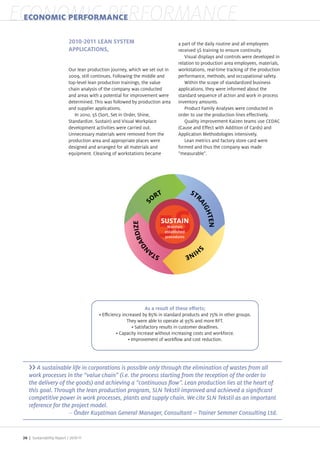
                                                                       SUSTAIN
                                                                          Maintain
                                                                         established
                                                                         procedures


                                           E ciency increased by 85% in standard products and 75% in other groups.
                                                      They were able to operate at 95% and more R T.
                                                           Satisfactory results in customer deadlines.
                                                  Capacity increase without increasing costs and workforce.
                                                         Improvement of work ow and cost reduction.


      A sustainable life in corporations is possible only through the elimination of wastes from all
    work processes in the “value chain” (i.e. the process starting from the reception of the order to


    competitive power in work processes, plants and supply chain. We cite SLN Tekstil as an important
    reference for the project model.
                     –


 26 | Sustainability Report /
ECONOMIC DATA
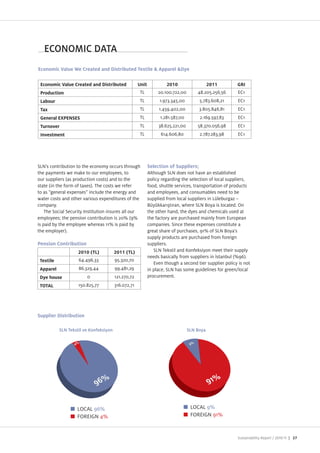
Economic Value We Created and Distributed Textile & Apparel &Dye

 Economic Value Created and Distributed              Unit            2010                   2011        GRI
 Production                                           TL         20.100.722,00       48.205.256,56      EC1
 Labour                                               TL          1.973.345,00        5.783.608,21      EC1
 Tax                                                  TL         1.459.402,00         3.805.846,81      EC1
 General EXPENSES                                     TL          1.281.587,00        2.169.597,83      EC1
 Turnover                                             TL         38.625.221,00       58.370.056,98      EC1
 Investment                                           TL          614.606,80          2.787.283,98      EC1


SLN s contribution to the economy occurs through
the payments we make to our employees, to                   Although SLN does not have an established
our suppliers (as production costs) and to the              policy regarding the selection of local suppliers,
state (in the form of taxes). The costs we refer            food, shuttle services, transportation of products
to as “general expenses include the energy and              and employees, and consumables need to be
water costs and other various expenditures of the           supplied from local suppliers in L leburga –
company.                                                    B y kkar t ran, where SLN Boya is located. On
    The Social Security Institution insures all our         the other hand, the dyes and chemicals used at
employees the pension contribution is 20% (9%               the factory are purchased mainly from European
is paid by the employee whereas 11% is paid by              companies. Since these expenses constitute a
the employer).                                              great share of purchases, 91% of SLN Boya s
                                                            supply products are purchased from foreign
Pension Contribution                                        suppliers.
                    2010 (TL)           2011 (TL)              SLN Tekstil and onfeksiyon meet their supply
                                                            needs basically from suppliers in stanbul (%96).
 Textile            64.496,33           95.320,70
                                                               Even though a second tier supplier policy is not
 Apparel            86.329,44           99.481,29           in place, SLN has some guidelines for green local
 Dye house              0               121.270,72          procurement.
 TOTAL              150.825,77          316.072,71


Supplier Distribution

           SLN Tekstil ve Konfeksiyon                                            SLN Boya


                   LOCAL 96%                                                      LOCAL 9%
                   FOREIGN 4%                                                     FOREIGN 91%


                                                                                                        Sustainability Report /   | 27
ECONOMIC PERFORMANCE
 ECONOMIC PERFORMANCE

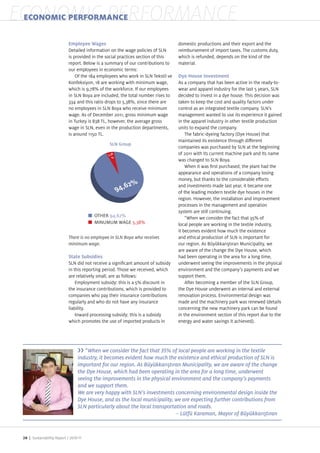
                            Employee Wages                                        domestic productions and their export and the
                              etailed information on the wage policies of SLN     reimbursement of import taxes. The customs duty,
                            is provided in the social practices section of this   which is refunded, depends on the kind of the
                            report. Below is a summary of our contributions to    material.
                            our employees in economic terms
                                Of the 184 employees who work in SLN Tekstil ve   Dye House Investment
                              onfeksiyon, 18 are working with minimum wage,       As a company that has been active in the ready to
                            which is 9,78% of the workforce. If our employees     wear and apparel industry for the last 5 years, SLN
                            in SLN Boya are included, the total number rises to   decided to invest in a dye house. This decision was
                            334 and this ratio drops to 5,38%, since there are    taken to keep the cost and quality factors under
                            no employees in SLN Boya who receive minimum          control as an integrated textile company. SLN s
                            wage. As of ecember 2011, gross minimum wage          management wanted to use its experience it gained
                            in Turkey is 838 TL, however, the average gross       in the apparel industry in other textile production
                            wage in SLN, even in the production departments,      units to expand the company.
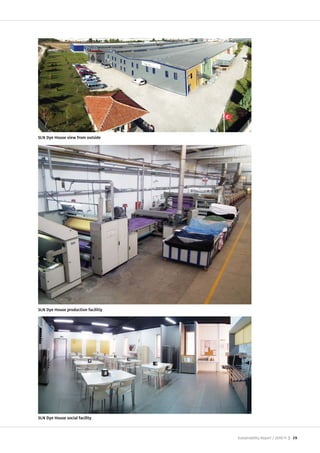
                            is around 1150 TL.                                        The fabric dyeing factory ( ye House) that
                                                                                  maintained its existence through di erent
                                                    SLN Group
                                                                                  companies was purchased by SLN at the beginning
                                                                                  of 2011 with its current machine park and its name
                                                                                  was changed to SLN Boya.
                                                                                      When it was rst purchased, the plant had the
                                                                                  appearance and operations of a company losing
                                                                                  money, but thanks to the considerable e orts
                                                                                  and investments made last year, it became one
                                                                                  of the leading modern textile dye houses in the
                                                                                  region. However, the installation and improvement
                                                                                  processes in the management and operation
                                                                                  system are still continuing.
                                            OTHER 94,62%                              “When we consider the fact that 35% of
                                            MINUMUM WAGE 5,38%                    local people are working in the textile industry,
                                                                                  it becomes evident how much the existence
                                There is no employee in SLN Boya who receives     and ethical production of SLN is important for
                                minimum wage.                                     our region. As B y kkar t ran Municipality, we
                                                                                  are aware of the change the ye House, which
                            State Subsidies                                       had been operating in the area for a long time,
                            SLN did not receive a signi cant amount of subsidy    underwent seeing the improvements in the physical
                            in this reporting period. Those we received, which    environment and the company s payments and we
                            are relatively small, are as follows                  support them.
                                Employment subsidy this is a 5% discount in           After becoming a member of the SLN Group,
                            the insurance contributions, which is provided to     the ye House underwent an internal and external
                            companies who pay their insurance contributions       renovation process. Environmental design was
                            regularly and who do not have any insurance           made and the machinery park was renewed (details
                            liability.                                            concerning the new machinery park can be found
                                Inward processing subsidy this is a subsidy       in the environment section of this report due to the
                            which promotes the use of imported products in        energy and water savings it achieved).


                                       “When we consider the fact that 35% of local people are working in the textile
                                    industry, it becomes evident how much the existence and ethical production of SLN is

                                    the Dye House, which had been operating in the area for a long time, underwent
                                    seeing the improvements in the physical environment and the company’s payments
                                    and we support them.
                                    We are very happy with SLN’s investments concerning environmental design inside the
                                    Dye House, and as the local municipality, we are expecting further contributions from
                                    SLN particularly about the local transportation and roads.
                                                                               –


 28 | Sustainability Report /
Sustainability Report /   | 29
ECONOMIC PERFORMANCE
 ECONOMIC PERFORMANCE


    SOCIAL BENEFITS

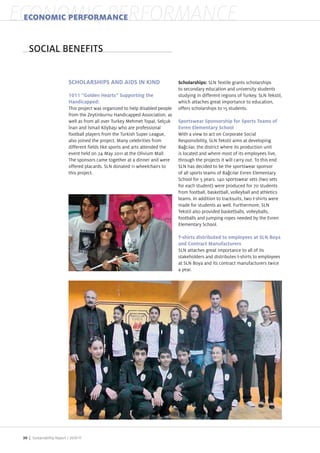
                            SCHOLARSHIPS AND AIDS IN KIND                        Scholarships: SLN Textile grants scholarships
                                                                                 to secondary education and university students
                            1011 “Golden Hearts” Supporting the                  studying in different regions of Turkey. SLN Tekstil,
                            Handicapped:                                         which attaches great importance to education,
                            This pro ect was organi ed to help disabled people   offers scholarships to 15 students.
                            from the eytinburnu Handicapped Association, as
                            well as from all over Turkey Mehmet Topal, Sel uk    Sportswear Sponsorship for Sports Teams of
                             nan and smail yba who are professional              Evren Elementary School
                            football players from the Turkish Super League,      With a view to act on Corporate Social
                            also oined the pro ect. Many celebrities from        Responsibility, SLN Tekstil aims at developing
                            different fields like sports and arts attended the   Ba c lar, the district where its production unit
                            event held on 24 May 2011 at the Olivium Mall.       is located and where most of its employees live,
                            The sponsors came together at a dinner and were      through the pro ects it will carry out. To this end
                            offered placards. SLN donated 11 wheelchairs to      SLN has decided to be the sportswear sponsor
                            this pro ect.                                        of all sports teams of Ba c lar Evren Elementary
                                                                                 School for 5 years. 140 sportswear sets (two sets
                                                                                 for each student) were produced for 70 students
                                                                                 from football, basketball, volleyball and athletics
                                                                                 teams. In addition to tracksuits, two t shirts were
                                                                                 made for students as well. Furthermore, SLN
                                                                                 Tekstil also provided basketballs, volleyballs,
                                                                                 footballs and umping ropes needed by the Evren
                                                                                 Elementary School.

                                                                                 T-shirts distributed to employees at SLN Boya
                                                                                 and Contract Manufacturers
                                                                                 SLN attaches great importance to all of its
                                                                                 stakeholders and distributes t shirts to employees
                                                                                 at SLN Boya and its contract manufacturers twice
                                                                                 a year.


 30 | Sustainability Report /
PRODUCT RESPONSIBILITY
 PRODUCT RESPONSIBILITY


      "SLN is a highly committed key partner with the service they provide where we rely on totaly."
                                                –


                                                                                       Sustainability Report /   | 31
PRODUCT RESPONSIBILITY
 PRODUCT RESPONSIBILITY

                            OUR UNDERSTANDING OF QUALITY                            has certi ed this fact.
                                                                                       Our general production goal is the achievement
                                 s we stated in our mission, in order to minimi e   of highest possible customer satisfaction through
                            A    our negative social, environmental and
                            economic impact and to honour the commitments
                                                                                    our customer oriented working system.
                                                                                       We tried to measure the level of satisfaction
                            we made to our customers by achieving innovation        of our customers regarding SLN s services and
                            and high quality, SLN integrates all current            learn about their requests and opinions through
                            legal, industrial and customer based product            the customer satisfaction surveys conducted
                            responsibilities within its production processes.       during the reporting period and general customer
                               Production of the goods right the rst time is the    noti cations.
                            general production strategy of our company.                The feedback we received from our customers
                               In order to generate correct solutions within the    indicates that they are generally satis ed with
                            Time, Energy and Cost triangle, SLN uses cutting        SLN products and product services. In addition
                            edge technology machinery and modern production         to this, our management carefully addresses
                            systems. Within the quality system process, all         requests and improvement suggestions they
                            stages (from the purchase of raw materials to           communicated to us.
                            the delivery of the goods to customers) have               In order to increase customer satisfaction
                            been planned in detail with relevant policies and       concerning the product quality and deadlines, we
                            procedures.                                             are aiming to decrease internal repairs.
                               Through continuous development and
                            improvement programs, customer satisfaction was         OUR SUSTAINABLE PRODUCTS
                            adopted as the rst quality ob ective in all units.
                            E ective product ow and process management              Creating sustainable value and products for
                            were established through ISO 9001 2008 uality           our stakeholders by focusing on our social,
                            Management System.                                      environmental and economic impact with our
                               The chemical and physics laboratories of             innovative and high quality production methods is
                            SLN Boya where raw and dyed fabric tests are            one of our ma or management approaches.
                            conducted have been accredited by SGS in 2011              To this end, we included a collection consisting
                            in accordance with PUMA Standards. SLN Tekstil          of CMIA and Organic Cotton products into our
                              nal product quality control laboratory has a SGS      product range in the last three years by taking into
                            certi cation since 2007.                                consideration PUMA s product requests.
                               Raw and dyed fabric tests conducted in SLN              Since we mainly work in accordance with
                            Boya laboratories help us create the physical and       the requests of our customers, we are unable
                            chemical conditions requested by our customers.         to generate a direct drive for the production of
                               The chemicals and dyes used in our company           sustainable products or for their increase. However,
                            do not contain substances that are ha ardous            we communicate our commitments in this regard
                            for human health and the Eco Tex Standard 100           and our desire to produce sustainable products on
                            certi cate received by our company many years ago       various occasions.


                                          the ecological standards
                                          of textile products during
                                          production and thus supports
                                          product responsibility and
                                          customer health.


 32 | Sustainability Report /
OUR MAIN CUSTOMER'S OPINIONS


Jürgen Mahn: ue to the fact Selin has been a key person to the Puma business even before SLN,
we have a perfect and very close partnership which has been grown over the years. Trust is the
basis for everything we do together as a Team.

Dilek Ergen: Highly committed, a key partner with the service they provide where we rely on
totally.
                                                                                                                 Jürgen Mahn-PUMA,
Stefan Seidel: I can mostly comment on compliance and sustainability. Here SLN is one of our                     Global Sourcing
leading suppliers on a global scale and certainly o ers great exibility when it comes to short                   Director Apparel World
delivery times.                                                                                                  Cat Ltd.

               Being a young and energetic company, SLN does not have a traditional and fro en
character. Therefore it is very quick and exible in adapting to developing processes. SLN is
one of the companies that we work with very smoothly and comfortably thanks to the e ective
communication between us.


Jürgen Mahn Price is still an issue because Europe is more expensive than other markets. This is
a problem, but we need to overcome this together.                                                                Dilek Ergen-PUMA,
                                                                                                                 Senior Head of
Dilek Ergen: SLN needs to invest in competitive locations and stay committed to productive                       Apparel Sourcing
production processes such as Lean, should not pay e ort on short term investments and strategies                 EEMEA
but aim to have a min 5 years planning with stakeholders.
 SLN can certainly further improve with Communication about the activities achievements,
better manage the supply chain and the dialogues with stakeholders, can still do much more in
the area of sustainable bre usage (recycling).

Stefan Seidel: While SLN is certainly already on the right track compared to its peers, I think the
ma or challenge is to fully integrate subcontractors and sub suppliers into the sustainability e orts.
 Continue the path with development and production of more sustainable products, evaluation
of recycling options for production waste and products at the end of their product life, inclusion
of subcontractors into sustainability e orts and reporting, continue to engage with critical                     Stefan Seidel-PUMA,
stakeholders such as NGOs as well as experts (academics, consultants, etc.)                                      Safe Ecology Team
                                                                                                                 Head


Jürgen Mahn: Partnership, SAFE, Sustainability, PI s Competitiveness oined strategy.

Dilek Ergen: We target to meet ey performance criteria for Purchasing such as Price, lead time,
on time development and production delivery, product ability and service level sure are the other
two main considerations.

Stefan Seidel: Again, focusing on the sustainability aspect it is the material (e.g. organic cotton,
recyclable material) but also the connected certi cations such as GOTS, ISO 14001, Oeko Tex, etc.
                                                                                                                               PUMA.
                                                                                                                 Safe Humanity and
                                                                                                                 Ecology Auditor
                                                                                                                 and Responsible
                                                                                                                 for Continuous
                                                                                                                 Improvement


                                                                                                         Sustainability Report /   | 33
PRODUCT RESPONSIBILITY
 PRODUCT RESPONSIBILITY

                            OUR AFRICAN COTTON


                            “A hand for trade - a heart for Africa”
                            SLN oined the Cotton Made in Africa pro ect                        Activation of market forces in the
                            with PUMA s encouragement in 2009 and its                            sales markets (Europe USA)
                            participation increased steadily in the last three
                            years.
                                Cotton made in Africa is a strategic alliance of
                            partners from trade and industry, the public sector
                            and non governmental organi ations (NGOs)
                            which contribute to the fight against poverty and
                            environmental degradation in sub Saharan Africa           Improvement of social              Promotion of
                            and help local cotton farmers and their families to      condutions in developing      environmental protection
                                                                                            countries               in developing countries
                            raise their own standard of living. The pro ect is
                            maintained by the Aid by Trade Foundation (AbT),
                            which was founded in 2005 by r. Michael Otto.
                            Besides AbT, further participants and supporters       created by the alliance partners, for example PUMA
                            are for example the German Ministry of Economic        and the Otto group, who commit to merchandising
                            Cooperation and evelopment (BM ) and the Bill          a specific amount of cotton, which assures sales
                              Melinda Gates Foundation. Up to now about            volume for the farmers. Members of the alliance pay
                            150.000 smallholders are involved, located in Benin,   a license fee which is then reinvested in the pro ect
                            Burkina Faso, Mo ambique and ambia.                    countries to assure education, raise living standards
                                The aim of the pro ect is to improve the           and preserve the natural environment in the pro ect
                            growing conditions of cotton and make production       countries.
                            sustainable in the CmiA pro ect regions while              Collections of CMIA products have been created
                            exploiting synergies that amplify pro ect              with the participation of African designers for the
                            effectiveness. Another pro ect goal is to enhance      last two years. Thus a connection is built between
                            the competitiveness of African cotton, while adding    the fashion and development pro ects. The success
                            a new dimension of corporate responsibility.           of the pro ect is measured by sustainability
                            The concept of CmiA is a self help principle for       indicators such as its contribution to the elimination
                            smallholders. The cotton is traded at a market         of poverty and to preservation of environment in
                            price and not at increased prices. The idea behind     the region, the percentage of educated children,
                            the pro ect is to provide training in the form of      farmers income, efficiency of water usage, and the
                            workshops to farmers about how to cultivate            use of pesticides and fertili ers.
                            cotton while also enhancing their productivity and         CMIA cotton purchased by SLN in 2010 2011 has
                            simultaneously lowering the environmental impact       reached 300 tonnes. As of 2011, this corresponds to
                            of cotton production. At the same time, demand is      the 30,7% of the production.


 34 | Sustainability Report /
ORGANIC COTTON PRODUCTION                               Independent certification companies certify
We started Organic Cotton production in 2010            organic agriculture process and organic products
with PUMA. When we started the pro ect, our goal        are secured in all stages of production.
was to minimi e the environmental damage of the             In the 2010 2011 harvest period, 25 million
conventional cotton production and to support           tonnes of cotton was produced in the world.
pro ects, which would increase environmental            Approximately 1% of this production consisted
awareness to prevent the destruction of natural         of organic cotton agriculture. Although this may
resources in the future.                                seem small, it increases steadily every year and has
                                                        great impact on all textile production systems as a
What is Organic Agriculture?                            production philosophy. In 2010, 5% of the organic
According to IFOAM s (International Federation          cotton grown around the world was produced in
of Organic Agriculture) basic norms, organic            Turkey. According to data from Organic Exchange,
agriculture is a whole system approach based            80% of organic cotton production occurs in India,
upon a set of processes resulting in a sustainable      Syria, China and USA.
ecosystem, safe food, good nutrition, animal                SLN textile and dye units have been certified by
welfare and social ustice. Organic production           GOTS, an independent accreditation organi ation.
therefore is more than a system of production           In order to ensure that our products are produced
that includes or excludes certain inputs. By            at the organic standards, our company was
definition, organic products do not contain             certified with the global organic textile standard.
any toxic substances or pesticides, synthetic           As of 2010, our organic production reached
fertili ers, sewage, radiation or genetic engineering   3,36 tonnes and constitutes 8,86% of our total
which damage the environment permanently.               production.


              business organization that focuses on
              facilitating the growth of a global organic
              cotton industry. It also reduces the usage
              of synthetic fertilizer and pesticides in the
              cultivation of cotton.


                          Africa Cotton
                          Organic Cotton
                          Regular Cotton


                              2009                       2010                    2011


                                                                                                     Sustainability Report /   | 35
SOCIAL PERFORMANCE
 SOCIAL PERFORMANCE


           Investing outside stanbul, it is also targeted to

           All CSR pro ects which cover SLN s company policy and which are performed in the new units
                                                       also will contribute to their training on human and labour rights and will raise their
        cultural level.

           Implementing CSR pro ects which was targeted in 2011 and prepared in

                                                       which has been prepared together with Sogep and which covers new arrangements
        about Human Rights and Labour law.


 36 | Sustainability Report /
MANAGEMENT APPROACH                                        given to workers together with SOGEP and A AV in
TO OUR SOCIAL IMPACT                                       2009. Our own training staff repeated these training
                                                           programs in the last two years. All of SLN s employees
Our Social Policies and Practices                          (100%) attended this training at least once in the last
                                                           three years.
       s SLN we provide equal opportunities and                In accordance with domestic laws, persons
W      social rights to our employees in accordance
with the Turkish labour law, social security law, and
                                                           younger than 16 or those who have not completed
                                                           compulsory education are not employed as explained
the internationally accepted Global Compact.               in the Code of Conduct. Young employees older than
   In preparing and applying its policies with the         16 and younger than 18 are called unior employees
cooperation of our partners (i.e. our customers,           and they have special working hours and breaks
consultants and NGOs), SLN committed to respecting         established by law. Similarly, pregnant or nursing
fundamental human rights, the dignity and worth            women en oy tasks, breaks and special arrangements
of human beings, the equal rights of men and               suitable for their physical condition. They are under
women and to promoting social progress and better          no circumstances asked to work overtime.
standards of life, as stated in the preamble of the            SLN takes necessary measures to enable its
United Nations Universal eclaration of Human               employees to work in a comfortable environment
Rights. SLN references the Global Compact principles       without being exposed to mobbing and harassment
as a guide and focuses on them when carrying out its       and trains its employees on this topic. In 2011, 21
activities. All matters and practices in force have been   mid level and top managers received a 5 week
prepared in detail within SLN s social policies and        training titled “Improvement of Communication
procedures and shared with our employees. SLN s            Within the Company and Prevention of Mobbing
Code of Conduct forms the basis of all our policies.       and Harassment.
Our leading principle here is non discrimination in            SLN attaches great importance to the equality of
accordance with Global Compact Principle 6, which          working conditions and takes necessary measures
states “the elimination of discrimination in respect of    in this regard. We utili e a wage promotion policy
employment and occupation . In recruiting, waging,         based on the qualities, professional pro ciency and
relocating or promoting its employees, SLN makes           performance of our employees.
no distinction of any kind such as religion, language,
colour, race, sect, political view, ethnic origin, sex,    Workforce
physical handicap, political or other opinions. It         SLN Tekstil believes that a healthy and safe
treats all employees equally, protects their rights and    workplace and happy employees lead to success.
regards human rights matters as a part of its daily        High employee turnover rates in the textile industry
business operations. In order to train employees with      and heavy reliance on manual skills make it very
regard to the non discrimination principle, a training     di cult to nd and keep quali ed workers. In SLN,
which included the topics of “Improving Human              we are aware of the importance of employees
Rights in the Work Place and at Home, Gender and           loyalty and make our investments in human
Social equality, iscrimination Prevention was              resources accordingly.


                                                                                                          Sustainability Report /   | 37
SOCIAL PERFORMANCE
 SOCIAL PERFORMANCE


                            2010 – 2011 employee turnover rate


                                Resigning
                                Military
                                service
                                 ismissal
                                Marriage
                                Total
                                Resigning
                                Military
                                service
                                 ismissal
                                Marriage
                                Total
                                Retirement
                                Resigning
                                 ismissal


                                Retirement


  Employee                                                                                                Employee
                                                                                                           50
  40             Man                                                                                             Man
                 Woman                                                                                           Woman

   35
                                                                                                           40
                                                     14
   30

   25                                                                                                      30                                             31
                                                                                                                                  40
   20
                                                                                                           20
   15                 7                              24

   10
                      11                                                                                   10
                                                                                      4
    5                                                                                                                                                     9
                                  2                                  5                5                                          5

    0                                                                                                        0
              gning              ry           missa
                                                    l
                                                              rriage          irmen
                                                                                    t                                  Resin
                                                                                                                             g                         issal
         Resi              Milita e      Diss             Ma              Ret                                                                Dissm
                                  c
                            Servi
   Since SLN Boya is in a period of reorgani ation in 2011, the rate of employee turnover is generally high. It is expected to drop in future years.


 38 | Sustainability Report /
Whenever an employee s contract is terminated
by the employer for any reason, minimum
noti cation periods foreseen by law are observed.             As we stated in our previous report, all our
    We provide and support training and self              CSR activities are conducted in accordance with
improvement activities that improve our employees         PUMA Safe management system in general. Their
professionally and personally. Our company regards        compliance is continuously monitored through
supporting and empowerment of women labour                internal and external audits. PUMA Safe is a social
as a part of its CSR activities. In Turkey, textile is    and environmental compliance system. PUMA.Safe
one of the industries where female workers are            includes the rules and expectations which suppliers
employed to a high degree. We in SLN encourage            in the supply chain are expected to adhere to.
our young female workers to continue their                PUMA structures the supply chain according to
education and provide support in this direction.          Code of Conduct, monitors applications and audits
In this reporting period, 23 (12,43 %) of our             them periodically. PUMA.Safe program focuses on
employees, most of whom are young female                  company rules and policies, employment policies,
workers, are enrolled in elementary school, high          child labour, working conditions and times of
school or university.                                      unior handicapped pregnant workers, working
      As a continuation of this support, we are           hours and breaks, wages, vested bene ts and
planning to o er English lessons to our employees         overtime, promotions and transfers, termination
in manufacturing in 2012, a practice which is not         of labour contracts, prevention of mobbing and
observed in our country very often and which we           harassment, non discrimination, forced labour,
hope it will set an example.                              freedom of association, suggestion and complaint
                                                          policies, occupational health and safety, and
                                                          environment.


 Company Training Program                                         Per employee      2010           2011          GRI
 Total OHS (Occupational Health and Safety) training              Hours Year            18          97        LA10
 Company Policies and Procedures                                  Hours Year            6           12      LA10,HR3
 Awareness Trainings (Energy e ciency, common diseases)           Hours Year            4           8         LA10
 Communication Improvement training (Managers)                    Hours Year                        20           SO3
 English (Administrative Sta )                                    Hours Year           208                    LA10
 Total                                                            Hours Year           236          137


  Total Employees                                Unit                     2010               2011             GRI
  White collar personnel                       Employee                    47                86               LA1
  Blue collar personnel                        Employee                   120                246              LA1


  Total Employees                                                  Unit           2010              2011          GRI
  Contract Employees with and Inde nite Period                   Employee          167              332           LA1
  Employees with provisional contract                            Employee              0             0            LA1
  Full time employees                                            Employee          167              332           LA1
  Part time employees                                            Employee              0             0            LA1

  Gender                                Unit              2010                   2011                      GRI
  Male                             Employee                 91                   217                       LA13
  Female                           Employee                 76                   115                       LA13

 Age Group                       18-30            30-40              40-50                 50-60              GRI
 2010                             64                74                    32                 1               LA13
 2011                             128               134                   70                 0               LA13


                                                                                                                  Sustainability Report /   | 39
SOCIAL PERFORMANCE
 SOCIAL PERFORMANCE

                            Our Employment Procedure                                  our employees within the scope of our companies
                            SLN has a fair employment and promotion                   facilities and strategies. Our remuneration system is
                            procedure, which does not discriminate people             based on equality of opportunity and fairness.
                            according to religion, language, ethnic origin, age,          Increases in salaries are made based on
                            civil status, sexual orientation or political view.       economic indicators, legal increases and industrial
                            We only consider the professional knowledge and           wage studies. The ratio of employees who receive
                            training of a person when employing him or her.           minimum wage in SLN is 5,38%. Our company aims
                            The ratio of women in the workforce is a signi cant       to be among the most preferred textile companies.
                            indicator in this regard.                                     Our company provides all payments and bene ts
                                                                                      to its employees foreseen by the law. All our
                                                                                      employees en oy bene ts such as maternity and
                                                                                      death leaves, marriage bene t, food bene t, and
                                                                                      transportation and dinner bene t during overtime.
                                                                                      Our employees are assigned company vehicles,
                                                                                      computers and mobile phones based on the nature
                                                                                      of the work they do.
                                                                                          Working hours at SLN consist of 45 hours
                                                                                      per week as stipulated by applicable laws and
                                                                                      regulations. Any hours in excess are referred
                                                                                      to as overtime and paid in accordance with the
                                                                                      applicable laws and regulations.

                                    35 %                      65 %                    Freedom of Association
                                                                                      One of the Global Compact principles we focus
                                                                                      on is Principle 3 “Businesses should uphold
                               Due to the business culture, workers interest          the freedom of association and the e ective
                            and the nature of the work performed at SLN               recognition of the right to collective bargaining.
                            Boya, men are mostly employed in this unit. This          At SLN we regard freedom of association as a
                            creates the impression that the number of female          constitutional and democratic right. Accordingly,
                            SLN employees has decreased when compared to              all employees are free to establish and become
                            previous years. In fact, this is a result of SLN Boya s   members of associations, unions, and political
                            participation in the group.                               parties. Due to the fact that our employees are
                               SLN utili es an equal and fair wage policy. Men        not members of any unions, and taking into
                            and women from di erent ages working in similar           considerance PUMA s Safe and FLA s systems,
                            positions receive the same wage and en oy same            which guide us in social matters, a “Worker
                            bene ts. Accordingly, when wages are analysed             Representative is elected every year. These
                            based on employees, the rate of wages of male and         representatives meet with Human Resources
                            female employees is 1.                                    Social Compliance Manager once or twice a month
                               We sub ect our candidates to an ob ective              regularly. The minutes of these meetings are later
                            evaluation process based on the competencies              communicated to the top management and are
                            required by the industry and determined by our            discussed in detail. Topics which are in conformity
                            company and pro ciencies required by the work.            with company strategies and policies and which
                            The most important criterion in the employment            are urgent for the employees are evaluated
                            procedure is the compatibility of the candidates to       immediately and the results are announced to all
                            the corporate culture and values and the existence        employees through notice boards. In this way the
                            of a potential, which will enable them to develop         requests and complaints of the employees are
                            qualities in line with the goals of the company.          directly noti ed to the management.
                               Our resources for employment are web based
                            human resources systems, individual applications          Suggestions Complaints Policy
                            and candidates, which are suggested from within           We regard employee satisfaction as one of our
                            the company.                                              ma or goals. Our employees can communicate
                               All of our employees, including the top                all kinds of opinions, suggestions, requests
                            management, are selected from the regions where           and complaints directly or through worker
                            our production units are located.                         representatives in spoken or written form or
                                                                                      through the suggestion complaint boxes placed
                                                                                      around the company or they can send an e mail to
                            and Overtime Practices                                                              as stated in the Code of
                            SLN established a balanced remuneration policy in         Conduct.
                            order to improve the quality and standard of life of


 40 | Sustainability Report /
OUR SUPPLY CHAIN AND CONTRACT
                                                           “We have been working with SLN for a long
MANUFACTURER POLICY

  n selecting its contract manufacturers, SLN
                                                       characteristic of the system for us is the product
I Tekstil expects compliance with the criteria it
set within the framework of the “Supply Chain
                                                       organization which should be made in a programmed
                                                       way that does not cause any problems regarding time
Compliance Policy . This was developed with            and capacity.”
regard to PUMA.Safe and FLA compliance systems,                                   –
which address social, occupational health and
safety and environment issues. We are aware
of the importance of establishing a sustainable
relationship based on trust with our business
partners. Therefore we expect our partners to
understand, accept and internali e our values.
To this end, we perform various information
and auditing activities to our contract suppliers
at di erent times through our “Supply Chain          expect our suppliers to adopt a working system
Compliance Manager employed in the company.          in which a wage policy that meets the basic
    When selecting our contract suppliers, we        needs of the employees and which comply with
attach great importance to compliance with           domestic laws and regulations is applied, where the
Global Compact principle(s), social security         employees work 45 hours per week in accordance
laws and fundamental human rights which are          with the Labour Law No 4857, and where any work
internationally accepted and which we focus          in excess of these is referred to as overtime and
on. Employees of the contract suppliers, which       paid accordingly, and where at least one day of the
provide services to us through, purchase contracts   week is accepted as holiday.
and service contracts must be insured within the        As SLN, we commit that we will comply with
framework of the Social Security Law No 5510. We     the principles stated in our Code of Conduct
                                                     and that we will require our partners in our
                                                     supply chain to do the same. No employee in
                                                     our supply chain will be discriminated against
Contract Supplier Diagram                            based on religion, language, ethnic origin, sect,
                                                     colour, sexual orientation or political view. Child
                                                     workers or minors who have not completed their
                                                     compulsory education cannot be employed. Young
                                                     employees (those older than 16 and younger than
                                                     18) are employed according to the social security
                                                     law and have special working hours and breaks.
                                                     Our suppliers encourage regular trainings and we
                                                     audit them periodically with our social compliance
                                                     manager.
                                                        In accordance with our Code of Conduct,
                                                     which was renewed together with our social
                                                     policy developed in 2010 2011, SLN required its
                                                     suppliers not to allow forced labour, mobbing
                                                     and harassment in their businesses. With the
                                                     participation of PUMA. Safe and SOGEP, a pilot


       “We have been working with SLN for approximately 5 years. Our cooperation increased
    every year. Their work takes up approximately 60-70% of our production. The most important
    characteristic of SLN for us is that it is reliable and has a supporting nature. They act equitably in
    case of a problem.”
                       –


                                                                                                 Sustainability Report /   | 41
SOCIAL PERFORMANCE
 SOCIAL PERFORMANCE

                            pro ect which will include trainings on Human           risky situations stated in the report, and to perform
                            Rights, Gender Equality and Labour Law will be          and evaluate this analysis every year.
                            carried out in 2012 in Ha ar Tekstil Ltd., one of           We condition our contract manufacturers
                            SLN s contract suppliers. PUMA will reimburse the       within the framework of the environmental and
                            budget of the pro ect, which was initiated by SLN.      sustainable development policies we determined
                            Employees in our supply chain are free to establish     in order to minimi e our environmental impact and
                            and become members of and work actively in              to contribute to the protection of nature. Our rst
                            associations and unions, and register in political      aim is to reduce waste at its sources. Therefore all
                            parties. This is one of SLN s social compliance         our contract manufacturers use the “Lean system,
                            terms.                                                   ust as we do in SLN. Here the main ob ective is
                               Within the scope of the service contracts we         to reduce the waste ratios and utili e resources
                            make with our contract manufacturers, we require        e ciently. Energy e ciency and waste separation
                            them to take necessary measures regarding               is another step we expect our suppliers to take.
                            occupational health and safety. All our suppliers       Through the monthly energy consumption and
                            are obligated to work with an occupational safety       waste monitoring system, our suppliers are able to
                            engineering – consultancy company, to have              study their environmental performance, ust like
                            necessary technical controls performed, to ensure       we do. Our suppliers have been conditioned about
                            that occupational health and safety trainings are       the disposal of the wastes as well. After separating
                            given, to provide personal protective equipment         their waste, they donate paper and plastic to the
                            where necessary, to perform necessary health            TEMA Foundation. They dispose of the other waste
                            controls of their employees, to establish an            contractually in accordance with the environmental
                            in rmary in the workplace, to make a contractual        legislation. At SLN Tekstil, we require our suppliers
                            arrangement with a hospital, to work with a doctor      to give training on energy saving measures.
                            under a contract, and to employ a nurse who             We expect them to raise the awareness of their
                            will be present at the workplace at all times, if       employees in this regard.
                            possible. In accordance with occupational health            The contract manufacturers, which work for SLN,
                            and safety regulations, our suppliers are required      are a lar Tekstil, Ha ar Tekstil for sewing, Printsan
                            to build emergency exit lines and exit doors, which     for printing and Efe Ege Tekstil for printing and
                            are illuminated su ciently, and to keep su cient        embroidery.
                            amount of re ghting equipment in the workplace.             According to PUMA s 2015 suppliers social
                               We expect our supply chain to have healthy           targets, all PUMA suppliers (like SLN) should reach
                            and safe workplaces and happy employees. We             the performance level A. According to criteria set
                            continuously control these through our audits.          by PUMA, the levels range from D to A and all of
                            There was only one occupational accident with           the supplier s subcontractors (in this case a lar
                            a minor in ury in our supply chain during the           Tekstil, Printsan, Efe Ege Tekstil and Ha ar Tekstil)
                            reporting period, which supports this principle.        should achieve the B level.
                            At SLN, we require our all contract manufacturers           SLN is an A level supplier of PUMA and all its
                            to perform risk analyses in accordance with             subcontractors achieved the B level.
                            regulations, to take necessary actions based on the


                                                                                     “All employees working at contract
                                                                                  manufacturers are insured and receive
                                                                                  minimum wage. However, overtime may
                                                                                  be problematic in certain times of the
                                                                                  year. I believe that 99% of the conditions

                                                                                  the announced and unannounced audits
                                                                                  conducted throughout the year.”
                                                                                  “There are problems regarding the
                                                                                  development of a management system
                                                                                  and environmental issues in contract
                                                                                  manufacturers.”
                                                                                                    –


 42 | Sustainability Report /
EMPLOYEE HEALTH AND SAFETY                               some machines or removed others if necessary
In order to catch the wind of change and to grow,        precautions could not be taken. We introduced
we commit that we will be open to continuous             precautions for smaller risks in short time and
development and relevant parties. In this process,       prepared Action Plans for risks, which required
we are aware that occupational health and safety         more time and investment.
is our greatest responsibility in our workplace and          In order to increase awareness of our employees
in the workplaces of our contract manufacturers.         regarding Occupational Health and Safety, we
To this end, our goal at SLN is a healthy and            regularly carry out training programs.
safe workplace and ero (“0 ) work accidents. In              Our company doctor and occupational safety
addition to complying with the legal arrangements        consultant give these trainings, which are
concerning occupational health and safety, SLN           performed according to the OHS regulation and
introduced several practices, which might set an         legislation. In the survey in which we measured the       Duygu Aytekin
example in the industry. In order to increase the        e ciency of these trainings                               Dönmez, the
awareness about occupational safety, to control              The Occupational Health and Safety Committee
the OHS risks in our company and to increase             convenes regularly every month in order to assess         “Particularly
the e ciency of occupational safety procedures,          the current risks and to evaluate the completed           the trainings
which are in use, we have established the OHSAS          tasks within the scope of OHS. Human Resources            concerning breast
18001 Occupational Safety System in 2009. We are         and manufacturing representatives and worker              cancer created
continuously controlling and managing our system         representatives elected by the employees attend           great interest and
according to this system. SLN Boya also received         the committee meetings. The committee considers           sensitivity among
the OHSAS 18001 certi cation after it oined the          the actions to be taken that month, reviews the           female employees.
SLN group in 2011.                                       actions missing from the action plan, and discusses       Women want
    Employee health and occupational safety is the       the measures that need to be taken. At the end of         to learn more
responsibility of all employees at SLN. Employee         the meeting, decisions are rendered which are then        about this
health and occupational safety is as important as        communicated to the management and necessary              condition which
our other business goals. According to data from         actions are taken.                                        was frequently
Social Security Institution, 62.903 work accidents           We control the compliance of the drinking water       brought to public
occurred in di erent industries in Turkey. Of these,     we provide to employees with the “Water Intended          attention and the
3.474 (5,5%) occurred in the textile industry. Textile   for Human Consumption requirement through                 methods for its
is the fourth or fth industry where work accidents       the laboratory tests that are being conducted every       early diagnosis
occur most frequently.                                   six months. The employees working in the kitchen          and treatment.”
    In the rst year of reporting (2010), there were      undergo periodical health examination every six
no work accidents at SLN. In the second reporting        months in accordance with the domestic law.
year (2011), there were 2 work accidents with minor      Employees working in the dye house are vaccinated
in uries. At SLN we believe that all accidents are       for tetanus. All our employees undergo health
preventable. There were 4 work accidents in our          control once a year in accordance with domestic
dye house in the rst half of 2011. However, as a         laws.
result of the precautions we have taken, this gure           Similarly, in accordance with the OHS
dropped to 2 in the second half of the year.             applications, the company doctor and nurse give
    In order to achieve our “ ero accident goal,         awareness trainings to employees concerning
SLN hired a licensed occupational safety expert          common diseases that constitute a risk.
accredited by T rkak to perform our risk analysis.           Diseases covered by training programs types of
We listed the risks found by the expert according        in uen a and methods of protection breast cancer,
to their severity and si e and took immediate            methods of diagnosis and treatment prostate
measures for the severe risks we renewed                 cancer, methods of diagnosis and treatment.


 Rates of absenteeism by our                                 Textile                           Dye
                                                   2010                  2011                2011
 Total workforce                                     167                   184                 148
 Annual working days                                272                    262                 298
 Total number of working days                      45.507               48.300               44.178
 Casual leave days                                  518                  1.064                 729
 Sick leave days                                    962                   456                  539
 Total number of lost days                         1.480                  1.521               1.268
 Absenteeism rate                                  3,25%                 3,15%               2,87%


                                                                                                      Sustainability Report /      | 43
SOCIAL PERFORMANCE
 SOCIAL PERFORMANCE

                                                                                   also gave a speech about PUMA s code of conduct
      “With this project, we aimed at increasing the                               and sustainability activities. The content of the
   communication between the mid-level and top                                     workshops which were organi ed within the scope
                                                                                   of the “Improving the Internal Communication
                                                                                   pro ect which was carried out in order to develop
                                                                                   the management s communication skills and
                                                                                   to create a more e ective and happy working
                                                                                   environment was developed by SLN Tekstil, SOGEP,
                            Communication within the Company                       and the PUMA.Safe Humanity representatives.
                            “E ective Internal Communication contributes           SLN s management participated in this training.
                            to the pursuit of organi ational goals, the                Five weekly training programs were carried out
                            strengthening of the feeling of internal               during the course of this pro ect. The following
                            belongingness, the formation of a team spirit,         topics were addressed in these trainings
                            the continuity of the motivation in the company          Communication process and its importance
                            and the increase in total productivity. Moreover, it     Equitable communication process
                            improves the dialogue conditions at the workplace        Tips on e ective communication
                            and creates a more e cient work environment.             Leadership
                            The strong communication among employees plays           Stress Management
 (sewing dept.)             an important role in the creation of a successful          Puma s Code of Conduct, Puma s Safe program,
 “As a result of            working environment.                                   Puma s sustainability goals for 2015 and SLN s
 these trainings                Research indicates that the success of             contribution to these goals were also addressed in
 I learned many             a manager is 85% dependent of his or her               these trainings.
                            communications skills. At this point, the                  In addition to these ma or headlines, the internal
 corrected all the          communication skills of those in the management        communication mechanism and its malfunctions
 misbeliefs I had”.         plan a vital role. Communication skills improve        were also discussed. These discussions constituted
                            performance. In order for the communication            the most productive parts of the group trainings.
                            process to be e ective, we need to regard the other    The participants were actively involved in the
                            person as our equal. Equality means regarding the      trainings and team work, group formation and
                            other person as important as us. Gender, status,       simulation methods were frequently used.
                            cultural di erences all disrupts this equality.        Moreover, an hour in every workshop was assigned
                                “Organi ational Stress Management , another        to the internal communication mechanism and its
                            training given within the scope of the pro ect, is     dysfunctional aspects.
                            also very important for productivity. Organi ational       In order to assess the e ectiveness of the
                            stress management is possible only through             pro ect, an attitude scale speci c to the topics
                            supporting the employees and team work,                to be addressed within the pro ect and the goals
 Canan Var,
                            improving working conditions, managing work            of the pro ect was developed and applied to the
 (packing dept.)
                            overload or too little work, and having open and       participants before the beginning of the pro ect.
 “I learned                 compatible role expectations.                          Participants lled the same attitude scale after the
 a lot about                    Ceren Isat, the trainer from SOGEP (Social         pro ect ended and the di erences between the two
 occupational               Development and Gender Equality Policies               scales were evaluated. According to the results,
 safety that I did          Centre) gave a training titled “Improving the          those who believed that their co workers did not
 not know. I shared         Internal Communication . Olgun Ayd n, who is           understand them and those who believed that their
 this knowledge             the “humanity representative of the PUMA.Safe          communication skills were insu cient decreased
 with those around          program, also observed this training. Mr Ayd n         signi cantly. This demonstrated that the training
 me.”


 44 | Sustainability Report /
From SLN Tekstil
has reached its goals.                                  employees were also very satis ed with these
                                                                                                                  Collective
    Moreover, it was observed that the group            trainings. A group of participants consisting of mid
                                                                                                                  Employee
trainings increased not only the communication          level and top managers and some employees from
                                                                                                                  Dialogues
among people but also the trust they felt towards       the model shop also attended these trainings.
each other. As the participants stated, coming
                                                                                                                  “We used to
together for the group trainings contributed to the     OUR CONTRIBUTIONS TO                                      work 12 hours a
improvement of communication ust as much as
                                                                                                                  day. Now we are
the content of the workshops.
                                                                                                                  working 8 hours
                                                                                                                  a day since SLN
Lifelong Learning Program – English Lessons             Stakeholder Engagement
                                                                                                                  bought the dye
The purpose of this pro ect is to support the
                                                                                                                  house. The wages,
continuous employability of the employees and to              ne of the most important aspects of “Corporate
have them learn a skill, which will help them at the
end of their careers, which is one of the GRI (Global
                                                        O     Social Responsibility is the ethical and
                                                        responsible attitude of the companies towards
                                                                                                                  food and working
                                                                                                                  conditions
                                                                                                                  have improved
Reporting Initiative) sustainability indicators. Thus   their stakeholders at their own will. Increasing
                                                                                                                  compared
we will contribute to the lifelong learning processes   competition and global conditions forced the
                                                                                                                  to before.
of our employees. The importance of the lifelong        companies to adapt to these new circumstances.
                                                                                                                  We regularly
learning concept has increased recently. Through        Today, success is not de ned only in terms
                                                                                                                  receive trainings
published research studies, lifelong learning was       of highest pro ts and lowest costs, because
                                                                                                                  concerning work
deemed necessary for occupational mobility and          the companies are in cooperation with many
                                                                                                                  and workers’
personal improvement in a global economy and            di erent institutions and actors (e.g. customers
                                                                                                                  health and the
competitive environment.                                and suppliers of a company, public and civil
                                                                                                                  environment.”
    As a result of the globali ation of the world       organi ations) at the same time. All of these actors
economy, companies started to extend their              have di erent expectations from the companies.
operations beyond their countries of origin.                In this context, Assoc. Prof. Dr. Dilek amant l        From SLN Tekstil
Therefore, learning English, which is considered        Nay r, Deputy Head of Department of German                 Collective
the common language around the world, is                Business Administration at Marmara University,             Employee
very important in this respect. The aim of these        developed a pro ect analysing SLN s relationship           Dialogues
trainings was to increase the quali cation of the       with its stakeholders. This pro ect complemented
employees. These trainings were carried out with        the other CSR pro ect developed for SLN for the            “SLN is far more
the participation of a foreign instructor.              CSR lecture. This pro ect aimed at uncovering SLN          reliable than
    The trainings were carried out between              Tekstil s dialogue with its suppliers, and observing       the companies
03.08.2010 and 03.08.2011. The attendants received      the contributions of the social compliance                 we worked
208 hours of training where they improved their         conditions SLN imposed to its suppliers. The pro ect       with before.
reading, writing, listening and speaking skills.        was carried out in a 3 month period (April – May           We are very
They used books, laptops, posters, CDs, and other       – une). 4 contract suppliers ( a lar Tekstil, Ha ar
learning tools during the lessons. Participants         LTD. ti, Ha ar A. ., Printsan) that manufacture            the work and
took a placement test at the end of the training to     goods for SLN were interviewed personally. In              employee health,
measure their level.                                    these interviews, both SLN and its stakeholders            payments and
    The placement test showed that a great ma ority     voiced their suggestions and complaints in order to        insurance. We do
of the participants who knew English only at            improve the communication between them.                    not experience
elementary level improved considerably. These               The data obtained within the scope of the              any problems
trainings were immensely useful for SLN who             pro ect indicated that SLN has gained shortly after        whatsoever.”
has many foreign connections and who always             its foundation an important position on the textile
needs the language skills of its employees. The         market and in relation to its suppliers.


     “In order to be a sustainable company its necessary to integrate the subject into its
  business strategy in all respects. Its not all about using the environmental friendly
  products, the issue should be considered at each stage of the company operations
  from purchase to sale...


  and encouraging step”
                                                                                         –


                                                                                                      Sustainability Report /   | 45
SOCIAL PERFORMANCE
 SOCIAL PERFORMANCE

                                                                                      All of the suppliers seemed aware that the
   The trainings that are organized by SLN are very                                inputs they used had to comply with the standards
                                                                                   set by PUMA. Therefore, when they were
   informative and useful for the employees. The                                   choosing their suppliers, they picked the suppliers
   company supports us in this regard continuously.                                determined and approved by SLN Tekstil.
                                                                                      The state and o cial organi ations are among
   women. As a result of these trainings, we learned about                         the important stakeholders of companies and they
   the rights women have during pregnancy, e.g. nursing                            a ect them considerably through law making or
   leave, etc.”                                                                    other activities. However, suppliers also stated that
                                                                                   they were exceedingly meeting the expectations
                                                                                   of o cial institutions and the state when ful lling
                                                                                   their customers requirements.
                                A common view among the companies                     All suppliers stated that their customers –
                            interviewed was that expectations of SLN Tekstil       SLN Tekstil in particular – had certain social
                            were higher than those of other rms they worked        responsibility pro ects. Apart from that, SLN
                            with. At the beginning, the suppliers thought          provided material and moral support to its
                            that it was very di cult to meet SLN Tekstil s         stakeholders so that they obtain the certi cates
                            expectations concerning the environment, needs of      (such as ISO 9001) showing an increase in quality
                            the employees, and certain standards. However, in      standards.
                            time they came to reali e that these expectations
                            were legitimate and that they bene ted both
                            sides. In this context, SLN Tekstil s expectations     Students of Management and Organi ation
                            solved the customers already existing problems.        Department of Business Administration Faculty at
                            They improved their working conditions, rights         Marmara University and SLN Tekstil carried out a
                            and duties of the employees were systemi ed,            oint corporate social responsibility pro ect.
                            insurance problems were eliminated, and legal             In this pro ect, which was carried out within the
                            responsibilities were ful lled properly. At the end    scope of the CSR (Corporate Social Responsibility)
                            of these e orts it was determined that overall         lecture taught by Assoc. Prof. Dilek amant l Nay r,
                            productivity had increased, which strengthened         the students were asked to apply the theoretical
                            the bond between SLN Tekstil and its customer and      information they learned in their lessons on a
                            ensured business continuity.                           company – SLN Tekstil. Thus, SLN would nd
                                Employees and partners of the companies,           various opportunities to ful l its corporate social
                            which were analysed for the pro ect, also constitute   responsibilities, and the awareness of university
                            SLN Tekstil s other stakeholders. It was discovered    students regarding CSR would be increased. When
                            that two of these companies were family                developing the pro ects, the students were inspired
                            businesses whereas the other two were regular          by other pro ects applied all around the world. At
                            corporations. However none of them received            the end, they created pro ects that were compatible
                            professional assistance from outside. In other words   with SLN s nature and eld of activity.
                            they did not employ professional managers. It was         Divided into groups, the students developed 3
                            also discovered that the level of education among      pro ects titled “Sponsorship “Volunteering and
                            the employees was very low, a situation observed       “Internet Access . Out of these three pro ects, SLN
                            throughout the industry. It is also a fact that the    plans to implement the “Internet Communication
                            companies, which are institutionali ed, attach more    pro ect in 2012. Moreover, SLN s management is
                            importance to improving the educational level of       also considering implementing the other pro ects in
                            their employees.                                       the following years.


   and internalized. I believe SLN is very successful in this regard. Otherwise the projects run the risk
   of not being sustainable within themselves.”


   internalization, assimilation, and institutionalization of the subject matter. I believe that SLN’s


                                                                                                        –


 46 | Sustainability Report /
THE CONTENT OF THESE THREE
PROJECTS DEVELOPED BY STUDENTS
IS AS FOLLOWS:
1) Sponsorship
This pro ect, whose target group are
disabled persons, consists of three stages
“Ba c lar Handicapped Festival sponsorship,
“Handicapped Marathon sponsorship and
supporting the Engelliler Saray (Handicapped
Palace) being built in Ba c lar.
   “Handicapped Festival sponsorship will bring
the local people and SLN together on a common
ground and raise the awareness of people
concerning the disabled. In the “Handicapped
Marathon , a marathon will be organi ed in
which national sportsmen and women, national
handicapped sportsmen and citi ens will
participate. SLN will sponsor this pro ect and
make the sportswear of the national sportsmen
who will run the marathon.                             will be established (Women s club, Children s Club,
   Lastly, SLN will facilitate the construction of     Travel Club, etc.) Weekly meetings will be held for
the “Handicapped Palace which is being built           these clubs.
in Ba c lar. 250 ob opportunities will be created        Under the “Health headline, employees will
once the Palace is completed. There will be a          donate blood to the Red Crescent.
centre for the rehabilitation of the families of         Under the “Environment headline, oint pro ects
disabled people.                                       will be conducted with the TEMA Foundation
   The general purpose of these pro ects is to         (Memorial Forest).
demonstrate that all obstacles vanish once the           Under the “Society headline, tailoring courses         “We are like a
disabled are o ered necessary opportunities.           will be opened for the housewives in the Ba c lar        family here. We are
                                                       District in order to reintegrate them into the
2) Internet Communication                              society. As a result, women living in the region         the communication
In this pro ect, which was developed for our           will have learned a skill to support themselves.         with the
disabled citi ens, SLN will produce t shirts                                                                    management or
bearing the letters HET (“Hayat Engel Tan ma ,         4) Volunteering 2                                        our chiefs. This is
which means “Life Without Obstacles ) and these        In the last pro ect, one or more kindergartens           so much so that
t shirts will be sold on the Internet. Moreover,       within the Ba c lar district which are operated          we know about
o cial Facebook and Twitter pages will be              by the Municipality will be selected and moral           the projects SLN
created to promote the pro ect. The t shirts           and material support will be provided to them.           conducts in relation
                                                                                                                to the environment.
will be sold on online shopping websites such          The maintenance, repair, painting, etc. needs
as “trendyol , “markafoni , “gittigidiyor etc.         school bus needs table, stationary, toy, etc.
                                                                                                                learned a lot
Most of the money coming from the sales of             needs of these kindergartens will be ful lled
                                                                                                                through the
the t shirts will be used for the reintegration of     by SLN. It has been scienti cally proven that
                                                                                                                trainings held
disabled citi ens in the society. Since this pro ect   kindergartens help build a solid foundation for          within the
is compatible with SLN s product range and will        further education and signi cantly contribute            company. Enver
bene t to the company in the long run, it has          to their success later in life. During the pro ect,      was one of them
stood out among others. Moreover, Internet and         some of SLN employees devote parts of their              and we both
social media play a very important role in our         time to the pro ect. Volunteering employees              applied our
daily lives. A campaign carried out through social     will constitute the workforce of the pro ect.            knowledge in our
media will be much more e ective.                      In this context, improvement of the physical             daily life and told
                                                       conditions of the kindergarten will increase the         it to our friends.
3) Volunteering 1                                      quality of the education children attending to the       Thus we not only
This pro ect, which also integrates SLN employees,     pro ect schools are receiving. This pro ect aims         contributed to the
consists of four parts. The headlines of the pro ect   at sociali ing the employees, increasing their           workplace but to
are “employees , “health , “environment and            social and individual awareness, environmental           people around us.”
“society . It aims to produce bene ts for the          consciousness, and helping them become                   SLN Tekstil
various groups of the society at minimum cost.         individuals who contribute to the society,               Employee
Within the scope of this pro ect                       to themselves and to the company and the                 Representative–
  Under the “Employees headline, social clubs          corporate social policies of the company.                Burcu Kurt


                                                                                                   Sustainability Report /     | 47
ENVIRONMENTAL PERFORMANCE
 ENVIRONMENTAL PERFORMANCE


       Following the relocation of the cutting unit, transportation between departments will be considerably reduced by means of proper
    planning and thus, carbon emission will decrease. Locating the cutting unit at the dye house area


       Thanks to the energy efficiency pro ects and their implementations at our subcontractors,


                                                                       (ORDU) will generate employment in Anatolia and will help
    employees relocate from stanbul to Anatolia. These pro ects also provide support for the city planning pro ects of stanbul. If a sector
    with a high demand for workers such as the ready made clothing sector is moved outside stanbul, this will both contribute to a
    decrease in stanbul s population and to the city s environmental planning.

                                                   by means of the energy saving pro ects to be implemented at SLN Tekstil.


      The purchase of machines running with a low rate of water will continue. These Investments together with other technical
    optimi ation processes

       Installing advanced treatment systems at the wastewater treatment plant. The purpose here is to


 48 | Sustainability Report /
Our Environmental Management Practices
   MANAGEMENT                                         In 2009 we integrated ISO 14001 Environmental
                                                      Management System into our operations, in
   APPROACH TO OUR                                    addition to the ISO 9001 uality Management
                                                      System, which played an important role in the
   ENVIRONMENTAL                                      continuity of our production quality. Within this
                                                      framework, our “Sustainability Team is in charge
   IMPACT                                             of auditing our Environmental Management System
                                                      in addition to economic and social factors and to
                                                      monitor the company s negative impact on the
                                                      environment. Our Sustainability Team develops
Our Environmental Policy                              environmental protection activities and pro ects
We at SLN strive to minimi e our negative             and prepares a regulatory and preventive action
impact on the environment without making any          plan. It also keeps the top management informed.
compromises in the quality of our products. We            In addition to our Environmental Management
are aware that natural resources must be used         System, we have also obtained the eko Tex
effectively and efficiently so that the future        Standard 100, Organic Cotton OE Standard 100,
generations benefit from them ust as we do. To        Organic Cotton OE Blended and GOTS (Global
this end, we have adopted the following principles    Organic Textile Certificate) certificates, which
  To comply with the domestic environmental           are acknowledged both in our industry and
legislation and to take steps which are not even      internationally. This underlines the fact that our
required by the law.                                  products are eco friendly and chemicals that are
  To use natural resources and all kinds of energy    ha ardous for health and environment are not used
resources as effectively and economically as          at any stage of our production.
possible.                                                 Aware of the fact that a sustainable economic
  To minimi e the negative impact of our activities   growth is possible only through effective
on the environment and the human health.              use of resources, our company is monitoring
  To achieve measurable and continuous                all natural resources it is utili ing during its
development in every area related to environment.     production activities (including those of contract
  To determine environmental dimensions and all of    manufacturers) through 4 ey Performance
our different environmental aspects.                  Indicators on a monthly basis. These key indicators
  To minimi e pollution and waste and ensure the      are energy consumption, water usage, fuel usage
disposal of ha ardous wastes after minimi ing their   of company vehicles and solid wastes. The data
environmental impact.                                 obtained as a result of these examinations are
  To give trainings to raise the awareness of our     evaluated by the top management at the end of
employees and our contract manufacturers and to       every year and short and medium term production
encourage them to apply these principles.             and investment decisions are made.
  To lay down company goals and ob ectives in line        The ey Performance Indicators ( PI) we are
with these principles, to review them every year      monitoring are entered to Puma.Safe Ecology s
and to announce the progress achieved.                Enablon system every six months as necessitated
  To improve our environmental management             by the Puma.Safe.Ecology system
system in the light of these principles.                  Enablon is a software system developed to


                                                                                                  Sustainability Report /   | 49
ENVIRONMENTAL PERFORMANCE
 ENVIRONMENTAL PERFORMANCE

                            monitor the impact made on the environment                            ve onfeksiyon units. SLN Boya is not included in
                            as a result of production activities. By entering                     the system.
                            the required data to the system, the energy                               The charts below give an overview of SLN s 2011
                            consumption, solid and liquid waste amounts, and                      water, energy and waste consumption per unit in
                            wastewater ratios of companies can be monitored                       comparison to the 2010 average benchmark and
                            and the resultant ecological footprint can be                         PUMA s 2015 target calculation started in 2010 and
                            automatically calculated. The data then is compared                   PUMA set targets for SLN for each of the three
                            and analysed periodically. Calculations are based on                  criteria (water, energy and waste). SLN is responsible
                            the number of employees and the total area of the                     for reaching those targets until 2015. According to
                            companies.                                                            PUMA s environmental targets, each supplier should
                               Enablon covers for the moment only SLN Tekstil                     reduce its environmental impacts by 25%.


                            SLN ENVIRONMENTAL PERFORMANCE ACCORDING TO PUMA ENABLON PROGRAM

                            100
                                              liter/ pair or pc
                                              Average 2010 Benchmark: 90 litre/pair or pc
                                80
                                              2015 Target: 70 liter/pair or pc

                                60


                                40


                                20


                                 0
                                          ary            ary         ch       l                              ust    ber  ber   ber    ber
                                      Janu         Febr
                                                        u         Mar     Apri       May   June    July   Aug Septem Octo Novem Decem


                                1,5
                                              kWh/pair or pc
                                              Average 2010 Benchmark: 1,30 kWh/pair or pc
                                1,2
                                              2015 Target: 1 kWh/pair or pc
                                0,9

                                0,6

                                0,3

                                0,0
                                             ary            ary      ch          l                           ust    ber  ber   ber    ber
                                      Janu         Febr
                                                        u         Mar     Apri       May   June    July   Aug Septem Octo Novem Decem


                                80
                                              grams/pair or pc
                                70
                                              Average 2010 Benchmark: 70 grams /pair or pc
                                60
                                              2015 Target: 50 grams /pair or pc
                                50

                                40

                                30

                                20

                                10
                                             ary            ary      ch          l                           ust    ber  ber   ber    ber
                                      Janu         Febr
                                                        u         Mar     Apri       May   June    July   Aug Septem Octo Novem Decem


 50 | Sustainability Report /
Turkey signed the yoto Protocol in 2009.                  these sections.
Although the country does not have an emission                  Furthermore, although domestic environmental
reduction commitment for the 2008 2012 period,               laws require Indoor Emission Measurements (dust
we at SLN have been measuring our carbon                     measurement) to be performed once in every 3 years,
footprint since 2009. We have been trying to                 we at SLN have been measuring them every year.
determine our impact on the climate and to
implement relevant action plans to reduce our                Raw Material Use
emissions.                                                   Energy and raw materials are extensively used in
   There is detailed information about the                   the textile industry. As a result, we are making
pro ects that were developed with regards to                 every effort to use resources effectively, to
emission measurements and water and energy                   purchase them according to legal procedures, and
efficiency in the later parts of the report. Relevant        to select our suppliers accordingly.
environmental indicators are also addressed in                  SLN provides its raw materials by working with


                                              Unit
                                                g.                 1.019.655,00              1.169.770,00
                                              Meter                  19.113,00                45.539,00
                                              Item                 15.401.828,00            14.950.924,00
                                              Item                 9.902.568,00             8.042.435,00
                                              Item                 4.694.654,00             7.297.050,00
                                              Item                 3.276.434,00              2.781.991,00
                                              Item                  129.745,00                97.545,00
                                              Item                 3.395.988,00             3.939.256,00
                                              Item                  123.280,00               123.647,00
                                              Meter                  53.170,00                97.960,00
                                               Coil                  21.440,00                22.550,00


                                                      Unit
 SALT                                                   g.                                    5.773.845
                                                        g.                                   230.000,00
                                                        g.                                   95.000,00
                                                        g.                                   50.000,00
                                                        g.                                   75.000,00
                                                        g.                                   90.000,00
                                                        g.                                    1.300,00
                                                        g.                                    4.500,00
                                                        g.                                   15.000,00
                                                        g.                                    1.800,00
                                                        g.                                  3.500.000,00
                                                        g.                                   70.000,00
                                                        g.                                    8.500,00
                                                        g.                                   15.000,00

                                                      Unit
                                                        g.                                   15.000,00
                                                        g.                                   90.000,00
                                                        g.                                   70.000,00
                                                        g.                                   115.000,00


                                                                                                            Sustainability Report /   | 51
ENVIRONMENTAL PERFORMANCE
 ENVIRONMENTAL PERFORMANCE

                            suppliers that stand out not only because of their    ha ardous wastes are collected when the total
                            quality and price policies, but also because of       amount reaches 50 kg. At that point Evciler imya
                            their environmental and social practices. There are   Madencilik ve At k Ayr t rma and Anel Doga
                            both domestic and foreign companies that supply       Entegre companies are collecting from SLN the
                            SLN with raw materials. Some of these companies       electronic waste for disposal.
                            are Dystar, Seta , Rodolf and CHT from which we
                            purchase our dyes and auxiliary agent chemicals.
                               In choosing the most suitable and efficient        Non ha ardous wastes such as waste paper,
                            materials for our production processes, we are        cardboard, cylinder and plastic are collected in
                            constantly cooperating with our suppliers and         separate recycling boxes that are located in every
                            value their opinions of our company.                  department. These waste papers and cardboards
                                                                                  are packaged and then collected by Tema
                            WASTE MANAGEMENT                                      Foundation for recycling or reuse.
                                                                                      All cardboard boxes used within the company
                            At SLN, our main goal when performing our             are made from recycled materials.
                            activities is to use all resources effectively and        Our nylon wastes that come into the company
                            efficiently. To that end we defined the different     wrapped around cloth batches are collected in a
                            types of waste we are generating and the damage       separate area in our waste unit. Our non ha ardous
                            they may cause to the environment. In order to        nylon wastes are collected by ahraman Hurda ve
                            raise the awareness of our own employees and          Metal Company every month.
                            of the employees of our contract manufacturers            Our fabric waste originates form cut cloth or
                            regarding recycling and the effective use of          clippings and second grade clothes produced at our
                            resources, these are trained every year on waste      company. After being processed, they are made
                            separation and recycling                              into fibres to be used as filling material and used in
                               SLN commits to implementing the activities         home textile products. Deni Otomotiv collects our
                            below in order to fulfil its environmental and        cloth wastes every two weeks.
                            social responsibilities and to make its employees         SLN employees see these waste papers as trees
                            responsible in this matter.                           saved.

                            Electrical – electronic waste                         Chemical Waste
                            Ha ardous wastes such as fluorescent lamps,           We strive to minimi e our use of dyes, auxiliary
                            condensers, starters, electric cables, printers,      chemicals, salts and volatile substances utili ed
                            etc. are kept in a special area and put in special    as raw materials in the production process. These
                            packages to be sent to authori e collectors. The      chemicals are preserved in the Chemical Dye Store


 52 | Sustainability Report /
in accordance with the environmental legislation             "SLN Boya purchases 80% of its dye spectrum
concerning their storage and the conditions              from our company. In order to serve them better, we
of occupational health and safety chemical
storage rules. Wastewater pools and channels are
                                                         attach great importance to the placement of orders
supposed to prevent the leakage of wastewater            systematically in advance."
and ha ardous materials and thus damage human                                         –
health and environment.
    Our chemical waste is preserved within the
closed chemical waste area inside our waste unit.
Our contaminated chemical barrels are collected by
  i ek At k D n m company every 20 days and
are disposed of. Our contaminated nylon and paper
wastes, on the other hand, are collected by Evciler    into granules after going through certain processes.
  imya Madencilik ve At k Ayr t rma company every      Nylon garbage bags or plastic kitchen utensils can
six months and disposed of. The chemical barrels       be produced from this raw material. The packaging
and chemical tanks (IBC) (plastic barrels used by      waste collected from us is transformed into second
the companies we work with to transport chemicals      grade garbage bags and sold on the market.
and which are put in iron cages and have a 1000 kg
capacity) are collected by companies authori ed by     Domestic Waste and Waste Oil
the Ministry of Environment.                           The domestic waste produced at our company is
    The users and employees are informed               collected in nylon bags at the end of the day. These
about these chemicals that contain carcinogenic        bags are then sealed and put in containers provided
substances through MSDS reports. They are also         by the local municipality for disposal and recycling.
given trainings about them and provided with           Ba c lar and B y kkar t ran Municipalities collect
necessary personal equipment in accordance with        these containers from our company twice a week.
the MSDS information.                                      Waste oil produced at our company is stored
                                                       in the waste unit of our company. Chemical waste
Packaging Waste                                        oil from machinery maintenance is separated
The packaging waste from our company is collected      accordingly and disposed of by o a S nai Ya ,
by ahramanlar ve ayk s lar Company with                whereas vegetable oil from the kitchen is separated
delivery note and invoice. This waste is transformed   and disposed of by o a Geri a an m.


                                                                                                     Sustainability Report /   | 53
ENVIRONMENTAL PERFORMANCE
 ENVIRONMENTAL PERFORMANCE


                                RELEVANT                     SECTION                       CONDITIONS AT THE MAIN WASTE
       WASTES
                                REGULATIONS                                                STORAGE AREA
                                                             STORAGE CONDITIONS
       Contaminated Wastes      Regulation on the            Must be collected in sepa     Ha ardous wastes must be stored in the
                                Control of Ha ardous         rate vessels in the unit      temporary storage area
                                Wastes

       O ce waste paper,        Regulation on the            Waste paper container         Must be stored in the temporary storage
       Cardboard, Nylon         Control of Packaging and                                   area
       wastes                   Packaging Waste
       Waste oil (Used after    Regulation on the Con        Waste oil tank                Ha ardous wastes must be stored in the
       the maintenance of ma    trol of Waste Oils                                         temporary storage area
       chinery and equipment)

       Waste battery            Regulation on the            Waste battery container       Ha ardous wastes must be stored in the
                                Control of Used Batteries                                  temporary storage area
                                and Accumulators
       Fluorescent              Regulation on the            Waste uorescent               Ha ardous wastes must be stored in the
                                Control of Ha ardous         container                     temporary storage area
                                Wastes
       Adhesive Packages        Regulation on the Con        Waste paper container         Ha ardous wastes must be stored in the
                                trol of Ha ardous Wastes                                   temporary storage area
       Electronic Wastes        Regulation on the Con        Electronic waste container    Ha ardous wastes must be stored in the
                                trol of Ha ardous Wastes                                   temporary storage area

       Packaging Wastes (Pa     Regulation on the            Waste paper container         Must be stored in the temporary storage
       per, Cardboard, Nylon,   Control of Packaging and                                   area
       Metal, etc.)             Packaging Waste
       Metal Wastes             Communiqu on Recy                                          Ha ardous wastes must be stored in the
                                cling of Some Non Ha                                       temporary storage area
                                ardous Wastes
       Waste Accumulator        Regulation on the Con                                      Ha ardous wastes must be stored in the
                                trol of Used Batteries and                                 temporary storage area
                                Accumulators
       Composite Waste          Regulation on the            Separate waste containers     There is a closed top concrete ground
                                Control of Packaging and     are kept in the unit          composite waste area which is outside
                                Packaging Waste                                            the main building, which can contain
                                                                                           large amounts of waste, and where
                                                                                           leakage and rain water drainage lines are
                                                                                           separete.
       Vegetable Oil Waste      Regulation on the Con        Waste oil container kept in   Ha ardous wastes must be stored in the
                                trol of Waste Vegetable      the cafeteria                 temporary storage area
                                Oils
       Fabric Waste             Communiqu on Recy            Separate Waste containers     Ha ardous wastes must be stored in the
                                cling of Some Non Ha         are kept in the unit          temporary storage area
                                ardous Wastes
       Medical Wastes           Regulation on the Con        Collected in the Medical      Ha ardous wastes must be stored in the
                                trol of Medical Wastes       Waste Container in the        temporary storage area
                                                             in rmary
       Waste Water              Regulation for Water Pol     Waste water channel           Waste water channel
                                lution Control

       Emission                 Regulation on Industrial     Released to atmosphere
                                Air Pollution Control        from chimney


       Sludge                   Regulation on the Con        At the treatment plant        Ha ardous wastes must be stored in the
                                trol of Ha ardous Wastes                                   temporary storage area


 54 | Sustainability Report /
DATE OF OFFICIAL          QUANTITY
                                 EXPLANATION
METHOD OF DISPOSAL                                                                        GAZETTE                   (kg)
                                 (ACTIONS TO BE TAKEN AS PER REGULATIONS)                 LAW
Recovery                         Must be given to a licensed plant. Waste declaration     14,03,2005                7.565
(RDF ont. At k Bertaraf –        form is lled online at the end of every year.            257555
S reko At k Y n. Nak.)

Recovery                         Must be given to licensed companies as per Regula        8 24 11                   29.655
(TEMA Foundation, ahraman        tion on the Control of Packaging and Packaging Waste     2835
Hurda Metal – ayk s Hurda)
Recovery                         Must be given to licensed companies as per               30,07,2008                NA
( o a S nai Ya lar)              Regulation on the Control of Waste Oils. Waste oil       26952
                                 declaration form is lled at the end of every yerar and
                                 submitted.
Disposal                         Must be given to licensed disposal plant. Declaration    31,08,2004                NA
(TAP) Moveable Battery Produc    is made at the end of the year.                          25569
ers and Importers Association
Disposal                         Must be given to a licensed disposal plant. Waste        14,03,2005                111
(Evciler imya Anel Do a          declaration form is lled online at the end of every      25755
Entegre)                         year.
Disposal                         Must be given to a licensed disposal plant. Waste dec    14,03,2005                NA
(Ekolo ik Ener i)                laration form is lled online at the end of every year.   25755
Recovery                         Must be given to a licensed disposal plant. Waste        14.03.2005                400
(Evciler imya Anel Do a          declaration form is lled online at the end of every      25755
Entegre)                         year.
( ahraman Hurda Metal            Must be given to lincensed companies as per              24.08.2011                13.750
 ayk s Hurda)                    Regulation on the Control of Packaging and               28035
                                 Packaging Waste
( ahraman Hurda Metal)           Must be given to a licensed disposal plant. Waste        17.06.2011                2.880
                                 declaration form is lled online at the end of every      27967
                                 year.
Disposal                         Must be given to licensed disposal plant.                31.08.2004                NA
(Ak der)                                                                                  25569

Recovery                         Must be given to licensed plant. Non ha ardous           24.08.2011                37.500
( ayk s Ticaret)                 declaration form is lled at the end of every year.       28035


Recovery                         Must be given to a licensed plant. Waste declaration     19.04.2005                NA
( o a Geri a an m)               form is lled online at the end of every year.            25791

Recovery                         Must be given to a licensed plant. Non ha ardous         17.06.2011                161.060
(Deni Otomotiv)                  declaration form is lled at the end of every year.       27967

Disposal                         Medical Wastes are transported and disposed of by        22.07.2005                NA
(Asr n T p Merke i)              vehicles and institutions organi ation which are         25883
                                 licensed by the Ministry.
Treatment Plant                  Limit values must be met. Samples are taken              31.12.2004                All of service
                                 from treatment plants every month and analy ed.          25687                     water
                                 Discharge license is renewed every 5 years.
Necessary emission measure       After limit values are met, emissions are released       03.07.2009                Dye House
ments are made by ev Dan         to the atmosphere. Renewed every time process is         27277                     Chimney gas
Hali evre Company licensed       changed, capacity is increased, emission is changed,                               emission
by the Ministry of Environment   coordinates are changed. Tested once in every 3                                    values
                                 years.
Recovery                         Must be given to licensed disposal plant. Tests are      14.03.2005                8.600
(Bumerang At k Bertaraf)         conducted every year and results are indicated in the    25755
                                 waste declaration form, which is submitted.


                                                                                                       Sustainability Report /       | 55
ENVIRONMENTAL PERFORMANCE
 ENVIRONMENTAL PERFORMANCE

                            WATER USE                                                14.000 kg fabric is dyed daily. All of this water is
                                                                                     given to the waste water system after processing.
                            The procedure of dyeing requires a lot of water.
                            As a result, textile is one of the industries which      Heat Recovery from Waste Water
                            impact the environment to a great extent due             Before the hot water created during the dyeing
                            to the abundant use of water and the amount of           processes is given to the waste water system, its
                            wastewater produced.                                     heat energy is used through the heat recovery
                                Through the machinery replacement and process        system. The amount of water heated through the
                            optimi ations we performed in the dye house we           energy from wastewater is 590 m3.
                            purchased in 2011, we strived to minimi e the                With this system, the amount of energy (steam
                            amount of water and energy we used. Our activities       energy) necessary to heat the process water
                            in this eld will continue to be one of our main          decreased by 60%. In parallel to this, the system
                            priorities.                                              reduces the amount of steam used in the entire
                                The wastewater used in SLN Tekstil and               plant by 20 25%.
                              onfeksiyon is given to the sewage system of the            An overview of the heat recovery system: The
                            municipality.                                            hot waste process water from the dyeing machines
                                                                                     is accumulated in retention ponds. The clean water
                                                                                     that is later used in dyeing processes is circulated
                            There are two water wells on our premises. One of        around this pool through thin plates or pipes and
                            them has a 73 m3 h capacity whereas the other has        the heat recovery is achieved (this is called heat
                            a 60 m3 h capacity. According to the performance         exchange). The water used in dyeing processes is
                            of the plant, one of them is operated as the             usually 90 130 degrees C. Transferring this water
                            primary well while the other one is operated as          to the waste water system without recovering this
                            replacement.                                             heat would mean a severe loss of energy.
                                After the initial treatment, the water drawn from        The wastewater cannot be used as process water
                            the well is then sent to soft water retention ponds      again since it is coloured and impure, however, its
                            for processing.                                          energy is re used through the heat transfer system.
                                During the fabric dyeing process, 84 lt. water is        After the heat recovery process, the water sent
                            used to dye 1 kg of fabric.                              to the treatment system is cooled down below
                                As a result of the renovations we carried out        35 degrees C, which facilitates the treatment
                            in 2011, the processes were re arranged and new          procedure. This system lowers the energy
                            machinery was brought in. As a result, the amount        consumption and the amount of emissions created
                            of water necessary for dyeing 1 kg fabric dropped        by the company.
                            to 70 lt. The goal for 2012 is to use 60 lt. of water.
                            We are in the process of purchasing the required         SLN Boya Water Treatment System
                            machinery and improve the dyeing processes.              The wastewater, which is produced as a result
                                980 m3 water is consumed in our plant where          of the production processes in the dye house, is
                                                                                     carried by the wastewater channels and circulated
      Sln Tekstil                                                                    through rotating drum lter and its bres are
                                  Unit         2010         2011         GRI         removed. The water coming from here passes
      Water consumption            m³         2.430         2.636        EN8         through the heat recovery system where its heat
      Sln Boya                                                                       is decreased and carried to the treatment plant via
                                                                                     channels.
                                  Unit                      2011         GRI
                                                                                         The wastewater treatment is completed through
      Water consumption            m³                     310.000                    the biological treatment system and returns to


 56 | Sustainability Report /
nature at values stipulated by the Ministry of         causes severe pollution with its colour, odour and
Environment. The amount of wastewater returned         looks, despite being treated at conditions stipulated
to nature almost equals the amount of water used       by the Ministry of Environment.
(sama for the water lost or evaporated during             This pollution is widely observed in the Ergene
production).                                           Basin of the Thrace Region, where our plant is
    The solidi ed sludge produced as a result of the   located. The textile factories consume the natural
biological treatment system is packed and stored       spring waters and cause serious pollution.
in the special storage area in our plant at values        Various measures are taken in this regard.
stipulated by the Ministry of Environment. This        The Ministry of Environment is developing new
sludge is collected by Bumerang At k Bertaraf and      procedures concerning water treatment systems.
disposed of every three months.                        One of these procedures require that the factories
    Companies that produce concrete usually use        render their dyeing water colourless and odourless
the sludge.                                            through di erent treatment systems before
                                                       returning it to nature.
ERGENE BASIN
The waste water produced as a result of the dyeing
process and returned to nature through streams


                                                                                                     Sustainability Report /   | 57
ENVIRONMENTAL PERFORMANCE
 ENVIRONMENTAL PERFORMANCE

                            ENERGY USE                                                 SLN Boya Electricity and
                            It is known that the textile industry is very energy
                            intensive. Therefore the e cient use of energy at          SLN Boya s electricity and steam energy is supplied
                            every stage of the production is very important and        from the cogeneration system established by
                            essential both for the reduction of costs and of the         orlu Energy, which in turn increases the company
                            environmental impact.                                      expenses. However, this arrangement prevents the
                                In SLN Tekstil ve onfeksiyon, located in               electricity distribution and transmission losses as well.
                            Istanbul, electricity is directly taken from the grid.         In a cogeneration system, the steam is obtained
                            Steam generators that run on electricity produce           by turning the waste heat, which is produced
                            the steam. The building is heated with natural gas.        during electricity generation into steam energy.
                                In SLN Boya, located in L leburga                      Therefore the steam used in our company is a
                            B y kkar t ran region, the electricity and the             recycled product.
                            steam energy used at the plant are provided by
                              orlu Ener i Elektrik retim A. ., which is located        Cogeneration System
                            next to our company. Due to the fact that steam            Cogeneration is the generation of both electricity
                            is purchased, no steam generator exists in the             and steam energy in the same system. This
                            plant. The natural gas consumed in the factory is          arrangement leads to very economic results
                            necessary for operating certain machinery and the          compared to the generation of electricity and steam
                            quantities are very low compared to other factories.       separately at di erent locations. A gas turbine
                                We use diesel fuel or gasoline in the vehicles         that only generates electricity can transform only
                            used for transporting employees or products.               30 40% of the energy it uses. When a cogeneration
                                                                                       system is used, on the other hand, most of the heat
                                                                                       energy to be discharged from the system may also
                                                                                       be utili ed. This waste heat is then transformed into
                                                                                       steam energy, which results in the utili ation of the
                                                                                       energy input at 70 90%. This technique is called
                                                                                       “Combined Heat and Power Systems (CHP) or
                                                                                       “cogeneration in short.

                                                                                       SLN BOYA ENERGY SAVING PRACTICES
                                                                                       Changes in the Machine Park
                                                                                       Dyeing Machines

                                                                                       The liquor ratio, which is used during fabric dyeing
                                                                                       processes carried out in certain dyeing machines,
                                                                                       is 1 7. However, this ratio drops to 1 5 in the new
                                                                                       dyeing machines we purchased. As a result of the
                                                                                       special designs of the new machines, the amount
                                                                                       of water that directly contacts fabrics is minimi ed.


                                                           Unit        2010              KJ            2011                KJ            GRI
  Electricity Consumption                                  kWh       381,464     1,373,270,400        373,195       1,343,502,000        EN4
  Steam Consumption                                         m³          9.2           23,111,136        9.5           23,864,760         EN4
  Natural Gas Consumption                                   m³         5,745         198,438,619       8,367         289,005,383         EN3
  Vehicle Diesel Consumption (Shuttle busses,              Liter      30,841     1,097,563,339        35,968        1,280,021,990        EN3
  Transportation Vehicles)
  Vehicle Gasoline Consumption (Shuttle                    Liter       7,622         252,103,137       11,349        375,376,346         EN3
  busses, Transportation Vehicles)


                                                           Unit                                         2011             joule           GRI
  Electricity Consumption                                  kWh                                      4,554,000      16,358,400,000        EN4
  Steam Consumption                                         m³                                        26,056       65,454,756,480        EN4
  Natural Gas Consumption                                   Sm³                                      1,201,681      41,507,383,589       EN3
  Vehicle Diesel Consumption (Shuttle busses,              Liter                                     12,429.80        23,864,760         EN3
  Transportation Vehicles)


 58 | Sustainability Report /
This results in a decrease in the liquor ratio. The   environment for the employees.
bene ts of this decrease are as follows:                Since the chemicals used in the plant are sent
  The amount of water used in dyeing process          to the machines untouched by humans, chemical
decreased by 30%.                                     work accidents caused by human factor will be
  Since the water that needs to be heated for this    prevented.
process decreases, the steam to be used for heating     The workload of dye operators is decreased, as a
decreases by 30%.                                     result of which the workforce will be scaled down.
  The amount of chemicals to be used decreases by
30% as a result of less water usage.                  Maintenance of the machinery and pipelines
  The amount of wastewater decreases, which takes     The entire factory underwent general
the load o the treatment plant and decreases the      maintenance and repair in 2011. Below are some
amount of energy used for treatment.                  of the improvements, which resulted in energy
The replacement of machinery will be completed by     savings:
2012 13.                                                Steam traps in the factory (an apparatus which
                                                      prevents steam leakages in the steam pipeline)
Chemical and Dyeing Automation System                 are controlled and changed. As a result, 10.753 kg
The following systems were established in the dye     steam leakage per day was prevented and a 10%
house:                                                steam saving was achieved.
 Barcode controlled weighing, solution and              The open width levelling drying machine
distribution system for the Powder Paint.             circulation fan revision. With this maintenance,
 Fully automated measurement and distribution         324.000 kWh electricity will be saved annually
system for liquid chemicals.                          based on the assumption that the machine is
 Fully automated weighing, solution and               operated 12 hours a day, 300 days a year.
distribution systems for powder chemicals.              Cylinder changes in the ram machine: the power
                                                      transfer systems decreased as a result of this
                                                      maintenance, which in turn lowered the energy
  Rapid measurement of the chemicals and dyes         consumption.
and their transfer to the machines.
  Ensure the timely and correct weighing of the       Optimizations in the dyeing processes
formulas used in dyeing machines.                     As a result of the optimi ations made in the dyeing
  Prevent wastes resulting from manual operation.     processes, the process times decreased, and less
  Eliminate contamination in the Dye and              energy and water were consumed as a result of
Chemical itchen and create a healthy working          lower temperatures and smaller number of baths.


                                                                                                  Sustainability Report /   | 59
ENVIRONMENTAL PERFORMANCE
 ENVIRONMENTAL PERFORMANCE

                            SLN Tekstil ve Konfeksiyon Energy Saving
                            Practices                                              In November 2011, Altensis BES Ener i
                            Below are our practices carried out in the reporting   Dan manl k – Leed and Breeam Certi ed – was
                            period to minimi e our negative impact on the          hired to carry out the energy audit of SLN Tekstil s
                            environment:                                           management building. Energy audit is an extensive
                               All lighting systems in common areas were           analysis of the energy use in the buildings. The
                            changed into motion sensor lamps.                      purpose of the audit is to determine the most
                              Lamps in all o ces and manufacturing areas were      useful opportunities for increasing the e cient
                            changed with energy e cient uorescent lamps.           use of energy based on the needs of the company.
                              15 sewing machines were replaced with new ones       The building was audited in accordance with the
                            which resulted in 60% energy saving.                   national and international auditing principles. The
                              Softening lters were installed to the water used     scope of the audit includes:
                            in our steam benches and laboratories. These lters       HVAC Systems
                            soften the water and allow them to get hot fasters.      Compressed Air Circuit
                            The energy saving achieved here is approximately         Steam Boiler
                            20%.                                                     Lighting systems and lighting controls
                              All pipes carrying steam to self boiler ironing      Various energy e ciency measurements have
                            benches were isolated in order to prevent energy       been used to perform the analyses and to o er
                            leakages.                                              alternatives to increase the energy performance of
                              Believing that we cannot manage the data we          these systems. These measurements included: heat
                            cannot measure, we hired Altensis Bes Ener i           analysis of systems, power factor, compatibility of
                            Ltd. in the reporting period to measure our            electrical circuits and energy usage.
                            energy e ciency. During this measurement, the              The tables below demonstrate the energy usage
                            heating and cooling systems, pressure air systems,     in the SLN Management Building according to
                            the steam generator used in the production of          di erent resources and their current states of cost
                            steam and lighting systems in our company were         ratios.
                            examined.                                                  Since apparel manufacturing requires lighting
                              We gave “Energy E ciency, Water Economy and          and use of electrical machinery, electricity is the
                            Environmental Awareness (“Enver ) trainings to all     most widely used type of energy.
                            our employees and the employees of our contract            The report prepared by Bes Energy at the end of
                            manufacturers.                                         the audit was submitted to the management. The
                              We placed “Use Less Water signs in areas where       suggestions for improving energy e ciency were
                            water is used.                                         included in the company s program for 2012.
                              We switched to diesel powered company vehicles,          Some of the suggestions included in the report
                            which cause less CO2 emission.                         are: elimination of de cient isolation in certain
                                                                                   parts of the building, installation of thermostatic
                                             Energy Cost %                         valves to radiators, use of 100% electronic
                                                                                   ballasts, development of energy e ciency training
                                                                                   programs.


                                          Energy Cosumption %


                                                 NATURAL GAS
                                                 ELECTRICITY


 60 | Sustainability Report /
"Following the
                                                                                                              Enver training,
                                                                                                              our main topic of
                                                                                                              discussion became
                                                                                                              the projects for
                                                                                                              achieving energy

                                                                                                              homes. With
                                                                                                              this training
                                                                                                              we learned
                                                                                                              information that
                                                                                                              will help us to
                                                                                                              reduce the natural
                                                                                                              gas and electricity
                                                                                                              bills during the
                                                                                                              winter.
                                                                                                              As a result of
                                                                                                              the trainings we
                                                                                                              received about the
                                                                                                              environment, our
                                                       and Natural Resources.
                                                                                                              environmental
The “ENVER Pro ect (Energy E ciency), which is             The purpose of the training was to raise the
                                                                                                              consciousness
carried out by the Ministry of Energy, was initiated   awareness of the personnel in this regard and help
                                                                                                              increased.
in order to increase awareness regarding energy        them contribute both to their own economy and
                                                                                                              We started to
e ciency. The mascot of the pro ect is a boy named     to the economy of the country. The de nition and
                                                                                                              separate our
Enver (En Ver is the short form of Energy E ciency)    importance of energy e ciency, Turkey s situation
                                                                                                              waste. Thanks
who stands for energy e ciency. Enver informs          in this respect, the bene ts and methods of
                                                                                                              to the trainings
people around him about the e cient use of energy      energy e ciency were all explained during these
                                                                                                              concerning
resources.                                             trainings.
                                                                                                              occupational
   All our employees (including those at SLN Boya)         It was intended that the brochures and
                                                                                                              health and safety,
received a 2 hour training given by Ahmet kan,         storybooks distributed help the employees to raise
                                                                                                              we realized that
an electrical engineer, within the scope of this       this awareness among their families and friends.
                                                                                                              we are living in
pro ect. Brochures and booklets explaining the             The surveys and interviews conducted
                                                                                                              a world full of
Enver Pro ect were given to participants. These        following the trainings generated positive
                                                                                                              potential work
brochures were provided by the Ministry of Energy      feedback about these trainings.
                                                                                                              accidents and
                                                                                                              that we should
                                                                                                              take preventive
                                                                                                              measures."

                                                                                                              SLN Tekstil
                                                                                                              Employee
                                                                                                              Representative–
                                                                                                              Özkan Özöç


                                                                                                  Sustainability Report /   | 61
ENVIRONMENTAL PERFORMANCE
 ENVIRONMENTAL PERFORMANCE

                            CARBON AND WATER FOOTPRINT                                The e ects of global warming have become
                            Through our energy e ciency pro ects we                evident in the last few years. Natural disasters such
                            conducted at SLN Tekstil and onfeksiyon in             as droughts, oods, and storms are becoming more
                            2010 and 2011 we aimed at reducing our energy          frequent. Rising temperatures endanger ecosystems
                            consumption and carbon emission. Our carbon            and cause irreversible damages to mankind and
                            emission measurements of 2010 2011 demonstrate         nature. The International Panel on Climate Change
                            that we have been successful in this regard.           (IPCC), the nominated United Nations body for
                               Since we do not have any carbon emission data       research on this issue, has revealed in its studies
                            regarding our SLN Boya unit for previous years, we     that the increasing level of carbon emissions (CO2)
                            are unable to make a comparison with the past. The     by human activity is the ma or driver of climate
                            emission data in this reporting period belongs only    change. With increasing population and economic
                            to 2011.                                               growth the demand for fossil fuels has risen in the
                               In this reporting period, our water footprint was   last decades, leading to the release of more CO2
                            also measured in addition to our carbon footprint.     emissions into the atmosphere. Surveys show an
                                                                                   increasing interest among consumers in addressing
                            The Carbon and Water Footprint Project                 this problem. For that reason, it is important that
                            “In 2009 SLN evaluated its Carbon Emission for         innovative companies show their responsibility and
                            the company premises in stanbul, including             take an active role in their leadership function. By
                            the transportation. For 2010 2011 the evaluation       taking energy saving actions, those producers also
                            includes also SLN Boya and all of its subcontractors   pro t from bene ts such as reduced costs as well.
                            in order to have the whole SLN s production Carbon        To proactively manage its CO2 emissions and
                            Footprint.                                             water consumptions and to support clients in their
                               Being an equally important indicator, the           activities, SLN has evaluated its company carbon
                            Water Footprint was also included this year in the     and water footprint for the year of 2010 2011.
                            evaluation.


                                  “In general SLN emissions per piece are generally very low compared to other

                                continuous improvement.’’
                                                                               –


                                                                                          SLN Boya (dyeing) 86%

                                                                                          Hazar Ltd. (sewing/subcontractor) 6%

                                                                                           a lar (sewing/subcontractor) 2%

                                                                                          SLN Tekstil onfeksiyon 4%

                                                                                          SLN Efe (pirinting) 2%


 62 | Sustainability Report /
Carbon Footprint                                       well as water costs were calculated for each of the
The company’s Carbon Footprint indicates the           company divisions, respectively subcontractors.
total amount of GHG emissions which includes               According to the results of the evaluation, all
both all direct emissions at the site of the           units caused in total 4.882 tonnes CO2e emissions
company (e.g. boiler, generator), cars emissions,      in 2010 2011, with the dyeing unit having the
as well as indirect emissions of purchased             largest share (86%). This amount would be equal
electricity, heat or steam of SLN. Besides obtaining   to the annual per capita emission of 1220 Turkish
a detailed overview of the company’s carbon            citizens or 508 German citizens (4 tonnes of CO2
emissions, we also wanted to learn about the           per year per capita in Turkey and 9,6 tonnes of
potential ways to reduce our emissions. Systain        CO2 per year per capita in Germany).
Consulting carried out the carbon footprint                SLN Tekstil and onfeksiyon succeeded in
evaluation as it was in 2009. In 2009, the             reducing its absolute, as well as relative carbon
results were included into the SLN Sustainability      footprint. Comparing the total emission between
Report 2009. For this reporting term, the data         2009 and 2010, the total emission decreased by
were updated and the scope was enlarged with           7%, from 302 tonnes in 2009 to 280,2 tonnes in
including new units and also subcontractors.           2010. The company’s target of emission reduction
Additionally the water footprint has been assessed     was 10% in 2009, which means we have almost
into the report.                                       reached our target.
   The footprint calculation includes data from            The chart below shows the share of CO2e
SLN Tekstil ve onfeksiyon, SLN Efe (printing),         emissions of each unit for the year 2011.
SLN Boya (dyeing) and two sewing subcontractors        Regarding SLN Boya, only data from 2011 was
(Hazar Ltd. and Caglar). Data about SLN’s fuel,        considered due to the fact that the dye house
energy and electricity consumption, as well as         belonged to another company in 2010, before SLN
production and water consumption data was              purchased the factory. In the rst nine months of
collected on a monthly basis from November             2011, the absolute carbon emissions of SLN Boya
2010 to October 2011. This data was analysed and       amounted to 4.197 tonnes CO2e emissions. Due
compared with the last report (2009). For these        to the nature of the business (high energy usage),
two periods, the absolute carbon footprint, the        the dyeing unit generates more emissions and for
output related carbon footprint, energy costs, the     this reasons the reduction should be evaluated as
absolute and output related water footprint, as        unit based.


                                                                                                   Sustainability Report /   | 63
ENVIRONMENTAL PERFORMANCE
 ENVIRONMENTAL PERFORMANCE

                            SLN Tekstil CO2 emission sources in 2011                Boya (dyeing unit) is excluded. Due to the par
                            The carbon footprint per piece of SLN Tekstil ve        ticular processing, the printing unit has the lowest
                             onfeksiyon was reduced by 44% to a level of 87         emissions per piece.
                            grams CO2e emissions per piece in the past two             The diagram below shows the water footprint
                            years. However, it has to be considered that the        for the various units. SLN Efe has the lowest water
                            produced number of pieces increased by 50%. As          consumption per piece, but on the same time has
                            such, productivity has increased remarkably.            to pay the highest water costs per piece. Beside
                               The following diagram provides a comparison          Hazar Ltd., all units show a slight increase in water
                            for each unit on the CO2e emissions per piece. SLN      usage per piece compared to 2010.


                                 kg/piece
                                 0.22
                                 0.20              fuel oil        diesel
                                 0.18
                                 0.16              natural gas     electricity
                                 0.14
                                 0.12
                                 0.10
                                 0.08
                                 0.06
                                 0.04
                                 0.02
                                 0.00
                                            2010         2011    2010        2011         2010        2011        2010        2011
                                                SLN Efe            SLN Tekstil ve          a lar (sewing /        Hazar (sewing /
                                               (printing)            onfeksiyon            subcontractor)          subcontractor)


                            SLN Tekstil’s energy costs in 2010-2011                     The diagram shows that all companies have a
                            The diagram below gives an overview of each unit        slight increase in energy related costs from 2010 to
                            and its energy costs per piece for comparison pur       2011, even when emissions dropped. This has to do
                            poses. Again, SLN Boya (dyeing unit) is excluded.       with the increasing level of energy prices in general.


                                0.08
                                0.07
                                                   fuel oil
                                0.06               diesel
                                0.05               natural gas
                                                   electricity
                                0.04
                                0.03
                                0.02
                                0.01
                                0.00
                                            2010         2011    2010       2011         2010        2011        2010        2011
                                                SLN Efe           SLN Tekstil ve          a lar (sewing /         Hazar (sewing /
                                               (printing)           onfeksiyon            subcontractor)           subcontractor)


 64 | Sustainability Report /
Water Footprint                                          due to the inclusion of SLN Boya (see chart below).
Concerning environmental protection, water con           Most of the water consumption arises from SLN
sumption is another ma or issue. For this reason,        Boya, although, this result lies in the middle eld
the so called Water Footprint has been evaluated.        compared to other dyeing factories. The output
In total all, the total consumption of water of all      related water usage amounted to 3,17 Iitre per piece
units was 6.912 m3 in 2010. In the rst nine months       in 2010 and increased in 2011 to approximately
of 2011 all units consumed 370.252 m3 water. The         92 lt per piece. The total water costs account for
signi cant di erence between 2010 and 2011 is            28.429 TL in 2010 and 393.660 TL in 2011.


                                                                    Sln Boya
                                                                    Hazar (subcontractor)
                                                                      a lar (subcontractor
                                                                    Taketim (stiching)
                                                                    Efe Ege Printing


The diagram below shows the water footprint for
the various units. SLN Efe has the lowest water con
sumption per piece, but on the same time has to
pay the highest water costs per piece. Beside Hazar
Ltd., all units show a slight increase in water usage
per piece compared to 2010.


    liter/piece
    1.40

    1.20

    1.00

    0,80

    0,60

    0,40
    0,20

    0.00
                  2010       2011     2010        2011       2010        2011       2010         2011
                      SLN Efe          SLN Tekstil ve         a lar (sewing /          Hazar (sewing /
                     (printing)          onfeksiyon           subcontractor)            subcontractor)


                                                                                                         Sustainability Report /   | 65
GRI
 GRI

  GRI                 Explanation                                                            Reference pages                 Reporting
  indicators                                                                                 / Comments                      status
  1.                  Strategy and Analysis
  1.1                 Statement from the most senior decision-maker of the organization. 4                                   Full
  1,2                 Description of key impacts, risks, and opportunities.                  19-21                           Full
  Corporate Profile
  2.1                 Name of the organization.                                              3                               Full
  2.2                 Primary brands, products, and/or services.                             6-9;                            Full
  2.3                 Operational structure of the organization, including main divisions,   11-12                           Full
                      operating companies, subsidiaries, and joint ventures.
  2.4                 Location of organization's headquarters.                               3                               Full
  2.5                 Number of countries where the organization operates, and names         The organization operates       Full
                      of countries with either major operations or that are specifically     only in Turkey.
                      relevant to the sustainability issues covered in the report.
  2.6                 Nature of ownership and legal form.                                    11 – Owned by two family        Full
                                                                                             members Selin and Salih Gur
                                                                                             and company is not a stock
                                                                                             corporation.
  2.7                 Markets served (including geographic breakdown, sectors served,        6-7                             Full
                      and types of customers/beneficiaries).
  2.8                 Scale of the reporting organization.                                   18-9;27 – Company total         Full
                                                                                             capitalization; 8.738.116,14
                                                                                             TL equity; 3.738.116,14 TL
                                                                                             Debt; 4.000.000 TL
  2.9                 Significant changes during the reporting period regarding size,        6-7                             Full
                      structure, or ownership.
  2.10                Awards received in the reporting period.                               9                               Full
  Report Profile
  3.1                 Reporting period                                                       3                               Full
  3.2                 Date of most recent previous report.                                   3                               Full
  3.3                 Reporting cycle                                                        3                               Full
  3.4                 Contact point for questions regarding the report or its contents.      3                               Full
  3.5                 Process for defining report content.                                   3;19-21                         Full
  3.6                 Boundary of the report                                                 3                               Full
  3.7                 Any specific limitations on the scope or boundary of the report.       3                               Full
  3.8                 Basis for reporting on joint ventures and other subsidiaries.          3                               Full
  3.9                 Data measurement techniques and the bases of calculations              This report is compliant with Full
                                                                                             GRI B level. Data gathering
                                                                                             processes are conducted
                                                                                             within the database of
                                                                                             SLN and same calculation
                                                                                             methods are used throughout
                                                                                             the SLN software database.
  3.10                Reasons for any re-statements of information provided in earlier        SLN 2009 report was our        Full
                      reports                                                                first report. Some projects
                                                                                             that are included in this
                                                                                             report were initiated in 2009
                                                                                             and continued during 2010-
                                                                                             2011.
  3.11                Significant changes from previous reporting periods in the scope,      3                               Full
                      boundary, or measurement methods applied in the report.


 66 | Sustainability Report /
GRI            Explanation                                                            Reference pages                    Reporting
indicators                                                                            / Comments                         status
3.12           GRI indicators table.                                                  66                                 Full
3.13           External audit of the report.                                          SLN 2010-11 Sustainability         Full
                                                                                      Report is prepared at GRI B
                                                                                      level. The report is self-
                                                                                      assessed according to GRI
                                                                                      disclosed methodology and
                                                                                      no external assurance is
                                                                                      included.
Governance, Commitments and Engagement Practices
4.1            Governance structure of the organization                               11                                  Full
4.2            Chairman of the Board of Directors.                                    11                                  Full
4.3            Number of independent members of the board of directors.               There is no independent             Full
                                                                                      board member. All board
                                                                                      members are executives.
4.4            Participation of shareholders and employees to the management.         Shareholders who have an           Full
                                                                                      active role in the company
                                                                                      management form the Board
                                                                                      of Directors.
4.5            Linkage between compensation for members of top management              The members of the board of        Full
               (including departure arrangements), and the organization's             directors are remunerated as
               performance (including social and environmental performance).          company employees and the
                                                                                      management’s salary system
                                                                                      is set for management by the
                                                                                      executive committee.
4.6            Processes in place for the board of directors to ensure conflicts of   Board members are                  Full
               interest are avoided.                                                  executives of SLN Group
                                                                                      companies and this
                                                                                      committee makes all
                                                                                      managerial decisions.
4.7            Process for determining the qualifications and expertise of the        Board member and SLN                Full
               members of the board of directors for guiding the organization's       Tekstil’s CEO Selin Gur is the
               strategy on economic, environmental, and social topics.                head of the sustainability
                                                                                      team. CSR initiatives are
                                                                                      supervised by all of the board
                                                                                      members; however, Selin Gur
                                                                                      is the initiator of SLN’s CSR
                                                                                      projects.
4.8            Mission or codes of conduct relevant to CSR performance of the         14-15                               Full
               corporation and the status of their implementation.
4.9            Procedures of the highest governance body for overseeing the           11                                  Full
               organization's CSR performance, including relevant risks and
               opportunities, and adherence or compliance with internationally
               agreed standards, codes of conduct, and principles.
4.10           Processes for evaluating the highest governance body's CSR             11-13
               performance.
The highest    14-17                                                                  Full
governance
body's self-
inspection
regarding
its CSR
performance
4.11           The corporation’s risk management approach to CSR-related areas.       13                                  Full


                                                                                                    Sustainability Report /      | 67
GRI
 GRI

  GRI                 Explanation                                                              Reference pages               Reporting
  indicators                                                                                   / Comments                    status
  4.12                Externally developed CSR charters, principles, or other initiatives to   12                            Full
                      which the organization subscribes or endorses.
  4.13                Corporation’s memberships in associations (such as industry              7                             Full
                      associations) and/or national/international advocacy organizations.
  4.14                List of stakeholder groups.                                              19                            Full
  4.15                Basis for identification and selection of stakeholders with whom to      19                            Full
                      engage.
  4.16                Approaches to stakeholder engagement, including frequency of             19-20                         Full
                      engagement by type and by stakeholder group.
  4.17                Key topics and concerns that have been raised through stakeholder        21                            Full
                      engagement, and how the organization has responded to those key
                      topics and concerns, including through its reporting.
  Performance Indicators
  Economic            Management Approach                                                      23-24                         Full
  Performance
  EC1                 Direct economic value generated and distributed.                         27                            Full
  EC3                 Coverage of the organization's defined benefit plan obligations.         27                            Full
  EC4                 Significant financial assistance received from government.               24                            Full
  EC5                 Standard entry-level wages compared to local minimum wages.              Wages are paid taking
                                                                                               into consideration living
                                                                                               conditions in all locations
                                                                                               and are above the minimum
                                                                                               wage.
  EC6                 Policy, practices, and proportion of spending on locally based           27                            Full
                      suppliers at significant locations of operation.
  EC7                 Procedures for local hiring and proportion of senior management          Dye house settlement areas
                      hired from the local community.                                          of white-collar employees.
  Workforce           Management Approach                                                      37                            Full
  Practices
  LA1 (Main)          Total workforce by employment type, employment contract, and             39                            Full
                      region.
  LA2 (Main)          Total number and rate of employee turnover by age group, gender,         38                            Full
                      and region.
  LA5 (Main)          Minimum notice period(s) regarding significant operational               38                            Full
                      changes.
  LA6 (Annex)         Percentage of total workforce represented in formal joint                43                            Full
                      management-worker health and safety committees that help
                      monitor and advise on occupational health and safety programs.
  LA7 (Main)          Rates of injury, occupational diseases, lost days, and absenteeism,      43                            Full
                      and number of work-related fatalities by region.
  LA8 (Main)          Education, training, counselling, prevention, and risk-control           43-45                         Full
                      programs in place to assist workforce members, their families, or
                      community members regarding serious diseases.
  LA10 (Main)         Average hours of training per year per employee by employee              33                            Full
                      category.
  LA11 (Annex)        Programs for skills management and lifelong learning that support        44-45                         Partial
                      the continued employability of employees.
  LA13 (Main)         Breakdown of employees per category according to gender, age             39                            Full
                      group, minority group membership.
  LA14 (Main)         Ratio of basic salary of men to women by employee category.              40                            Full


 68 | Sustainability Report /
GRI              Explanation                                                               Reference pages                    Reporting
indicators                                                                                 / Comments                         status
Human Rights     Management Approach                                                       14,15, 36, 37, 41                  Full
HR1 (Main)       Investment agreements that include human rights clauses.                  14, 15, 41                         Full
HR2 (Main)       Percentage of significant suppliers that have undergone screening         41                                 Full
                 on human rights and actions taken.
HR3 (Annex)      Total hours of employee training on policies and procedures               39                                 Full
                 concerning aspects of human rights that are relevant to operations.
HR4 (Main)       Total number of incidents of discrimination and actions taken.            There were no discrimination- Full
                                                                                           related incidents in the
                                                                                           reporting period.
HR5 (Main)       Operations identified in which the right to exercise freedom of           14, 15, 40, 41                     Full
                 association may be at significant risk, and actions taken to support
                 these rights.
HR6 (Main)       Operations identified as having significant risk for incidents of child   14, 15, 37, 41,                    Full
                 labour, and measures taken to the elimination of child labour.
HR7 (Main)       Operations identified as having significant risk for incidents of         14, 15, 40, 41                     Full
                 forced or compulsory labour, and measures taken to eliminate
                 forced or compulsory labour.
Society          Management Approach                                                       37
SO2              Business Units analysed for corruption.
                 Business Units analysed for corruption.
Percentage       No corruption incident ocurred in the reporting period.                   Full
and total
number of
business units
analysed for
risks related to
corruption.
Product          Management Approach                                                       32, 34-35
Responsibility
PR1 (Main)       Life cycle stages in which health and safety impact of products and       32                                 Partial
                 services are assessed for improvement.
PR2 (Annex)      Total number of incidents of non-compliance with regulations and          No such incident occurred          Full
                 voluntary codes concerning health and safety impact of products           during the reporting period.
                 and services.
PR3 (Main)       Products and services subject to product and service information          34, 35                             Full
                 and labelling concerning their usage.
PR4 (Annex)      Incidents of non-compliance with regulations concerning product           No such incident occurred          Full
                 and service information and labelling.                                    during the reporting period.
PR5 (Annex)      Practices related to customer satisfaction, including results of          32, 33                             Full
                 surveys measuring customer satisfaction.
PR8 (Annex)      Total number of substantiated complaints regarding breaches of            No such incident occurred          Full
                 customer privacy and losses of customer data.                             during the reporting period.
Environment      Management Approach                                                       48, 49                             Full
Management
Approach
EN1              Materials used by weight or volume.                                       51                                 Full
EN3              Direct energy consumption by primary energy source.                       58                                 Full
EN4              Indirect energy consumption by primary source.                            58                                 Full
EN6              Initiatives to provide energy-efficient or renewable energy based         58-60                              Full
                 products and services, and reductions in energy requirements as a
                 result of these initiatives.


                                                                                                         Sustainability Report /        | 69
GRI
 GRI

  GRI                 Explanation                                                     Reference pages   Reporting
  indicators                                                                          / Comments        status
  EN8                 Total water withdrawal by source.                               56                Full
  EN16                Total direct and indirect greenhouse gas emissions by weight.   62, 64            Full
  EN18                Initiatives to reduce greenhouse gas emissions and reductions   60, 61; 63, 64    Full
                      achieved.
  EN21                Total water discharge by quality and destination.               56                Full
  EN22                Total weight of waste by type and disposal method.              52-55             Full
  EN26                Initiatives to mitigate environmental impact of products and    62-65             Full
                      services, and extent of impact mitigation.
  EN26                Initiatives to mitigate environmental impact of products and    +                 Full
                      services, and extent of impact mitigation.


 70 | Sustainability Report /
Businesses should support and respect the          Page 14
protection of internationally proclaimed human rights
             Businesses should make sure that they are not     Page 14
complicit in human rights abuses.


             Businesses should uphold the freedom of           Page 14
association and the effective recognition of the right to
collective bargaining
            the elimination of all forms of forced and         Page 14
compulsory labour
             the effective abolition of child labour           Page 14
          the elimination of discrimination in respect of      Page 14
employment and occupation.


            Businesses should support a precautionary          Page 14
approach to environmental challenges
           undertake initiatives to promote greater            Page 14
environmental responsibility
           encourage the development and diffusion of
environmentally friendly technologies.


                Businesses should work against corruption in   Page 14
all its forms, including extortion and bribery.


                                                                         Sustainability Report /   | 71
GRI
 GRI


 72 | Sustainability Report /
Sln Tekstil Ve Moda San. Tic. Ltd. ti.
Evren Mah. Halkal Cad.
Turgut Reis Sokak
No. 1 Ba c lar 34212
 stanbul TUR EY
Tel : (90) 212 489 35 40 ( pbx )
Fax: (90) 212 489 35 49
www.slnmoda.com.tr

This report is printed on 100% recycled paper
This report was prepared
        with the support of
         Systain Consulting
          www.systain.com


This report was designed by

Sln teks.sust.2011

  • 1.
    GRI REPORT 2010-2011 Sustainability Report Sustainable Threads
  • 2.
  • 3.
    ABOUT US ABOUTUS About Us About this Report 3 Statement from the Executive Board 4 ompan ro le SLN With Numbers 8 Our Approach to Sustainability 10 Corporate Governance 11 Vision and Mission 12 Sustainabilit in the Suppl Chain 12 Compan Goals 1 Stakeholder Engagement 18 ur Sta eholders and ialo ue rocess 1 ur rimar Sta eholders 1 eterminin our riorities 21 Economic Performance 22 Mana ement Approach to our Economic mpact 23 Economic ata 2 Product Responsibility 31 Social Performance 36 Mana ement Approach to our Social mpact 3 ur Suppl Chain and Contract Manufacturer olic 41 Emplo ee ealth and Safet 43 Environmental Performance 48 Mana ement Approach to our Environmental mpact 4 Waste Mana ement 2 Water se Ener se 8 Carbon ootprint 3 Water ootprint GRI Index 66 Annexes 1 2 | Sustainability Report /
  • 4.
    LN is atextile company consisting of apparel N tex il xtile onsisting sis p re The content of the report was prepared by h co n eport a p par d by a dye hou and dye house units located in stanbul and e in st l an considering SLN s practices in the eld of o siderin d n e l f r lareli lare i reli CSR CSR concerning employees and wor places, or places, A L As SLN, we are pr ud t issue our seco e pro d to i s cond coo suppliers, environmental impact, customers c u omers sustaina i ty epo containing sustainability report containin our social, st nabi t a and the society in general The performance rm env ronm ntal n economic environmental and economic data from nvi onm indicators concerning these topics can be fou d s n e foun and and We publ shed our rst sustainability ublis our s in the relevant sections repo report in port and comm te and committed to do so “AA Sta eholder Engagement ialogue alog biannual y onou ing this biannually onouring th s underta ing and annually nour and GRI sta eholder engagement nt t c ntinui to s u continuing to issue sustainability reports, our n ta principle were used as a guide for sta eholder od compan aims to compan aims to set a positive example in any ms engagement GRI principles have been used as as the porat s the corporate social responsibility area in the a the foundation of our approach to the report ep rt T s textile Tur ish textil sector and in determining the material issues s ur rs ur rst report issued in addressed the production activities of SLN onfe siyon, the produc SLN welcomes any feedbac and questions m y b an uestion a member of the group, in addition to the member regarding the content of this report o e o i r port rt production and production an export activities of SLN n Te si ve Moda The second report includes e sil e Moda a Contact Person n rs n s a dition y additionally the activities of SLN Boya, which Meliha IL IRIM e ha L RI ha was estab ished n was established in uman Resource Responsible for Supply ma Resource sourr esponsib e or u pl ponsible o sb n order to show ou sta eho e s SLN s rder to show our a holder SLN r Chai Comp ia e Chain Compliance h i mpli subcontractor policy and its related application b o t acto p licy tor y its elatt pplic t on li processes, we also addressed in this report the es also ddressed in this epor the ress s ort mail meli yildir mail meliha yildirim slnmoda com tr i l ildi slnmo com nmod nm CSR pro ects that too place at our second tier S r ects h too a at u econd tie s ier Web Address www slnmoda com tr e Address www nmo a com d moda supplier suppliers ppliers T s epor a b n repared n This report has been prepared in r pare accordan e t h accordance with the GR Global Reporting c ance Global Repor n o a o Initiative) Initiative) G3 reporting principles, as was the nitia i a eporting rinciples, porti ncip e a h previous ne previous one owever, the current report is us wever the cur en eport i ve he urre more more te s more extensive and meets the requirements d ets h requirem t e uire eme of Level B, which has been approved by GRI f Level wh c ha been ppro e by GRI evel ev has rove RI Sustainability Report / | 3
  • 5.
    ABOUT US ABOUTUS We integrated our sustainable business model STATEMENT FROM with our innovative product and service approach, staying loyal to all ethical values. THE EXECUTIVE BOARD In this process, we were attentive to develop our shareholder dialogue and to ful l Esteemed shareholders, our reassurances to the primary shareholder groups. “Empowering internal communication he global nancial crisis experienced in in collaboration with S GEP, English language T seriously a ected all industries overall, along with the textile industry in which we education within the scope of life long education programs, “Shareholder Attendance operate as SLN. in collaboration with Marmara niversity are This challenging period indicated that we examples of signi cant social pro ects within have to create a new road map, strengthening reporting term. our proactive, permanent and universal values We assured that our contract manufacturers, both globally and on country basis. The balance of who hold a signi cant part in our chain of supply, production and consumption needs to be carefully participate in many social pro ects and acquire reviewed, and all the negative e ects originated in awareness together with us. this period have to be collaboratively assessed in In order to determine our impact on the a transparent and accountable way by the whole environment, we added the new Water ootprint chain of shareholders. measurements in this term in addition to the In order to obtain a nancially sustainable Carbon ootprint measurements that we launched state, we need to have an ethical and accountable in 2 . attitude to the other shareholders. This is the most In 2 1 11, we also maintained the Plain signi cant ey element to create a successful Production LEAN Program that we launched in business model. In line with this, we need to adopt . We reached a production e ciency of % the act of contributing to the solutions of social, as SLN Te stil ve onfe siyon, reali ing our goal for environmental and economic problems in the the pro ect. community as a primary corporate responsibility. In order to integrate our most important At SLN, we are striving to implement the product of supply, the dyed fabric production principle of sustainability successfully to the whole into the company, we performed our dye house company, in order to have a sustainable state and investment in the start of . It too more time to share our in uences with all our shareholders. than planned to form company values and a sense We now that sustainability is a critical strategic of quality for the dye house unit, adapting it to element that plays a signi cant part to shape our the SLN Te stil in the desired conditions. Involving future. challenges both in terms of cost and time planning, We are sharing with you our report of this process was completed to the end of . performance and sustainability e orts, the rst of After the integration of the dye house unit, the which was in and the second of which is in integrated production unit was formed. We believe . ur goal is to convey our administrative, that this change will bring us advantages both in environmental and social performance along with service and price. our innovative management approach to you, our At SLN, our most signi cant goal for the esteemed shareholders. upcoming years is to maintain our current customer portfolio and add new brand customers to it. We hope that this report containing our sustainability performance from will be a guide for you in terms of our sustainability approach and practices. Our report for this term has been prepared again according to GRI principles on a B level with an extended scope. GC Principles were ta en as guidelines to determine the scope of extension. Sincerely Selin G r SLN Te stil ve onfe siyon CEO C AIRWOMAN O T E E EC TIVE BOAR SEL N G R 4 | Sustainability Report /
  • 6.
    C AIRMAN OT E E EC TIVE BOAR SAL G R Esteemed Shareholders, t SLN, the corporate success and A responsibilities of the company are of equal value and importance to us with the short and long term nancial achievements, while carrying out our investment pro ects. As our previous experiences and our six year company history showed us, a company, which is unable to ful l its corporate responsibilities, will never achieve nancial success to carry the company forward in the long term. Achieving success and satisfaction incorporating the whole chain of shareholders is and steam savings than s to process and machine only possible through maintaining and sharing amendments. corporate values along with the company culture. With the environmental arrangements around Our dye house investment in has been the company, our dye house now loo s greener and established to better respond to the customer cleaner. The insulation and puri cation applications demands in terms of quality, speed and price. for pipes and water channels throughout the rom the day SLN dye unit was integrated in the company brought energy savings while enabling company, we have been determined to set SLN safer transfer of water to the water unit. Our most culture and values in this company as well. On this signi cant goal in this sub ect is to develop our purpose, there has been a month program at the water puri cation system and contribute to the dye house unit, which hosts employees. In this recovery of the Ergene Basin in Thrace. long, challenging and costly process, the program We hope that this report will provide turned out to be longer and more comprehensive enlightening sustainability and performance than we planned. owever, we are graceful that data for all our manufacturing units. In our next SLN corporate values and priorities are now reporting term, we are going to maintain the integrated in the SLN dye culture. energy and water usage pro ects related to the dye In we started to improve the social house and share the performance indicators with and environmental conditions of the company. you, our ey shareholders. Eventually, the social conditions of the company We are than ful to you for your interest and were brought to an equal level with SLN Te stil ve contribution in creating the report. onfe siyon. Increasing awareness for employees and creating an employee portfolio that goes Sincerely parallel with general SLN values were the most Salih G r challenging and time consuming processes. SLN Boya Chairman of the Board Arrangement and process optimi ation studies on the environment proved to have positive e ects on the visual and production processes of the company. With the changing processes and new machines, we use less energy while saving more time and water. We achieved up to 3 % water Sustainability Report / | 5
  • 7.
    ABOUT US ABOUTUS for the parent company. COMPANY PROFILE SLN Tekstil is the main o ce where the organi ation and coordination of the company s entire textile activities are carried out. It contains With its 350.000 unit/month a model shop and cutting and manufacturing units. Moreover, it is the textile manufacturer apparel, 15 tonnes/day dye and exporter, which performs the commercial production capacity and its quality activities of the company. SLN exports % of its standards, SLN is among the leading textile products. textile and apparel companies in SLN Konfeksiyon, which maintained its Turkey. structure as it was described in the previous report, is located in the same building as the main o ce. The company performs 4 % of the sewing, ironing and pac ing operations of SLN Te stil. Contract manufacturers outside ince its foundation in , SLN managed to the company carry out the remaining %. S stay at the forefront of the industry through its product portfolio, its approach to customers, Additional information concerning the contract manufacturers has been provided in the relevant products and employees and its ability to adopt section. and adapt to technological and quality trends. SLN Te stil s building, which has a . m2 As a result, it wor ed with global brands in the closed area, is located in Istanbul, Tur ey, and has sportswear industry and succeeded in creating a a monthly capacity of . pieces. business relationship, which still continues today. % of SLN Te stil s product range consists of The dye unit that was established in helped sportswear for men, women and children, while increase SLN s competitive power with regards to % consists of outwear for the same groups. quality, cost and manufacturing times. % of our products are nitted fabric. Although The trade name of the parent company, which the main fabric used in these products are cotton, is located in Istanbul, was changed to SLN Te stil polyester and cotton polyester mixtures, we also Moda n . Ve Tur. San. Ltd. ti. referred to as SLN produce garments with bres with high added Te stil in this report) as new companies oined the value, some of which are pima cotton, organic group in . In addition to the parent company, cotton, CMIA cotton, tencel, meryl, modal, SLN onfe siyon San. Tic. Ltd. ti. referred to designed dyed yarn. as SLN onfe siyon in this report) and SLN Boya SLN s clients include global companies from ve Apre San.Tic.A. . referred to as SLN Boya in Germany, England, Scotland and the Netherlands. this report) are also included in this report as P MA, a sportswear company, has been wor ing organi ations carrying out the textile operations with SLN for years and has the greatest share 6 | Sustainability Report /
  • 8.
    of production. SLNhas been wor ing with Tommy There are various factories from di erent il ger for years, Lyle and Scott for 3 years, industries in the L leburga B y kkar t ran Leassig for years, Gaastra and 1 for years, region, where the plant is located. Textile, and Thomas Pink for one year. We have added energy, glass, machinery and chemicals are Christian ior and Museum among our customers the leading industries. Although the energy in . Since all our clients are global brands, SLN industry contributes signi cantly to the region s exports apparel to di erent countries upon their economy, textile industry has the highest request. We frequently export our products to number of employees %). As a member of Germany, Scotland, Netherlands and England. the textile industry, SLN Boya contributes to the SLN Boya oined the group at the beginning development of the region with its employees. of . It is a knitted fabric and chemical nish Agriculture plays a very important role in the unit founded in B y kkar t ran town of rklareli economy of the region and provides % of the L leburga Region. After frequent changes of obs, whereas workmanship accounts for % of ownership, the dye house became a member of the obs. Trade comes third with %. the SLN group in . The total number of employees in the group yed knitted fabric is manufactured at the is . People work in SLN Tekstil, in SLN dye house, which has a knitted fabric dyeing onfeksiyon and in SLN Boya. machinery park. All kinds of knitted fabric mostly cotton, polyester and cotton polyester mixtures) are dyed and chemically nished in these machines. SLN Boya is a % contract dyeing house. Customers supply the raw fabric, while the dye house is solely responsible for the dyeing. Its biggest client is SLN Tekstil, which utili es % of its capacity. Likewise As Tekstil, Erse Tekstil, Celion, rma and ns Tekstil are among the 3 textile manufacturers SLN Boya works with of MEMBERSHIPS these companies are passive. All of its customers Memberships of SLN Tekstil ve Konfeksiyon are textile companies, which manufacture ready stanbul Textile and Garment Exporters Association T B to wear garments. Some of them are exporters, stanbul Chamber of Industry SO like SLN, while other sell their products only in stanbul Chamber of Commerce TO Turkey. Memberships of SLN Boya SLN Boya was founded on a . m2 area, L leburga Chamber of Commerce and Industry . m2 of which are closed. Its daily production capacity is between to tonnes. Sustainability Report / | 7
  • 9.
    ABOUT US ABOUTUS SLN WITH NUMBERS Employees Capacity Piece Garment, tons yed abric WORK FLOW Raw fabric Quality control Dying Cutting 8 | Sustainability Report /
  • 10.
    AWARDS PUMA Sustainability Award; SLN acquired this award from P MA, as a result of stanbul Textile and Garment its successful sustainability e orts in 2 1 Exporters Association Sewing Packaging Final control PRODUCTION VOLUME IN YEARS pieces pieces pieces Sustainability Report / | 9
  • 11.
    OUR APPROACH TOSUSTAINABILITY OUR APPROACH TO SUSTAINABILITY MISSION VALUES VISION SUPPLY CHAIN SUSTAINABILITY RISK MANAGEMENT 10 | Sustainability Report /
  • 12.
    CORPORATE GOVERNANCE A board of directors consisting of three shareholders manages SLN companies. The board is made up of Salih G r, the chairman, Selin material topics the board of directors addresses. In the monthly management review meetings held with the participation of managers of the G r and Serkan G r. All members of the board company, the company s internal procedures are actively involved in the management of the are examined and issues and goals concerning company and strictly responsible for sustainability sustainability, marketing, production, personnel and related issues. technical details are discussed. Supplier evaluation The board of directors meets on a monthly activities are conducted with the participation of basis and inspects the functionality of the internal the managers of relevant departments. supervision procedures of the three companies. In the meetings of the board of directors They evaluate the performance potentials, risks and held twice a year, the goals of the company are opportunities relating to the goals of the company. evaluated, the resources are assessed within Promotion of the company in domestic and the framework of foreseen risks and potential foreign markets, analysis of potential customers, opportunities, and the company investments are and resource management are also among the determined. Management Board General Manager Quality Assurance Human Resources Manufacturing Account Informatics Purchaising Pattern Shop Exportation Representative Accounting Finance Management Board Chairman Management Board Member Management Board Member Quality Plant Manager Assurance Raw Fabric Operations Physics Lab. Control Manager Machinery Dye House Human Purchaising Planning Informatics Finance Energy Exec Resources Sustainability Report / | 11
  • 13.
    OUR APPROACH TOSUSTAINABILITY OUR APPROACH TO SUSTAINABILITY VISION AND MISSION To become the most To generate sustainable widely known and preferred value for our stakeholders by focusing Service and quality oriented sportswear manufacturer in Turkey. on our social, environmental and Employee satisfaction economic impact and by using our Ethical and reliable production innovative production approach which lexible and innovative approach treasures superior quality. Responsible corporate citi enship To keep the customer satisfaction at Built to last the highest level possible through our customer oriented working system, and to manufacture products with the highest added value and the best quality in the shortest time possible. SUSTAINABILITY IN THE SUPPLY CHAIN Sustainability Topics Corporate Governance Occupational health and safety Energy e ciency Customer s requests sustainable Internal communication and Climate changes Carbon production organi ation Emission Water use water treatment Sub supplier management Contract manufacturer management systems ialogue with stakeholders Waste management Local employment Relations with universities O ur vision to be the most popular and preferred sportswear manufacturer in the Turkish textile market forced us to understand the developments played an important role in the development of this understanding in our company. We are aware that in order for social in the global business world and to investigate responsibility to ourish in our company, we need common practices. We are very well aware of to understand all of our social, environmental and the fact that SLN is a company within the global economic impact, which do or will exist. To this production process. In addition to the uality end, we are making every e ort to develop various Time Cost triangle, SLN is a company with practices to carry out our responsibilities to all our organi ational responsibility which is essential for key stakeholders and to achieve an ethical and the continuity of its business. This is a process, transparent production as part of our corporate which must be undertaken and put into practice. culture. Our main client P MA s expectations and requests In preparing SLN s Sustainability Policy, we used 12 | Sustainability Report /
  • 14.
    the nited NationsGlobal Compact as a guide. process. Our activity areas related to these principles were In addition to the Global Compact, P MA s determined in accordance with the characteristics Safe compliance system and the LA air Labor of our country, our industry and our working Association) code of conduct helped us form our conditions. We conducted our studies mostly in policy. All GC practices continue to develop as living those areas. All company practices were taken processes and all policies established within the into consideration within the framework of company are based on this sustainability approach. legal obligations and necessary regulatory and see the next page) preventive activities were determined in the RISK MANAGEMENT In SLN, risk management is handled based on the concept of sustainability. Our sustainability committee carries out evaluations regarding Customer satisfaction Business continuity Employee satisfaction procedures and risk analyses. Relevant topics Employee health and safety are determined and a risk analysis action plan is Energy e ciency Emission management prepared. All risk analyses are carried out with the Product quality “Right the rst time Lean participation of heads of the relevant departments. Management In determining the topics, social, environmental and economic impact are considered and The sustainability goals that are determined scrutini ed with the participation of top managers. annually by the board of directors are determined Our primary topics, which constitute foreseen risks, by analysing the risk factors de ned during the are as follows year. Sustainability Management Sustainability Applications Data Collection & Analiysis Dyehouse Data Collection Responsible For Energy Data Collection & & Analiysis Dyehouse Analiysis Sustainability Report / | 13
  • 15.
    OUR APPROACH TOSUSTAINABILITY OUR APPROACH TO SUSTAINABILITY Issues and practices concerning were addressed through our company s Businesses should SLN Tekstil Code of Conduct, support and respect the protection Social Policy, of internationally proclaimed human Company s Contract Manufacturer Policy, rights. Company s Employment procedure, Company s Suggestions and Complaints Procedure and Applications, Company s O S Policies, Practices and O S trainings, O SAS 18 1 certification, Company s Supplier and Contract Manufacturer Policies, In house trainings. Businesses should make Issues and practices concerning were addressed through our company s sure that they are not complicit in SLN Tekstil Code of Conduct human rights abuses. Social Policy, Company s Contract Manufacturer Policy, In house trainings. Issues and practices concerning were addressed through our company s Businesses should uphold SLN Tekstil Code of Conduct, the freedom of association and the Social Policy, effective recognition of the right to Company s Contract Manufacturer Policy, collective bargaining Company s O S Policies, Practices and O S trainings. the elimination of all forms Issues and practices concerning were addressed through our company s of forced and compulsory labour SLN Tekstil Code of Conduct, Social Policy, Company s Contract Manufacturer Policy, Company s O S Policies, Practices and O S trainings. the effective abolition of Issues and practices concerning were addressed through our company s child labour and SLN Tekstil Code of Conduct, Social Policy, Company s Contract Manufacturer Policy, Company s Employment procedure, the elimination Issues and practices concerning were addressed through our company s of discrimination in respect of SLN Tekstil Code of Conduct, employment and occupation. Social Policy, Company s Contract Manufacturer Policy, Company s Employment procedure. Issues and practices concerning were addressed through our company s Businesses should Environmental policy and relevant practices. support a precautionary approach to environmental challenges Undertake initiatives Issues and practices concerning were addressed through our company s to promote greater environmental Environmental policy and relevant practices responsibility and ISO 14 1, ekoTex 1 , GOTs certifications encourage the Issues and practices concerning were addressed through our company s development and diffusion of Environmental policy and relevant practices environmentally friendly technologies. In house trainings. Issues and practices concerning were addressed through our Businesses should company s work agains corruption in all its SLN Tekstil Code of Conduct forms, including extortion and Throughout SLN Tekstil s existence, no relevant inappropriate active was bribery. detected. 14 | Sustainability Report /
  • 16.
    OUR CODE OFCONDUCT WE SLN TEKSTIL COMPANY DECLARE that we will abide by the provisions of the laws regulating human rights. Therefore, our company is obligated to comply with higher ethical standards. This also includes the code of conduct of our suppliers. As a result, our company guarantees to comply with the Code of Conduct below. YOUTH LABOR AND PREVENTION OF commits to abide by all laws concerning ABUSE AND HARASSMENT: SLN CHILD LABOR: In accordance with workplace conditions, safety and commits to provide its employees a the rules regulating human rights and environment. working environment which becomes domestic laws, persons younger than human dignity and which is in 1 years old or those who have not WAGES AND PAYMENTS: Our conformity with the universal principles completed compulsory education are not fundamental approach to wage of human rights. Therefore SLN does employed. Employees older than 1 and management is to develop a fair and not allow the abuse and harassment younger than 18 have special working competitive wages policy in order to overtaxing) of the subordinates by hours and breaks, which are laid down recruit qualified employees and to their superiors and vice versa, drudgery by law. oung workers are employed ensure that they stay with the company. giving employees work which lie after taking into consideration their In determining the wages policy, a outside their ob description) or mobbing health, mental, moral and psychosocial system is established by considering the psychological or emotional harassment) development, and personal skills. legal minimum wage, average wages in the workplace. in the industry and the strategies of FORCED LABOR: orced or compulsory our company in order to increase the FREEDOM OF ASSOCIATION: SLN labour is any work or service that is motivation and performance of the regards freedom association a required from any person under the employees. Wages are increased in constitutional right, respects, menace of any penalty, and for which relation to the inflation rate and the encourages and supports its employees that person has not offered himself or market conditions. The skills, efficiency membership in organi ations and herself voluntarily. Providing wages or and conduct of the employees are also unions of their choosing and their active other compensation to a worker does considered while determining their involvement in them so long as these not necessarily indicate that the labour wages. Our employees en oy all benefits carried out in accordance with national is not forced or compulsory. SLN Tekstil foreseen by the law. laws and regulations. believes that making an employee work overtime without taking his or NON-DISCRIMINATION: In accordance ENVIRONMENT: SLN commits her consent constitutes forced labour. with Article 2 of Universal eclaration that it will comply with all relevant orced labour is a fundamental violation of uman Rights, SLN makes no environmental laws and regulations, of human rights. orced labour or distinction of any kind among its prevent environmental pollution, physical psychological punishment will employees such as colour, language, reduce pollution at its source, under no circumstances be allowed. race, sect, political opinion, ethnic adopt all necessary recycling and or origin, age, sex or region. It applies recovery practices, and conform to the OCCUPATIONAL HEALTH AND an equal wage policy when recruiting internationally recogni ed standards in SAFETY: SLN has adopted a working or distributing work. It treats all its environmental management activities system, which prioriti es compliance employees equally and protects their when conductions its operations. Our with obligations arising from legal rights and encourages their protection. aim is to increase the quality of our arrangements regarding occupational SLN does not use or allow the usage of products and activities while minimi ing health and safety, taking measures for any criteria other than the professional our negative impact on the environment determining risks at workplace, and the background and capacity of the and to leave future generations a clean health of the employees. SLN commits employees while employing workers, and healthy environment. to perform the occupational health and determining their wages and benefits, safety activities in accordance with the allocating training opportunities ANTI-CORRUPTION: SLN undertakes internationally recogni ed standards and distributing tasks, promoting, to work in accordance with all laws and and by aiming to improve itself in this disciplining, laying off and retiring regulations in its work flow, regards regard continuously. SLN provides employees. All of our employees are struggle against corruption as a part protective gear to its employees who under our company s guarantee and of its daily business activities, and are necessitated by the nature of the they are sub ect to equal treatment encourages all of its employees and work and requires them to be used. SLN regardless of their position or seniority. suppliers to be a part of this struggle. Sustainability Report / | 15
  • 17.
    OUR APPROACH TOSUSTAINABILITY OUR APPROACH TO SUSTAINABILITY Increasing the domestic Increase in the company turnover and new investments made competitive power with various investments made outside stanbul, the competitive ollowing global power of the company in the domestic market has been increased. production standards With the investment of dyehouse undertaken in L leburga , a fabric painting unit which will to increase productivity meet the dyed knitted fabric needs of SLN Tekstil commenced operations in 2011. The unit also Implementing Lean provides an additional income for the company s budget by acting as a contract dyehouse for action Plan by 1 % in all other ready to wear companies. production units We are prapering to start working with a new subcontractor established in Ordu sewing Increasing production and packaging). Invesments made to render the workshop to comply with the quality and capacity by 10% sustainability standards of SLN are still ongoing. Lean pro ect practices were implemented in all production fields by 100% between 200 2010 including the contract workshops) and the production efficiency was achieved by 8 %. Currently, in order to ensure the continuity of the pro ects and implementations, pro ect training is carried on together with the implementing company. The production capacity has been increased by 3 % from 200 to 2011. Possible steps for Our carbon emission between 2 1 and 2 11 was reduced by %. decreasing carbon emission All paper products used in the company are sent to recycling through TEMA foundation. In this Sub ecting papers regard, all packaging papers used have been purchased as recycled products for the last 2 years. internally used to recycling Awareness increasing training programs were conducted within the company promises for being more environmental friendly, with regard to use of energy and emissions. Sharing in house est The company shared all its financial, social and environmental pro ects and implementations practices with all our with its stakeholders in the sustainability report of 2 . The company also shares its pro ects stakeholders with all its key stakeholders, mostly with customers and employees, through presentations, Continuity in Employee press bulletins and newsletters periodically prepared for various activities. SLN management has Training made a commitment to its stakeholders to maintain the stakeholder information activities in a Implementing more efficient manner in the future. new corporate social The hours of training given on various sub ects were 23 hours in 2 1 and 13 hours in 2 11. responsibility CSR) pro ects In 2 11, corporate communication enhancement pro ect was implemented in cooperation with ecreasing the absence SOGEP and PUMA. In addition, in 2 11, research phases of 3 different CSR pro ects prepared rate from 2.2 % to 1.2 % in cooperation with Marmara University and PUMA were completed. One of the pro ect out of these 3 is included in the targets to be implemented in 2 12. The absence rate was increased from 2.2 % to 3.1 %. 16 | Sustainability Report /
  • 18.
    in stanbul tothe dye house area in L leburga . With this pro ect, it is targeted to decrease the costs of transportation and manufacturing. The cost of cutting, which currently which is located in Ordu, will start with 1 % capacity of the whole sewing and packaging process and will be increased by 40% during 2012. With this, the costs of sewing and packaging, which constitute 20% of the production costs, will be decreased by 20%. will have replaced the sewing machines of SLN onfeksiyon with the latest technology machines, which all gasoline powered company we will continue investing in the latest dye machine technologies used in our production processes. ollowing the relocation of the cutting unit, transportation between departments will be considerably reduced by means of proper planning and thus, carbon emission will decrease. Locating the cutting unit at the dye house area Thanks to the energy efficiency pro ects and their implementations at our subcontractors, OR U) will generate employment in Anatolia and will help employees relocate from stanbul to Anatolia. These pro ects also provide support for the city planning pro ects of stanbul. If a sector with a high demand for workers such as the ready made clothing sector is moved outside stanbul, this will both contribute to a decrease in stanbul s population and to the city s environmental planning. by means of the energy saving pro ects to be implemented at SLN Tekstil. The purchase of machines running with a low rate of water will continue. These Investments together with other technical optimi ation processes Installing advanced treatment systems at the wastewater treatment plant. The purpose here is to Investing outside stanbul, it is also targeted to All CSR pro ects which cover SLN s company policy and which are performed in the new units also will contribute to their training on labour rights and will raise their cultural level. Implementing Internet Communication CSR pro ect which was targeted in 2011 and prepared in which has been prepared together with Sogep and which covers new arrangements about uman Rights and Labour law. Sustainability Report / | 17
  • 19.
    STAKEHOLDER ENGAGEMENT STAKEHOLDERENGAGEMENT "We accept that Stakeholder engagement is as crucial to an organization's sustainability and success." – Selin Gür 18 | Sustainability Report /
  • 20.
    OUR STAKEHOLDERS ANDDIALOGUE PROCESS n order to improve our report with regards In preparing our report, we rst contacted the I to stakeholder engagement, we used the international standard AA1000 Stakeholder appropriate key stakeholders through methods determined previously. The data obtained through ialogue 2011 as a guide, in addition to the GRI our dialogues with them were evaluated by the stakeholder engagement principle. sustainability committee and the possible risks The underlying principle behind the AA1000 and opportunities for our company were taken Stakeholder Engagement Standard represents a into consideration. As a result, the material topics process carried out by the organi ation in order included in this report were determined. We hope to facilitate the e ective implementation of to have met the requests and expectations of our the stakeholder engagement process through stakeholders with the topics we included in our appropriate methods and analyses. As a report as a result of the stakeholder dialogue. result, during the stakeholder analyses of the organi ations, stakeholder expectations, which OUR PRIMARY STAKEHOLDERS must be strategically prioriti ed, are determined. As SLN, we are always trying to improve our This method prevents the organi ation from position within the Turkish textile industry. We are allocating resources to irrelevant areas. Moreover, aware of the fact that it is very important to be in it also assists the development of strategies, which a permanent dialogue with our key stakeholders meet the primary expectations of the society, which which are a ected by the activities, products and is a very important stakeholder in it and which services of our company and which also a ect the generally includes the consumer customer group. implementation of our corporate strategies and The bene ts of a company arise from ful lling its formation of our goals through their own actions. corporate responsibilities, e ciently allocating its The processes which were initiated as a result resources, and by creating a corporate image in the of the dialogues with our main stakeholders and eyes of its stakeholders, which honours its social, which are mentioned in our previous report are still environmental and economic responsibilities. being implemented. In order to strengthen these AA1000 standard achieved great success with dialogues we carried out a more e ective dialogue respect to CSR applications. It is the only standard process by means of the AA1000SES principles in which many corporations use as a reference in the this reporting period. stakeholder engagement CSR applications. Below are our key stakeholders, which were We aimed three fundamental principles within determined according to the standards and our the scope of AA1000 methods of dialogue. 1. Stakeholder Engagement The key stakeholders were determined through 2. Prioriti ing annual meetings, top management meetings, 3. Responsiveness department meetings and employee trainings by Employee loyalty and satisfaction survey, SLN training programs, information meetings, communication meetings, meetings held on a department basis. Training programs, improvement audits, one on one surveys. Regular meetings, one on one interviews. oint CSR pro ects, quality based meetings and surveys, company visits, conferences. Regular visits, various means of communication e mail, telephone, fax, etc.). One on one interviews, improvement audits, means of communication. Pro ect partnerships, organi ational and employee memberships, conference participations and presentations Pro ect partnerships, conference participations and presentations, one on one interviews Surveys and opinion gathering Sustainability Report / | 19
  • 21.
    STAKEHOLDER ENGAGEMENT STAKEHOLDERENGAGEMENT taking into consideration SLN s economic, social Dialogue with Customers and environmental interactions. Accordingly, SLN is continuously in dialogue with PUMA, we determined our key stakeholders to be our its main client, through the CSR pro ects they employees, customers and suppliers, as in the organi e together. These pro ects constitute the previous year. The other stakeholders who are also most e ective means of communication between part of SLN Tekstil s group of stakeholders are PUMA and SLN. Moreover, in house and supplier shareholders, public institutions and organi ations improvement pro ects improvement pro ects municipalities, tax o ces), NGOs, banks, applied for product quality, social elements, etc.) local community and academicians with equal also enable regular communication with the importance. iversity of our dialogues acted as a customers and constitute a feedback mechanism driving force in measuring the expectations and which a ects the determination of the topics needs of our stakeholders. of the reports. In addition to this, customer oriented meetings, conferences, customer surveys Dialogue with Employees which address CSR topics) and general means Selin G r, chairwoman of the board, adopted one of communication telephone, e mail, fax, etc.) on one interviews with the personnel or managers are other methods used in the dialogue with the or direct reporting as methods of communication in customers. order to evaluate the comments received from lower levels of the corporate hierarchy more e ciently. Dialogue with Suppliers All SLN employees are able to communicate Through our CSR activities, performed in order to their requests, suggestions and opinions to top improve social and environmental conditions, we management during regular personnel meetings, stay in touch with our main suppliers contract through worker s representatives, or by means of manufacturers, dye house). Their periodical suggestion complaint boxes placed around the feedbacks are communicated to SLN regularly. In production areas. Moreover, they can communicate addition to this, one on one surveys conducted their feedback directly to top management during during reporting provide feedback from both the meetings and trainings held periodically. main suppliers i.e. contract manufacturers) and the Corporate Governance Client s Requests Sustainable production Occupational health and safety Internal communication and organi ation Contract manufacturer management Sub supplier management ialogue with Stakeholders Energy E ciency Climate changes Carbon emission Water use – Water treatment systems Waste management Local employment Relations with universities 20 | Sustainability Report /
  • 22.
    secondary suppliers rawmaterial suppliers). provide the most efficient feedback regarding these In the following sections of our report, we used topics were developed with reference to the topics quotes from the personnel who has been working determined as a result of the preliminary surveys. As with SLN and who had signi cant experiences, such, stakeholder feedback mechanisms were formed. by taking into consideration the trainings and At the last stage, stakeholders feedback was workshops it participated in and the surveys. We analysed in detail and the environmental, social and believe that the reader will be able to understand economic topics, which were most relevant to the the report from the viewpoint of an SLN employee. company, were included in the report. ialogues which re ect the views and thoughts When determining the material topics, the of our other key stakeholders customers, suppliers Global Compact principles, the national laws and and NGOs) are cited in the following sections of the topics related to the industry were considered. this report. In this context, Topics which directly a ect SLN s performance DETERMINING OUR PRIORITIES and which are signi cant for key stakeholders were GRI principles were used in forming the basis of our selected as rst material topics reporting approach and in determining the material Topics which are signi cant to our key topics. stakeholders and which are regarded highly by the Potential material topics were determined society were selected as second material topics through preliminary meetings and workshops, Topics which did not a ect our performance which the sustainability committee held in the directly and which were not regarded by our key company within the scope of the GRI prioriti ing stakeholders to be material, but might constitute test. The top management approved the topics a risk in the future within the framework of afterwards. sustainability, were determined to be third material Stakeholder dialogue platforms that would topics. Sustainability Report / | 21
  • 23.
    ECONOMIC PERFORMANCE ECONOMICPERFORMANCE Increasing quantity of products with a high added value by adding various brands to the production chain. in stanbul to the dye house area in L leburga . With this pro ect, it is targeted to decrease the costs of transportation and manufacturing. The cost of cutting, which currently which is located in Ordu, will start with 1 % capacity of the whole sewing and packaging process and will be increased by 40% during 2012. With this, the costs of sewing and packaging, which constitute 20% of the production costs, will be decreased by 20%. will have replaced the sewing machines of SLN onfeksiyon with the latest technology machines, which all gasoline powered company we will continue investing in the latest dye machine technologies used in our production processes. 22 | Sustainability Report /
  • 24.
    Exporters Associations), theindustry s export MANAGEMENT figures decreased by 1 , % in comparison with the previous year. espite this loss, the industry APPROACH TO OUR maintained its position as the second largest export industry right behind the automotive sector, ECONOMIC IMPACT which suffered a 31,8% decrease in exports. Turkey s general export decreased by 23% in TEXTILE AND APPAREL INDUSTRY IN 200 , whereas industrial export decreased by 2 , %. Starting from October 2010, however, the TURKEY effects of the economic crisis and other factors that damaged our export started to decline. hen assessed together, textile and apparel In this context, developments in the global W industry is the fifth biggest industry in Turkey in terms of gross domestic product, their market conditions, the domestic production costs and the course of the exchange rate are the main share in the manufacturing industry and total factors that affect the apparel industry s export industry production, exportation, their nominal performance. Today, Turkish Textile and Apparel foreign exchange contribution to economy, Industry is the driving force of Turkish economy employment, investments, openness and with the employment it provides and its monthly macroeconomic industries. Textile and apparel export income that exceeds 1 billion US . In industries provide 10% of Turkey s gross domestic addition, ready to wear and apparel industry was product. the second greatest export industry in 2011, behind With the abolition of quotas applied to textile automotive, which increased its export by 20,4% and apparel products after 200 and China s in the anuary September 2011 period. espite the export on the rise, the textile and apparel industry shrinkage in the EU countries, which constitute started to go through a restructuring period. In 80% of its exports, the apparel export is expected 200 , textile industry s share in manufacturing to reach US 1 billion in 2012 with the help of industry was 10, % while apparel s share was the exchange rate. owever, it is also asserted by ,4%. Textile production decreased by 12% in taking into consideration the crisis expectations comparison to previous year, whereas apparel that the industry may preserve its current status production decreased by 1 , %. In 200 , the share instead of growing. of apparel and ready to wear export in general The problems which plague the textile and export was 1 % but it dropped to 1 % in 200 and apparel industry in Turkey are high financing to %12 in 2008. Textile s share in general export and energy costs, overcapacity, underground dropped from % to %. production, lack of branding and the weakness in The regression in the apparel industry, which the capital structures of the companies. owever, suffered a 2,1% decrease in 2008 a first since the industry en oys certain advantages as well, 1 ), continued in 200 when the global crisis which are short delivery times, proximity to target shrunk the world economy considerably. markets, wide range of products, a developed According to T B stanbul Textile and Apparel textile and finishing industry, to name a few. Sustainability Report / | 23
  • 25.
    ECONOMIC PERFORMANCE ECONOMICPERFORMANCE OUR ECONOMIC PERFORMANCE through a si able budget, constitutes a risk for SLN since it is a different branch of business with costs The fundamental policy of our company commits higher than those in the apparel manufacturing. to achieving sustainable economic growth through owever, despite its setbacks, it also offers SLN a flexible and transparent production, while many advantages by making it an integrated plant managing a client portfolio that contains leading that can be closely monitored by the management global brands. of our company. SLN contributes to the economy significantly in There are no significant economic challenges the geographical areas it carries out its operations or risks in the apparel industry where SLN i.e. stanbul, L leburga – B y kkar t ran). operates. This is partly due to the fact that SLN is The employment we create with our average doing business with few but loyal clients, which 3.800.000 pcs year apparel and 4. 00 tonnes are leaders in their respective sectors. Reliable year dyed fabric capacity has a positive influence clientele constitutes a very important economic on the region s economy. stability factor for SLN. SLN s production increased five fold within In addition to its existing portfolio, SLN focused years since its establishment. The production, on the U market in 2011 in order to increase which was 34.000 pcs in 200 rose to 3.3 4.2 its ratio of products with higher added value in 2011. When it was founded, SLN s goal was to and to develop new collections. We hope that reach a 3.000.000 pcs year production capacity different markets will give our company a broader within years. espite the .3% decrease it perspective. suffered due to economic crisis in 2008 200 , ecreasing cost ratios, improvements observed production increased steadily and we managed to in our economic data and energy efficiency achieve our goals. Our next ob ective is to maintain investments we made for a sustainable environment this production capacity while adding new clients brought significant economic benefits to our to our portfolio and producing goods with higher company in 2011, particularly within the dye house. added values. ou can find information about energy efficiency In order not to allow a decrease in the quality and carbon footprint in the environment section. of our products or an increase in production time The Lean Pro ect, which we started to while manufacturing products with high added implement in the apparel manufacturing value, and to keep production costs under control, department in 200 in order to increase we opened our dye house in 2011. This investment productivity, is still running. The expert controls amounted to .000.000. We also started to work and audits performed within the scope of this with a contract manufacturer in the Middle Black pro ect will continue in the future as well. Sea Region to transfer our apparel production to Our economic performance is monitored Anatolia. carefully through the Sente Vogue ollow up The dye house investment, which was reali ed Software utili ed in our company. 4,000,000 3,500,000 3,000,000 2,500,000 2,000,000 1,500,000 1,000,000 500,000 (PIECES) 0 (YEAR) 2006 2007 2008 2009 2010 2011 24 | Sustainability Report /
  • 26.
    THE SENTEZ VOGUEFOLLOW-UP maintain these conditions will survive, SLN SYSTEM established the Lean Production System in 2009 in order to establish effective business processes. In order to ensure that the system is integrated firmly The Sente epartment, which is directly connected within the company and continuity is maintained, to the Board of irectors, analyses and calculates SLN continued to work with expert pro ect the product costs, orders, and models of all consultants in the 2010 2011 period. The system s exported orders by using the Sente Vogue Apparel effectiveness is followed through Sente , SLN s ollow up System. This department is in charge production control software. of entering, monitoring and confirming all the SLN encouraged the contract manufacturers incoming invoices and submitting a cost report to to establish Lean Production Systems as well. The the management based on the quantity of orders. same expert consultants carry out the pro ects, The fabric and accessory details of every order, which are currently being implemented at our their subcontractor manufacturing and general contract manufacturers. expenses ratios are also included in this report. There are five areas which support Lean After the analysis of piece orders and models, Production practices Cost, uality, elivery, Safety, the statistical and graphical representation of and Morale. Lean helps us in this direction as an every detail is also submitted to the management. important improvement tool and philosophy. The Sente epartment prepares a customer based cost report every month which consists of the details of all sent fabrics, formulas, dyes, elimination of 8 wastes: chemicals, labour, electricity, natural gas, packing, 1. Overproduction transport and general expenses by using the Sente 2. Waiting YE ye ouse follow up system. The formulas 3. Transportation are brought together in a single report and the 4. Inventory customer formula analysis report is prepared. The 5. Motion epartment also submits to the management the 6. Over processing reports, which were produced as a result of Lean 7. Correction of defective units production. 8. Constant flow in information exchange and implementation of production concepts upon Monthly Lean Production Report (includes R Ts, Si customers requests Time Analyses, Customer Analyses) Monthly Lean inancial Report (formuli es Benefits of the System: Expense Items and Production uantities) Waste reduction Monthly Lean Cost Analysis Report (consists of Production cost reduction Time and Performances) Shorter manufacturing lead times Increased productivity LEAN PRODUCTION SYSTEM Inventory reduction Increased capacity in current facilities The Lean evelopment Program, which we started Space saving to implement in SLN Tekstil and SLN onfeksiyon igher quality in the previous reporting term, accelerates the igher profits product and service flow and achieves continuity in igher system flexibility in reacting to changes production. More strategic focus The purpose of this system is to manufacture Improved cash flow through increased shipping high quality products at a low cost in a short time. and billing frequencies nowing that only the manufacturers who Sustainability Report / | 25
  • 27.
    ECONOMIC PERFORMANCE ECONOMICPERFORMANCE 2010-2011 LEAN SYSTEM a part of the daily routine and all employees received 5S training to ensure continuity. Visual displays and controls were developed in relation to production area employees, materials, Our lean production ourney, which we set out in workstations, real time tracking of the production 2009, still continues. ollowing the middle and performance, methods, and occupational safety. top level lean production trainings, the value Within the scope of standardi ed business chain analysis of the company was conducted applications, they were informed about the and areas with a potential for improvement were standard sequence of action and work in process determined. This was followed by production area inventory amounts. and supplier applications. Product amily Analyses were conducted in In 2010, 5S (Sort, Set in Order, Shine, order to use the production lines effectively. Standardi e, Sustain) and Visual Workplace uality improvement ai en teams use CE AC development activities were carried out. (Cause and Effect with Addition of Cards) and Unnecessary materials were removed from the Application Methodologies intensively. production area and appropriate places were Lean metrics and factory store card were designed and arranged for all materials and formed and thus the company was made equipment. Cleaning of workstations became “measurable . SUSTAIN Maintain established procedures E ciency increased by 85% in standard products and 75% in other groups. They were able to operate at 95% and more R T. Satisfactory results in customer deadlines. Capacity increase without increasing costs and workforce. Improvement of work ow and cost reduction. A sustainable life in corporations is possible only through the elimination of wastes from all work processes in the “value chain” (i.e. the process starting from the reception of the order to competitive power in work processes, plants and supply chain. We cite SLN Tekstil as an important reference for the project model. – 26 | Sustainability Report /
  • 28.
    ECONOMIC DATA Economic ValueWe Created and Distributed Textile & Apparel &Dye Economic Value Created and Distributed Unit 2010 2011 GRI Production TL 20.100.722,00 48.205.256,56 EC1 Labour TL 1.973.345,00 5.783.608,21 EC1 Tax TL 1.459.402,00 3.805.846,81 EC1 General EXPENSES TL 1.281.587,00 2.169.597,83 EC1 Turnover TL 38.625.221,00 58.370.056,98 EC1 Investment TL 614.606,80 2.787.283,98 EC1 SLN s contribution to the economy occurs through the payments we make to our employees, to Although SLN does not have an established our suppliers (as production costs) and to the policy regarding the selection of local suppliers, state (in the form of taxes). The costs we refer food, shuttle services, transportation of products to as “general expenses include the energy and and employees, and consumables need to be water costs and other various expenditures of the supplied from local suppliers in L leburga – company. B y kkar t ran, where SLN Boya is located. On The Social Security Institution insures all our the other hand, the dyes and chemicals used at employees the pension contribution is 20% (9% the factory are purchased mainly from European is paid by the employee whereas 11% is paid by companies. Since these expenses constitute a the employer). great share of purchases, 91% of SLN Boya s supply products are purchased from foreign Pension Contribution suppliers. 2010 (TL) 2011 (TL) SLN Tekstil and onfeksiyon meet their supply needs basically from suppliers in stanbul (%96). Textile 64.496,33 95.320,70 Even though a second tier supplier policy is not Apparel 86.329,44 99.481,29 in place, SLN has some guidelines for green local Dye house 0 121.270,72 procurement. TOTAL 150.825,77 316.072,71 Supplier Distribution SLN Tekstil ve Konfeksiyon SLN Boya LOCAL 96% LOCAL 9% FOREIGN 4% FOREIGN 91% Sustainability Report / | 27
  • 29.
    ECONOMIC PERFORMANCE ECONOMICPERFORMANCE Employee Wages domestic productions and their export and the etailed information on the wage policies of SLN reimbursement of import taxes. The customs duty, is provided in the social practices section of this which is refunded, depends on the kind of the report. Below is a summary of our contributions to material. our employees in economic terms Of the 184 employees who work in SLN Tekstil ve Dye House Investment onfeksiyon, 18 are working with minimum wage, As a company that has been active in the ready to which is 9,78% of the workforce. If our employees wear and apparel industry for the last 5 years, SLN in SLN Boya are included, the total number rises to decided to invest in a dye house. This decision was 334 and this ratio drops to 5,38%, since there are taken to keep the cost and quality factors under no employees in SLN Boya who receive minimum control as an integrated textile company. SLN s wage. As of ecember 2011, gross minimum wage management wanted to use its experience it gained in Turkey is 838 TL, however, the average gross in the apparel industry in other textile production wage in SLN, even in the production departments, units to expand the company. is around 1150 TL. The fabric dyeing factory ( ye House) that maintained its existence through di erent SLN Group companies was purchased by SLN at the beginning of 2011 with its current machine park and its name was changed to SLN Boya. When it was rst purchased, the plant had the appearance and operations of a company losing money, but thanks to the considerable e orts and investments made last year, it became one of the leading modern textile dye houses in the region. However, the installation and improvement processes in the management and operation system are still continuing. OTHER 94,62% “When we consider the fact that 35% of MINUMUM WAGE 5,38% local people are working in the textile industry, it becomes evident how much the existence There is no employee in SLN Boya who receives and ethical production of SLN is important for minimum wage. our region. As B y kkar t ran Municipality, we are aware of the change the ye House, which State Subsidies had been operating in the area for a long time, SLN did not receive a signi cant amount of subsidy underwent seeing the improvements in the physical in this reporting period. Those we received, which environment and the company s payments and we are relatively small, are as follows support them. Employment subsidy this is a 5% discount in After becoming a member of the SLN Group, the insurance contributions, which is provided to the ye House underwent an internal and external companies who pay their insurance contributions renovation process. Environmental design was regularly and who do not have any insurance made and the machinery park was renewed (details liability. concerning the new machinery park can be found Inward processing subsidy this is a subsidy in the environment section of this report due to the which promotes the use of imported products in energy and water savings it achieved). “When we consider the fact that 35% of local people are working in the textile industry, it becomes evident how much the existence and ethical production of SLN is the Dye House, which had been operating in the area for a long time, underwent seeing the improvements in the physical environment and the company’s payments and we support them. We are very happy with SLN’s investments concerning environmental design inside the Dye House, and as the local municipality, we are expecting further contributions from SLN particularly about the local transportation and roads. – 28 | Sustainability Report /
  • 30.
  • 31.
    ECONOMIC PERFORMANCE ECONOMICPERFORMANCE SOCIAL BENEFITS SCHOLARSHIPS AND AIDS IN KIND Scholarships: SLN Textile grants scholarships to secondary education and university students 1011 “Golden Hearts” Supporting the studying in different regions of Turkey. SLN Tekstil, Handicapped: which attaches great importance to education, This pro ect was organi ed to help disabled people offers scholarships to 15 students. from the eytinburnu Handicapped Association, as well as from all over Turkey Mehmet Topal, Sel uk Sportswear Sponsorship for Sports Teams of nan and smail yba who are professional Evren Elementary School football players from the Turkish Super League, With a view to act on Corporate Social also oined the pro ect. Many celebrities from Responsibility, SLN Tekstil aims at developing different fields like sports and arts attended the Ba c lar, the district where its production unit event held on 24 May 2011 at the Olivium Mall. is located and where most of its employees live, The sponsors came together at a dinner and were through the pro ects it will carry out. To this end offered placards. SLN donated 11 wheelchairs to SLN has decided to be the sportswear sponsor this pro ect. of all sports teams of Ba c lar Evren Elementary School for 5 years. 140 sportswear sets (two sets for each student) were produced for 70 students from football, basketball, volleyball and athletics teams. In addition to tracksuits, two t shirts were made for students as well. Furthermore, SLN Tekstil also provided basketballs, volleyballs, footballs and umping ropes needed by the Evren Elementary School. T-shirts distributed to employees at SLN Boya and Contract Manufacturers SLN attaches great importance to all of its stakeholders and distributes t shirts to employees at SLN Boya and its contract manufacturers twice a year. 30 | Sustainability Report /
  • 32.
    PRODUCT RESPONSIBILITY PRODUCTRESPONSIBILITY "SLN is a highly committed key partner with the service they provide where we rely on totaly." – Sustainability Report / | 31
  • 33.
    PRODUCT RESPONSIBILITY PRODUCTRESPONSIBILITY OUR UNDERSTANDING OF QUALITY has certi ed this fact. Our general production goal is the achievement s we stated in our mission, in order to minimi e of highest possible customer satisfaction through A our negative social, environmental and economic impact and to honour the commitments our customer oriented working system. We tried to measure the level of satisfaction we made to our customers by achieving innovation of our customers regarding SLN s services and and high quality, SLN integrates all current learn about their requests and opinions through legal, industrial and customer based product the customer satisfaction surveys conducted responsibilities within its production processes. during the reporting period and general customer Production of the goods right the rst time is the noti cations. general production strategy of our company. The feedback we received from our customers In order to generate correct solutions within the indicates that they are generally satis ed with Time, Energy and Cost triangle, SLN uses cutting SLN products and product services. In addition edge technology machinery and modern production to this, our management carefully addresses systems. Within the quality system process, all requests and improvement suggestions they stages (from the purchase of raw materials to communicated to us. the delivery of the goods to customers) have In order to increase customer satisfaction been planned in detail with relevant policies and concerning the product quality and deadlines, we procedures. are aiming to decrease internal repairs. Through continuous development and improvement programs, customer satisfaction was OUR SUSTAINABLE PRODUCTS adopted as the rst quality ob ective in all units. E ective product ow and process management Creating sustainable value and products for were established through ISO 9001 2008 uality our stakeholders by focusing on our social, Management System. environmental and economic impact with our The chemical and physics laboratories of innovative and high quality production methods is SLN Boya where raw and dyed fabric tests are one of our ma or management approaches. conducted have been accredited by SGS in 2011 To this end, we included a collection consisting in accordance with PUMA Standards. SLN Tekstil of CMIA and Organic Cotton products into our nal product quality control laboratory has a SGS product range in the last three years by taking into certi cation since 2007. consideration PUMA s product requests. Raw and dyed fabric tests conducted in SLN Since we mainly work in accordance with Boya laboratories help us create the physical and the requests of our customers, we are unable chemical conditions requested by our customers. to generate a direct drive for the production of The chemicals and dyes used in our company sustainable products or for their increase. However, do not contain substances that are ha ardous we communicate our commitments in this regard for human health and the Eco Tex Standard 100 and our desire to produce sustainable products on certi cate received by our company many years ago various occasions. the ecological standards of textile products during production and thus supports product responsibility and customer health. 32 | Sustainability Report /
  • 34.
    OUR MAIN CUSTOMER'SOPINIONS Jürgen Mahn: ue to the fact Selin has been a key person to the Puma business even before SLN, we have a perfect and very close partnership which has been grown over the years. Trust is the basis for everything we do together as a Team. Dilek Ergen: Highly committed, a key partner with the service they provide where we rely on totally. Jürgen Mahn-PUMA, Stefan Seidel: I can mostly comment on compliance and sustainability. Here SLN is one of our Global Sourcing leading suppliers on a global scale and certainly o ers great exibility when it comes to short Director Apparel World delivery times. Cat Ltd. Being a young and energetic company, SLN does not have a traditional and fro en character. Therefore it is very quick and exible in adapting to developing processes. SLN is one of the companies that we work with very smoothly and comfortably thanks to the e ective communication between us. Jürgen Mahn Price is still an issue because Europe is more expensive than other markets. This is a problem, but we need to overcome this together. Dilek Ergen-PUMA, Senior Head of Dilek Ergen: SLN needs to invest in competitive locations and stay committed to productive Apparel Sourcing production processes such as Lean, should not pay e ort on short term investments and strategies EEMEA but aim to have a min 5 years planning with stakeholders. SLN can certainly further improve with Communication about the activities achievements, better manage the supply chain and the dialogues with stakeholders, can still do much more in the area of sustainable bre usage (recycling). Stefan Seidel: While SLN is certainly already on the right track compared to its peers, I think the ma or challenge is to fully integrate subcontractors and sub suppliers into the sustainability e orts. Continue the path with development and production of more sustainable products, evaluation of recycling options for production waste and products at the end of their product life, inclusion of subcontractors into sustainability e orts and reporting, continue to engage with critical Stefan Seidel-PUMA, stakeholders such as NGOs as well as experts (academics, consultants, etc.) Safe Ecology Team Head Jürgen Mahn: Partnership, SAFE, Sustainability, PI s Competitiveness oined strategy. Dilek Ergen: We target to meet ey performance criteria for Purchasing such as Price, lead time, on time development and production delivery, product ability and service level sure are the other two main considerations. Stefan Seidel: Again, focusing on the sustainability aspect it is the material (e.g. organic cotton, recyclable material) but also the connected certi cations such as GOTS, ISO 14001, Oeko Tex, etc. PUMA. Safe Humanity and Ecology Auditor and Responsible for Continuous Improvement Sustainability Report / | 33
  • 35.
    PRODUCT RESPONSIBILITY PRODUCTRESPONSIBILITY OUR AFRICAN COTTON “A hand for trade - a heart for Africa” SLN oined the Cotton Made in Africa pro ect Activation of market forces in the with PUMA s encouragement in 2009 and its sales markets (Europe USA) participation increased steadily in the last three years. Cotton made in Africa is a strategic alliance of partners from trade and industry, the public sector and non governmental organi ations (NGOs) which contribute to the fight against poverty and environmental degradation in sub Saharan Africa Improvement of social Promotion of and help local cotton farmers and their families to condutions in developing environmental protection countries in developing countries raise their own standard of living. The pro ect is maintained by the Aid by Trade Foundation (AbT), which was founded in 2005 by r. Michael Otto. Besides AbT, further participants and supporters created by the alliance partners, for example PUMA are for example the German Ministry of Economic and the Otto group, who commit to merchandising Cooperation and evelopment (BM ) and the Bill a specific amount of cotton, which assures sales Melinda Gates Foundation. Up to now about volume for the farmers. Members of the alliance pay 150.000 smallholders are involved, located in Benin, a license fee which is then reinvested in the pro ect Burkina Faso, Mo ambique and ambia. countries to assure education, raise living standards The aim of the pro ect is to improve the and preserve the natural environment in the pro ect growing conditions of cotton and make production countries. sustainable in the CmiA pro ect regions while Collections of CMIA products have been created exploiting synergies that amplify pro ect with the participation of African designers for the effectiveness. Another pro ect goal is to enhance last two years. Thus a connection is built between the competitiveness of African cotton, while adding the fashion and development pro ects. The success a new dimension of corporate responsibility. of the pro ect is measured by sustainability The concept of CmiA is a self help principle for indicators such as its contribution to the elimination smallholders. The cotton is traded at a market of poverty and to preservation of environment in price and not at increased prices. The idea behind the region, the percentage of educated children, the pro ect is to provide training in the form of farmers income, efficiency of water usage, and the workshops to farmers about how to cultivate use of pesticides and fertili ers. cotton while also enhancing their productivity and CMIA cotton purchased by SLN in 2010 2011 has simultaneously lowering the environmental impact reached 300 tonnes. As of 2011, this corresponds to of cotton production. At the same time, demand is the 30,7% of the production. 34 | Sustainability Report /
  • 36.
    ORGANIC COTTON PRODUCTION Independent certification companies certify We started Organic Cotton production in 2010 organic agriculture process and organic products with PUMA. When we started the pro ect, our goal are secured in all stages of production. was to minimi e the environmental damage of the In the 2010 2011 harvest period, 25 million conventional cotton production and to support tonnes of cotton was produced in the world. pro ects, which would increase environmental Approximately 1% of this production consisted awareness to prevent the destruction of natural of organic cotton agriculture. Although this may resources in the future. seem small, it increases steadily every year and has great impact on all textile production systems as a What is Organic Agriculture? production philosophy. In 2010, 5% of the organic According to IFOAM s (International Federation cotton grown around the world was produced in of Organic Agriculture) basic norms, organic Turkey. According to data from Organic Exchange, agriculture is a whole system approach based 80% of organic cotton production occurs in India, upon a set of processes resulting in a sustainable Syria, China and USA. ecosystem, safe food, good nutrition, animal SLN textile and dye units have been certified by welfare and social ustice. Organic production GOTS, an independent accreditation organi ation. therefore is more than a system of production In order to ensure that our products are produced that includes or excludes certain inputs. By at the organic standards, our company was definition, organic products do not contain certified with the global organic textile standard. any toxic substances or pesticides, synthetic As of 2010, our organic production reached fertili ers, sewage, radiation or genetic engineering 3,36 tonnes and constitutes 8,86% of our total which damage the environment permanently. production. business organization that focuses on facilitating the growth of a global organic cotton industry. It also reduces the usage of synthetic fertilizer and pesticides in the cultivation of cotton. Africa Cotton Organic Cotton Regular Cotton 2009 2010 2011 Sustainability Report / | 35
  • 37.
    SOCIAL PERFORMANCE SOCIALPERFORMANCE Investing outside stanbul, it is also targeted to All CSR pro ects which cover SLN s company policy and which are performed in the new units also will contribute to their training on human and labour rights and will raise their cultural level. Implementing CSR pro ects which was targeted in 2011 and prepared in which has been prepared together with Sogep and which covers new arrangements about Human Rights and Labour law. 36 | Sustainability Report /
  • 38.
    MANAGEMENT APPROACH given to workers together with SOGEP and A AV in TO OUR SOCIAL IMPACT 2009. Our own training staff repeated these training programs in the last two years. All of SLN s employees Our Social Policies and Practices (100%) attended this training at least once in the last three years. s SLN we provide equal opportunities and In accordance with domestic laws, persons W social rights to our employees in accordance with the Turkish labour law, social security law, and younger than 16 or those who have not completed compulsory education are not employed as explained the internationally accepted Global Compact. in the Code of Conduct. Young employees older than In preparing and applying its policies with the 16 and younger than 18 are called unior employees cooperation of our partners (i.e. our customers, and they have special working hours and breaks consultants and NGOs), SLN committed to respecting established by law. Similarly, pregnant or nursing fundamental human rights, the dignity and worth women en oy tasks, breaks and special arrangements of human beings, the equal rights of men and suitable for their physical condition. They are under women and to promoting social progress and better no circumstances asked to work overtime. standards of life, as stated in the preamble of the SLN takes necessary measures to enable its United Nations Universal eclaration of Human employees to work in a comfortable environment Rights. SLN references the Global Compact principles without being exposed to mobbing and harassment as a guide and focuses on them when carrying out its and trains its employees on this topic. In 2011, 21 activities. All matters and practices in force have been mid level and top managers received a 5 week prepared in detail within SLN s social policies and training titled “Improvement of Communication procedures and shared with our employees. SLN s Within the Company and Prevention of Mobbing Code of Conduct forms the basis of all our policies. and Harassment. Our leading principle here is non discrimination in SLN attaches great importance to the equality of accordance with Global Compact Principle 6, which working conditions and takes necessary measures states “the elimination of discrimination in respect of in this regard. We utili e a wage promotion policy employment and occupation . In recruiting, waging, based on the qualities, professional pro ciency and relocating or promoting its employees, SLN makes performance of our employees. no distinction of any kind such as religion, language, colour, race, sect, political view, ethnic origin, sex, Workforce physical handicap, political or other opinions. It SLN Tekstil believes that a healthy and safe treats all employees equally, protects their rights and workplace and happy employees lead to success. regards human rights matters as a part of its daily High employee turnover rates in the textile industry business operations. In order to train employees with and heavy reliance on manual skills make it very regard to the non discrimination principle, a training di cult to nd and keep quali ed workers. In SLN, which included the topics of “Improving Human we are aware of the importance of employees Rights in the Work Place and at Home, Gender and loyalty and make our investments in human Social equality, iscrimination Prevention was resources accordingly. Sustainability Report / | 37
  • 39.
    SOCIAL PERFORMANCE SOCIALPERFORMANCE 2010 – 2011 employee turnover rate Resigning Military service ismissal Marriage Total Resigning Military service ismissal Marriage Total Retirement Resigning ismissal Retirement Employee Employee 50 40 Man Man Woman Woman 35 40 14 30 25 30 31 40 20 20 15 7 24 10 11 10 4 5 9 2 5 5 5 0 0 gning ry missa l rriage irmen t Resin g issal Resi Milita e Diss Ma Ret Dissm c Servi Since SLN Boya is in a period of reorgani ation in 2011, the rate of employee turnover is generally high. It is expected to drop in future years. 38 | Sustainability Report /
  • 40.
    Whenever an employees contract is terminated by the employer for any reason, minimum noti cation periods foreseen by law are observed. As we stated in our previous report, all our We provide and support training and self CSR activities are conducted in accordance with improvement activities that improve our employees PUMA Safe management system in general. Their professionally and personally. Our company regards compliance is continuously monitored through supporting and empowerment of women labour internal and external audits. PUMA Safe is a social as a part of its CSR activities. In Turkey, textile is and environmental compliance system. PUMA.Safe one of the industries where female workers are includes the rules and expectations which suppliers employed to a high degree. We in SLN encourage in the supply chain are expected to adhere to. our young female workers to continue their PUMA structures the supply chain according to education and provide support in this direction. Code of Conduct, monitors applications and audits In this reporting period, 23 (12,43 %) of our them periodically. PUMA.Safe program focuses on employees, most of whom are young female company rules and policies, employment policies, workers, are enrolled in elementary school, high child labour, working conditions and times of school or university. unior handicapped pregnant workers, working As a continuation of this support, we are hours and breaks, wages, vested bene ts and planning to o er English lessons to our employees overtime, promotions and transfers, termination in manufacturing in 2012, a practice which is not of labour contracts, prevention of mobbing and observed in our country very often and which we harassment, non discrimination, forced labour, hope it will set an example. freedom of association, suggestion and complaint policies, occupational health and safety, and environment. Company Training Program Per employee 2010 2011 GRI Total OHS (Occupational Health and Safety) training Hours Year 18 97 LA10 Company Policies and Procedures Hours Year 6 12 LA10,HR3 Awareness Trainings (Energy e ciency, common diseases) Hours Year 4 8 LA10 Communication Improvement training (Managers) Hours Year 20 SO3 English (Administrative Sta ) Hours Year 208 LA10 Total Hours Year 236 137 Total Employees Unit 2010 2011 GRI White collar personnel Employee 47 86 LA1 Blue collar personnel Employee 120 246 LA1 Total Employees Unit 2010 2011 GRI Contract Employees with and Inde nite Period Employee 167 332 LA1 Employees with provisional contract Employee 0 0 LA1 Full time employees Employee 167 332 LA1 Part time employees Employee 0 0 LA1 Gender Unit 2010 2011 GRI Male Employee 91 217 LA13 Female Employee 76 115 LA13 Age Group 18-30 30-40 40-50 50-60 GRI 2010 64 74 32 1 LA13 2011 128 134 70 0 LA13 Sustainability Report / | 39
  • 41.
    SOCIAL PERFORMANCE SOCIALPERFORMANCE Our Employment Procedure our employees within the scope of our companies SLN has a fair employment and promotion facilities and strategies. Our remuneration system is procedure, which does not discriminate people based on equality of opportunity and fairness. according to religion, language, ethnic origin, age, Increases in salaries are made based on civil status, sexual orientation or political view. economic indicators, legal increases and industrial We only consider the professional knowledge and wage studies. The ratio of employees who receive training of a person when employing him or her. minimum wage in SLN is 5,38%. Our company aims The ratio of women in the workforce is a signi cant to be among the most preferred textile companies. indicator in this regard. Our company provides all payments and bene ts to its employees foreseen by the law. All our employees en oy bene ts such as maternity and death leaves, marriage bene t, food bene t, and transportation and dinner bene t during overtime. Our employees are assigned company vehicles, computers and mobile phones based on the nature of the work they do. Working hours at SLN consist of 45 hours per week as stipulated by applicable laws and regulations. Any hours in excess are referred to as overtime and paid in accordance with the applicable laws and regulations. 35 % 65 % Freedom of Association One of the Global Compact principles we focus on is Principle 3 “Businesses should uphold Due to the business culture, workers interest the freedom of association and the e ective and the nature of the work performed at SLN recognition of the right to collective bargaining. Boya, men are mostly employed in this unit. This At SLN we regard freedom of association as a creates the impression that the number of female constitutional and democratic right. Accordingly, SLN employees has decreased when compared to all employees are free to establish and become previous years. In fact, this is a result of SLN Boya s members of associations, unions, and political participation in the group. parties. Due to the fact that our employees are SLN utili es an equal and fair wage policy. Men not members of any unions, and taking into and women from di erent ages working in similar considerance PUMA s Safe and FLA s systems, positions receive the same wage and en oy same which guide us in social matters, a “Worker bene ts. Accordingly, when wages are analysed Representative is elected every year. These based on employees, the rate of wages of male and representatives meet with Human Resources female employees is 1. Social Compliance Manager once or twice a month We sub ect our candidates to an ob ective regularly. The minutes of these meetings are later evaluation process based on the competencies communicated to the top management and are required by the industry and determined by our discussed in detail. Topics which are in conformity company and pro ciencies required by the work. with company strategies and policies and which The most important criterion in the employment are urgent for the employees are evaluated procedure is the compatibility of the candidates to immediately and the results are announced to all the corporate culture and values and the existence employees through notice boards. In this way the of a potential, which will enable them to develop requests and complaints of the employees are qualities in line with the goals of the company. directly noti ed to the management. Our resources for employment are web based human resources systems, individual applications Suggestions Complaints Policy and candidates, which are suggested from within We regard employee satisfaction as one of our the company. ma or goals. Our employees can communicate All of our employees, including the top all kinds of opinions, suggestions, requests management, are selected from the regions where and complaints directly or through worker our production units are located. representatives in spoken or written form or through the suggestion complaint boxes placed around the company or they can send an e mail to and Overtime Practices as stated in the Code of SLN established a balanced remuneration policy in Conduct. order to improve the quality and standard of life of 40 | Sustainability Report /
  • 42.
    OUR SUPPLY CHAINAND CONTRACT “We have been working with SLN for a long MANUFACTURER POLICY n selecting its contract manufacturers, SLN characteristic of the system for us is the product I Tekstil expects compliance with the criteria it set within the framework of the “Supply Chain organization which should be made in a programmed way that does not cause any problems regarding time Compliance Policy . This was developed with and capacity.” regard to PUMA.Safe and FLA compliance systems, – which address social, occupational health and safety and environment issues. We are aware of the importance of establishing a sustainable relationship based on trust with our business partners. Therefore we expect our partners to understand, accept and internali e our values. To this end, we perform various information and auditing activities to our contract suppliers at di erent times through our “Supply Chain expect our suppliers to adopt a working system Compliance Manager employed in the company. in which a wage policy that meets the basic When selecting our contract suppliers, we needs of the employees and which comply with attach great importance to compliance with domestic laws and regulations is applied, where the Global Compact principle(s), social security employees work 45 hours per week in accordance laws and fundamental human rights which are with the Labour Law No 4857, and where any work internationally accepted and which we focus in excess of these is referred to as overtime and on. Employees of the contract suppliers, which paid accordingly, and where at least one day of the provide services to us through, purchase contracts week is accepted as holiday. and service contracts must be insured within the As SLN, we commit that we will comply with framework of the Social Security Law No 5510. We the principles stated in our Code of Conduct and that we will require our partners in our supply chain to do the same. No employee in our supply chain will be discriminated against Contract Supplier Diagram based on religion, language, ethnic origin, sect, colour, sexual orientation or political view. Child workers or minors who have not completed their compulsory education cannot be employed. Young employees (those older than 16 and younger than 18) are employed according to the social security law and have special working hours and breaks. Our suppliers encourage regular trainings and we audit them periodically with our social compliance manager. In accordance with our Code of Conduct, which was renewed together with our social policy developed in 2010 2011, SLN required its suppliers not to allow forced labour, mobbing and harassment in their businesses. With the participation of PUMA. Safe and SOGEP, a pilot “We have been working with SLN for approximately 5 years. Our cooperation increased every year. Their work takes up approximately 60-70% of our production. The most important characteristic of SLN for us is that it is reliable and has a supporting nature. They act equitably in case of a problem.” – Sustainability Report / | 41
  • 43.
    SOCIAL PERFORMANCE SOCIALPERFORMANCE pro ect which will include trainings on Human risky situations stated in the report, and to perform Rights, Gender Equality and Labour Law will be and evaluate this analysis every year. carried out in 2012 in Ha ar Tekstil Ltd., one of We condition our contract manufacturers SLN s contract suppliers. PUMA will reimburse the within the framework of the environmental and budget of the pro ect, which was initiated by SLN. sustainable development policies we determined Employees in our supply chain are free to establish in order to minimi e our environmental impact and and become members of and work actively in to contribute to the protection of nature. Our rst associations and unions, and register in political aim is to reduce waste at its sources. Therefore all parties. This is one of SLN s social compliance our contract manufacturers use the “Lean system, terms. ust as we do in SLN. Here the main ob ective is Within the scope of the service contracts we to reduce the waste ratios and utili e resources make with our contract manufacturers, we require e ciently. Energy e ciency and waste separation them to take necessary measures regarding is another step we expect our suppliers to take. occupational health and safety. All our suppliers Through the monthly energy consumption and are obligated to work with an occupational safety waste monitoring system, our suppliers are able to engineering – consultancy company, to have study their environmental performance, ust like necessary technical controls performed, to ensure we do. Our suppliers have been conditioned about that occupational health and safety trainings are the disposal of the wastes as well. After separating given, to provide personal protective equipment their waste, they donate paper and plastic to the where necessary, to perform necessary health TEMA Foundation. They dispose of the other waste controls of their employees, to establish an contractually in accordance with the environmental in rmary in the workplace, to make a contractual legislation. At SLN Tekstil, we require our suppliers arrangement with a hospital, to work with a doctor to give training on energy saving measures. under a contract, and to employ a nurse who We expect them to raise the awareness of their will be present at the workplace at all times, if employees in this regard. possible. In accordance with occupational health The contract manufacturers, which work for SLN, and safety regulations, our suppliers are required are a lar Tekstil, Ha ar Tekstil for sewing, Printsan to build emergency exit lines and exit doors, which for printing and Efe Ege Tekstil for printing and are illuminated su ciently, and to keep su cient embroidery. amount of re ghting equipment in the workplace. According to PUMA s 2015 suppliers social We expect our supply chain to have healthy targets, all PUMA suppliers (like SLN) should reach and safe workplaces and happy employees. We the performance level A. According to criteria set continuously control these through our audits. by PUMA, the levels range from D to A and all of There was only one occupational accident with the supplier s subcontractors (in this case a lar a minor in ury in our supply chain during the Tekstil, Printsan, Efe Ege Tekstil and Ha ar Tekstil) reporting period, which supports this principle. should achieve the B level. At SLN, we require our all contract manufacturers SLN is an A level supplier of PUMA and all its to perform risk analyses in accordance with subcontractors achieved the B level. regulations, to take necessary actions based on the “All employees working at contract manufacturers are insured and receive minimum wage. However, overtime may be problematic in certain times of the year. I believe that 99% of the conditions the announced and unannounced audits conducted throughout the year.” “There are problems regarding the development of a management system and environmental issues in contract manufacturers.” – 42 | Sustainability Report /
  • 44.
    EMPLOYEE HEALTH ANDSAFETY some machines or removed others if necessary In order to catch the wind of change and to grow, precautions could not be taken. We introduced we commit that we will be open to continuous precautions for smaller risks in short time and development and relevant parties. In this process, prepared Action Plans for risks, which required we are aware that occupational health and safety more time and investment. is our greatest responsibility in our workplace and In order to increase awareness of our employees in the workplaces of our contract manufacturers. regarding Occupational Health and Safety, we To this end, our goal at SLN is a healthy and regularly carry out training programs. safe workplace and ero (“0 ) work accidents. In Our company doctor and occupational safety addition to complying with the legal arrangements consultant give these trainings, which are concerning occupational health and safety, SLN performed according to the OHS regulation and introduced several practices, which might set an legislation. In the survey in which we measured the Duygu Aytekin example in the industry. In order to increase the e ciency of these trainings Dönmez, the awareness about occupational safety, to control The Occupational Health and Safety Committee the OHS risks in our company and to increase convenes regularly every month in order to assess “Particularly the e ciency of occupational safety procedures, the current risks and to evaluate the completed the trainings which are in use, we have established the OHSAS tasks within the scope of OHS. Human Resources concerning breast 18001 Occupational Safety System in 2009. We are and manufacturing representatives and worker cancer created continuously controlling and managing our system representatives elected by the employees attend great interest and according to this system. SLN Boya also received the committee meetings. The committee considers sensitivity among the OHSAS 18001 certi cation after it oined the the actions to be taken that month, reviews the female employees. SLN group in 2011. actions missing from the action plan, and discusses Women want Employee health and occupational safety is the the measures that need to be taken. At the end of to learn more responsibility of all employees at SLN. Employee the meeting, decisions are rendered which are then about this health and occupational safety is as important as communicated to the management and necessary condition which our other business goals. According to data from actions are taken. was frequently Social Security Institution, 62.903 work accidents We control the compliance of the drinking water brought to public occurred in di erent industries in Turkey. Of these, we provide to employees with the “Water Intended attention and the 3.474 (5,5%) occurred in the textile industry. Textile for Human Consumption requirement through methods for its is the fourth or fth industry where work accidents the laboratory tests that are being conducted every early diagnosis occur most frequently. six months. The employees working in the kitchen and treatment.” In the rst year of reporting (2010), there were undergo periodical health examination every six no work accidents at SLN. In the second reporting months in accordance with the domestic law. year (2011), there were 2 work accidents with minor Employees working in the dye house are vaccinated in uries. At SLN we believe that all accidents are for tetanus. All our employees undergo health preventable. There were 4 work accidents in our control once a year in accordance with domestic dye house in the rst half of 2011. However, as a laws. result of the precautions we have taken, this gure Similarly, in accordance with the OHS dropped to 2 in the second half of the year. applications, the company doctor and nurse give In order to achieve our “ ero accident goal, awareness trainings to employees concerning SLN hired a licensed occupational safety expert common diseases that constitute a risk. accredited by T rkak to perform our risk analysis. Diseases covered by training programs types of We listed the risks found by the expert according in uen a and methods of protection breast cancer, to their severity and si e and took immediate methods of diagnosis and treatment prostate measures for the severe risks we renewed cancer, methods of diagnosis and treatment. Rates of absenteeism by our Textile Dye 2010 2011 2011 Total workforce 167 184 148 Annual working days 272 262 298 Total number of working days 45.507 48.300 44.178 Casual leave days 518 1.064 729 Sick leave days 962 456 539 Total number of lost days 1.480 1.521 1.268 Absenteeism rate 3,25% 3,15% 2,87% Sustainability Report / | 43
  • 45.
    SOCIAL PERFORMANCE SOCIALPERFORMANCE also gave a speech about PUMA s code of conduct “With this project, we aimed at increasing the and sustainability activities. The content of the communication between the mid-level and top workshops which were organi ed within the scope of the “Improving the Internal Communication pro ect which was carried out in order to develop the management s communication skills and to create a more e ective and happy working environment was developed by SLN Tekstil, SOGEP, Communication within the Company and the PUMA.Safe Humanity representatives. “E ective Internal Communication contributes SLN s management participated in this training. to the pursuit of organi ational goals, the Five weekly training programs were carried out strengthening of the feeling of internal during the course of this pro ect. The following belongingness, the formation of a team spirit, topics were addressed in these trainings the continuity of the motivation in the company Communication process and its importance and the increase in total productivity. Moreover, it Equitable communication process improves the dialogue conditions at the workplace Tips on e ective communication and creates a more e cient work environment. Leadership The strong communication among employees plays Stress Management (sewing dept.) an important role in the creation of a successful Puma s Code of Conduct, Puma s Safe program, “As a result of working environment. Puma s sustainability goals for 2015 and SLN s these trainings Research indicates that the success of contribution to these goals were also addressed in I learned many a manager is 85% dependent of his or her these trainings. communications skills. At this point, the In addition to these ma or headlines, the internal corrected all the communication skills of those in the management communication mechanism and its malfunctions misbeliefs I had”. plan a vital role. Communication skills improve were also discussed. These discussions constituted performance. In order for the communication the most productive parts of the group trainings. process to be e ective, we need to regard the other The participants were actively involved in the person as our equal. Equality means regarding the trainings and team work, group formation and other person as important as us. Gender, status, simulation methods were frequently used. cultural di erences all disrupts this equality. Moreover, an hour in every workshop was assigned “Organi ational Stress Management , another to the internal communication mechanism and its training given within the scope of the pro ect, is dysfunctional aspects. also very important for productivity. Organi ational In order to assess the e ectiveness of the stress management is possible only through pro ect, an attitude scale speci c to the topics supporting the employees and team work, to be addressed within the pro ect and the goals Canan Var, improving working conditions, managing work of the pro ect was developed and applied to the (packing dept.) overload or too little work, and having open and participants before the beginning of the pro ect. “I learned compatible role expectations. Participants lled the same attitude scale after the a lot about Ceren Isat, the trainer from SOGEP (Social pro ect ended and the di erences between the two occupational Development and Gender Equality Policies scales were evaluated. According to the results, safety that I did Centre) gave a training titled “Improving the those who believed that their co workers did not not know. I shared Internal Communication . Olgun Ayd n, who is understand them and those who believed that their this knowledge the “humanity representative of the PUMA.Safe communication skills were insu cient decreased with those around program, also observed this training. Mr Ayd n signi cantly. This demonstrated that the training me.” 44 | Sustainability Report /
  • 46.
    From SLN Tekstil hasreached its goals. employees were also very satis ed with these Collective Moreover, it was observed that the group trainings. A group of participants consisting of mid Employee trainings increased not only the communication level and top managers and some employees from Dialogues among people but also the trust they felt towards the model shop also attended these trainings. each other. As the participants stated, coming “We used to together for the group trainings contributed to the OUR CONTRIBUTIONS TO work 12 hours a improvement of communication ust as much as day. Now we are the content of the workshops. working 8 hours a day since SLN Lifelong Learning Program – English Lessons Stakeholder Engagement bought the dye The purpose of this pro ect is to support the house. The wages, continuous employability of the employees and to ne of the most important aspects of “Corporate have them learn a skill, which will help them at the end of their careers, which is one of the GRI (Global O Social Responsibility is the ethical and responsible attitude of the companies towards food and working conditions have improved Reporting Initiative) sustainability indicators. Thus their stakeholders at their own will. Increasing compared we will contribute to the lifelong learning processes competition and global conditions forced the to before. of our employees. The importance of the lifelong companies to adapt to these new circumstances. We regularly learning concept has increased recently. Through Today, success is not de ned only in terms receive trainings published research studies, lifelong learning was of highest pro ts and lowest costs, because concerning work deemed necessary for occupational mobility and the companies are in cooperation with many and workers’ personal improvement in a global economy and di erent institutions and actors (e.g. customers health and the competitive environment. and suppliers of a company, public and civil environment.” As a result of the globali ation of the world organi ations) at the same time. All of these actors economy, companies started to extend their have di erent expectations from the companies. operations beyond their countries of origin. In this context, Assoc. Prof. Dr. Dilek amant l From SLN Tekstil Therefore, learning English, which is considered Nay r, Deputy Head of Department of German Collective the common language around the world, is Business Administration at Marmara University, Employee very important in this respect. The aim of these developed a pro ect analysing SLN s relationship Dialogues trainings was to increase the quali cation of the with its stakeholders. This pro ect complemented employees. These trainings were carried out with the other CSR pro ect developed for SLN for the “SLN is far more the participation of a foreign instructor. CSR lecture. This pro ect aimed at uncovering SLN reliable than The trainings were carried out between Tekstil s dialogue with its suppliers, and observing the companies 03.08.2010 and 03.08.2011. The attendants received the contributions of the social compliance we worked 208 hours of training where they improved their conditions SLN imposed to its suppliers. The pro ect with before. reading, writing, listening and speaking skills. was carried out in a 3 month period (April – May We are very They used books, laptops, posters, CDs, and other – une). 4 contract suppliers ( a lar Tekstil, Ha ar learning tools during the lessons. Participants LTD. ti, Ha ar A. ., Printsan) that manufacture the work and took a placement test at the end of the training to goods for SLN were interviewed personally. In employee health, measure their level. these interviews, both SLN and its stakeholders payments and The placement test showed that a great ma ority voiced their suggestions and complaints in order to insurance. We do of the participants who knew English only at improve the communication between them. not experience elementary level improved considerably. These The data obtained within the scope of the any problems trainings were immensely useful for SLN who pro ect indicated that SLN has gained shortly after whatsoever.” has many foreign connections and who always its foundation an important position on the textile needs the language skills of its employees. The market and in relation to its suppliers. “In order to be a sustainable company its necessary to integrate the subject into its business strategy in all respects. Its not all about using the environmental friendly products, the issue should be considered at each stage of the company operations from purchase to sale... and encouraging step” – Sustainability Report / | 45
  • 47.
    SOCIAL PERFORMANCE SOCIALPERFORMANCE All of the suppliers seemed aware that the The trainings that are organized by SLN are very inputs they used had to comply with the standards set by PUMA. Therefore, when they were informative and useful for the employees. The choosing their suppliers, they picked the suppliers company supports us in this regard continuously. determined and approved by SLN Tekstil. The state and o cial organi ations are among women. As a result of these trainings, we learned about the important stakeholders of companies and they the rights women have during pregnancy, e.g. nursing a ect them considerably through law making or leave, etc.” other activities. However, suppliers also stated that they were exceedingly meeting the expectations of o cial institutions and the state when ful lling their customers requirements. A common view among the companies All suppliers stated that their customers – interviewed was that expectations of SLN Tekstil SLN Tekstil in particular – had certain social were higher than those of other rms they worked responsibility pro ects. Apart from that, SLN with. At the beginning, the suppliers thought provided material and moral support to its that it was very di cult to meet SLN Tekstil s stakeholders so that they obtain the certi cates expectations concerning the environment, needs of (such as ISO 9001) showing an increase in quality the employees, and certain standards. However, in standards. time they came to reali e that these expectations were legitimate and that they bene ted both sides. In this context, SLN Tekstil s expectations Students of Management and Organi ation solved the customers already existing problems. Department of Business Administration Faculty at They improved their working conditions, rights Marmara University and SLN Tekstil carried out a and duties of the employees were systemi ed, oint corporate social responsibility pro ect. insurance problems were eliminated, and legal In this pro ect, which was carried out within the responsibilities were ful lled properly. At the end scope of the CSR (Corporate Social Responsibility) of these e orts it was determined that overall lecture taught by Assoc. Prof. Dilek amant l Nay r, productivity had increased, which strengthened the students were asked to apply the theoretical the bond between SLN Tekstil and its customer and information they learned in their lessons on a ensured business continuity. company – SLN Tekstil. Thus, SLN would nd Employees and partners of the companies, various opportunities to ful l its corporate social which were analysed for the pro ect, also constitute responsibilities, and the awareness of university SLN Tekstil s other stakeholders. It was discovered students regarding CSR would be increased. When that two of these companies were family developing the pro ects, the students were inspired businesses whereas the other two were regular by other pro ects applied all around the world. At corporations. However none of them received the end, they created pro ects that were compatible professional assistance from outside. In other words with SLN s nature and eld of activity. they did not employ professional managers. It was Divided into groups, the students developed 3 also discovered that the level of education among pro ects titled “Sponsorship “Volunteering and the employees was very low, a situation observed “Internet Access . Out of these three pro ects, SLN throughout the industry. It is also a fact that the plans to implement the “Internet Communication companies, which are institutionali ed, attach more pro ect in 2012. Moreover, SLN s management is importance to improving the educational level of also considering implementing the other pro ects in their employees. the following years. and internalized. I believe SLN is very successful in this regard. Otherwise the projects run the risk of not being sustainable within themselves.” internalization, assimilation, and institutionalization of the subject matter. I believe that SLN’s – 46 | Sustainability Report /
  • 48.
    THE CONTENT OFTHESE THREE PROJECTS DEVELOPED BY STUDENTS IS AS FOLLOWS: 1) Sponsorship This pro ect, whose target group are disabled persons, consists of three stages “Ba c lar Handicapped Festival sponsorship, “Handicapped Marathon sponsorship and supporting the Engelliler Saray (Handicapped Palace) being built in Ba c lar. “Handicapped Festival sponsorship will bring the local people and SLN together on a common ground and raise the awareness of people concerning the disabled. In the “Handicapped Marathon , a marathon will be organi ed in which national sportsmen and women, national handicapped sportsmen and citi ens will participate. SLN will sponsor this pro ect and make the sportswear of the national sportsmen who will run the marathon. will be established (Women s club, Children s Club, Lastly, SLN will facilitate the construction of Travel Club, etc.) Weekly meetings will be held for the “Handicapped Palace which is being built these clubs. in Ba c lar. 250 ob opportunities will be created Under the “Health headline, employees will once the Palace is completed. There will be a donate blood to the Red Crescent. centre for the rehabilitation of the families of Under the “Environment headline, oint pro ects disabled people. will be conducted with the TEMA Foundation The general purpose of these pro ects is to (Memorial Forest). demonstrate that all obstacles vanish once the Under the “Society headline, tailoring courses “We are like a disabled are o ered necessary opportunities. will be opened for the housewives in the Ba c lar family here. We are District in order to reintegrate them into the 2) Internet Communication society. As a result, women living in the region the communication In this pro ect, which was developed for our will have learned a skill to support themselves. with the disabled citi ens, SLN will produce t shirts management or bearing the letters HET (“Hayat Engel Tan ma , 4) Volunteering 2 our chiefs. This is which means “Life Without Obstacles ) and these In the last pro ect, one or more kindergartens so much so that t shirts will be sold on the Internet. Moreover, within the Ba c lar district which are operated we know about o cial Facebook and Twitter pages will be by the Municipality will be selected and moral the projects SLN created to promote the pro ect. The t shirts and material support will be provided to them. conducts in relation to the environment. will be sold on online shopping websites such The maintenance, repair, painting, etc. needs as “trendyol , “markafoni , “gittigidiyor etc. school bus needs table, stationary, toy, etc. learned a lot Most of the money coming from the sales of needs of these kindergartens will be ful lled through the the t shirts will be used for the reintegration of by SLN. It has been scienti cally proven that trainings held disabled citi ens in the society. Since this pro ect kindergartens help build a solid foundation for within the is compatible with SLN s product range and will further education and signi cantly contribute company. Enver bene t to the company in the long run, it has to their success later in life. During the pro ect, was one of them stood out among others. Moreover, Internet and some of SLN employees devote parts of their and we both social media play a very important role in our time to the pro ect. Volunteering employees applied our daily lives. A campaign carried out through social will constitute the workforce of the pro ect. knowledge in our media will be much more e ective. In this context, improvement of the physical daily life and told conditions of the kindergarten will increase the it to our friends. 3) Volunteering 1 quality of the education children attending to the Thus we not only This pro ect, which also integrates SLN employees, pro ect schools are receiving. This pro ect aims contributed to the consists of four parts. The headlines of the pro ect at sociali ing the employees, increasing their workplace but to are “employees , “health , “environment and social and individual awareness, environmental people around us.” “society . It aims to produce bene ts for the consciousness, and helping them become SLN Tekstil various groups of the society at minimum cost. individuals who contribute to the society, Employee Within the scope of this pro ect to themselves and to the company and the Representative– Under the “Employees headline, social clubs corporate social policies of the company. Burcu Kurt Sustainability Report / | 47
  • 49.
    ENVIRONMENTAL PERFORMANCE ENVIRONMENTALPERFORMANCE Following the relocation of the cutting unit, transportation between departments will be considerably reduced by means of proper planning and thus, carbon emission will decrease. Locating the cutting unit at the dye house area Thanks to the energy efficiency pro ects and their implementations at our subcontractors, (ORDU) will generate employment in Anatolia and will help employees relocate from stanbul to Anatolia. These pro ects also provide support for the city planning pro ects of stanbul. If a sector with a high demand for workers such as the ready made clothing sector is moved outside stanbul, this will both contribute to a decrease in stanbul s population and to the city s environmental planning. by means of the energy saving pro ects to be implemented at SLN Tekstil. The purchase of machines running with a low rate of water will continue. These Investments together with other technical optimi ation processes Installing advanced treatment systems at the wastewater treatment plant. The purpose here is to 48 | Sustainability Report /
  • 50.
    Our Environmental ManagementPractices MANAGEMENT In 2009 we integrated ISO 14001 Environmental Management System into our operations, in APPROACH TO OUR addition to the ISO 9001 uality Management System, which played an important role in the ENVIRONMENTAL continuity of our production quality. Within this framework, our “Sustainability Team is in charge IMPACT of auditing our Environmental Management System in addition to economic and social factors and to monitor the company s negative impact on the environment. Our Sustainability Team develops Our Environmental Policy environmental protection activities and pro ects We at SLN strive to minimi e our negative and prepares a regulatory and preventive action impact on the environment without making any plan. It also keeps the top management informed. compromises in the quality of our products. We In addition to our Environmental Management are aware that natural resources must be used System, we have also obtained the eko Tex effectively and efficiently so that the future Standard 100, Organic Cotton OE Standard 100, generations benefit from them ust as we do. To Organic Cotton OE Blended and GOTS (Global this end, we have adopted the following principles Organic Textile Certificate) certificates, which To comply with the domestic environmental are acknowledged both in our industry and legislation and to take steps which are not even internationally. This underlines the fact that our required by the law. products are eco friendly and chemicals that are To use natural resources and all kinds of energy ha ardous for health and environment are not used resources as effectively and economically as at any stage of our production. possible. Aware of the fact that a sustainable economic To minimi e the negative impact of our activities growth is possible only through effective on the environment and the human health. use of resources, our company is monitoring To achieve measurable and continuous all natural resources it is utili ing during its development in every area related to environment. production activities (including those of contract To determine environmental dimensions and all of manufacturers) through 4 ey Performance our different environmental aspects. Indicators on a monthly basis. These key indicators To minimi e pollution and waste and ensure the are energy consumption, water usage, fuel usage disposal of ha ardous wastes after minimi ing their of company vehicles and solid wastes. The data environmental impact. obtained as a result of these examinations are To give trainings to raise the awareness of our evaluated by the top management at the end of employees and our contract manufacturers and to every year and short and medium term production encourage them to apply these principles. and investment decisions are made. To lay down company goals and ob ectives in line The ey Performance Indicators ( PI) we are with these principles, to review them every year monitoring are entered to Puma.Safe Ecology s and to announce the progress achieved. Enablon system every six months as necessitated To improve our environmental management by the Puma.Safe.Ecology system system in the light of these principles. Enablon is a software system developed to Sustainability Report / | 49
  • 51.
    ENVIRONMENTAL PERFORMANCE ENVIRONMENTALPERFORMANCE monitor the impact made on the environment ve onfeksiyon units. SLN Boya is not included in as a result of production activities. By entering the system. the required data to the system, the energy The charts below give an overview of SLN s 2011 consumption, solid and liquid waste amounts, and water, energy and waste consumption per unit in wastewater ratios of companies can be monitored comparison to the 2010 average benchmark and and the resultant ecological footprint can be PUMA s 2015 target calculation started in 2010 and automatically calculated. The data then is compared PUMA set targets for SLN for each of the three and analysed periodically. Calculations are based on criteria (water, energy and waste). SLN is responsible the number of employees and the total area of the for reaching those targets until 2015. According to companies. PUMA s environmental targets, each supplier should Enablon covers for the moment only SLN Tekstil reduce its environmental impacts by 25%. SLN ENVIRONMENTAL PERFORMANCE ACCORDING TO PUMA ENABLON PROGRAM 100 liter/ pair or pc Average 2010 Benchmark: 90 litre/pair or pc 80 2015 Target: 70 liter/pair or pc 60 40 20 0 ary ary ch l ust ber ber ber ber Janu Febr u Mar Apri May June July Aug Septem Octo Novem Decem 1,5 kWh/pair or pc Average 2010 Benchmark: 1,30 kWh/pair or pc 1,2 2015 Target: 1 kWh/pair or pc 0,9 0,6 0,3 0,0 ary ary ch l ust ber ber ber ber Janu Febr u Mar Apri May June July Aug Septem Octo Novem Decem 80 grams/pair or pc 70 Average 2010 Benchmark: 70 grams /pair or pc 60 2015 Target: 50 grams /pair or pc 50 40 30 20 10 ary ary ch l ust ber ber ber ber Janu Febr u Mar Apri May June July Aug Septem Octo Novem Decem 50 | Sustainability Report /
  • 52.
    Turkey signed theyoto Protocol in 2009. these sections. Although the country does not have an emission Furthermore, although domestic environmental reduction commitment for the 2008 2012 period, laws require Indoor Emission Measurements (dust we at SLN have been measuring our carbon measurement) to be performed once in every 3 years, footprint since 2009. We have been trying to we at SLN have been measuring them every year. determine our impact on the climate and to implement relevant action plans to reduce our Raw Material Use emissions. Energy and raw materials are extensively used in There is detailed information about the the textile industry. As a result, we are making pro ects that were developed with regards to every effort to use resources effectively, to emission measurements and water and energy purchase them according to legal procedures, and efficiency in the later parts of the report. Relevant to select our suppliers accordingly. environmental indicators are also addressed in SLN provides its raw materials by working with Unit g. 1.019.655,00 1.169.770,00 Meter 19.113,00 45.539,00 Item 15.401.828,00 14.950.924,00 Item 9.902.568,00 8.042.435,00 Item 4.694.654,00 7.297.050,00 Item 3.276.434,00 2.781.991,00 Item 129.745,00 97.545,00 Item 3.395.988,00 3.939.256,00 Item 123.280,00 123.647,00 Meter 53.170,00 97.960,00 Coil 21.440,00 22.550,00 Unit SALT g. 5.773.845 g. 230.000,00 g. 95.000,00 g. 50.000,00 g. 75.000,00 g. 90.000,00 g. 1.300,00 g. 4.500,00 g. 15.000,00 g. 1.800,00 g. 3.500.000,00 g. 70.000,00 g. 8.500,00 g. 15.000,00 Unit g. 15.000,00 g. 90.000,00 g. 70.000,00 g. 115.000,00 Sustainability Report / | 51
  • 53.
    ENVIRONMENTAL PERFORMANCE ENVIRONMENTALPERFORMANCE suppliers that stand out not only because of their ha ardous wastes are collected when the total quality and price policies, but also because of amount reaches 50 kg. At that point Evciler imya their environmental and social practices. There are Madencilik ve At k Ayr t rma and Anel Doga both domestic and foreign companies that supply Entegre companies are collecting from SLN the SLN with raw materials. Some of these companies electronic waste for disposal. are Dystar, Seta , Rodolf and CHT from which we purchase our dyes and auxiliary agent chemicals. In choosing the most suitable and efficient Non ha ardous wastes such as waste paper, materials for our production processes, we are cardboard, cylinder and plastic are collected in constantly cooperating with our suppliers and separate recycling boxes that are located in every value their opinions of our company. department. These waste papers and cardboards are packaged and then collected by Tema WASTE MANAGEMENT Foundation for recycling or reuse. All cardboard boxes used within the company At SLN, our main goal when performing our are made from recycled materials. activities is to use all resources effectively and Our nylon wastes that come into the company efficiently. To that end we defined the different wrapped around cloth batches are collected in a types of waste we are generating and the damage separate area in our waste unit. Our non ha ardous they may cause to the environment. In order to nylon wastes are collected by ahraman Hurda ve raise the awareness of our own employees and Metal Company every month. of the employees of our contract manufacturers Our fabric waste originates form cut cloth or regarding recycling and the effective use of clippings and second grade clothes produced at our resources, these are trained every year on waste company. After being processed, they are made separation and recycling into fibres to be used as filling material and used in SLN commits to implementing the activities home textile products. Deni Otomotiv collects our below in order to fulfil its environmental and cloth wastes every two weeks. social responsibilities and to make its employees SLN employees see these waste papers as trees responsible in this matter. saved. Electrical – electronic waste Chemical Waste Ha ardous wastes such as fluorescent lamps, We strive to minimi e our use of dyes, auxiliary condensers, starters, electric cables, printers, chemicals, salts and volatile substances utili ed etc. are kept in a special area and put in special as raw materials in the production process. These packages to be sent to authori e collectors. The chemicals are preserved in the Chemical Dye Store 52 | Sustainability Report /
  • 54.
    in accordance withthe environmental legislation "SLN Boya purchases 80% of its dye spectrum concerning their storage and the conditions from our company. In order to serve them better, we of occupational health and safety chemical storage rules. Wastewater pools and channels are attach great importance to the placement of orders supposed to prevent the leakage of wastewater systematically in advance." and ha ardous materials and thus damage human – health and environment. Our chemical waste is preserved within the closed chemical waste area inside our waste unit. Our contaminated chemical barrels are collected by i ek At k D n m company every 20 days and are disposed of. Our contaminated nylon and paper wastes, on the other hand, are collected by Evciler into granules after going through certain processes. imya Madencilik ve At k Ayr t rma company every Nylon garbage bags or plastic kitchen utensils can six months and disposed of. The chemical barrels be produced from this raw material. The packaging and chemical tanks (IBC) (plastic barrels used by waste collected from us is transformed into second the companies we work with to transport chemicals grade garbage bags and sold on the market. and which are put in iron cages and have a 1000 kg capacity) are collected by companies authori ed by Domestic Waste and Waste Oil the Ministry of Environment. The domestic waste produced at our company is The users and employees are informed collected in nylon bags at the end of the day. These about these chemicals that contain carcinogenic bags are then sealed and put in containers provided substances through MSDS reports. They are also by the local municipality for disposal and recycling. given trainings about them and provided with Ba c lar and B y kkar t ran Municipalities collect necessary personal equipment in accordance with these containers from our company twice a week. the MSDS information. Waste oil produced at our company is stored in the waste unit of our company. Chemical waste Packaging Waste oil from machinery maintenance is separated The packaging waste from our company is collected accordingly and disposed of by o a S nai Ya , by ahramanlar ve ayk s lar Company with whereas vegetable oil from the kitchen is separated delivery note and invoice. This waste is transformed and disposed of by o a Geri a an m. Sustainability Report / | 53
  • 55.
    ENVIRONMENTAL PERFORMANCE ENVIRONMENTALPERFORMANCE RELEVANT SECTION CONDITIONS AT THE MAIN WASTE WASTES REGULATIONS STORAGE AREA STORAGE CONDITIONS Contaminated Wastes Regulation on the Must be collected in sepa Ha ardous wastes must be stored in the Control of Ha ardous rate vessels in the unit temporary storage area Wastes O ce waste paper, Regulation on the Waste paper container Must be stored in the temporary storage Cardboard, Nylon Control of Packaging and area wastes Packaging Waste Waste oil (Used after Regulation on the Con Waste oil tank Ha ardous wastes must be stored in the the maintenance of ma trol of Waste Oils temporary storage area chinery and equipment) Waste battery Regulation on the Waste battery container Ha ardous wastes must be stored in the Control of Used Batteries temporary storage area and Accumulators Fluorescent Regulation on the Waste uorescent Ha ardous wastes must be stored in the Control of Ha ardous container temporary storage area Wastes Adhesive Packages Regulation on the Con Waste paper container Ha ardous wastes must be stored in the trol of Ha ardous Wastes temporary storage area Electronic Wastes Regulation on the Con Electronic waste container Ha ardous wastes must be stored in the trol of Ha ardous Wastes temporary storage area Packaging Wastes (Pa Regulation on the Waste paper container Must be stored in the temporary storage per, Cardboard, Nylon, Control of Packaging and area Metal, etc.) Packaging Waste Metal Wastes Communiqu on Recy Ha ardous wastes must be stored in the cling of Some Non Ha temporary storage area ardous Wastes Waste Accumulator Regulation on the Con Ha ardous wastes must be stored in the trol of Used Batteries and temporary storage area Accumulators Composite Waste Regulation on the Separate waste containers There is a closed top concrete ground Control of Packaging and are kept in the unit composite waste area which is outside Packaging Waste the main building, which can contain large amounts of waste, and where leakage and rain water drainage lines are separete. Vegetable Oil Waste Regulation on the Con Waste oil container kept in Ha ardous wastes must be stored in the trol of Waste Vegetable the cafeteria temporary storage area Oils Fabric Waste Communiqu on Recy Separate Waste containers Ha ardous wastes must be stored in the cling of Some Non Ha are kept in the unit temporary storage area ardous Wastes Medical Wastes Regulation on the Con Collected in the Medical Ha ardous wastes must be stored in the trol of Medical Wastes Waste Container in the temporary storage area in rmary Waste Water Regulation for Water Pol Waste water channel Waste water channel lution Control Emission Regulation on Industrial Released to atmosphere Air Pollution Control from chimney Sludge Regulation on the Con At the treatment plant Ha ardous wastes must be stored in the trol of Ha ardous Wastes temporary storage area 54 | Sustainability Report /
  • 56.
    DATE OF OFFICIAL QUANTITY EXPLANATION METHOD OF DISPOSAL GAZETTE (kg) (ACTIONS TO BE TAKEN AS PER REGULATIONS) LAW Recovery Must be given to a licensed plant. Waste declaration 14,03,2005 7.565 (RDF ont. At k Bertaraf – form is lled online at the end of every year. 257555 S reko At k Y n. Nak.) Recovery Must be given to licensed companies as per Regula 8 24 11 29.655 (TEMA Foundation, ahraman tion on the Control of Packaging and Packaging Waste 2835 Hurda Metal – ayk s Hurda) Recovery Must be given to licensed companies as per 30,07,2008 NA ( o a S nai Ya lar) Regulation on the Control of Waste Oils. Waste oil 26952 declaration form is lled at the end of every yerar and submitted. Disposal Must be given to licensed disposal plant. Declaration 31,08,2004 NA (TAP) Moveable Battery Produc is made at the end of the year. 25569 ers and Importers Association Disposal Must be given to a licensed disposal plant. Waste 14,03,2005 111 (Evciler imya Anel Do a declaration form is lled online at the end of every 25755 Entegre) year. Disposal Must be given to a licensed disposal plant. Waste dec 14,03,2005 NA (Ekolo ik Ener i) laration form is lled online at the end of every year. 25755 Recovery Must be given to a licensed disposal plant. Waste 14.03.2005 400 (Evciler imya Anel Do a declaration form is lled online at the end of every 25755 Entegre) year. ( ahraman Hurda Metal Must be given to lincensed companies as per 24.08.2011 13.750 ayk s Hurda) Regulation on the Control of Packaging and 28035 Packaging Waste ( ahraman Hurda Metal) Must be given to a licensed disposal plant. Waste 17.06.2011 2.880 declaration form is lled online at the end of every 27967 year. Disposal Must be given to licensed disposal plant. 31.08.2004 NA (Ak der) 25569 Recovery Must be given to licensed plant. Non ha ardous 24.08.2011 37.500 ( ayk s Ticaret) declaration form is lled at the end of every year. 28035 Recovery Must be given to a licensed plant. Waste declaration 19.04.2005 NA ( o a Geri a an m) form is lled online at the end of every year. 25791 Recovery Must be given to a licensed plant. Non ha ardous 17.06.2011 161.060 (Deni Otomotiv) declaration form is lled at the end of every year. 27967 Disposal Medical Wastes are transported and disposed of by 22.07.2005 NA (Asr n T p Merke i) vehicles and institutions organi ation which are 25883 licensed by the Ministry. Treatment Plant Limit values must be met. Samples are taken 31.12.2004 All of service from treatment plants every month and analy ed. 25687 water Discharge license is renewed every 5 years. Necessary emission measure After limit values are met, emissions are released 03.07.2009 Dye House ments are made by ev Dan to the atmosphere. Renewed every time process is 27277 Chimney gas Hali evre Company licensed changed, capacity is increased, emission is changed, emission by the Ministry of Environment coordinates are changed. Tested once in every 3 values years. Recovery Must be given to licensed disposal plant. Tests are 14.03.2005 8.600 (Bumerang At k Bertaraf) conducted every year and results are indicated in the 25755 waste declaration form, which is submitted. Sustainability Report / | 55
  • 57.
    ENVIRONMENTAL PERFORMANCE ENVIRONMENTALPERFORMANCE WATER USE 14.000 kg fabric is dyed daily. All of this water is given to the waste water system after processing. The procedure of dyeing requires a lot of water. As a result, textile is one of the industries which Heat Recovery from Waste Water impact the environment to a great extent due Before the hot water created during the dyeing to the abundant use of water and the amount of processes is given to the waste water system, its wastewater produced. heat energy is used through the heat recovery Through the machinery replacement and process system. The amount of water heated through the optimi ations we performed in the dye house we energy from wastewater is 590 m3. purchased in 2011, we strived to minimi e the With this system, the amount of energy (steam amount of water and energy we used. Our activities energy) necessary to heat the process water in this eld will continue to be one of our main decreased by 60%. In parallel to this, the system priorities. reduces the amount of steam used in the entire The wastewater used in SLN Tekstil and plant by 20 25%. onfeksiyon is given to the sewage system of the An overview of the heat recovery system: The municipality. hot waste process water from the dyeing machines is accumulated in retention ponds. The clean water that is later used in dyeing processes is circulated There are two water wells on our premises. One of around this pool through thin plates or pipes and them has a 73 m3 h capacity whereas the other has the heat recovery is achieved (this is called heat a 60 m3 h capacity. According to the performance exchange). The water used in dyeing processes is of the plant, one of them is operated as the usually 90 130 degrees C. Transferring this water primary well while the other one is operated as to the waste water system without recovering this replacement. heat would mean a severe loss of energy. After the initial treatment, the water drawn from The wastewater cannot be used as process water the well is then sent to soft water retention ponds again since it is coloured and impure, however, its for processing. energy is re used through the heat transfer system. During the fabric dyeing process, 84 lt. water is After the heat recovery process, the water sent used to dye 1 kg of fabric. to the treatment system is cooled down below As a result of the renovations we carried out 35 degrees C, which facilitates the treatment in 2011, the processes were re arranged and new procedure. This system lowers the energy machinery was brought in. As a result, the amount consumption and the amount of emissions created of water necessary for dyeing 1 kg fabric dropped by the company. to 70 lt. The goal for 2012 is to use 60 lt. of water. We are in the process of purchasing the required SLN Boya Water Treatment System machinery and improve the dyeing processes. The wastewater, which is produced as a result 980 m3 water is consumed in our plant where of the production processes in the dye house, is carried by the wastewater channels and circulated Sln Tekstil through rotating drum lter and its bres are Unit 2010 2011 GRI removed. The water coming from here passes Water consumption m³ 2.430 2.636 EN8 through the heat recovery system where its heat Sln Boya is decreased and carried to the treatment plant via channels. Unit 2011 GRI The wastewater treatment is completed through Water consumption m³ 310.000 the biological treatment system and returns to 56 | Sustainability Report /
  • 58.
    nature at valuesstipulated by the Ministry of causes severe pollution with its colour, odour and Environment. The amount of wastewater returned looks, despite being treated at conditions stipulated to nature almost equals the amount of water used by the Ministry of Environment. (sama for the water lost or evaporated during This pollution is widely observed in the Ergene production). Basin of the Thrace Region, where our plant is The solidi ed sludge produced as a result of the located. The textile factories consume the natural biological treatment system is packed and stored spring waters and cause serious pollution. in the special storage area in our plant at values Various measures are taken in this regard. stipulated by the Ministry of Environment. This The Ministry of Environment is developing new sludge is collected by Bumerang At k Bertaraf and procedures concerning water treatment systems. disposed of every three months. One of these procedures require that the factories Companies that produce concrete usually use render their dyeing water colourless and odourless the sludge. through di erent treatment systems before returning it to nature. ERGENE BASIN The waste water produced as a result of the dyeing process and returned to nature through streams Sustainability Report / | 57
  • 59.
    ENVIRONMENTAL PERFORMANCE ENVIRONMENTALPERFORMANCE ENERGY USE SLN Boya Electricity and It is known that the textile industry is very energy intensive. Therefore the e cient use of energy at SLN Boya s electricity and steam energy is supplied every stage of the production is very important and from the cogeneration system established by essential both for the reduction of costs and of the orlu Energy, which in turn increases the company environmental impact. expenses. However, this arrangement prevents the In SLN Tekstil ve onfeksiyon, located in electricity distribution and transmission losses as well. Istanbul, electricity is directly taken from the grid. In a cogeneration system, the steam is obtained Steam generators that run on electricity produce by turning the waste heat, which is produced the steam. The building is heated with natural gas. during electricity generation into steam energy. In SLN Boya, located in L leburga Therefore the steam used in our company is a B y kkar t ran region, the electricity and the recycled product. steam energy used at the plant are provided by orlu Ener i Elektrik retim A. ., which is located Cogeneration System next to our company. Due to the fact that steam Cogeneration is the generation of both electricity is purchased, no steam generator exists in the and steam energy in the same system. This plant. The natural gas consumed in the factory is arrangement leads to very economic results necessary for operating certain machinery and the compared to the generation of electricity and steam quantities are very low compared to other factories. separately at di erent locations. A gas turbine We use diesel fuel or gasoline in the vehicles that only generates electricity can transform only used for transporting employees or products. 30 40% of the energy it uses. When a cogeneration system is used, on the other hand, most of the heat energy to be discharged from the system may also be utili ed. This waste heat is then transformed into steam energy, which results in the utili ation of the energy input at 70 90%. This technique is called “Combined Heat and Power Systems (CHP) or “cogeneration in short. SLN BOYA ENERGY SAVING PRACTICES Changes in the Machine Park Dyeing Machines The liquor ratio, which is used during fabric dyeing processes carried out in certain dyeing machines, is 1 7. However, this ratio drops to 1 5 in the new dyeing machines we purchased. As a result of the special designs of the new machines, the amount of water that directly contacts fabrics is minimi ed. Unit 2010 KJ 2011 KJ GRI Electricity Consumption kWh 381,464 1,373,270,400 373,195 1,343,502,000 EN4 Steam Consumption m³ 9.2 23,111,136 9.5 23,864,760 EN4 Natural Gas Consumption m³ 5,745 198,438,619 8,367 289,005,383 EN3 Vehicle Diesel Consumption (Shuttle busses, Liter 30,841 1,097,563,339 35,968 1,280,021,990 EN3 Transportation Vehicles) Vehicle Gasoline Consumption (Shuttle Liter 7,622 252,103,137 11,349 375,376,346 EN3 busses, Transportation Vehicles) Unit 2011 joule GRI Electricity Consumption kWh 4,554,000 16,358,400,000 EN4 Steam Consumption m³ 26,056 65,454,756,480 EN4 Natural Gas Consumption Sm³ 1,201,681 41,507,383,589 EN3 Vehicle Diesel Consumption (Shuttle busses, Liter 12,429.80 23,864,760 EN3 Transportation Vehicles) 58 | Sustainability Report /
  • 60.
    This results ina decrease in the liquor ratio. The environment for the employees. bene ts of this decrease are as follows: Since the chemicals used in the plant are sent The amount of water used in dyeing process to the machines untouched by humans, chemical decreased by 30%. work accidents caused by human factor will be Since the water that needs to be heated for this prevented. process decreases, the steam to be used for heating The workload of dye operators is decreased, as a decreases by 30%. result of which the workforce will be scaled down. The amount of chemicals to be used decreases by 30% as a result of less water usage. Maintenance of the machinery and pipelines The amount of wastewater decreases, which takes The entire factory underwent general the load o the treatment plant and decreases the maintenance and repair in 2011. Below are some amount of energy used for treatment. of the improvements, which resulted in energy The replacement of machinery will be completed by savings: 2012 13. Steam traps in the factory (an apparatus which prevents steam leakages in the steam pipeline) Chemical and Dyeing Automation System are controlled and changed. As a result, 10.753 kg The following systems were established in the dye steam leakage per day was prevented and a 10% house: steam saving was achieved. Barcode controlled weighing, solution and The open width levelling drying machine distribution system for the Powder Paint. circulation fan revision. With this maintenance, Fully automated measurement and distribution 324.000 kWh electricity will be saved annually system for liquid chemicals. based on the assumption that the machine is Fully automated weighing, solution and operated 12 hours a day, 300 days a year. distribution systems for powder chemicals. Cylinder changes in the ram machine: the power transfer systems decreased as a result of this maintenance, which in turn lowered the energy Rapid measurement of the chemicals and dyes consumption. and their transfer to the machines. Ensure the timely and correct weighing of the Optimizations in the dyeing processes formulas used in dyeing machines. As a result of the optimi ations made in the dyeing Prevent wastes resulting from manual operation. processes, the process times decreased, and less Eliminate contamination in the Dye and energy and water were consumed as a result of Chemical itchen and create a healthy working lower temperatures and smaller number of baths. Sustainability Report / | 59
  • 61.
    ENVIRONMENTAL PERFORMANCE ENVIRONMENTALPERFORMANCE SLN Tekstil ve Konfeksiyon Energy Saving Practices In November 2011, Altensis BES Ener i Below are our practices carried out in the reporting Dan manl k – Leed and Breeam Certi ed – was period to minimi e our negative impact on the hired to carry out the energy audit of SLN Tekstil s environment: management building. Energy audit is an extensive All lighting systems in common areas were analysis of the energy use in the buildings. The changed into motion sensor lamps. purpose of the audit is to determine the most Lamps in all o ces and manufacturing areas were useful opportunities for increasing the e cient changed with energy e cient uorescent lamps. use of energy based on the needs of the company. 15 sewing machines were replaced with new ones The building was audited in accordance with the which resulted in 60% energy saving. national and international auditing principles. The Softening lters were installed to the water used scope of the audit includes: in our steam benches and laboratories. These lters HVAC Systems soften the water and allow them to get hot fasters. Compressed Air Circuit The energy saving achieved here is approximately Steam Boiler 20%. Lighting systems and lighting controls All pipes carrying steam to self boiler ironing Various energy e ciency measurements have benches were isolated in order to prevent energy been used to perform the analyses and to o er leakages. alternatives to increase the energy performance of Believing that we cannot manage the data we these systems. These measurements included: heat cannot measure, we hired Altensis Bes Ener i analysis of systems, power factor, compatibility of Ltd. in the reporting period to measure our electrical circuits and energy usage. energy e ciency. During this measurement, the The tables below demonstrate the energy usage heating and cooling systems, pressure air systems, in the SLN Management Building according to the steam generator used in the production of di erent resources and their current states of cost steam and lighting systems in our company were ratios. examined. Since apparel manufacturing requires lighting We gave “Energy E ciency, Water Economy and and use of electrical machinery, electricity is the Environmental Awareness (“Enver ) trainings to all most widely used type of energy. our employees and the employees of our contract The report prepared by Bes Energy at the end of manufacturers. the audit was submitted to the management. The We placed “Use Less Water signs in areas where suggestions for improving energy e ciency were water is used. included in the company s program for 2012. We switched to diesel powered company vehicles, Some of the suggestions included in the report which cause less CO2 emission. are: elimination of de cient isolation in certain parts of the building, installation of thermostatic Energy Cost % valves to radiators, use of 100% electronic ballasts, development of energy e ciency training programs. Energy Cosumption % NATURAL GAS ELECTRICITY 60 | Sustainability Report /
  • 62.
    "Following the Enver training, our main topic of discussion became the projects for achieving energy homes. With this training we learned information that will help us to reduce the natural gas and electricity bills during the winter. As a result of the trainings we received about the environment, our and Natural Resources. environmental The “ENVER Pro ect (Energy E ciency), which is The purpose of the training was to raise the consciousness carried out by the Ministry of Energy, was initiated awareness of the personnel in this regard and help increased. in order to increase awareness regarding energy them contribute both to their own economy and We started to e ciency. The mascot of the pro ect is a boy named to the economy of the country. The de nition and separate our Enver (En Ver is the short form of Energy E ciency) importance of energy e ciency, Turkey s situation waste. Thanks who stands for energy e ciency. Enver informs in this respect, the bene ts and methods of to the trainings people around him about the e cient use of energy energy e ciency were all explained during these concerning resources. trainings. occupational All our employees (including those at SLN Boya) It was intended that the brochures and health and safety, received a 2 hour training given by Ahmet kan, storybooks distributed help the employees to raise we realized that an electrical engineer, within the scope of this this awareness among their families and friends. we are living in pro ect. Brochures and booklets explaining the The surveys and interviews conducted a world full of Enver Pro ect were given to participants. These following the trainings generated positive potential work brochures were provided by the Ministry of Energy feedback about these trainings. accidents and that we should take preventive measures." SLN Tekstil Employee Representative– Özkan Özöç Sustainability Report / | 61
  • 63.
    ENVIRONMENTAL PERFORMANCE ENVIRONMENTALPERFORMANCE CARBON AND WATER FOOTPRINT The e ects of global warming have become Through our energy e ciency pro ects we evident in the last few years. Natural disasters such conducted at SLN Tekstil and onfeksiyon in as droughts, oods, and storms are becoming more 2010 and 2011 we aimed at reducing our energy frequent. Rising temperatures endanger ecosystems consumption and carbon emission. Our carbon and cause irreversible damages to mankind and emission measurements of 2010 2011 demonstrate nature. The International Panel on Climate Change that we have been successful in this regard. (IPCC), the nominated United Nations body for Since we do not have any carbon emission data research on this issue, has revealed in its studies regarding our SLN Boya unit for previous years, we that the increasing level of carbon emissions (CO2) are unable to make a comparison with the past. The by human activity is the ma or driver of climate emission data in this reporting period belongs only change. With increasing population and economic to 2011. growth the demand for fossil fuels has risen in the In this reporting period, our water footprint was last decades, leading to the release of more CO2 also measured in addition to our carbon footprint. emissions into the atmosphere. Surveys show an increasing interest among consumers in addressing The Carbon and Water Footprint Project this problem. For that reason, it is important that “In 2009 SLN evaluated its Carbon Emission for innovative companies show their responsibility and the company premises in stanbul, including take an active role in their leadership function. By the transportation. For 2010 2011 the evaluation taking energy saving actions, those producers also includes also SLN Boya and all of its subcontractors pro t from bene ts such as reduced costs as well. in order to have the whole SLN s production Carbon To proactively manage its CO2 emissions and Footprint. water consumptions and to support clients in their Being an equally important indicator, the activities, SLN has evaluated its company carbon Water Footprint was also included this year in the and water footprint for the year of 2010 2011. evaluation. “In general SLN emissions per piece are generally very low compared to other continuous improvement.’’ – SLN Boya (dyeing) 86% Hazar Ltd. (sewing/subcontractor) 6% a lar (sewing/subcontractor) 2% SLN Tekstil onfeksiyon 4% SLN Efe (pirinting) 2% 62 | Sustainability Report /
  • 64.
    Carbon Footprint well as water costs were calculated for each of the The company’s Carbon Footprint indicates the company divisions, respectively subcontractors. total amount of GHG emissions which includes According to the results of the evaluation, all both all direct emissions at the site of the units caused in total 4.882 tonnes CO2e emissions company (e.g. boiler, generator), cars emissions, in 2010 2011, with the dyeing unit having the as well as indirect emissions of purchased largest share (86%). This amount would be equal electricity, heat or steam of SLN. Besides obtaining to the annual per capita emission of 1220 Turkish a detailed overview of the company’s carbon citizens or 508 German citizens (4 tonnes of CO2 emissions, we also wanted to learn about the per year per capita in Turkey and 9,6 tonnes of potential ways to reduce our emissions. Systain CO2 per year per capita in Germany). Consulting carried out the carbon footprint SLN Tekstil and onfeksiyon succeeded in evaluation as it was in 2009. In 2009, the reducing its absolute, as well as relative carbon results were included into the SLN Sustainability footprint. Comparing the total emission between Report 2009. For this reporting term, the data 2009 and 2010, the total emission decreased by were updated and the scope was enlarged with 7%, from 302 tonnes in 2009 to 280,2 tonnes in including new units and also subcontractors. 2010. The company’s target of emission reduction Additionally the water footprint has been assessed was 10% in 2009, which means we have almost into the report. reached our target. The footprint calculation includes data from The chart below shows the share of CO2e SLN Tekstil ve onfeksiyon, SLN Efe (printing), emissions of each unit for the year 2011. SLN Boya (dyeing) and two sewing subcontractors Regarding SLN Boya, only data from 2011 was (Hazar Ltd. and Caglar). Data about SLN’s fuel, considered due to the fact that the dye house energy and electricity consumption, as well as belonged to another company in 2010, before SLN production and water consumption data was purchased the factory. In the rst nine months of collected on a monthly basis from November 2011, the absolute carbon emissions of SLN Boya 2010 to October 2011. This data was analysed and amounted to 4.197 tonnes CO2e emissions. Due compared with the last report (2009). For these to the nature of the business (high energy usage), two periods, the absolute carbon footprint, the the dyeing unit generates more emissions and for output related carbon footprint, energy costs, the this reasons the reduction should be evaluated as absolute and output related water footprint, as unit based. Sustainability Report / | 63
  • 65.
    ENVIRONMENTAL PERFORMANCE ENVIRONMENTALPERFORMANCE SLN Tekstil CO2 emission sources in 2011 Boya (dyeing unit) is excluded. Due to the par The carbon footprint per piece of SLN Tekstil ve ticular processing, the printing unit has the lowest onfeksiyon was reduced by 44% to a level of 87 emissions per piece. grams CO2e emissions per piece in the past two The diagram below shows the water footprint years. However, it has to be considered that the for the various units. SLN Efe has the lowest water produced number of pieces increased by 50%. As consumption per piece, but on the same time has such, productivity has increased remarkably. to pay the highest water costs per piece. Beside The following diagram provides a comparison Hazar Ltd., all units show a slight increase in water for each unit on the CO2e emissions per piece. SLN usage per piece compared to 2010. kg/piece 0.22 0.20 fuel oil diesel 0.18 0.16 natural gas electricity 0.14 0.12 0.10 0.08 0.06 0.04 0.02 0.00 2010 2011 2010 2011 2010 2011 2010 2011 SLN Efe SLN Tekstil ve a lar (sewing / Hazar (sewing / (printing) onfeksiyon subcontractor) subcontractor) SLN Tekstil’s energy costs in 2010-2011 The diagram shows that all companies have a The diagram below gives an overview of each unit slight increase in energy related costs from 2010 to and its energy costs per piece for comparison pur 2011, even when emissions dropped. This has to do poses. Again, SLN Boya (dyeing unit) is excluded. with the increasing level of energy prices in general. 0.08 0.07 fuel oil 0.06 diesel 0.05 natural gas electricity 0.04 0.03 0.02 0.01 0.00 2010 2011 2010 2011 2010 2011 2010 2011 SLN Efe SLN Tekstil ve a lar (sewing / Hazar (sewing / (printing) onfeksiyon subcontractor) subcontractor) 64 | Sustainability Report /
  • 66.
    Water Footprint due to the inclusion of SLN Boya (see chart below). Concerning environmental protection, water con Most of the water consumption arises from SLN sumption is another ma or issue. For this reason, Boya, although, this result lies in the middle eld the so called Water Footprint has been evaluated. compared to other dyeing factories. The output In total all, the total consumption of water of all related water usage amounted to 3,17 Iitre per piece units was 6.912 m3 in 2010. In the rst nine months in 2010 and increased in 2011 to approximately of 2011 all units consumed 370.252 m3 water. The 92 lt per piece. The total water costs account for signi cant di erence between 2010 and 2011 is 28.429 TL in 2010 and 393.660 TL in 2011. Sln Boya Hazar (subcontractor) a lar (subcontractor Taketim (stiching) Efe Ege Printing The diagram below shows the water footprint for the various units. SLN Efe has the lowest water con sumption per piece, but on the same time has to pay the highest water costs per piece. Beside Hazar Ltd., all units show a slight increase in water usage per piece compared to 2010. liter/piece 1.40 1.20 1.00 0,80 0,60 0,40 0,20 0.00 2010 2011 2010 2011 2010 2011 2010 2011 SLN Efe SLN Tekstil ve a lar (sewing / Hazar (sewing / (printing) onfeksiyon subcontractor) subcontractor) Sustainability Report / | 65
  • 67.
    GRI GRI GRI Explanation Reference pages Reporting indicators / Comments status 1. Strategy and Analysis 1.1 Statement from the most senior decision-maker of the organization. 4 Full 1,2 Description of key impacts, risks, and opportunities. 19-21 Full Corporate Profile 2.1 Name of the organization. 3 Full 2.2 Primary brands, products, and/or services. 6-9; Full 2.3 Operational structure of the organization, including main divisions, 11-12 Full operating companies, subsidiaries, and joint ventures. 2.4 Location of organization's headquarters. 3 Full 2.5 Number of countries where the organization operates, and names The organization operates Full of countries with either major operations or that are specifically only in Turkey. relevant to the sustainability issues covered in the report. 2.6 Nature of ownership and legal form. 11 – Owned by two family Full members Selin and Salih Gur and company is not a stock corporation. 2.7 Markets served (including geographic breakdown, sectors served, 6-7 Full and types of customers/beneficiaries). 2.8 Scale of the reporting organization. 18-9;27 – Company total Full capitalization; 8.738.116,14 TL equity; 3.738.116,14 TL Debt; 4.000.000 TL 2.9 Significant changes during the reporting period regarding size, 6-7 Full structure, or ownership. 2.10 Awards received in the reporting period. 9 Full Report Profile 3.1 Reporting period 3 Full 3.2 Date of most recent previous report. 3 Full 3.3 Reporting cycle 3 Full 3.4 Contact point for questions regarding the report or its contents. 3 Full 3.5 Process for defining report content. 3;19-21 Full 3.6 Boundary of the report 3 Full 3.7 Any specific limitations on the scope or boundary of the report. 3 Full 3.8 Basis for reporting on joint ventures and other subsidiaries. 3 Full 3.9 Data measurement techniques and the bases of calculations This report is compliant with Full GRI B level. Data gathering processes are conducted within the database of SLN and same calculation methods are used throughout the SLN software database. 3.10 Reasons for any re-statements of information provided in earlier SLN 2009 report was our Full reports first report. Some projects that are included in this report were initiated in 2009 and continued during 2010- 2011. 3.11 Significant changes from previous reporting periods in the scope, 3 Full boundary, or measurement methods applied in the report. 66 | Sustainability Report /
  • 68.
    GRI Explanation Reference pages Reporting indicators / Comments status 3.12 GRI indicators table. 66 Full 3.13 External audit of the report. SLN 2010-11 Sustainability Full Report is prepared at GRI B level. The report is self- assessed according to GRI disclosed methodology and no external assurance is included. Governance, Commitments and Engagement Practices 4.1 Governance structure of the organization 11 Full 4.2 Chairman of the Board of Directors. 11 Full 4.3 Number of independent members of the board of directors. There is no independent Full board member. All board members are executives. 4.4 Participation of shareholders and employees to the management. Shareholders who have an Full active role in the company management form the Board of Directors. 4.5 Linkage between compensation for members of top management The members of the board of Full (including departure arrangements), and the organization's directors are remunerated as performance (including social and environmental performance). company employees and the management’s salary system is set for management by the executive committee. 4.6 Processes in place for the board of directors to ensure conflicts of Board members are Full interest are avoided. executives of SLN Group companies and this committee makes all managerial decisions. 4.7 Process for determining the qualifications and expertise of the Board member and SLN Full members of the board of directors for guiding the organization's Tekstil’s CEO Selin Gur is the strategy on economic, environmental, and social topics. head of the sustainability team. CSR initiatives are supervised by all of the board members; however, Selin Gur is the initiator of SLN’s CSR projects. 4.8 Mission or codes of conduct relevant to CSR performance of the 14-15 Full corporation and the status of their implementation. 4.9 Procedures of the highest governance body for overseeing the 11 Full organization's CSR performance, including relevant risks and opportunities, and adherence or compliance with internationally agreed standards, codes of conduct, and principles. 4.10 Processes for evaluating the highest governance body's CSR 11-13 performance. The highest 14-17 Full governance body's self- inspection regarding its CSR performance 4.11 The corporation’s risk management approach to CSR-related areas. 13 Full Sustainability Report / | 67
  • 69.
    GRI GRI GRI Explanation Reference pages Reporting indicators / Comments status 4.12 Externally developed CSR charters, principles, or other initiatives to 12 Full which the organization subscribes or endorses. 4.13 Corporation’s memberships in associations (such as industry 7 Full associations) and/or national/international advocacy organizations. 4.14 List of stakeholder groups. 19 Full 4.15 Basis for identification and selection of stakeholders with whom to 19 Full engage. 4.16 Approaches to stakeholder engagement, including frequency of 19-20 Full engagement by type and by stakeholder group. 4.17 Key topics and concerns that have been raised through stakeholder 21 Full engagement, and how the organization has responded to those key topics and concerns, including through its reporting. Performance Indicators Economic Management Approach 23-24 Full Performance EC1 Direct economic value generated and distributed. 27 Full EC3 Coverage of the organization's defined benefit plan obligations. 27 Full EC4 Significant financial assistance received from government. 24 Full EC5 Standard entry-level wages compared to local minimum wages. Wages are paid taking into consideration living conditions in all locations and are above the minimum wage. EC6 Policy, practices, and proportion of spending on locally based 27 Full suppliers at significant locations of operation. EC7 Procedures for local hiring and proportion of senior management Dye house settlement areas hired from the local community. of white-collar employees. Workforce Management Approach 37 Full Practices LA1 (Main) Total workforce by employment type, employment contract, and 39 Full region. LA2 (Main) Total number and rate of employee turnover by age group, gender, 38 Full and region. LA5 (Main) Minimum notice period(s) regarding significant operational 38 Full changes. LA6 (Annex) Percentage of total workforce represented in formal joint 43 Full management-worker health and safety committees that help monitor and advise on occupational health and safety programs. LA7 (Main) Rates of injury, occupational diseases, lost days, and absenteeism, 43 Full and number of work-related fatalities by region. LA8 (Main) Education, training, counselling, prevention, and risk-control 43-45 Full programs in place to assist workforce members, their families, or community members regarding serious diseases. LA10 (Main) Average hours of training per year per employee by employee 33 Full category. LA11 (Annex) Programs for skills management and lifelong learning that support 44-45 Partial the continued employability of employees. LA13 (Main) Breakdown of employees per category according to gender, age 39 Full group, minority group membership. LA14 (Main) Ratio of basic salary of men to women by employee category. 40 Full 68 | Sustainability Report /
  • 70.
    GRI Explanation Reference pages Reporting indicators / Comments status Human Rights Management Approach 14,15, 36, 37, 41 Full HR1 (Main) Investment agreements that include human rights clauses. 14, 15, 41 Full HR2 (Main) Percentage of significant suppliers that have undergone screening 41 Full on human rights and actions taken. HR3 (Annex) Total hours of employee training on policies and procedures 39 Full concerning aspects of human rights that are relevant to operations. HR4 (Main) Total number of incidents of discrimination and actions taken. There were no discrimination- Full related incidents in the reporting period. HR5 (Main) Operations identified in which the right to exercise freedom of 14, 15, 40, 41 Full association may be at significant risk, and actions taken to support these rights. HR6 (Main) Operations identified as having significant risk for incidents of child 14, 15, 37, 41, Full labour, and measures taken to the elimination of child labour. HR7 (Main) Operations identified as having significant risk for incidents of 14, 15, 40, 41 Full forced or compulsory labour, and measures taken to eliminate forced or compulsory labour. Society Management Approach 37 SO2 Business Units analysed for corruption. Business Units analysed for corruption. Percentage No corruption incident ocurred in the reporting period. Full and total number of business units analysed for risks related to corruption. Product Management Approach 32, 34-35 Responsibility PR1 (Main) Life cycle stages in which health and safety impact of products and 32 Partial services are assessed for improvement. PR2 (Annex) Total number of incidents of non-compliance with regulations and No such incident occurred Full voluntary codes concerning health and safety impact of products during the reporting period. and services. PR3 (Main) Products and services subject to product and service information 34, 35 Full and labelling concerning their usage. PR4 (Annex) Incidents of non-compliance with regulations concerning product No such incident occurred Full and service information and labelling. during the reporting period. PR5 (Annex) Practices related to customer satisfaction, including results of 32, 33 Full surveys measuring customer satisfaction. PR8 (Annex) Total number of substantiated complaints regarding breaches of No such incident occurred Full customer privacy and losses of customer data. during the reporting period. Environment Management Approach 48, 49 Full Management Approach EN1 Materials used by weight or volume. 51 Full EN3 Direct energy consumption by primary energy source. 58 Full EN4 Indirect energy consumption by primary source. 58 Full EN6 Initiatives to provide energy-efficient or renewable energy based 58-60 Full products and services, and reductions in energy requirements as a result of these initiatives. Sustainability Report / | 69
  • 71.
    GRI GRI GRI Explanation Reference pages Reporting indicators / Comments status EN8 Total water withdrawal by source. 56 Full EN16 Total direct and indirect greenhouse gas emissions by weight. 62, 64 Full EN18 Initiatives to reduce greenhouse gas emissions and reductions 60, 61; 63, 64 Full achieved. EN21 Total water discharge by quality and destination. 56 Full EN22 Total weight of waste by type and disposal method. 52-55 Full EN26 Initiatives to mitigate environmental impact of products and 62-65 Full services, and extent of impact mitigation. EN26 Initiatives to mitigate environmental impact of products and + Full services, and extent of impact mitigation. 70 | Sustainability Report /
  • 72.
    Businesses should supportand respect the Page 14 protection of internationally proclaimed human rights Businesses should make sure that they are not Page 14 complicit in human rights abuses. Businesses should uphold the freedom of Page 14 association and the effective recognition of the right to collective bargaining the elimination of all forms of forced and Page 14 compulsory labour the effective abolition of child labour Page 14 the elimination of discrimination in respect of Page 14 employment and occupation. Businesses should support a precautionary Page 14 approach to environmental challenges undertake initiatives to promote greater Page 14 environmental responsibility encourage the development and diffusion of environmentally friendly technologies. Businesses should work against corruption in Page 14 all its forms, including extortion and bribery. Sustainability Report / | 71
  • 73.
    GRI GRI 72| Sustainability Report /
  • 74.
    Sln Tekstil VeModa San. Tic. Ltd. ti. Evren Mah. Halkal Cad. Turgut Reis Sokak No. 1 Ba c lar 34212 stanbul TUR EY Tel : (90) 212 489 35 40 ( pbx ) Fax: (90) 212 489 35 49 www.slnmoda.com.tr This report is printed on 100% recycled paper
  • 75.
    This report wasprepared with the support of Systain Consulting www.systain.com This report was designed by