FIRE EXTINGUISHER
UL RATING:
WHAT IT MEANS
OnlineSafetyDepot.com
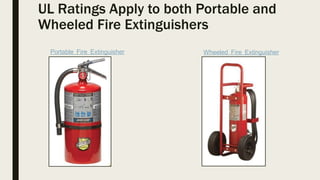
UL Ratings Apply to both Portable and
Wheeled Fire Extinguishers
Portable Fire Extinguisher Wheeled Fire Extinguisher
Universal UL Rating Symbol
What does UL Stand for?
■ UL stands for Underwriters Laboratories,
■ Underwriters Laboratories is a nonprofit organization dedicated to public safety.
■ Underwriters Laboratories (UL) performs product testing for evaluation of safety
risk and performance values on a vast variety of products.
■ Additionally, UL offers third-party certification when certain standards are met.
■ A UL listing on a product means that the product has been tested and determined
that it meets UL’s requirements which are based on nationally recognized safety
standards.
ANSI/UL 771: Rating and Fire Testing
of Fire Extinguishers
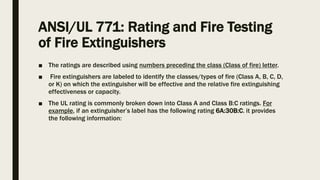
■ The ratings are described using numbers preceding the class (Class of fire) letter.
■ Fire extinguishers are labeled to identify the classes/types of fire (Class A, B, C, D,
or K) on which the extinguisher will be effective and the relative fire extinguishing
effectiveness or capacity.
■ The UL rating is commonly broken down into Class A and Class B:C ratings. For
example, if an extinguisher’s label has the following rating 6A:30B:C. it provides
the following information:
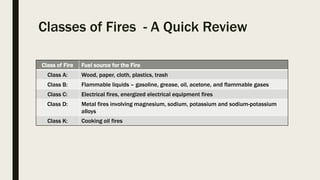
Classes of Fires - A Quick Review
Class of Fire Fuel source for the Fire
Class A: Wood, paper, cloth, plastics, trash
Class B: Flammable liquids – gasoline, grease, oil, acetone, and flammable gases
Class C: Electrical fires, energized electrical equipment fires
Class D: Metal fires involving magnesium, sodium, potassium and sodium-potassium
alloys
Class K: Cooking oil fires
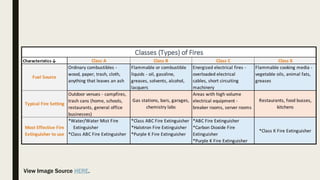
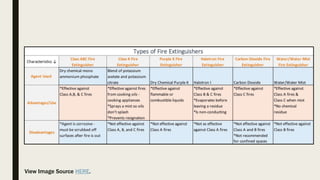
View Image Source HERE.
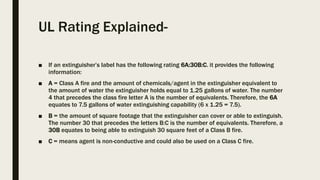
UL Rating Explained-
■ If an extinguisher’s label has the following rating 6A:30B:C. it provides the following
information:
■ A = Class A fire and the amount of chemicals/agent in the extinguisher equivalent to
the amount of water the extinguisher holds equal to 1.25 gallons of water. The number
4 that precedes the class fire letter A is the number of equivalents. Therefore, the 6A
equates to 7.5 gallons of water extinguishing capability (6 x 1.25 = 7.5).
■ B = the amount of square footage that the extinguisher can cover or able to extinguish.
The number 30 that precedes the letters B:C is the number of equivalents. Therefore, a
30B equates to being able to extinguish 30 square feet of a Class B fire.
■ C = means agent is non-conductive and could also be used on a Class C fire.
Additional Reading Sources
■ What Kind of Extinguisher Do I Need?
■ The Importance of Fire Extinguisher Tamper Seals
■ Understanding Portable Fire Extinguishers- Use and Limitations
■ Specifications For Wheeled Fire Extinguishers
■ Fire Extinguisher UL Ratings: What It Means
■ Fire Safety – Prevention, Early Warning & Emergency Plan Execution
■ How To Operate A Fire Extinguisher
■ Offshore Fire Extinguisher Placement & Protection

Understanding What UL Ratings Are

  • 1.
    FIRE EXTINGUISHER UL RATING: WHATIT MEANS OnlineSafetyDepot.com
  • 2.
    UL Ratings Applyto both Portable and Wheeled Fire Extinguishers Portable Fire Extinguisher Wheeled Fire Extinguisher
  • 3.
  • 4.
    What does ULStand for? ■ UL stands for Underwriters Laboratories, ■ Underwriters Laboratories is a nonprofit organization dedicated to public safety. ■ Underwriters Laboratories (UL) performs product testing for evaluation of safety risk and performance values on a vast variety of products. ■ Additionally, UL offers third-party certification when certain standards are met. ■ A UL listing on a product means that the product has been tested and determined that it meets UL’s requirements which are based on nationally recognized safety standards.
  • 5.
    ANSI/UL 771: Ratingand Fire Testing of Fire Extinguishers ■ The ratings are described using numbers preceding the class (Class of fire) letter. ■ Fire extinguishers are labeled to identify the classes/types of fire (Class A, B, C, D, or K) on which the extinguisher will be effective and the relative fire extinguishing effectiveness or capacity. ■ The UL rating is commonly broken down into Class A and Class B:C ratings. For example, if an extinguisher’s label has the following rating 6A:30B:C. it provides the following information:
  • 6.
    Classes of Fires- A Quick Review Class of Fire Fuel source for the Fire Class A: Wood, paper, cloth, plastics, trash Class B: Flammable liquids – gasoline, grease, oil, acetone, and flammable gases Class C: Electrical fires, energized electrical equipment fires Class D: Metal fires involving magnesium, sodium, potassium and sodium-potassium alloys Class K: Cooking oil fires
  • 7.
  • 8.
  • 9.
    UL Rating Explained- ■If an extinguisher’s label has the following rating 6A:30B:C. it provides the following information: ■ A = Class A fire and the amount of chemicals/agent in the extinguisher equivalent to the amount of water the extinguisher holds equal to 1.25 gallons of water. The number 4 that precedes the class fire letter A is the number of equivalents. Therefore, the 6A equates to 7.5 gallons of water extinguishing capability (6 x 1.25 = 7.5). ■ B = the amount of square footage that the extinguisher can cover or able to extinguish. The number 30 that precedes the letters B:C is the number of equivalents. Therefore, a 30B equates to being able to extinguish 30 square feet of a Class B fire. ■ C = means agent is non-conductive and could also be used on a Class C fire.
  • 10.
    Additional Reading Sources ■What Kind of Extinguisher Do I Need? ■ The Importance of Fire Extinguisher Tamper Seals ■ Understanding Portable Fire Extinguishers- Use and Limitations ■ Specifications For Wheeled Fire Extinguishers ■ Fire Extinguisher UL Ratings: What It Means ■ Fire Safety – Prevention, Early Warning & Emergency Plan Execution ■ How To Operate A Fire Extinguisher ■ Offshore Fire Extinguisher Placement & Protection