A Guide to Obseruatior,
participatior], and Reflection
in the Classroom
FIFTH EDITION


Arthea J.S. Reed
Unfi"rtity of I'lorthCarolinaat Asheville

Verna E. Bergemann
Uniu"rrityof Xinl, Carolinaat Asheville


   B o s t o n B u r r R i d g e , I L D u b u q u e , I A l v l a d i s o n ' W I N e w YLondon n F r a n c i s cMexico o u i s
                                                                               Lisbon      o r k S a Madrid       o S t . L city
                                                              Lumpur
      Bangkok Bogo-t5. Caracas ttl^t.
     MilarrMontrealNewDelhis"'.*g.s.o.,tsingaporeSydneyTaipeiToronto
tserving Questioning Techniquel
                                                                                                           canhelp
                                       foi'eii.amining.qu_estions byasked reachers' codingsystem
                                                                                          A
         Therearemanyapproaches                                *i[?o.*      o.r ,..hnique developed.     by N9r1is
         you examine   fie'rype.sof q,ro.iJr-;1.?l(.                            "        Bloom'Bloom's   cognrtlve
                                                             raxonomy     oFBenjamin
         sanders  (seeTabte based the cognicive
                            2.1),         on
                                                                                            ln ocherwords'under-
                                                                  fiil    i, r,i.r"r.rricar.
         raxonomy   assurnes deverop*..r, of cog.riti.rr.
                             rhar                                                           callsknowledge recall
                                                                                                            or
         standing concep*
                   of          Progresr.,   rro- r*olt ""lt"t*a'"g'*l1',Bloo*                        and interpreta-
                                                                             cailsthis transladon
          (Sanders callsdri; ,rrl*o.y), *if"^preh.eyr.on,(i*dti'                levels cognitiot T analysis'
                                                                                       of                       syn-
                                  knowledg..;d"t         labers .il;;gier
          tion) to morecomplex                                *or. .""r"pr* revers     oF,rrid.rr.anding is the abil-
                                                    to,
          fiesis,and evaruari,on. berweerr'rlr. "rra
                                  In
                                                                       *i newsituarions.      Broorns cognirive  tax-
                                      ones;il;;iro         probr.*,
          iry coappry(appiication)                                                                 olce high levels
                                                                                        is cyclical'.
                                                   irh. .h"r*no*r, knowledge
          onomyis diagrammed F!eu., t.i.
                                   in
                                                           individuarmusrbegin,o "id ro this
                                                                                                      knowledge    by
                                                        an
           of knowredge a concepr ,iri.".a,
                         of
                                        "r.                                                     1
          developing new concePts'
32   OBSERVITiG THE SCHOOLS
                IN
        '.f


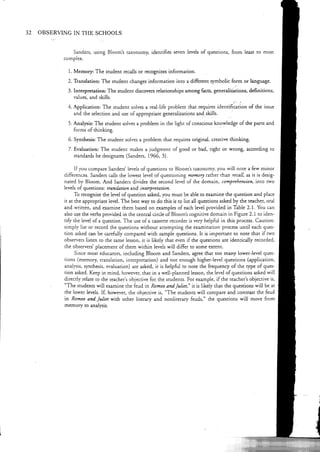
                 Sanders,using Bloomt raxonomy, identifies seven levelsoF questions, from least to
              complex.

                1. Memoryn The srudent recallsor recognizes
                                                          information.
               2. Tianslation: The srudent changesinformation into a different symbolic fo:- or language.

               3. Interpretation: The studenr discoversrelationshipsamong facts,generdizations,definitions,
                  values,and skills.

               4. Application: The student solvesa real-life problem that requiresidentification of fie issue
                  and r}reselectionand use of appropriate generalizationsan{.skifls

                5. Analysis:The student solvesa problem in the light oFconsciousknowledge of rhe paru and
                   forms of riinking.

                6. Synthesis:The student solvesa problem that requiresoriginal, creativethinking.

                7. Evaluation: The student makes a judgment of good or bad, right or wrong, according to
                   standards designates
                            he           (Sanders,1966, 3).

                    If you compareSanders'levels questionsto Blooms taxonomy,you will note a Fewminor
                                                    of
              differences.   Sanderscails the lowest level of questioningmemlry rather rhan recall,as it is desig-
              nated by Bloom. And Sandersdivides the second level of rhe domain, comprehensiott" wo        inro
              levels of questions: transhtion and interpretation.
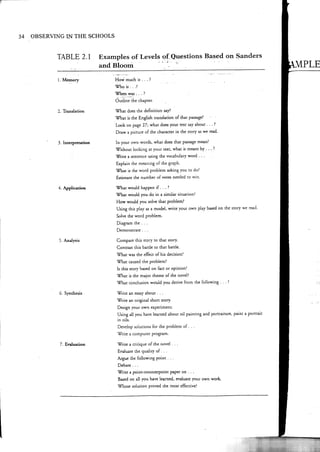
                    To recognize levelof question asked,you must be able to examinefie quesdon and place
                                   the
              it at r}reappropriatelevel.The besrway ro do this is to list all questionsaskedby r}reteacher,oral
              andwritten, and examinethem basedon examples eachlevelprovided inTable 2.1. You can
                                                                      of
              alsousethe verbsprovidedin the centralcircleof Bloomt cognitivedomain in Figure2.1 ro iden-
              tif' the level of a question.The useof a cassefte   recorderis very helpful in this process.Caution:
              simply list or recordthe questions   withour arremptingcheexaminationprocess          undl each ques-
              don askedcan be carefi.rlly    compared wifi sample questions.It is important to note *rat if two
              observers   listen to the samelesson, is likely rhat even if the questionsare identically recorded,
                                                    it
              the observers'   placementof them within levelswill differ to someextent.
                    Sincemost educarors,    including Bloom and Sanders,     agreethat too many lower-levelques-
              tions (memory translation,interpretation)and not enough higher-levelquestions(application,
              anall'sis,synthesis,evaluation) are asked,it is helpful to note the frequenry of the rype of ques-
              tion asked.   Keep in mind, however,   thar in a well-plannedlesson, levelof questionsaskedwill
                                                                                      the
              directly relateto the teacher's  objecrivcfor.the students.For exa.mple, the teacher's
                                                                                           if            objectiveis,
              "The studentswill examinethe feud in Romeo        and Juliet," it is likely that chequestionsu'ill be at
              the loq,er levels.If, however,the objective is, "The studentswill compare and contrast the feud
              in Romeoand Juliet with other literary and nonliterary feuds," the questions will move from
              memory ro analysis.
OBSERVING TEACHERS


              FIGURE2.1 Cognitive Behaviors and Verbs"
                                             Based on Bloom's                               Coguitive Domain


                                                                            Abiliry to rccall,co bring inro
                                                                            mind appropriatc matcrid, and                                              II. Comprchensivcncss
                                                                                knowledgc o[ spccGcs

rnd


                                                                                                                                 (Rcquirest.) Thc abitirYro
                         (uires  I, II, [[], M
                                                                              oudinc, disringuish,mcmo-                            cekca wrirten or oral com-
jto                     and V.) Abiliry to makc
                                                                              rizc, recognizc, rccirc, abu-                               municarion        and makc usc
                       fudgmena about quali-                                   lece,idenrifr, nemc, ordec                                   of the idcas it conrains
                     ry ,"elucs,proccduces
                     mcrhods, etc, b),
                                                                                                                                                orher idcas or marerials
tnor                Lrsingr.hcapgropri-
                                                                                                                                                 or scc Fullcsc meening'
'<is-              arc crircrir                                                                                grup,   rnrutatc, e)Grn-
                                             arguc, asscss, judgc,
                                                                                                               ine, disctrss, classifu'
                                             sclccr. cr-ahnrc, solve,
 rwo                                                                                                           interpcec, dcscribe, illus-
                                             weigh, raluc,     apPrr'isc,
                                                                                             I                   trare. escimate, cxPlain
                                              Pfove
rlace
                                                                                   COGNITTVE
 oral                                                                               DOIvIAIN                                                            (Rcquir3sI
   can                                                                                                                                                 3 <i l . J .  o r . i n
                (uircs I, U, m,              c.onstmcr,   comPosc'                                             sotve, usc, predicr,
ien-            and IV.) Thc abiliry                                                                            rclarc, epol.v, diegrrrn.              to   '-f-{c   .l :lc*
                                              organizc, dcsign' crcerc'
                                                                                                                                                   2robtc:n, :Gcl. lr:nc:
tion:            to pur rogedrcr clc-         plan. pcrform,     Predicr
                                                                                                                d-raw, dcrronsr;lte
                                   to [orm                                                                                                        pie, cr ::'lcc;-t. :jla isc
rr leq-          mcnci or parc
t..-"                         organizrdoo                                                                                                       in :' ncJ        5ieJ:':ion
                  a unificd
: rwo                                                                              cornoare, conr3sr.
                  or wholc-
-; -A                                                                             dcrivc, organizc'   crens-

                                                                               hrc. discover,causc& eftct,
                                                                               diffcrenrietc, scc rczrcns whY,
i r r e q -                                                                           scc reledorshiPs


a l I PQ-


j *ill                                                            (Rcquircs t, li, and III.) Abiliqf ro break down a
                                                                    communicarion or maccrial into componcnt
rveis,                                                             parb and ro.dctcct rJrcrclacionship o[ rhc para
 be at                                                                          the waY thcY erc organizcd'

, ieud
 :rom

                                                                       .: -              tV. Ana.lysis


                                                                        :
                    This diagram idencifiesand explains the six.levels o[cognitive behaviors;it also givesa sa'm-
                                                                          evaluadon to the proPer levelof cogni-
               ple list of ',r.ib, *rat may be used in reladng behavioral
               tive behavior.                   . r. : : :'          i


                                                                                                                                      oFField Experienccs
               ,Adaprcd by Sanchon s. Funlq J.Fr"rr L Hoffin;;'An"c Keidrley, and Brucc E- tong of rhc Florida Satc univcrsiry office
                                                                                                 Longman S. Green and company, lnc.' 1985'
               from Bcnjamin Broom er a- tJl,  Tannom of Eduatun ohjcciua, agnitirc Donzit,
34 OBSERVING IN THE SCHOOLS


          TABLE 2.1           Examples of Levels of,Questions Based on Sanders
                                               "'' ' '.. a-
                              and Bloom

          1. Memory               Howmuchis...?
                                  Vhg is  ?
                                  '!7henwas...?

                                  O",tln.     il,. chapter.

          2. Tiznslation          What does the definition say?
                                  What is the English translation of thar passage?
                                  look on page27; what does your text say about . . . ?
                                  Draw a picture of the character in the story as we read.

          3. Inteqpretation       In your own words, what does that passagemean?
                                  'Wirlout
                                           looking ac your tcxt, what is meant by ' . -.?
                                   Write a sentence using *re vocabulary word . . .
                                   Explain the meaning of fie graPh.
                                   'lfhat
                                          is rhe word probiem asking you to do?
                                   Estimate the number of votes needed to win.
                                   'What
           4. Application                would happen if . . - ?
                                   '$Chat
                                          would you do in a similar situation?
                                   How would you solve that problem?
                                   Using this play as a model, write your own play based on rhe story we read.
                                   Solve *re word problem.
                                   Diagramthe...
                                   Demonstrate . . .

           5. Analysis             Compare this story to that story.
                                   Consast this batde to that banle.
                                   'lChat
                                          was the effect of his decision?
                                   7'har caused the problem?
                                   Is this story based on facr or opinion?
                                   'What
                                           is the major chemc of the novel?
                                   'lfhat
                                           conclusion would you derive from the following .
                                   'Write
           6. Svnthesis                      an essayabout . . .
                                   'lZrirc
                                             an original shon srory.
                                   Design your own experiment.
                                   Using all you have learned about oil painting and ponraiture, paint a portrait
                                   in oils.
                                   Develop soiutions for the problem of . . .
                                   'lfrite
                                           a computer program.

                                   'Write
           7. Evaluation                     a critiquc of rhe novel . . .
                                   Evaluate dre qualiry of . . .
                                   Atgr.     che following point . . .
                                   Debate . . .
                                   'Writc
                                          a point-counterpoint       PaPer on . . .
                                    Based on all you have learned, evaluate your own work.
                                   Vhose solution proved tie most effecdve?

Questioning Techniques.PDF

  • 1.
    A Guide toObseruatior, participatior], and Reflection in the Classroom FIFTH EDITION Arthea J.S. Reed Unfi"rtity of I'lorthCarolinaat Asheville Verna E. Bergemann Uniu"rrityof Xinl, Carolinaat Asheville B o s t o n B u r r R i d g e , I L D u b u q u e , I A l v l a d i s o n ' W I N e w YLondon n F r a n c i s cMexico o u i s Lisbon o r k S a Madrid o S t . L city Lumpur Bangkok Bogo-t5. Caracas ttl^t. MilarrMontrealNewDelhis"'.*g.s.o.,tsingaporeSydneyTaipeiToronto
  • 2.
    tserving Questioning Techniquel canhelp foi'eii.amining.qu_estions byasked reachers' codingsystem A Therearemanyapproaches *i[?o.* o.r ,..hnique developed. by N9r1is you examine fie'rype.sof q,ro.iJr-;1.?l(. " Bloom'Bloom's cognrtlve raxonomy oFBenjamin sanders (seeTabte based the cognicive 2.1), on ln ocherwords'under- fiil i, r,i.r"r.rricar. raxonomy assurnes deverop*..r, of cog.riti.rr. rhar callsknowledge recall or standing concep* of Progresr., rro- r*olt ""lt"t*a'"g'*l1',Bloo* and interpreta- cailsthis transladon (Sanders callsdri; ,rrl*o.y), *if"^preh.eyr.on,(i*dti' levels cognitiot T analysis' of syn- knowledg..;d"t labers .il;;gier tion) to morecomplex *or. .""r"pr* revers oF,rrid.rr.anding is the abil- to, fiesis,and evaruari,on. berweerr'rlr. "rra In *i newsituarions. Broorns cognirive tax- ones;il;;iro probr.*, iry coappry(appiication) olce high levels is cyclical'. irh. .h"r*no*r, knowledge onomyis diagrammed F!eu., t.i. in individuarmusrbegin,o "id ro this knowledge by an of knowredge a concepr ,iri.".a, of "r. 1 developing new concePts'
  • 3.
    32 OBSERVITiG THE SCHOOLS IN '.f Sanders,using Bloomt raxonomy, identifies seven levelsoF questions, from least to complex. 1. Memoryn The srudent recallsor recognizes information. 2. Tianslation: The srudent changesinformation into a different symbolic fo:- or language. 3. Interpretation: The studenr discoversrelationshipsamong facts,generdizations,definitions, values,and skills. 4. Application: The student solvesa real-life problem that requiresidentification of fie issue and r}reselectionand use of appropriate generalizationsan{.skifls 5. Analysis:The student solvesa problem in the light oFconsciousknowledge of rhe paru and forms of riinking. 6. Synthesis:The student solvesa problem that requiresoriginal, creativethinking. 7. Evaluation: The student makes a judgment of good or bad, right or wrong, according to standards designates he (Sanders,1966, 3). If you compareSanders'levels questionsto Blooms taxonomy,you will note a Fewminor of differences. Sanderscails the lowest level of questioningmemlry rather rhan recall,as it is desig- nated by Bloom. And Sandersdivides the second level of rhe domain, comprehensiott" wo inro levels of questions: transhtion and interpretation. To recognize levelof question asked,you must be able to examinefie quesdon and place the it at r}reappropriatelevel.The besrway ro do this is to list all questionsaskedby r}reteacher,oral andwritten, and examinethem basedon examples eachlevelprovided inTable 2.1. You can of alsousethe verbsprovidedin the centralcircleof Bloomt cognitivedomain in Figure2.1 ro iden- tif' the level of a question.The useof a cassefte recorderis very helpful in this process.Caution: simply list or recordthe questions withour arremptingcheexaminationprocess undl each ques- don askedcan be carefi.rlly compared wifi sample questions.It is important to note *rat if two observers listen to the samelesson, is likely rhat even if the questionsare identically recorded, it the observers' placementof them within levelswill differ to someextent. Sincemost educarors, including Bloom and Sanders, agreethat too many lower-levelques- tions (memory translation,interpretation)and not enough higher-levelquestions(application, anall'sis,synthesis,evaluation) are asked,it is helpful to note the frequenry of the rype of ques- tion asked. Keep in mind, however, thar in a well-plannedlesson, levelof questionsaskedwill the directly relateto the teacher's objecrivcfor.the students.For exa.mple, the teacher's if objectiveis, "The studentswill examinethe feud in Romeo and Juliet," it is likely that chequestionsu'ill be at the loq,er levels.If, however,the objective is, "The studentswill compare and contrast the feud in Romeoand Juliet with other literary and nonliterary feuds," the questions will move from memory ro analysis.
  • 4.
    OBSERVING TEACHERS FIGURE2.1 Cognitive Behaviors and Verbs" Based on Bloom's Coguitive Domain Abiliry to rccall,co bring inro mind appropriatc matcrid, and II. Comprchensivcncss knowledgc o[ spccGcs rnd (Rcquirest.) Thc abitirYro (uires I, II, [[], M oudinc, disringuish,mcmo- cekca wrirten or oral com- jto and V.) Abiliry to makc rizc, recognizc, rccirc, abu- municarion and makc usc fudgmena about quali- lece,idenrifr, nemc, ordec of the idcas it conrains ry ,"elucs,proccduces mcrhods, etc, b), orher idcas or marerials tnor Lrsingr.hcapgropri- or scc Fullcsc meening' '<is- arc crircrir grup, rnrutatc, e)Grn- arguc, asscss, judgc, ine, disctrss, classifu' sclccr. cr-ahnrc, solve, rwo interpcec, dcscribe, illus- weigh, raluc, apPrr'isc, I trare. escimate, cxPlain Pfove rlace COGNITTVE oral DOIvIAIN (Rcquir3sI can 3 <i l . J . o r . i n (uircs I, U, m, c.onstmcr, comPosc' sotve, usc, predicr, ien- and IV.) Thc abiliry rclarc, epol.v, diegrrrn. to '-f-{c .l :lc* organizc, dcsign' crcerc' 2robtc:n, :Gcl. lr:nc: tion: to pur rogedrcr clc- plan. pcrform, Predicr d-raw, dcrronsr;lte to [orm pie, cr ::'lcc;-t. :jla isc rr leq- mcnci or parc t..-" organizrdoo in :' ncJ 5ieJ:':ion a unificd : rwo cornoare, conr3sr. or wholc- -; -A dcrivc, organizc' crens- hrc. discover,causc& eftct, diffcrenrietc, scc rczrcns whY, i r r e q - scc reledorshiPs a l I PQ- j *ill (Rcquircs t, li, and III.) Abiliqf ro break down a communicarion or maccrial into componcnt rveis, parb and ro.dctcct rJrcrclacionship o[ rhc para be at the waY thcY erc organizcd' , ieud :rom .: - tV. Ana.lysis : This diagram idencifiesand explains the six.levels o[cognitive behaviors;it also givesa sa'm- evaluadon to the proPer levelof cogni- ple list of ',r.ib, *rat may be used in reladng behavioral tive behavior. . r. : : :' i oFField Experienccs ,Adaprcd by Sanchon s. Funlq J.Fr"rr L Hoffin;;'An"c Keidrley, and Brucc E- tong of rhc Florida Satc univcrsiry office Longman S. Green and company, lnc.' 1985' from Bcnjamin Broom er a- tJl, Tannom of Eduatun ohjcciua, agnitirc Donzit,
  • 5.
    34 OBSERVING INTHE SCHOOLS TABLE 2.1 Examples of Levels of,Questions Based on Sanders "'' ' '.. a- and Bloom 1. Memory Howmuchis...? Vhg is ? '!7henwas...? O",tln. il,. chapter. 2. Tiznslation What does the definition say? What is the English translation of thar passage? look on page27; what does your text say about . . . ? Draw a picture of the character in the story as we read. 3. Inteqpretation In your own words, what does that passagemean? 'Wirlout looking ac your tcxt, what is meant by ' . -.? Write a sentence using *re vocabulary word . . . Explain the meaning of fie graPh. 'lfhat is rhe word probiem asking you to do? Estimate the number of votes needed to win. 'What 4. Application would happen if . . - ? '$Chat would you do in a similar situation? How would you solve that problem? Using this play as a model, write your own play based on rhe story we read. Solve *re word problem. Diagramthe... Demonstrate . . . 5. Analysis Compare this story to that story. Consast this batde to that banle. 'lChat was the effect of his decision? 7'har caused the problem? Is this story based on facr or opinion? 'What is the major chemc of the novel? 'lfhat conclusion would you derive from the following . 'Write 6. Svnthesis an essayabout . . . 'lZrirc an original shon srory. Design your own experiment. Using all you have learned about oil painting and ponraiture, paint a portrait in oils. Develop soiutions for the problem of . . . 'lfrite a computer program. 'Write 7. Evaluation a critiquc of rhe novel . . . Evaluate dre qualiry of . . . Atgr. che following point . . . Debate . . . 'Writc a point-counterpoint PaPer on . . . Based on all you have learned, evaluate your own work. Vhose solution proved tie most effecdve?