Understanding the Volunteer in VGIChristopher J. ParkerSpatial SocialCultural Knowledge Workshop 15 June 2010
OverviewThe language of Volunteered Geographic InformationWhy human factors?Current workFuture workSummaryDiscussion2
Overview3
Overview4
1	The Language of VGI5
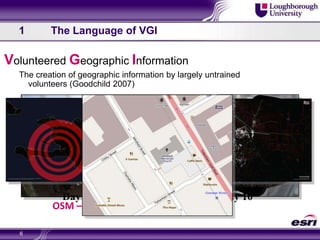
61	The Language of VGIVolunteered Geographic Information The creation of geographic information by largely untrained volunteers (Goodchild 2007)Day 0Day 10OSM – State of the Map 20096
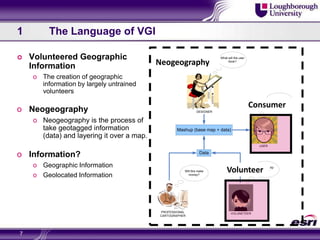
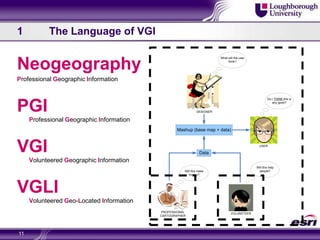
1	The Language of VGIVolunteered Geographic Information The creation of geographic information by largely untrained volunteersNeogeographyNeogeography is the process of take geotagged information (data) and layering it over a map. Information?Geographic InformationGeolocated Information7NeogeographyConsumerVolunteer
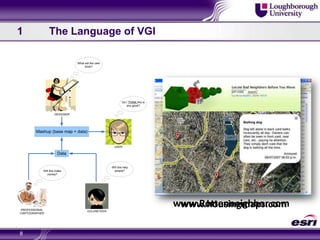
1	The Language of VGI8www.Rottenneighbor.comwww.housingmaps.com
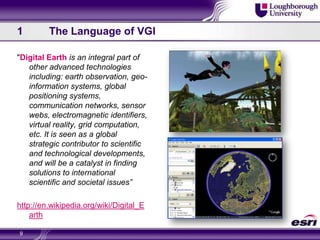
1	The Language of VGI"Digital Earth is an integral part of other advanced technologies including: earth observation, geo-information systems, global positioning systems, communication networks, sensor webs, electromagnetic identifiers, virtual reality, grid computation, etc. It is seen as a global strategic contributor to scientific and technological developments, and will be a catalyst in finding solutions to international scientific and societal issues”http://en.wikipedia.org/wiki/Digital_Earth9
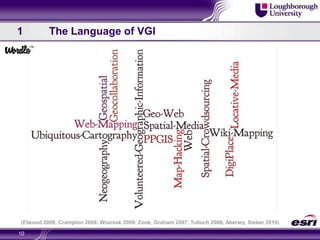
1	The Language of VGI10(Elwood 2008; Crampton 2008; Wozniak 2009; Zook, Graham 2007; Tulloch 2008; Aberley, Sieber 2010)
1	The Language of VGINeogeographyPGIProfessional Geographic InformationVGIVolunteered Geographic InformationVGLIVolunteered Geo-Located Information11
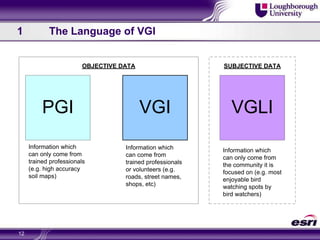
1	The Language of VGI12
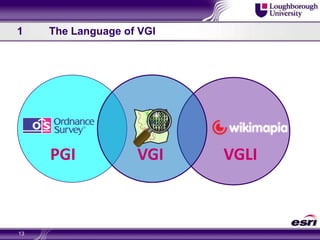
1	The Language of VGI13PGIVGIVGLI
2	Why Research Human Factors?14
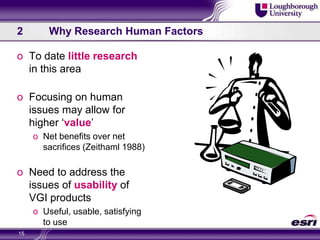
2	Why Research Human FactorsTo date little research in this areaFocusing on human issues may allow for higher ‘value’Net benefits over net sacrifices (Zeithaml 1988)Need to address the issues of usability of VGI productsUseful, usable, satisfying to use15
2	Why Research Human FactorsUsability A set of attributes that bear on the effort needed for use, and on the individual assessment of such use, by a stated or implied set of users (ISO 9126)Human FactorsA philosophy based on the needs and interests of the user, with an emphasis on making products usable and understandable (Norman 2002)16
3	Current Research17
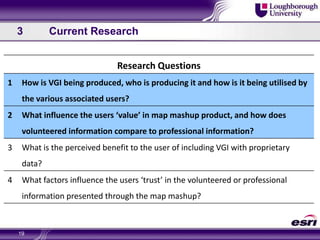
3	Current ResearchThe nature of VGI usersWho is producing VGI?What are the relationships between users?What data flow exists between users?The value of VGI to usersWhat perceptual benefits may be received from the use of VGI?What concerns or tensions are felt by users of VGI which may affect the user experience of VGI systems?How do different types of users perceive the information they are producing/ utilising?How do the theories of consumer value associate with user perceptions of VGI?18
3	Current Research19
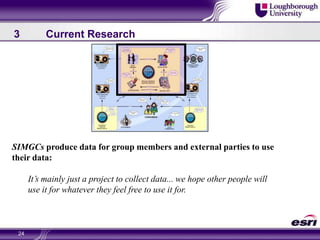
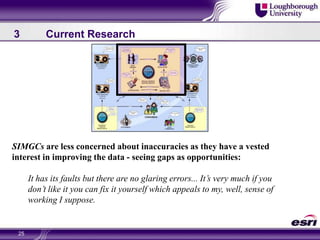
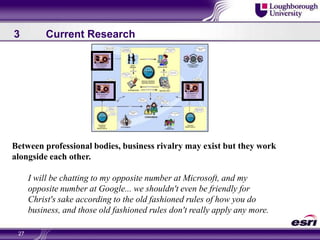
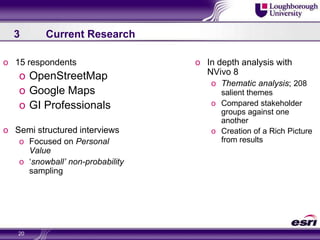
203	Current Research15 respondents OpenStreetMapGoogle MapsGI ProfessionalsSemi structured interviewsFocused on Personal Value‘snowball’ non-probability samplingIn depth analysis with NVivo 8Thematic analysis; 208 salient themesCompared stakeholder groups against one anotherCreation of a Rich Picture from results20
213	Current Research
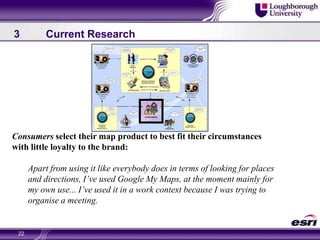
223	Current ResearchConsumers select their map product to best fit their circumstances with little loyalty to the brand: Apart from using it like everybody does in terms of looking for places and directions, I’ve used Google My Maps, at the moment mainly for my own use... I’ve used it in a work context because I was trying to organise a meeting.
233	Current ResearchSpecial Interest Mapping Groups (SIMGs), contributors (SIMGCs) and professionals are particularly vested in the use of their groups’ map:I’ll often check out to see if the local CTC has a website [same map project involved in] to see what’s on there. And being able to find where the tea places are in the locality is quite useful.
243	Current ResearchSIMGCs produce data for group members and external parties to use their data:It’s mainly just a project to collect data... we hope other people will use it for whatever they feel free to use it for.
253	Current ResearchSIMGCs are less concerned about inaccuracies as they have a vested interest in improving the data - seeing gaps as opportunities:It has its faults but there are no glaring errors... It’s very much if you don’t like it you can fix it yourself which appeals to my, well, sense of working I suppose.
263	Current ResearchSIMGs and professionals can be in constant tension with each other as their agendas and ideologies do not necessarily fit with each other. It kind of annoys me that Google are potentially using the same kind of idea. [OpenStreetMap SIMGC]
273	Current ResearchBetween professional bodies, business rivalry may exist but they work alongside each other. I will be chatting to my opposite number at Microsoft, and my opposite number at Google... we shouldn't even be friendly for Christ's sake according to the old fashioned rules of how you do business, and those old fashioned rules don't really apply any more.
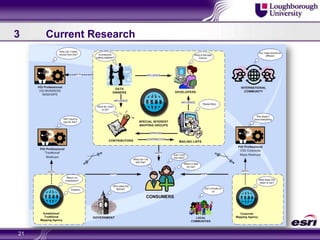
3	Current ResearchThe main stakeholder groups are identifiedConsumers, Special Interest Mapping GroupsLocal Communities ProfessionalsThe Rich Picture effectively provided context to the research outcomes and represented stakeholder relationships in an easily accessible fashion. Different stakeholders will perceive elements of VGI very differently, based on which stakeholder group they may be identified with.If considering value as the improvement to a stakeholder’s condition through utilising VGI, a salient increase in stakeholder value can be observed in all functional and work related perceptionsThe implication of this work should be to provide a framework of VGI stakeholders to be utilised within future user-centred VGI research 2828
4	Future Research29
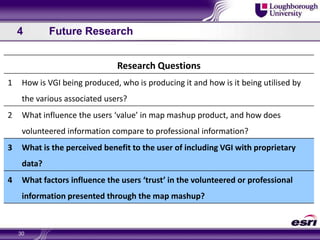
4	Future Research30
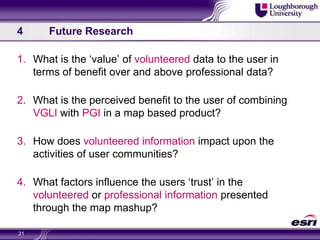
4	Future ResearchWhat is the ‘value’ of volunteered data to the user in terms of benefit over and above professional data?What is the perceived benefit to the user of combining VGLI with PGI in a map based product?How does volunteered information impact upon the activities of user communities?What factors influence the users ‘trust’ in the volunteered or professional information presented through the map mashup?31
4	Future Research
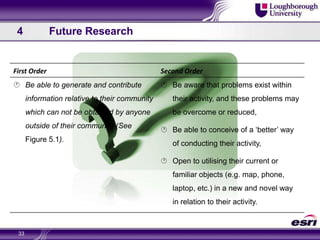
4	Future Research33
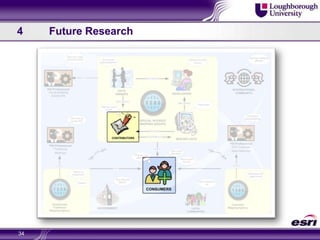
4	Future Research34
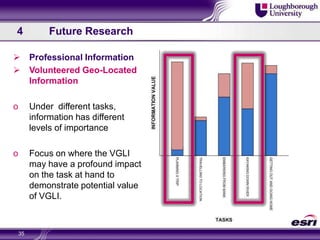
4	Future Research35Professional Information
Volunteered Geo-Located Information
Under  different tasks, information has different levels of importance
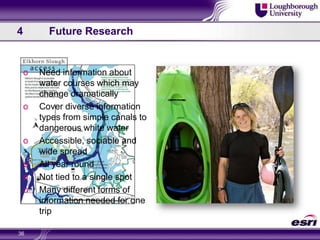
Focus on where the VGLI may have a profound impact on the task at hand to demonstrate potential value of VGLI.4	Future Research36Need information about water courses which may change dramaticallyCover diverse information types from simple canals to dangerous white waterAccessible, sociable and wide spreadAll year roundNot tied to a single spotMany different forms of information needed for one trip
4	Future Research37
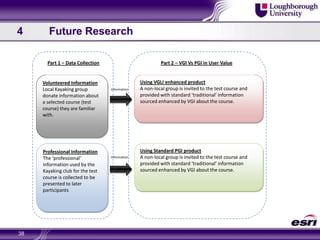
4	Future Research38Part 1 – Data CollectionPart 2 – VGI Vs PGI in User ValueVolunteered InformationLocal Kayaking group donate information about a selected course (test course) they are familiar with.Using VGLI enhanced productA non-local group is invited to the test course and provided with standard ‘traditional’ information sourced enhanced by VGI about the course.InformationUsing Standard PGI productA non-local group is invited to the test course and provided with standard ‘traditional’ information sourced enhanced by VGI about the course.Professional InformationThe ‘professional’ information used by the Kayaking club for the test course is collected to be presented to later participantsInformation
5	Summary39
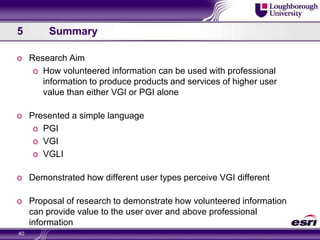
5	SummaryResearch AimHow volunteered information can be used with professional information to produce products and services of higher user value than either VGI or PGI alonePresented a simple languagePGIVGIVGLIDemonstrated how different user types perceive VGI differentProposal of research to demonstrate how volunteered information can provide value to the user over and above professional information40

Understanding the Volunteer in VGI

  • 1.
    Understanding the Volunteerin VGIChristopher J. ParkerSpatial SocialCultural Knowledge Workshop 15 June 2010
  • 2.
    OverviewThe language ofVolunteered Geographic InformationWhy human factors?Current workFuture workSummaryDiscussion2
  • 3.
  • 4.
  • 5.
  • 6.
    61 The Language ofVGIVolunteered Geographic Information The creation of geographic information by largely untrained volunteers (Goodchild 2007)Day 0Day 10OSM – State of the Map 20096
  • 7.
    1 The Language ofVGIVolunteered Geographic Information The creation of geographic information by largely untrained volunteersNeogeographyNeogeography is the process of take geotagged information (data) and layering it over a map. Information?Geographic InformationGeolocated Information7NeogeographyConsumerVolunteer
  • 8.
    1 The Language ofVGI8www.Rottenneighbor.comwww.housingmaps.com
  • 9.
    1 The Language ofVGI"Digital Earth is an integral part of other advanced technologies including: earth observation, geo-information systems, global positioning systems, communication networks, sensor webs, electromagnetic identifiers, virtual reality, grid computation, etc. It is seen as a global strategic contributor to scientific and technological developments, and will be a catalyst in finding solutions to international scientific and societal issues”http://en.wikipedia.org/wiki/Digital_Earth9
  • 10.
    1 The Language ofVGI10(Elwood 2008; Crampton 2008; Wozniak 2009; Zook, Graham 2007; Tulloch 2008; Aberley, Sieber 2010)
  • 11.
    1 The Language ofVGINeogeographyPGIProfessional Geographic InformationVGIVolunteered Geographic InformationVGLIVolunteered Geo-Located Information11
  • 12.
  • 13.
    1 The Language ofVGI13PGIVGIVGLI
  • 14.
  • 15.
    2 Why Research HumanFactorsTo date little research in this areaFocusing on human issues may allow for higher ‘value’Net benefits over net sacrifices (Zeithaml 1988)Need to address the issues of usability of VGI productsUseful, usable, satisfying to use15
  • 16.
    2 Why Research HumanFactorsUsability A set of attributes that bear on the effort needed for use, and on the individual assessment of such use, by a stated or implied set of users (ISO 9126)Human FactorsA philosophy based on the needs and interests of the user, with an emphasis on making products usable and understandable (Norman 2002)16
  • 17.
  • 18.
    3 Current ResearchThe natureof VGI usersWho is producing VGI?What are the relationships between users?What data flow exists between users?The value of VGI to usersWhat perceptual benefits may be received from the use of VGI?What concerns or tensions are felt by users of VGI which may affect the user experience of VGI systems?How do different types of users perceive the information they are producing/ utilising?How do the theories of consumer value associate with user perceptions of VGI?18
  • 19.
  • 20.
    203 Current Research15 respondentsOpenStreetMapGoogle MapsGI ProfessionalsSemi structured interviewsFocused on Personal Value‘snowball’ non-probability samplingIn depth analysis with NVivo 8Thematic analysis; 208 salient themesCompared stakeholder groups against one anotherCreation of a Rich Picture from results20
  • 21.
  • 22.
    223 Current ResearchConsumers selecttheir map product to best fit their circumstances with little loyalty to the brand: Apart from using it like everybody does in terms of looking for places and directions, I’ve used Google My Maps, at the moment mainly for my own use... I’ve used it in a work context because I was trying to organise a meeting.
  • 23.
    233 Current ResearchSpecial InterestMapping Groups (SIMGs), contributors (SIMGCs) and professionals are particularly vested in the use of their groups’ map:I’ll often check out to see if the local CTC has a website [same map project involved in] to see what’s on there. And being able to find where the tea places are in the locality is quite useful.
  • 24.
    243 Current ResearchSIMGCs producedata for group members and external parties to use their data:It’s mainly just a project to collect data... we hope other people will use it for whatever they feel free to use it for.
  • 25.
    253 Current ResearchSIMGCs areless concerned about inaccuracies as they have a vested interest in improving the data - seeing gaps as opportunities:It has its faults but there are no glaring errors... It’s very much if you don’t like it you can fix it yourself which appeals to my, well, sense of working I suppose.
  • 26.
    263 Current ResearchSIMGs andprofessionals can be in constant tension with each other as their agendas and ideologies do not necessarily fit with each other. It kind of annoys me that Google are potentially using the same kind of idea. [OpenStreetMap SIMGC]
  • 27.
    273 Current ResearchBetween professionalbodies, business rivalry may exist but they work alongside each other. I will be chatting to my opposite number at Microsoft, and my opposite number at Google... we shouldn't even be friendly for Christ's sake according to the old fashioned rules of how you do business, and those old fashioned rules don't really apply any more.
  • 28.
    3 Current ResearchThe mainstakeholder groups are identifiedConsumers, Special Interest Mapping GroupsLocal Communities ProfessionalsThe Rich Picture effectively provided context to the research outcomes and represented stakeholder relationships in an easily accessible fashion. Different stakeholders will perceive elements of VGI very differently, based on which stakeholder group they may be identified with.If considering value as the improvement to a stakeholder’s condition through utilising VGI, a salient increase in stakeholder value can be observed in all functional and work related perceptionsThe implication of this work should be to provide a framework of VGI stakeholders to be utilised within future user-centred VGI research 2828
  • 29.
  • 30.
  • 31.
    4 Future ResearchWhat isthe ‘value’ of volunteered data to the user in terms of benefit over and above professional data?What is the perceived benefit to the user of combining VGLI with PGI in a map based product?How does volunteered information impact upon the activities of user communities?What factors influence the users ‘trust’ in the volunteered or professional information presented through the map mashup?31
  • 32.
  • 33.
  • 34.
  • 35.
  • 36.
  • 37.
    Under differenttasks, information has different levels of importance
  • 38.
    Focus on wherethe VGLI may have a profound impact on the task at hand to demonstrate potential value of VGLI.4 Future Research36Need information about water courses which may change dramaticallyCover diverse information types from simple canals to dangerous white waterAccessible, sociable and wide spreadAll year roundNot tied to a single spotMany different forms of information needed for one trip
  • 39.
  • 40.
    4 Future Research38Part 1– Data CollectionPart 2 – VGI Vs PGI in User ValueVolunteered InformationLocal Kayaking group donate information about a selected course (test course) they are familiar with.Using VGLI enhanced productA non-local group is invited to the test course and provided with standard ‘traditional’ information sourced enhanced by VGI about the course.InformationUsing Standard PGI productA non-local group is invited to the test course and provided with standard ‘traditional’ information sourced enhanced by VGI about the course.Professional InformationThe ‘professional’ information used by the Kayaking club for the test course is collected to be presented to later participantsInformation
  • 41.
  • 42.
    5 SummaryResearch AimHow volunteeredinformation can be used with professional information to produce products and services of higher user value than either VGI or PGI alonePresented a simple languagePGIVGIVGLIDemonstrated how different user types perceive VGI differentProposal of research to demonstrate how volunteered information can provide value to the user over and above professional information40

Editor's Notes

  • #3 Next slide – who I am and what I DO
  • #4 Research potential impact of volunteered data that professional data can not provideIdeas in Transit + Loughborough UniversityResearch how VGI and traditional Cartography can be combined together to produce new forms of map based productsNot in the computer science sense of ‘can we do it’ but in the human factors sense of creating products of higher worth and ‘enjoyment’ to consumers than either VGI or professional information alone.In the last year I have been out researching this with various groups and attending conferences such as State of the Map 2009 and 1st Geograph conference.
  • #5 How volunteered information can be used with professional information to produce products and services of higher user value than either VGI or PGI aloneThese are the gaps in known literature I will address
  • #6 Quick recap of what VGI isthe problems with naming phenomenon in the literatureMy address of the situation
  • #8 General overview of Neogeography and VGI
  • #11 Some of the 14 names used to describe the Neogeography Phenomenon
  • #13 NEOGEOGRAPHY IS THE ENTIRE THINGVGI is similar to PGI (OSM being open source Ordnance Survey)Within potential scope of traditional cartographyVGLI is something different from both – can only come from communityOutside of traditional cartographyVGLI – birdwatchers
  • #14 Overlap between PGI (Ordnance Survey), VGI (OpenStreetMap) and VGLI (Rotten Neighbours)
  • #16 Lots of work in:Santa Barbara (USA)UCL (UK)Bonn (Germany)Etc.
  • #17 Clear up two terms which are different but complimentary
  • #19 Aims of the research – starting out almost blank in October 2008At the start of this study, the position of human factors within VGI, and associated elements of User-centred Design may be considered unknown.Distinct lack of human factors research into VGI (Harding, Sharples et al. 2009)
  • #20 We have seen these Research Questions beforeFocus on VGI in the strictest state, OpenStreetMapNext slide go over methods used in addressing these two issues
  • #22 Rich Picture – Monk & Howard
  • #28 LAST SLIDE ON THE FINDINGS – summary next
  • #31 Tackle the other research questions
  • #32 Research Aims#1 most important in shaping studyDirects us towards focusing on VGLI rather than VGI
  • #34 Where to start – finding a communityPoints – what will make a good communityComing up – rich picture then Andy’s drawing
  • #36 Click for the shapes to appear
  • #37 difficulty of courses, parking spots, landing points and local amenities. Information on course may depend on water levels which may change rapidly over a 24 hour period.Their results should be transferable to other groups who use ‘dynamic data’NEXT SLIDE – REMINDER OF CONDITIONS REQUIRED
  • #38 Highlight how Kayakers fit the requirements
  • #39 Diagram to show
  • #41 4 main points
  • #42 Today’s slides are already online on the blogDiscussion points- What do you think of VGLI