Understanding
the Primary
Goal of
Exploratory
Data Analysis
Introduction:
Exploratory data analysis (EDA) is a
crucial step in the data science process.
Scientists and data analysts use it to
evaluate and condense datasets in
order to find trends, identify anomalies,
and test theories. Gaining an
understanding of EDA's main objective
can greatly improve your data analysis
abilities and produce more precise and
perceptive results. Join one of the
online financial modelling courses for a
better understanding at EDA.
We shall explore the core principles and
goals of EDA in this blog.
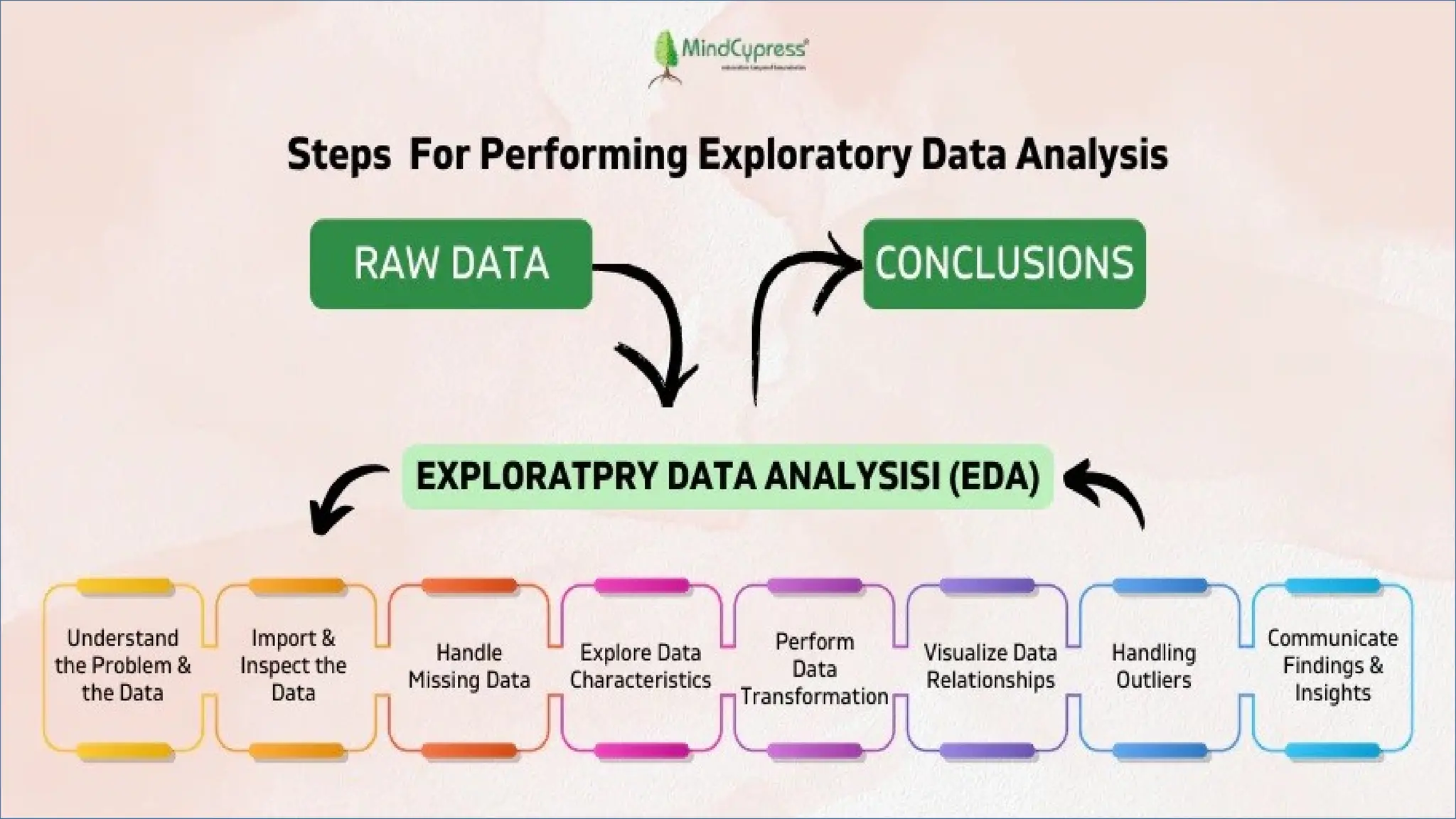
What is Exploratory Data Analysis?
The initial examination of data to identify its
underlying structure, extract significant
variables, and find outliers and anomalies is
known as exploratory data analysis. To
comprehend the dataset more fully, statistical
graphics and other techniques for data
visualization are used. EDA is about learning
what the data can tell us, not about verifying
theories.
The Primary Goal of Exploratory Data
Analysis
The primary goal of EDA is ensuring the data
is suitable for further analysis and modeling.
This accomplishes several crucial objectives:
Understanding Data Structure
Understanding the fundamental distribution
and structure of the data is aided by EDA.
Analysts can determine whether the data is
suitable for the planned analysis and of a
sufficient quality by summarizing its key
features, frequently using visual aids.
Examining the many kinds of variables
(numerical or categorical), ranges, and
distributions are all part of this. Aspirants join
online financial modelling courses to learn
more about data structure.
Identifying Patterns and Relationships
The ability to recognize patterns, trends, and
relationships in the data is a crucial
component of EDA. This entails looking at the
relationships between various variables and
determining whether there are any clear
patterns over time or between categories.
For example, bar charts can display
comparisons among categorical variables,
whereas scatter plots can indicate correlations
between numerical variables. Joining top
financial modelling classes can help you with
relevant skills for the same.
Detecting Anomalies and Outliers
Anomalies and outliers can have a significant
impact on the results of data analysis. These
odd data points, which may hint to mistakes in
data entry or collection or other underlying
problems, are easier to find with EDA's
assistance.
In order to guarantee the precision and
dependability of the analysis, it is necessary to
tackle these irregularities. Aspirants can learn
how to tackle the irregularities through
reputed financial modelling certification
classes.
Assessing Data Quality
For any analysis, the quality of the data is
crucial. EDA allows analysts to search for
mistakes, inconsistencies, and missing values
in the dataset.
This evaluation makes it possible to clean and
prepare the data, which is essential before
using more sophisticated analytical methods
or creating predictive models.
Formulating Hypotheses
EDA is essential for generating hypotheses
even though it is not about testing them.
Analysts can create new questions and
hypotheses by examining the data, which can
then be tested using more exacting statistical
techniques.
The scientific approach of data analysis is
based on this iterative process of inquiry and
hypothesis formation.
Choosing Appropriate Modeling
Techniques
EDA offers information that facilitates the
selection of appropriate modeling tools for
additional study. Analysts can decide which
techniques—linear models, non-linear models,
classification algorithms, or others—are most
appropriate by comprehending the
distribution and linkages of the data.
Joining top financial modelling classes can
give you insights on how to choose
appropriate modeling techniques.
Techniques and Tools in EDA
To accomplish its objectives, EDA uses a range
of methods and resources, including:
• Descriptive Statistics: Variance, mean,
median, mode, and standard deviation are
statistics that summarize data dispersion
and central tendency.
• Data Visualization: A visual depiction of
the distribution and correlations of the data
is provided by graphical techniques such as
scatter plots, heat maps, box plots, and
histograms.
• Data Cleaning: To enhance the quality of
data, data cleaning involves locating and
addressing outliers, duplicates, and missing
values.
• Transformations: Mathematical
transformations are used to reduce
variance and improve the data's analytical
suitability.
Conclusion
Professionals working in data science and
analysis must have a basic understanding of
the main objective of exploratory data
analysis.
EDA is a crucial process that guarantees the
data is suitable for analysis, finds patterns and
relationships, finds anomalies, and directs the
choice of the most appropriate modeling
techniques. It is not just a preliminary step.
Analysts can derive deeper insights from their
data and reach more relevant and accurate
conclusions by becoming proficient in EDA.
If you want to learn more about EDA, join
financial modelling certification classes at
MindCypress.
Slide End and Resource
Resource:
https://www.mindcypress.com/blogs/financ
e-accounting/understanding-the-primary-g
oal-of-exploratory-data-analysis
Email: support@mindcypress.com
Phone: +1-206-922-2417
+971 50 142 7401

Understanding the Primary Goal of Exploratory Data Analysis.pptx

  • 1.
  • 2.
    Introduction: Exploratory data analysis(EDA) is a crucial step in the data science process. Scientists and data analysts use it to evaluate and condense datasets in order to find trends, identify anomalies, and test theories. Gaining an understanding of EDA's main objective can greatly improve your data analysis abilities and produce more precise and perceptive results. Join one of the online financial modelling courses for a better understanding at EDA.
  • 4.
    We shall explorethe core principles and goals of EDA in this blog. What is Exploratory Data Analysis? The initial examination of data to identify its underlying structure, extract significant variables, and find outliers and anomalies is known as exploratory data analysis. To comprehend the dataset more fully, statistical graphics and other techniques for data visualization are used. EDA is about learning what the data can tell us, not about verifying theories. The Primary Goal of Exploratory Data Analysis The primary goal of EDA is ensuring the data is suitable for further analysis and modeling. This accomplishes several crucial objectives:
  • 5.
    Understanding Data Structure Understandingthe fundamental distribution and structure of the data is aided by EDA. Analysts can determine whether the data is suitable for the planned analysis and of a sufficient quality by summarizing its key features, frequently using visual aids. Examining the many kinds of variables (numerical or categorical), ranges, and distributions are all part of this. Aspirants join online financial modelling courses to learn more about data structure.
  • 6.
    Identifying Patterns andRelationships The ability to recognize patterns, trends, and relationships in the data is a crucial component of EDA. This entails looking at the relationships between various variables and determining whether there are any clear patterns over time or between categories. For example, bar charts can display comparisons among categorical variables, whereas scatter plots can indicate correlations between numerical variables. Joining top financial modelling classes can help you with relevant skills for the same.
  • 7.
    Detecting Anomalies andOutliers Anomalies and outliers can have a significant impact on the results of data analysis. These odd data points, which may hint to mistakes in data entry or collection or other underlying problems, are easier to find with EDA's assistance. In order to guarantee the precision and dependability of the analysis, it is necessary to tackle these irregularities. Aspirants can learn how to tackle the irregularities through reputed financial modelling certification classes.
  • 8.
    Assessing Data Quality Forany analysis, the quality of the data is crucial. EDA allows analysts to search for mistakes, inconsistencies, and missing values in the dataset. This evaluation makes it possible to clean and prepare the data, which is essential before using more sophisticated analytical methods or creating predictive models.
  • 9.
    Formulating Hypotheses EDA isessential for generating hypotheses even though it is not about testing them. Analysts can create new questions and hypotheses by examining the data, which can then be tested using more exacting statistical techniques. The scientific approach of data analysis is based on this iterative process of inquiry and hypothesis formation.
  • 10.
    Choosing Appropriate Modeling Techniques EDAoffers information that facilitates the selection of appropriate modeling tools for additional study. Analysts can decide which techniques—linear models, non-linear models, classification algorithms, or others—are most appropriate by comprehending the distribution and linkages of the data. Joining top financial modelling classes can give you insights on how to choose appropriate modeling techniques.
  • 11.
    Techniques and Toolsin EDA To accomplish its objectives, EDA uses a range of methods and resources, including: • Descriptive Statistics: Variance, mean, median, mode, and standard deviation are statistics that summarize data dispersion and central tendency. • Data Visualization: A visual depiction of the distribution and correlations of the data is provided by graphical techniques such as scatter plots, heat maps, box plots, and histograms. • Data Cleaning: To enhance the quality of data, data cleaning involves locating and addressing outliers, duplicates, and missing values. • Transformations: Mathematical transformations are used to reduce variance and improve the data's analytical suitability.
  • 12.
    Conclusion Professionals working indata science and analysis must have a basic understanding of the main objective of exploratory data analysis. EDA is a crucial process that guarantees the data is suitable for analysis, finds patterns and relationships, finds anomalies, and directs the choice of the most appropriate modeling techniques. It is not just a preliminary step. Analysts can derive deeper insights from their data and reach more relevant and accurate conclusions by becoming proficient in EDA. If you want to learn more about EDA, join financial modelling certification classes at MindCypress.
  • 13.
    Slide End andResource Resource: https://www.mindcypress.com/blogs/financ e-accounting/understanding-the-primary-g oal-of-exploratory-data-analysis Email: support@mindcypress.com Phone: +1-206-922-2417 +971 50 142 7401