SESSION 2
ONE BASIS
The Bible
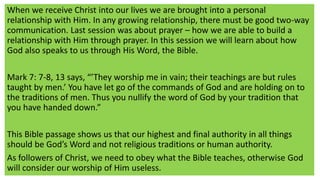
When we receive Christ into our lives we are brought into a personal
relationship with Him. In any growing relationship, there must be good two-way
communication. Last session was about prayer – how we are able to build a
relationship with Him through prayer. In this session we will learn about how
God also speaks to us through His Word, the Bible.
Mark 7: 7-8, 13 says, “’They worship me in vain; their teachings are but rules
taught by men.’ You have let go of the commands of God and are holding on to
the traditions of men. Thus you nullify the word of God by your tradition that
you have handed down.”
This Bible passage shows us that our highest and final authority in all things
should be God’s Word and not religious traditions or human authority.
As followers of Christ, we need to obey what the Bible teaches, otherwise God
will consider our worship of Him useless.
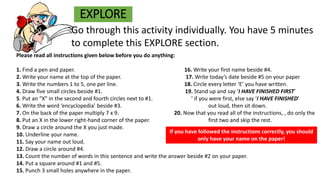
EXPLORE
Go through this activity individually. You have 5 minutes
to complete this EXPLORE section.
Please read all instructions given below before you do anything:
1. Find a pen and paper. 16. Write your first name beside #4.
2. Write your name at the top of the paper. 17. Write today’s date beside #5 on your paper
3. Write the numbers 1 to 5, one per line. 18. Circle every letter ‘E’ you have written.
4. Draw five small circles beside #1. 19. Stand up and say ‘I HAVE FINISHED FIRST’
5. Put an “X” in the second and fourth circles next to #1. ’ if you were first, else say ‘I HAVE FINISHED’
6. Write the word ‘encyclopedia’ beside #3. out loud, then sit down.
7. On the back of the paper multiply 7 x 9. 20. Now that you read all of the instructions, , do only the
8. Put an X in the lower right-hand corner of the paper. first two and skip the rest.
9. Draw a circle around the X you just made.
10. Underline your name.
11. Say your name out loud.
12. Draw a circle around #4.
13. Count the number of words in this sentence and write the answer beside #2 on your paper.
14. Put a square around #1 and #5.
15. Punch 3 small holes anywhere in the paper.
If you have followed the instructions correctly, you should
only have your name on the paper!
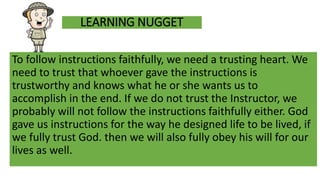
LEARNING NUGGET
To follow instructions faithfully, we need a trusting heart. We
need to trust that whoever gave the instructions is
trustworthy and knows what he or she wants us to
accomplish in the end. If we do not trust the Instructor, we
probably will not follow the instructions faithfully either. God
gave us instructions for the way he designed life to be lived, if
we fully trust God. then we will also fully obey his will for our
lives as well.
Examine
For Christians, the Bible is our primary source for knowing God and
His ways. It is a living book through which God Himself speaks to us
for our instruction, inspiration and direction. But are we certain that
it is really God’s Word? Can it be relied upon? Consider the following
facts: The Bible is unique in human literature. It was written by over
40 authors, in three languages, on three continents, over a period of
1500 years, yet is without contradiction or error. Imagine reading
three newspapers today that describe the same event yesterday –
they almost certainly would not agree, even on important details. So
the unity of the Bible is amazing!
Is the Bible Really God’s Word?
The Bible chronicles hundreds of prophecies that have already come to
pass, many of them in ways that are beyond human control. For
instance, Psalm 22 predicts the manner of Jesus’ death on a cross with
horrible precision. Yet it was written by King David hundred of years
before the Romans invented the use of a cross for capital punishment!
Such a prediction would be impossible apart from the knowledge of God
Himself.
The ancient manuscripts attest to the Bible’s accuracy. The more
numerous the copies and the closer they are to the original writing, the
greater certainty we have of the accuracy of a material. There are
thousands of ancient manuscripts and fragments of the Bible, some
from within a hundred years of its writing. By contrast, the earliest
manuscripts of ancient classics like Aristotle or Caesar date from more
than a thousand years after their writing, and are attested to by only a
handful of manuscripts. No ancient document comes close to the Bible
in manuscript evidence.
Is the Bible Really God’s Word?
The Bible has survived repeated attempts to stamp it out of
existence. In AD 303, the Roman emperor Diocletian decreed
that all Bibles should be burned. Less than a generation later,
however, Christianity was accepted as the true religion of
Rome! Voltaire was quoted as having predicted that the Bible
would be relegated to the junk heap of history within 100 years
of his death. Ironically, Bibles were being printed on a printing
press in his own home fifty years later. More than two hundred
years after his death, demand for the Bible shows no evidence
of waning. These facts show us that, yes, the Bible is the
reliable and infallible (without error) Word of God.
WHY FOLLOW GOD’S WORD?
Read Psalm 119:105
105 Your word is a lamp to my feet
And a light to my path. NASB
1. How does the Word of God help us?
God’s Word gives us guidance and direction for our lives
Read II Timothy 3:16-17
2. How does Paul describe the benefits of the Bible? In what ways
do these relate to our lives?
16 All Scripture is [a]inspired by God and profitable for teaching, for
reproof, for correction, for [b]training in righteousness; 17 so that the
man of God may be adequate, equipped for every good work. NASB
The Bible teaches us, tells us what to do, tells us
what we are doing wrong, and trains us to honor
God in the way we live our lives. These are all
important to help us be more like Christ, and to
be ready to serve the Lord.
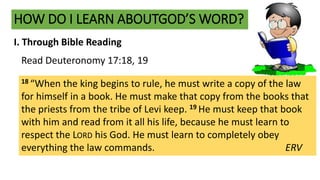
HOW DO I LEARN ABOUTGOD’S WORD?
I. Through Bible Reading
18 “When the king begins to rule, he must write a copy of the law
for himself in a book. He must make that copy from the books that
the priests from the tribe of Levi keep. 19 He must keep that book
with him and read from it all his life, because he must learn to
respect the LORD his God. He must learn to completely obey
everything the law commands. ERV
Read Deuteronomy 17:18, 19
3. What was the instruction given for kings to do when they begin
their reign? Why do you think they had to write the whole Law (the
Bible) down by hand? Why is regular reading of the Bible important
to our lives?
The instruction was for the king to write down a copy of the
Law. Writing it down by hand would help them learn what it
says and remember more accurately. Regularly reading the
Bible will help us fear the Lord, stay humble, follow the path
that God wants us to follow, and be blessed by the Lord
when we obey.
HOW DO I LEARN ABOUTGOD’S WORD?
II. Through personal Bible Study
9 He had arranged to leave Babylon on April 8, the first day of
the new year,[a] and he arrived at Jerusalem on August 4,[b] for the
gracious hand of his God was on him. 10 This was because Ezra had
determined to study and obey the Law of the LORD and to teach
those decrees and regulations to the people of Israel. NLT
Read Ezra 7:9, 10
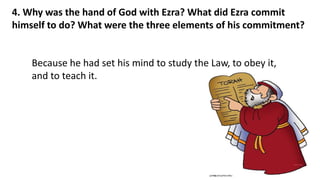
4. Why was the hand of God with Ezra? What did Ezra commit
himself to do? What were the three elements of his commitment?
Because he had set his mind to study the Law, to obey it,
and to teach it.
THE OBEDIENCE-BASED
BIBLE STUDY (OBBS)
The Obedience-Based Bible Study is a simple, easily reproducible
process of not just studying but applying God’s Word. Here is how
it works:
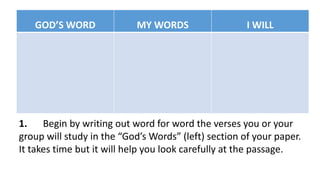
Take a blank piece of notebook paper and fold it into thirds (like a
three-fold brochure). At the top of the left section write, “God’s
Word”. At the top of the middle section write, “My Words”. At the
top of the right section write, “I will”.
GOD’S WORD MY WORDS I WILL
1. Begin by writing out word for word the verses you or your
group will study in the “God’s Words” (left) section of your paper.
It takes time but it will help you look carefully at the passage.
2. Write down a paraphrase of the passage in the “My Words”
(middle)section. Pretend you are retelling the passage to a friend.
Use your own words, and make sure you cover everything in the
passage. Retelling it helps you make sure you really understand
what it means.
3. Write down what you will do as a result of what you have
learned in the “I Will” (right) section. This is the most important
part of OBBS! This should always be written in the form, “I will
_______.” That makes it a commitment between you and God to
obey what you have learned. Then commit to the Lord that you
will indeed do it, and ask Him for the power and strength through
the Holy
OBBS IN A DGROUP
When doing OBBS in a DGroup or D12, follow the same process.
After each person in the group has completed the “My Word”
section, ask several people to share their “My Words” paraphrase.
After several group members retell the Scripture, you can study
the passage together. Your discussion must be question-driven to
facilitate the discovery process. No one in the group should
dominate the discussion or “teach” about the passage.
Below are some questions to encourage interaction with Scripture:
✔ Did anything in this passage capture your attention?
✔ What did you like about this passage?
✔ Did anything bother you? Why?
✔ What does this passage tell us about God?
✔ What does this passage tell us about Man?
✔ What does this passage tell us about living to please God?
In a group setting, each person should share their “I Will” statement
for accountability. Make sure that action plans follow the SMART
Goals Principles and that each member commits to confidentiality.
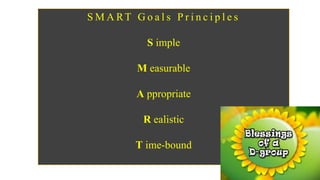
S M A RT G o a l s P r i n c i p l e s
S imple
M easurable
A ppropriate
R ealistic
T ime-bound
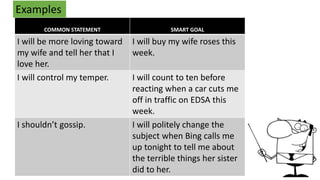
Examples
COMMON STATEMENT SMART GOAL
I will be more loving toward
my wife and tell her that I
love her.
I will buy my wife roses this
week.
I will control my temper. I will count to ten before
reacting when a car cuts me
off in traffic on EDSA this
week.
I shouldn’t gossip. I will politely change the
subject when Bing calls me
up tonight to tell me about
the terrible things her sister
did to her.
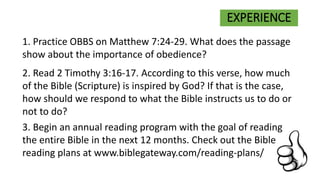
EXPERIENCE
1. Practice OBBS on Matthew 7:24-29. What does the passage
show about the importance of obedience?
2. Read 2 Timothy 3:16-17. According to this verse, how much
of the Bible (Scripture) is inspired by God? If that is the case,
how should we respond to what the Bible instructs us to do or
not to do?
3. Begin an annual reading program with the goal of reading
the entire Bible in the next 12 months. Check out the Bible
reading plans at www.biblegateway.com/reading-plans/
EQUIP
On-the-Job Training: 30 minutes
Your discipler will demonstrate to you how to facilitate a small
group discussion using Book 1: One by One, Lesson 1.
Continue to practice “Pray-Care-Share” with others around
you, starting with those you have been praying for in the past
weeks.
Teach new believers the Book 1: One by One lessons; have the
first meeting within 48 hours of their decision to accept Christ
as Savior and Lord.

CCF GLC 1 Book 2 _Session 2_One Basis - Prayer

  • 1.
  • 2.
    When we receiveChrist into our lives we are brought into a personal relationship with Him. In any growing relationship, there must be good two-way communication. Last session was about prayer – how we are able to build a relationship with Him through prayer. In this session we will learn about how God also speaks to us through His Word, the Bible. Mark 7: 7-8, 13 says, “’They worship me in vain; their teachings are but rules taught by men.’ You have let go of the commands of God and are holding on to the traditions of men. Thus you nullify the word of God by your tradition that you have handed down.” This Bible passage shows us that our highest and final authority in all things should be God’s Word and not religious traditions or human authority. As followers of Christ, we need to obey what the Bible teaches, otherwise God will consider our worship of Him useless.
  • 3.
    EXPLORE Go through thisactivity individually. You have 5 minutes to complete this EXPLORE section. Please read all instructions given below before you do anything: 1. Find a pen and paper. 16. Write your first name beside #4. 2. Write your name at the top of the paper. 17. Write today’s date beside #5 on your paper 3. Write the numbers 1 to 5, one per line. 18. Circle every letter ‘E’ you have written. 4. Draw five small circles beside #1. 19. Stand up and say ‘I HAVE FINISHED FIRST’ 5. Put an “X” in the second and fourth circles next to #1. ’ if you were first, else say ‘I HAVE FINISHED’ 6. Write the word ‘encyclopedia’ beside #3. out loud, then sit down. 7. On the back of the paper multiply 7 x 9. 20. Now that you read all of the instructions, , do only the 8. Put an X in the lower right-hand corner of the paper. first two and skip the rest. 9. Draw a circle around the X you just made. 10. Underline your name. 11. Say your name out loud. 12. Draw a circle around #4. 13. Count the number of words in this sentence and write the answer beside #2 on your paper. 14. Put a square around #1 and #5. 15. Punch 3 small holes anywhere in the paper. If you have followed the instructions correctly, you should only have your name on the paper!
  • 4.
    LEARNING NUGGET To followinstructions faithfully, we need a trusting heart. We need to trust that whoever gave the instructions is trustworthy and knows what he or she wants us to accomplish in the end. If we do not trust the Instructor, we probably will not follow the instructions faithfully either. God gave us instructions for the way he designed life to be lived, if we fully trust God. then we will also fully obey his will for our lives as well.
  • 5.
    Examine For Christians, theBible is our primary source for knowing God and His ways. It is a living book through which God Himself speaks to us for our instruction, inspiration and direction. But are we certain that it is really God’s Word? Can it be relied upon? Consider the following facts: The Bible is unique in human literature. It was written by over 40 authors, in three languages, on three continents, over a period of 1500 years, yet is without contradiction or error. Imagine reading three newspapers today that describe the same event yesterday – they almost certainly would not agree, even on important details. So the unity of the Bible is amazing! Is the Bible Really God’s Word?
  • 6.
    Is the BibleReally God’s Word? The Bible chronicles hundreds of prophecies that have already come to pass, many of them in ways that are beyond human control. For instance, Psalm 22 predicts the manner of Jesus’ death on a cross with horrible precision. Yet it was written by King David hundred of years before the Romans invented the use of a cross for capital punishment! Such a prediction would be impossible apart from the knowledge of God Himself. The ancient manuscripts attest to the Bible’s accuracy. The more numerous the copies and the closer they are to the original writing, the greater certainty we have of the accuracy of a material. There are thousands of ancient manuscripts and fragments of the Bible, some from within a hundred years of its writing. By contrast, the earliest manuscripts of ancient classics like Aristotle or Caesar date from more than a thousand years after their writing, and are attested to by only a handful of manuscripts. No ancient document comes close to the Bible in manuscript evidence.
  • 7.
    Is the BibleReally God’s Word? The Bible has survived repeated attempts to stamp it out of existence. In AD 303, the Roman emperor Diocletian decreed that all Bibles should be burned. Less than a generation later, however, Christianity was accepted as the true religion of Rome! Voltaire was quoted as having predicted that the Bible would be relegated to the junk heap of history within 100 years of his death. Ironically, Bibles were being printed on a printing press in his own home fifty years later. More than two hundred years after his death, demand for the Bible shows no evidence of waning. These facts show us that, yes, the Bible is the reliable and infallible (without error) Word of God.
  • 8.
    WHY FOLLOW GOD’SWORD? Read Psalm 119:105 105 Your word is a lamp to my feet And a light to my path. NASB 1. How does the Word of God help us? God’s Word gives us guidance and direction for our lives
  • 9.
    Read II Timothy3:16-17 2. How does Paul describe the benefits of the Bible? In what ways do these relate to our lives? 16 All Scripture is [a]inspired by God and profitable for teaching, for reproof, for correction, for [b]training in righteousness; 17 so that the man of God may be adequate, equipped for every good work. NASB The Bible teaches us, tells us what to do, tells us what we are doing wrong, and trains us to honor God in the way we live our lives. These are all important to help us be more like Christ, and to be ready to serve the Lord.
  • 10.
    HOW DO ILEARN ABOUTGOD’S WORD? I. Through Bible Reading 18 “When the king begins to rule, he must write a copy of the law for himself in a book. He must make that copy from the books that the priests from the tribe of Levi keep. 19 He must keep that book with him and read from it all his life, because he must learn to respect the LORD his God. He must learn to completely obey everything the law commands. ERV Read Deuteronomy 17:18, 19
  • 11.
    3. What wasthe instruction given for kings to do when they begin their reign? Why do you think they had to write the whole Law (the Bible) down by hand? Why is regular reading of the Bible important to our lives? The instruction was for the king to write down a copy of the Law. Writing it down by hand would help them learn what it says and remember more accurately. Regularly reading the Bible will help us fear the Lord, stay humble, follow the path that God wants us to follow, and be blessed by the Lord when we obey.
  • 12.
    HOW DO ILEARN ABOUTGOD’S WORD? II. Through personal Bible Study 9 He had arranged to leave Babylon on April 8, the first day of the new year,[a] and he arrived at Jerusalem on August 4,[b] for the gracious hand of his God was on him. 10 This was because Ezra had determined to study and obey the Law of the LORD and to teach those decrees and regulations to the people of Israel. NLT Read Ezra 7:9, 10
  • 13.
    4. Why wasthe hand of God with Ezra? What did Ezra commit himself to do? What were the three elements of his commitment? Because he had set his mind to study the Law, to obey it, and to teach it.
  • 14.
    THE OBEDIENCE-BASED BIBLE STUDY(OBBS) The Obedience-Based Bible Study is a simple, easily reproducible process of not just studying but applying God’s Word. Here is how it works: Take a blank piece of notebook paper and fold it into thirds (like a three-fold brochure). At the top of the left section write, “God’s Word”. At the top of the middle section write, “My Words”. At the top of the right section write, “I will”.
  • 15.
    GOD’S WORD MYWORDS I WILL 1. Begin by writing out word for word the verses you or your group will study in the “God’s Words” (left) section of your paper. It takes time but it will help you look carefully at the passage.
  • 16.
    2. Write downa paraphrase of the passage in the “My Words” (middle)section. Pretend you are retelling the passage to a friend. Use your own words, and make sure you cover everything in the passage. Retelling it helps you make sure you really understand what it means. 3. Write down what you will do as a result of what you have learned in the “I Will” (right) section. This is the most important part of OBBS! This should always be written in the form, “I will _______.” That makes it a commitment between you and God to obey what you have learned. Then commit to the Lord that you will indeed do it, and ask Him for the power and strength through the Holy
  • 17.
    OBBS IN ADGROUP When doing OBBS in a DGroup or D12, follow the same process. After each person in the group has completed the “My Word” section, ask several people to share their “My Words” paraphrase. After several group members retell the Scripture, you can study the passage together. Your discussion must be question-driven to facilitate the discovery process. No one in the group should dominate the discussion or “teach” about the passage.
  • 18.
    Below are somequestions to encourage interaction with Scripture: ✔ Did anything in this passage capture your attention? ✔ What did you like about this passage? ✔ Did anything bother you? Why? ✔ What does this passage tell us about God? ✔ What does this passage tell us about Man? ✔ What does this passage tell us about living to please God?
  • 19.
    In a groupsetting, each person should share their “I Will” statement for accountability. Make sure that action plans follow the SMART Goals Principles and that each member commits to confidentiality.
  • 20.
    S M ART G o a l s P r i n c i p l e s S imple M easurable A ppropriate R ealistic T ime-bound
  • 21.
    Examples COMMON STATEMENT SMARTGOAL I will be more loving toward my wife and tell her that I love her. I will buy my wife roses this week. I will control my temper. I will count to ten before reacting when a car cuts me off in traffic on EDSA this week. I shouldn’t gossip. I will politely change the subject when Bing calls me up tonight to tell me about the terrible things her sister did to her.
  • 22.
    EXPERIENCE 1. Practice OBBSon Matthew 7:24-29. What does the passage show about the importance of obedience? 2. Read 2 Timothy 3:16-17. According to this verse, how much of the Bible (Scripture) is inspired by God? If that is the case, how should we respond to what the Bible instructs us to do or not to do? 3. Begin an annual reading program with the goal of reading the entire Bible in the next 12 months. Check out the Bible reading plans at www.biblegateway.com/reading-plans/
  • 23.
    EQUIP On-the-Job Training: 30minutes Your discipler will demonstrate to you how to facilitate a small group discussion using Book 1: One by One, Lesson 1. Continue to practice “Pray-Care-Share” with others around you, starting with those you have been praying for in the past weeks. Teach new believers the Book 1: One by One lessons; have the first meeting within 48 hours of their decision to accept Christ as Savior and Lord.