“You have got to build a firm foundation on the
living word of God. You have got to study it, to store
it in your heart, to gain the wisdom that it gives and
apply it to your life.”
― Calvin W. Allison
Dear Readers,
In the following pages, you will find 53 short and simple
articles on Bible (courtesy: various sources from the internet).
Though, these articles are not arranged in a systematic way or
may not be meant for scholarly studies, nevertheless, it would
help the readers to acquire some knowledge on the Bible.
These articles may be used for personal study or may be
published in your parish bulletins or other publications.
To encourage your group/parishioners to read these articles,
you can even conduct a BIBLE STUDY QUIZ. For further details
on how to conduct the BIBLE STUDY QUIZ, please refer to –
BIBLE QUEST section of this website. You will also find a
sample objective type question set prepared for PART 1 and 2
of the BIBLE STUDY articles below. You can use this format or
adapt as per your need.
ALSO AVAILABLE 43 SETS OF BIBLE QUIZZES (BIBLE
QUEST) IN THIS WEBSITE. For further details go to the
title BIBLE QUEST and read the INTRODUCTION.
Fr Felix Rebello
Email: frfelixrbello@gmail.com
FOR BIBLE QUIZ – part 1 – articles 1 to 18
See question set after the article 18
ARTICLE 1
What is the Bible?
Put simply, the Bible is God's word to humankind. It is a
combination of His directions for how we should live, a history of
the world, a story with a purpose and a revelation of God. The Bible
is the ultimate authority on God and all matters of the Christian life
and salvation.
What does 'Bible' mean?
The word Bible basically means "collection of books", and in its
physical sense it is exactly that - the Holy Bible is the collection of
Holy Books placed together to form one book.
How did we get the Bible?
Over a period of about one and a half Millennia, God inspired many
different people to write down His words into 73 individual books.
During the centuries following Jesus' ascension into Heaven, these
were collected together to form the Bible.
The Bible since then...
Since the original texts were decided upon (a somewhat final
decision being made in 397 AD), the Bible has been translated from
its original Hebrew, Aramaic and Greek into more languages than
any other book. It is also available in English in many different
translations, from the King James Version of 1611 (which is known
for its archaic speech) to the modern, everyday language translations
such as the New International Version and the New Revised
Standard Version.
ARTICLE 2
WHY ARE THERE DIFFERENT VERSIONS OF THE BIBLE?
Courtesy: Internet
When people hear there are over 50 different versions of the Bible in English alone, they often
think to themselves, "No wonder there are many denominations each teaching different things,
there are many different versions of the Bible." This view, however, is wrong. Yes there are many
denominations, but don't blame that on the fact there are many versions of the Bible. There is
one Bible.
First we need to understand what we mean by a "version". A better word than "version" is
"translation". The Old Testament was originally written in Hebrew and the New Testament in
Greek. If every man could read Hebrew and Greek, then we would have no need for an "English
version". Most people can't read Greek, "It's all Greek to me"! We must rely, therefore, upon men
who are fully fluent in English and Greek. These "scholars" read the original Greek Bible and
come up with an English equivalent. This process is called translation. We have all seen a foreign
diplomat give a news conference through the help of a translator. One translator may choose
different words or sentences, but the message is identical. Translation is a reliable science of
communicating between different languages. Remember, it was God Himself who created all the
language barriers in Genesis 11 at the Tower of Babel. God is satisfied that His inspired word can
be maintained although translated into over 200 languages.
Translation of the Greek New Testament is a very precise science. The New American Standard
Bible, for example, was translated over 10 years, by over 45 scholars and was first published in
1962 AD. Similar painstaking work was applied to the production of the New International (1978
AD), and King James (1611AD) and the New King James (1982AD). These translations and
others like them were the products of many years of work from scholars from many
denominations.
Each translation has its own strengths and weaknesses. The King James Version (KJV) is
excellent, but you must use a dictionary as you read because it uses language typical of the time
it was translated (1611). I recommend you purchase a more recent translation. The New
American Standard Version (NASV) is believed by many to be one of the most accurate
translations and is an excellent study Bible. The American Standard Version (ASV) is also
excellent and highly accurate. The New King James Version (NKJV) is high on the recommended
list. The New International Version (NIV) tries to make the text as easy to understand as possible
and is an excellent reading Bible, but not a good study Bible. The New World Translation (1950,
the Jehovah's Witnesses Bible) should be avoided because its is actually corrupt, being a
sectarian paraphrase rather than a true translation of the Holy Scriptures.
Although the exact choice of words or sentence structure is different in each translation, the
meaning is identical. Take the words of Jesus in Mark 16:16 from three "versions" as an example;
NIV: "Whoever believes and is baptized will be saved". KJV: "He that believeth and is baptized
shall be saved". NAS: "He who has believed and has been baptized shall be saved" Different
words and sentences but the meaning is identical. To blame religious division on the fact there
are different Bible versions, therefore, is incorrect. The view that each translation of the Bible
conveys a different message is also incorrect. There is only one Bible message that has been
translated into hundreds of different languages.
ARTICLE 3
The Bible, the Sole Rule of Faith?
Protestants derive their religion from a mere reading of the Bible which they interpret according to
their own private judgment. Catholics derive their doctrines from the Church which propounds to
them infallibly the teachings of the Bible and of Tradition. Which of these two formulas is
supported by the Bible itself and by the facts of history, and which consequently is correct?
The Bible makes it clear that Christ established the Church as a teaching organization to speak to
the world in His name and with His authority. Our Lord Himself wrote nothing. He commanded
the Apostles not to write but to teach and preach: "Going, therefore, teach all nations" and
"preach the Gospel to every creature." Christ's disciples and the Christians were commanded to
hear the Church, not to read the still nonexistent or at best incomplete New Testament Scriptures:
"He who hears you, hears Me." The teaching Church was in existence long before a single line of
the New Testament was written. The Apostles evangelized different peoples, not by presenting to
them a copy of the New Testament which did not as yet exist, but by preaching the Gospel, the
oral message of Christ to them. Thousands of men became Christians and adhered to the whole
truth of God before they saw or read a single book of the New Testament.
It was the leaders of the existing teaching Church who wrote the books of the New Testament. It
was the Church which collected and preserved these books, and distinguished them from
spurious books which might have otherwise found their way into the Bible. It was from the
Catholic Church that the Protestants of the sixteenth century took their Bible and also their belief
in its divine inspiration. How illogical, then, it is for a group to step in fifteen hundred years later,
wrest the Bible from its historical and lawful possessor and fosterer, put the Bible in the place of
the Church, and pretend to possess a true understanding of the purpose and meaning of the
Bible?
The different books of the New Testament were for many centuries scattered in the various
Christian communities of the Orient. Being written on papyrus which was fragile and breakable,
these books could not be widely circulated and hence were read by a comparatively few groups.
It was only in 397 A.D. that the Council of Carthage finally decided which books belong to the
Bible, and it was about this time, too, that the books of the Bible were combined into one volume.
Before the invention of printing in the sixteenth century, copies of the Bible written by hand were
so rare and costly that only the rich could procure them.
Bible Christianity, then, is an invention of the sixteenth century. In the previous centuries it was
not only unknown but it was impossible. Bible Christianity is a formal denial of the Catholic
Church, of her divine authority and mission to teach all. It strives to abrogate the Church which
Christ instituted, endeavours to substitute in its place a book, and makes the Bible, as interpreted
by one's own private judgment, the sole and supreme rule of faith and morality.
ARTICLE 4
I. INSPIRATION OF THE BIBLE
When Paul said: "All Scripture is given by inspiration of God" (2 Tim. 3:16), he used the Greek
word "theopneustos" for the idea of inspiration. This Greek word is composed of "theos," meaning
God, and "pneo," meaning to breathe. The compound word is an adjective meaning literally
"breathed of God." Since it is the breath that produces speech, this word provided a very apt and
impressive way of saying that the Scripture is the word of God.
II. THE HUMAN ELEMENT IN INSPIRATION
However it was only in special cases that the words to be written down were orally dictated to the
Scripture writers. In most cases the minds of the writers became the laboratory in which God
converted His breath, as it were, into human language. This was not done by a mechanical
process. The personality and temperament of the writers were not suspended. These are
manifest in the writings. Hence we read from Gaussen: "In maintaining that all Scripture is from
God, we are far from thinking that man goes for nothing in it . . . In Scripture all the words are
man’s, as there, too, all the words are God’s. In a certain sense, the Epistle to the Romans is
altogether a letter of Paul’s and, in a still higher sense, the Epistle to the Romans is altogether a
letter of God’s" (Theopneustia, a book indorsed highly by C. H. Spurgeon). And so we read also
from Manly: "The divine origin and authority of the Word of God is not to be affirmed so as to
exclude or impair the reality of the human authorship, and the peculiarities resulting there from.
The Bible is God’s Word to man, throughout; yet at the same time it is really and thoroughly a
man’s composition. No attempt should be made-and we shall certainly make none-to set aside or
ignore the "human element" of the Scriptures, which is unmistakably apparent on their very face;
no one should wish to so magnify the divine as to crowd this out, or almost out. This is one of the
mistakes which good men have committed. Let both be admitted, recognized, accepted thankfully
and rejoicingly, each contributing to make the Bible more completely adapted to human needs as
the instrument of divine grace, and the guide for weak and wandering human souls. The word is
not of man, as to its source; nor depending on man, as to its authority. It is by and through man
as its medium; yet not only simply as the channel along which it runs, like water through a lifeless
pipe, but through and by man as the agent voluntarily active "and intelligent in its communication.
Both sides of the truth are expressed in the Scriptural language: ‘Holy men of God spake as they
were moved (borne along) by the Holy Spirit.’ (2 Pet. 1:21). The men spoke; the impulse and
direction were from God" (The Bible Doctrine of Inspiration). "The Scriptures contain a human as
well as a divine element, so that while they constitute a body of infallible truth, this truth is shaped
in human moulds and adapted to ordinary human intelligence" (Strong).
ARTICLE 5
Reading the Bible
Because the Bible is both authoritative and historical, it is important to read it as such. It
is God's word that seeks application in your life, but to understand how to apply it, you
must understand its original meaning, its original context. A simple and obvious
example of the need for context in any work is found in the fact that the words, "there is
no God", are found 15 times throughout the Bible (NIV). It is not until you look at them
in context that you realise they are all part of a sentence to the effect of "there is no God
but one" (e.g., Dt. 32:39) or "the fool says in his heart: 'There is no God'" (e.g., Ps.
14:1), or similar such statements.
But the need for context extends further in the Bible to an appreciation of the culture
and circumstances of the time. For example, in Exodus 21 we read that justice should be
in the form of exact retribution: "take life for life, eye for eye, tooth for tooth, hand for
hand, foot for foot, burn for burn, wound for wound, bruise for bruise" (vv.23-25), while
in Matthew chapter 5 we read Jesus as saying: "If someone strikes you on the right
cheek, turn to him the other also. And if someone wants to sue you and take your tunic,
let him have your cloak as well" (vv.39-40). The differences between these two
apparently contradictory statements, both of which are authoritative, are reconciled
through an understanding of the culture and circumstances of each statement, and the
application to today's life is similarly found. In some circumstances it may be a good
idea to have a commentary handy when reading the Bible, to enable a clearer
understanding of the passage you're reading. (Commentaries comment on the culture
and circumstance, then focus on the meaning of the passages in the Bible.) But a great
deal of the time application for passages can be easily found simply by thinking and
praying about them. For example, in the 14th chapter of Paul's letter to the Romans he
instructs them to obey the authorities and the law of the land. Although we live under
different authorities today, it can be clearly seen that this passage is easily applied in our
lives today by obeying the government and living by the laws of the country we live in.
Sometimes understanding and applying what you read is easy, sometimes hard. The key
is to read the Bible regularly, asking God to help you understand, and reading
commentaries and other such works by gifted Christian scholars when the meaning and
application of the text is not immediately apparent. Finally, the Bible is God's word to
us, we are supposed to live by it, and grow in godliness by obeying it. We must do all
that we can to understand it and apply it as God wishes.
ARTICLE 6
HOW BIBLE CAME TO BE?
The Bible is one of the great books of the world. However, there have been those who continually
misunderstand just what it is, and how it came to be, and some of the problems inherent in the
Bible. Fundamentalist Christians have the utterly mistaken idea that the Bible is perfect, that
every word in it came from God directly to man and that all that God has ever spoken, done,
seen, or felt is written and contained in the Bible. This is utterly and simply naive and worthless in
getting to the truth of the Bible, or God, how he acts, thinks, feels, etc.
"There are at least 36 different authors, who wrote in three continents, in many countries, in three
languages, and from every possible human standpoint. Among these authors were kings,
farmers, mechanics, scientific men, lawyers, generals, fishermen, ministers, and priests, a tax-
collector, a doctor, some rich, some poor, some city bred, some country born - thus touching all
the experiences of men - extending over 1500 years." On one thing most serious Bible scholars
agree on, is that the Bible is not a perfectly written, grammatically correct, historically 100%
accurate, perfectly preserved book. Does it need to be in order for it to be God's word though?
Granted God, by definition is perfect, but men and women are not. And God chooses to go
through human mediums when giving his instructions. In the process of editing, translating,
transmitting the records, things get lost, shuffled around, changed, added to and deleted from.
Not only do we have to do with this type of issue, as to what is added into the scriptures from later
perspectives and what is left out, but we also have got to begin to realize that there is nothing we
have concerning the original autographs of ***ANY*** of the New Testament writers. There is
even question as to whether the evangelists themselves were eyewitnesses to Jesus' life!
Realistically, the Bible is a human made document. Sure it deals with God's dealings with men
and women, but it is written by men. It is transmitted by men, and lest we forget, we are told
"copying is a source of both survival and corruption for a text." We must remember that in early
Christian times the manuscripts looked like this:
INTHOSEDAYSALMOSTEVERYTHINGWASWRITTENINCAPITALLETTERSWITHOUTPUNCTU
ATIONANDNOSPACESBETWEENWORDS.
The Bible will not mean what it is meant to mean until we begin to have something of an
understanding of just what it is and what it is not. Fundamentalist Christians miss this crucial
concept completely and strain at gnats but swallow camels when they declare the Bible to be
something other than what it itself says and displays. Without some sort of reality check, the
Fundamentalist Christians are building their foundation of scriptural exegesis on sand and will
never, worlds without end, convince the rest of the world about just what the Bible means,
whether discussing salvation, grace, the law, or God.
ARTICLE 7
Bible History based on important figures
The much of the history of the Bible may be divided up into simple segments around the lifetimes
of five important Biblical figures: Abraham, Moses, David, Daniel and Jesus. Once you commit to
memory the general time frame of the lives of each of these men, you can begin to view other
time information you read in the Bible in relation to the lives of these men. It is not necessary to
find out or remember the "exact" birth date or death date of each of these men. In fact, that
specific information for most of them is shrouded in the mists of ancient history. But it is possible
to pinpoint a more general focal date in each of their lives that will be very helpful for our
purposes. For each of them lived along a timeline which can be conveniently divided up into five
hundred year segments. We do not intend to suggest that the dates below are an exact mid-point
in each of the men's lives. We merely suggest that by focusing on these dates which did occur in
their lifetime, you can more easily memorize the sequence of events in the scripture.
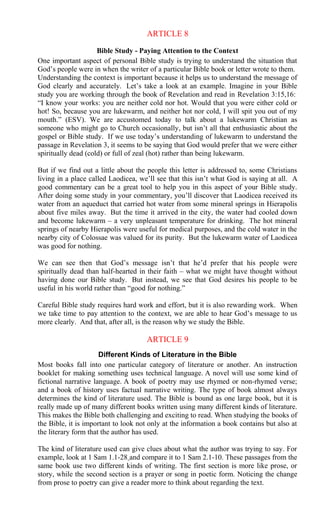
Here are the general, simplified Biblical dates connected with these five:
Abraham 2000 BC, Moses 1500 BC , David 1000 BC, Daniel 500 BC
Note: In our common calendar system, there is no such year as "0" either B.C. or A.D. The year 1
B.C. is immediately followed by 1 A.D.
If you will make it a project to memorize just these five dates and the men connected with them,
you will find that the effort was well worth it! Here is one possible method: Rather than memorize
the facts given here in "pairs"... that is, "Abraham + 2000 B.C."... You may find it helpful to
memorize the names as a unit first - "Abraham, Moses, David, Daniel, Jesus". This kind of list
is usually easy to memorize, as it almost sounds like a little poem when stated out loud
rhythmically! You can "divide" it up into two sections, perhaps... "Abraham, Moses.... David,
Daniel, Jesus. Then clarify in your mind that the first date in the series is 2000, followed by
intervals of 500 years. As soon as you have these five names and their associated dates
memorized, it is also very helpful to visually lay them out on a "time line" such as the one above.
Then as you find other names, events and dates in the scriptures, you can place them on that line
in their relative positions. By actually picking up a pen and paper and creating your own time
line, you will impress upon your subconscious the facts you are writing down. And by writing down
the list of the five names-perhaps several days in a row until you have them solidly in mind-you
will reinforce your memory.
ARTICLE 8
Bible Study - Paying Attention to the Context
One important aspect of personal Bible study is trying to understand the situation that
God’s people were in when the writer of a particular Bible book or letter wrote to them.
Understanding the context is important because it helps us to understand the message of
God clearly and accurately. Let’s take a look at an example. Imagine in your Bible
study you are working through the book of Revelation and read in Revelation 3:15,16:
“I know your works: you are neither cold nor hot. Would that you were either cold or
hot! So, because you are lukewarm, and neither hot nor cold, I will spit you out of my
mouth.” (ESV). We are accustomed today to talk about a lukewarm Christian as
someone who might go to Church occasionally, but isn’t all that enthusiastic about the
gospel or Bible study. If we use today’s understanding of lukewarm to understand the
passage in Revelation 3, it seems to be saying that God would prefer that we were either
spiritually dead (cold) or full of zeal (hot) rather than being lukewarm.
But if we find out a little about the people this letter is addressed to, some Christians
living in a place called Laodicea, we’ll see that this isn’t what God is saying at all. A
good commentary can be a great tool to help you in this aspect of your Bible study.
After doing some study in your commentary, you’ll discover that Laodicea received its
water from an aqueduct that carried hot water from some mineral springs in Hierapolis
about five miles away. But the time it arrived in the city, the water had cooled down
and become lukewarm – a very unpleasant temperature for drinking. The hot mineral
springs of nearby Hierapolis were useful for medical purposes, and the cold water in the
nearby city of Colossae was valued for its purity. But the lukewarm water of Laodicea
was good for nothing.
We can see then that God’s message isn’t that he’d prefer that his people were
spiritually dead than half-hearted in their faith – what we might have thought without
having done our Bible study. But instead, we see that God desires his people to be
useful in his world rather than “good for nothing.”
Careful Bible study requires hard work and effort, but it is also rewarding work. When
we take time to pay attention to the context, we are able to hear God’s message to us
more clearly. And that, after all, is the reason why we study the Bible.
ARTICLE 9
Different Kinds of Literature in the Bible
Most books fall into one particular category of literature or another. An instruction
booklet for making something uses technical language. A novel will use some kind of
fictional narrative language. A book of poetry may use rhymed or non-rhymed verse;
and a book of history uses factual narrative writing. The type of book almost always
determines the kind of literature used. The Bible is bound as one large book, but it is
really made up of many different books written using many different kinds of literature.
This makes the Bible both challenging and exciting to read. When studying the books of
the Bible, it is important to look not only at the information a book contains but also at
the literary form that the author has used.
The kind of literature used can give clues about what the author was trying to say. For
example, look at 1 Sam 1.1-28 and compare it to 1 Sam 2.1-10. These passages from the
same book use two different kinds of writing. The first section is more like prose, or
story, while the second section is a prayer or song in poetic form. Noticing the change
from prose to poetry can give a reader more to think about regarding the text.
A brief example from the New Testament is the story of Jesus' birth. Luke 2.1-21 tells
of the events of Jesus' birth and gives many details regarding the birth itself. In contrast,
John does not use a story to tell about Jesus' birth. Instead, it begins with a poem (1.1-
14), which refers to Jesus as "the Word" and "the true light" that became "a human
being." How do these different kinds of literature influence the way we think about who
Jesus is? Why has the writer of each of these Gospels emphasized different aspects of
Jesus' birth and identity? Looking at the way a writer chooses to share information can
open the way for new ways of understandings what the Bible has to say. The Bible
includes a great number of types of literature. Some forms of literature describe an
entire book. In the Bible the most important of these forms are laws and rules, history,
poetry and songs, wisdom sayings and proverbs, Gospels, letters, and apocalyptic
writings. Other forms of literature describe sections within a book. The most important
of these forms are prose narrative, prayers, parables, prophesies (oracles), and long
family lists (genealogies).
ARTICLE 10
ORIGINAL LANGAUGE OF THE BIBLE
The Bible (from Greek biblia "the books") is the collections of the primary religious texts of
Judaism and Christianity. There is no common version of the Bible, as the individual books
(Biblical canon), their contents and their order vary among denominations. Mainstream Judaism
divides the Tanakh into 24 books, while a minority stream of Judaism, the Samaritans, accepts
only five. The 24 texts of the Hebrew Bible are divided into 39 books in Christian Old Testaments,
and complete Christian Bibles range from the 66 books of the Protestant canon to the 81 books in
the Ethiopian Orthodox Bible,[1]
to the 84 books of the Eastern Orthodox Bible.
The Jewish Bible, or Tanakh, is divided into three parts: (1) the five books of the Torah
("teaching" or "law"), comprising the origins of the Israelite nation, its laws and its covenant with
the God of Israel; (2) the Nevi'im ("prophets"), containing the historic account of ancient Israel and
Judah plus works of prophecy; and (3) the Ketuvim ("writings"): poetic and philosophical works
such as the Psalms and the Book of Job.[2]
The Christian Bible is divided into two parts. The first is called the Old Testament, containing the
(minimum) 39 books of Hebrew Scripture, and the second portion is called the New Testament,
containing a set of 27 books. The first four books of the New Testament form the Canonical
gospels which recount the life of Christ and are central to the Christian faith. Christian Bibles
include the books of the Hebrew Bible, but arranged in a different order: Jewish Scripture ends
with the people of Israel restored to Jerusalem and the temple, whereas the Christian
arrangement ends with the book of the prophet Malachi. The oldest surviving Christian Bibles are
Greek manuscripts from the 4th century; the oldest complete Jewish Bible is a Greek translation,
also dating to the 4th century. The oldest complete manuscripts of the Hebrew Bible (the
Masoretic text) date from the Middle Ages.[3]
During the three centuries following the establishment of Christianity in the 1st century, Church
Fathers compiled Gospel accounts and letters of apostles into a Christian Bible which became
known as the New Testament. The Old and New Testaments together are commonly referred to
as "The Holy Bible". The canonical composition of the Old Testament is under dispute between
Christian groups: Protestants hold only the books of the Hebrew Bible to be canonical; Roman
Catholics and Eastern Orthodox additionally consider the deuterocanonical books, a group of
Jewish books, to be canonical. The New Testament is composed of the Gospels ("good news"),
the Acts of the Apostles, the Epistles (letters), and the Book of Revelation.
ARTICLE 11
Who Wrote the Bible?
Many people contributed to the writing of the Bible. Actually the Bible is a collection of
writings from about forty contributors, thirty in the Old Testament and ten in the New
Testament. For example, the Psalms are a collection of the works of several authors, of
whom David, the "sweet singer of Israel", is the best known. But psalms were also
written by Moses, by Asaph, by a man named Ethan, and by the sons of Korah.
The accounts which have been preserved in the Old Testament date from the earliest
times, and were both written down and transmitted orally. As time passed they were
collected together and received by the Hebrews as coming to them by God's mandate.
The prophets transmit God's message to humans, while many of the Psalms articulate
cries of people to God. Yet these psalms are also preserved in the Bible as part of God's
message to mankind.
The New Testament stories and teachings were widely circulated among the early
Christian churches. The letters of Paul to the Christians in several cities were likely the
earliest writings now found in the New Testament. But many other letters and epistles
were circulated as well. Gradually it became clear to the early churches which writings
were truly inspired and which were spurious or simply edifying messages from pious
authors.
It is truly amazing that all forty of these authors, spread out over 1600 years, have such
a unified message in spite of their great diversity in language, culture and time. There is
a reason for that! The reason is that these forty or so writers are all secondary authors.
There is actually only one primary author, the one who inspired all the human authors,
the eternal God.
Christians believe that the Bible came to us from God himself, who used all these
human authors to give us his message, through the presence and inspiration of his Spirit.
He did not simply give dictation to these authors, because we observe their unique
personalities and varying styles of writing shining through. But God's message, God's
authorship, is always there, providing in the end through all the years, exactly what he
wanted us to have. In this way the Bible is our own ageless treasure.
ARTICLE 12
Why do some Bibles have a section called the Apocrypha?
During the period between the completion of the Old Testament and the first writings included in
the New Testament (i.e. the period between 450 BC and 50 AD), many essays, psalms and
historical accounts circulated throughout the synagogues and early churches. Some of these
documents gradually came to be regarded by certain of the believers as actually inspired and
deserving of a place in the canon.
We usually date the first definite listing of the accepted books of the Bible as occurring around
367 AD. However, a second set of booklets had been assembled through the years, and these
were given the name Apocrypha (meaning "hidden"). Though they are all from the time before the
birth of Christ, they were never included in the Hebrew Bible. However, many Christians regarded
them as valuable for reading and edification, and in some editions of the Bible they were
interspersed among the Old Testament books.
Then Martin Luther, in his Bible translation of 1534, extracted the apocryphal books from their
usual places in the Old Testament, and had them printed at the end of the Old Testament. He
stated that they "are not held equal to the Sacred Scriptures and yet are useful and good for
reading." After that, many Protestant Bibles omitted them completely. However, in 1546 the
Roman Catholic Council of Trent specifically listed the apocryphal books approved by the Roman
Catholic Church as inspired and they are always included in Roman Catholic Bibles and are
usually interspersed among the books of the Old Testament.
The Apocrypha generally consists of 14 booklets of which 1 and 2 Maccabees and 1 Esdras are
the main documents and form the bulk of the apocryphal writings. First Maccabees is an historical
account of the struggle of the Maccabee family and their followers for Jewish independence from
167 to 134 BC. Second Maccabees covers the same ground but dramatizes the accounts and
makes moral and doctrinal observations. Other books are Tobit, Judith, Baruch, Ecclesiasticus,
and The Wisdom of Solomon.
Since neither Jesus nor the apostles make any reference to the apocryphal books, most
Christians have regarded their authority as secondary to that of the 39 books of the Old
Testament. Yet within these apocryphal books are passages of great piety and historical
information. We should therefore approach the Apocrypha with a discerning mind and heart, and
carefully discriminate between that which is in harmony with the essentials of the Christian faith
and that which deviates from what is taught in the 66 books of the canon. We have the Lord's
promise that he will lead us into the truth, and we live by that promise in everything we read.
ARTICLE 13
What are the Dead Sea Scrolls?
Are new parts of the Bible still coming to light? How is this possible?
In 1947 in an obscure cave west of the Dead Sea, Bedouin shepherds discovered some scrolls
carefully placed in ten tall jars. They did not know what they had come upon, but they sold the
scrolls to a nearby dealer. This was the opening chapter to an astonishing archeological find;
eventually some 800 different manuscripts would be found in eleven caves near the valley called
Wadi Qumran. In all, some 60,000 fragments, portions, or complete scrolls of these 800
manuscripts were retrieved, covering many subjects.
Many of the documents contained biblical texts. Either fragments or complete copies were found
of every book in the Old Testament except Esther. They had been placed in these caves around
the middle of the first century AD, and the amazing fact is that they had lain there undisturbed for
1900 years! But why are these Dead Sea Scrolls so important for us? The reason is that before
this discovery the earliest manuscripts of biblical texts dated from the ninth century after Christ.
They were copies of earlier copies which were long lost.
But now, for example, we have a scroll of the complete book of Isaiah dating from the second
century before Christ. It is a thousand years older than any previous Hebrew Scripture document
that we had before 1947.
So as these scrolls were painstakingly unrolled and translated, biblical scholars and Christians
everywhere wondered what the results would be. Would the new finds provide contradictory texts,
quite different from the text of our Bibles? Would the Bible have to be altered or expanded?
Even though not all of the scrolls are unrolled and translated more than half a century later, the
answers are coming clear. The texts are amazingly similar to the documents we already have.
The variations are less than two percent, and not a single teaching or doctrine of the Bible we
have is altered. Rather than posing a threat to the Christian faith, the Dead Sea Scrolls have, in
fact, provided convincing support for the genuineness of God's revelation as given to us in the
Bible.
Nevertheless, Bible scholars are having intense debates about some of the texts. For example,
some new Bible translations have added approximately 70 words to the end of 1 Samuel 10. The
passage tells us that a certain king Nahash gouged out the eyes of the Israelites. While the text
itself is of little consequence, it raises some very basic questions. Are new parts of the Bible still
coming to light? Don't we have God's complete revelation? How is this possible? Such questions
need a forthright answer, and that answer is to trust in God's provision. This trust embraces our
faith in His plan for the universe, and in His sending of His son to our needy world. Therefore, it
also certainly embraces our trust in His revelation. If we trust Him with our destiny, we can trust
His provision of exactly what we need to know and receive from Him.
The Dead Sea Scrolls have provided enormous light for Bible translators. The Scripture text we
have today is clearly reliable and substantiated from these ancient scrolls. The challenge we face
in responding to this marvelous find is to place our faith in God's Word and in His provision of light
on our path for time and eternity.
.
ARTICLE 14
Search for Revelation
Man throughout history has searched for God and has argued, discussed, and philosophized
about the Supreme Being. This has led to a multitude of explanations. If one studies these, he will
soon realize that man can never understand God through his own reasoning. To know God and
what He does must come from a source outside of one's own thoughts -- God must supernaturally
reveal Himself to mankind. God has revealed Himself in two ways. The first is natural revelation,
which comes from nature. Examples of this are the cause and effect, and the design and purpose
arguments that point to a First Cause and a Great Designer. This type of revelation can only give
partial knowledge of the attributes of God. For instance, since the First Cause existed before the
universe, God must be self-existing and eternal. The immensity of the universe shows God's
unlimited greatness and powerfulness. The simplicity and yet intricacy of material and energy
points to God's unlimited knowledge. All these show the glory of God.
There is little need to dwell on what can be learned from natural revelation since it is limited and
imperfect and can tell little of God's purpose in creating the world or of His moral character. But
this aspect of revelation is still valuable because it reveals enough of the nature of God that men
want to seek revelation from Him. To seek to know God is a proper thing to do if the search
centers on finding whether God has revealed Himself, and if He has, where this revelation is
found. It is reasonable and probable to expect that God would reveal Himself to man. It is unlikely
God would have created such a wonderful universe without revealing the Who and Why behind it.
The second way of God’s revelation of himself is known as special revelation. This revelation has
occurred through direct communication from God and His working through historical events
directed to Abraham, Moses, and the other Old Testament prophets, and supremely through His
Son, Jesus Christ, and His apostles. This is supernatural revelation because its source is God.
This type of revelation given by God's messengers is called special revelation to distinguish it
from natural revelation. Special revelation is limited to those who receive it, and their record of it,
and it is more detailed and specific than natural revelation. According to Christian teachings,
special revelation is recorded in the Bible--the Scripture of the Christian religion.
No one is asked to believe the Bible is God's revelation without evidence that it is factual and true.
No one is asked to accept this by "faith" only. Faith is a central Christian teaching, but this does
not mean Christianity must be believed without evidence or reason. One aspect of Faith is the
persuasion and conviction of the truthfulness of Christianity, but this does not mean Christianity is
not based on factual evidence. There is adequate evidence that God has revealed Himself
through special revelation.
ARTICLE 15
The Bible, Human and Divine
When one takes up the Bible, however, he discovers a paradoxical truth. The Bible contains
many promises, warnings, and instructions from God. But it also records the sinful schemes of
men, their boastful words of unbelief, and even the sad story of many a major act of sin and
shame. Furthermore, the entire Scripture was written in the living languages of Israel (mostly
ancient Hebrew, with a small portion in Aramaic, another Semitic tongue) and of the Graeco-
Roman world of the first century, A.D. (Koine Greek). So the Word of God is recorded in man's
languages, with all the limitations which that places upon the Scripture. Furthermore, the Bible is
not only a Semitic book, for the most part; it is also an ancient book, with the characteristics of
ancient writings. For example, the speeches which the Bible records are certainly not generally
full and verbatim accounts of the addresses made, but are good and true summaries of what was
said. And when ancient writers quoted sources, they made no difference between direct and
indirect quotation. (Note, for example, the way the Old Testament text is quoted in the New. The
apostles sometimes made accurate translations from the Hebrew original, sometimes they simply
gave the sense of the original, and most frequently they quoted from the Septuagint, whether or
not the Greek version was a careful translation of the Hebrew text which we have.) Weights and
measures and numbers are given in round figures as a general rule, and even such rough
estimates of distance are given as "a sabbath day's journey." Often we find "about" this or that
distance, "about" such and such a time, and the like. And even when the "about" is not stated, it is
to be understood, for the Bible does not give data with the scientific precision of the twentieth
century. Hence Solomon's temple laver was [about] thirty cubits in circumference and [about] ten
cubits in diameter. II Chronicles 4:2. This is only one of the many aspects of the "humanness" of
the Bible. (Had God desired to do so, He certainly could have had all observations and records
made with infinite precision, but He chose to allow good and honest witnesses to put down their
observations with the rough approximations of common people.) With conscious exaggeration the
Book of Exodus reports that "all" the cattle of the Egyptians died--which meant simply that there
was a fearful loss of cattle, not that none survived at all. And so the writer can tell us later in the
chapter that the servants of Pharaoh who feared the word of Yahweh. provided shelter for their
cattle during the plague of hail. Exodus 9:6,20.
It is worthy of careful notice that in general the Bible contains no revelations of what man can
discover by scientific research--by the use, for example, of such refined instruments as the
Hubble telescope and the electron microscope. For God spoke through the prophets and through
His Son, not to make human research unnecessary in any field of human knowledge, but to bring
men into a saving relationship with Him through repentance and faith.
ARTICLE 16
BIBLE TRANSLATIONS AND THE GREEK TEXT
The Old Testament was written in the Hebrew language and the New Testament in the
Greek. Must we therefore study the Scriptures in their original languages to understand
them or can translations accurately convey the meaning of the Old and New Testament
Scriptures?
The answer to this perplexing question can be found in Christ and the apostles' use of
Scripture. Eighty percent of the Old Testament quotations found in the New Testament
are from the Greek Septuagint (LXX) Old Testament translation (which is far from a
word-to-word translation), not from the Hebrew text. These Septuagint quotations were
treated as Scripture and were accepted as trustworthy. Today our translations stand in a
similar place as the LXX did in the first century.
The New Testament was written in the common, ordinary language of its day so people
could understand the gospel and thus believe in Christ. Paul said, "How then shall they
call on him in whom they have not believed? and how shall they believe in him of
whom they have not heard? and how shall they hear without a preacher? . . . So then
faith cometh by hearing, and hearing by the word of God" (Rom. 10:14, 17).[1]
Preaching and hearing the gospel means the Bible must be in the hearer's language;
there must be translations.
In summary, people must be able to understand Scripture, and to do so they must have it
in their own language.
Translations
Of the many translations available, how can we know which one to use? There are some
general facts to consider when choosing a version of the Bible.
1. Modern English translations have value since words become obsolete, ambiguous,
misleading, etc., due to language changes.
2. Newer translations are based on more thoroughly researched Greek texts than the
older ones, but this is no guarantee that their Greek texts are better.
3. More than one version should be used, especially when studying difficult passages.
4. Some versions are mainly paraphrases (not following the original wording very
closely but interpreting it), and their use should be limited.
ARTICLE 17
The Old Testament
Are we under the Old Testament today? Are we required to offer burnt animal sacrifices as David
was required? In Psalms 66:15 we read, “I will offer you burnt sacrifices of fat animals, with the
sweet aroma of rams, I will offer bulls with goats.” Are we today to offer the burnt animal
sacrifices as is specified here in the book of Psalms? No. The Old Testament has been taken out
of the way when Christ died on the cross. We read in Colossians 2:14, “Having wiped out the
handwriting of requirements that was against us, which was contrary to us. And He has taken it
out of the way, nailing it to His cross.” In speaking of the New Testament we read in Hebrews
9:16, “For where there is a testament, there must also of necessity be the death of the testator.”
So after Christ died the Old Testament was taken out of the way and His testament, the New
Testament, took effect for us today.
We are no longer under the Old Testament. The Old Testament was then replaced for us today
with the New Testament. The Old Testament is still useful for us today, because without the Old
Testament the New Testament would be difficult to understand. There are also many good
lessons in the Old Testament. But today we do not go to the Old Testament to learn what to do to
be saved and how to worship God. In speaking of Christ and His New Testament we read in
Hebrews 8:6-7, “But now He has obtained a more excellent ministry, inasmuch as He is also
Mediator of a better covenant, which was established on better promises. For if that first
covenant had been faultless, then no place would have been sought for the second.” So we see
here the New Testament is a better covenant with better promises. And then in Galatians 3:24-25,
"Therefore the law was our tutor to bring us to Christ, that we might be justified by faith. But after
faith is come, we are no longer under a tutor." We are no longer under the Old Testament.
Then in speaking of the Old Testament law in Romans 7:6 we read, “But now we have been
delivered from the law, having died to what we were held by, so that we should serve in the
newness of the Spirit and not in the oldness of the letter.” Since we have been delivered from the
Old Testament law we should not try to serve God by its regulations. Why?
In speaking of the Old Testament law we read in Galatians 5:4, “Christ is become of no effect
unto you, whosoever of you are justified by the law; you are fallen from grace.” If we try to justify
ourselves by the Old Testament we will fall from grace and will be lost.
Following quiz was conducted in the above 18 articles. More articles
continued after this quiz in the later pages
BIBLE STUDY QUIZ (BSQ) – March 15, 2015
(Questions for this BSQ are chosen from the articles of BIBLE STUDY – part 1 from our church website.
After each question, article no. reference is given for you to cross check your answers.
You have to simply tick (a,b or c) the correct answers in the answer sheet given separately).
1. During the centuries following Jesus' _____, these were collected together to form the Bible. (article 1)
a] death on the cross b] ascension into Heaven c] life on earth.
2. Bible is also available in English in many different translations, from the King James Version of ____ to the
modern, everyday language translations (article 1) a] 1611 b] 1800 c] 1921
3. The Old Testament was originally written in ____ and the New Testament in Greek. (article 2)
a] Aramaic b] Hebrew c] English
4. The New American Standard Bible, for example, was translated over 10 years, by over ___ scholars and was
first published in 1962 AD. (article 2) a] 85 b] 65 c] 45
5. The view that each translation of the Bible conveys a different message is also _____. (article 2)
a] correct b] partly correct c] incorrect
6. It was from the Catholic Church that the Protestants of the ____ century took their Bible and also their belief in
its divine inspiration.(article 3) a] 16th
b] 17th
c] 18th
7. It was only in ___ A.D. that the Council of Carthage finally decided which books belong to the Bible, and it was
about this time, too, that the books of the Bible were combined into one volume. (article 3) a] 450 B] 397 C] 557
8. Paul used the Greek word "theopneustos" for the idea of inspiration. This Greek word is composed of "theos,"
meaning God, and "pneo," meaning to _____ (article 4) a] spirit b] breath c] study
9. In writing of bible in most cases the minds of the writers became the laboratory in which God converted His
_____, as it were, into human language. (article 4) a] thoughts b] wisdom c] breath
10. Human and Divine sides of the ____ are expressed in the Scriptural language: ‘Holy men of God spake as
they were moved (borne along) by the Holy Spirit.’ (2 Pet. 1:21). (article 4) a] truth b] love b] justice
11. Bible is both authoritative and ____ (article 5) a] powerless b] historical c] fragile
12. A simple and obvious example of the need for context in any work is found in the fact that the words, "there is
no God", are found ___ times throughout the Bible (NIV). (article 5) a] 15 b] 18 c] 24
13. But a great deal of the time application for passages can be easily found simply by thinking and ____ about
them. (article 5) a] discussing b] sharing c] praying
14. Fundamentalist Christians have the utterly mistaken idea that the Bible is ______ (article 6).
a] perfect b] imperfect c] false
15. "There are at least ___ different authors, who wrote in three continents, in many countries, in three languages,
and from every possible human standpoint. (article 6) a] 23 b] 36 c] 42
16. The much of the history of the Bible may be divided up into simple segments around the lifetimes of ____
important Biblical figures (article 7) a] two b] three c] five
17. The general, simplified Biblical date connected with David is _____: (article 7) a] 2000 b] 1500 c] 1000
18. Understanding the ____ is important because it helps us to understand the message of God clearly and
accurately. (article 8) a] context b] writer c] language
19. When studying the books of the Bible, it is important to look not only at the information a book contains but
also at the ____ that the author has used. (Article 9) a] history b] literary form c] poems
20. Compare 1 Sam 1.1-28 and 1 Sam 2.1-10. These passages from the same book use ____ different kinds of
writing. (article 9) a] two b] three c] five
21. John begins with a ___ (1.1-14), which refers to Jesus as "the Word" and "the true light" that became "a
human being." (article 9) a] story b] poem c] fact
22. Complete Christian Bibles range from the ___ books of the Protestant canon to the 81 books in the Ethiopian
Orthodox Bible, to the 84 books of the Eastern Orthodox Bible. (article 10) a] 63 b] 65 c] 66
23. The first part of the Jewish Bible books - Torah means ____ (article 10) A] prophecy b] teaching c]
philosophy
24. The oldest surviving Christian Bibles are Greek manuscripts from the ___ century (article 10) a] 2nd
b] 3rd
c]
4th
25. During the ____ centuries following the establishment of Christianity in the 1st century, Church Fathers
compiled the New Testament. (article 10) a] three b] five c] six
26. Actually the Bible is a collection of writings from about _____ contributors, thirty in the Old Testament and ten
in the New Testament. (article 11) a] forty b] fifty c] sixty
BSQ contd page 2/- pto
BSQ – page 2/-
27. The Psalms are a collection of the works of several authors, of whom _____, the "sweet singer of Israel", is
the best known. (article 11) a] Solomon b] David c] Moses
28. The ____ to the Christians in several cities were likely the earliest writings now found in the New Testament.
(article 11) a] letters of Paul b] letters of Peter c] letters of John
29. The eternal God is the ______ author of the Bible. (article 11) A] important b] primary c] secondary
30. A second set of booklets had been assembled through the years, and these were given the name Apocrypha
(meaning _____). (article 12) a] extra b] hidden c] discovered
31. First Maccabees is an _____ of the struggle of the Maccabee family and their followers for Jewish
independence from 167 to 134 BC. (article 12) a] dramatic account b] imaginary account c] historical account
32. Since neither Jesus nor the apostles make any reference to the apocryphal books, most Christians have
regarded their authority as ____to that of the 39 books of the Old Testament. (article 12)
a] doubtful b] minimal c] secondary
33. In ______ in an obscure cave west of the Dead Sea, Bedouin shepherds discovered some scrolls carefully
placed in ten tall jars. (article 13) a] 1947 b] 1965 c] 1977
34. The new founds of Dead Scrolls provided _____ for the genuineness of God's revelation as given to us in the
Bible (article 13) a] partial support b] moral support c] convincing support
35. The Bible scholars are having intense debates about some of the Dead Scroll texts. For example, some new
Bible translations have added approximately ____ words to the end of 1 Samuel 10. (article 13) a] 120 b] 70 c]
60
36. God’s natural revelation can only give _____ knowledge of the attributes of God. (article 14)
a] partial b] empty c] wrong
37. The second way of God’s revelation of himself is known as ____ revelation that occurred through direct
communication from God to Abram and others (article 14) a] unnatural b] special c] great
38. No one is asked to believe the Bible is God's revelation without ____ that it is factual and true. (article 14)
a] evidence b] faith c] struggle
39. The Word of God is recorded in man's languages, with all the __ which that places upon the Scripture (article
15) a] strengths b] attractions c] limitations
40. In the Bible the weights and measures and numbers are given in ____ as a general rule.(article 15)
a] exact figures b] round figures c] estimated figures
41. For God spoke through the prophets and through His Son, _____ human research unnecessary in any field of
human knowledge. (article 15) a] to make b] to stress c] not to make
42. People must be able to understand Scripture, and to do so they must have it in ____ (article 16).
a] their own language b] original language c] close to Greek language
43. When studying difficult passages ____ versions should be used (article 16) a] only one b] more than one c]
all
44. Without the Old Testament the New Testament ____ (article 17).
a] is of no use b] is meaningless c] would be difficult to understand
45. Today we do not go to the Old Testament to learn what to do to be saved and how to ____ God. (article 17)
a] worship b] obey c] follow
46. So we see here the New Testament is a better covenant with better ____. (article 17)
a] ideas b] promises c] actions
47. If we try to justify ourselves by the Old Testament we will ___ and will be lost.(article 17)
a] fall from grace b] reject the grace c] prevent the grace
48. Every Christian should have ______ for the scientific method and accept its validity. (article 18)
a] great love b] great respect c] great desire
49. The Scientists who deny the existence of supernatural conclude that we got here _____ and will end up in
nothingness. (article 18) a] for a purpose b] to live life fully c] by chance
50. When it comes to miracles, it is fair to conclude that they lie outside of science, but are ____ science. (article
18)
a] contrary to b] against c] not opposed to
YEAR END FEEDBACK SECTION
Please answer the YEAR END FEEDBACK questions about 7 to 10 lines each in the normal size good
handwriting (in the reverse of your answer sheet). Besides 2 bonus points, inspiring answers will be uploaded in
our website which may encourage many more priests/parishes to organise this kind of quiz. For questions refer at
the end of the answer sheet.
Sample answer sheet is on the next page. Change as per the need
of your parish.
Answers for the quiz are printed on the last page
BIBLE STUDY QUIZ
Name: _______________________________________________SC NO._________MARKS OUT OF
50________
Answers
Simply mark √ or X on the correct answer. After once ticking, if you want to change the answer, cancel the
answer ticked, and write the correct alphabet in the blank column (last column).
1 a b c
2 a b c
3 a b c
4 a b c
5 a b c
6 a b c
7 a b c
8 a b c
9 a b c
10 a b c
11 a b c
12 a b c
13 a b c
14 a b c
15 a b c
16 a b c
17 a b c
18 a b c
19 a b c
20 a b c
21 a b c
22 a b c
23 a b c
24 a b c
25 a b c
26 a b C
27 a b C
28 a b C
29 a b C
30 a b C
31 a b c
32 a b c
33 a b c
34 a b c
35 a b c
36 a b c
37 a b c
38 a b c
39 a b c
40 a b c
41 a b c
42 a b c
43 a b c
44 a b c
45 a b c
46 a b c
47 a b c
48 a b c
49 a b c
50 a b c
YEAR END FEEDBACK
Answer the following questions on the reverse of this page (in about 7 to 10 lines, normal size and
good handwriting). 15 minutes extra time is allotted to write this feedback.
Up to 2 bonus points will be given for the inspiring answers.
1] How did you benefit from your regular participation in the monthly Bible Quest? (your faith life/personal
life/family life etc)
2] How did you benefit from your participation in today’s Bible Study Quiz? Give your feedback and suggestions, if
any.
FOR BIBLE QUIZ – part 2 – articles 19 to 35
See question set after the article 35
ARTICLE 18
Is the Bible at odds with science?
The Bible tells us that miracles happen! The birth of Jesus to a virgin, and His resurrection from
the grave are cardinal elements in the faith of Christians. The origin of life itself stems from the
mind and act of God. Incredibly, some scientists teach that we evolved from single cells, which in
turn developed over billions of years from electrical charges. In the face of the amazing
complexity of living beings, they still find no evidence of intelligent design in the universe. Thus
science is often pitted against the Bible, but everything depends on what we mean by science.
Science is based on careful observation, on precise description of natural events and
phenomena. Every Christian should have great respect for the scientific method and accept its
validity. However, some well-meaning Christians take the position that science and the Bible are
enemies. This attitude contributes nothing to anyone's understanding. Unfortunately, some
scientists regard the Bible as an antiquated collection of myths and primitive nonsense. The two
sides appear to be locked in endless conflict. Both sides could use a dose of humility.
Clearly science has made astonishing discoveries and benefitted humanity. Every Christian
should support the quest of science as it seeks to uncover and understand the amazing mysteries
of the universe. One's sense of wonder at the complexity and enormity of the universe can only
be deepened and enriched. At the same time some scientists fall into the trap of calling theories
facts when they are only theories. This actually violates the scientific method. Among these
enormous and unproved assumptions are those concerning the origin of life and the denial of the
supernatural. For such Scientists the conclusion is that we got here by chance and will end up in
nothingness. This position is fundamentally unsupportable, and the Bible provides a wonderful
and totally reasonable alternative. It is an alternative that involves faith in the timeless existence
of the being the Bible calls God.
There is a very sinister idea making the rounds these days, that idea is that science is grounded
only in facts and religion is grounded solely in faith in the Bible. The truth is that both of these
views are grounded in a huge leap of faith. The creationist indeed places her faith in intelligent
design. However, the evolutionist also operates by faith: faith in the inexplicable and wholly
random origin of something out of nothing! This also is a leap of faith. For Christians, faith in
intelligent design as explanation for the origin of life is far more reasonable than faith in
randomness and blind chance. When it comes to miracles, it is fair to conclude that they lie
outside of science, but are not opposed to science. God can and does intervene in history, so
scientists (and all of us) do well to be humble in the face of miracle..
Let's remember, too, that the Bible is not a scientific textbook. Although the Bible is not a
scientific treatise, it is our guidebook for life. It teaches us amazement in the face of life's
mysteries. On our sickbed when all the answers of science have been exhausted, we throw
ourselves on the hope so wonderfully described in the Bible. We live here by faith and reach for
life beyond the grave. In its pages we find the story of our origin and destiny. Has it become your
guidebook, too?
Article 19
What is Biblical numerology?
Biblical numerology is the study of numbers in the Bible. Two of the most
commonly repeated numbers in the Bible are 7 and 40. The number 7
signifies completion or perfection (Genesis 7:2-4; Revelation 1:20). It is
often called “God’s number” since He is the only One who is perfect and
complete (Revelation 4:5; 5:1, 5-6). The number 3 is also thought to be the
number of divine perfection: The Trinity consists of Father, Son, and Holy
Spirit.
The number 40 is often understood as the “number of probation or trial.” For
example: the Israelites wandered for 40 years (Deuteronomy 8:2-5); Moses
was on the mount for 40 days (Exodus 24:18); 40 days were involved in the
story of Jonah and Nineveh (Jonah 3:4); Jesus was tempted for 40 days
(Matthew 4:2); there were 40 days between Jesus’ resurrection and ascension
(Acts 1:3). Another number repeated in the Bible is 4, which is the number of
creation: North, South, East, West; four seasons. The number 6 is thought to
be the number of man: Man was created on the 6th day; man labors 6 days
only. Another example of the Bible using a number to signify something is
the number 666, the number of the Antichrist in Revelation chapter 13.
Whether or not the numbers really do have a significance is still debated in
many circles. The Bible definitely seems to use numbers in patterns or to
teach a spiritual truth. However, many people put too much significance on
“Biblical numerology,” trying to find a special meaning behind every
number in the Bible. Often a number in the Bible is simply a number. God
does not call us to search for secret meanings, hidden messages, and codes in
the Bible. There is more than enough truth in the words and meanings of
Scripture to meet all our needs and make us “complete and thoroughly
equipped for every good work” (2 Timothy 3:16).
Article 20
What is the main message of the Bible?
The Bible addresses many basic issues of life and death, of the present and
the future, and so it is difficult to select just one theme as the main one.
Students of the Bible have generally grouped the leading topics treated in the
Bible under two main heads. Let's look briefly at both of them.
The first school suggests that the main message of the Bible is the
wonderful presentation of salvation. The good news of salvation in Jesus
Christ is the fundamental message of the Scripture. Under this head there are
many basic truths:
• God created a majestic universe and crowned it by forming the first
man and woman in sinless perfection.
• Adam and Eve succumbed to temptation from Satan, and fell into sin
and shame. The consequences of sin are obvious, but people
everywhere still love to rebel against God.
• Yet God did not abandon humanity on its course to destruction. He
chose one people to demonstrate his special care and from them to
provide a Savior for the whole world.
• God sent his own son Jesus Christ to bear the awesome consequences
of sin. God does not just blithely disregard sin, but he poured out all the
terror of eternal condemnation on his son in those terrible hours of
suffering and death on the cross.
• In the resurrection of Jesus, God demonstrates his victory over sin and
calls people everywhere to identify with this victory by faith in Jesus
Christ.
• In living in this salvation, we know that life is not meaningless, but we
live surrounded by God's love, and bound for eternity with him.
The second school of thought views the main message of the Bible from a
much different perspective. These readers agree that salvation is certainly
very important, but it is only part of a much greater message. That bigger
message goes far beyond the man-centered focus of salvation to embrace the
purpose of all time and space. We may call this message the revelation of
God's plan and purpose for the universe. Under this head there are also
many basic truths: (continued in the next issue of Panvel Pulse)
Article 21
What is the main message of the Bible?
(Part 2 - contd from last issue)
The second school of thought views the main message of the Bible from a
much different perspective. These readers agree that salvation is certainly
very important, but it is only part of a much greater message. That bigger
message goes far beyond the man-centered focus of salvation to embrace the
purpose of all time and space. We may call this message the revelation of
God's plan and purpose for the universe. Under this head there are also
many basic truths:
• God in his dynamic and creative essence resolved to create the universe
and delight in it.
• However, God is not the sole transcendent being. There is a rebellious
and fallen being named Satan who opposes God and his plan. He
deceives and undermines God's purpose everywhere.
• This conflict marks all history and results in two kingdoms. Satan
foments disorder and all that is bizarre and sinister. Quarreling and
dissension among God's people is often his most horrid device.
• In sending his son Jesus Christ, God established the decisive hour in
this conflict. In his servanthood, Jesus was the opposite of all the pomp,
pride, greed and egoism that Satan promotes.
• In Christ's death, Satan declared victory over God, but the resurrection
turned that seeming victory into actual defeat.
• Satan still prowls the world, but he realizes he cannot win. God's
people are now heralds of his present and coming kingdom. Gradually
the contours of the final conflict emerge across the world.
• Eventually evil so captivates and enslaves humanity that the climactic
end time of history arrives. Finally, Christ returns to earth as the victor
and God's kingdom is established for all eternity. The purpose of God's
creation and universal plan is achieved.
Both these majestic messages are found in the Bible. They are simply two
perspectives on one majestic theme: God’s Plan For His People And His
Cosmic Kingdom. What is your heart’s response to his message?
Article 22
The Pentateuch
Pentateuch is a name given to the first five books of the Bible - Genesis, Exodus,
Leviticus, Numbers, and Deuteronomy. It is derived from two Greek words, pente,
meaning five, and teuchos, meaning volumes. Pentateuch means five volumes.
The five books originally formed a single scroll, as they still do in Hebrew manuscripts.
When they were divided into five sections, or books, is unknown, however it is
reasonably certain that it was at, or before, the writing of the Septuagint, from which the
descriptive book names, or titles, were taken by the Greek translators.
Later Scriptures refer to the Pentateuch as The Law, or The Book of the Law. It has
always been at the beginning of the Bible, not only because its events occurred first, but
because it formed the rationale for the rest of the sacred books. It revealed the Who,
what, where, why, and when of it all, in the period from the Creation, to the Exodus and
entry into the Promised Land.
Moses has been generally accepted by Jewish and Christian tradition as the compiler of
the Pentateuch, using all of the ancient records, written and oral, available to him.
Hence, they are also known as the Book of Moses, or the First, Second, Third, Fourth,
and Fifth Books of Moses. The only exception are the few verses that record his death,
which were added by a later writer, perhaps Ezra.
Moses certainly had the training, having been raised amidst the long-established
Egyptian Civilization. His education involved 40 years in the luxury of the Pharaoh's
palace (to learn how to lead and govern), followed by 40 years out in the Sinai (to learn
how to survive during the Israelite's wilderness years) under his father-in-law Jethro .
If the Bible were a house, the Pentateuch would be the foundation from which
everything else is built. It is the natural and logical beginning of any Christian Bible
Reading Plan.
Article 23
Why should we read the BIBLE?
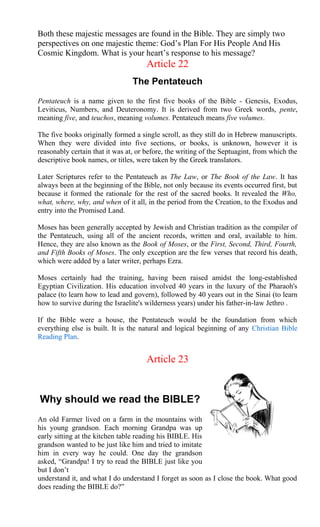
An old Farmer lived on a farm in the mountains with
his young grandson. Each morning Grandpa was up
early sitting at the kitchen table reading his BIBLE. His
grandson wanted to be just like him and tried to imitate
him in every way he could. One day the grandson
asked, “Grandpa! I try to read the BIBLE just like you
but I don’t
understand it, and what I do understand I forget as soon as I close the book. What good
does reading the BIBLE do?”
The Grandfather quietly turned from putting coal in the stove and replied, “Take this
coal basket down to the river and bring me back a basket of water.” The boy did as he
was told, but all the water leaked out before he got back to the house. The grandfather
laughed and said, “You’ll have to move a little faster next time,” and sent him back to
the River with the basket to try again.
This time the boy ran faster, but again the basket was empty before he returned home.
Out of breath, he told his grandfather that it was impossible to carry water in a basket,
and he went to get a bucket instead. The old man said, “I don’t want a bucket of water; I
want a basket of water. You’re just not trying hard enough,” and he went out the door to
watch the boy try again.
At this point, the boy knew it was impossible, but he wanted to show his grandfather
that even if he ran as fast as he could, the water would leak out before he got back to the
house. The boy again dipped the basket into river and ran hard, but when he reached his
grandfather the basket was again empty. Out of breath, he said, “See Grandpa, it’s
useless!”
“So you think it is useless?” The old man said, “Look at the basket.” The boy looked at
the basket and for the first time realized that the basket was different. It had been
transformed from a dirty old coal basket and was now clean, inside and out. “Son, that’s
what happens when you read the BIBLE. You might not understand or remember
everything, but when you read it; you will be changed, inside and out. That is the work
of Jesus in our live.
Article 24
BOOK OF GENESIS
OVERVIEW
According to Jewish and Christian
tradition, the first five books of the
Hebrew Scriptures (Old Testament) --
the Pentateuch --were written by
Moses under the inspiration of God.
God inspired Moses to write the truth
and prevented him from making any errors. The Bible itself states that Moses was the
author. Many conservative Christians and Jews continue with this belief today.
However, mainline and liberal theologians generally accept the "Documentary
Hypothesis" which asserts that the Pentateuch was written by five authors or groups of
authors, from diverse locations, over a period of centuries. Each wrote with the goal of
promoting his/her/their own religious views The five individuals or groups are
commonly called:
J: a writer(s) who used Yahweh/Jehovah as the divine name.
E: a writer(s) who used Elohim as the divine name. *
P: a writer(s) who added material of major interest to the priesthood.
D: the author of the book of Deuteronomy. *
R: a redactor(s) who welded the contributions of J, E and P together into the present
Pentateuch.
* Did not contribute to Genesis.
The authors of Genesis seem have picked up part of their story from Hindu legends of
the creation and early history of humanity. Stories of Hindu heroes Adimo, Heva,
Sherma, Hama and Jiapheta apparently were replicated into legends about Adam, Eve,
Shem, Ham, and Japeth.
The two creation stories at the start of Genesis were also apparently heavily influenced
by Pagan writings from Mesopotamia; the transition between the two sources occurs at
Genesis 2:4 with a verse inserted by the redactor "R."
The first ten chapters of the book of Genesis are reprinted in the following essays. 2
The original authors, according to the Documentary Hypothesis, are indicated in
different colors: J, P, and R. We follow the identification by R.E. Friedman.
Article 25
Meaning of Torah
First five books of the Bible
The word "Torah" in Hebrew is derived
from the root , which in the hifil
conjugation means "to guide/teach" (cf.
Lev. 10:11). The meaning of the word is
therefore "teaching", "doctrine", or
"instruction"; the commonly accepted
"law" gives a wrong impression.[6]
Other
translational contexts
in the English language include custom, theory, guidance,[7]
or system.[8]
The term
"Torah" is used in the general sense to include both rabbinic Judaism's written law
and oral law, serving to encompass the entire spectrum of authoritative Jewish
religious teachings throughout history, including the Mishnah, the Talmud, the
Midrash and more, and the inaccurate rendering of "Torah" as "Law"[9]
may be an
obstacle to understanding the ideal that is summed up in the term talmud torah ( ,
"study of Torah").[2]
The earliest name for the first part of the Bible seems to have been "The Torah of
Moses". This title, however, is found neither in the Torah itself, nor in the works of
the pre-Exilic literary prophets. It appears in Joshua (8:31–32; 23:6) and Kings (I
Kings 2:3; II Kings 14:6; 23:25), but it cannot be said to refer there to the entire
corpus. In contrast, there is every likelihood that its use in the post-Exilic works (Mal.
3:22; Dan. 9:11, 13; Ezra 3:2; 7:6; Neh. 8:1; II Chron. 23:18; 30:16) was intended to
be comprehensive. Other early titles were "The Book of Moses" (Ezra 6:18; Neh.
13:1; II Chron. 35:12; 25:4; cf. II Kings 14:6) and "The Book of the Torah" (Neh. 8:3),
which seems to be a contraction of a fuller name, "The Book of the Torah of God"
(Neh. 8:8, 18; 10:29–30; cf. 9:3).[10]
Scholars usually refer to the first five books of the Hebrew Bible as the Pentateuch, a
term first used in the Hellenistic Judaism of Alexandria,[11]
meaning five books, or as
the Law, or Law of Moses. Muslims refer to the Torah as Tawrat (, "Law"), an Arabic
word for the revelations given to the Islamic prophet Musa (, Moses in Arabic).
Article 26
Book of Genesis - Principles of Interpretation
How one should read the book of Genesis. How should we interpret the words written in these early
chapters? Should we take them literally or allegorically? This field in known as Hermeneutics, which
comes from the Greek Word interpret. Today there are two main schools in the interpretation of Genesis,
especially the first 11 chapters. Some argue for a literal interpretation others for an allegorical or
symbolic interpretation. Encyclopedia Britannica writes the following regarding these two methods.
Literal interpretation asserts that a biblical text is to be interpreted according to the “plain meaning”
conveyed by its grammatical construction and historical context. The literal meaning is held to correspond
to the intention of the authors. This type of hermeneutics is often, but not necessarily, associated with
belief in the verbal inspiration of the Bible, according to which the individual words of the divine message
were divinely chosen. Extreme forms of this view are criticized on the ground that they do not account
adequately for the evident individuality of style and vocabulary found in the various biblical authors.
Jerome, an influential 4th-century biblical scholar, championed the literal interpretation of the Bible in
opposition to what he regarded as the excesses of allegorical interpretation. The primacy of the literal
sense was later advocated by such diverse figures as Thomas Aquinas, Nicholas of Lyra, John Colet,
Martin Luther, and John Calvin.
Allegorical interpretation, a third type of hermeneutics, interprets the biblical narratives as having a
second level of reference beyond those persons, things, and events explicitly mentioned in the text. A
particular form of allegorical interpretation is the typological, according to which the key figures, main
events, and principal institutions of the Old Testament are seen as “types” or foreshadowings of persons,
events, and objects in the New Testament. According to this theory, interpretations such as that of
Noah's ark as a “type” of the Christian church have been intended by God from the beginning.
Do we reconcile Science and Scripture?
At conflict is how we reconcile scripture and science. When science comes into conflict with scripture,
which is right? This was a problem addressed by the Catholic Church and their view of Darwin and the
science behind Darwinian Evolution in light of Genesis. The problem of this conflict does not face the
Catholic Church alone, but everybody who strives to believe the Bible is God’s Word and yet also pride
themselves on being logical observing what science is revealing about our world.
The question we need to address is the relevance of scripture. Can the Bible be relied on to reveal the
reality of the world today? This is the core of the conflict, when we hear and are taught daily that
Evolution as proposed by Darwin is a fact, and that this fact contradicts the Bible, how should we
respond. Here are four options.
1. Should we blindly accept the claims of science, as a group of “objective students” trying to discover the
“Knowledge”?
2. Should we believe the Bible and reject any scientific claims which contradict the Bible?
3. Should we try to reconcile our Bible to claims of science?
4. Should we look for ways to reconcile “the claims” of science to the Bible?
Article 27
THE BIBLE IS ONE BOOK
The Bible is one book. It is the Holy Spirit inspired written record of God's master plan for man's
salvation. Beginning in the Old Testament with the opening chapters of Genesis and continuing
to the last book of the New Testament (The Book of Revelation), God the Father reveals His
desire to heal the broken relationship between Himself and man through the saving work of the
promised Redeemer, Jesus the Messiah. Jesus revealed the definitive nature of God's divine
plan in what we call the Old Testament when He told the Apostles and disciples after His
Resurrection.
The Old Testament begins in Genesis with the creation of the cosmos and an account of the
origin of life on earth. The account continues with the fall from grace of our original parents and
the promise of a future Redeemer through the "seed of the woman" (Gen 3:15). The history of
the early world in Genesis proceeds with the stories of the lives of numerous individuals in the
record of the family line of the "promised seed" that is preserved in Seth, the third son of Adam
and Eve, Seth's descendant Noah, and Noah's descendant Abraham. It was through Abraham
that God set apart a family, and from that family a people to worship and fellowship with Him. The
narrative of events in Genesis comes to a climax in a second "creation" event in the book of
Exodus. Reminiscent of the Creation event when God separated the land out from the sea of
chaos (Gen 1:9-10), God separated the children of Israel out from the chaos of the pagan peoples
of the earth. Then, in the Theophany at Sinai(Ex 19-24), God brought about the birth of the
nation of Israel’s people born to be God's holy possession and His Bride, the Church of the Sinai
Covenant. Just as God established Adam to serve and guard His Edenic Sanctuary (Gen 2:15),
Israel is called to become a priestly nation (Ex 19:6) the national family whose mission was to
serve and guard God's earthly Sanctuary, to be a witness to the nations of the world of the One
True God, to take possession of the "Promised Land" (Gen 15:18-21; Ex 23:31-33; Dt 11:24), and
to be the people from whom the promised Messiah (Gen 3:15; Dt 18:18-19) was to be born.
But these are not isolated events and biographies. The themes of lost fellowship, judgment,
promised redemption, restoration of fellowship and unity are repeated throughout the Bible's
record of salvation history and reach their fulfillment in the last Bible book, the Book of
Revelation. The Bible begins with the creation of heaven and earth, with a bridegroom, a bride,
and a wedding, and the Bible ends in the Book of Revelation with a new creation, a bridegroom, a
bride, and a wedding: Then I saw a new heaven and a new earth; the first heaven and the first
earth had disappeared now, and there was no longer any sea. I saw the holy city, the New
Jerusalem, coming down out of heaven from God, prepared as a bride dressed for her husband
(Rev 21:1-2). Genesis records the marriage of our first parents and Revelation the wedding feast
of the Lamb and His Bride, the Church, Blessed are those who are invited to the wedding feast of
the Lamb! (Rev 19:9).
Article 28
THE QUESTION OF THE AUTHORSHIP OF
THE BOOK OF MOSES
Jesus speaking to the Sadducees, referring to Exodus 3:6: Now about the dead rising again,
have you never read in the Book of Moses, in the passage about the bush, how God spoke to
him and said: I am the God of Abraham, the God of Isaac and the God of Jacob? Mark 12:26.
Usually when we speak of the authors of Sacred Scripture we are thinking of the individuals, the
prophets and other holy men who wrote down the words of each of the books, but according to
the text of Sacred Scripture these men may have been the human writers but it is God who is the
author. St. Paul and St. Peter, both writers of Sacred Scripture, testified to this belief:
• 2 Timothy 3:16 [St. Paul wrote]: All Scripture is inspired by God and useful for refuting
error, for guiding people's lives and teaching them to be upright.
• 2 Peter 1:21 [St. Peter wrote]: For no prophecy ever came from human initiative. When
people spoke for God it was the Holy Spirit that moved them.
That God is the author of the Bible has always been the position of the Catholic Church ‘the Bible
being both human and divine in its origins, just as Jesus Christ, the Living Word, is Himself both
human and divine. The Catholic Church affirms this 2,000 year teaching in the Universal
Catechism: God is the author of Sacred Scripture. "The divinely revealed realities, which are
contained and presented in the text of Sacred Scripture, have been written down under the
inspiration of the Holy Spirit." "For Holy Mother Church, relying on the faith of the apostolic age,
accepts as sacred and canonical the books of the Old and New Testaments, whole and entire,
with all their parts, on the grounds that, written under the inspiration of the Holy Spirit, they have
God as their author and have been handed on as such to the Church herself" (Catechism of the
Catholic Church #105; also see Jn 20:31; 2 Tim 3:16; 2 Pet 1:19-21; 3:15-16).
That God is the author of Sacred Scripture was the belief of both Jewish (Old Testament) and
Christian scholars until the Age of Enlightenment in the 18th
century when the Bible began to be
studied simply as literature devoid of any divine connection. In the 19th
century new theories were
introduced that reduced the record of Sacred Scripture to different strands of oral stories handed
down through generations and altered by the editing by numerous nameless redactors.
In the history of both Jewish and Christian tradition, and for most of the Judeo-Christian era,
Moses is given credit for having been inspired by God to write down the words of God contained
in the Pentateuch, and the Bible supports this claim.
Article 29
THE QUESTION OF THE AUTHORSHIP OF
THE BOOK OF MOSES
Jesus speaking to the Sadducees, referring to Exodus 3:6: Now about the dead rising again,
have you never read in the Book of Moses, in the passage about the bush, how God spoke to
him and said: I am the God of Abraham, the God of Isaac and the God of Jacob? Mark 12:26.
Usually when we speak of the authors of Sacred Scripture we are thinking of the individuals, the
prophets and other holy men who wrote down the words of each of the books, but according to
the text of Sacred Scripture these men may have been the human writers but it is God who is the
author. St. Paul and St. Peter, both writers of Sacred Scripture, testified to this belief:
• 2 Timothy 3:16 [St. Paul wrote]: All Scripture is inspired by God and useful for refuting
error, for guiding people's lives and teaching them to be upright.
• 2 Peter 1:21 [St. Peter wrote]: For no prophecy ever came from human initiative. When
people spoke for God it was the Holy Spirit that moved them.
That God is the author of the Bible has always been the position of the Catholic Church ‘the Bible
being both human and divine in its origins, just as Jesus Christ, the Living Word, is Himself both
human and divine. The Catholic Church affirms this 2,000 year teaching in the Universal
Catechism: God is the author of Sacred Scripture. "The divinely revealed realities, which are
contained and presented in the text of Sacred Scripture, have been written down under the
inspiration of the Holy Spirit." "For Holy Mother Church, relying on the faith of the apostolic age,
accepts as sacred and canonical the books of the Old and New Testaments, whole and entire,
with all their parts, on the grounds that, written under the inspiration of the Holy Spirit, they have
God as their author and have been handed on as such to the Church herself" (Catechism of the
Catholic Church #105; also see Jn 20:31; 2 Tim 3:16; 2 Pet 1:19-21; 3:15-16).
That God is the author of Sacred Scripture was the belief of both Jewish (Old Testament) and
Christian scholars until the Age of Enlightenment in the 18th
century when the Bible began to be
studied simply as literature devoid of any divine connection. In the 19th
century new theories were
introduced that reduced the record of Sacred Scripture to different strands of oral stories handed
down through generations and altered by the editing by numerous nameless redactors.
In the history of both Jewish and Christian tradition, and for most of the Judeo-Christian era,
Moses is given credit for having been inspired by God to write down the words of God contained
in the Pentateuch, and the Bible supports this claim.
Article 30
THE BOOK OF GENESIS
Who Wrote the Book of Genesis?
The traditional view was that Moses wrote the Book of Genesis between
1446 and 1406 BCE. The Documentary Hypothesis developed by modern
scholarship indicates that several different authors contributed to the text and
at least one edited multiple sources together to create the final Genesis text
that we have today. Exactly how many different sources were used and how
many authors or editors were involved is a matter of debate.
Early critical scholarship argued that various traditions about the origins of
the Israelites were collected and written down during the reign of Solomon
(c. 961–931 BCE). Archaeological evidence casts doubt on whether there
was much of an Israelite state at thistime, though, let alone an empire of the
sort described in the Old Testament.
Textual research on the documents suggests that some of the earliest portions
of Genesis can only be dated to the 6th century, well after Solomon. Current
scholarship seems to favor the idea that the narratives in Genesis and other
early Old Testament texts were at least collected, if not written down, during
the reign of Hezekiah (c. 727–698 BCE).
When Was the Book of Genesis Written?
The oldest manuscripts we have of Genesis date to some point between 150
BCE and 70 CE. Literary research on the Old Testament suggests that the
oldest parts of the Book of Genesis may have first been written during the
8th century BCE. The latest parts and final editing were probably done
during the 5th century BCE. The Pentateuch probably existed in something
like its current form by the 4th century BCE
(Next issue - Book of Genesis summery)
Article 31
THE BOOK OF GENESIS SUMMERY
Genesis 1-11: The beginning of Genesis is the beginning of the universe
and of all existence: God creates the universe, the planet earth, and
everything else. God creates humanity and a paradise for them to live in,
but they are kicked out after disobeying. Corruption in humanity later
causes God to destroy everything and everyone save one man, Noah, and
his family on an ark. From this one family come all the nations of the world,
leading eventually to a man named Abraham
Genesis 12-25: Abraham is singled out by God and he makes a covenant
with God. His son, Isaac, inherits this covenant as well as the blessings that
go with it. God gives Abraham and his descendants the land of Canaan,
though others already live there.
Genesis 25-36: Jacob is given a new name, Israel, and he continues the
line which inherits God's covenant and blessings.
Genesis 37-50: Joseph, Jacob's son, is sold by his brothers into slavery in
Egypt where he acquires a great deal of power. His family comes to live
with him and thus the entire line of Abraham settles in Egypt where they will
eventually grow to great numbers.
Article 32
Book of Genesis Themes
1] Covenants: Recurring throughout the Bible is the idea of
covenants and this is already important early in the Book of Genesis.
A covenant is a contract or treaty between God and humans, either
with all humans or with one specific group like God's "Chosen
People." Early on God is depicted as making promises to Adam,
Eve, Cain, and others about their own personal futures. Later God is
depicted as making promises to Abraham about the future of all his
descendants.
There is debate among scholars about whether the recurring stories
of covenants is one deliberate, grand, overarching theme of the
Bible as a whole or whether they are just individual themes that
ended up being linked together when the biblical texts were
collected and edited together.
2] Sovereignty of God: Genesis starts out with God creating
everything, including existence itself, and throughout Genesis God
asserts his authority over creation by destroying whatever fails to
live up to his expectations. God has no particular obligations to
anything created except that which he decides to offer; put another
way, there are no inherent rights possessed by any people or any
other part of creation except that which God decides to grant.
3] Flawed Humanity: The imperfection of humanity is a theme
which starts in Genesis and continues throughout the Bible. The
imperfection starts with and is exacerbated by the disobedience in
the Garden of Eden. After that, humans consistently fail to do what
is right and what God expects. Fortunately, the existence of a few
people here and there who do live up to some of God's expectations
has prevented the extermination of our species.
Article 33
An Introduction to the Book of Exodus
The book of Exodus tells the story of how one who reveals himself as “I am who I am” takes on
and vanquishes the powers of oppression, sets a people free, and gifts them with law, a
priesthood, and a place of worship. The narrative trajectory of events recounted is a lens through
which the course of countless revolutions has since been understood: oppression; deliverance;
social contract; internal conflict; revision and renewal of the contract; and, beyond the bounds of
the book of Exodus, wandering; the unraveling of the covenant; renewed oppression; the promise
of a new covenant and a new exodus.
It is the story of a particular people, the direct continuation of the story of Jacob’s clan in Egypt
(Gen 37-50). “I am who I am,” aka YHWH, identifies himself to a leader of his choosing,
Moses, as the God of their ancestors. YHWH has heard the cry of the people in the slave-
house of Egypt; he will set them free and take them to a land flowing with milk and honey
(Exod 3).
This same God rescues Moses at birth; though Moses commits murder and runs away, God calls
him and appoints him to challenge Pharaoh, unleash ten plagues on Egypt, escape with a mixed
multitude in the dead of night, part the Red Sea, and journey to a desert mountain; there they are
told that “you will be for me a treasured possession among all the peoples … a kingdom of priests
and a holy nation”; the people are constituted as one people under God (1-18; 19:5-
6). Beginning with the “Ten Words,” God reveals to Moses law and covenant designed to
safeguard the freedom obtained; Moses and Aaron and the elders of Israel ascend the mountain,
behold God, and eat and drink in his presence; in the sight of the people, the appearance of the
glory of YHWH on the mountain is like a devouring fire (19-24; 24:9-11). God gives instructions
for the construction of a mobile place of worship, the institution of a priesthood, and reiterates, as
a sign forever, the Sabbath imperative; the commanded rest has kept Israel ever since (25-31).
Nonetheless, in a crisis typical of revolutions, the people manufacture a god like the one they
were familiar with in the slave-house of Egypt; Moses intercedes in the hope that “I am who I am”
will not abort the project of liberation. Moses goes on to command his fellow Levite tribesmen to
“kill your brother, your friend, your neighbor,” the prototypical example of a revolutionary purge.
The crisis is resolved in blood; the remnant is ordered to go on the march (32-33).
God reveals himself to Moses again and proclaims, “YHWH, YHWH, a God merciful and
gracious, slow to anger, abounding in steadfast love and faithfulness, keeping steadfast love to
the thousandth generation” (34:6-7a). The covenant is renewed, the Sabbath imperative
reiterated (34:10-35:3). The book concludes with the construction of the Tabernacle; YHWH’s
glory descends to fill it (35-40).
Article 34
BOOK OF EXODUS - Themes and Theology
Exodus lays a foundational theology in which God reveals his name, his attributes, his redemption, his
law and how he is to be worshiped. It also reports the appointment and work of Moses as the mediator of
the Sinaitic covenant, describes the beginnings of the priesthood in Israel, defines the role of the prophet
and relates how the ancient covenant relationship between God and his people (see note on Ge 17:2)
came under a new administration (the covenant given at Mount Sinai).
Profound insights into the nature of God are found in chs. 3; 6; 33–34. The focus of these texts is on the
fact and importance of his presence with his people. But emphasis is also placed on his attributes of
justice, truthfulness, mercy, faithfulness and holiness. Thus to know God’s “name” is to know him and to
know his character (see 3:13–15; 6:3).
God is also the Lord of history. Neither the affliction of Israel nor the plagues in Egypt were outside his
control. The pharaoh, the Egyptians and all Israel saw the power of God. There was no one like him,
“majestic in holiness, awesome in glory, working wonders” (15:11). It is reassuring to know that God
remembers and is concerned about his people (2:24). What he had promised centuries earlier to
Abraham, Isaac and Jacob he now begins to bring to fruition as Israel is freed from Egyptian bondage
and sets out for the land of promise. The covenant at Sinai is but another step in God’s fulfillment of his
promise to the patriarchs (3:15–17; 6:2–8; 19:3–8).
The Biblical message of salvation is likewise powerfully set forth in this book. The verb “redeem” is used,
e.g., in 6:6; 15:13. But the heart of redemption theology is best seen in the Passover narrative of ch. 12,
the sealing of the covenant in ch. 24, and the account of God’s gracious renewal of that covenant after
Israel’s blatant unfaithfulness to it in their worship of the golden calf (34:1–14).
The apostle Paul viewed the death of the Passover lamb as fulfilled in Christ (1Co 5:7). Indeed, John the
Baptist called Jesus the “Lamb of God, who takes away the sin of the world” (Jn 1:29).
The foundation of Biblical ethics and morality is laid out first in the gracious character of God as revealed
in the exodus itself and then in the Ten Commandments (20:1–17) and the ordinances of the Book of the
Covenant (20:22—23:33), which taught Israel how to apply in a practical way the principles of the
commandments. The book concludes with an elaborate discussion of the theology of worship. Though
costly in time, effort and monetary value, the tabernacle, in meaning and function, points to the “chief end
of man,” namely, “to glorify God and to enjoy him forever” (Westminster Shorter Catechism). By means of
the tabernacle, the omnipotent, unchanging and transcendent God of the universe came to “dwell” or
“tabernacle” with his people, thereby revealing his gracious nearness as well. God is not only mighty in
Israel’s behalf; he is also present in the nation’s midst.
However, these theological elements do not merely sit side by side in the Exodus narrative. They receive
their fullest and richest significance from the fact that they are embedded in the account of God’s raising
up his servant Moses (1) to liberate his people from Egyptian bondage, (2) to inaugurate his earthly
kingdom among them by bringing them into a special national covenant with him, and (3) to erect within
Israel God’s royal tent. And this account of redemption from bondage leading to consecration in covenant
and the pitching of God’s royal tent in the earth, all through the ministry of a chosen mediator, discloses
God’s purpose in history—the purpose he would fulfill through Israel, and ultimately through Jesus Christ
the supreme Mediator.
Article 35
BOOK OF EXODUS – Genres and unifying elements
Genres.
The book of Exodus is presented in the form of an epic. Like most epics, it begins in the middle of
things, with the Israelites languishing in slavery and their would-be deliverer born under the threat
of death by drowning.
The story proceeds along epic lines, with a cosmic confrontation between good and evil that is
happily resolved through a mighty act of rescue and a long journey to freedom. Moses is the
heroic (albeit imperfect) national leader who serves as the human instrument of a divine
deliverance.
Like many epics, Exodus is also the story of the founding of a nation. This helps to explain how
the second half of the book connects to the first: once they are delivered from bondage, the
people of God meet to receive a national constitution (the Ten Commandments) and to establish
a place for their national assembly (the tabernacle).
Within its epic framework, Exodus also contains a wealth of subgenres: rescue story, calling
story, human-divine encounter, diplomatic negotiation, plague story, genealogy, institution of a
festival, song of victory, travelogue, miracle story, legal code, case law, covenant renewal
ceremony, architectural blueprint, garment design, building narrative.
Unifying elements
The person of Moses provides Exodus with a strong sense of narrative unity. It is Moses who
meets with God at the burning bush, demands that Pharaoh let God’s people go, leads
Israel across the sea on dry land, sings the song of their salvation, comes down a
mountain (twice) with the Law of God, leads Israel in worship, and finally sets up the
tabernacle.
Since Moses is a national leader, Exodus is also unified by its focus on Israel as the people of
God. But the real hero of the story is God himself, and Exodus finds its most essential
unity in his actions and attributes as the God who hears his people pray, delivers them
from slavery, provides for them in the wilderness, instructs them how to live, invites them
to worship him, and meets with them in all the power of his holy divine presence.
To be even more specific, the main theme of Exodus is the glory of God. The initial plot conflict is
that Pharaoh will not let God’s people go out to glorify their God (see 9:1). When God
plagues the Egyptians and drowns Pharaoh’s armies at the bottom of the sea, he does it to
gain glory for himself (see 14:4, 17–18)—a glory that Moses celebrates in his victory song
(see 15:11).
This divine glory is revealed in visible form many times throughout the book: at the burning bush,
in the pillar of cloud (16:10), at the top of Mount Sinai (see 24:15–17), in the face of Moses
(34:29–35), and most climactically in the completed tabernacle (40:34–35). The central
message of Exodus is that God’s people are saved for God’s glory.
BIBLE STUDY QUIZ PART 2
ARTICLES FROM 19 TO35
BIBLE STUDY QUIZ (BSQ) –part 2 – March 20, 2016
(Questions for this BSQ 2 are chosen from the articles of BIBLE STUDY – part 2 from SFX church website.
You have to simply tick (a,b or c) the correct answers in the answer sheet given separately).
1] Two of the commonly repeated numbers in the Bible are 7 and ___ a] 12 b] 40 c] 3
2] The number ____ is thought to be the number of man. a] 24 b] 12 c] 6
3] Students of the Bible have generally grouped the leading topics treated in the Bible under ___ main heads.
a] 2 b] 4 c] 8
4] God in his dynamic and creative essence resolved to create the universe and ______.
a] rule over it b] blessed it c] delighted in it
5] Pentateuch the first five books of the bible. The name Pentateuch derived from ____ language
a] Hebrew b] Arabic c] Persian
6] Moses’ education involved ___ years in the luxury of the Pharaoh's palace (to learn how to lead and govern).
aA] 30 b] 40 c] 50
7] If the Bible were a house, the Pentateuch would be the _____ from which everything else is built.
a] cornerstone b] foundation c] layout
8] In the story of the old Farmer, grandpa was up early sitting _____ reading his BIBLE.
a] in the garden b] on the sofa c] at the kitchen table
9] At the end of the same story, the boy looked at the basket and for the first time realized that the basket was
____. a] broken b] old c] different
10] God inspired Moses to write the ____ and prevented him from making any errors. a] truth b] facts c] story
11] The authors of Genesis seems to have picked up part of their story from ____ legends of the creation and
early history of humanity. a] Hindu b] ancient c] Jewish
12] The ____ creation stories at the start of Genesis were also apparently heavily influenced by Pagan writings
from Mesopotamia. a] four b] two c] three
13] In Hebrew ‘Torah’ means ____ a] fight b] discover c] teach
14] The earliest name for the first part of the Bible seems to have been "The Torah of ___".
a] Abraham b] Moses c] Adam
15] _____ usually refer to the first five books of the Hebrew Bible as the Pentateuch, a term first used in the
Hellenistic Judaism of Alexandria. a] scholars b] scientists c] educationists
16] Interpreting the Bible is known as Hermeneutics, which comes from the ____ Word interpret.
a] Hebrew b] Latin c] Greek
17] Literal interpretation asserts that a biblical text is to be interpreted according to the ____ conveyed by its
grammatical construction and historical context. a] complex meaning b] plain meaning c] hidden meaning
18] The problem of conflict between scripture and _____does not face the Catholic Church alone, but everybody
who strives to believe the Bible is God’s Word. a] science b] history c] politics
19] Evolution as proposed by Darwin is a fact, and that this fact ______ the Bible.
a] agrees with b] denies c] contradicts
20] The Bible is one book. It is the Holy Spirit inspired written record of God's ____ plan for man's salvation. a]
pure b] complete c] master
21] It was through _____ that God set apart a family, and from that family a people to worship and fellowship with
God. a] Noah b] Abraham c] Moses
22] God brought about the birth of the nation of Israel’s people born to be God's holy possession and His Bride,
the Church of the ____ Covenant. a] Sinai b] Abrahimic c] Davidic
23] Genesis records the ____ of our first parents and Revelation the wedding feast of the Lamb and His Bride, the
Church. a] marriage b] sin c] disobedience
24] That ____ the author of the Bible has always been the position of the Catholic Church
a] prophets are b] holy men are c] God is
25] For no prophecy ever came from human initiative. When people spoke for God it was the Holy Spirit that
moved them. Who wrote this? a] St Paul b] St Peter c] St John
26] The traditional view was that Moses wrote the Book of Genesis between ___ BCE.
a] between 1446 and 1406 b] 1646 and 1706 c] 1205 and 1245
BSQ 2..contd page 2/
BSQ 2/contd page 2
27] Exactly how many different sources were used and how many authors or editors were involved in writing the
Pentateuch is ____. a] clear b] not important c] a matter of debate
28] The Pentateuch probably existed in something like its current form by the ___ century BCE
a] 6th
b] 4th
c] 5th
29] Genesis – 1 to 11 - From this one family come all the nations of the world, leading eventually to a man named
___. a] Moses b] Isaac c] Abraham
30] Gen. 12-25 - Abraham’s son Isaac inherits the ____ and the blessings that go with it.
A] property b] covenant c] temple
31] Genesis 37-50: Joseph, Jacob's son, is sold by his ____ into slavery in Egypt where he acquires a great deal
of power. a] brothers b] neighbours c] parents
32] A covenant is a contract or treaty between God and humans, either with all humans or with one specific group
like God's ____. a] gentiles b] chosen people c] aliens
33] Genesis starts out with God creating everything, including existence itself, and throughout Genesis God
asserts his authority over creation by ____ whatever fails to live up to his expectations.
a] forgiving b] changing c] destroying
34. God has no particular ____ to anything created except that which he decides to offer.
a] greatness b] obligations c] power
35] The ____ of humanity is a theme which starts in Genesis and continues throughout the Bible.
a] greatness b] disobedience c] imperfection
36] Fortunately, the existence of a few people here and there who do live up to some of God's expectations has
prevented the _____ of our species. a] extermination b] exploitation c] suffering
37] The book of Exodus tells the story of how one who reveals himself as “I am _____”
a] who I am b] mighty God c] the Savior.
38] This same God rescues Moses at birth; though Moses commits murder and runs away, God calls him and
appoints him to ___ Pharaoh. a] praise b] challenge c] convert
39] Moses and Aaron and the ____ of Israel ascend the mountain, behold God, and eat and drink in his presence.
a] priests b] friends c] elders
40] Nonetheless, in a crisis typical of revolutions, the people manufacture a ___ like the one they were familiar
with in the slave-house of Egypt. a] god b] king c] leader
41] The book of Exodus concludes with the construction of the ____; YHWH’s glory descends to fill it (35-40). a]
cave b] Temple c] Tabernacle
42] Exodus lays a foundational ____ in which God reveals his name, his attributes, his redemption, his law and
how he is to be worshiped. a] education b] theory c] theology
43] Book of exodus also reports the appointment and work of ____ as the mediator of the Sinaitic covenant.
a] Abraham b] Moses c] Aron
44] Thus to know God’s “name” is to know him and to know his ____. a] power b] character c] mercy
45] The book of exodus is the account of God’s gracious renewal of that covenant after Israel’s blatant
unfaithfulness to it in their _____. a] worship b] relations c] obedience
46] The “tabernacle” symbolizes God is not only mighty in Israel’s behalf; he is also present in the nation’s ____.
a] victory b] suffering c] midst
47] The story in the book of exodus proceeds along epic lines, with a cosmic confrontation between _____.
a] god and devil b] good and evil c] divine and human
48] Like many epics, Exodus is also the story of the founding of a ____. a] nation b] government c] kingship
49] Since Moses is a national leader, Exodus is also unified by its focus on Israel as the ______.
a] people of God b] suffering nation c] chosen race
50] The central message of Exodus is that God’s people are saved for God’s ____. a] love b] glory c] power
Next Quiz - BQ 11
In the month of June 2016, as usual 4th
Sunday. Start preparing Mark chs 10 to 16
and Letter to Thessalonians.
BIBLE STUDY QUIZ – Part 2
Name: ________________________________________SC NO._________MARKS OUT OF 50________
Answers
Simply mark √ or X on the correct answer. After once ticking, if you want to change the answer, cancel the
answer ticked, and write the correct alphabet in the blank column (last column).
1 a b c
2 a b c
3 a b c
4 a b c
5 a b c
6 a b c
7 a b c
8 a b c
9 a b c
10 a b c
11 a b c
12 a b c
13 a b c
14 a b c
15 a b c
16 a b c
17 a b c
18 a b c
19 a b c
20 a b c
21 a b c
22 a b c
23 a b c
24 a b c
25 a b c
26 a b C
27 a b C
28 a b C
29 a b C
30 a b C
31 a b c
32 a b c
33 a b c
34 a b c
35 a b c
36 a b c
37 a b c
38 a b c
39 a b c
40 a b c
41 a b c
42 a b c
43 a b c
44 a b c
45 a b c
46 a b c
47 a b c
48 a b c
49 a b c
50 a b c
GIVE YOUR GENUINE FEEDBACK
How did you benefit from your participation in the BQ in general and today’s Bible Study Quiz-part 2? Write a few
sentences. Use reverse page if needed. Best feedbacks will be published in gem face book
FOR BIBLE QUIZ – part 3 – articles 36 to
53
Article 36
BOOK OF LEVITICUS – Introduction
What is Leviticus?
The Book of Leviticus is a record of the laws which Israelites believed God handed
down to them through Moses. They believe that following all of these laws, exactly and
precisely, was necessary to retain God's blessings both for them personally and for their
nation as a whole.
One important aspect of these laws is that they were supposed to set them apart from
other tribes and peoples — the Israelites were different because unlike everyone else,
they were God's "Chosen People" and as such followed God's chosen laws.
The word "Leviticus" means "concerning the Levites." A Levite was a member of the
clan of Levi, the group from which one family was selected by God to oversee the
administration of all the religious laws. Some of the laws in Leviticus were for the
Levites in particular because the laws were instructions on how to conduct worship of
God.
Facts about the Book of Leviticus:
• Leviticus is the third book the Bible, the Torah and, the Pentateuch
• Leviticus has 27 chapters & 659 verses
• Chapter & verse divisions are of Christian origin
• Leviticus has very little narrative and no physical traveling
Important Characters in Leviticus
• Moses: Leader of the Israelites, receives the laws from God and gives them to
the people
• Aaron: Moses' older brother, chosen by God to be the first high priest
Who Wrote the Book of Leviticus?
The tradition of Moses being the author of Leviticus still has many adherents among
believers, but the Documentary Hypothesis developed by scholars attributes the
authorship of Leviticus entirely to priests. It was probably many priests working
over multiple generations. They may or may not have used outside sources as the
basis for Leviticus.
When Was the Book of Leviticus Written?
Most scholars agree that Leviticus was probably written during the 6th century BCE.
Where scholars disagree is on whether it was written during the exile, after the exile, or
a combination of both. A few scholars, though, have argued that Leviticus may have
been written down in its basic form before the exile. Whatever outside traditions the
priestly authors of Leviticus drew upon, though, may have dated many hundreds of
years prior to this.
Article 37
BOOK OF LEVITICUS (contd) – Background and Setting
Before the year that Israel camped at Mt. Sinai: 1) the presence of God’s glory had
never formally resided among the Israelites; 2) a central place of worship, like the
tabernacle, had never existed; 3) a structured and regulated set of sacrifices and feasts
had not been given; and 4) a High-Priest, a formal priesthood, and a cadre of tabernacle
workers had not been appointed.
As Exodus concluded, features one and two had been accomplished, thereby requiring
that elements three and four be inaugurated, which is where Leviticus fits in. Exodus
19:6 called Israel to be “a kingdom of priests and a holy nation.” Leviticus in turn is
God’s instruction for His newly redeemed people, teaching them how to worship and
obey Him.
Israel had, up to that point, only the historical records of the patriarchs from which to
gain their knowledge of how to worship and live before their God. Having been slaves
for centuries in Egypt, the land of a seemingly infinite number of gods, their concept of
worship and the godly life was severely distorted.
Their tendency to hold on to polytheism and pagan ritual is witnessed in the wilderness
wanderings, e.g., when they worshiped the golden calf (cf. Ex. 32). God would not
permit them to worship in the ways of their Egyptian neighbors, nor would He tolerate
Egyptian ideas about morality and sin. With the instructions in Leviticus, the priests
could lead Israel in worship appropriate to the Lord.
Even though the book contains a great deal of law, it is presented in a historical format.
Immediately after Moses supervised the construction of the tabernacle, God came in
glory to dwell there; this marked the close of the book of Exodus (40:34–38).
Leviticus begins with God calling Moses from the tabernacle and ends with God’s
commands to Moses in the form of binding legislation. Israel’s King had occupied His
palace (the tabernacle), instituted His law, and declared Himself a covenant partner with
His subjects.
No geographical movement occurs in this book. The people of Israel stay at the foot of
Sinai, the mountain where God came down to give His law (25:1; 26:46; 27:34). They
were still there one month later when the record of Numbers began (cf. Num. 1:1).
Article 38
BOOK OF NUMBERS – Introduction
The Book of Numbers (from Greek Ἀριθμοί, Arithmoi; Hebrew: , Bəmidbar,
"In the desert [of]") is the fourth book of the Hebrew Bible, and the fourth of
five books of the Jewish Torah.
Numbers begins at Mount Sinai, where the Israelites have received their laws
and covenant from God and God has taken up residence among them in the
sanctuary. The task before them is to take possession of the Promised Land.
The people are numbered and preparations are made for resuming their
march. The Israelites begin the journey, but they "murmur" at the hardships
along the way, and about the authority of Moses and Aaron.
For these acts, God destroys approximately 15,000 of them through various
means. They arrive at the borders of Canaan and send spies into the land, but
upon hearing the spies' falsified report concerning the conditions in Canaan
the Israelites refuse to take possession of it, and God condemns them to death
in the wilderness until a new generation can grow up and carry out the task.
The book ends with the new generation of Israelites in the Plain of Moab
ready for the crossing of the Jordan River.
Numbers is the culmination of the story of Israel's exodus from oppression in
Egypt and their journey to take possession of the land God promised their
fathers. As such it draws to a conclusion the themes introduced in Genesis
and played out in Exodus and Leviticus: God has promised the Israelites that
they shall become a great (i.e. numerous) nation, that they will have a special
relationship with Yahweh their god, and that they shall take possession of the
land of Canaan.
Against this, Numbers also demonstrates the importance of holiness,
faithfulness and trust: despite God's presence and his priests, Israel lacks
faith and the possession of the land is left to a new generation. The book has
a long and complex history, but its final form is probably due to a Priestly
redaction (i.e., editing) of a Yahwistic original text some time in the early
Persian period (5th century BCE).
Article 39
BOOK OF NUMBERS – themes and outline
Themes in the Book of Numbers:
• A census or count of the people was needed to prepare them for future tasks. The first
census organized the people by tribes, for their journey ahead. The second census, in
Chapter 26, counted the men 20 years and older who could serve in the army. Planning
is wise if we face a major task.
• Rebellion against God brings bad consequences. Instead of believing Joshua and
Caleb, the only two spies who said Israel could conquer Canaan, the people did not trust
God and refused to cross into the Promised Land. For their lack of faith, they wandered
40 years in the desert until all but a few of that generation had died.
• God does not tolerate sin. God, who is holy, let time and the desert take the lives of
those who disobeyed him. The next generation, free of the influence of Egypt, were
prepared to be a separate, holy people, loyal to God. Today, Jesus Christ saves, but God
expects us to make every effort to drive sin from our lives.
• Canaan was the fulfillment of God's promises to Abraham, Isaac and Jacob. The
Jewish people grew in numbers during their 400 years of slavery in Egypt. They were
now strong enough, with God's help, to conquer and populate the Promised Land. God's
word is good. He rescues his people and stands by them.
Outline of the Book of Numbers:
• Israel prepares for the journey to the Promised Land - Numbers 1:1-10:10.
• The people complain, Miriam and Aaron oppose Moses, and the people refuse to enter
Canaan because of the reports of the unfaithful spies - Numbers 10:11-14:45.
• For 40 years the people wander in the desert until the faithless generation is consumed
- Numbers 15:1-21:35.
• As the people approach the Promised Land again, a king tries to hire Balaam, a local
sorcerer and prophet, to put a curse on Israel. On the way, Balaam's donkey talks to him,
saving him from death! An angel of the Lord tells Balaam to speak only what the Lord
tells him. Balaam is able only to bless the Israelites, not curse them - Numbers 22:1-
26:1.
• Moses takes another census of the people, to organize an army. Moses commissions
Joshua to succeed him. God gives instructions on offerings and feasts - Numbers 26:1-
30:16.
• The Israelites take vengeance on the Midianites, then camp on the plains of Moab -
Numbers 31:1-36:13.
Article 40
BOOK OF DEUTERONOMY – Introduction
Deuteronomy means "second law." It is a retelling of the covenant between God and his
people Israel, presented in three addresses or sermons by Moses. These series of three
strong sermons by Moses to the people of Israel as they are about to enter the Promised
Land. It's one of the most significant books in the Old Testament, often quoted by Jesus
Christ in the New Testament, including three times when he was tempted by Satan in
the wilderness.
Deuteronomy, that is, "second law," contains a restating of the Law given at Mount
Sinai. But Deuteronomy goes much deeper, revealing the depth of God's personal love
for his people - a love that is at the very foundation of God's purpose in giving the Law.
The Law, we see, is God's expression of love and protection toward his people, and our
obedience to the Law expresses our response of love and trust back to God.
At the end of Deuteronomy, the final book of the Pentateuch, we must say farewell to
Moses as we witness the passing of his torch to Joshua and the death of Moses.
Written as the Israelites are to enter the Promised Land, Deuteronomy is a stern
reminder that God is worthy of worship and obedience. His laws are given to us for our
protection, not as punishment.
As we read Deuteronomy and meditate on it, the relevance of this 3,500 year-old book
is startling. In it, God tells people that obeying him brings blessings and goodness, and
disobeying him brings disaster. The consequences of using illegal drugs, breaking the
law, and living an immoral life are proof that this warning still rings true today.
Deuteronomy is the last of the five books of Moses, called the Pentateuch. These God-
inspired accounts, Genesis, Exodus, Leviticus, Numbers, and Deuteronomy, begin at
Creation and end with the death of Moses. They detail God's covenant relationship with
the Jewish people that is woven throughout the Old Testament.
Article 41
BOOK OF DEUTERONOMY – themes and outline
Themes in the Book of Deuteronomy:
History of God's Help - Moses reviewed God's miraculous help in freeing the Israelite
people from slavery in Egypt, and the people's repeated disobedience. Looking back, the
people were able to see how rejecting God always brought calamity upon them.
Review of the Law - The people entering Canaan were bound by the same laws of God
as their parents. They had to renew this contract, or covenant with God before entering
the Promised Land. Scholars note that Deuteronomy is structured as a treaty between a
king and his vassals, or subjects, in that time period. It represents a formal agreement
between God and his people Israel.
God's Love Motivates Him - God loves his people as a father loves his children, but he
also disciplines them when they disobey. God does not want a nation of spoiled brats!
God's love is an emotional, heart-love, not just a legalistic, conditional love.
God Gives Freedom of Choice - People are free to obey or disobey God, but they
should also know they are responsible for the consequences. A contract, or covenant,
requires obedience, and God expects nothing less.
Children Must be Taught - To keep the covenant, the people must instruct their
children in God's ways and be sure they follow them. This responsibility continues
through every generation. When this teaching becomes lax, trouble begins.
Outline of the Book of Deuteronomy:
• Moses Gives his First Speech About Israel's History - Deuteronomy 1:6-4:43.
• Moses Gives his Second Speech About Basic Requirements of the Law -
Deuteronomy 4:44-11:32.
• Moses Continues his Second Speech on Detailed Requirements of the Law -
Deuteronomy 12:1-26:19.
• Moses Gives his Third Speech Relating Blessings and Curses - Deuteronomy
27:1-28:68.
• Moses Continues his Third Speech with Warnings and Encouragement -
Deuteronomy 29:1-30:20.
• Commissioning of Joshua and Moses' Final Words - Deuteronomy 31:1-34:12.
Article 42
BOOK OF JOSHUA – Introduction
The Book of Joshua or Book of Jehoshua (Hebrew: Sefer Yĕhôshúa) is the sixth book
in the Hebrew Bible and the Christian Old Testament. Its 24 chapters tell of the entry of
the Israelites into Canaan, their conquest and division of the land under the leadership
of Joshua, and of serving God in the land. Joshua forms part of the biblical account of
the emergence of Israel which begins with the exodus of theIsraelites from slavery in
Egypt, continues with the book of Joshua, and culminates in the Judges with the
conquest and settlement of the land. The book is in two roughly equal parts. The first
part depicts the campaigns of the Israelites in central, southern and northern Canaan, as
well as the destruction of their enemies. The second part details the division of the
conquered land among the twelve tribes. The two parts are framed by set-piece speeches
by God and Joshua commanding the conquest and at the end warning of the need for
faithful observance of the Law (torah) revealed to Moses.
Almost all scholars agree that the book of Joshua holds little historical value for early
Israel and most likely reflects a much later period. Rather than being written as history,
the Deuteronomistic history – Deuteronomy, Joshua, Judges, Samuel and Kings – was
intended to illustrate a theological scheme in which Israel and her leaders are judged by
their obedience to the teachings and laws (the covenant) set down in the book
of Deuteronomy.
Although tradition holds that the book was written by Joshua, it is probable that it was
written by multiple editors and authors far removed from the times it depicts. The
earliest parts of the book are possibly chapters 2–11, the story of the conquest; these
chapters were later incorporated into an early form of Joshua written late in the reign of
king Josiah (reigned 640–609 BCE), but the book was not completed until after the fall
of Jerusalem to the Babylonians in 586, and possibly not until after the return from
the Babylonian exile in 539.
Overview
The book of Joshua describes the conquest and possession of the land of Canaan and
may be divided into three simple divisions: (1) invasion or entrance, (2) conquest, and
(3) possession or division of the land. This is the land God had promised Israel through
Abraham, Isaac, and Jacob. Here God fulfilled that promise, though not exhaustively
since there still remains a rest for the people of God (Heb. 4). Joshua describes the
military triumph of God’s people through faith and obedience. However, unlike most
military histories, in the book of Joshua the focus is on the commander’s Commander,
the Captain of the Lord’s host (5:15). Repeatedly, as Joshua’s name illustrates (Yahweh
saves), the book demonstrates that Israel’s victories were due to God’s power and
intervention.
Article 43
BOOK OF JOSHUA – Themes
For 40 years the Israelites journeyed to make it to the promised land, but after they
refused to obey God and conquer Canaan they were left wandering. Joshua was chosen
to be Moses successor and the one to finally lead the Israelites to the promised land and
that is what the book of Joshua is about. These are some of the themes in the book of
Joshua.
Themes of the Book of Joshua:
1] Success
In the book of Joshua God tells us two things about success. The first is that we will not
find success until we follow God. When the Israelites disobeyed God they were left
wandering but when they finally obeyed God is when the were finally led to the
promised land. The second thing God teaches us about success in the book of Joshua is
that the success we will receive is God's idea of success not necessarily what the world's
idea of success is.
2] Faith
God eventually led the Israelites to the promised land through Joshua and the reason
was that when they finally obeyed God they were finally showing that they had faith in
him. Sometimes when we want something we forget to look back and remember the
times that God did provide for us. When we do that it is easier to be faithful again.
3] Guidance
All the themes of Joshua can be linked together. We have success when we have faith in
God and when we have faith in God he guides us. Fortunately today we have even more
guidance than the Israelites did at the time because we have a book of instructions in the
Bible.
4] Leadership
Joshua isn't talked about as much as other people in the Bible like Moses, Noah, Paul,
David and others but Joshua was one of the best examples of a leader in the Bible.
Joshua was courageous, strong and confident. Joshua was willing to seek God's advice
and to act on it immediately.
5] Conquest
God instructed the Israelites to conquer the Canaanites and to take their land but they
never finished the task. We will probably never be told to conquer anybody like the
Israelites were but it is important to carry out the tasks that he gives us. It is not enough
to simply believe in God.
Article 44
BOOK OF JUDGES - Introducing Judges
Despicable people doing deplorable things. That pretty much sums up the book of Judges. Why would
the Bible even contain such trashy tales about dysfunctional characters? As I read the book, I find it
difficult to find any sympathy for those—even the heroes—involved in these violent and abusive
accounts.
Who can love people who maltreat others? Who would care about people who complicate and sabotage
their own lives and then refuse the hope that is offered? Who would have patience with people who
refuse to learn from their mistakes but instead pass them on as a legacy to the next generation? The
answer is that only God could care about creatures such as these. So the book of Judges is not really
about the judges who held court in Israel. It is about the God of mercy and patience who loves even the
most dysfunctional and resistant among us.
The book of Judges covers the history of Israel between the death of Joshua and the appearance of
Samuel (approximately 1220-1050 B.C.). For Israel this was a time without a formal government. The
people were supposed to look to God for leadership, but when they failed to do so, they were doomed
to a continuing cycle of disobedience, suffering, cries for help and deliverance.
How can you benefit from the book of Judges? You will learn of the great depth of God's love and
mercy as you see it continually offered to people who do not deserve or appreciate it. You will be able
to learn from the mistakes of others. Perhaps you will be able to break cycles of dysfunction which
persist in your own life or home. Most of all, the study of Judges should help you to hand the throne of
your life over to God, the true king. The writer of the book of Judges often uses the phrase "in those
days Israel had no king."
Without God reigning in our hearts, our lives are destined to become as disastrous as the characters of
this book.
To gain these benefits, it is important to study the book of Judges correctly. If you look to the
characters of these stories as role models, you will be sorely disappointed. Even the judges whom God
uses to save Israel are depraved and fallen creatures. The point of these stories is not the character
qualities of the judges, but the fact that God works through people such as these. The only true hero of
this book is God.
It is also important that you refrain from becoming smug about your own enlightenment. As you read
Judges, you will encounter characters who treat women as possessions and who settle problems with
angry outbursts of violence (and these are supposedly the good guys!). These are stories of people in a
much more primitive time who were struggling to understand God, themselves and forgiveness.
Although they acted out in a much more dramatic and childish way, their passions and their rebellion
against God were the same as yours and mine. So as you read, look for the sins you have in common
with the characters and ask yourself what would happen if you were to give full reign to every passion.
In your quiet times, may you come to understand the condition of humankind and the mercy of God
with new clarity and depth.
Article 45
BOOK OF JUDGES – THEMES
There are five major themes in the book of Judges:
a. The vacuum of leadership. The giants have passed from the scene, to be replaced by
a series of ad hoc Spirit-inspired deliverers. These men (and women) emerged from
obscurity, exercised their God-given gift of power, then vanished into anonymity with
no trace, no heritage.
b. The time of conquest was over, and was followed by a period of uneasy co-existence
and incessant conflict. Enemy nations included: Philistia, Moab, Ammon, Amalek,
Mesopotamia and Midian.
c. At the same time, the Israelites fought amongst themselves: Abimelech murdered
Gideon's sons, Gileadites killed Ephraimites, and everyone slaughtered Benjamin.
d. It was a time of religious compromise. Idolatry was rampant, affecting even some of
the judges (Gideon).
e. The Holy Spirit revealed Himself in a new way, as an empowerer of individuals for
specific tasks in unique ways.
The entire pattern of the book is given in Judges 2:11-23:
a. The Israelites forsook their God and served the gods of the local people, Baal and
Ashtaroth.
b. The Lord gave them into the power of their enemies, who plundered them.
c. God raised up judges to deliver them from these oppressors
d. Israel was secure and obedient during the life of that judge.
e. The judge died.
f. repeat a. through e.
This cycle evoked two emotional responses from the Lord. First, He was angry (Judg
2:12-14, Judg 2:20; Judg 3:8; Judg 10:7), as idolatry always provoked His anger (Deut
4:25; Deut 31:17; Ps 78:58). Then, surprisingly, He had “compassion” each time Israel
groaned under oppression (Judg 2:18).
"He could bear Israel’s misery no longer” (Judg 10:16; "His heart became
impatient over the misery of Israel" Amplified).
There are no new racial teachings in Judges, rather the dire predictions of Moses came
to pass: if Israel disobeyed the covenant, God would give them into the hands of the
surrounding nations. These nations were hostile to God, and not a part of His plan other
than as a scourge to Israel and an executor of divine punishment.
Article 46
BOOK OF RUTH – introduction
The book of Ruth tells the extraordinary story of God’s faithfulness to Israel in the life
and work of three ordinary people, Naomi, Ruth and Boaz. As they work through both
economic hardship and prosperity, we see the hand of God at work most clearly in their
productive agricultural labor, generous management of resources for the good of all,
respectful treatment of co-workers, ingenuity in the face of necessity, and the
conception and raising of children. Throughout everything God’s faithfulness to them
creates opportunities for fruitful work, and their faithfulness to God brings the blessing
of provision and security to each other and the people around them.
The events in the book of Ruth take place at the time of the festival of the barley harvest
(Ruth 1:22; 2:17, 23; 3:2, 15, 17), when the connection between God’s blessing and
human labor was celebrated. Two passages from the Torah give the background of the
festival (emphasis added):
You shall observe the festival of harvest, of the first fruits of your labor, of what you
sow in the field. (Exodus 23:16)
You shall keep the festival of weeks for the Lord your God, contributing a freewill
offering in proportion to the blessing that you have received from the Lord your God.
Rejoice before the Lord your God—you and your sons and your daughters, your male
and female slaves, the Levites resident in your towns, as well as the strangers, the
orphans, and the widows who are among you—at the place that the Lord your God will
choose as a dwelling for his name. Remember that you were a slave in Egypt, and
diligently observe these statutes. (Deuteronomy 16:10–12.)
Together these passages establish a theological foundation for the events in the Book of
Ruth.
1. God’s blessing is the source of human productivity (“blessing that you have
received from the Lord”).
2. God bestows his blessing of productivity through human labor (“fruits of your
labor”).
3. God calls people to provide opportunities to work productively (“remember that
you were a slave in Egypt,” an allusion to God’s liberation of his people from slavery
in Egypt and his provision for them in the wilderness and the land of Canaan) for poor
and vulnerable people (“the strangers, the orphans and the widows.”)
In sum, productivity of human labor is an extension of God’s work in the world, and
God’s blessing on human labor is inextricably linked to God’s command to provide
generously for those without the means to provide for themselves. These principles
underlie the Book of Ruth. But the book is a narrative, not a theological treatise, and the
story is compelling.
Article 47
BOOK OF RUTH – Author, outline and themes
Author of the Book of Ruth:
The author is not named. Although some sources credit Samuel the prophet, Samuel died before David's
kingship, which is alluded to at the end of the book.
Date Written:
The book of Ruth was written sometime after 1010 B.C., since that was when David took the throne of Israel. It
also refers to a "former time" in Israel, indicating it was written years after the actual events occurred.
Written To:
The audience of Ruth was the people of ancient Israel but eventually became all future readers of the Bible.
Outline of the Book of Ruth:
• Ruth returns to Judah from Moab with her mother-in-law, Naomi - Ruth 1:1-22.
• Ruth gleans grain in the field of Boaz. The law required property owners to leave some grain for the poor and
widows, like Ruth - Ruth 2:1-23.
• Following Jewish customs, Ruth lets Boaz know he is a kinsman redeemer and that she is eligible to marry him -
Ruth 3:1-18.
• Boaz marries Ruth; together they care for Naomi. Ruth and Boaz have a son who becomes an ancestor of
Jesus, the Messiah - Ruth 4:1-28.
Themes in the Book of Ruth:
Faithfulness is one of the key themes of this book. We see Ruth's faithfulness to Naomi, Boaz's faithfulness to
Ruth, and everyone's faithfulness to God. God, in return, rewards them with great blessings.
These characters' faithfulness led to kindness toward each other. Kindness is an outpouring of love. Everyone in
this book
showed the type of selfless love toward others that God expects from his followers.
A high sense of honor also dominates this book. Ruth was a hardworking, morally chaste woman. Boaz treated
her with respect, while fulfilling his lawful responsibility. We see strong examples of obeying God's laws.
A sense of safekeeping is emphasized in the book of Ruth. Ruth took care of Naomi, Naomi took care of Ruth,
then Boaz took care of both women. Finally, God took care of all of them, blessing Ruth and Boaz with a child
they named Obed, who became the grandfather of David. From David's line came Jesus of Nazareth, Savior of
the world.
Finally, redemption is a underlying theme in the book of Ruth. As Boaz, the "kinsman redeemer," saves Ruth and
Naomi from a hopeless situation, he illustrates how Jesus Christ redeems our lives.
Article 48
1 AND 2 BOOKS OF SAMUEL - INTRODUCTION
1 and 2 books of Samuel describe the rise and development of kingship in
Israel. Samuel is a pivotal figure. He bridges the gap between the period of
the Judges and the monarchy, and guides Israel’s transition to kingship. A
Deuteronomistic editor presents both positive and negative traditions about
the monarchy, portraying it both as evidence of Israel’s rejection of the
Lord as their sovereign (1 Sm 8:6–22;12:1–25) and as part of God’s plan
to deliver the people (1 Sm 9:16; 10:17–27; 2 Sm 7:8–17). Samuel’s
misgivings about abuse of royal power foreshadow the failures and
misdeeds of Saul and David and the failures of subsequent Israelite kings.
Although the events described in 1 and 2 Samuel move from the last of the
judges to the decline of David’s reign and the beginning of a legendary
“Golden Age” under Solomon’s rule, this material does not present either a
continuous history or a systematic account of this period. The author/editor
developed a narrative timeline around freely composed speeches, delivered
by prophets like Samuel (e.g., 1 Sm 15:10–31; 28:15–19) and Nathan
(2 Sm 12:1–12), who endorse Deuteronomistic perspectives regarding the
establishment of the monarchy, the relationship between worship and
obedience, and the divine covenant established with the house of David.
These books include independent blocks (e.g., the Ark Narrative [1 Sm
4:1–7:1], Saul’s rise to power [1 Sm 9:1–11:15], David’s ascendancy over
Saul [1 Sm 16–31], the Succession Narrative [2 Sm 9–20; 1 Kgs 1–2]),
which the editor shaped into three narrative cycles, the last two marked by
transitional passages in 1 Sm 13:1and 2 Sm 1:1. Each section focuses on a
major figure in the development of the monarchy: Samuel, the reluctant
king maker (1 Sm 1–12); Saul, the king whom the Lord rejects (1 Sm 13–
31); David, the king after the Lord’s own heart (2 Sm 1–24). A common
theme unites these narratives: Israel’s God acts justly, prospering those
who remain faithful and destroying those who reject his ways (1 Sm 2:9).
Along with the rest of the Deuteronomistic History, the Books of Samuel
become an object lesson for biblical Israel as it tries to re-establish its
religious identity after the destruction of Jerusalem and the loss of its
homeland (587/586 B.C.).
Article 49
1 AND 2 BOOKS OF SAMUEL – THEME
The Book of Samuel is a theological evaluation of kingship in general and of
dynastic kingship and David in particular.[20]
The main themes of the book
are introduced in the opening poem (the "Song of Hannah"): (1), the
sovereignty of Yahweh, God of Israel; (2), the reversal of human fortunes;
and (3), kingship.[21]
These themes are played out in the stories of the three
main characters, Samuel, Saul and David.
Samuel
Samuel answers the description of the "prophet like Moses" predicted
in Deuteronomy 18:15–22: like Moses, he has direct contact
with Yahweh, the God of the Israelites, acts as a judge, and is a
perfect leader who never makes mistakes.[22]
Samuel's
successful defence of the Israelites against their enemies
demonstrates that they have no need for a king (who will,
moreover, introduce inequality), yet despite this the people
demand a king. But the king they are given is Yahweh's gift, and
Samuel explains that kingship can be a blessing rather than a
curse if they remain faithful to their God. On the other hand, total
destruction of both king and people will result if they turn to
wickedness.
Saul
Saul is the chosen one, a king appointed by Yahweh, and anointed by
Samuel, Yahweh's prophet, and yet he is ultimately rejected.[23]
Saul has two
faults which make him unfit for the office of king: he carries out a sacrifice
in place of Samuel (1 Samuel 13:8–14), and he fails to complete the genocide
of the Amalekites as God has ordered (1 Samuel 15).
David
One of the main units within Samuel is the "History of David's Rise", the
purpose of which is to justify David as the legitimate successor to Saul.
[25]
The narrative stresses that he gained the throne lawfully, always
respecting "the Lord's anointed" (i.e. Saul) and never taking any of his
numerous chances to seize the throne by violence.[26]
As God's chosen king
over Israel David is also the son of God ("I will be a father to him, and he
shall be a son to me..." – 2 Samuel 7:14).[27]
God enters into an eternal
covenant (treaty) with David and his line, promising divine protection of the
dynasty and of Jerusalem through all time.
Article 50
INTRODUCTION – BOOK OF 1 KINGS
Ancient Israel had such great potential. It was the promised land of God's
chosen people. King David, a mighty warrior, conquered Israel's enemies,
ushering in an era of peace and prosperity.
David's son, King Solomon, received extraordinary wisdom from God. He
built a magnificent temple, increased trade, and became the richest man of
his time. But against God's clear command, Solomon married foreign wives,
who led him away from singular worship of Jehovah. Solomon's book
of Ecclesiastes details his mistakes and regret.
A series of mostly weak and idolatrous kings followed Solomon. Once a
unified kingdom, Israel was divided. The worst of the kings was Ahab, who
along with his queen Jezebel, encouraged the worship of Baal, the Canaanite
sun-god and his female consort Ashtoreth. This peaked in a colossal
showdown between the prophet Elijah and the prophets of Baal on Mount
Carmel.
After their false prophets were slain, Ahab and Jezebel swore revenge against
Elijah, but it was God who exacted punishment. Ahab was slain in battle.
We can draw two lessons from 1 Kings. First, the company we keep can have
a good or bad influence on us. Idolatry is still a danger today, but in more
subtle forms.
When we have a solid understanding of what God expects from us, we are
better prepared to choose wise friends and avoid temptation.
Second, Elijah's severe depression after his triumph on Mount Carmel
shows us God's patience and loving kindness. Today, the Holy Spirit is our
comforter, bringing us through life's valley experiences.
Author of 1 Kings:
The books of 1 Kings and 2 Kings were originally one book. Jewish tradition
credits Jeremiah the prophet as the author of 1 Kings, although Bible
scholars are divided on the issue. Others attribute a group of anonymous
authors called the Deuteronomists, since language from the book
of Deuteronomy is repeated in 1 Kings. The true author of this book is
unknown.
Article 51
BOOKS OF 1 AND 2 KINGS
Who wrote the book?
Like the books of 1 and 2 Samuel, 1 and 2 Kings originally were one book. In the Hebrew Bible the book of Kings
continued the narrative started in Samuel. The Septuagint separated them into two parts. We derive our English
title “Kings” from Jerome’s Vulgate, the Latin translation of the Bible.
No one knows the author of 1 and 2 Kings, though some commentators have suggested Ezra, Ezekiel, and
Jeremiah as possible authors. Because the entire work encompasses a time period of more than four hundred
years, several source materials were used to compile the records. Certain clues such as literary styles, themes
woven throughout the book, and the nature of material used point to a single compiler or author rather than
multiple compilers or authors. This person assembled the manuscript while God’s people were in exile at Babylon
(see 2 Kings). But he didn’t complete the work until the Babylonians released King Jehoiachin after thirty-seven
years in prison (560 BC), most likely completing it within another twenty years.
Where are we?
First Kings opens describing the final days of King David (around 971 BC) and the conspiracies surrounding his
succession. When David died (1 Kings 2:10), Solomon ascended the throne and established himself as a strong
and wise leader.
In the early years of Solomon’s reign, Israel experienced its “glory days.” Its influence, economy, and military
power enjoyed little opposition; its neighbors posed no strong military threat.
Shortly after Solomon’s death in 931 BC (1 Kings 11:43), the kingdom was divided into northern (Israel) and
southern (Judah) entities. First Kings follows the history of this divided kingdom through the year 853 BC.
Why is First Kings so important?
Those kings who reigned under God’s authority—who remained faithful to the Law—experienced God’s blessings.
But those kings who deviated from the Law experienced curses.
First Kings reveals Solomon’s relationship with Yahweh, emphasizing Solomon’s divinely given wisdom and
wealth. Solomon’s reputation reached far beyond Israel’s borders to modern-day Yemen, the queen of Sheba’s
likely home (1 Kings 10:1–13). Solomon’s numerous marriages and extensive harem are the stuff of legends, but
they led to his wandering faith in later years. Solomon did, however, build the temple, God’s permanent dwelling
place among His people.
First Kings also introduces the prophet Elijah, who pronounced God’s judgment on the evil northern king Ahab. In
addition to performing other miracles, Elijah won a dramatic confrontation with false prophets on Mount Carmel
(18:1–46).
Article 52
BOOK OF 2 KINGS
Author: The Book of 2 Kings does not name its author. The tradition is that the prophet Jeremiah was the author
of both 1 and 2 Kings.
Date of Writing: The Book of 2 Kings, along with 1 Kings, was likely written between 560 and 540 B.C.
Purpose of Writing: The Book of 2 Kings is a sequel to the Book of 1 Kings. It continues the story of the kings
over the divided kingdom (Israel and Judah.) The Book of 2 Kings concludes with the final overthrow and
deportation of the people of Israel and Judah to Assyria and Babylon, respectively.
Key Verses:2 Kings 17:7-8: "All this took place because the Israelites had sinned against the LORD their God,
who had brought them up out of Egypt from under the power of Pharaoh king of Egypt. They worshiped other
gods and followed the practices of the nations the LORD had driven out before them, as well as the practices that
the kings of Israel had introduced."
2 Kings 22:1a-2: "Josiah was eight years old when he became king, and he reigned in Jerusalem thirty-one years.
He did what was right in the eyes of the LORD and walked in all the ways of his father David, not turning aside to
the right or to the left."
2 Kings 24:2: “The LORD sent Babylonian, Aramean, Moabite and Ammonite raiders against him. He sent them to
destroy Judah, in accordance with the word of the LORD proclaimed by his servants the prophets.”2 Kings 8:19:
“Nevertheless, for the sake of his servant David, the LORD was not willing to destroy Judah. He had promised to
maintain a lamp for David and his descendants forever.”
Brief Summary:Second Kings depicts the downfall of the divided kingdom. Prophets continue to warn the people
that the judgment of God is at hand, but they will not repent. The kingdom of Israel is repeatedly ruled by wicked
kings, and even though a few of Judah's kings are good, the majority of them lead the people away from worship
of Jehovah. These few good rulers, along with Elisha and other prophets, cannot stop the nation's decline. The
Northern Kingdom of Israel is eventually destroyed by the Assyrians, and about 136 years later the Southern
Kingdom of Judah is destroyed by the Babylonians.
There are three prominent themes present in the Book of 2 Kings. First, the Lord will judge His people when they
disobey and turn their backs on Him. The Israelites’ unfaithfulness was reflected in the evil idolatry of the kings
and resulted in God exercising His righteous wrath against their rebellion. Second, the word of the true prophets
of God always comes to pass. Because the Lord always keeps His word, so too are the words of His prophets
always true. Third, the Lord is faithful. He remembered His promise to David (2 Samuel 7:10-13), and, despite the
disobedience of the people and the evil kings who ruled them, the Lord did not bring David’s family to an end.
Article 53
Introduction to 1 Chronicles
A flood devastates a community. Houses that were not swept away are filled knee-deep with mud. As the waters
recede at last, the residents return and look at the damage. At first they're numb, then grief-stricken over their
losses. Finally, they take courage and tackle the job of rebuilding, and soon a renewed community emerges from
the wreckage.
That's the sort of situation that faced the Jews on their return to Jerusalem after their exile to Babylon. Their city
and temple had been ransacked by Nebuchadnezzar in 587 B.C. (2Ki 25:8-12). After Persia took over Babylon,
King Cyrus gave the Jews permission to return and rebuild. Nehemiah made an inspection tour and found
massive destruction (Ne 2:11-17). It was enough to dishearten even the most loyal Jew.
Enter Ezra, the priest, traditionally considered the author of the Chronicles. (They were originally written as one
book but later divided, probably because the single scroll was unwieldy for reading aloud in the synagogue.) Ezra
was a man with a purpose. He made the journey back to Jerusalem to help rebuild the temple and restore the
worship of God (Ezr 7:6-10). With everything in ruins, surrounded by unfriendly non-Jews who had been imported
by Nebuchadnezzar, the people needed encouragement to begin—and finish—the work. They also needed
admonitions to stay faithful to the Lord. The books of 1 and 2 Chronicles were apparently written to provide that
encouragement and admonition.
At first glance the Chronicles don't look very encouraging! First Chronicles begins with one of those dreaded
"name" lists: genealogies beginning all the way back at Adam. While it's not very interesting for us to read nine
chapters of someone else's family tree, it must have been fascinating for the returning Jews to reestablish contact
with their broken history.
After the genealogies, 1 Chronicles briefly sums up the life of Israel's first king, Saul, then begins a lengthy
account of the life of King David. Skipping over David's sins and failures—we have to go to 2 Samuel to find those
—it relates in adventure-story style the conquest of Jerusalem, triumphs of David and his warriors, the bringing of
the ark of the covenant to Jerusalem, and David's dying in honor and high regard. Throughout the book the Lord's
hand is seen, blessing obedience and faithfulness with success.
Our circumstances are different, but we still need encouragement to continue the work God has given us. What
needs to be renewed in your life? During your quiet times in 1 Chronicles, you will discover those places where
you need to seek renewal—and the courage you need to begin the process. You can praise God along with
David: "In your hands are strength and power to exalt and give strength to all" (1Ch 29:12).
INTRODUCTION
You may be a religious leader (priest, nun etc) or just a lay person who would
like to do your bit to proclaim the Word of God to your parishioners or any other
group. Here is an opportunity for you. The following Bible Study Quiz (BSQ) is
prepared from a set of 18 short 1 page articles on BIBLE STUDY FOR THE
SIMPLE articles uploaded on our website. You can ask well in advance the
participants to visit – www.infantjesusjogeshwari.in - BIBLE QUEST section
and read these articles from the file BIBLE STUDY – part 1, and come prepared.
The objective type (just to tick a, b or c) BSQ questions on this part of the
articles (with 50 questions) is given in the later pages.
To make you easier to conduct this quiz, the answers are given on the last page
below. Since answers are already in public domain, you are free to use your own
ideas (like replacing the questions at random etc) so that participants do not
simply learn their answers by heart from the website (tell the participants in
advance about your plan of replacing the questions). A sample blank answer
sheet is also enclosed as a help, for written quiz.
Besides following this method of quiz, you may conduct this quiz in many other
creative ways like group quiz, oral quiz etc. If preparing for BSQ by reading 18
articles is too much, you can prepare the quiz part by part.
ALSO SEE BIBLE QUEST SECTION OF THIS
WEBSITE AND CONDUCT MONTHLY BIBLE
QUIZ FOR YOUR PARISHIONERS/GROUPS
Fr Felix Rebello
Following are some of the quotes on Bible by
the great and holy people. These quotes are
published here below for you to read and be
inspired by these quotes!
• When you read God's Word, you must constantly be saying to
yourself, "It is talking to me, and about me." Soren Kierkegaard
• For some years now I have read through the Bible twice every
year. If you picture the Bible to be a mighty tree and every
word a little branch, I have shaken every one of these branches
because I wanted to know what it was and what it meant.
--Martin Luther
• Here, then, is the real problem of our negligence. We fail in our
duty to study God's Word not so much because it is difficult to
understand, not so much because it is dull and boring, but
because it is work. Our problem is not a lack of intelligence or a
lack of passion. Our problem is that we are lazy. --R. C. Sproul
• If there is anything in my thoughts or style to commend, the
credit is due to my parents for instilling in me an early love of
the Scriptures. --Daniel Webster
• "So great is my veneration for the BIBLE that the earlier my
children begin to read it, the more confident will be my hope
that they will prove useful citizens to their country and
respectable members of society" John Quincy Adams
• "The Bible is God’s chart for you to steer by, to keep you from
the bottom of the sea, and to show you where the harbour is,
and how to reach it without running on rocks and bars" Henry
Ward Beecher
• The Word of God well understood and religiously obeyed is the
shortest route to spiritual perfection. And we must not select a
few favorite passages to the exclusion of others. Nothing less
than a whole Bible can make a whole Christian. --AW. Tozer
• "The BIBLE holds up before us ideals that are within sight of
the weakest and the lowliest, and yet so high that the best and
the noblest are kept with their faces turned ever upward. It
carries the call of the Saviour to the remotest corners of the
earth; on its pages are written the assurances of the present
and our hopes for the future" – William Jennings Bryan
• “Of the many influences that have shaped the United States
into a distinctive nation and people, none may be said to be
more fundamental and enduring than the Bible.” President
Ronald Reagan, 40th President of the United States
• The longer you read the Bible, the more you will like it; it will
grow sweeter and sweeter; and the more you get into the spirit
of it, the more you will get into the spirit of Christ. –Romaine
• "To what greater inspiration and counsel can we turn than to
the imperishable truth to be found in this Treasure House, the
BIBLE?" Queen Elizabeth
• “I believe that the existence of the Bible is the greatest benefit
to the human race. Any attempt to belittle it, I believe, is a
crime against humanity.” Immanuel Kant, German idealist
philosopher, 1724-1804
• The book to read is not the one which thinks for you, but the
one which makes you think. No book in the world equals the
Bible for that. –Mccosh
• You may as well quit reading and hearing the Word of God,
and give it to the devil, if you do not desire to live according to
it. -- Martin Luther
• "The secret of my success? It is simple. It is found in the
BIBLE,
"In all thy ways acknowledge Him and He shall direct thy
paths" - George Washington Carver
• The New Testament is the very best book that ever was or ever
will be known in the world. --Charles Dickens
• "For more than a thousand years the BIBLE, collectively taken,
has gone hand in hand with civilization, science, law… In short,
with the moral and intellectual cultivation of the species,
always supporting and often leading the way" - Samuel Taylor
Coleridge
• The Bible is not an end in itself, but a means to bring men to an
intimate and satisfying knowledge of God, that they may enter
into Him, that they may delight in His Presence, may taste and
know the inner sweetness of the very God Himself in the core
and center of their hearts.-- A. W. Tozer
• Whatever merit there is in anything that I have written is
simply due to the fact that when I was a child my mother daily
read me a part of the Bible and daily made me learn a part of it
by heart. --John Ruskin
• "After more than sixty years of almost daily reading of the
BIBLE, I never fail to find it always new and marvelously in
tune with the changing needs of every day" Cecil B. DeMille
• “We must not build on the sands of an uncertain and ever
changing science…but upon the rock of inspired Scriptures.”
Sir Ambrose Flemming,
• You may as well quit reading and hearing the Word of God,
and give it to the devil, if you do not desire to live according to
it. -- Martin Luther
• The book to read is not the one which thinks for you, but the
one which makes you think. No book in the world equals the
Bible for that. –Mccosh
• “Within the covers of the Bible are the answers for all the
problems men face.” ― Ronald Reagan
• “If you believe what you like in the Gospel, and reject what you
don't like, it is not the Gospel you believe, but yourself.” ―
Saint Augustine of Hippo
• "Other books were given for our information, the BIBLE was
given for our transformation"- The Defender
• “I have a problem with people who take the Constitution
loosely and the Bible literally.” - Bill Maher
• “Reading the Bible will help you get to know the word, but it’s
when you put it down and live your life that you get to know
the author.” ― Steve Maraboli
• “You Christians look after a document containing enough
dynamite to blow all civilisation to pieces, turn the world
upside down and bring peace to a battle-torn planet. But you
treat it as though it is nothing more than a piece of literature.”
― Mahatma Gandhi
• “The Bible is the greatest of all books; to study it is the noblest
of all pursuits; to understand it, the highest of all goals.” - ―
Charles C. Ryrie
• “It is impossible to enslave, mentally or socially, a bible-
reading people. The principles of the bible are the groundwork
of human freedom.”
― Horace Greeley
• “England has two books, the Bible and Shakespeare. England
made Shakespeare, but the Bible made England.” ― Victor
Hugo
• “If you believe what you like in the Gospel, and reject what you
don't like, it is not the Gospel you believe, but yourself.” ―
Augustine of Hippo
• To get the full flavor of an herb, it must be pressed between the
fingers, so it is the same with the Scriptures; the more familiar
they become, the more they reveal their hidden treasures and
yield their indescribable riches. — John Chrysostom, A.D. 347-
407
• “The New Testament is the very best book that ever was or ever
will be known in the world.” - Charles Dickens
• “The primary purpose of reading the Bible is not to know the
Bible but to know God.” ― James Merritt
• “The Bible is meant to be down-to-earth. It was written for real
people facing real issues.” ― Judah Smith
• “I believe the Bible is the best gift God has ever given to man.
All the good from The Savior of the world is communicated to
us through this Book.” ― Abraham Lincoln
• “Burn God's words into your heart, His thoughts into your
mind and His ways into your actions; and you'll have a Spirit-
filled life.” ― Alisa Hope Wagner
• “The Bible was not given for our information but for our
transformation.” ― D.L. Moody
• “The Bible is useful because it opens our eyes, and because it’s
highly impractical to walk through life with our eyes
closed.” ― Peter J. Leithart
• “First and foremost, God is the true hero of the story. No
matter how captivating the other characters may be, our top
priority is to discover what the Bible reveals about
God.” ― Carolyn Custis James
• “the bible gives me a deep comforting sense that (things seen
are temporal, and things unseen are eternal.” ― Helen Keller
• “The Bible was composed in such a way that as beginners
mature, its meaning grows with them.” ― Augustine of
Hippo, Confessions
• “All that I am I owe to Jesus Christ, revealed to me in His
divine Book.”
― David Livingstone
• “The reason you don't like the Bible, you old sinner, is because
it knows all about you.” - ― Billy Sunday

Bible study

  • 1.
    “You have gotto build a firm foundation on the living word of God. You have got to study it, to store it in your heart, to gain the wisdom that it gives and apply it to your life.” ― Calvin W. Allison Dear Readers, In the following pages, you will find 53 short and simple articles on Bible (courtesy: various sources from the internet). Though, these articles are not arranged in a systematic way or may not be meant for scholarly studies, nevertheless, it would help the readers to acquire some knowledge on the Bible. These articles may be used for personal study or may be published in your parish bulletins or other publications. To encourage your group/parishioners to read these articles, you can even conduct a BIBLE STUDY QUIZ. For further details on how to conduct the BIBLE STUDY QUIZ, please refer to – BIBLE QUEST section of this website. You will also find a sample objective type question set prepared for PART 1 and 2 of the BIBLE STUDY articles below. You can use this format or adapt as per your need. ALSO AVAILABLE 43 SETS OF BIBLE QUIZZES (BIBLE QUEST) IN THIS WEBSITE. For further details go to the title BIBLE QUEST and read the INTRODUCTION. Fr Felix Rebello Email: frfelixrbello@gmail.com FOR BIBLE QUIZ – part 1 – articles 1 to 18 See question set after the article 18 ARTICLE 1
  • 2.
    What is theBible? Put simply, the Bible is God's word to humankind. It is a combination of His directions for how we should live, a history of the world, a story with a purpose and a revelation of God. The Bible is the ultimate authority on God and all matters of the Christian life and salvation. What does 'Bible' mean? The word Bible basically means "collection of books", and in its physical sense it is exactly that - the Holy Bible is the collection of Holy Books placed together to form one book. How did we get the Bible? Over a period of about one and a half Millennia, God inspired many different people to write down His words into 73 individual books. During the centuries following Jesus' ascension into Heaven, these were collected together to form the Bible. The Bible since then... Since the original texts were decided upon (a somewhat final decision being made in 397 AD), the Bible has been translated from its original Hebrew, Aramaic and Greek into more languages than any other book. It is also available in English in many different translations, from the King James Version of 1611 (which is known for its archaic speech) to the modern, everyday language translations such as the New International Version and the New Revised Standard Version. ARTICLE 2 WHY ARE THERE DIFFERENT VERSIONS OF THE BIBLE? Courtesy: Internet When people hear there are over 50 different versions of the Bible in English alone, they often think to themselves, "No wonder there are many denominations each teaching different things, there are many different versions of the Bible." This view, however, is wrong. Yes there are many denominations, but don't blame that on the fact there are many versions of the Bible. There is one Bible. First we need to understand what we mean by a "version". A better word than "version" is "translation". The Old Testament was originally written in Hebrew and the New Testament in Greek. If every man could read Hebrew and Greek, then we would have no need for an "English version". Most people can't read Greek, "It's all Greek to me"! We must rely, therefore, upon men who are fully fluent in English and Greek. These "scholars" read the original Greek Bible and come up with an English equivalent. This process is called translation. We have all seen a foreign diplomat give a news conference through the help of a translator. One translator may choose different words or sentences, but the message is identical. Translation is a reliable science of communicating between different languages. Remember, it was God Himself who created all the language barriers in Genesis 11 at the Tower of Babel. God is satisfied that His inspired word can be maintained although translated into over 200 languages.
  • 3.
    Translation of theGreek New Testament is a very precise science. The New American Standard Bible, for example, was translated over 10 years, by over 45 scholars and was first published in 1962 AD. Similar painstaking work was applied to the production of the New International (1978 AD), and King James (1611AD) and the New King James (1982AD). These translations and others like them were the products of many years of work from scholars from many denominations. Each translation has its own strengths and weaknesses. The King James Version (KJV) is excellent, but you must use a dictionary as you read because it uses language typical of the time it was translated (1611). I recommend you purchase a more recent translation. The New American Standard Version (NASV) is believed by many to be one of the most accurate translations and is an excellent study Bible. The American Standard Version (ASV) is also excellent and highly accurate. The New King James Version (NKJV) is high on the recommended list. The New International Version (NIV) tries to make the text as easy to understand as possible and is an excellent reading Bible, but not a good study Bible. The New World Translation (1950, the Jehovah's Witnesses Bible) should be avoided because its is actually corrupt, being a sectarian paraphrase rather than a true translation of the Holy Scriptures. Although the exact choice of words or sentence structure is different in each translation, the meaning is identical. Take the words of Jesus in Mark 16:16 from three "versions" as an example; NIV: "Whoever believes and is baptized will be saved". KJV: "He that believeth and is baptized shall be saved". NAS: "He who has believed and has been baptized shall be saved" Different words and sentences but the meaning is identical. To blame religious division on the fact there are different Bible versions, therefore, is incorrect. The view that each translation of the Bible conveys a different message is also incorrect. There is only one Bible message that has been translated into hundreds of different languages. ARTICLE 3 The Bible, the Sole Rule of Faith? Protestants derive their religion from a mere reading of the Bible which they interpret according to their own private judgment. Catholics derive their doctrines from the Church which propounds to them infallibly the teachings of the Bible and of Tradition. Which of these two formulas is supported by the Bible itself and by the facts of history, and which consequently is correct? The Bible makes it clear that Christ established the Church as a teaching organization to speak to the world in His name and with His authority. Our Lord Himself wrote nothing. He commanded the Apostles not to write but to teach and preach: "Going, therefore, teach all nations" and "preach the Gospel to every creature." Christ's disciples and the Christians were commanded to hear the Church, not to read the still nonexistent or at best incomplete New Testament Scriptures: "He who hears you, hears Me." The teaching Church was in existence long before a single line of the New Testament was written. The Apostles evangelized different peoples, not by presenting to them a copy of the New Testament which did not as yet exist, but by preaching the Gospel, the oral message of Christ to them. Thousands of men became Christians and adhered to the whole truth of God before they saw or read a single book of the New Testament. It was the leaders of the existing teaching Church who wrote the books of the New Testament. It was the Church which collected and preserved these books, and distinguished them from spurious books which might have otherwise found their way into the Bible. It was from the Catholic Church that the Protestants of the sixteenth century took their Bible and also their belief in its divine inspiration. How illogical, then, it is for a group to step in fifteen hundred years later, wrest the Bible from its historical and lawful possessor and fosterer, put the Bible in the place of the Church, and pretend to possess a true understanding of the purpose and meaning of the Bible? The different books of the New Testament were for many centuries scattered in the various Christian communities of the Orient. Being written on papyrus which was fragile and breakable,
  • 4.
    these books couldnot be widely circulated and hence were read by a comparatively few groups. It was only in 397 A.D. that the Council of Carthage finally decided which books belong to the Bible, and it was about this time, too, that the books of the Bible were combined into one volume. Before the invention of printing in the sixteenth century, copies of the Bible written by hand were so rare and costly that only the rich could procure them. Bible Christianity, then, is an invention of the sixteenth century. In the previous centuries it was not only unknown but it was impossible. Bible Christianity is a formal denial of the Catholic Church, of her divine authority and mission to teach all. It strives to abrogate the Church which Christ instituted, endeavours to substitute in its place a book, and makes the Bible, as interpreted by one's own private judgment, the sole and supreme rule of faith and morality. ARTICLE 4 I. INSPIRATION OF THE BIBLE When Paul said: "All Scripture is given by inspiration of God" (2 Tim. 3:16), he used the Greek word "theopneustos" for the idea of inspiration. This Greek word is composed of "theos," meaning God, and "pneo," meaning to breathe. The compound word is an adjective meaning literally "breathed of God." Since it is the breath that produces speech, this word provided a very apt and impressive way of saying that the Scripture is the word of God. II. THE HUMAN ELEMENT IN INSPIRATION However it was only in special cases that the words to be written down were orally dictated to the Scripture writers. In most cases the minds of the writers became the laboratory in which God converted His breath, as it were, into human language. This was not done by a mechanical process. The personality and temperament of the writers were not suspended. These are manifest in the writings. Hence we read from Gaussen: "In maintaining that all Scripture is from God, we are far from thinking that man goes for nothing in it . . . In Scripture all the words are man’s, as there, too, all the words are God’s. In a certain sense, the Epistle to the Romans is altogether a letter of Paul’s and, in a still higher sense, the Epistle to the Romans is altogether a letter of God’s" (Theopneustia, a book indorsed highly by C. H. Spurgeon). And so we read also from Manly: "The divine origin and authority of the Word of God is not to be affirmed so as to exclude or impair the reality of the human authorship, and the peculiarities resulting there from. The Bible is God’s Word to man, throughout; yet at the same time it is really and thoroughly a man’s composition. No attempt should be made-and we shall certainly make none-to set aside or ignore the "human element" of the Scriptures, which is unmistakably apparent on their very face; no one should wish to so magnify the divine as to crowd this out, or almost out. This is one of the mistakes which good men have committed. Let both be admitted, recognized, accepted thankfully and rejoicingly, each contributing to make the Bible more completely adapted to human needs as the instrument of divine grace, and the guide for weak and wandering human souls. The word is not of man, as to its source; nor depending on man, as to its authority. It is by and through man as its medium; yet not only simply as the channel along which it runs, like water through a lifeless pipe, but through and by man as the agent voluntarily active "and intelligent in its communication. Both sides of the truth are expressed in the Scriptural language: ‘Holy men of God spake as they were moved (borne along) by the Holy Spirit.’ (2 Pet. 1:21). The men spoke; the impulse and direction were from God" (The Bible Doctrine of Inspiration). "The Scriptures contain a human as well as a divine element, so that while they constitute a body of infallible truth, this truth is shaped in human moulds and adapted to ordinary human intelligence" (Strong). ARTICLE 5 Reading the Bible Because the Bible is both authoritative and historical, it is important to read it as such. It is God's word that seeks application in your life, but to understand how to apply it, you must understand its original meaning, its original context. A simple and obvious
  • 5.
    example of theneed for context in any work is found in the fact that the words, "there is no God", are found 15 times throughout the Bible (NIV). It is not until you look at them in context that you realise they are all part of a sentence to the effect of "there is no God but one" (e.g., Dt. 32:39) or "the fool says in his heart: 'There is no God'" (e.g., Ps. 14:1), or similar such statements. But the need for context extends further in the Bible to an appreciation of the culture and circumstances of the time. For example, in Exodus 21 we read that justice should be in the form of exact retribution: "take life for life, eye for eye, tooth for tooth, hand for hand, foot for foot, burn for burn, wound for wound, bruise for bruise" (vv.23-25), while in Matthew chapter 5 we read Jesus as saying: "If someone strikes you on the right cheek, turn to him the other also. And if someone wants to sue you and take your tunic, let him have your cloak as well" (vv.39-40). The differences between these two apparently contradictory statements, both of which are authoritative, are reconciled through an understanding of the culture and circumstances of each statement, and the application to today's life is similarly found. In some circumstances it may be a good idea to have a commentary handy when reading the Bible, to enable a clearer understanding of the passage you're reading. (Commentaries comment on the culture and circumstance, then focus on the meaning of the passages in the Bible.) But a great deal of the time application for passages can be easily found simply by thinking and praying about them. For example, in the 14th chapter of Paul's letter to the Romans he instructs them to obey the authorities and the law of the land. Although we live under different authorities today, it can be clearly seen that this passage is easily applied in our lives today by obeying the government and living by the laws of the country we live in. Sometimes understanding and applying what you read is easy, sometimes hard. The key is to read the Bible regularly, asking God to help you understand, and reading commentaries and other such works by gifted Christian scholars when the meaning and application of the text is not immediately apparent. Finally, the Bible is God's word to us, we are supposed to live by it, and grow in godliness by obeying it. We must do all that we can to understand it and apply it as God wishes. ARTICLE 6 HOW BIBLE CAME TO BE? The Bible is one of the great books of the world. However, there have been those who continually misunderstand just what it is, and how it came to be, and some of the problems inherent in the Bible. Fundamentalist Christians have the utterly mistaken idea that the Bible is perfect, that every word in it came from God directly to man and that all that God has ever spoken, done, seen, or felt is written and contained in the Bible. This is utterly and simply naive and worthless in getting to the truth of the Bible, or God, how he acts, thinks, feels, etc. "There are at least 36 different authors, who wrote in three continents, in many countries, in three languages, and from every possible human standpoint. Among these authors were kings, farmers, mechanics, scientific men, lawyers, generals, fishermen, ministers, and priests, a tax- collector, a doctor, some rich, some poor, some city bred, some country born - thus touching all the experiences of men - extending over 1500 years." On one thing most serious Bible scholars agree on, is that the Bible is not a perfectly written, grammatically correct, historically 100% accurate, perfectly preserved book. Does it need to be in order for it to be God's word though? Granted God, by definition is perfect, but men and women are not. And God chooses to go through human mediums when giving his instructions. In the process of editing, translating, transmitting the records, things get lost, shuffled around, changed, added to and deleted from. Not only do we have to do with this type of issue, as to what is added into the scriptures from later perspectives and what is left out, but we also have got to begin to realize that there is nothing we have concerning the original autographs of ***ANY*** of the New Testament writers. There is
  • 6.
    even question asto whether the evangelists themselves were eyewitnesses to Jesus' life! Realistically, the Bible is a human made document. Sure it deals with God's dealings with men and women, but it is written by men. It is transmitted by men, and lest we forget, we are told "copying is a source of both survival and corruption for a text." We must remember that in early Christian times the manuscripts looked like this: INTHOSEDAYSALMOSTEVERYTHINGWASWRITTENINCAPITALLETTERSWITHOUTPUNCTU ATIONANDNOSPACESBETWEENWORDS. The Bible will not mean what it is meant to mean until we begin to have something of an understanding of just what it is and what it is not. Fundamentalist Christians miss this crucial concept completely and strain at gnats but swallow camels when they declare the Bible to be something other than what it itself says and displays. Without some sort of reality check, the Fundamentalist Christians are building their foundation of scriptural exegesis on sand and will never, worlds without end, convince the rest of the world about just what the Bible means, whether discussing salvation, grace, the law, or God. ARTICLE 7 Bible History based on important figures The much of the history of the Bible may be divided up into simple segments around the lifetimes of five important Biblical figures: Abraham, Moses, David, Daniel and Jesus. Once you commit to memory the general time frame of the lives of each of these men, you can begin to view other time information you read in the Bible in relation to the lives of these men. It is not necessary to find out or remember the "exact" birth date or death date of each of these men. In fact, that specific information for most of them is shrouded in the mists of ancient history. But it is possible to pinpoint a more general focal date in each of their lives that will be very helpful for our purposes. For each of them lived along a timeline which can be conveniently divided up into five hundred year segments. We do not intend to suggest that the dates below are an exact mid-point in each of the men's lives. We merely suggest that by focusing on these dates which did occur in their lifetime, you can more easily memorize the sequence of events in the scripture. Here are the general, simplified Biblical dates connected with these five: Abraham 2000 BC, Moses 1500 BC , David 1000 BC, Daniel 500 BC Note: In our common calendar system, there is no such year as "0" either B.C. or A.D. The year 1 B.C. is immediately followed by 1 A.D. If you will make it a project to memorize just these five dates and the men connected with them, you will find that the effort was well worth it! Here is one possible method: Rather than memorize the facts given here in "pairs"... that is, "Abraham + 2000 B.C."... You may find it helpful to memorize the names as a unit first - "Abraham, Moses, David, Daniel, Jesus". This kind of list is usually easy to memorize, as it almost sounds like a little poem when stated out loud rhythmically! You can "divide" it up into two sections, perhaps... "Abraham, Moses.... David, Daniel, Jesus. Then clarify in your mind that the first date in the series is 2000, followed by intervals of 500 years. As soon as you have these five names and their associated dates memorized, it is also very helpful to visually lay them out on a "time line" such as the one above. Then as you find other names, events and dates in the scriptures, you can place them on that line in their relative positions. By actually picking up a pen and paper and creating your own time line, you will impress upon your subconscious the facts you are writing down. And by writing down the list of the five names-perhaps several days in a row until you have them solidly in mind-you will reinforce your memory.
  • 7.
    ARTICLE 8 Bible Study- Paying Attention to the Context One important aspect of personal Bible study is trying to understand the situation that God’s people were in when the writer of a particular Bible book or letter wrote to them. Understanding the context is important because it helps us to understand the message of God clearly and accurately. Let’s take a look at an example. Imagine in your Bible study you are working through the book of Revelation and read in Revelation 3:15,16: “I know your works: you are neither cold nor hot. Would that you were either cold or hot! So, because you are lukewarm, and neither hot nor cold, I will spit you out of my mouth.” (ESV). We are accustomed today to talk about a lukewarm Christian as someone who might go to Church occasionally, but isn’t all that enthusiastic about the gospel or Bible study. If we use today’s understanding of lukewarm to understand the passage in Revelation 3, it seems to be saying that God would prefer that we were either spiritually dead (cold) or full of zeal (hot) rather than being lukewarm. But if we find out a little about the people this letter is addressed to, some Christians living in a place called Laodicea, we’ll see that this isn’t what God is saying at all. A good commentary can be a great tool to help you in this aspect of your Bible study. After doing some study in your commentary, you’ll discover that Laodicea received its water from an aqueduct that carried hot water from some mineral springs in Hierapolis about five miles away. But the time it arrived in the city, the water had cooled down and become lukewarm – a very unpleasant temperature for drinking. The hot mineral springs of nearby Hierapolis were useful for medical purposes, and the cold water in the nearby city of Colossae was valued for its purity. But the lukewarm water of Laodicea was good for nothing. We can see then that God’s message isn’t that he’d prefer that his people were spiritually dead than half-hearted in their faith – what we might have thought without having done our Bible study. But instead, we see that God desires his people to be useful in his world rather than “good for nothing.” Careful Bible study requires hard work and effort, but it is also rewarding work. When we take time to pay attention to the context, we are able to hear God’s message to us more clearly. And that, after all, is the reason why we study the Bible. ARTICLE 9 Different Kinds of Literature in the Bible Most books fall into one particular category of literature or another. An instruction booklet for making something uses technical language. A novel will use some kind of fictional narrative language. A book of poetry may use rhymed or non-rhymed verse; and a book of history uses factual narrative writing. The type of book almost always determines the kind of literature used. The Bible is bound as one large book, but it is really made up of many different books written using many different kinds of literature. This makes the Bible both challenging and exciting to read. When studying the books of the Bible, it is important to look not only at the information a book contains but also at the literary form that the author has used. The kind of literature used can give clues about what the author was trying to say. For example, look at 1 Sam 1.1-28 and compare it to 1 Sam 2.1-10. These passages from the same book use two different kinds of writing. The first section is more like prose, or story, while the second section is a prayer or song in poetic form. Noticing the change from prose to poetry can give a reader more to think about regarding the text.
  • 8.
    A brief examplefrom the New Testament is the story of Jesus' birth. Luke 2.1-21 tells of the events of Jesus' birth and gives many details regarding the birth itself. In contrast, John does not use a story to tell about Jesus' birth. Instead, it begins with a poem (1.1- 14), which refers to Jesus as "the Word" and "the true light" that became "a human being." How do these different kinds of literature influence the way we think about who Jesus is? Why has the writer of each of these Gospels emphasized different aspects of Jesus' birth and identity? Looking at the way a writer chooses to share information can open the way for new ways of understandings what the Bible has to say. The Bible includes a great number of types of literature. Some forms of literature describe an entire book. In the Bible the most important of these forms are laws and rules, history, poetry and songs, wisdom sayings and proverbs, Gospels, letters, and apocalyptic writings. Other forms of literature describe sections within a book. The most important of these forms are prose narrative, prayers, parables, prophesies (oracles), and long family lists (genealogies). ARTICLE 10 ORIGINAL LANGAUGE OF THE BIBLE The Bible (from Greek biblia "the books") is the collections of the primary religious texts of Judaism and Christianity. There is no common version of the Bible, as the individual books (Biblical canon), their contents and their order vary among denominations. Mainstream Judaism divides the Tanakh into 24 books, while a minority stream of Judaism, the Samaritans, accepts only five. The 24 texts of the Hebrew Bible are divided into 39 books in Christian Old Testaments, and complete Christian Bibles range from the 66 books of the Protestant canon to the 81 books in the Ethiopian Orthodox Bible,[1] to the 84 books of the Eastern Orthodox Bible. The Jewish Bible, or Tanakh, is divided into three parts: (1) the five books of the Torah ("teaching" or "law"), comprising the origins of the Israelite nation, its laws and its covenant with the God of Israel; (2) the Nevi'im ("prophets"), containing the historic account of ancient Israel and Judah plus works of prophecy; and (3) the Ketuvim ("writings"): poetic and philosophical works such as the Psalms and the Book of Job.[2] The Christian Bible is divided into two parts. The first is called the Old Testament, containing the (minimum) 39 books of Hebrew Scripture, and the second portion is called the New Testament, containing a set of 27 books. The first four books of the New Testament form the Canonical gospels which recount the life of Christ and are central to the Christian faith. Christian Bibles include the books of the Hebrew Bible, but arranged in a different order: Jewish Scripture ends with the people of Israel restored to Jerusalem and the temple, whereas the Christian arrangement ends with the book of the prophet Malachi. The oldest surviving Christian Bibles are Greek manuscripts from the 4th century; the oldest complete Jewish Bible is a Greek translation, also dating to the 4th century. The oldest complete manuscripts of the Hebrew Bible (the Masoretic text) date from the Middle Ages.[3] During the three centuries following the establishment of Christianity in the 1st century, Church Fathers compiled Gospel accounts and letters of apostles into a Christian Bible which became known as the New Testament. The Old and New Testaments together are commonly referred to as "The Holy Bible". The canonical composition of the Old Testament is under dispute between Christian groups: Protestants hold only the books of the Hebrew Bible to be canonical; Roman Catholics and Eastern Orthodox additionally consider the deuterocanonical books, a group of Jewish books, to be canonical. The New Testament is composed of the Gospels ("good news"), the Acts of the Apostles, the Epistles (letters), and the Book of Revelation. ARTICLE 11 Who Wrote the Bible?
  • 9.
    Many people contributedto the writing of the Bible. Actually the Bible is a collection of writings from about forty contributors, thirty in the Old Testament and ten in the New Testament. For example, the Psalms are a collection of the works of several authors, of whom David, the "sweet singer of Israel", is the best known. But psalms were also written by Moses, by Asaph, by a man named Ethan, and by the sons of Korah. The accounts which have been preserved in the Old Testament date from the earliest times, and were both written down and transmitted orally. As time passed they were collected together and received by the Hebrews as coming to them by God's mandate. The prophets transmit God's message to humans, while many of the Psalms articulate cries of people to God. Yet these psalms are also preserved in the Bible as part of God's message to mankind. The New Testament stories and teachings were widely circulated among the early Christian churches. The letters of Paul to the Christians in several cities were likely the earliest writings now found in the New Testament. But many other letters and epistles were circulated as well. Gradually it became clear to the early churches which writings were truly inspired and which were spurious or simply edifying messages from pious authors. It is truly amazing that all forty of these authors, spread out over 1600 years, have such a unified message in spite of their great diversity in language, culture and time. There is a reason for that! The reason is that these forty or so writers are all secondary authors. There is actually only one primary author, the one who inspired all the human authors, the eternal God. Christians believe that the Bible came to us from God himself, who used all these human authors to give us his message, through the presence and inspiration of his Spirit. He did not simply give dictation to these authors, because we observe their unique personalities and varying styles of writing shining through. But God's message, God's authorship, is always there, providing in the end through all the years, exactly what he wanted us to have. In this way the Bible is our own ageless treasure. ARTICLE 12 Why do some Bibles have a section called the Apocrypha? During the period between the completion of the Old Testament and the first writings included in the New Testament (i.e. the period between 450 BC and 50 AD), many essays, psalms and historical accounts circulated throughout the synagogues and early churches. Some of these documents gradually came to be regarded by certain of the believers as actually inspired and deserving of a place in the canon. We usually date the first definite listing of the accepted books of the Bible as occurring around 367 AD. However, a second set of booklets had been assembled through the years, and these were given the name Apocrypha (meaning "hidden"). Though they are all from the time before the birth of Christ, they were never included in the Hebrew Bible. However, many Christians regarded them as valuable for reading and edification, and in some editions of the Bible they were interspersed among the Old Testament books. Then Martin Luther, in his Bible translation of 1534, extracted the apocryphal books from their usual places in the Old Testament, and had them printed at the end of the Old Testament. He stated that they "are not held equal to the Sacred Scriptures and yet are useful and good for reading." After that, many Protestant Bibles omitted them completely. However, in 1546 the Roman Catholic Council of Trent specifically listed the apocryphal books approved by the Roman Catholic Church as inspired and they are always included in Roman Catholic Bibles and are usually interspersed among the books of the Old Testament.
  • 10.
    The Apocrypha generallyconsists of 14 booklets of which 1 and 2 Maccabees and 1 Esdras are the main documents and form the bulk of the apocryphal writings. First Maccabees is an historical account of the struggle of the Maccabee family and their followers for Jewish independence from 167 to 134 BC. Second Maccabees covers the same ground but dramatizes the accounts and makes moral and doctrinal observations. Other books are Tobit, Judith, Baruch, Ecclesiasticus, and The Wisdom of Solomon. Since neither Jesus nor the apostles make any reference to the apocryphal books, most Christians have regarded their authority as secondary to that of the 39 books of the Old Testament. Yet within these apocryphal books are passages of great piety and historical information. We should therefore approach the Apocrypha with a discerning mind and heart, and carefully discriminate between that which is in harmony with the essentials of the Christian faith and that which deviates from what is taught in the 66 books of the canon. We have the Lord's promise that he will lead us into the truth, and we live by that promise in everything we read. ARTICLE 13 What are the Dead Sea Scrolls? Are new parts of the Bible still coming to light? How is this possible? In 1947 in an obscure cave west of the Dead Sea, Bedouin shepherds discovered some scrolls carefully placed in ten tall jars. They did not know what they had come upon, but they sold the scrolls to a nearby dealer. This was the opening chapter to an astonishing archeological find; eventually some 800 different manuscripts would be found in eleven caves near the valley called Wadi Qumran. In all, some 60,000 fragments, portions, or complete scrolls of these 800 manuscripts were retrieved, covering many subjects. Many of the documents contained biblical texts. Either fragments or complete copies were found of every book in the Old Testament except Esther. They had been placed in these caves around the middle of the first century AD, and the amazing fact is that they had lain there undisturbed for 1900 years! But why are these Dead Sea Scrolls so important for us? The reason is that before this discovery the earliest manuscripts of biblical texts dated from the ninth century after Christ. They were copies of earlier copies which were long lost. But now, for example, we have a scroll of the complete book of Isaiah dating from the second century before Christ. It is a thousand years older than any previous Hebrew Scripture document that we had before 1947. So as these scrolls were painstakingly unrolled and translated, biblical scholars and Christians everywhere wondered what the results would be. Would the new finds provide contradictory texts, quite different from the text of our Bibles? Would the Bible have to be altered or expanded? Even though not all of the scrolls are unrolled and translated more than half a century later, the answers are coming clear. The texts are amazingly similar to the documents we already have. The variations are less than two percent, and not a single teaching or doctrine of the Bible we have is altered. Rather than posing a threat to the Christian faith, the Dead Sea Scrolls have, in fact, provided convincing support for the genuineness of God's revelation as given to us in the Bible. Nevertheless, Bible scholars are having intense debates about some of the texts. For example, some new Bible translations have added approximately 70 words to the end of 1 Samuel 10. The passage tells us that a certain king Nahash gouged out the eyes of the Israelites. While the text itself is of little consequence, it raises some very basic questions. Are new parts of the Bible still coming to light? Don't we have God's complete revelation? How is this possible? Such questions need a forthright answer, and that answer is to trust in God's provision. This trust embraces our faith in His plan for the universe, and in His sending of His son to our needy world. Therefore, it also certainly embraces our trust in His revelation. If we trust Him with our destiny, we can trust His provision of exactly what we need to know and receive from Him.
  • 11.
    The Dead SeaScrolls have provided enormous light for Bible translators. The Scripture text we have today is clearly reliable and substantiated from these ancient scrolls. The challenge we face in responding to this marvelous find is to place our faith in God's Word and in His provision of light on our path for time and eternity. . ARTICLE 14 Search for Revelation Man throughout history has searched for God and has argued, discussed, and philosophized about the Supreme Being. This has led to a multitude of explanations. If one studies these, he will soon realize that man can never understand God through his own reasoning. To know God and what He does must come from a source outside of one's own thoughts -- God must supernaturally reveal Himself to mankind. God has revealed Himself in two ways. The first is natural revelation, which comes from nature. Examples of this are the cause and effect, and the design and purpose arguments that point to a First Cause and a Great Designer. This type of revelation can only give partial knowledge of the attributes of God. For instance, since the First Cause existed before the universe, God must be self-existing and eternal. The immensity of the universe shows God's unlimited greatness and powerfulness. The simplicity and yet intricacy of material and energy points to God's unlimited knowledge. All these show the glory of God. There is little need to dwell on what can be learned from natural revelation since it is limited and imperfect and can tell little of God's purpose in creating the world or of His moral character. But this aspect of revelation is still valuable because it reveals enough of the nature of God that men want to seek revelation from Him. To seek to know God is a proper thing to do if the search centers on finding whether God has revealed Himself, and if He has, where this revelation is found. It is reasonable and probable to expect that God would reveal Himself to man. It is unlikely God would have created such a wonderful universe without revealing the Who and Why behind it. The second way of God’s revelation of himself is known as special revelation. This revelation has occurred through direct communication from God and His working through historical events directed to Abraham, Moses, and the other Old Testament prophets, and supremely through His Son, Jesus Christ, and His apostles. This is supernatural revelation because its source is God. This type of revelation given by God's messengers is called special revelation to distinguish it from natural revelation. Special revelation is limited to those who receive it, and their record of it, and it is more detailed and specific than natural revelation. According to Christian teachings, special revelation is recorded in the Bible--the Scripture of the Christian religion. No one is asked to believe the Bible is God's revelation without evidence that it is factual and true. No one is asked to accept this by "faith" only. Faith is a central Christian teaching, but this does not mean Christianity must be believed without evidence or reason. One aspect of Faith is the persuasion and conviction of the truthfulness of Christianity, but this does not mean Christianity is not based on factual evidence. There is adequate evidence that God has revealed Himself through special revelation. ARTICLE 15 The Bible, Human and Divine When one takes up the Bible, however, he discovers a paradoxical truth. The Bible contains many promises, warnings, and instructions from God. But it also records the sinful schemes of men, their boastful words of unbelief, and even the sad story of many a major act of sin and shame. Furthermore, the entire Scripture was written in the living languages of Israel (mostly ancient Hebrew, with a small portion in Aramaic, another Semitic tongue) and of the Graeco- Roman world of the first century, A.D. (Koine Greek). So the Word of God is recorded in man's languages, with all the limitations which that places upon the Scripture. Furthermore, the Bible is not only a Semitic book, for the most part; it is also an ancient book, with the characteristics of
  • 12.
    ancient writings. Forexample, the speeches which the Bible records are certainly not generally full and verbatim accounts of the addresses made, but are good and true summaries of what was said. And when ancient writers quoted sources, they made no difference between direct and indirect quotation. (Note, for example, the way the Old Testament text is quoted in the New. The apostles sometimes made accurate translations from the Hebrew original, sometimes they simply gave the sense of the original, and most frequently they quoted from the Septuagint, whether or not the Greek version was a careful translation of the Hebrew text which we have.) Weights and measures and numbers are given in round figures as a general rule, and even such rough estimates of distance are given as "a sabbath day's journey." Often we find "about" this or that distance, "about" such and such a time, and the like. And even when the "about" is not stated, it is to be understood, for the Bible does not give data with the scientific precision of the twentieth century. Hence Solomon's temple laver was [about] thirty cubits in circumference and [about] ten cubits in diameter. II Chronicles 4:2. This is only one of the many aspects of the "humanness" of the Bible. (Had God desired to do so, He certainly could have had all observations and records made with infinite precision, but He chose to allow good and honest witnesses to put down their observations with the rough approximations of common people.) With conscious exaggeration the Book of Exodus reports that "all" the cattle of the Egyptians died--which meant simply that there was a fearful loss of cattle, not that none survived at all. And so the writer can tell us later in the chapter that the servants of Pharaoh who feared the word of Yahweh. provided shelter for their cattle during the plague of hail. Exodus 9:6,20. It is worthy of careful notice that in general the Bible contains no revelations of what man can discover by scientific research--by the use, for example, of such refined instruments as the Hubble telescope and the electron microscope. For God spoke through the prophets and through His Son, not to make human research unnecessary in any field of human knowledge, but to bring men into a saving relationship with Him through repentance and faith. ARTICLE 16 BIBLE TRANSLATIONS AND THE GREEK TEXT The Old Testament was written in the Hebrew language and the New Testament in the Greek. Must we therefore study the Scriptures in their original languages to understand them or can translations accurately convey the meaning of the Old and New Testament Scriptures? The answer to this perplexing question can be found in Christ and the apostles' use of Scripture. Eighty percent of the Old Testament quotations found in the New Testament are from the Greek Septuagint (LXX) Old Testament translation (which is far from a word-to-word translation), not from the Hebrew text. These Septuagint quotations were treated as Scripture and were accepted as trustworthy. Today our translations stand in a similar place as the LXX did in the first century. The New Testament was written in the common, ordinary language of its day so people could understand the gospel and thus believe in Christ. Paul said, "How then shall they call on him in whom they have not believed? and how shall they believe in him of whom they have not heard? and how shall they hear without a preacher? . . . So then faith cometh by hearing, and hearing by the word of God" (Rom. 10:14, 17).[1] Preaching and hearing the gospel means the Bible must be in the hearer's language; there must be translations. In summary, people must be able to understand Scripture, and to do so they must have it in their own language. Translations
  • 13.
    Of the manytranslations available, how can we know which one to use? There are some general facts to consider when choosing a version of the Bible. 1. Modern English translations have value since words become obsolete, ambiguous, misleading, etc., due to language changes. 2. Newer translations are based on more thoroughly researched Greek texts than the older ones, but this is no guarantee that their Greek texts are better. 3. More than one version should be used, especially when studying difficult passages. 4. Some versions are mainly paraphrases (not following the original wording very closely but interpreting it), and their use should be limited. ARTICLE 17 The Old Testament Are we under the Old Testament today? Are we required to offer burnt animal sacrifices as David was required? In Psalms 66:15 we read, “I will offer you burnt sacrifices of fat animals, with the sweet aroma of rams, I will offer bulls with goats.” Are we today to offer the burnt animal sacrifices as is specified here in the book of Psalms? No. The Old Testament has been taken out of the way when Christ died on the cross. We read in Colossians 2:14, “Having wiped out the handwriting of requirements that was against us, which was contrary to us. And He has taken it out of the way, nailing it to His cross.” In speaking of the New Testament we read in Hebrews 9:16, “For where there is a testament, there must also of necessity be the death of the testator.” So after Christ died the Old Testament was taken out of the way and His testament, the New Testament, took effect for us today. We are no longer under the Old Testament. The Old Testament was then replaced for us today with the New Testament. The Old Testament is still useful for us today, because without the Old Testament the New Testament would be difficult to understand. There are also many good lessons in the Old Testament. But today we do not go to the Old Testament to learn what to do to be saved and how to worship God. In speaking of Christ and His New Testament we read in Hebrews 8:6-7, “But now He has obtained a more excellent ministry, inasmuch as He is also Mediator of a better covenant, which was established on better promises. For if that first covenant had been faultless, then no place would have been sought for the second.” So we see here the New Testament is a better covenant with better promises. And then in Galatians 3:24-25, "Therefore the law was our tutor to bring us to Christ, that we might be justified by faith. But after faith is come, we are no longer under a tutor." We are no longer under the Old Testament. Then in speaking of the Old Testament law in Romans 7:6 we read, “But now we have been delivered from the law, having died to what we were held by, so that we should serve in the newness of the Spirit and not in the oldness of the letter.” Since we have been delivered from the Old Testament law we should not try to serve God by its regulations. Why? In speaking of the Old Testament law we read in Galatians 5:4, “Christ is become of no effect unto you, whosoever of you are justified by the law; you are fallen from grace.” If we try to justify ourselves by the Old Testament we will fall from grace and will be lost. Following quiz was conducted in the above 18 articles. More articles continued after this quiz in the later pages BIBLE STUDY QUIZ (BSQ) – March 15, 2015 (Questions for this BSQ are chosen from the articles of BIBLE STUDY – part 1 from our church website. After each question, article no. reference is given for you to cross check your answers. You have to simply tick (a,b or c) the correct answers in the answer sheet given separately).
  • 14.
    1. During thecenturies following Jesus' _____, these were collected together to form the Bible. (article 1) a] death on the cross b] ascension into Heaven c] life on earth. 2. Bible is also available in English in many different translations, from the King James Version of ____ to the modern, everyday language translations (article 1) a] 1611 b] 1800 c] 1921 3. The Old Testament was originally written in ____ and the New Testament in Greek. (article 2) a] Aramaic b] Hebrew c] English 4. The New American Standard Bible, for example, was translated over 10 years, by over ___ scholars and was first published in 1962 AD. (article 2) a] 85 b] 65 c] 45 5. The view that each translation of the Bible conveys a different message is also _____. (article 2) a] correct b] partly correct c] incorrect 6. It was from the Catholic Church that the Protestants of the ____ century took their Bible and also their belief in its divine inspiration.(article 3) a] 16th b] 17th c] 18th 7. It was only in ___ A.D. that the Council of Carthage finally decided which books belong to the Bible, and it was about this time, too, that the books of the Bible were combined into one volume. (article 3) a] 450 B] 397 C] 557 8. Paul used the Greek word "theopneustos" for the idea of inspiration. This Greek word is composed of "theos," meaning God, and "pneo," meaning to _____ (article 4) a] spirit b] breath c] study 9. In writing of bible in most cases the minds of the writers became the laboratory in which God converted His _____, as it were, into human language. (article 4) a] thoughts b] wisdom c] breath 10. Human and Divine sides of the ____ are expressed in the Scriptural language: ‘Holy men of God spake as they were moved (borne along) by the Holy Spirit.’ (2 Pet. 1:21). (article 4) a] truth b] love b] justice 11. Bible is both authoritative and ____ (article 5) a] powerless b] historical c] fragile 12. A simple and obvious example of the need for context in any work is found in the fact that the words, "there is no God", are found ___ times throughout the Bible (NIV). (article 5) a] 15 b] 18 c] 24 13. But a great deal of the time application for passages can be easily found simply by thinking and ____ about them. (article 5) a] discussing b] sharing c] praying 14. Fundamentalist Christians have the utterly mistaken idea that the Bible is ______ (article 6). a] perfect b] imperfect c] false 15. "There are at least ___ different authors, who wrote in three continents, in many countries, in three languages, and from every possible human standpoint. (article 6) a] 23 b] 36 c] 42 16. The much of the history of the Bible may be divided up into simple segments around the lifetimes of ____ important Biblical figures (article 7) a] two b] three c] five 17. The general, simplified Biblical date connected with David is _____: (article 7) a] 2000 b] 1500 c] 1000 18. Understanding the ____ is important because it helps us to understand the message of God clearly and accurately. (article 8) a] context b] writer c] language 19. When studying the books of the Bible, it is important to look not only at the information a book contains but also at the ____ that the author has used. (Article 9) a] history b] literary form c] poems 20. Compare 1 Sam 1.1-28 and 1 Sam 2.1-10. These passages from the same book use ____ different kinds of writing. (article 9) a] two b] three c] five 21. John begins with a ___ (1.1-14), which refers to Jesus as "the Word" and "the true light" that became "a human being." (article 9) a] story b] poem c] fact 22. Complete Christian Bibles range from the ___ books of the Protestant canon to the 81 books in the Ethiopian Orthodox Bible, to the 84 books of the Eastern Orthodox Bible. (article 10) a] 63 b] 65 c] 66 23. The first part of the Jewish Bible books - Torah means ____ (article 10) A] prophecy b] teaching c] philosophy 24. The oldest surviving Christian Bibles are Greek manuscripts from the ___ century (article 10) a] 2nd b] 3rd c] 4th 25. During the ____ centuries following the establishment of Christianity in the 1st century, Church Fathers compiled the New Testament. (article 10) a] three b] five c] six 26. Actually the Bible is a collection of writings from about _____ contributors, thirty in the Old Testament and ten in the New Testament. (article 11) a] forty b] fifty c] sixty BSQ contd page 2/- pto BSQ – page 2/-
  • 15.
    27. The Psalmsare a collection of the works of several authors, of whom _____, the "sweet singer of Israel", is the best known. (article 11) a] Solomon b] David c] Moses 28. The ____ to the Christians in several cities were likely the earliest writings now found in the New Testament. (article 11) a] letters of Paul b] letters of Peter c] letters of John 29. The eternal God is the ______ author of the Bible. (article 11) A] important b] primary c] secondary 30. A second set of booklets had been assembled through the years, and these were given the name Apocrypha (meaning _____). (article 12) a] extra b] hidden c] discovered 31. First Maccabees is an _____ of the struggle of the Maccabee family and their followers for Jewish independence from 167 to 134 BC. (article 12) a] dramatic account b] imaginary account c] historical account 32. Since neither Jesus nor the apostles make any reference to the apocryphal books, most Christians have regarded their authority as ____to that of the 39 books of the Old Testament. (article 12) a] doubtful b] minimal c] secondary 33. In ______ in an obscure cave west of the Dead Sea, Bedouin shepherds discovered some scrolls carefully placed in ten tall jars. (article 13) a] 1947 b] 1965 c] 1977 34. The new founds of Dead Scrolls provided _____ for the genuineness of God's revelation as given to us in the Bible (article 13) a] partial support b] moral support c] convincing support 35. The Bible scholars are having intense debates about some of the Dead Scroll texts. For example, some new Bible translations have added approximately ____ words to the end of 1 Samuel 10. (article 13) a] 120 b] 70 c] 60 36. God’s natural revelation can only give _____ knowledge of the attributes of God. (article 14) a] partial b] empty c] wrong 37. The second way of God’s revelation of himself is known as ____ revelation that occurred through direct communication from God to Abram and others (article 14) a] unnatural b] special c] great 38. No one is asked to believe the Bible is God's revelation without ____ that it is factual and true. (article 14) a] evidence b] faith c] struggle 39. The Word of God is recorded in man's languages, with all the __ which that places upon the Scripture (article 15) a] strengths b] attractions c] limitations 40. In the Bible the weights and measures and numbers are given in ____ as a general rule.(article 15) a] exact figures b] round figures c] estimated figures 41. For God spoke through the prophets and through His Son, _____ human research unnecessary in any field of human knowledge. (article 15) a] to make b] to stress c] not to make 42. People must be able to understand Scripture, and to do so they must have it in ____ (article 16). a] their own language b] original language c] close to Greek language 43. When studying difficult passages ____ versions should be used (article 16) a] only one b] more than one c] all 44. Without the Old Testament the New Testament ____ (article 17). a] is of no use b] is meaningless c] would be difficult to understand 45. Today we do not go to the Old Testament to learn what to do to be saved and how to ____ God. (article 17) a] worship b] obey c] follow 46. So we see here the New Testament is a better covenant with better ____. (article 17) a] ideas b] promises c] actions 47. If we try to justify ourselves by the Old Testament we will ___ and will be lost.(article 17) a] fall from grace b] reject the grace c] prevent the grace 48. Every Christian should have ______ for the scientific method and accept its validity. (article 18) a] great love b] great respect c] great desire 49. The Scientists who deny the existence of supernatural conclude that we got here _____ and will end up in nothingness. (article 18) a] for a purpose b] to live life fully c] by chance 50. When it comes to miracles, it is fair to conclude that they lie outside of science, but are ____ science. (article 18) a] contrary to b] against c] not opposed to YEAR END FEEDBACK SECTION Please answer the YEAR END FEEDBACK questions about 7 to 10 lines each in the normal size good handwriting (in the reverse of your answer sheet). Besides 2 bonus points, inspiring answers will be uploaded in our website which may encourage many more priests/parishes to organise this kind of quiz. For questions refer at the end of the answer sheet. Sample answer sheet is on the next page. Change as per the need of your parish. Answers for the quiz are printed on the last page
  • 16.
    BIBLE STUDY QUIZ Name:_______________________________________________SC NO._________MARKS OUT OF 50________ Answers Simply mark √ or X on the correct answer. After once ticking, if you want to change the answer, cancel the answer ticked, and write the correct alphabet in the blank column (last column). 1 a b c 2 a b c 3 a b c 4 a b c 5 a b c 6 a b c 7 a b c 8 a b c 9 a b c 10 a b c 11 a b c 12 a b c 13 a b c 14 a b c 15 a b c 16 a b c 17 a b c 18 a b c 19 a b c 20 a b c 21 a b c 22 a b c 23 a b c 24 a b c 25 a b c 26 a b C 27 a b C 28 a b C 29 a b C 30 a b C 31 a b c 32 a b c 33 a b c 34 a b c 35 a b c 36 a b c 37 a b c 38 a b c 39 a b c 40 a b c 41 a b c 42 a b c 43 a b c 44 a b c 45 a b c 46 a b c 47 a b c 48 a b c 49 a b c 50 a b c YEAR END FEEDBACK Answer the following questions on the reverse of this page (in about 7 to 10 lines, normal size and good handwriting). 15 minutes extra time is allotted to write this feedback. Up to 2 bonus points will be given for the inspiring answers. 1] How did you benefit from your regular participation in the monthly Bible Quest? (your faith life/personal life/family life etc) 2] How did you benefit from your participation in today’s Bible Study Quiz? Give your feedback and suggestions, if any. FOR BIBLE QUIZ – part 2 – articles 19 to 35 See question set after the article 35 ARTICLE 18
  • 17.
    Is the Bibleat odds with science? The Bible tells us that miracles happen! The birth of Jesus to a virgin, and His resurrection from the grave are cardinal elements in the faith of Christians. The origin of life itself stems from the mind and act of God. Incredibly, some scientists teach that we evolved from single cells, which in turn developed over billions of years from electrical charges. In the face of the amazing complexity of living beings, they still find no evidence of intelligent design in the universe. Thus science is often pitted against the Bible, but everything depends on what we mean by science. Science is based on careful observation, on precise description of natural events and phenomena. Every Christian should have great respect for the scientific method and accept its validity. However, some well-meaning Christians take the position that science and the Bible are enemies. This attitude contributes nothing to anyone's understanding. Unfortunately, some scientists regard the Bible as an antiquated collection of myths and primitive nonsense. The two sides appear to be locked in endless conflict. Both sides could use a dose of humility. Clearly science has made astonishing discoveries and benefitted humanity. Every Christian should support the quest of science as it seeks to uncover and understand the amazing mysteries of the universe. One's sense of wonder at the complexity and enormity of the universe can only be deepened and enriched. At the same time some scientists fall into the trap of calling theories facts when they are only theories. This actually violates the scientific method. Among these enormous and unproved assumptions are those concerning the origin of life and the denial of the supernatural. For such Scientists the conclusion is that we got here by chance and will end up in nothingness. This position is fundamentally unsupportable, and the Bible provides a wonderful and totally reasonable alternative. It is an alternative that involves faith in the timeless existence of the being the Bible calls God. There is a very sinister idea making the rounds these days, that idea is that science is grounded only in facts and religion is grounded solely in faith in the Bible. The truth is that both of these views are grounded in a huge leap of faith. The creationist indeed places her faith in intelligent design. However, the evolutionist also operates by faith: faith in the inexplicable and wholly random origin of something out of nothing! This also is a leap of faith. For Christians, faith in intelligent design as explanation for the origin of life is far more reasonable than faith in randomness and blind chance. When it comes to miracles, it is fair to conclude that they lie outside of science, but are not opposed to science. God can and does intervene in history, so scientists (and all of us) do well to be humble in the face of miracle.. Let's remember, too, that the Bible is not a scientific textbook. Although the Bible is not a scientific treatise, it is our guidebook for life. It teaches us amazement in the face of life's mysteries. On our sickbed when all the answers of science have been exhausted, we throw ourselves on the hope so wonderfully described in the Bible. We live here by faith and reach for life beyond the grave. In its pages we find the story of our origin and destiny. Has it become your guidebook, too? Article 19 What is Biblical numerology? Biblical numerology is the study of numbers in the Bible. Two of the most commonly repeated numbers in the Bible are 7 and 40. The number 7 signifies completion or perfection (Genesis 7:2-4; Revelation 1:20). It is often called “God’s number” since He is the only One who is perfect and complete (Revelation 4:5; 5:1, 5-6). The number 3 is also thought to be the
  • 18.
    number of divineperfection: The Trinity consists of Father, Son, and Holy Spirit. The number 40 is often understood as the “number of probation or trial.” For example: the Israelites wandered for 40 years (Deuteronomy 8:2-5); Moses was on the mount for 40 days (Exodus 24:18); 40 days were involved in the story of Jonah and Nineveh (Jonah 3:4); Jesus was tempted for 40 days (Matthew 4:2); there were 40 days between Jesus’ resurrection and ascension (Acts 1:3). Another number repeated in the Bible is 4, which is the number of creation: North, South, East, West; four seasons. The number 6 is thought to be the number of man: Man was created on the 6th day; man labors 6 days only. Another example of the Bible using a number to signify something is the number 666, the number of the Antichrist in Revelation chapter 13. Whether or not the numbers really do have a significance is still debated in many circles. The Bible definitely seems to use numbers in patterns or to teach a spiritual truth. However, many people put too much significance on “Biblical numerology,” trying to find a special meaning behind every number in the Bible. Often a number in the Bible is simply a number. God does not call us to search for secret meanings, hidden messages, and codes in the Bible. There is more than enough truth in the words and meanings of Scripture to meet all our needs and make us “complete and thoroughly equipped for every good work” (2 Timothy 3:16). Article 20 What is the main message of the Bible? The Bible addresses many basic issues of life and death, of the present and the future, and so it is difficult to select just one theme as the main one. Students of the Bible have generally grouped the leading topics treated in the Bible under two main heads. Let's look briefly at both of them. The first school suggests that the main message of the Bible is the wonderful presentation of salvation. The good news of salvation in Jesus Christ is the fundamental message of the Scripture. Under this head there are many basic truths: • God created a majestic universe and crowned it by forming the first man and woman in sinless perfection. • Adam and Eve succumbed to temptation from Satan, and fell into sin and shame. The consequences of sin are obvious, but people everywhere still love to rebel against God. • Yet God did not abandon humanity on its course to destruction. He chose one people to demonstrate his special care and from them to provide a Savior for the whole world. • God sent his own son Jesus Christ to bear the awesome consequences of sin. God does not just blithely disregard sin, but he poured out all the
  • 19.
    terror of eternalcondemnation on his son in those terrible hours of suffering and death on the cross. • In the resurrection of Jesus, God demonstrates his victory over sin and calls people everywhere to identify with this victory by faith in Jesus Christ. • In living in this salvation, we know that life is not meaningless, but we live surrounded by God's love, and bound for eternity with him. The second school of thought views the main message of the Bible from a much different perspective. These readers agree that salvation is certainly very important, but it is only part of a much greater message. That bigger message goes far beyond the man-centered focus of salvation to embrace the purpose of all time and space. We may call this message the revelation of God's plan and purpose for the universe. Under this head there are also many basic truths: (continued in the next issue of Panvel Pulse) Article 21 What is the main message of the Bible? (Part 2 - contd from last issue) The second school of thought views the main message of the Bible from a much different perspective. These readers agree that salvation is certainly very important, but it is only part of a much greater message. That bigger message goes far beyond the man-centered focus of salvation to embrace the purpose of all time and space. We may call this message the revelation of God's plan and purpose for the universe. Under this head there are also many basic truths: • God in his dynamic and creative essence resolved to create the universe and delight in it. • However, God is not the sole transcendent being. There is a rebellious and fallen being named Satan who opposes God and his plan. He deceives and undermines God's purpose everywhere. • This conflict marks all history and results in two kingdoms. Satan foments disorder and all that is bizarre and sinister. Quarreling and dissension among God's people is often his most horrid device. • In sending his son Jesus Christ, God established the decisive hour in this conflict. In his servanthood, Jesus was the opposite of all the pomp, pride, greed and egoism that Satan promotes. • In Christ's death, Satan declared victory over God, but the resurrection turned that seeming victory into actual defeat. • Satan still prowls the world, but he realizes he cannot win. God's people are now heralds of his present and coming kingdom. Gradually the contours of the final conflict emerge across the world. • Eventually evil so captivates and enslaves humanity that the climactic end time of history arrives. Finally, Christ returns to earth as the victor and God's kingdom is established for all eternity. The purpose of God's creation and universal plan is achieved.
  • 20.
    Both these majesticmessages are found in the Bible. They are simply two perspectives on one majestic theme: God’s Plan For His People And His Cosmic Kingdom. What is your heart’s response to his message? Article 22 The Pentateuch Pentateuch is a name given to the first five books of the Bible - Genesis, Exodus, Leviticus, Numbers, and Deuteronomy. It is derived from two Greek words, pente, meaning five, and teuchos, meaning volumes. Pentateuch means five volumes. The five books originally formed a single scroll, as they still do in Hebrew manuscripts. When they were divided into five sections, or books, is unknown, however it is reasonably certain that it was at, or before, the writing of the Septuagint, from which the descriptive book names, or titles, were taken by the Greek translators. Later Scriptures refer to the Pentateuch as The Law, or The Book of the Law. It has always been at the beginning of the Bible, not only because its events occurred first, but because it formed the rationale for the rest of the sacred books. It revealed the Who, what, where, why, and when of it all, in the period from the Creation, to the Exodus and entry into the Promised Land. Moses has been generally accepted by Jewish and Christian tradition as the compiler of the Pentateuch, using all of the ancient records, written and oral, available to him. Hence, they are also known as the Book of Moses, or the First, Second, Third, Fourth, and Fifth Books of Moses. The only exception are the few verses that record his death, which were added by a later writer, perhaps Ezra. Moses certainly had the training, having been raised amidst the long-established Egyptian Civilization. His education involved 40 years in the luxury of the Pharaoh's palace (to learn how to lead and govern), followed by 40 years out in the Sinai (to learn how to survive during the Israelite's wilderness years) under his father-in-law Jethro . If the Bible were a house, the Pentateuch would be the foundation from which everything else is built. It is the natural and logical beginning of any Christian Bible Reading Plan. Article 23 Why should we read the BIBLE? An old Farmer lived on a farm in the mountains with his young grandson. Each morning Grandpa was up early sitting at the kitchen table reading his BIBLE. His grandson wanted to be just like him and tried to imitate him in every way he could. One day the grandson asked, “Grandpa! I try to read the BIBLE just like you but I don’t understand it, and what I do understand I forget as soon as I close the book. What good does reading the BIBLE do?”
  • 21.
    The Grandfather quietlyturned from putting coal in the stove and replied, “Take this coal basket down to the river and bring me back a basket of water.” The boy did as he was told, but all the water leaked out before he got back to the house. The grandfather laughed and said, “You’ll have to move a little faster next time,” and sent him back to the River with the basket to try again. This time the boy ran faster, but again the basket was empty before he returned home. Out of breath, he told his grandfather that it was impossible to carry water in a basket, and he went to get a bucket instead. The old man said, “I don’t want a bucket of water; I want a basket of water. You’re just not trying hard enough,” and he went out the door to watch the boy try again. At this point, the boy knew it was impossible, but he wanted to show his grandfather that even if he ran as fast as he could, the water would leak out before he got back to the house. The boy again dipped the basket into river and ran hard, but when he reached his grandfather the basket was again empty. Out of breath, he said, “See Grandpa, it’s useless!” “So you think it is useless?” The old man said, “Look at the basket.” The boy looked at the basket and for the first time realized that the basket was different. It had been transformed from a dirty old coal basket and was now clean, inside and out. “Son, that’s what happens when you read the BIBLE. You might not understand or remember everything, but when you read it; you will be changed, inside and out. That is the work of Jesus in our live. Article 24 BOOK OF GENESIS OVERVIEW According to Jewish and Christian tradition, the first five books of the Hebrew Scriptures (Old Testament) -- the Pentateuch --were written by Moses under the inspiration of God. God inspired Moses to write the truth and prevented him from making any errors. The Bible itself states that Moses was the author. Many conservative Christians and Jews continue with this belief today. However, mainline and liberal theologians generally accept the "Documentary Hypothesis" which asserts that the Pentateuch was written by five authors or groups of authors, from diverse locations, over a period of centuries. Each wrote with the goal of promoting his/her/their own religious views The five individuals or groups are commonly called: J: a writer(s) who used Yahweh/Jehovah as the divine name. E: a writer(s) who used Elohim as the divine name. * P: a writer(s) who added material of major interest to the priesthood. D: the author of the book of Deuteronomy. * R: a redactor(s) who welded the contributions of J, E and P together into the present Pentateuch. * Did not contribute to Genesis. The authors of Genesis seem have picked up part of their story from Hindu legends of the creation and early history of humanity. Stories of Hindu heroes Adimo, Heva,
  • 22.
    Sherma, Hama andJiapheta apparently were replicated into legends about Adam, Eve, Shem, Ham, and Japeth. The two creation stories at the start of Genesis were also apparently heavily influenced by Pagan writings from Mesopotamia; the transition between the two sources occurs at Genesis 2:4 with a verse inserted by the redactor "R." The first ten chapters of the book of Genesis are reprinted in the following essays. 2 The original authors, according to the Documentary Hypothesis, are indicated in different colors: J, P, and R. We follow the identification by R.E. Friedman. Article 25 Meaning of Torah First five books of the Bible The word "Torah" in Hebrew is derived from the root , which in the hifil conjugation means "to guide/teach" (cf. Lev. 10:11). The meaning of the word is therefore "teaching", "doctrine", or "instruction"; the commonly accepted "law" gives a wrong impression.[6] Other translational contexts in the English language include custom, theory, guidance,[7] or system.[8] The term "Torah" is used in the general sense to include both rabbinic Judaism's written law and oral law, serving to encompass the entire spectrum of authoritative Jewish religious teachings throughout history, including the Mishnah, the Talmud, the Midrash and more, and the inaccurate rendering of "Torah" as "Law"[9] may be an obstacle to understanding the ideal that is summed up in the term talmud torah ( , "study of Torah").[2] The earliest name for the first part of the Bible seems to have been "The Torah of Moses". This title, however, is found neither in the Torah itself, nor in the works of the pre-Exilic literary prophets. It appears in Joshua (8:31–32; 23:6) and Kings (I Kings 2:3; II Kings 14:6; 23:25), but it cannot be said to refer there to the entire corpus. In contrast, there is every likelihood that its use in the post-Exilic works (Mal. 3:22; Dan. 9:11, 13; Ezra 3:2; 7:6; Neh. 8:1; II Chron. 23:18; 30:16) was intended to be comprehensive. Other early titles were "The Book of Moses" (Ezra 6:18; Neh. 13:1; II Chron. 35:12; 25:4; cf. II Kings 14:6) and "The Book of the Torah" (Neh. 8:3), which seems to be a contraction of a fuller name, "The Book of the Torah of God" (Neh. 8:8, 18; 10:29–30; cf. 9:3).[10] Scholars usually refer to the first five books of the Hebrew Bible as the Pentateuch, a term first used in the Hellenistic Judaism of Alexandria,[11] meaning five books, or as the Law, or Law of Moses. Muslims refer to the Torah as Tawrat (, "Law"), an Arabic word for the revelations given to the Islamic prophet Musa (, Moses in Arabic).
  • 23.
    Article 26 Book ofGenesis - Principles of Interpretation How one should read the book of Genesis. How should we interpret the words written in these early chapters? Should we take them literally or allegorically? This field in known as Hermeneutics, which comes from the Greek Word interpret. Today there are two main schools in the interpretation of Genesis, especially the first 11 chapters. Some argue for a literal interpretation others for an allegorical or symbolic interpretation. Encyclopedia Britannica writes the following regarding these two methods. Literal interpretation asserts that a biblical text is to be interpreted according to the “plain meaning” conveyed by its grammatical construction and historical context. The literal meaning is held to correspond to the intention of the authors. This type of hermeneutics is often, but not necessarily, associated with belief in the verbal inspiration of the Bible, according to which the individual words of the divine message were divinely chosen. Extreme forms of this view are criticized on the ground that they do not account adequately for the evident individuality of style and vocabulary found in the various biblical authors. Jerome, an influential 4th-century biblical scholar, championed the literal interpretation of the Bible in opposition to what he regarded as the excesses of allegorical interpretation. The primacy of the literal sense was later advocated by such diverse figures as Thomas Aquinas, Nicholas of Lyra, John Colet, Martin Luther, and John Calvin. Allegorical interpretation, a third type of hermeneutics, interprets the biblical narratives as having a second level of reference beyond those persons, things, and events explicitly mentioned in the text. A particular form of allegorical interpretation is the typological, according to which the key figures, main events, and principal institutions of the Old Testament are seen as “types” or foreshadowings of persons, events, and objects in the New Testament. According to this theory, interpretations such as that of Noah's ark as a “type” of the Christian church have been intended by God from the beginning. Do we reconcile Science and Scripture? At conflict is how we reconcile scripture and science. When science comes into conflict with scripture, which is right? This was a problem addressed by the Catholic Church and their view of Darwin and the science behind Darwinian Evolution in light of Genesis. The problem of this conflict does not face the Catholic Church alone, but everybody who strives to believe the Bible is God’s Word and yet also pride themselves on being logical observing what science is revealing about our world. The question we need to address is the relevance of scripture. Can the Bible be relied on to reveal the reality of the world today? This is the core of the conflict, when we hear and are taught daily that Evolution as proposed by Darwin is a fact, and that this fact contradicts the Bible, how should we respond. Here are four options. 1. Should we blindly accept the claims of science, as a group of “objective students” trying to discover the “Knowledge”? 2. Should we believe the Bible and reject any scientific claims which contradict the Bible? 3. Should we try to reconcile our Bible to claims of science? 4. Should we look for ways to reconcile “the claims” of science to the Bible? Article 27 THE BIBLE IS ONE BOOK The Bible is one book. It is the Holy Spirit inspired written record of God's master plan for man's salvation. Beginning in the Old Testament with the opening chapters of Genesis and continuing to the last book of the New Testament (The Book of Revelation), God the Father reveals His desire to heal the broken relationship between Himself and man through the saving work of the promised Redeemer, Jesus the Messiah. Jesus revealed the definitive nature of God's divine plan in what we call the Old Testament when He told the Apostles and disciples after His Resurrection.
  • 24.
    The Old Testamentbegins in Genesis with the creation of the cosmos and an account of the origin of life on earth. The account continues with the fall from grace of our original parents and the promise of a future Redeemer through the "seed of the woman" (Gen 3:15). The history of the early world in Genesis proceeds with the stories of the lives of numerous individuals in the record of the family line of the "promised seed" that is preserved in Seth, the third son of Adam and Eve, Seth's descendant Noah, and Noah's descendant Abraham. It was through Abraham that God set apart a family, and from that family a people to worship and fellowship with Him. The narrative of events in Genesis comes to a climax in a second "creation" event in the book of Exodus. Reminiscent of the Creation event when God separated the land out from the sea of chaos (Gen 1:9-10), God separated the children of Israel out from the chaos of the pagan peoples of the earth. Then, in the Theophany at Sinai(Ex 19-24), God brought about the birth of the nation of Israel’s people born to be God's holy possession and His Bride, the Church of the Sinai Covenant. Just as God established Adam to serve and guard His Edenic Sanctuary (Gen 2:15), Israel is called to become a priestly nation (Ex 19:6) the national family whose mission was to serve and guard God's earthly Sanctuary, to be a witness to the nations of the world of the One True God, to take possession of the "Promised Land" (Gen 15:18-21; Ex 23:31-33; Dt 11:24), and to be the people from whom the promised Messiah (Gen 3:15; Dt 18:18-19) was to be born. But these are not isolated events and biographies. The themes of lost fellowship, judgment, promised redemption, restoration of fellowship and unity are repeated throughout the Bible's record of salvation history and reach their fulfillment in the last Bible book, the Book of Revelation. The Bible begins with the creation of heaven and earth, with a bridegroom, a bride, and a wedding, and the Bible ends in the Book of Revelation with a new creation, a bridegroom, a bride, and a wedding: Then I saw a new heaven and a new earth; the first heaven and the first earth had disappeared now, and there was no longer any sea. I saw the holy city, the New Jerusalem, coming down out of heaven from God, prepared as a bride dressed for her husband (Rev 21:1-2). Genesis records the marriage of our first parents and Revelation the wedding feast of the Lamb and His Bride, the Church, Blessed are those who are invited to the wedding feast of the Lamb! (Rev 19:9). Article 28 THE QUESTION OF THE AUTHORSHIP OF THE BOOK OF MOSES Jesus speaking to the Sadducees, referring to Exodus 3:6: Now about the dead rising again, have you never read in the Book of Moses, in the passage about the bush, how God spoke to him and said: I am the God of Abraham, the God of Isaac and the God of Jacob? Mark 12:26. Usually when we speak of the authors of Sacred Scripture we are thinking of the individuals, the prophets and other holy men who wrote down the words of each of the books, but according to the text of Sacred Scripture these men may have been the human writers but it is God who is the author. St. Paul and St. Peter, both writers of Sacred Scripture, testified to this belief: • 2 Timothy 3:16 [St. Paul wrote]: All Scripture is inspired by God and useful for refuting error, for guiding people's lives and teaching them to be upright. • 2 Peter 1:21 [St. Peter wrote]: For no prophecy ever came from human initiative. When people spoke for God it was the Holy Spirit that moved them. That God is the author of the Bible has always been the position of the Catholic Church ‘the Bible being both human and divine in its origins, just as Jesus Christ, the Living Word, is Himself both human and divine. The Catholic Church affirms this 2,000 year teaching in the Universal Catechism: God is the author of Sacred Scripture. "The divinely revealed realities, which are contained and presented in the text of Sacred Scripture, have been written down under the inspiration of the Holy Spirit." "For Holy Mother Church, relying on the faith of the apostolic age, accepts as sacred and canonical the books of the Old and New Testaments, whole and entire,
  • 25.
    with all theirparts, on the grounds that, written under the inspiration of the Holy Spirit, they have God as their author and have been handed on as such to the Church herself" (Catechism of the Catholic Church #105; also see Jn 20:31; 2 Tim 3:16; 2 Pet 1:19-21; 3:15-16). That God is the author of Sacred Scripture was the belief of both Jewish (Old Testament) and Christian scholars until the Age of Enlightenment in the 18th century when the Bible began to be studied simply as literature devoid of any divine connection. In the 19th century new theories were introduced that reduced the record of Sacred Scripture to different strands of oral stories handed down through generations and altered by the editing by numerous nameless redactors. In the history of both Jewish and Christian tradition, and for most of the Judeo-Christian era, Moses is given credit for having been inspired by God to write down the words of God contained in the Pentateuch, and the Bible supports this claim. Article 29 THE QUESTION OF THE AUTHORSHIP OF THE BOOK OF MOSES Jesus speaking to the Sadducees, referring to Exodus 3:6: Now about the dead rising again, have you never read in the Book of Moses, in the passage about the bush, how God spoke to him and said: I am the God of Abraham, the God of Isaac and the God of Jacob? Mark 12:26. Usually when we speak of the authors of Sacred Scripture we are thinking of the individuals, the prophets and other holy men who wrote down the words of each of the books, but according to the text of Sacred Scripture these men may have been the human writers but it is God who is the author. St. Paul and St. Peter, both writers of Sacred Scripture, testified to this belief: • 2 Timothy 3:16 [St. Paul wrote]: All Scripture is inspired by God and useful for refuting error, for guiding people's lives and teaching them to be upright. • 2 Peter 1:21 [St. Peter wrote]: For no prophecy ever came from human initiative. When people spoke for God it was the Holy Spirit that moved them. That God is the author of the Bible has always been the position of the Catholic Church ‘the Bible being both human and divine in its origins, just as Jesus Christ, the Living Word, is Himself both human and divine. The Catholic Church affirms this 2,000 year teaching in the Universal Catechism: God is the author of Sacred Scripture. "The divinely revealed realities, which are contained and presented in the text of Sacred Scripture, have been written down under the inspiration of the Holy Spirit." "For Holy Mother Church, relying on the faith of the apostolic age, accepts as sacred and canonical the books of the Old and New Testaments, whole and entire, with all their parts, on the grounds that, written under the inspiration of the Holy Spirit, they have God as their author and have been handed on as such to the Church herself" (Catechism of the Catholic Church #105; also see Jn 20:31; 2 Tim 3:16; 2 Pet 1:19-21; 3:15-16). That God is the author of Sacred Scripture was the belief of both Jewish (Old Testament) and Christian scholars until the Age of Enlightenment in the 18th century when the Bible began to be studied simply as literature devoid of any divine connection. In the 19th century new theories were introduced that reduced the record of Sacred Scripture to different strands of oral stories handed down through generations and altered by the editing by numerous nameless redactors. In the history of both Jewish and Christian tradition, and for most of the Judeo-Christian era, Moses is given credit for having been inspired by God to write down the words of God contained in the Pentateuch, and the Bible supports this claim.
  • 26.
    Article 30 THE BOOKOF GENESIS Who Wrote the Book of Genesis? The traditional view was that Moses wrote the Book of Genesis between 1446 and 1406 BCE. The Documentary Hypothesis developed by modern scholarship indicates that several different authors contributed to the text and at least one edited multiple sources together to create the final Genesis text that we have today. Exactly how many different sources were used and how many authors or editors were involved is a matter of debate. Early critical scholarship argued that various traditions about the origins of the Israelites were collected and written down during the reign of Solomon (c. 961–931 BCE). Archaeological evidence casts doubt on whether there was much of an Israelite state at thistime, though, let alone an empire of the sort described in the Old Testament. Textual research on the documents suggests that some of the earliest portions of Genesis can only be dated to the 6th century, well after Solomon. Current scholarship seems to favor the idea that the narratives in Genesis and other early Old Testament texts were at least collected, if not written down, during the reign of Hezekiah (c. 727–698 BCE). When Was the Book of Genesis Written? The oldest manuscripts we have of Genesis date to some point between 150 BCE and 70 CE. Literary research on the Old Testament suggests that the oldest parts of the Book of Genesis may have first been written during the 8th century BCE. The latest parts and final editing were probably done during the 5th century BCE. The Pentateuch probably existed in something like its current form by the 4th century BCE (Next issue - Book of Genesis summery) Article 31 THE BOOK OF GENESIS SUMMERY Genesis 1-11: The beginning of Genesis is the beginning of the universe and of all existence: God creates the universe, the planet earth, and everything else. God creates humanity and a paradise for them to live in, but they are kicked out after disobeying. Corruption in humanity later causes God to destroy everything and everyone save one man, Noah, and his family on an ark. From this one family come all the nations of the world, leading eventually to a man named Abraham
  • 27.
    Genesis 12-25: Abrahamis singled out by God and he makes a covenant with God. His son, Isaac, inherits this covenant as well as the blessings that go with it. God gives Abraham and his descendants the land of Canaan, though others already live there. Genesis 25-36: Jacob is given a new name, Israel, and he continues the line which inherits God's covenant and blessings. Genesis 37-50: Joseph, Jacob's son, is sold by his brothers into slavery in Egypt where he acquires a great deal of power. His family comes to live with him and thus the entire line of Abraham settles in Egypt where they will eventually grow to great numbers. Article 32 Book of Genesis Themes 1] Covenants: Recurring throughout the Bible is the idea of covenants and this is already important early in the Book of Genesis. A covenant is a contract or treaty between God and humans, either with all humans or with one specific group like God's "Chosen People." Early on God is depicted as making promises to Adam, Eve, Cain, and others about their own personal futures. Later God is depicted as making promises to Abraham about the future of all his descendants. There is debate among scholars about whether the recurring stories of covenants is one deliberate, grand, overarching theme of the Bible as a whole or whether they are just individual themes that ended up being linked together when the biblical texts were collected and edited together. 2] Sovereignty of God: Genesis starts out with God creating everything, including existence itself, and throughout Genesis God asserts his authority over creation by destroying whatever fails to live up to his expectations. God has no particular obligations to anything created except that which he decides to offer; put another way, there are no inherent rights possessed by any people or any other part of creation except that which God decides to grant. 3] Flawed Humanity: The imperfection of humanity is a theme which starts in Genesis and continues throughout the Bible. The imperfection starts with and is exacerbated by the disobedience in the Garden of Eden. After that, humans consistently fail to do what is right and what God expects. Fortunately, the existence of a few
  • 28.
    people here andthere who do live up to some of God's expectations has prevented the extermination of our species. Article 33 An Introduction to the Book of Exodus The book of Exodus tells the story of how one who reveals himself as “I am who I am” takes on and vanquishes the powers of oppression, sets a people free, and gifts them with law, a priesthood, and a place of worship. The narrative trajectory of events recounted is a lens through which the course of countless revolutions has since been understood: oppression; deliverance; social contract; internal conflict; revision and renewal of the contract; and, beyond the bounds of the book of Exodus, wandering; the unraveling of the covenant; renewed oppression; the promise of a new covenant and a new exodus. It is the story of a particular people, the direct continuation of the story of Jacob’s clan in Egypt (Gen 37-50). “I am who I am,” aka YHWH, identifies himself to a leader of his choosing, Moses, as the God of their ancestors. YHWH has heard the cry of the people in the slave- house of Egypt; he will set them free and take them to a land flowing with milk and honey (Exod 3). This same God rescues Moses at birth; though Moses commits murder and runs away, God calls him and appoints him to challenge Pharaoh, unleash ten plagues on Egypt, escape with a mixed multitude in the dead of night, part the Red Sea, and journey to a desert mountain; there they are told that “you will be for me a treasured possession among all the peoples … a kingdom of priests and a holy nation”; the people are constituted as one people under God (1-18; 19:5- 6). Beginning with the “Ten Words,” God reveals to Moses law and covenant designed to safeguard the freedom obtained; Moses and Aaron and the elders of Israel ascend the mountain, behold God, and eat and drink in his presence; in the sight of the people, the appearance of the glory of YHWH on the mountain is like a devouring fire (19-24; 24:9-11). God gives instructions for the construction of a mobile place of worship, the institution of a priesthood, and reiterates, as a sign forever, the Sabbath imperative; the commanded rest has kept Israel ever since (25-31). Nonetheless, in a crisis typical of revolutions, the people manufacture a god like the one they were familiar with in the slave-house of Egypt; Moses intercedes in the hope that “I am who I am” will not abort the project of liberation. Moses goes on to command his fellow Levite tribesmen to “kill your brother, your friend, your neighbor,” the prototypical example of a revolutionary purge. The crisis is resolved in blood; the remnant is ordered to go on the march (32-33). God reveals himself to Moses again and proclaims, “YHWH, YHWH, a God merciful and gracious, slow to anger, abounding in steadfast love and faithfulness, keeping steadfast love to the thousandth generation” (34:6-7a). The covenant is renewed, the Sabbath imperative reiterated (34:10-35:3). The book concludes with the construction of the Tabernacle; YHWH’s glory descends to fill it (35-40). Article 34 BOOK OF EXODUS - Themes and Theology
  • 29.
    Exodus lays afoundational theology in which God reveals his name, his attributes, his redemption, his law and how he is to be worshiped. It also reports the appointment and work of Moses as the mediator of the Sinaitic covenant, describes the beginnings of the priesthood in Israel, defines the role of the prophet and relates how the ancient covenant relationship between God and his people (see note on Ge 17:2) came under a new administration (the covenant given at Mount Sinai). Profound insights into the nature of God are found in chs. 3; 6; 33–34. The focus of these texts is on the fact and importance of his presence with his people. But emphasis is also placed on his attributes of justice, truthfulness, mercy, faithfulness and holiness. Thus to know God’s “name” is to know him and to know his character (see 3:13–15; 6:3). God is also the Lord of history. Neither the affliction of Israel nor the plagues in Egypt were outside his control. The pharaoh, the Egyptians and all Israel saw the power of God. There was no one like him, “majestic in holiness, awesome in glory, working wonders” (15:11). It is reassuring to know that God remembers and is concerned about his people (2:24). What he had promised centuries earlier to Abraham, Isaac and Jacob he now begins to bring to fruition as Israel is freed from Egyptian bondage and sets out for the land of promise. The covenant at Sinai is but another step in God’s fulfillment of his promise to the patriarchs (3:15–17; 6:2–8; 19:3–8). The Biblical message of salvation is likewise powerfully set forth in this book. The verb “redeem” is used, e.g., in 6:6; 15:13. But the heart of redemption theology is best seen in the Passover narrative of ch. 12, the sealing of the covenant in ch. 24, and the account of God’s gracious renewal of that covenant after Israel’s blatant unfaithfulness to it in their worship of the golden calf (34:1–14). The apostle Paul viewed the death of the Passover lamb as fulfilled in Christ (1Co 5:7). Indeed, John the Baptist called Jesus the “Lamb of God, who takes away the sin of the world” (Jn 1:29). The foundation of Biblical ethics and morality is laid out first in the gracious character of God as revealed in the exodus itself and then in the Ten Commandments (20:1–17) and the ordinances of the Book of the Covenant (20:22—23:33), which taught Israel how to apply in a practical way the principles of the commandments. The book concludes with an elaborate discussion of the theology of worship. Though costly in time, effort and monetary value, the tabernacle, in meaning and function, points to the “chief end of man,” namely, “to glorify God and to enjoy him forever” (Westminster Shorter Catechism). By means of the tabernacle, the omnipotent, unchanging and transcendent God of the universe came to “dwell” or “tabernacle” with his people, thereby revealing his gracious nearness as well. God is not only mighty in Israel’s behalf; he is also present in the nation’s midst. However, these theological elements do not merely sit side by side in the Exodus narrative. They receive their fullest and richest significance from the fact that they are embedded in the account of God’s raising up his servant Moses (1) to liberate his people from Egyptian bondage, (2) to inaugurate his earthly kingdom among them by bringing them into a special national covenant with him, and (3) to erect within Israel God’s royal tent. And this account of redemption from bondage leading to consecration in covenant and the pitching of God’s royal tent in the earth, all through the ministry of a chosen mediator, discloses God’s purpose in history—the purpose he would fulfill through Israel, and ultimately through Jesus Christ the supreme Mediator. Article 35 BOOK OF EXODUS – Genres and unifying elements Genres. The book of Exodus is presented in the form of an epic. Like most epics, it begins in the middle of things, with the Israelites languishing in slavery and their would-be deliverer born under the threat of death by drowning. The story proceeds along epic lines, with a cosmic confrontation between good and evil that is happily resolved through a mighty act of rescue and a long journey to freedom. Moses is the
  • 30.
    heroic (albeit imperfect)national leader who serves as the human instrument of a divine deliverance. Like many epics, Exodus is also the story of the founding of a nation. This helps to explain how the second half of the book connects to the first: once they are delivered from bondage, the people of God meet to receive a national constitution (the Ten Commandments) and to establish a place for their national assembly (the tabernacle). Within its epic framework, Exodus also contains a wealth of subgenres: rescue story, calling story, human-divine encounter, diplomatic negotiation, plague story, genealogy, institution of a festival, song of victory, travelogue, miracle story, legal code, case law, covenant renewal ceremony, architectural blueprint, garment design, building narrative. Unifying elements The person of Moses provides Exodus with a strong sense of narrative unity. It is Moses who meets with God at the burning bush, demands that Pharaoh let God’s people go, leads Israel across the sea on dry land, sings the song of their salvation, comes down a mountain (twice) with the Law of God, leads Israel in worship, and finally sets up the tabernacle. Since Moses is a national leader, Exodus is also unified by its focus on Israel as the people of God. But the real hero of the story is God himself, and Exodus finds its most essential unity in his actions and attributes as the God who hears his people pray, delivers them from slavery, provides for them in the wilderness, instructs them how to live, invites them to worship him, and meets with them in all the power of his holy divine presence. To be even more specific, the main theme of Exodus is the glory of God. The initial plot conflict is that Pharaoh will not let God’s people go out to glorify their God (see 9:1). When God plagues the Egyptians and drowns Pharaoh’s armies at the bottom of the sea, he does it to gain glory for himself (see 14:4, 17–18)—a glory that Moses celebrates in his victory song (see 15:11). This divine glory is revealed in visible form many times throughout the book: at the burning bush, in the pillar of cloud (16:10), at the top of Mount Sinai (see 24:15–17), in the face of Moses (34:29–35), and most climactically in the completed tabernacle (40:34–35). The central message of Exodus is that God’s people are saved for God’s glory. BIBLE STUDY QUIZ PART 2 ARTICLES FROM 19 TO35 BIBLE STUDY QUIZ (BSQ) –part 2 – March 20, 2016 (Questions for this BSQ 2 are chosen from the articles of BIBLE STUDY – part 2 from SFX church website. You have to simply tick (a,b or c) the correct answers in the answer sheet given separately). 1] Two of the commonly repeated numbers in the Bible are 7 and ___ a] 12 b] 40 c] 3 2] The number ____ is thought to be the number of man. a] 24 b] 12 c] 6 3] Students of the Bible have generally grouped the leading topics treated in the Bible under ___ main heads. a] 2 b] 4 c] 8 4] God in his dynamic and creative essence resolved to create the universe and ______. a] rule over it b] blessed it c] delighted in it 5] Pentateuch the first five books of the bible. The name Pentateuch derived from ____ language a] Hebrew b] Arabic c] Persian 6] Moses’ education involved ___ years in the luxury of the Pharaoh's palace (to learn how to lead and govern). aA] 30 b] 40 c] 50 7] If the Bible were a house, the Pentateuch would be the _____ from which everything else is built. a] cornerstone b] foundation c] layout 8] In the story of the old Farmer, grandpa was up early sitting _____ reading his BIBLE. a] in the garden b] on the sofa c] at the kitchen table 9] At the end of the same story, the boy looked at the basket and for the first time realized that the basket was ____. a] broken b] old c] different
  • 31.
    10] God inspiredMoses to write the ____ and prevented him from making any errors. a] truth b] facts c] story 11] The authors of Genesis seems to have picked up part of their story from ____ legends of the creation and early history of humanity. a] Hindu b] ancient c] Jewish 12] The ____ creation stories at the start of Genesis were also apparently heavily influenced by Pagan writings from Mesopotamia. a] four b] two c] three 13] In Hebrew ‘Torah’ means ____ a] fight b] discover c] teach 14] The earliest name for the first part of the Bible seems to have been "The Torah of ___". a] Abraham b] Moses c] Adam 15] _____ usually refer to the first five books of the Hebrew Bible as the Pentateuch, a term first used in the Hellenistic Judaism of Alexandria. a] scholars b] scientists c] educationists 16] Interpreting the Bible is known as Hermeneutics, which comes from the ____ Word interpret. a] Hebrew b] Latin c] Greek 17] Literal interpretation asserts that a biblical text is to be interpreted according to the ____ conveyed by its grammatical construction and historical context. a] complex meaning b] plain meaning c] hidden meaning 18] The problem of conflict between scripture and _____does not face the Catholic Church alone, but everybody who strives to believe the Bible is God’s Word. a] science b] history c] politics 19] Evolution as proposed by Darwin is a fact, and that this fact ______ the Bible. a] agrees with b] denies c] contradicts 20] The Bible is one book. It is the Holy Spirit inspired written record of God's ____ plan for man's salvation. a] pure b] complete c] master 21] It was through _____ that God set apart a family, and from that family a people to worship and fellowship with God. a] Noah b] Abraham c] Moses 22] God brought about the birth of the nation of Israel’s people born to be God's holy possession and His Bride, the Church of the ____ Covenant. a] Sinai b] Abrahimic c] Davidic 23] Genesis records the ____ of our first parents and Revelation the wedding feast of the Lamb and His Bride, the Church. a] marriage b] sin c] disobedience 24] That ____ the author of the Bible has always been the position of the Catholic Church a] prophets are b] holy men are c] God is 25] For no prophecy ever came from human initiative. When people spoke for God it was the Holy Spirit that moved them. Who wrote this? a] St Paul b] St Peter c] St John 26] The traditional view was that Moses wrote the Book of Genesis between ___ BCE. a] between 1446 and 1406 b] 1646 and 1706 c] 1205 and 1245 BSQ 2..contd page 2/ BSQ 2/contd page 2 27] Exactly how many different sources were used and how many authors or editors were involved in writing the Pentateuch is ____. a] clear b] not important c] a matter of debate 28] The Pentateuch probably existed in something like its current form by the ___ century BCE a] 6th b] 4th c] 5th 29] Genesis – 1 to 11 - From this one family come all the nations of the world, leading eventually to a man named ___. a] Moses b] Isaac c] Abraham 30] Gen. 12-25 - Abraham’s son Isaac inherits the ____ and the blessings that go with it. A] property b] covenant c] temple 31] Genesis 37-50: Joseph, Jacob's son, is sold by his ____ into slavery in Egypt where he acquires a great deal of power. a] brothers b] neighbours c] parents 32] A covenant is a contract or treaty between God and humans, either with all humans or with one specific group like God's ____. a] gentiles b] chosen people c] aliens 33] Genesis starts out with God creating everything, including existence itself, and throughout Genesis God asserts his authority over creation by ____ whatever fails to live up to his expectations. a] forgiving b] changing c] destroying 34. God has no particular ____ to anything created except that which he decides to offer. a] greatness b] obligations c] power 35] The ____ of humanity is a theme which starts in Genesis and continues throughout the Bible. a] greatness b] disobedience c] imperfection 36] Fortunately, the existence of a few people here and there who do live up to some of God's expectations has prevented the _____ of our species. a] extermination b] exploitation c] suffering 37] The book of Exodus tells the story of how one who reveals himself as “I am _____” a] who I am b] mighty God c] the Savior. 38] This same God rescues Moses at birth; though Moses commits murder and runs away, God calls him and appoints him to ___ Pharaoh. a] praise b] challenge c] convert 39] Moses and Aaron and the ____ of Israel ascend the mountain, behold God, and eat and drink in his presence. a] priests b] friends c] elders 40] Nonetheless, in a crisis typical of revolutions, the people manufacture a ___ like the one they were familiar with in the slave-house of Egypt. a] god b] king c] leader
  • 32.
    41] The bookof Exodus concludes with the construction of the ____; YHWH’s glory descends to fill it (35-40). a] cave b] Temple c] Tabernacle 42] Exodus lays a foundational ____ in which God reveals his name, his attributes, his redemption, his law and how he is to be worshiped. a] education b] theory c] theology 43] Book of exodus also reports the appointment and work of ____ as the mediator of the Sinaitic covenant. a] Abraham b] Moses c] Aron 44] Thus to know God’s “name” is to know him and to know his ____. a] power b] character c] mercy 45] The book of exodus is the account of God’s gracious renewal of that covenant after Israel’s blatant unfaithfulness to it in their _____. a] worship b] relations c] obedience 46] The “tabernacle” symbolizes God is not only mighty in Israel’s behalf; he is also present in the nation’s ____. a] victory b] suffering c] midst 47] The story in the book of exodus proceeds along epic lines, with a cosmic confrontation between _____. a] god and devil b] good and evil c] divine and human 48] Like many epics, Exodus is also the story of the founding of a ____. a] nation b] government c] kingship 49] Since Moses is a national leader, Exodus is also unified by its focus on Israel as the ______. a] people of God b] suffering nation c] chosen race 50] The central message of Exodus is that God’s people are saved for God’s ____. a] love b] glory c] power Next Quiz - BQ 11 In the month of June 2016, as usual 4th Sunday. Start preparing Mark chs 10 to 16 and Letter to Thessalonians. BIBLE STUDY QUIZ – Part 2 Name: ________________________________________SC NO._________MARKS OUT OF 50________ Answers Simply mark √ or X on the correct answer. After once ticking, if you want to change the answer, cancel the answer ticked, and write the correct alphabet in the blank column (last column). 1 a b c 2 a b c 3 a b c 4 a b c 5 a b c 6 a b c 7 a b c 8 a b c 9 a b c 10 a b c 11 a b c 12 a b c 13 a b c 14 a b c 15 a b c 16 a b c 17 a b c 18 a b c 19 a b c 20 a b c 21 a b c 22 a b c 23 a b c 24 a b c 25 a b c 26 a b C 27 a b C 28 a b C 29 a b C 30 a b C 31 a b c 32 a b c 33 a b c 34 a b c 35 a b c 36 a b c 37 a b c 38 a b c 39 a b c 40 a b c 41 a b c 42 a b c 43 a b c 44 a b c 45 a b c 46 a b c 47 a b c 48 a b c 49 a b c 50 a b c
  • 33.
    GIVE YOUR GENUINEFEEDBACK How did you benefit from your participation in the BQ in general and today’s Bible Study Quiz-part 2? Write a few sentences. Use reverse page if needed. Best feedbacks will be published in gem face book FOR BIBLE QUIZ – part 3 – articles 36 to 53 Article 36 BOOK OF LEVITICUS – Introduction What is Leviticus? The Book of Leviticus is a record of the laws which Israelites believed God handed down to them through Moses. They believe that following all of these laws, exactly and precisely, was necessary to retain God's blessings both for them personally and for their nation as a whole. One important aspect of these laws is that they were supposed to set them apart from other tribes and peoples — the Israelites were different because unlike everyone else, they were God's "Chosen People" and as such followed God's chosen laws. The word "Leviticus" means "concerning the Levites." A Levite was a member of the clan of Levi, the group from which one family was selected by God to oversee the administration of all the religious laws. Some of the laws in Leviticus were for the Levites in particular because the laws were instructions on how to conduct worship of God. Facts about the Book of Leviticus: • Leviticus is the third book the Bible, the Torah and, the Pentateuch • Leviticus has 27 chapters & 659 verses • Chapter & verse divisions are of Christian origin • Leviticus has very little narrative and no physical traveling Important Characters in Leviticus • Moses: Leader of the Israelites, receives the laws from God and gives them to the people • Aaron: Moses' older brother, chosen by God to be the first high priest Who Wrote the Book of Leviticus? The tradition of Moses being the author of Leviticus still has many adherents among believers, but the Documentary Hypothesis developed by scholars attributes the authorship of Leviticus entirely to priests. It was probably many priests working over multiple generations. They may or may not have used outside sources as the basis for Leviticus. When Was the Book of Leviticus Written? Most scholars agree that Leviticus was probably written during the 6th century BCE. Where scholars disagree is on whether it was written during the exile, after the exile, or a combination of both. A few scholars, though, have argued that Leviticus may have
  • 34.
    been written downin its basic form before the exile. Whatever outside traditions the priestly authors of Leviticus drew upon, though, may have dated many hundreds of years prior to this. Article 37 BOOK OF LEVITICUS (contd) – Background and Setting Before the year that Israel camped at Mt. Sinai: 1) the presence of God’s glory had never formally resided among the Israelites; 2) a central place of worship, like the tabernacle, had never existed; 3) a structured and regulated set of sacrifices and feasts had not been given; and 4) a High-Priest, a formal priesthood, and a cadre of tabernacle workers had not been appointed. As Exodus concluded, features one and two had been accomplished, thereby requiring that elements three and four be inaugurated, which is where Leviticus fits in. Exodus 19:6 called Israel to be “a kingdom of priests and a holy nation.” Leviticus in turn is God’s instruction for His newly redeemed people, teaching them how to worship and obey Him. Israel had, up to that point, only the historical records of the patriarchs from which to gain their knowledge of how to worship and live before their God. Having been slaves for centuries in Egypt, the land of a seemingly infinite number of gods, their concept of worship and the godly life was severely distorted. Their tendency to hold on to polytheism and pagan ritual is witnessed in the wilderness wanderings, e.g., when they worshiped the golden calf (cf. Ex. 32). God would not permit them to worship in the ways of their Egyptian neighbors, nor would He tolerate Egyptian ideas about morality and sin. With the instructions in Leviticus, the priests could lead Israel in worship appropriate to the Lord. Even though the book contains a great deal of law, it is presented in a historical format. Immediately after Moses supervised the construction of the tabernacle, God came in glory to dwell there; this marked the close of the book of Exodus (40:34–38). Leviticus begins with God calling Moses from the tabernacle and ends with God’s commands to Moses in the form of binding legislation. Israel’s King had occupied His palace (the tabernacle), instituted His law, and declared Himself a covenant partner with His subjects. No geographical movement occurs in this book. The people of Israel stay at the foot of Sinai, the mountain where God came down to give His law (25:1; 26:46; 27:34). They were still there one month later when the record of Numbers began (cf. Num. 1:1). Article 38 BOOK OF NUMBERS – Introduction
  • 35.
    The Book ofNumbers (from Greek Ἀριθμοί, Arithmoi; Hebrew: , Bəmidbar, "In the desert [of]") is the fourth book of the Hebrew Bible, and the fourth of five books of the Jewish Torah. Numbers begins at Mount Sinai, where the Israelites have received their laws and covenant from God and God has taken up residence among them in the sanctuary. The task before them is to take possession of the Promised Land. The people are numbered and preparations are made for resuming their march. The Israelites begin the journey, but they "murmur" at the hardships along the way, and about the authority of Moses and Aaron. For these acts, God destroys approximately 15,000 of them through various means. They arrive at the borders of Canaan and send spies into the land, but upon hearing the spies' falsified report concerning the conditions in Canaan the Israelites refuse to take possession of it, and God condemns them to death in the wilderness until a new generation can grow up and carry out the task. The book ends with the new generation of Israelites in the Plain of Moab ready for the crossing of the Jordan River. Numbers is the culmination of the story of Israel's exodus from oppression in Egypt and their journey to take possession of the land God promised their fathers. As such it draws to a conclusion the themes introduced in Genesis and played out in Exodus and Leviticus: God has promised the Israelites that they shall become a great (i.e. numerous) nation, that they will have a special relationship with Yahweh their god, and that they shall take possession of the land of Canaan. Against this, Numbers also demonstrates the importance of holiness, faithfulness and trust: despite God's presence and his priests, Israel lacks faith and the possession of the land is left to a new generation. The book has a long and complex history, but its final form is probably due to a Priestly redaction (i.e., editing) of a Yahwistic original text some time in the early Persian period (5th century BCE). Article 39 BOOK OF NUMBERS – themes and outline Themes in the Book of Numbers: • A census or count of the people was needed to prepare them for future tasks. The first census organized the people by tribes, for their journey ahead. The second census, in Chapter 26, counted the men 20 years and older who could serve in the army. Planning is wise if we face a major task. • Rebellion against God brings bad consequences. Instead of believing Joshua and Caleb, the only two spies who said Israel could conquer Canaan, the people did not trust God and refused to cross into the Promised Land. For their lack of faith, they wandered 40 years in the desert until all but a few of that generation had died.
  • 36.
    • God doesnot tolerate sin. God, who is holy, let time and the desert take the lives of those who disobeyed him. The next generation, free of the influence of Egypt, were prepared to be a separate, holy people, loyal to God. Today, Jesus Christ saves, but God expects us to make every effort to drive sin from our lives. • Canaan was the fulfillment of God's promises to Abraham, Isaac and Jacob. The Jewish people grew in numbers during their 400 years of slavery in Egypt. They were now strong enough, with God's help, to conquer and populate the Promised Land. God's word is good. He rescues his people and stands by them. Outline of the Book of Numbers: • Israel prepares for the journey to the Promised Land - Numbers 1:1-10:10. • The people complain, Miriam and Aaron oppose Moses, and the people refuse to enter Canaan because of the reports of the unfaithful spies - Numbers 10:11-14:45. • For 40 years the people wander in the desert until the faithless generation is consumed - Numbers 15:1-21:35. • As the people approach the Promised Land again, a king tries to hire Balaam, a local sorcerer and prophet, to put a curse on Israel. On the way, Balaam's donkey talks to him, saving him from death! An angel of the Lord tells Balaam to speak only what the Lord tells him. Balaam is able only to bless the Israelites, not curse them - Numbers 22:1- 26:1. • Moses takes another census of the people, to organize an army. Moses commissions Joshua to succeed him. God gives instructions on offerings and feasts - Numbers 26:1- 30:16. • The Israelites take vengeance on the Midianites, then camp on the plains of Moab - Numbers 31:1-36:13. Article 40 BOOK OF DEUTERONOMY – Introduction Deuteronomy means "second law." It is a retelling of the covenant between God and his people Israel, presented in three addresses or sermons by Moses. These series of three strong sermons by Moses to the people of Israel as they are about to enter the Promised Land. It's one of the most significant books in the Old Testament, often quoted by Jesus Christ in the New Testament, including three times when he was tempted by Satan in the wilderness. Deuteronomy, that is, "second law," contains a restating of the Law given at Mount Sinai. But Deuteronomy goes much deeper, revealing the depth of God's personal love for his people - a love that is at the very foundation of God's purpose in giving the Law. The Law, we see, is God's expression of love and protection toward his people, and our obedience to the Law expresses our response of love and trust back to God. At the end of Deuteronomy, the final book of the Pentateuch, we must say farewell to Moses as we witness the passing of his torch to Joshua and the death of Moses. Written as the Israelites are to enter the Promised Land, Deuteronomy is a stern reminder that God is worthy of worship and obedience. His laws are given to us for our protection, not as punishment.
  • 37.
    As we readDeuteronomy and meditate on it, the relevance of this 3,500 year-old book is startling. In it, God tells people that obeying him brings blessings and goodness, and disobeying him brings disaster. The consequences of using illegal drugs, breaking the law, and living an immoral life are proof that this warning still rings true today. Deuteronomy is the last of the five books of Moses, called the Pentateuch. These God- inspired accounts, Genesis, Exodus, Leviticus, Numbers, and Deuteronomy, begin at Creation and end with the death of Moses. They detail God's covenant relationship with the Jewish people that is woven throughout the Old Testament. Article 41 BOOK OF DEUTERONOMY – themes and outline Themes in the Book of Deuteronomy: History of God's Help - Moses reviewed God's miraculous help in freeing the Israelite people from slavery in Egypt, and the people's repeated disobedience. Looking back, the people were able to see how rejecting God always brought calamity upon them. Review of the Law - The people entering Canaan were bound by the same laws of God as their parents. They had to renew this contract, or covenant with God before entering the Promised Land. Scholars note that Deuteronomy is structured as a treaty between a king and his vassals, or subjects, in that time period. It represents a formal agreement between God and his people Israel. God's Love Motivates Him - God loves his people as a father loves his children, but he also disciplines them when they disobey. God does not want a nation of spoiled brats! God's love is an emotional, heart-love, not just a legalistic, conditional love. God Gives Freedom of Choice - People are free to obey or disobey God, but they should also know they are responsible for the consequences. A contract, or covenant, requires obedience, and God expects nothing less. Children Must be Taught - To keep the covenant, the people must instruct their children in God's ways and be sure they follow them. This responsibility continues through every generation. When this teaching becomes lax, trouble begins. Outline of the Book of Deuteronomy: • Moses Gives his First Speech About Israel's History - Deuteronomy 1:6-4:43. • Moses Gives his Second Speech About Basic Requirements of the Law - Deuteronomy 4:44-11:32. • Moses Continues his Second Speech on Detailed Requirements of the Law - Deuteronomy 12:1-26:19. • Moses Gives his Third Speech Relating Blessings and Curses - Deuteronomy 27:1-28:68. • Moses Continues his Third Speech with Warnings and Encouragement - Deuteronomy 29:1-30:20. • Commissioning of Joshua and Moses' Final Words - Deuteronomy 31:1-34:12.
  • 38.
    Article 42 BOOK OFJOSHUA – Introduction The Book of Joshua or Book of Jehoshua (Hebrew: Sefer Yĕhôshúa) is the sixth book in the Hebrew Bible and the Christian Old Testament. Its 24 chapters tell of the entry of the Israelites into Canaan, their conquest and division of the land under the leadership of Joshua, and of serving God in the land. Joshua forms part of the biblical account of the emergence of Israel which begins with the exodus of theIsraelites from slavery in Egypt, continues with the book of Joshua, and culminates in the Judges with the conquest and settlement of the land. The book is in two roughly equal parts. The first part depicts the campaigns of the Israelites in central, southern and northern Canaan, as well as the destruction of their enemies. The second part details the division of the conquered land among the twelve tribes. The two parts are framed by set-piece speeches by God and Joshua commanding the conquest and at the end warning of the need for faithful observance of the Law (torah) revealed to Moses. Almost all scholars agree that the book of Joshua holds little historical value for early Israel and most likely reflects a much later period. Rather than being written as history, the Deuteronomistic history – Deuteronomy, Joshua, Judges, Samuel and Kings – was intended to illustrate a theological scheme in which Israel and her leaders are judged by their obedience to the teachings and laws (the covenant) set down in the book of Deuteronomy. Although tradition holds that the book was written by Joshua, it is probable that it was written by multiple editors and authors far removed from the times it depicts. The earliest parts of the book are possibly chapters 2–11, the story of the conquest; these chapters were later incorporated into an early form of Joshua written late in the reign of king Josiah (reigned 640–609 BCE), but the book was not completed until after the fall of Jerusalem to the Babylonians in 586, and possibly not until after the return from the Babylonian exile in 539. Overview The book of Joshua describes the conquest and possession of the land of Canaan and may be divided into three simple divisions: (1) invasion or entrance, (2) conquest, and (3) possession or division of the land. This is the land God had promised Israel through Abraham, Isaac, and Jacob. Here God fulfilled that promise, though not exhaustively since there still remains a rest for the people of God (Heb. 4). Joshua describes the military triumph of God’s people through faith and obedience. However, unlike most military histories, in the book of Joshua the focus is on the commander’s Commander, the Captain of the Lord’s host (5:15). Repeatedly, as Joshua’s name illustrates (Yahweh saves), the book demonstrates that Israel’s victories were due to God’s power and intervention. Article 43 BOOK OF JOSHUA – Themes For 40 years the Israelites journeyed to make it to the promised land, but after they refused to obey God and conquer Canaan they were left wandering. Joshua was chosen to be Moses successor and the one to finally lead the Israelites to the promised land and that is what the book of Joshua is about. These are some of the themes in the book of Joshua. Themes of the Book of Joshua:
  • 39.
    1] Success In thebook of Joshua God tells us two things about success. The first is that we will not find success until we follow God. When the Israelites disobeyed God they were left wandering but when they finally obeyed God is when the were finally led to the promised land. The second thing God teaches us about success in the book of Joshua is that the success we will receive is God's idea of success not necessarily what the world's idea of success is. 2] Faith God eventually led the Israelites to the promised land through Joshua and the reason was that when they finally obeyed God they were finally showing that they had faith in him. Sometimes when we want something we forget to look back and remember the times that God did provide for us. When we do that it is easier to be faithful again. 3] Guidance All the themes of Joshua can be linked together. We have success when we have faith in God and when we have faith in God he guides us. Fortunately today we have even more guidance than the Israelites did at the time because we have a book of instructions in the Bible. 4] Leadership Joshua isn't talked about as much as other people in the Bible like Moses, Noah, Paul, David and others but Joshua was one of the best examples of a leader in the Bible. Joshua was courageous, strong and confident. Joshua was willing to seek God's advice and to act on it immediately. 5] Conquest God instructed the Israelites to conquer the Canaanites and to take their land but they never finished the task. We will probably never be told to conquer anybody like the Israelites were but it is important to carry out the tasks that he gives us. It is not enough to simply believe in God. Article 44 BOOK OF JUDGES - Introducing Judges Despicable people doing deplorable things. That pretty much sums up the book of Judges. Why would the Bible even contain such trashy tales about dysfunctional characters? As I read the book, I find it difficult to find any sympathy for those—even the heroes—involved in these violent and abusive accounts. Who can love people who maltreat others? Who would care about people who complicate and sabotage their own lives and then refuse the hope that is offered? Who would have patience with people who refuse to learn from their mistakes but instead pass them on as a legacy to the next generation? The answer is that only God could care about creatures such as these. So the book of Judges is not really about the judges who held court in Israel. It is about the God of mercy and patience who loves even the most dysfunctional and resistant among us. The book of Judges covers the history of Israel between the death of Joshua and the appearance of Samuel (approximately 1220-1050 B.C.). For Israel this was a time without a formal government. The people were supposed to look to God for leadership, but when they failed to do so, they were doomed to a continuing cycle of disobedience, suffering, cries for help and deliverance. How can you benefit from the book of Judges? You will learn of the great depth of God's love and mercy as you see it continually offered to people who do not deserve or appreciate it. You will be able to learn from the mistakes of others. Perhaps you will be able to break cycles of dysfunction which persist in your own life or home. Most of all, the study of Judges should help you to hand the throne of
  • 40.
    your life overto God, the true king. The writer of the book of Judges often uses the phrase "in those days Israel had no king." Without God reigning in our hearts, our lives are destined to become as disastrous as the characters of this book. To gain these benefits, it is important to study the book of Judges correctly. If you look to the characters of these stories as role models, you will be sorely disappointed. Even the judges whom God uses to save Israel are depraved and fallen creatures. The point of these stories is not the character qualities of the judges, but the fact that God works through people such as these. The only true hero of this book is God. It is also important that you refrain from becoming smug about your own enlightenment. As you read Judges, you will encounter characters who treat women as possessions and who settle problems with angry outbursts of violence (and these are supposedly the good guys!). These are stories of people in a much more primitive time who were struggling to understand God, themselves and forgiveness. Although they acted out in a much more dramatic and childish way, their passions and their rebellion against God were the same as yours and mine. So as you read, look for the sins you have in common with the characters and ask yourself what would happen if you were to give full reign to every passion. In your quiet times, may you come to understand the condition of humankind and the mercy of God with new clarity and depth. Article 45 BOOK OF JUDGES – THEMES There are five major themes in the book of Judges: a. The vacuum of leadership. The giants have passed from the scene, to be replaced by a series of ad hoc Spirit-inspired deliverers. These men (and women) emerged from obscurity, exercised their God-given gift of power, then vanished into anonymity with no trace, no heritage. b. The time of conquest was over, and was followed by a period of uneasy co-existence and incessant conflict. Enemy nations included: Philistia, Moab, Ammon, Amalek, Mesopotamia and Midian. c. At the same time, the Israelites fought amongst themselves: Abimelech murdered Gideon's sons, Gileadites killed Ephraimites, and everyone slaughtered Benjamin. d. It was a time of religious compromise. Idolatry was rampant, affecting even some of the judges (Gideon). e. The Holy Spirit revealed Himself in a new way, as an empowerer of individuals for specific tasks in unique ways. The entire pattern of the book is given in Judges 2:11-23: a. The Israelites forsook their God and served the gods of the local people, Baal and Ashtaroth. b. The Lord gave them into the power of their enemies, who plundered them. c. God raised up judges to deliver them from these oppressors d. Israel was secure and obedient during the life of that judge. e. The judge died. f. repeat a. through e. This cycle evoked two emotional responses from the Lord. First, He was angry (Judg 2:12-14, Judg 2:20; Judg 3:8; Judg 10:7), as idolatry always provoked His anger (Deut 4:25; Deut 31:17; Ps 78:58). Then, surprisingly, He had “compassion” each time Israel groaned under oppression (Judg 2:18). "He could bear Israel’s misery no longer” (Judg 10:16; "His heart became
  • 41.
    impatient over themisery of Israel" Amplified). There are no new racial teachings in Judges, rather the dire predictions of Moses came to pass: if Israel disobeyed the covenant, God would give them into the hands of the surrounding nations. These nations were hostile to God, and not a part of His plan other than as a scourge to Israel and an executor of divine punishment. Article 46 BOOK OF RUTH – introduction The book of Ruth tells the extraordinary story of God’s faithfulness to Israel in the life and work of three ordinary people, Naomi, Ruth and Boaz. As they work through both economic hardship and prosperity, we see the hand of God at work most clearly in their productive agricultural labor, generous management of resources for the good of all, respectful treatment of co-workers, ingenuity in the face of necessity, and the conception and raising of children. Throughout everything God’s faithfulness to them creates opportunities for fruitful work, and their faithfulness to God brings the blessing of provision and security to each other and the people around them. The events in the book of Ruth take place at the time of the festival of the barley harvest (Ruth 1:22; 2:17, 23; 3:2, 15, 17), when the connection between God’s blessing and human labor was celebrated. Two passages from the Torah give the background of the festival (emphasis added): You shall observe the festival of harvest, of the first fruits of your labor, of what you sow in the field. (Exodus 23:16) You shall keep the festival of weeks for the Lord your God, contributing a freewill offering in proportion to the blessing that you have received from the Lord your God. Rejoice before the Lord your God—you and your sons and your daughters, your male and female slaves, the Levites resident in your towns, as well as the strangers, the orphans, and the widows who are among you—at the place that the Lord your God will choose as a dwelling for his name. Remember that you were a slave in Egypt, and diligently observe these statutes. (Deuteronomy 16:10–12.) Together these passages establish a theological foundation for the events in the Book of Ruth. 1. God’s blessing is the source of human productivity (“blessing that you have received from the Lord”). 2. God bestows his blessing of productivity through human labor (“fruits of your labor”). 3. God calls people to provide opportunities to work productively (“remember that you were a slave in Egypt,” an allusion to God’s liberation of his people from slavery in Egypt and his provision for them in the wilderness and the land of Canaan) for poor and vulnerable people (“the strangers, the orphans and the widows.”) In sum, productivity of human labor is an extension of God’s work in the world, and God’s blessing on human labor is inextricably linked to God’s command to provide generously for those without the means to provide for themselves. These principles underlie the Book of Ruth. But the book is a narrative, not a theological treatise, and the story is compelling. Article 47
  • 42.
    BOOK OF RUTH– Author, outline and themes Author of the Book of Ruth: The author is not named. Although some sources credit Samuel the prophet, Samuel died before David's kingship, which is alluded to at the end of the book. Date Written: The book of Ruth was written sometime after 1010 B.C., since that was when David took the throne of Israel. It also refers to a "former time" in Israel, indicating it was written years after the actual events occurred. Written To: The audience of Ruth was the people of ancient Israel but eventually became all future readers of the Bible. Outline of the Book of Ruth: • Ruth returns to Judah from Moab with her mother-in-law, Naomi - Ruth 1:1-22. • Ruth gleans grain in the field of Boaz. The law required property owners to leave some grain for the poor and widows, like Ruth - Ruth 2:1-23. • Following Jewish customs, Ruth lets Boaz know he is a kinsman redeemer and that she is eligible to marry him - Ruth 3:1-18. • Boaz marries Ruth; together they care for Naomi. Ruth and Boaz have a son who becomes an ancestor of Jesus, the Messiah - Ruth 4:1-28. Themes in the Book of Ruth: Faithfulness is one of the key themes of this book. We see Ruth's faithfulness to Naomi, Boaz's faithfulness to Ruth, and everyone's faithfulness to God. God, in return, rewards them with great blessings. These characters' faithfulness led to kindness toward each other. Kindness is an outpouring of love. Everyone in this book showed the type of selfless love toward others that God expects from his followers. A high sense of honor also dominates this book. Ruth was a hardworking, morally chaste woman. Boaz treated her with respect, while fulfilling his lawful responsibility. We see strong examples of obeying God's laws. A sense of safekeeping is emphasized in the book of Ruth. Ruth took care of Naomi, Naomi took care of Ruth, then Boaz took care of both women. Finally, God took care of all of them, blessing Ruth and Boaz with a child they named Obed, who became the grandfather of David. From David's line came Jesus of Nazareth, Savior of the world. Finally, redemption is a underlying theme in the book of Ruth. As Boaz, the "kinsman redeemer," saves Ruth and Naomi from a hopeless situation, he illustrates how Jesus Christ redeems our lives. Article 48 1 AND 2 BOOKS OF SAMUEL - INTRODUCTION 1 and 2 books of Samuel describe the rise and development of kingship in Israel. Samuel is a pivotal figure. He bridges the gap between the period of the Judges and the monarchy, and guides Israel’s transition to kingship. A Deuteronomistic editor presents both positive and negative traditions about the monarchy, portraying it both as evidence of Israel’s rejection of the Lord as their sovereign (1 Sm 8:6–22;12:1–25) and as part of God’s plan to deliver the people (1 Sm 9:16; 10:17–27; 2 Sm 7:8–17). Samuel’s misgivings about abuse of royal power foreshadow the failures and misdeeds of Saul and David and the failures of subsequent Israelite kings.
  • 43.
    Although the eventsdescribed in 1 and 2 Samuel move from the last of the judges to the decline of David’s reign and the beginning of a legendary “Golden Age” under Solomon’s rule, this material does not present either a continuous history or a systematic account of this period. The author/editor developed a narrative timeline around freely composed speeches, delivered by prophets like Samuel (e.g., 1 Sm 15:10–31; 28:15–19) and Nathan (2 Sm 12:1–12), who endorse Deuteronomistic perspectives regarding the establishment of the monarchy, the relationship between worship and obedience, and the divine covenant established with the house of David. These books include independent blocks (e.g., the Ark Narrative [1 Sm 4:1–7:1], Saul’s rise to power [1 Sm 9:1–11:15], David’s ascendancy over Saul [1 Sm 16–31], the Succession Narrative [2 Sm 9–20; 1 Kgs 1–2]), which the editor shaped into three narrative cycles, the last two marked by transitional passages in 1 Sm 13:1and 2 Sm 1:1. Each section focuses on a major figure in the development of the monarchy: Samuel, the reluctant king maker (1 Sm 1–12); Saul, the king whom the Lord rejects (1 Sm 13– 31); David, the king after the Lord’s own heart (2 Sm 1–24). A common theme unites these narratives: Israel’s God acts justly, prospering those who remain faithful and destroying those who reject his ways (1 Sm 2:9). Along with the rest of the Deuteronomistic History, the Books of Samuel become an object lesson for biblical Israel as it tries to re-establish its religious identity after the destruction of Jerusalem and the loss of its homeland (587/586 B.C.). Article 49 1 AND 2 BOOKS OF SAMUEL – THEME The Book of Samuel is a theological evaluation of kingship in general and of dynastic kingship and David in particular.[20] The main themes of the book are introduced in the opening poem (the "Song of Hannah"): (1), the sovereignty of Yahweh, God of Israel; (2), the reversal of human fortunes; and (3), kingship.[21] These themes are played out in the stories of the three main characters, Samuel, Saul and David.
  • 44.
    Samuel Samuel answers thedescription of the "prophet like Moses" predicted in Deuteronomy 18:15–22: like Moses, he has direct contact with Yahweh, the God of the Israelites, acts as a judge, and is a perfect leader who never makes mistakes.[22] Samuel's successful defence of the Israelites against their enemies demonstrates that they have no need for a king (who will, moreover, introduce inequality), yet despite this the people demand a king. But the king they are given is Yahweh's gift, and Samuel explains that kingship can be a blessing rather than a curse if they remain faithful to their God. On the other hand, total destruction of both king and people will result if they turn to wickedness. Saul Saul is the chosen one, a king appointed by Yahweh, and anointed by Samuel, Yahweh's prophet, and yet he is ultimately rejected.[23] Saul has two faults which make him unfit for the office of king: he carries out a sacrifice in place of Samuel (1 Samuel 13:8–14), and he fails to complete the genocide of the Amalekites as God has ordered (1 Samuel 15). David One of the main units within Samuel is the "History of David's Rise", the purpose of which is to justify David as the legitimate successor to Saul. [25] The narrative stresses that he gained the throne lawfully, always respecting "the Lord's anointed" (i.e. Saul) and never taking any of his numerous chances to seize the throne by violence.[26] As God's chosen king over Israel David is also the son of God ("I will be a father to him, and he shall be a son to me..." – 2 Samuel 7:14).[27] God enters into an eternal covenant (treaty) with David and his line, promising divine protection of the dynasty and of Jerusalem through all time. Article 50 INTRODUCTION – BOOK OF 1 KINGS Ancient Israel had such great potential. It was the promised land of God's chosen people. King David, a mighty warrior, conquered Israel's enemies, ushering in an era of peace and prosperity. David's son, King Solomon, received extraordinary wisdom from God. He built a magnificent temple, increased trade, and became the richest man of his time. But against God's clear command, Solomon married foreign wives, who led him away from singular worship of Jehovah. Solomon's book of Ecclesiastes details his mistakes and regret. A series of mostly weak and idolatrous kings followed Solomon. Once a unified kingdom, Israel was divided. The worst of the kings was Ahab, who along with his queen Jezebel, encouraged the worship of Baal, the Canaanite sun-god and his female consort Ashtoreth. This peaked in a colossal
  • 45.
    showdown between theprophet Elijah and the prophets of Baal on Mount Carmel. After their false prophets were slain, Ahab and Jezebel swore revenge against Elijah, but it was God who exacted punishment. Ahab was slain in battle. We can draw two lessons from 1 Kings. First, the company we keep can have a good or bad influence on us. Idolatry is still a danger today, but in more subtle forms. When we have a solid understanding of what God expects from us, we are better prepared to choose wise friends and avoid temptation. Second, Elijah's severe depression after his triumph on Mount Carmel shows us God's patience and loving kindness. Today, the Holy Spirit is our comforter, bringing us through life's valley experiences. Author of 1 Kings: The books of 1 Kings and 2 Kings were originally one book. Jewish tradition credits Jeremiah the prophet as the author of 1 Kings, although Bible scholars are divided on the issue. Others attribute a group of anonymous authors called the Deuteronomists, since language from the book of Deuteronomy is repeated in 1 Kings. The true author of this book is unknown. Article 51 BOOKS OF 1 AND 2 KINGS Who wrote the book? Like the books of 1 and 2 Samuel, 1 and 2 Kings originally were one book. In the Hebrew Bible the book of Kings continued the narrative started in Samuel. The Septuagint separated them into two parts. We derive our English title “Kings” from Jerome’s Vulgate, the Latin translation of the Bible. No one knows the author of 1 and 2 Kings, though some commentators have suggested Ezra, Ezekiel, and Jeremiah as possible authors. Because the entire work encompasses a time period of more than four hundred years, several source materials were used to compile the records. Certain clues such as literary styles, themes woven throughout the book, and the nature of material used point to a single compiler or author rather than multiple compilers or authors. This person assembled the manuscript while God’s people were in exile at Babylon (see 2 Kings). But he didn’t complete the work until the Babylonians released King Jehoiachin after thirty-seven years in prison (560 BC), most likely completing it within another twenty years. Where are we? First Kings opens describing the final days of King David (around 971 BC) and the conspiracies surrounding his succession. When David died (1 Kings 2:10), Solomon ascended the throne and established himself as a strong and wise leader. In the early years of Solomon’s reign, Israel experienced its “glory days.” Its influence, economy, and military power enjoyed little opposition; its neighbors posed no strong military threat. Shortly after Solomon’s death in 931 BC (1 Kings 11:43), the kingdom was divided into northern (Israel) and southern (Judah) entities. First Kings follows the history of this divided kingdom through the year 853 BC. Why is First Kings so important?
  • 46.
    Those kings whoreigned under God’s authority—who remained faithful to the Law—experienced God’s blessings. But those kings who deviated from the Law experienced curses. First Kings reveals Solomon’s relationship with Yahweh, emphasizing Solomon’s divinely given wisdom and wealth. Solomon’s reputation reached far beyond Israel’s borders to modern-day Yemen, the queen of Sheba’s likely home (1 Kings 10:1–13). Solomon’s numerous marriages and extensive harem are the stuff of legends, but they led to his wandering faith in later years. Solomon did, however, build the temple, God’s permanent dwelling place among His people. First Kings also introduces the prophet Elijah, who pronounced God’s judgment on the evil northern king Ahab. In addition to performing other miracles, Elijah won a dramatic confrontation with false prophets on Mount Carmel (18:1–46). Article 52 BOOK OF 2 KINGS Author: The Book of 2 Kings does not name its author. The tradition is that the prophet Jeremiah was the author of both 1 and 2 Kings. Date of Writing: The Book of 2 Kings, along with 1 Kings, was likely written between 560 and 540 B.C. Purpose of Writing: The Book of 2 Kings is a sequel to the Book of 1 Kings. It continues the story of the kings over the divided kingdom (Israel and Judah.) The Book of 2 Kings concludes with the final overthrow and deportation of the people of Israel and Judah to Assyria and Babylon, respectively. Key Verses:2 Kings 17:7-8: "All this took place because the Israelites had sinned against the LORD their God, who had brought them up out of Egypt from under the power of Pharaoh king of Egypt. They worshiped other gods and followed the practices of the nations the LORD had driven out before them, as well as the practices that the kings of Israel had introduced." 2 Kings 22:1a-2: "Josiah was eight years old when he became king, and he reigned in Jerusalem thirty-one years. He did what was right in the eyes of the LORD and walked in all the ways of his father David, not turning aside to the right or to the left." 2 Kings 24:2: “The LORD sent Babylonian, Aramean, Moabite and Ammonite raiders against him. He sent them to destroy Judah, in accordance with the word of the LORD proclaimed by his servants the prophets.”2 Kings 8:19: “Nevertheless, for the sake of his servant David, the LORD was not willing to destroy Judah. He had promised to maintain a lamp for David and his descendants forever.” Brief Summary:Second Kings depicts the downfall of the divided kingdom. Prophets continue to warn the people that the judgment of God is at hand, but they will not repent. The kingdom of Israel is repeatedly ruled by wicked kings, and even though a few of Judah's kings are good, the majority of them lead the people away from worship of Jehovah. These few good rulers, along with Elisha and other prophets, cannot stop the nation's decline. The Northern Kingdom of Israel is eventually destroyed by the Assyrians, and about 136 years later the Southern Kingdom of Judah is destroyed by the Babylonians. There are three prominent themes present in the Book of 2 Kings. First, the Lord will judge His people when they disobey and turn their backs on Him. The Israelites’ unfaithfulness was reflected in the evil idolatry of the kings and resulted in God exercising His righteous wrath against their rebellion. Second, the word of the true prophets of God always comes to pass. Because the Lord always keeps His word, so too are the words of His prophets always true. Third, the Lord is faithful. He remembered His promise to David (2 Samuel 7:10-13), and, despite the disobedience of the people and the evil kings who ruled them, the Lord did not bring David’s family to an end. Article 53 Introduction to 1 Chronicles A flood devastates a community. Houses that were not swept away are filled knee-deep with mud. As the waters recede at last, the residents return and look at the damage. At first they're numb, then grief-stricken over their losses. Finally, they take courage and tackle the job of rebuilding, and soon a renewed community emerges from the wreckage. That's the sort of situation that faced the Jews on their return to Jerusalem after their exile to Babylon. Their city and temple had been ransacked by Nebuchadnezzar in 587 B.C. (2Ki 25:8-12). After Persia took over Babylon, King Cyrus gave the Jews permission to return and rebuild. Nehemiah made an inspection tour and found massive destruction (Ne 2:11-17). It was enough to dishearten even the most loyal Jew.
  • 47.
    Enter Ezra, thepriest, traditionally considered the author of the Chronicles. (They were originally written as one book but later divided, probably because the single scroll was unwieldy for reading aloud in the synagogue.) Ezra was a man with a purpose. He made the journey back to Jerusalem to help rebuild the temple and restore the worship of God (Ezr 7:6-10). With everything in ruins, surrounded by unfriendly non-Jews who had been imported by Nebuchadnezzar, the people needed encouragement to begin—and finish—the work. They also needed admonitions to stay faithful to the Lord. The books of 1 and 2 Chronicles were apparently written to provide that encouragement and admonition. At first glance the Chronicles don't look very encouraging! First Chronicles begins with one of those dreaded "name" lists: genealogies beginning all the way back at Adam. While it's not very interesting for us to read nine chapters of someone else's family tree, it must have been fascinating for the returning Jews to reestablish contact with their broken history. After the genealogies, 1 Chronicles briefly sums up the life of Israel's first king, Saul, then begins a lengthy account of the life of King David. Skipping over David's sins and failures—we have to go to 2 Samuel to find those —it relates in adventure-story style the conquest of Jerusalem, triumphs of David and his warriors, the bringing of the ark of the covenant to Jerusalem, and David's dying in honor and high regard. Throughout the book the Lord's hand is seen, blessing obedience and faithfulness with success. Our circumstances are different, but we still need encouragement to continue the work God has given us. What needs to be renewed in your life? During your quiet times in 1 Chronicles, you will discover those places where you need to seek renewal—and the courage you need to begin the process. You can praise God along with David: "In your hands are strength and power to exalt and give strength to all" (1Ch 29:12). INTRODUCTION You may be a religious leader (priest, nun etc) or just a lay person who would like to do your bit to proclaim the Word of God to your parishioners or any other group. Here is an opportunity for you. The following Bible Study Quiz (BSQ) is prepared from a set of 18 short 1 page articles on BIBLE STUDY FOR THE SIMPLE articles uploaded on our website. You can ask well in advance the participants to visit – www.infantjesusjogeshwari.in - BIBLE QUEST section and read these articles from the file BIBLE STUDY – part 1, and come prepared. The objective type (just to tick a, b or c) BSQ questions on this part of the articles (with 50 questions) is given in the later pages. To make you easier to conduct this quiz, the answers are given on the last page below. Since answers are already in public domain, you are free to use your own ideas (like replacing the questions at random etc) so that participants do not simply learn their answers by heart from the website (tell the participants in advance about your plan of replacing the questions). A sample blank answer sheet is also enclosed as a help, for written quiz. Besides following this method of quiz, you may conduct this quiz in many other creative ways like group quiz, oral quiz etc. If preparing for BSQ by reading 18 articles is too much, you can prepare the quiz part by part.
  • 48.
    ALSO SEE BIBLEQUEST SECTION OF THIS WEBSITE AND CONDUCT MONTHLY BIBLE QUIZ FOR YOUR PARISHIONERS/GROUPS Fr Felix Rebello Following are some of the quotes on Bible by the great and holy people. These quotes are published here below for you to read and be inspired by these quotes! • When you read God's Word, you must constantly be saying to yourself, "It is talking to me, and about me." Soren Kierkegaard • For some years now I have read through the Bible twice every year. If you picture the Bible to be a mighty tree and every word a little branch, I have shaken every one of these branches because I wanted to know what it was and what it meant. --Martin Luther • Here, then, is the real problem of our negligence. We fail in our duty to study God's Word not so much because it is difficult to understand, not so much because it is dull and boring, but because it is work. Our problem is not a lack of intelligence or a lack of passion. Our problem is that we are lazy. --R. C. Sproul • If there is anything in my thoughts or style to commend, the credit is due to my parents for instilling in me an early love of the Scriptures. --Daniel Webster • "So great is my veneration for the BIBLE that the earlier my children begin to read it, the more confident will be my hope that they will prove useful citizens to their country and respectable members of society" John Quincy Adams • "The Bible is God’s chart for you to steer by, to keep you from the bottom of the sea, and to show you where the harbour is, and how to reach it without running on rocks and bars" Henry Ward Beecher • The Word of God well understood and religiously obeyed is the shortest route to spiritual perfection. And we must not select a
  • 49.
    few favorite passagesto the exclusion of others. Nothing less than a whole Bible can make a whole Christian. --AW. Tozer • "The BIBLE holds up before us ideals that are within sight of the weakest and the lowliest, and yet so high that the best and the noblest are kept with their faces turned ever upward. It carries the call of the Saviour to the remotest corners of the earth; on its pages are written the assurances of the present and our hopes for the future" – William Jennings Bryan • “Of the many influences that have shaped the United States into a distinctive nation and people, none may be said to be more fundamental and enduring than the Bible.” President Ronald Reagan, 40th President of the United States • The longer you read the Bible, the more you will like it; it will grow sweeter and sweeter; and the more you get into the spirit of it, the more you will get into the spirit of Christ. –Romaine • "To what greater inspiration and counsel can we turn than to the imperishable truth to be found in this Treasure House, the BIBLE?" Queen Elizabeth • “I believe that the existence of the Bible is the greatest benefit to the human race. Any attempt to belittle it, I believe, is a crime against humanity.” Immanuel Kant, German idealist philosopher, 1724-1804 • The book to read is not the one which thinks for you, but the one which makes you think. No book in the world equals the Bible for that. –Mccosh • You may as well quit reading and hearing the Word of God, and give it to the devil, if you do not desire to live according to it. -- Martin Luther • "The secret of my success? It is simple. It is found in the BIBLE, "In all thy ways acknowledge Him and He shall direct thy paths" - George Washington Carver • The New Testament is the very best book that ever was or ever will be known in the world. --Charles Dickens • "For more than a thousand years the BIBLE, collectively taken, has gone hand in hand with civilization, science, law… In short, with the moral and intellectual cultivation of the species, always supporting and often leading the way" - Samuel Taylor Coleridge
  • 50.
    • The Bibleis not an end in itself, but a means to bring men to an intimate and satisfying knowledge of God, that they may enter into Him, that they may delight in His Presence, may taste and know the inner sweetness of the very God Himself in the core and center of their hearts.-- A. W. Tozer • Whatever merit there is in anything that I have written is simply due to the fact that when I was a child my mother daily read me a part of the Bible and daily made me learn a part of it by heart. --John Ruskin • "After more than sixty years of almost daily reading of the BIBLE, I never fail to find it always new and marvelously in tune with the changing needs of every day" Cecil B. DeMille • “We must not build on the sands of an uncertain and ever changing science…but upon the rock of inspired Scriptures.” Sir Ambrose Flemming, • You may as well quit reading and hearing the Word of God, and give it to the devil, if you do not desire to live according to it. -- Martin Luther • The book to read is not the one which thinks for you, but the one which makes you think. No book in the world equals the Bible for that. –Mccosh • “Within the covers of the Bible are the answers for all the problems men face.” ― Ronald Reagan • “If you believe what you like in the Gospel, and reject what you don't like, it is not the Gospel you believe, but yourself.” ― Saint Augustine of Hippo • "Other books were given for our information, the BIBLE was given for our transformation"- The Defender • “I have a problem with people who take the Constitution loosely and the Bible literally.” - Bill Maher • “Reading the Bible will help you get to know the word, but it’s when you put it down and live your life that you get to know the author.” ― Steve Maraboli • “You Christians look after a document containing enough dynamite to blow all civilisation to pieces, turn the world
  • 51.
    upside down andbring peace to a battle-torn planet. But you treat it as though it is nothing more than a piece of literature.” ― Mahatma Gandhi • “The Bible is the greatest of all books; to study it is the noblest of all pursuits; to understand it, the highest of all goals.” - ― Charles C. Ryrie • “It is impossible to enslave, mentally or socially, a bible- reading people. The principles of the bible are the groundwork of human freedom.” ― Horace Greeley • “England has two books, the Bible and Shakespeare. England made Shakespeare, but the Bible made England.” ― Victor Hugo • “If you believe what you like in the Gospel, and reject what you don't like, it is not the Gospel you believe, but yourself.” ― Augustine of Hippo • To get the full flavor of an herb, it must be pressed between the fingers, so it is the same with the Scriptures; the more familiar they become, the more they reveal their hidden treasures and yield their indescribable riches. — John Chrysostom, A.D. 347- 407 • “The New Testament is the very best book that ever was or ever will be known in the world.” - Charles Dickens • “The primary purpose of reading the Bible is not to know the Bible but to know God.” ― James Merritt • “The Bible is meant to be down-to-earth. It was written for real people facing real issues.” ― Judah Smith • “I believe the Bible is the best gift God has ever given to man. All the good from The Savior of the world is communicated to us through this Book.” ― Abraham Lincoln • “Burn God's words into your heart, His thoughts into your mind and His ways into your actions; and you'll have a Spirit- filled life.” ― Alisa Hope Wagner • “The Bible was not given for our information but for our transformation.” ― D.L. Moody
  • 52.
    • “The Bibleis useful because it opens our eyes, and because it’s highly impractical to walk through life with our eyes closed.” ― Peter J. Leithart • “First and foremost, God is the true hero of the story. No matter how captivating the other characters may be, our top priority is to discover what the Bible reveals about God.” ― Carolyn Custis James • “the bible gives me a deep comforting sense that (things seen are temporal, and things unseen are eternal.” ― Helen Keller • “The Bible was composed in such a way that as beginners mature, its meaning grows with them.” ― Augustine of Hippo, Confessions • “All that I am I owe to Jesus Christ, revealed to me in His divine Book.” ― David Livingstone • “The reason you don't like the Bible, you old sinner, is because it knows all about you.” - ― Billy Sunday