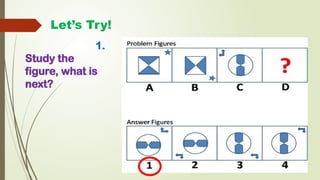
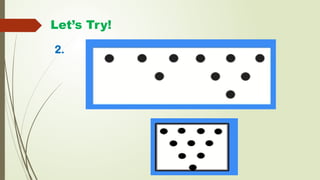
Let’s Try!
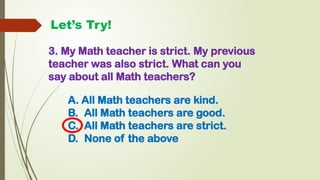
3. MyMath teacher is strict. My previous
teacher was also strict. What can you
say about all Math teachers?
A. All Math teachers are kind.
B. All Math teachers are good.
C. All Math teachers are strict.
D. None of the above
4.
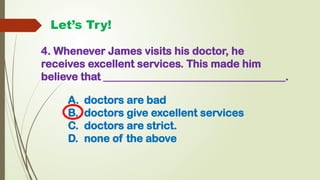
4. Whenever Jamesvisits his doctor, he
receives excellent services. This made him
believe that __________________________________.
Let’s Try!
A. doctors are bad
B. doctors give excellent services
C. doctors are strict.
D. none of the above
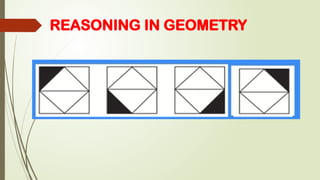
REASONING IN GEOMETRY
1.INTUITION
It’s a type of perception which could be an
idea, a model, or a system of belief; it
supports drawing a conclusion on the basis
of incomplete information or knowing
something immediately based on one’s
feeling rather than facts.
Sometimes called “scientific guessing”
8.
REASONING IN GEOMETRY
Example:
1.Inside the auditorium, the organizer of the
meeting waited for the last five participants.
When they enter the auditorium one after they
other, wet and having umbrella, the organizer
concluded that “ It was raining outside.”
9.
REASONING IN GEOMETRY
2.The dogs are barking outside your house.
And you assumed that someone or a visitor is
coming.
3. Nigel is crying and full of bruises when he
enters the classroom.
10.
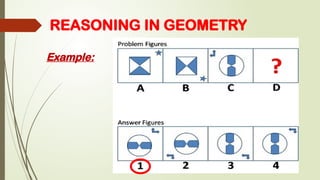
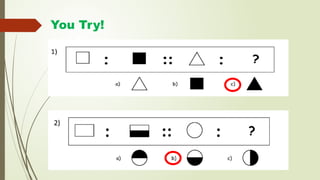
2. Analogy
REASONING INGEOMETRY
A way of thinking about something by
comparing it to something else.
It is the ability to reason with relational
patterns.
REASONING IN GEOMETRY
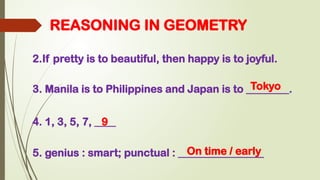
2.Ifpretty is to beautiful, then happy is to joyful.
3. Manila is to Philippines and Japan is to ________.
Tokyo
4. 1, 3, 5, 7, ____
9
5. genius : smart; punctual : ________________
On time / early
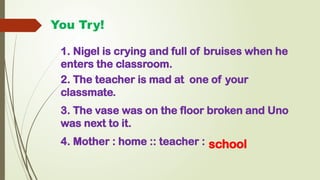
You Try!
1. Nigelis crying and full of bruises when he
enters the classroom.
2. The teacher is mad at one of your
classmate.
3. The vase was on the floor broken and Uno
was next to it.
4. Mother : home :: teacher : school
REASONING IN GEOMETRY
3.Inductive Reasoning
A process of drawing conclusion based on
sets of observations.
From specific observations or examples to
general statement.
18.
Example:
REASONING IN GEOMETRY
1.The left-handed people I know use
left-handed scissors; therefore, all
left-handed people use left-handed
scissors.
19.
REASONING IN GEOMETRY
Example:
2.Uno always leaves for school at
7:00 a.m. Uno is always on time. Uno
assumes, then, that if she leaves at
7:00 a.m. for school today, she will be
on time.
20.
REASONING IN GEOMETRY
4.Deductive Reasoning
A logical process where you progress
from general ideas to specific
conclusions.
21.
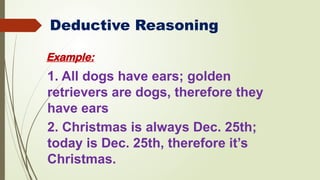
Deductive Reasoning
1. Alldogs have ears; golden
retrievers are dogs, therefore they
have ears
Example:
2. Christmas is always Dec. 25th;
today is Dec. 25th, therefore it’s
Christmas.
22.
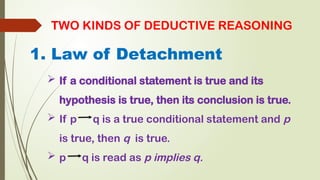
TWO KINDS OFDEDUCTIVE REASONING
1. Law of Detachment
If a conditional statement is true and its
hypothesis is true, then its conclusion is true.
If p q is a true conditional statement and p
is true, then q is true.
p q is read as p implies q.
23.
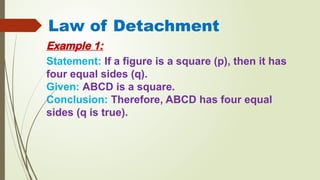
Law of Detachment
Example1:
Statement: If a figure is a square (p), then it has
four equal sides (q).
Given: ABCD is a square.
Conclusion: Therefore, ABCD has four equal
sides (q is true).
24.
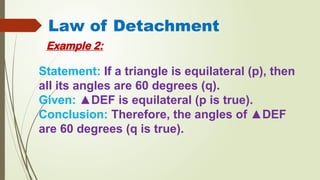
Statement: If atriangle is equilateral (p), then
all its angles are 60 degrees (q).
Given: ▲DEF is equilateral (p is true).
Conclusion: Therefore, the angles of ▲DEF
are 60 degrees (q is true).
Law of Detachment
Example 2:
25.
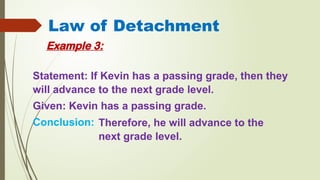
Law of Detachment
Example3:
Statement: If Kevin has a passing grade, then they
will advance to the next grade level.
Given: Kevin has a passing grade.
Conclusion: Therefore, he will advance to the
next grade level.
26.
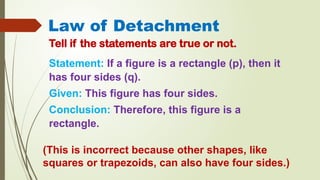
Law of Detachment
Tellif the statements are true or not.
Statement: If a figure is a rectangle (p), then it
has four sides (q).
Given: This figure has four sides.
Conclusion: Therefore, this figure is a
rectangle.
(This is incorrect because other shapes, like
squares or trapezoids, can also have four sides.)
27.
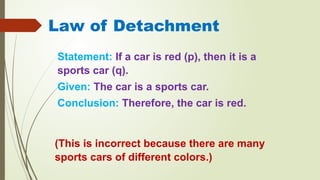
Law of Detachment
Statement:If a car is red (p), then it is a
sports car (q).
Given: The car is a sports car.
Conclusion: Therefore, the car is red.
(This is incorrect because there are many
sports cars of different colors.)
28.
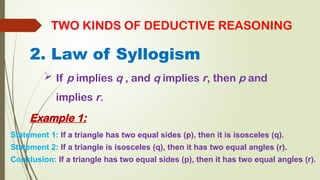
2. Law ofSyllogism
TWO KINDS OF DEDUCTIVE REASONING
If p implies q , and q implies r, then p and
implies r.
Example 1:
Statement 1: If a triangle has two equal sides (p), then it is isosceles (q).
Statement 2: If a triangle is isosceles (q), then it has two equal angles (r).
Conclusion: If a triangle has two equal sides (p), then it has two equal angles (r).
29.
Law of Syllogism
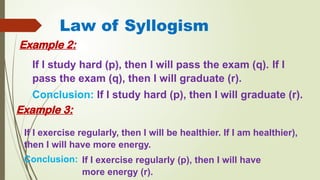
Example2:
If I study hard (p), then I will pass the exam (q). If I
pass the exam (q), then I will graduate (r).
Conclusion: If I study hard (p), then I will graduate (r).
If I exercise regularly, then I will be healthier. If I am healthier),
then I will have more energy.
Conclusion:
Example 3:
If I exercise regularly (p), then I will have
more energy (r).
30.
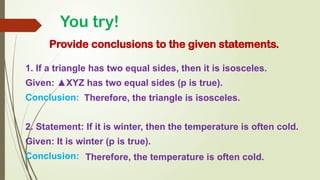
You try!
Provide conclusionsto the given statements.
1. If a triangle has two equal sides, then it is isosceles.
Given: ▲XYZ has two equal sides (p is true).
Conclusion:
2. Statement: If it is winter, then the temperature is often cold.
Given: It is winter (p is true).
Conclusion:
Therefore, the triangle is isosceles.
Therefore, the temperature is often cold.
31.
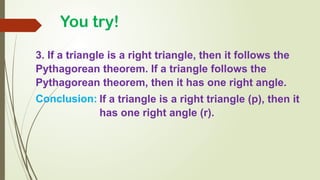
3. If atriangle is a right triangle, then it follows the
Pythagorean theorem. If a triangle follows the
Pythagorean theorem, then it has one right angle.
Conclusion:
You try!
If a triangle is a right triangle (p), then it
has one right angle (r).
32.
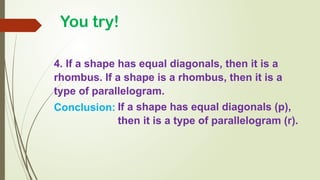
4. If ashape has equal diagonals, then it is a
rhombus. If a shape is a rhombus, then it is a
type of parallelogram.
Conclusion: If a shape has equal diagonals (p),
then it is a type of parallelogram (r).
You try!
33.
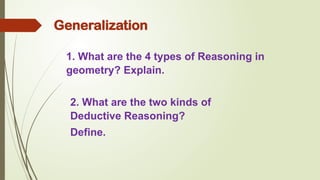
Generalization
1. What arethe 4 types of Reasoning in
geometry? Explain.
2. What are the two kinds of
Deductive Reasoning?
Define.
34.
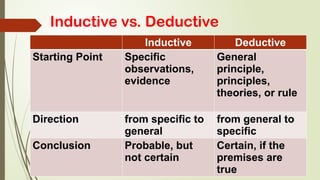
Inductive Deductive
Starting PointSpecific
observations,
evidence
General
principle,
principles,
theories, or rule
Direction from specific to
general
from general to
specific
Conclusion Probable, but
not certain
Certain, if the
premises are
true
Inductive vs. Deductive