Understanding Python
Data Structures: A
Comprehensive Guide
Welcome to this comprehensive guide on Python data structures, the
building blocks for organizing and storing data efficiently. We'll delve
into four fundamental data structures: lists, tuples, sets, and
dictionaries, exploring their unique properties and real-world
applications. Whether you're a beginner or an experienced programmer,
this presentation will provide a clear understanding of these essential
concepts. Get ready to unlock the power of Python's versatile data
structures!
Introduction to Python
Data Structures
Data Organization
Data structures are essential
for organizing and storing
data in a structured manner.
They allow you to manage
collections of data items,
enabling efficient access,
manipulation, and analysis.
Built-in Types
Python provides a range of
built-in data structures that
are widely used in
programming. These
structures offer convenient
ways to represent and work
with various types of data.
Versatility
Python's data structures are remarkably versatile, catering to
diverse programming needs, from simple data storage to complex
algorithmic operations. Let's explore these structures in detail!
Lists in Python: Overview
Ordered Collections
Lists are ordered
collections of items,
meaning the elements are
arranged in a specific
sequence, and their
positions are maintained.
Mutable
Lists are mutable, allowing
you to modify their
contents after they are
created. You can add,
remove, or change
elements within a list.
Data Type Flexibility
Lists can hold diverse data
types, including integers,
floats, strings, and even
other lists, providing a
flexible way to store
various kinds of
information.
Sequential Data
Lists are commonly used
for representing
sequences of data, such as
a list of names, a list of
numbers, or a list of
actions to perform.
Lists in Python: Examples
my_list = [1, 'Python', 3.14]
print(my_list[0]) # Output: 1
print(my_list[1]) # Output: 'Python'
print(my_list[2]) # Output: 3.14
Tuples in Python: Overview
Ordered Collections
Like lists, tuples are
ordered collections of
items, preserving the
order of their elements.
Immutable
Unlike lists, tuples are
immutable, meaning you
cannot modify their
contents after creation.
This immutability provides
data integrity and
consistency.
Fixed Collections
Tuples are often used for
storing fixed collections of
data where you want to
ensure that the elements
remain unchanged.
Data Type Flexibility
Tuples can contain diverse
data types, including
integers, floats, strings,
and even other tuples,
offering a way to group
various types of
information.
Tuples in Python: Examples
my_tuple = (1, 'Python', 3.14)
print(my_tuple[0]) # Output: 1
print(my_tuple[1]) # Output: 'Python'
print(my_tuple[2]) # Output: 3.14
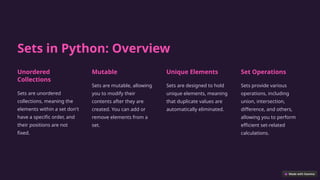
Sets in Python: Overview
Unordered
Collections
Sets are unordered
collections, meaning the
elements within a set don't
have a specific order, and
their positions are not
fixed.
Mutable
Sets are mutable, allowing
you to modify their
contents after they are
created. You can add or
remove elements from a
set.
Unique Elements
Sets are designed to hold
unique elements, meaning
that duplicate values are
automatically eliminated.
Set Operations
Sets provide various
operations, including
union, intersection,
difference, and others,
allowing you to perform
efficient set-related
calculations.
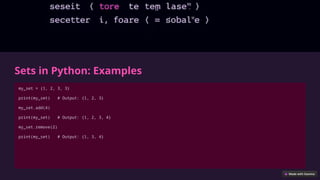
Sets in Python: Examples
my_set = {1, 2, 3, 3}
print(my_set) # Output: {1, 2, 3}
my_set.add(4)
print(my_set) # Output: {1, 2, 3, 4}
my_set.remove(2)
print(my_set) # Output: {1, 3, 4}
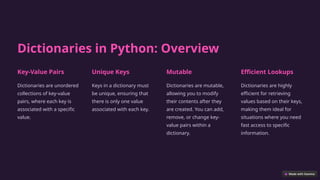
Dictionaries in Python: Overview
Key-Value Pairs
Dictionaries are unordered
collections of key-value
pairs, where each key is
associated with a specific
value.
Unique Keys
Keys in a dictionary must
be unique, ensuring that
there is only one value
associated with each key.
Mutable
Dictionaries are mutable,
allowing you to modify
their contents after they
are created. You can add,
remove, or change key-
value pairs within a
dictionary.
Efficient Lookups
Dictionaries are highly
efficient for retrieving
values based on their keys,
making them ideal for
situations where you need
fast access to specific
information.
Dictionaries in Python:
Examples
my_dict = {'a': 1, 'b': 2}
print(my_dict['a']) # Output: 1
print(my_dict['b']) # Output: 2
my_dict['c'] = 3
print(my_dict) # Output: {'a': 1, 'b': 2, 'c': 3}

Understanding-Python-Data-Structures-A-Comprehensive-Guide.pptx

  • 1.
    Understanding Python Data Structures:A Comprehensive Guide Welcome to this comprehensive guide on Python data structures, the building blocks for organizing and storing data efficiently. We'll delve into four fundamental data structures: lists, tuples, sets, and dictionaries, exploring their unique properties and real-world applications. Whether you're a beginner or an experienced programmer, this presentation will provide a clear understanding of these essential concepts. Get ready to unlock the power of Python's versatile data structures!
  • 2.
    Introduction to Python DataStructures Data Organization Data structures are essential for organizing and storing data in a structured manner. They allow you to manage collections of data items, enabling efficient access, manipulation, and analysis. Built-in Types Python provides a range of built-in data structures that are widely used in programming. These structures offer convenient ways to represent and work with various types of data. Versatility Python's data structures are remarkably versatile, catering to diverse programming needs, from simple data storage to complex algorithmic operations. Let's explore these structures in detail!
  • 3.
    Lists in Python:Overview Ordered Collections Lists are ordered collections of items, meaning the elements are arranged in a specific sequence, and their positions are maintained. Mutable Lists are mutable, allowing you to modify their contents after they are created. You can add, remove, or change elements within a list. Data Type Flexibility Lists can hold diverse data types, including integers, floats, strings, and even other lists, providing a flexible way to store various kinds of information. Sequential Data Lists are commonly used for representing sequences of data, such as a list of names, a list of numbers, or a list of actions to perform.
  • 4.
    Lists in Python:Examples my_list = [1, 'Python', 3.14] print(my_list[0]) # Output: 1 print(my_list[1]) # Output: 'Python' print(my_list[2]) # Output: 3.14
  • 5.
    Tuples in Python:Overview Ordered Collections Like lists, tuples are ordered collections of items, preserving the order of their elements. Immutable Unlike lists, tuples are immutable, meaning you cannot modify their contents after creation. This immutability provides data integrity and consistency. Fixed Collections Tuples are often used for storing fixed collections of data where you want to ensure that the elements remain unchanged. Data Type Flexibility Tuples can contain diverse data types, including integers, floats, strings, and even other tuples, offering a way to group various types of information.
  • 6.
    Tuples in Python:Examples my_tuple = (1, 'Python', 3.14) print(my_tuple[0]) # Output: 1 print(my_tuple[1]) # Output: 'Python' print(my_tuple[2]) # Output: 3.14
  • 7.
    Sets in Python:Overview Unordered Collections Sets are unordered collections, meaning the elements within a set don't have a specific order, and their positions are not fixed. Mutable Sets are mutable, allowing you to modify their contents after they are created. You can add or remove elements from a set. Unique Elements Sets are designed to hold unique elements, meaning that duplicate values are automatically eliminated. Set Operations Sets provide various operations, including union, intersection, difference, and others, allowing you to perform efficient set-related calculations.
  • 8.
    Sets in Python:Examples my_set = {1, 2, 3, 3} print(my_set) # Output: {1, 2, 3} my_set.add(4) print(my_set) # Output: {1, 2, 3, 4} my_set.remove(2) print(my_set) # Output: {1, 3, 4}
  • 9.
    Dictionaries in Python:Overview Key-Value Pairs Dictionaries are unordered collections of key-value pairs, where each key is associated with a specific value. Unique Keys Keys in a dictionary must be unique, ensuring that there is only one value associated with each key. Mutable Dictionaries are mutable, allowing you to modify their contents after they are created. You can add, remove, or change key- value pairs within a dictionary. Efficient Lookups Dictionaries are highly efficient for retrieving values based on their keys, making them ideal for situations where you need fast access to specific information.
  • 10.
    Dictionaries in Python: Examples my_dict= {'a': 1, 'b': 2} print(my_dict['a']) # Output: 1 print(my_dict['b']) # Output: 2 my_dict['c'] = 3 print(my_dict) # Output: {'a': 1, 'b': 2, 'c': 3}