Understanding groups and teams
Edited 01/06/2023
Ma. Corazon P. Rodriguez
What is a group?
• “A group is defined as two or more interacting
and interdependent individuals who come
together to achieve a specific goal.”
• “Groups can be both formal and informal.
Formal groups are defined by the organization
structure with designated work assignments
and specific tasks”
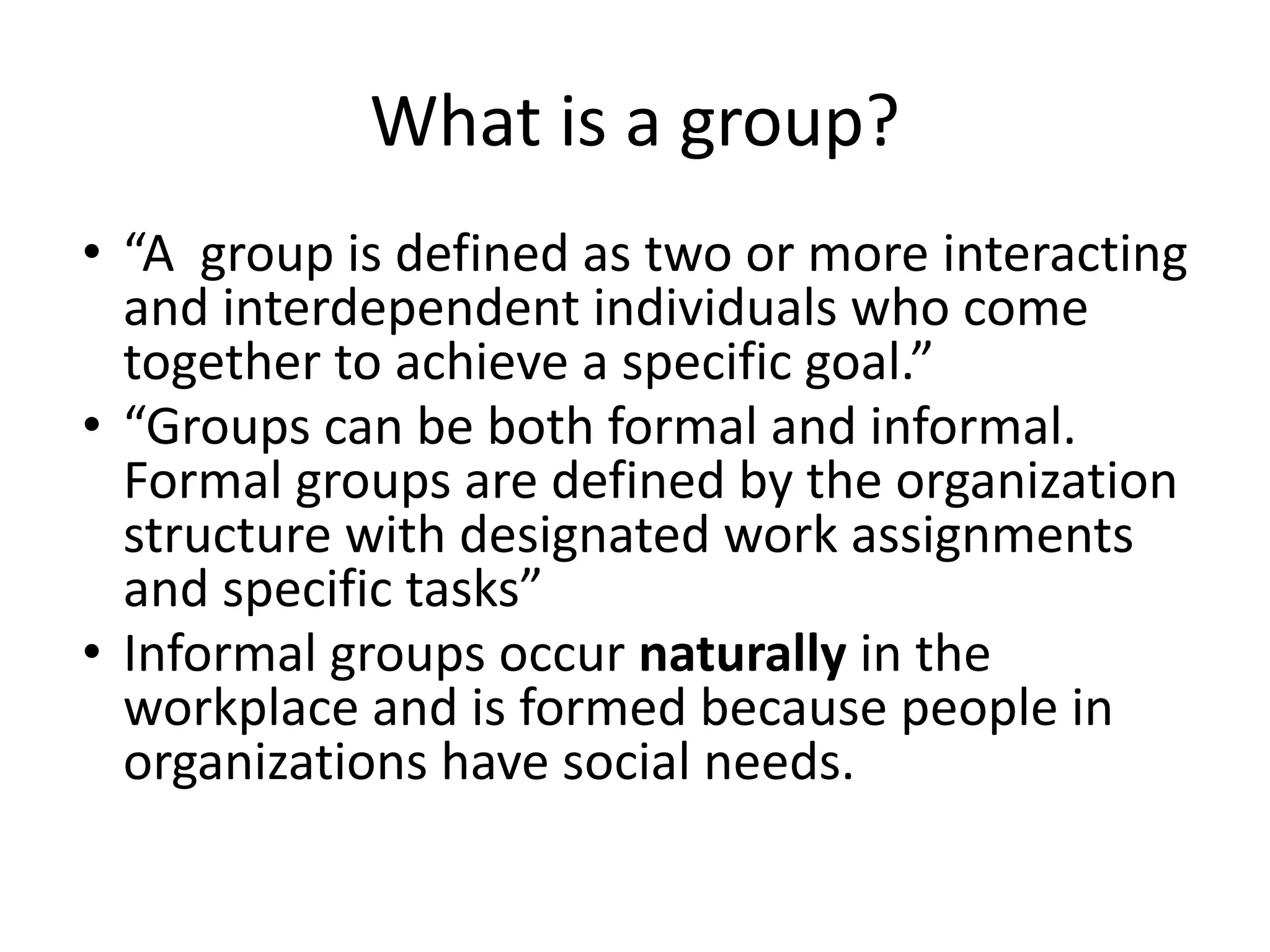
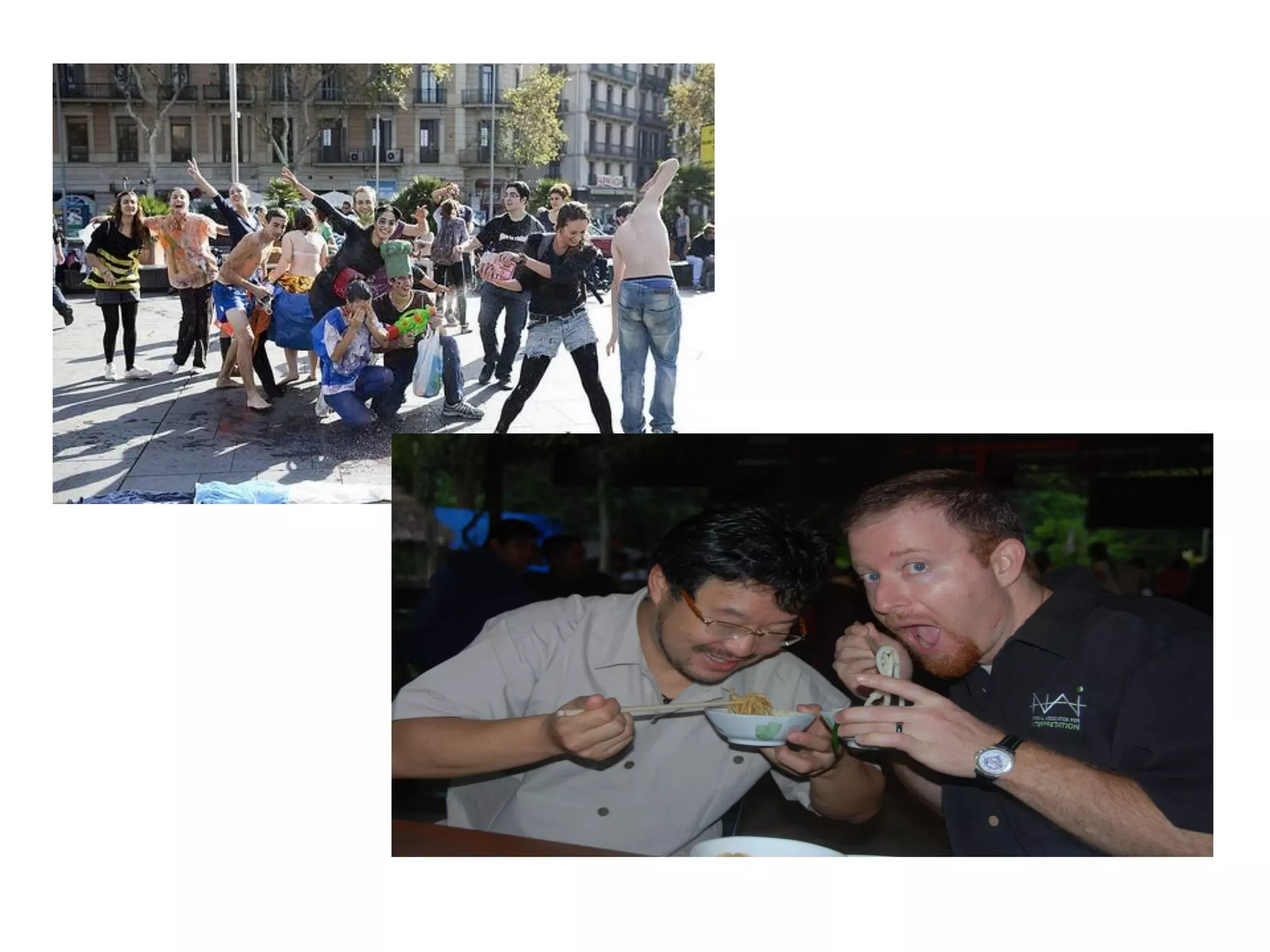
• Informal groups occur naturally in the
workplace and is formed because people in
organizations have social needs.
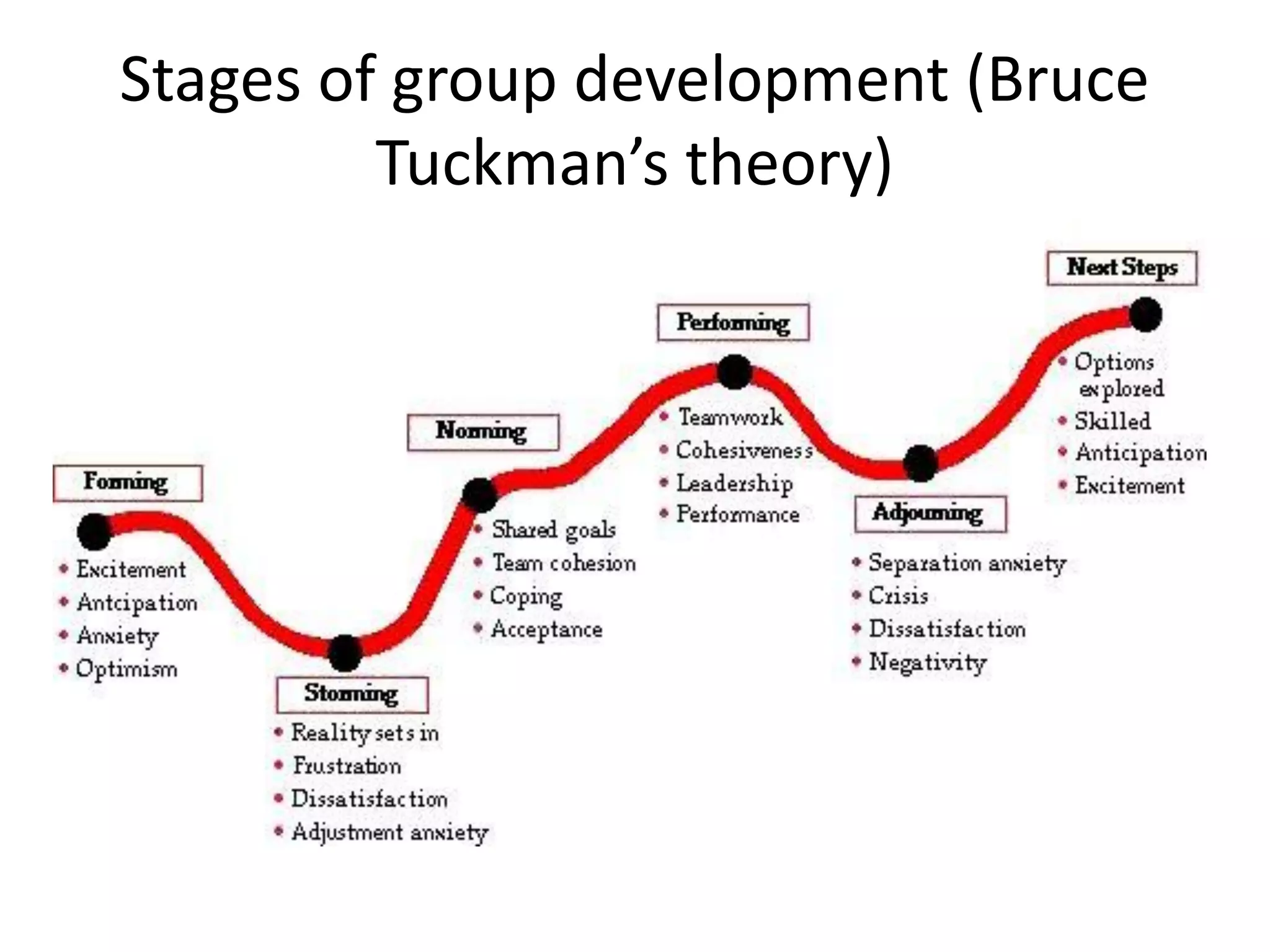
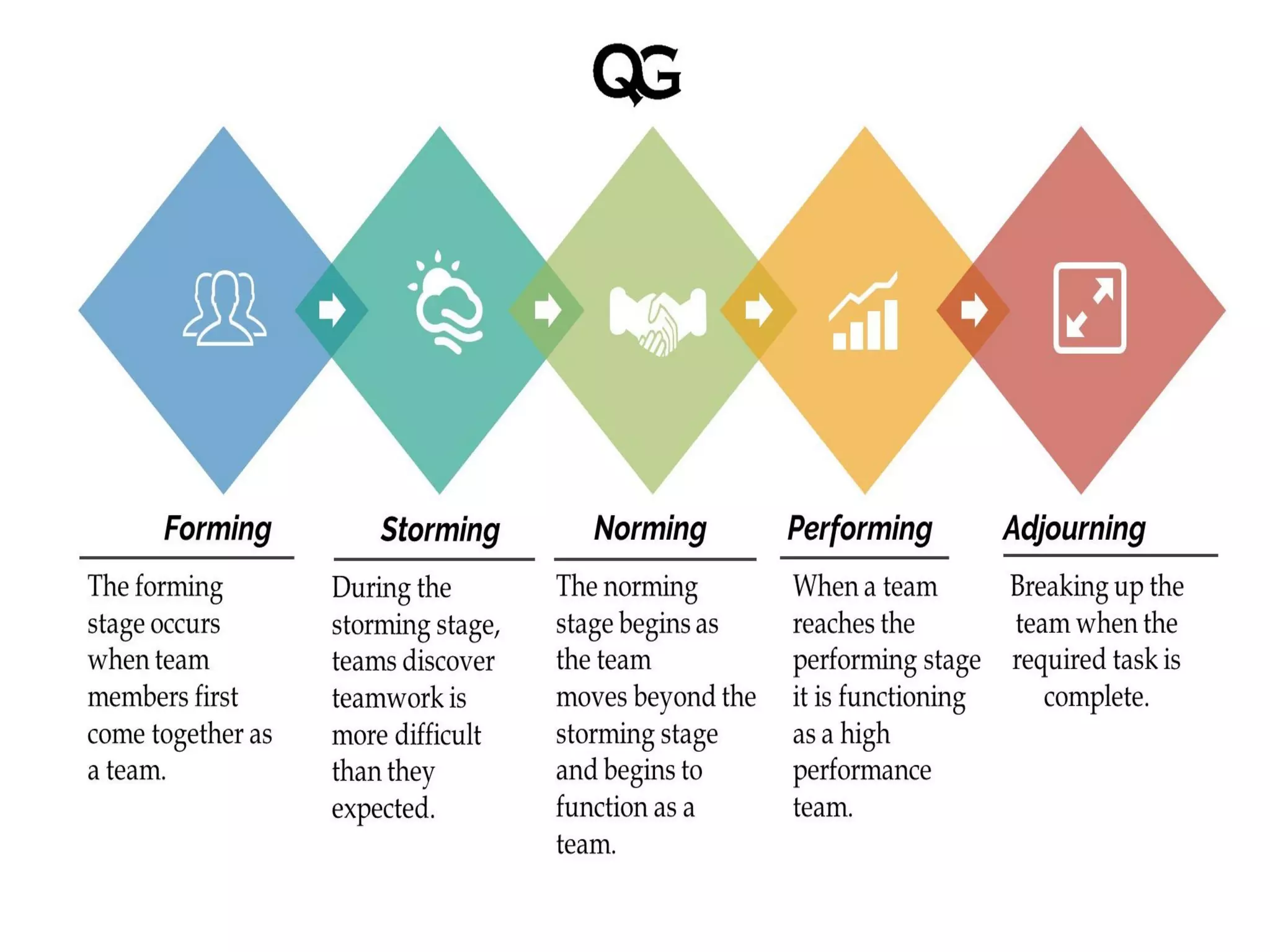
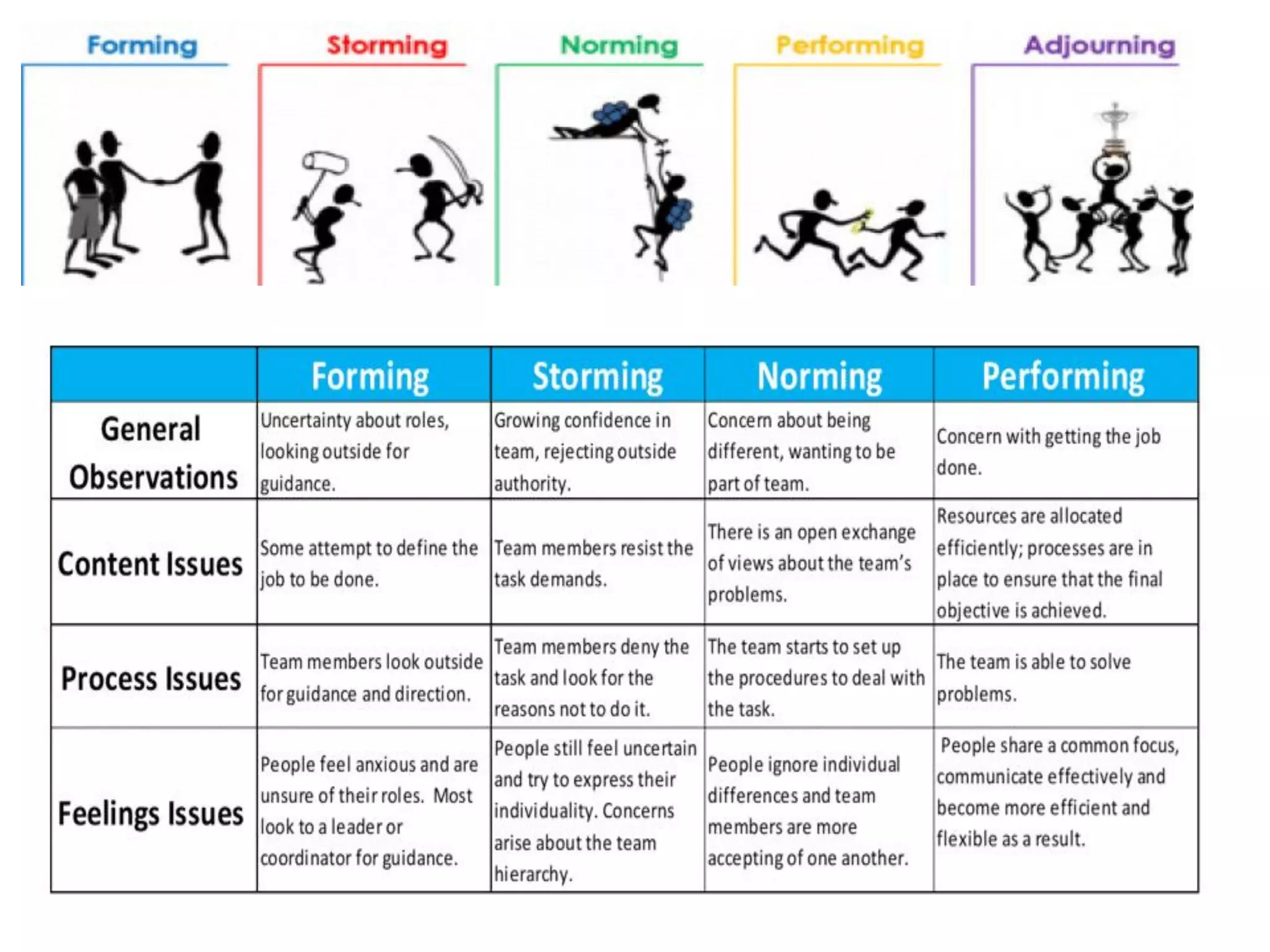
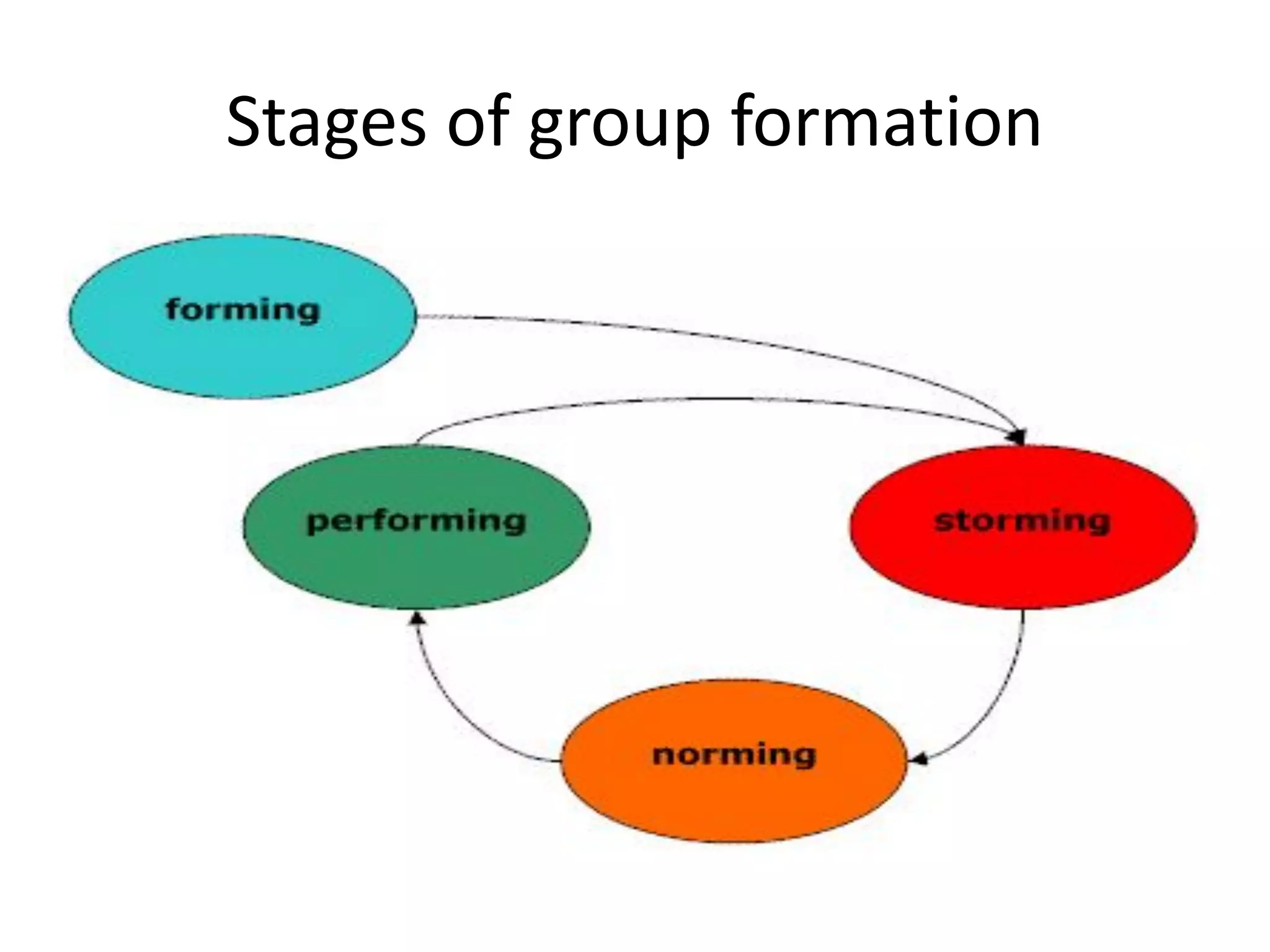
Stages of group development (Bruce
Tuckman’s theory)
Stages of group formation
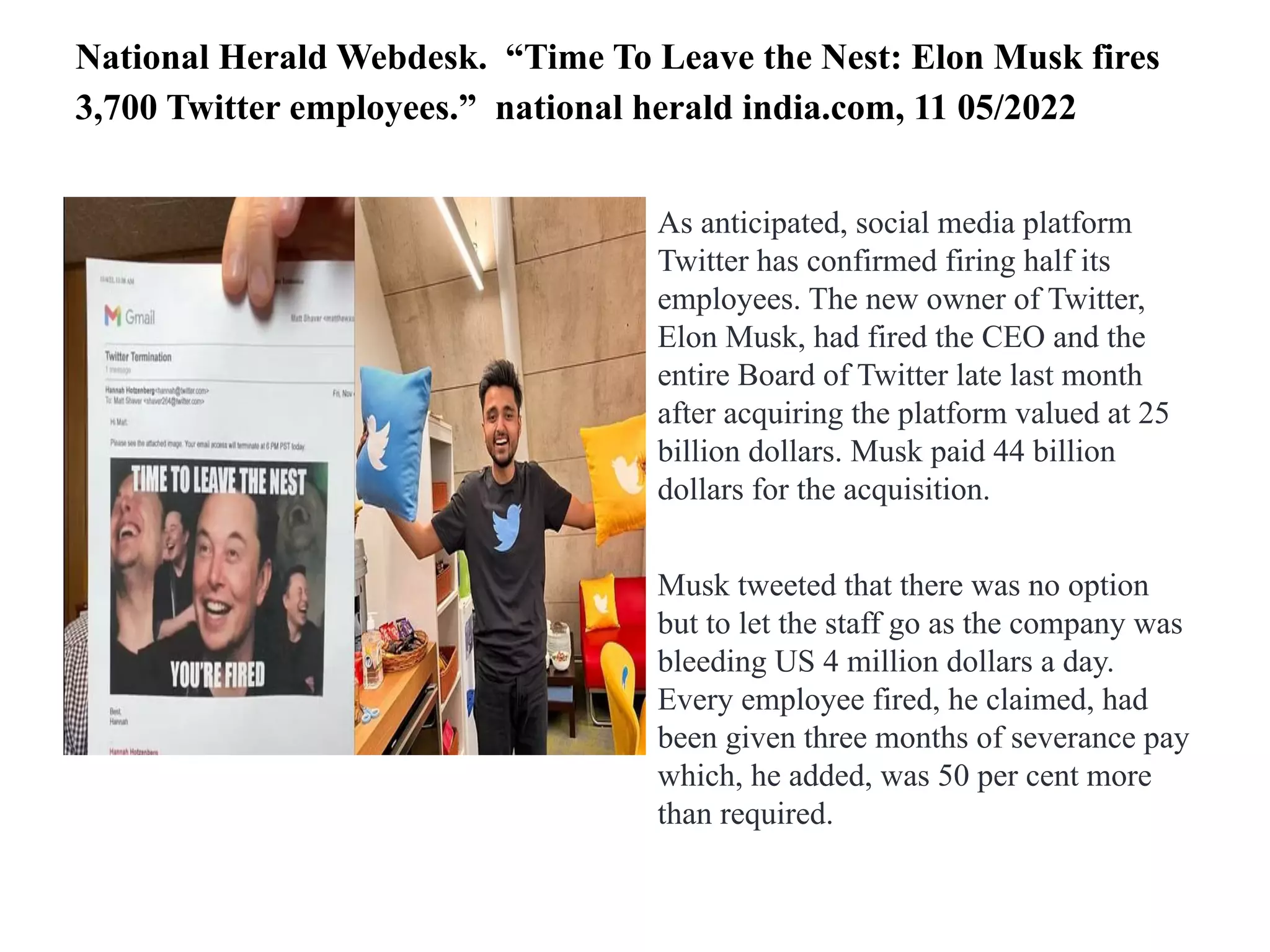
National Herald Webdesk. “Time To Leave the Nest: Elon Musk fires
3,700 Twitter employees.” national herald india.com, 11 05/2022
As anticipated, social media platform
Twitter has confirmed firing half its
employees. The new owner of Twitter,
Elon Musk, had fired the CEO and the
entire Board of Twitter late last month
after acquiring the platform valued at 25
billion dollars. Musk paid 44 billion
dollars for the acquisition.
Musk tweeted that there was no option
but to let the staff go as the company was
bleeding US 4 million dollars a day.
Every employee fired, he claimed, had
been given three months of severance pay
which, he added, was 50 per cent more
than required.
The company, agencies reported, was
silent about the depth of the cuts until late
on Friday, when head of safety and
integrity Yoel Roth tweeted confirmation
of plans to lay-off about 3,700 people, or
50% of the staff.
Tweets by staff of the social media
company said teams responsible for
communications, content curation,
human rights and machine learning
ethics were among those affected, as
were some product and engineering
teams. Among those let go were 784
employees from the company's San
Francisco headquarters and 199 in San
Jose and Los Angeles.
While a section of employees are planning
to challenge the lay offs in court, others took
to social media to express their outrage at
the manner of their dismissal. Others
expressed their solidarity with colleagues.
At least one employee tweeted that she has
been retained but she felt like ‘vomitting’.
Potential explanations behind
successful groups
It just might be true that the group is
identified with a major decision
maker in the organization. If this is
the case then one can expect that
formal and informal links may be in
operation that will make work more
enjoyable for the group. Do you think
this is the reason why members of the
DDS are happy doing their work?
Another explanation
• The resources each member of the team
brings to the group.
• For example members who have knowledge,
skills and abilities to do a good job.
• Members who are able to work with other
people without asserting their own
importance and who are able to accept the
importance of other people.
• - employee productivity- efficiency and
effectiveness
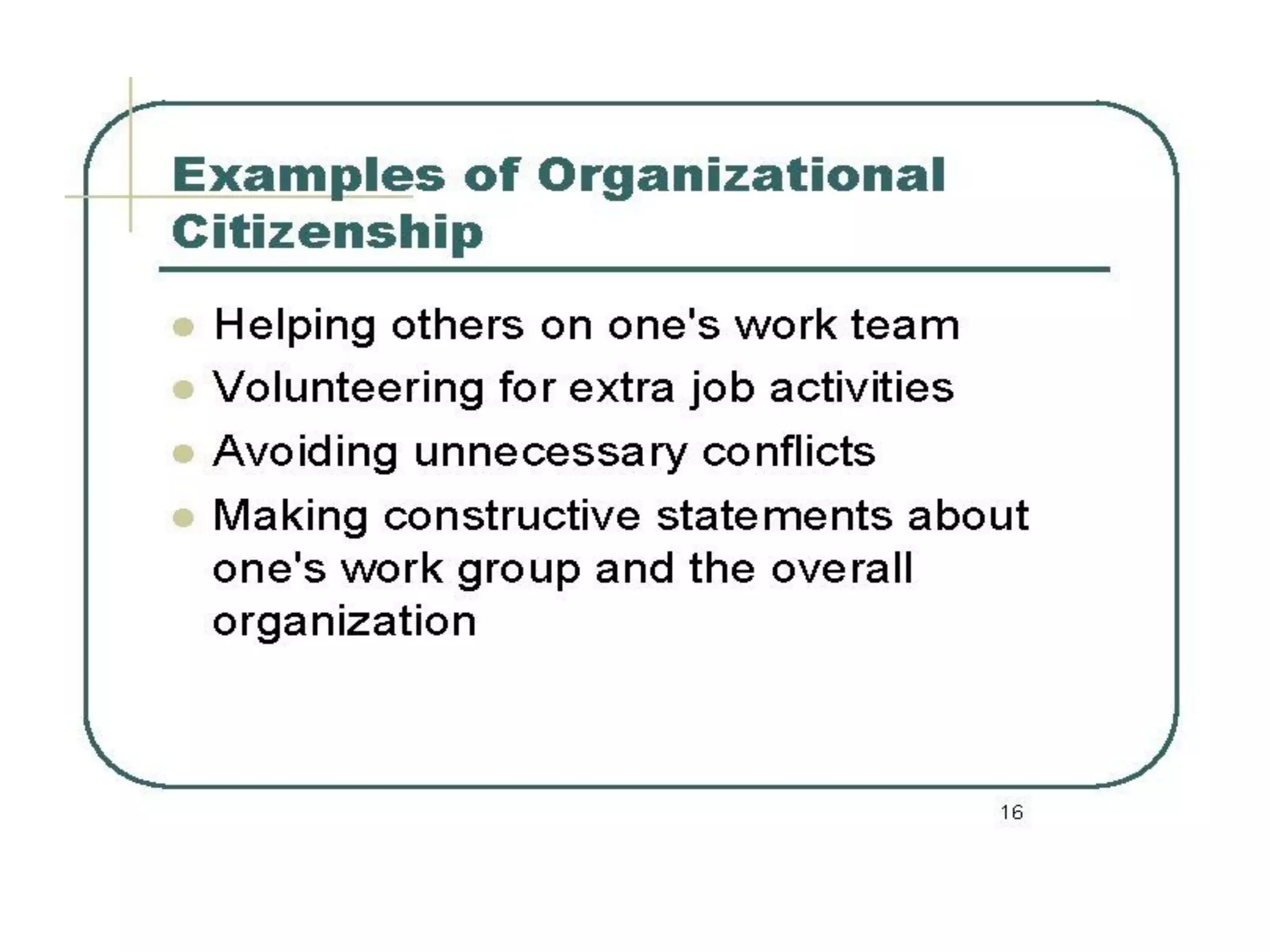
• -organization citizenship behavior (OCB) – “ability
to work well with others, volunteering for
extended job activities, avoiding unnecessary
conflicts, making constructive statements” (373)
• How many among these explanations are/were
experienced in the current groups? What could
be explanations for ease/difficulty of working
together?
Still another explanation
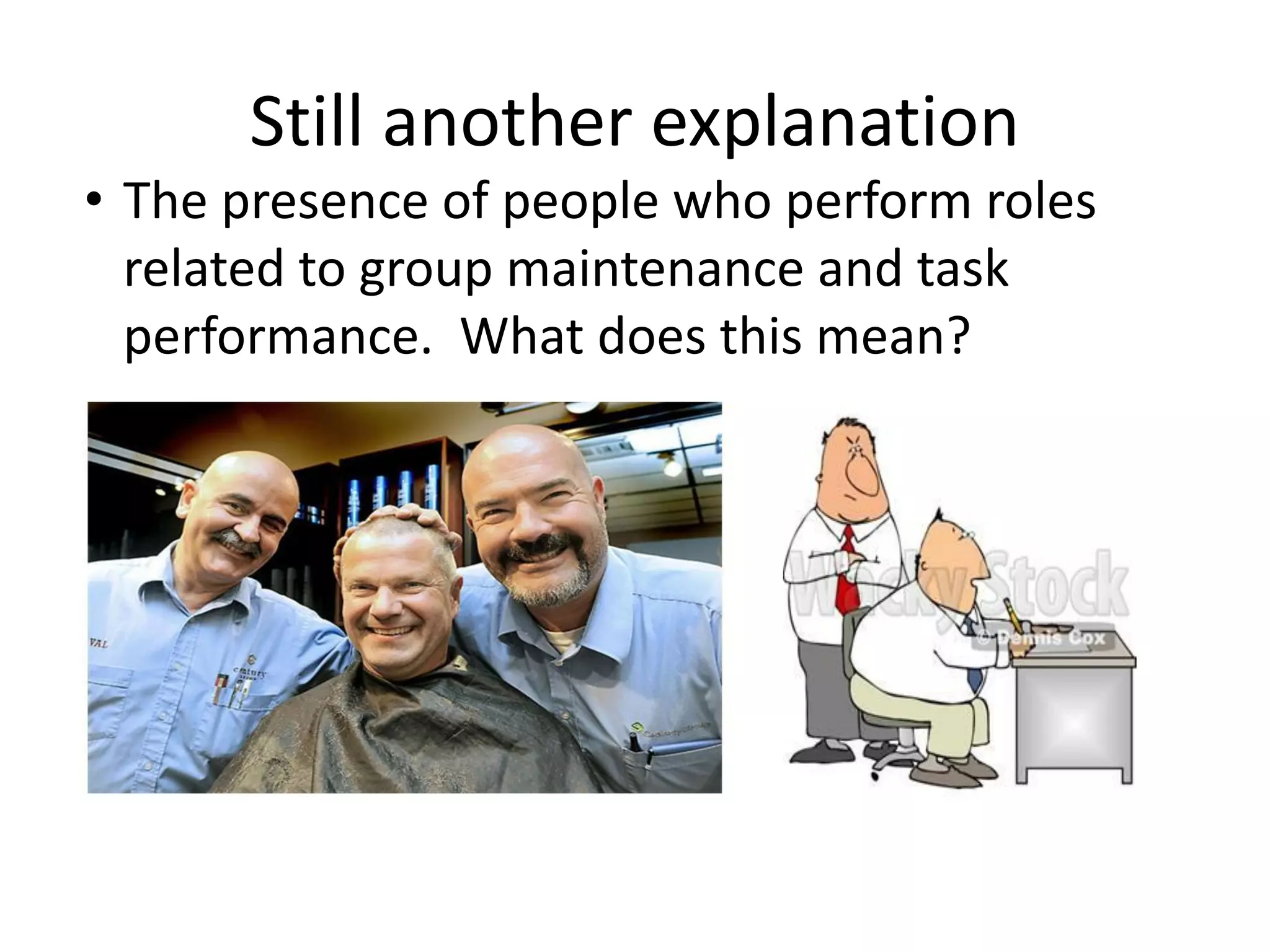
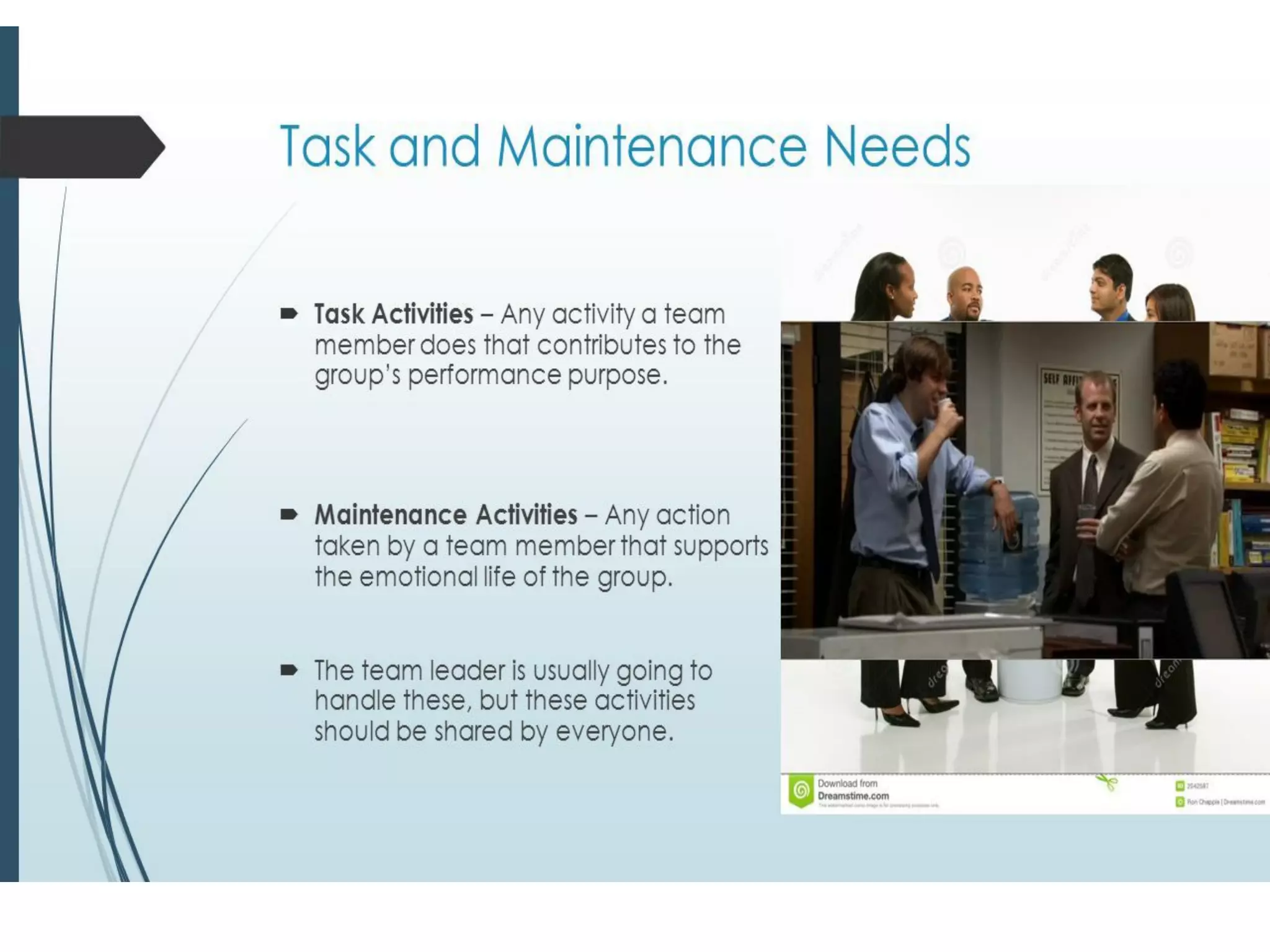
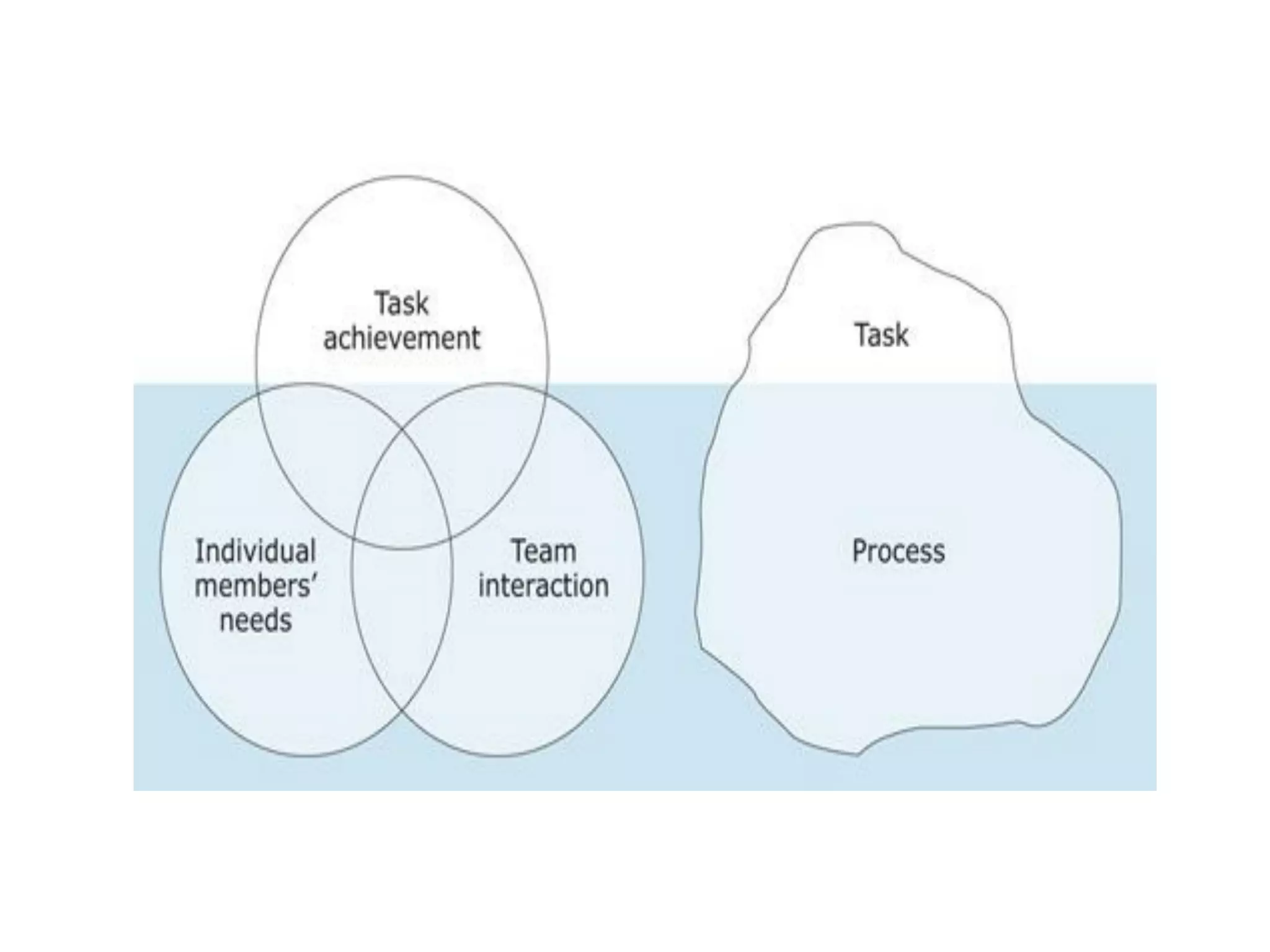
• The presence of people who perform roles
related to group maintenance and task
performance. What does this mean?
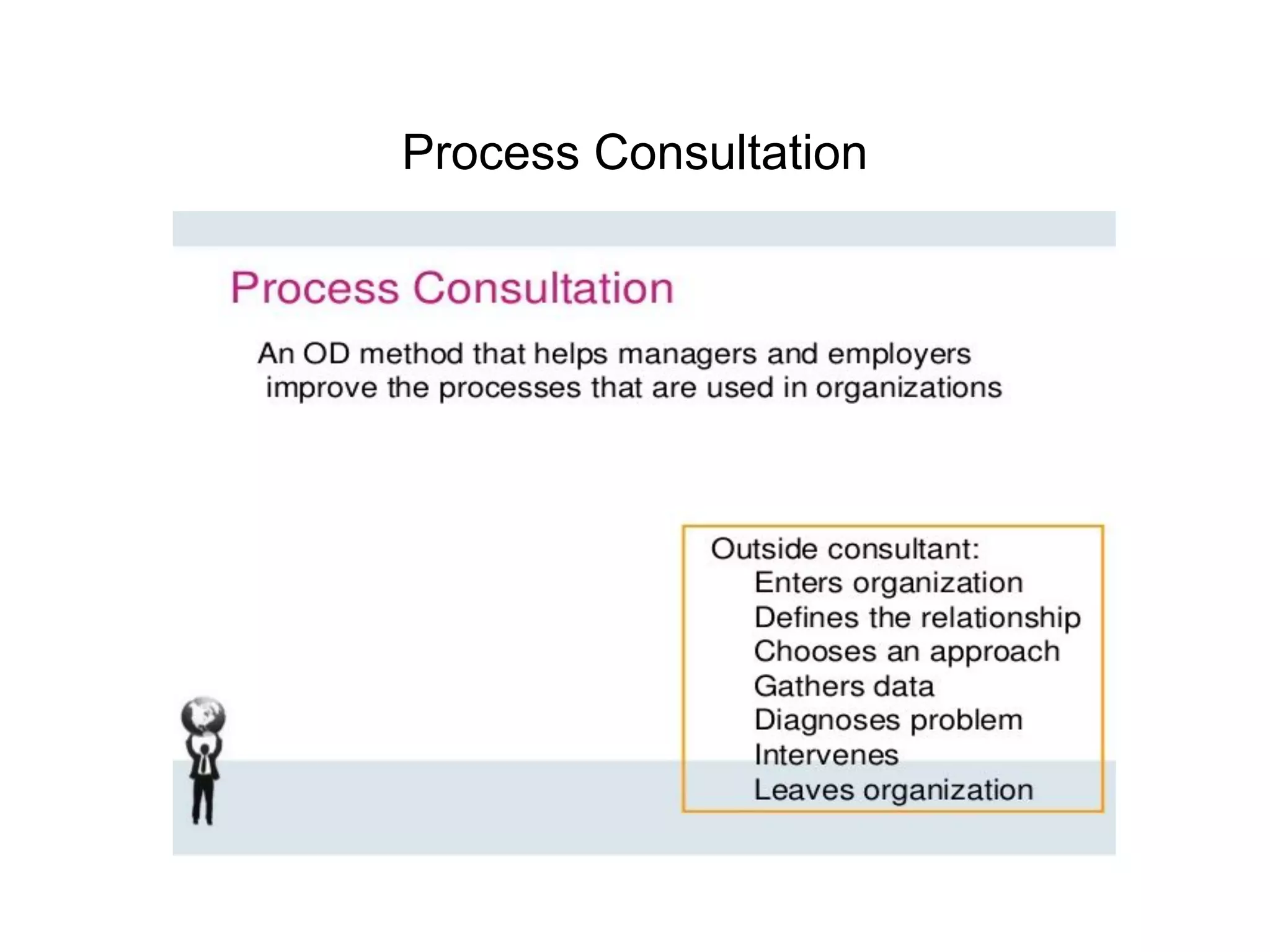
What is process consultation?
Process consultation - Process consultation can help
team members experience a change of perspective and
experiment with various problem fixing suggestions. The
clear insight provided by the expert or consultant is
extremely valuable since it offers both team members and
top managers guidelines on how to approach, handle and
tackle a wide array of work-related problems.
Process Consultation
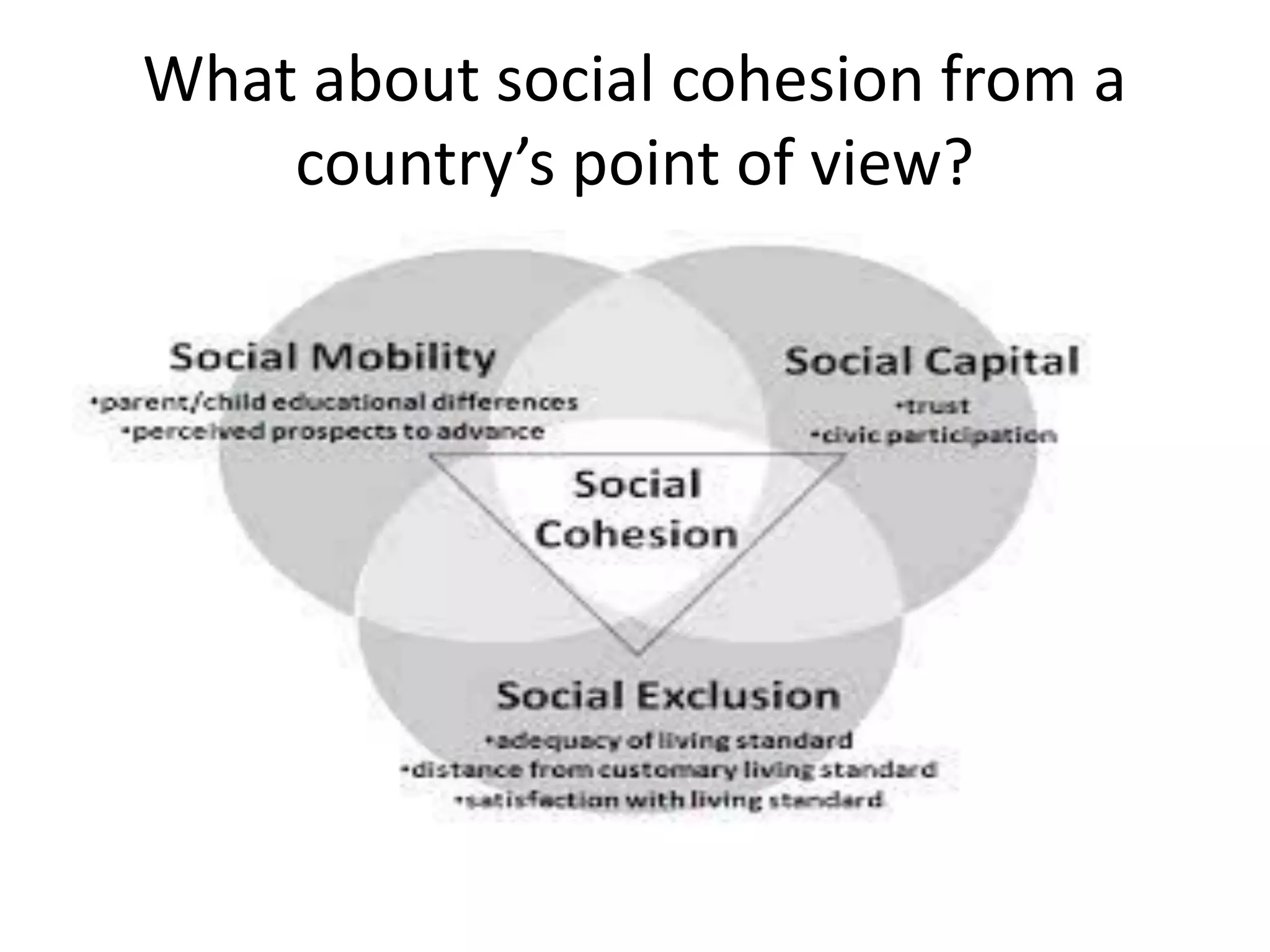
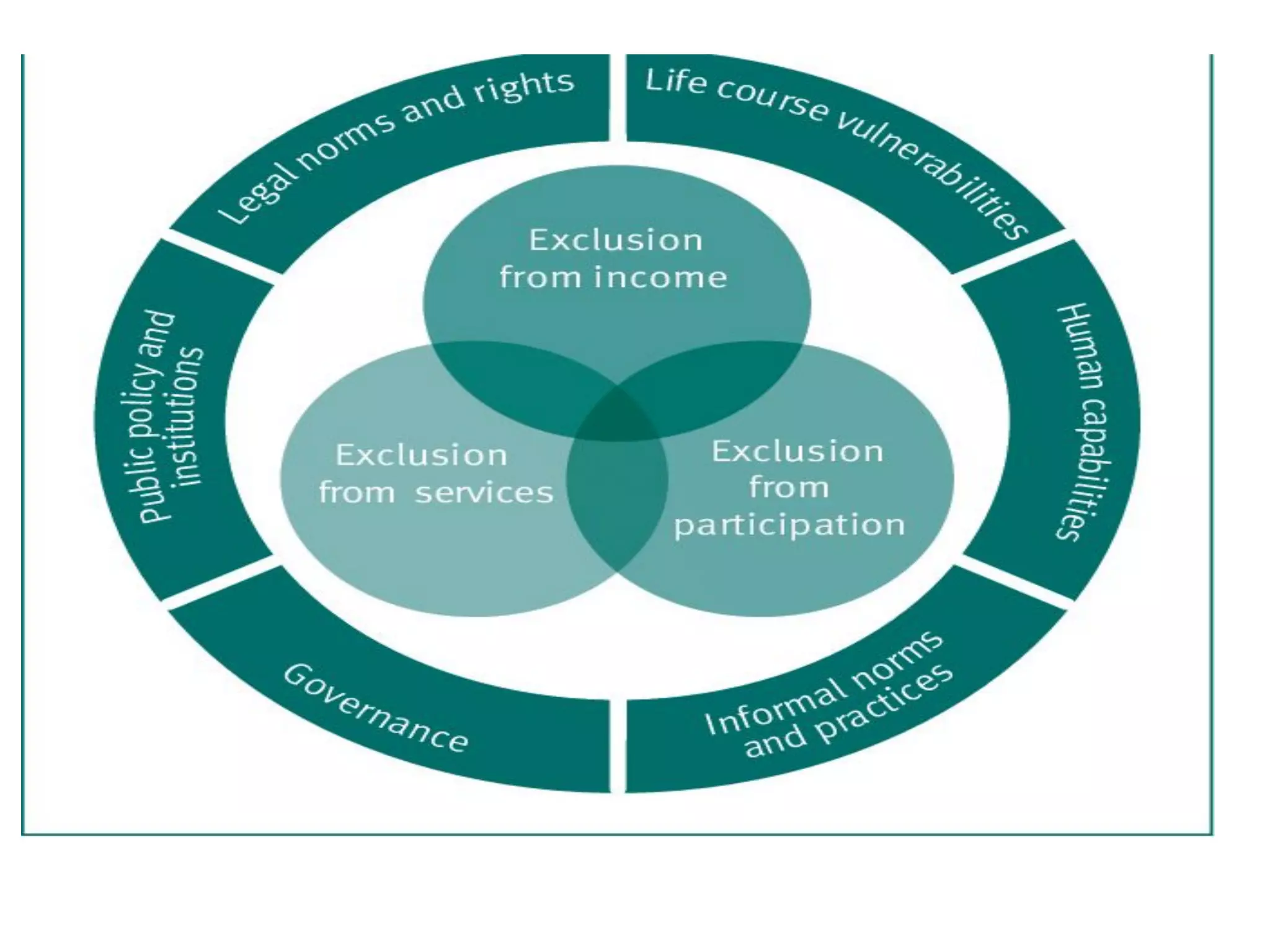
What about social cohesion from a
country’s point of view?
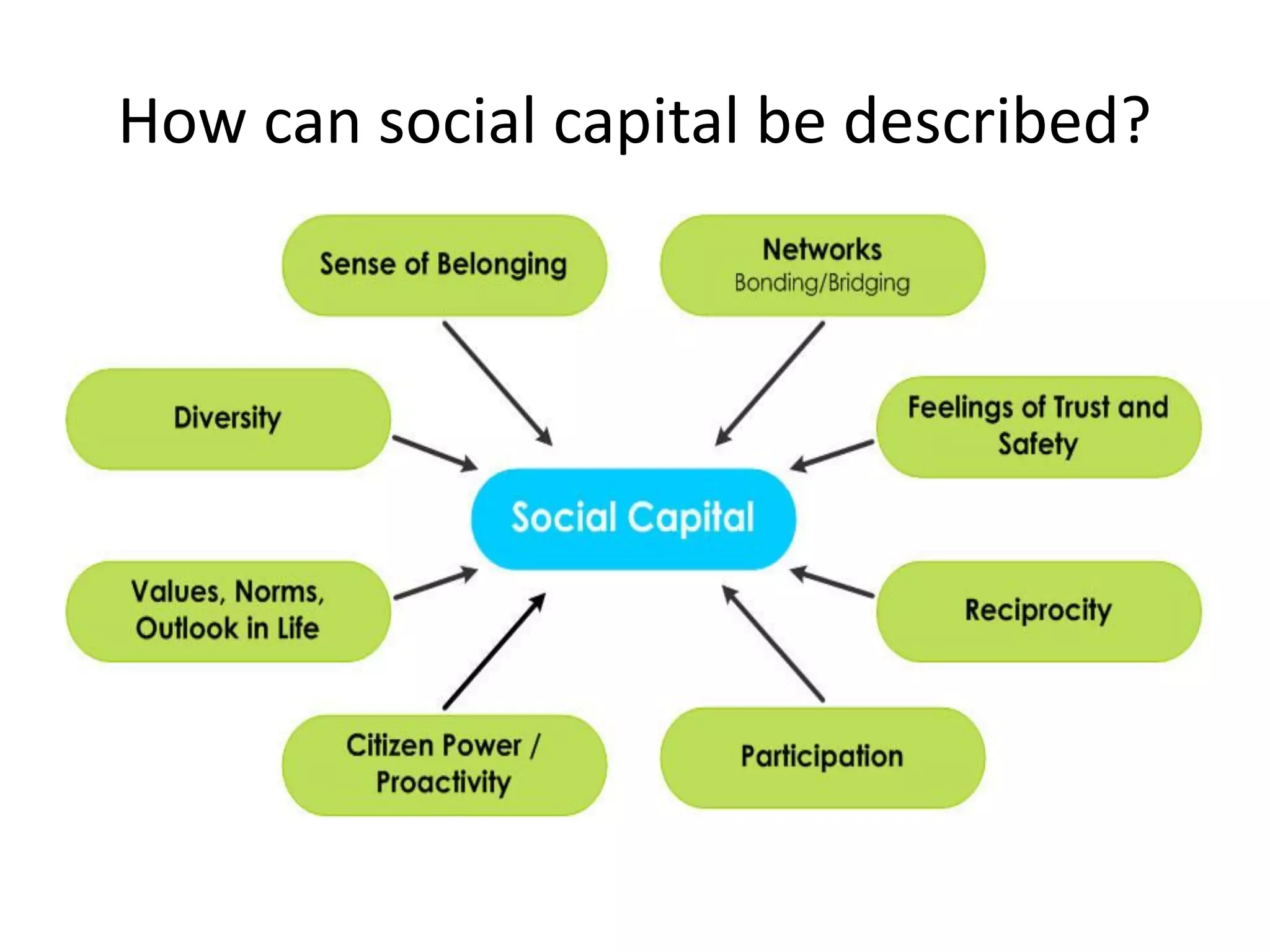
How can social capital be described?
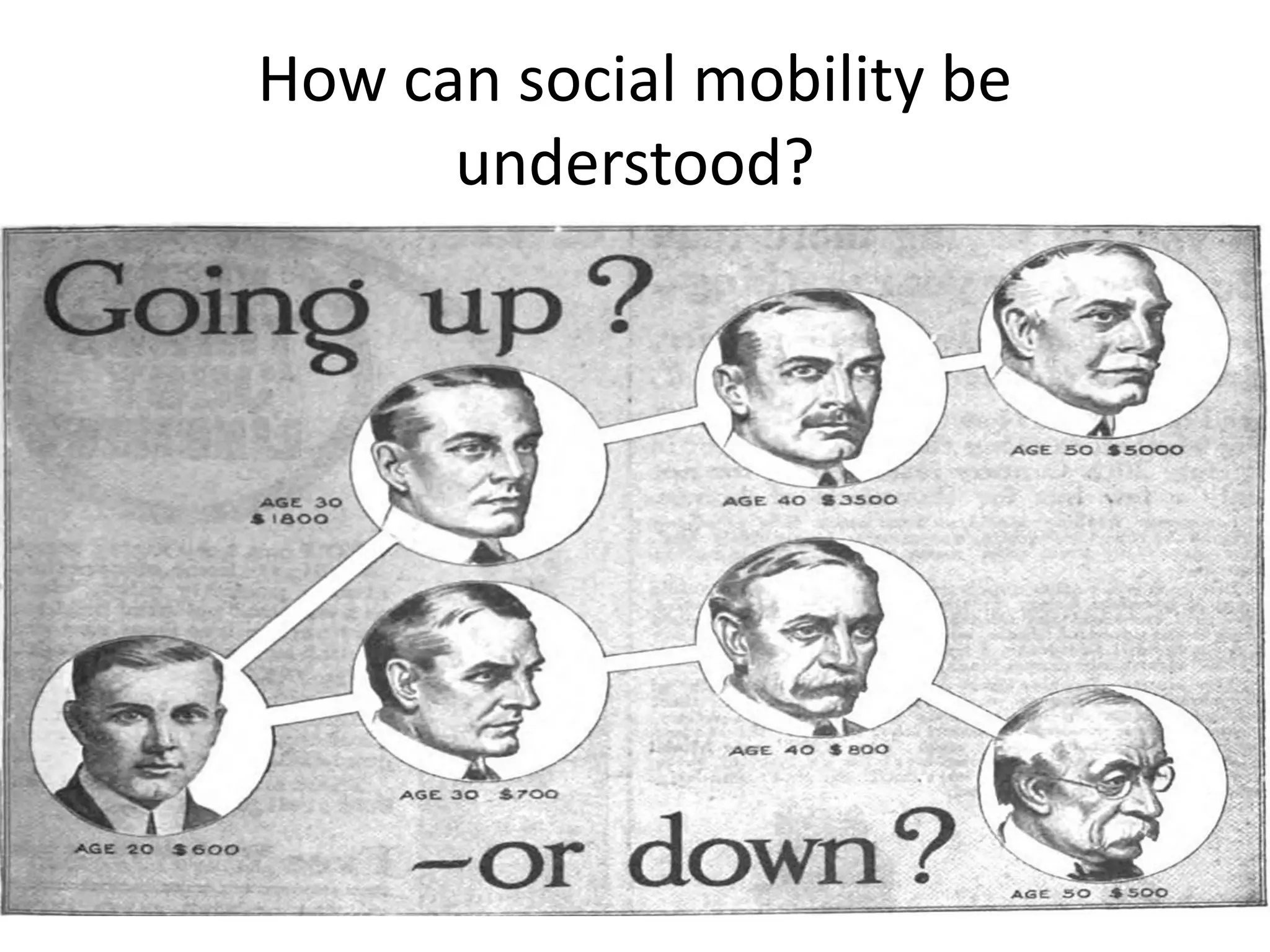
How can social mobility be
understood?
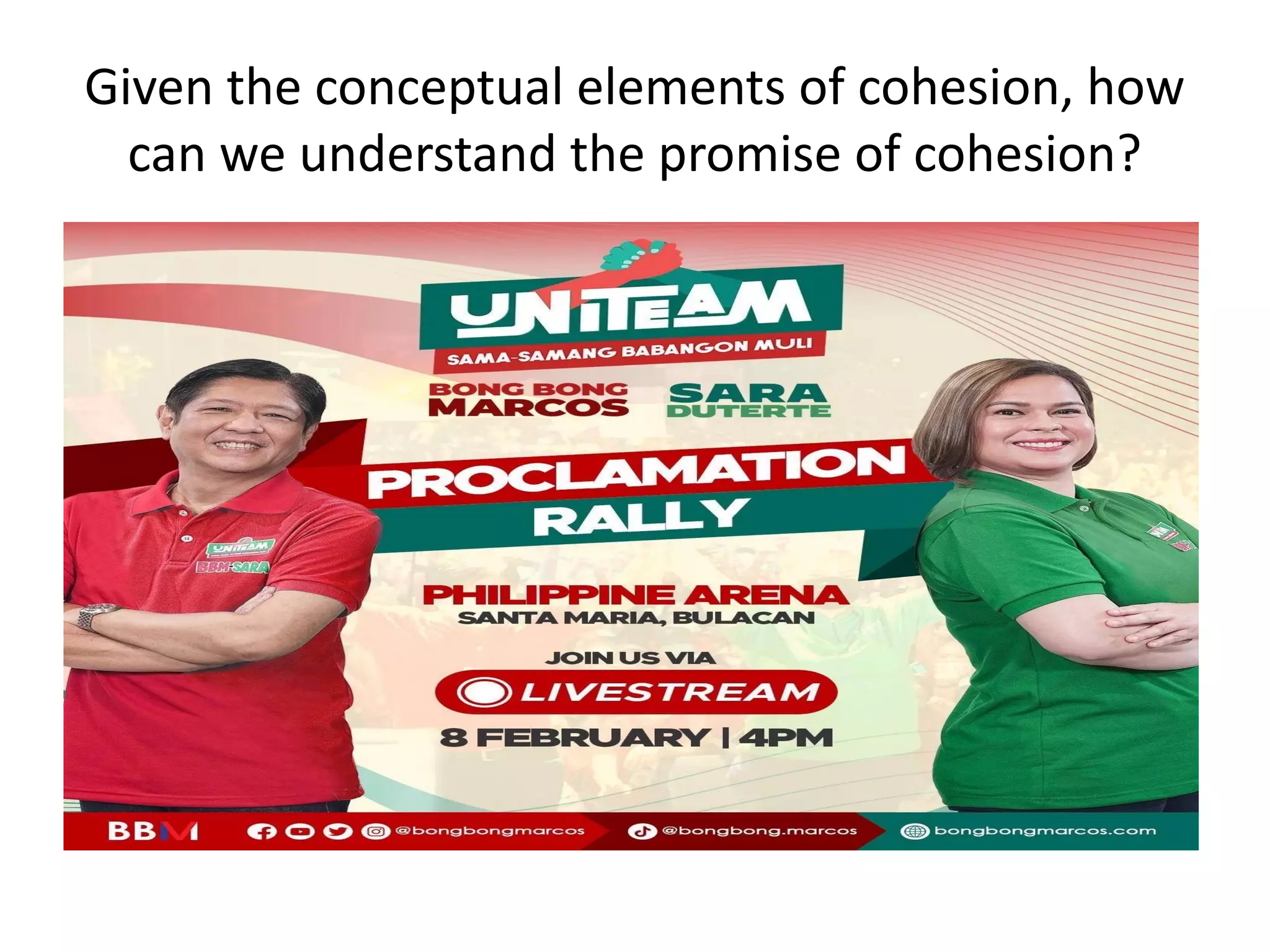
Given the conceptual elements of cohesion, how
can we understand the promise of cohesion?
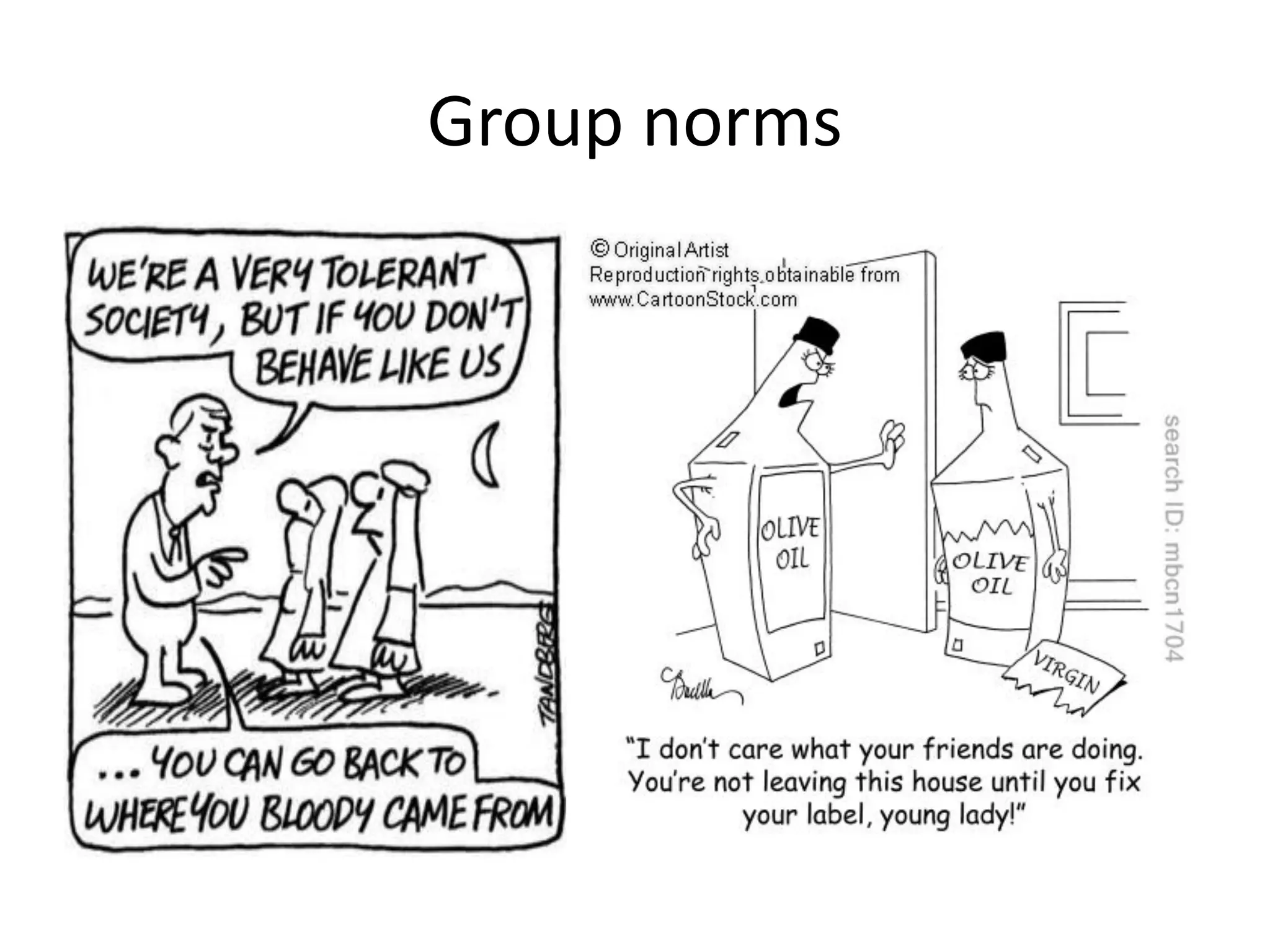
Group norms
• Norms are standards or expectations that are
accepted and shared by members of the group
• Groups normally have norms about levels of
effort and performance ( is this true?)
• Groups have explicit cues on how hard to
work, what level of output to have, when to
look busy and when it is acceptable to goof
off (totoo ba ito?)
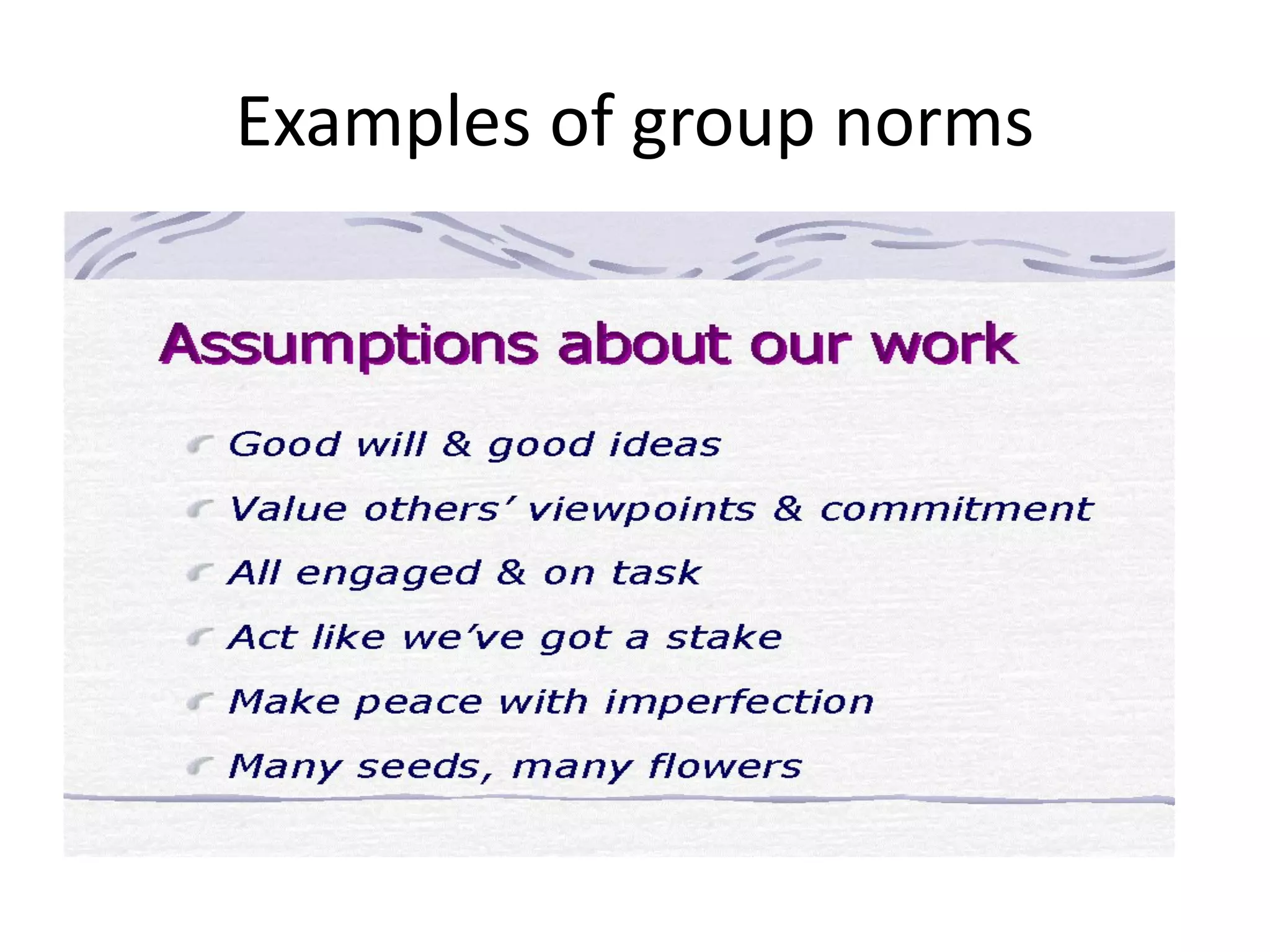
Examples of group norms
Group norms
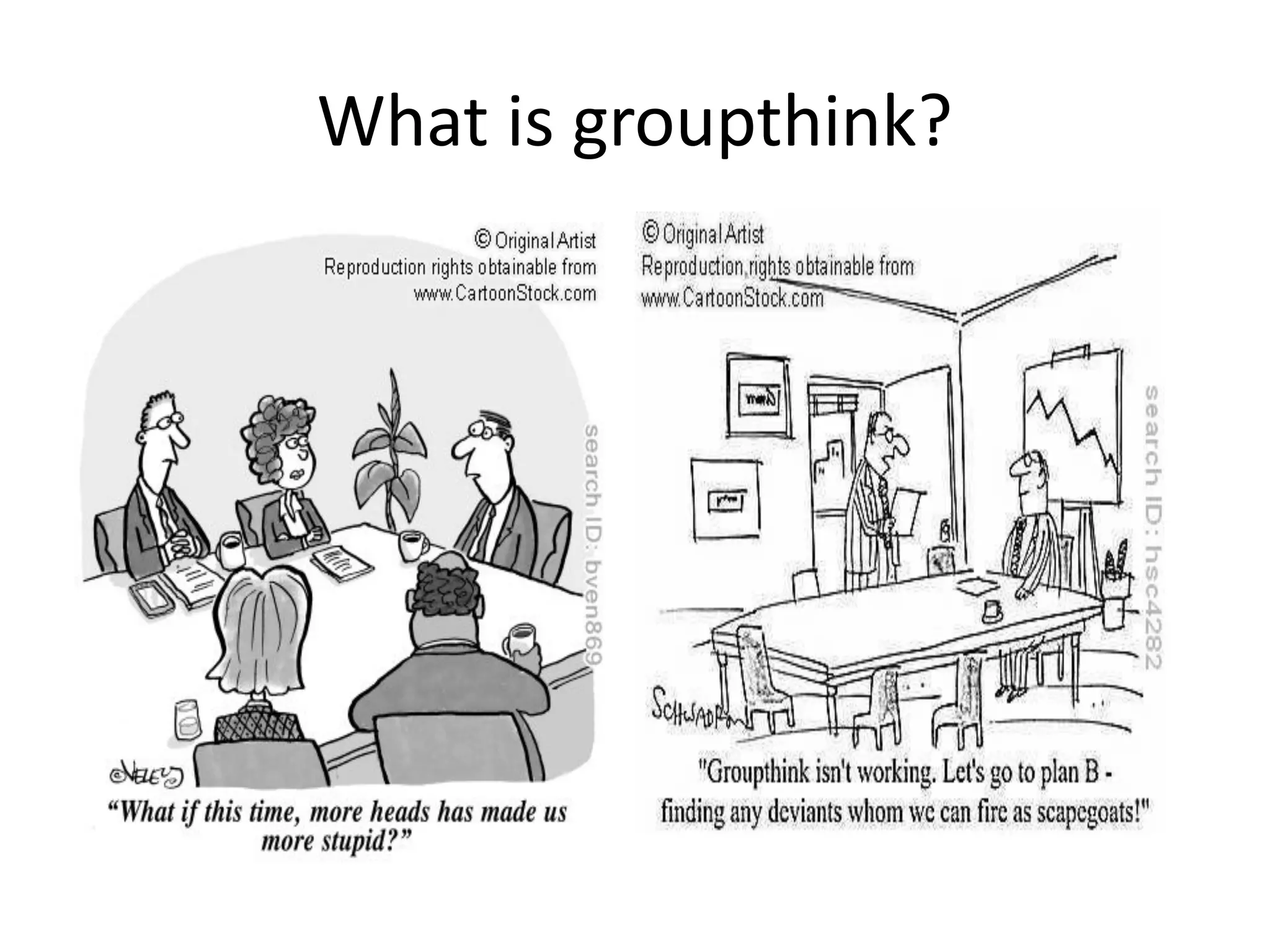
What is groupthink?
Groupthink
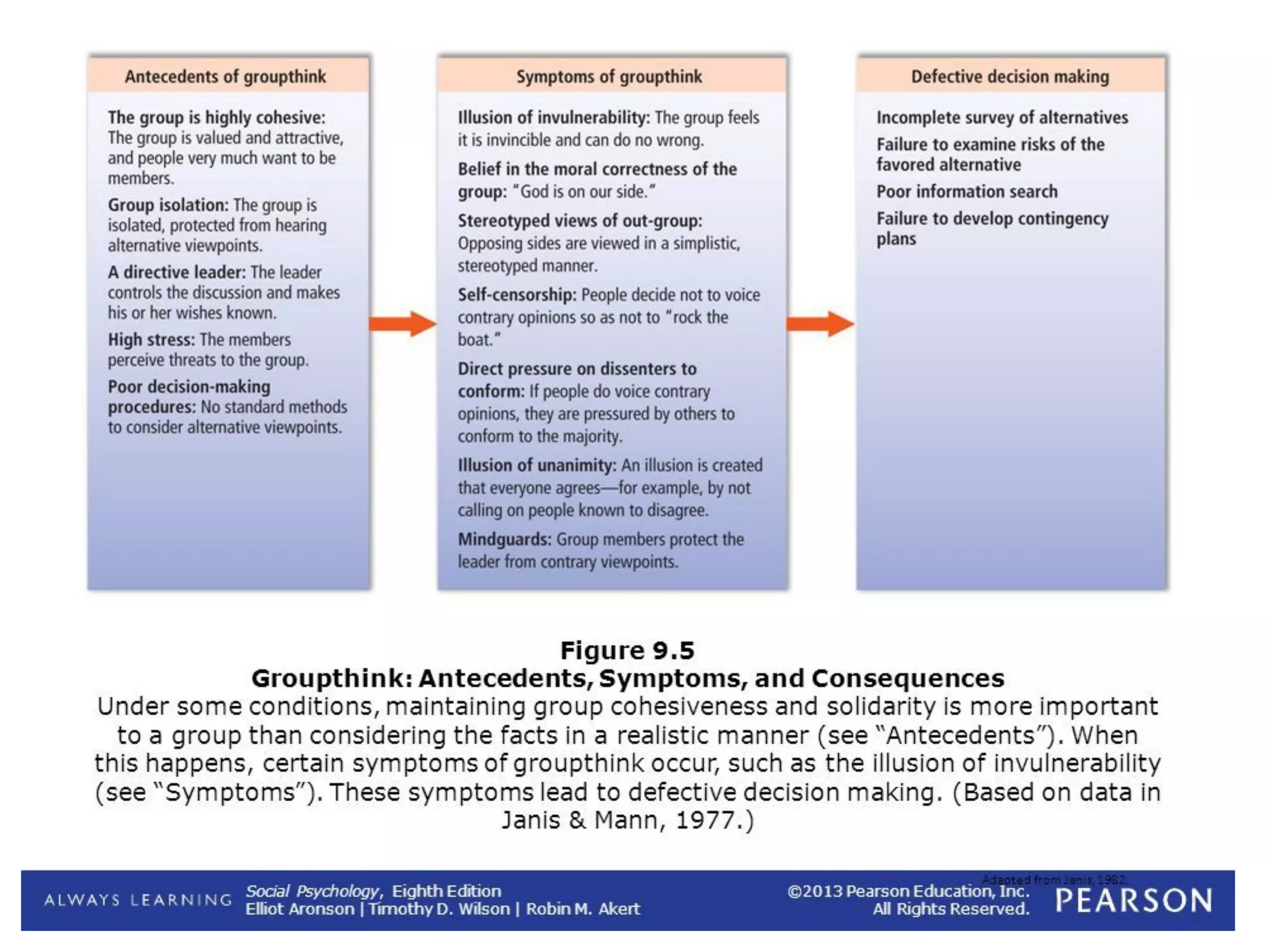
• Occurs when group pressure to conform is
strong
• Divergent views are not tolerated
• Films produced by Joshua
Oppenheimer—whose masterful The Act of
Killing and The Look of Silence are thematic
works about group-think atrocities
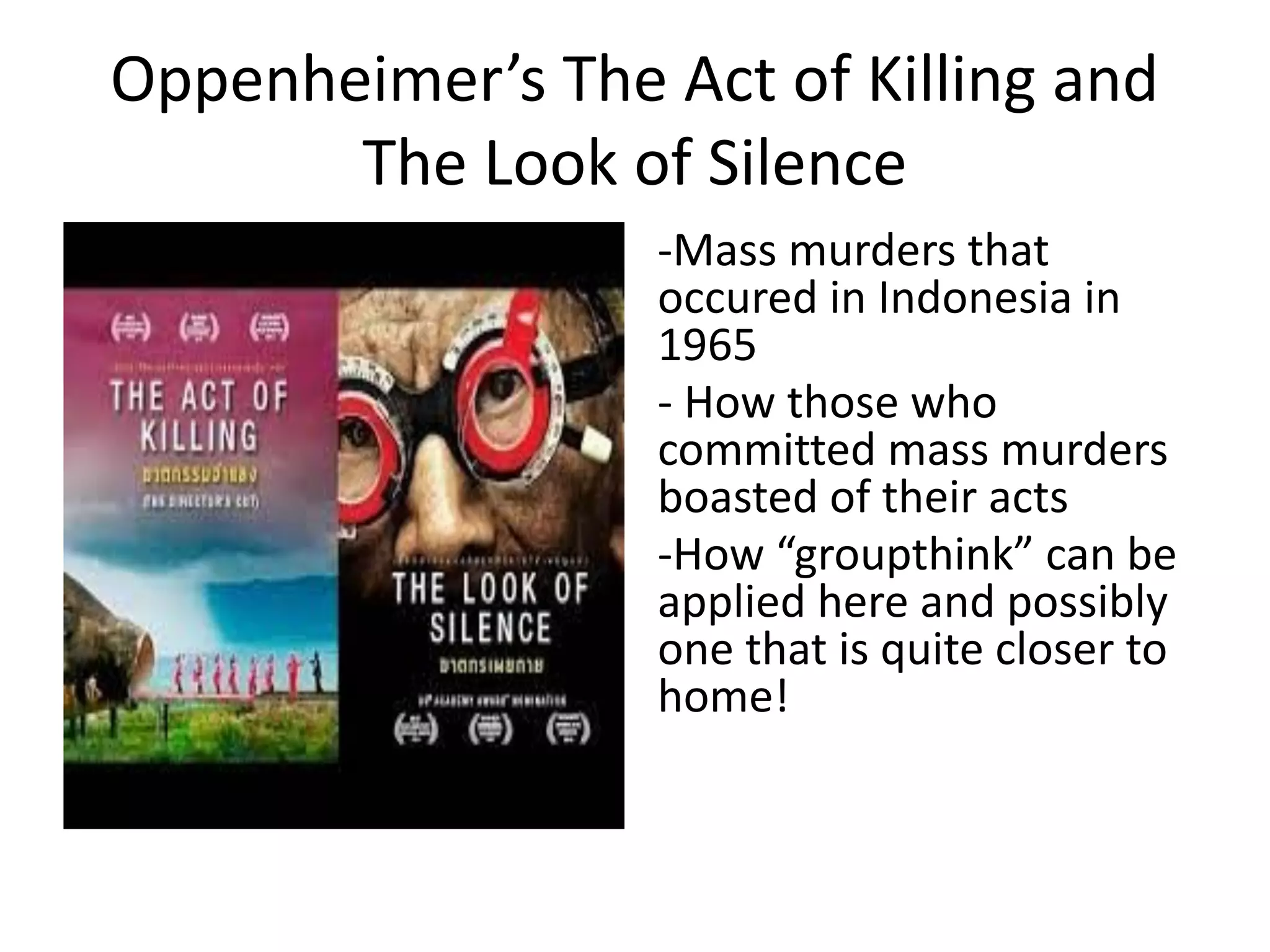
Oppenheimer’s The Act of Killing and
The Look of Silence
-Mass murders that
occured in Indonesia in
1965
- How those who
committed mass murders
boasted of their acts
-How “groupthink” can be
applied here and possibly
one that is quite closer to
home!
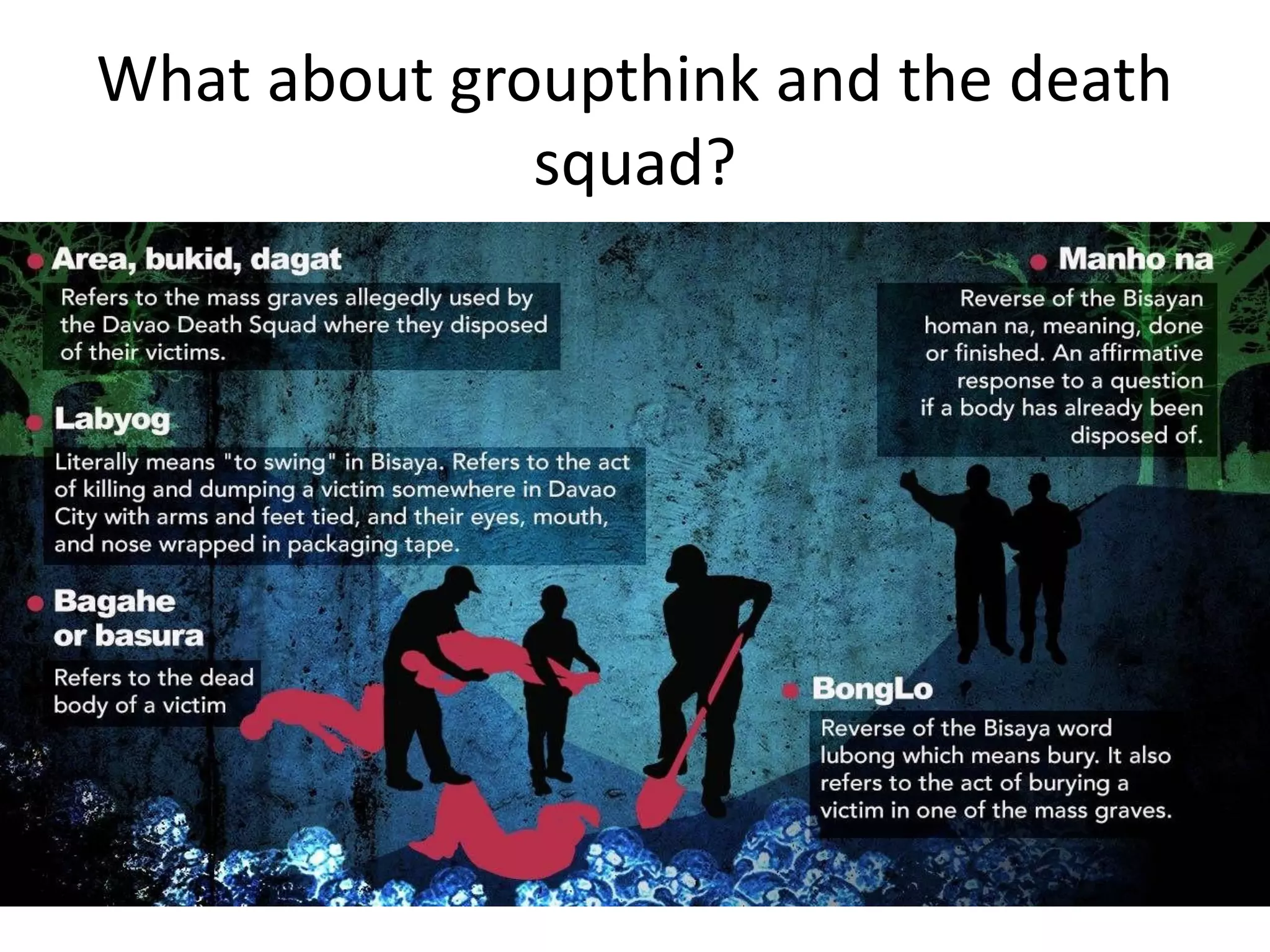
What about groupthink and the death
squad?
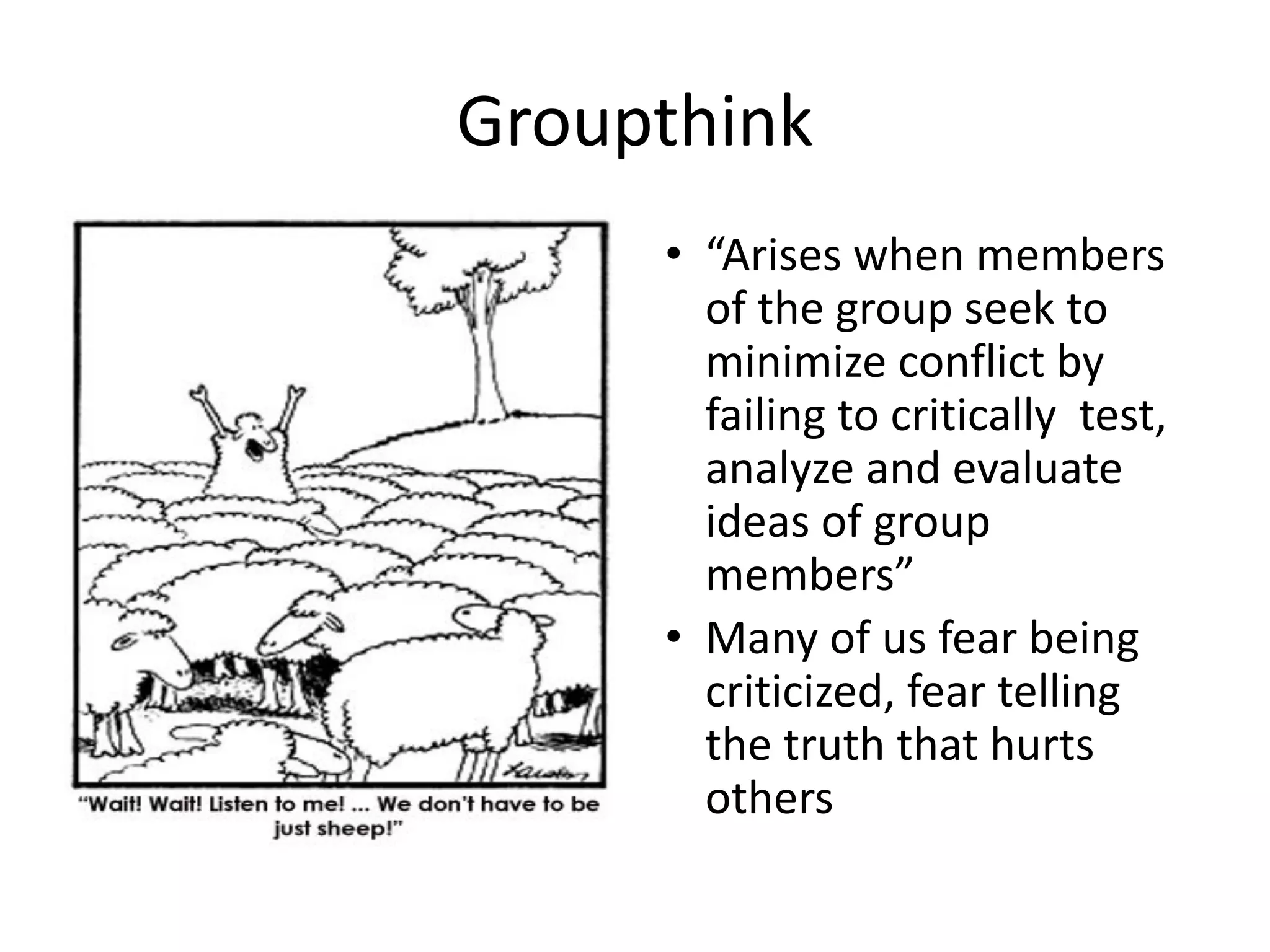
Groupthink
• “Arises when members
of the group seek to
minimize conflict by
failing to critically test,
analyze and evaluate
ideas of group
members”
• Many of us fear being
criticized, fear telling
the truth that hurts
others
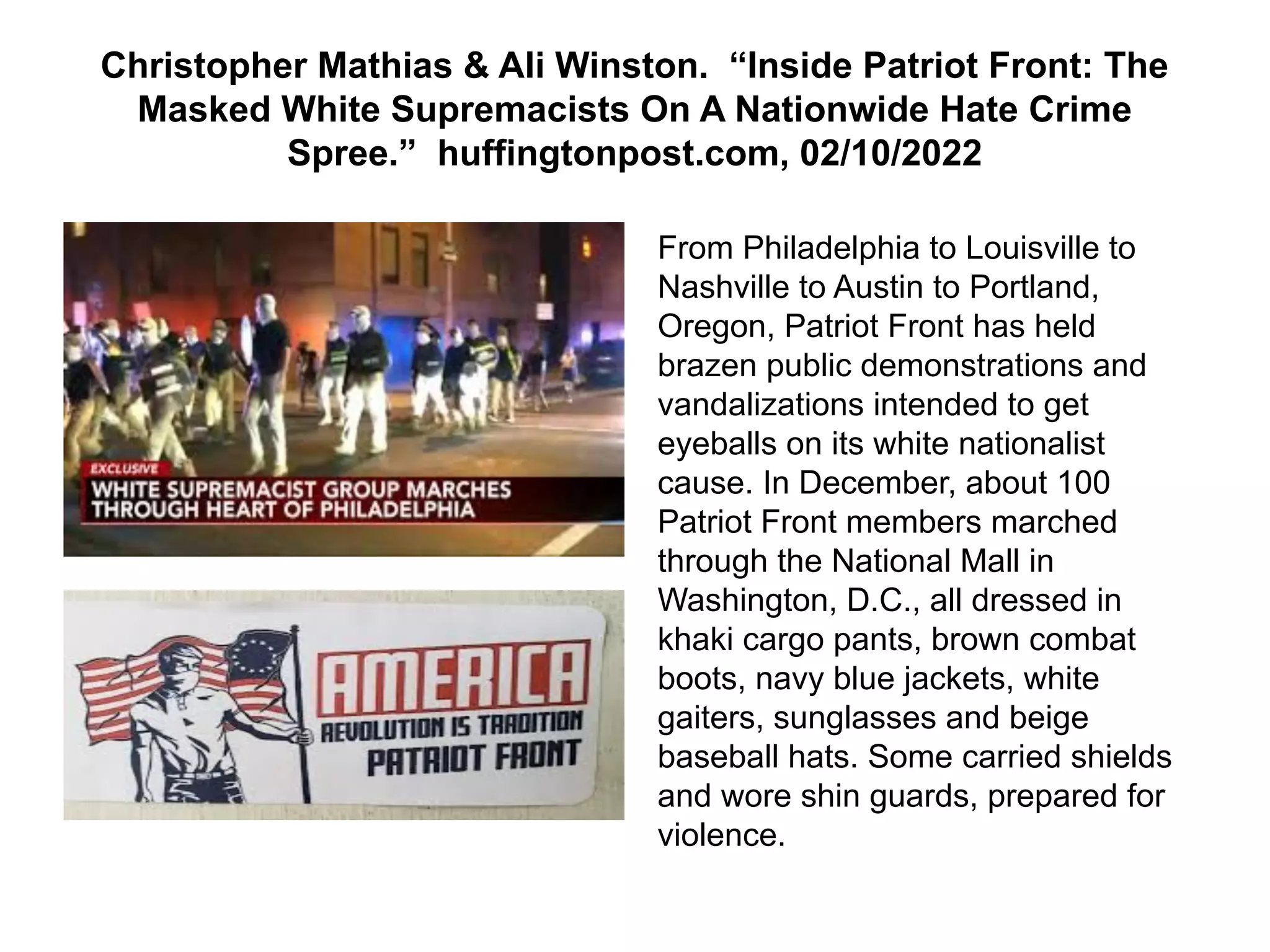
Christopher Mathias & Ali Winston. “Inside Patriot Front: The
Masked White Supremacists On A Nationwide Hate Crime
Spree.” huffingtonpost.com, 02/10/2022
From Philadelphia to Louisville to
Nashville to Austin to Portland,
Oregon, Patriot Front has held
brazen public demonstrations and
vandalizations intended to get
eyeballs on its white nationalist
cause. In December, about 100
Patriot Front members marched
through the National Mall in
Washington, D.C., all dressed in
khaki cargo pants, brown combat
boots, navy blue jackets, white
gaiters, sunglasses and beige
baseball hats. Some carried shields
and wore shin guards, prepared for
violence.
Patriot Front, per Rousseau’s
manifesto, seeks a “hard reset on
the nation we see today — a
return to the traditions and
virtues of our forefathers.”
Decrying mass immigration,
rampant consumerism,
increasing diversity and the
declining fortunes of white
Americans, Rousseau espouses
the renewal of a true American
“volk” through racial primacy,
physical prowess and the
renewal of the nuclear family.
The group appears especially
agitated by the historic wave of
anti-racist uprisings which have
swept across America over the last
two years.
Murals depicting Floyd — whose
murder at the hands of Minneapolis
cops last year helped spark
thousands of demonstrations against
police brutality across the country —
were defaced by Patriot Front
members in Canton, Ohio;
Philadelphia; Manhattan; Newark,
New Jersey; Portland, Oregon; and
Lafayette, Indiana.
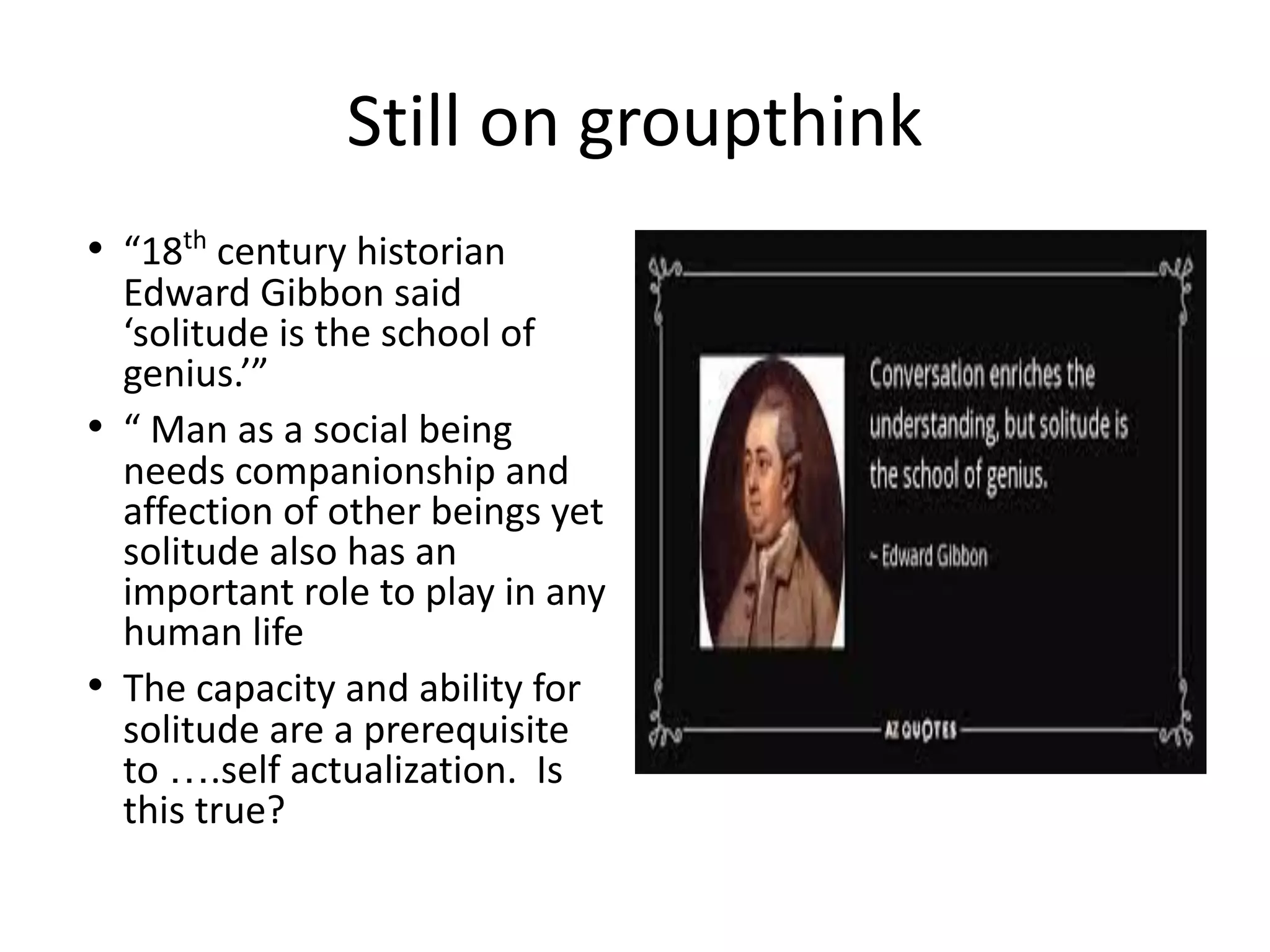
Still on groupthink
• “18th
century historian
Edward Gibbon said
‘solitude is the school of
genius.’”
• “ Man as a social being
needs companionship and
affection of other beings yet
solitude also has an
important role to play in any
human life
• The capacity and ability for
solitude are a prerequisite
to ….self actualization. Is
this true?
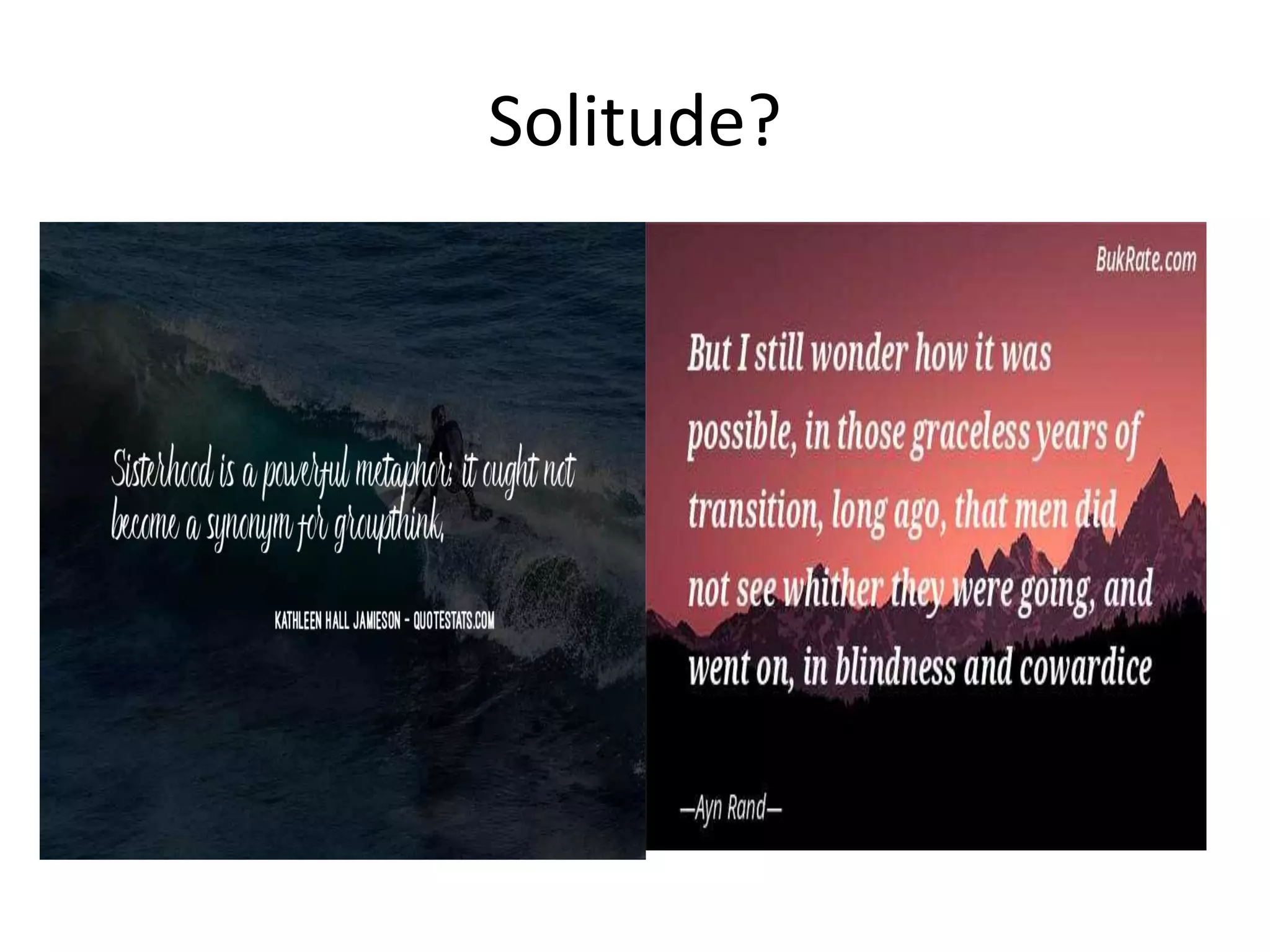
Solitude?
• “You have to get away from all that madness for
a while because we become insane, we get
confused with our roles, as being who we really
are. Man is not his role. Man is something
deeper than that. So, go into the forest or some
place ALONE in nature, all by yourself, and find
out who you really are! And when you no longer
confuse yourself with your particular temporary
body, but identify with the entire process of
nature and the whole cosmos… When death
comes, what a funny thing that will happen.
Death comes, and will find no one to kill.”
• ~ Alan Watts
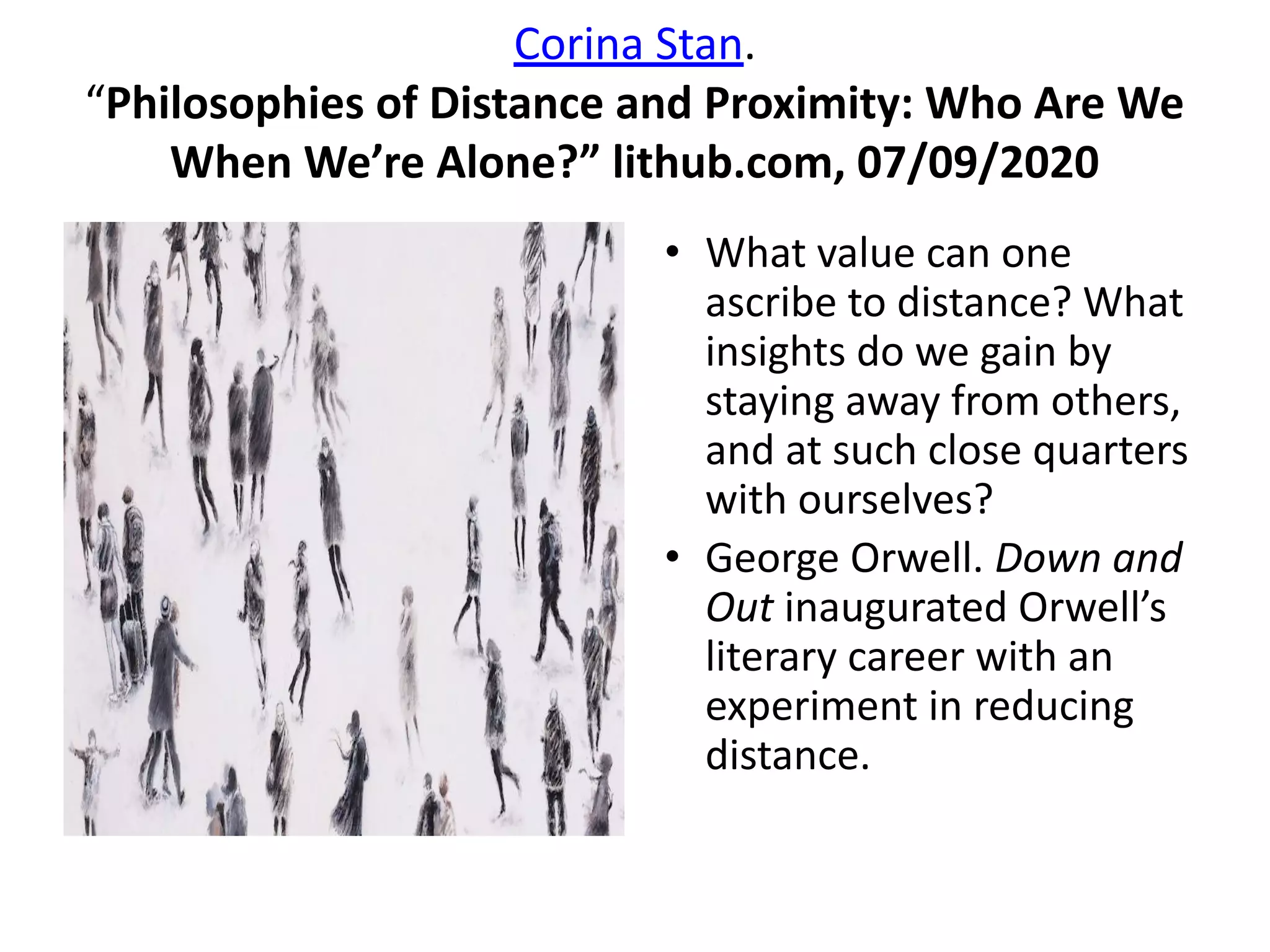
Corina Stan.
“Philosophies of Distance and Proximity: Who Are We
When We’re Alone?” lithub.com, 07/09/2020
• What value can one
ascribe to distance? What
insights do we gain by
staying away from others,
and at such close quarters
with ourselves?
• George Orwell. Down and
Out inaugurated Orwell’s
literary career with an
experiment in reducing
distance.
• In a parable loved by
Arthur Schopenhauer and
Sigmund Freud, some
porcupines huddle
together in freezing
weather, trying to stay
close enough to keep
warm, yet also far enough
so they avoid pricking one
another.
• Citing this parable, the
French semiologist Roland
Barthes formulated his
course of lectures, How to
Live Together, around a
question: “At what
distance should I keep
myself from others in
order to build with them
a sociability without
alienation and a solitude
without exile?”
• A vocabulary of
distance and proximity
• the problem of
distance bears on
questions of space,
values, foundational
myths, notions of
identity and difference.
• For the most part, the
Western philosophical
tradition has placed
friendship at the heart
of a happy life, a
similarity of interests,
habits and values being
considered nurturing
for those involved.
• Yet Aristotle’s paradoxical
apostrophe—O my
friends, there are no
friends!—famously
highlights the impossible
demands of authentic
friendship, and the fact
that it can perhaps only
exist as an ideal on the
horizon of our social
interactions.
• For Ralph Waldo
Emerson, a friend must
remain a spirit ensconced
in distance, “forever a
sort of beautiful enemy,
untamable, devoutly
revered, and not a trivial
conveniency to be soon
outgrown and cast aside.”
• Nietzsche (Neat-chuh)
- “love of the farthest”:
instead of cultivating
bonds with those
closest to us, we should
seek connections with
those who are different,
those who can help us
broaden our horizons.”
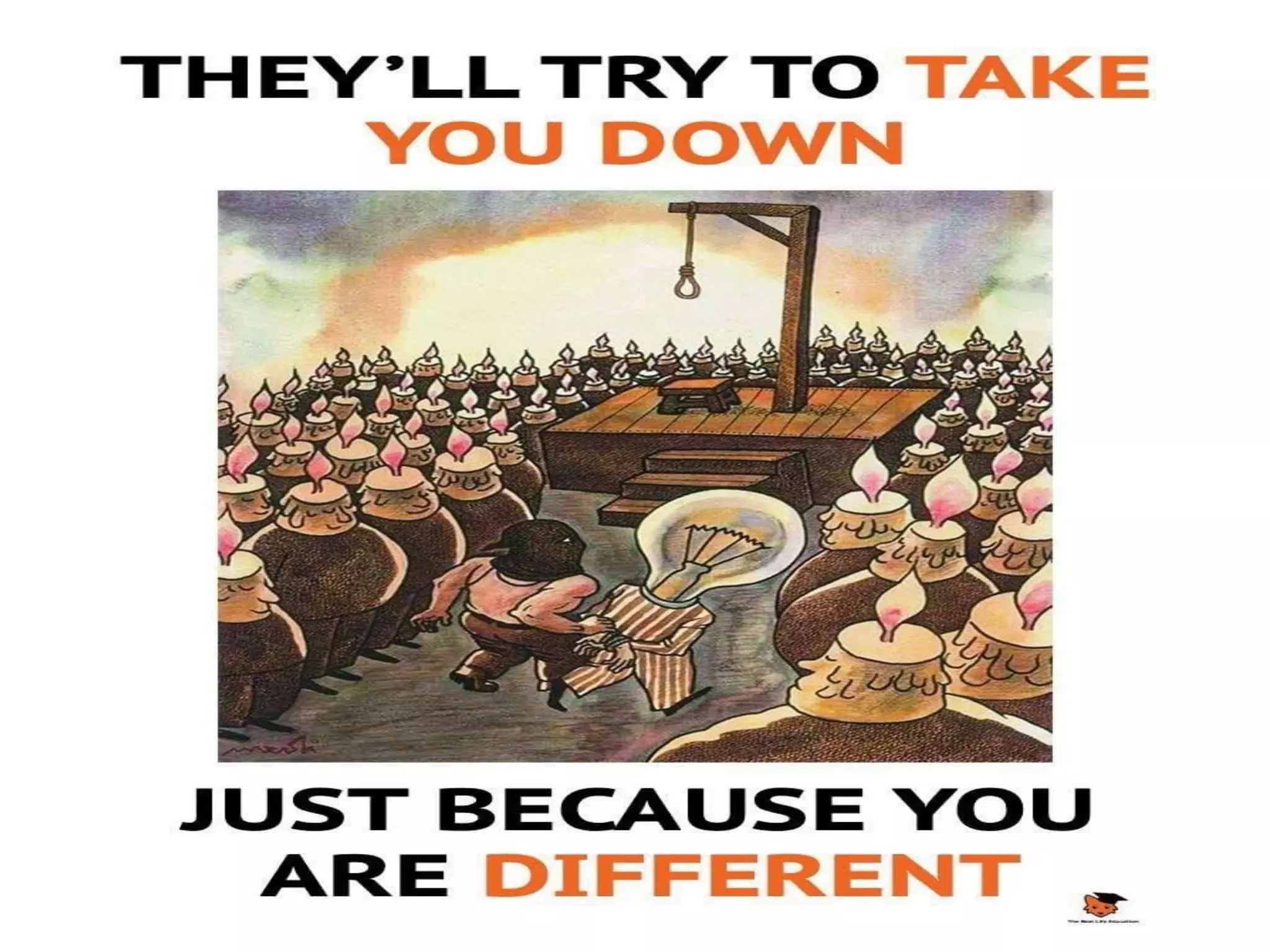
• Nietzsche thus turns his
back on an entire
tradition of thinking about
community that prized a
shared history, myths of
origin and common
rituals, blaming
Judeo-Christian morality
for encouraging the
cultivation of a “herd
mentality” that denied
the diversity of life forms.
• Instead of docilely
conforming to rules and
expectations that fence us
in a community of
like-minded individuals,
one should seek that
region where difficult and
surprising encounters are
possible. Nietzsche
reminds readers that all
strong epochs cultivated a
“pathos of distance.”
• The paradox is that
“communities of
proximity” are affected by
a troubling kind of
distance, precisely
because they are
premised on life-scripts
that compel their
members to evaluate
themselves through
comparison with others.
• n Being and Time, Martin
Heidegger refers to this
aspect with the term
“distantiality”
(Abständigkeit): the nagging
care about how one
differs from others, which
manifests in an “ambiguous
watching of one another, a
secret and reciprocal
listening-in,” antagonistic
rather than benevolent.
• In the company of Barthes
(Baarts) and other thinkers
invested in this problem,
the question of
community becomes:
What is an ethical way of
relating to other people?
And what happens when
we find ourselves in
isolation, contemplating
not only our distance
from others, but also
distances within
ourselves?
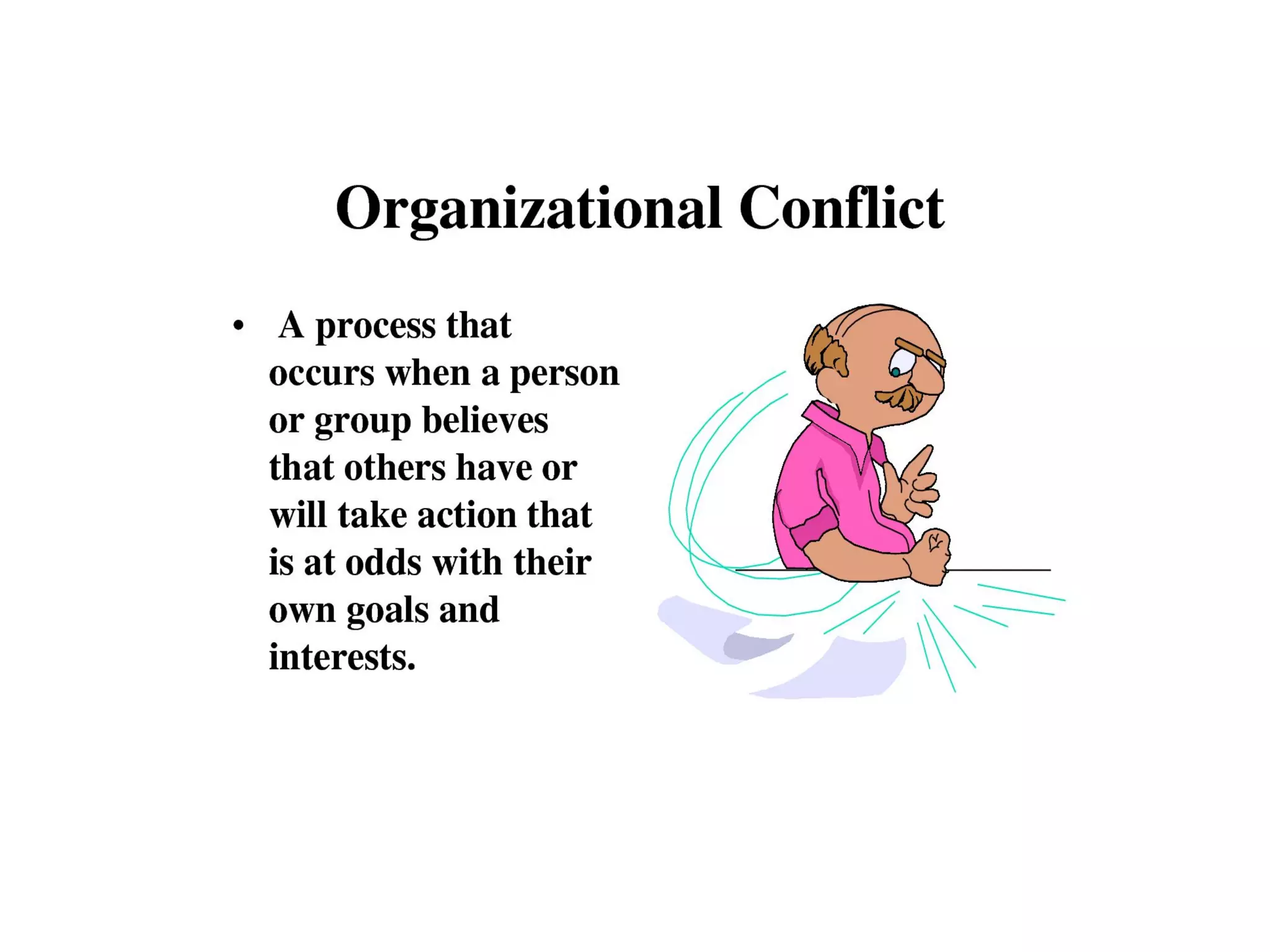
Conflict
• “Perceived incompatible differences resulting
in some form of opposition.”
• Traditional notion of conflict – must be
avoided
• Human relations view of conflict –it is a
natural and inevitable outcome of group
interaction and can be converted to a positive
force in the performance of one’s duties
Conflict
• Interactionist view of conflict- not only is
conflict a positive force – it is absolutely
necessary! One must be angry with oneself
before change is possible! Do you agree?
• Many kinds of conflict – process conflict, task
conflict. The most dysfunctional conflict has
to do with relational conflict.
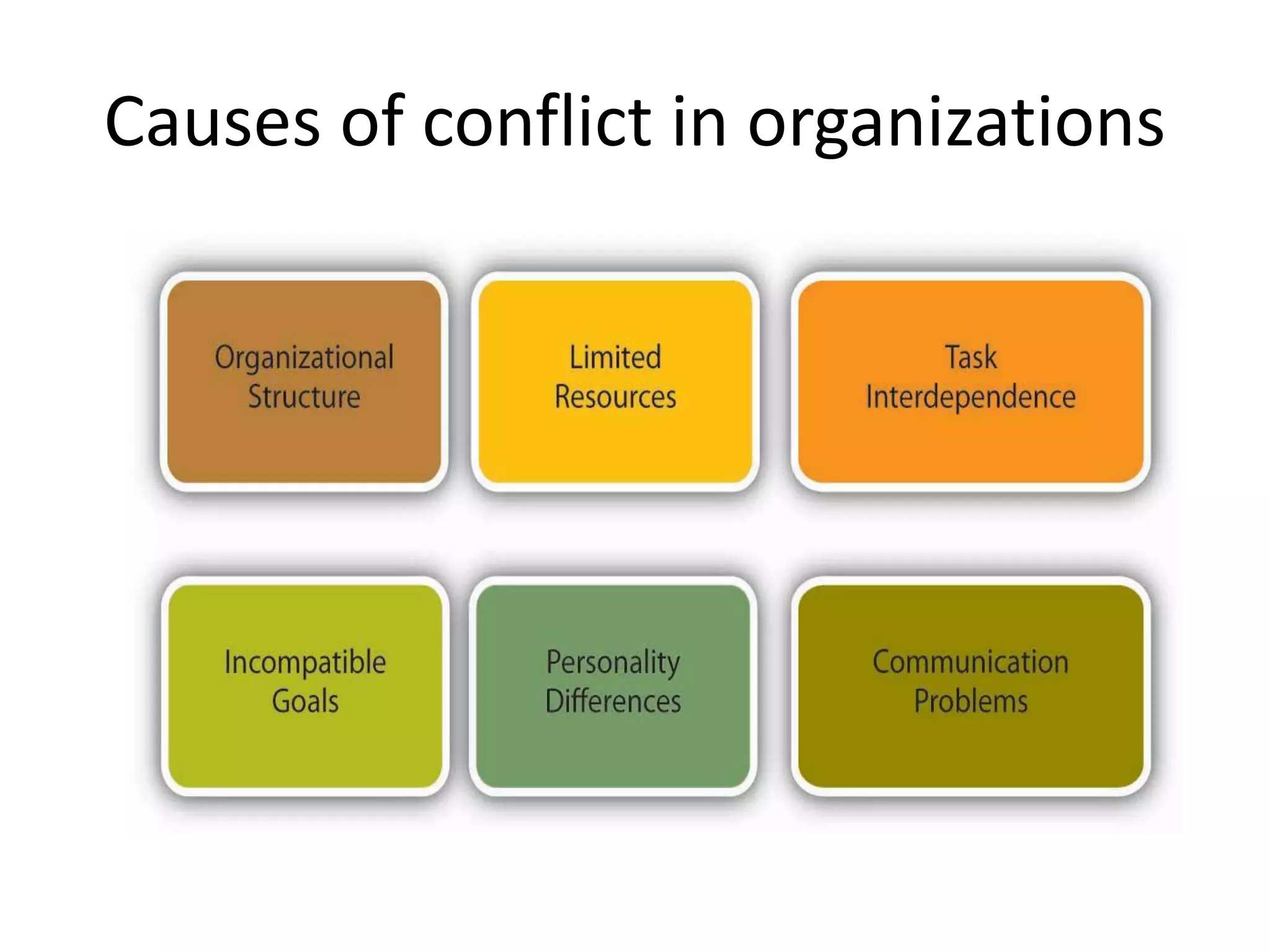
Causes of conflict in organizations
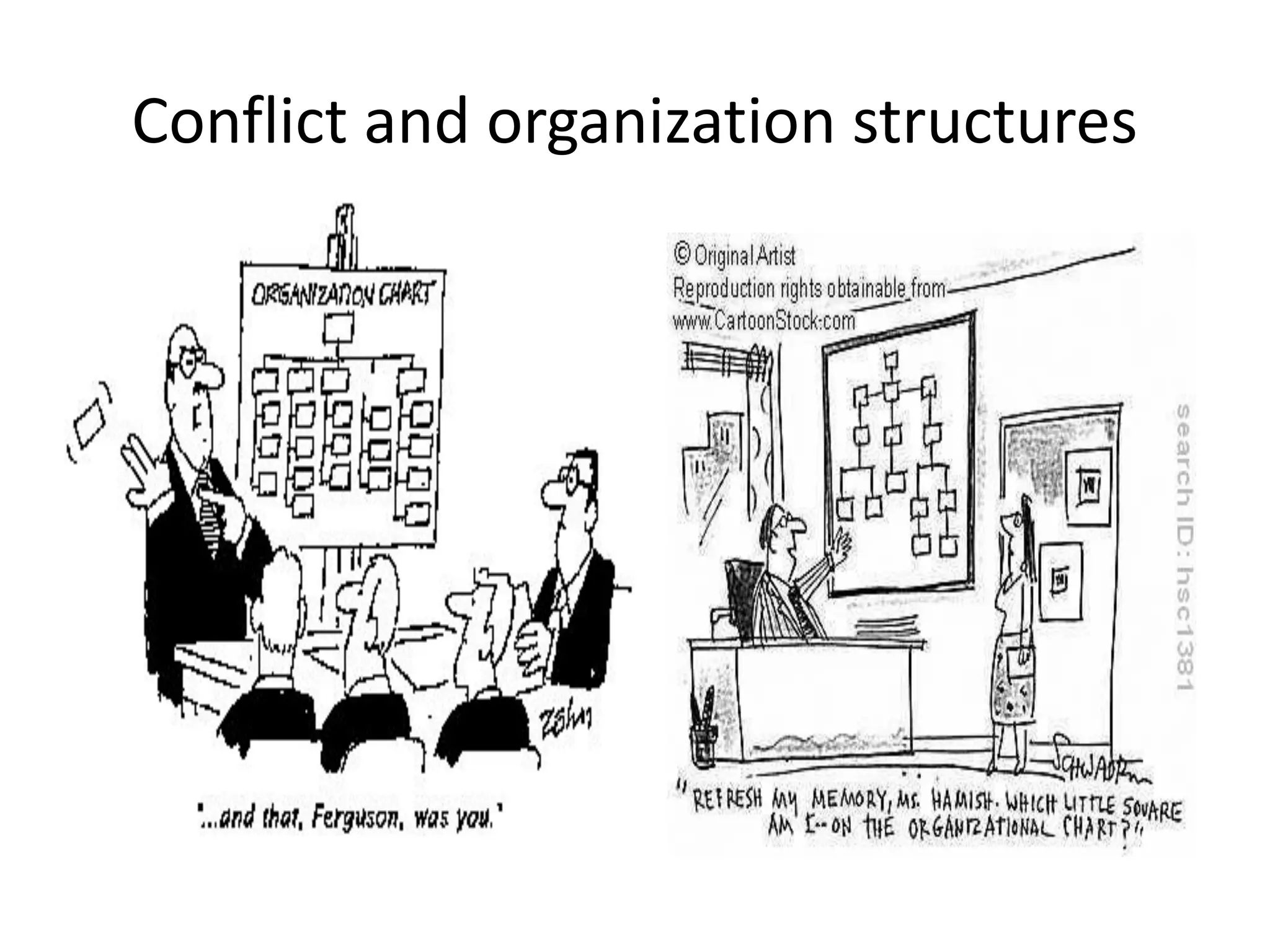
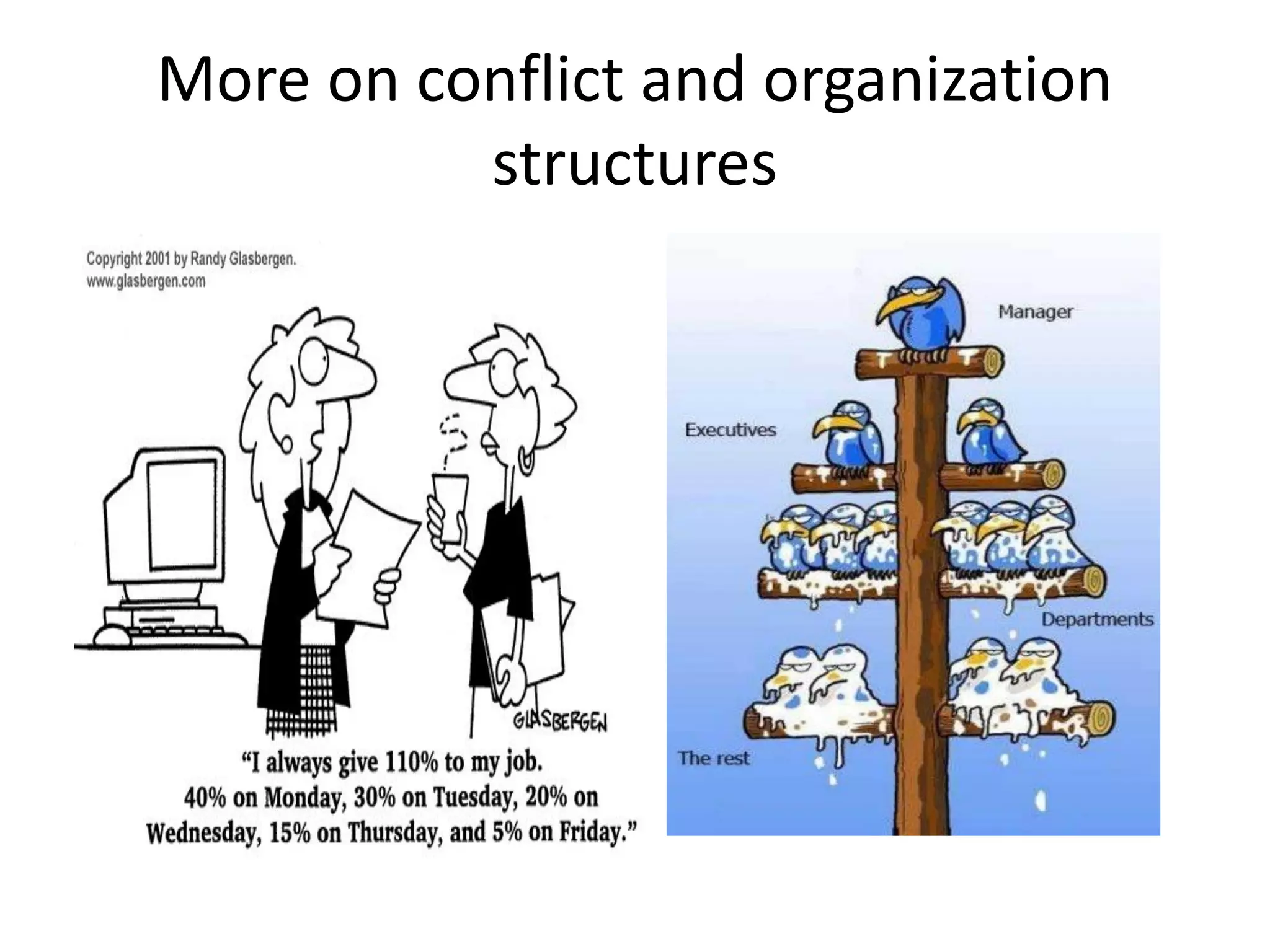
Conflict and organization structures
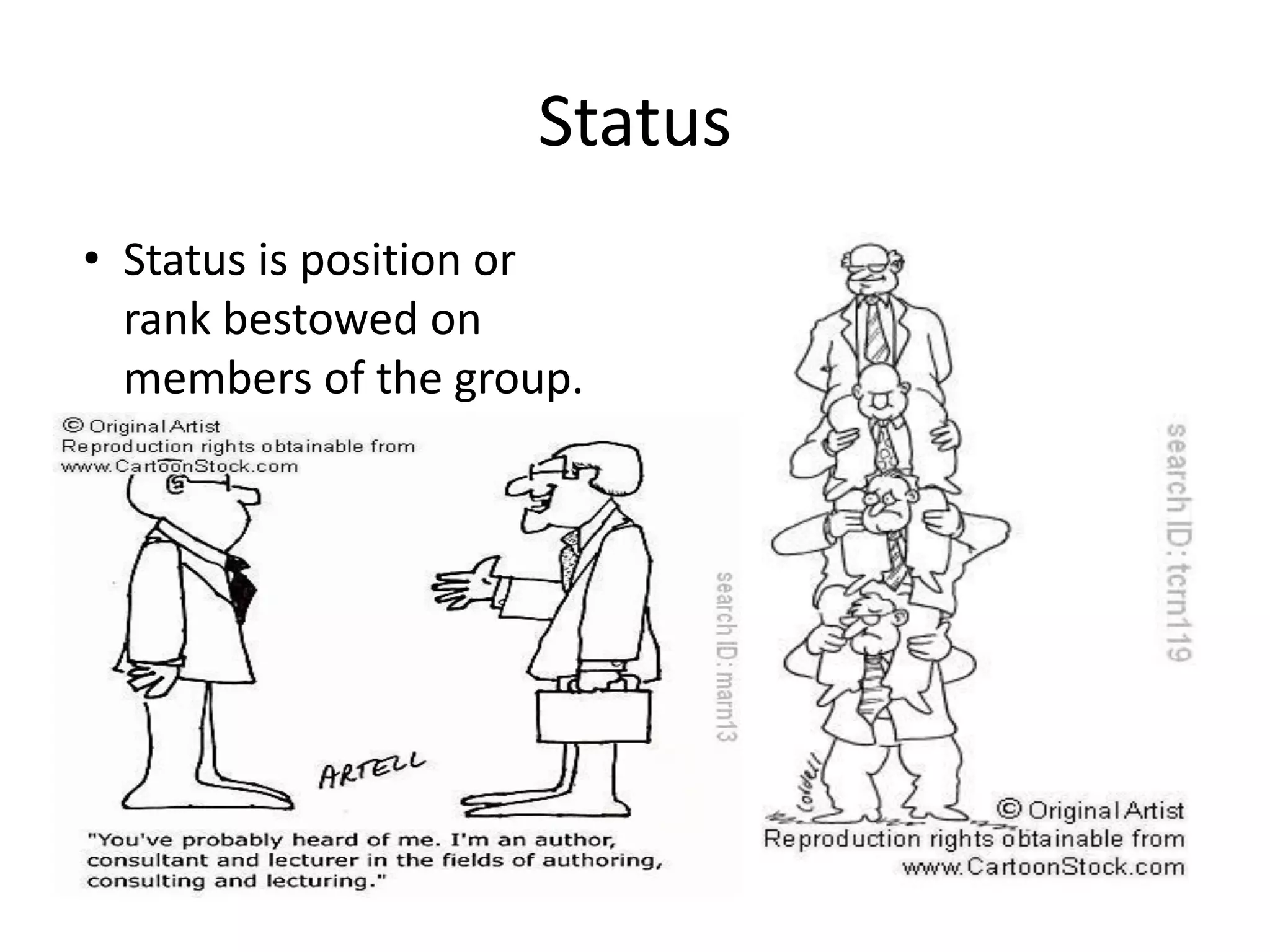
Status
• Status is position or
rank bestowed on
members of the group.
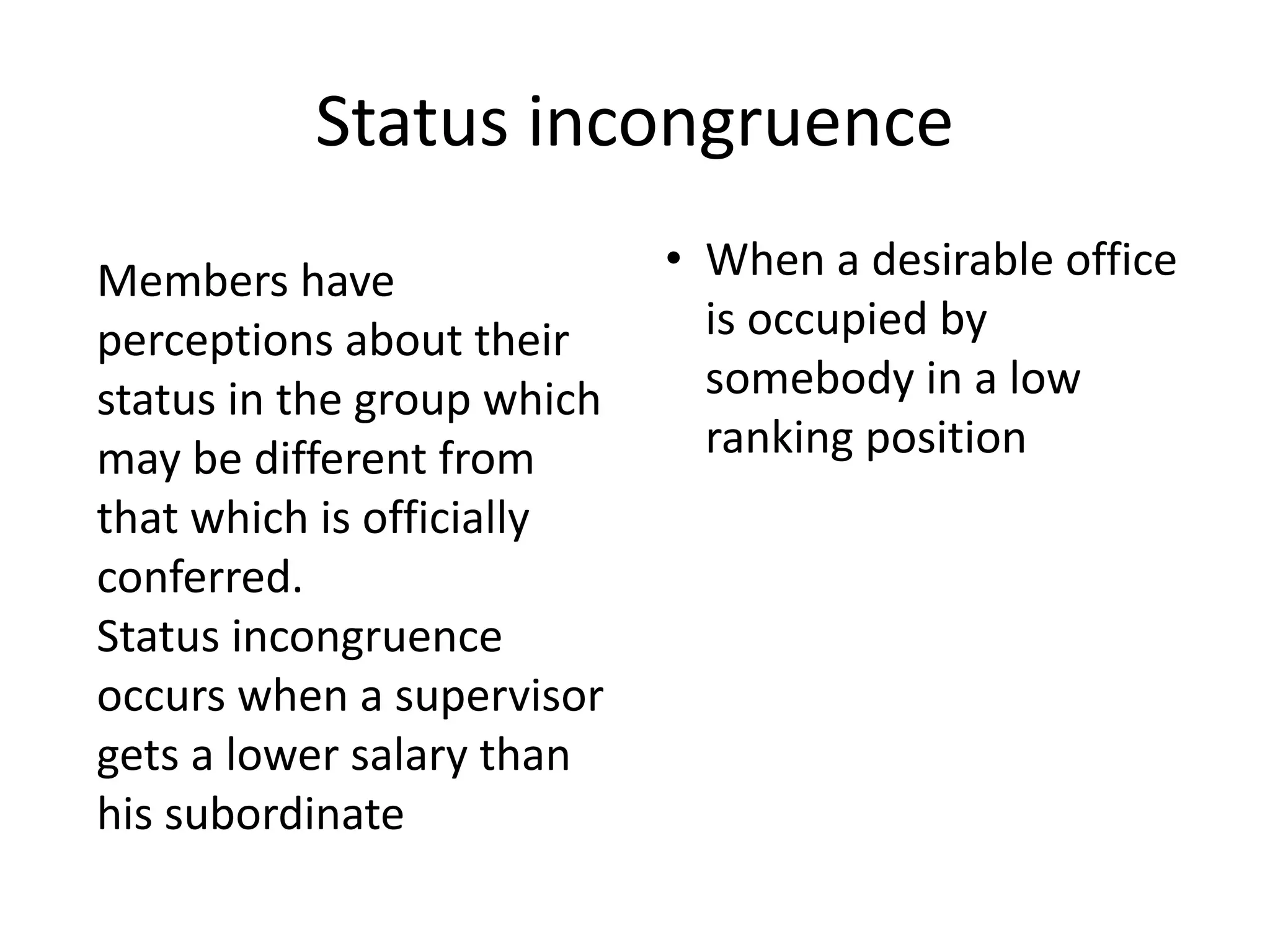
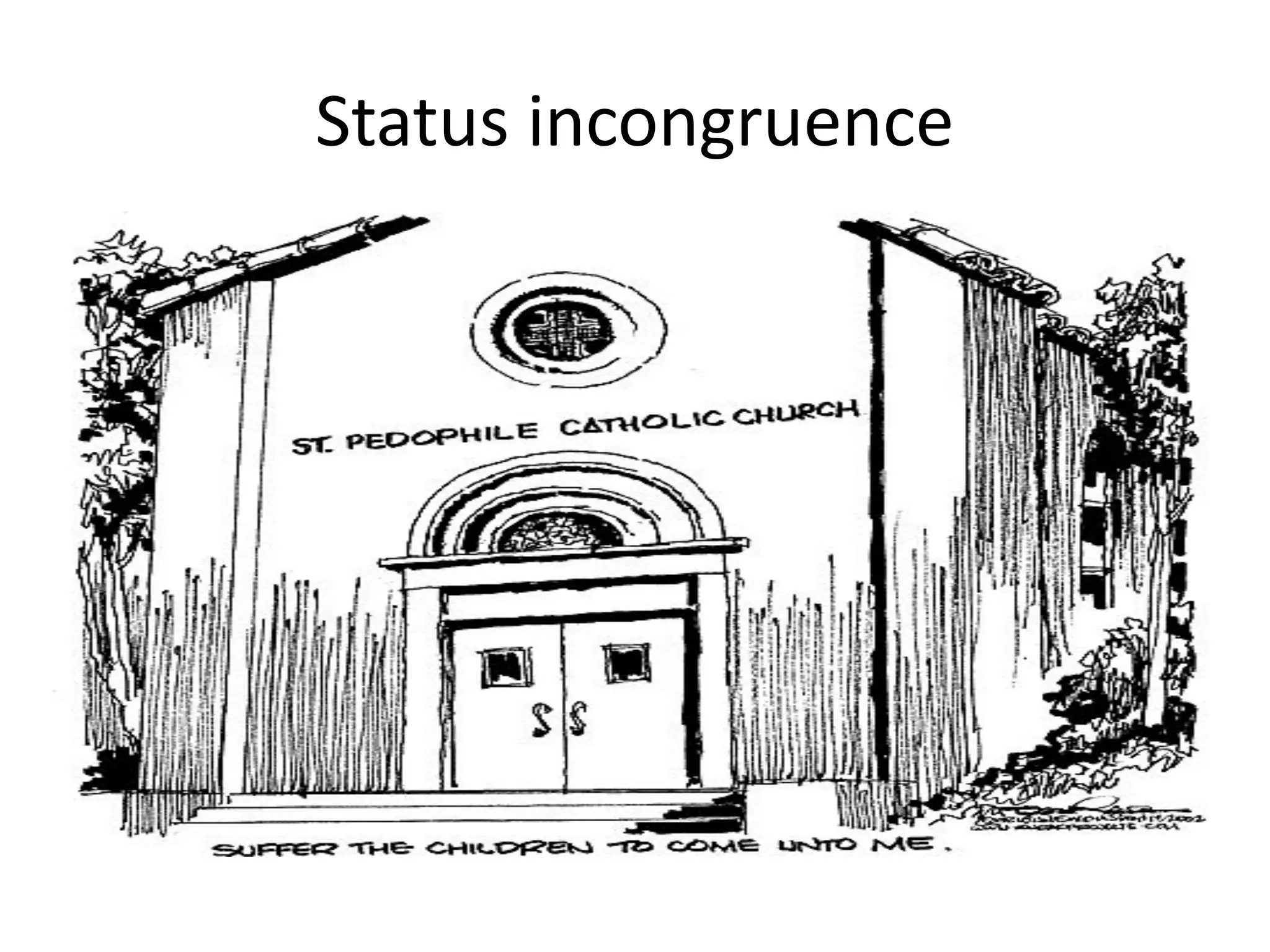
Status incongruence
• When a desirable office
is occupied by
somebody in a low
ranking position
Members have
perceptions about their
status in the group which
may be different from
that which is officially
conferred.
Status incongruence
occurs when a supervisor
gets a lower salary than
his subordinate
Status incongruence
More on conflict and organization
structures
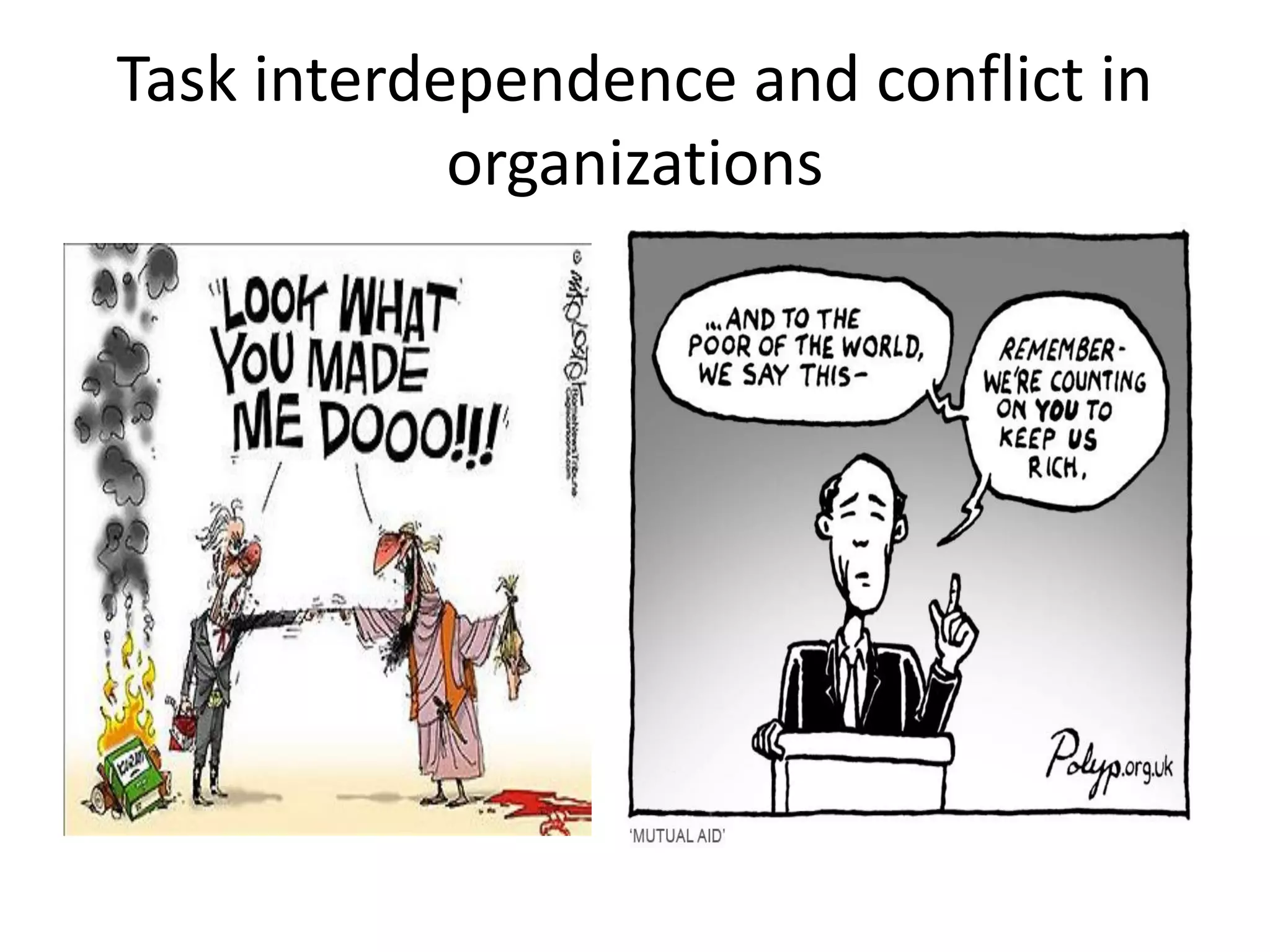
Task interdependence and conflict in
organizations
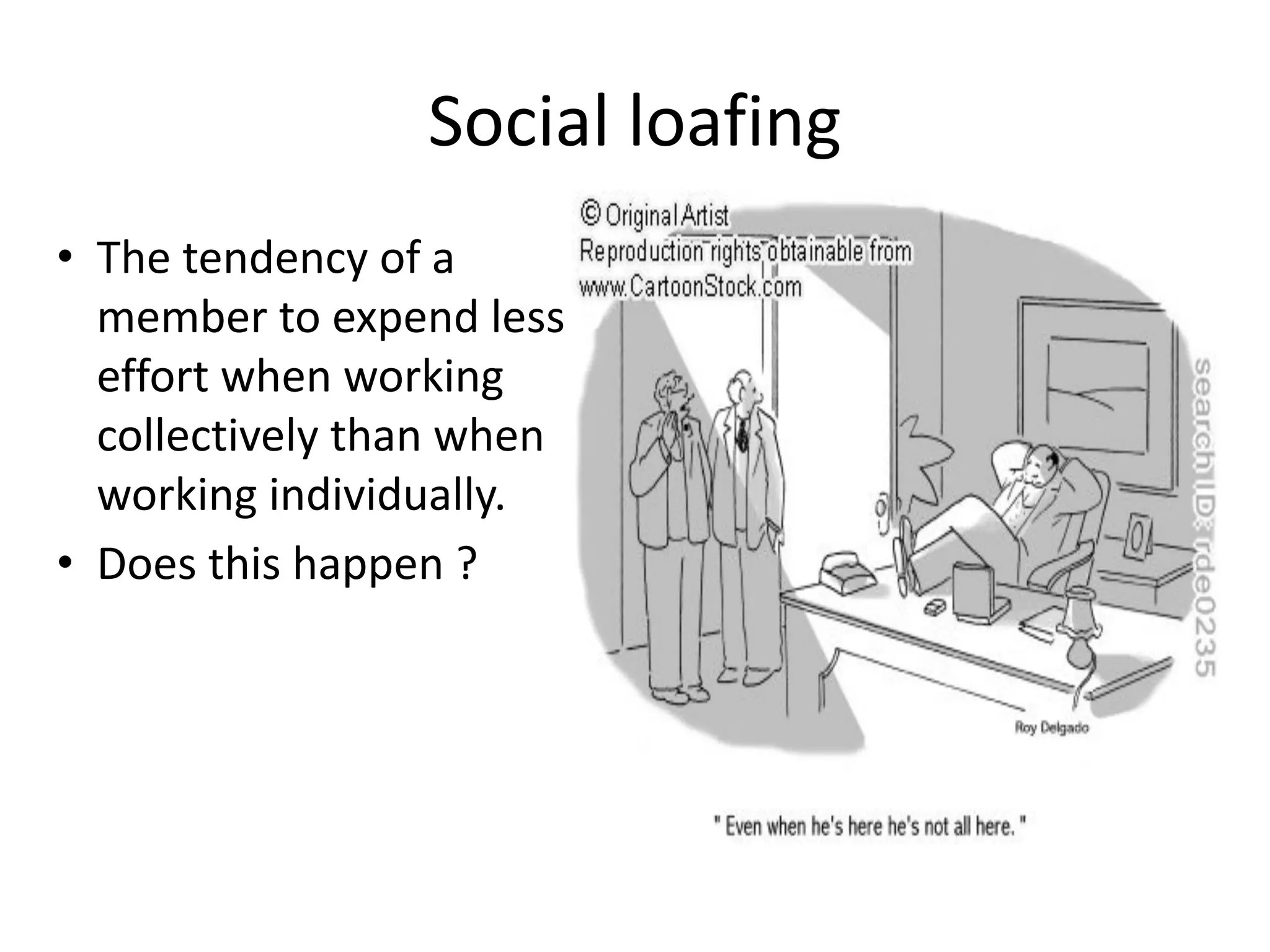
Social loafing
• The tendency of a
member to expend less
effort when working
collectively than when
working individually.
• Does this happen ?
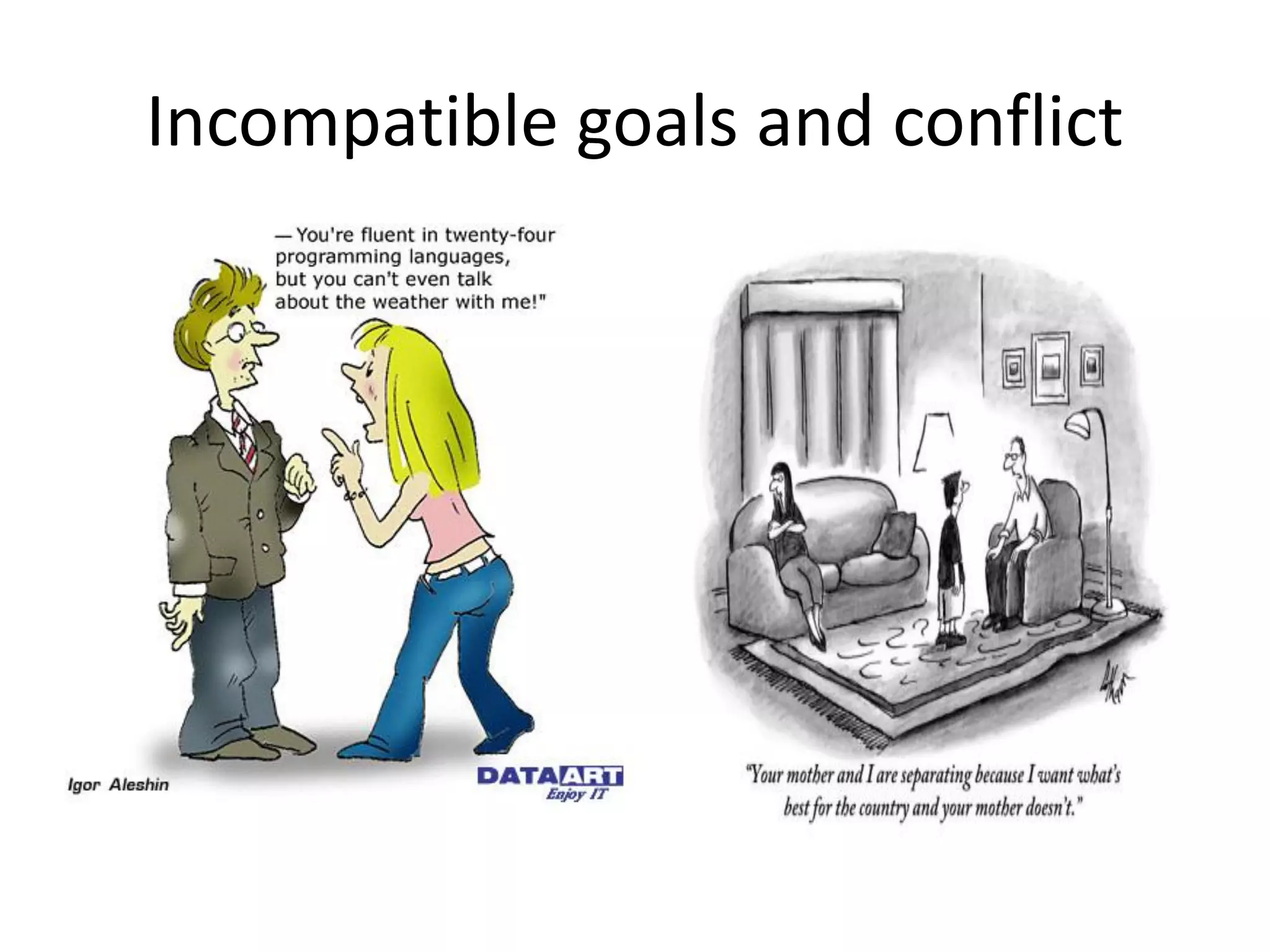
Incompatible goals and conflict
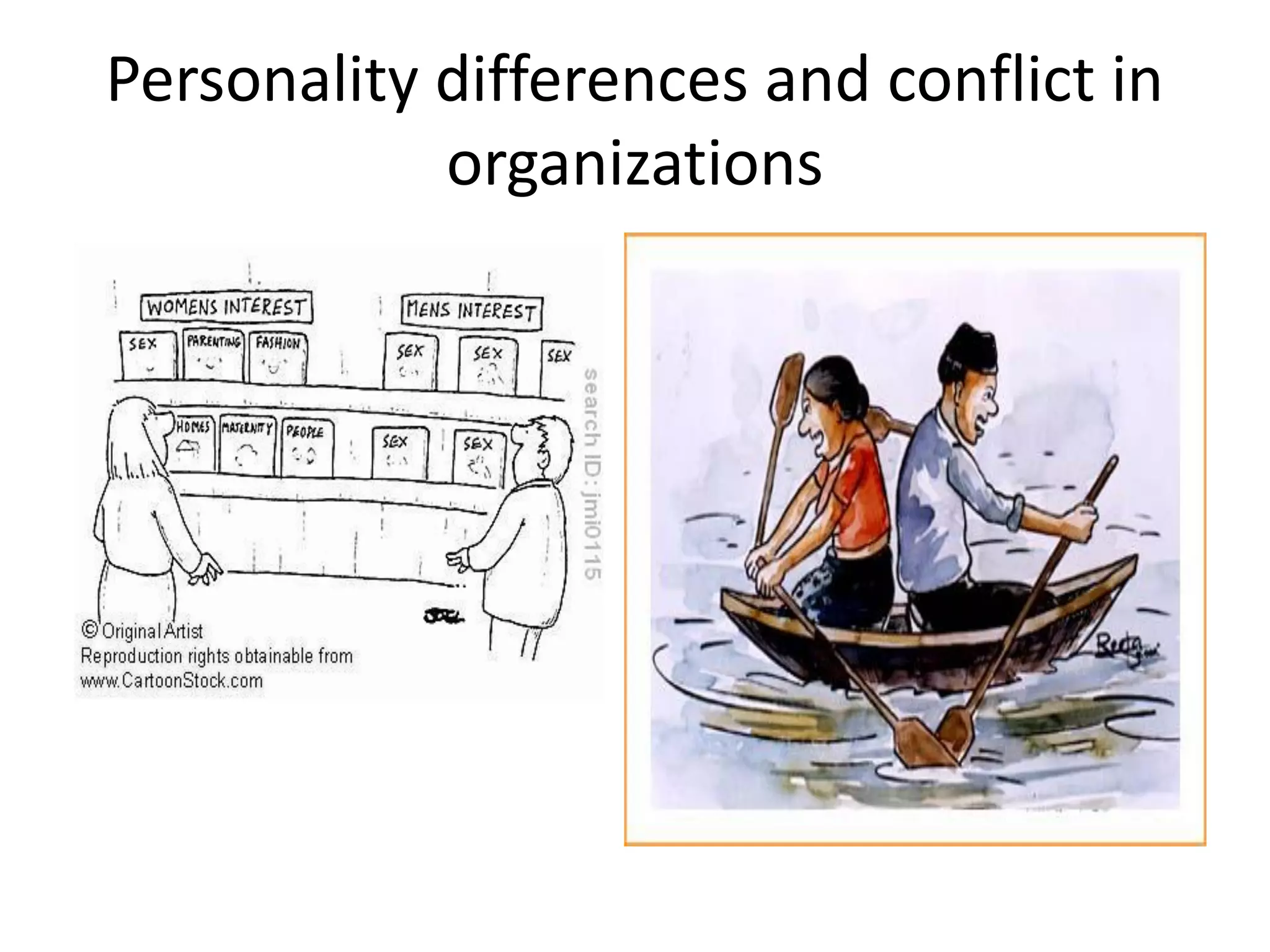
Personality differences and conflict in
organizations
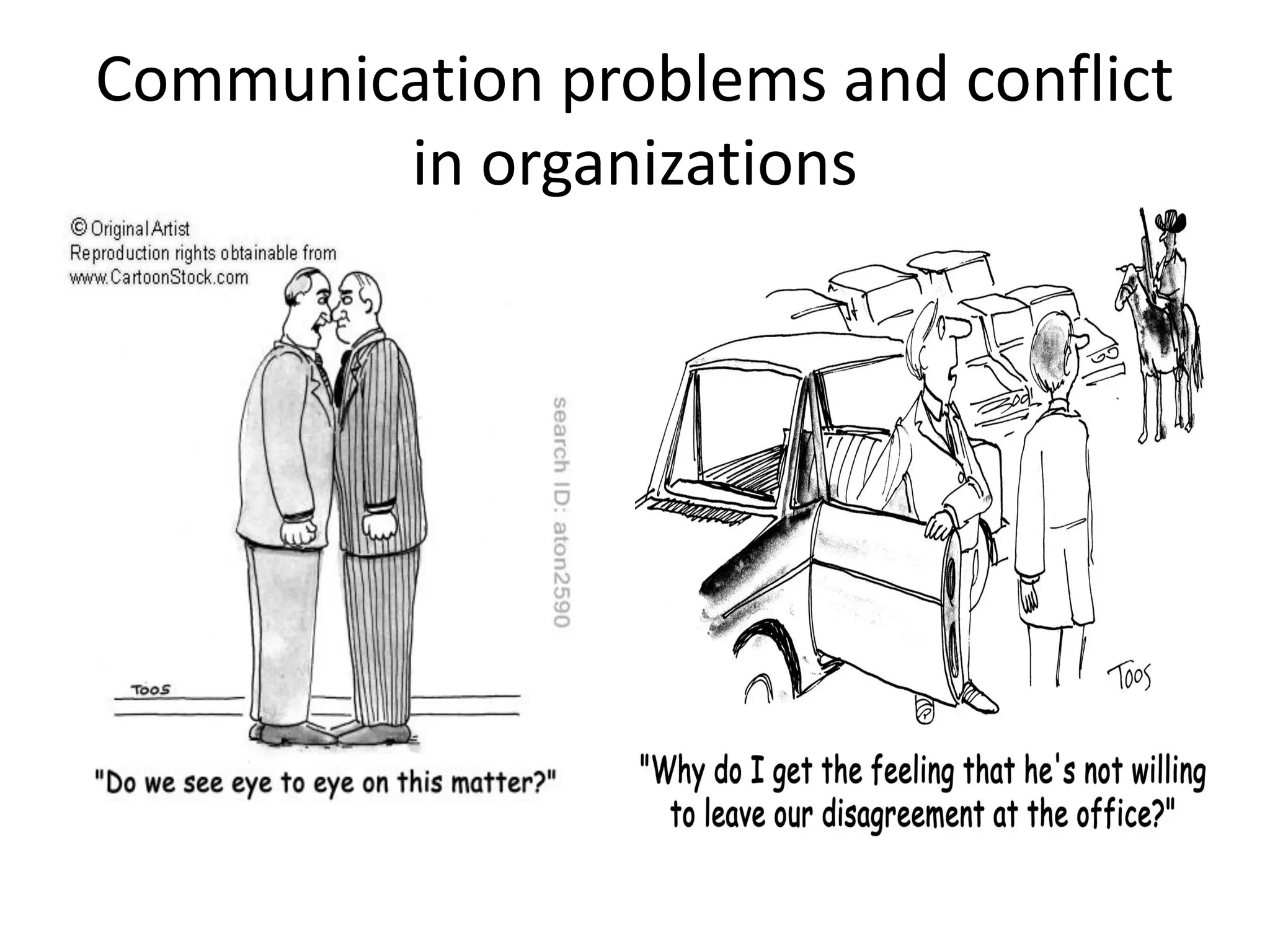
Communication problems and conflict
in organizations
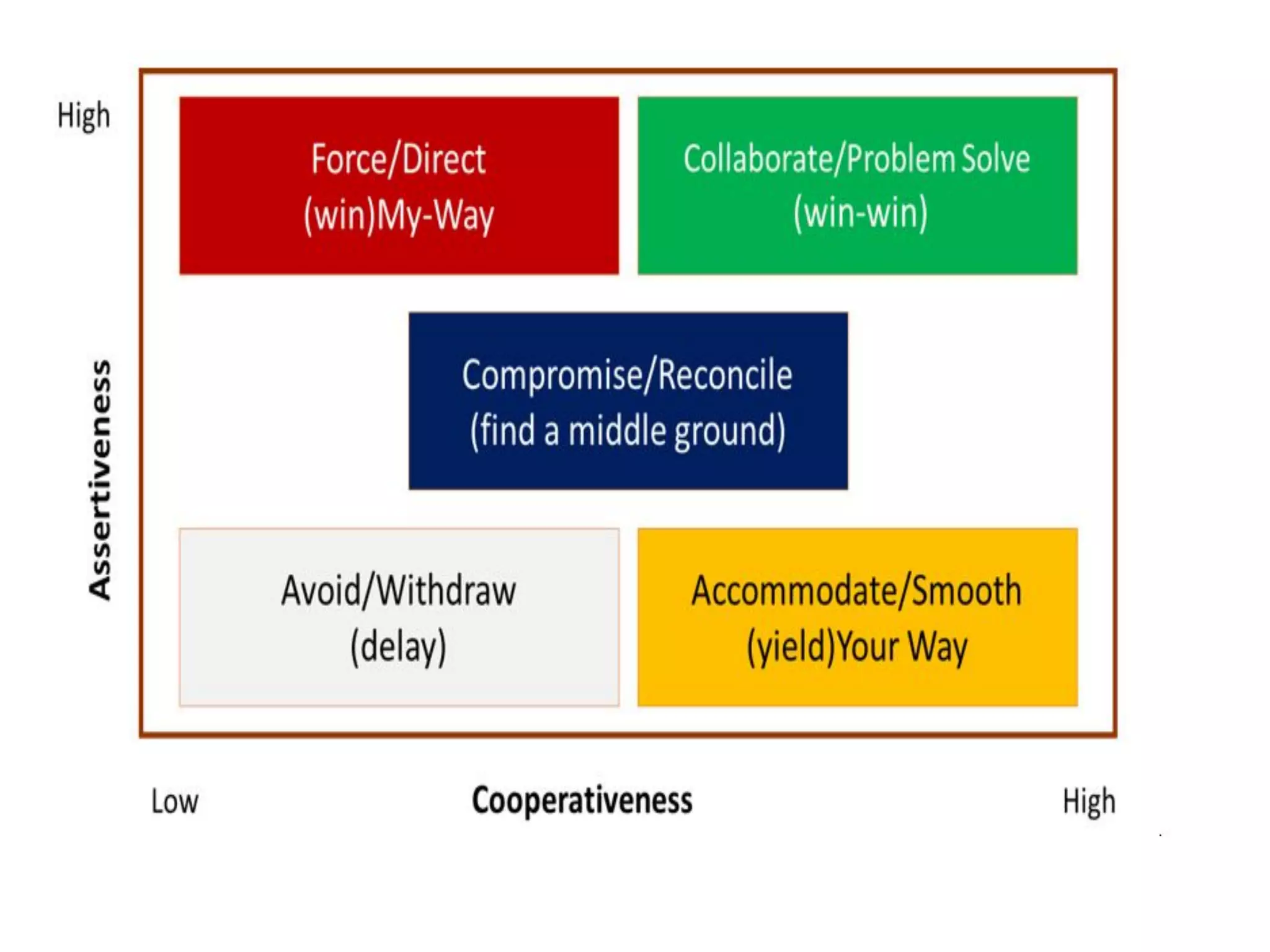
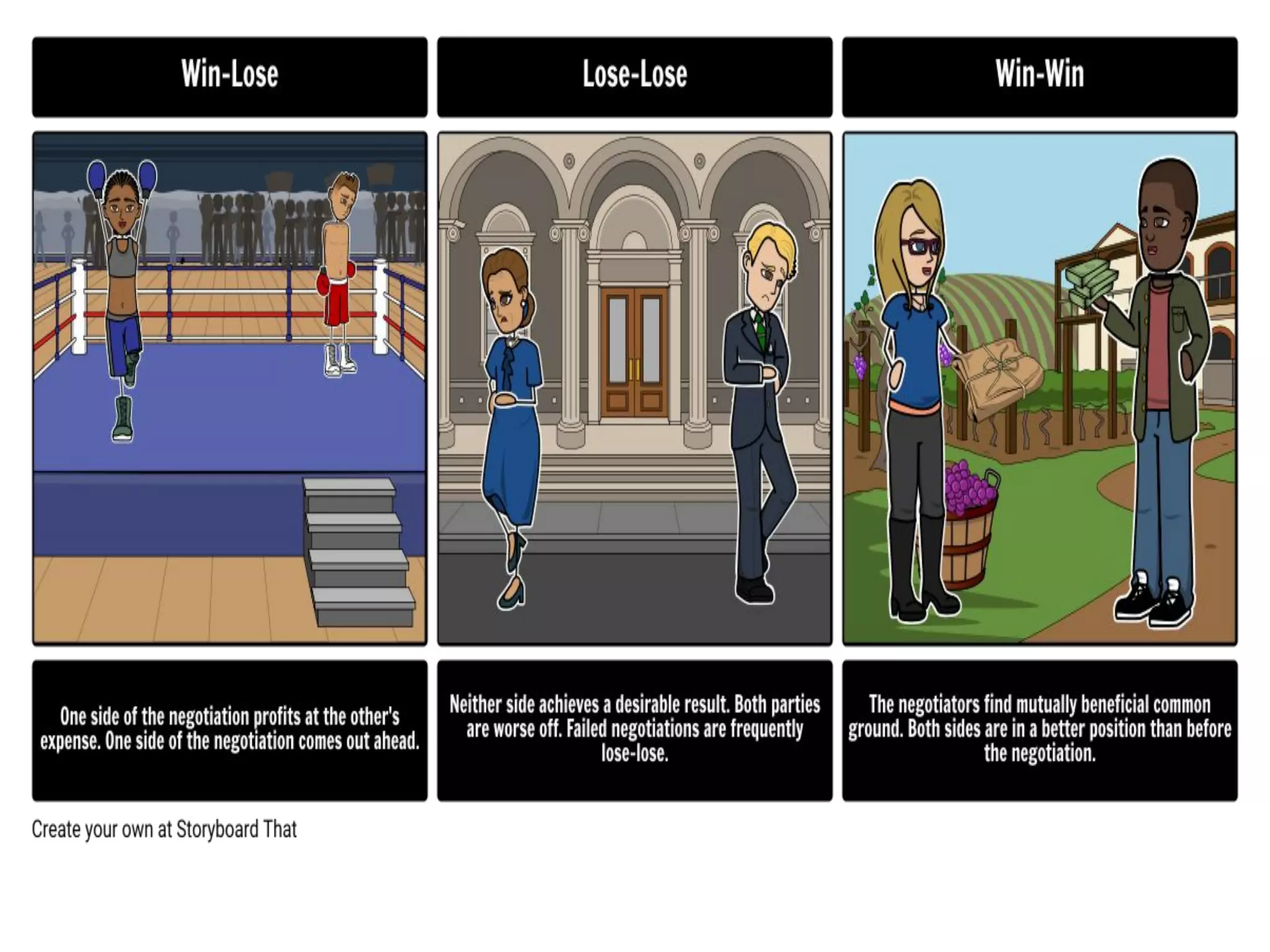
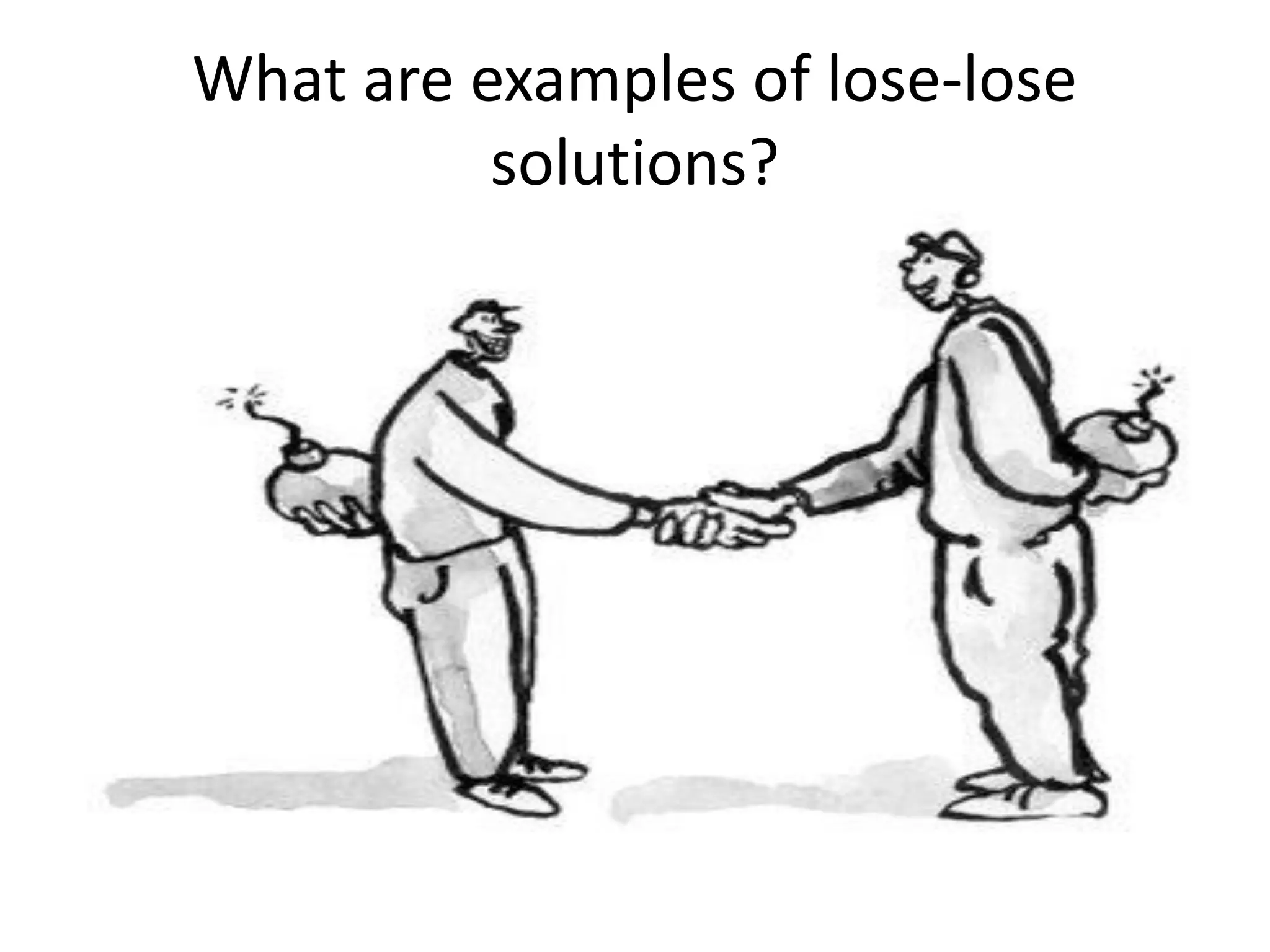
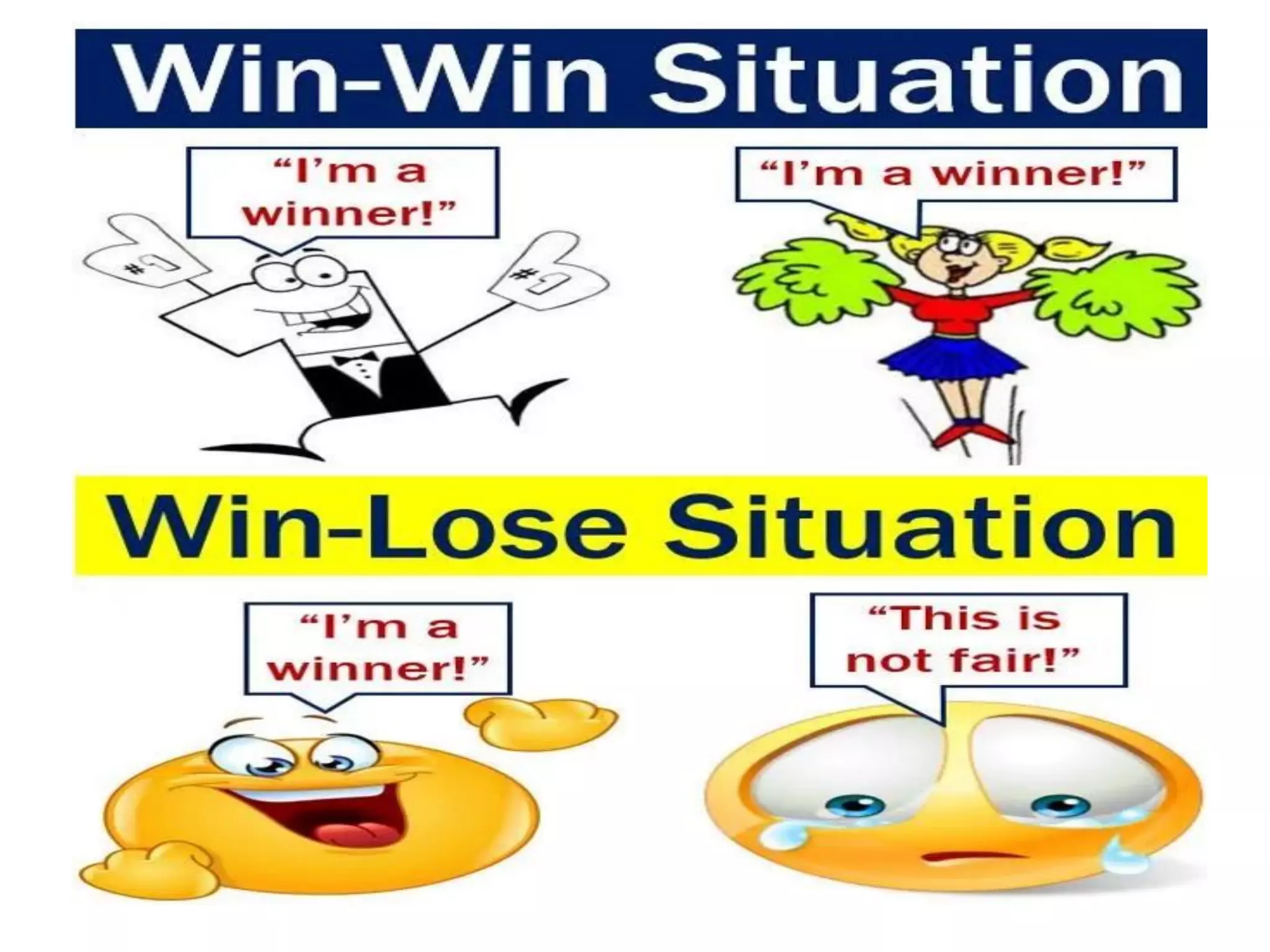
What are examples of lose-lose
solutions?
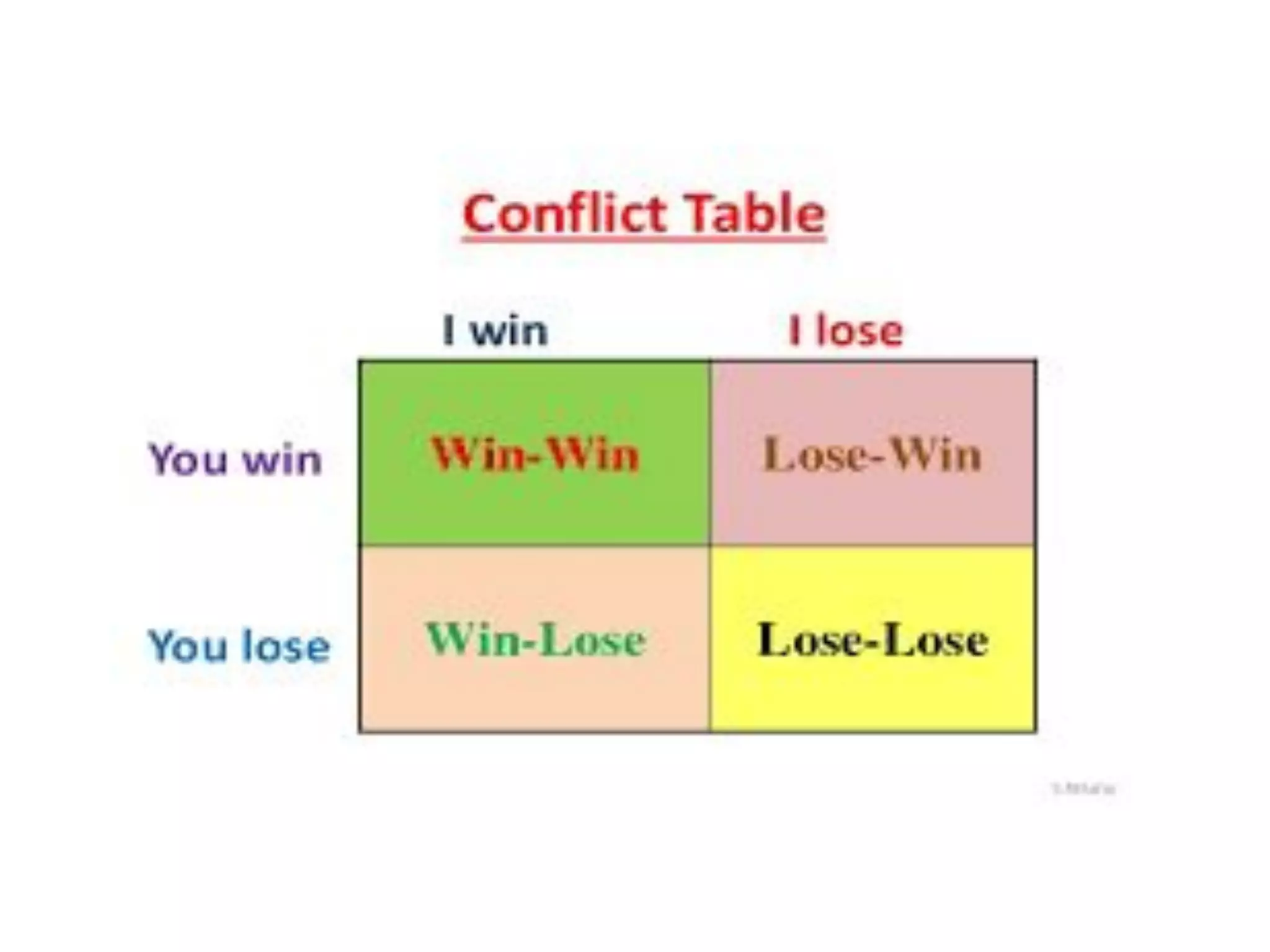
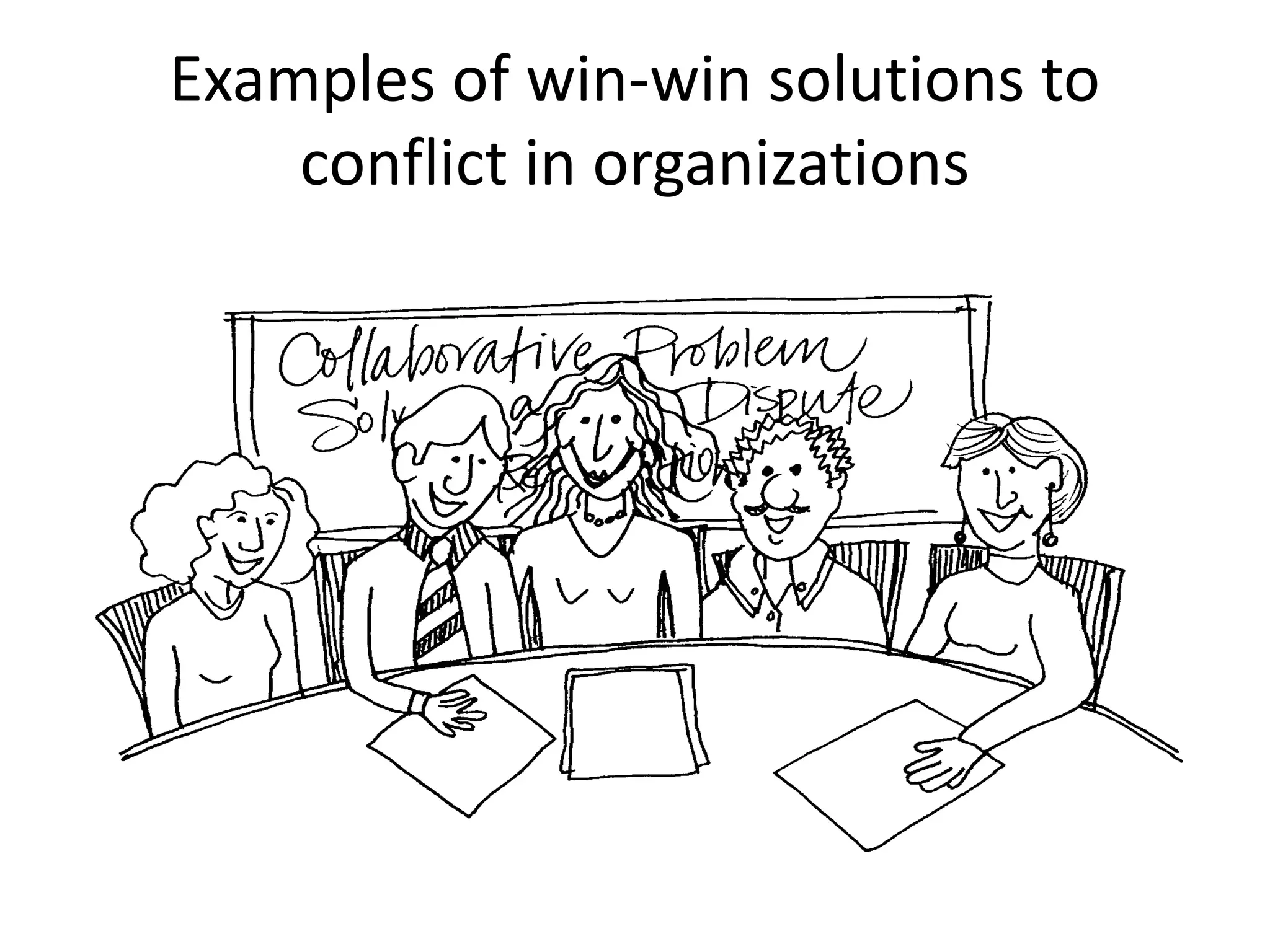
Examples of win-win solutions to
conflict in organizations
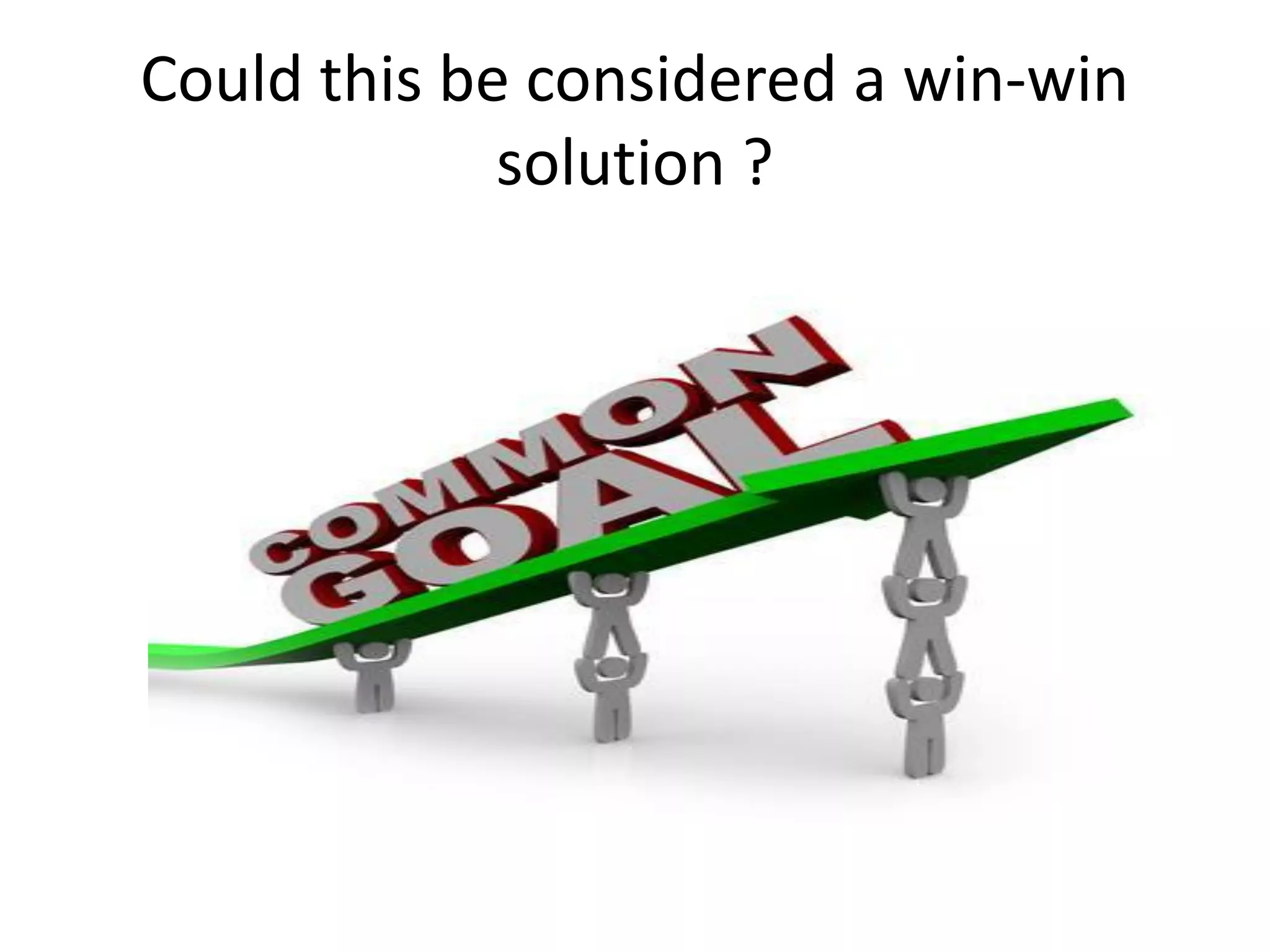
Could this be considered a win-win
solution ?
Aristotle quotes
• “Anybody can become angry — that is easy, but to
be angry with the right person and to the right
degree and at the right time and for the right
purpose, and in the right way — that is not within
everybody's power and is not easy.”
• “I count him braver who overcomes his desires
than him who conquers his enemies, for the
hardest victory is over self.”
Microagressions and conflict in
organizations today
• (Source: Freidersdorf, Conor. “The Rise of
Victimhood.” The Atlantic. Com, 09/11/2015
• Honor culture where differences are addressed
using “duels,” etc.
• Dignity cultures – where violent actions are
addressed through avoidance, negotiation,
mediation, negotiation and hopefully win-win
solutions
• Microaggression: A Beginner's #SJW Guide!
(youtube)
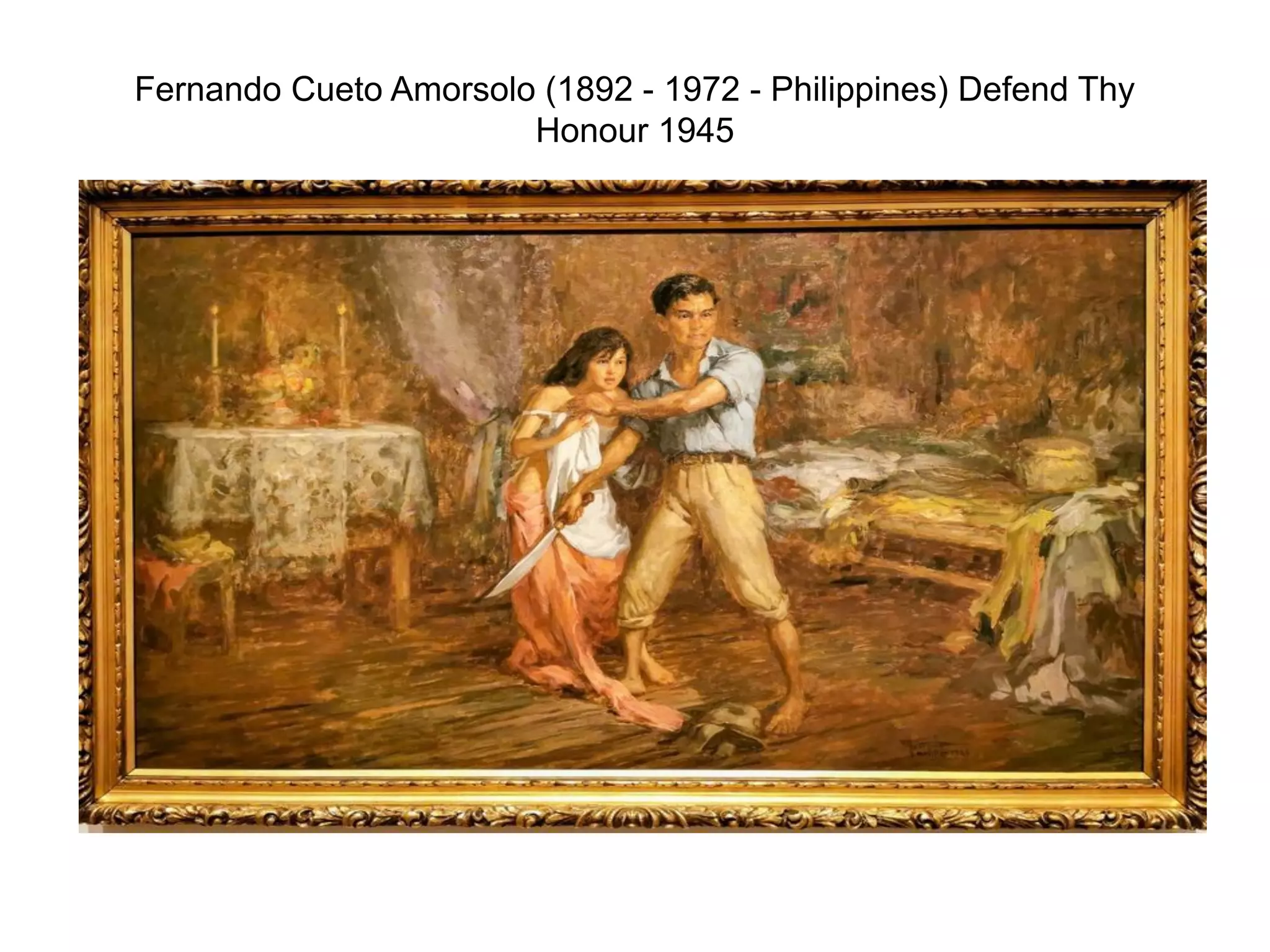
Fernando Cueto Amorsolo (1892 - 1972 - Philippines) Defend Thy
Honour 1945
How conflict is historically addressed
• In honor cultures like
the Old West or the
street gangs of West
Side Story, they might
engage in a duel or
physical fight.
• The winner lives, the
loser dies
• In dignity cultures, like
the ones that prevailed
in Western countries
during the 19th and
20th Centuries, “insults
might provoke offense,
but they no longer have
the same importance as
a way of establishing or
destroying a reputation
for bravery,”
• “When intolerable
conflicts do arise,
dignity cultures
prescribe direct but
non-violent actions.”
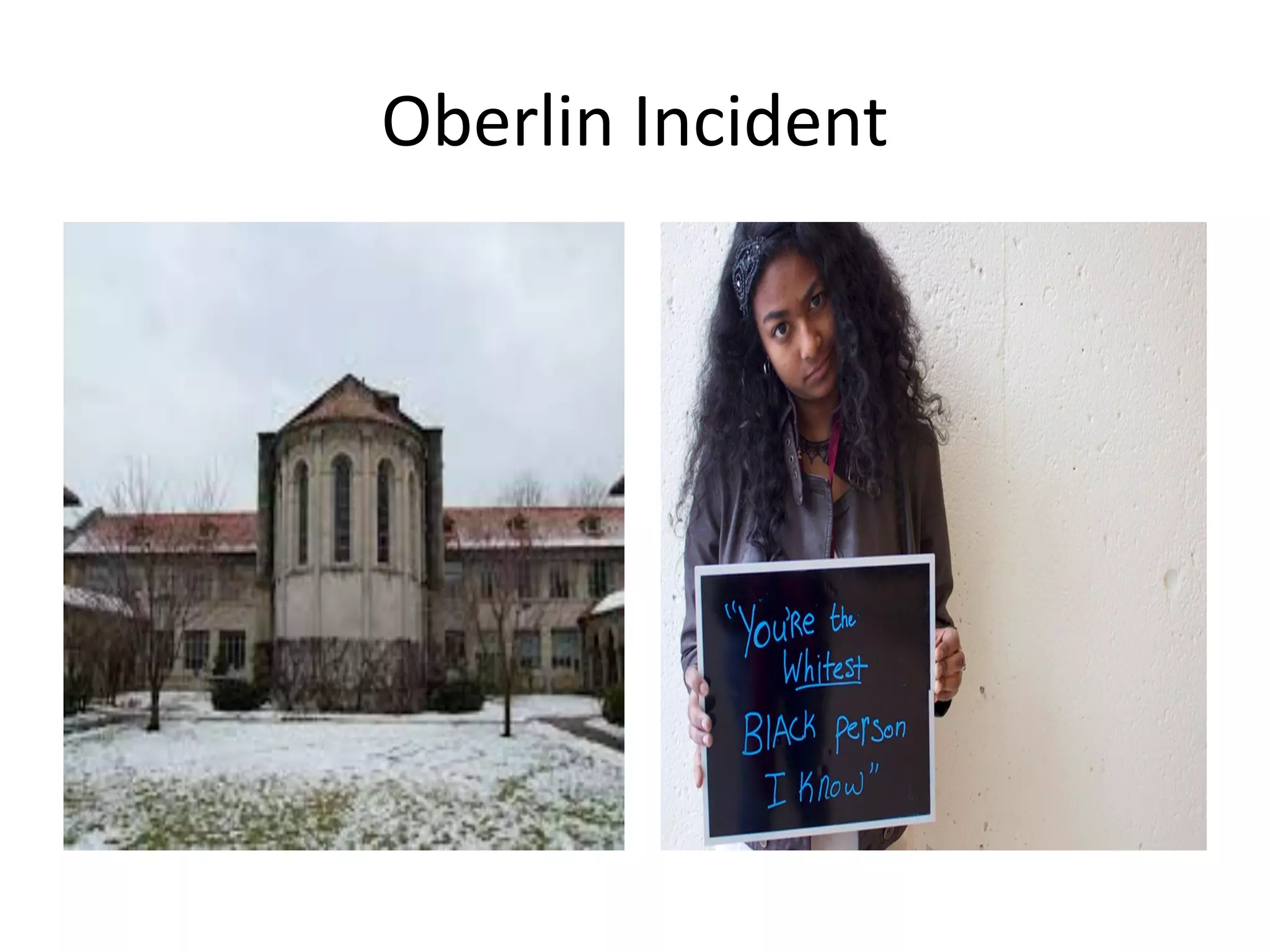
• The sociologists,
Bradley Campbell and
Jason Manning, cited
the Oberlin incident as
one of many examples
of a new, increasingly
common approach to
handling conflict.
Oberlin Incident
• It isn’t honor culture
• “Honorable people are
sensitive to insult, and
so they would
understand that
microaggressions, even
if unintentional, are
severe offenses that
demand a serious
response,” they write.
• “But honor cultures
value unilateral
aggression and
disparage appeals for
help. Public complaints
that advertise or even
exaggerate one’s own
victimization and need
for sympathy would be
anathema to a person
of honor.”
• But neither is it dignity
culture:
• “Members of a dignity
culture, on the other
hand, would see no
shame in appealing to
third parties, but they
would not approve of
such appeals for minor
and merely verbal
offenses.
• Instead they would
likely counsel either
confronting the
offender directly to
discuss the issue, or
better yet, ignoring the
remarks altogether.”
Culture of victimhood
• The culture on display
on many college and
university campuses, by
way of contrast, is
“characterized by
concern with status
and sensitivity to slight
combined with a heavy
reliance on third
parties.
• People are intolerant of
insults, even if
unintentional, and react
by bringing them to the
attention of authorities
or to the public at
large.
• Domination is the main
form of deviance, and
victimization a way of
attracting sympathy, so
rather than emphasize
either their strength or
inner worth, the
aggrieved emphasize
their oppression and
social marginalization.”
• Victimhood cultures
emerge in settings, like
today’s college
campuses, “that
increasingly lack the
intimacy and cultural
homogeneity that once
characterized towns
and suburbs,
• “Under such conditions
complaint to third parties
has supplanted both
toleration and
negotiation. People
increasingly demand help
from others, and
advertise their
oppression as evidence
that they deserve respect
and assistance.
• Victimhood culture
“arose because of the rise

of social conditions
conducive to it,
• Self-help in the form of
dueling or fighting is not
an option.
• where one cannot rely on
members of a family, tribe
or clan to automatically
take one’s side in a
dispute.
• “a morality that privileges
equality and condemns
oppression is most likely to
arise precisely in settings
that already have relatively
high degrees of equality.”
• microaggressions as “a
form of social control in
which the aggrieved collect
and publicize accounts of
intercollective offenses,
making the case that
relatively minor slights are
part of a larger pattern of
injustice and that those
who suffer them are
socially marginalized and
deserving of sympathy,
• the emergence of “the
blogosphere” in the early
aughts––something I
participated in to some
extent–– was rife with
examples of conservative,
progressive, and
libertarian bloggers calling
attention to minor slights
against their respective
ideological groups by
mainstream media
outlets.
• of making the case that
the small slight that
they’d seized upon was
actually evidence of a
larger, significant injustice
to a whole class of
people.
• In a city like New York
during the
stop-and-frisk era,
minorities were
stopped by police
because other people in
their community,
aggrieved by minor
quality-of-life issues like
loitering or sitting on
stoops or squeegee
men
• successfully appealed to
third-parties to
intervene by arguing
that what may seem
like small annoyances
were actually
burdensome and
victimizing when
aggregated.
What are microagressions?
• These may have been referred to by candidate
for US President, Donald Trump – the
preoccupation with what others referred to
“being politically correct.”
• Violations are addressed using social media to
“provoke sympathy and antagonism, concern
for status and “victimhood”
• This is caused, according to some by lack of
intimacy and cultural homogeneity
Microaggression violate long
standing norms such as
encouraging people to have thick
skin, brush off slights, charitably
interpret the intentions of others
A clash of moral cultures. The
norms that apply to marginalized
groups and maybe the privileged
class
-Microaggression coined in the 70s
by a Harvard Psychology Professor,
the popular use of the word is
attributed to a Counseling
Psychologist and Diversity Training
Specialist - Derald Wing Sue
-He took offense after he and
another colored passenger in an
airline were asked to transfer seats
to balance the weight of a small
plane.
-Claimed white people could have
been asked to transfer. He and his
friend are African Americans
-Sue and his friend claimed that “the
power of microaggression lies in the
invisibility to the aggressor.”
-See examples of microaggression in
the next slide
In a university in America, people
are told not to say:
America is a melting pot,
I believe the most qualified person
should get the job
These are offensive statements
according to officials of the
university
-Critics of microaggression
question why the
interpretation of the victim
weighs heavier than the real
intention of the perpetrator.
How can statements like these
asked of Asians and Latinos be
insulting- Where were you
born? Where are your from?
Why are so quiet?
-magnifying small offenses,
mind reading by identifying
subconscious thoughts even
the offenders are unaware of,
labelling others as
aggressors-these are all part of
microaggression
-These are all causes of conflict
in organizations- critics of
microaggression say
Honor cultures deal with
conflict violently. “No one
should dishonor members of
my family” as the head of the
family inflicts harm on the
person who insulted the
victim. One’s reputation
makes one honorable.
-Honor cultures exists in places
where legal authority is weak
and a reputation of toughness
is an effective deterrent
against predation or attack
Dignity culture exists
differently of what others
think, public reputation is less
important. Insults might
provoke offense but no longer
have the same effect as
destroying one’s reputation.
Dignity cultures have parents
who advise their kids: sticks
and stones can break my
bones but words will never
hurt me.
An ethic of self restraint
prevails. When intolerable
conflicts arise, dignity cultures
prefer non-violent actions such
as negotiated compromise
geared towards solving the
problem.
-If offense is severe they go to
the police or appeal to the
courts. It is wrong to take the
law into their own hands
-The ideal is to use the courts
as quickly and rarely as
possible
-The presence of stable and
powerful system and the
popularity of social closeness
were what encouraged the
culture of dignity
-The culture of victimhood
however changed the
narrative to: sticks and stones
can hurt my bones but words
are hurtful.
-Victimhood resembles honor
culture. Honorable people are
sensitive to insults and
demands serious response
-But victimhood is anathema
to honor culture. This is
tantamount to saying to be a
victim is not to have honor.
In his video on microaggressions, Sue offered five
suggestions for things individuals can do to avoid them:
1. Be constantly vigilant of your own biases and fears.
2. Seek out interaction with people who differ from you (in
terms of race, culture, ethnicity, and other qualities).
3. Don't be defensive.
4. Be open to discussing your own attitudes and biases ad
how they might have hurt others or in some sense
revealed bias on your part.
5. Be an ally, by standing personally against all forms of bias
and discrimination.
A few faculty members who resigned/fired
from jobs because of microaggression
The Portland State University
professor who resigned with a
scathing public letter has spoken out
in an interview, saying that he was
hounded by diversity investigators
and left unable to teach critical
thinking.
Peter Boghossian was a full-time
assistant professor of philosophy at
Portland State University for 10 years
until his resignation letter was
published on Wednesday, calling it a
'social justice factory' that drives
'intolerance of divergent beliefs'.
In total defiance of the First
Amendment, the University of
North Texas has fired a math
professor for criticizing the
concept of microaggressions
and for refusing to attend extra
diversity training to correct his
views, which the math
department chair deemed “not
compatible with the values of
this department.”
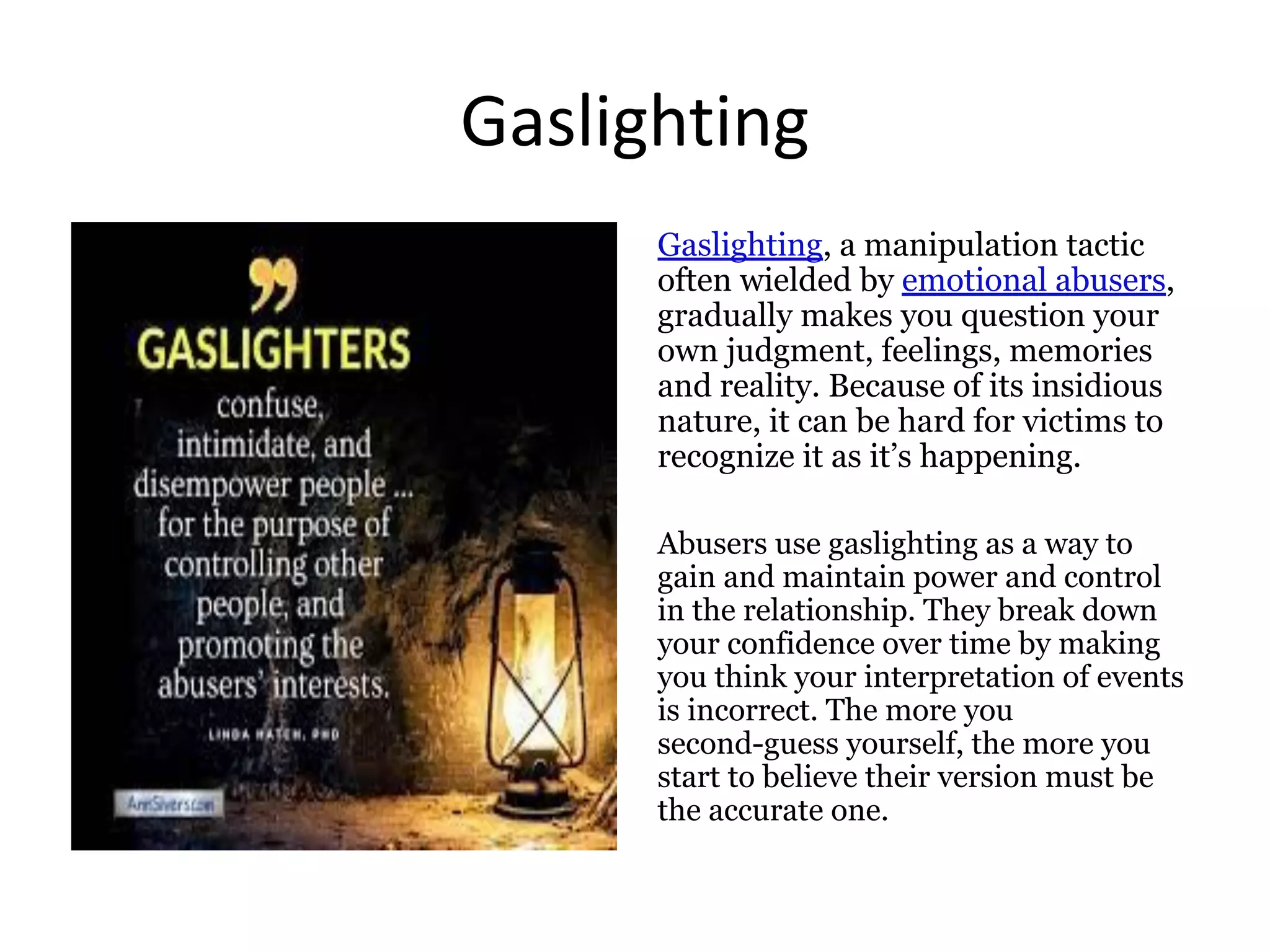
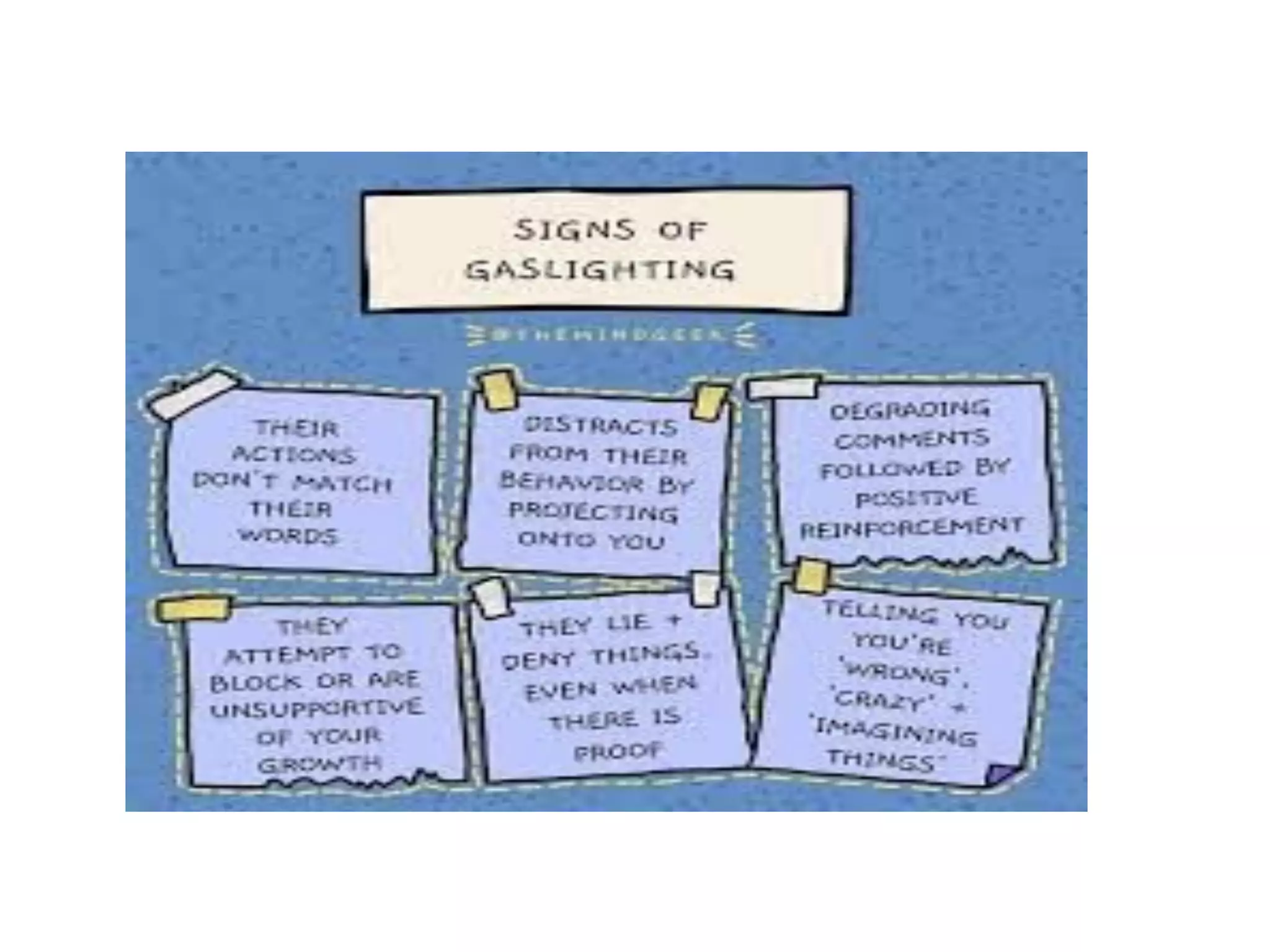
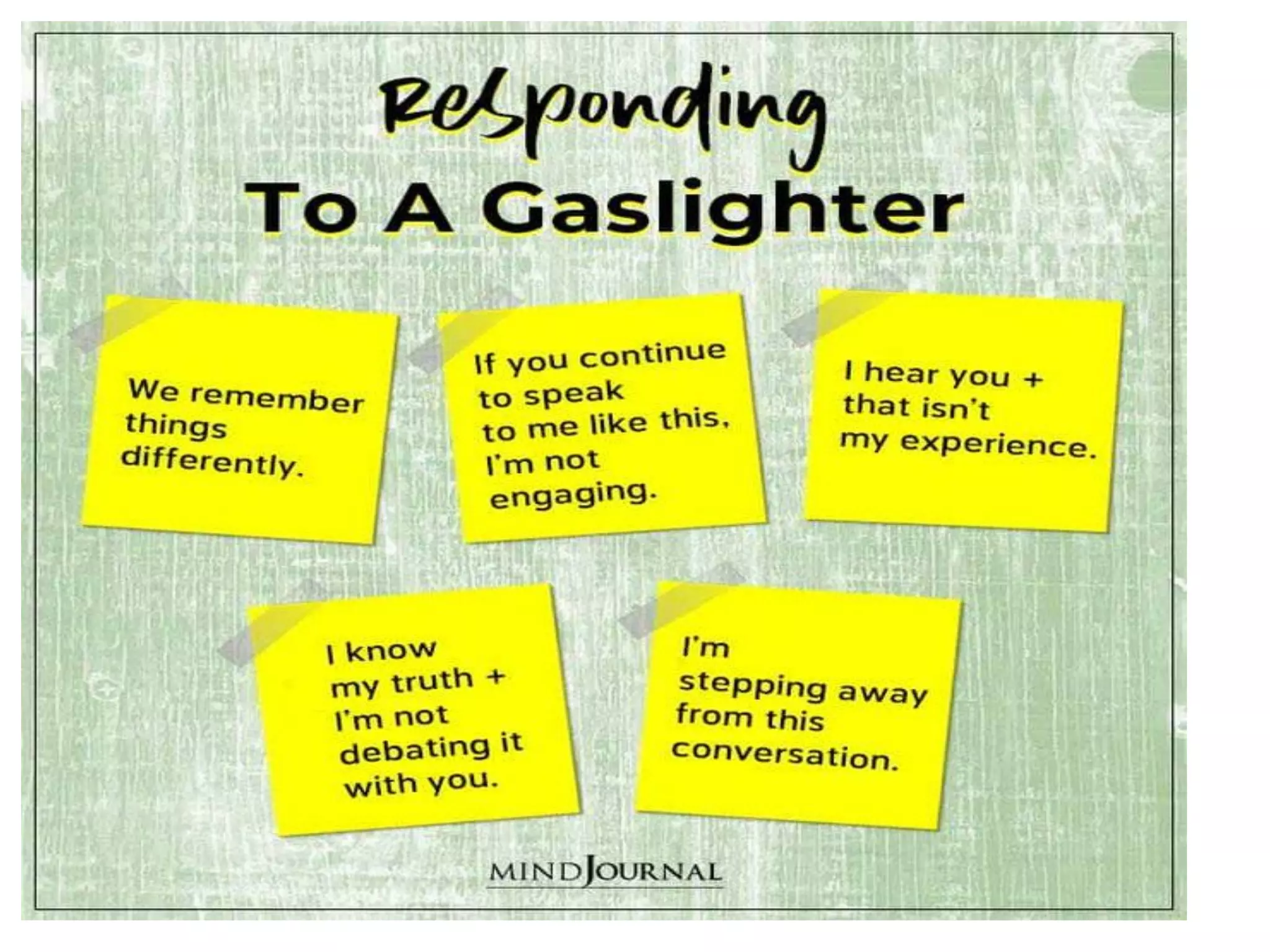
Gaslighting
Gaslighting, a manipulation tactic
often wielded by emotional abusers,
gradually makes you question your
own judgment, feelings, memories
and reality. Because of its insidious
nature, it can be hard for victims to
recognize it as it’s happening.
Abusers use gaslighting as a way to
gain and maintain power and control
in the relationship. They break down
your confidence over time by making
you think your interpretation of events
is incorrect. The more you
second-guess yourself, the more you
start to believe their version must be
the accurate one.
“People who cannot authentically
argue their point of view or stand
behind their words turn to
gaslighting as a tool,” therapist
Shannon Thomas, author of “Healing
From Hidden Abuse,” told HuffPost.
“They resort to confusion-creating
tactics, and that is a sign of character
weakness.”
Gaslighting is also a way for the
abusive partner to avoid taking
responsibility for their bad behavior,
said psychotherapist Beverly Engel,
author of “The Emotionally Abusive
Relationship.”
the common phrases gaslighters
use so you can be more adept at
recognizing this behavior.
1. That never happened- so sow
seeds of self doubt
2. You’re too sensitive- you’re
making a big deal out of
nothing
3. You’re crazy and many people
think so too
4. You have a terrible memory
5. I am sorry you think that I
hurt you
6. You should have known how I
would have react
Chris Murphy. “Everyone Who Has Publicly Accused Bill Murray
of Misconduct.” vanity.com, 10/24/2022
In her recent memoir, Dying of
Politeness, Davis alleges that
Murray made her lie on a bed
while he used a massage device on
her, “the Thumper,” during the
making of 1990’s Quick Change.
“I said no multiple times, but he
wouldn’t relent,” writes Davis in
her memoir. The Oscar winner
also claims that Murray yelled at
her on set in front of more than
300 people, a tactic she says he
would employ to exert his
authority on set.
“I was watching him tear apart
somebody one day on set,” Davis told
Vanity Fair. “He finished, and the
other person went away, and he
turned around sort of self-satisfied
and I said, ‘Man, I can’t wait for you
to do that to me again, because now I
know how I’ll react.’ And he said, ‘Oh,
I don’t have to. You behaved after
that.’ So he thought he has to go off
on somebody to make sure they
‘behave.’ Whatever his idea of
‘behaving’ is—not challenging him, I
guess.”
Anjelica Huston
Oscar winner Anjelica Huston described Murray as “a shit”
after working with him on Wes Anderson’s 2004 film The
Life Aquatic With Steve Zissou. In 2019, Huston told Vulture
that while filming, Murray invited everyone in the cast except
her to dinner. “I was really hurt,” she continued. “And then I
think we met again in Florence, because that movie was shot all
over Italy, and we were doing a scene at Gore Vidal’s house in
Ravello, and [Murray] said, ‘Hey, how’ve you been? I missed
you.’ I said, ‘You’re full of shit. You didn’t miss me.’ He looked
all confused for a moment.” However, Huston says that Murray
showed up at the funeral of her late husband, Robert Graham,
and that Murray “couldn’t have been nicer that day.” “He
showed up,” she said. “A lot of people didn’t.”
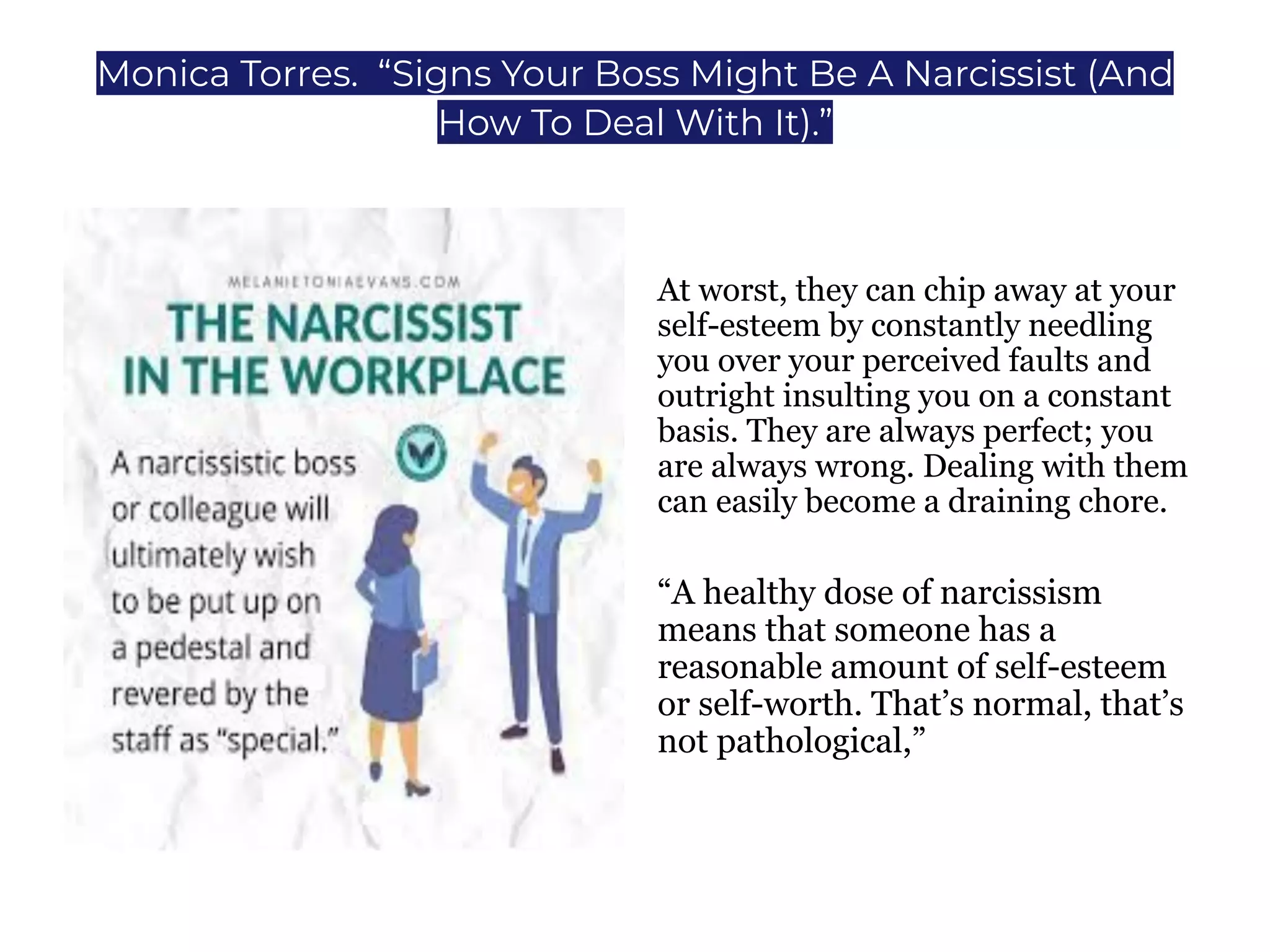
Monica Torres. “Signs Your Boss Might Be A Narcissist (And
How To Deal With It).”
At worst, they can chip away at your
self-esteem by constantly needling
you over your perceived faults and
outright insulting you on a constant
basis. They are always perfect; you
are always wrong. Dealing with them
can easily become a draining chore.
“A healthy dose of narcissism
means that someone has a
reasonable amount of self-esteem
or self-worth. That’s normal, that’s
not pathological,”
“On the other hand, people with
extreme narcissistic traits must
remain the center of the world at all
times, and so in the workplace, these
individuals are damaging to their
organization, the culture of the
organization, the morale of
employees.”
Symptoms: a sense of
grandiosity and
self-importance, fantasies of
perfection and superiority, a
sense of specialness and
uniqueness, a need for praise
and attention, a strong sense of
entitlement and a tendency to
exploit others.
Examples of narcissistic traits and
attitudes:
1. They believe you are either with
them or against them…“The day
you move into the enemy camp,
they will do everything to
eliminate you from their
entourage. They will fire you,
they will demote you.”
2. They may initially charm but will
trap you if you challenge them.
These bosses will charm you
with their generosity but their
mood changes when you are
perceived as an enemy!
3. They won’t admit they are wrong.
Narcissistic bosses deny accountability
at all costs and are emotionally unable
to accept defeat or criticism. “Because
they are perfect, admission of error is
impossible. That would shatter their
self-esteem. Which, by the way, they
have very little of,”
You can see this as a boss blames
employees for the boss’s error while
denying that they had any role. In fact,
when confronted, these bosses can turn
the tables and play the victim, making
you feel like the error was all your
fault.
4. They steal your ideas-
narcissistic bosses are “great
thieves of ideas.” Because they
believe they are perfect and are
driven to maintain that
unassailable self-image, they
often feel entitled to take
employees’ good ideas and pass
them off as their own without
worrying about morality. To
them, that’s simply what it takes
to stay on top of their business.
5. They ask for favors they won’t
return-These bosses will ask for
favors and never return them
because “they feel they are entitled
to, they’re the boss,”
6. They demonstrate a noticeable
lack of empathy and be verbally
abusive- ‘Too bad.’ You just need to
do better,”....‘Oh, my God, you’re so
weak.’
How to cope with a narcissistic boss:
1. Document everything
2. Don’t talk to the boss if you can
help it
3. Put the boss’s criticism in
perspective and look for allies in
the organization
4. Strengthen other work
relationships so that your boss is
not your world
5. If all else fails- quit!
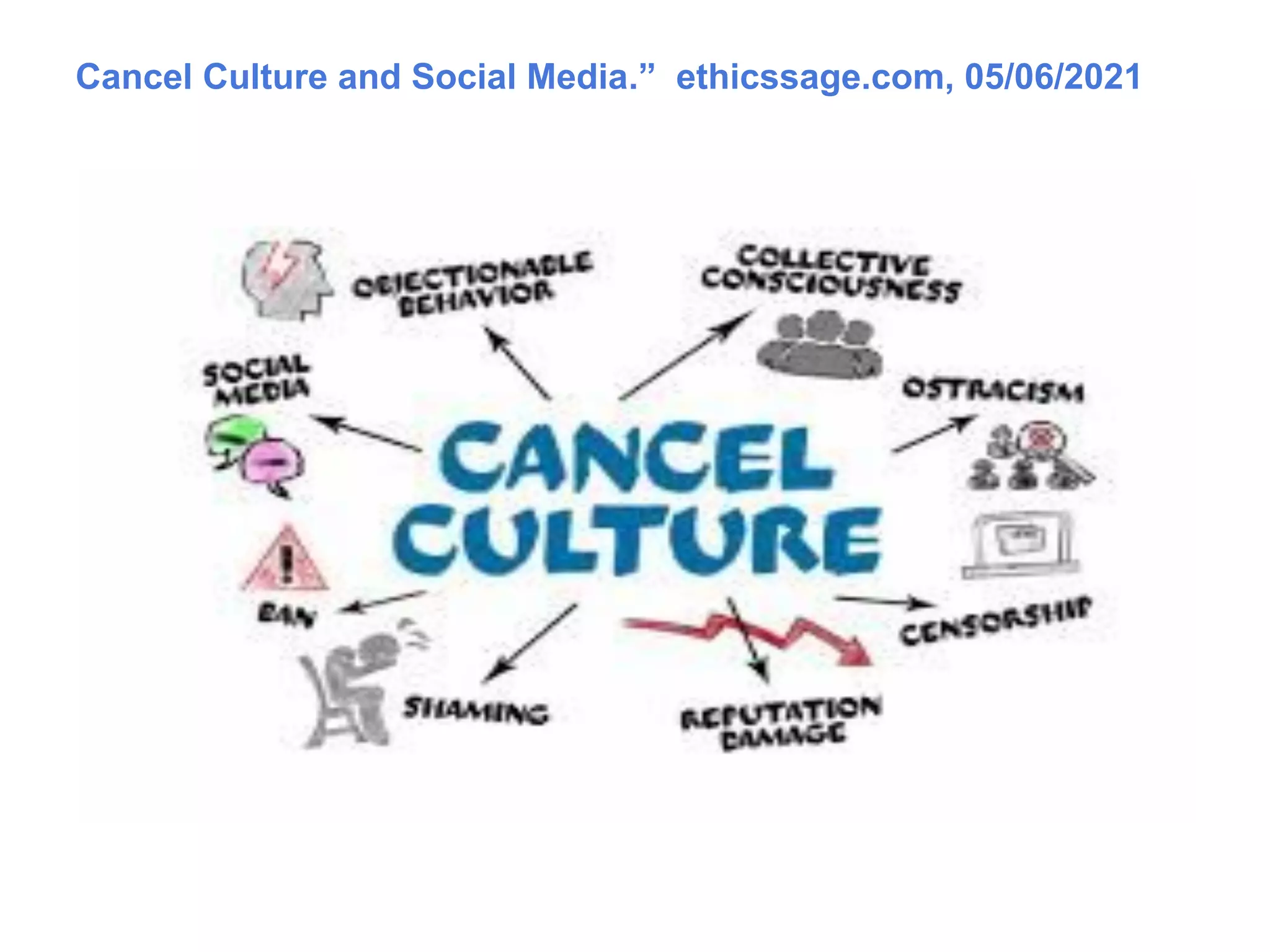
Cancel Culture and Social Media.” ethicssage.com, 05/06/2021
When we think of the cancel culture
what comes to mind right away is how
social media is used to call someone
out for their words or actions as
offensive to a group. Those offended
go on social media and start a
firestorm of criticism against the
offending party. Before you know it,
others have taken to the internet to
voice their views. The result may be
to cancel the offending party by
denying them the status they may
have achieved or blacklisting them in
the mind of the public. It some
respects it is like ostracizing a person
or group. However, in other cases it is
an expression of capitalism, which is
where a company is boycotted by the
public. The public stops buying a
product and uses social media to
influence others to do the same.
Social media is where a molehill
becomes a mountain. Once an issue
hits the virtual realm, it is no longer
subject to private resolution—it is out
there for the world to judge, critique, and
potentially fight for.
Whether the public punishment
corresponds to the act that sparked it
may be up for debate, but the growing
number of such incidents has fueled
controversy over what has become
known as "cancel culture." Critics of
cancel culture say the process stifles free
expression, inhibits the exchange of
ideas and keeps people from straying
from their comfort zones. Others,
however, argue that it has empowered
people to challenge the status quo and
demand accountability from those in
positions of power.
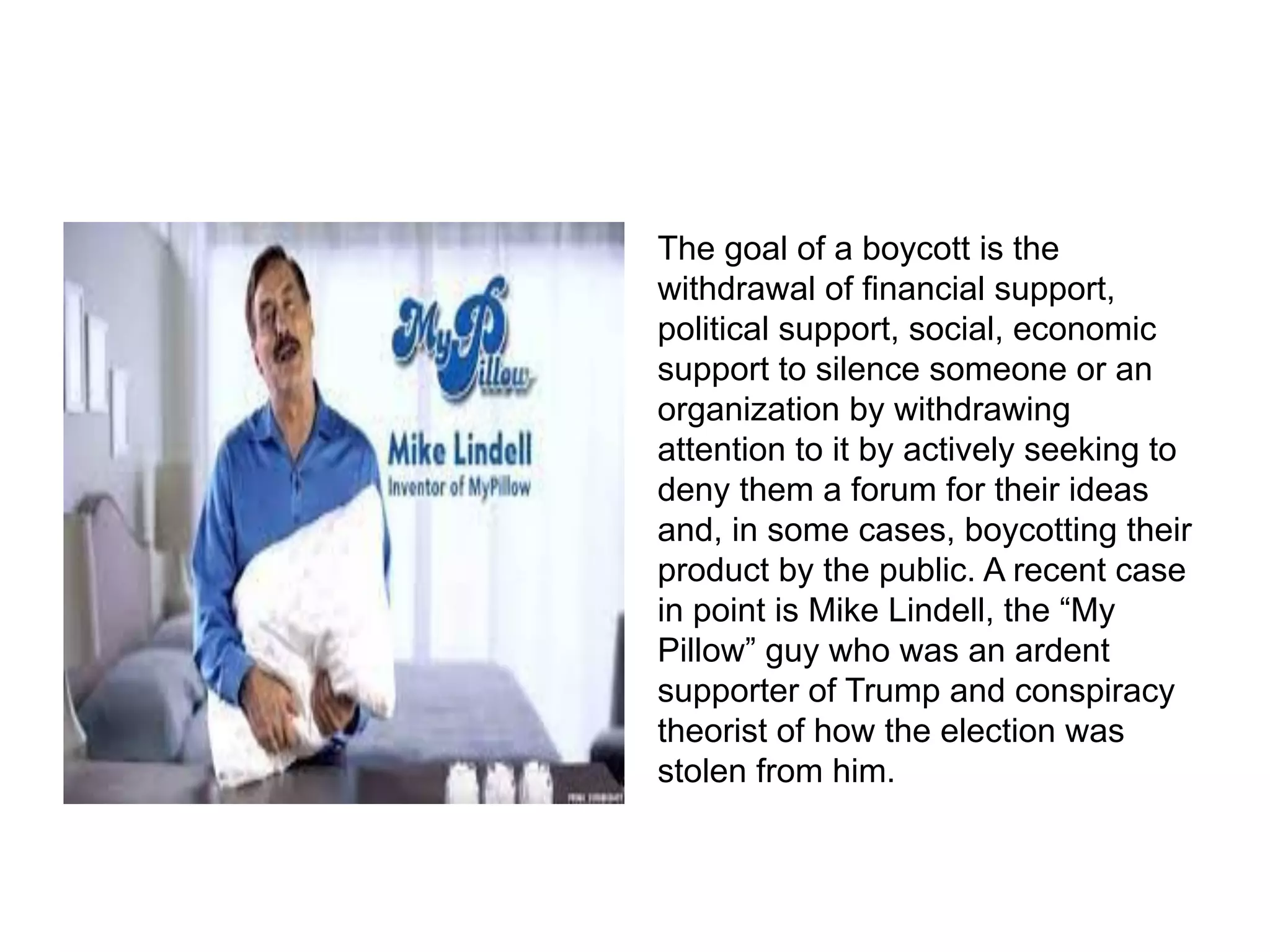
The goal of a boycott is the
withdrawal of financial support,
political support, social, economic
support to silence someone or an
organization by withdrawing
attention to it by actively seeking to
deny them a forum for their ideas
and, in some cases, boycotting their
product by the public. A recent case
in point is Mike Lindell, the “My
Pillow” guy who was an ardent
supporter of Trump and conspiracy
theorist of how the election was
stolen from him.
Lindell co-chaired the president's
reelection campaign in Minnesota and
has helped fund Trump lawyers Sidney
Powell and Lin Wood. After Trump lost
the election in November, they peddled
the false theory that he was the victim of
voter fraud.
This conspiracy theory was a catalyst
for the hundreds of insurgents who
swarmed the Capitol building on
January 6, resulting in the deaths of five
people. Lindell has claimed that the
insurrectionists were Antifa activists, not
Trump supporters.
Lindell was quickly denounced and
companies acted to take his product off
their shelves including Wayfair, Bed Bath &
Beyond, Kohl's, and H-E-B. All dropped My
Pillow products, leading Lyndell to claim he
is the victim of cancel culture. He laments
the attacks against his company and the
price he has paid for exercising his free
speech rights. Estimates are the lost
revenue to the company will be $65
million.
Some say Lindell should only blame
himself for his business woes. He publicly
aligned himself with a historically
unpopular political figure and remained by
his side after he incited an insurrection at
the Capitol building. He had to know he
was putting his business in jeopardy by
publicly supporting a man who is one of
the most disliked in the country.
Aja Romano. “The second wave of ‘cancel culture.’” vox.com,
05/05/2021
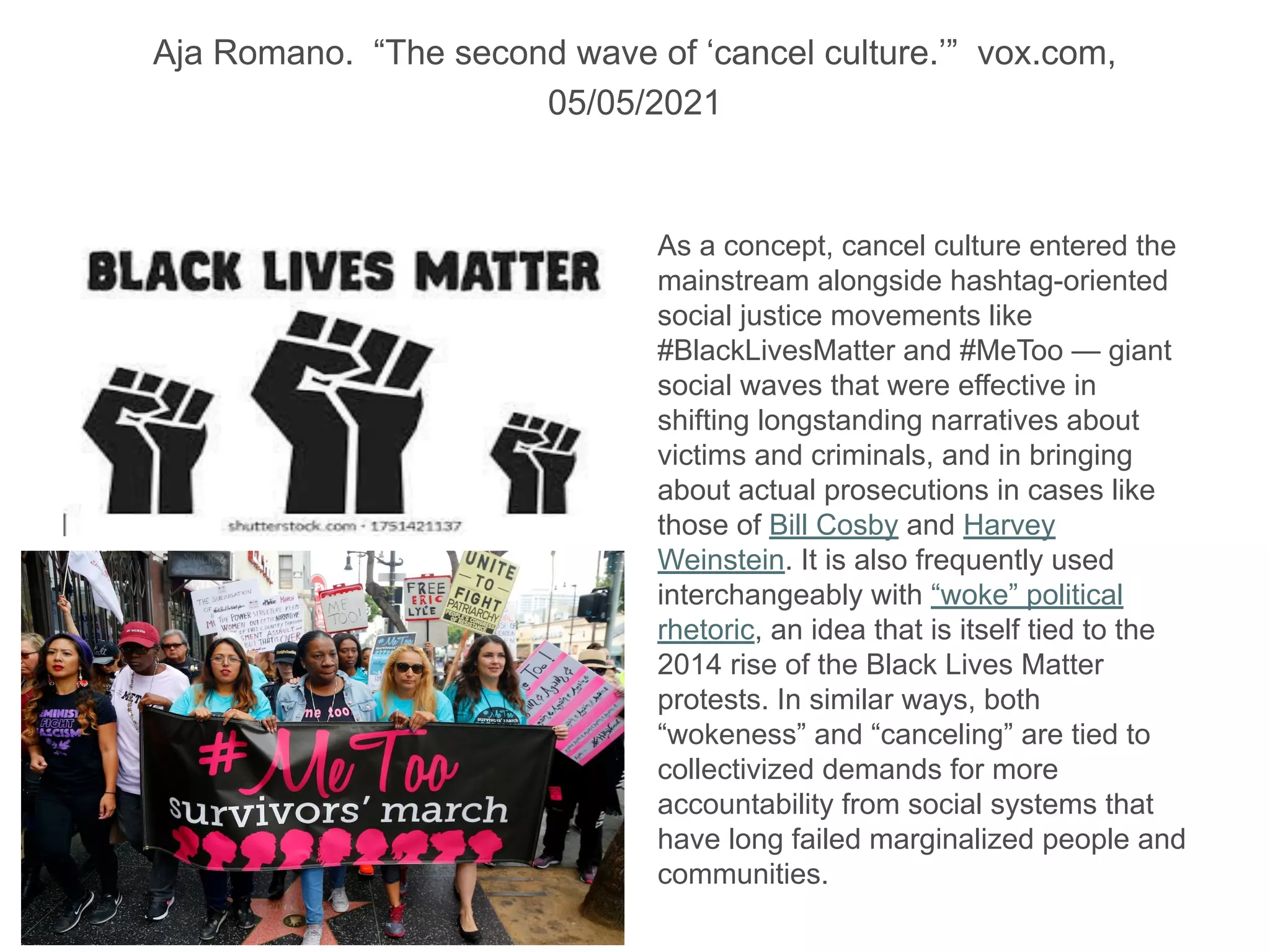
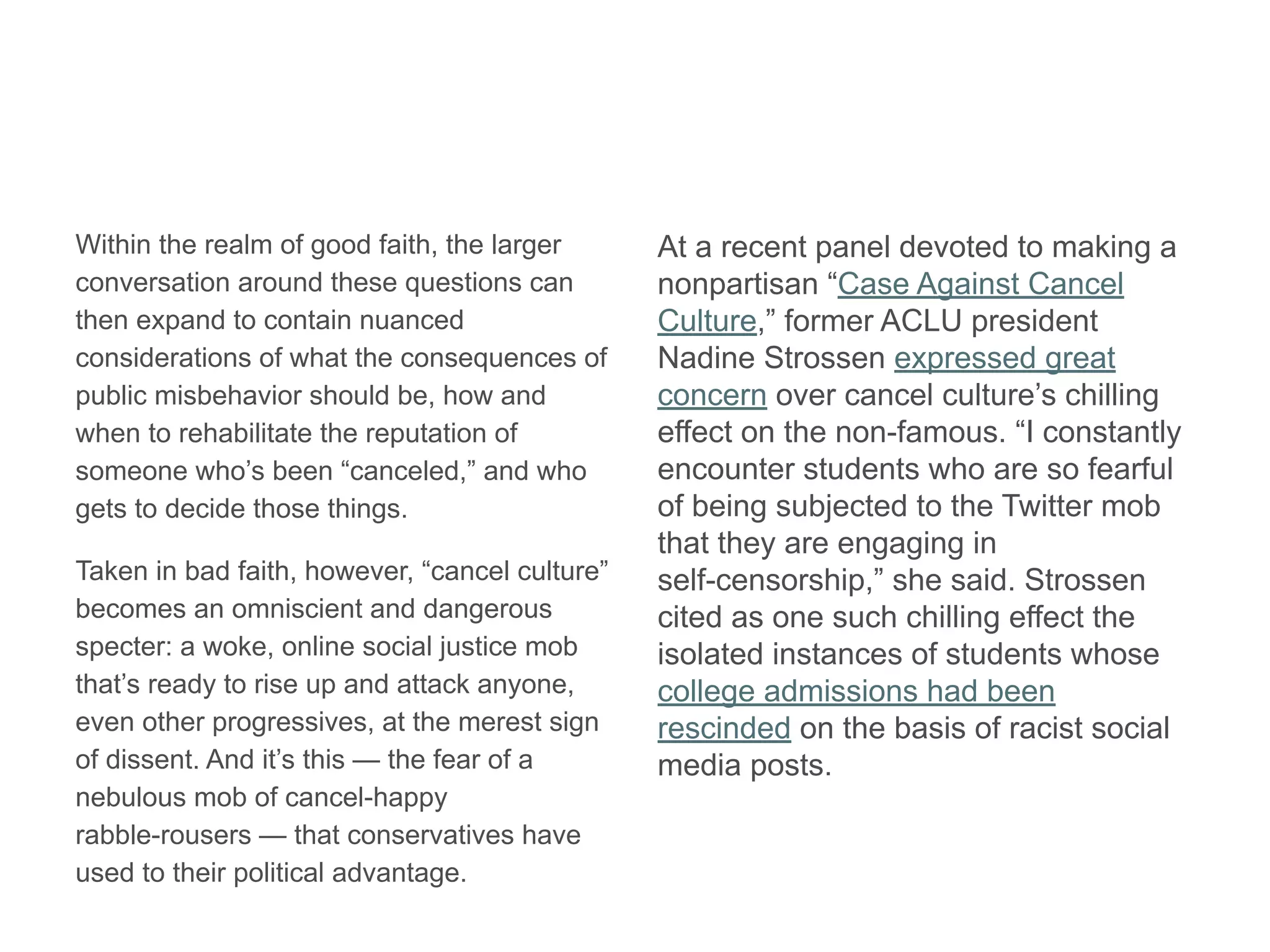
As a concept, cancel culture entered the
mainstream alongside hashtag-oriented
social justice movements like
#BlackLivesMatter and #MeToo — giant
social waves that were effective in
shifting longstanding narratives about
victims and criminals, and in bringing
about actual prosecutions in cases like
those of Bill Cosby and Harvey
Weinstein. It is also frequently used
interchangeably with “woke” political
rhetoric, an idea that is itself tied to the
2014 rise of the Black Lives Matter
protests. In similar ways, both
“wokeness” and “canceling” are tied to
collectivized demands for more
accountability from social systems that
have long failed marginalized people and
communities.
Within the realm of good faith, the larger
conversation around these questions can
then expand to contain nuanced
considerations of what the consequences of
public misbehavior should be, how and
when to rehabilitate the reputation of
someone who’s been “canceled,” and who
gets to decide those things.
Taken in bad faith, however, “cancel culture”
becomes an omniscient and dangerous
specter: a woke, online social justice mob
that’s ready to rise up and attack anyone,
even other progressives, at the merest sign
of dissent. And it’s this — the fear of a
nebulous mob of cancel-happy
rabble-rousers — that conservatives have
used to their political advantage.
At a recent panel devoted to making a
nonpartisan “Case Against Cancel
Culture,” former ACLU president
Nadine Strossen expressed great
concern over cancel culture’s chilling
effect on the non-famous. “I constantly
encounter students who are so fearful
of being subjected to the Twitter mob
that they are engaging in
self-censorship,” she said. Strossen
cited as one such chilling effect the
isolated instances of students whose
college admissions had been
rescinded on the basis of racist social
media posts.
the origins of cancel culture are rooted
in giving marginalized members of
society the ability to seek
accountability and change, especially
from people who hold a
disproportionate amount of wealth,
power, and privilege.
But far too often, people who call for
accountability on social media seem to slide
quickly into wanting to administer
punishment instead. In some cases, this
process really does play out with a mob
mentality, one that seems bent on inflicting
pain and hurt while allowing no room for
growth and change, showing no mercy, and
offering no real forgiveness — let alone
allowing for the possibility that the mob itself
might be entirely unjustified.
“People connect boycotts with
de-platforming speakers on college
campuses,” he observed, “with social
media harassment, with people being
fired abruptly for breaching a taboo in a
viral video.” The result is an
environment where social media is a
double-edged sword: “One could
argue,” Aleem said, “that there’s now
public input on issues [that wasn’t
available] before, and that’s good for
civil society, but that the vehicle
through which that input comes
produces some civically unhealthy
ways of expression.”
The concept of canceling someone
was created by communities of
people who’ve never had much
power to begin with. When people in
those communities attempt to
demand accountability by canceling
someone, the odds are still stacked
against them. They’re still the ones
without the social, political, or
professional power to compel
someone into meaningful atonement,
but they can at least be vocal by
calling for a collective boycott.
In other words, the way cancel culture is
discussed in the media might make it seem
like something to fear and avoid at all costs,
an apocalyptic event that will destroy
countless lives and livelihoods, but in most
cases, it’s probably not. That’s not to
suggest that no one will ever be held
accountable, or that powerful people won’t
continue to be asked to answer for their
transgressions. But the greater worry is still
that people with too much power might use
it for bad ends.
At its best, cancel culture has been about
rectifying power imbalances and
redistributing power to those who have little
of it. Instead, it now seems that the concept
may have become a weapon for people in
power to use against those it was intended
to help.
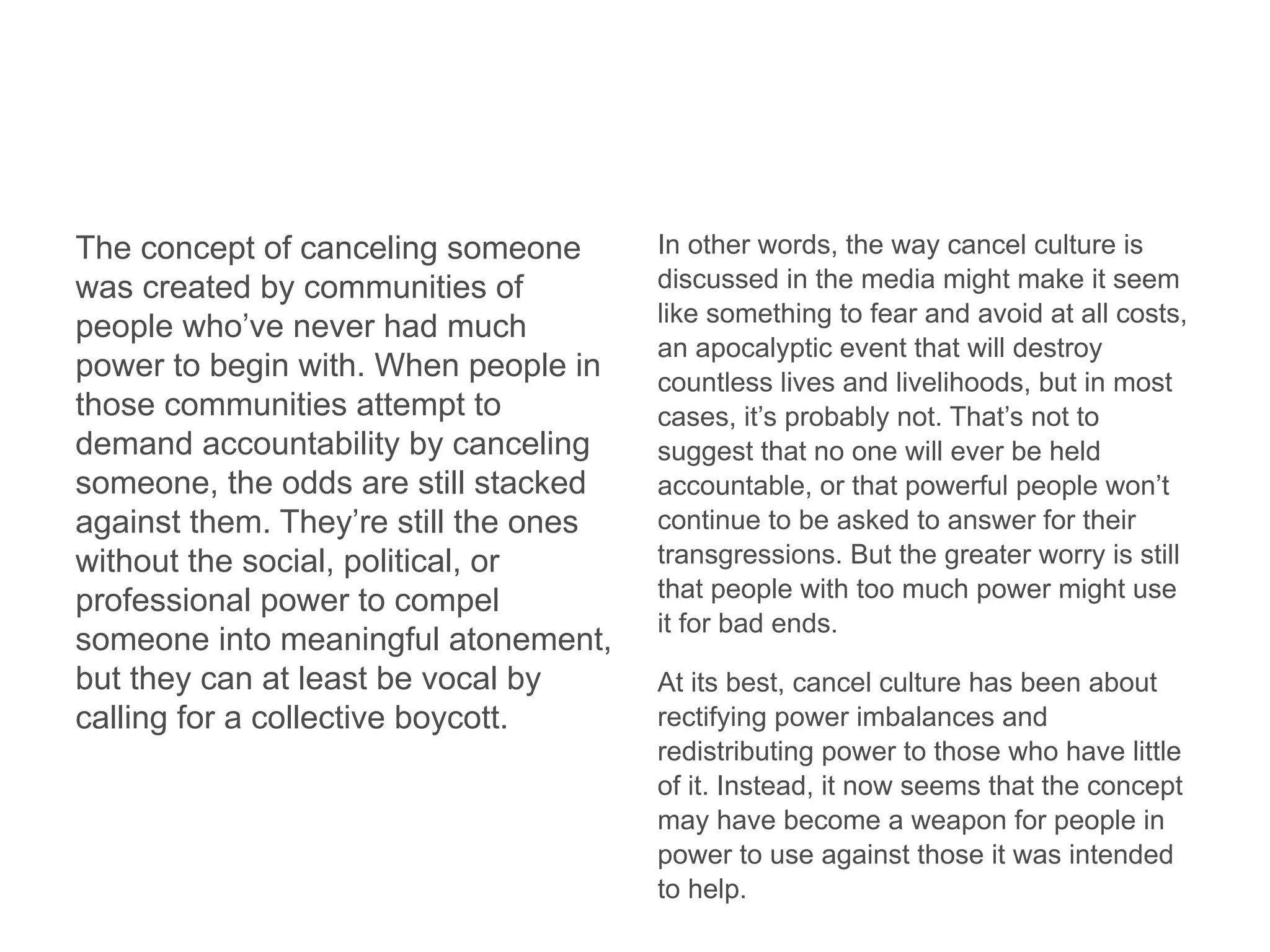
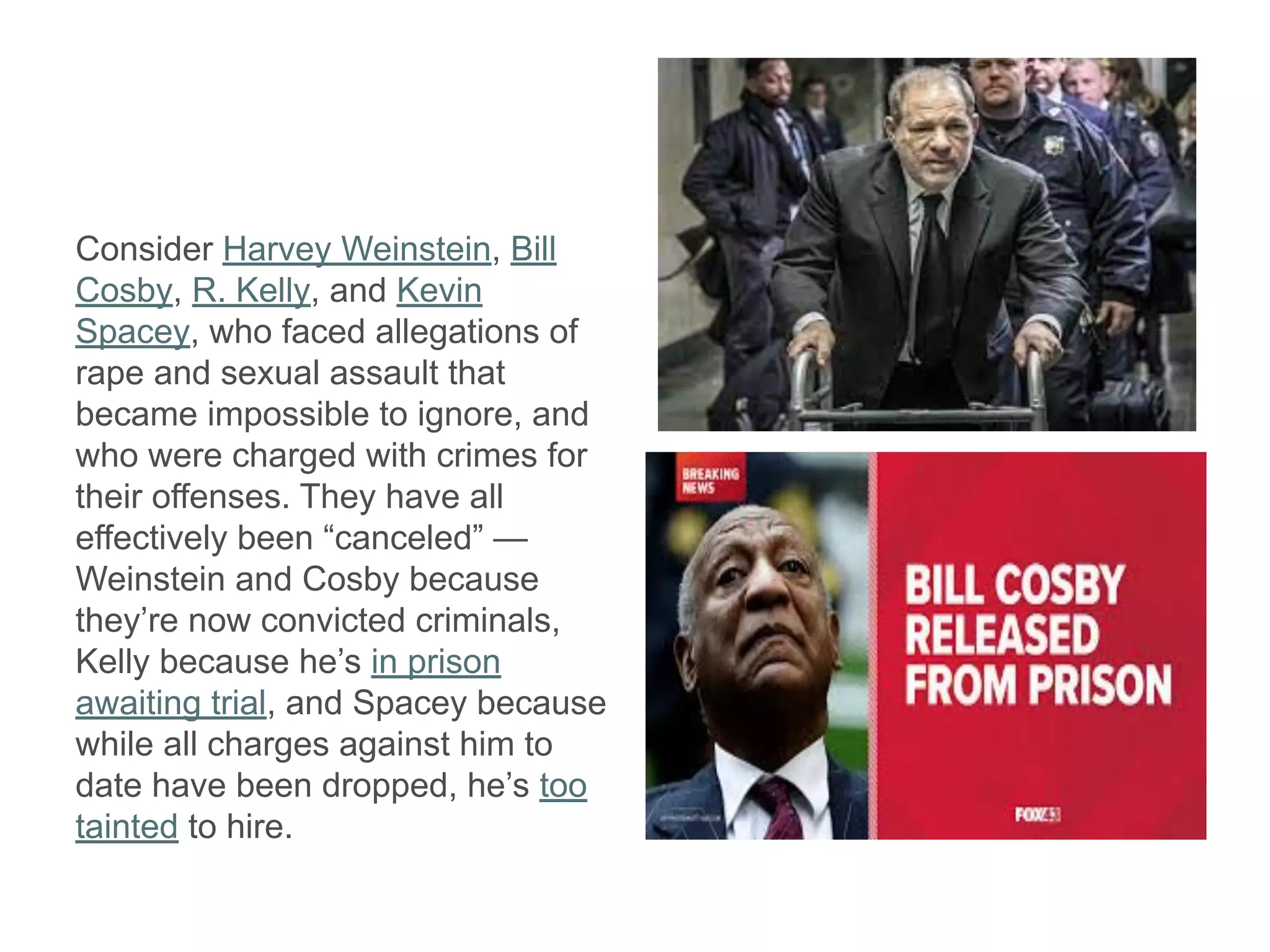
Consider Harvey Weinstein, Bill
Cosby, R. Kelly, and Kevin
Spacey, who faced allegations of
rape and sexual assault that
became impossible to ignore, and
who were charged with crimes for
their offenses. They have all
effectively been “canceled” —
Weinstein and Cosby because
they’re now convicted criminals,
Kelly because he’s in prison
awaiting trial, and Spacey because
while all charges against him to
date have been dropped, he’s too
tainted to hire.
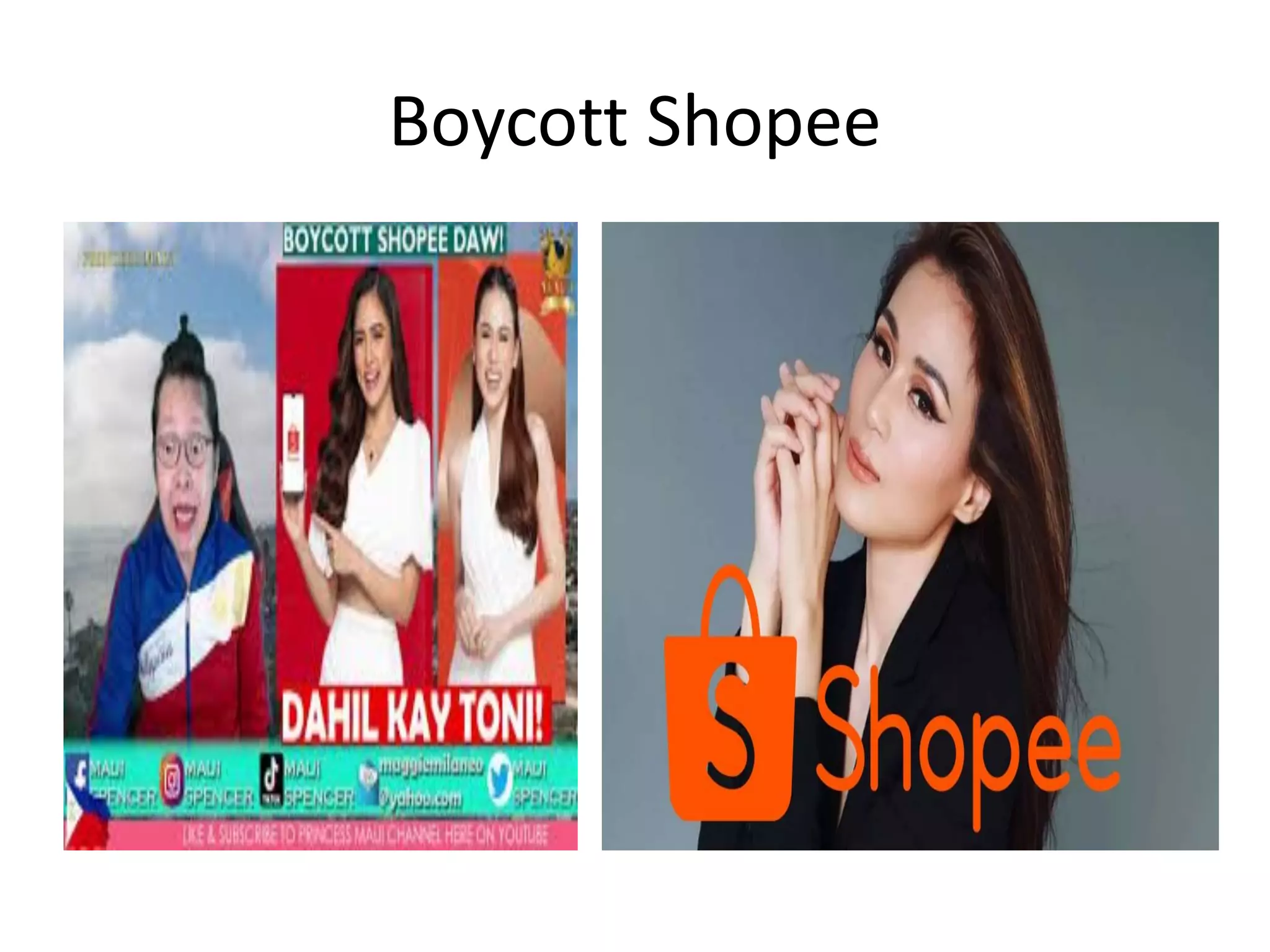
Boycott Shopee

Understanding groups and teams

  • 1.
    Understanding groups andteams Edited 01/06/2023 Ma. Corazon P. Rodriguez
  • 2.
    What is agroup? • “A group is defined as two or more interacting and interdependent individuals who come together to achieve a specific goal.” • “Groups can be both formal and informal. Formal groups are defined by the organization structure with designated work assignments and specific tasks” • Informal groups occur naturally in the workplace and is formed because people in organizations have social needs.
  • 5.
    Stages of groupdevelopment (Bruce Tuckman’s theory)
  • 8.
    Stages of groupformation
  • 10.
    National Herald Webdesk.“Time To Leave the Nest: Elon Musk fires 3,700 Twitter employees.” national herald india.com, 11 05/2022 As anticipated, social media platform Twitter has confirmed firing half its employees. The new owner of Twitter, Elon Musk, had fired the CEO and the entire Board of Twitter late last month after acquiring the platform valued at 25 billion dollars. Musk paid 44 billion dollars for the acquisition. Musk tweeted that there was no option but to let the staff go as the company was bleeding US 4 million dollars a day. Every employee fired, he claimed, had been given three months of severance pay which, he added, was 50 per cent more than required.
  • 11.
    The company, agenciesreported, was silent about the depth of the cuts until late on Friday, when head of safety and integrity Yoel Roth tweeted confirmation of plans to lay-off about 3,700 people, or 50% of the staff. Tweets by staff of the social media company said teams responsible for communications, content curation, human rights and machine learning ethics were among those affected, as were some product and engineering teams. Among those let go were 784 employees from the company's San Francisco headquarters and 199 in San Jose and Los Angeles. While a section of employees are planning to challenge the lay offs in court, others took to social media to express their outrage at the manner of their dismissal. Others expressed their solidarity with colleagues. At least one employee tweeted that she has been retained but she felt like ‘vomitting’.
  • 12.
    Potential explanations behind successfulgroups It just might be true that the group is identified with a major decision maker in the organization. If this is the case then one can expect that formal and informal links may be in operation that will make work more enjoyable for the group. Do you think this is the reason why members of the DDS are happy doing their work?
  • 14.
    Another explanation • Theresources each member of the team brings to the group. • For example members who have knowledge, skills and abilities to do a good job. • Members who are able to work with other people without asserting their own importance and who are able to accept the importance of other people.
  • 15.
    • - employeeproductivity- efficiency and effectiveness • -organization citizenship behavior (OCB) – “ability to work well with others, volunteering for extended job activities, avoiding unnecessary conflicts, making constructive statements” (373) • How many among these explanations are/were experienced in the current groups? What could be explanations for ease/difficulty of working together?
  • 18.
    Still another explanation •The presence of people who perform roles related to group maintenance and task performance. What does this mean?
  • 21.
    What is processconsultation? Process consultation - Process consultation can help team members experience a change of perspective and experiment with various problem fixing suggestions. The clear insight provided by the expert or consultant is extremely valuable since it offers both team members and top managers guidelines on how to approach, handle and tackle a wide array of work-related problems.
  • 22.
  • 23.
    What about socialcohesion from a country’s point of view?
  • 25.
    How can socialcapital be described?
  • 26.
    How can socialmobility be understood?
  • 27.
    Given the conceptualelements of cohesion, how can we understand the promise of cohesion?
  • 28.
    Group norms • Normsare standards or expectations that are accepted and shared by members of the group • Groups normally have norms about levels of effort and performance ( is this true?) • Groups have explicit cues on how hard to work, what level of output to have, when to look busy and when it is acceptable to goof off (totoo ba ito?)
  • 29.
  • 30.
  • 31.
  • 32.
    Groupthink • Occurs whengroup pressure to conform is strong • Divergent views are not tolerated • Films produced by Joshua Oppenheimer—whose masterful The Act of Killing and The Look of Silence are thematic works about group-think atrocities
  • 33.
    Oppenheimer’s The Actof Killing and The Look of Silence -Mass murders that occured in Indonesia in 1965 - How those who committed mass murders boasted of their acts -How “groupthink” can be applied here and possibly one that is quite closer to home!
  • 34.
    What about groupthinkand the death squad?
  • 35.
    Groupthink • “Arises whenmembers of the group seek to minimize conflict by failing to critically test, analyze and evaluate ideas of group members” • Many of us fear being criticized, fear telling the truth that hurts others
  • 38.
    Christopher Mathias &Ali Winston. “Inside Patriot Front: The Masked White Supremacists On A Nationwide Hate Crime Spree.” huffingtonpost.com, 02/10/2022 From Philadelphia to Louisville to Nashville to Austin to Portland, Oregon, Patriot Front has held brazen public demonstrations and vandalizations intended to get eyeballs on its white nationalist cause. In December, about 100 Patriot Front members marched through the National Mall in Washington, D.C., all dressed in khaki cargo pants, brown combat boots, navy blue jackets, white gaiters, sunglasses and beige baseball hats. Some carried shields and wore shin guards, prepared for violence.
  • 39.
    Patriot Front, perRousseau’s manifesto, seeks a “hard reset on the nation we see today — a return to the traditions and virtues of our forefathers.” Decrying mass immigration, rampant consumerism, increasing diversity and the declining fortunes of white Americans, Rousseau espouses the renewal of a true American “volk” through racial primacy, physical prowess and the renewal of the nuclear family. The group appears especially agitated by the historic wave of anti-racist uprisings which have swept across America over the last two years. Murals depicting Floyd — whose murder at the hands of Minneapolis cops last year helped spark thousands of demonstrations against police brutality across the country — were defaced by Patriot Front members in Canton, Ohio; Philadelphia; Manhattan; Newark, New Jersey; Portland, Oregon; and Lafayette, Indiana.
  • 40.
    Still on groupthink •“18th century historian Edward Gibbon said ‘solitude is the school of genius.’” • “ Man as a social being needs companionship and affection of other beings yet solitude also has an important role to play in any human life • The capacity and ability for solitude are a prerequisite to ….self actualization. Is this true?
  • 41.
  • 42.
    • “You haveto get away from all that madness for a while because we become insane, we get confused with our roles, as being who we really are. Man is not his role. Man is something deeper than that. So, go into the forest or some place ALONE in nature, all by yourself, and find out who you really are! And when you no longer confuse yourself with your particular temporary body, but identify with the entire process of nature and the whole cosmos… When death comes, what a funny thing that will happen. Death comes, and will find no one to kill.” • ~ Alan Watts
  • 43.
    Corina Stan. “Philosophies ofDistance and Proximity: Who Are We When We’re Alone?” lithub.com, 07/09/2020 • What value can one ascribe to distance? What insights do we gain by staying away from others, and at such close quarters with ourselves? • George Orwell. Down and Out inaugurated Orwell’s literary career with an experiment in reducing distance.
  • 44.
    • In aparable loved by Arthur Schopenhauer and Sigmund Freud, some porcupines huddle together in freezing weather, trying to stay close enough to keep warm, yet also far enough so they avoid pricking one another. • Citing this parable, the French semiologist Roland Barthes formulated his course of lectures, How to Live Together, around a question: “At what distance should I keep myself from others in order to build with them a sociability without alienation and a solitude without exile?”
  • 45.
    • A vocabularyof distance and proximity • the problem of distance bears on questions of space, values, foundational myths, notions of identity and difference. • For the most part, the Western philosophical tradition has placed friendship at the heart of a happy life, a similarity of interests, habits and values being considered nurturing for those involved.
  • 46.
    • Yet Aristotle’sparadoxical apostrophe—O my friends, there are no friends!—famously highlights the impossible demands of authentic friendship, and the fact that it can perhaps only exist as an ideal on the horizon of our social interactions. • For Ralph Waldo Emerson, a friend must remain a spirit ensconced in distance, “forever a sort of beautiful enemy, untamable, devoutly revered, and not a trivial conveniency to be soon outgrown and cast aside.”
  • 47.
    • Nietzsche (Neat-chuh) -“love of the farthest”: instead of cultivating bonds with those closest to us, we should seek connections with those who are different, those who can help us broaden our horizons.” • Nietzsche thus turns his back on an entire tradition of thinking about community that prized a shared history, myths of origin and common rituals, blaming Judeo-Christian morality for encouraging the cultivation of a “herd mentality” that denied the diversity of life forms.
  • 48.
    • Instead ofdocilely conforming to rules and expectations that fence us in a community of like-minded individuals, one should seek that region where difficult and surprising encounters are possible. Nietzsche reminds readers that all strong epochs cultivated a “pathos of distance.” • The paradox is that “communities of proximity” are affected by a troubling kind of distance, precisely because they are premised on life-scripts that compel their members to evaluate themselves through comparison with others.
  • 49.
    • n Beingand Time, Martin Heidegger refers to this aspect with the term “distantiality” (Abständigkeit): the nagging care about how one differs from others, which manifests in an “ambiguous watching of one another, a secret and reciprocal listening-in,” antagonistic rather than benevolent. • In the company of Barthes (Baarts) and other thinkers invested in this problem, the question of community becomes: What is an ethical way of relating to other people? And what happens when we find ourselves in isolation, contemplating not only our distance from others, but also distances within ourselves?
  • 53.
    Conflict • “Perceived incompatibledifferences resulting in some form of opposition.” • Traditional notion of conflict – must be avoided • Human relations view of conflict –it is a natural and inevitable outcome of group interaction and can be converted to a positive force in the performance of one’s duties
  • 54.
    Conflict • Interactionist viewof conflict- not only is conflict a positive force – it is absolutely necessary! One must be angry with oneself before change is possible! Do you agree? • Many kinds of conflict – process conflict, task conflict. The most dysfunctional conflict has to do with relational conflict.
  • 56.
    Causes of conflictin organizations
  • 57.
  • 58.
    Status • Status isposition or rank bestowed on members of the group.
  • 59.
    Status incongruence • Whena desirable office is occupied by somebody in a low ranking position Members have perceptions about their status in the group which may be different from that which is officially conferred. Status incongruence occurs when a supervisor gets a lower salary than his subordinate
  • 61.
  • 62.
    More on conflictand organization structures
  • 64.
    Task interdependence andconflict in organizations
  • 65.
    Social loafing • Thetendency of a member to expend less effort when working collectively than when working individually. • Does this happen ?
  • 66.
  • 67.
    Personality differences andconflict in organizations
  • 69.
    Communication problems andconflict in organizations
  • 74.
    What are examplesof lose-lose solutions?
  • 77.
    Examples of win-winsolutions to conflict in organizations
  • 78.
    Could this beconsidered a win-win solution ?
  • 79.
    Aristotle quotes • “Anybodycan become angry — that is easy, but to be angry with the right person and to the right degree and at the right time and for the right purpose, and in the right way — that is not within everybody's power and is not easy.” • “I count him braver who overcomes his desires than him who conquers his enemies, for the hardest victory is over self.”
  • 80.
    Microagressions and conflictin organizations today • (Source: Freidersdorf, Conor. “The Rise of Victimhood.” The Atlantic. Com, 09/11/2015 • Honor culture where differences are addressed using “duels,” etc. • Dignity cultures – where violent actions are addressed through avoidance, negotiation, mediation, negotiation and hopefully win-win solutions • Microaggression: A Beginner's #SJW Guide! (youtube)
  • 81.
    Fernando Cueto Amorsolo(1892 - 1972 - Philippines) Defend Thy Honour 1945
  • 82.
    How conflict ishistorically addressed • In honor cultures like the Old West or the street gangs of West Side Story, they might engage in a duel or physical fight. • The winner lives, the loser dies • In dignity cultures, like the ones that prevailed in Western countries during the 19th and 20th Centuries, “insults might provoke offense, but they no longer have the same importance as a way of establishing or destroying a reputation for bravery,”
  • 83.
    • “When intolerable conflictsdo arise, dignity cultures prescribe direct but non-violent actions.” • The sociologists, Bradley Campbell and Jason Manning, cited the Oberlin incident as one of many examples of a new, increasingly common approach to handling conflict.
  • 84.
  • 85.
    • It isn’thonor culture • “Honorable people are sensitive to insult, and so they would understand that microaggressions, even if unintentional, are severe offenses that demand a serious response,” they write. • “But honor cultures value unilateral aggression and disparage appeals for help. Public complaints that advertise or even exaggerate one’s own victimization and need for sympathy would be anathema to a person of honor.”
  • 86.
    • But neitheris it dignity culture: • “Members of a dignity culture, on the other hand, would see no shame in appealing to third parties, but they would not approve of such appeals for minor and merely verbal offenses. • Instead they would likely counsel either confronting the offender directly to discuss the issue, or better yet, ignoring the remarks altogether.”
  • 87.
    Culture of victimhood •The culture on display on many college and university campuses, by way of contrast, is “characterized by concern with status and sensitivity to slight combined with a heavy reliance on third parties. • People are intolerant of insults, even if unintentional, and react by bringing them to the attention of authorities or to the public at large.
  • 88.
    • Domination isthe main form of deviance, and victimization a way of attracting sympathy, so rather than emphasize either their strength or inner worth, the aggrieved emphasize their oppression and social marginalization.” • Victimhood cultures emerge in settings, like today’s college campuses, “that increasingly lack the intimacy and cultural homogeneity that once characterized towns and suburbs,
  • 89.
    • “Under suchconditions complaint to third parties has supplanted both toleration and negotiation. People increasingly demand help from others, and advertise their oppression as evidence that they deserve respect and assistance. • Victimhood culture “arose because of the rise of social conditions conducive to it, • Self-help in the form of dueling or fighting is not an option. • where one cannot rely on members of a family, tribe or clan to automatically take one’s side in a dispute.
  • 90.
    • “a moralitythat privileges equality and condemns oppression is most likely to arise precisely in settings that already have relatively high degrees of equality.” • microaggressions as “a form of social control in which the aggrieved collect and publicize accounts of intercollective offenses, making the case that relatively minor slights are part of a larger pattern of injustice and that those who suffer them are socially marginalized and deserving of sympathy,
  • 91.
    • the emergenceof “the blogosphere” in the early aughts––something I participated in to some extent–– was rife with examples of conservative, progressive, and libertarian bloggers calling attention to minor slights against their respective ideological groups by mainstream media outlets. • of making the case that the small slight that they’d seized upon was actually evidence of a larger, significant injustice to a whole class of people.
  • 92.
    • In acity like New York during the stop-and-frisk era, minorities were stopped by police because other people in their community, aggrieved by minor quality-of-life issues like loitering or sitting on stoops or squeegee men • successfully appealed to third-parties to intervene by arguing that what may seem like small annoyances were actually burdensome and victimizing when aggregated.
  • 93.
    What are microagressions? •These may have been referred to by candidate for US President, Donald Trump – the preoccupation with what others referred to “being politically correct.” • Violations are addressed using social media to “provoke sympathy and antagonism, concern for status and “victimhood” • This is caused, according to some by lack of intimacy and cultural homogeneity
  • 94.
    Microaggression violate long standingnorms such as encouraging people to have thick skin, brush off slights, charitably interpret the intentions of others A clash of moral cultures. The norms that apply to marginalized groups and maybe the privileged class -Microaggression coined in the 70s by a Harvard Psychology Professor, the popular use of the word is attributed to a Counseling Psychologist and Diversity Training Specialist - Derald Wing Sue -He took offense after he and another colored passenger in an airline were asked to transfer seats to balance the weight of a small plane. -Claimed white people could have been asked to transfer. He and his friend are African Americans
  • 95.
    -Sue and hisfriend claimed that “the power of microaggression lies in the invisibility to the aggressor.” -See examples of microaggression in the next slide In a university in America, people are told not to say: America is a melting pot, I believe the most qualified person should get the job These are offensive statements according to officials of the university -Critics of microaggression question why the interpretation of the victim weighs heavier than the real intention of the perpetrator. How can statements like these asked of Asians and Latinos be insulting- Where were you born? Where are your from? Why are so quiet?
  • 99.
    -magnifying small offenses, mindreading by identifying subconscious thoughts even the offenders are unaware of, labelling others as aggressors-these are all part of microaggression -These are all causes of conflict in organizations- critics of microaggression say Honor cultures deal with conflict violently. “No one should dishonor members of my family” as the head of the family inflicts harm on the person who insulted the victim. One’s reputation makes one honorable. -Honor cultures exists in places where legal authority is weak and a reputation of toughness is an effective deterrent against predation or attack
  • 100.
    Dignity culture exists differentlyof what others think, public reputation is less important. Insults might provoke offense but no longer have the same effect as destroying one’s reputation. Dignity cultures have parents who advise their kids: sticks and stones can break my bones but words will never hurt me. An ethic of self restraint prevails. When intolerable conflicts arise, dignity cultures prefer non-violent actions such as negotiated compromise geared towards solving the problem. -If offense is severe they go to the police or appeal to the courts. It is wrong to take the law into their own hands -The ideal is to use the courts as quickly and rarely as possible
  • 101.
    -The presence ofstable and powerful system and the popularity of social closeness were what encouraged the culture of dignity -The culture of victimhood however changed the narrative to: sticks and stones can hurt my bones but words are hurtful. -Victimhood resembles honor culture. Honorable people are sensitive to insults and demands serious response -But victimhood is anathema to honor culture. This is tantamount to saying to be a victim is not to have honor.
  • 102.
    In his videoon microaggressions, Sue offered five suggestions for things individuals can do to avoid them: 1. Be constantly vigilant of your own biases and fears. 2. Seek out interaction with people who differ from you (in terms of race, culture, ethnicity, and other qualities). 3. Don't be defensive. 4. Be open to discussing your own attitudes and biases ad how they might have hurt others or in some sense revealed bias on your part. 5. Be an ally, by standing personally against all forms of bias and discrimination.
  • 103.
    A few facultymembers who resigned/fired from jobs because of microaggression The Portland State University professor who resigned with a scathing public letter has spoken out in an interview, saying that he was hounded by diversity investigators and left unable to teach critical thinking. Peter Boghossian was a full-time assistant professor of philosophy at Portland State University for 10 years until his resignation letter was published on Wednesday, calling it a 'social justice factory' that drives 'intolerance of divergent beliefs'. In total defiance of the First Amendment, the University of North Texas has fired a math professor for criticizing the concept of microaggressions and for refusing to attend extra diversity training to correct his views, which the math department chair deemed “not compatible with the values of this department.”
  • 105.
    Gaslighting Gaslighting, a manipulationtactic often wielded by emotional abusers, gradually makes you question your own judgment, feelings, memories and reality. Because of its insidious nature, it can be hard for victims to recognize it as it’s happening. Abusers use gaslighting as a way to gain and maintain power and control in the relationship. They break down your confidence over time by making you think your interpretation of events is incorrect. The more you second-guess yourself, the more you start to believe their version must be the accurate one.
  • 107.
    “People who cannotauthentically argue their point of view or stand behind their words turn to gaslighting as a tool,” therapist Shannon Thomas, author of “Healing From Hidden Abuse,” told HuffPost. “They resort to confusion-creating tactics, and that is a sign of character weakness.” Gaslighting is also a way for the abusive partner to avoid taking responsibility for their bad behavior, said psychotherapist Beverly Engel, author of “The Emotionally Abusive Relationship.” the common phrases gaslighters use so you can be more adept at recognizing this behavior. 1. That never happened- so sow seeds of self doubt 2. You’re too sensitive- you’re making a big deal out of nothing 3. You’re crazy and many people think so too 4. You have a terrible memory 5. I am sorry you think that I hurt you 6. You should have known how I would have react
  • 110.
    Chris Murphy. “EveryoneWho Has Publicly Accused Bill Murray of Misconduct.” vanity.com, 10/24/2022 In her recent memoir, Dying of Politeness, Davis alleges that Murray made her lie on a bed while he used a massage device on her, “the Thumper,” during the making of 1990’s Quick Change. “I said no multiple times, but he wouldn’t relent,” writes Davis in her memoir. The Oscar winner also claims that Murray yelled at her on set in front of more than 300 people, a tactic she says he would employ to exert his authority on set. “I was watching him tear apart somebody one day on set,” Davis told Vanity Fair. “He finished, and the other person went away, and he turned around sort of self-satisfied and I said, ‘Man, I can’t wait for you to do that to me again, because now I know how I’ll react.’ And he said, ‘Oh, I don’t have to. You behaved after that.’ So he thought he has to go off on somebody to make sure they ‘behave.’ Whatever his idea of ‘behaving’ is—not challenging him, I guess.”
  • 111.
    Anjelica Huston Oscar winnerAnjelica Huston described Murray as “a shit” after working with him on Wes Anderson’s 2004 film The Life Aquatic With Steve Zissou. In 2019, Huston told Vulture that while filming, Murray invited everyone in the cast except her to dinner. “I was really hurt,” she continued. “And then I think we met again in Florence, because that movie was shot all over Italy, and we were doing a scene at Gore Vidal’s house in Ravello, and [Murray] said, ‘Hey, how’ve you been? I missed you.’ I said, ‘You’re full of shit. You didn’t miss me.’ He looked all confused for a moment.” However, Huston says that Murray showed up at the funeral of her late husband, Robert Graham, and that Murray “couldn’t have been nicer that day.” “He showed up,” she said. “A lot of people didn’t.”
  • 113.
    Monica Torres. “SignsYour Boss Might Be A Narcissist (And How To Deal With It).” At worst, they can chip away at your self-esteem by constantly needling you over your perceived faults and outright insulting you on a constant basis. They are always perfect; you are always wrong. Dealing with them can easily become a draining chore. “A healthy dose of narcissism means that someone has a reasonable amount of self-esteem or self-worth. That’s normal, that’s not pathological,”
  • 114.
    “On the otherhand, people with extreme narcissistic traits must remain the center of the world at all times, and so in the workplace, these individuals are damaging to their organization, the culture of the organization, the morale of employees.” Symptoms: a sense of grandiosity and self-importance, fantasies of perfection and superiority, a sense of specialness and uniqueness, a need for praise and attention, a strong sense of entitlement and a tendency to exploit others. Examples of narcissistic traits and attitudes: 1. They believe you are either with them or against them…“The day you move into the enemy camp, they will do everything to eliminate you from their entourage. They will fire you, they will demote you.” 2. They may initially charm but will trap you if you challenge them. These bosses will charm you with their generosity but their mood changes when you are perceived as an enemy!
  • 115.
    3. They won’tadmit they are wrong. Narcissistic bosses deny accountability at all costs and are emotionally unable to accept defeat or criticism. “Because they are perfect, admission of error is impossible. That would shatter their self-esteem. Which, by the way, they have very little of,” You can see this as a boss blames employees for the boss’s error while denying that they had any role. In fact, when confronted, these bosses can turn the tables and play the victim, making you feel like the error was all your fault. 4. They steal your ideas- narcissistic bosses are “great thieves of ideas.” Because they believe they are perfect and are driven to maintain that unassailable self-image, they often feel entitled to take employees’ good ideas and pass them off as their own without worrying about morality. To them, that’s simply what it takes to stay on top of their business.
  • 116.
    5. They askfor favors they won’t return-These bosses will ask for favors and never return them because “they feel they are entitled to, they’re the boss,” 6. They demonstrate a noticeable lack of empathy and be verbally abusive- ‘Too bad.’ You just need to do better,”....‘Oh, my God, you’re so weak.’ How to cope with a narcissistic boss: 1. Document everything 2. Don’t talk to the boss if you can help it 3. Put the boss’s criticism in perspective and look for allies in the organization 4. Strengthen other work relationships so that your boss is not your world 5. If all else fails- quit!
  • 118.
    Cancel Culture andSocial Media.” ethicssage.com, 05/06/2021
  • 119.
    When we thinkof the cancel culture what comes to mind right away is how social media is used to call someone out for their words or actions as offensive to a group. Those offended go on social media and start a firestorm of criticism against the offending party. Before you know it, others have taken to the internet to voice their views. The result may be to cancel the offending party by denying them the status they may have achieved or blacklisting them in the mind of the public. It some respects it is like ostracizing a person or group. However, in other cases it is an expression of capitalism, which is where a company is boycotted by the public. The public stops buying a product and uses social media to influence others to do the same. Social media is where a molehill becomes a mountain. Once an issue hits the virtual realm, it is no longer subject to private resolution—it is out there for the world to judge, critique, and potentially fight for. Whether the public punishment corresponds to the act that sparked it may be up for debate, but the growing number of such incidents has fueled controversy over what has become known as "cancel culture." Critics of cancel culture say the process stifles free expression, inhibits the exchange of ideas and keeps people from straying from their comfort zones. Others, however, argue that it has empowered people to challenge the status quo and demand accountability from those in positions of power.
  • 120.
    The goal ofa boycott is the withdrawal of financial support, political support, social, economic support to silence someone or an organization by withdrawing attention to it by actively seeking to deny them a forum for their ideas and, in some cases, boycotting their product by the public. A recent case in point is Mike Lindell, the “My Pillow” guy who was an ardent supporter of Trump and conspiracy theorist of how the election was stolen from him.
  • 121.
    Lindell co-chaired thepresident's reelection campaign in Minnesota and has helped fund Trump lawyers Sidney Powell and Lin Wood. After Trump lost the election in November, they peddled the false theory that he was the victim of voter fraud. This conspiracy theory was a catalyst for the hundreds of insurgents who swarmed the Capitol building on January 6, resulting in the deaths of five people. Lindell has claimed that the insurrectionists were Antifa activists, not Trump supporters. Lindell was quickly denounced and companies acted to take his product off their shelves including Wayfair, Bed Bath & Beyond, Kohl's, and H-E-B. All dropped My Pillow products, leading Lyndell to claim he is the victim of cancel culture. He laments the attacks against his company and the price he has paid for exercising his free speech rights. Estimates are the lost revenue to the company will be $65 million. Some say Lindell should only blame himself for his business woes. He publicly aligned himself with a historically unpopular political figure and remained by his side after he incited an insurrection at the Capitol building. He had to know he was putting his business in jeopardy by publicly supporting a man who is one of the most disliked in the country.
  • 122.
    Aja Romano. “Thesecond wave of ‘cancel culture.’” vox.com, 05/05/2021 As a concept, cancel culture entered the mainstream alongside hashtag-oriented social justice movements like #BlackLivesMatter and #MeToo — giant social waves that were effective in shifting longstanding narratives about victims and criminals, and in bringing about actual prosecutions in cases like those of Bill Cosby and Harvey Weinstein. It is also frequently used interchangeably with “woke” political rhetoric, an idea that is itself tied to the 2014 rise of the Black Lives Matter protests. In similar ways, both “wokeness” and “canceling” are tied to collectivized demands for more accountability from social systems that have long failed marginalized people and communities.
  • 123.
    Within the realmof good faith, the larger conversation around these questions can then expand to contain nuanced considerations of what the consequences of public misbehavior should be, how and when to rehabilitate the reputation of someone who’s been “canceled,” and who gets to decide those things. Taken in bad faith, however, “cancel culture” becomes an omniscient and dangerous specter: a woke, online social justice mob that’s ready to rise up and attack anyone, even other progressives, at the merest sign of dissent. And it’s this — the fear of a nebulous mob of cancel-happy rabble-rousers — that conservatives have used to their political advantage. At a recent panel devoted to making a nonpartisan “Case Against Cancel Culture,” former ACLU president Nadine Strossen expressed great concern over cancel culture’s chilling effect on the non-famous. “I constantly encounter students who are so fearful of being subjected to the Twitter mob that they are engaging in self-censorship,” she said. Strossen cited as one such chilling effect the isolated instances of students whose college admissions had been rescinded on the basis of racist social media posts.
  • 124.
    the origins ofcancel culture are rooted in giving marginalized members of society the ability to seek accountability and change, especially from people who hold a disproportionate amount of wealth, power, and privilege. But far too often, people who call for accountability on social media seem to slide quickly into wanting to administer punishment instead. In some cases, this process really does play out with a mob mentality, one that seems bent on inflicting pain and hurt while allowing no room for growth and change, showing no mercy, and offering no real forgiveness — let alone allowing for the possibility that the mob itself might be entirely unjustified. “People connect boycotts with de-platforming speakers on college campuses,” he observed, “with social media harassment, with people being fired abruptly for breaching a taboo in a viral video.” The result is an environment where social media is a double-edged sword: “One could argue,” Aleem said, “that there’s now public input on issues [that wasn’t available] before, and that’s good for civil society, but that the vehicle through which that input comes produces some civically unhealthy ways of expression.”
  • 125.
    The concept ofcanceling someone was created by communities of people who’ve never had much power to begin with. When people in those communities attempt to demand accountability by canceling someone, the odds are still stacked against them. They’re still the ones without the social, political, or professional power to compel someone into meaningful atonement, but they can at least be vocal by calling for a collective boycott. In other words, the way cancel culture is discussed in the media might make it seem like something to fear and avoid at all costs, an apocalyptic event that will destroy countless lives and livelihoods, but in most cases, it’s probably not. That’s not to suggest that no one will ever be held accountable, or that powerful people won’t continue to be asked to answer for their transgressions. But the greater worry is still that people with too much power might use it for bad ends. At its best, cancel culture has been about rectifying power imbalances and redistributing power to those who have little of it. Instead, it now seems that the concept may have become a weapon for people in power to use against those it was intended to help.
  • 126.
    Consider Harvey Weinstein,Bill Cosby, R. Kelly, and Kevin Spacey, who faced allegations of rape and sexual assault that became impossible to ignore, and who were charged with crimes for their offenses. They have all effectively been “canceled” — Weinstein and Cosby because they’re now convicted criminals, Kelly because he’s in prison awaiting trial, and Spacey because while all charges against him to date have been dropped, he’s too tainted to hire.
  • 127.