Rashi Soni
TGT SocialScience
Pragyan School
Understanding Democracy
Class-VII
Chapter- 20
2.
Rashi Soni
TGT SocialScience
Pragyan School
What is Democracy?
Democracy, is a form of government where the people govern themselves
directly or through elected representatives.
Direct Democracy Indirect Democracy
• People directly take part in the
decision making procedure.
• Citizens elect their
representatives and the
representatives take part in the
decision making procedure on
the behalf of their electors.
• There are no intermediators;
the vote of the citizens directly
determine all laws and policies
of the government.
• Citizens elect representatives
to create and amend laws and
policies on their behalf.
• The government is regarded
more direct and transparent.
• Comparatively the government
is considered less transparent.
• Examples- Ancient Athens,
Switzerland
• Examples- Indian, France, the
United States of America and
United Kingdom
3.
Rashi Soni
TGT SocialScience
Pragyan School
The Advent of Democracy
Ancient
Greece
Renaissance in
Europe
The American
War of
Independence
The French
Revolution
The World
Wars & The
Russian
Revolution
The historic events that led to the evolution of democracy
in its present form.
4.
Rashi Soni
TGT SocialScience
Pragyan School
The Advent of Democracy:
Ancient Greece
• The earliest form of
democracy began in
Athens (ancient
Greece) in the 6th
century BCE.
• During that period,
citizens assembled at
one place to make
laws and take
decisions regarding
day to day matters of
governance.
Direct Democracy in Ancient
Greece
Video Link (Athens Greece Democracy):
https://www.youtube.com/watch?v=0fivQUlC7-8
5.
Rashi Soni
TGT SocialScience
Pragyan School
The Advent of Democracy:
Renaissance in Europe
• The movement witnessed the
rebirth of literature, art,
science and philosophy in
Europe.
• The movement helped in
reviving of humanistic idea
that led to the growth of
‘democracy’.
• Legislative bodies came into
being which were composed
of both aristocratic and non-
aristocratic families.
A Renaissance Fresco called the
School of Athens
Video Link (Renaissance in Europe):
https://www.youtube.com/watch?v=Om1jvUzVAtE
6.
Rashi Soni
TGT SocialScience
Pragyan School
The Advent of Democracy:
Glorious Revolution, England in 1688
• The Glorious Revolution,
England in 1688 further
strengthen the roots of
democracy.
• The revolution gave a
blow to the absolute rule
of the British King.
• It made the ruler
answerable to the
Parliament
(representative body of
the people in England).
‘Liberty’ concept introduced during
the Glorious Revolution, England
1688
Video Link (Glorious Revolution,1688):
https://youtube.com/shorts/OyetV3axedo?feature=shared
7.
Rashi Soni
TGT SocialScience
Pragyan School
The Advent of Democracy:
The American War of Independence
• A war of independence
ensued between British
colonies in America and
Britain in 1755.
• The war marked the end
of British imperialism in
America.
• The success of America
ushered in ideas of a
written constitution in the
form of the American
Constitution that was
enforced in 1789.
The American War of Independence, 1775
Video Link (American Revolution,1755):
https://www.youtube.com/watch?v=NdRuU5ON-LU
8.
Rashi Soni
TGT SocialScience
Pragyan School
The Advent of Democracy:
The French Revolution
• The French Revolution of
1789 brought forward the
ideas of liberty, equality
and fraternity.
• The Declaration of the
Rights of Man and of the
Citizen stated that an
individual is born free and
upheld the universal and
natural rights of humans.
• It also led to the
abolishment of slavery
in1794 in the French
colonies.
The Declaration of the Rights of Man and
of the Citizen- The French Revolution
9.
Rashi Soni
TGT SocialScience
Pragyan School
The Advent of Democracy:
The First World War (1914-18)
• The First World War led to
the dissolution of major
European imperial powers.
• New nation states were
created where the
government adopted the
principles of democracy to
govern their countries.
The First World War: 1914-1918
10.
Rashi Soni
TGT SocialScience
Pragyan School
The Advent of Democracy:
The Russian Revolution, 1917
• The Russian Revolution of
1917 made it clear that
political equality is
incomplete without social
and economic equality.
• The revolution destroyed
the autocratic government
and led to the formation of
the Soviet Union.
• The 1991, the Union of
Soviet Socialist Republic
was dissolved in 1991.
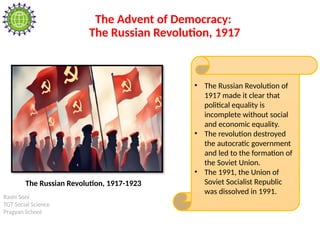
The Russian Revolution, 1917-1923
Rashi Soni
TGT SocialScience
Pragyan School
Why Democracy?
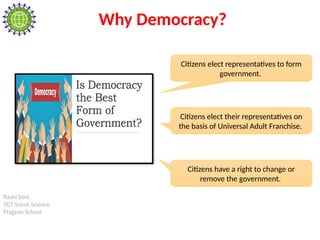
Citizens elect representatives to form
government.
Citizens elect their representatives on
the basis of Universal Adult Franchise.
Citizens have a right to change or
remove the government.
13.
Rashi Soni
TGT SocialScience
Pragyan School
Why Democracy?
Election are held at periodical intervals.
This ensures that the government is
accountable.
Citizens can use various platforms to
voice their opinions. Freedom of
speech and public opinion ensure
regular participation of the citizens in
the political process.
Equality and justice are ensured to all
the citizens of the country.
Video Link (Democracy):
https://www.youtube.com/watch?v=u6jgWxkbR7A
14.
Rashi Soni
TGT SocialScience
Pragyan School
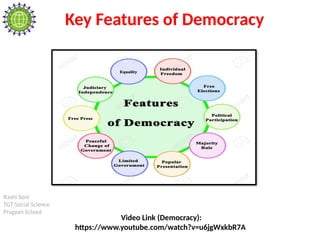
Key Features of Democracy
Video Link (Democracy):
https://www.youtube.com/watch?v=u6jgWxkbR7A
15.
Rashi Soni
TGT SocialScience
Pragyan School
Key Features of Democracy:
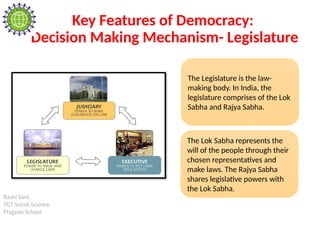
Decision Making Mechanism- Legislature
The Legislature is the law-
making body. In India, the
legislature comprises of the Lok
Sabha and Rajya Sabha.
The Lok Sabha represents the
will of the people through their
chosen representatives and
make laws. The Rajya Sabha
shares legislative powers with
the Lok Sabha.
16.
Rashi Soni
TGT SocialScience
Pragyan School
Key Features of Democracy:
Decision Making Mechanism- Executive
The Executive implements the
laws and plays an important
role in the decision-making
process. The President is the
executive head of the Union of
India.
The Prime Minister is the leader
of the majority party. He/she
works along with a team of
ministers who are elected by
the people and are answerable
to them.
17.
Rashi Soni
TGT SocialScience
Pragyan School
Key Features of Democracy:
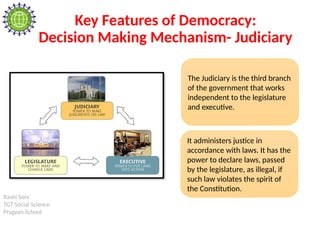
Decision Making Mechanism- Judiciary
The Judiciary is the third branch
of the government that works
independent to the legislature
and executive.
It administers justice in
accordance with laws. It has the
power to declare laws, passed
by the legislature, as illegal, if
such law violates the spirit of
the Constitution.
18.
Rashi Soni
TGT SocialScience
Pragyan School
Key Features of Democracy:
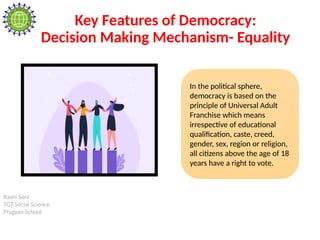
Decision Making Mechanism- Equality
In the political sphere,
democracy is based on the
principle of Universal Adult
Franchise which means
irrespective of educational
qualification, caste, creed,
gender, sex, region or religion,
all citizens above the age of 18
years have a right to vote.
19.
Rashi Soni
TGT SocialScience
Pragyan School
Key Features of Democracy:
Decision Making Mechanism- Equality
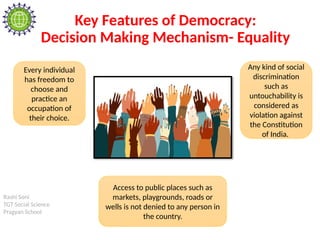
Every individual
has freedom to
choose and
practice an
occupation of
their choice.
Any kind of social
discrimination
such as
untouchability is
considered as
violation against
the Constitution
of India.
Access to public places such as
markets, playgrounds, roads or
wells is not denied to any person in
the country.
20.
Rashi Soni
TGT SocialScience
Pragyan School
Key Features of Democracy:
Decision Making Mechanism- Equality
• Reservation for Schedule Tribes,
Schedule Castes and Other
Backward Classes in the
educational institutions and
government jobs.
• Low-cost housing schemes for
economically weak sections of
the society.
• Reservation of seats for women
in public modes of transport as
well as in panchayats and
parliament.
21.
Rashi Soni
TGT SocialScience
Pragyan School
Key Features of Democracy:
Decision Making Mechanism- Equality
• Literacy schemes to
encourage education
amongst economically
backward sections.
• Development schemes for
rural areas.
• Provision of mid-day meal
in government schools.
22.
Rashi Soni
TGT SocialScience
Pragyan School
Key Features of Democracy:
Decision Making Mechanism- Justice
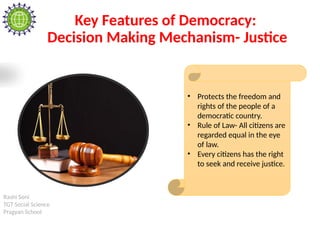
• Protects the freedom and
rights of the people of a
democratic country.
• Rule of Law- All citizens are
regarded equal in the eye
of law.
• Every citizens has the right
to seek and receive justice.
23.
Rashi Soni
TGT SocialScience
Pragyan School
Key Features of Democracy:
Decision Making Mechanism-
Human Dignity
24.
Rashi Soni
TGT SocialScience
Pragyan School
Key Features of Democracy:
Decision Making Mechanism-
Human Dignity
Dignity refers to the recognition of the fact that a human being is worthy of respect.
There is respect for equality and justice for everyone, irrespective of his/her status or
achievements.
Everyone enjoys the Fundamental Rights guaranteed by the Constitution and no one is
allowed to violate the right of others.
Participation and cooperation of the people and recognition of the values of democracy
is a necessary condition for the success of the welfare policies and programmes