Rashi Soni
TGT Social Science
Pragyan School
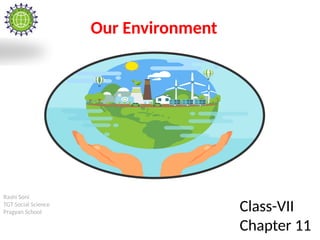
Our Environment
Class-VII
Chapter 11
Rashi Soni
TGT Social Science
Pragyan School
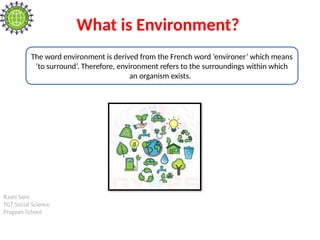
What is Environment?
The word environment is derived from the French word ‘environer’ which means
‘to surround’. Therefore, environment refers to the surroundings within which
an organism exists.
Rashi Soni
TGT Social Science
Pragyan School
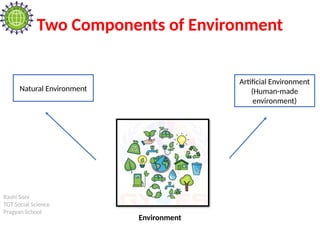
Two Components of Environment
Natural Environment
Artificial Environment
(Human-made
environment)
Environment
Rashi Soni
TGT Social Science
Pragyan School
Two Components of Environment
Natural Environment comprises biotic and abiotic things that occurs naturally
on the Earth.
Artificial Environment (human-made environment) that consists of the
elements which develop as a result of interaction between humans and
nature, for example dams, parks, houses and so on.
Rashi Soni
TGT Social Science
Pragyan School
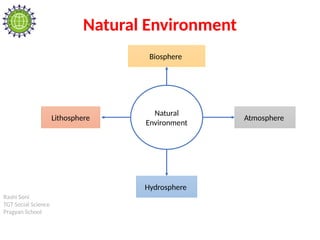
Natural Environment
Natural
Environment
Lithosphere Atmosphere
Hydrosphere
Biosphere
Rashi Soni
TGT Social Science
Pragyan School
Natural Environment- Abiotic
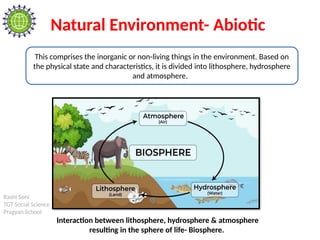
This comprises the inorganic or non-living things in the environment. Based on
the physical state and characteristics, it is divided into lithosphere, hydrosphere
and atmosphere.
Interaction between lithosphere, hydrosphere & atmosphere
resulting in the sphere of life- Biosphere.
Rashi Soni
TGT Social Science
Pragyan School
Natural Environment- Abiotic
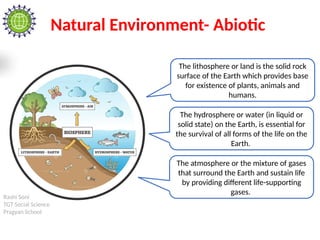
The lithosphere or land is the solid rock
surface of the Earth which provides base
for existence of plants, animals and
humans.
The hydrosphere or water (in liquid or
solid state) on the Earth, is essential for
the survival of all forms of the life on the
Earth.
The atmosphere or the mixture of gases
that surround the Earth and sustain life
by providing different life-supporting
gases.
Rashi Soni
TGT Social Science
Pragyan School
Natural Environment- Biotic
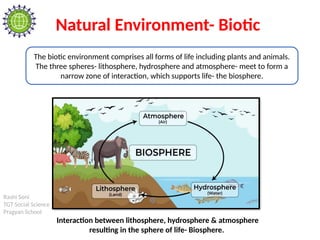
The biotic environment comprises all forms of life including plants and animals.
The three spheres- lithosphere, hydrosphere and atmosphere- meet to form a
narrow zone of interaction, which supports life- the biosphere.
Interaction between lithosphere, hydrosphere & atmosphere
resulting in the sphere of life- Biosphere.
Rashi Soni
TGT Social Science
Pragyan School
Natural Environment- Biosphere
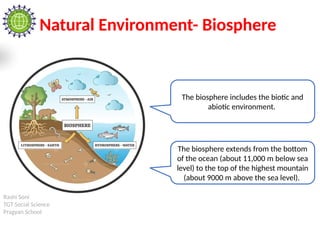
The biosphere includes the biotic and
abiotic environment.
The biosphere extends from the bottom
of the ocean (about 11,000 m below sea
level) to the top of the highest mountain
(about 9000 m above the sea level).
Rashi Soni
TGT Social Science
Pragyan School
Interdependence of Organisms
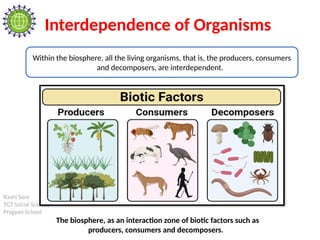
Within the biosphere, all the living organisms, that is, the producers, consumers
and decomposers, are interdependent.
The biosphere, as an interaction zone of biotic factors such as
producers, consumers and decomposers.
Rashi Soni
TGT Social Science
Pragyan School
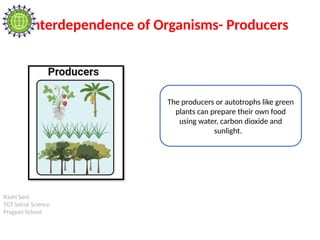
Interdependence of Organisms- Producers
The producers or autotrophs like green
plants can prepare their own food
using water, carbon dioxide and
sunlight.
Rashi Soni
TGT Social Science
Pragyan School
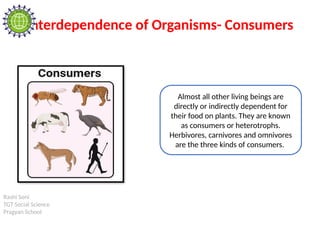
Interdependence of Organisms- Consumers
Almost all other living beings are
directly or indirectly dependent for
their food on plants. They are known
as consumers or heterotrophs.
Herbivores, carnivores and omnivores
are the three kinds of consumers.
Rashi Soni
TGT Social Science
Pragyan School
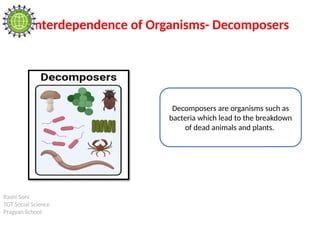
Interdependence of Organisms- Decomposers
Decomposers are organisms such as
bacteria which lead to the breakdown
of dead animals and plants.
Rashi Soni
TGT Social Science
Pragyan School
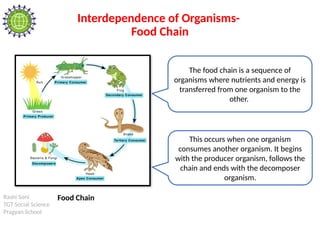
Interdependence of Organisms-
Food Chain
Food Chain
The food chain is a sequence of
organisms where nutrients and energy is
transferred from one organism to the
other.
This occurs when one organism
consumes another organism. It begins
with the producer organism, follows the
chain and ends with the decomposer
organism.
Rashi Soni
TGT Social Science
Pragyan School
Interdependence of Organisms-
Food Web
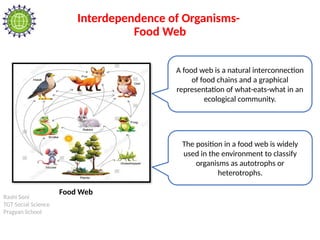
Food Web
A food web is a natural interconnection
of food chains and a graphical
representation of what-eats-what in an
ecological community.
The position in a food web is widely
used in the environment to classify
organisms as autotrophs or
heterotrophs.
Rashi Soni
TGT Social Science
Pragyan School
An Ecosystem
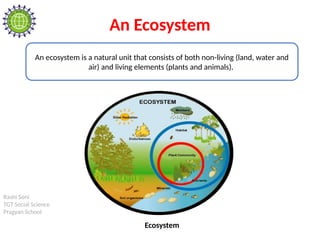
An ecosystem is a natural unit that consists of both non-living (land, water and
air) and living elements (plants and animals).
Ecosystem
Rashi Soni
TGT Social Science
Pragyan School
An Ecosystem
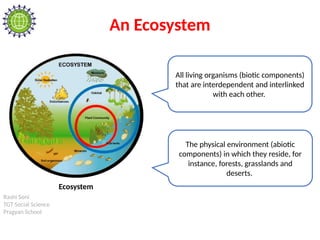
Ecosystem
All living organisms (biotic components)
that are interdependent and interlinked
with each other.
The physical environment (abiotic
components) in which they reside, for
instance, forests, grasslands and
deserts.
Rashi Soni
TGT Social Science
Pragyan School
Human Environment
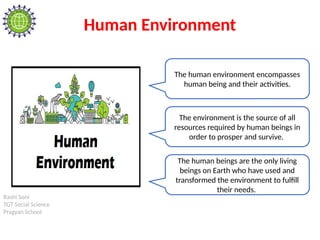
The human environment encompasses
human being and their activities.
The environment is the source of all
resources required by human beings in
order to prosper and survive.
The human beings are the only living
beings on Earth who have used and
transformed the environment to fulfill
their needs.
Rashi Soni
TGT Social Science
Pragyan School
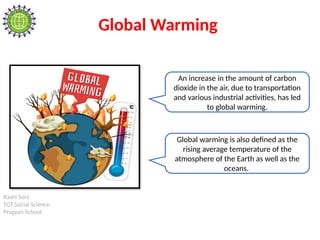
Global Warming
An increase in the amount of carbon
dioxide in the air, due to transportation
and various industrial activities, has led
to global warming.
Global warming is also defined as the
rising average temperature of the
atmosphere of the Earth as well as the
oceans.
Rashi Soni
TGT Social Science
Pragyan School
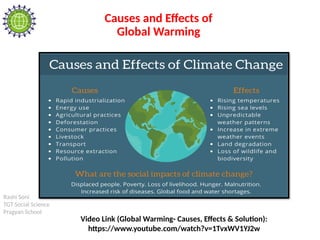
Causes and Effects of
Global Warming
Video Link (Global Warming- Causes, Effects & Solution):
https://www.youtube.com/watch?v=1TvxWV1YJ2w
Rashi Soni
TGT Social Science
Pragyan School
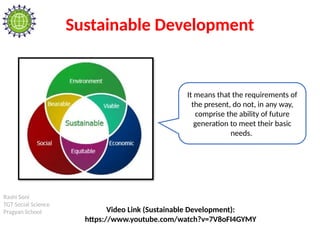
Sustainable Development
It means that the requirements of
the present, do not, in any way,
comprise the ability of future
generation to meet their basic
needs.
Video Link (Sustainable Development):
https://www.youtube.com/watch?v=7V8oFI4GYMY
Rashi Soni
TGT Social Science
Pragyan School
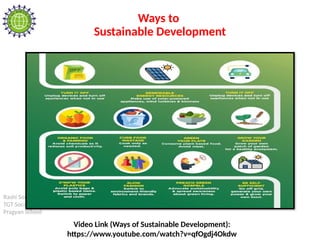
Ways to
Sustainable Development
Video Link (Ways of Sustainable Development):
https://www.youtube.com/watch?v=qfOgdj4Okdw
Rashi Soni
TGT Social Science
Pragyan School
THANK YOU

Our Environment- Class VII- CBSE (In depth learning)

  • 1.
    Rashi Soni TGT SocialScience Pragyan School Our Environment Class-VII Chapter 11
  • 2.
    Rashi Soni TGT SocialScience Pragyan School What is Environment? The word environment is derived from the French word ‘environer’ which means ‘to surround’. Therefore, environment refers to the surroundings within which an organism exists.
  • 3.
    Rashi Soni TGT SocialScience Pragyan School Two Components of Environment Natural Environment Artificial Environment (Human-made environment) Environment
  • 4.
    Rashi Soni TGT SocialScience Pragyan School Two Components of Environment Natural Environment comprises biotic and abiotic things that occurs naturally on the Earth. Artificial Environment (human-made environment) that consists of the elements which develop as a result of interaction between humans and nature, for example dams, parks, houses and so on.
  • 5.
    Rashi Soni TGT SocialScience Pragyan School Natural Environment Natural Environment Lithosphere Atmosphere Hydrosphere Biosphere
  • 6.
    Rashi Soni TGT SocialScience Pragyan School Natural Environment- Abiotic This comprises the inorganic or non-living things in the environment. Based on the physical state and characteristics, it is divided into lithosphere, hydrosphere and atmosphere. Interaction between lithosphere, hydrosphere & atmosphere resulting in the sphere of life- Biosphere.
  • 7.
    Rashi Soni TGT SocialScience Pragyan School Natural Environment- Abiotic The lithosphere or land is the solid rock surface of the Earth which provides base for existence of plants, animals and humans. The hydrosphere or water (in liquid or solid state) on the Earth, is essential for the survival of all forms of the life on the Earth. The atmosphere or the mixture of gases that surround the Earth and sustain life by providing different life-supporting gases.
  • 8.
    Rashi Soni TGT SocialScience Pragyan School Natural Environment- Biotic The biotic environment comprises all forms of life including plants and animals. The three spheres- lithosphere, hydrosphere and atmosphere- meet to form a narrow zone of interaction, which supports life- the biosphere. Interaction between lithosphere, hydrosphere & atmosphere resulting in the sphere of life- Biosphere.
  • 9.
    Rashi Soni TGT SocialScience Pragyan School Natural Environment- Biosphere The biosphere includes the biotic and abiotic environment. The biosphere extends from the bottom of the ocean (about 11,000 m below sea level) to the top of the highest mountain (about 9000 m above the sea level).
  • 10.
    Rashi Soni TGT SocialScience Pragyan School Interdependence of Organisms Within the biosphere, all the living organisms, that is, the producers, consumers and decomposers, are interdependent. The biosphere, as an interaction zone of biotic factors such as producers, consumers and decomposers.
  • 11.
    Rashi Soni TGT SocialScience Pragyan School Interdependence of Organisms- Producers The producers or autotrophs like green plants can prepare their own food using water, carbon dioxide and sunlight.
  • 12.
    Rashi Soni TGT SocialScience Pragyan School Interdependence of Organisms- Consumers Almost all other living beings are directly or indirectly dependent for their food on plants. They are known as consumers or heterotrophs. Herbivores, carnivores and omnivores are the three kinds of consumers.
  • 13.
    Rashi Soni TGT SocialScience Pragyan School Interdependence of Organisms- Decomposers Decomposers are organisms such as bacteria which lead to the breakdown of dead animals and plants.
  • 14.
    Rashi Soni TGT SocialScience Pragyan School Interdependence of Organisms- Food Chain Food Chain The food chain is a sequence of organisms where nutrients and energy is transferred from one organism to the other. This occurs when one organism consumes another organism. It begins with the producer organism, follows the chain and ends with the decomposer organism.
  • 15.
    Rashi Soni TGT SocialScience Pragyan School Interdependence of Organisms- Food Web Food Web A food web is a natural interconnection of food chains and a graphical representation of what-eats-what in an ecological community. The position in a food web is widely used in the environment to classify organisms as autotrophs or heterotrophs.
  • 16.
    Rashi Soni TGT SocialScience Pragyan School An Ecosystem An ecosystem is a natural unit that consists of both non-living (land, water and air) and living elements (plants and animals). Ecosystem
  • 17.
    Rashi Soni TGT SocialScience Pragyan School An Ecosystem Ecosystem All living organisms (biotic components) that are interdependent and interlinked with each other. The physical environment (abiotic components) in which they reside, for instance, forests, grasslands and deserts.
  • 18.
    Rashi Soni TGT SocialScience Pragyan School Human Environment The human environment encompasses human being and their activities. The environment is the source of all resources required by human beings in order to prosper and survive. The human beings are the only living beings on Earth who have used and transformed the environment to fulfill their needs.
  • 19.
    Rashi Soni TGT SocialScience Pragyan School Global Warming An increase in the amount of carbon dioxide in the air, due to transportation and various industrial activities, has led to global warming. Global warming is also defined as the rising average temperature of the atmosphere of the Earth as well as the oceans.
  • 20.
    Rashi Soni TGT SocialScience Pragyan School Causes and Effects of Global Warming Video Link (Global Warming- Causes, Effects & Solution): https://www.youtube.com/watch?v=1TvxWV1YJ2w
  • 21.
    Rashi Soni TGT SocialScience Pragyan School Sustainable Development It means that the requirements of the present, do not, in any way, comprise the ability of future generation to meet their basic needs. Video Link (Sustainable Development): https://www.youtube.com/watch?v=7V8oFI4GYMY
  • 22.
    Rashi Soni TGT SocialScience Pragyan School Ways to Sustainable Development Video Link (Ways of Sustainable Development): https://www.youtube.com/watch?v=qfOgdj4Okdw
  • 23.
    Rashi Soni TGT SocialScience Pragyan School THANK YOU