Understanding and Predicting
User Satisfaction
with Intelligent Assistants
Julia Kiseleva, Kyle Williams, Jiepu Jiang,
Ahmed Hassan Awadallah,
Aidan C. Crook, Imed Zitouni, Tasos Anastasakos
Eindhoven University of Technology
Pennsylvania State University
University of Massachusetts Amherst
Microsoft
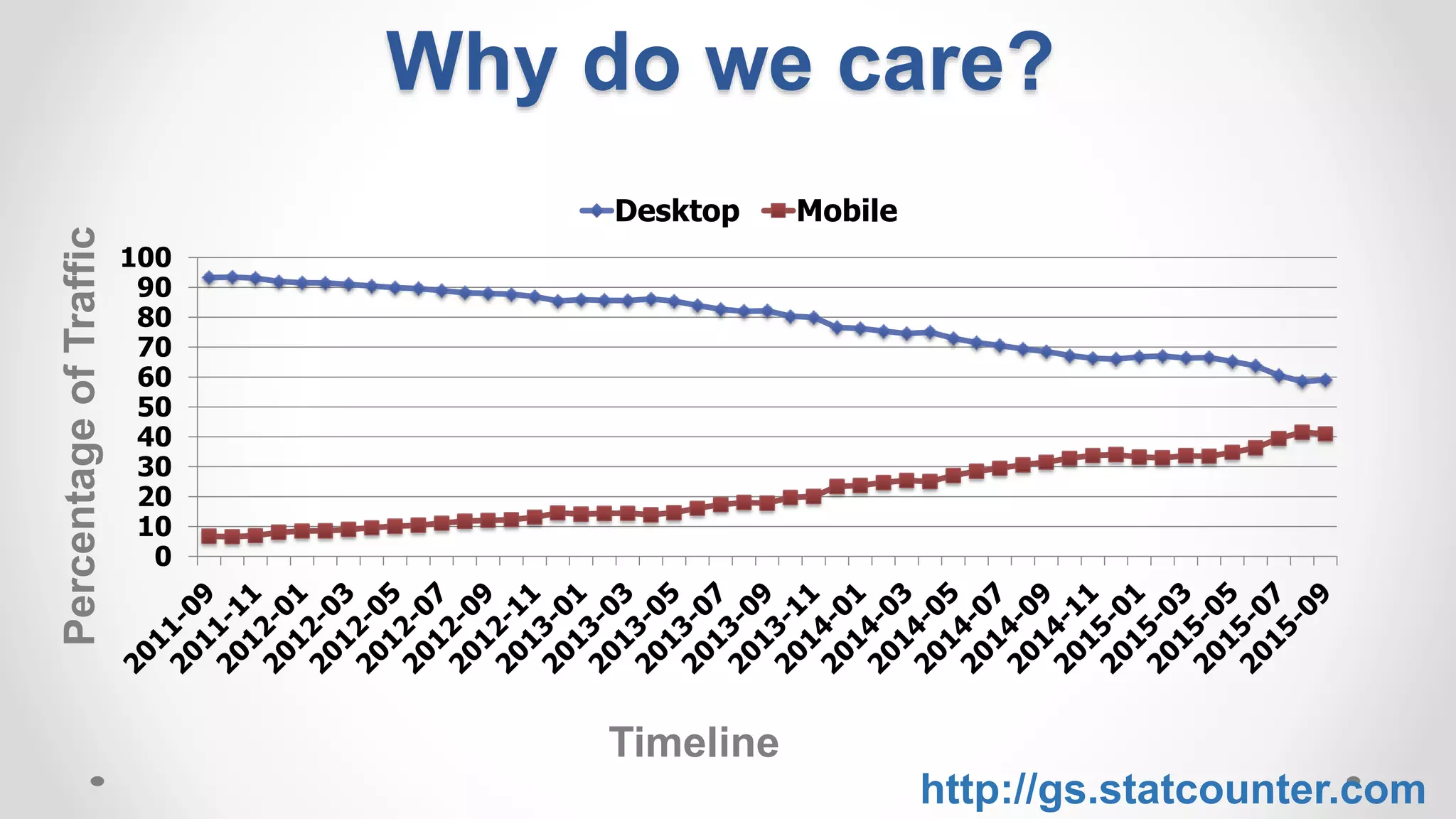
Why do we care?
0
10
20
30
40
50
60
70
80
90
100
Desktop Mobile
Timeline
PercentageofTraffic
http://gs.statcounter.com
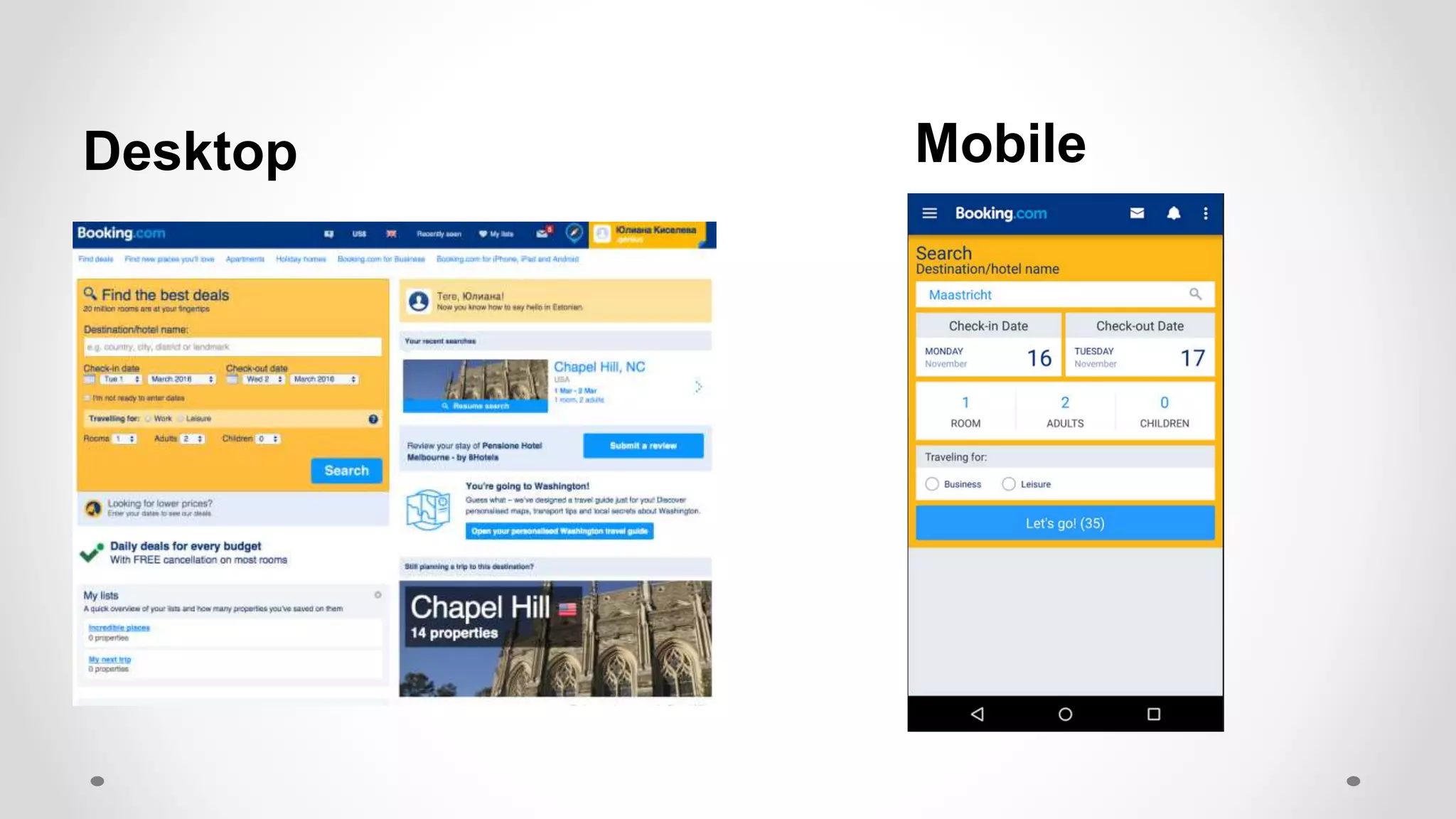
Desktop Mobile
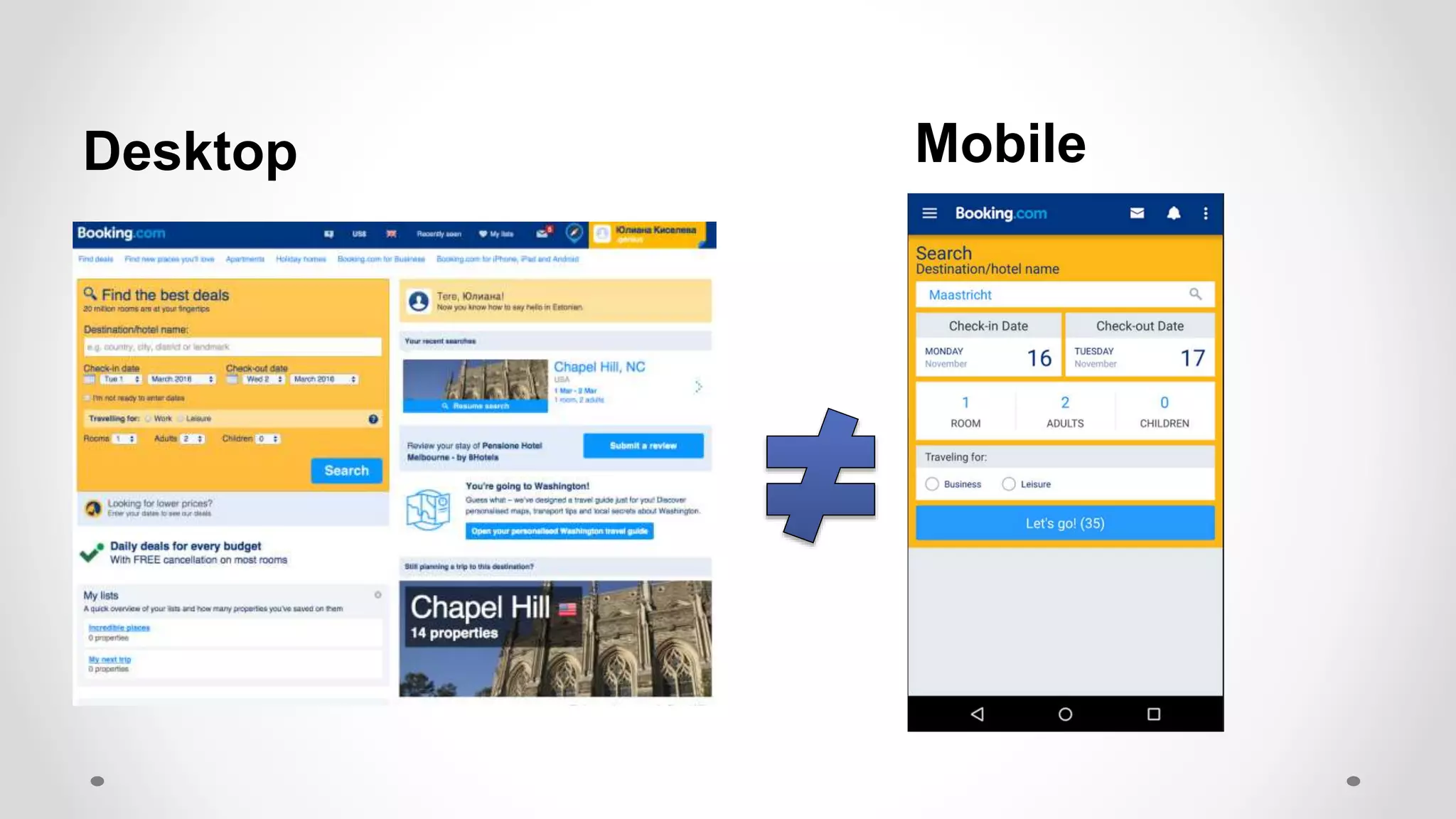
Desktop Mobile
Understanding User Satisfaction
with Intelligent Assistants
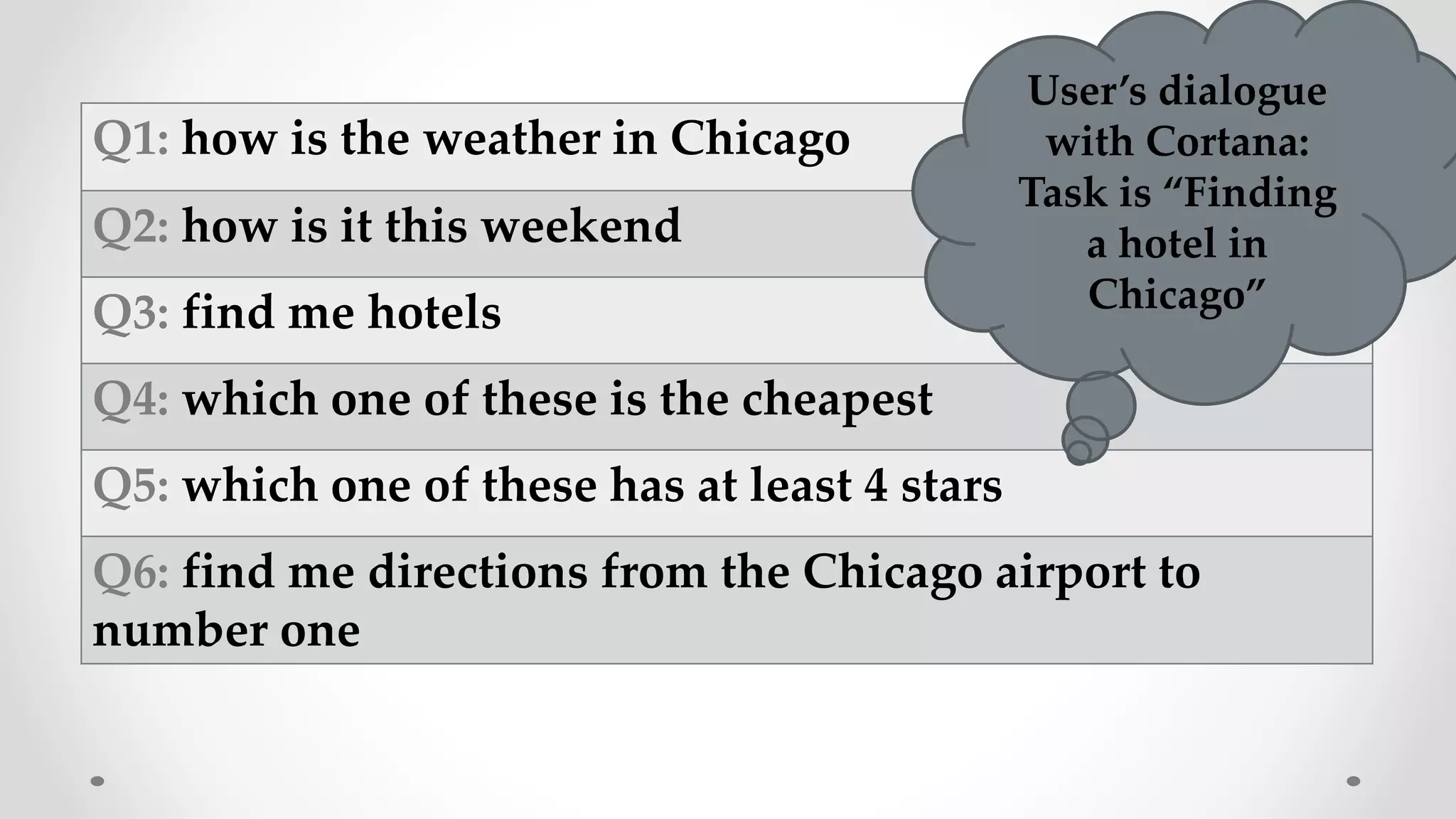
Q1: how is the weather in Chicago
Q2: how is it this weekend
Q3: find me hotels
Q4: which one of these is the cheapest
Q5: which one of these has at least 4 stars
Q6: find me directions from the Chicago airport to
number one
User’s dialogue
with Cortana:
Task is “Finding
a hotel in
Chicago”
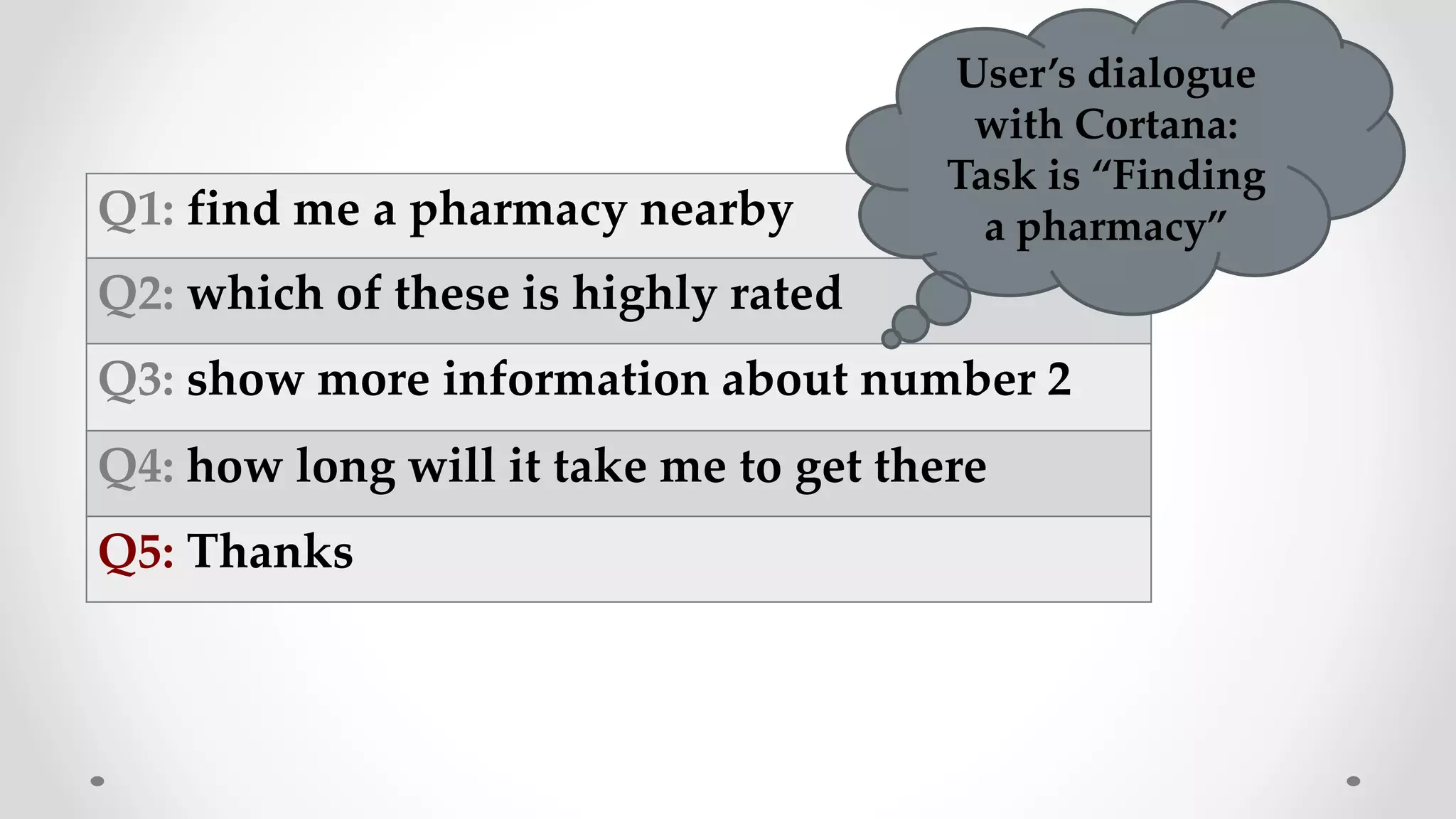
Q1: find me a pharmacy nearby
Q2: which of these is highly rated
Q3: show more information about number 2
Q4: how long will it take me to get there
Q5: Thanks
User’s dialogue
with Cortana:
Task is “Finding
a pharmacy”
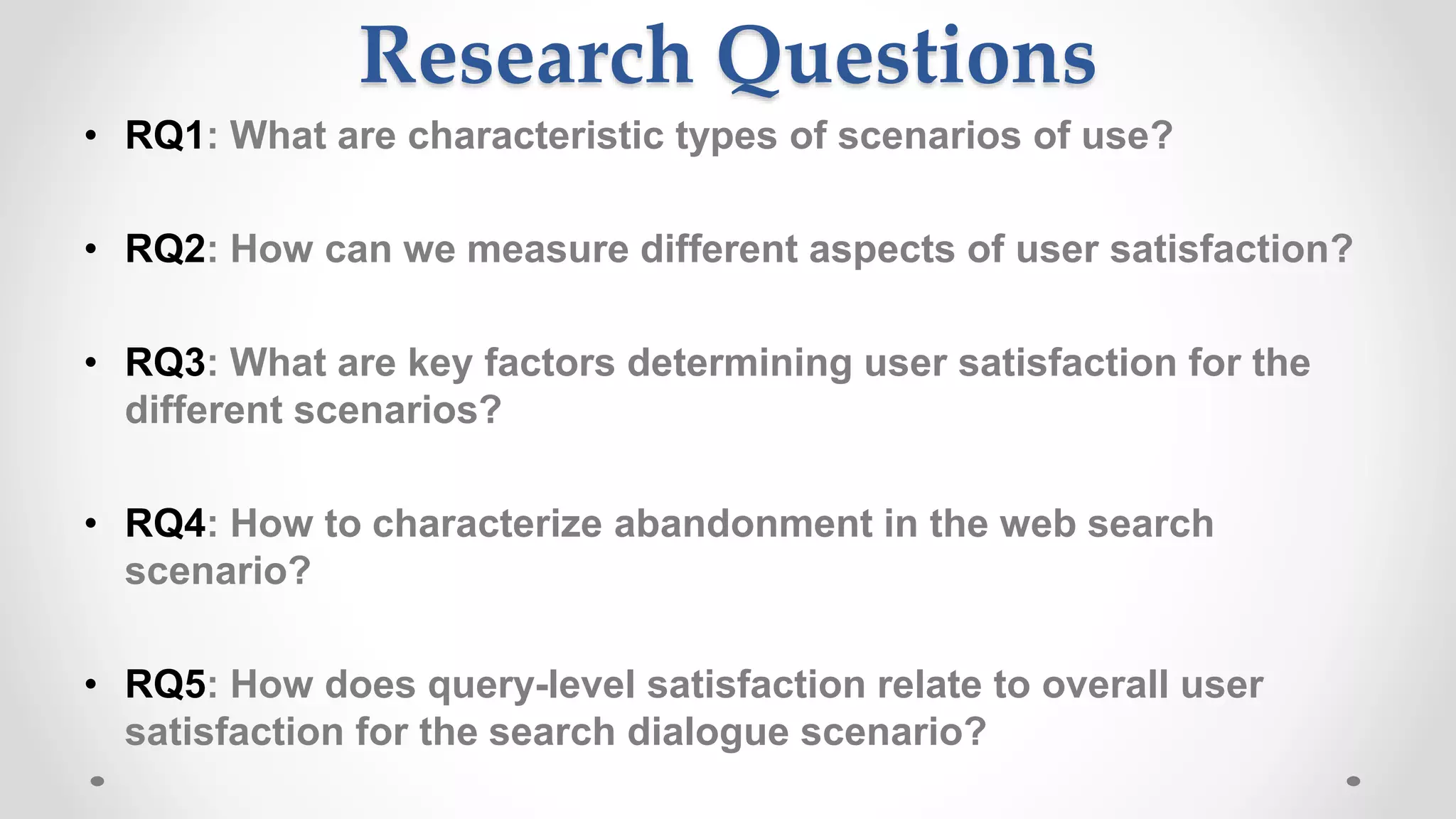
Research Questions
• RQ1: What are characteristic types of scenarios of use?
Controlling Device
• Call a person
• Send a text message
• Check on-device calendar
• Open an application
• Turn on/off wi-fi
• Play music
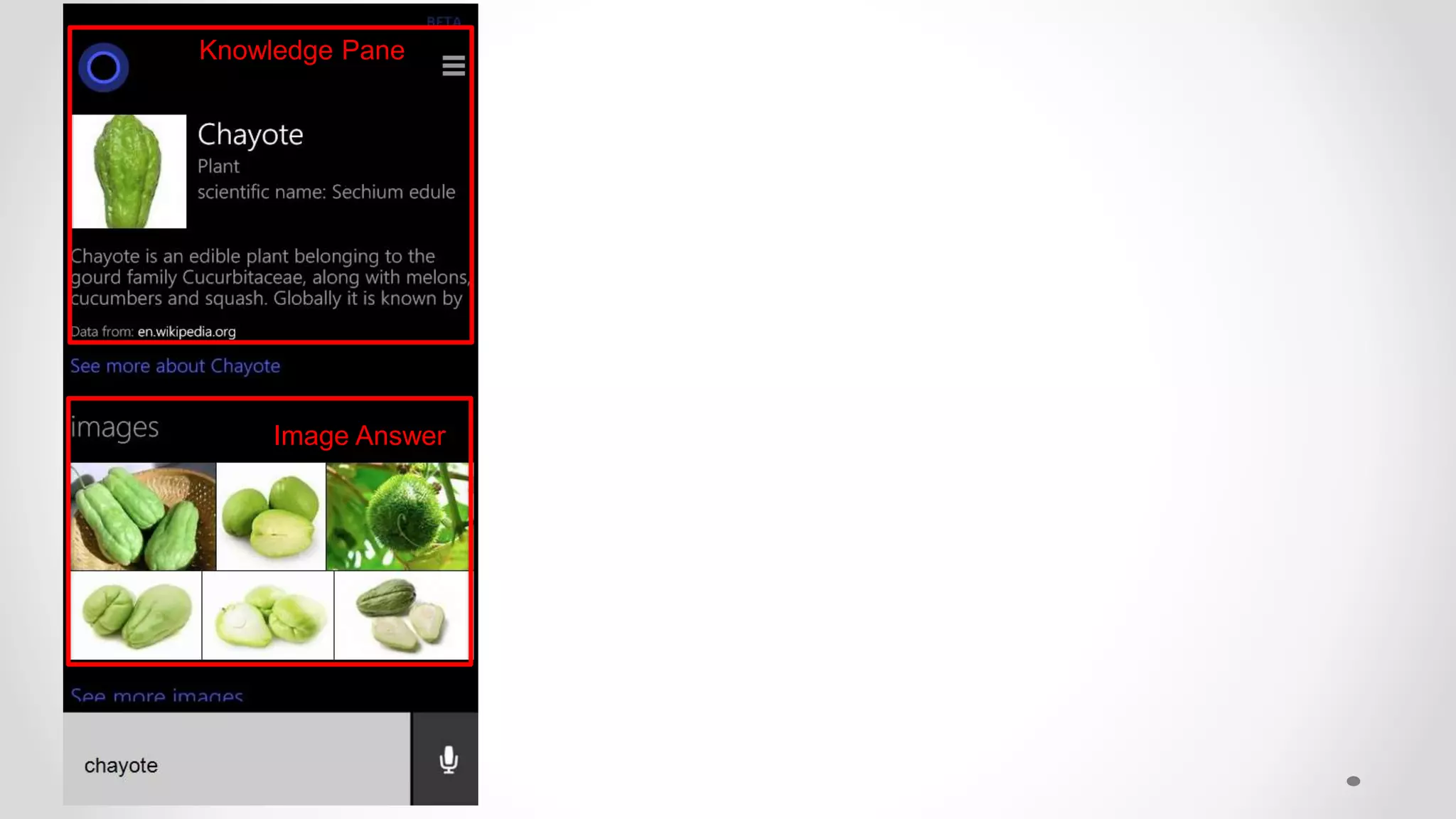
Knowledge Pane
Image Answer
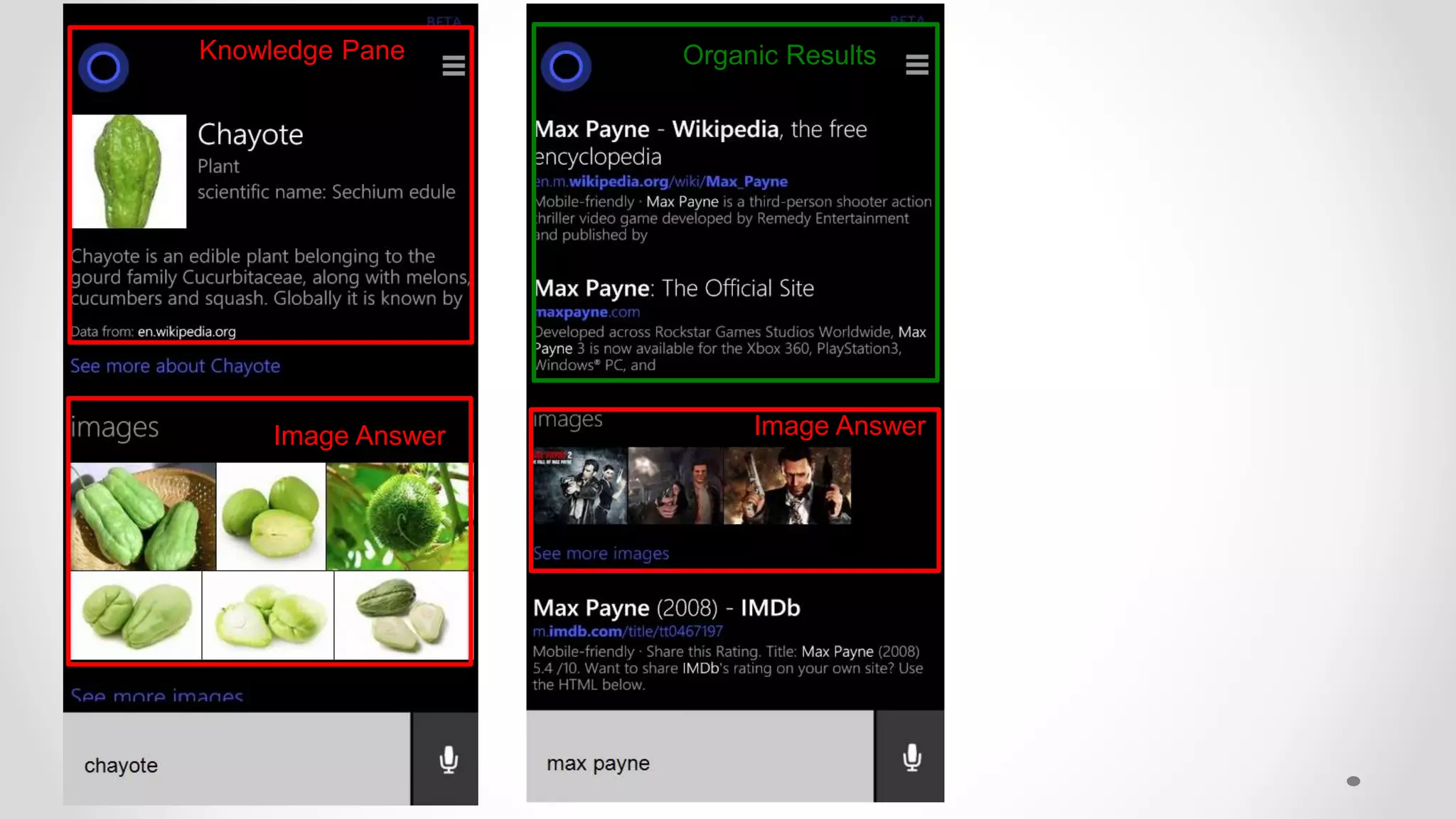
Knowledge Pane
Image Answer Image Answer
Organic Results
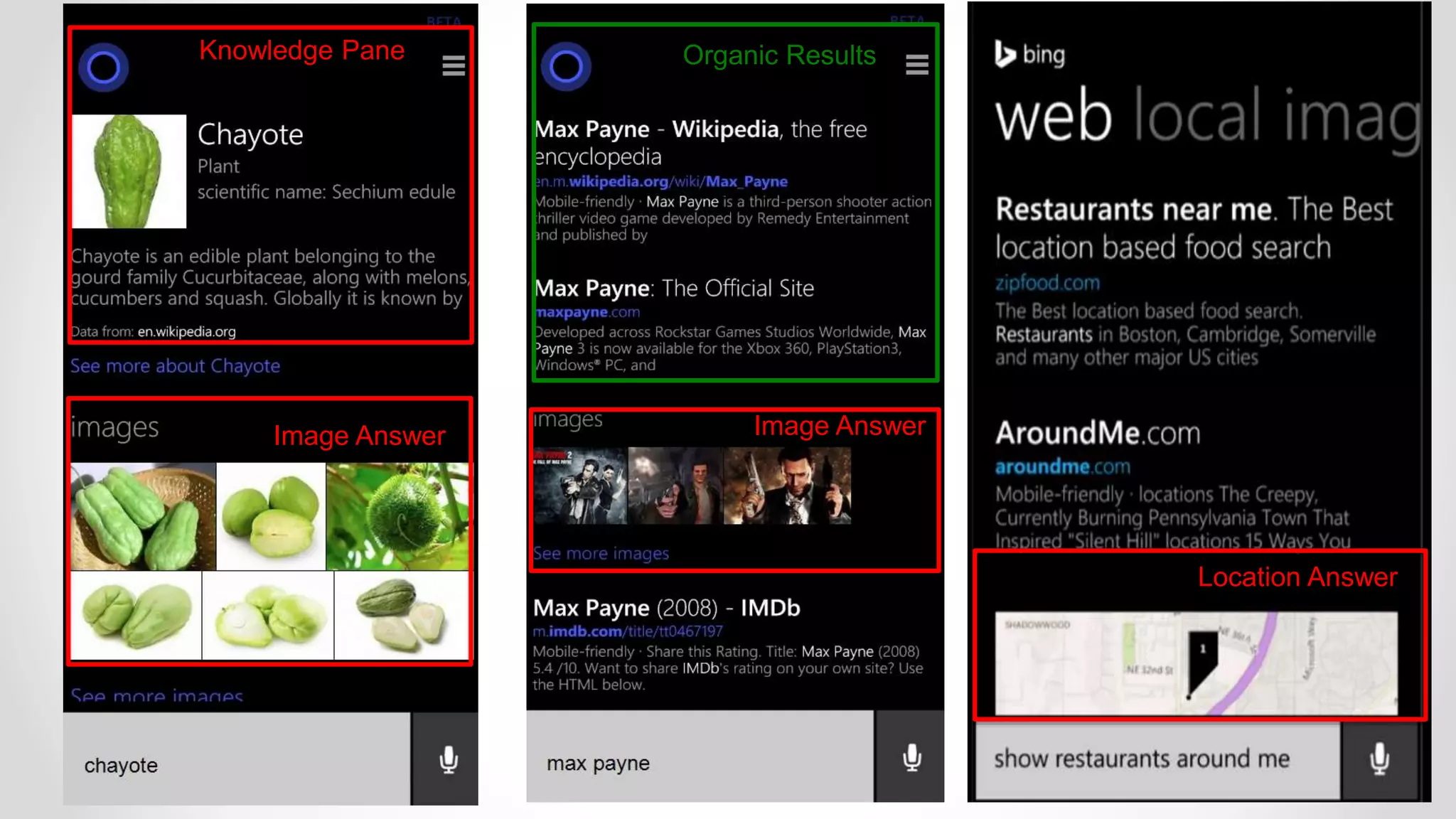
Knowledge Pane
Image Answer Image Answer
Location Answer
Organic Results
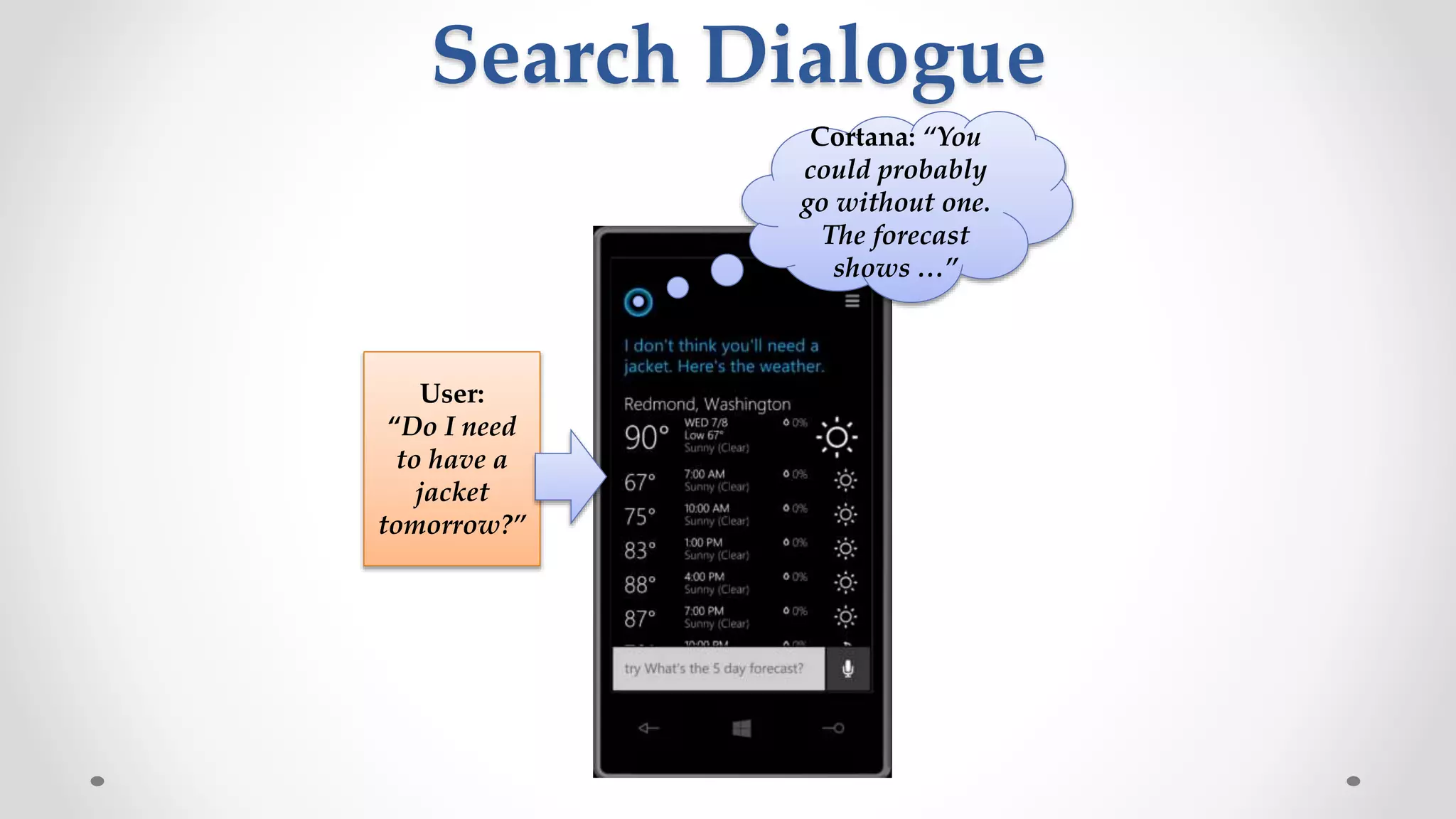
User:
“Do I need
to have a
jacket
tomorrow?”
Search Dialogue
User:
“Do I need
to have a
jacket
tomorrow?”
Cortana: “You
could probably
go without one.
The forecast
shows …”
Search Dialogue
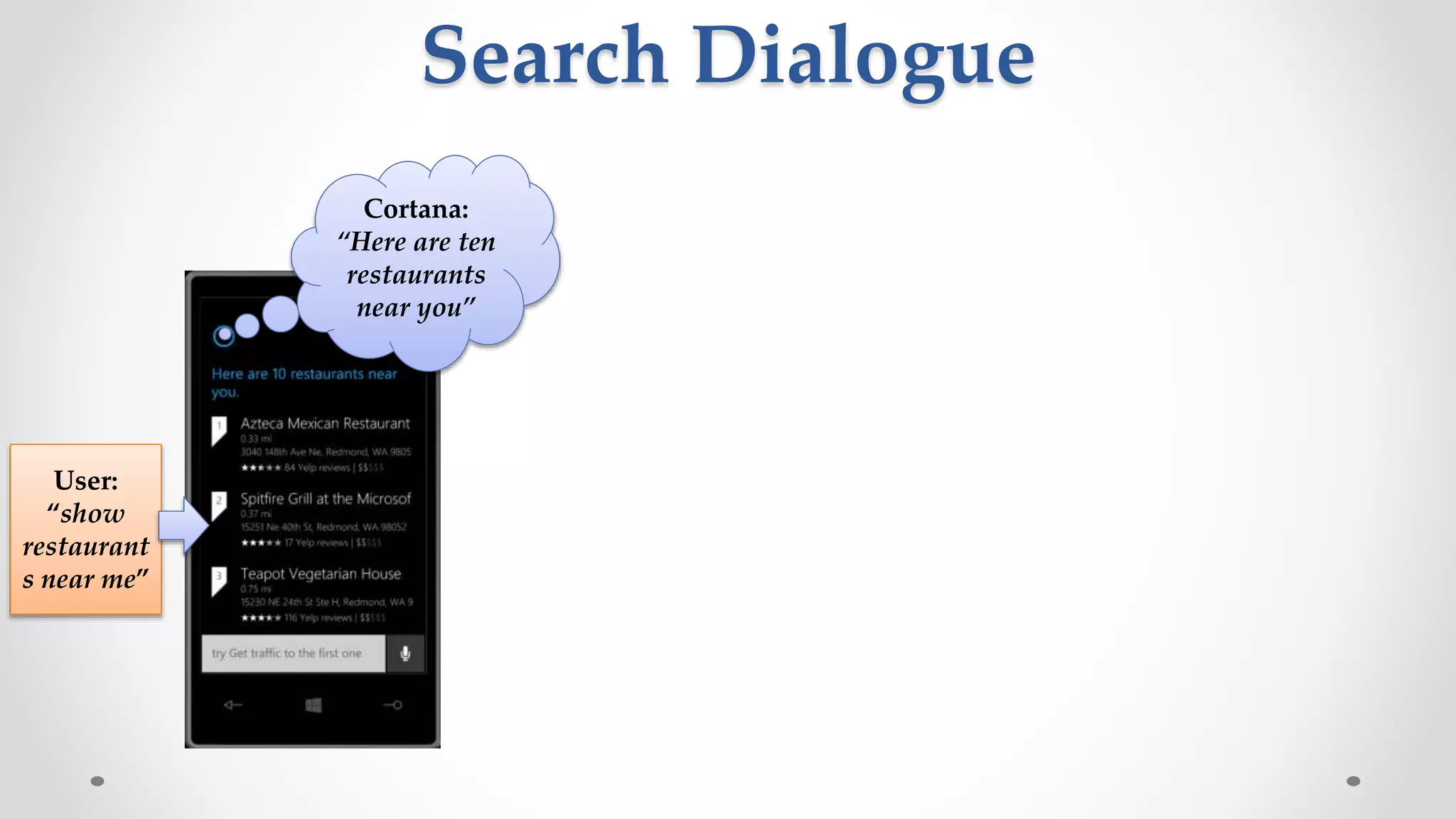
Cortana:
“Here are ten
restaurants
near you”
User:
“show
restaurant
s near me”
Search Dialogue
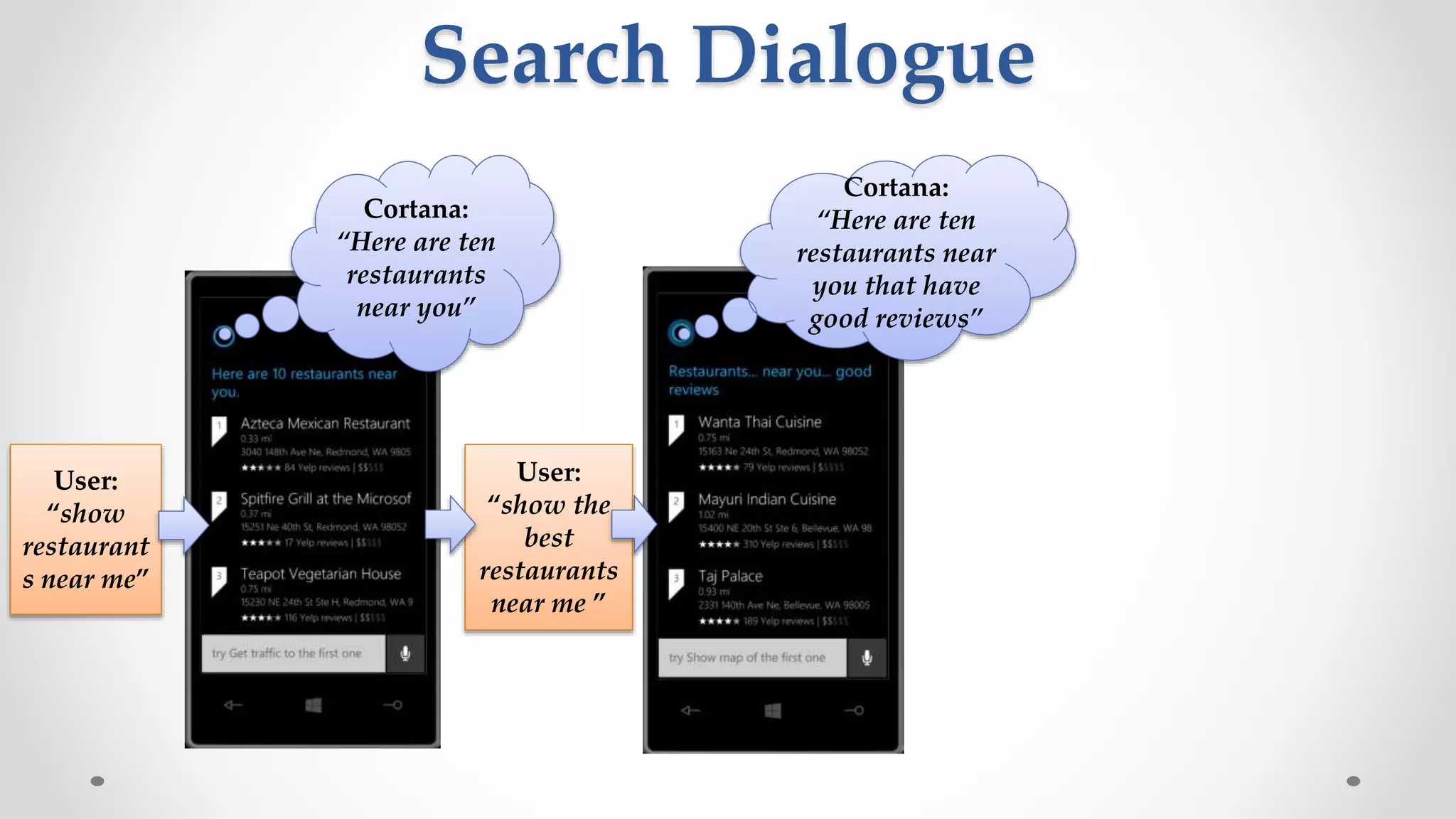
Cortana:
“Here are ten
restaurants
near you”
Cortana:
“Here are ten
restaurants near
you that have
good reviews”
User:
“show
restaurant
s near me”
User:
“show the
best
restaurants
near me ”
Search Dialogue
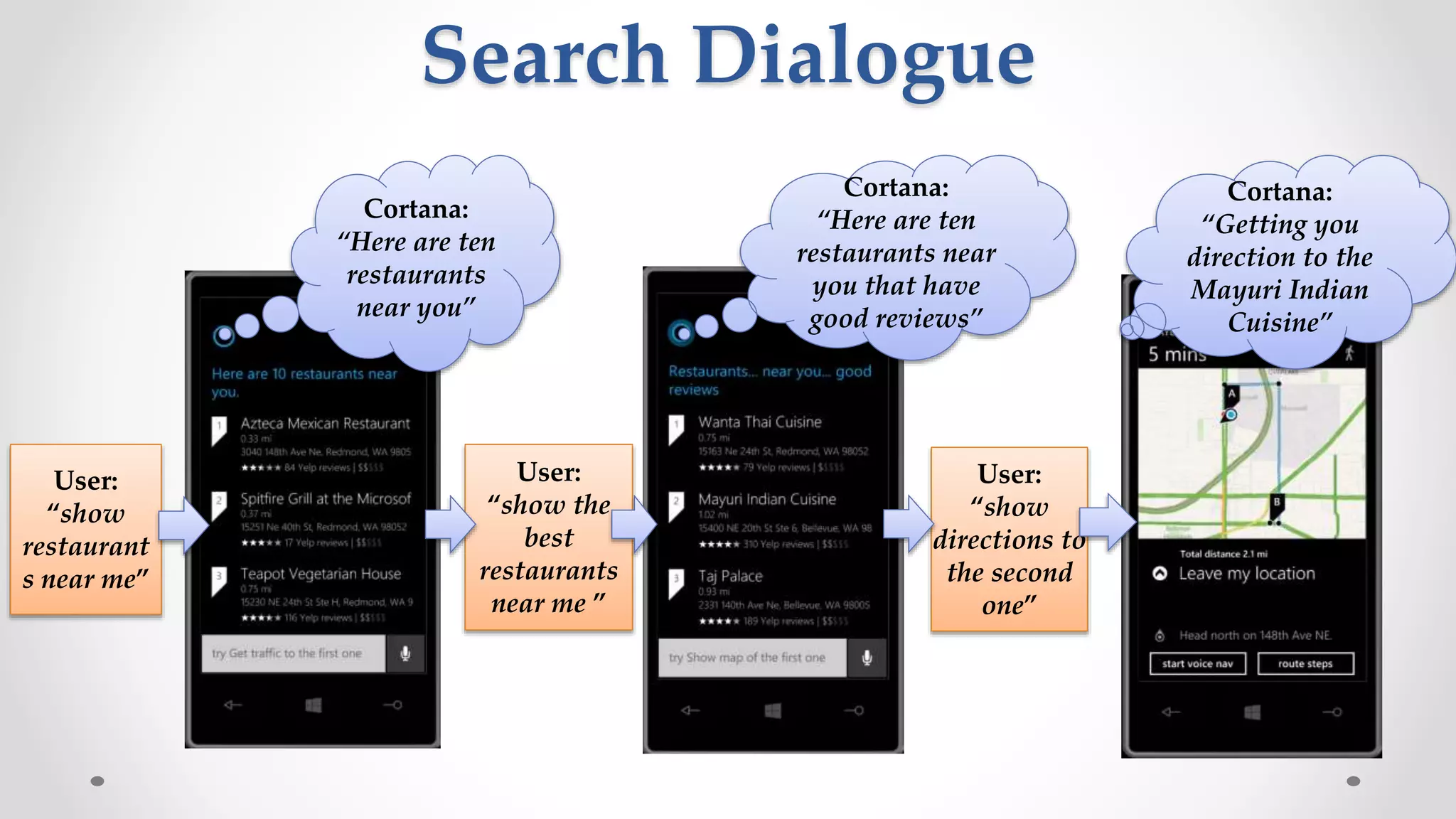
Cortana:
“Here are ten
restaurants
near you”
Cortana:
“Here are ten
restaurants near
you that have
good reviews”
Cortana:
“Getting you
direction to the
Mayuri Indian
Cuisine”
User:
“show
restaurant
s near me”
User:
“show the
best
restaurants
near me ”
User:
“show
directions to
the second
one”
Search Dialogue
Research Questions
• RQ1: What are characteristic types of scenarios of use?
• RQ2: How can we measure different aspects of user satisfaction?
• RQ3: What are key factors determining user satisfaction for the
different scenarios?
• RQ4: How to characterize abandonment in the web search
scenario?
• RQ5: How does query-level satisfaction relate to overall user
satisfaction for the search dialogue scenario?
Research Questions
• RQ1: What are characteristic types of scenarios of use?
• RQ2: How can we measure different aspects of user satisfaction?
• RQ3: What are key factors determining user satisfaction for the
different scenarios?
• RQ4: How to characterize abandonment in the web search
scenario?
• RQ5: How does query-level satisfaction relate to overall user
satisfaction for the search dialogue scenario?
USERSTUDY
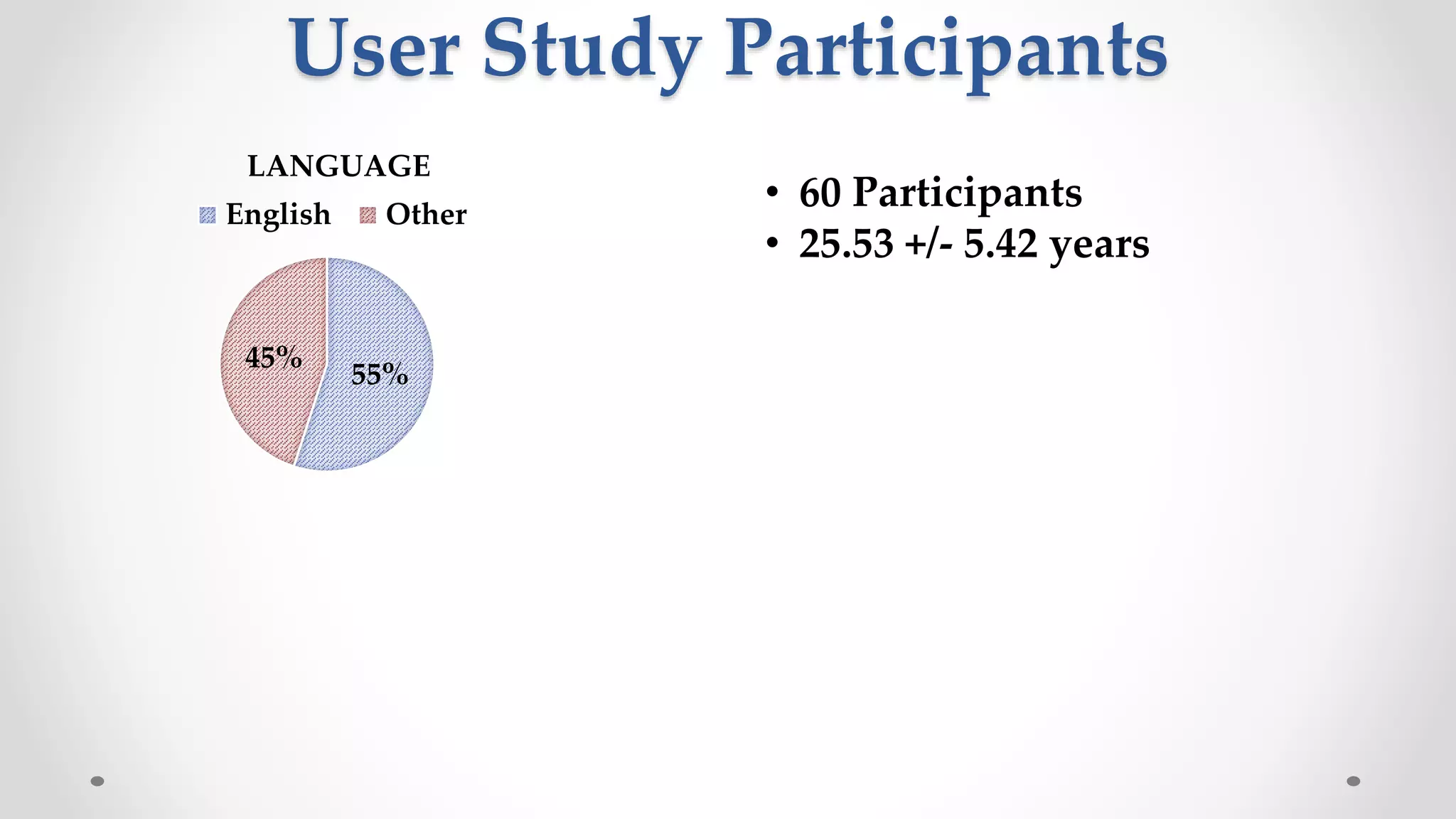
User Study Participants
55%
45%
LANGUAGE
English Other
• 60 Participants
• 25.53 +/- 5.42 years
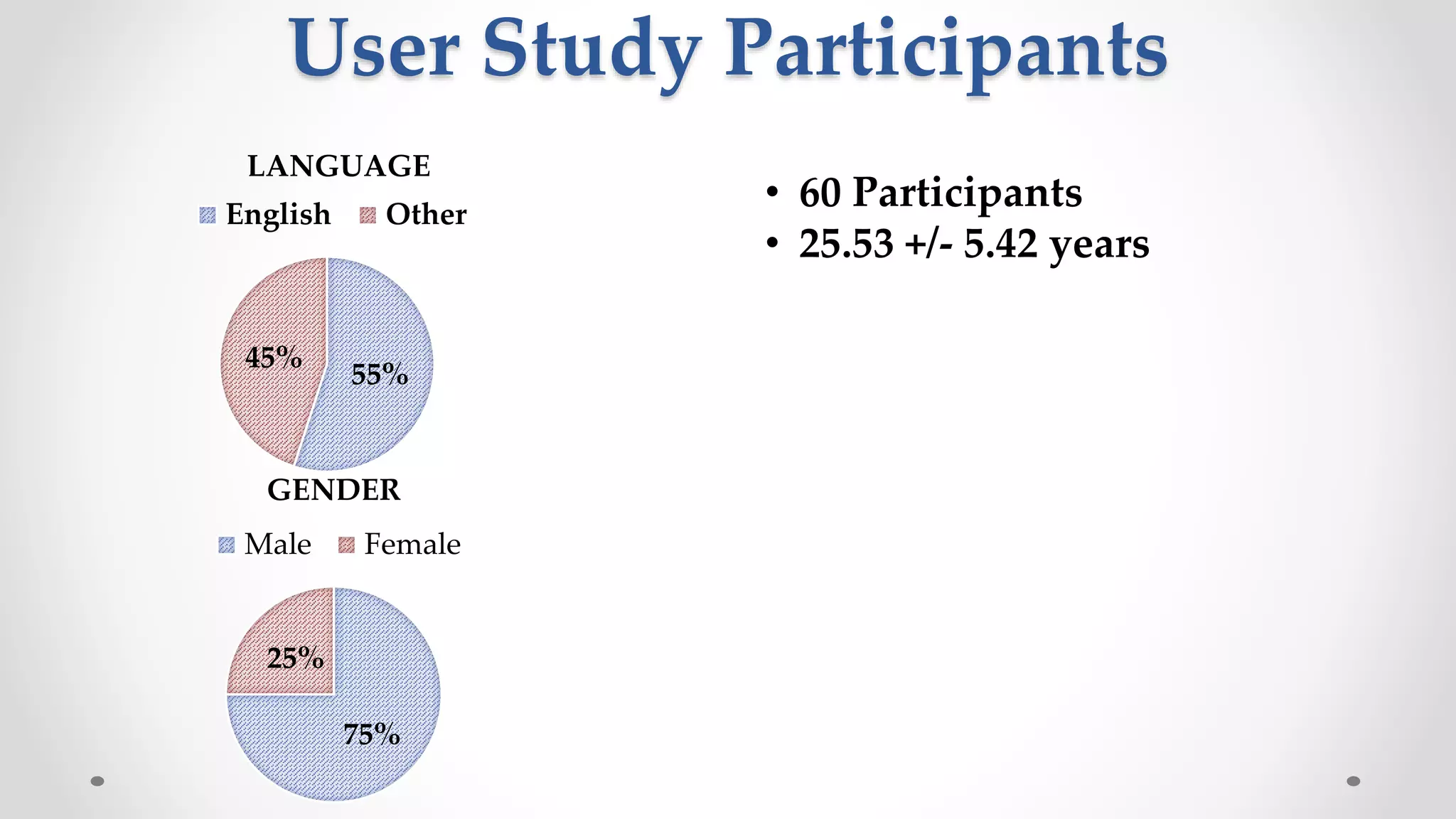
User Study Participants
75%
25%
GENDER
Male Female
55%
45%
LANGUAGE
English Other
• 60 Participants
• 25.53 +/- 5.42 years
User Study Participants
75%
25%
GENDER
Male Female
55%
45%
LANGUAGE
English Other
82%
8%
2%
8%
EDUCATION
Computer Science Electrical Engineering
Mathematics Other
• 60 Participants
• 25.53 +/- 5.42 years
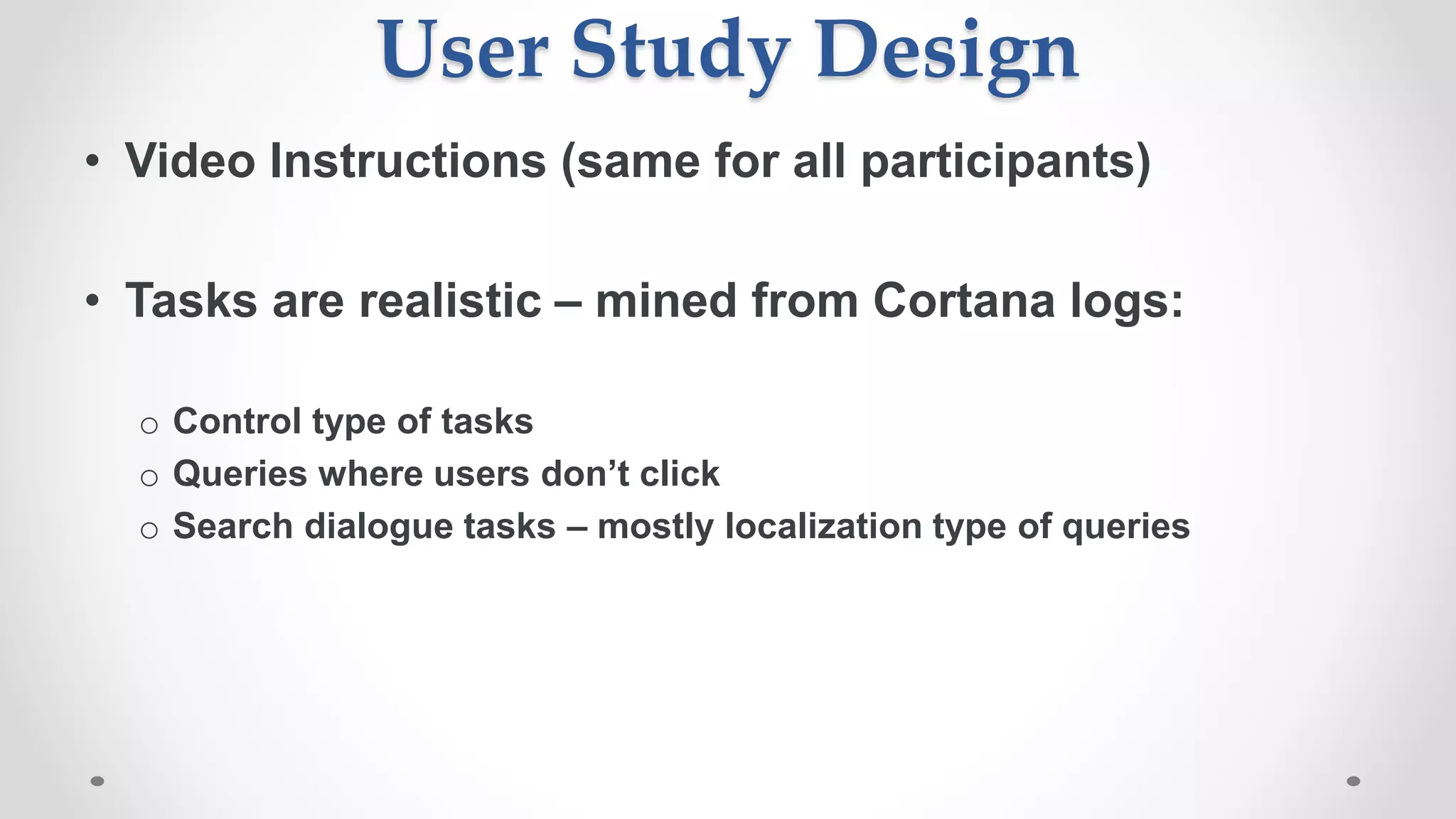
User Study Design
• Video Instructions (same for all participants)
• Tasks are realistic – mined from Cortana logs:
o Control type of tasks
o Queries where users don’t click
o Search dialogue tasks – mostly localization type of queries
Find out what is
the hair color of
your favorite
celebrity
You are planning a
vacation. Pick a place.
Check if the weather is
good enough for the
period you are planning
the vacation. Find a hotel
that suits you. Find the
driving directions to this
place.
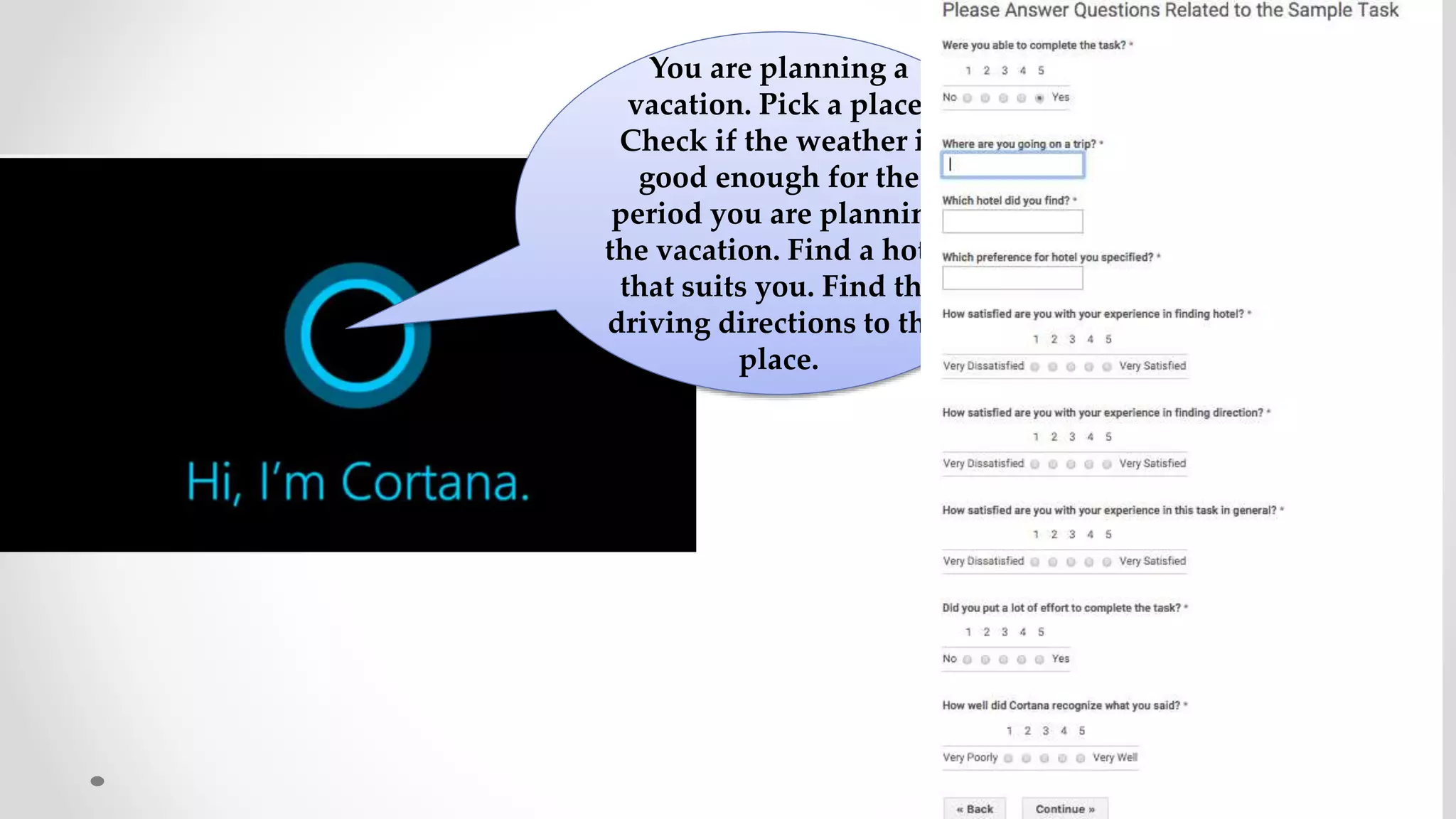
You are planning a
vacation. Pick a place.
Check if the weather is
good enough for the
period you are planning
the vacation. Find a hotel
that suits you. Find the
driving directions to this
place.
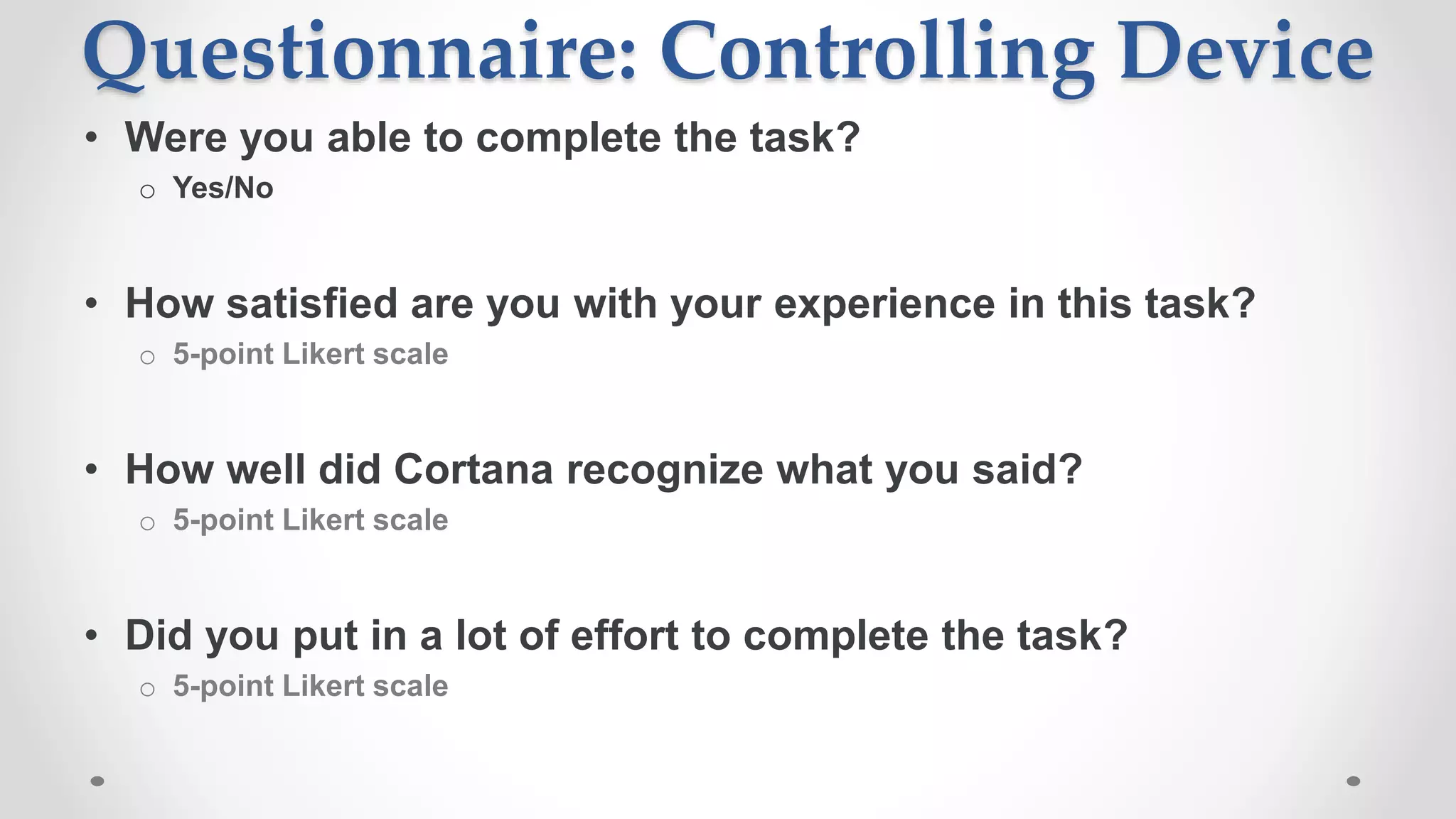
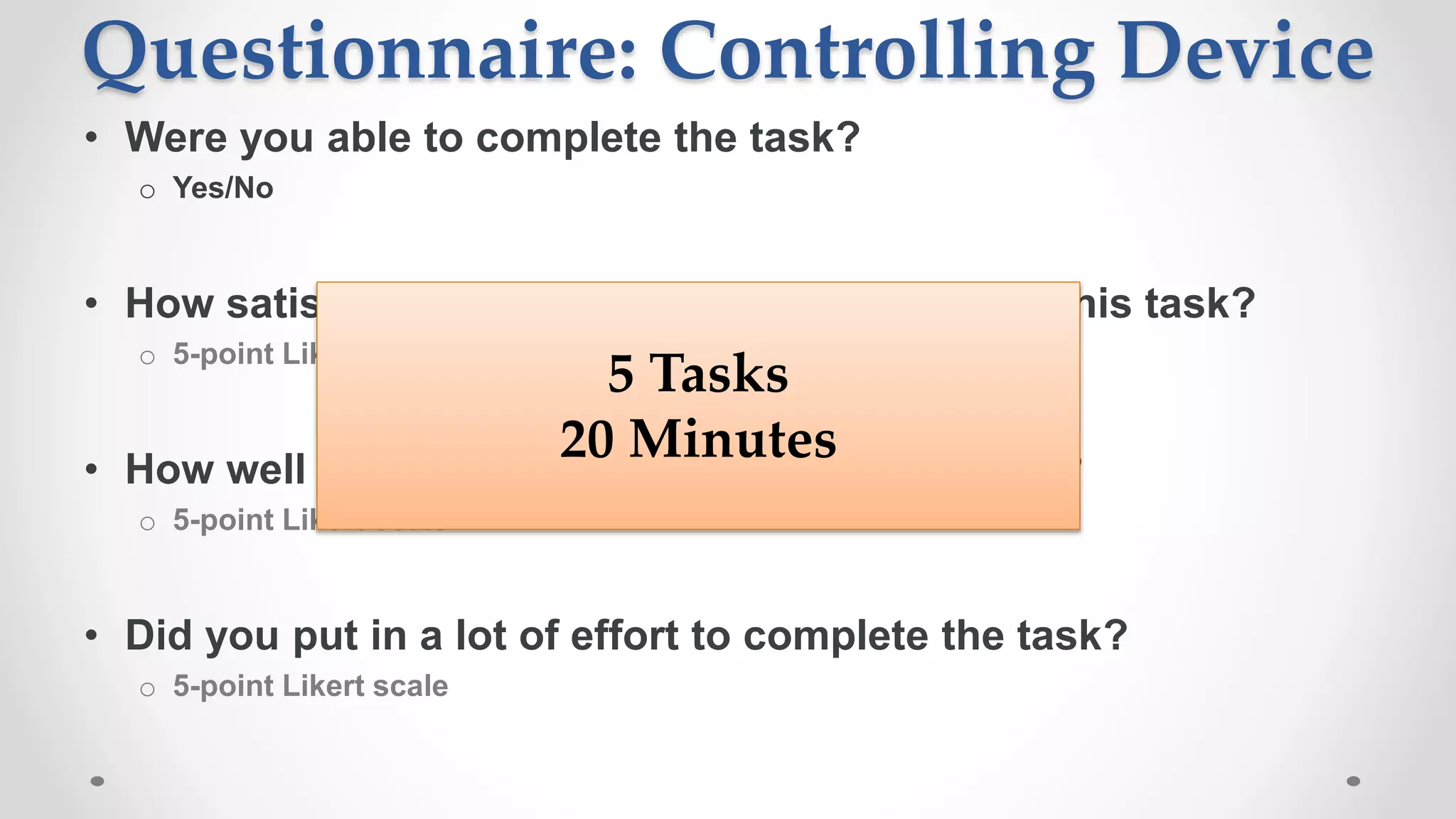
Questionnaire: Controlling Device
• Were you able to complete the task?
o Yes/No
• How satisfied are you with your experience in this task?
o 5-point Likert scale
• How well did Cortana recognize what you said?
o 5-point Likert scale
• Did you put in a lot of effort to complete the task?
o 5-point Likert scale
Questionnaire: Controlling Device
• Were you able to complete the task?
o Yes/No
• How satisfied are you with your experience in this task?
o 5-point Likert scale
• How well did Cortana recognize what you said?
o 5-point Likert scale
• Did you put in a lot of effort to complete the task?
o 5-point Likert scale
5 Tasks
20 Minutes
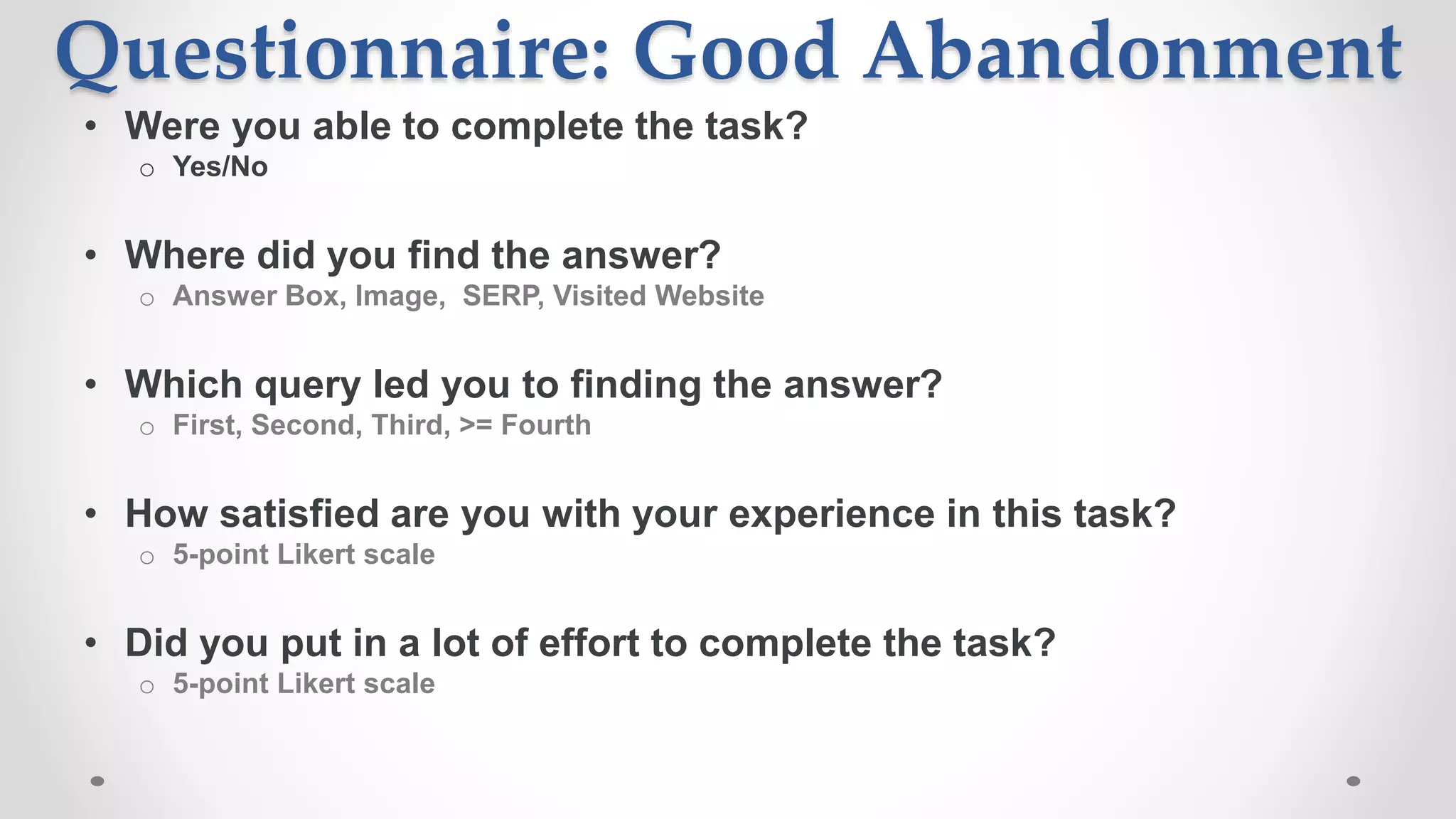
Questionnaire: Good Abandonment
• Were you able to complete the task?
o Yes/No
• Where did you find the answer?
o Answer Box, Image, SERP, Visited Website
• Which query led you to finding the answer?
o First, Second, Third, >= Fourth
• How satisfied are you with your experience in this task?
o 5-point Likert scale
• Did you put in a lot of effort to complete the task?
o 5-point Likert scale
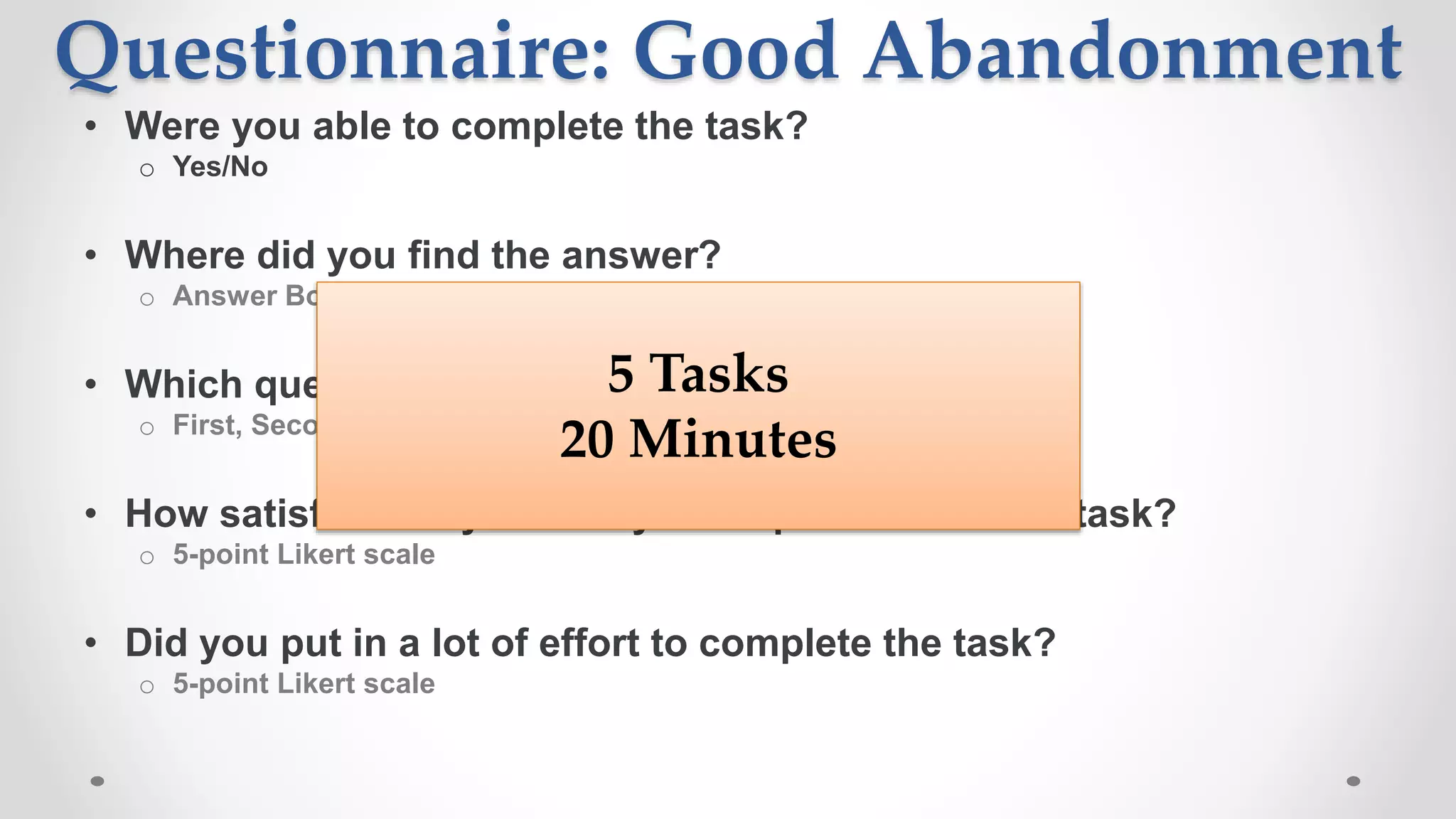
Questionnaire: Good Abandonment
• Were you able to complete the task?
o Yes/No
• Where did you find the answer?
o Answer Box, Image, SERP, Visited Website
• Which query led you to finding the answer?
o First, Second, Third, >= Fourth
• How satisfied are you with your experience in this task?
o 5-point Likert scale
• Did you put in a lot of effort to complete the task?
o 5-point Likert scale
5 Tasks
20 Minutes
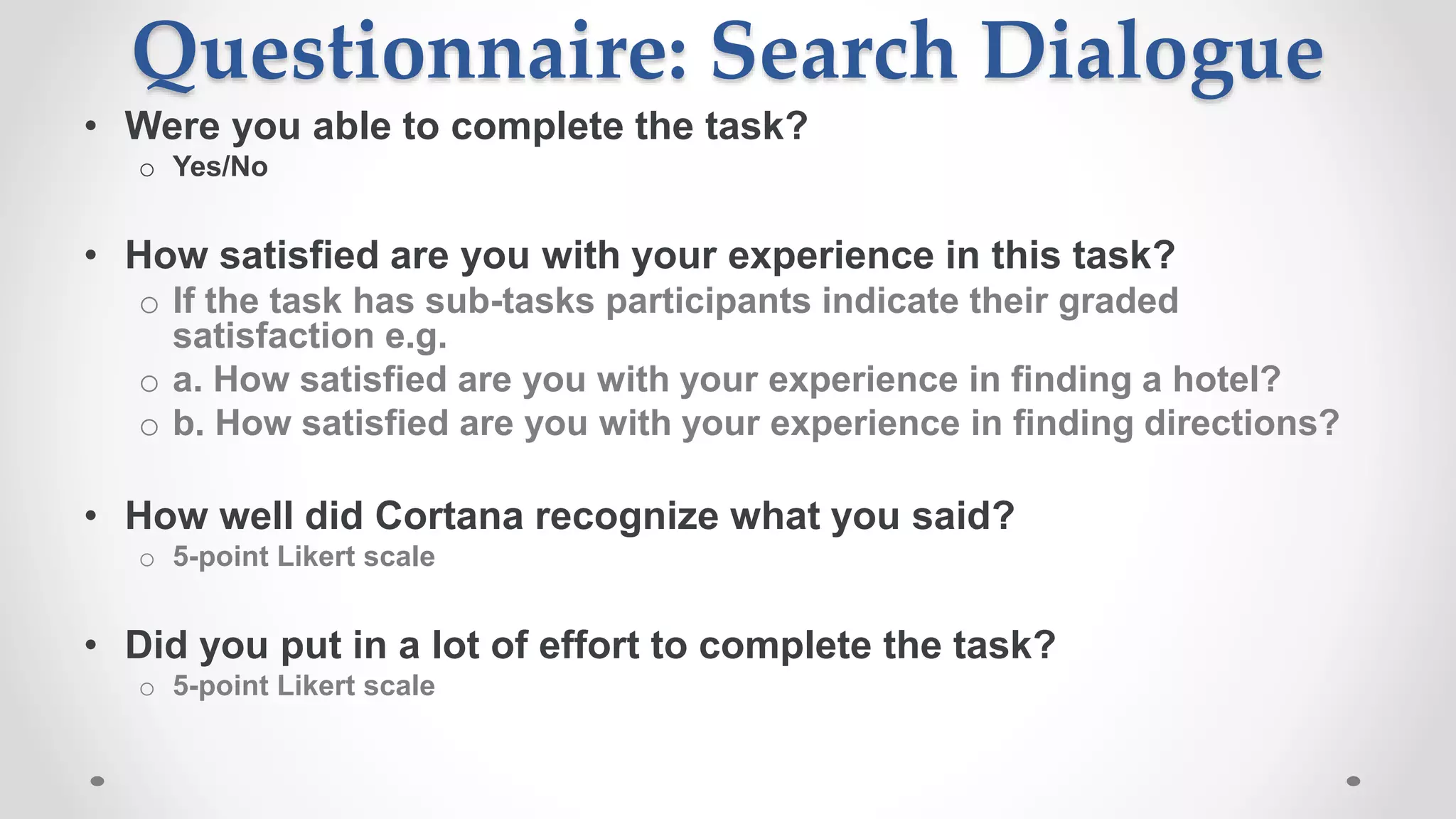
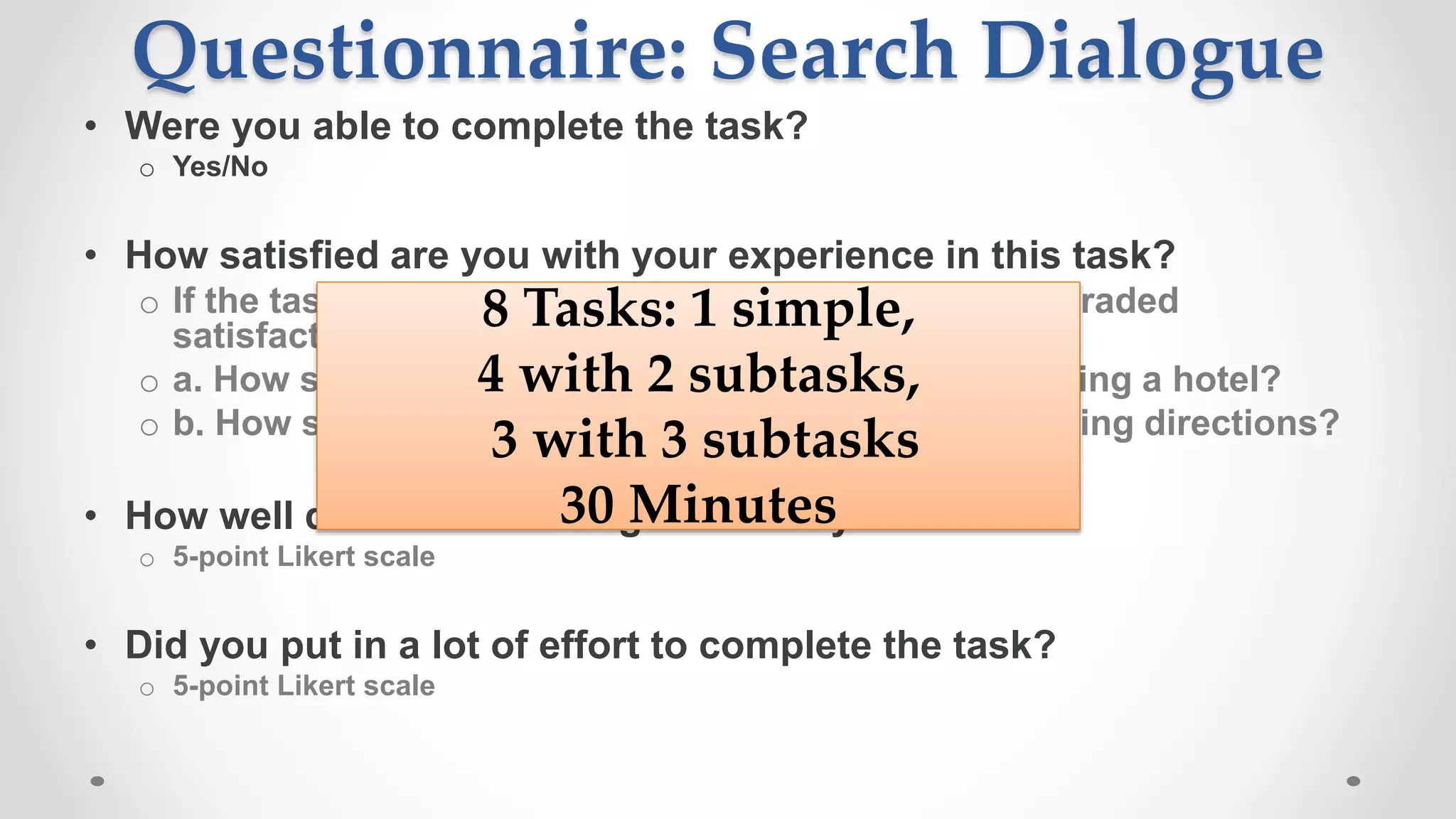
Questionnaire: Search Dialogue
• Were you able to complete the task?
o Yes/No
• How satisfied are you with your experience in this task?
o If the task has sub-tasks participants indicate their graded
satisfaction e.g.
o a. How satisfied are you with your experience in finding a hotel?
o b. How satisfied are you with your experience in finding directions?
• How well did Cortana recognize what you said?
o 5-point Likert scale
• Did you put in a lot of effort to complete the task?
o 5-point Likert scale
Questionnaire: Search Dialogue
• Were you able to complete the task?
o Yes/No
• How satisfied are you with your experience in this task?
o If the task has sub-tasks participants indicate their graded
satisfaction e.g.
o a. How satisfied are you with your experience in finding a hotel?
o b. How satisfied are you with your experience in finding directions?
• How well did Cortana recognize what you said?
o 5-point Likert scale
• Did you put in a lot of effort to complete the task?
o 5-point Likert scale
8 Tasks: 1 simple,
4 with 2 subtasks,
3 with 3 subtasks
30 Minutes
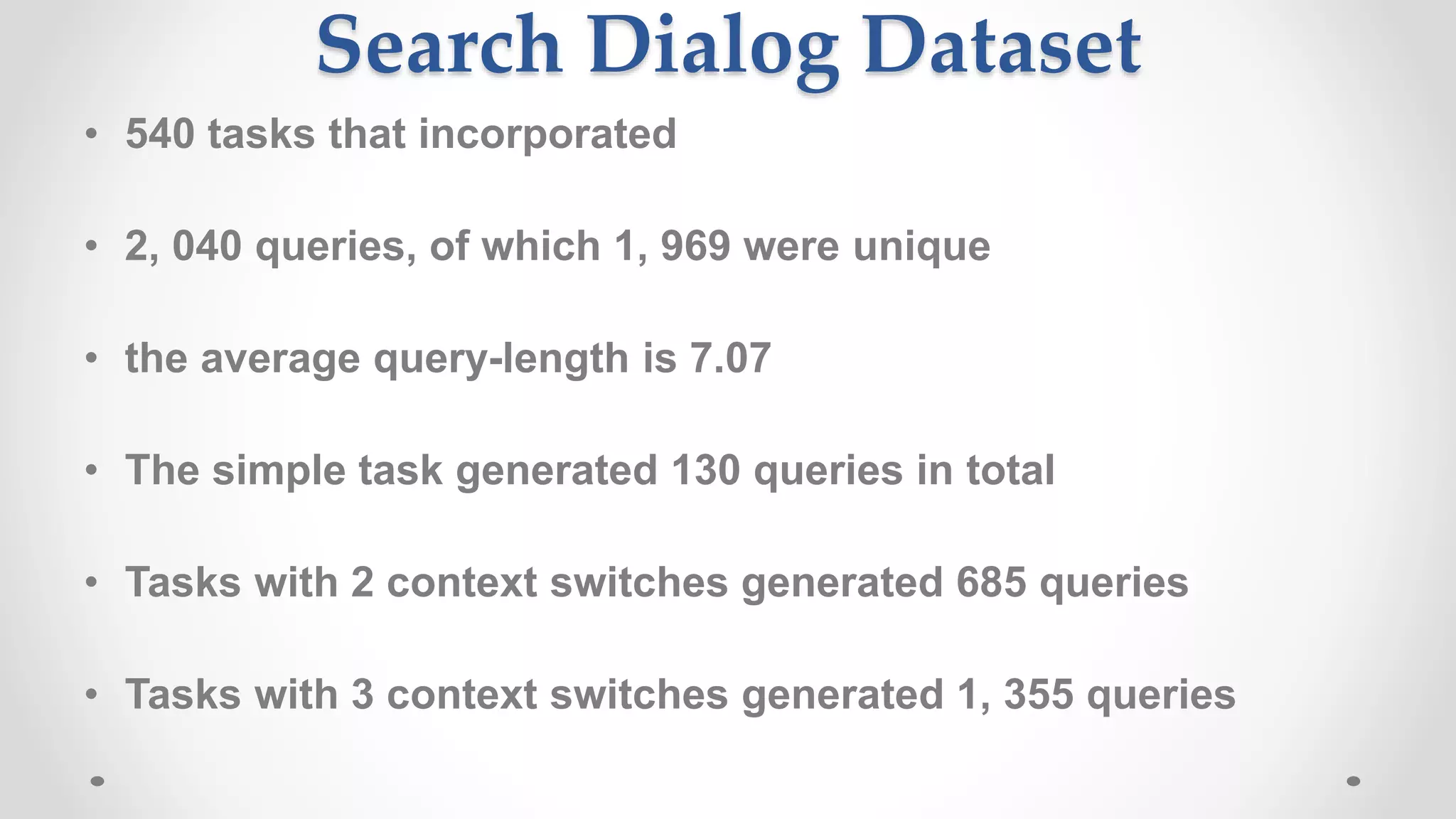
Search Dialog Dataset
• 540 tasks that incorporated
• 2, 040 queries, of which 1, 969 were unique
• the average query-length is 7.07
• The simple task generated 130 queries in total
• Tasks with 2 context switches generated 685 queries
• Tasks with 3 context switches generated 1, 355 queries
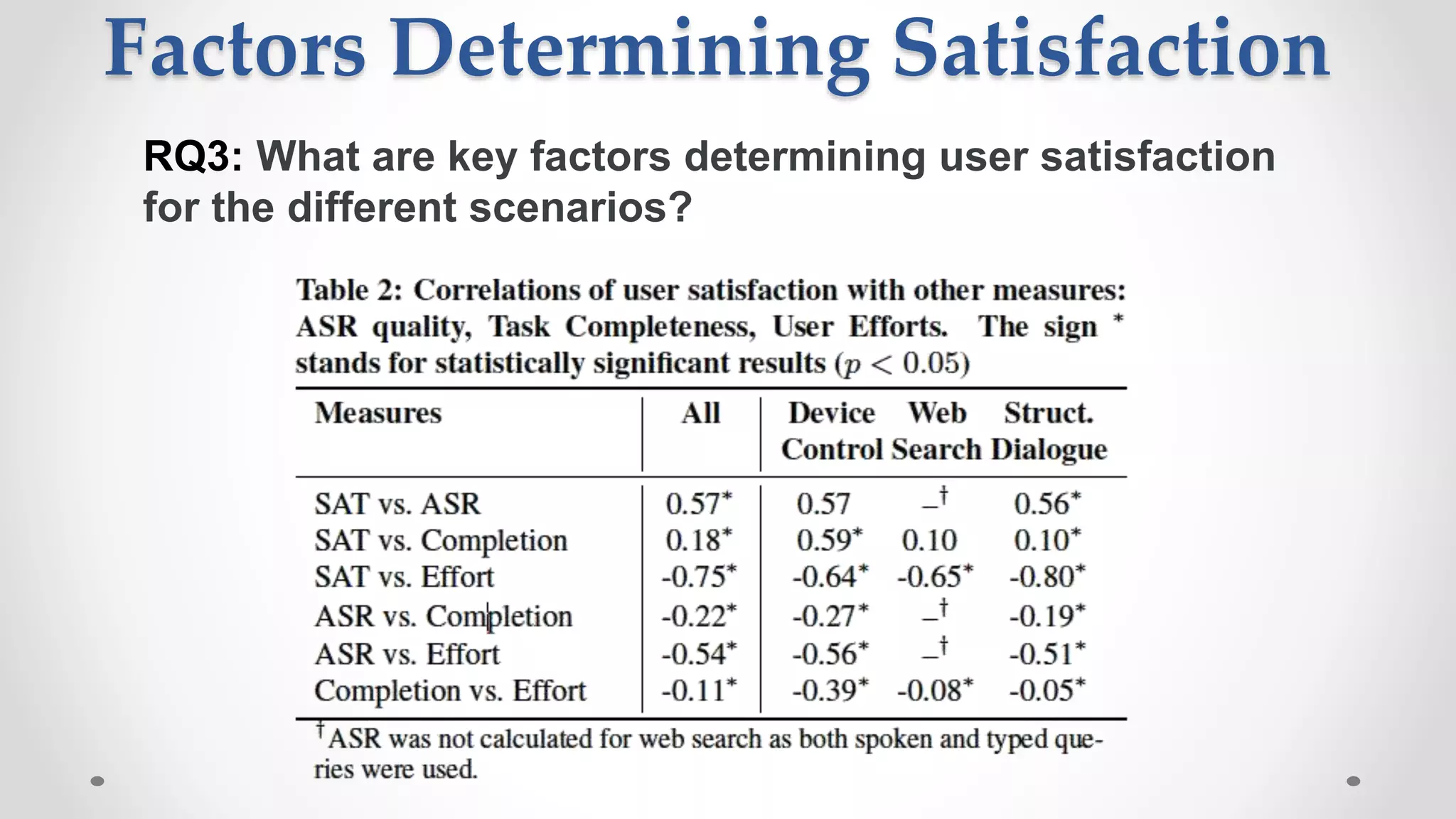
Factors Determining Satisfaction
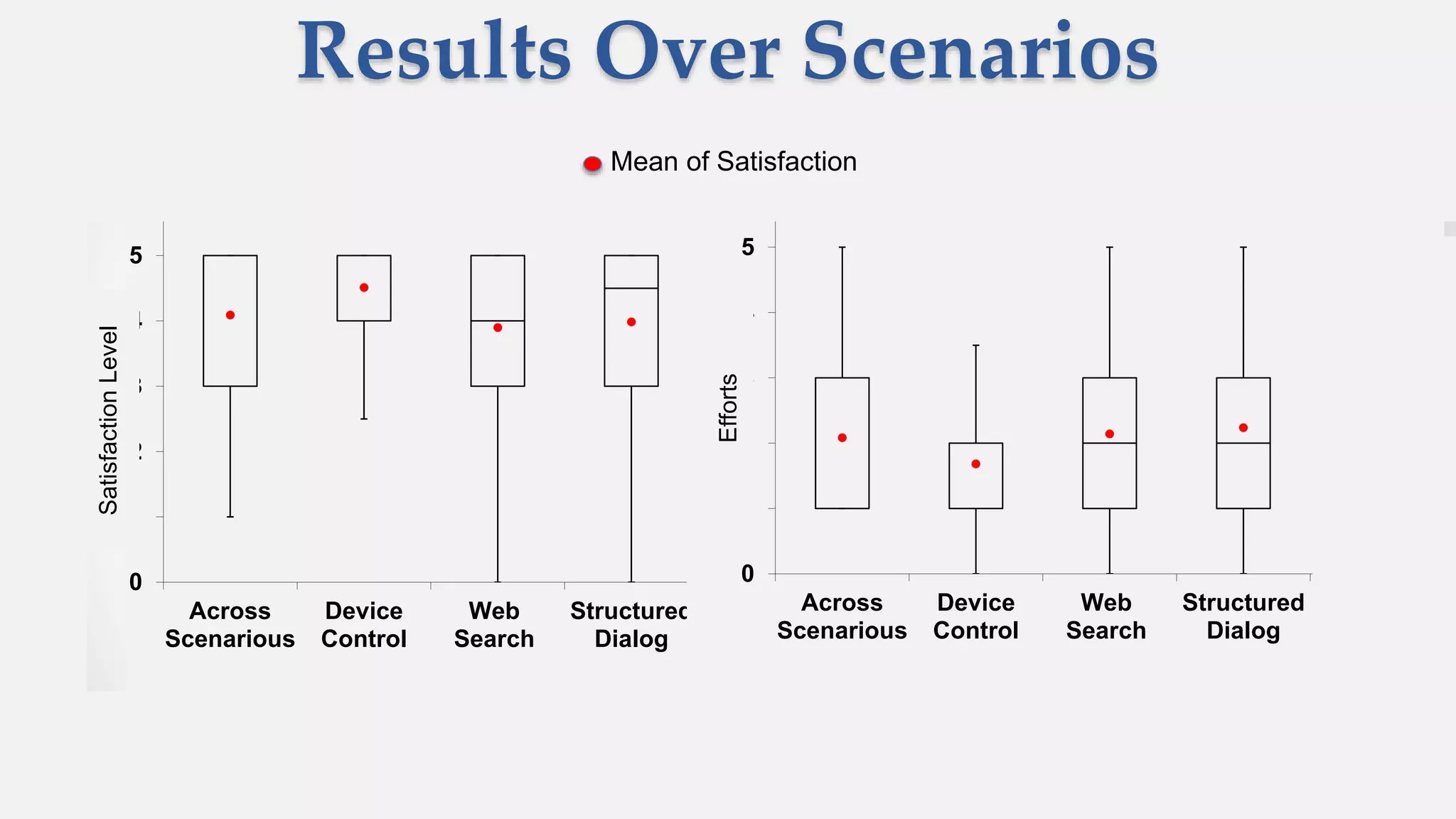
RQ3: What are key factors determining user satisfaction
for the different scenarios?
0
1
2
3
4
5
6
Across
Scenarious
Device
Control
Web
Search
Structured
Dialog
5
0
1
2
3
4
5
6
Across
Scenarious
Device
Control
Web
Search
Structured
Dialog
5
SatisfactionLevel
Efforts
Results Over Scenarios
Mean of Satisfaction
Results `Good Abandonment’
RQ4: How to characterize abandonment in the web
search scenario?
0
1
2
3
4
5
6
First Query Second
Query
Third
Query
>= Fourth
Quey
0
1
2
3
4
5
6
Answer
Box
Image SERP Visited
WebSite
5
SatisfactionLevel
Results `Good Abandonment’
Mean of Satisfaction
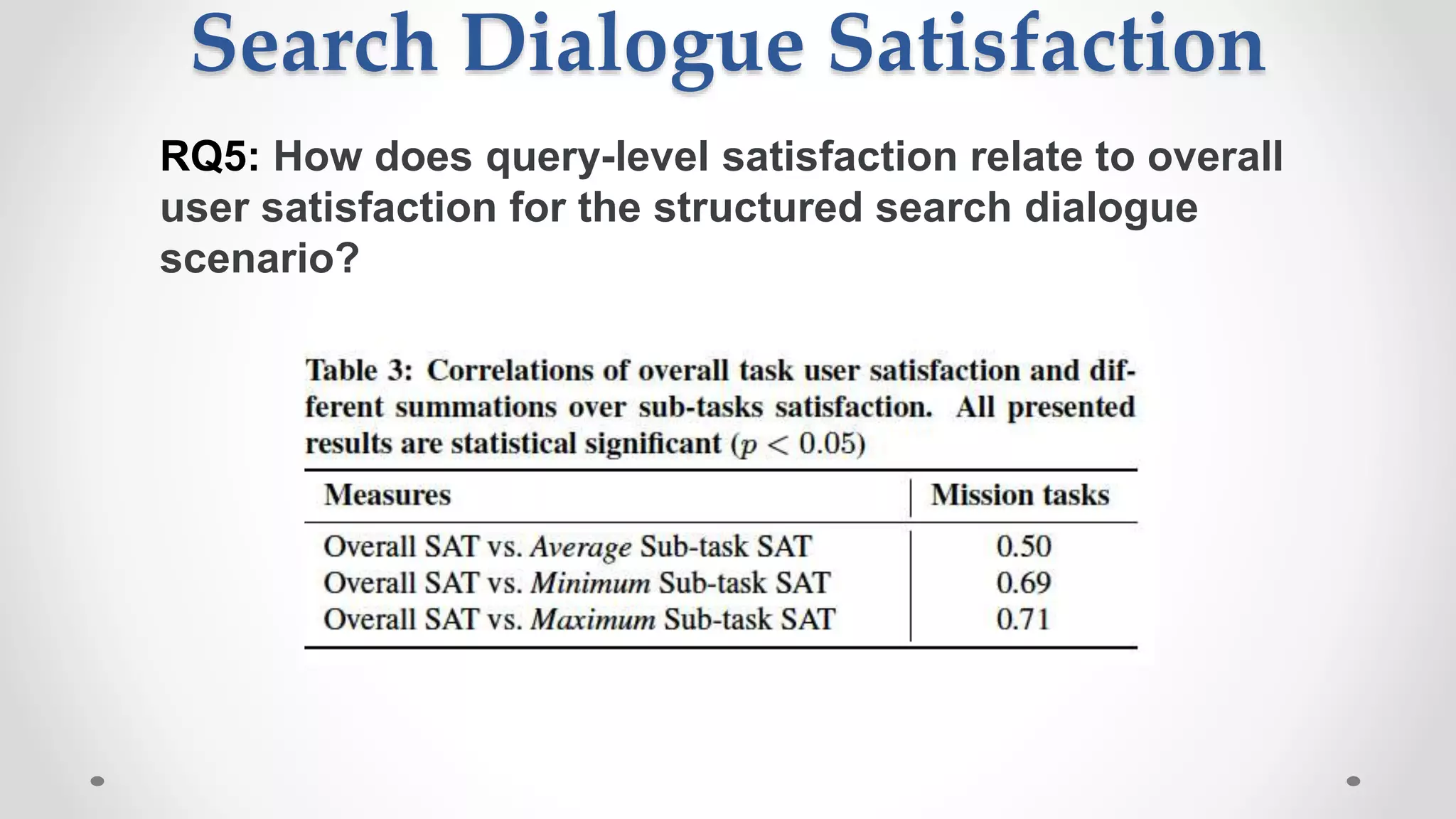
Search Dialogue Satisfaction
RQ5: How does query-level satisfaction relate to overall
user satisfaction for the structured search dialogue
scenario?
Cortana:
“Here are ten
restaurants
near you”
Cortana:
“Here are ten
restaurants near
you that have
good reviews”
Cortana:
“Getting you
direction to the
Mayuri Indian
Cuisine”
User:
“show
restaurant
s near me”
User:
“show the
best
restaurants
near me ”
User:
“show
directions to
the second
one”
SAT? SAT? SAT?
SAT? SAT? SAT?
Overall
SAT?
?
Search Dialogue Satisfaction
RQ5: How does query-level satisfaction relate to overall
user satisfaction for the structured search dialogue
scenario?
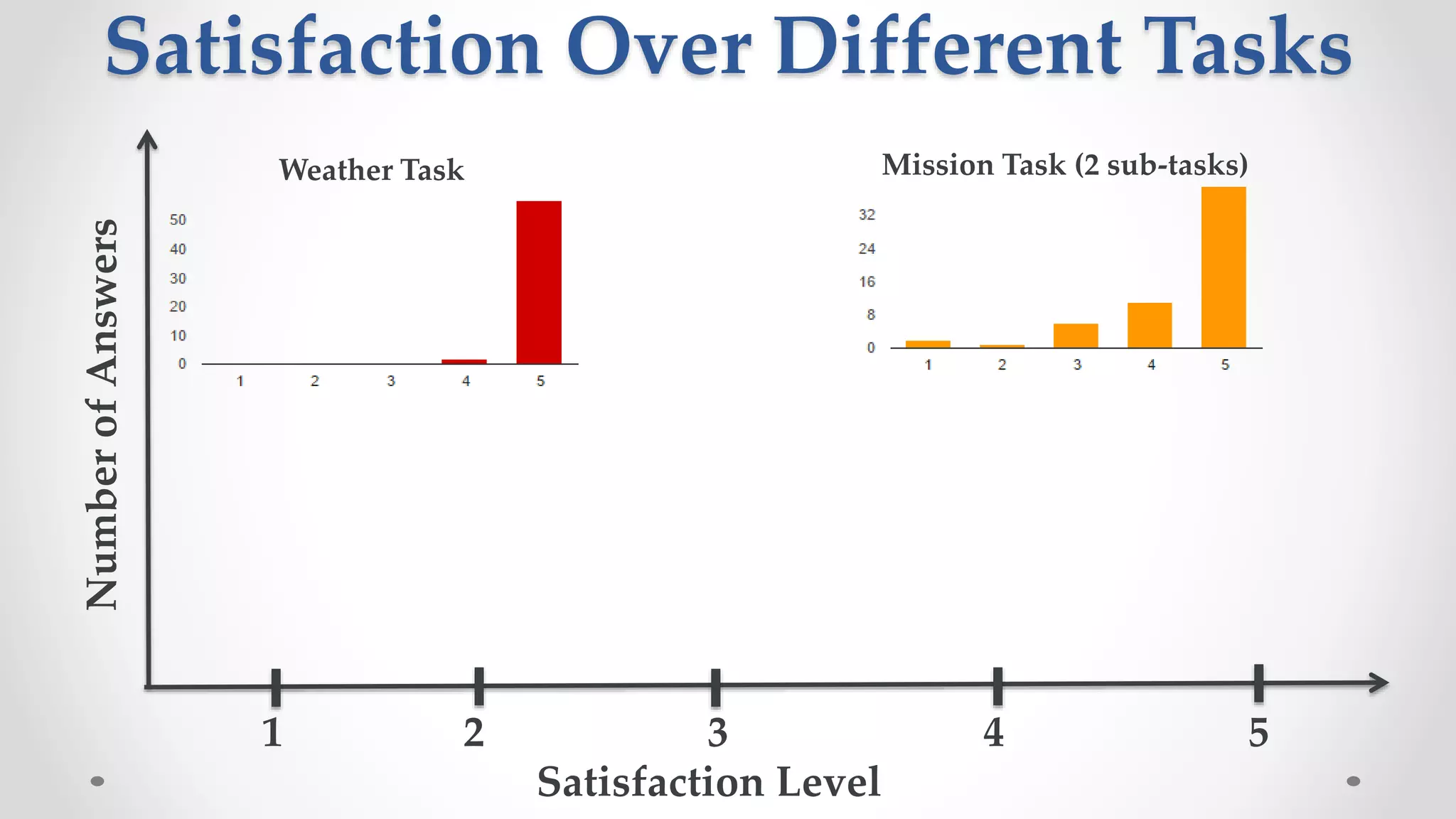
Satisfaction Over Different Tasks
Satisfaction Level
Weather Task
NumberofAnswers
1 2 3 4 5
Satisfaction Over Different Tasks
Satisfaction Level
Weather Task Mission Task (2 sub-tasks)
NumberofAnswers
1 2 3 4 5
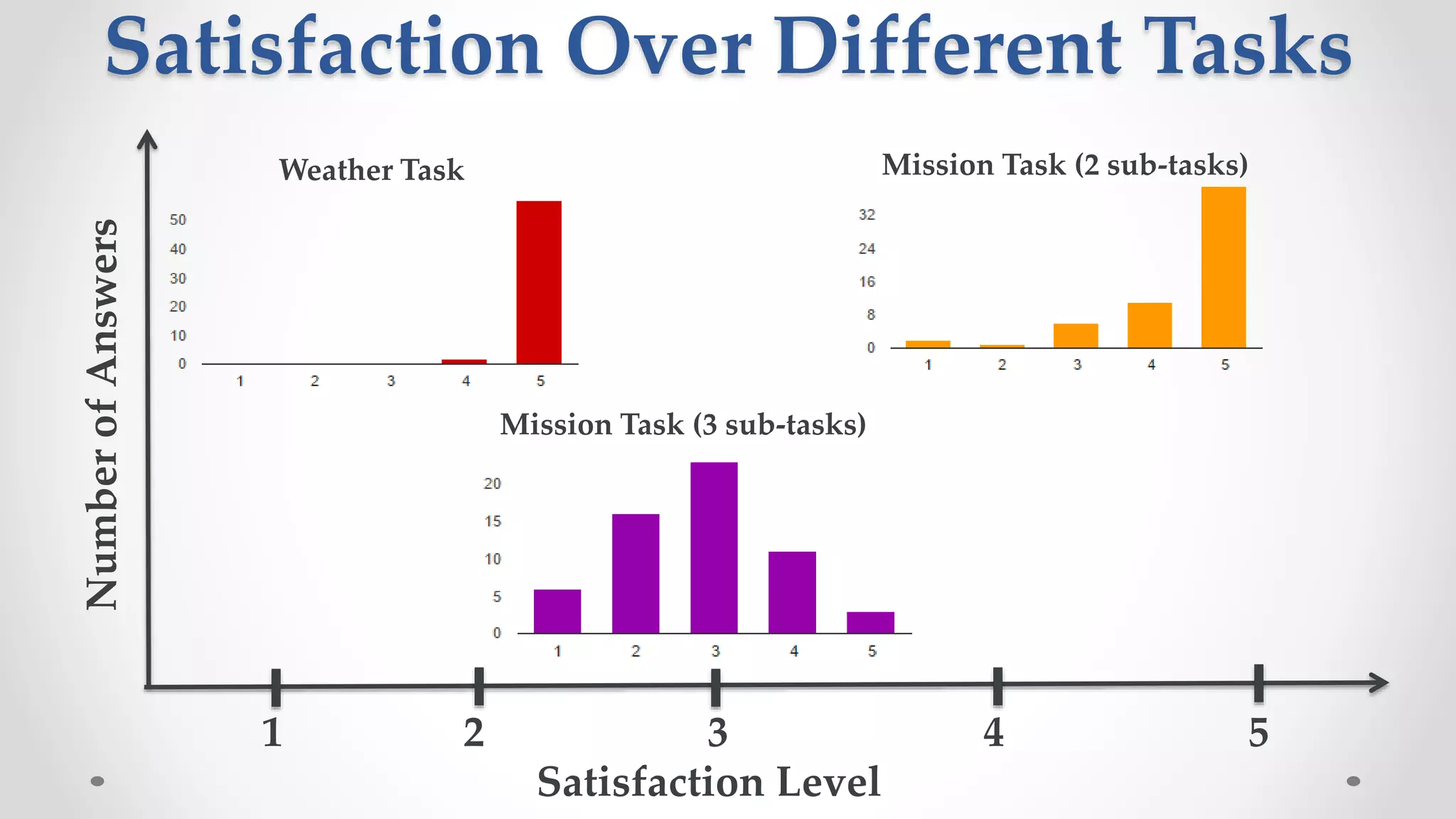
Satisfaction Over Different Tasks
Satisfaction Level
Weather Task Mission Task (2 sub-tasks)
Mission Task (3 sub-tasks)
NumberofAnswers
1 2 3 4 5
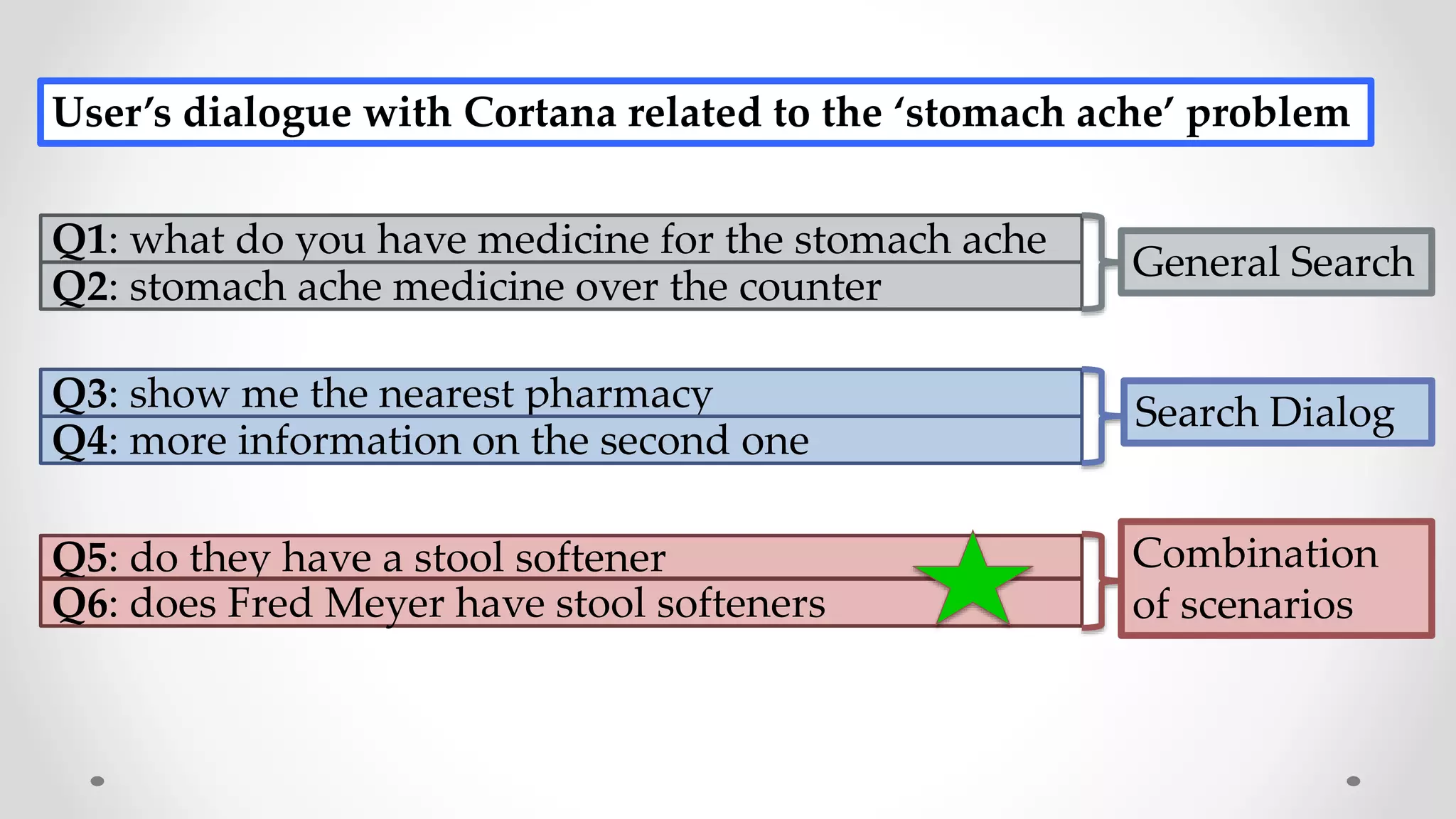
Q1: what do you have medicine for the stomach ache
Q2: stomach ache medicine over the counter
Q3: show me the nearest pharmacy
Q4: more information on the second one
Q5: do they have a stool softener
Q6: does Fred Meyer have stool softeners
General Search
Search Dialog
Combination
of scenarios
User’s dialogue with Cortana related to the ‘stomach ache’ problem
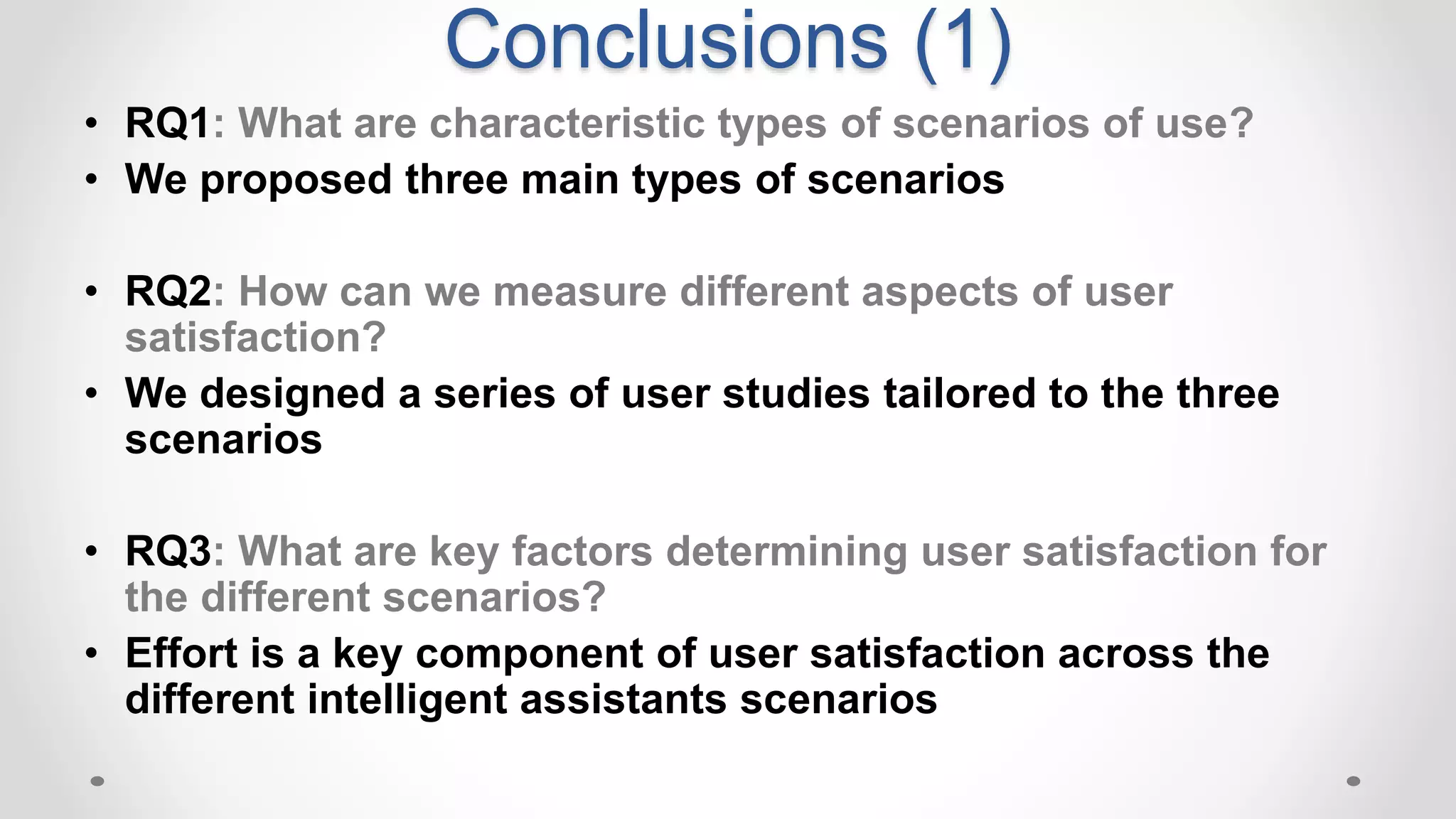
Conclusions (1)
• RQ1: What are characteristic types of scenarios of use?
• We proposed three main types of scenarios
• RQ2: How can we measure different aspects of user
satisfaction?
• We designed a series of user studies tailored to the three
scenarios
• RQ3: What are key factors determining user satisfaction for
the different scenarios?
• Effort is a key component of user satisfaction across the
different intelligent assistants scenarios
Conclusions (2)
• RQ4: How to characterize abandonment in the web search
scenario?
• We concluded that to measure good abandonment we need
to investigate the other forms of interaction signals that are
not based on clicks or reformulation
• RQ5: How does query-level satisfaction relate to overall user
satisfaction for the search dialogue scenario?
• We looked at user satisfaction as ‘a user journey towards an
information goal where each step is important,’ and showed
the importance of session context
Predicting User Satisfaction
with Intelligent Assistants
(Good Abandonment Case)
Evaluating User Satisfaction
• We need metrics to evaluate user satisfaction
• Good abandonment [Human et. al, 2009]:
Mobile: 36% of abandoned queries in were likely good
Desktop: 14.3%
• Traditional methods use implicit signals: clicks and dwell time
Evaluating User Satisfaction
• We need metrics to evaluate user satisfaction
• Good abandonment [Human et. al, 2009]:
Mobile: 36% of abandoned queries in were likely good
Desktop: 14.3%
• Traditional methods use implicit signals: clicks and dwell time
Don’t work
Our Main Research Problem
In the absence of clicks, what is the relationship
between a user's gestures and satisfaction and can we
use gestures to detect satisfaction and good
abandonment?
Research Questions
• RQ1: What SERP elements are the sources of good
abandonment in mobile search?
• RQ2: Do a user's gestures provide signals that can be used
to detect satisfaction and good abandonment in mobile
search?
• RQ3: Which user gestures provide the strongest signals for
satisfaction and good abandonment?
Research Questions
• RQ1: What SERP elements are the sources of good
abandonment in mobile search?
• RQ2: Do a user's gestures provide signals that can be used
to detect satisfaction and good abandonment in mobile
search?
• RQ3: Which user gestures provide the strongest signals for
satisfaction and good abandonment?
USERSTUDY
Research Questions
• RQ1: What SERP elements are the sources of good
abandonment in mobile search?
• RQ2: Do a user's gestures provide signals that can be used
to detect satisfaction and good abandonment in mobile
search?
• RQ3: Which user gestures provide the strongest signals for
satisfaction and good abandonment?
USERSTUDY
CROWDSOURCING
Crowdsourcing Procedure
Random sample of abandoned queries from the search logs of a
personal digital assistant during one week in June 2015 (no query
suggestion)
Crowdsourcing Procedure
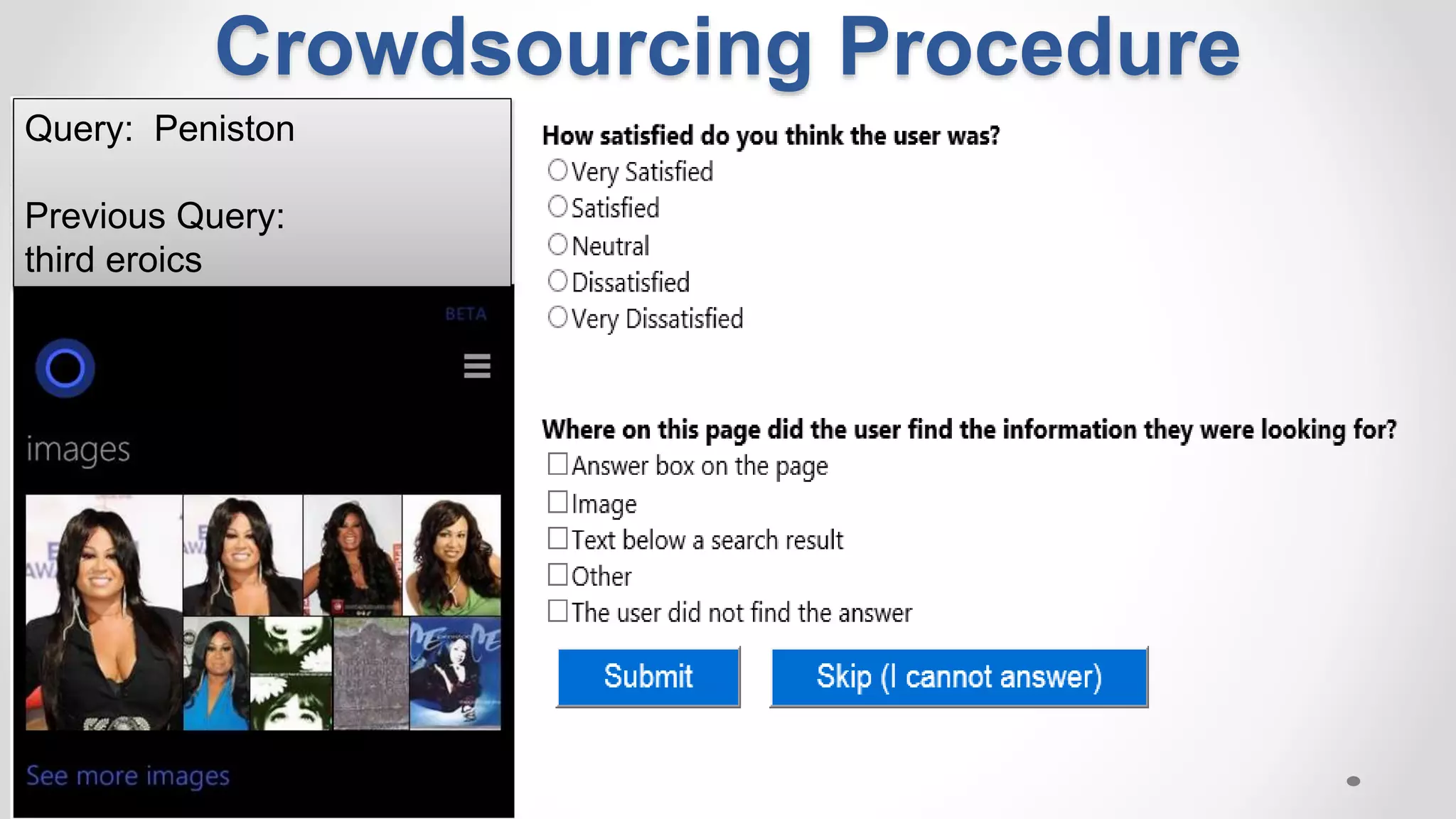
Query: Peniston
Previous Query:
third eroics
Crowdsourcing Data
• Total amount of queries – 3,895
• Judgments agreement (3 per one query) – 73%
• After filtering: SAT – 1,565 and DSAT – 1,924
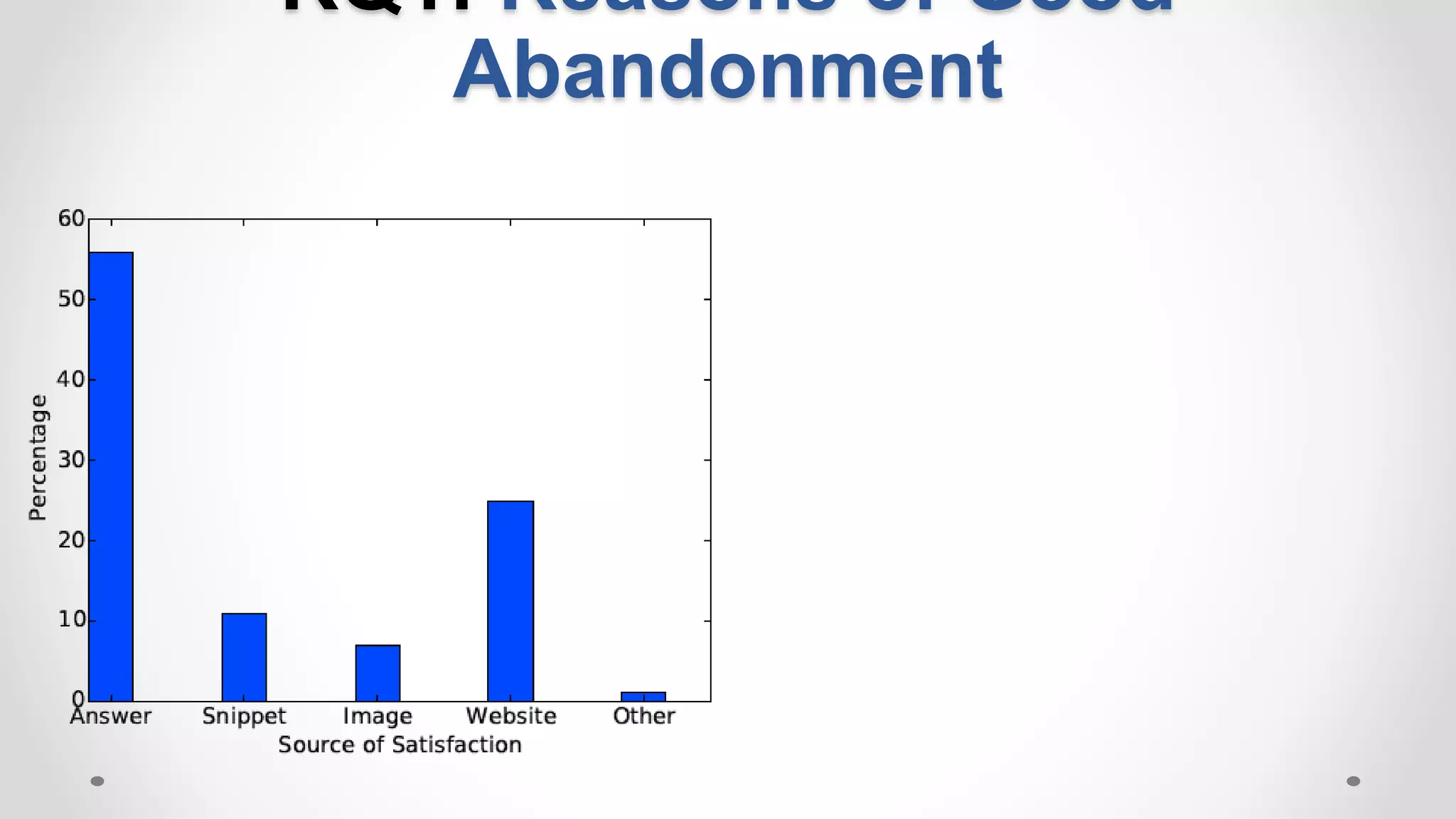
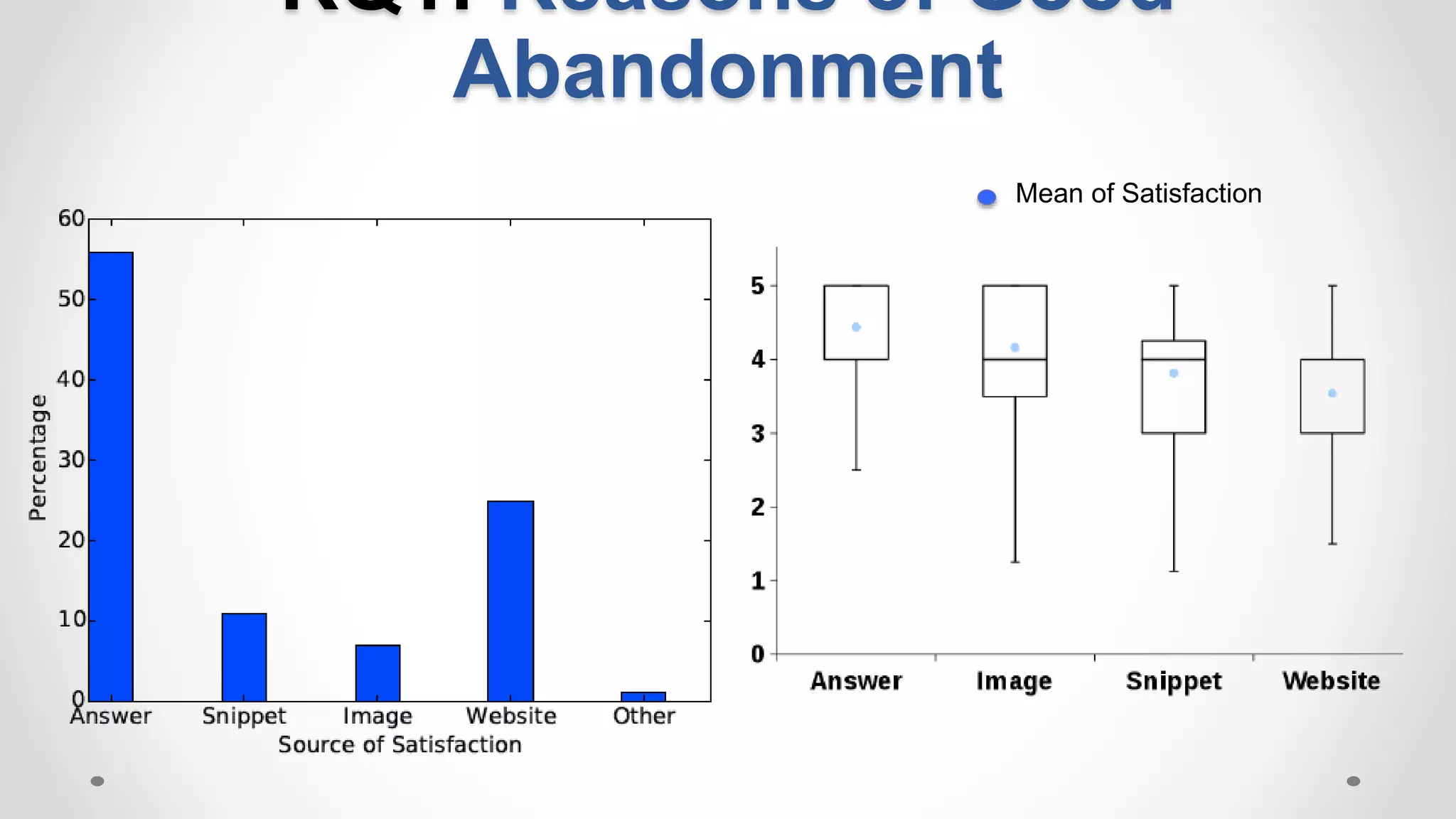
RQ1: Reasons of Good
Abandonment
RQ1: Reasons of Good
Abandonment
Mean of Satisfaction
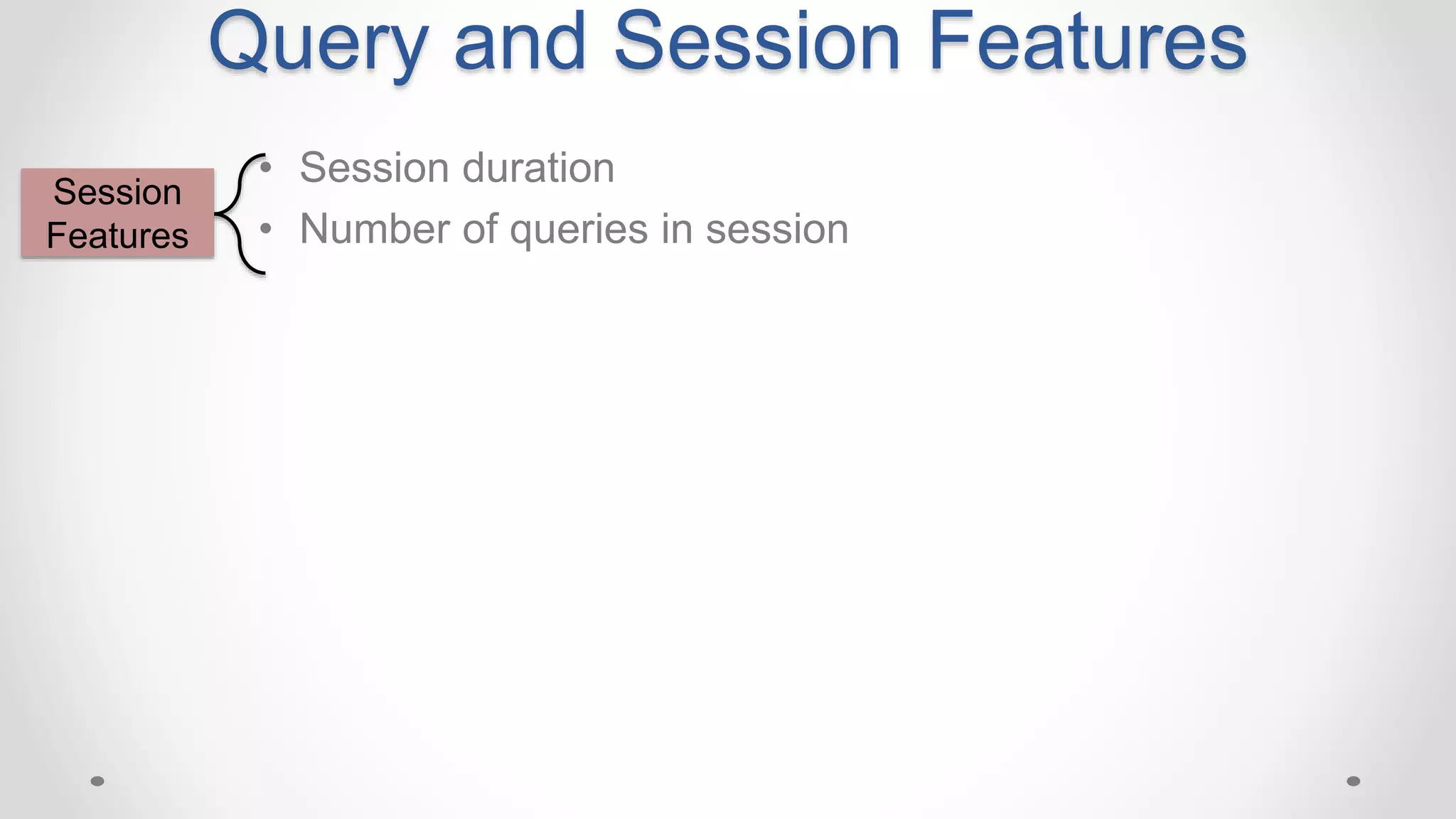
Query and Session Features
• Session duration
• Number of queries in session
Session
Features
Query and Session Features
• Session duration
• Number of queries in session
• Index of query within session
• Time to next query
• Query length (number of words)
• Is this query a reformulation
• Was this query reformulated
Session
Features
Query
Features
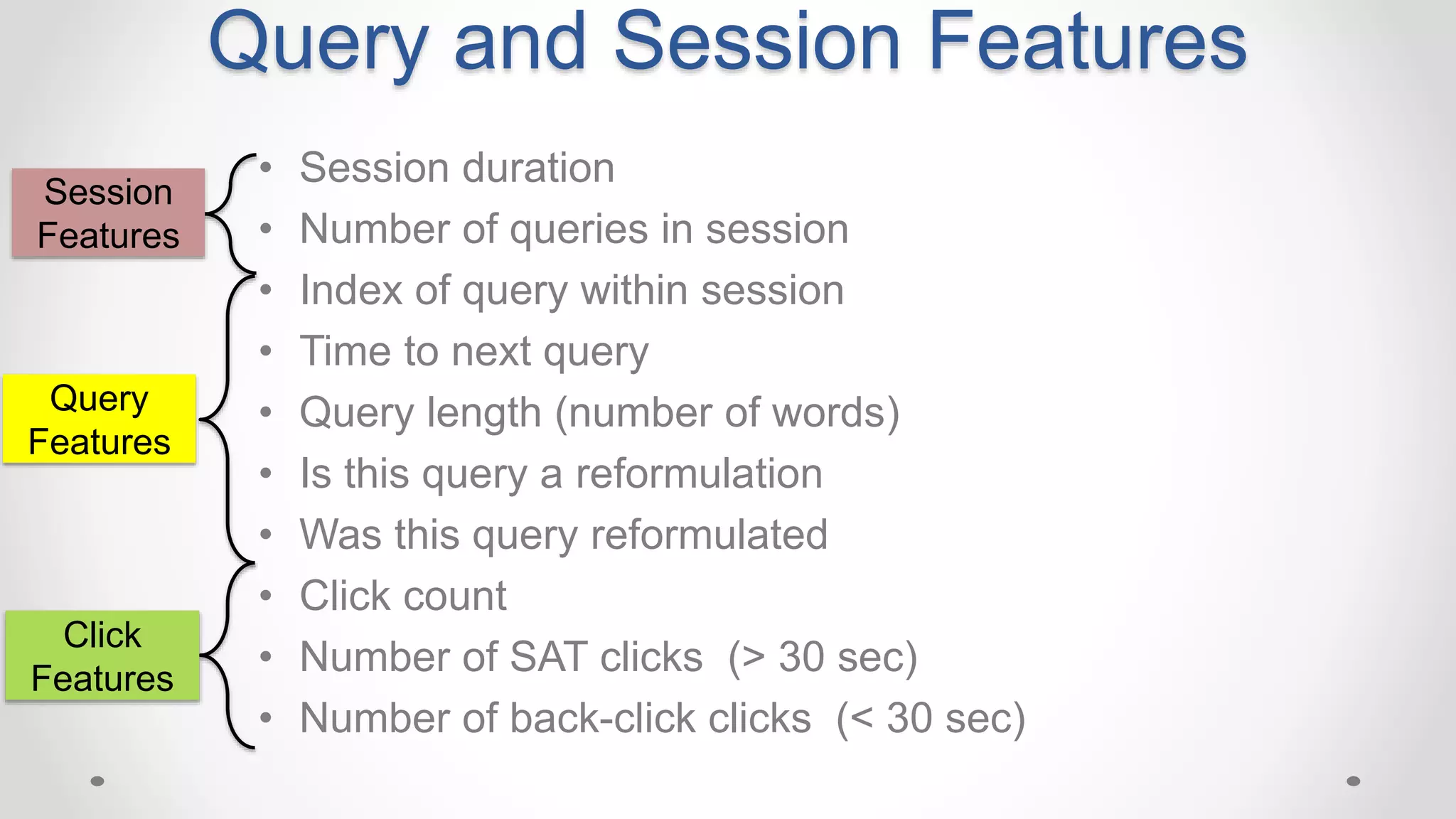
Query and Session Features
• Session duration
• Number of queries in session
• Index of query within session
• Time to next query
• Query length (number of words)
• Is this query a reformulation
• Was this query reformulated
• Click count
• Number of SAT clicks (> 30 sec)
• Number of back-click clicks (< 30 sec)
Session
Features
Query
Features
Click
Features
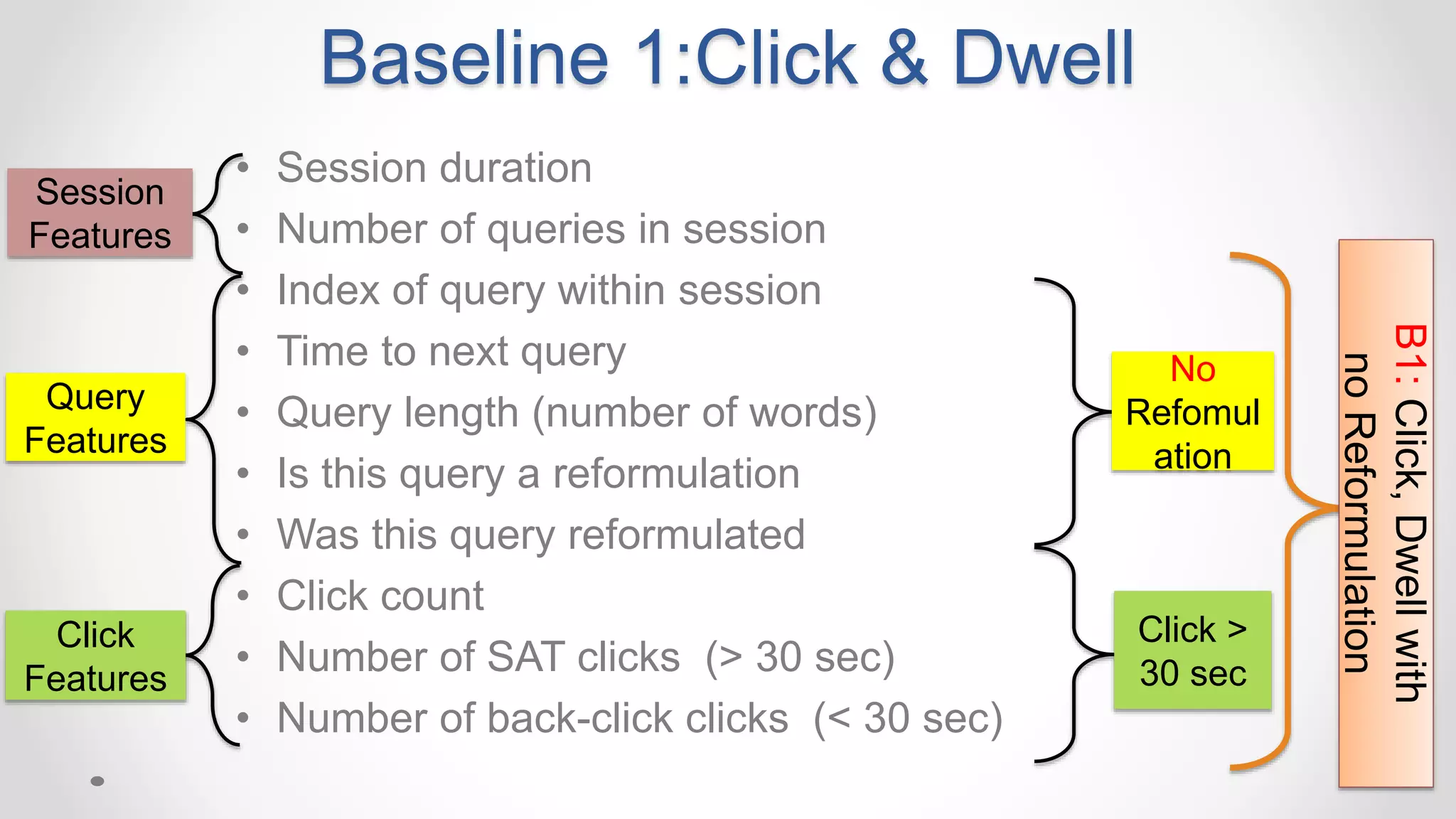
Baseline 1:Click & Dwell
• Session duration
• Number of queries in session
• Index of query within session
• Time to next query
• Query length (number of words)
• Is this query a reformulation
• Was this query reformulated
• Click count
• Number of SAT clicks (> 30 sec)
• Number of back-click clicks (< 30 sec)
Session
Features
Query
Features
Click
Features
Click >
30 sec
No
Refomul
ation
B1:Click,Dwellwith
noReformulation
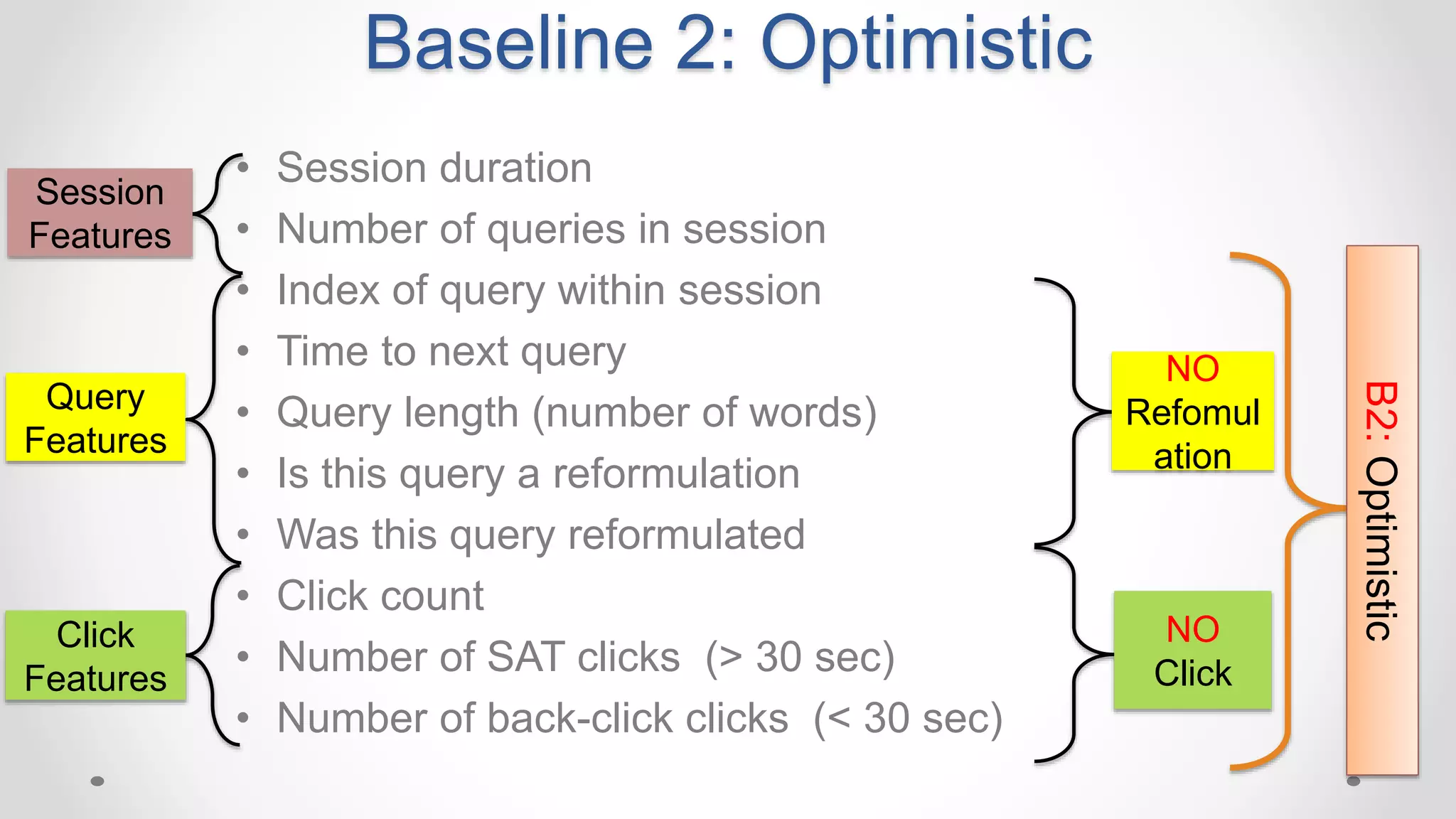
Baseline 2: Optimistic
• Session duration
• Number of queries in session
• Index of query within session
• Time to next query
• Query length (number of words)
• Is this query a reformulation
• Was this query reformulated
• Click count
• Number of SAT clicks (> 30 sec)
• Number of back-click clicks (< 30 sec)
Session
Features
Query
Features
Click
Features
NO
Click
NO
Refomul
ation
B2:Optimistic
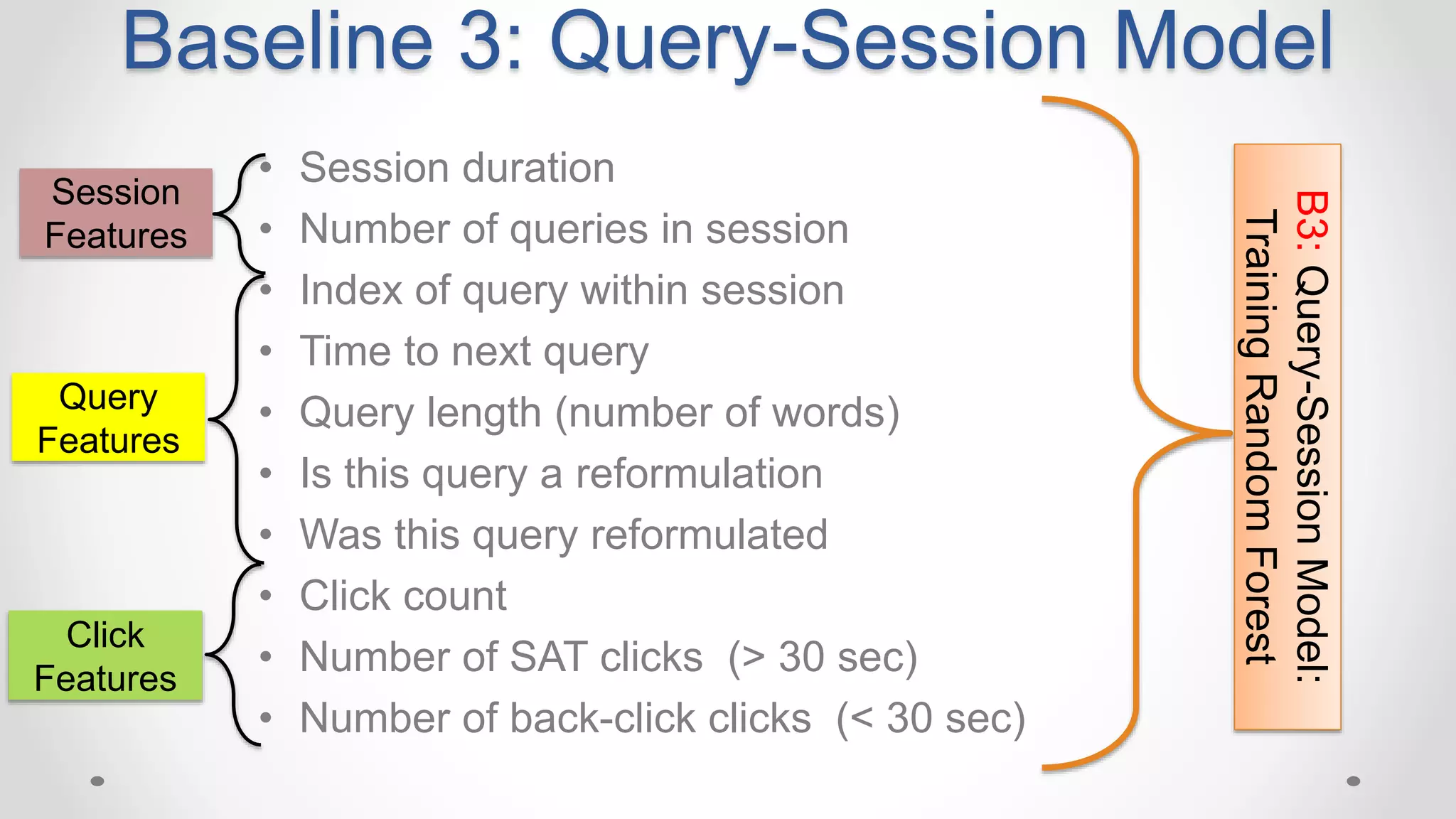
Baseline 3: Query-Session Model
• Session duration
• Number of queries in session
• Index of query within session
• Time to next query
• Query length (number of words)
• Is this query a reformulation
• Was this query reformulated
• Click count
• Number of SAT clicks (> 30 sec)
• Number of back-click clicks (< 30 sec)
Session
Features
Query
Features
Click
Features
B3:Query-SessionModel:
TrainingRandomForest
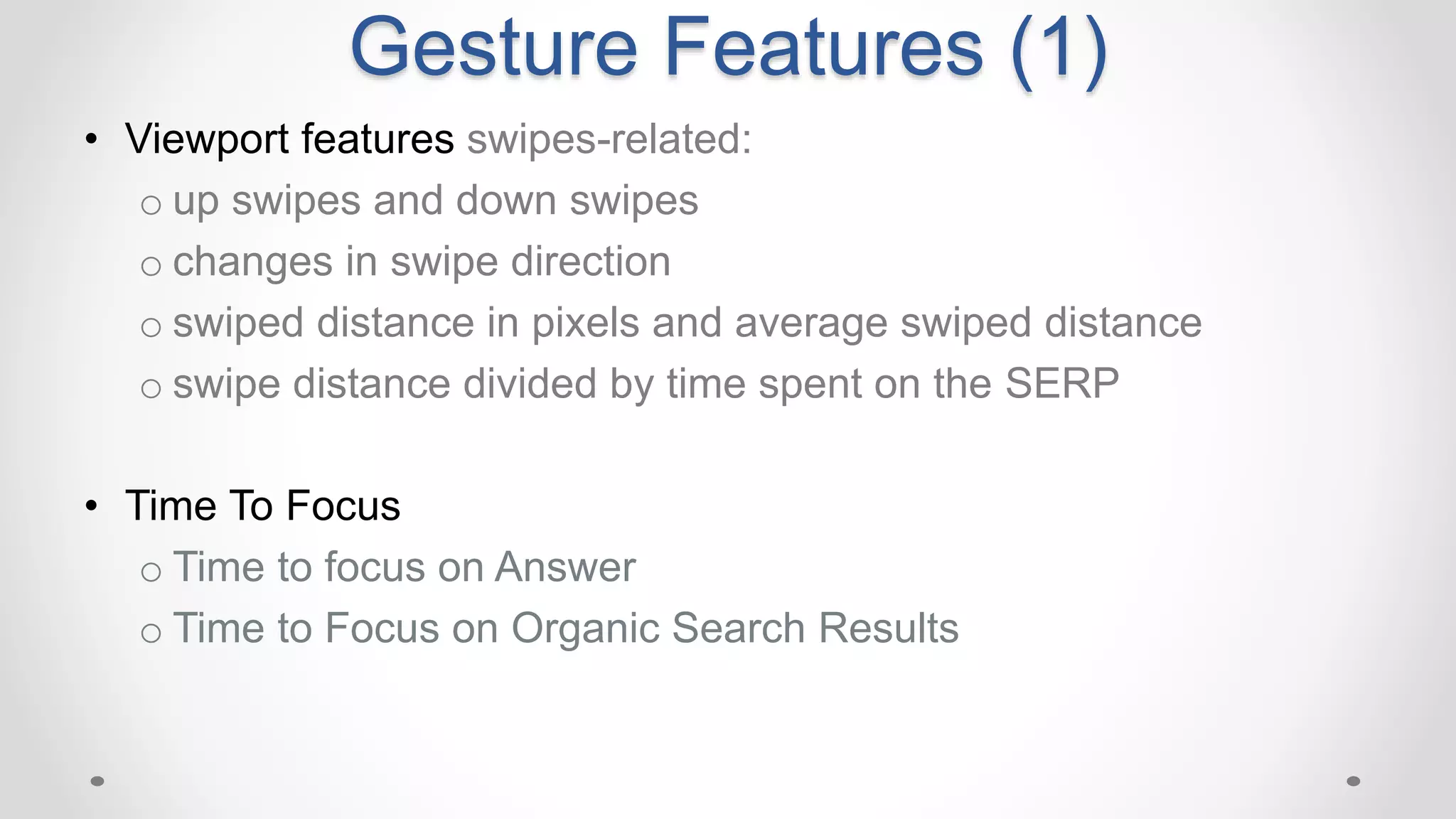
Gesture Features (1)
• Viewport features swipes-related:
o up swipes and down swipes
o changes in swipe direction
o swiped distance in pixels and average swiped distance
o swipe distance divided by time spent on the SERP
Gesture Features (1)
• Viewport features swipes-related:
o up swipes and down swipes
o changes in swipe direction
o swiped distance in pixels and average swiped distance
o swipe distance divided by time spent on the SERP
• Time To Focus
o Time to focus on Answer
o Time to Focus on Organic Search Results
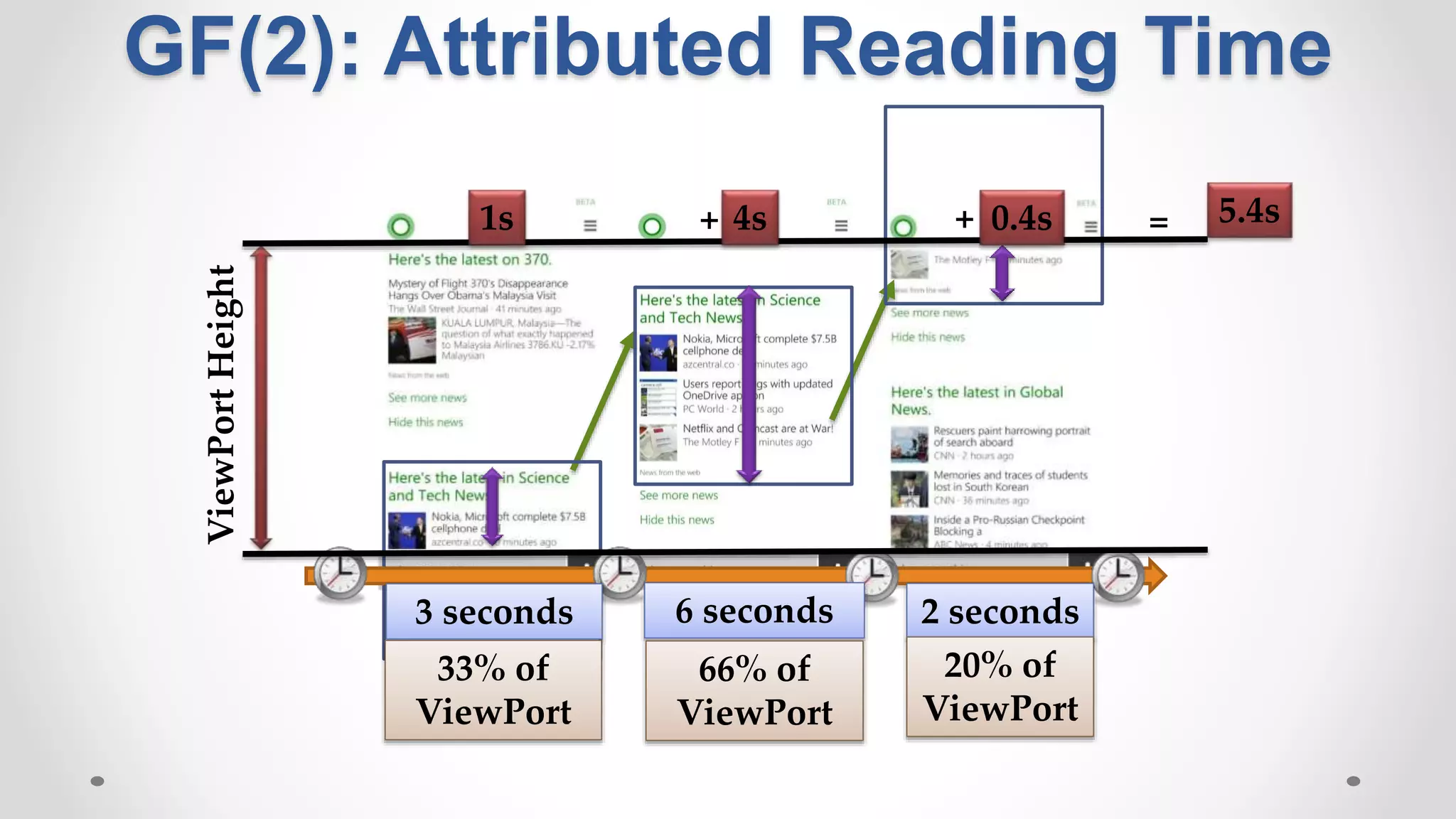
3 seconds 6 seconds
33% of
ViewPort
66% of
ViewPort
ViewPortHeight
2 seconds
20% of
ViewPort
1s 4s 0.4s 5.4s+ + =
GF(2): Attributed Reading Time
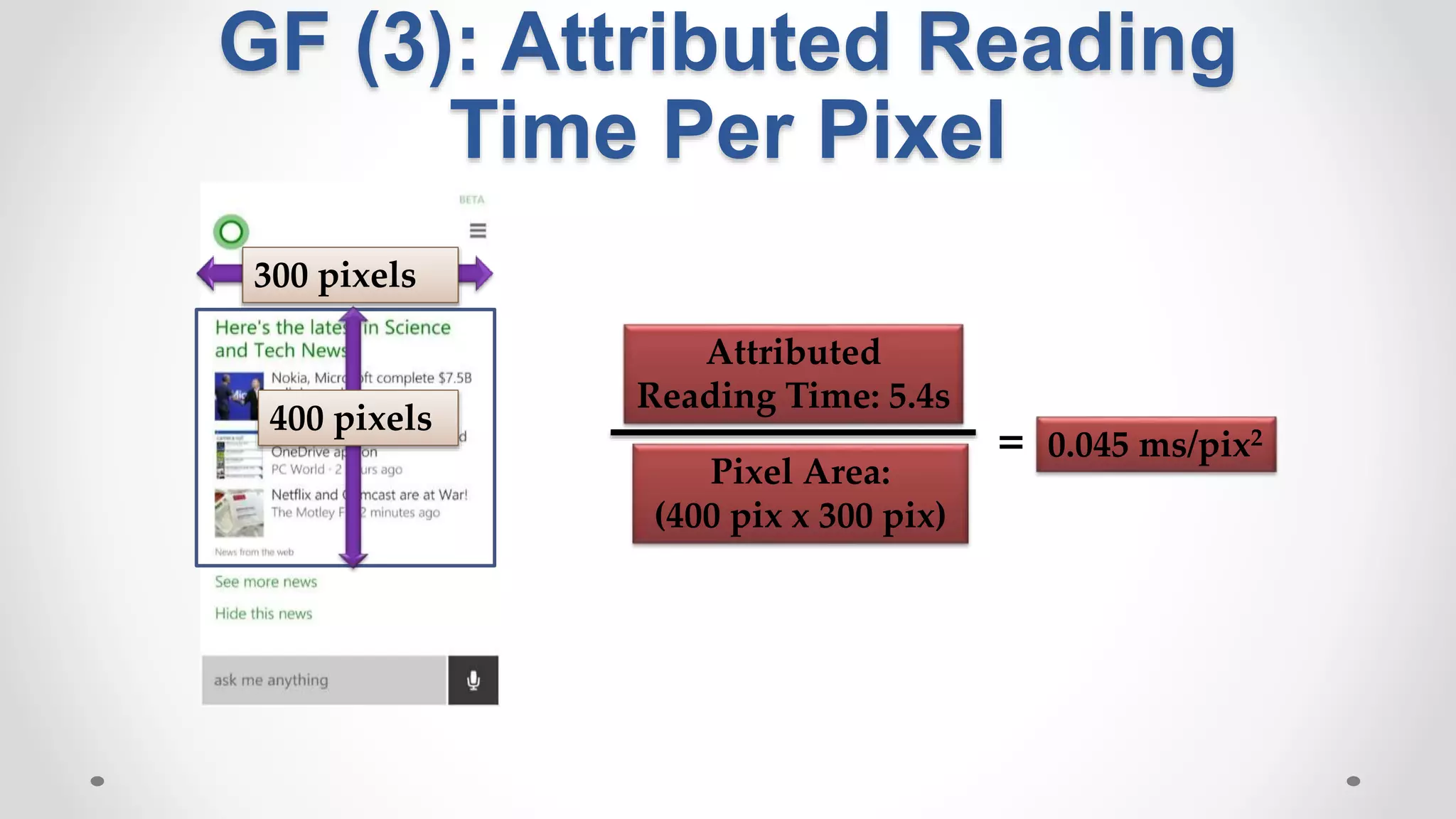
400 pixels
300 pixels
Attributed
Reading Time: 5.4s
Pixel Area:
(400 pix x 300 pix)
0.045 ms/pix2=
GF (3): Attributed Reading
Time Per Pixel
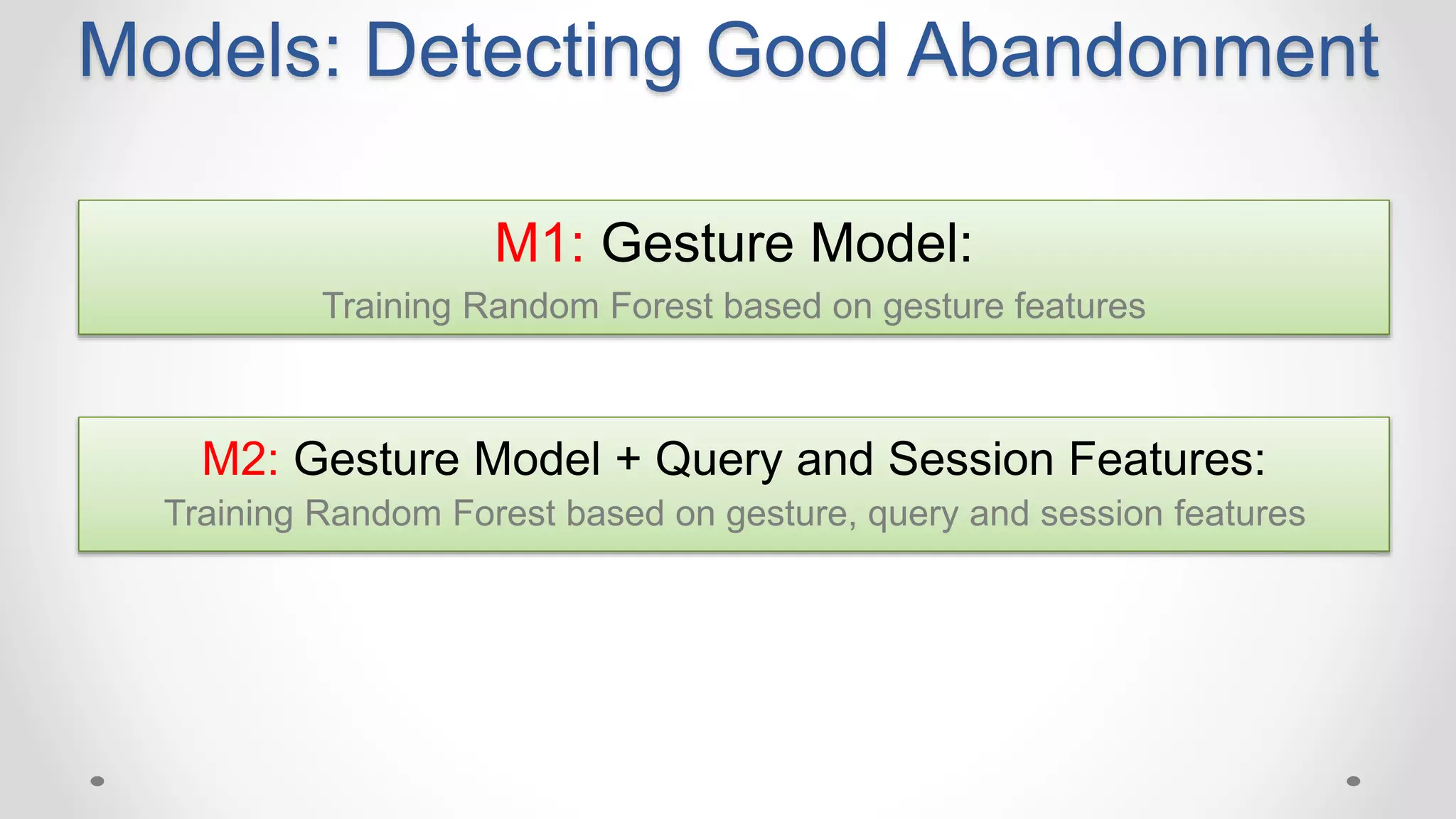
Models: Detecting Good Abandonment
M1: Gesture Model:
Training Random Forest based on gesture features
M2: Gesture Model + Query and Session Features:
Training Random Forest based on gesture, query and session features
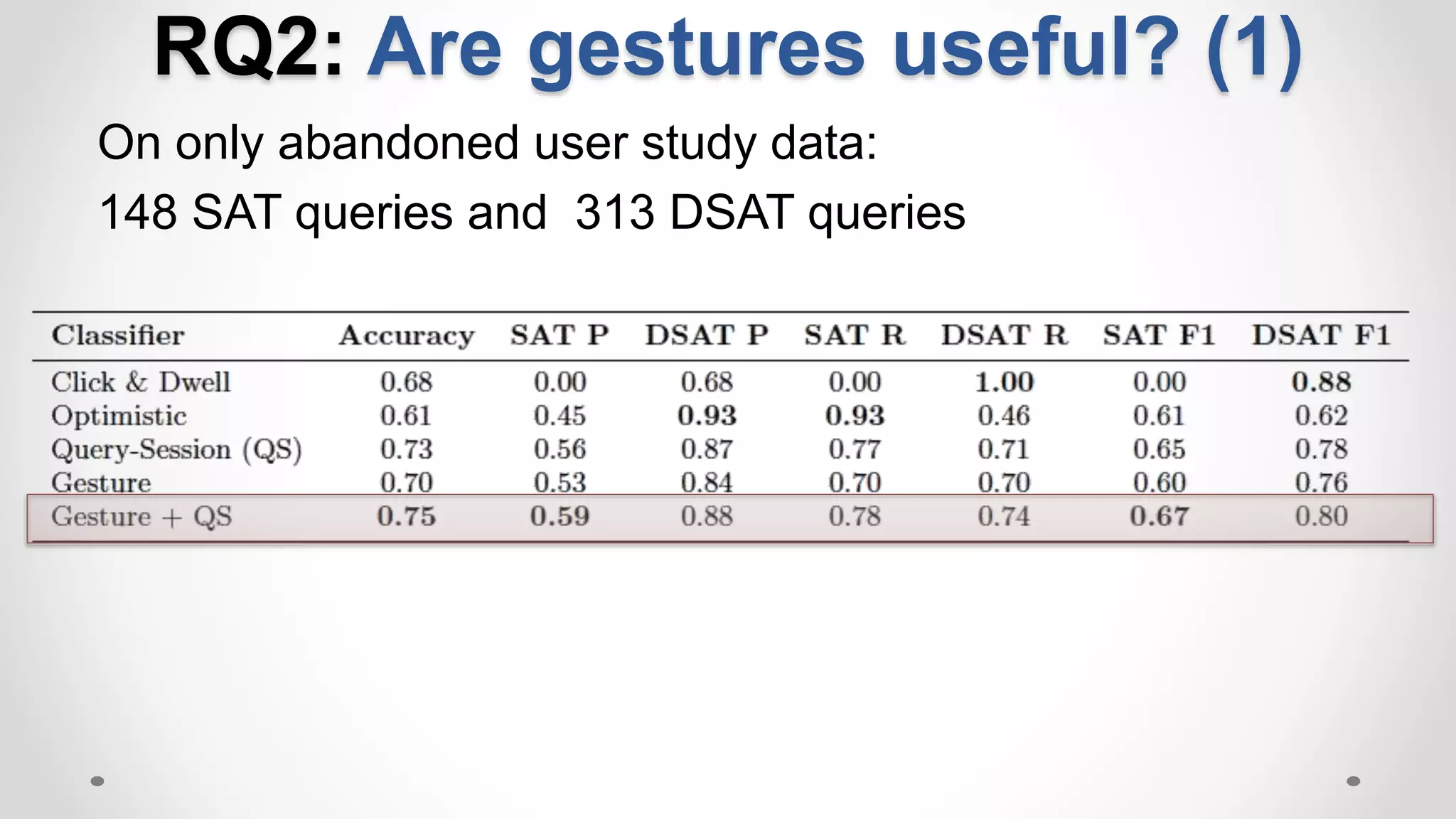
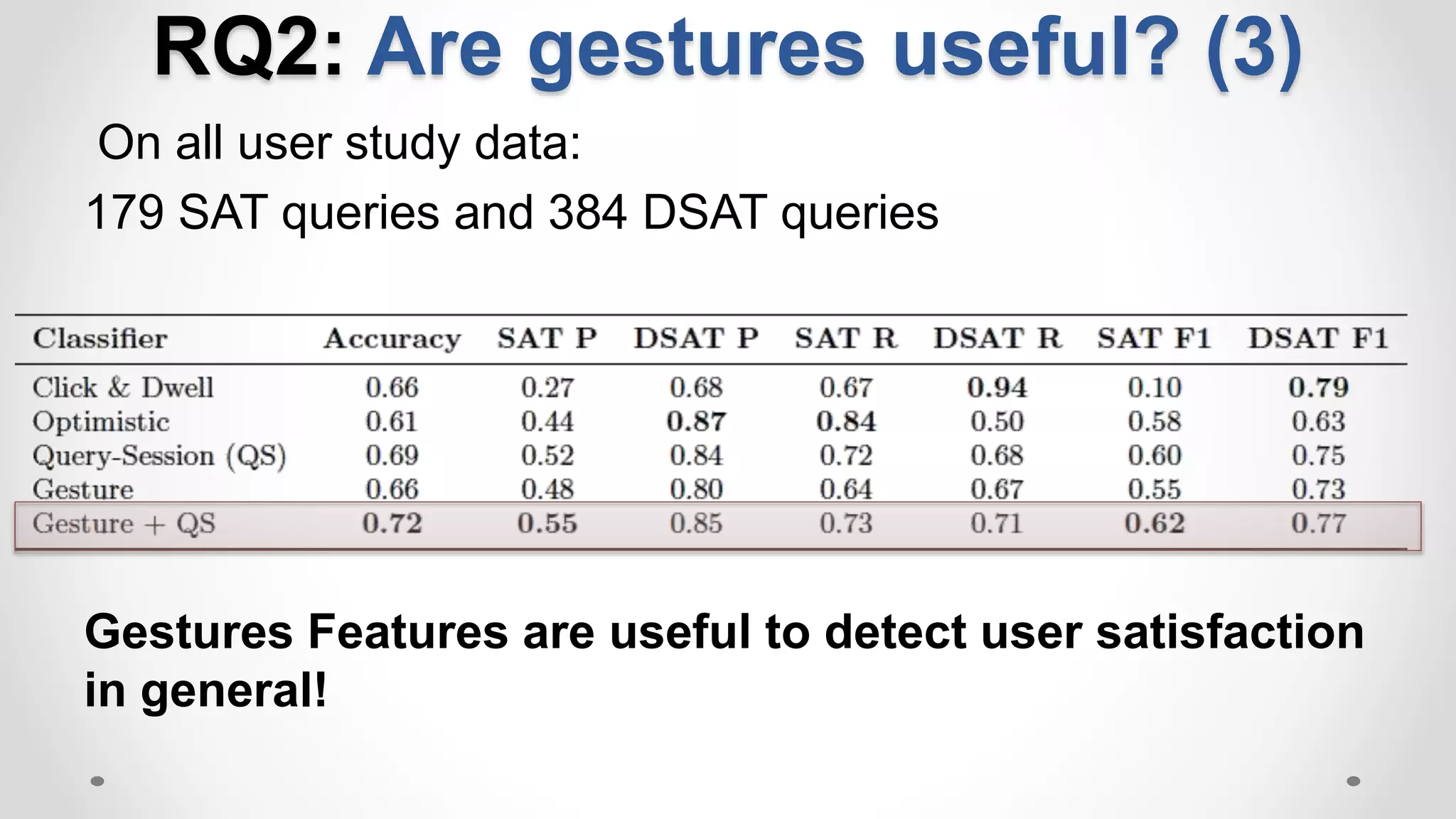
RQ2: Are gestures useful? (1)
On only abandoned user study data:
148 SAT queries and 313 DSAT queries
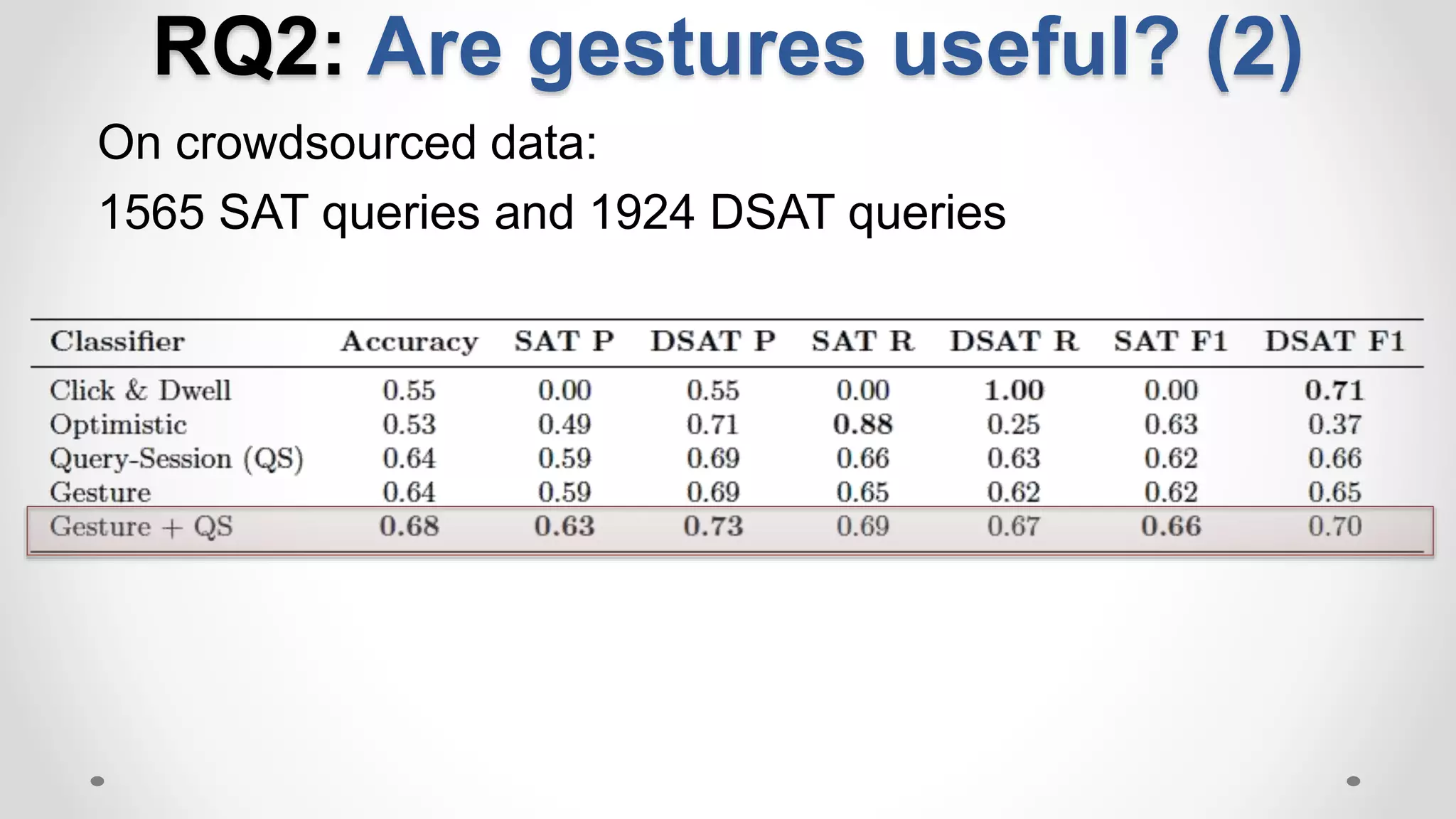
RQ2: Are gestures useful? (2)
On crowdsourced data:
1565 SAT queries and 1924 DSAT queries
RQ2: Are gestures useful? (3)
On all user study data:
179 SAT queries and 384 DSAT queries
Gestures Features are useful to detect user satisfaction
in general!
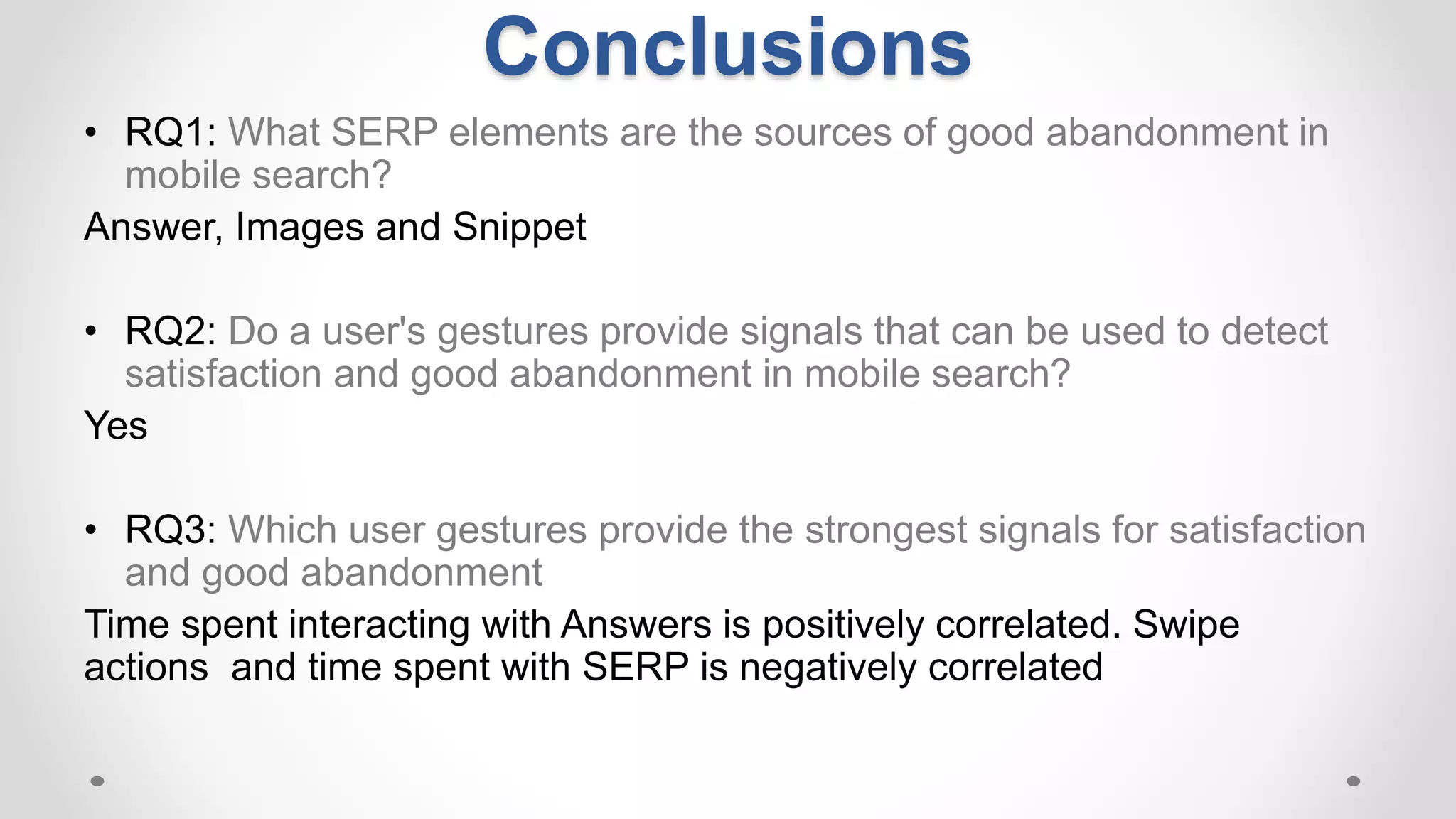
Conclusions
• RQ1: What SERP elements are the sources of good abandonment in
mobile search?
Answer, Images and Snippet
• RQ2: Do a user's gestures provide signals that can be used to detect
satisfaction and good abandonment in mobile search?
Yes
• RQ3: Which user gestures provide the strongest signals for satisfaction
and good abandonment
Time spent interacting with Answers is positively correlated. Swipe
actions and time spent with SERP is negatively correlated
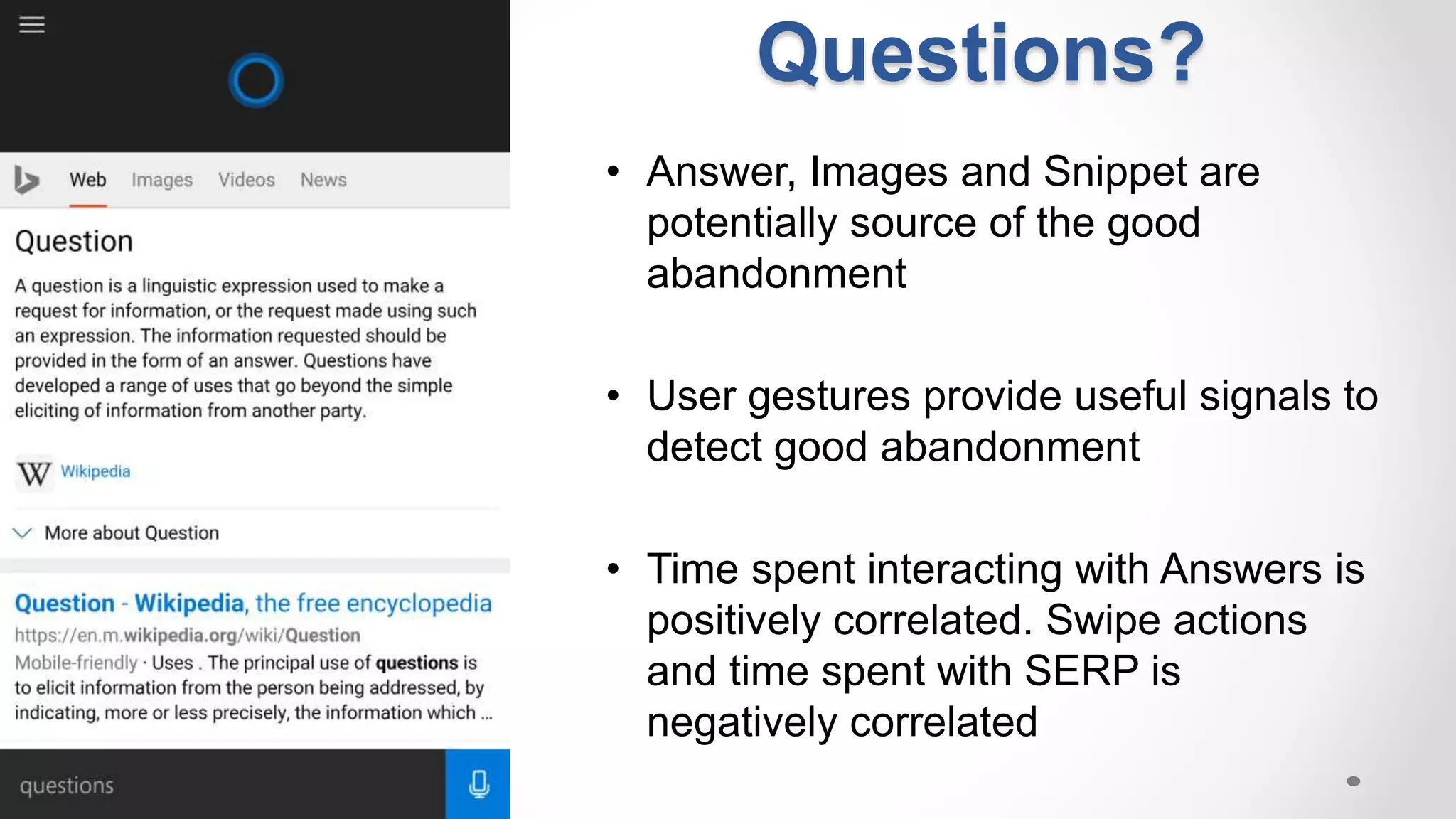
• Answer, Images and Snippet are
potentially source of the good
abandonment
• User gestures provide useful signals to
detect good abandonment
• Time spent interacting with Answers is
positively correlated. Swipe actions
and time spent with SERP is
negatively correlated
Questions?

Understanding and Predicting User Satisfaction with Intelligent Assistants

  • 1.
    Understanding and Predicting UserSatisfaction with Intelligent Assistants Julia Kiseleva, Kyle Williams, Jiepu Jiang, Ahmed Hassan Awadallah, Aidan C. Crook, Imed Zitouni, Tasos Anastasakos Eindhoven University of Technology Pennsylvania State University University of Massachusetts Amherst Microsoft
  • 2.
    Why do wecare? 0 10 20 30 40 50 60 70 80 90 100 Desktop Mobile Timeline PercentageofTraffic http://gs.statcounter.com
  • 3.
  • 4.
  • 5.
  • 6.
    Q1: how isthe weather in Chicago Q2: how is it this weekend Q3: find me hotels Q4: which one of these is the cheapest Q5: which one of these has at least 4 stars Q6: find me directions from the Chicago airport to number one User’s dialogue with Cortana: Task is “Finding a hotel in Chicago”
  • 7.
    Q1: find mea pharmacy nearby Q2: which of these is highly rated Q3: show more information about number 2 Q4: how long will it take me to get there Q5: Thanks User’s dialogue with Cortana: Task is “Finding a pharmacy”
  • 8.
    Research Questions • RQ1:What are characteristic types of scenarios of use?
  • 9.
    Controlling Device • Calla person • Send a text message • Check on-device calendar • Open an application • Turn on/off wi-fi • Play music
  • 11.
  • 12.
    Knowledge Pane Image AnswerImage Answer Organic Results
  • 13.
    Knowledge Pane Image AnswerImage Answer Location Answer Organic Results
  • 14.
    User: “Do I need tohave a jacket tomorrow?” Search Dialogue
  • 15.
    User: “Do I need tohave a jacket tomorrow?” Cortana: “You could probably go without one. The forecast shows …” Search Dialogue
  • 16.
    Cortana: “Here are ten restaurants nearyou” User: “show restaurant s near me” Search Dialogue
  • 17.
    Cortana: “Here are ten restaurants nearyou” Cortana: “Here are ten restaurants near you that have good reviews” User: “show restaurant s near me” User: “show the best restaurants near me ” Search Dialogue
  • 18.
    Cortana: “Here are ten restaurants nearyou” Cortana: “Here are ten restaurants near you that have good reviews” Cortana: “Getting you direction to the Mayuri Indian Cuisine” User: “show restaurant s near me” User: “show the best restaurants near me ” User: “show directions to the second one” Search Dialogue
  • 19.
    Research Questions • RQ1:What are characteristic types of scenarios of use? • RQ2: How can we measure different aspects of user satisfaction? • RQ3: What are key factors determining user satisfaction for the different scenarios? • RQ4: How to characterize abandonment in the web search scenario? • RQ5: How does query-level satisfaction relate to overall user satisfaction for the search dialogue scenario?
  • 20.
    Research Questions • RQ1:What are characteristic types of scenarios of use? • RQ2: How can we measure different aspects of user satisfaction? • RQ3: What are key factors determining user satisfaction for the different scenarios? • RQ4: How to characterize abandonment in the web search scenario? • RQ5: How does query-level satisfaction relate to overall user satisfaction for the search dialogue scenario? USERSTUDY
  • 21.
    User Study Participants 55% 45% LANGUAGE EnglishOther • 60 Participants • 25.53 +/- 5.42 years
  • 22.
    User Study Participants 75% 25% GENDER MaleFemale 55% 45% LANGUAGE English Other • 60 Participants • 25.53 +/- 5.42 years
  • 23.
    User Study Participants 75% 25% GENDER MaleFemale 55% 45% LANGUAGE English Other 82% 8% 2% 8% EDUCATION Computer Science Electrical Engineering Mathematics Other • 60 Participants • 25.53 +/- 5.42 years
  • 24.
    User Study Design •Video Instructions (same for all participants) • Tasks are realistic – mined from Cortana logs: o Control type of tasks o Queries where users don’t click o Search dialogue tasks – mostly localization type of queries
  • 25.
    Find out whatis the hair color of your favorite celebrity
  • 26.
    You are planninga vacation. Pick a place. Check if the weather is good enough for the period you are planning the vacation. Find a hotel that suits you. Find the driving directions to this place.
  • 27.
    You are planninga vacation. Pick a place. Check if the weather is good enough for the period you are planning the vacation. Find a hotel that suits you. Find the driving directions to this place.
  • 28.
    Questionnaire: Controlling Device •Were you able to complete the task? o Yes/No • How satisfied are you with your experience in this task? o 5-point Likert scale • How well did Cortana recognize what you said? o 5-point Likert scale • Did you put in a lot of effort to complete the task? o 5-point Likert scale
  • 29.
    Questionnaire: Controlling Device •Were you able to complete the task? o Yes/No • How satisfied are you with your experience in this task? o 5-point Likert scale • How well did Cortana recognize what you said? o 5-point Likert scale • Did you put in a lot of effort to complete the task? o 5-point Likert scale 5 Tasks 20 Minutes
  • 30.
    Questionnaire: Good Abandonment •Were you able to complete the task? o Yes/No • Where did you find the answer? o Answer Box, Image, SERP, Visited Website • Which query led you to finding the answer? o First, Second, Third, >= Fourth • How satisfied are you with your experience in this task? o 5-point Likert scale • Did you put in a lot of effort to complete the task? o 5-point Likert scale
  • 31.
    Questionnaire: Good Abandonment •Were you able to complete the task? o Yes/No • Where did you find the answer? o Answer Box, Image, SERP, Visited Website • Which query led you to finding the answer? o First, Second, Third, >= Fourth • How satisfied are you with your experience in this task? o 5-point Likert scale • Did you put in a lot of effort to complete the task? o 5-point Likert scale 5 Tasks 20 Minutes
  • 32.
    Questionnaire: Search Dialogue •Were you able to complete the task? o Yes/No • How satisfied are you with your experience in this task? o If the task has sub-tasks participants indicate their graded satisfaction e.g. o a. How satisfied are you with your experience in finding a hotel? o b. How satisfied are you with your experience in finding directions? • How well did Cortana recognize what you said? o 5-point Likert scale • Did you put in a lot of effort to complete the task? o 5-point Likert scale
  • 33.
    Questionnaire: Search Dialogue •Were you able to complete the task? o Yes/No • How satisfied are you with your experience in this task? o If the task has sub-tasks participants indicate their graded satisfaction e.g. o a. How satisfied are you with your experience in finding a hotel? o b. How satisfied are you with your experience in finding directions? • How well did Cortana recognize what you said? o 5-point Likert scale • Did you put in a lot of effort to complete the task? o 5-point Likert scale 8 Tasks: 1 simple, 4 with 2 subtasks, 3 with 3 subtasks 30 Minutes
  • 34.
    Search Dialog Dataset •540 tasks that incorporated • 2, 040 queries, of which 1, 969 were unique • the average query-length is 7.07 • The simple task generated 130 queries in total • Tasks with 2 context switches generated 685 queries • Tasks with 3 context switches generated 1, 355 queries
  • 35.
    Factors Determining Satisfaction RQ3:What are key factors determining user satisfaction for the different scenarios?
  • 36.
  • 37.
    Results `Good Abandonment’ RQ4:How to characterize abandonment in the web search scenario?
  • 38.
    0 1 2 3 4 5 6 First Query Second Query Third Query >=Fourth Quey 0 1 2 3 4 5 6 Answer Box Image SERP Visited WebSite 5 SatisfactionLevel Results `Good Abandonment’ Mean of Satisfaction
  • 39.
    Search Dialogue Satisfaction RQ5:How does query-level satisfaction relate to overall user satisfaction for the structured search dialogue scenario?
  • 40.
    Cortana: “Here are ten restaurants nearyou” Cortana: “Here are ten restaurants near you that have good reviews” Cortana: “Getting you direction to the Mayuri Indian Cuisine” User: “show restaurant s near me” User: “show the best restaurants near me ” User: “show directions to the second one” SAT? SAT? SAT? SAT? SAT? SAT? Overall SAT? ?
  • 41.
    Search Dialogue Satisfaction RQ5:How does query-level satisfaction relate to overall user satisfaction for the structured search dialogue scenario?
  • 42.
    Satisfaction Over DifferentTasks Satisfaction Level Weather Task NumberofAnswers 1 2 3 4 5
  • 43.
    Satisfaction Over DifferentTasks Satisfaction Level Weather Task Mission Task (2 sub-tasks) NumberofAnswers 1 2 3 4 5
  • 44.
    Satisfaction Over DifferentTasks Satisfaction Level Weather Task Mission Task (2 sub-tasks) Mission Task (3 sub-tasks) NumberofAnswers 1 2 3 4 5
  • 45.
    Q1: what doyou have medicine for the stomach ache Q2: stomach ache medicine over the counter Q3: show me the nearest pharmacy Q4: more information on the second one Q5: do they have a stool softener Q6: does Fred Meyer have stool softeners General Search Search Dialog Combination of scenarios User’s dialogue with Cortana related to the ‘stomach ache’ problem
  • 46.
    Conclusions (1) • RQ1:What are characteristic types of scenarios of use? • We proposed three main types of scenarios • RQ2: How can we measure different aspects of user satisfaction? • We designed a series of user studies tailored to the three scenarios • RQ3: What are key factors determining user satisfaction for the different scenarios? • Effort is a key component of user satisfaction across the different intelligent assistants scenarios
  • 47.
    Conclusions (2) • RQ4:How to characterize abandonment in the web search scenario? • We concluded that to measure good abandonment we need to investigate the other forms of interaction signals that are not based on clicks or reformulation • RQ5: How does query-level satisfaction relate to overall user satisfaction for the search dialogue scenario? • We looked at user satisfaction as ‘a user journey towards an information goal where each step is important,’ and showed the importance of session context
  • 48.
    Predicting User Satisfaction withIntelligent Assistants (Good Abandonment Case)
  • 49.
    Evaluating User Satisfaction •We need metrics to evaluate user satisfaction • Good abandonment [Human et. al, 2009]: Mobile: 36% of abandoned queries in were likely good Desktop: 14.3% • Traditional methods use implicit signals: clicks and dwell time
  • 50.
    Evaluating User Satisfaction •We need metrics to evaluate user satisfaction • Good abandonment [Human et. al, 2009]: Mobile: 36% of abandoned queries in were likely good Desktop: 14.3% • Traditional methods use implicit signals: clicks and dwell time Don’t work
  • 51.
    Our Main ResearchProblem In the absence of clicks, what is the relationship between a user's gestures and satisfaction and can we use gestures to detect satisfaction and good abandonment?
  • 52.
    Research Questions • RQ1:What SERP elements are the sources of good abandonment in mobile search? • RQ2: Do a user's gestures provide signals that can be used to detect satisfaction and good abandonment in mobile search? • RQ3: Which user gestures provide the strongest signals for satisfaction and good abandonment?
  • 53.
    Research Questions • RQ1:What SERP elements are the sources of good abandonment in mobile search? • RQ2: Do a user's gestures provide signals that can be used to detect satisfaction and good abandonment in mobile search? • RQ3: Which user gestures provide the strongest signals for satisfaction and good abandonment? USERSTUDY
  • 54.
    Research Questions • RQ1:What SERP elements are the sources of good abandonment in mobile search? • RQ2: Do a user's gestures provide signals that can be used to detect satisfaction and good abandonment in mobile search? • RQ3: Which user gestures provide the strongest signals for satisfaction and good abandonment? USERSTUDY CROWDSOURCING
  • 55.
    Crowdsourcing Procedure Random sampleof abandoned queries from the search logs of a personal digital assistant during one week in June 2015 (no query suggestion)
  • 56.
  • 57.
    Crowdsourcing Data • Totalamount of queries – 3,895 • Judgments agreement (3 per one query) – 73% • After filtering: SAT – 1,565 and DSAT – 1,924
  • 58.
    RQ1: Reasons ofGood Abandonment
  • 59.
    RQ1: Reasons ofGood Abandonment Mean of Satisfaction
  • 60.
    Query and SessionFeatures • Session duration • Number of queries in session Session Features
  • 61.
    Query and SessionFeatures • Session duration • Number of queries in session • Index of query within session • Time to next query • Query length (number of words) • Is this query a reformulation • Was this query reformulated Session Features Query Features
  • 62.
    Query and SessionFeatures • Session duration • Number of queries in session • Index of query within session • Time to next query • Query length (number of words) • Is this query a reformulation • Was this query reformulated • Click count • Number of SAT clicks (> 30 sec) • Number of back-click clicks (< 30 sec) Session Features Query Features Click Features
  • 63.
    Baseline 1:Click &Dwell • Session duration • Number of queries in session • Index of query within session • Time to next query • Query length (number of words) • Is this query a reformulation • Was this query reformulated • Click count • Number of SAT clicks (> 30 sec) • Number of back-click clicks (< 30 sec) Session Features Query Features Click Features Click > 30 sec No Refomul ation B1:Click,Dwellwith noReformulation
  • 64.
    Baseline 2: Optimistic •Session duration • Number of queries in session • Index of query within session • Time to next query • Query length (number of words) • Is this query a reformulation • Was this query reformulated • Click count • Number of SAT clicks (> 30 sec) • Number of back-click clicks (< 30 sec) Session Features Query Features Click Features NO Click NO Refomul ation B2:Optimistic
  • 65.
    Baseline 3: Query-SessionModel • Session duration • Number of queries in session • Index of query within session • Time to next query • Query length (number of words) • Is this query a reformulation • Was this query reformulated • Click count • Number of SAT clicks (> 30 sec) • Number of back-click clicks (< 30 sec) Session Features Query Features Click Features B3:Query-SessionModel: TrainingRandomForest
  • 66.
    Gesture Features (1) •Viewport features swipes-related: o up swipes and down swipes o changes in swipe direction o swiped distance in pixels and average swiped distance o swipe distance divided by time spent on the SERP
  • 67.
    Gesture Features (1) •Viewport features swipes-related: o up swipes and down swipes o changes in swipe direction o swiped distance in pixels and average swiped distance o swipe distance divided by time spent on the SERP • Time To Focus o Time to focus on Answer o Time to Focus on Organic Search Results
  • 68.
    3 seconds 6seconds 33% of ViewPort 66% of ViewPort ViewPortHeight 2 seconds 20% of ViewPort 1s 4s 0.4s 5.4s+ + = GF(2): Attributed Reading Time
  • 69.
    400 pixels 300 pixels Attributed ReadingTime: 5.4s Pixel Area: (400 pix x 300 pix) 0.045 ms/pix2= GF (3): Attributed Reading Time Per Pixel
  • 70.
    Models: Detecting GoodAbandonment M1: Gesture Model: Training Random Forest based on gesture features M2: Gesture Model + Query and Session Features: Training Random Forest based on gesture, query and session features
  • 71.
    RQ2: Are gesturesuseful? (1) On only abandoned user study data: 148 SAT queries and 313 DSAT queries
  • 72.
    RQ2: Are gesturesuseful? (2) On crowdsourced data: 1565 SAT queries and 1924 DSAT queries
  • 73.
    RQ2: Are gesturesuseful? (3) On all user study data: 179 SAT queries and 384 DSAT queries Gestures Features are useful to detect user satisfaction in general!
  • 74.
    Conclusions • RQ1: WhatSERP elements are the sources of good abandonment in mobile search? Answer, Images and Snippet • RQ2: Do a user's gestures provide signals that can be used to detect satisfaction and good abandonment in mobile search? Yes • RQ3: Which user gestures provide the strongest signals for satisfaction and good abandonment Time spent interacting with Answers is positively correlated. Swipe actions and time spent with SERP is negatively correlated
  • 75.
    • Answer, Imagesand Snippet are potentially source of the good abandonment • User gestures provide useful signals to detect good abandonment • Time spent interacting with Answers is positively correlated. Swipe actions and time spent with SERP is negatively correlated Questions?

Editor's Notes

  • #10 Search online for contana screenshots
  • #60 later. We nd strong signicant negative correlation of -0.65 between sat- isfaction and eort, and a negative correlation of -0.08 be- tween completion and eort, indicating that less eort leads to more satisfaction and higher completion rates.