Individual Differences, User Perceptions and Eye
Gaze in Biomedical Search Interfaces
7 September 2015
Ying-Hsang Liu 1,2
1
School of Information Studies
Charles Sturt University
2
Research School of Computer Science
The Australian National University
1Outline
Introduction
Research Questions
Interfaces
Research Design
Results
Summary and Discussion
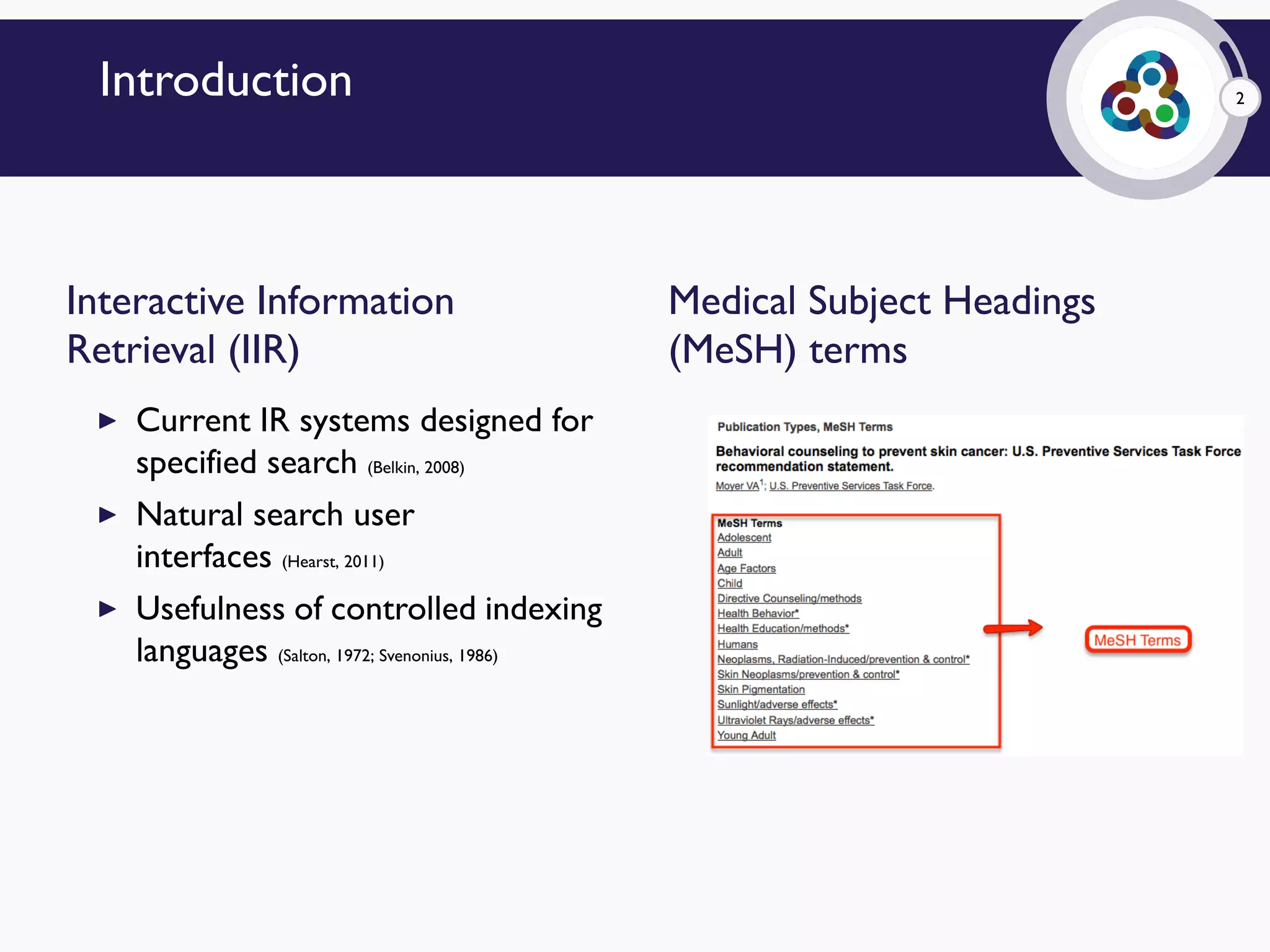
2Introduction
Interactive Information
Retrieval (IIR)
▶ Current IR systems designed for
specified search (Belkin, 2008)
▶ Natural search user
interfaces (Hearst, 2011)
▶ Usefulness of controlled indexing
languages (Salton, 1972; Svenonius, 1986)
Medical Subject Headings
(MeSH) terms
3Research Questions
Research questions
▶ What elements of search
interfaces do searchers look at
when searching for documents
to answer complex questions?
▶ What is the relation between
user perceptions of an
interface and the interface
elements they look at?
▶ What is the relation between
individual differences and the
interface elements which are
looked at?
User experiment in a
laboratory setting
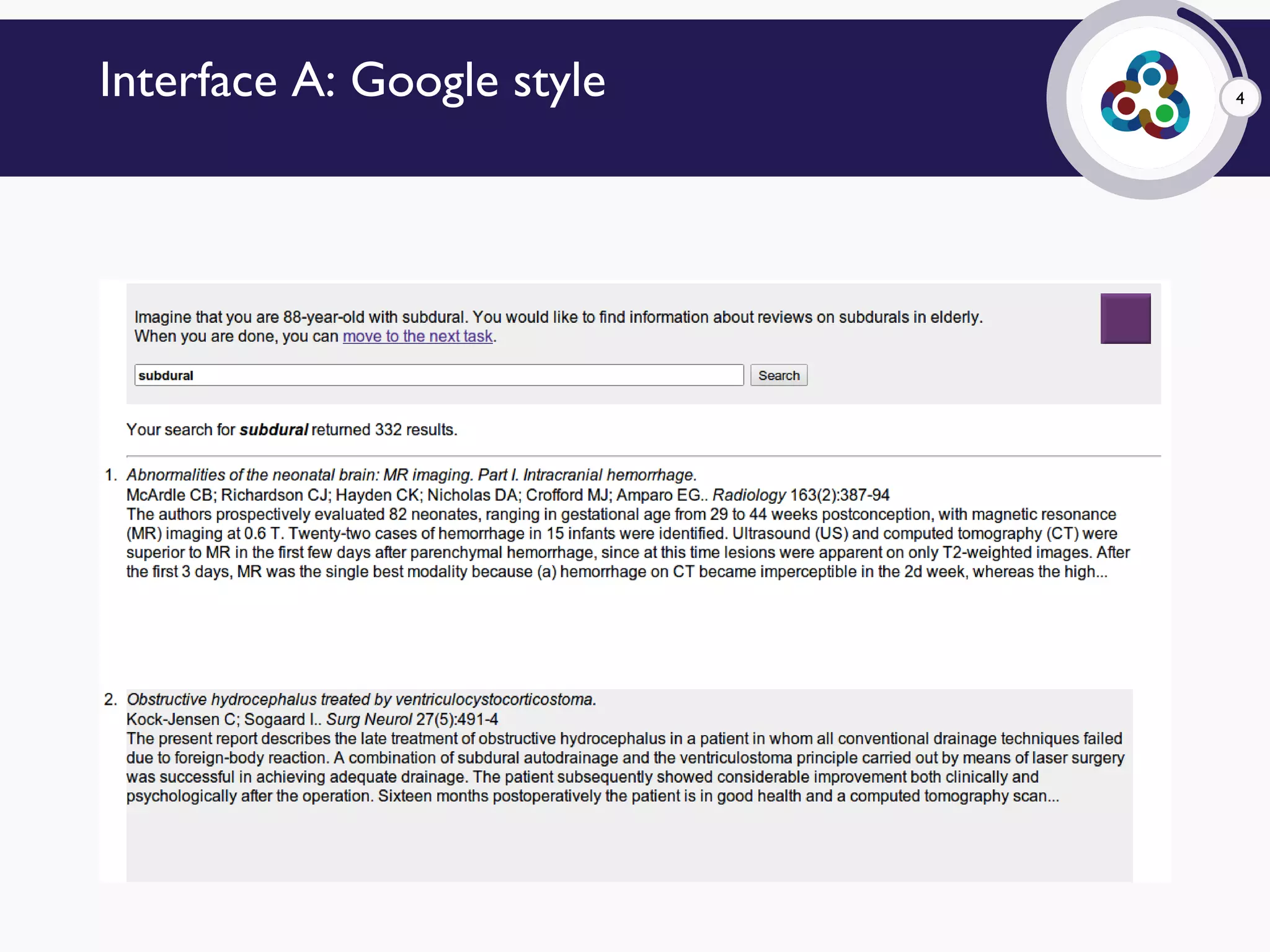
4Interface A: Google style
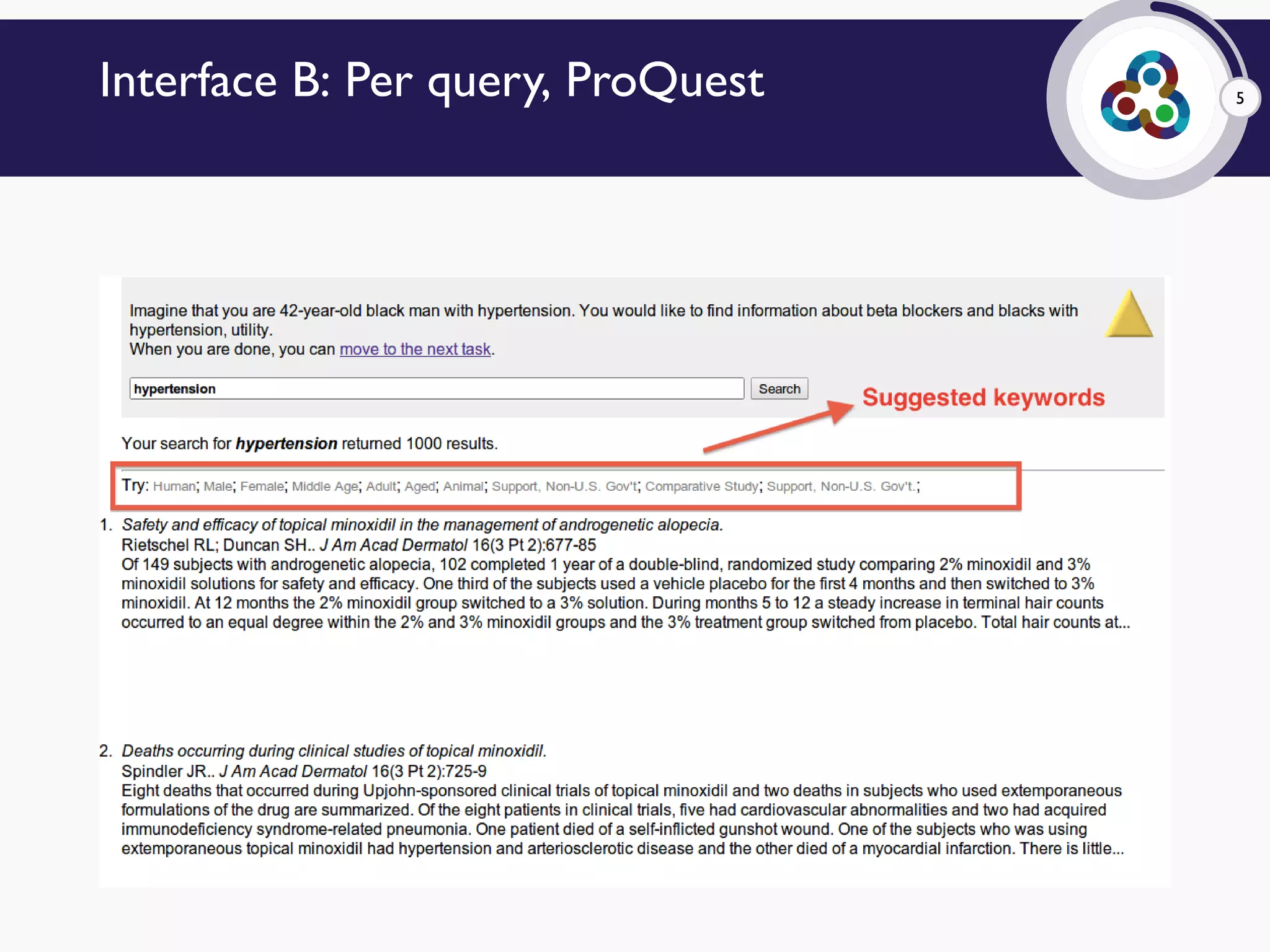
5Interface B: Per query, ProQuest
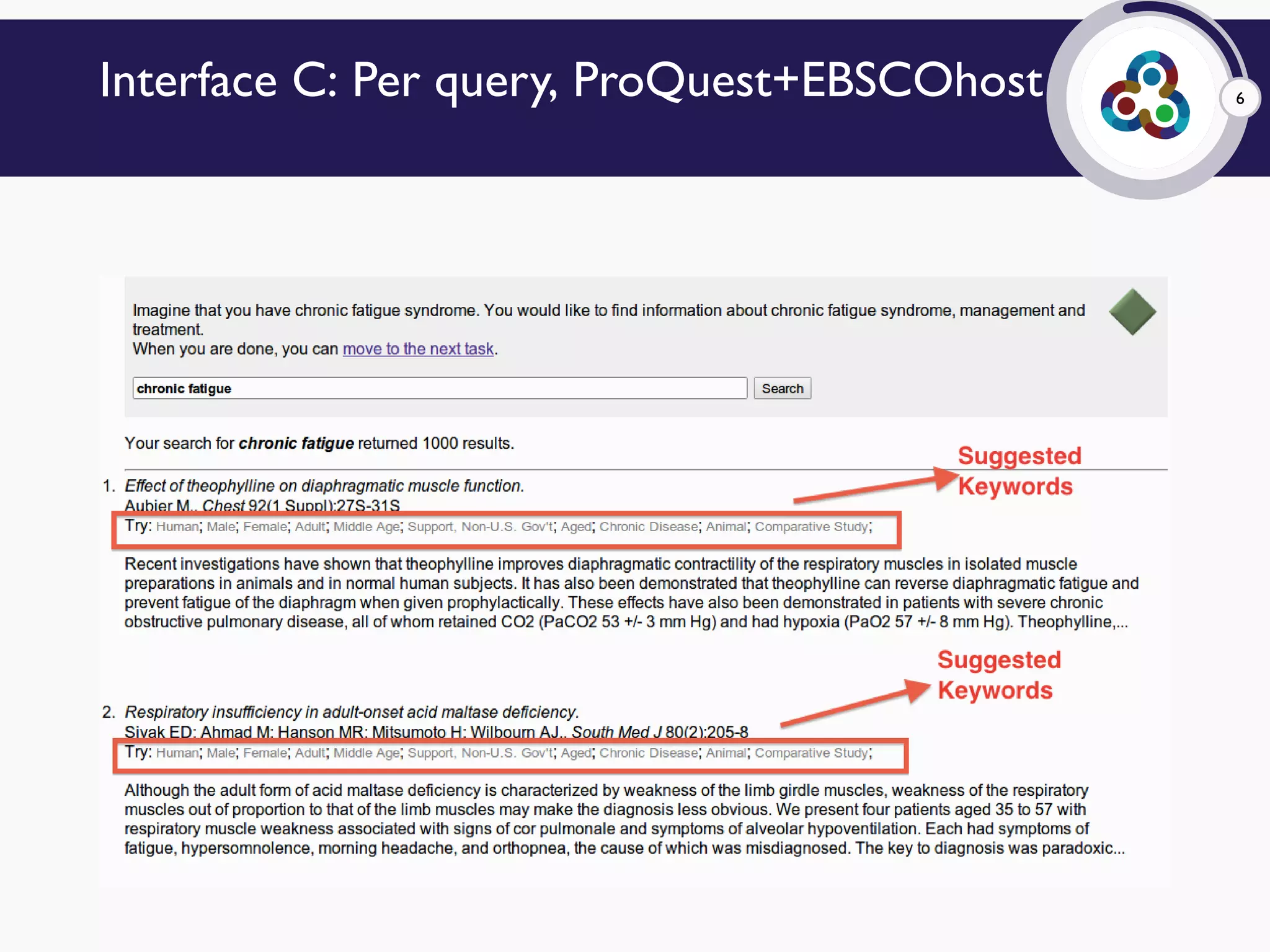
6Interface C: Per query, ProQuest+EBSCOhost
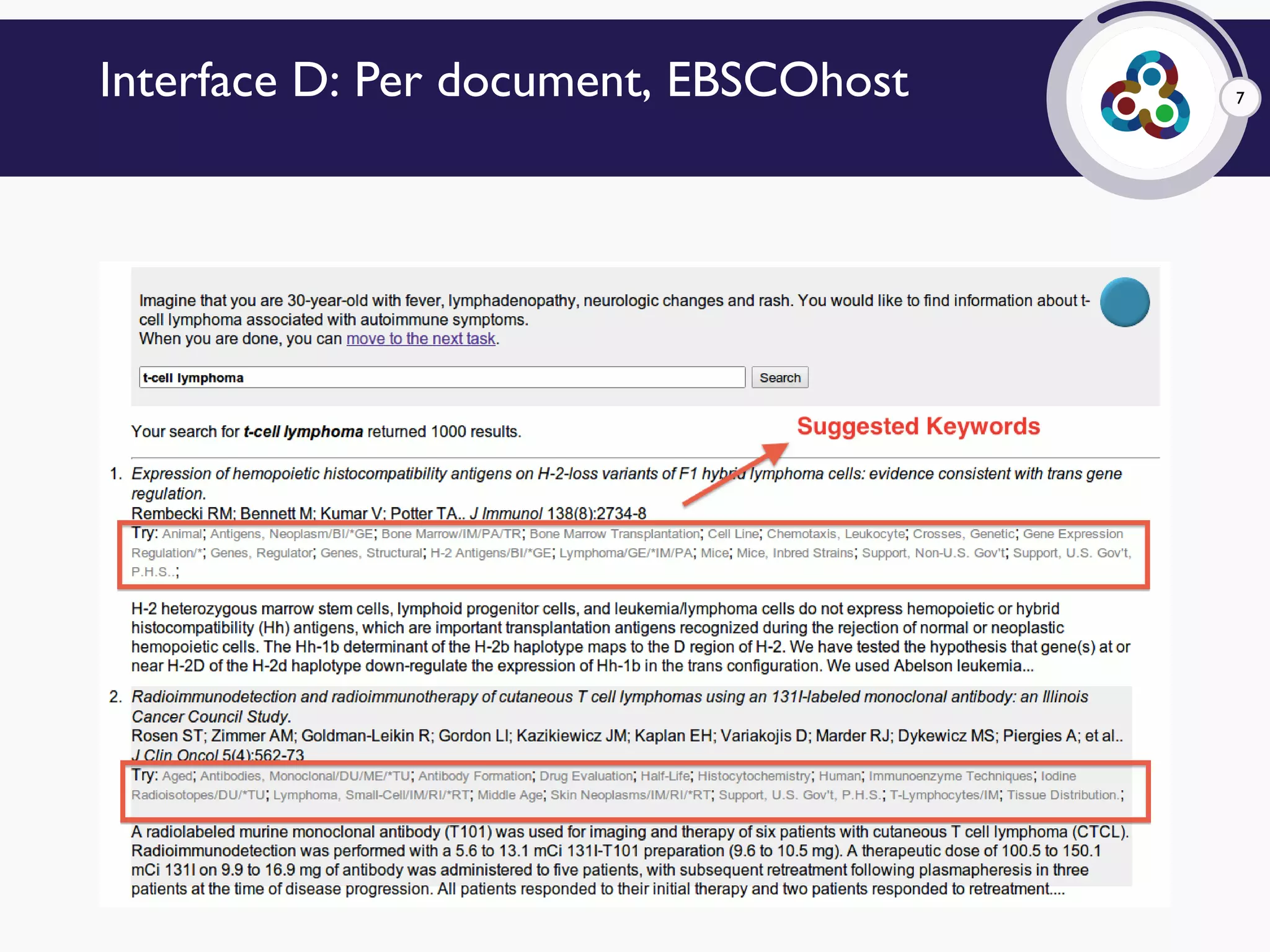
7Interface D: Per document, EBSCOhost
8Test Collection
Selection of search topics
▶ Document test collection from
OHSUMED (Hersh, Buckley, Leone, & Hickam, 1994)
▶ MEDLINE from 1987 to 1991;
348,566 records
▶ Randomly select 8 topics based
on proportion of judged relevant
documents
▶ 2 topics from each of the
quartiles (4 search topic pairs)
Sample search topic
▶ ID: 78
▶ Imagine that you are 42-year-old
black man with hypertension.
▶ You would like to find
information about beta blockers
and blacks with hypertension,
utility.
9Experimental Design
Factorial design
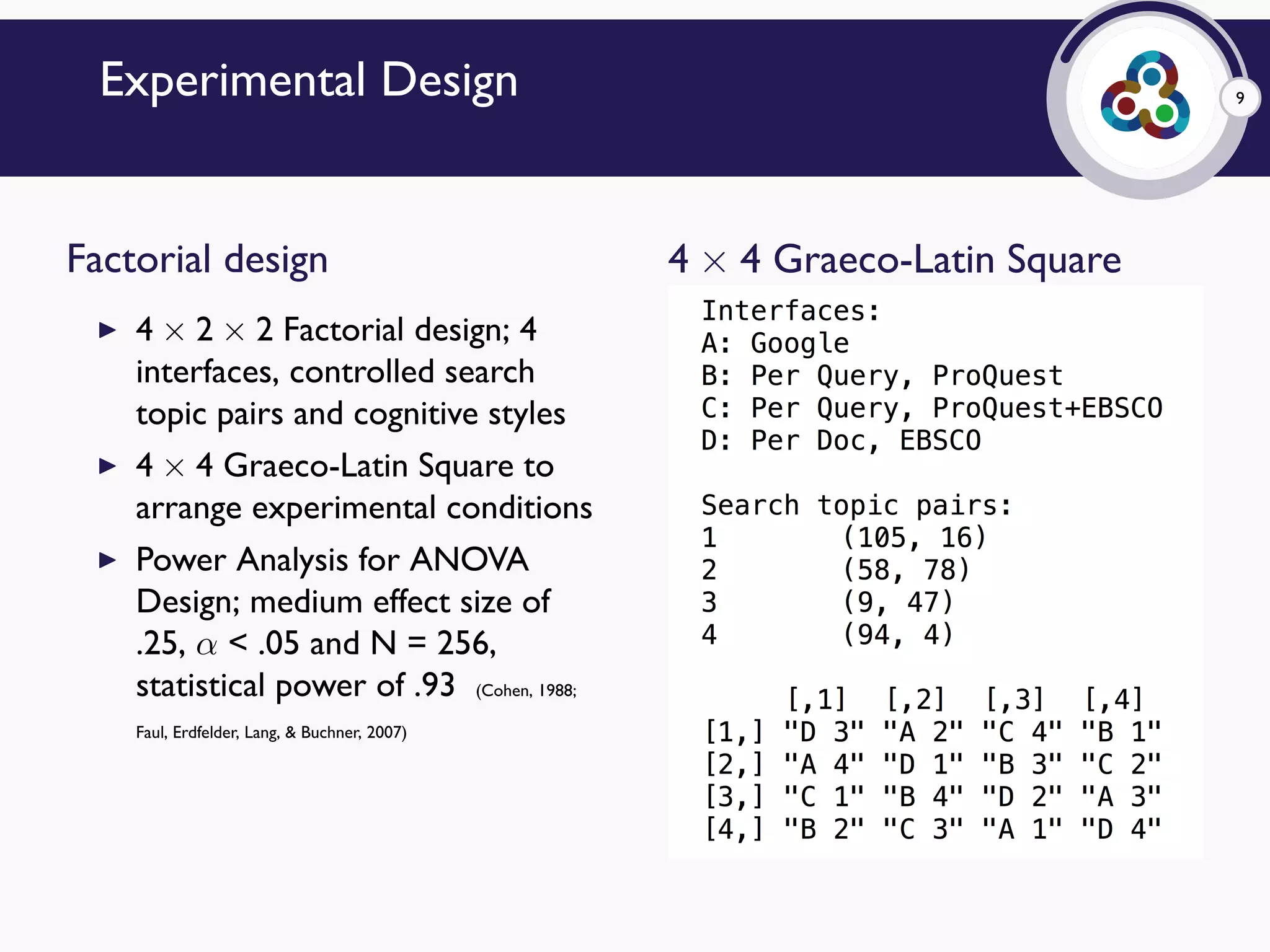
▶ 4 × 2 × 2 Factorial design; 4
interfaces, controlled search
topic pairs and cognitive styles
▶ 4 × 4 Graeco-Latin Square to
arrange experimental conditions
▶ Power Analysis for ANOVA
Design; medium effect size of
.25, α < .05 and N = 256,
statistical power of .93 (Cohen, 1988;
Faul, Erdfelder, Lang, & Buchner, 2007)
4 × 4 Graeco-Latin Square
10Software and Hardware
Experimental system setup
▶ Experimental search system
based on Solr
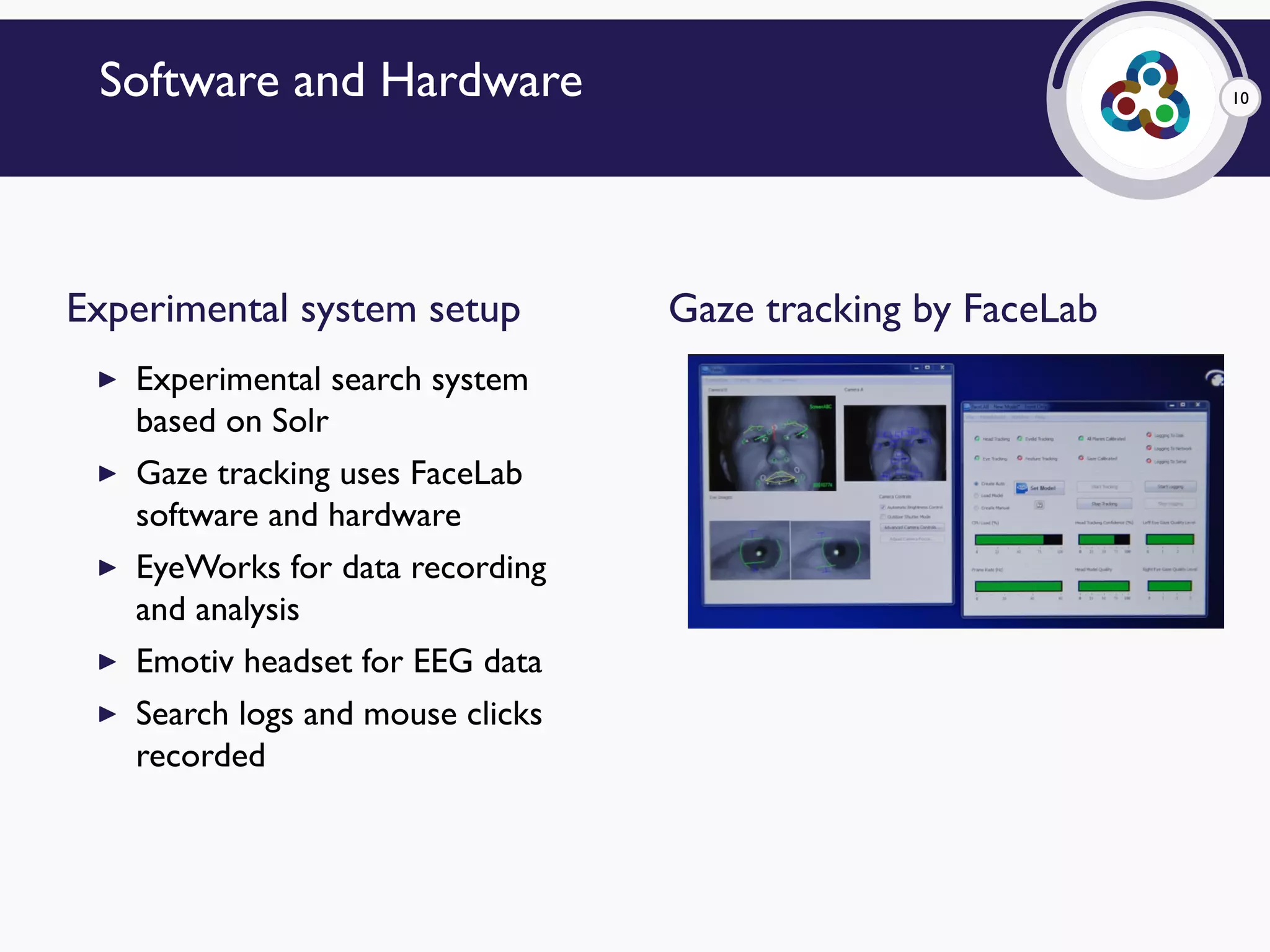
▶ Gaze tracking uses FaceLab
software and hardware
▶ EyeWorks for data recording
and analysis
▶ Emotiv headset for EEG data
▶ Search logs and mouse clicks
recorded
Gaze tracking by FaceLab
11Experimental Procedure
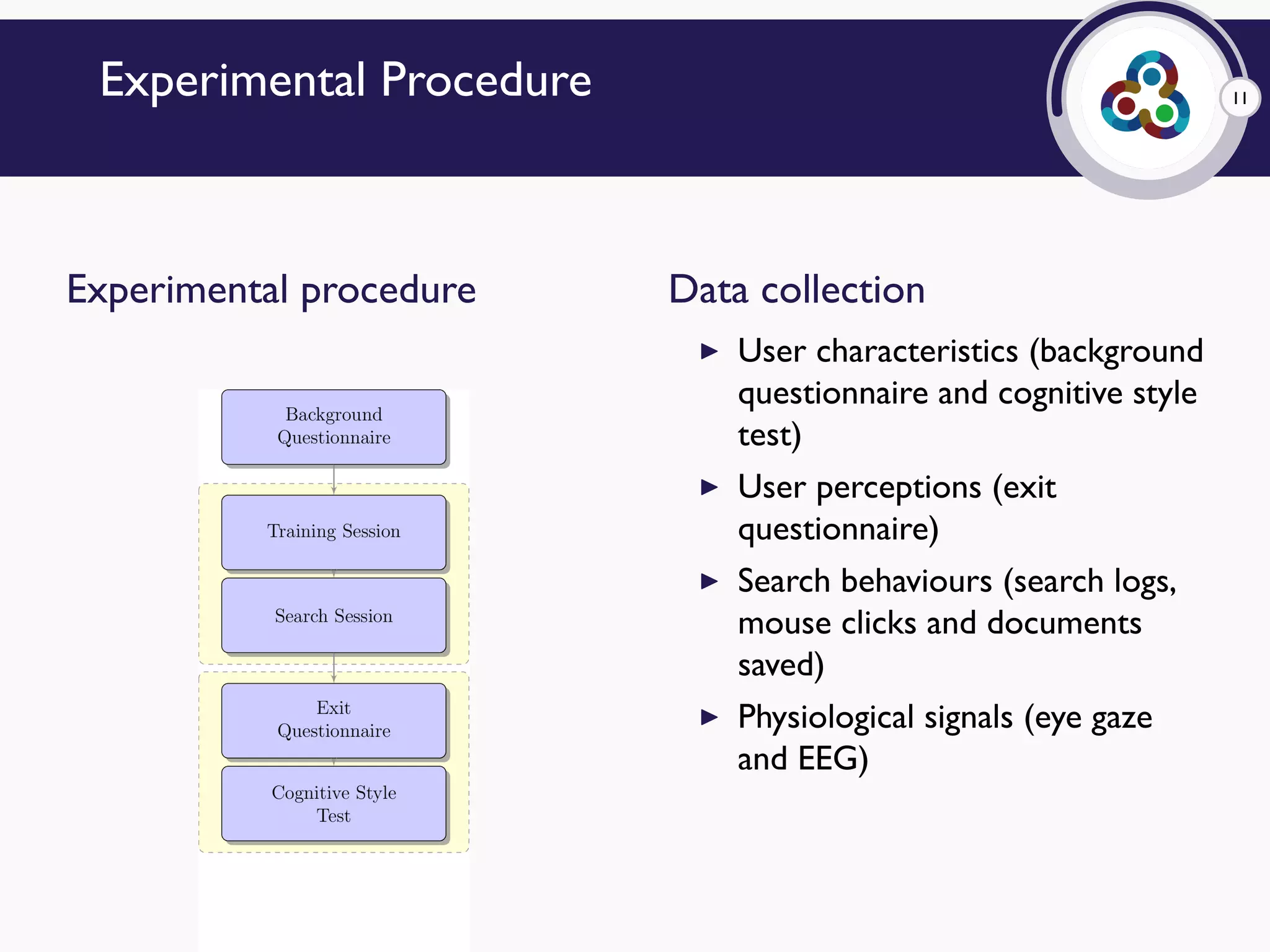
Experimental procedure Data collection
▶ User characteristics (background
questionnaire and cognitive style
test)
▶ User perceptions (exit
questionnaire)
▶ Search behaviours (search logs,
mouse clicks and documents
saved)
▶ Physiological signals (eye gaze
and EEG)
12Searcher Characteristics
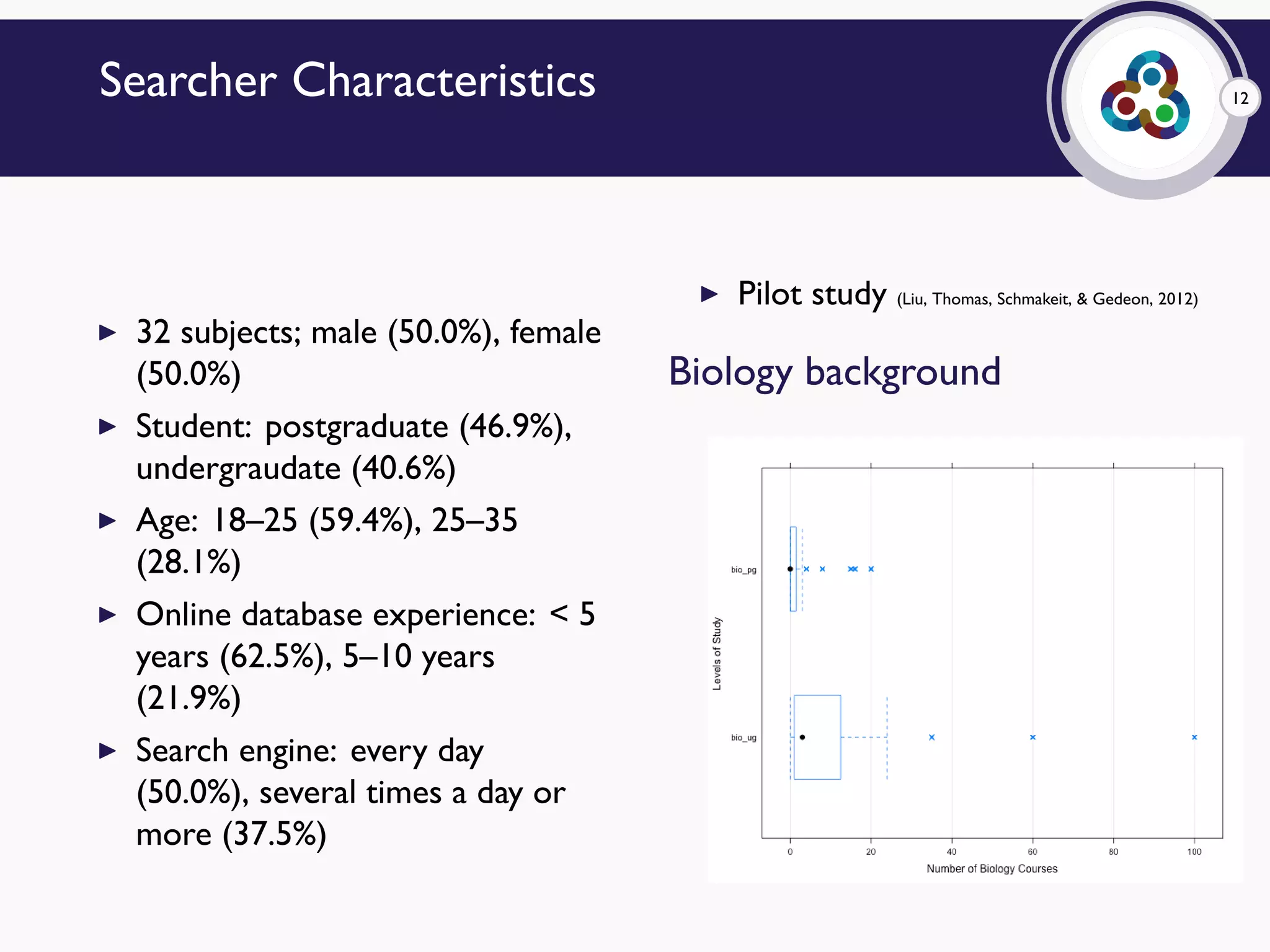
▶ 32 subjects; male (50.0%), female
(50.0%)
▶ Student: postgraduate (46.9%),
undergraudate (40.6%)
▶ Age: 18–25 (59.4%), 25–35
(28.1%)
▶ Online database experience: < 5
years (62.5%), 5–10 years
(21.9%)
▶ Search engine: every day
(50.0%), several times a day or
more (37.5%)
▶ Pilot study (Liu, Thomas, Schmakeit, & Gedeon, 2012)
Biology background
13Searcher Characteristics (cont’d)
▶ Cognitive style: Individual’s
preference or tendency to
process information
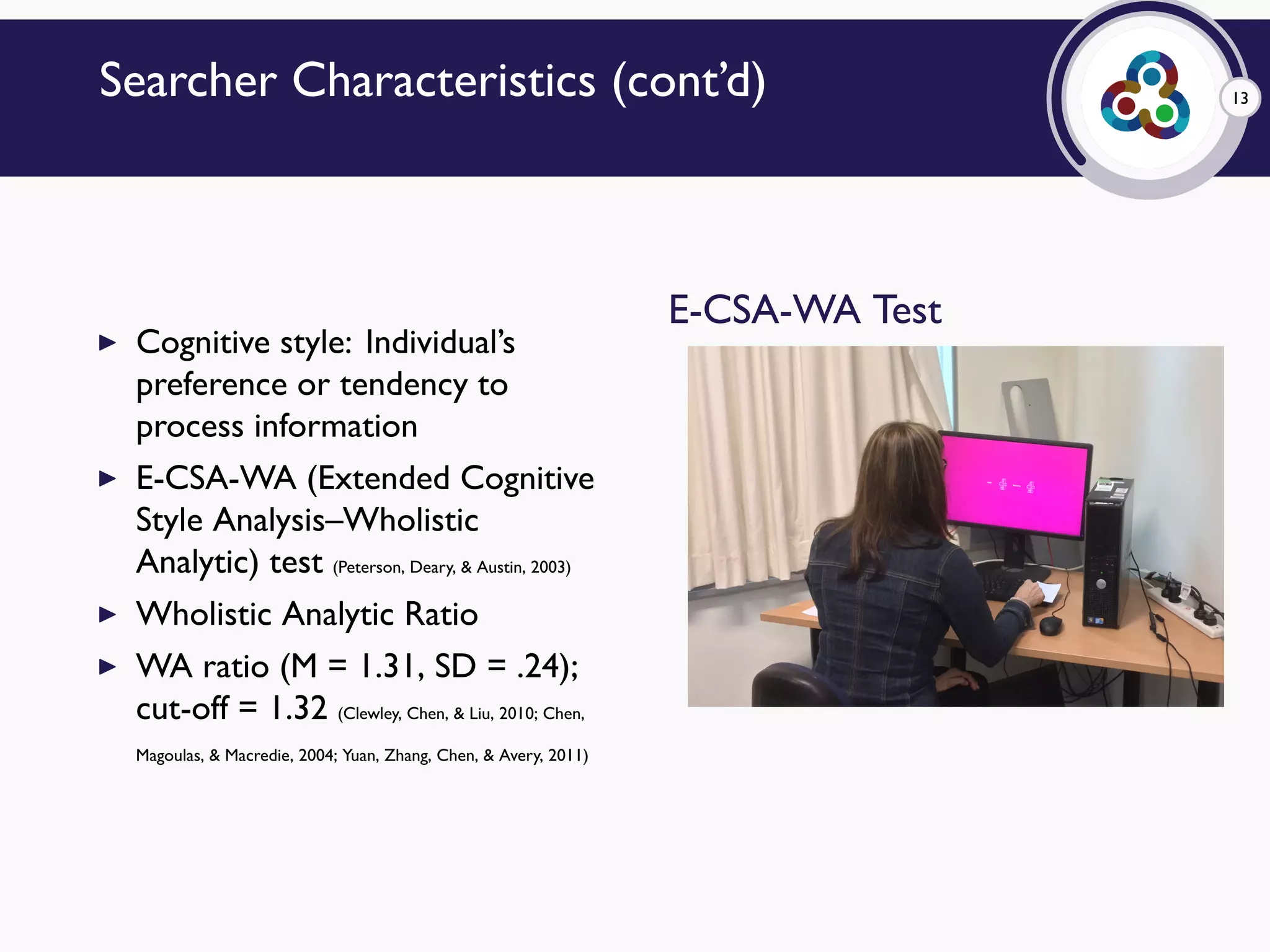
▶ E-CSA-WA (Extended Cognitive
Style Analysis–Wholistic
Analytic) test (Peterson, Deary, & Austin, 2003)
▶ Wholistic Analytic Ratio
▶ WA ratio (M = 1.31, SD = .24);
cut-off = 1.32 (Clewley, Chen, & Liu, 2010; Chen,
Magoulas, & Macredie, 2004; Yuan, Zhang, Chen, & Avery, 2011)
E-CSA-WA Test
14Data Analysis
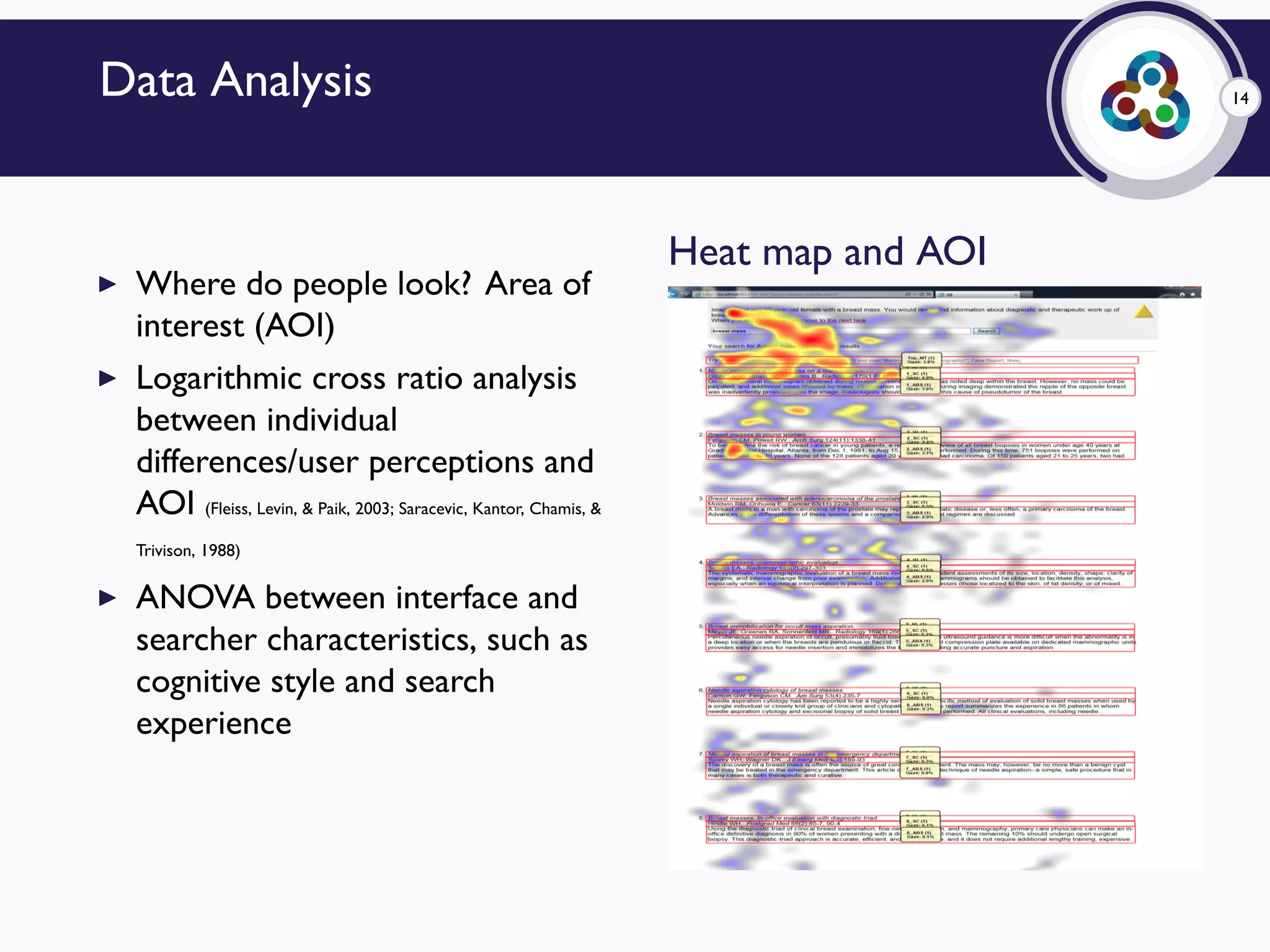
▶ Where do people look? Area of
interest (AOI)
▶ Logarithmic cross ratio analysis
between individual
differences/user perceptions and
AOI (Fleiss, Levin, & Paik, 2003; Saracevic, Kantor, Chamis, &
Trivison, 1988)
▶ ANOVA between interface and
searcher characteristics, such as
cognitive style and search
experience
Heat map and AOI
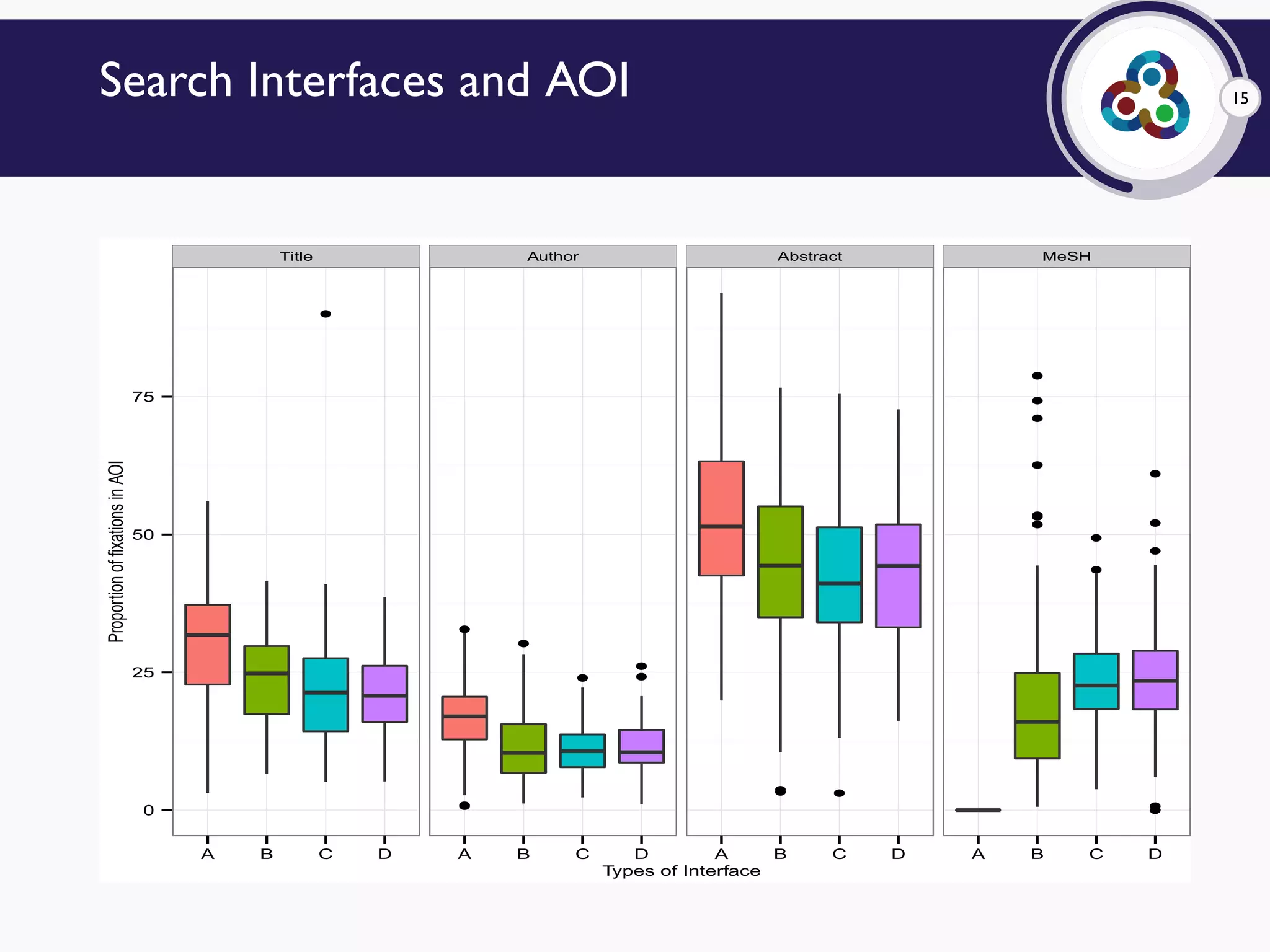
15Search Interfaces and AOI
Title Author Abstract MeSH
q
q
qq
q
q
q
q
qq q
qq
q
q
q
q
q
q
q
qq
q
q
q
q
0
25
50
75
A B C D A B C D A B C D A B C D
Types of Interface
ProportionoffixationsinAOI
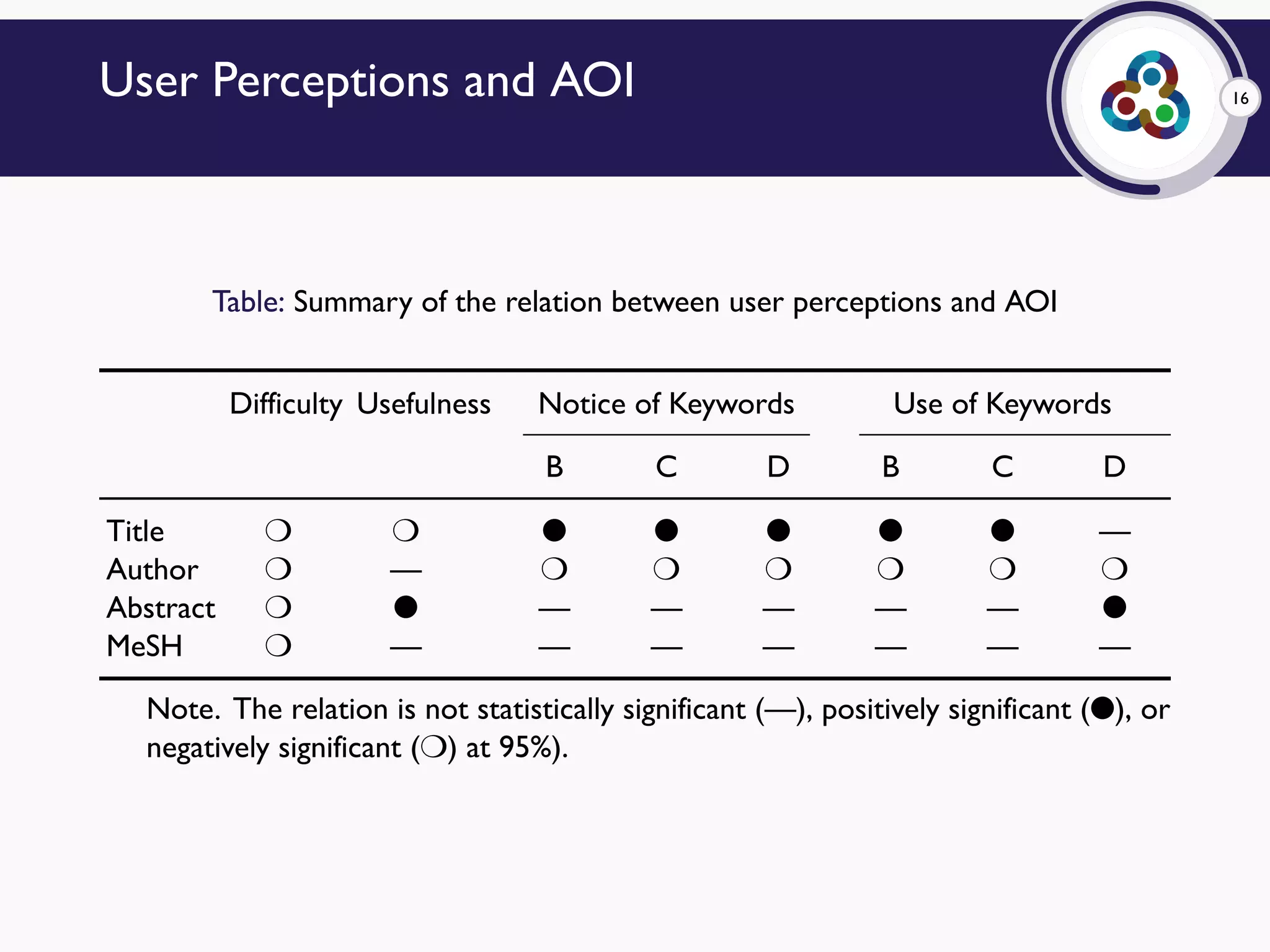
16User Perceptions and AOI
Table: Summary of the relation between user perceptions and AOI
Difficulty Usefulness Notice of Keywords Use of Keywords
B C D B C D
Title H H G G G G G —
Author H — H H H H H H
Abstract H G — — — — — G
MeSH H — — — — — — —
Note. The relation is not statistically significant (—), positively significant (G), or
negatively significant (H) at 95%).
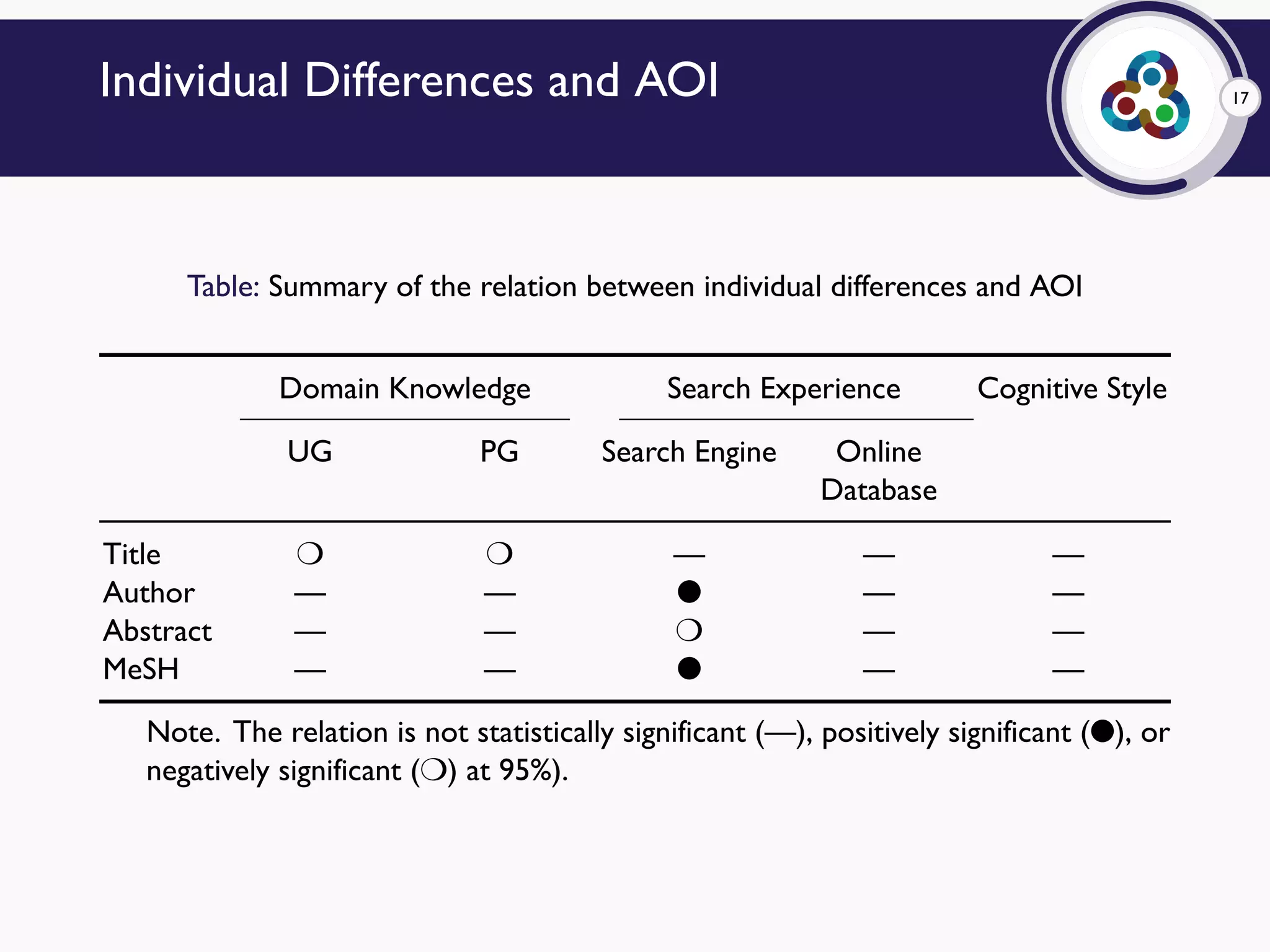
17Individual Differences and AOI
Table: Summary of the relation between individual differences and AOI
Domain Knowledge Search Experience Cognitive Style
UG PG Search Engine Online
Database
Title H H — — —
Author — — G — —
Abstract — — H — —
MeSH — — G — —
Note. The relation is not statistically significant (—), positively significant (G), or
negatively significant (H) at 95%).
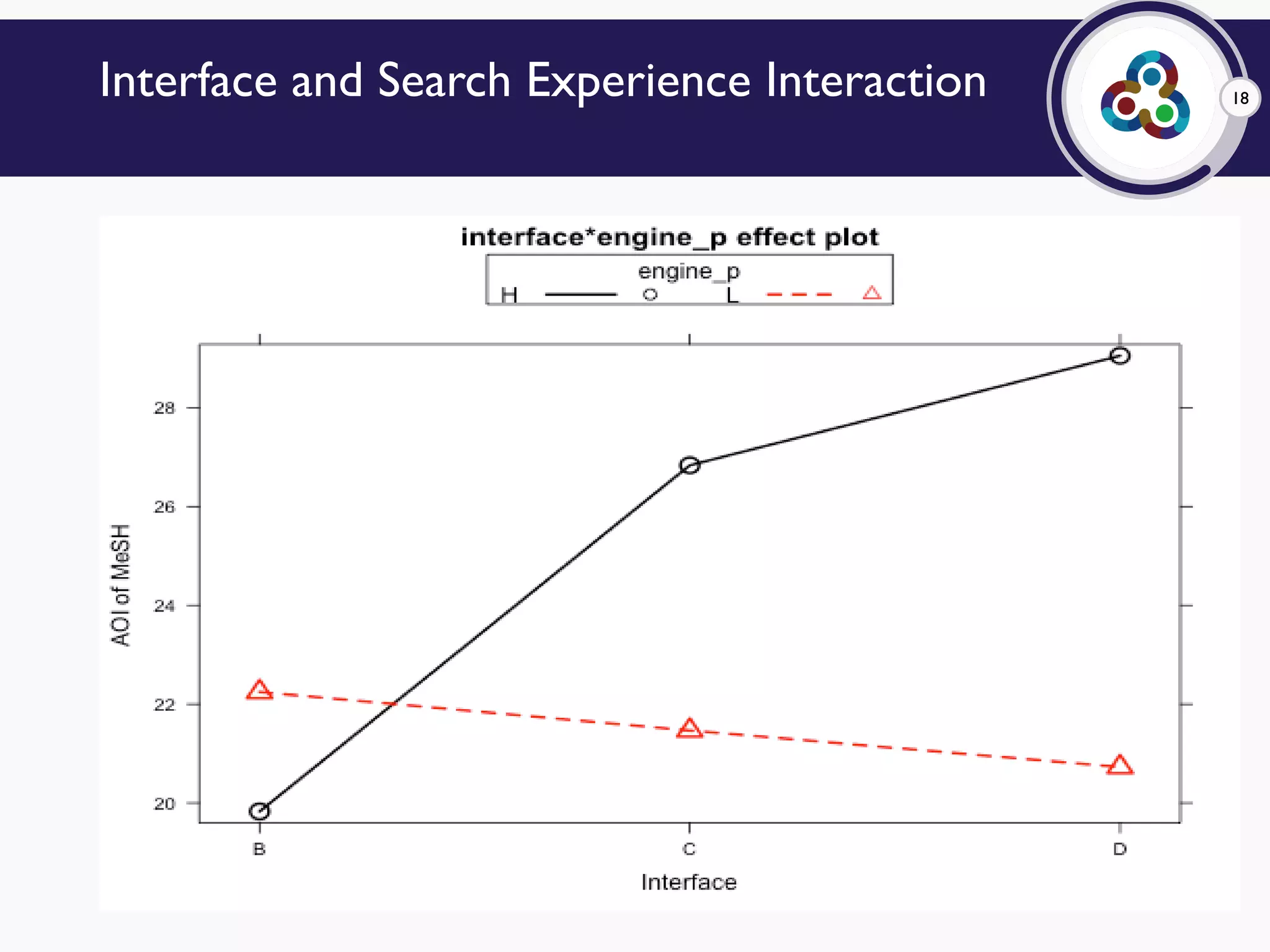
18Interface and Search Experience Interaction
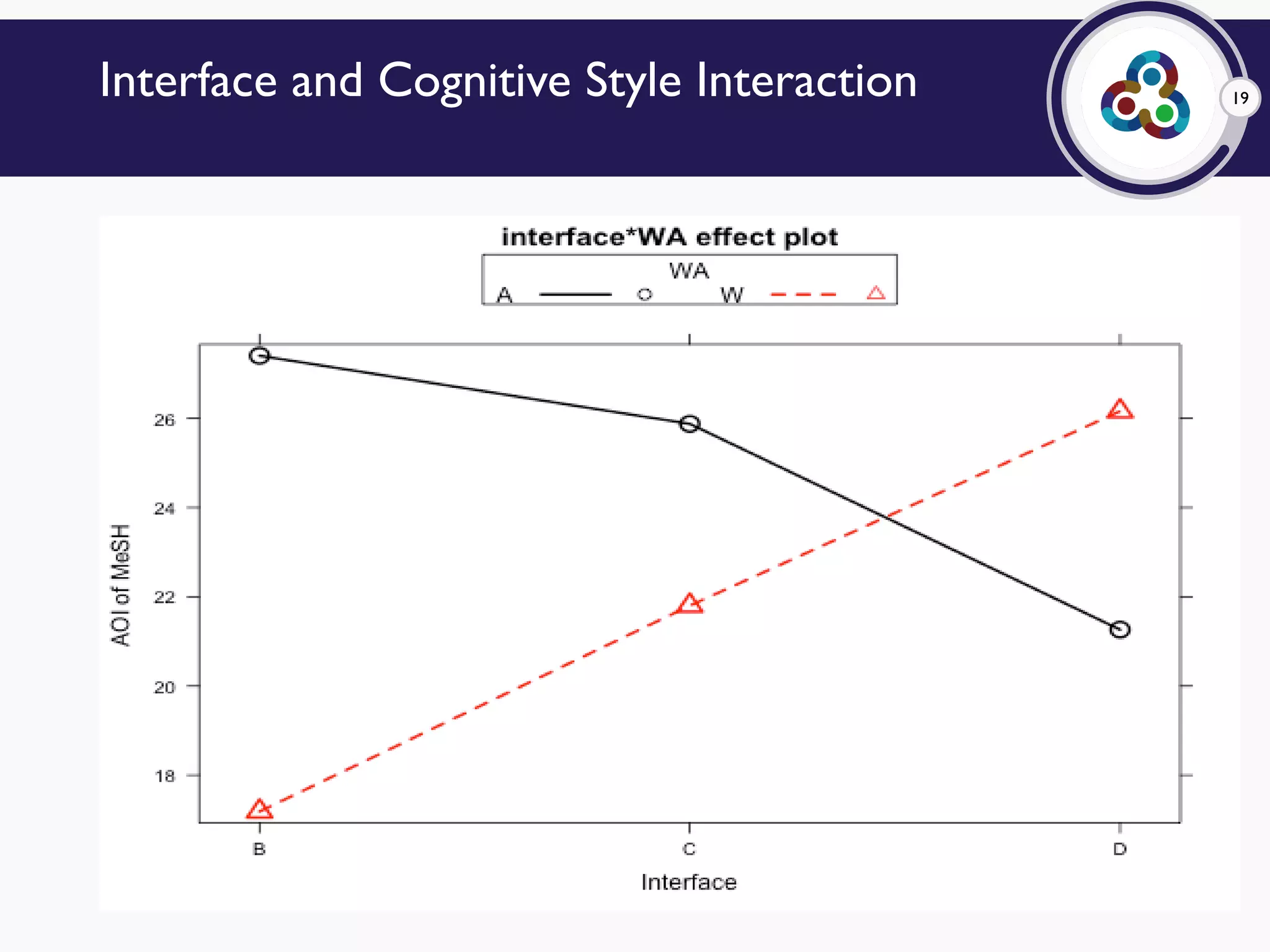
19Interface and Cognitive Style Interaction
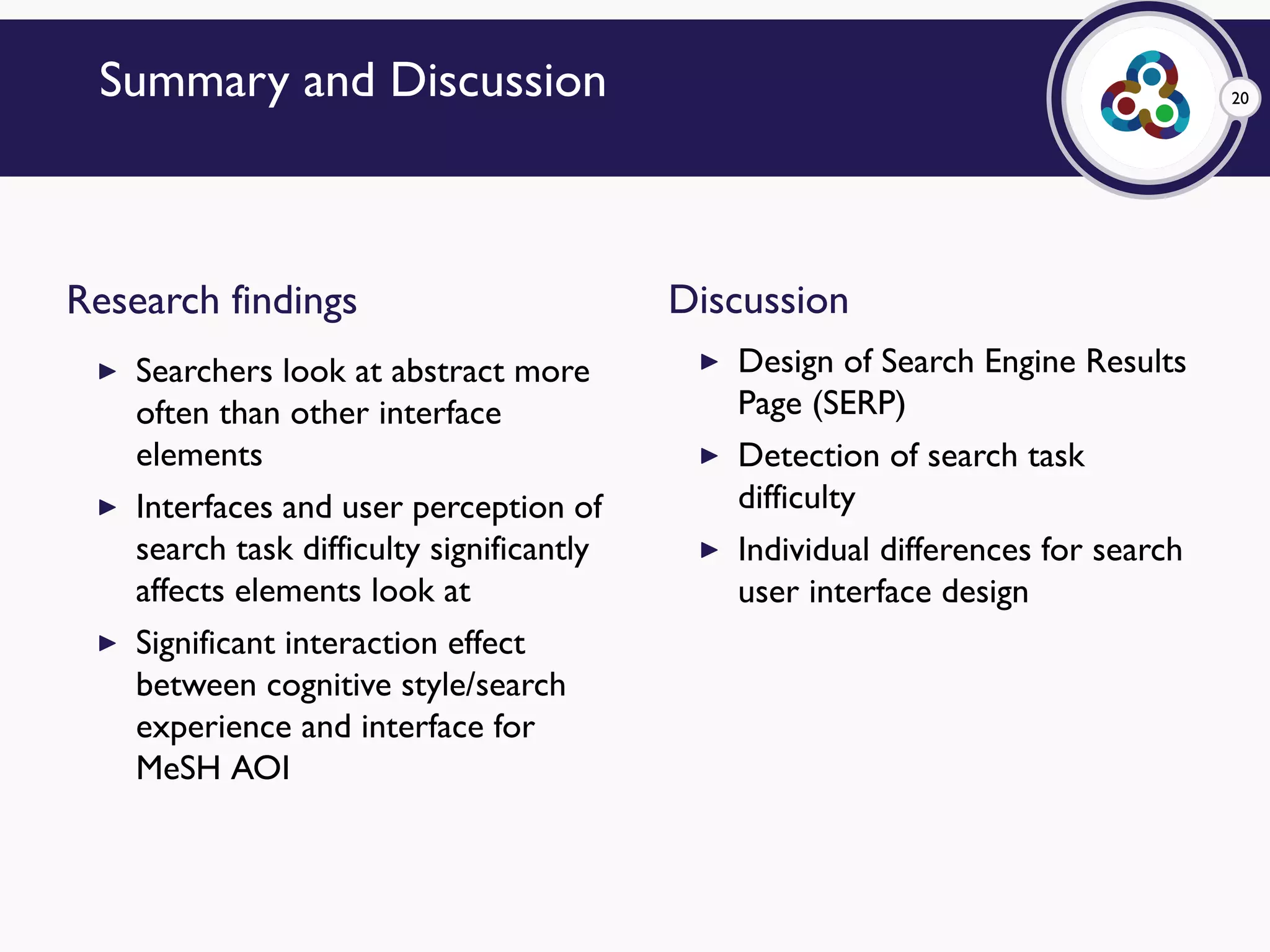
20Summary and Discussion
Research findings
▶ Searchers look at abstract more
often than other interface
elements
▶ Interfaces and user perception of
search task difficulty significantly
affects elements look at
▶ Significant interaction effect
between cognitive style/search
experience and interface for
MeSH AOI
Discussion
▶ Design of Search Engine Results
Page (SERP)
▶ Detection of search task
difficulty
▶ Individual differences for search
user interface design
21
Thank You!
Questions or
Comments?
This study is partially funded by 2014 ALIA Research Grant
Award, led by Dr Ying-Hsang Liu with Marijana Bacic (Monash
Health), Dr Paul Thomas (CSIRO) and Professor Tom
Gedeon (ANU).

Individual Differences, User Perceptions and Eye Gaze in Biomedical Search Interfaces

  • 1.
    Individual Differences, UserPerceptions and Eye Gaze in Biomedical Search Interfaces 7 September 2015 Ying-Hsang Liu 1,2 1 School of Information Studies Charles Sturt University 2 Research School of Computer Science The Australian National University
  • 2.
  • 3.
    2Introduction Interactive Information Retrieval (IIR) ▶Current IR systems designed for specified search (Belkin, 2008) ▶ Natural search user interfaces (Hearst, 2011) ▶ Usefulness of controlled indexing languages (Salton, 1972; Svenonius, 1986) Medical Subject Headings (MeSH) terms
  • 4.
    3Research Questions Research questions ▶What elements of search interfaces do searchers look at when searching for documents to answer complex questions? ▶ What is the relation between user perceptions of an interface and the interface elements they look at? ▶ What is the relation between individual differences and the interface elements which are looked at? User experiment in a laboratory setting
  • 5.
  • 6.
    5Interface B: Perquery, ProQuest
  • 7.
    6Interface C: Perquery, ProQuest+EBSCOhost
  • 8.
    7Interface D: Perdocument, EBSCOhost
  • 9.
    8Test Collection Selection ofsearch topics ▶ Document test collection from OHSUMED (Hersh, Buckley, Leone, & Hickam, 1994) ▶ MEDLINE from 1987 to 1991; 348,566 records ▶ Randomly select 8 topics based on proportion of judged relevant documents ▶ 2 topics from each of the quartiles (4 search topic pairs) Sample search topic ▶ ID: 78 ▶ Imagine that you are 42-year-old black man with hypertension. ▶ You would like to find information about beta blockers and blacks with hypertension, utility.
  • 10.
    9Experimental Design Factorial design ▶4 × 2 × 2 Factorial design; 4 interfaces, controlled search topic pairs and cognitive styles ▶ 4 × 4 Graeco-Latin Square to arrange experimental conditions ▶ Power Analysis for ANOVA Design; medium effect size of .25, α < .05 and N = 256, statistical power of .93 (Cohen, 1988; Faul, Erdfelder, Lang, & Buchner, 2007) 4 × 4 Graeco-Latin Square
  • 11.
    10Software and Hardware Experimentalsystem setup ▶ Experimental search system based on Solr ▶ Gaze tracking uses FaceLab software and hardware ▶ EyeWorks for data recording and analysis ▶ Emotiv headset for EEG data ▶ Search logs and mouse clicks recorded Gaze tracking by FaceLab
  • 12.
    11Experimental Procedure Experimental procedureData collection ▶ User characteristics (background questionnaire and cognitive style test) ▶ User perceptions (exit questionnaire) ▶ Search behaviours (search logs, mouse clicks and documents saved) ▶ Physiological signals (eye gaze and EEG)
  • 13.
    12Searcher Characteristics ▶ 32subjects; male (50.0%), female (50.0%) ▶ Student: postgraduate (46.9%), undergraudate (40.6%) ▶ Age: 18–25 (59.4%), 25–35 (28.1%) ▶ Online database experience: < 5 years (62.5%), 5–10 years (21.9%) ▶ Search engine: every day (50.0%), several times a day or more (37.5%) ▶ Pilot study (Liu, Thomas, Schmakeit, & Gedeon, 2012) Biology background
  • 14.
    13Searcher Characteristics (cont’d) ▶Cognitive style: Individual’s preference or tendency to process information ▶ E-CSA-WA (Extended Cognitive Style Analysis–Wholistic Analytic) test (Peterson, Deary, & Austin, 2003) ▶ Wholistic Analytic Ratio ▶ WA ratio (M = 1.31, SD = .24); cut-off = 1.32 (Clewley, Chen, & Liu, 2010; Chen, Magoulas, & Macredie, 2004; Yuan, Zhang, Chen, & Avery, 2011) E-CSA-WA Test
  • 15.
    14Data Analysis ▶ Wheredo people look? Area of interest (AOI) ▶ Logarithmic cross ratio analysis between individual differences/user perceptions and AOI (Fleiss, Levin, & Paik, 2003; Saracevic, Kantor, Chamis, & Trivison, 1988) ▶ ANOVA between interface and searcher characteristics, such as cognitive style and search experience Heat map and AOI
  • 16.
    15Search Interfaces andAOI Title Author Abstract MeSH q q qq q q q q qq q qq q q q q q q q qq q q q q 0 25 50 75 A B C D A B C D A B C D A B C D Types of Interface ProportionoffixationsinAOI
  • 17.
    16User Perceptions andAOI Table: Summary of the relation between user perceptions and AOI Difficulty Usefulness Notice of Keywords Use of Keywords B C D B C D Title H H G G G G G — Author H — H H H H H H Abstract H G — — — — — G MeSH H — — — — — — — Note. The relation is not statistically significant (—), positively significant (G), or negatively significant (H) at 95%).
  • 18.
    17Individual Differences andAOI Table: Summary of the relation between individual differences and AOI Domain Knowledge Search Experience Cognitive Style UG PG Search Engine Online Database Title H H — — — Author — — G — — Abstract — — H — — MeSH — — G — — Note. The relation is not statistically significant (—), positively significant (G), or negatively significant (H) at 95%).
  • 19.
    18Interface and SearchExperience Interaction
  • 20.
    19Interface and CognitiveStyle Interaction
  • 21.
    20Summary and Discussion Researchfindings ▶ Searchers look at abstract more often than other interface elements ▶ Interfaces and user perception of search task difficulty significantly affects elements look at ▶ Significant interaction effect between cognitive style/search experience and interface for MeSH AOI Discussion ▶ Design of Search Engine Results Page (SERP) ▶ Detection of search task difficulty ▶ Individual differences for search user interface design
  • 22.
    21 Thank You! Questions or Comments? Thisstudy is partially funded by 2014 ALIA Research Grant Award, led by Dr Ying-Hsang Liu with Marijana Bacic (Monash Health), Dr Paul Thomas (CSIRO) and Professor Tom Gedeon (ANU).