Predicting Current User Intent
with Contextual Markov Models
Julia Kiseleva, Hoang Thanh Lam, Mykola Pechenizkiy (TU/e)
Toon Calders (ULB)
DDDM@ICDM2013,
Dallas, TX, USA
CAPA project: http://www.win.tue.nl/~mpechen/projects/capa/
7 December 2013
Outline
• What is predictive Web analytics
• Context-Aware Predictive Analytics framework
• User intent modeling
• Contextual Markov Models
• Case study, experimental results
• Conclusions and further ongoing work
DDDM@ICDM2013
Dec 7, 2013
1Predicting Current User Intent with Contextual Markov Models
Mykola Pechenizkiy, Eindhoven University of Technology
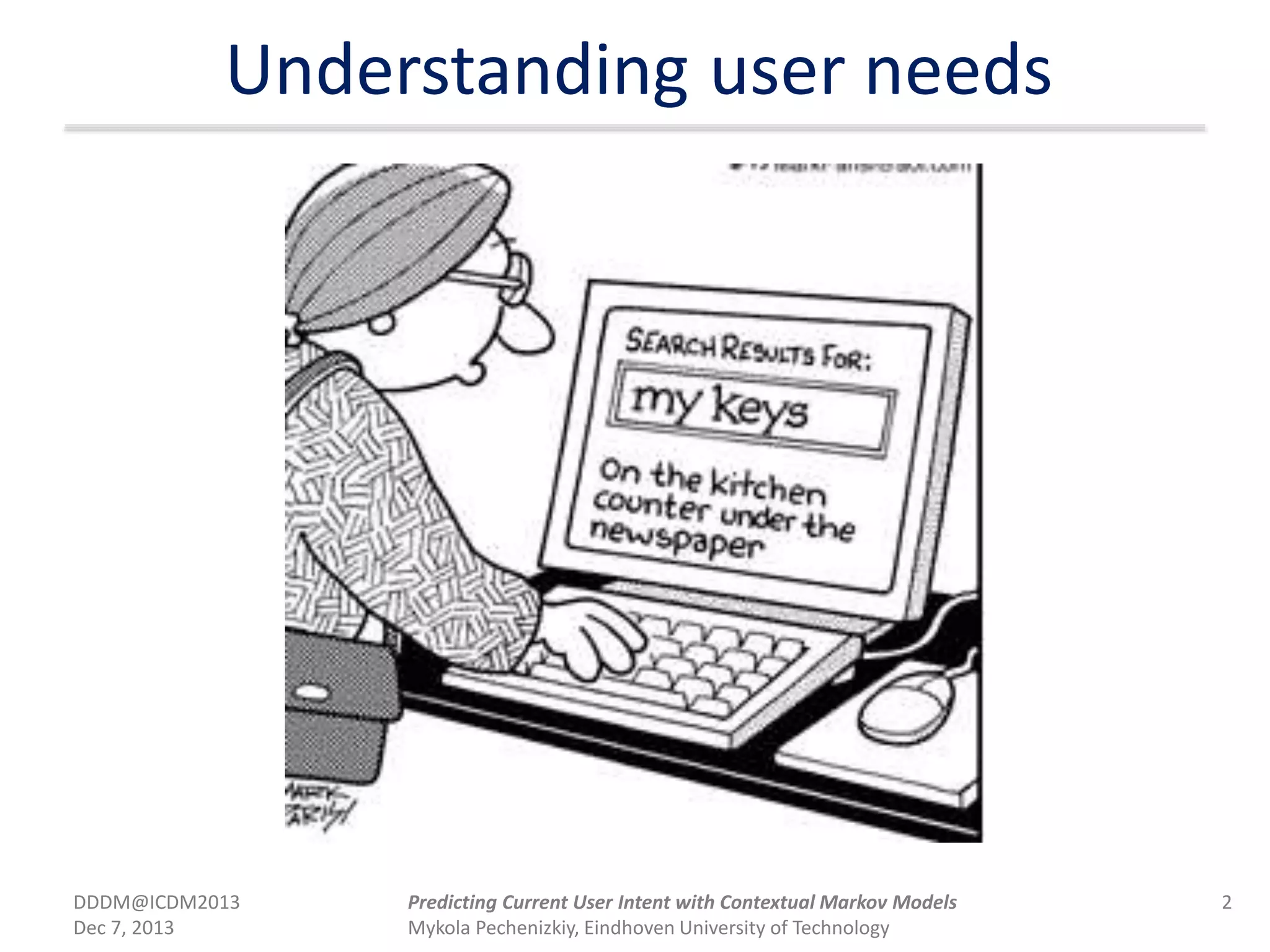
Understanding user needs
DDDM@ICDM2013
Dec 7, 2013
2Predicting Current User Intent with Contextual Markov Models
Mykola Pechenizkiy, Eindhoven University of Technology
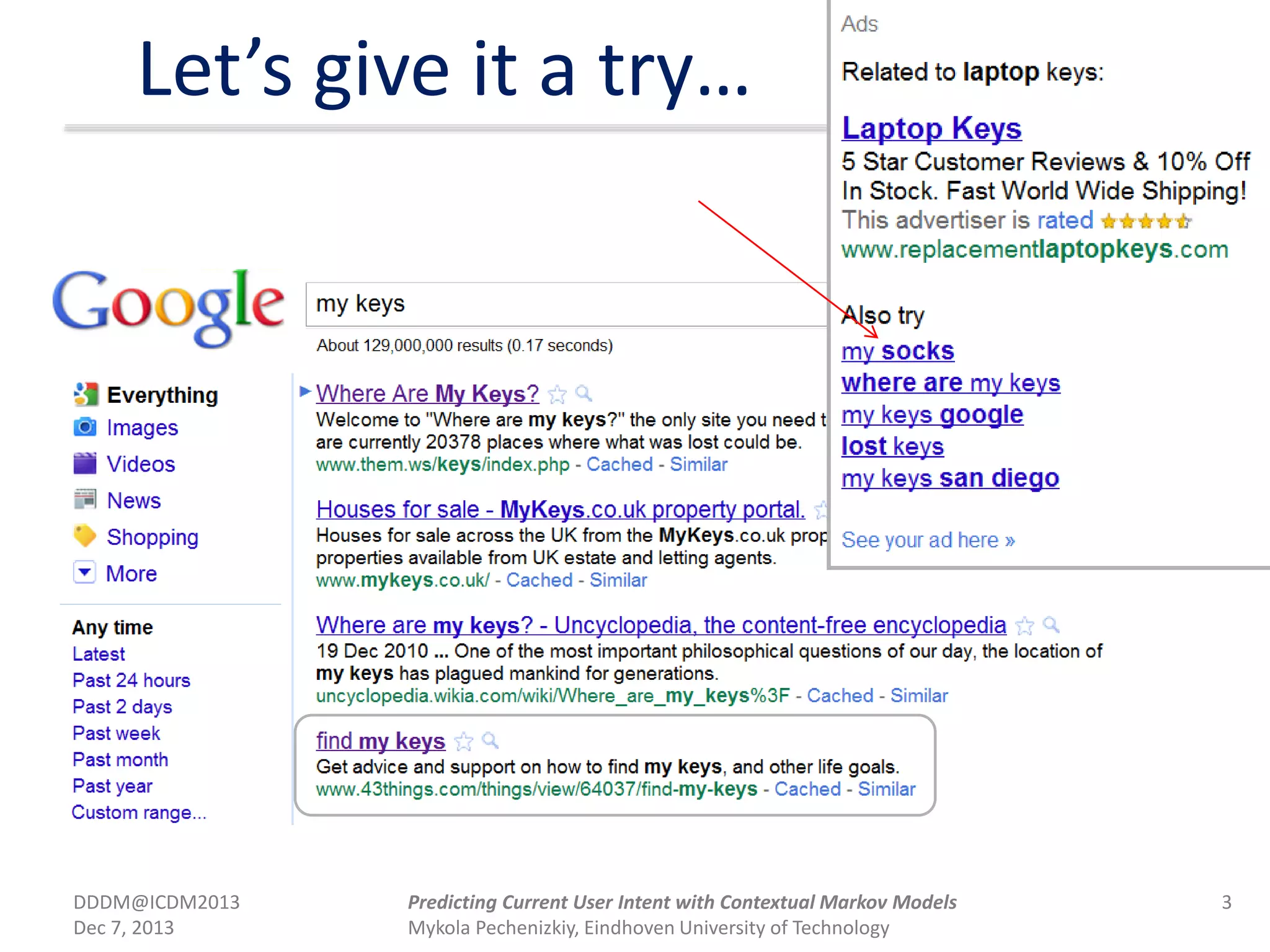
Let’s give it a try…
DDDM@ICDM2013
Dec 7, 2013
3Predicting Current User Intent with Contextual Markov Models
Mykola Pechenizkiy, Eindhoven University of Technology
User Intent Modeling: What?
• Next action prediction
– Click prediction in display advertising
– Drop out prediction
– Trail prediction
• Information need prediction:
– Navigational vs. explorative vs. purchase
– Open acronym based on context
• Type of product wanted
– Personalization based on context
DDDM@ICDM2013
Dec 7, 2013
4Predicting Current User Intent with Contextual Markov Models
Mykola Pechenizkiy, Eindhoven University of Technology
User Intent Modeling: Why?
• To understand users and website usage
– redesign website, redirect flows,
– diversified search, recommendations
• To better use budget (pageviews)
– what (type of) ads to serve?
– brand awareness CPM, or convergence CPC
• To manipulate user – worth giving a promotion?
– personalize with intent of converging to a desired
action
– personalized suggestions based on user context
DDDM@ICDM2013
Dec 7, 2013
5Predicting Current User Intent with Contextual Markov Models
Mykola Pechenizkiy, Eindhoven University of Technology
User Intent Modeling: How?
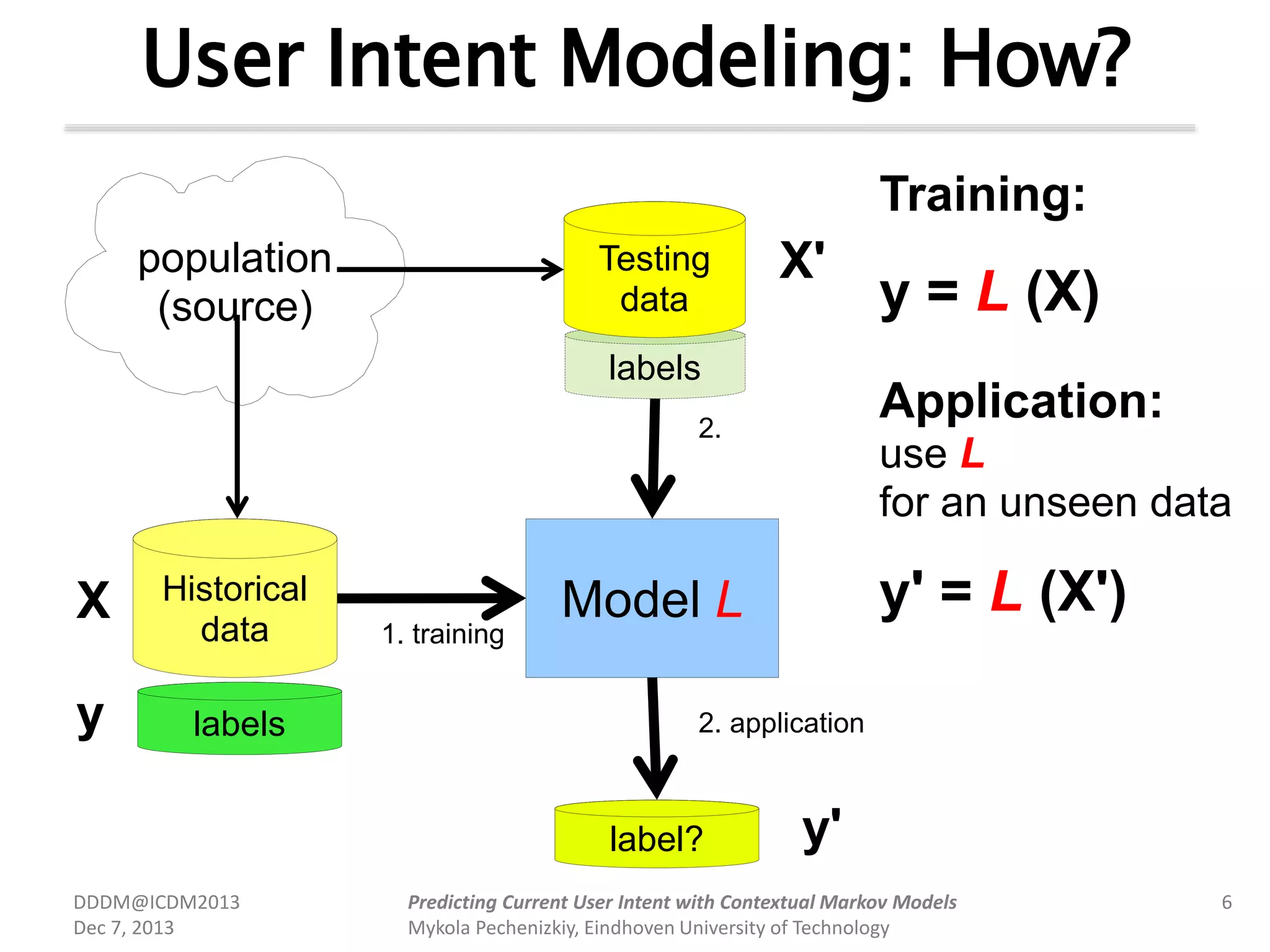
Model L
population
(source)
Historical
data
labels
label?
1. training
2.
2. application
X
y
X'
y'
Training:
y = L (X)
Application:
use L
for an unseen data
y' = L (X')
labels
Testing
data
DDDM@ICDM2013
Dec 7, 2013
6Predicting Current User Intent with Contextual Markov Models
Mykola Pechenizkiy, Eindhoven University of Technology
Context in IR & RecSys
• User Context
– Preferences, usage history, profiles
• Document/Product Context
– Meta-data, content features
• Task Context
– Current activity, location etc.
• Social Context
– Leveraging the social graph
DDDM@ICDM2013
Dec 7, 2013
7Predicting Current User Intent with Contextual Markov Models
Mykola Pechenizkiy, Eindhoven University of Technology
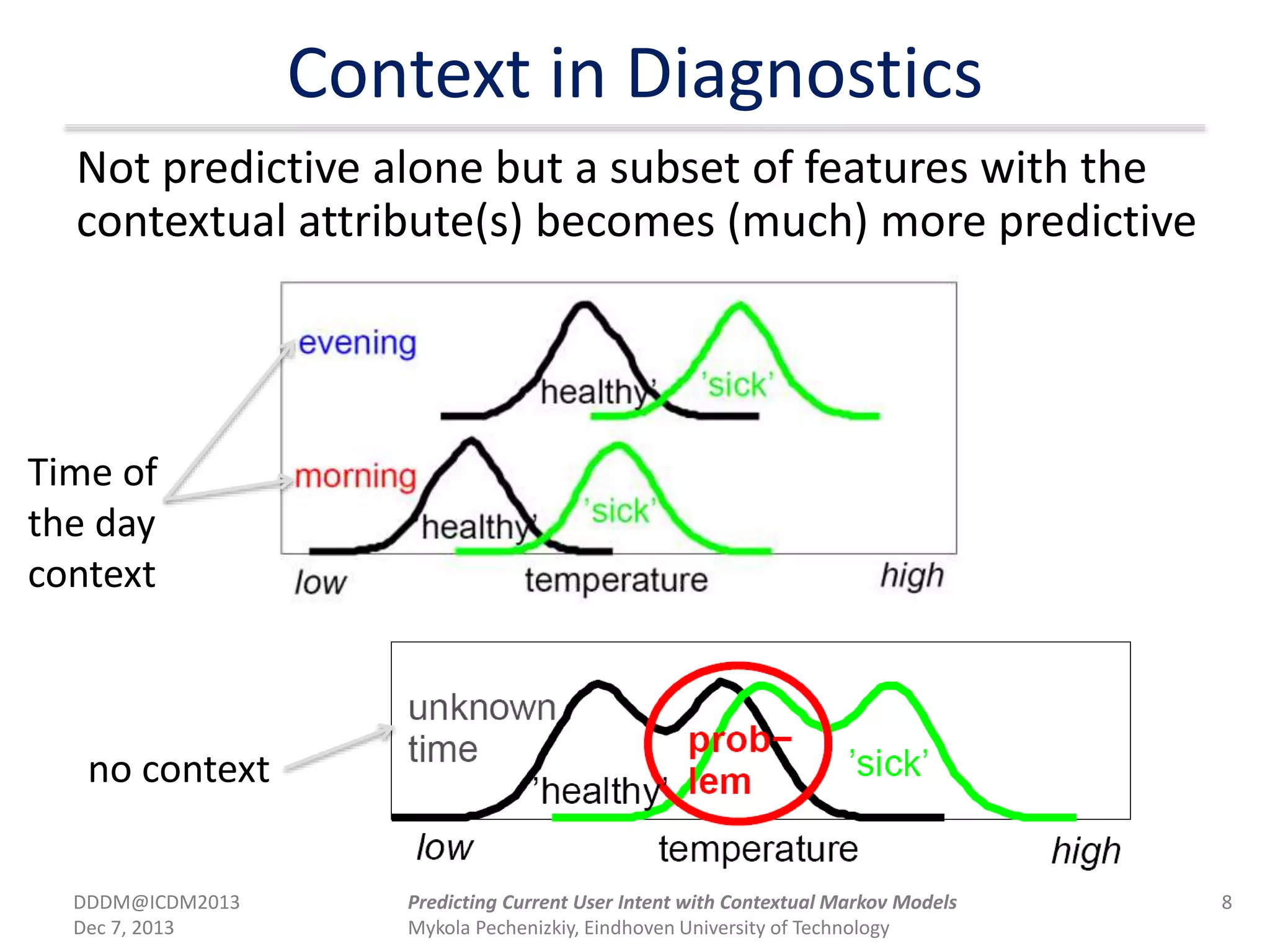
Context in Diagnostics
Not predictive alone but a subset of features with the
contextual attribute(s) becomes (much) more predictive
Time of
the day
context
no context
DDDM@ICDM2013
Dec 7, 2013
8Predicting Current User Intent with Contextual Markov Models
Mykola Pechenizkiy, Eindhoven University of Technology
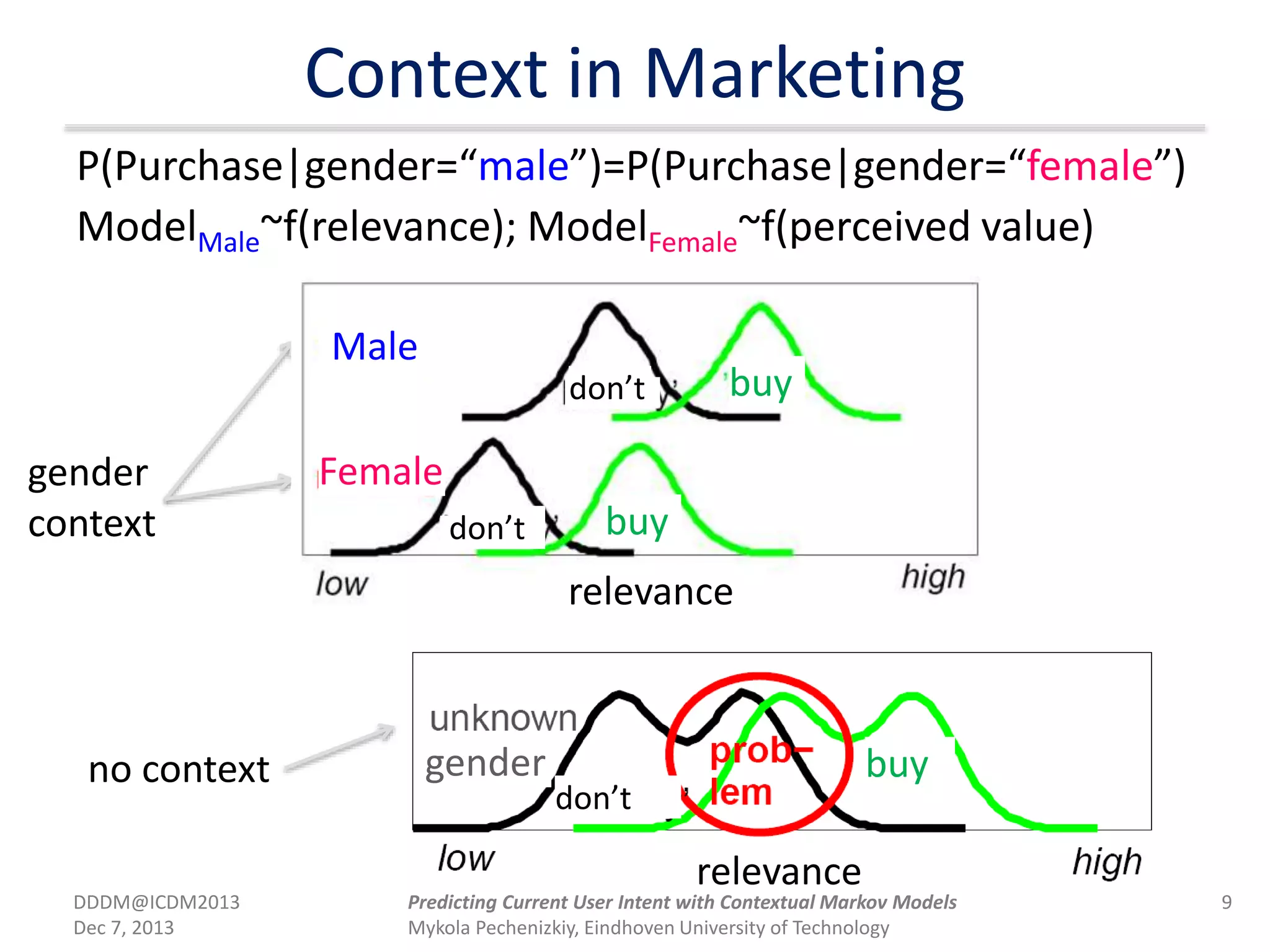
Context in Marketing
P(Purchase|gender=“male”)=P(Purchase|gender=“female”)
ModelMale~f(relevance); ModelFemale~f(perceived value)
gender
context
no context
Male
Female
buy
buy
relevance
relevance
buy
don’t
don’t
don’t
gender
DDDM@ICDM2013
Dec 7, 2013
9Predicting Current User Intent with Contextual Markov Models
Mykola Pechenizkiy, Eindhoven University of Technology
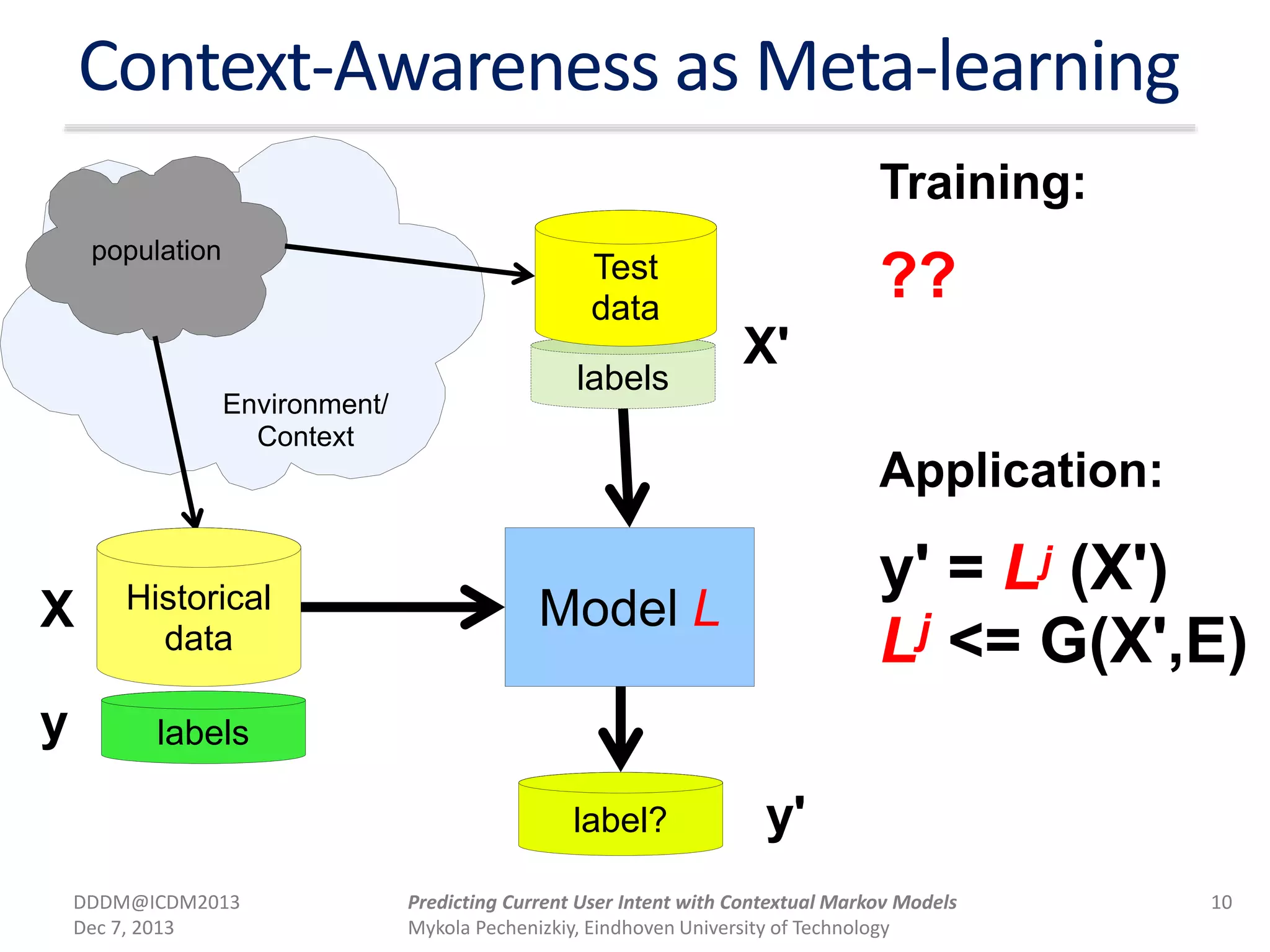
Environment/
Context
Model L
population
Training:
??
Application:
y' = Lj (X')
Lj <= G(X',E)
X'
y'
Historical
data
labels
X
y
label?
Context-Awareness as Meta-learning
labels
Test
data
DDDM@ICDM2013
Dec 7, 2013
10Predicting Current User Intent with Contextual Markov Models
Mykola Pechenizkiy, Eindhoven University of Technology
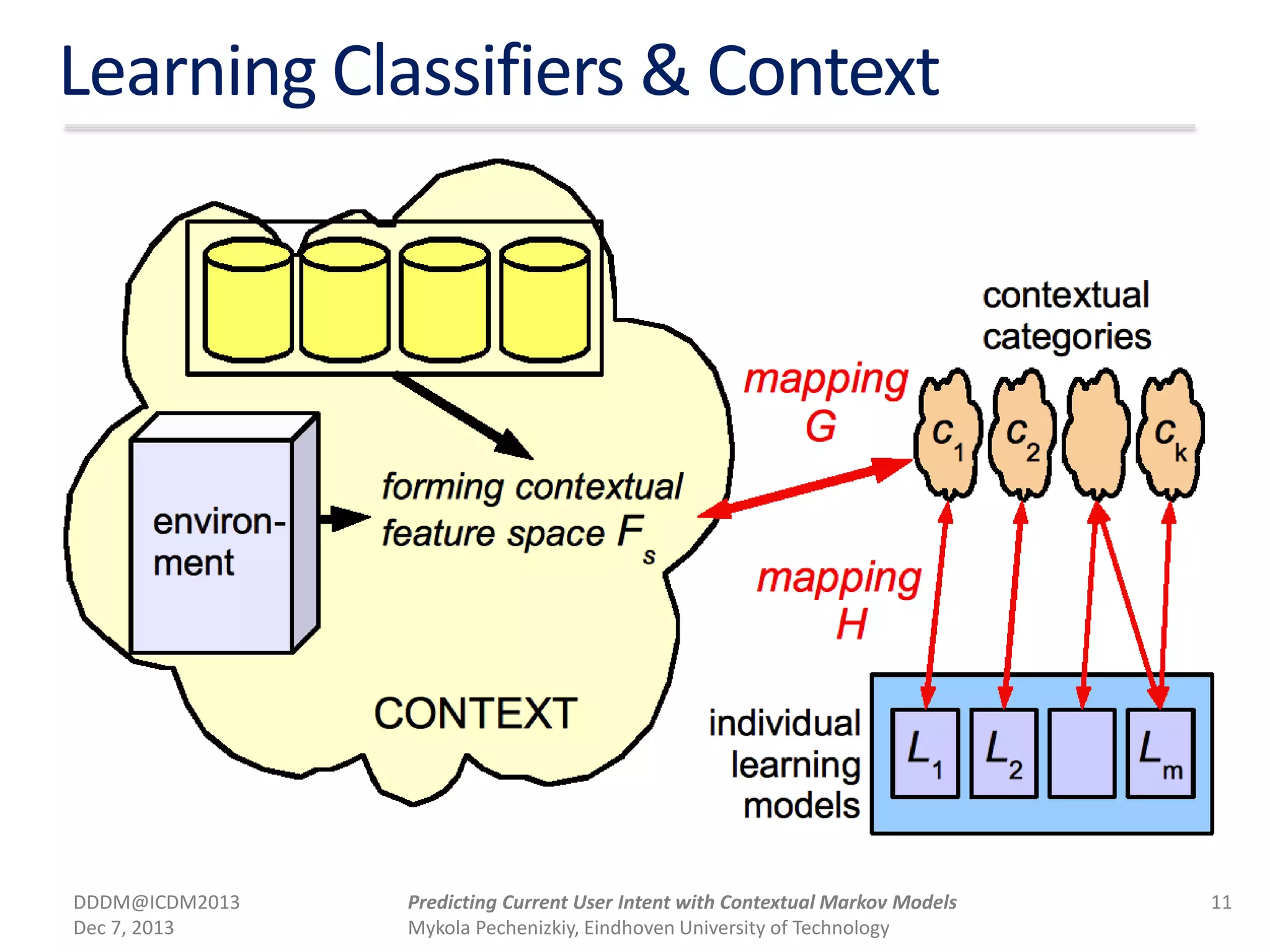
Learning Classifiers & Context
DDDM@ICDM2013
Dec 7, 2013
11Predicting Current User Intent with Contextual Markov Models
Mykola Pechenizkiy, Eindhoven University of Technology
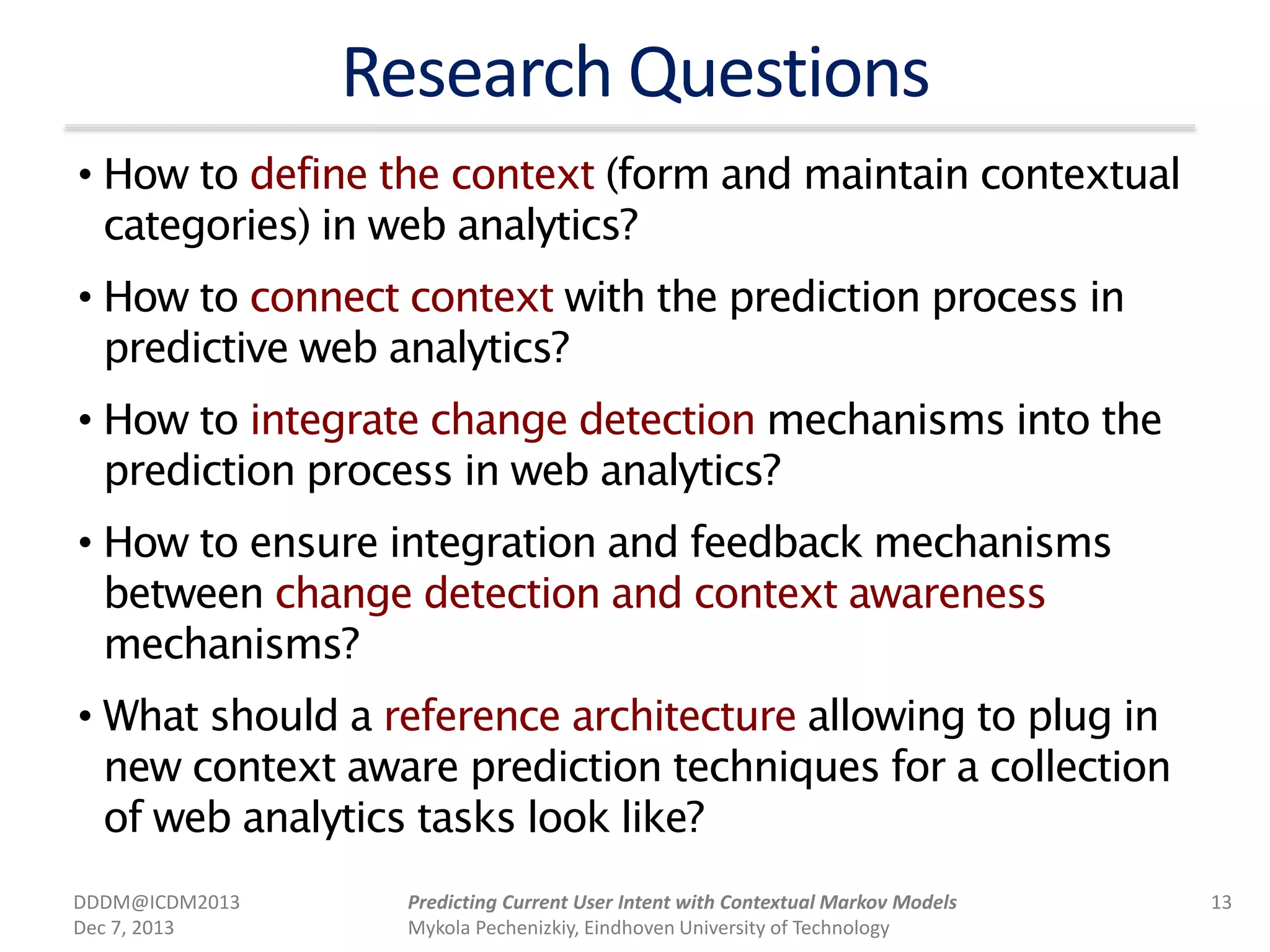
Research Questions
• How to define the context (form and maintain contextual
categories) in web analytics?
• How to connect context with the prediction process in
predictive web analytics?
• How to integrate change detection mechanisms into the
prediction process in web analytics?
• How to ensure integration and feedback mechanisms
between change detection and context awareness
mechanisms?
• What should a reference architecture allowing to plug in
new context aware prediction techniques for a collection
of web analytics tasks look like?
DDDM@ICDM2013
Dec 7, 2013
13Predicting Current User Intent with Contextual Markov Models
Mykola Pechenizkiy, Eindhoven University of Technology
IEEE CBMS 2010
Perth, Australia
Handling Concept Drift in Medical Applications: Importance, Challenges and Solutions
© M. Pechenizkiy and I. Zliobaite
14
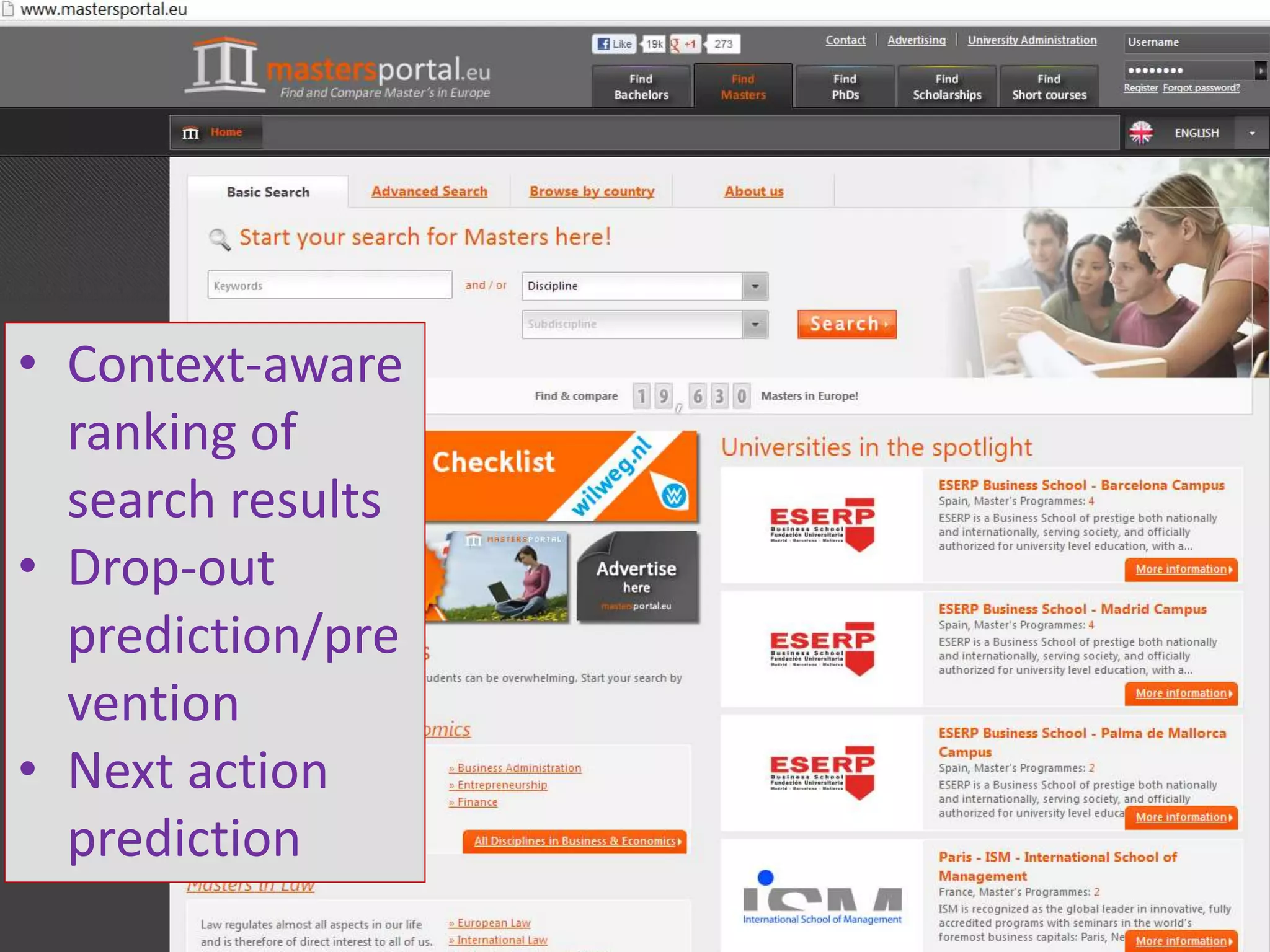
• Context-aware
ranking of
search results
• Drop-out
prediction/pre
vention
• Next action
prediction
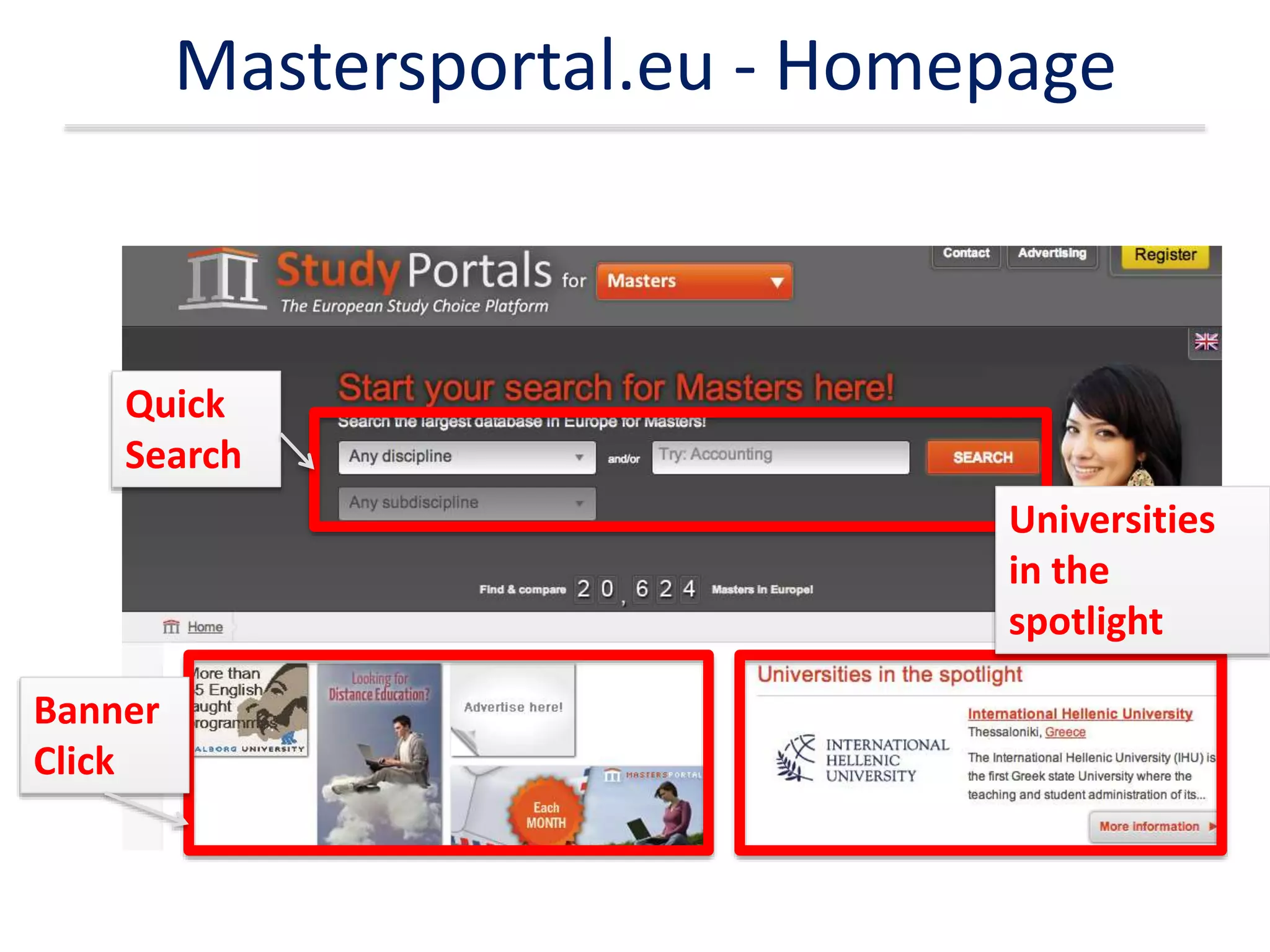
Mastersportal.eu - Homepage
Quick
Search
Banner
Click
Universities
in the
spotlight
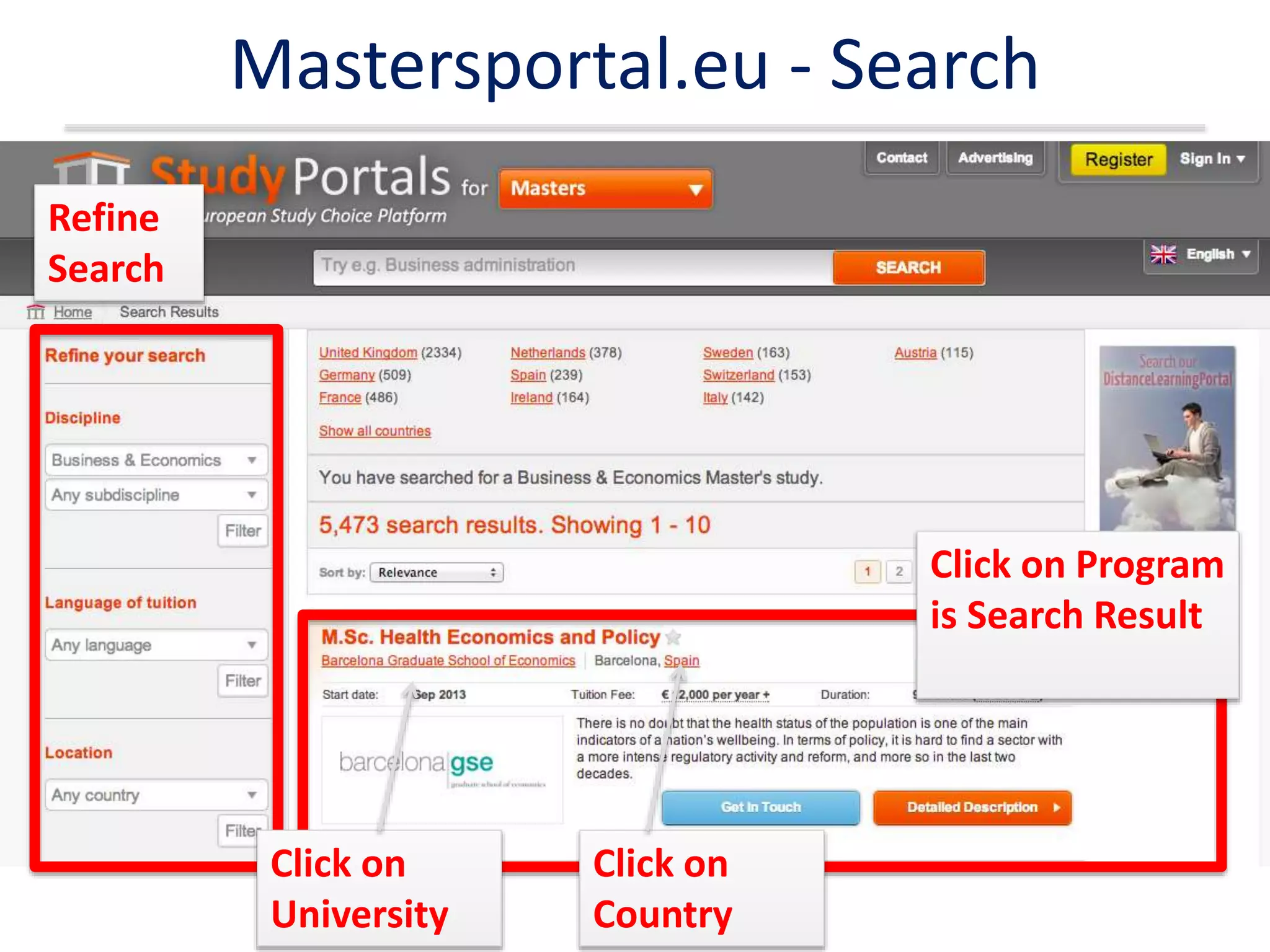
Mastersportal.eu - Search
Refine
Search
Click on Program
is Search Result
Click on
University
Click on
Country
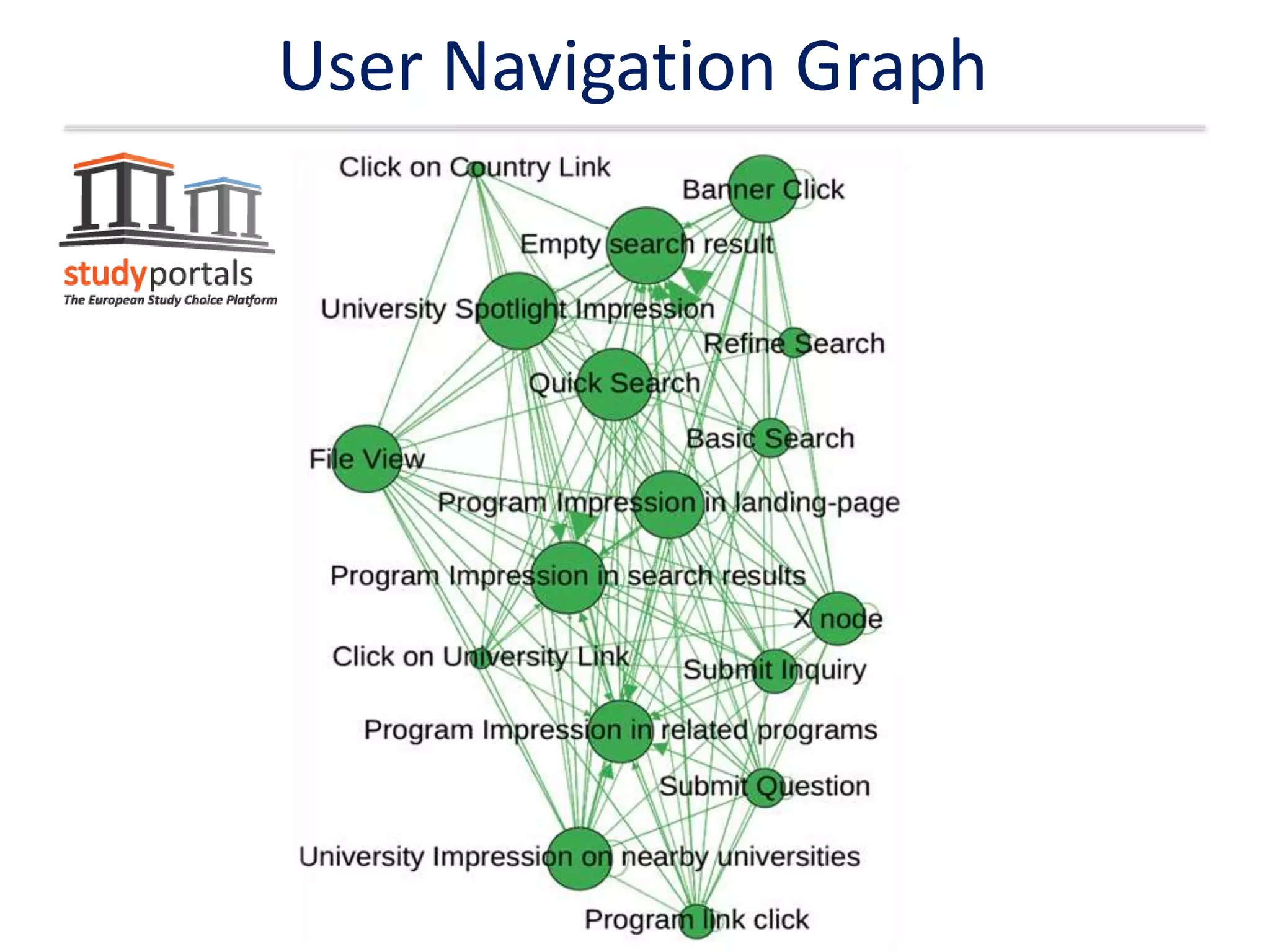
User Navigation Graph
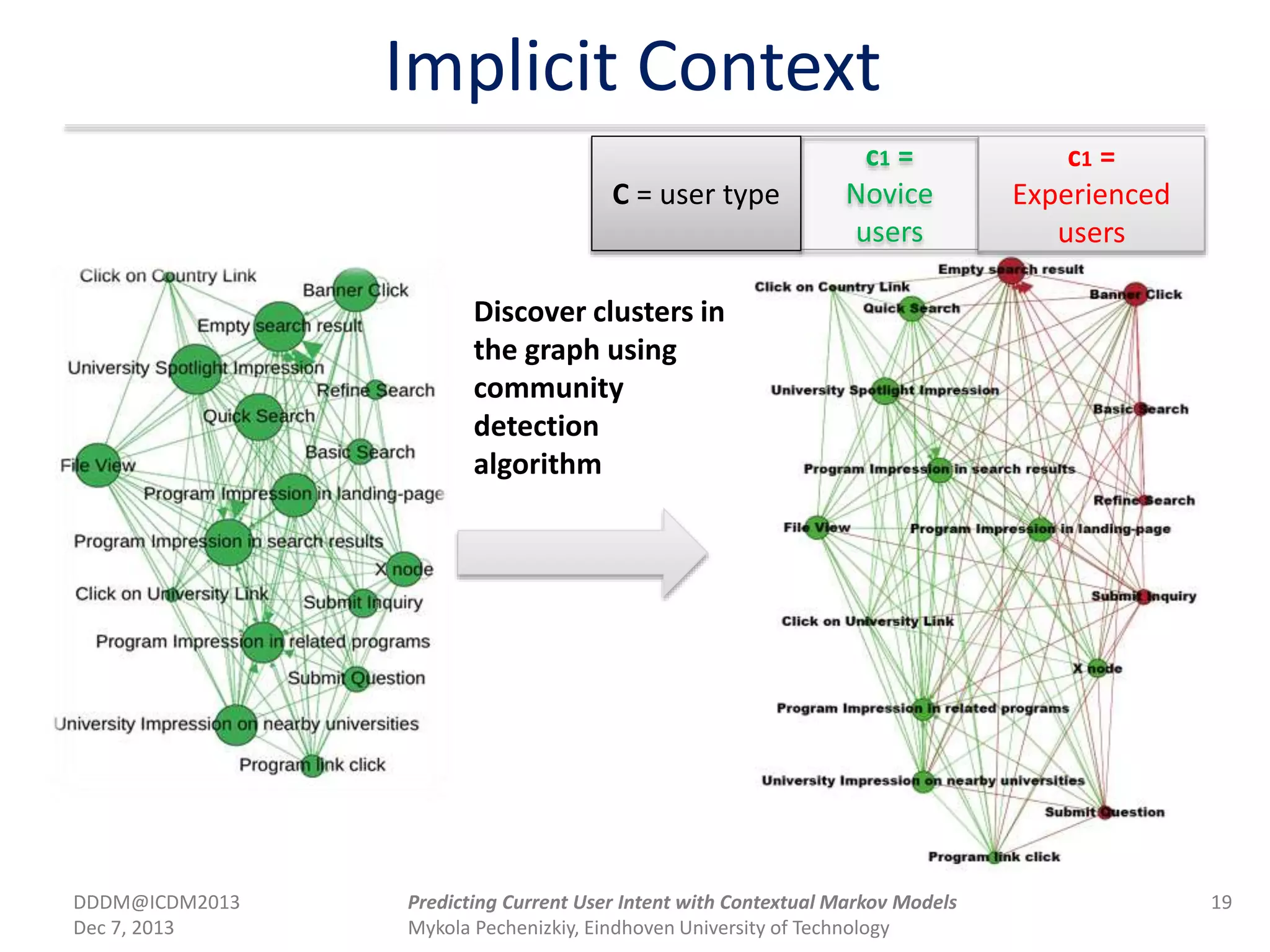
Motivation for Contextual Markov Models
Useful Contexts:
E[M] < pc1*E[Mc1] + pc2*E[Mc2]
Why should it help?
Explicit contexts (user location)
Implicit contexts (inferred from clickstream)
Implicit Context
Discover clusters in
the graph using
community
detection
algorithm
c1 =
Novice
users
c1 =
Experienced
users
C = user type
DDDM@ICDM2013
Dec 7, 2013
19Predicting Current User Intent with Contextual Markov Models
Mykola Pechenizkiy, Eindhoven University of Technology
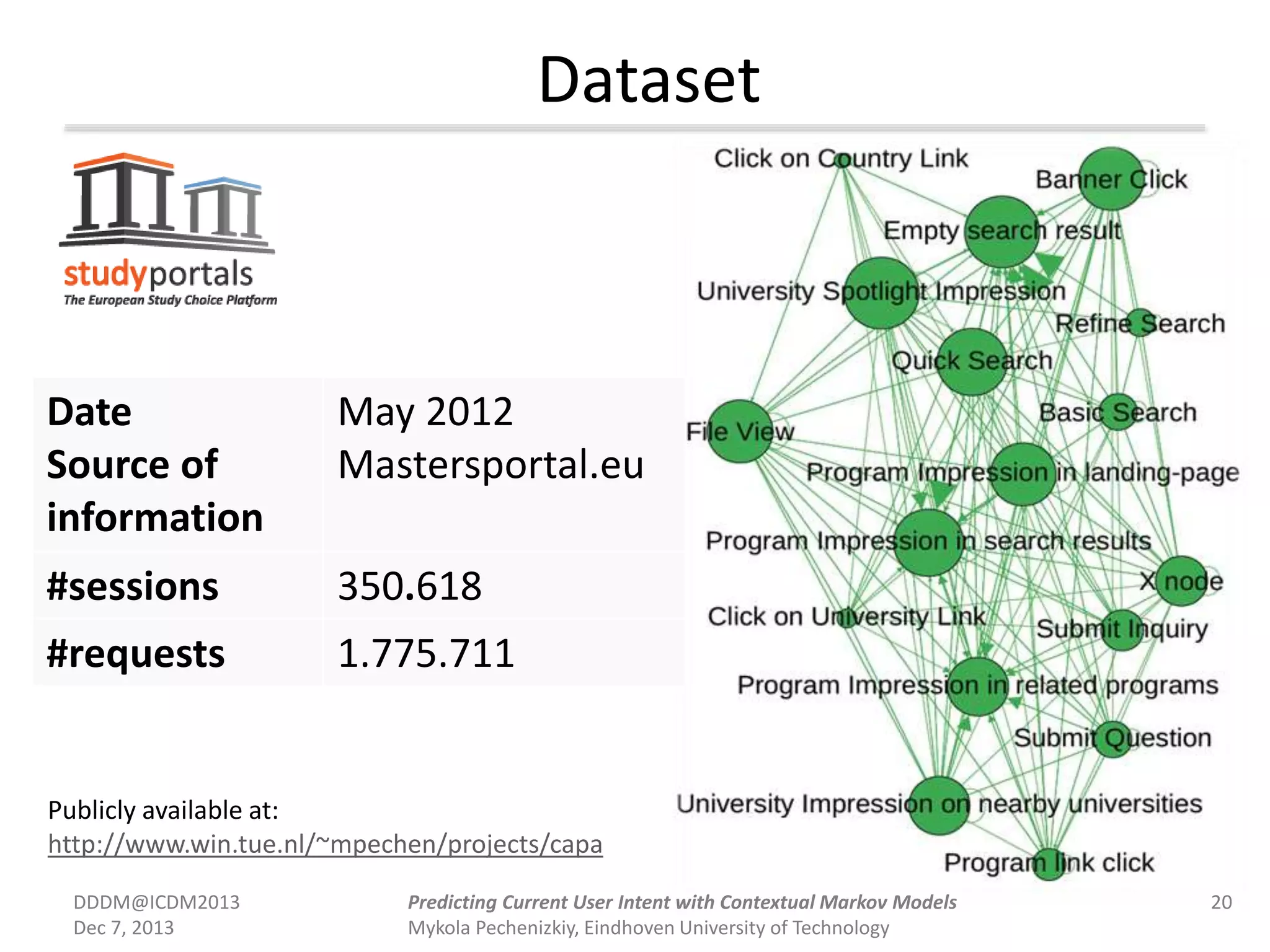
Dataset
Date
Source of
information
May 2012
Mastersportal.eu
#sessions 350.618
#requests 1.775.711
DDDM@ICDM2013
Dec 7, 2013
20Predicting Current User Intent with Contextual Markov Models
Mykola Pechenizkiy, Eindhoven University of Technology
Publicly available at:
http://www.win.tue.nl/~mpechen/projects/capa
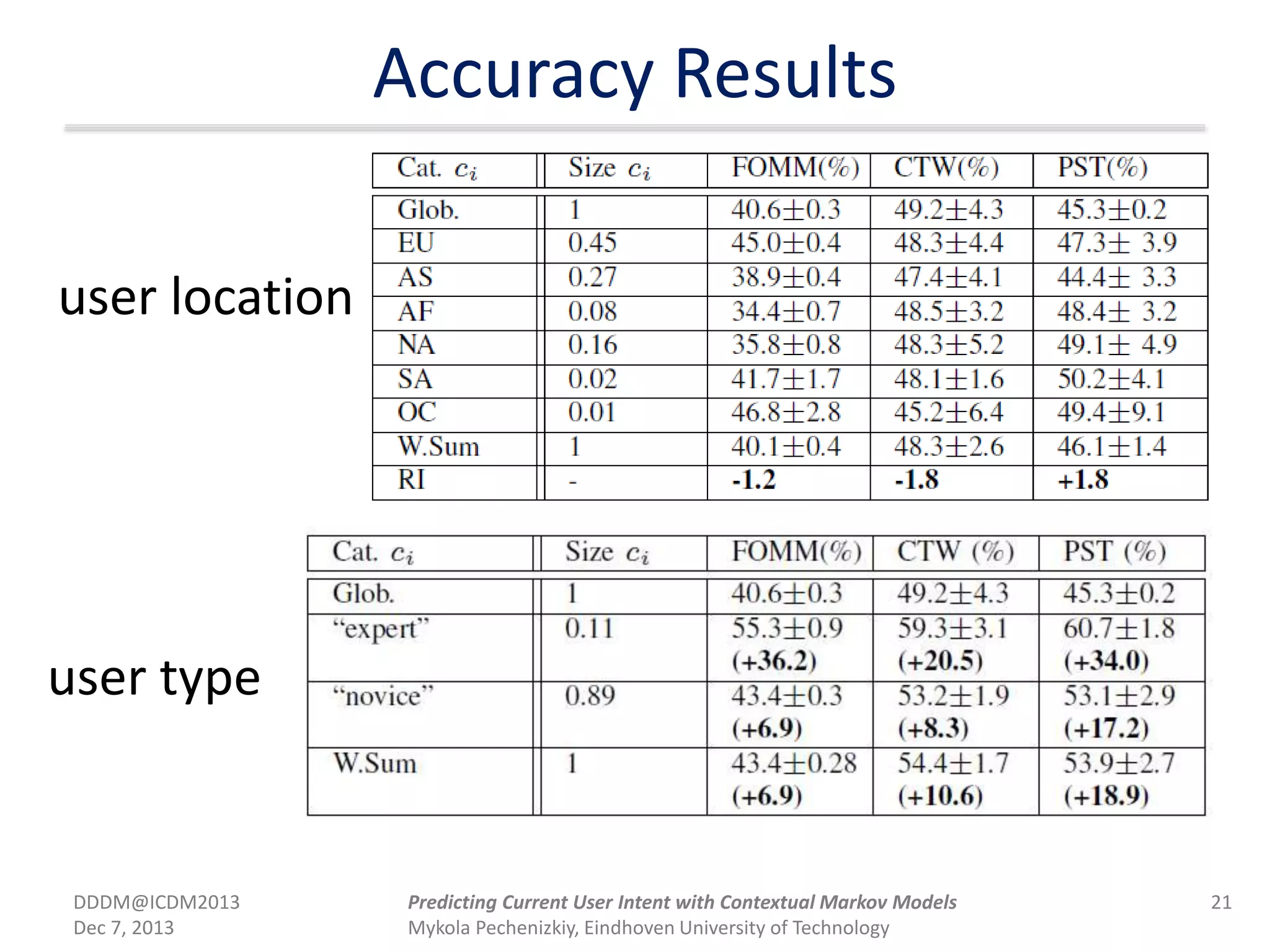
Accuracy Results
DDDM@ICDM2013
Dec 7, 2013
21Predicting Current User Intent with Contextual Markov Models
Mykola Pechenizkiy, Eindhoven University of Technology
user location
user type
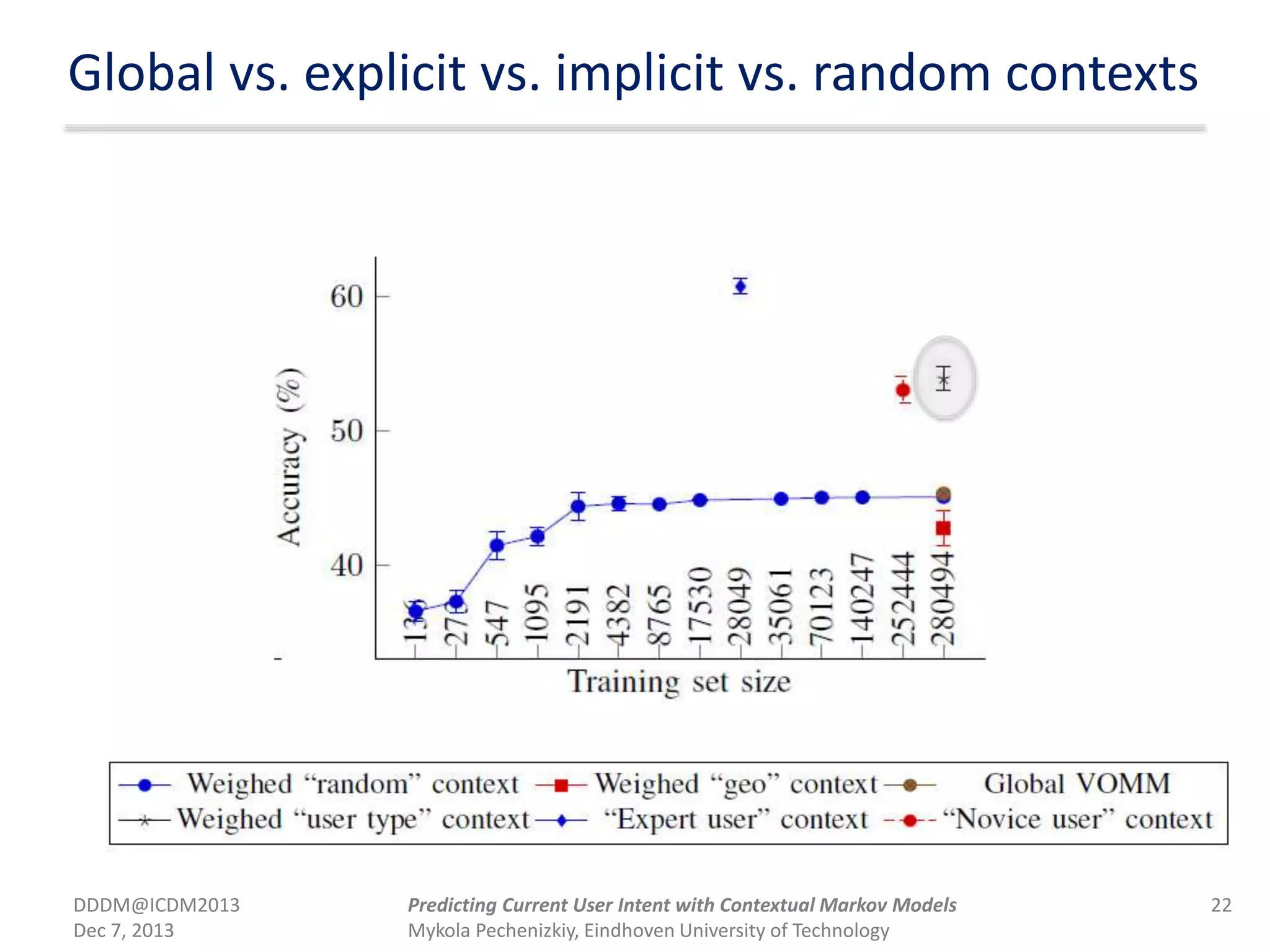
Global vs. explicit vs. implicit vs. random contexts
DDDM@ICDM2013
Dec 7, 2013
22Predicting Current User Intent with Contextual Markov Models
Mykola Pechenizkiy, Eindhoven University of Technology
Conclusions
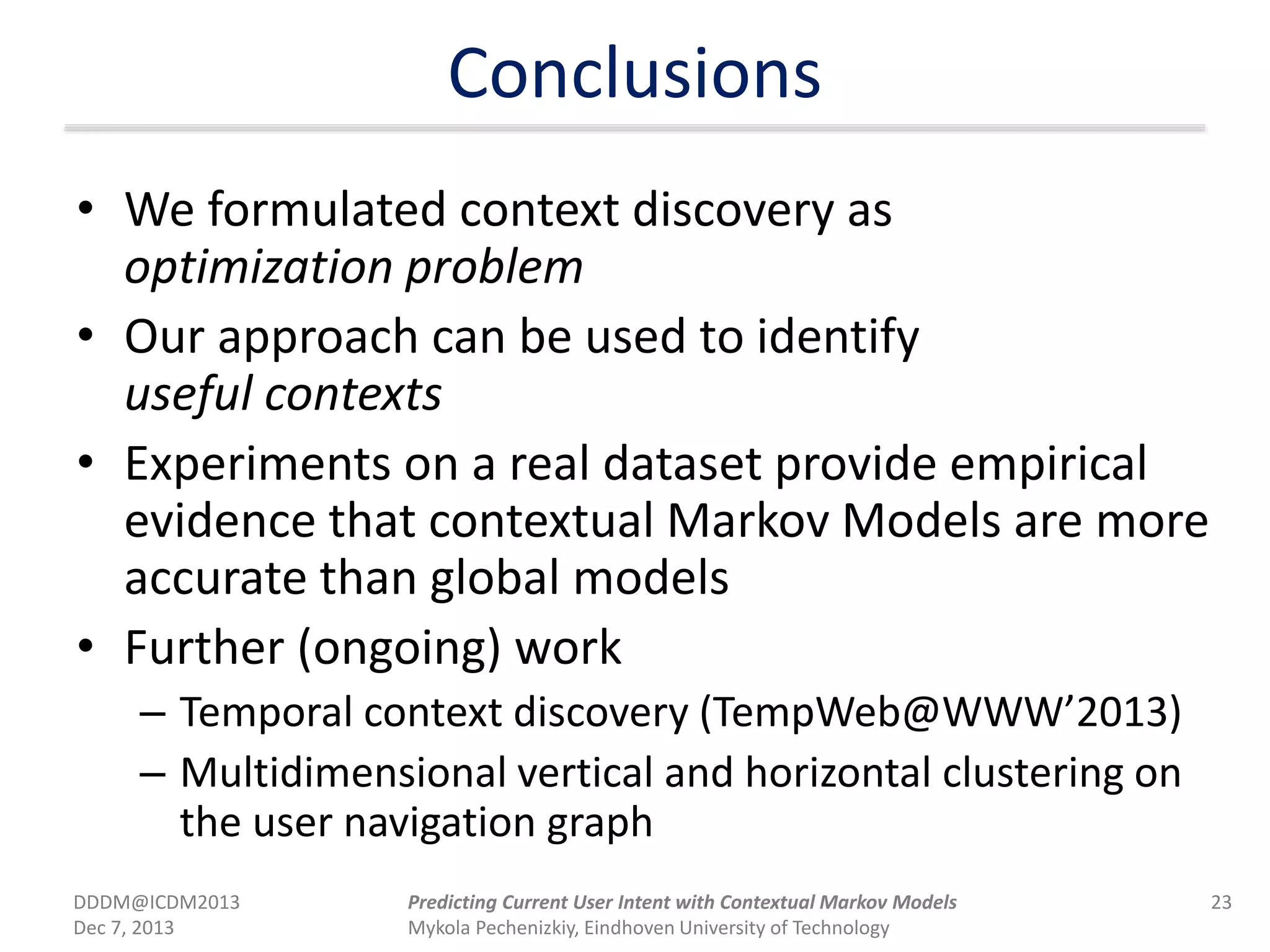
• We formulated context discovery as
optimization problem
• Our approach can be used to identify
useful contexts
• Experiments on a real dataset provide empirical
evidence that contextual Markov Models are more
accurate than global models
• Further (ongoing) work
– Temporal context discovery (TempWeb@WWW’2013)
– Multidimensional vertical and horizontal clustering on
the user navigation graph
DDDM@ICDM2013
Dec 7, 2013
23Predicting Current User Intent with Contextual Markov Models
Mykola Pechenizkiy, Eindhoven University of Technology
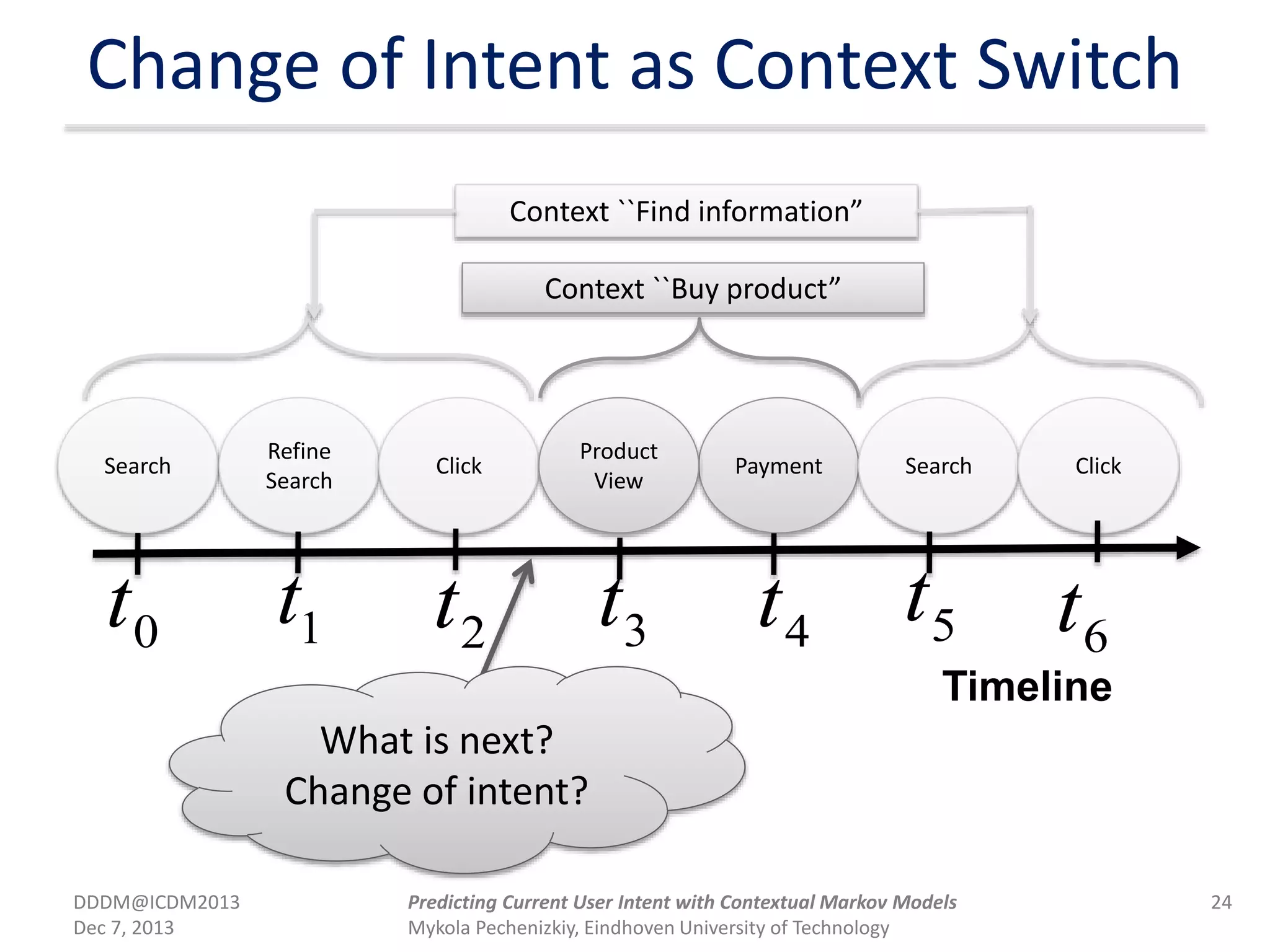
Change of Intent as Context Switch
Timeline
t5t0 t3t2 t4
t1
Search
Refine
Search
PaymentClick
Product
View
Search Click
t6
Context ``Find information”
Context ``Buy product”
What is next?
Change of intent?
DDDM@ICDM2013
Dec 7, 2013
24Predicting Current User Intent with Contextual Markov Models
Mykola Pechenizkiy, Eindhoven University of Technology
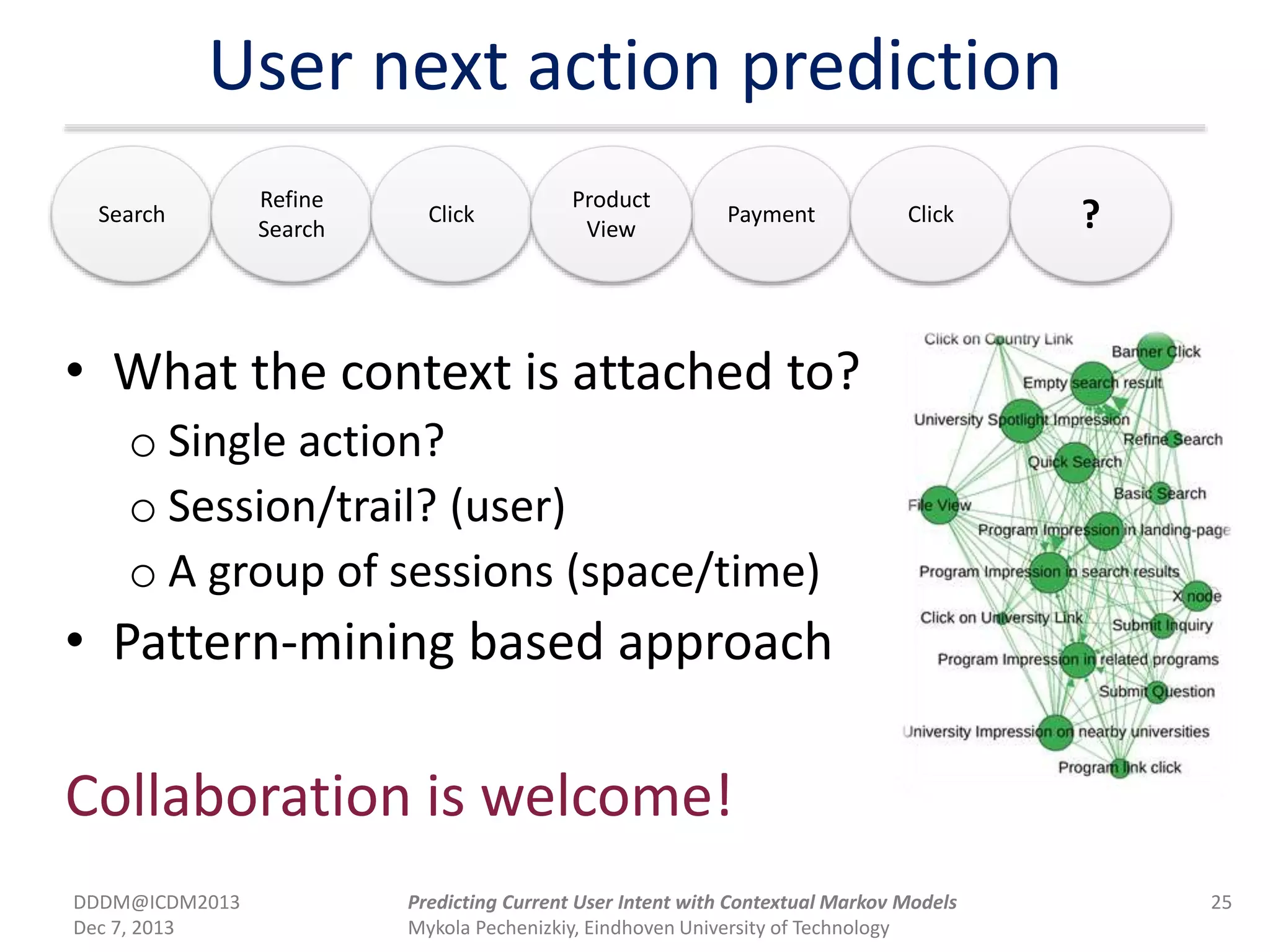
User next action prediction
Search
Refine
Search
PaymentClick
Product
View
Click ?
• What the context is attached to?
o Single action?
o Session/trail? (user)
o A group of sessions (space/time)
• Pattern-mining based approach
Collaboration is welcome!
DDDM@ICDM2013
Dec 7, 2013
25Predicting Current User Intent with Contextual Markov Models
Mykola Pechenizkiy, Eindhoven University of Technology
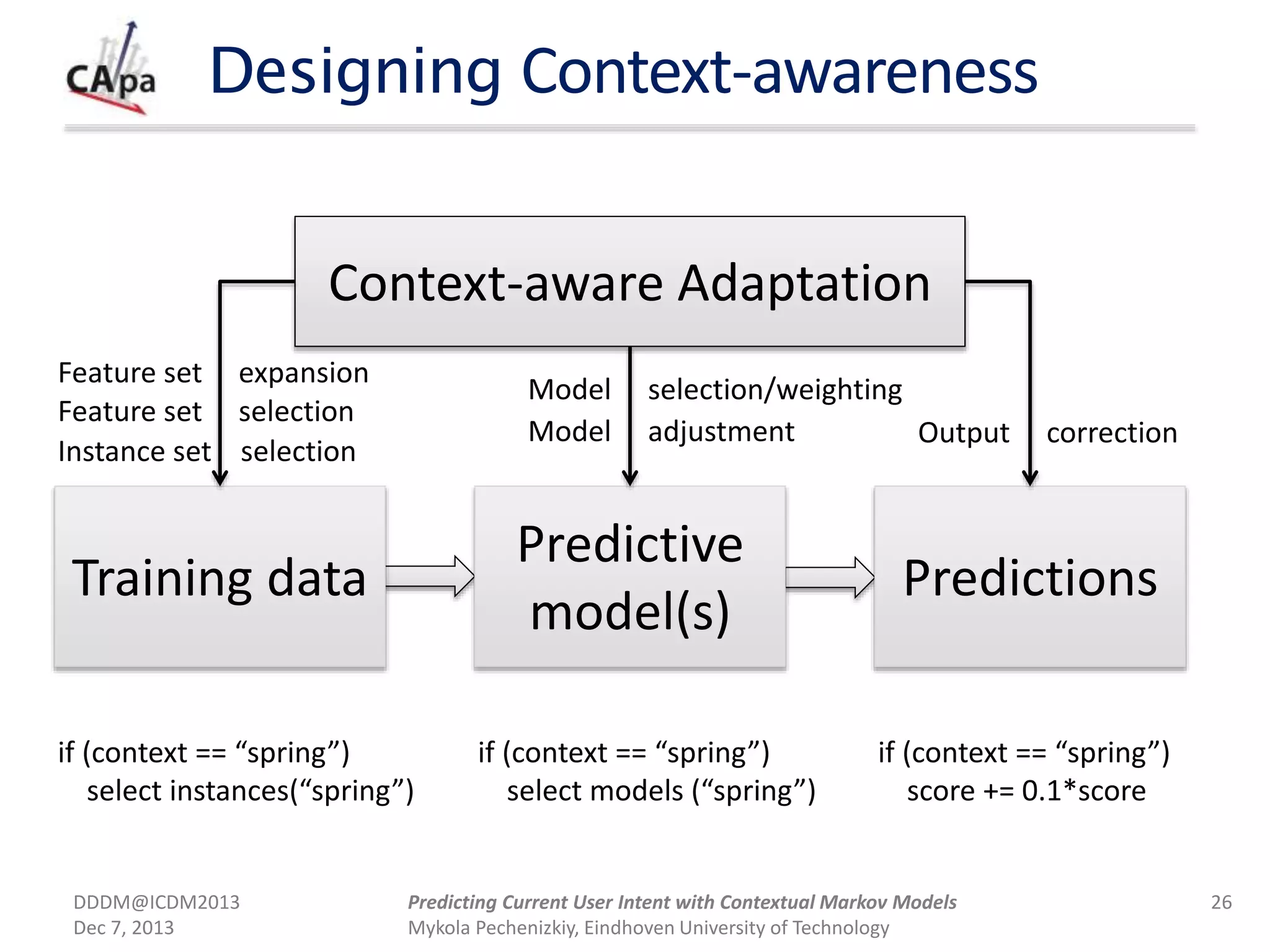
Designing Context-awareness
Predictive
model(s)
PredictionsTraining data
Context-aware Adaptation
Instance set selection
Feature set selection
Feature set expansion
Model selection/weighting
Model adjustment Output correction
if (context == “spring”)
select instances(“spring”)
if (context == “spring”)
select models (“spring”)
if (context == “spring”)
score += 0.1*score
DDDM@ICDM2013
Dec 7, 2013
26Predicting Current User Intent with Contextual Markov Models
Mykola Pechenizkiy, Eindhoven University of Technology
Designing Context-awareness
Definitions/
properties/
utilities
[Un]
[Semi]Super
vised
methods
How to
define
context
Context mining:
how to discover context
Instance set selection
Feature set selection
Feature set expansion
Model selection/weighting
Model adjustment Output correction
Contextual features
Contextual categories
Features not predictive alone,
but increasing predictive power
of other features
Descriptors explaining a
significant group of instances
having some distinct behaviour
Subgroup discovery
AntiLDA
Uplift modeling
Actionable attributes
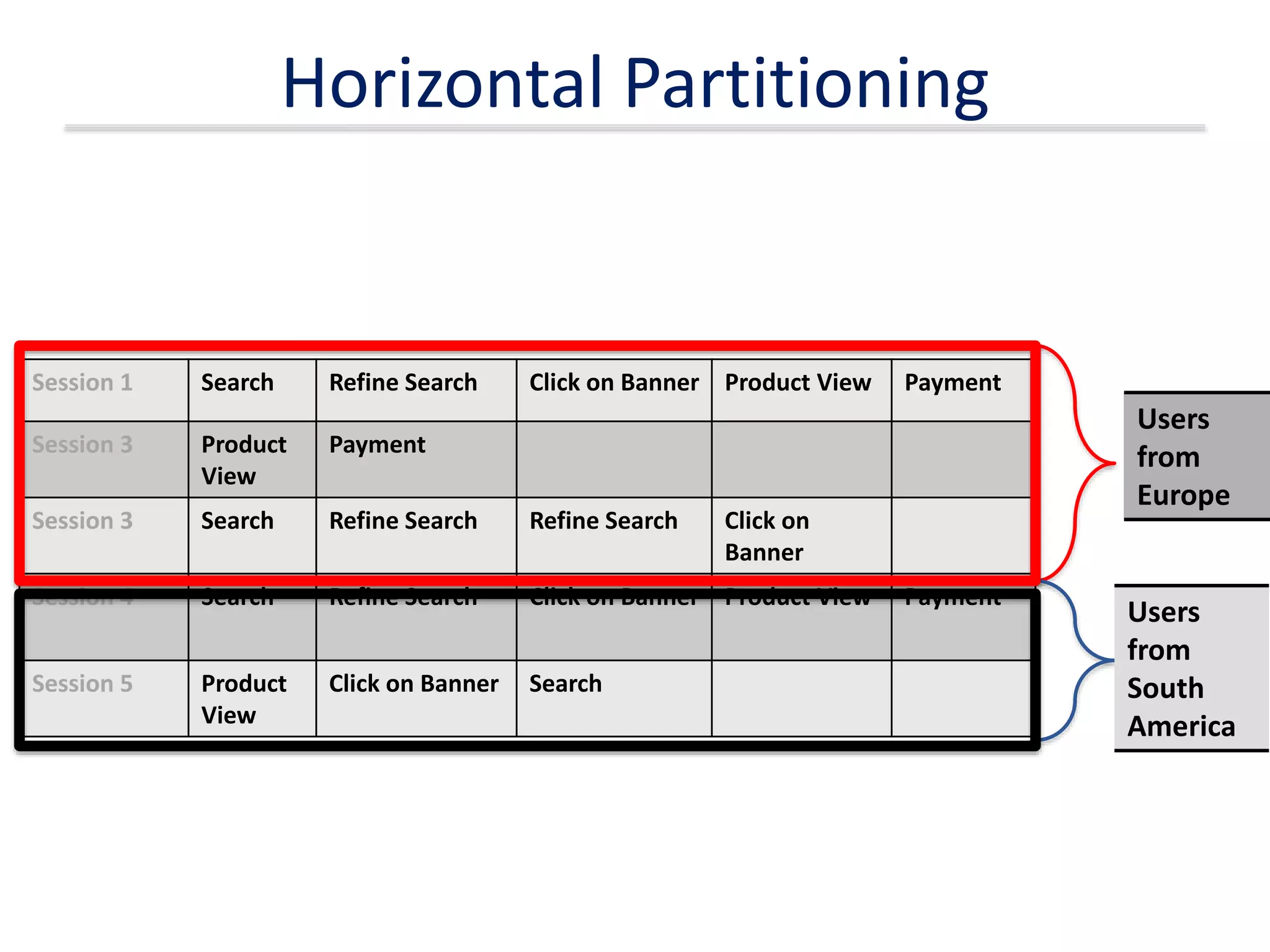
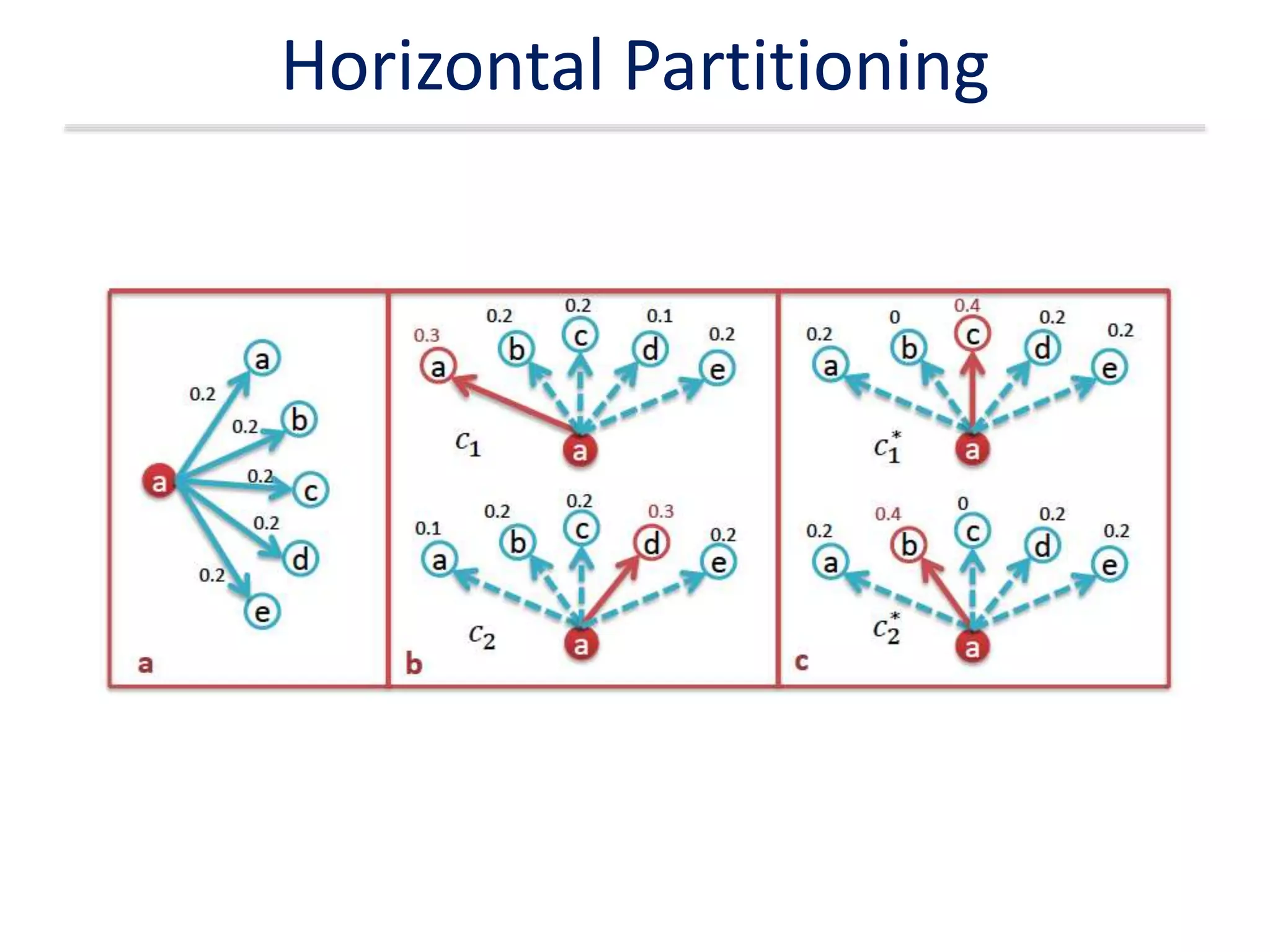
Horizontal Partitioning
Users
from
Europe
Users
from
South
America
Session 1 Search Refine Search Click on Banner Product View Payment
Session 3 Product
View
Payment
Session 3 Search Refine Search Refine Search Click on
Banner
Session 4 Search Refine Search Click on Banner Product View Payment
Session 5 Product
View
Click on Banner Search
Horizontal Partitioning
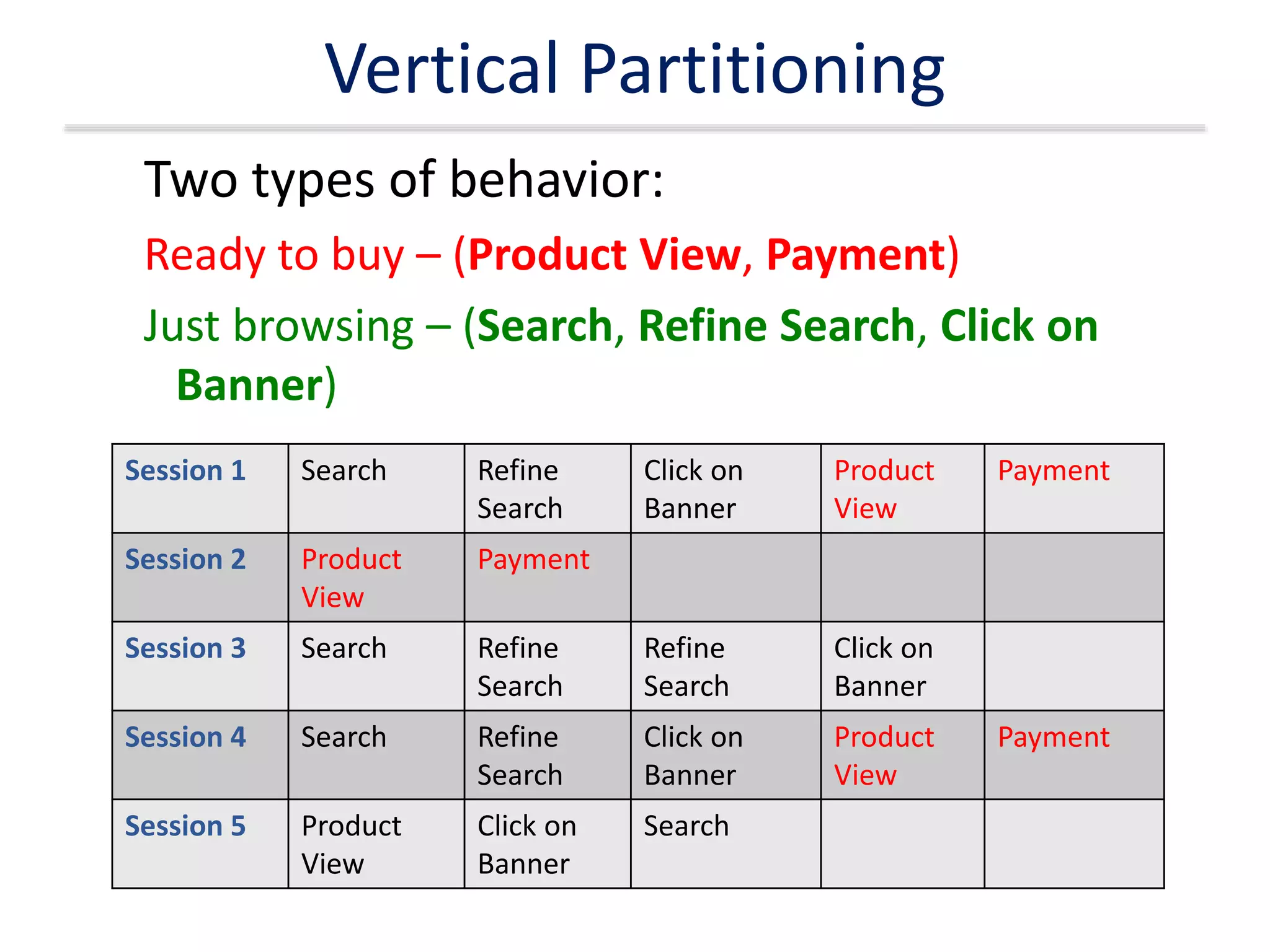
Two types of behavior:
Ready to buy – (Product View, Payment)
Just browsing – (Search, Refine Search, Click on
Banner)
Session 1 Search Refine
Search
Click on
Banner
Product
View
Payment
Session 2 Product
View
Payment
Session 3 Search Refine
Search
Refine
Search
Click on
Banner
Session 4 Search Refine
Search
Click on
Banner
Product
View
Payment
Session 5 Product
View
Click on
Banner
Search
Vertical Partitioning
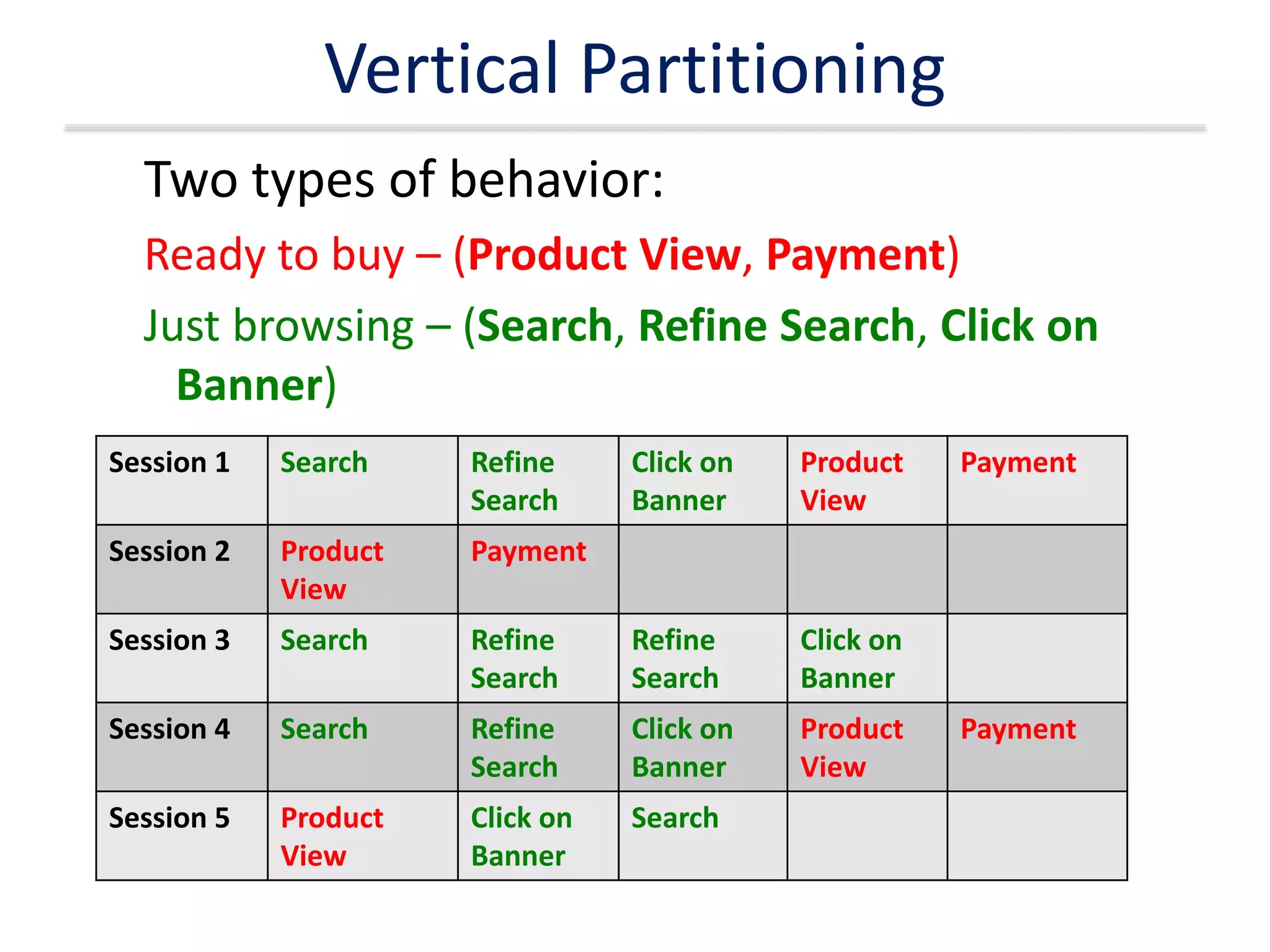
Session 1 Search Refine
Search
Click on
Banner
Product
View
Payment
Session 2 Product
View
Payment
Session 3 Search Refine
Search
Refine
Search
Click on
Banner
Session 4 Search Refine
Search
Click on
Banner
Product
View
Payment
Session 5 Product
View
Click on
Banner
Search
Two types of behavior:
Ready to buy – (Product View, Payment)
Just browsing – (Search, Refine Search, Click on
Banner)
Vertical Partitioning

Predicting Current User Intent with Contextual Markov Models

  • 1.
    Predicting Current UserIntent with Contextual Markov Models Julia Kiseleva, Hoang Thanh Lam, Mykola Pechenizkiy (TU/e) Toon Calders (ULB) DDDM@ICDM2013, Dallas, TX, USA CAPA project: http://www.win.tue.nl/~mpechen/projects/capa/ 7 December 2013
  • 2.
    Outline • What ispredictive Web analytics • Context-Aware Predictive Analytics framework • User intent modeling • Contextual Markov Models • Case study, experimental results • Conclusions and further ongoing work DDDM@ICDM2013 Dec 7, 2013 1Predicting Current User Intent with Contextual Markov Models Mykola Pechenizkiy, Eindhoven University of Technology
  • 3.
    Understanding user needs DDDM@ICDM2013 Dec7, 2013 2Predicting Current User Intent with Contextual Markov Models Mykola Pechenizkiy, Eindhoven University of Technology
  • 4.
    Let’s give ita try… DDDM@ICDM2013 Dec 7, 2013 3Predicting Current User Intent with Contextual Markov Models Mykola Pechenizkiy, Eindhoven University of Technology
  • 5.
    User Intent Modeling:What? • Next action prediction – Click prediction in display advertising – Drop out prediction – Trail prediction • Information need prediction: – Navigational vs. explorative vs. purchase – Open acronym based on context • Type of product wanted – Personalization based on context DDDM@ICDM2013 Dec 7, 2013 4Predicting Current User Intent with Contextual Markov Models Mykola Pechenizkiy, Eindhoven University of Technology
  • 6.
    User Intent Modeling:Why? • To understand users and website usage – redesign website, redirect flows, – diversified search, recommendations • To better use budget (pageviews) – what (type of) ads to serve? – brand awareness CPM, or convergence CPC • To manipulate user – worth giving a promotion? – personalize with intent of converging to a desired action – personalized suggestions based on user context DDDM@ICDM2013 Dec 7, 2013 5Predicting Current User Intent with Contextual Markov Models Mykola Pechenizkiy, Eindhoven University of Technology
  • 7.
    User Intent Modeling:How? Model L population (source) Historical data labels label? 1. training 2. 2. application X y X' y' Training: y = L (X) Application: use L for an unseen data y' = L (X') labels Testing data DDDM@ICDM2013 Dec 7, 2013 6Predicting Current User Intent with Contextual Markov Models Mykola Pechenizkiy, Eindhoven University of Technology
  • 8.
    Context in IR& RecSys • User Context – Preferences, usage history, profiles • Document/Product Context – Meta-data, content features • Task Context – Current activity, location etc. • Social Context – Leveraging the social graph DDDM@ICDM2013 Dec 7, 2013 7Predicting Current User Intent with Contextual Markov Models Mykola Pechenizkiy, Eindhoven University of Technology
  • 9.
    Context in Diagnostics Notpredictive alone but a subset of features with the contextual attribute(s) becomes (much) more predictive Time of the day context no context DDDM@ICDM2013 Dec 7, 2013 8Predicting Current User Intent with Contextual Markov Models Mykola Pechenizkiy, Eindhoven University of Technology
  • 10.
    Context in Marketing P(Purchase|gender=“male”)=P(Purchase|gender=“female”) ModelMale~f(relevance);ModelFemale~f(perceived value) gender context no context Male Female buy buy relevance relevance buy don’t don’t don’t gender DDDM@ICDM2013 Dec 7, 2013 9Predicting Current User Intent with Contextual Markov Models Mykola Pechenizkiy, Eindhoven University of Technology
  • 11.
    Environment/ Context Model L population Training: ?? Application: y' =Lj (X') Lj <= G(X',E) X' y' Historical data labels X y label? Context-Awareness as Meta-learning labels Test data DDDM@ICDM2013 Dec 7, 2013 10Predicting Current User Intent with Contextual Markov Models Mykola Pechenizkiy, Eindhoven University of Technology
  • 12.
    Learning Classifiers &Context DDDM@ICDM2013 Dec 7, 2013 11Predicting Current User Intent with Contextual Markov Models Mykola Pechenizkiy, Eindhoven University of Technology
  • 13.
    Research Questions • Howto define the context (form and maintain contextual categories) in web analytics? • How to connect context with the prediction process in predictive web analytics? • How to integrate change detection mechanisms into the prediction process in web analytics? • How to ensure integration and feedback mechanisms between change detection and context awareness mechanisms? • What should a reference architecture allowing to plug in new context aware prediction techniques for a collection of web analytics tasks look like? DDDM@ICDM2013 Dec 7, 2013 13Predicting Current User Intent with Contextual Markov Models Mykola Pechenizkiy, Eindhoven University of Technology
  • 14.
    IEEE CBMS 2010 Perth,Australia Handling Concept Drift in Medical Applications: Importance, Challenges and Solutions © M. Pechenizkiy and I. Zliobaite 14 • Context-aware ranking of search results • Drop-out prediction/pre vention • Next action prediction
  • 15.
  • 16.
    Mastersportal.eu - Search Refine Search Clickon Program is Search Result Click on University Click on Country
  • 17.
  • 18.
    Motivation for ContextualMarkov Models Useful Contexts: E[M] < pc1*E[Mc1] + pc2*E[Mc2] Why should it help? Explicit contexts (user location) Implicit contexts (inferred from clickstream)
  • 19.
    Implicit Context Discover clustersin the graph using community detection algorithm c1 = Novice users c1 = Experienced users C = user type DDDM@ICDM2013 Dec 7, 2013 19Predicting Current User Intent with Contextual Markov Models Mykola Pechenizkiy, Eindhoven University of Technology
  • 20.
    Dataset Date Source of information May 2012 Mastersportal.eu #sessions350.618 #requests 1.775.711 DDDM@ICDM2013 Dec 7, 2013 20Predicting Current User Intent with Contextual Markov Models Mykola Pechenizkiy, Eindhoven University of Technology Publicly available at: http://www.win.tue.nl/~mpechen/projects/capa
  • 21.
    Accuracy Results DDDM@ICDM2013 Dec 7,2013 21Predicting Current User Intent with Contextual Markov Models Mykola Pechenizkiy, Eindhoven University of Technology user location user type
  • 22.
    Global vs. explicitvs. implicit vs. random contexts DDDM@ICDM2013 Dec 7, 2013 22Predicting Current User Intent with Contextual Markov Models Mykola Pechenizkiy, Eindhoven University of Technology
  • 23.
    Conclusions • We formulatedcontext discovery as optimization problem • Our approach can be used to identify useful contexts • Experiments on a real dataset provide empirical evidence that contextual Markov Models are more accurate than global models • Further (ongoing) work – Temporal context discovery (TempWeb@WWW’2013) – Multidimensional vertical and horizontal clustering on the user navigation graph DDDM@ICDM2013 Dec 7, 2013 23Predicting Current User Intent with Contextual Markov Models Mykola Pechenizkiy, Eindhoven University of Technology
  • 24.
    Change of Intentas Context Switch Timeline t5t0 t3t2 t4 t1 Search Refine Search PaymentClick Product View Search Click t6 Context ``Find information” Context ``Buy product” What is next? Change of intent? DDDM@ICDM2013 Dec 7, 2013 24Predicting Current User Intent with Contextual Markov Models Mykola Pechenizkiy, Eindhoven University of Technology
  • 25.
    User next actionprediction Search Refine Search PaymentClick Product View Click ? • What the context is attached to? o Single action? o Session/trail? (user) o A group of sessions (space/time) • Pattern-mining based approach Collaboration is welcome! DDDM@ICDM2013 Dec 7, 2013 25Predicting Current User Intent with Contextual Markov Models Mykola Pechenizkiy, Eindhoven University of Technology
  • 26.
    Designing Context-awareness Predictive model(s) PredictionsTraining data Context-awareAdaptation Instance set selection Feature set selection Feature set expansion Model selection/weighting Model adjustment Output correction if (context == “spring”) select instances(“spring”) if (context == “spring”) select models (“spring”) if (context == “spring”) score += 0.1*score DDDM@ICDM2013 Dec 7, 2013 26Predicting Current User Intent with Contextual Markov Models Mykola Pechenizkiy, Eindhoven University of Technology
  • 27.
    Designing Context-awareness Definitions/ properties/ utilities [Un] [Semi]Super vised methods How to define context Contextmining: how to discover context Instance set selection Feature set selection Feature set expansion Model selection/weighting Model adjustment Output correction Contextual features Contextual categories Features not predictive alone, but increasing predictive power of other features Descriptors explaining a significant group of instances having some distinct behaviour Subgroup discovery AntiLDA Uplift modeling Actionable attributes
  • 28.
    Horizontal Partitioning Users from Europe Users from South America Session 1Search Refine Search Click on Banner Product View Payment Session 3 Product View Payment Session 3 Search Refine Search Refine Search Click on Banner Session 4 Search Refine Search Click on Banner Product View Payment Session 5 Product View Click on Banner Search
  • 29.
  • 30.
    Two types ofbehavior: Ready to buy – (Product View, Payment) Just browsing – (Search, Refine Search, Click on Banner) Session 1 Search Refine Search Click on Banner Product View Payment Session 2 Product View Payment Session 3 Search Refine Search Refine Search Click on Banner Session 4 Search Refine Search Click on Banner Product View Payment Session 5 Product View Click on Banner Search Vertical Partitioning
  • 31.
    Session 1 SearchRefine Search Click on Banner Product View Payment Session 2 Product View Payment Session 3 Search Refine Search Refine Search Click on Banner Session 4 Search Refine Search Click on Banner Product View Payment Session 5 Product View Click on Banner Search Two types of behavior: Ready to buy – (Product View, Payment) Just browsing – (Search, Refine Search, Click on Banner) Vertical Partitioning