 The answer is yes. But it’s for the first
question.
 In Ecology, term ‘alien’ start to described in
end 19 centuries.
 Described as exotic species at Workshop on
Introduction of Exotic Aquatic Organisms in
Asia (1989).
 Definition of those term are still changing
(until now).
“I define a species as ‘alien’
as if human activities
(deliberate or inadvertent)
moved it outside of it’s native
range.”
-David L Strayer 2010-
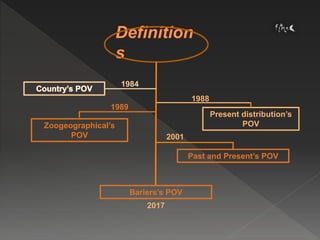
1984
1988
2001
Present distribution’s
POVZoogeographical’s
POV
1989
Past and Present’s POV
Bariers’s POV
2017
“An organism whose entire range is outside
the country to which it is introduced”
-Shafland and Lewis 1984-
Terminology assosiated with introduced organisms
“Any species intentionally or accidentally
transported and released by a man into an
environment outside its present range”
-Welcomme 1988 (International introductions of inland aquatic species)-
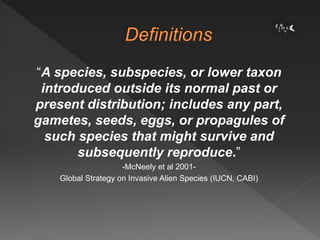
“A species, subspecies, or lower taxon
introduced outside its normal past or
present distribution; includes any part,
gametes, seeds, eggs, or propagules of
such species that might survive and
subsequently reproduce.”
-McNeely et al 2001-
Global Strategy on Invasive Alien Species (IUCN, CABI)
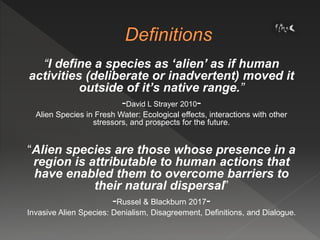
“I define a species as ‘alien’ as if human
activities (deliberate or inadvertent) moved it
outside of it’s native range.”
-David L Strayer 2010-
Alien Species in Fresh Water: Ecological effects, interactions with other
stressors, and prospects for the future.
“Alien species are those whose presence in a
region is attributable to human actions that
have enabled them to overcome barriers to
their natural dispersal”
-Russel & Blackburn 2017-
Invasive Alien Species: Denialism, Disagreement, Definitions, and Dialogue.
 Alien v Native
 Alien v Invasive
 ‘The Invasive’ dialogue
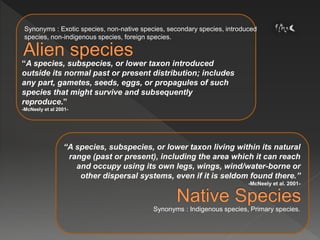
Synonyms : Exotic species, non-native species, secondary species, introduced
species, non-indigenous species, foreign species.
Synonyms : Indigenous species, Primary species.
“A species, subspecies, or lower taxon living within its natural
range (past or present), including the area which it can reach
and occupy using its own legs, wings, wind/water-borne or
other dispersal systems, even if it is seldom found there.”
-McNeely et al. 2001-
“A species, subspecies, or lower taxon introduced
outside its normal past or present distribution; includes
any part, gametes, seeds, eggs, or propagules of such
species that might survive and subsequently
reproduce.”
-McNeely et al 2001-
 Not a synonym!
 Alien species refers to spatial’s point of
view and invasive species refers to
impact’s point of view.
 By contrast, invasive species are generally
taken to be that subset of alien species
that are determined overall to have
negative impacts: not all alien species are
invasive.
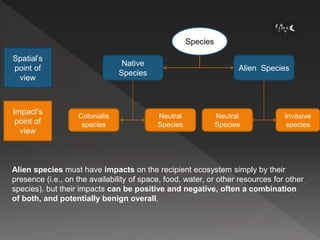
Species
Native
Species
Alien Species
Spatial’s
point of
view
Colonialis
species
Neutral
Species
Neutral
Species
Invasive
species
Impact’s
point of
view
Alien species must have impacts on the recipient ecosystem simply by their
presence (i.e., on the availability of space, food, water, or other resources for other
species), but their impacts can be positive and negative, often a combination
of both, and potentially benign overall.
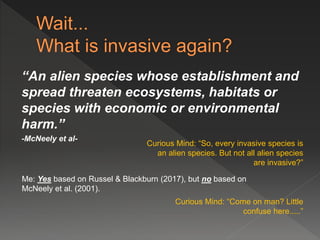
“An alien species whose establishment and
spread threaten ecosystems, habitats or
species with economic or environmental
harm.”
-McNeely et al-
Curious Mind: “So, every invasive species is
an alien species. But not all alien species
are invasive?”
Me: Yes based on Russel & Blackburn (2017), but no based on
McNeely et al. (2001).
Curious Mind: “Come on man? Little
confuse here.....”
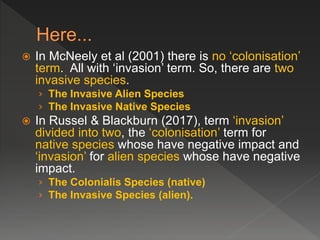
 In McNeely et al (2001) there is no ‘colonisation’
term. All with ‘invasion’ term. So, there are two
invasive species.
› The Invasive Alien Species
› The Invasive Native Species
 In Russel & Blackburn (2017), term ‘invasion’
divided into two, the ‘colonisation’ term for
native species whose have negative impact and
‘invasion’ for alien species whose have negative
impact.
› The Colonialis Species (native)
› The Invasive Species (alien).
Understanding alien species for dummies

Understanding alien species for dummies

  • 2.
     The answeris yes. But it’s for the first question.  In Ecology, term ‘alien’ start to described in end 19 centuries.  Described as exotic species at Workshop on Introduction of Exotic Aquatic Organisms in Asia (1989).  Definition of those term are still changing (until now).
  • 3.
    “I define aspecies as ‘alien’ as if human activities (deliberate or inadvertent) moved it outside of it’s native range.” -David L Strayer 2010-
  • 4.
  • 5.
    “An organism whoseentire range is outside the country to which it is introduced” -Shafland and Lewis 1984- Terminology assosiated with introduced organisms “Any species intentionally or accidentally transported and released by a man into an environment outside its present range” -Welcomme 1988 (International introductions of inland aquatic species)-
  • 6.
    “A species, subspecies,or lower taxon introduced outside its normal past or present distribution; includes any part, gametes, seeds, eggs, or propagules of such species that might survive and subsequently reproduce.” -McNeely et al 2001- Global Strategy on Invasive Alien Species (IUCN, CABI)
  • 7.
    “I define aspecies as ‘alien’ as if human activities (deliberate or inadvertent) moved it outside of it’s native range.” -David L Strayer 2010- Alien Species in Fresh Water: Ecological effects, interactions with other stressors, and prospects for the future. “Alien species are those whose presence in a region is attributable to human actions that have enabled them to overcome barriers to their natural dispersal” -Russel & Blackburn 2017- Invasive Alien Species: Denialism, Disagreement, Definitions, and Dialogue.
  • 8.
     Alien vNative  Alien v Invasive  ‘The Invasive’ dialogue
  • 9.
    Synonyms : Exoticspecies, non-native species, secondary species, introduced species, non-indigenous species, foreign species. Synonyms : Indigenous species, Primary species. “A species, subspecies, or lower taxon living within its natural range (past or present), including the area which it can reach and occupy using its own legs, wings, wind/water-borne or other dispersal systems, even if it is seldom found there.” -McNeely et al. 2001- “A species, subspecies, or lower taxon introduced outside its normal past or present distribution; includes any part, gametes, seeds, eggs, or propagules of such species that might survive and subsequently reproduce.” -McNeely et al 2001-
  • 10.
     Not asynonym!  Alien species refers to spatial’s point of view and invasive species refers to impact’s point of view.  By contrast, invasive species are generally taken to be that subset of alien species that are determined overall to have negative impacts: not all alien species are invasive.
  • 11.
    Species Native Species Alien Species Spatial’s point of view Colonialis species Neutral Species Neutral Species Invasive species Impact’s pointof view Alien species must have impacts on the recipient ecosystem simply by their presence (i.e., on the availability of space, food, water, or other resources for other species), but their impacts can be positive and negative, often a combination of both, and potentially benign overall.
  • 12.
    “An alien specieswhose establishment and spread threaten ecosystems, habitats or species with economic or environmental harm.” -McNeely et al- Curious Mind: “So, every invasive species is an alien species. But not all alien species are invasive?” Me: Yes based on Russel & Blackburn (2017), but no based on McNeely et al. (2001). Curious Mind: “Come on man? Little confuse here.....”
  • 13.
     In McNeelyet al (2001) there is no ‘colonisation’ term. All with ‘invasion’ term. So, there are two invasive species. › The Invasive Alien Species › The Invasive Native Species  In Russel & Blackburn (2017), term ‘invasion’ divided into two, the ‘colonisation’ term for native species whose have negative impact and ‘invasion’ for alien species whose have negative impact. › The Colonialis Species (native) › The Invasive Species (alien).