DiaInternacionaldaLiberdade de Imprensa 2013
USP São Paulo : 15 de maio de 2013
Safe to Speak: Securing Freedom of
Expression in All Media
Mark Hillary
This talk…
• Recent events in the UK… press scandals
and inquiries
• What is the press today?Can the press be
regulated or controlled and what does this
mean for the freedom of the press?
• Digital journalism
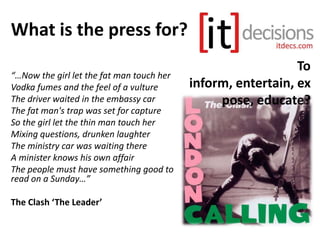
What is the press for?
“…Now the girl let the fat man touch her
Vodka fumes and the feel of a vulture
The driver waited in the embassy car
The fat man's trap was set for capture
So the girl let the thin man touch her
Mixing questions, drunken laughter
The ministry car was waiting there
A minister knows his own affair
The people must have something good to
read on a Sunday…”
The Clash ‘The Leader’
To
inform, entertain, ex
pose, educate?
UK Parliament
• In 2009 The Daily Telegraph published
uncensored details of the expense claim of
every British Member of Parliament – going
back years
• The claims detailed abuse and fraud alongside
legal – but extravagant – claims
• Several MPs were forced to repay money and
some went to jail
• The Telegraph paid £110,000 (R$300k) for the
information, other publications turned it
down, yet the source has never been revealed
News International
• News International journalists in the UK were
accused of illegally hacking into the voicemail of
celebrities and politicians from 2005 to 2007
• By 2011 it became clear that journalists had
been accessing the voicemail of dead
soldiers, murder victims, and victims of terrorist
attacks
• Not only did the public feel
outraged, advertisers shunned the NI title ‘News
of the World’ – a Sunday newspaper that had
been published since 1843. Rupert Murdoch
closed the newspaper in 2011
Leveson
• In 2011, British Prime Minister David Cameron
asked Lord Justice Leveson to explore the
culture, ethics, and practice of the British press –
as a reaction to the News International scandal
•Leveson published his inquiry report in
November 2012
• The most important recommendation was the
creation of an independent body to oversee the
press – to replace the ‘toothless’ Press
Complaints Commission
What’s wrong with Leveson?
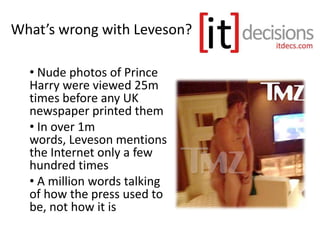
• Nude photos of Prince
Harry were viewed 25m
times before any UK
newspaper printed them
• In over 1m
words, Leveson mentions
the Internet only a few
hundred times
• A million words talking
of how the press used to
be, not how it is
Why does it matter?
• Regulation still matters while there are
professional journalists
• It provides a set of guidelines for reporters and
editors – reporters are protected by professional
guidelines and ethical standards
• But there are examples like the UK
parliamentary expenses scandal where the
information was clearly stolen – was it unethical
to pay for stolen information even if the public
supported the end result?
What is the press?
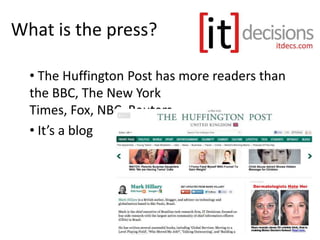
• The Huffington Post has more readers than
the BBC, The New York
Times, Fox, NBC, Reuters…
• It’s a blog
What is the press?
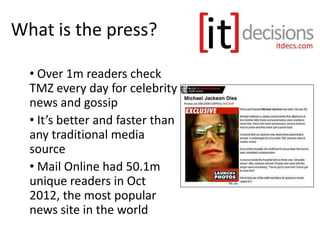
• Over 1m readers check
TMZ every day for celebrity
news and gossip
• It’s better and faster than
any traditional media
source
• Mail Online had 50.1m
unique readers in Oct
2012, the most popular
news site in the world
What is a journalist?
• Anyone can publish globally.. 24/7 and even
from a phone without visiting an office or
checking with an editor
• Video, photos, blogs, tweets… all forms of
publishing can be shared, copied, distributed
and if a story is of enough interest it will
attract the attention of the ‘majors’
• This is Citizen Journalism
What is a journalist?
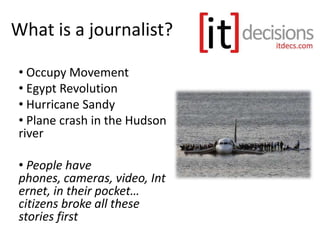
• Occupy Movement
• Egypt Revolution
• Hurricane Sandy
• Plane crash in the Hudson
river
• People have
phones, cameras, video, Int
ernet, in their pocket…
citizens broke all these
stories first
Can it be controlled?
• Short answer is no
• Brands can adopt ethical standards and
codes of practice and employ professional
journalists – readers still value brands
•But anyone can start a blog… how popular
does it have to be before it is considered a
part of ‘the media’ – our most popular news
sources are already blogs and social media
not the traditional media
Think of it like this
• You create a news site focused on stories
about Brazil… an online Veja
•You write the stories outside Brazil (in
Portuguese) and host the server outside
Brazil – is it a Brazilian magazine?
• The readers are all in Brazil, but the writers
and content are all based outside Brazil… the
laws of Brazil have no relevance to this
journal, or do they?
Is this positive?
• The positive aspect of the Internet and the
democratisation of publishing is that it is
almost impossible for a government to now
suppress access to information
• Censorship in the traditional sense is
impossible – see Wikileaks for proof
• But… what do we lose?
Is this positive?
• Professional writers can cut through the noise
and focus on what matters
• Ethics and accuracy still matter to brands
• Traditional print journals still don’t know how
to survive in this world… some are entirely free
and some are insisting on paywalls – nobody
agrees on the right approach to online
publishing of news
• It is harder to launch a career in journalism as
the industry itself struggles to understand the
future – nobody starts on a local paper today
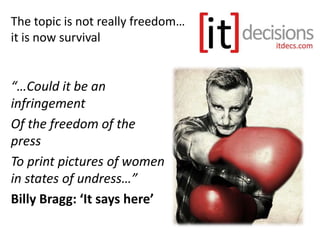
The topic is not really freedom…
it is now survival
“…Could it be an
infringement
Of the freedom of the
press
To print pictures of women
in states of undress…”
Billy Bragg: ‘It says here’
Mark Hillary
twitter.com/markhillary
j.mp/markhillary
mail@markhillary.com

UN World Press Freedom Day

  • 1.
    DiaInternacionaldaLiberdade de Imprensa2013 USP São Paulo : 15 de maio de 2013 Safe to Speak: Securing Freedom of Expression in All Media Mark Hillary
  • 2.
    This talk… • Recentevents in the UK… press scandals and inquiries • What is the press today?Can the press be regulated or controlled and what does this mean for the freedom of the press? • Digital journalism
  • 3.
    What is thepress for? “…Now the girl let the fat man touch her Vodka fumes and the feel of a vulture The driver waited in the embassy car The fat man's trap was set for capture So the girl let the thin man touch her Mixing questions, drunken laughter The ministry car was waiting there A minister knows his own affair The people must have something good to read on a Sunday…” The Clash ‘The Leader’ To inform, entertain, ex pose, educate?
  • 4.
    UK Parliament • In2009 The Daily Telegraph published uncensored details of the expense claim of every British Member of Parliament – going back years • The claims detailed abuse and fraud alongside legal – but extravagant – claims • Several MPs were forced to repay money and some went to jail • The Telegraph paid £110,000 (R$300k) for the information, other publications turned it down, yet the source has never been revealed
  • 5.
    News International • NewsInternational journalists in the UK were accused of illegally hacking into the voicemail of celebrities and politicians from 2005 to 2007 • By 2011 it became clear that journalists had been accessing the voicemail of dead soldiers, murder victims, and victims of terrorist attacks • Not only did the public feel outraged, advertisers shunned the NI title ‘News of the World’ – a Sunday newspaper that had been published since 1843. Rupert Murdoch closed the newspaper in 2011
  • 6.
    Leveson • In 2011,British Prime Minister David Cameron asked Lord Justice Leveson to explore the culture, ethics, and practice of the British press – as a reaction to the News International scandal •Leveson published his inquiry report in November 2012 • The most important recommendation was the creation of an independent body to oversee the press – to replace the ‘toothless’ Press Complaints Commission
  • 7.
    What’s wrong withLeveson? • Nude photos of Prince Harry were viewed 25m times before any UK newspaper printed them • In over 1m words, Leveson mentions the Internet only a few hundred times • A million words talking of how the press used to be, not how it is
  • 8.
    Why does itmatter? • Regulation still matters while there are professional journalists • It provides a set of guidelines for reporters and editors – reporters are protected by professional guidelines and ethical standards • But there are examples like the UK parliamentary expenses scandal where the information was clearly stolen – was it unethical to pay for stolen information even if the public supported the end result?
  • 9.
    What is thepress? • The Huffington Post has more readers than the BBC, The New York Times, Fox, NBC, Reuters… • It’s a blog
  • 10.
    What is thepress? • Over 1m readers check TMZ every day for celebrity news and gossip • It’s better and faster than any traditional media source • Mail Online had 50.1m unique readers in Oct 2012, the most popular news site in the world
  • 11.
    What is ajournalist? • Anyone can publish globally.. 24/7 and even from a phone without visiting an office or checking with an editor • Video, photos, blogs, tweets… all forms of publishing can be shared, copied, distributed and if a story is of enough interest it will attract the attention of the ‘majors’ • This is Citizen Journalism
  • 12.
    What is ajournalist? • Occupy Movement • Egypt Revolution • Hurricane Sandy • Plane crash in the Hudson river • People have phones, cameras, video, Int ernet, in their pocket… citizens broke all these stories first
  • 13.
    Can it becontrolled? • Short answer is no • Brands can adopt ethical standards and codes of practice and employ professional journalists – readers still value brands •But anyone can start a blog… how popular does it have to be before it is considered a part of ‘the media’ – our most popular news sources are already blogs and social media not the traditional media
  • 14.
    Think of itlike this • You create a news site focused on stories about Brazil… an online Veja •You write the stories outside Brazil (in Portuguese) and host the server outside Brazil – is it a Brazilian magazine? • The readers are all in Brazil, but the writers and content are all based outside Brazil… the laws of Brazil have no relevance to this journal, or do they?
  • 15.
    Is this positive? •The positive aspect of the Internet and the democratisation of publishing is that it is almost impossible for a government to now suppress access to information • Censorship in the traditional sense is impossible – see Wikileaks for proof • But… what do we lose?
  • 16.
    Is this positive? •Professional writers can cut through the noise and focus on what matters • Ethics and accuracy still matter to brands • Traditional print journals still don’t know how to survive in this world… some are entirely free and some are insisting on paywalls – nobody agrees on the right approach to online publishing of news • It is harder to launch a career in journalism as the industry itself struggles to understand the future – nobody starts on a local paper today
  • 17.
    The topic isnot really freedom… it is now survival “…Could it be an infringement Of the freedom of the press To print pictures of women in states of undress…” Billy Bragg: ‘It says here’
  • 18.