Woonsocket Data in Your BackyardFindings from the 2009 Rhode Island KIDS COUNT FactbookPresented by Stephanie Geller, Rhode Island KIDS COUNTSeptember 24, 2009
Special ThanksConnecting for Children & Familiesfor hosting today’s presentation.
2009 Rhode Island KIDS COUNT FactbookThe 2009 Factbook is the  15th annual publication.The 2009 Factbook contains 63 indicators of child well-being, including the new indicator Housing and Health.Most indicators include city and town level information.
Family and Community
Woonsocket Child PopulationBy Race & Ethnicity, 2000According to the 2000 Census, there are 11,155 children under age 18 in Woonsocket. Children in Single Parent FamiliesSource: U.S. Census Bureau, 2000 In 2000, 4,707 (46%) children in Woonsocket lived in single-parent families, significantly higher than the state rate of 30%.
In 2007, 78% of all poor children in Rhode Island lived in a single-parent family.  Children in single-parent families were 7 times more likely to live in poverty than children in two-parent families. Mother’s Education LevelSource: Rhode Island Department of Health, 2003-2007.In Woonsocket, 25% of new mothers had less than a high school diploma, significantly higher than the state rate of 15%.  The proportion of new mothers with a  bachelor’s degree or above (14%) was less than half the state rate of 36%.
Research shows strong links between parental education levels and a child’s school readiness, health, and the level of education that the child is likely to achieve. Infants Born at Highest RiskMotherUnder Age 20
Unmarried
Without High School DegreeChild9 times more likely to grow up in poverty
More likely to suffer from abuse or neglect
Less likely to be ready for school at kindergarten entry
Less likely to perform well in school
Less likely to complete high school
In 2008, 50 (8%) of Woonsocket babies were born with all three risk factors. Infants Born at Highest Risk, 2008Source: Rhode Island Department of Health, KIDSNET Database, 2008.
Economic Well-Being
Child Poverty in Rhode IslandSource: U.S. Bureau of the Census, American Community Survey, 2004-2007.In 2007, 17.5% (40,468) of Rhode Island’s 231,579 children under age 18 lived below the federal poverty threshold.
 Of the 40,468 children living in poverty, 44% lived in extreme poverty.
In total, an estimated 7.6% (17,697) of all children in Rhode Island lived in extreme poverty.Children in PovertyRhode Island Child Poverty Rate, 2000Woonsocket 31.8%Create your own chart or map on child well-being.  Compare Rhode Island with other states or compare Rhode Island communities.Go to: http://datacenter.kidscount.org/Providence 40.5%18.1%-40.9%7.5%-18.1%4.3%-7.5%1.0%-4.3%
Children in Poverty, 2000Source: U.S. Bureau of the Census, 2000. According to the American Community Survey, between 2005 and 2007, 31.7% of Woonsocket’s children (3,409) lived in families with incomes below the poverty level.Cost of RentSource: Rhode Island Department of Housing and Urban Development Rent Survey, 2000-2008.To afford the average rent in Rhode Island of $1,232 without a cost burden, a worker would need to earn $23.69 per hour for 40 hours a week. This is more than three times the state’s minimum wage of $7.40 per hour.
In 2008, the average cost of housing in Woonsocket was $976. A family of three living at the poverty level in Woonsocket would have to devote 67% of its household income to the cost of rent. Housing is considered affordable if it consumes 30% or less of a family’s household income. Children in Families Receiving Cash AssistanceAs of December 1, 2008, 1,464 (13%) of children in Woonsocket were receiving cash assistance.
Almost seven out of ten (69%) RI Works beneficiaries are children under the age of 18. Almost half (49%) of children enrolled in RI Works are under the age of six.
Between 1996 and 2008, there was a 54% decline in the Rhode Island cash assistance caseload.Children Receiving SNAP Benefits (Food Stamps)Source: Rhode Island Department of Human Services, 2008. In October 2008, 84% of income-eligible children in Woonsocket participated in the Food Stamp/SNAP Program, compared to 77% statewide.
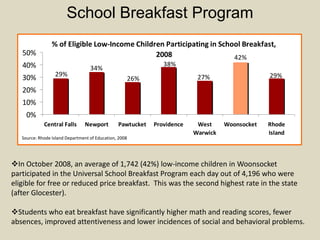
Research shows that hunger and lack of regular access to sufficient food are linked to serious health, psychological, emotional and academic problems in children can impede their healthy growth and development. School Breakfast ProgramSource: Rhode Island Department of Education, 2008In October 2008, an average of 1,742 (42%) low-income children in Woonsocket participated in the Universal School Breakfast Program each day out of 4,196 who were eligible for free or reduced price breakfast.  This was the second highest rate in the state (after Glocester).
Students who eat breakfast have significantly higher math and reading scores, fewer absences, improved attentiveness and lower incidences of social and behavioral problems. Health
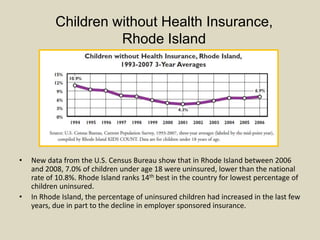
Children without Health Insurance, Rhode IslandNew data from the U.S. Census Bureau show that in Rhode Island between 2006 and 2008, 7.0% of children under age 18 were uninsured, lower than the national rate of 10.8%. Rhode Island ranks 14th best in the country for lowest percentage of children uninsured. In Rhode Island, the percentage of uninsured children had increased in the last few years, due in part to the decline in employer sponsored insurance.
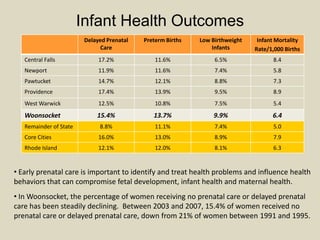
Infant Health Outcomes Early prenatal care is important to identify and treat health problems and influence health behaviors that can compromise fetal development, infant health and maternal health.
 In Woonsocket, the percentage of women receiving no prenatal care or delayed prenatal care has been steadily declining.  Between 2003 and 2007, 15.4% of women received no prenatal care or delayed prenatal care, down from 21% of women between 1991 and 1995.Children with Elevated Blood Lead LevelsDespite declines in lead poisoning rates, children living in Rhode Island’s core cities are more likely to have a history of elevated blood lead levels (5.2%) than children in the remainder of the state.
In the most recent year of testing, 669 Woonsocket children were screened for elevated blood lead levels, 29 (4.3%) screened positive initially and 20 (3.0%) were confirmed positive for blood lead levels 10mcg/dL.Housing and HealthIn both Rhode Island and the nation as a whole, children in low-income families are more likely to live in older housing than children in general.
Low-income families are more likely to lack the resources required to maintain, repair or improve their homes in ways that reduce residential health hazards such as lead paint, unsafe stairs, leaks, and cracks that may allow moisture or rodents to enter the home.
Between 2005 and 2007, 87% of low-income children in Rhode Island lived in older housing, the highest percentage in any state. Births to TeensSource: Rhode Island Department of Health,  2003-2007.Teen mothers are less likely to have the financial resources, social supports and parenting skills needed for healthy child development.
The teen birth rate per 1,000 teen girls ages 18-19 is significantly higher in Woonsocket (113.1) than in the state as a whole (43.2).
Between 2003 and 2007 in Rhode Island, almost one in five teen births (18%) were to teens who were already mothers (repeat births). Safety
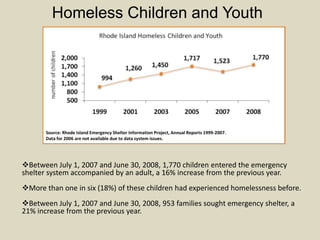
Homeless Children and YouthSource: Rhode Island Emergency Shelter Information Project, Annual Reports 1999-2007.Data for 2006 are not available due to data system issues. Between July 1, 2007 and June 30, 2008, 1,770 children entered the emergency shelter system accompanied by an adult, a 16% increase from the previous year.
More than one in six (18%) of these children had experienced homelessness before.
Between July 1, 2007 and June 30, 2008, 953 families sought emergency shelter, a 21% increase from the previous year. Juveniles Referred to Family CourtOf the wayward and delinquent offenses referred to Family Court in Rhode Island during 2008, 74% were committed by males and 26% by females.
Youth in urban communities with high poverty concentrations were more likely to be referred to the Family Court.
In 2008, 8,790 wayward or delinquent offenses were referred to Family Court.  17% of these offenses were status offenses such as truancy and disobedient conduct that would not be punishable if committed by an adult.  Types of Juvenile Wayward/Delinquent Offenses Referred to Family Court, 2008
Children of Incarcerated ParentsSource: Rhode Island Department of Corrections, September 30, 2008.In 2008, 88 adults incarcerated in Rhode Island whose last known residence was Woonsocket reported having 227 children a rate of 20.3  per 1,000 children, which is higher than the state rate of 11.1.
Children with incarcerated parents are at increased risk for poor academic achievement, emotional and behavioral problems, depression, and criminal behavior and incarceration.Child Abuse and NeglectIn 2008 in Woonsocket, there were 315 victims of child abuse and neglect, a rate of 28.2 per 1,000 children. This is higher than the core city average of 17.0 victims per 1,000 children and more than twice the state rate of 10.7 child abuse and neglect victims per 1,000 children. Woonsocket’s rate is the highest in the state.

Woonsocket2009 Data in Your Backyard Presentation

  • 1.
    Woonsocket Data inYour BackyardFindings from the 2009 Rhode Island KIDS COUNT FactbookPresented by Stephanie Geller, Rhode Island KIDS COUNTSeptember 24, 2009
  • 2.
    Special ThanksConnecting forChildren & Familiesfor hosting today’s presentation.
  • 3.
    2009 Rhode IslandKIDS COUNT FactbookThe 2009 Factbook is the 15th annual publication.The 2009 Factbook contains 63 indicators of child well-being, including the new indicator Housing and Health.Most indicators include city and town level information.
  • 4.
  • 5.
    Woonsocket Child PopulationByRace & Ethnicity, 2000According to the 2000 Census, there are 11,155 children under age 18 in Woonsocket. Children in Single Parent FamiliesSource: U.S. Census Bureau, 2000 In 2000, 4,707 (46%) children in Woonsocket lived in single-parent families, significantly higher than the state rate of 30%.
  • 6.
    In 2007, 78%of all poor children in Rhode Island lived in a single-parent family. Children in single-parent families were 7 times more likely to live in poverty than children in two-parent families. Mother’s Education LevelSource: Rhode Island Department of Health, 2003-2007.In Woonsocket, 25% of new mothers had less than a high school diploma, significantly higher than the state rate of 15%. The proportion of new mothers with a bachelor’s degree or above (14%) was less than half the state rate of 36%.
  • 7.
    Research shows stronglinks between parental education levels and a child’s school readiness, health, and the level of education that the child is likely to achieve. Infants Born at Highest RiskMotherUnder Age 20
  • 8.
  • 9.
    Without High SchoolDegreeChild9 times more likely to grow up in poverty
  • 10.
    More likely tosuffer from abuse or neglect
  • 11.
    Less likely tobe ready for school at kindergarten entry
  • 12.
    Less likely toperform well in school
  • 13.
    Less likely tocomplete high school
  • 14.
    In 2008, 50(8%) of Woonsocket babies were born with all three risk factors. Infants Born at Highest Risk, 2008Source: Rhode Island Department of Health, KIDSNET Database, 2008.
  • 15.
  • 16.
    Child Poverty inRhode IslandSource: U.S. Bureau of the Census, American Community Survey, 2004-2007.In 2007, 17.5% (40,468) of Rhode Island’s 231,579 children under age 18 lived below the federal poverty threshold.
  • 17.
    Of the40,468 children living in poverty, 44% lived in extreme poverty.
  • 18.
    In total, anestimated 7.6% (17,697) of all children in Rhode Island lived in extreme poverty.Children in PovertyRhode Island Child Poverty Rate, 2000Woonsocket 31.8%Create your own chart or map on child well-being. Compare Rhode Island with other states or compare Rhode Island communities.Go to: http://datacenter.kidscount.org/Providence 40.5%18.1%-40.9%7.5%-18.1%4.3%-7.5%1.0%-4.3%
  • 19.
    Children in Poverty,2000Source: U.S. Bureau of the Census, 2000. According to the American Community Survey, between 2005 and 2007, 31.7% of Woonsocket’s children (3,409) lived in families with incomes below the poverty level.Cost of RentSource: Rhode Island Department of Housing and Urban Development Rent Survey, 2000-2008.To afford the average rent in Rhode Island of $1,232 without a cost burden, a worker would need to earn $23.69 per hour for 40 hours a week. This is more than three times the state’s minimum wage of $7.40 per hour.
  • 20.
    In 2008, theaverage cost of housing in Woonsocket was $976. A family of three living at the poverty level in Woonsocket would have to devote 67% of its household income to the cost of rent. Housing is considered affordable if it consumes 30% or less of a family’s household income. Children in Families Receiving Cash AssistanceAs of December 1, 2008, 1,464 (13%) of children in Woonsocket were receiving cash assistance.
  • 21.
    Almost seven outof ten (69%) RI Works beneficiaries are children under the age of 18. Almost half (49%) of children enrolled in RI Works are under the age of six.
  • 22.
    Between 1996 and2008, there was a 54% decline in the Rhode Island cash assistance caseload.Children Receiving SNAP Benefits (Food Stamps)Source: Rhode Island Department of Human Services, 2008. In October 2008, 84% of income-eligible children in Woonsocket participated in the Food Stamp/SNAP Program, compared to 77% statewide.
  • 23.
    Research shows thathunger and lack of regular access to sufficient food are linked to serious health, psychological, emotional and academic problems in children can impede their healthy growth and development. School Breakfast ProgramSource: Rhode Island Department of Education, 2008In October 2008, an average of 1,742 (42%) low-income children in Woonsocket participated in the Universal School Breakfast Program each day out of 4,196 who were eligible for free or reduced price breakfast. This was the second highest rate in the state (after Glocester).
  • 24.
    Students who eatbreakfast have significantly higher math and reading scores, fewer absences, improved attentiveness and lower incidences of social and behavioral problems. Health
  • 25.
    Children without HealthInsurance, Rhode IslandNew data from the U.S. Census Bureau show that in Rhode Island between 2006 and 2008, 7.0% of children under age 18 were uninsured, lower than the national rate of 10.8%. Rhode Island ranks 14th best in the country for lowest percentage of children uninsured. In Rhode Island, the percentage of uninsured children had increased in the last few years, due in part to the decline in employer sponsored insurance.
  • 26.
    Infant Health OutcomesEarly prenatal care is important to identify and treat health problems and influence health behaviors that can compromise fetal development, infant health and maternal health.
  • 27.
    In Woonsocket,the percentage of women receiving no prenatal care or delayed prenatal care has been steadily declining. Between 2003 and 2007, 15.4% of women received no prenatal care or delayed prenatal care, down from 21% of women between 1991 and 1995.Children with Elevated Blood Lead LevelsDespite declines in lead poisoning rates, children living in Rhode Island’s core cities are more likely to have a history of elevated blood lead levels (5.2%) than children in the remainder of the state.
  • 28.
    In the mostrecent year of testing, 669 Woonsocket children were screened for elevated blood lead levels, 29 (4.3%) screened positive initially and 20 (3.0%) were confirmed positive for blood lead levels 10mcg/dL.Housing and HealthIn both Rhode Island and the nation as a whole, children in low-income families are more likely to live in older housing than children in general.
  • 29.
    Low-income families aremore likely to lack the resources required to maintain, repair or improve their homes in ways that reduce residential health hazards such as lead paint, unsafe stairs, leaks, and cracks that may allow moisture or rodents to enter the home.
  • 30.
    Between 2005 and2007, 87% of low-income children in Rhode Island lived in older housing, the highest percentage in any state. Births to TeensSource: Rhode Island Department of Health, 2003-2007.Teen mothers are less likely to have the financial resources, social supports and parenting skills needed for healthy child development.
  • 31.
    The teen birthrate per 1,000 teen girls ages 18-19 is significantly higher in Woonsocket (113.1) than in the state as a whole (43.2).
  • 32.
    Between 2003 and2007 in Rhode Island, almost one in five teen births (18%) were to teens who were already mothers (repeat births). Safety
  • 33.
    Homeless Children andYouthSource: Rhode Island Emergency Shelter Information Project, Annual Reports 1999-2007.Data for 2006 are not available due to data system issues. Between July 1, 2007 and June 30, 2008, 1,770 children entered the emergency shelter system accompanied by an adult, a 16% increase from the previous year.
  • 34.
    More than onein six (18%) of these children had experienced homelessness before.
  • 35.
    Between July 1,2007 and June 30, 2008, 953 families sought emergency shelter, a 21% increase from the previous year. Juveniles Referred to Family CourtOf the wayward and delinquent offenses referred to Family Court in Rhode Island during 2008, 74% were committed by males and 26% by females.
  • 36.
    Youth in urbancommunities with high poverty concentrations were more likely to be referred to the Family Court.
  • 37.
    In 2008, 8,790wayward or delinquent offenses were referred to Family Court. 17% of these offenses were status offenses such as truancy and disobedient conduct that would not be punishable if committed by an adult. Types of Juvenile Wayward/Delinquent Offenses Referred to Family Court, 2008
  • 38.
    Children of IncarceratedParentsSource: Rhode Island Department of Corrections, September 30, 2008.In 2008, 88 adults incarcerated in Rhode Island whose last known residence was Woonsocket reported having 227 children a rate of 20.3 per 1,000 children, which is higher than the state rate of 11.1.
  • 39.
    Children with incarceratedparents are at increased risk for poor academic achievement, emotional and behavioral problems, depression, and criminal behavior and incarceration.Child Abuse and NeglectIn 2008 in Woonsocket, there were 315 victims of child abuse and neglect, a rate of 28.2 per 1,000 children. This is higher than the core city average of 17.0 victims per 1,000 children and more than twice the state rate of 10.7 child abuse and neglect victims per 1,000 children. Woonsocket’s rate is the highest in the state.