ulx
Hotels Remaking History
                                               ron	nyren


                              Historic buildings often make            declined have gained new life as     tectural and interior elements
Ten renovation and            ideal hotels, whether or not they        downtowns strive to recover.         to reclaim the site’s history and
retrofit projects make over   began life as one. Converted indus-         Often it is necessary to reduce   provide a sense of place—for both
                              trial structures, office buildings—      the room count in older buildings    locals and out-of-town guests.
structures to meet the        and even a water tower—have              to ensure that rooms are large
                              been repurposed as hotels. In            enough to meet contemporary          Ron nyRen is a freelance architecture, urban
needs of the contemporary     other cases, historic hotels that fell   standards. Modern design touches     design, and real estate writer based in the San
                                                                                                            Francisco Bay Area.
hospitality industry and      into disrepair when central cities       interweave with restored archi-

tap the place-specific
power of older buildings.
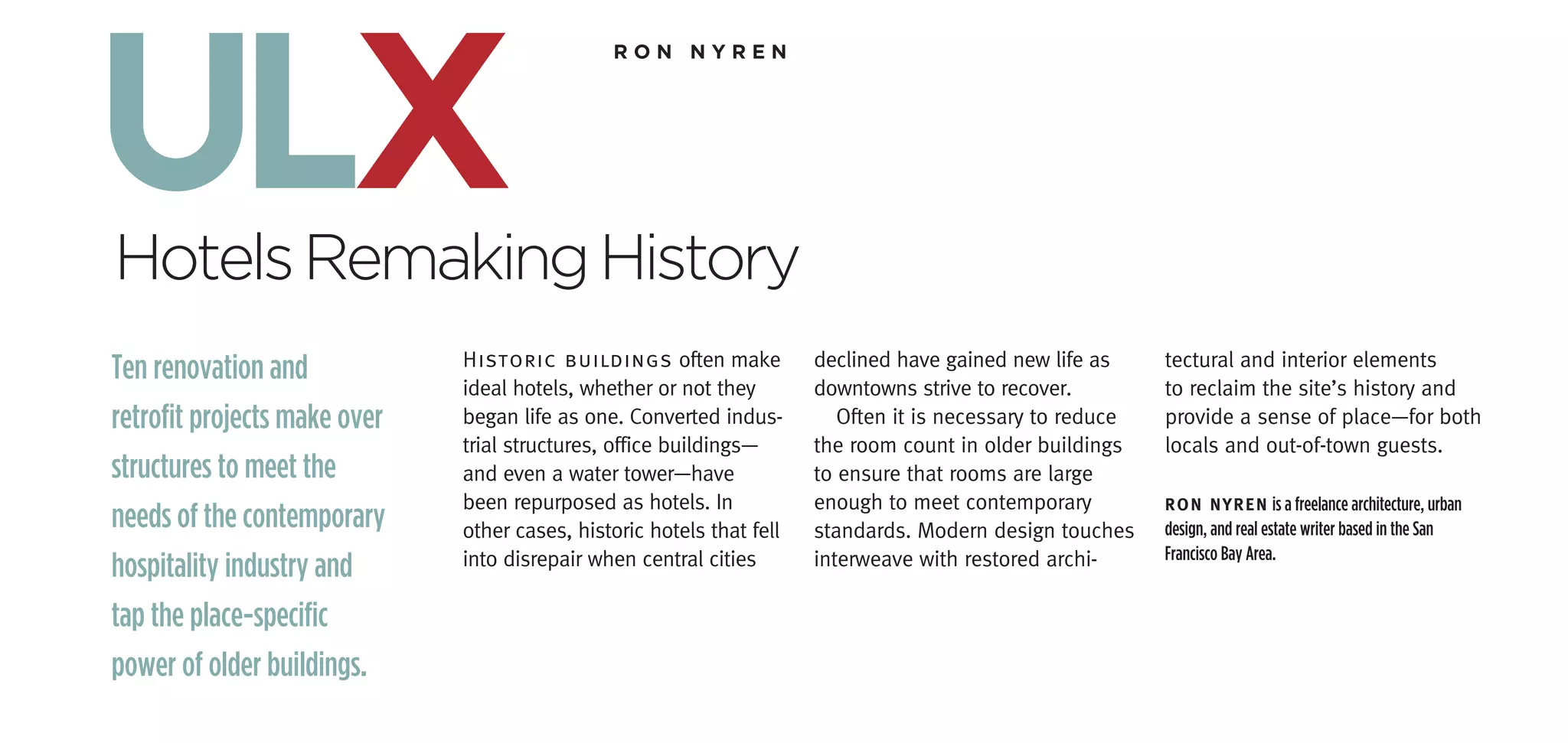
1. andel’s Hotel Lodz
                                           LoDz,	PoLanD
                                           One of Poland’s largest cities, Lodz served as a major                                              London-based Jestico + Whiles and OP Architekten
                                           textile industry center in the 19th century. By the                                                 of Vienna, the facility also includes a large atrium, a
                                           1990s, however, the industry had fallen into decline,                                               restaurant, and seven conference rooms. On the roof,
                                           and the textile mills at the city’s heart were left vacant.                                         the ballroom and the swimming pool are enclosed in
                                           The mixed-use project Manufaktura opened in the city                                                glass; the pool cantilevers above the main entrance.
                                           center in 2006, converting industrial buildings dating                                                 The design restored and preserved historic red-brick
                                           to the 1850s to house cultural and leisure facilities and                                           walls, vaulted ceilings, and cast ironwork while insert-
                                           adding a new retail center. Last year, andel’s Hotel                                                ing contemporary sculptural elements, such as the
                                           Lodz opened in a former weaving mill within Manufak-                                                atrium’s elliptical concrete forms lit by color-changing
                                           tura and now offers 220 standard guest rooms and 58                                                 lighting. Vienna International Hotels & Resorts of
                                           suites and extended-stay apartments.                                                                Vienna is the hotel’s operator.
                                              Designed for Vienna, Austria–based real estate
                                           developer Warimpex Finanz- und Beteiligungs AG by
©Vienna international Hotelmanagement ag


                                                                                                         ©Vienna international Hotelmanagement ag
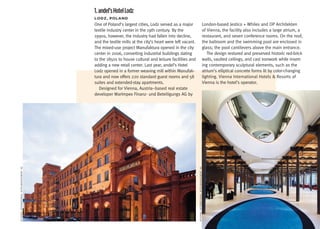
2. The Boundary
LonDon,	U.K.
On Boundary Street in the Shoreditch area of east London, London joint venture Prescott &
Conran Ltd. created a hotel and dining venue out of a vacant, deteriorated industrial ware-
house built in 1893. Design firm Conran & Partners, also of London, removed the mansard
and added two floors containing duplex bedrooms with double-height living spaces.
   The design retains the building’s brickwork, large sash windows, and light wells. The
new floors are clad in green copper with a timber sunshade. Opened last year, the build-
ing includes a restaurant, a roof garden with bar and grill, a café, and a food store. Each
of the 17 guest bedrooms reflects the style of a different designer or design movement,
including Bauhaus, Charles Eames, Le Corbusier, Mies van der Rohe, and the Shakers.
   Sustainable design features include natural ventilation and materials obtained from
local suppliers. A new groundwater cooling system, which relies on an artesian aquifer
under the restaurant, operates the air conditioning, refrigeration systems, ice machines,
and other equipment.
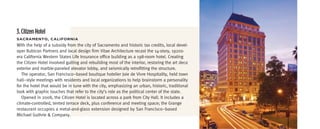
3. Citizen Hotel
SaCramenTo,	CaLifornia
With the help of a subsidy from the city of Sacramento and historic tax credits, local devel-
oper Rubicon Partners and local design firm Vitae Architecture recast the 14-story, 1920s-
era California Western States Life Insurance office building as a 198-room hotel. Creating
the Citizen Hotel involved gutting and rebuilding most of the interior, restoring the art deco
exterior and marble-paneled elevator lobby, and seismically retrofitting the structure.
   The operator, San Francisco–based boutique hotelier Joie de Vivre Hospitality, held town
hall–style meetings with residents and local organizations to help brainstorm a personality
for the hotel that would be in tune with the city, emphasizing an urban, historic, traditional
look with graphic touches that refer to the city’s role as the political center of the state.
   Opened in 2008, the Citizen Hotel is located across a park from City Hall. It includes a
climate-controlled, tented terrace deck, plus conference and meeting space; the Grange
restaurant occupies a metal-and-glass extension designed by San Francisco–based
Michael Guthrie & Company.
4. Gladstone Hotel
            ToronTo,	CanaDa
            The Gladstone Hotel is billed as Toronto’s oldest continuously operat-
            ing hotel, dating back to 1889, but by the end of the 20th century, long-
            deferred maintenance resulted in water damage and general dilapidation.
            In 2002, the family of local architect Eberhard Zeidler purchased the build-
            ing and began extensive renovations, completed in 2005.
               Zeidler Partnership Architects restored the Richardsonian Romanesque struc-
            ture’s stone ornamentation, brickwork, wood siding, and arched windows, as
            well as the original hand-operated elevator. Plumbing and wiring were updated
            and new wood floors installed. Each of the 37 guest rooms and suites was
            designed by a different local artist or team of artists, chosen by the Zeidlers
            through a juried submission process. The hotel also has a café, a bar, meeting
            and conference rooms, a ballroom, and short-term rental artists’ studios.


tom arban
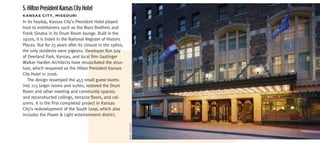
5. Hilton President Kansas City Hotel
KanSaS	CiTy,	miSSoUri
In its heyday, Kansas City’s President Hotel played
host to entertainers such as the Marx Brothers and
Frank Sinatra in its Drum Room lounge. Built in the
1920s, it is listed in the National Register of Historic
Places. But for 25 years after its closure in the 1980s,
the only residents were pigeons. Developer Ron Jury
of Overland Park, Kansas, and local firm Gastinger
Walker Harden Architects have resuscitated the struc-
ture, which reopened as the Hilton President Kansas
City Hotel in 2006.
   The design revamped the 453 small guest rooms
into 213 larger rooms and suites; restored the Drum
Room and other meeting and community spaces;
and reconstructed ceilings, terrazzo floors, and col-
umns. It is the first completed project in Kansas
City’s redevelopment of the South Loop, which also
includes the Power & Light entertainment district.


                                                           mike sinclair
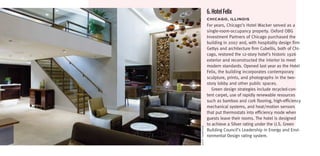
6. Hotel Felix
                 ChiCago,	iLLinoiS
                 For years, Chicago’s Hotel Wacker served as a
                 single-room-occupancy property. Oxford OBG
                 Investment Partners of Chicago purchased the
                 building in 2007 and, with hospitality design firm
                 Gettys and architecture firm Cubellis, both of Chi-
                 cago, restored the 12-story hotel’s historic 1926
                 exterior and reconstructed the interior to meet
                 modern standards. Opened last year as the Hotel
                 Felix, the building incorporates contemporary
                 sculpture, prints, and photographs in the two-
                 story lobby and other public spaces.
                    Green design strategies include recycled-con-
                 tent carpet, use of rapidly renewable resources
                 such as bamboo and cork flooring, high-efficiency
                 mechanical systems, and heat/motion sensors
                 that put thermostats into efficiency mode when
                 guests leave their rooms. The hotel is designed
                 to achieve a Silver rating under the U.S. Green


scott tHompson
                 Building Council’s Leadership in Energy and Envi-
                 ronmental Design rating system.
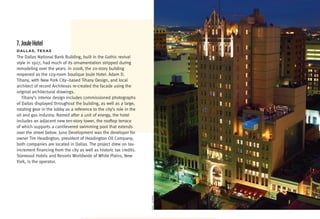
7. Joule Hotel
DaLLaS,	TexaS
The Dallas National Bank Building, built in the Gothic revival
style in 1927, had much of its ornamentation stripped during
remodeling over the years. In 2008, the 20-story building
reopened as the 129-room boutique Joule Hotel. Adam D.
Tihany, with New York City–based Tihany Design, and local
architect of record Architexas re-created the facade using the
original architectural drawings.
   Tihany’s interior design includes commissioned photographs
of Dallas displayed throughout the building, as well as a large,
rotating gear in the lobby as a reference to the city’s role in the
oil and gas industry. Named after a unit of energy, the hotel
includes an adjacent new ten-story tower, the rooftop terrace
of which supports a cantilevered swimming pool that extends
over the street below. Juno Development was the developer for
owner Tim Headington, president of Headington Oil Company;
both companies are located in Dallas. The project drew on tax-
increment financing from the city as well as historic tax credits.
Starwood Hotels and Resorts Worldwide of White Plains, New
York, is the operator.
                                                                      eric laignel
Urban splasH/© simon webb pHotograpHy
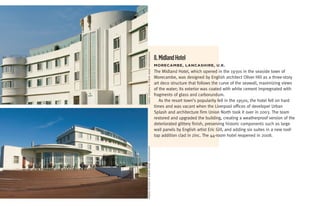
                                        8. Midland Hotel
                                        moreCambe,	LanCaShire,	U.K.
                                        The Midland Hotel, which opened in the 1930s in the seaside town of
                                        Morecambe, was designed by English architect Oliver Hill as a three-story
                                        art deco structure that follows the curve of the seawall, maximizing views
                                        of the water; its exterior was coated with white cement impregnated with
                                        fragments of glass and carborundum.
                                           As the resort town’s popularity fell in the 1950s, the hotel fell on hard
                                        times and was vacant when the Liverpool offices of developer Urban
                                        Splash and architecture firm Union North took it over in 2003. The team
                                        restored and upgraded the building, creating a weatherproof version of the
                                        deteriorated glittery finish, preserving historic components such as large
                                        wall panels by English artist Eric Gill, and adding six suites in a new roof-
                                        top addition clad in zinc. The 44-room hotel reopened in 2008.

Urban splasH/© simon webb pHotograpHy
ulx
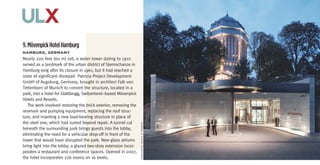
9. Mövenpick Hotel Hamburg
hambUrg,	germany
Nearly 200 feet (60 m) tall, a water tower dating to 1910
served as a landmark of the urban district of Sternschanze in
Hamburg long after its closure in 1961, but it had reached a
state of significant disrepair. Patrizia Project Development
GmbH of Augsburg, Germany, brought in architect Falk von
Tettenborn of Munich to convert the structure, located in a
park, into a hotel for Glattbrugg, Switzerland–based Mövenpick
Hotels and Resorts.
   The work involved restoring the brick exterior, removing the
reservoir and pumping equipment, replacing the roof struc-
ture, and inserting a new load-bearing structure in place of
the steel one, which had rusted beyond repair. A tunnel cut


                                                                  ©möVenpick Hotels & resorts
beneath the surrounding park brings guests into the lobby,
eliminating the need for a vehicular drop-off in front of the
tower that would have disrupted the park. New glass atriums
bring light into the lobby; a glazed two-story extension incor-
porates a restaurant and conference spaces. Opened in 2007,
the hotel incorporates 226 rooms on 16 levels.
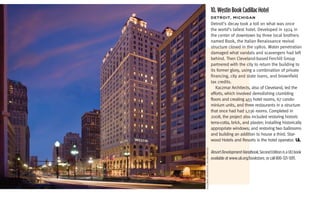
10. Westin Book Cadillac Hotel
                                  DeTroiT,	miChigan
                                  Detroit’s decay took a toll on what was once
                                  the world’s tallest hotel. Developed in 1924 in
                                  the center of downtown by three local brothers
                                  named Book, the Italian Renaissance revival
                                  structure closed in the 1980s. Water penetration
                                  damaged what vandals and scavengers had left
                                  behind. Then Cleveland-based Ferchill Group
                                  partnered with the city to return the building to
                                  its former glory, using a combination of private
                                  financing, city and state loans, and brownfield
                                  tax credits.
                                     Kaczmar Architects, also of Cleveland, led the
                                  efforts, which involved demolishing crumbling
                                  floors and creating 455 hotel rooms, 67 condo-
                                  minium units, and three restaurants in a structure
                                  that once had had 1,136 rooms. Completed in
                                  2008, the project also included restoring historic
                                  terra-cotta, brick, and plaster; installing historically
                                  appropriate windows; and restoring two ballrooms
                                  and building an addition to house a third. Star-
                                  wood Hotels and Resorts is the hotel operator. UL


kaczmar arcHitects incorporated
                                  Resort Development Handbook, Second Edition is a ULI book
                                  available at www.uli.org/bookstore, or call 800-321-5011.

ULX March April 2010

  • 1.
    ulx Hotels Remaking History ron nyren Historic buildings often make declined have gained new life as tectural and interior elements Ten renovation and ideal hotels, whether or not they downtowns strive to recover. to reclaim the site’s history and retrofit projects make over began life as one. Converted indus- Often it is necessary to reduce provide a sense of place—for both trial structures, office buildings— the room count in older buildings locals and out-of-town guests. structures to meet the and even a water tower—have to ensure that rooms are large been repurposed as hotels. In enough to meet contemporary Ron nyRen is a freelance architecture, urban needs of the contemporary other cases, historic hotels that fell standards. Modern design touches design, and real estate writer based in the San Francisco Bay Area. hospitality industry and into disrepair when central cities interweave with restored archi- tap the place-specific power of older buildings.
  • 2.
    1. andel’s HotelLodz LoDz, PoLanD One of Poland’s largest cities, Lodz served as a major London-based Jestico + Whiles and OP Architekten textile industry center in the 19th century. By the of Vienna, the facility also includes a large atrium, a 1990s, however, the industry had fallen into decline, restaurant, and seven conference rooms. On the roof, and the textile mills at the city’s heart were left vacant. the ballroom and the swimming pool are enclosed in The mixed-use project Manufaktura opened in the city glass; the pool cantilevers above the main entrance. center in 2006, converting industrial buildings dating The design restored and preserved historic red-brick to the 1850s to house cultural and leisure facilities and walls, vaulted ceilings, and cast ironwork while insert- adding a new retail center. Last year, andel’s Hotel ing contemporary sculptural elements, such as the Lodz opened in a former weaving mill within Manufak- atrium’s elliptical concrete forms lit by color-changing tura and now offers 220 standard guest rooms and 58 lighting. Vienna International Hotels & Resorts of suites and extended-stay apartments. Vienna is the hotel’s operator. Designed for Vienna, Austria–based real estate developer Warimpex Finanz- und Beteiligungs AG by ©Vienna international Hotelmanagement ag ©Vienna international Hotelmanagement ag
  • 3.
    2. The Boundary LonDon, U.K. OnBoundary Street in the Shoreditch area of east London, London joint venture Prescott & Conran Ltd. created a hotel and dining venue out of a vacant, deteriorated industrial ware- house built in 1893. Design firm Conran & Partners, also of London, removed the mansard and added two floors containing duplex bedrooms with double-height living spaces. The design retains the building’s brickwork, large sash windows, and light wells. The new floors are clad in green copper with a timber sunshade. Opened last year, the build- ing includes a restaurant, a roof garden with bar and grill, a café, and a food store. Each of the 17 guest bedrooms reflects the style of a different designer or design movement, including Bauhaus, Charles Eames, Le Corbusier, Mies van der Rohe, and the Shakers. Sustainable design features include natural ventilation and materials obtained from local suppliers. A new groundwater cooling system, which relies on an artesian aquifer under the restaurant, operates the air conditioning, refrigeration systems, ice machines, and other equipment.
  • 4.
    3. Citizen Hotel SaCramenTo, CaLifornia Withthe help of a subsidy from the city of Sacramento and historic tax credits, local devel- oper Rubicon Partners and local design firm Vitae Architecture recast the 14-story, 1920s- era California Western States Life Insurance office building as a 198-room hotel. Creating the Citizen Hotel involved gutting and rebuilding most of the interior, restoring the art deco exterior and marble-paneled elevator lobby, and seismically retrofitting the structure. The operator, San Francisco–based boutique hotelier Joie de Vivre Hospitality, held town hall–style meetings with residents and local organizations to help brainstorm a personality for the hotel that would be in tune with the city, emphasizing an urban, historic, traditional look with graphic touches that refer to the city’s role as the political center of the state. Opened in 2008, the Citizen Hotel is located across a park from City Hall. It includes a climate-controlled, tented terrace deck, plus conference and meeting space; the Grange restaurant occupies a metal-and-glass extension designed by San Francisco–based Michael Guthrie & Company.
  • 5.
    4. Gladstone Hotel ToronTo, CanaDa The Gladstone Hotel is billed as Toronto’s oldest continuously operat- ing hotel, dating back to 1889, but by the end of the 20th century, long- deferred maintenance resulted in water damage and general dilapidation. In 2002, the family of local architect Eberhard Zeidler purchased the build- ing and began extensive renovations, completed in 2005. Zeidler Partnership Architects restored the Richardsonian Romanesque struc- ture’s stone ornamentation, brickwork, wood siding, and arched windows, as well as the original hand-operated elevator. Plumbing and wiring were updated and new wood floors installed. Each of the 37 guest rooms and suites was designed by a different local artist or team of artists, chosen by the Zeidlers through a juried submission process. The hotel also has a café, a bar, meeting and conference rooms, a ballroom, and short-term rental artists’ studios. tom arban
  • 6.
    5. Hilton PresidentKansas City Hotel KanSaS CiTy, miSSoUri In its heyday, Kansas City’s President Hotel played host to entertainers such as the Marx Brothers and Frank Sinatra in its Drum Room lounge. Built in the 1920s, it is listed in the National Register of Historic Places. But for 25 years after its closure in the 1980s, the only residents were pigeons. Developer Ron Jury of Overland Park, Kansas, and local firm Gastinger Walker Harden Architects have resuscitated the struc- ture, which reopened as the Hilton President Kansas City Hotel in 2006. The design revamped the 453 small guest rooms into 213 larger rooms and suites; restored the Drum Room and other meeting and community spaces; and reconstructed ceilings, terrazzo floors, and col- umns. It is the first completed project in Kansas City’s redevelopment of the South Loop, which also includes the Power & Light entertainment district. mike sinclair
  • 7.
    6. Hotel Felix ChiCago, iLLinoiS For years, Chicago’s Hotel Wacker served as a single-room-occupancy property. Oxford OBG Investment Partners of Chicago purchased the building in 2007 and, with hospitality design firm Gettys and architecture firm Cubellis, both of Chi- cago, restored the 12-story hotel’s historic 1926 exterior and reconstructed the interior to meet modern standards. Opened last year as the Hotel Felix, the building incorporates contemporary sculpture, prints, and photographs in the two- story lobby and other public spaces. Green design strategies include recycled-con- tent carpet, use of rapidly renewable resources such as bamboo and cork flooring, high-efficiency mechanical systems, and heat/motion sensors that put thermostats into efficiency mode when guests leave their rooms. The hotel is designed to achieve a Silver rating under the U.S. Green scott tHompson Building Council’s Leadership in Energy and Envi- ronmental Design rating system.
  • 8.
    7. Joule Hotel DaLLaS, TexaS TheDallas National Bank Building, built in the Gothic revival style in 1927, had much of its ornamentation stripped during remodeling over the years. In 2008, the 20-story building reopened as the 129-room boutique Joule Hotel. Adam D. Tihany, with New York City–based Tihany Design, and local architect of record Architexas re-created the facade using the original architectural drawings. Tihany’s interior design includes commissioned photographs of Dallas displayed throughout the building, as well as a large, rotating gear in the lobby as a reference to the city’s role in the oil and gas industry. Named after a unit of energy, the hotel includes an adjacent new ten-story tower, the rooftop terrace of which supports a cantilevered swimming pool that extends over the street below. Juno Development was the developer for owner Tim Headington, president of Headington Oil Company; both companies are located in Dallas. The project drew on tax- increment financing from the city as well as historic tax credits. Starwood Hotels and Resorts Worldwide of White Plains, New York, is the operator. eric laignel
  • 9.
    Urban splasH/© simonwebb pHotograpHy 8. Midland Hotel moreCambe, LanCaShire, U.K. The Midland Hotel, which opened in the 1930s in the seaside town of Morecambe, was designed by English architect Oliver Hill as a three-story art deco structure that follows the curve of the seawall, maximizing views of the water; its exterior was coated with white cement impregnated with fragments of glass and carborundum. As the resort town’s popularity fell in the 1950s, the hotel fell on hard times and was vacant when the Liverpool offices of developer Urban Splash and architecture firm Union North took it over in 2003. The team restored and upgraded the building, creating a weatherproof version of the deteriorated glittery finish, preserving historic components such as large wall panels by English artist Eric Gill, and adding six suites in a new roof- top addition clad in zinc. The 44-room hotel reopened in 2008. Urban splasH/© simon webb pHotograpHy
  • 10.
    ulx 9. Mövenpick HotelHamburg hambUrg, germany Nearly 200 feet (60 m) tall, a water tower dating to 1910 served as a landmark of the urban district of Sternschanze in Hamburg long after its closure in 1961, but it had reached a state of significant disrepair. Patrizia Project Development GmbH of Augsburg, Germany, brought in architect Falk von Tettenborn of Munich to convert the structure, located in a park, into a hotel for Glattbrugg, Switzerland–based Mövenpick Hotels and Resorts. The work involved restoring the brick exterior, removing the reservoir and pumping equipment, replacing the roof struc- ture, and inserting a new load-bearing structure in place of the steel one, which had rusted beyond repair. A tunnel cut ©möVenpick Hotels & resorts beneath the surrounding park brings guests into the lobby, eliminating the need for a vehicular drop-off in front of the tower that would have disrupted the park. New glass atriums bring light into the lobby; a glazed two-story extension incor- porates a restaurant and conference spaces. Opened in 2007, the hotel incorporates 226 rooms on 16 levels.
  • 11.
    10. Westin BookCadillac Hotel DeTroiT, miChigan Detroit’s decay took a toll on what was once the world’s tallest hotel. Developed in 1924 in the center of downtown by three local brothers named Book, the Italian Renaissance revival structure closed in the 1980s. Water penetration damaged what vandals and scavengers had left behind. Then Cleveland-based Ferchill Group partnered with the city to return the building to its former glory, using a combination of private financing, city and state loans, and brownfield tax credits. Kaczmar Architects, also of Cleveland, led the efforts, which involved demolishing crumbling floors and creating 455 hotel rooms, 67 condo- minium units, and three restaurants in a structure that once had had 1,136 rooms. Completed in 2008, the project also included restoring historic terra-cotta, brick, and plaster; installing historically appropriate windows; and restoring two ballrooms and building an addition to house a third. Star- wood Hotels and Resorts is the hotel operator. UL kaczmar arcHitects incorporated Resort Development Handbook, Second Edition is a ULI book available at www.uli.org/bookstore, or call 800-321-5011.