
Engineering Services, Inc. 
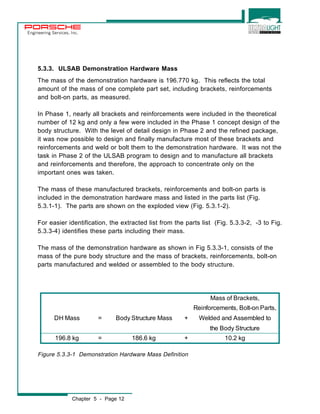
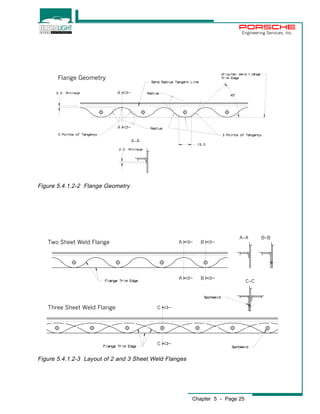
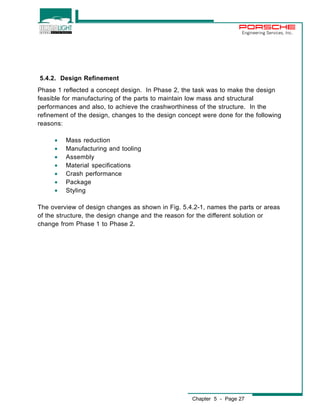
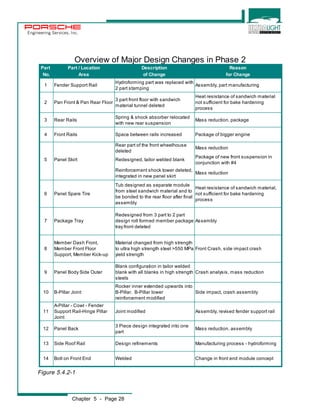
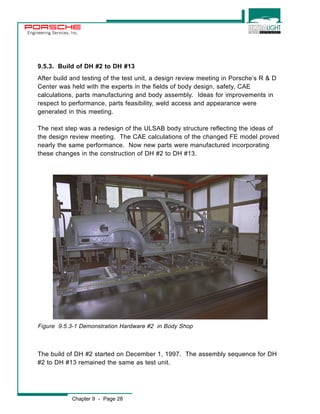
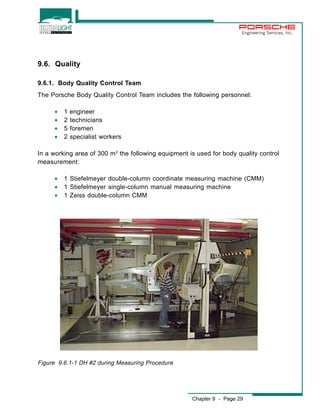
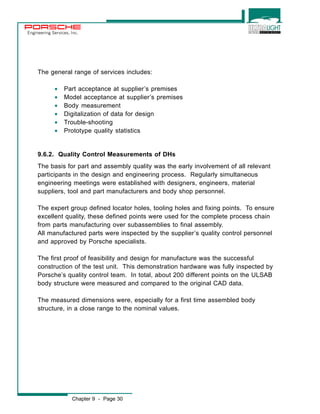
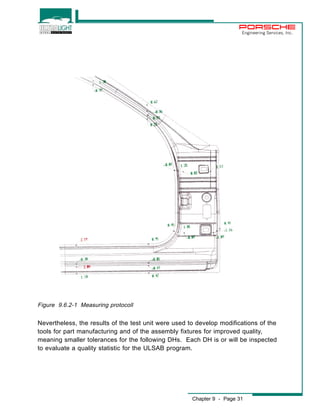
Porsche Engineering Services, Inc. 
ULSAB Program Phase 2 
Final Report 
to the 
Ultra Light Steel Auto Body 
Consortium
Engineering Services, Inc. 
Ultra Light Steel Auto Body 
Member Companies 
Aceralia 
AK Steel 
Bethlehem 
BHP Steel 
British Steel 
Cockerill Sambre 
CSN 
Dofasco 
Hoogovens 
Inland 
Kawasaki Steel 
Kobe 
Krakatau 
Krupp Hoesch 
LTV Steel 
National Steel 
Nippon Steel 
NKK 
POSCO 
Preussag 
Rouge Steel 
SIDERAR 
SIDMAR 
SOLLAC 
SSAB 
Stelco 
Sumitomo 
Tata 
Thyssen 
US Steel Group 
USIMINAS 
VSZ 
VOEST-ALPINE 
WCI 
Weirton
Engineering Services, Inc. 
ULSAB Final Report Table of Contents 
Table of Contents - Page 1 
Preface 
1. Executive Summary 
2. Phase 2 Introduction 
2.1. Phase 2 Program Goal 
2.2. Phase 2 Design and Analysis 
2.3. Demonstration Hardware (DH) 
2.4. Scope of Work 
2.5. Materials 
2.6. Testing of Test Unit 
2.7. Phase 2 Program Timing 
3. ULSAB Phase 2 Package 
3.1. General Approach 
3.2. Package Definition 
3.2.1. Vehicle Concept Type 
3.2.2. Exterior Dimensions 
3.2.3. Interior Dimensions 
3.2.4. Main Component Definition 
3.2.5. Underfloor Clearance 
3.2.6. Seating Position 
3.2.7. Visibility Study 
3.2.7.1. Horizontal and Vertical Obstruction 
3.2.7.2. A-Pillar Obstruction 
3.2.8. Gear Shift Lever Position 
3.2.9. Pedal Position 
3.2.10. Bumper Height Definition 
3.3. Package Drawings
Engineering Services, Inc. 
4. Styling 
4.1. Approach 
4.2. 2-D Styling Phase 
4.2.1. Sketching 
4.2.2. Clinic 
4.2.3. Electronic Paint 
4.2.4. Styling Theme Selection 
4.3. 3-D Styling Model 
4.3.1. Surface Release 
4.4. Rendering 
5. Design and Engineering 
5.1. Phase 2 Design and Engineering Approach 
5.2. Design and Engineering Process 
5.3. ULSAB Phase 2 Design Description 
5.3.1. Parts List – Demonstration Hardware 
5.3.2. ULSAB Structure Mass 
5.3.3. ULSAB Demonstration Hardware Mass 
5.3.4. Mass of Brackets and Reinforcements – Phase 2 
5.3.5. ULSAB Structure Mass Comparison Phase 1 – Phase 2 
5.3.6. DH Part Manufacturing Processes 
5.3.7. Material Grades 
5.3.8. Material Thickness 
5.4. Detail Design 
5.4.1. Weld Flange Standards 
5.4.1.1. Weld Flanges for Spot or Laser Welding 
5.4.1.2. Scalloped Spot Weld Flanges 
5.4.1.3. Locator, Tooling and Electrophoresis Holes 
5.4.2. Design Refinement 
Table of Contents - Page 2
Engineering Services, Inc. 
Table of Contents - Page 3 
6. CAE Analysis Results 
6.1. Selected Tests for CAE 
6.2. Static and Dynamic Stiffness 
6.2.1. Torsional Stiffness 
6.2.2. Bending Stiffness 
6.2.3. Normal Modes 
6.3. Crash Analysis 
6.3.1. AMS Offset Crash 
6.3.2. NCAP 100% Frontal Crash 
6.3.3. Rear Crash 
6.3.4. Side Impact Analysis 
6.3.5. Roof Crush (FMVSS 216) 
6.4. CAE Analysis Summary 
7. Materials and Processes 
7.1. Material Selection 
7.1.1. Material Selection Process 
7.1.2. Definition of Strength Levels 
7.1.3. Supplier Selection 
7.2. Material Specifications 
7.2.1. General Specifications 
7.2.2. Material Classes 
7.2.2.1. Mild Steel Definition 
7.2.2.2. High Strength Steel Definition 
7.2.2.3. Ultra High Strength Steel Definition 
7.2.2.4. Sandwich Material Definition 
7.2.3. Material Documentation 
7.3. Tailor Welded Blanks 
7.3.1. Selection of Welding Process 
7.3.2. Weld Line Layout 
7.3.3. Production Blank Layout
Engineering Services, Inc. 
7.4. Hydroforming 
7.4.1. General Process Description 
7.4.2. Benefit for the Project 
7.4.3. Forming Simulation (Review) 
7.4.4. Tube Manufacturing 
7.4.5. Process Steps for Rail Side Roof 
7.4.6. Results 
7.5. Hydromechanical Sheet Forming 
7.5.1. General Process Description 
7.5.2. Benefit for the Project 
7.5.3. Process Limitations 
7.5.4. Results 
8. Parts Manufacturing 
8.1. Supplier Selection 
8.2. Simultaneous Engineering 
8.3. Part Manufacturing Feasibility 
8.4. Quality Criteria 
9. DH Build 
9.1. Introduction 
9.2. Joining Technologies 
9.2.1. Laser Welding 
9.2.2. Spot Welding 
9.2.3. Active Gas Metal Arc Welding (MAG) 
9.2.4. Adhesive Bonding 
9.3. Flexible Modular Assembly Fixture System 
9.4. Design of Assembly Fixtures 
9.5. DH Build 
9.5.1. Assembly Team 
9.5.2. Build of the Test Unit 
9.5.3. Build of DH #2 to DH #13 
Table of Contents - Page 4
Engineering Services, Inc. 
Table of Contents - Page 5 
9.6. Quality 
9.6.1. Body Quality Control Team 
9.6.2. Quality Control Measurements of DHs 
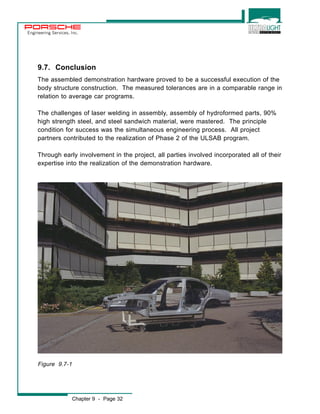
9.7. Conclusion 
10. Testing and Results 
10.1. Scope of Work 
10.2. Targets 
10.3. Static Rigidity 
10.3.1. Test Setup 
10.3.1.1. General 
10.3.1.2. Static Torsion 
10.3.1.3. Static Bending 
10.3.2. Results 
10.3.2.1. Static Torsion 
10.3.2.2. Static Bending 
10.4. Modal Analysis 
10.4.1. Test Setup 
10.4.2. Results 
10.5. Masses in Test Configuration 
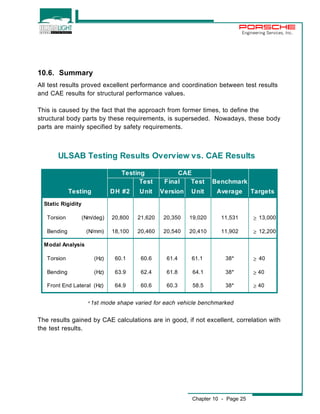
10.6. Summary 
11. Economic Analysis 
11.1. Introduction 
11.2. The Process of Cost Estimation 
11.2.1. Overview 
11.2.2. Cost Model Algorithm Development 
11.2.3. General Inputs 
11.2.4. Fabrication Input 
11.2.5. Assembly Input 
11.3. Cost Model Description
Engineering Services, Inc. 
11.4. ULSAB Cost Results 
11.4.1. Overall Cost Results 
11.4.2. Cost Breakdown for Fabrication 
11.4.3. Cost Breakdown for Assembly 
11.4.4. Cost Analysis for New Technologies and Materials 
11.4.5. Sensitivity Analysis 
11.5. Body Structure – Comparative Study 
11.5.1. Overview 
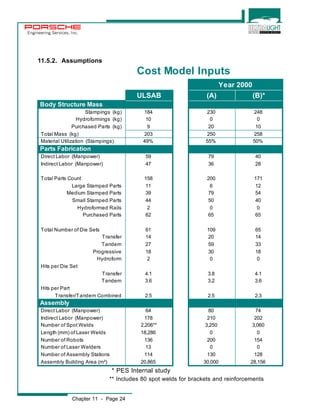
11.5.2. Assumptions 
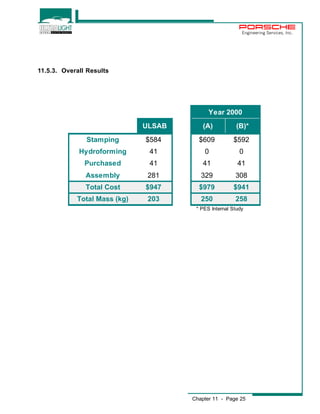
11.5.3. Overall Results 
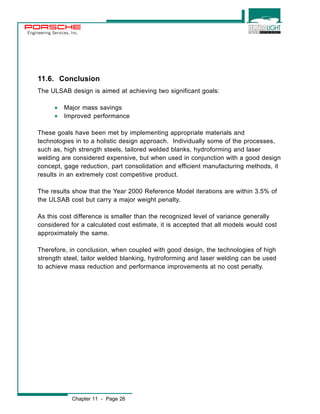
11.6. Conclusion 
NOTE: The cost models may be found on the Porsche ULSAB 
Phase 2 CD ROM Version 1.0.2. 
12. Summary of Phase 2 Results 
ULSAB Final Report Appendix Table of Contents 
Table of Contents - Page 6 
NOTE: 
The following information is located on the 
Porsche ULSAB Phase 2 CD ROM Version 1.0.2. 
1. Parts Book 
1.1. Exploded View 
1.2. Index – Parts Book Sheets 
1.3. Parts Book Sheets 
1.4. Index – Parts book, Brackets & Reinforcements 
1.5. Parts Book Sheets – Brackets & Reinforcements
Engineering Services, Inc. 
Table of Contents - Page 7 
2. Part Drawings 
2.1. Exploded View 
2.2. Parts List – Sorted by Part Number 
2.3. Parts List – Sorted by Material Grade 
2.4. Part Drawings 
3. Typical Sections 
3.1. Overview Illustration 
3.2. Index – Typical Sections 
3.3. Typical Section Sheets 
4. Assembly 
4.1. Assembly Tree 
4.2. Index –Weld Assemblies 
4.3. Weld Assembly Drawings 
4.4. Assembly Sequence Illustrations 
4.5. Index – Bolted and / or Bonded Assemblies 
4.6. Assembly Drawings, Bolted and / or Bonded Parts 
4.7. Assembly Illustrations – Bolted and / or Bonded Parts 
5. Package Drawings 
5.1. Side View 
5.2. Plan View 
5.3. Front & Rear View 
6. Economic Analysis 
6.1. Assembly System Data 
6.2. Stamping Process Sheets
Preface - Page 1 
Engineering Services, Inc. 
Preface 
In 1994, the steel industry, through the Ultra Light Steel Auto Body Consortium 
(ULSAB), commissioned Porsche Engineering Services, Inc. (PES) to conduct a 
concept phase (Phase 1) of the ULSAB project to determine if a substantially lighter 
steel body structure could be designed. 
In September 1995, worldwide auto industry attention was focused on the study 
when the results of Phase 1 were announced. The results also affected the growth 
of the ULSAB Consortium to 35 member steel companies, representing 18 nations 
worldwide. 
Encouraged by the results of Phase 1, the ULSAB Consortium once again 
commissioned PES to continue with Phase 2, the validation of the Phase 1 
concepts, culminating in the build of the demonstration hardware. Phase 2 proved 
that the weight reduction, predicted in Phase 1, could be achieved. The use of high 
strength steels, tailor welded blanks, hydroforming and laser welding in assembly 
were particular challenges to overcome in Phase 2. ULSAB Consortium members 
committed themselves to supplying all steel materials, as well as the tailor welded 
blanks and raw materials for hydroforming, for all parts to be manufactured. 
The focus of Phase 2 was the same as in Phase 1, i.e., weight reduction without 
compromising safety or structural performance. Without altering the aggressive 
targets for mass and structural performance, the safety requirements were 
increased in Phase 2 in response to growing industry and government concern for 
increased auto safety. It was imperative to keep up with safety requirement 
changes that occurred during the course of the program, which ran from spring 
1994 to spring 1998. As a result, it was necessary to analyze the ULSAB structure 
for offset crash behavior. With this new challenge, and valuable input gathered in 
discussions with OEMs during the presentation of Phase 1 findings, PES and the 
ULSAB Consortium commenced Phase 2.
Engineering Services, Inc. 
Phase 2 ended in Spring 1998 with the debut of the ULSAB demonstration hardware 
and will prove the Phase 1 concept to be not only feasible, but that performance 
targets will be exceeded by 60% for torsional rigidity, 48% for bending rigidity and 
50% for the normal mode frequency. Relative to the benchmark average, mass 
reduction remained at 25%, while crash analysis showed excellent results for the 
selected crash analysis events, including the offset crash. 
As a result of Phase 2, the use of high strength steels in the ULSAB demonstration 
hardware structure has now increased to 90% relative to its mass. The trend 
toward using high strength steel and new technologies to reduce body structure 
mass while improving safety, can be seen already in recently launched cars. The 
new Porsche Boxster, for example, uses 30% high strength steel, as well as tailored 
blanking, hydroforming and laser welding in assembly. 
Cost analysis in Phase 1 was conducted by IBIS Associates under contract to the 
ULSAB Consortium. In Phase 2, a more detailed cost analysis study was 
conducted, under the supervision of PES with the support of ULSAB consortium 
member companies. With the detailed information provided with the concept 
validation in Phase 2, a new cost model was created and the cost to produce the 
ULSAB structure was analyzed. The results show that it is possible to reduce the 
mass of body structures without cost penalty. 
Preface - Page 2
Engineering Services, Inc. 
1. Executive Summary
Chapter 1 - Page 1 
Engineering Services, Inc. 
1. Executive Summary 
Ultra Light Steel Auto Body (ULSAB) Phase 2 
Introduction 
On behalf of an international Consortium of 35 of the world’s leading sheet-steel 
producers from 18 countries, Porsche Engineering Services, Inc. (PES) in Troy, 
Michigan, was responsible for the program management, design, engineering, and 
the building of the demonstration hardware (DH). In addition, PES conducted the 
economic analysis study for the Ultra Light Steel Auto Body (ULSAB) program. 
Program Goal 
The goal of the ULSAB program was to develop a light-weight body structure design 
that is predominantly steel. This goal included: 
· Providing a significant mass reduction based on a future reference vehicle 
· Meeting functional and structural performance targets 
· Providing concepts that will be applicable for future car programs 
Program Structure 
In order to achieve the above-mentioned goals the program was structured in three 
phases: 
· Phase 1 Concept Development (paper study) 
· Phase 2 Concept Validation (build of demonstration hardware) 
· Phase 3 Vehicle Feasibility (total vehicle prototype assembly and 
evaluation)
Engineering Services, Inc. 
Phase 1 – Concept 
In September 1995, the results of Phase 1 were published. In this phase, the 
ULSAB program concentrated on developing design concepts for light-weight body 
structures and validating crashworthiness. Based on benchmarking data, the 
performance of a future reference vehicle was predicted and the structural 
performance targets for the ULSAB structure, excluding doors, rear deck lid, hood 
and front fenders were established. Because the ULSAB program focuses on mass 
reduction, a much more aggressive target was set for mass than for the other 
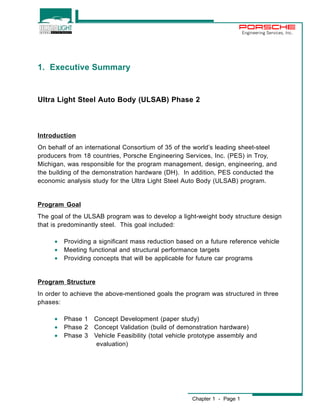
structural performance targets. These targets were: 
[ 
For the concept validation, the following crash analysis was performed in Phase 1: 
· NCAP, 100% frontal crash at 35 mph 
· Rear moving barrier crash at 35 mph (FMVSS 301) 
· EEVC, side impact crash at 50 km/h (with rigid barrier) 
· Roof crush (FMVSS 216) 
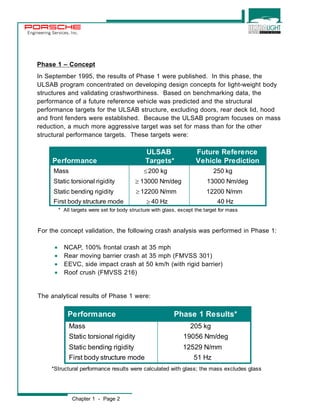
The analytical results of Phase 1 were: 
Chapter 1 - Page 2 
ULSAB Future Reference 
Performance Targets* Vehicle Prediction 
Mass 200 kg 250 kg 
Static torsional rigidity m 
13000 Nm/deg 13000 Nm/deg 
Static bending rigidity m 
12200 N/mm 12200 N/mm 
First body structure mode m 
40 Hz 40 Hz 
* All targets were set for body structure with glass, except the target for mass 
Performance Phase 1 Results* 
Mass 205 kg 
Static torsional rigidity 19056 Nm/deg 
Static bending rigidity 12529 N/mm 
First body structure mode 51 Hz 
*Structural performance results were calculated with glass; the mass excludes glass
Chapter 1 - Page 3 
Engineering Services, Inc. 
With the exception of mass, the results exceeded the targets. Mass was calculated at 
205 kg and slightly above the aggressive target of 200 kg. 
An independent cost study indicated that, based on a North American 
manufacturing scenerio, the Phase 1 concept could cost less to produce than 
comparable current vehicle structures. This result, based on the relatively low level 
of detail of the ULSAB Phase 1 concept, indicated that a light weight structure could 
make substantial use of high strength steel, tailor welded blanks, laser welding in 
assembly, and hydroforming, and end up in the cost range of structures of similar 
size using a more conventional approach at a higher mass. 
Phase 2 - Validation 
The Phase 1 design concept and its structural and crash performance results 
having had a relatively low mass, provided an excellent foundation for Phase 2 of 
the ULSAB program. Based on the success of this Phase 1 paper study, and the 
positive recognition by OEMs around the world, the ULSAB Consortium 
commissioned PES to undertake Phase 2 starting in November 1995. 
The overall goal of Phase 2 was the validation of Phase 1 results, culminating in the 
build of the ULSAB demonstration hardware structure. The tasks and 
responsibilities of Phase 2 for PES, besides the program management, were to 
manage the necessary detail design, engineering, crash analysis, material 
selection, design optimization for manufacturing, supplier selection for parts and to 
assemble, test and deliver the demonstration hardware to the ULSAB Consortium. 
In addition, PES was responsible for a detailed cost analysis based on the Phase 2 
detailed design.
Engineering Services, Inc. 
Crash Analysis 
During the course of the ULSAB program after the start in Spring 1994, the public 
demanded increased vehicle safety, and governments reacted with new 
requirements for crashworthiness. Therefore, the decision was made prior to the 
beginning of Phase 2, to analyze and to design the ULSAB structure for offset 
crash. This would enhance the credibility of the results. The AMS (Auto Motor 
Sport) 50% offset frontal crash at 55 km/h was considered the most severe test at 
that time and would represent the structural requirements an offset crash demands. 
This test was then added to the Phase 1 previously selected crash analysis events. 
For side impact crash analysis, a deformable barrier was used instead of the rigid 
barrier as used in Phase 1. 
The following crash analysis was performed in Phase 2: 
· AMS, 50% frontal offset crash at 55 km/h 
· NCAP, 100% frontal crash at 35 mph (FMVSS 208) 
· Side impact crash at 50 km/h (96/27 EG, with deformable barrier) 
· Rear moving barrier crash at 35 mph (FMVSS 301) 
· Roof crush (FMVSS 216) 
All crash calculations indicate excellent crash behavior of the ULSAB structure, 
even at speeds that exceed federal requirements. The front and rear impacts were 
run at 5 mph above the required limit, meaning 36% more energy had to be 
absorbed in the frontal impact. The offset crash also confirmed the overall integrity 
of the structure. The roof crush analysis validated that the federal standard 
requirement was met, partialy due to the hydroformed side roof rail concept design. 
Package 
At the start of Phase 2, as a result of various discussions with OEMs during the 
presentation of Phase 1 results, the ULSAB package was re-examined. In order to 
make the results of Phase 2 more credible, the decision was made not to consider 
secondary mass savings. This resulted in significant changes in several areas of 
the body structure. 
Chapter 1 - Page 4
Chapter 1 - Page 5 
Engineering Services, Inc. 
The relatively small engine specified in Phase 1 was replaced by an average size 
3-liter V6, necessitating a complete redesign of the front-end structure, including a 
revised front suspension layout and subframe design. The rear suspension also 
was revised and the rear rails redesigned accordingly. Essentially, the whole 
structure was redesigned, from front to rear bumper, but it still maintained the 
structure features as developed in Phase I, such as the side roof rail and the 
smooth load flow concept of front and rear rails into the rocker. 
Styling 
Using the revised package and the adjusted body structure design, styling the 
ULSAB was the next challenge. Styling became necessary to create the surfaces 
for the body side outer panel with its integrated exposed rear quarter panel, the 
windshield, the backlight and the roof panel. The styling concept for the 
greenhouse had to consider, in order to integrate, the side roof rail, as well as the 
overlapping upper door frame concept. This door concept was chosen mainly for 
cosmetic reasons; to cover the visible weld seams, in the upper door opening area 
of the body side outer panel which were caused by the tailor welded blank design of 
the body side outer panel. For the overall styling approach, the decision was made 
to create a neutral, not too futuristic or radical, more conservative styling. 
Styling was the first major milestone in Phase 2 and was performed entirely by 
computer-aided styling (CAS). 
Design and Engineering 
After the exterior styling was created, the package was then optimized and the 
design modified accordingly. The implication of any design change was assessed 
by modifying the Phase 1 static analysis model. Design changes resulting as an 
outcome of the analysis were then incorporated into the styling and the package. 
With the performance targets met, styling and the Phase 2 package were frozen, 
and with a more detailed Phase 2 design, a new shell model for the structural 
performance analysis was created. Static analysis was then used to optimize the
Engineering Services, Inc. 
Phase 2 design until the requirements were met and new crash analysis models 
were built. In the process of design optimization, which included material grade and 
thickness selection, both static analysis and crash analysis were performed with 
constantly updated models until the targets were met. 
Throughout this process, simultaneous engineering provided input from the tool and 
part suppliers, as well as from steel manufacturers, to ensure the manufacturing 
feasibility of the designed parts. As a result of the simultaneous engineering 
process, only minor design and tool changes were needed after the drawings were 
released. When the first part set was completed, a workhorse (test unit) was built. 
The validation of the test unit lead to further part optimization and, finally, to the 
build of demonstration structures. 
Suppliers 
At the start of the detail design process in Phase 2, suppliers for stamped and 
hydroformed parts were selected in order to be included in the simultaneous 
engineering process. Among the selection criteria were quality, experience, skills 
and location. Supplier flexibility and their willingness to explore new manufacturing 
methods, utilizing material grades rarely used in these applications and to “push the 
envelope” in the application of tailor welded blanks or in hydroforming technologies, 
were as important in the selection process as their cost competitiveness. 
Steel Materials 
· Steel Grades 
Perhaps the most important factor in meeting the targets for mass and 
crash performance is high strength steel. More than 90% of the ULSAB 
structure utilizes high strength and ultra high strength steel. High strength 
steels are applied where the design is driven by crash and strength 
requirements. Ultra high strength steels with yield strength of more than 
550 MPa are used for parts to provide additional strength for front and side 
impact. High strength and ultra high strength steel material specifications 
range from 210 to 800 MPa yield strength with a thickness range from 
Chapter 1 - Page 6
Chapter 1 - Page 7 
Engineering Services, Inc. 
0.65 to 2 mm. With the restriction of lower elongation, different forming 
characteristics and greater spring back of high strength steels, material 
supplier support combined with forming simulations were important factors 
in meeting the challenges for the development of manufacturable part 
designs. 
· Steel Sandwich Material 
The use of steel sandwich material has contributed to considerable mass 
savings. The sandwich material is made with a thermoplastic 
(polypropylene) core, with a thickness of 0.65 mm and is layered between 
two thin steel skins, each with a thickness of 0.14 mm and yield strength of 
240 MPa for the spare tire tub and 140 MPa for the dash panel insert. The 
steel sandwich shares many of the same processing possibilities of sheet 
steel, such as deep drawing, shear cutting, drilling, bonding, and riveting. 
However, it cannot be welded. Parts manufactured from steel sandwich 
material can be up to 50% lighter than those made of sheet steel with 
similar dimensional and functional characteristics. The spare tire tub 
made of steel sandwich material is a pre-painted module that is pre-assembled 
with the spare tire and repair tools. The module is dropped into 
place and bonded to the structure during the final assembly of the vehicle. 
Another application of sandwich material is the dash panel insert, which is 
bolted and bonded into the body structure, during final vehicle assembly. 
Tailor Welded Blanks 
Tailor welded blanks enable the engineers to accurately locate the steel within the 
part precisely where its attributes are most needed, while at the same time allowing 
for the elimination of mass that does not contribute to performance. Other benefits 
of tailor welded blanks include the use of fewer parts, dies and joining operations, 
as well as improved dimensional accuracy through the reduction of assembly steps. 
Nearly half (45%) of the ULSAB demonstration hardware mass consists of parts 
manufactured using laser welded tailored blanks.
Engineering Services, Inc. 
The best example of tailor welded blank usage is the body side outer panel. It 
employs a fully laser welded tailored blank with different thicknesses and grades of 
high strength steel. Careful placement of the seams in the tailor welded blank is 
critical in order to minimize mass and facilitate forming. This consideration was 
especially important in the body side outer panel because of its complexity and size, 
its use of high strength steels and the integration of the rear quarter panel with its 
Class A surface requirement. Mass reduction and the elimination of reinforcements 
were key goals in the development of this one-piece design. The consolidation of 
parts reduced mass and assembly steps. 
Hydroforming 
· Tubular Hydroforming 
The use of hydroforming should be considered as one of the most 
significant manufacturing processes applied in the ULSAB program for part 
manufacturing. The hydroformed side roof rail represents a significant 
structural member in the ULSAB structure. The side roof rail distributes 
loads appearing in the structure during vehicle operation, and in the event 
of an impact, distributes loads from the top of the A-pillar along the roof 
into B and C-pillar and then into the rear of the structure. The hydroformed 
side roof rail reduces the total number of parts and optimizes available 
package space. The raw material used to manufacture the side roof rail is 
a laser welded, high-strength steel tube 1 mm thick with an outside 
diameter of 96 mm and a yield strength of 280 MPa. The design was 
optimized and analyzed for feasibility using forming simulation. 
· Hydromechanical Sheet Forming 
The use of hydromechanical sheet forming was chosen for the roof panel 
for mass reduction reasons. This process provided the opportunity to 
manufacture the roof panel at a thinner material thickness and still achieve 
a work-hardening effect in the center area, where the degree of stretch is 
normally minimal and an increased material thickness is needed to meet 
dent resistance requirements. With hydro-mechanical sheet forming, this 
Chapter 1 - Page 8
Chapter 1 - Page 9 
Engineering Services, Inc. 
work-hardening effect is achieved by using fluid pressure to pre-stretch the 
blanks in the opposite direction towards the punch. This plastic elongation 
causes a work-hardening effect in the center area of the blank. In the 
second step, the punch forms the panel towards controlled fluid pressure 
and because there is no metal-to-metal contact on the outer part surface, 
excellent part quality is achieved. The ULSAB roof panel is manufactured 
in 0.7 mm high strength steel with a yield strength of 210 MPa. 
Tooling 
All tools for stamped parts are “soft” tools made of materials such as kirksite and 
built to production intent standards. Tools used for hydroforming are “hard” tools 
made of steel. In both cases, part manufacturing tolerances and quality standards 
were the same as those used in high-volume production. 
DH Assembly 
· Joining Technologies 
For the final assembly of the ULSAB structure, four types of joining 
technologies were applied. Spot welding is used for joining the majority of 
parts. Laser welding became necessary to join the hydroformed side roof 
rail to its mating parts. In addition, the rails in the front end structure are 
laser welded for improved structural performance. Laser welding in body 
structure assembly is already being used in mass production by many 
OEMs. The active gas metal arc welding (MAG) process, with its 
disadvantages, such as slow welding speed and relatively large heat 
impact zones, was kept to a minimum and used only in locations with no 
weld access for spot or laser welding. Bonding is used to join the sandwich 
parts that cannot be spot or laser welded into the structure. For the joining 
of the DH, about one-third fewer spot welds and significantly more laser 
welding is employed than for conventional body structures.
Engineering Services, Inc. 
· Assembly Sequence 
For the DH build, the assembly sequence uses two stage body side 
framing. The assembly sequence includes underbody assembly, body side 
assemblies, roof and rear panel assemblies. All DHs were built in a single 
build sequence. 
· Assembly Fixtures 
To assemble the DH, a modular fixture system was used. The fixtures 
were developed in a CAD system and the positions of locator holes were 
then incorporated into the parts design. 
DH Testing 
Testing was performed on the ULSAB test unit structure to validate its structural 
performance and mass. Included were tests for static torsion rigidity, static bending 
rigidity, modal analysis and mass in various configurations, including some bolt-on 
parts. Testing was performed at Porsche’s Research & Development Center in 
Weissach, Germany. Physical testing for crash was not part of the ULSAB program 
in Phase 2 and may be performed in a possible Phase 3, after the necessary 
components are built and/or assembled into the ULSAB structure. 
Economic Analysis 
With the detailed information created in Phase 2 of the ULSAB program, the costs 
of parts and assembly of the body structure were analyzed. Under the management 
of a PES’ team, and with support from the ULSAB Consortium members, an 
economic analysis group, comprising of analysts from the Massachusetts Institute 
of Technology (MIT), IBIS Associates and Classic Design, a detailed cost model 
was constructed that includes all aspects of fabrication and assembly. This cost 
model will enable the automotive OEMs to calculate ULSAB cost based on their 
own manufacturing criteria. Considering that the focus of Phase 2 was on mass 
reduction and not on cost savings, the result of this cost analysis is quite 
remarkable. It confirms that significant mass reduction of the body structure, in 
Chapter 1 - Page 10
Engineering Services, Inc. 
comparision to the benchmark vehicle average mass, was achieved with the use of 
steel with no cost penalty. 
Summary/Conclusion 
Throughout Phase 2, timely execution of the program was critical. All parts 
designed and released to our suppliers and all tooling and assembly of the first test 
unit have been on schedule. With the data acquired from the validation of the first 
test unit and subsequent testing, parts were refined and design optimization was 
performed. Refined parts were then used to build the demonstration hardware. 
Based on the testing of the demonstration hardware, the ULSAB structure shows 
Performance* Target Results 
Mass 200 kg 203 kg 
Static torsional rigidity 13000 Nm/deg 20800 Nm/deg 
Static bending rigidity 12200 N/mm 18100 N/mm 
First body structure mode 40 Hz 60 Hz 
*Structural performances are test results with glass. ULSAB structure mass without glass 
Chapter 1 - Page 11 
[ 
m 
m 
m 
the following structural performances: 
Achieving these results in a timely manner could only be achieved by utilizing the 
team approach that involved all parties in the early stages of the ULSAB program. 
A close working relationship with the ULSAB Consortium members and the 
commitment of our suppliers and their enthusiasm for the program helped to meet 
the challenge of manufacturing parts made of steel materials and combinations that 
have not been commonly applied previously. This “pioneering spirit” was carried on 
by all members of the PES team, including designers and engineers. The ULSAB 
program has explored the potential for mass reduction in the body structure using 
steel as the chosen material. State-of-the-art manufacturing and joining 
technologies, such as laser welding in assembly and hydroforming as well as 
commercially available materials, contributed to the success of the ULSAB 
program. It proves that steel offers the potential for light weight vehicle design 
which contributes to the preservation of resources and the reduction of emissions. 
Based on this experience, the steel industry should further intensify its dialogue and 
cooperation with OEMs to achieve their common goal of mass reduction of 
tomorrow’s vehicles, to protect the environment and to secure mobility of future 
generations.
Engineering Services, Inc. 
2. Phase 2 Introduction
Chapter 2 - Page 1 
Engineering Services, Inc. 
2. Phase 2 Introduction 
2.1. Phase 2 Program Goal 
The program goal of Phase 2 was the validation of Phase 1 results and the build of 
demonstration hardware. 
Phase 1 was the concept phase and consisted of concept design and analysis. The 
design was basic wire frame and surface data, without holes for drainage or locators 
for assembly. The Phase 1 analysis, based on the design concept, was meshed in 
its basic form to reflect the surfaces of the structure. 
2.2. Phase 2 Design and Analysis 
The design in Phase 2 was a refinement of the Phase 1 design. It includes surface 
data, allowing for production of tools including principal location points (PLP) and 
holes for tooling, drainage and weld access. Additionally, refinement of the design 
for manufacture and assembly (DFMA) was developed as the final design 
progressed, with emphasis on mass production (more than 100,000 units per year). 
The intention in Phase 2 was to continue the development of a “generic” structure 
that takes into consideration manufacturing and assembly methods. With the 
detailed design of the structural components, and assemblies, and with materials 
selected, build specifications and the final assembly sequence were established.
Engineering Services, Inc. 
Computer Aided Engineering (CAE) continued in Phase 2 in conjunction with the 
refinement of the design. The analysis provided confirmation of the design as well 
as structural and crash performance. The CAE analysis in Phase 2 included: 
· Finite Element Model Modification 
· Structural Analysis consisting of: 
w Mass 
w Static Torsion 
w Static Bending 
w Modal Analysis 
Continuing development of crash simulation concentrates on: 
· AMS, 50% frontal offset crash at 55 km/h 
· NCAP, 100% frontal crash at 35 mph (FMVSS 208) 
· Side impact crash at 50 km/h (96/27 EG, with deformable barrier) 
· Rear moving barrier crash at 35 mph (FMVSS 301) 
· Roof crush (FMVSS 216) 
All models were continuously updated to compare Phase 2 and Phase 1 results in 
order to maintain the same performance standards. 
2.3. Demonstration Hardware (DH) 
The term “demonstration hardware” is used to emphasize that the body structure is 
not a prototype but a legitimate representation of a production unit. All 
demonstration hardware components had to be fully tooled (soft tools for stamping 
and hard tools for hydroforming). All demonstration hardware was built in a single 
build sequence. The completed structure had to be “clear-coat” painted for 
unrestricted view of the build and construction methods. 
Chapter 2 - Page 2
Chapter 2 - Page 3 
Engineering Services, Inc. 
2.4. Scope of Work 
Porsche Engineering Services, Inc. in Troy, Michigan executed the program. The 
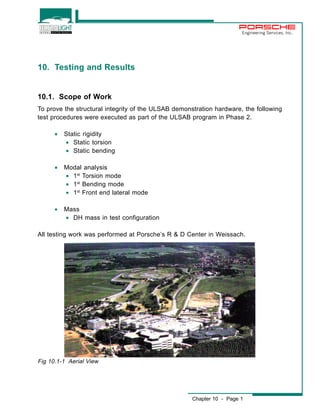
DH build, testing and the CAE analysis was performed at the Porsche R & D Center 
in Weissach, Germany. To achieve the targets for performance, timing and cost, 
the program responsibilities of PES included the following tasks: 
· Program Management and Planning 
· Build Management for the Construction of the Demonstration Hardware 
· Build of Demonstration Hardware 
· Part Supplier/Manufacturer Evaluation and Selection 
· Component Structure Design and Engineering 
· CAE Analysis 
· Physical Testing of Test Unit 
· Economic Analysis Study 
· Final Program Report 
2.5. Materials 
The ULSAB Consortium member companies provided all material-specific data 
required to design, develop and construct the ULSAB body structure in Phase 2. All 
materials used to manufacture parts for the DH build were provided to Porsche by 
ULSAB Consortium member companies including the tailor welded blanks and raw 
material (tubes) for the manufacturing of the hydroform side roof rail. In addition, 
the individual ULSAB Consortium member companies supported the program with 
data related to material selection and tailor welded blank development, as well as 
forming simulation and circle grid analysis on selected parts in order to create a 
feasible part design.
Engineering Services, Inc. 
2.6. Testing of Test Unit 
Physical testing was undertaken on the test unit to provide data and allow 
correlation of the CAE results with regard to: 
· Mass 
· Static Torsion 
· Static Bending 
· Modal Analysis 
Physical crash testing was not part of Phase 2. This could be executed in a 
possible Phase 3, with the necessary components, such as suspension, powertrain, 
and interior available. 
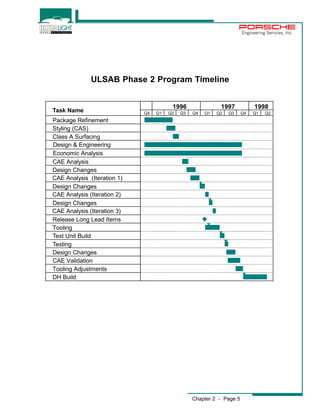
2.7. Phase 2 Program Timing 
Prior to the start of Phase 2 the program timing was established and the various 
tasks assigned. 
Based on this timeline the ULSAB Consortium established specific information release 
dates to keep 
Chapter 2 - Page 4
1996 1997 1998 
Chapter 2 - Page 5 
Engineering Services, Inc. 
ULSAB Phase 2 Program Timeline 
Task Name 
Package Refinement 
Styling (CAS) 
Class A Surfacing 
Design & Engineering 
CAE Analysis 
Design Changes 
CAE Analysis (Iteration 1) 
Design Changes 
CAE Analysis (Iteration 2) 
Design Changes 
CAE Analysis (Iteration 3) 
Release Long Lead Items 
Tooling 
Test Unit Build 
Testing 
Design Changes 
CAE Validation 
Tooling Adjustments 
DH Build 
Q4 Q1 Q2 Q3 Q4 Q1 Q2 Q3 Q4 Q1 Q2 
Economic Analysis
Engineering Services, Inc. 
3. ULSAB Phase 2 
Package
Chapter 3 - Page 1 
Engineering Services, Inc. 
3. ULSAB Phase 2 Package 
3.1. General Approach 
Discussions with OEMs about Phase 1 findings provided valuable input and 
guidance for the more detailed Phase 2 package layout created at the start of 
Phase 2. The Phase 2 package was defined as a modification of the Phase 1 
package without being too specific so the package findings could apply to more 
than one body structure concept. The most important components, space 
definitions and dimensions had to be considered by either defining them using 
engineering judgment, or by using actual component dimensions. Furthermore, 
secondary mass savings were not considered in order to take a more conservative 
and more credible approach. This is also reflected in component size and mass, as 
well as in the crash mass used for the crash analysis. 
3.2. Package Definition 
The first step in the package phase was to define the vehicle concept type, exterior 
dimensions, interior dimensions and the main components. With these package 
definitions, package drawings were revised and structural hard points defined. 
3.2.1. Vehicle Concept Type 
In Phase 2 the same concept type definition was used as in Phase 1, five 
passenger and four door midsize sedan.
Engineering Services, Inc. 
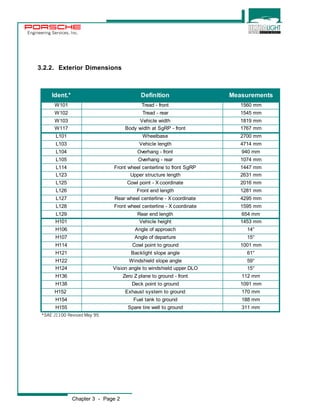
3.2.2. Exterior Dimensions 
Ident.* Definition Measurements 
W101 Tread - front 1560 mm 
W102 Tread - rear 1545 mm 
W103 Vehicle width 1819 mm 
W117 Body width at SgRP - front 1767 mm 
L101 Wheelbase 2700 mm 
L103 Vehicle length 4714 mm 
L104 Overhang - front 940 mm 
L105 Overhang - rear 1074 mm 
L114 Front wheel centerline to front SgRP 1447 mm 
L123 Upper structure length 2631 mm 
L125 Cowl point - X coordinate 2016 mm 
L126 Front end length 1281 mm 
L127 Rear wheel centerline - X coordinate 4295 mm 
L128 Front wheel centerline - X coordinate 1595 mm 
L129 Rear end length 654 mm 
H101 Vehicle height 1453 mm 
H106 Angle of approach 14° 
H107 Angle of departure 15° 
H114 Cowl point to ground 1001 mm 
H121 Backlight slope angle 61° 
H122 Windshield slope angle 59° 
H124 Vision angle to windshield upper DLO 15° 
H136 Zero Z plane to ground - front 112 mm 
H138 Deck point to ground 1091 mm 
H152 Exhaust system to ground 170 mm 
H154 Fuel tank to ground 188 mm 
H155 Spare tire well to ground 311 mm 
*SAE J1100 Revised May 95 
Chapter 3 - Page 2
Chapter 3 - Page 3 
Engineering Services, Inc. 
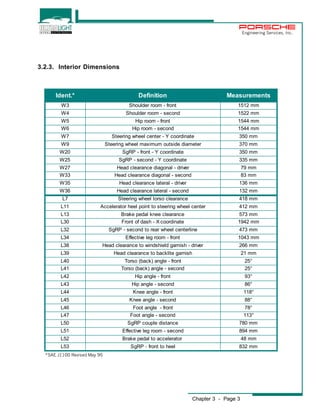
3.2.3. Interior Dimensions 
Ident.* Definition Measurements 
W3 Shoulder room - front 1512 mm 
W4 Shoulder room - second 1522 mm 
W5 Hip room - front 1544 mm 
W6 Hip room - second 1544 mm 
W7 Steering wheel center - Y coordinate 350 mm 
W9 Steering wheel maximum outside diameter 370 mm 
W20 SgRP - front - Y coordinate 350 mm 
W25 SgRP - second - Y coordinate 335 mm 
W27 Head clearance diagonal - driver 79 mm 
W33 Head clearance diagonal - second 83 mm 
W35 Head clearance lateral - driver 136 mm 
W36 Head clearance lateral - second 132 mm 
L7 Steering wheel torso clearance 418 mm 
L11 Accelerator heel point to steering wheel center 412 mm 
L13 Brake pedal knee clearance 573 mm 
L30 Front of dash - X coordinate 1942 mm 
L32 SgRP - second to rear wheel centerline 473 mm 
L34 Effective leg room - front 1043 mm 
L38 Head clearance to windshield garnish - driver 266 mm 
L39 Head clearance to backlite garnish 21 mm 
L40 Torso (back) angle - front 25° 
L41 Torso (back) angle - second 25° 
L42 Hip angle - front 93° 
L43 Hip angle - second 86° 
L44 Knee angle - front 118° 
L45 Knee angle - second 88° 
L46 Foot angle - front 78° 
L47 Foot angle - second 113° 
L50 SgRP couple distance 780 mm 
L51 Effective leg room - second 894 mm 
L52 Brake pedal to accelerator 48 mm 
L53 SgRP - front to heel 832 mm 
*SAE J1100 Revised May 95
Engineering Services, Inc. 
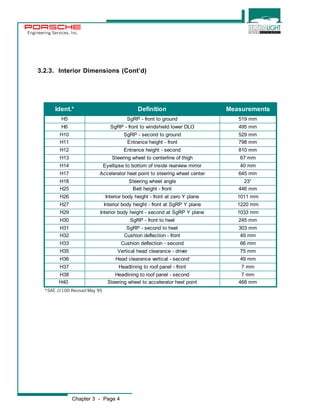
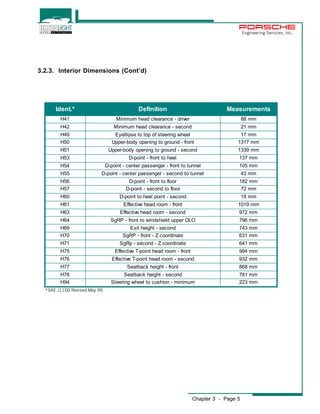
3.2.3. Interior Dimensions (Cont’d) 
Ident.* Definition Measurements 
H5 SgRP - front to ground 519 mm 
H6 SgRP - front to windshield lower DLO 495 mm 
H10 SgRP - second to ground 529 mm 
H11 Entrance height - front 798 mm 
H12 Entrance height - second 810 mm 
H13 Steering wheel to centerline of thigh 67 mm 
H14 Eyellipse to bottom of inside rearview mirror 40 mm 
H17 Accelerator heel point to steering wheel center 645 mm 
H18 Steering wheel angle 23° 
H25 Belt height - front 446 mm 
H26 Interior body height - front at zero Y plane 1011 mm 
H27 Interior body height - front at SgRP Y plane 1220 mm 
H29 Interior body height - second at SgRP Y plane 1033 mm 
H30 SgRP - front to heel 245 mm 
H31 SgRP - second to heel 303 mm 
H32 Cushion deflection - front 49 mm 
H33 Cushion deflection - second 66 mm 
H35 Vertical head clearance - driver 75 mm 
H36 Head clearance vertical - second 49 mm 
H37 Headlining to roof panel - front 7 mm 
H38 Headlining to roof panel - second 7 mm 
H40 Steering wheel to accelerator heel point 468 mm 
*SAE J1100 Revised May 95 
Chapter 3 - Page 4
Chapter 3 - Page 5 
Engineering Services, Inc. 
3.2.3. Interior Dimensions (Cont’d) 
Ident.* Definition Measurements 
H41 Minimum head clearance - driver 88 mm 
H42 Minimum head clearance - second 21 mm 
H49 Eyellipse to top of steering wheel 17 mm 
H50 Upper-body opening to ground - front 1317 mm 
H51 Upper-body opening to ground - second 1339 mm 
H53 D-point - front to heel 137 mm 
H54 D-point - center passenger - front to tunnel 105 mm 
H55 D-point - center passenger - second to tunnel 43 mm 
H56 D-point - front to floor 182 mm 
H57 D-point - second to floor 72 mm 
H60 D-point to heel point - second 19 mm 
H61 Effective head room - front 1019 mm 
H63 Effective head room - second 972 mm 
H64 SgRP - front to windshield upper DLO 796 mm 
H69 Exit height - second 743 mm 
H70 SgRP - front - Z coordinate 631 mm 
H71 SgRp - second - Z coordinate 641 mm 
H75 Effective T-point head room - front 994 mm 
H76 Effective T-point head room - second 932 mm 
H77 Seatback height - front 868 mm 
H78 Seatback height - second 781 mm 
H94 Steering wheel to cushion - minimum 223 mm 
*SAE J1100 Revised May 95
Engineering Services, Inc. 
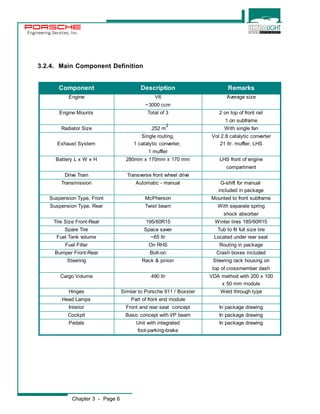
3.2.4. Main Component Definition 
Component Description Remarks 
Engine V6 Average size 
Chapter 3 - Page 6 
~3000 ccm 
Engine Mounts Total of 3 2 on top of front rail 
1 on subframe 
2 
Radiator Size .252 m With single fan 
Single routing, Vol 2.8 catalytic converter 
Exhaust System 1 catalytic converter, 21 ltr. muffler, LHS 
1 muffler 
Battery L x W x H 280mm x 170mm x 170 mm LHS front of engine 
compartment 
Drive Train Transverse front wheel drive 
Transmission Automatic - manual G-shift for manual 
included in package 
Suspension Type, Front McPherson Mounted to front subframe 
Suspension Type, Rear Twist beam With separate spring 
shock absorber 
Tire Size Front-Rear 195/60R15 Winter tires 185/60R15 
Spare Tire Space saver Tub to fit full size tire 
Fuel Tank volume ~65 ltr Located under rear seat 
Fuel Filler On RHS Routing in package 
Bumper Front-Rear Bolt-on Crash boxes included 
Steering Rack & pinion Steering rack housing on 
top of crossmember dash 
Cargo Volume 490 ltr VDA method with 200 x 100 
x 50 mm module 
Hinges Similar to Porsche 911 / Boxster Weld through type 
Head Lamps Part of front end module 
Interior Front and rear seat concept In package drawing 
Cockpit Basic concept with I/P beam In package drawing 
Pedals Unit with integrated In package drawing 
foot-parking-brake
Chapter 3 - Page 7 
Engineering Services, Inc. 
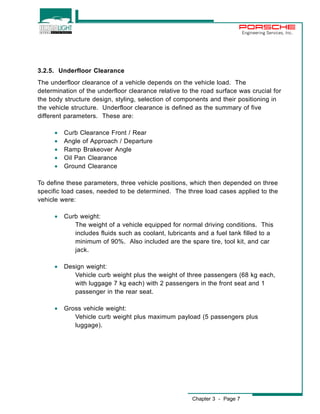
3.2.5. Underfloor Clearance 
The underfloor clearance of a vehicle depends on the vehicle load. The 
determination of the underfloor clearance relative to the road surface was crucial for 
the body structure design, styling, selection of components and their positioning in 
the vehicle structure. Underfloor clearance is defined as the summary of five 
different parameters. These are: 
· Curb Clearance Front / Rear 
· Angle of Approach / Departure 
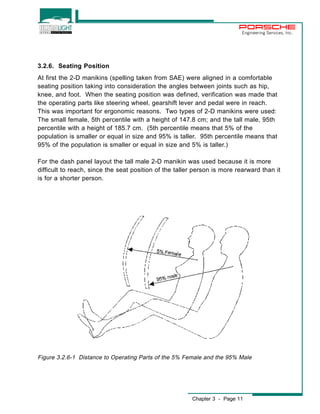
· Ramp Brakeover Angle 
· Oil Pan Clearance 
· Ground Clearance 
To define these parameters, three vehicle positions, which then depended on three 
specific load cases, needed to be determined. The three load cases applied to the 
vehicle were: 
· Curb weight: 
The weight of a vehicle equipped for normal driving conditions. This 
includes fluids such as coolant, lubricants and a fuel tank filled to a 
minimum of 90%. Also included are the spare tire, tool kit, and car 
jack. 
· Design weight: 
Vehicle curb weight plus the weight of three passengers (68 kg each, 
with luggage 7 kg each) with 2 passengers in the front seat and 1 
passenger in the rear seat. 
· Gross vehicle weight: 
Vehicle curb weight plus maximum payload (5 passengers plus 
luggage).
Engineering Services, Inc. 
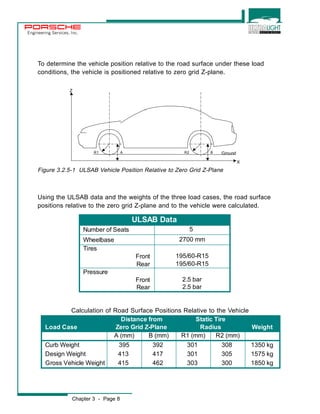
To determine the vehicle position relative to the road surface under these load 
conditions, the vehicle is positioned relative to zero grid Z-plane. 
R1 A R2 B 
Ground 
Z 
Figure 3.2.5-1 ULSAB Vehicle Position Relative to Zero Grid Z-Plane 
X 
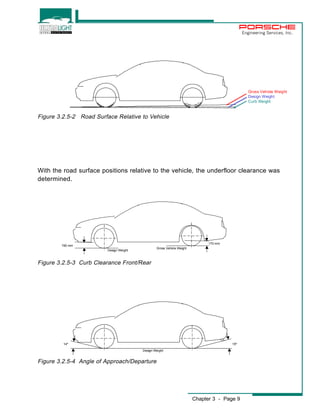
Using the ULSAB data and the weights of the three load cases, the road surface 
positions relative to the zero grid Z-plane and to the vehicle were calculated. 
Chapter 3 - Page 8 
ULSAB Data 
Number of Seats 5 
Wheelbase 2700 mm 
Tires 
Front 195/60-R15 
Rear 195/60-R15 
Pressure 
Front 2.5 bar 
Rear 2.5 bar 
Calculation of Road Surface Positions Relative to the Vehicle 
Distance from Static Tire 
Load Case Zero Grid Z-Plane Radius Weight 
A (mm) B (mm) R1 (mm) R2 (mm) 
Curb Weight 395 392 301 308 1350 kg 
Design Weight 413 417 301 305 1575 kg 
Gross Vehicle Weight 415 462 303 300 1850 kg
Chapter 3 - Page 9 
Engineering Services, Inc. 
Figure 3.2.5-2 Road Surface Relative to Vehicle 
Gross Vehicle Weight 
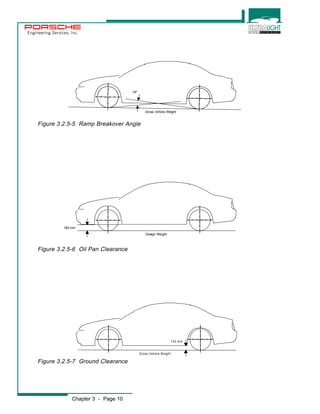
With the road surface positions relative to the vehicle, the underfloor clearance was 
determined. 
Figure 3.2.5-3 Curb Clearance Front/Rear 
Figure 3.2.5-4 Angle of Approach/Departure 
Design Weight 
Curb Weight 
Design Weight 
Gross Vehicle Weight 
190 mm 
170 mm 
15º 
Design Weight 
14º
Engineering Services, Inc. 
Figure 3.2.5-5 Ramp Breakover Angle 
Figure 3.2.5-6 Oil Pan Clearance 
Figure 3.2.5-7 Ground Clearance 
Chapter 3 - Page 10 
Gross Vehicle Weight 
143 mm 
185 mm 
Design Weight 
14º
Engineering Services, Inc. 
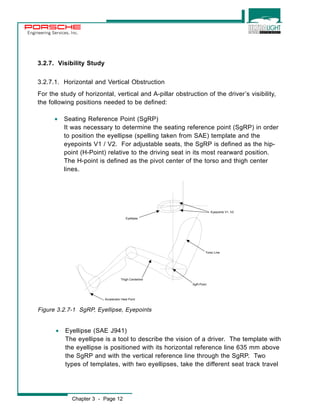
3.2.6. Seating Position 
At first the 2-D manikins (spelling taken from SAE) were aligned in a comfortable 
seating position taking into consideration the angles between joints such as hip, 
knee, and foot. When the seating position was defined, verification was made that 
the operating parts like steering wheel, gearshift lever and pedal were in reach. 
This was important for ergonomic reasons. Two types of 2-D manikins were used: 
The small female, 5th percentile with a height of 147.8 cm; and the tall male, 95th 
percentile with a height of 185.7 cm. (5th percentile means that 5% of the 
population is smaller or equal in size and 95% is taller. 95th percentile means that 
95% of the population is smaller or equal in size and 5% is taller.) 
For the dash panel layout the tall male 2-D manikin was used because it is more 
difficult to reach, since the seat position of the taller person is more rearward than it 
is for a shorter person. 
Figure 3.2.6-1 Distance to Operating Parts of the 5% Female and the 95% Male 
Chapter 3 - Page 11
Engineering Services, Inc. 
Accelerator Heel Point 
Chapter 3 - Page 12 
SgR-Point 
Eyellipse 
Eyepoints V1, V2 
Torso Line 
Thigh Centerline 
3.2.7. Visibility Study 
3.2.7.1. Horizontal and Vertical Obstruction 
For the study of horizontal, vertical and A-pillar obstruction of the driver’s visibility, 
the following positions needed to be defined: 
· Seating Reference Point (SgRP) 
It was necessary to determine the seating reference point (SgRP) in order 
to position the eyellipse (spelling taken from SAE) template and the 
eyepoints V1 / V2. For adjustable seats, the SgRP is defined as the hip-point 
(H-Point) relative to the driving seat in its most rearward position. 
The H-point is defined as the pivot center of the torso and thigh center 
lines. 
Figure 3.2.7-1 SgRP, Eyellipse, Eyepoints 
· Eyellipse (SAE J941) 
The eyellipse is a tool to describe the vision of a driver. The template with 
the eyellipse is positioned with its horizontal reference line 635 mm above 
the SgRP and with the vertical reference line through the SgRP. Two 
types of templates, with two eyellipses, take the different seat track travel
Engineering Services, Inc. 
ranges into consideration. For the ULSAB vehicle, with a seat track travel 
of 240 mm, a template for seat track travel of more than 130 mm was 
used. 
Point X Y Z 
V1 68 -5 665 
V2 68 -5 589 
Chapter 3 - Page 13 
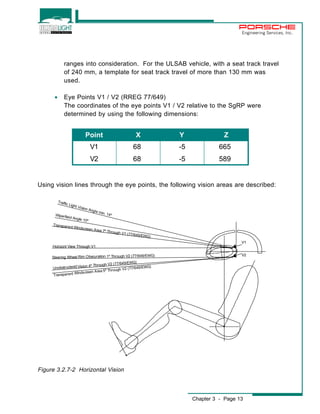
T raffic Light Vision Angle min. 14º 
Wiperfield Angle 10º 
Transparent Windscreen Area 7º Through V1 (77/649/EWG) 
Horizont View Through V1 
Steering Wheel R im O bscur at ion 1º Through V2 ( 77/649/EWG) 
Unobstructedd Vision 4º Through V2 (77/649/EWG) 
Transparent Windscreen Area 5º Through V2 (77/649/EWG) 
V1 
V2 
· Eye Points V1 / V2 (RREG 77/649) 
The coordinates of the eye points V1 / V2 relative to the SgRP were 
determined by using the following dimensions: 
Using vision lines through the eye points, the following vision areas are described: 
Figure 3.2.7-2 Horizontal Vision
Engineering Services, Inc. 
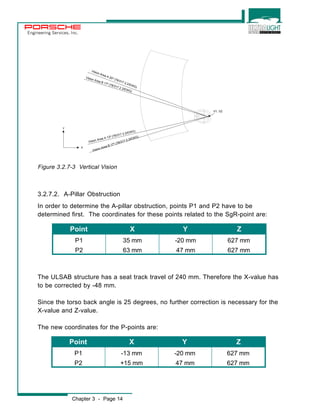
Vision Area A 20º (78/317 2.2/EWG) 
Vision Area B 17º (78/317 2.3/EWG) 
Vision Area A 13º (78/317 2.2/EWG) 
Vision Area B 17º (78/317 2.3/EWG) 
Figure 3.2.7-3 Vertical Vision 
3.2.7.2. A-Pillar Obstruction 
In order to determine the A-pillar obstruction, points P1 and P2 have to be 
determined first. The coordinates for these points related to the SgR-point are: 
Point X Y Z 
P1 35 mm -20 mm 627 mm 
P2 63 mm 47 mm 627 mm 
The ULSAB structure has a seat track travel of 240 mm. Therefore the X-value has 
to be corrected by -48 mm. 
Since the torso back angle is 25 degrees, no further correction is necessary for the 
X-value and Z-value. 
The new coordinates for the P-points are: 
Chapter 3 - Page 14 
V1, V2 
Y 
X 
Point X Y Z 
P1 -13 mm -20 mm 627 mm 
P2 +15 mm 47 mm 627 mm
Engineering Services, Inc. 
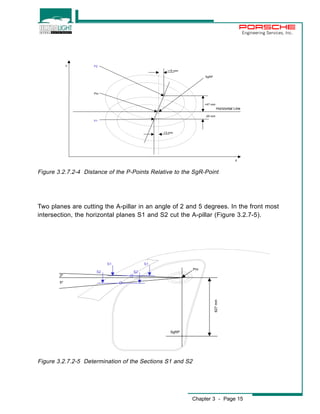
P2 
Pm 
P1 
Figure 3.2.7.2-4 Distance of the P-Points Relative to the SgR-Point 
Two planes are cutting the A-pillar in an angle of 2 and 5 degrees. In the front most 
intersection, the horizontal planes S1 and S2 cut the A-pillar (Figure 3.2.7-5). 
627 mm 
Chapter 3 - Page 15 
2º 
5º 
S1 
S2 
S1 
S2 
SgRP 
Pm 
Figure 3.2.7.2-5 Determination of the Sections S1 and S2 
SgRP 
Horizontal Line 
+15 mm 
+47 mm 
-20 mm 
-13 mm 
Y 
X
Engineering Services, Inc. 
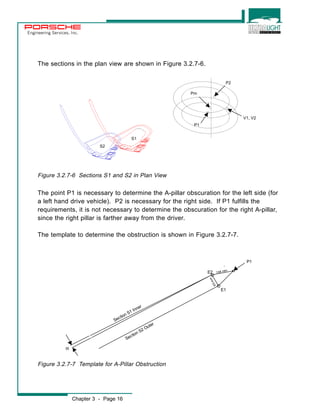
The sections in the plan view are shown in Figure 3.2.7-6. 
Figure 3.2.7-6 Sections S1 and S2 in Plan View 
The point P1 is necessary to determine the A-pillar obscuration for the left side (for 
a left hand drive vehicle). P2 is necessary for the right side. If P1 fulfills the 
requirements, it is not necessary to determine the obscuration for the right A-pillar, 
since the right pillar is farther away from the driver. 
The template to determine the obstruction is shown in Figure 3.2.7-7. 
Section S1 Inner 
Figure 3.2.7-7 Template for A-Pillar Obstruction 
Chapter 3 - Page 16 
P1 
a 
E2 104 mm 
E1 
65 mm 
Sec tion S2 Outer 
P1 
P2 
Pm 
V1, V2 
S1 
S2
Engineering Services, Inc. 
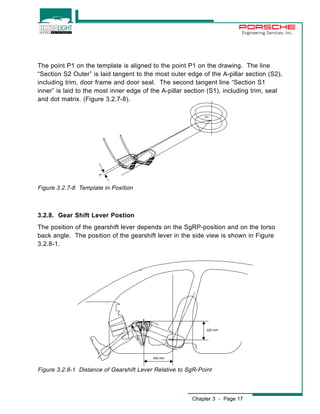
The point P1 on the template is aligned to the point P1 on the drawing. The line 
“Section S2 Outer” is laid tangent to the most outer edge of the A-pillar section (S2), 
including trim, door frame and door seal. The second tangent line “Section S1 
inner” is laid to the most inner edge of the A-pillar section (S1), including trim, seal 
and dot matrix. (Figure 3.2.7-8). 
Chapter 3 - Page 17 
340 mm 
220 mm 
290 mm 
P1 
1º 
Figure 3.2.7-8 Template in Position 
3.2.8. Gear Shift Lever Postion 
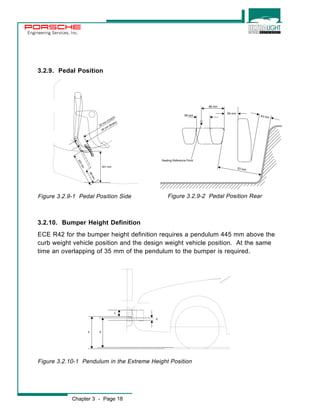
The position of the gearshift lever depends on the SgRP-position and on the torso 
back angle. The position of the gearshift lever in the side view is shown in Figure 
3.2.8-1. 
Figure 3.2.8-1 Distance of Gearshift Lever Relative to SgR-Point
Engineering Services, Inc. 
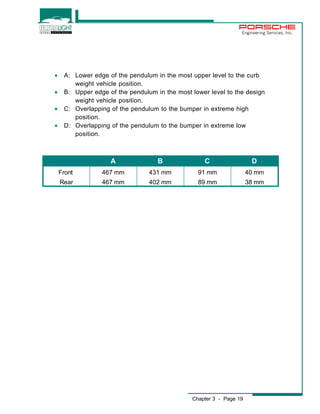
3.2.9. Pedal Position 
50 mm (Clutch) 
Figure 3.2.9-1 Pedal Position Side Figure 3.2.9-2 Pedal Position Rear 
3.2.10. Bumper Height Definition 
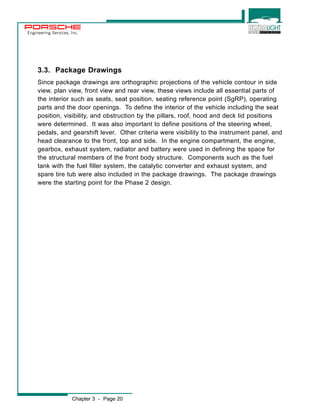
ECE R42 for the bumper height definition requires a pendulum 445 mm above the 
curb weight vehicle position and the design weight vehicle position. At the same 
time an overlapping of 35 mm of the pendulum to the bumper is required. 
A 
Figure 3.2.10-1 Pendulum in the Extreme Height Position 
Chapter 3 - Page 18 
D 
B 
C 
201 mm 
89 mm 
203 mm 
48 mm (Brake) 
98 mm 
59 mm 
58 mm 
53 mm 
53 mm 
Seating Reference Point
Engineering Services, Inc. 
· A: Lower edge of the pendulum in the most upper level to the curb 
Chapter 3 - Page 19 
weight vehicle position. 
· B: Upper edge of the pendulum in the most lower level to the design 
weight vehicle position. 
· C: Overlapping of the pendulum to the bumper in extreme high 
position. 
· D: Overlapping of the pendulum to the bumper in extreme low 
position. 
A B C D 
Front 467 mm 431 mm 91 mm 40 mm 
Rear 467 mm 402 mm 89 mm 38 mm
Engineering Services, Inc. 
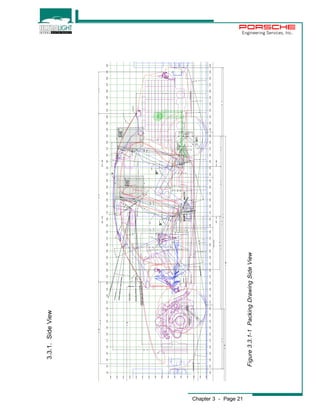
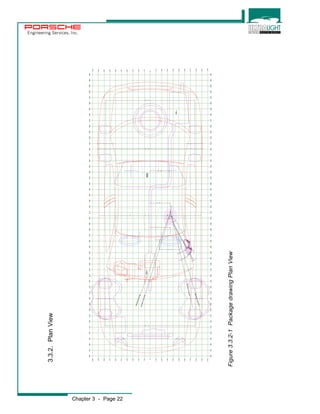
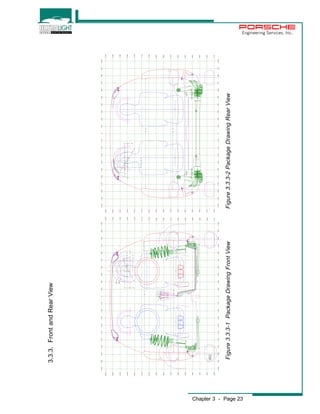
3.3. Package Drawings 
Since package drawings are orthographic projections of the vehicle contour in side 
view, plan view, front view and rear view, these views include all essential parts of 
the interior such as seats, seat position, seating reference point (SgRP), operating 
parts and the door openings. To define the interior of the vehicle including the seat 
position, visibility, and obstruction by the pillars, roof, hood and deck lid positions 
were determined. It was also important to define positions of the steering wheel, 
pedals, and gearshift lever. Other criteria were visibility to the instrument panel, and 
head clearance to the front, top and side. In the engine compartment, the engine, 
gearbox, exhaust system, radiator and battery were used in defining the space for 
the structural members of the front body structure. Components such as the fuel 
tank with the fuel filler system, the catalytic converter and exhaust system, and 
spare tire tub were also included in the package drawings. The package drawings 
were the starting point for the Phase 2 design. 
Chapter 3 - Page 20
Chapter 3 - Page 21 
Engineering Services, Inc. 
3.3.1. Side View 
Figure 3.3.1-1 Packing Drawing Side View
Chapter 3 - Page 22 
Engineering Services, Inc. 
3.3.2. Plan View 
Figure 3.3.2-1 Package drawing Plan View
Chapter 3 - Page 23 
Engineering Services, Inc. 
3.3.3. Front and Rear View 
Figure 3.3.3-1 Package Drawing Front View Figure 3.3.3-2 Package Drawing Rear View
Engineering Services, Inc. 
4. Styling
Chapter 4 - Page 1 
Engineering Services, Inc. 
4. Styling 
4.1. Approach 
The Phase 1 concept design of the ULSAB program did not account for any Class A 
surfaces for the outer panels of the structure. To establish Class A surfaces in 
Phase 2, a complete styling of the ULSAB vehicle was necessary in order to create 
the surfaces of the roof panel, body side outer panel, the back light and the 
windshield. Styling also provided the major feature lines for the doors, deck lid, 
hood, fender and front and rear bumpers; these were needed for the development of 
the mating structural parts. For Phase 2, styling also gave the ULSAB structure a 
professional look and provided surfaces for further design studies in the future, i.e. 
on hoods, doors, deck lids, etc. The styling was developed electronically using CAS 
(computer aided styling), no clay models were used. With support from Porsche’s 
styling studio, PES selected A. D. Concepts, a local source, to carry out the 
computer aided styling in a simultaneous engineering approach with PES. At the 
first team meetings of PES and A. D. Concepts, several elements of the styling 
were discussed with a view to creating a 3-dimensional styling model. Using the 
package drawings, important criteria such as overall vehicle proportions, vision 
lines, bumper locations and proposed cut lines were specified. After the initial 
meetings, a clearly defined vehicle architecture had evolved. 
4.2. 2-D Styling Phase 
4.2.1. Sketching 
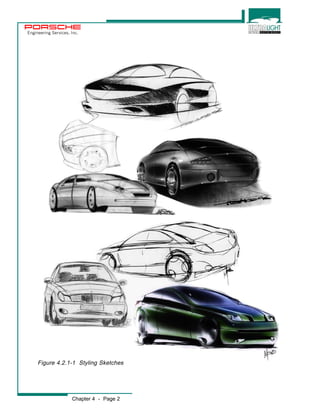
In a team review of the first sketches, a neutral styling approach was chosen to 
ensure the ULSAB styling model would not be too futuristic or radical. Traditional 
sketching techniques were used along with the latest electronic paint sketching 
software from the Alias|Wavefront company entitled StudioPaint running on Silicon 
Graphics High Impact workstations. Many automotive design studios around the 
world use this combination of hardware and software. The use of this tool for such 
a project increased productivity and enhanced the overall styling presentation with 
professionalism and accuracy, producing tighter sketches and more realistic, 
achievable styling goals.
Engineering Services, Inc. 
Figure 4.2.1-1 Styling Sketches 
Chapter 4 - Page 2
Chapter 4 - Page 3 
Engineering Services, Inc. 
4.2.2. Clinic 
In the first clinic, dozens of sketches were reviewed by the design and styling team 
to determine which direction the styling would take prior to its presentation to the 
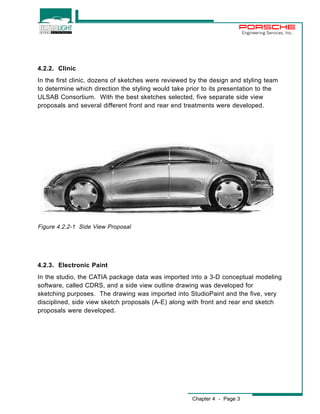
ULSAB Consortium. With the best sketches selected, five separate side view 
proposals and several different front and rear end treatments were developed. 
Figure 4.2.2-1 Side View Proposal 
4.2.3. Electronic Paint 
In the studio, the CATIA package data was imported into a 3-D conceptual modeling 
software, called CDRS, and a side view outline drawing was developed for 
sketching purposes. The drawing was imported into StudioPaint and the five, very 
disciplined, side view sketch proposals (A-E) along with front and rear end sketch 
proposals were developed.
Engineering Services, Inc. 
4.2.4. Styling Theme Selection 
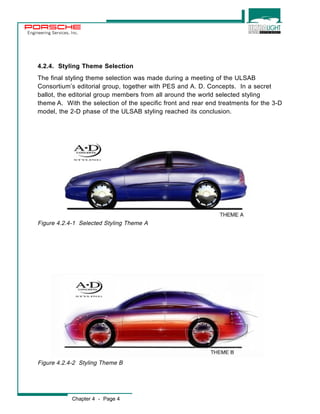
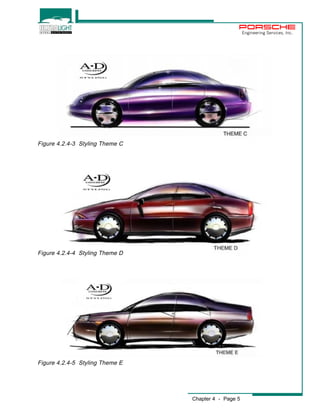
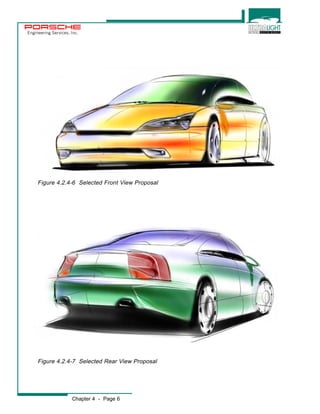
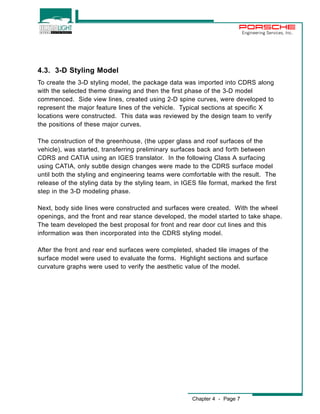
The final styling theme selection was made during a meeting of the ULSAB 
Consortium’s editorial group, together with PES and A. D. Concepts. In a secret 
ballot, the editorial group members from all around the world selected styling 
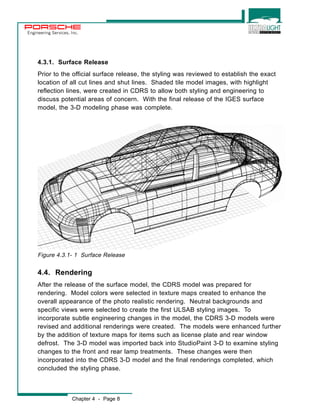
theme A. With the selection of the specific front and rear end treatments for the 3-D 
model, the 2-D phase of the ULSAB styling reached its conclusion. 
Figure 4.2.4-1 Selected Styling Theme A 
Figure 4.2.4-2 Styling Theme B 
Chapter 4 - Page 4
Chapter 4 - Page 5 
Engineering Services, Inc. 
Figure 4.2.4-3 Styling Theme C 
Figure 4.2.4-4 Styling Theme D 
Figure 4.2.4-5 Styling Theme E
Engineering Services, Inc. 
Figure 4.2.4-6 Selected Front View Proposal 
Figure 4.2.4-7 Selected Rear View Proposal 
Chapter 4 - Page 6
Chapter 4 - Page 7 
Engineering Services, Inc. 
4.3. 3-D Styling Model 
To create the 3-D styling model, the package data was imported into CDRS along 
with the selected theme drawing and then the first phase of the 3-D model 
commenced. Side view lines, created using 2-D spine curves, were developed to 
represent the major feature lines of the vehicle. Typical sections at specific X 
locations were constructed. This data was reviewed by the design team to verify 
the positions of these major curves. 
The construction of the greenhouse, (the upper glass and roof surfaces of the 
vehicle), was started, transferring preliminary surfaces back and forth between 
CDRS and CATIA using an IGES translator. In the following Class A surfacing 
using CATIA, only subtle design changes were made to the CDRS surface model 
until both the styling and engineering teams were comfortable with the result. The 
release of the styling data by the styling team, in IGES file format, marked the first 
step in the 3-D modeling phase. 
Next, body side lines were constructed and surfaces were created. With the wheel 
openings, and the front and rear stance developed, the model started to take shape. 
The team developed the best proposal for front and rear door cut lines and this 
information was then incorporated into the CDRS styling model. 
After the front and rear end surfaces were completed, shaded tile images of the 
surface model were used to evaluate the forms. Highlight sections and surface 
curvature graphs were used to verify the aesthetic value of the model.
Engineering Services, Inc. 
4.3.1. Surface Release 
Prior to the official surface release, the styling was reviewed to establish the exact 
location of all cut lines and shut lines. Shaded tile model images, with highlight 
reflection lines, were created in CDRS to allow both styling and engineering to 
discuss potential areas of concern. With the final release of the IGES surface 
model, the 3-D modeling phase was complete. 
Figure 4.3.1- 1 Surface Release 
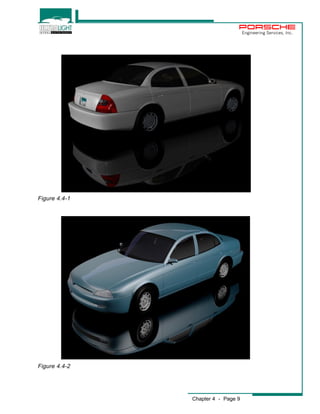
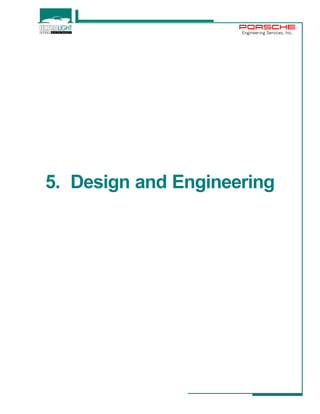
4.4. Rendering 
After the release of the surface model, the CDRS model was prepared for 
rendering. Model colors were selected in texture maps created to enhance the 
overall appearance of the photo realistic rendering. Neutral backgrounds and 
specific views were selected to create the first ULSAB styling images. To 
incorporate subtle engineering changes in the model, the CDRS 3-D models were 
revised and additional renderings were created. The models were enhanced further 
by the addition of texture maps for items such as license plate and rear window 
defrost. The 3-D model was imported back into StudioPaint 3-D to examine styling 
changes to the front and rear lamp treatments. These changes were then 
incorporated into the CDRS 3-D model and the final renderings completed, which 
concluded the styling phase. 
Chapter 4 - Page 8
Chapter 4 - Page 9 
Engineering Services, Inc. 
Figure 4.4-1 
Figure 4.4-2
Engineering Services, Inc. 
5. Design and Engineering
Chapter 5 - Page 1 
Engineering Services, Inc. 
5. Design and Engineering 
5.1. Phase 2 Design and Engineering Approach 
After the package was revised and the styling frozen, the challenge in Phase 2 was 
to maintain the structural performances, especially the mass, as analyzed in the 
Phase 1 concept. Further research into steel sandwich material led to additional 
changes in the Phase 2 design. Because of restrictions in size and application of 
the material, new design solutions had to be created to compensate for the 
advantages in mass reductions using sandwich material as it was applied in 
Phase 1. The hydroformed parts were analyzed for manufacturing feasibility using 
the detailed design data created in Phase 2. The restrictions of the hydroforming 
process, in combination with the refinement of the design, led to different concepts, 
design adjustments, and new solutions to achieve the target for mass. 
Furthermore, the 50% off-set crash, an additional crash analysis introduced in 
Phase 2, significantly influenced the design of parts, the application of steel grades, 
the material thicknesses and in particular, the changes to tailor welded blanks. 
Every change in the design process also had to be analyzed for its suitability for 
assembly and parts manufacturing. The design approach was driven by mass 
reduction and created innovative results without allowing initial component cost 
consideration to limit options. The design also focused on a production volume of 
more than 100,000 units per year. 
As well as concentrating on reaching the targets for performance and mass, 
importance was also placed on the reduction of assembly steps, the integration of 
reinforcements, the use of tailor welded blanks, and the avoidance of metal arc 
welding, wherever possible. Using the same design approach in both Phases 1 
and 2, it was possible to maintain low mass and high structural performances. The 
Phase 1 design concept and approach, the flexibility of the concept and the 
potential that it could be adjusted to various design tasks, were challenged in 
Phase 2 and ultimately justified.
Engineering Services, Inc. 
5.2. Design and Engineering Process 
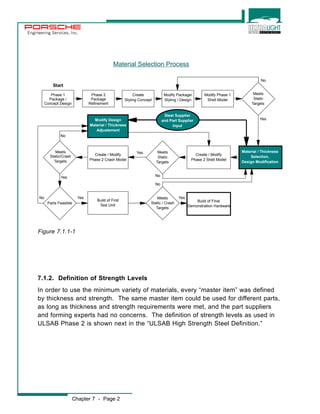
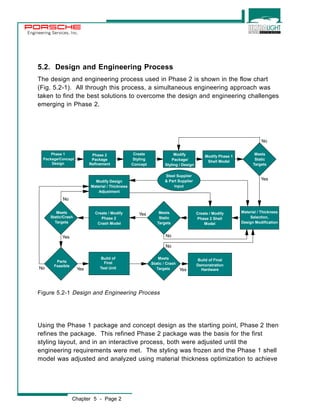
The design and engineering process used in Phase 2 is shown in the flow chart 
(Fig. 5.2-1). All through this process, a simultaneous engineering approach was 
taken to find the best solutions to overcome the design and engineering challenges 
emerging in Phase 2. 
Yes 
Figure 5.2-1 Design and Engineering Process 
No 
Using the Phase 1 package and concept design as the starting point, Phase 2 then 
refines the package. This refined Phase 2 package was the basis for the first 
styling layout, and in an interactive process, both were adjusted until the 
engineering requirements were met. The styling was frozen and the Phase 1 shell 
model was adjusted and analyzed using material thickness optimization to achieve 
Chapter 5 - Page 2 
Meets 
Static 
Targets 
Material / Thickness 
Selection, 
Design Modification 
Meets 
Static 
Targets 
Create / Modify 
Phase 2 
Crash Model 
Meets 
Static/Crash 
Targets 
Parts 
Feasible 
Meets 
Static / Crash 
Targets 
Build of 
First 
Test Unit 
Build of Final 
Demonstration 
Hardware 
Steel Supplier 
& Part Supplier 
Input 
Create / Modify 
Phase 2 Shell 
Model 
Modify Design 
Material / Thickness 
Adjustment 
No 
Yes 
No Yes Yes 
Yes 
No 
No 
Phase 1 
Package/Concept 
Design 
Phase 2 
Package 
Refinement 
Create 
Styling 
Concept 
Modify 
Package/ 
Styling / Design 
Modify Phase 1 
Shell Model 
Start 
No 
No 
No 
No 
No 
Yes 
Yes 
Yes 
Yes 
Yes
Chapter 5 - Page 3 
Engineering Services, Inc. 
the mass target while maintaining the structural performance goals. Together with 
the selected suppliers and the Material Group of the ULSAB Consortium, the part 
design was discussed and the material thicknesses were selected. With this 
information, the design was revised and the Phase 2 shell model created, analyzed 
and modified until all targets were met. New Phase 2 crash analysis models were 
built and after the first analysis, design modifications, material grade and thickness 
selection, further crash analyses were performed, until the results were satisfactory. 
With the revised design and material selection, the shell model was updated and 
the static analysis performed. The crash and static analysis models were 
constantly updated as a result of information from tool, part and steel suppliers. 
This was repeated until all results were satisfactory. The design was then modified 
and the part drawings released to the suppliers. With the first part set delivered, a 
test unit was built and the tests following provided the results for static performance 
and most importantly for mass. The design was enhanced and material substituted 
as needed. The process of shell and crash model modifications and analysis was 
performed again to validate the design. After the final design was released to the 
suppliers, parts were manufactured and the demonstration hardware built. 
Part of this process included regular design review meetings (not shown in the flow 
chart) of the design and engineering team as well as design review meetings with 
the demonstration hardware build team, engineers and analysts at Porsche R & D 
Center in Germany. In these internal PES meetings, technical problems were 
discussed and design directions decided in order to prepare for the demonstration 
hardware build and meet established deadlines.
Engineering Services, Inc. 
5.3. ULSAB Phase 2 Design Description 
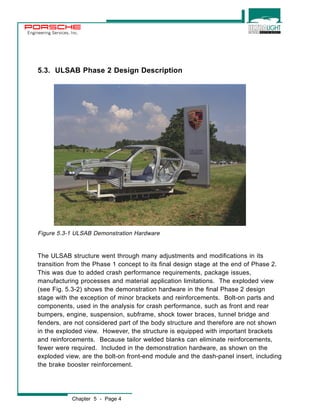
Figure 5.3-1 ULSAB Demonstration Hardware 
The ULSAB structure went through many adjustments and modifications in its 
transition from the Phase 1 concept to its final design stage at the end of Phase 2. 
This was due to added crash performance requirements, package issues, 
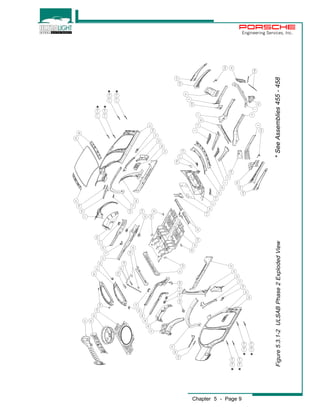
manufacturing processes and material application limitations. The exploded view 
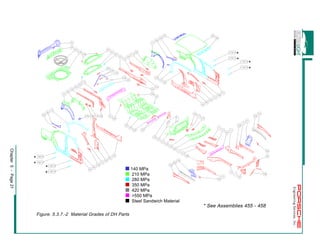
(see Fig. 5.3-2) shows the demonstration hardware in the final Phase 2 design 
stage with the exception of minor brackets and reinforcements. Bolt-on parts and 
components, used in the analysis for crash performance, such as front and rear 
bumpers, engine, suspension, subframe, shock tower braces, tunnel bridge and 
fenders, are not considered part of the body structure and therefore are not shown 
in the exploded view. However, the structure is equipped with important brackets 
and reinforcements. Because tailor welded blanks can eliminate reinforcements, 
fewer were required. Included in the demonstration hardware, as shown on the 
exploded view, are the bolt-on front-end module and the dash-panel insert, including 
the brake booster reinforcement. 
Chapter 5 - Page 4
Chapter 5 - Page 5 
Engineering Services, Inc. 
5.3.1. Parts List – Demonstration Hardware 
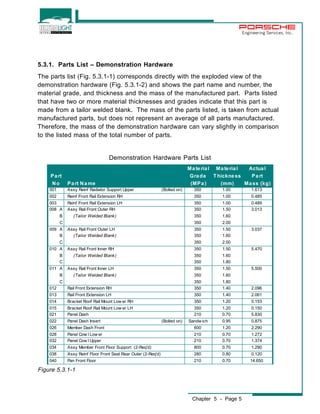
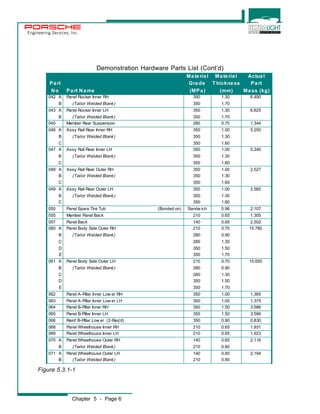
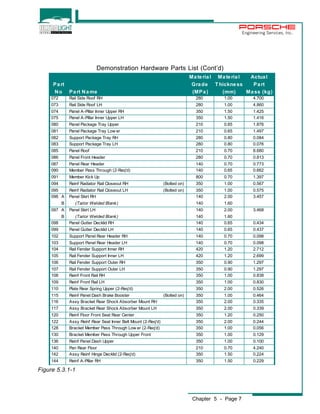
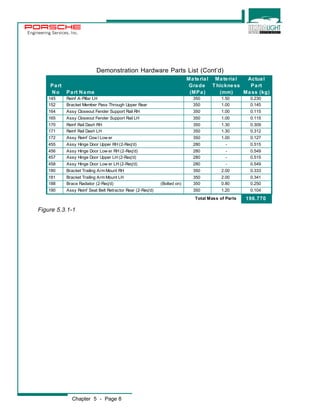
The parts list (Fig. 5.3.1-1) corresponds directly with the exploded view of the 
demonstration hardware (Fig. 5.3.1-2) and shows the part name and number, the 
material grade, and thickness and the mass of the manufactured part. Parts listed 
that have two or more material thicknesses and grades indicate that this part is 
made from a tailor welded blank. The mass of the parts listed, is taken from actual 
manufactured parts, but does not represent an average of all parts manufactured. 
Therefore, the mass of the demonstration hardware can vary slightly in comparison 
to the listed mass of the total number of parts. 
Figure 5.3.1-1 
Demonstration Hardware Parts List 
Ma te ria l Ma te ria l Actua l 
Part Grade Thickness Part 
No Part Name (MPa) (mm) Mass (kg) 
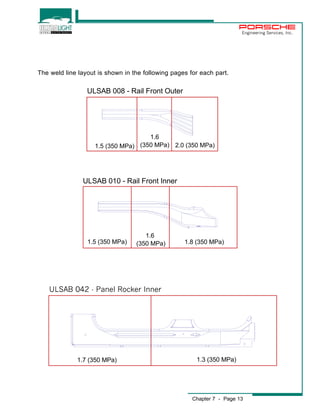
001 Assy Reinf Radiator Support Upper (Bolted on) 350 1.00 1.613 
002 Reinf Front Rail Extension RH 350 1.00 0.485 
003 Reinf Front Rail Extension LH 350 1.00 0.489 
008 A Assy Rail Front Outer RH 350 1.50 3.013 
B (Tailor Welded Blank) 350 1.60 
C 350 2.00 
009 A Assy Rail Front Outer LH 350 1.50 3.037 
B (Tailor Welded Blank) 350 1.60 
C 350 2.00 
010 A Assy Rail Front Inner RH 350 1.50 5.470 
B (Tailor Welded Blank) 350 1.60 
C 350 1.80 
011 A Assy Rail Front Inner LH 350 1.50 5.500 
B (Tailor Welded Blank) 350 1.60 
C 350 1.80 
012 Rail Front Extension RH 350 1.40 2.096 
013 Rail Front Extension LH 350 1.40 2.061 
014 Bracket Roof Rail Mount Low er RH 350 1.20 0.153 
015 Bracket Roof Rail Mount Low er LH 350 1.20 0.150 
021 Panel Dash 210 0.70 5.830 
022 Panel Dash Insert (Bolted on) Sandw ich 0.95 0.875 
026 Member Dash Front 600 1.20 2.290 
028 Panel Cow l Low er 210 0.70 1.272 
032 Panel Cow l Upper 210 0.70 1.374 
034 Assy Member Front Floor Support (2-Req'd) 800 0.70 1.290 
038 Assy Reinf Floor Front Seat Rear Outer (2-Req'd) 280 0.80 0.120 
040 Pan Front Floor 210 0.70 14.650
Engineering Services, Inc. 
Demonstration Hardware Parts List (Cont’d) 
Figure 5.3.1-1 
Chapter 5 - Page 6 
Ma te ria l Ma te ria l Actua l 
Part Grade Thickness Part 
No Part Name (MPa) (mm) Mass (kg) 
042 A Panel Rocker Inner RH 350 1.30 6.490 
B (Tailor Welded Blank) 350 1.70 
043 A Panel Rocker Inner LH 350 1.30 6.625 
B (Tailor Welded Blank) 350 1.70 
045 Member Rear Suspension 280 0.70 1.344 
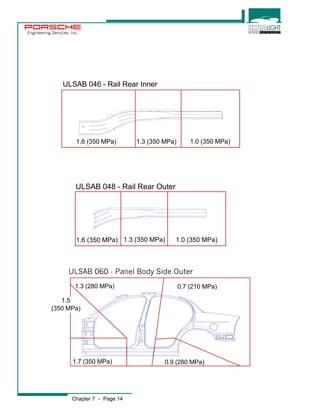
046 A Assy Rail Rear Inner RH 350 1.00 5.250 
B (Tailor Welded Blank) 350 1.30 
C 350 1.60 
047 A Assy Rail Rear Inner LH 350 1.00 5.240 
B (Tailor Welded Blank) 350 1.30 
C 350 1.60 
048 A Assy Rail Rear Outer RH 350 1.00 2.527 
B (Tailor Welded Blank) 350 1.30 
C 350 1.60 
049 A Assy Rail Rear Outer LH 350 1.00 2.565 
B (Tailor Welded Blank) 350 1.30 
C 350 1.60 
050 Panel Spare Tire Tub (Bonded on) Sandw ich 0.96 2.107 
055 Member Panel Back 210 0.65 1.305 
057 Panel Back 140 0.65 2.502 
060 A Panel Body Side Outer RH 210 0.70 15.780 
B (Tailor Welded Blank) 280 0.90 
C 280 1.30 
D 350 1.50 
E 350 1.70 
061 A Panel Body Side Outer LH 210 0.70 15.650 
B (Tailor Welded Blank) 280 0.90 
C 280 1.30 
D 350 1.50 
E 350 1.70 
062 Panel A-Pillar Inner Low er RH 350 1.00 1.365 
063 Panel A-Pillar Inner Low er LH 350 1.00 1.375 
064 Panel B-Pillar Inner RH 350 1.50 3.586 
065 Panel B-Pillar Inner LH 350 1.50 3.586 
066 Reinf B-Pillar Low er (2-Req'd) 350 0.90 0.830 
068 Panel Wheelhouse Inner RH 210 0.65 1.931 
069 Panel Wheelhouse Inner LH 210 0.65 1.923 
070 A Panel Wheelhouse Outer RH 140 0.65 2.116 
B (Tailor Welded Blank) 210 0.80 
071 A Panel Wheelhouse Outer LH 140 0.65 2.194 
B (Tailor Welded Blank) 210 0.80
Chapter 5 - Page 7 
Engineering Services, Inc. 
Demonstration Hardware Parts List (Cont’d) 
Figure 5.3.1-1 
Ma te ria l Ma te ria l Actua l 
Part Grade Thickness Part 
No Part Name (MPa) (mm) Mass (kg) 
072 Rail Side Roof RH 280 1.00 4.700 
073 Rail Side Roof LH 280 1.00 4.860 
074 Panel A-Pillar Inner Upper RH 350 1.50 1.425 
075 Panel A-Pillar Inner Upper LH 350 1.50 1.416 
080 Panel Package Tray Upper 210 0.65 1.876 
081 Panel Package Tray Low er 210 0.65 1.497 
082 Support Package Tray RH 280 0.80 0.084 
083 Support Package Tray LH 280 0.80 0.076 
085 Panel Roof 210 0.70 8.680 
086 Panel Front Header 280 0.70 0.813 
087 Panel Rear Header 140 0.70 0.773 
090 Member Pass Through (2-Req'd) 140 0.65 0.662 
091 Member Kick Up 800 0.70 1.397 
094 Reinf Radiator Rail Closeout RH (Bolted on) 350 1.00 0.567 
095 Reinf Radiator Rail Closeout LH (Bolted on) 350 1.00 0.575 
096 A Panel Skirt RH 140 2.00 3.457 
B (Tailor Welded Blank) 140 1.60 
097 A Panel Skirt LH 140 2.00 3.468 
B (Tailor Welded Blank) 140 1.60 
098 Panel Gutter Decklid RH 140 0.65 0.434 
099 Panel Gutter Decklid LH 140 0.65 0.437 
102 Support Panel Rear Header RH 140 0.70 0.098 
103 Support Panel Rear Header LH 140 0.70 0.098 
104 Rail Fender Support Inner RH 420 1.20 2.712 
105 Rail Fender Support Inner LH 420 1.20 2.699 
106 Rail Fender Support Outer RH 350 0.90 1.297 
107 Rail Fender Support Outer LH 350 0.90 1.297 
108 Reinf Front Rail RH 350 1.00 0.838 
109 Reinf Front Rail LH 350 1.00 0.830 
110 Plate Rear Spring Upper (2-Req'd) 350 2.00 0.526 
115 Reinf Panel Dash Brake Booster (Bolted on) 350 1.00 0.464 
116 Assy Bracket Rear Shock Absorber Mount RH 350 2.00 0.335 
117 Assy Bracket Rear Shock Absorber Mount LH 350 2.00 0.339 
120 Reinf Floor Front Seat Rear Center 350 1.20 0.250 
122 Assy Reinf Rear Seat Inner Belt Mount (2-Req'd) 350 2.00 0.244 
128 Bracket Member Pass Through Low er (2-Req'd) 350 1.00 0.056 
130 Bracket Member Pass Through Upper Front 350 1.00 0.129 
136 Reinf Panel Dash Upper 350 1.00 0.100 
140 Pan Rear Floor 210 0.70 4.240 
142 Assy Reinf Hinge Decklid (2-Req'd) 350 1.50 0.224 
144 Reinf A-Pillar RH 350 1.50 0.229
Engineering Services, Inc. 
Demonstration Hardware Parts List (Cont’d) 
Chapter 5 - Page 8 
Ma te ria l Ma te ria l Actua l 
Part Grade Thickness Part 
No Part Name (MPa) (mm) Mass (kg) 
145 Reinf A-Pillar LH 350 1.50 0.230 
152 Bracket Member Pass Through Upper Rear 350 1.00 0.145 
164 Assy Closeout Fender Support Rail RH 350 1.00 0.115 
165 Assy Closeout Fender Support Rail LH 350 1.00 0.115 
170 Reinf Rail Dash RH 350 1.30 0.309 
171 Reinf Rail Dash LH 350 1.30 0.312 
172 Assy Reinf Cowl Lower 350 1.00 0.127 
455 Assy Hinge Door Upper RH (2-Req'd) 280 - 0.515 
456 Assy Hinge Door Low er RH (2-Req'd) 280 - 0.549 
457 Assy Hinge Door Upper LH (2-Req'd) 280 - 0.515 
458 Assy Hinge Door Low er LH (2-Req'd) 280 - 0.549 
180 Bracket Trailing Arm Mount RH 350 2.00 0.333 
181 Bracket Trailing Arm Mount LH 350 2.00 0.341 
188 Brace Radiator (2-Req'd) (Bolted on) 350 0.80 0.250 
190 Assy Reinf Seat Belt Retractor Rear (2-Req'd) 350 1.20 0.104 
Total Mass of Parts 196.770 
Figure 5.3.1-1
Chapter 5 - Page 9 
Engineering Services, Inc. 
Figure 5.3.1-2 ULSAB Phase 2 Exploded View 
* * 
* * 
* * 
* * 
* See Assemblies 455 - 458
Engineering Services, Inc. 
5.3.2. ULSAB Structure Mass 
For the Phase 1 concept, it was assumed that future average body structures would 
contain approximately 12 kg of brackets and reinforcements. This number can vary, 
up or down, depending on the type of vehicle, i.e., front or rear wheel drive, and the 
package of components. Since the goal of the ULSAB program is to provide 
solutions for a generic concept, it was assumed in Phase 1 that the 12 kg for 
brackets and reinforcements have to be considered in the calculation for mass to 
give the Phase 1 results more credibility. In Phase 1, the ULSAB structure was 
calculated with a mass of 193 kg. With the 12 kg for brackets and reinforcements, 
the total mass equals 205 kg. In Phase 2, some of the brackets and reinforcements 
are already welded into the structure. These are reflected accordingly in the mass 
of the demonstration hardware and also included in the parts list. With the 
refinement of the Phase 2 package, minor brackets and reinforcements were 
designed (but not manufactured) and their mass was calculated to get a more 
accurate determination than the general assumption used in Phase 1. These 
brackets and reinforcements represent a more generic, than detailed, selection. 
The selection was based on package information, chosen components and 
engineering judgment. It can be assumed that in a possible Phase 3, the number of 
brackets and reinforcements, and their actual mass when manufactured, can be 
insignificantly higher or lower. This depends on the final component selection; their 
position in the structure and efforts made to minimize their mass. Also included in 
the mass calculation are 100 weld studs. This also represents a generic number for 
this type of structure and is based on engineering judgment. The calculated mass 
of the ULSAB structure (Fig. 5.3.2-1) is the measured mass of the demonstration 
hardware parts and the calculated mass of brackets and reinforcements shown in 
Fig. 5.3.2-2 and Fig. 5.3.2-3. The ULSAB structure mass in Phase 2 is 203 kg, with 
the variation assumed to be +/- 1%. This low variation is due to each part being 
manufactured from one coil of steel. The differences in sheet thicknesses between 
coils do not apply for the demonstration hardware, but would have to be considered 
in mass production. 
ULSAB = Mass of Demonstration + Calculated Mass of Brackets 
Structure Mass Hardware (Parts) and Reinforcements 
203.2 kg = 196.8 kg + 6.4 kg 
Figure 5.3.2-1 Definition of ULSAB Structure Mass 
Chapter 5 - Page 10
Engineering Services, Inc. 
Designed Brackets not Manufactured but 
Considered Part of the ULSAB Structure 
Part No Name Qty Calc Mass [Kg] 
331 Bracket Exhaust Mount 2 0.060 
332/333 Bracket Engine Mount RH/LH 2 0.528 
334/335 Bracket Fender Mount Rear RH/LH 2 0.228 
336 Bracket Battery Tray 1 0.412 
337 Bracket Spare Tire Mount 1 0.089 
338/339 Bracket Fuel Tank Mount Rear RH/LH 2 0.242 
340 Bracket Front Tie Dow n Hook 2 0.236 
341 Bracket Rear Tie Dow n Hook 2 0.236 
342/343 Bracket Front Jack Support RH/LH 2 0.656 
344/345 Bracket Rear Jack Support RH/LH 2 0.548 
346 Bracket Plenum Support Center 1 0.445 
N/A Weld Studs ~ 100 - 0.300 
TOTAL 19 3.980 
Chapter 5 - Page 11 
Figure 5.3.2-2 
Figure 5.3.2-3 
Designed Reinforcements not Manufactured but 
Considered Part of the ULSAB Structure 
Part No Name Qty Calc Mass [Kg] 
310 Reinf Hood Hinge Mount 2 0.086 
311 Reinf Instrument Panel Beam Mount 2 0.134 
312/313 Reinf Sub-Frame Front Mount 2 0.050 
314/315 Reinf Sub-Frame Center Mount 2 0.116 
316/317 Reinf Sub-Frame Rear Mount 2 0.418 
318 Reinf Steering Rack Assembly Mount RH 1 0.032 
319 Reinf Steering Rack Assembly Mount LH 1 0.041 
320 Reinf Gear Shift Mount 1 0.271 
321 Reinf Front Door Lock Striker 2 0.106 
322 Reinf Front Door Check Arm 2 0.030 
323 Reinf Rear Door Lock Striker 2 0.146 
324 Reinf Rear Door Check Arm 2 0.028 
325 Reinf Front D-Ring Adjustment 2 0.298 
326 Reinf Rear Seat Cushion Mount 2 0.140 
327 Reinf Rear Seat Latch 2 0.068 
328 Reinf Rear Seat Back Mount Outer 2 0.278 
329 Reinf Rear Seat Back Mount Center 1 0.035 
330 Reinf Deck Lid Latch 1 0.136 
TOTAL 31 2.413
Engineering Services, Inc. 
5.3.3. ULSAB Demonstration Hardware Mass 
The mass of the demonstration hardware is 196.770 kg. This reflects the total 
amount of the mass of one complete part set, including brackets, reinforcements 
and bolt-on parts, as measured. 
In Phase 1, nearly all brackets and reinforcements were included in the theoretical 
number of 12 kg and only a few were included in the Phase 1 concept design of the 
body structure. With the level of detail design in Phase 2 and the refined package, 
it was now possible to design and finally manufacture most of these brackets and 
reinforcements and weld or bolt them to the demonstration hardware. It was not the 
task in Phase 2 of the ULSAB program to design and to manufacture all brackets 
and reinforcements and therefore, the approach to concentrate only on the 
important ones was taken. 
The mass of these manufactured brackets, reinforcements and bolt-on parts is 
included in the demonstration hardware mass and listed in the parts list (Fig. 
5.3.1-1). The parts are shown on the exploded view (Fig. 5.3.1-2). 
For easier identification, the extracted list from the parts list (Fig. 5.3.3-2, -3 to Fig. 
5.3.3-4) identifies these parts including their mass. 
The mass of the demonstration hardware as shown in Fig 5.3.3-1, consists of the 
mass of the pure body structure and the mass of brackets, reinforcements, bolt-on 
parts manufactured and welded or assembled to the body structure. 
Chapter 5 - Page 12 
Mass of Brackets, 
Reinforcements, Bolt-on Parts, 
DH Mass = Body Structure Mass + Welded and Assembled to 
the Body Structure 
196.8 kg = 186.6 kg + 10.2 kg 
Figure 5.3.3-1 Demonstration Hardware Mass Definition
Engineering Services, Inc. 
Reinforcements Manufactured and Welded to Structure 
Part No Name Qty Mass [Kg] 
038 Assy Reinf Floor Front Seat Rear Outer 2 0.120 
110 Plate Rear Spring Upper 2 0.526 
120 Reinf Floor Front Seat Rear Center 1 0.250 
122 Reinf Rear Seat Inner Belt Mount 2 0.244 
136 Reinf Panel Dash Upper 1 0.100 
142 Assy Reinf Hinge Decklid 2 0.224 
144 Reinf A-Pillar RH 1 0.229 
145 Reinf A-Pillar LH 1 0.230 
164 Assy Closeout Fender Support Rail RH 1 0.115 
165 Assy Closeout Fender Support Rail LH 1 0.115 
176 Hinge Base RH 4 0.650 
177 Hinge Base LH 4 0.650 
178 Hinge Stem 119 4 0.379 
179 Hinge Stem 141 4 0.449 
172 Assy Reinf Cowl Lower 1 0.127 
190 Assy Reinf Seat Belt Retractor Rear 2 0.104 
33 parts 4.512 
Brackets Manufactured and Welded to Structure 
Part No Name Qty Mass [Kg] 
116 Assy Bracket Rear Shock Absorber Mount RH 1 0.335 
117 Assy Bracket Rear Shock Absorber Mount LH 1 0.339 
180 Bracket Trailing Arm Mount RH 1 0.333 
181 Bracket Trailing Arm Mount LH 1 0.341 
4 parts 1.348 
Part No Name Qty Mass [Kg] 
001 Assembly Reinf Radiator Support Upper 1 1.613 
022 Panel Dash Insert 1 0.875 
094 Reinf Radiator Rail Closeout RH 1 0.567 
095 Reinf Radiator Rail Closeout LH 1 0.575 
115 Reinf Panel Dash Brake Booster 1 0.464 
188 Brace Radiator 2 0.250 
7 parts 4.344 
Chapter 5 - Page 13 
Figure 5.3.3-2 
Figure 5.3.3-3 
Figure 5.3.3-4 
Bolt-On Parts Manufactured and Attached to Structure
Engineering Services, Inc. 
5.3.4. Mass of Brackets and Reinforcements – Phase 2 
The total mass of all brackets and reinforcements, (meaning the calculated mass of 
designed, not manufactured parts) and bolted-on parts welded or assembled to the 
demonstration hardware, amounts to 16.6 kg, and is included in the ULSAB 
structure mass of 203.2 kg. 
Total Mass of Brackets, Reinforcements & Bolt-on Parts - 16.6 kg 
6.4 kg 
1.35 kg 
Bolt-on parts assembled 
to body structure 
Figure 5.3.4-1 Mass Breakdown of Brackets, Reinforcements and Bolt-on Parts 
Chapter 5 - Page 14 
4.5 kg 
4.35 kg 
Calculated mass of brackets & 
reinforcements, not manufactured or 
part of the ULSAB Structure 
Brackets welded to 
body structure 
Reinforcements welded to 
body structure
Engineering Services, Inc. 
5.3.5. ULSAB Structure Mass Comparison Phase 1 – Phase 2 
The comparison of the results of the ULSAB structure mass is shown in Fig. 
5.3.5-1. In Phase 2 the measured body structure mass has decreased with the 
refinement of the design, compared with the body structure mass as calculated in 
Phase 1. 
The total calculated mass of 205 kg, as in the Phase 1 ULSAB structure, is 
compared to the Phase 2 ULSAB structure mass of 203.2 kg, which includes the 
actual mass of the demonstration hardware plus the calculated mass of brackets 
and reinforcements. 
Phase 1 Phase 2 
6.4 kg 
193 kg 196.8 kg 
} 
Brackets, reinforcements 
& bolt-on parts included in 
demonstration hardware (10.2 kg) 
Chapter 5 - Page 15 
+ Offset crash 
+ Package refinement 
+ Styling 
Assumed theoretical 
mass of brackets & 
reinforcements 
12 kg 
Figure 5.3.5-1 ULSAB Structure Mass Phase 1 - Phase 2 
Calculated mass of brackets & 
reinforcements designed, not 
manufactured 
+ Offset crash 
+ Package refinement 
+ Styling 
Mass of 
Demonstration 
Body Hardware 
structure 
Mass 
205 kg 
} 
ULSAB 
Structure 
Mass 
203.2 kg ± 1% 
{ 
Concept 
Validation 
ULSAB 
Structure 
Mass 
Body 
Structure 
Mass
Engineering Services, Inc. 
5.3.6. DH Part Manufacturing Processes 
The ULSAB structure as developed during Phase 1 and refined in Phase 2 is in 
general, a unibody design, with the exception of the hydroformed side roof rails. 
Stamping was the main manufacturing process considered for the parts design. 
Relative to the body structure mass of 196.8 kg, 89.2% is the mass of all stamped 
parts. 
The stampings can be divided into two groups; conventional stampings and 
stamped parts made from tailor welded blanks. 42.8% of the body structure mass 
is represented by conventionally stamped parts and 44.9% is the mass of parts 
made from tailor welded blanks. This relatively high percentage of tailor welded 
blank stampings, relative to the body structure mass, is one good indication of how 
the mass reduction was achieved. Especially if the use of high strength steels, in 
connection with the tailor welded blanks, is put into consideration. 
The hydroforming process is applied in the form of two processes: 
· The tubular hydroforming process for the side roof rail manufacturing 
· The hydromechanical sheet forming process, for the roof panel 
manufacturing. 
The spare tire tub and the dash panel insert are designed to be manufactured from 
steel sandwich material, also using the stamping process. 
Chapter 5 - Page 16
Engineering Services, Inc. 
The mass of the stamped parts made from steel sandwich material is 1.5% relative 
to the overall mass. 1.5% are miscellaneous parts, stock materials, such as tubes, 
or the forged hinge base of the weld through hinges. 
The pie chart in Fig. 5.3.6-1 shows the mass distribution of the manufacturing 
processes relative to the DH mass. 
The process used to manufacture the parts is shown in Fig. 5.3.6-2. 
1.5% Miscellaneous 
Figure 5.3.6-1 Manufacturing Process Relative to DH Mass 
Chapter 5 - Page 17 
44.9% Tailor Welded Blank Stamping 
42.8% Conventional Blank Stamping 
4.9% Tubular 4.4% Sheet Hydroforming 
Hydroforming 
1.5% Steel Sandwich 
Material Blank Stamping 
ÒÒÒ 89.2% Stampings 
ÒÒ 9.3% Hydroforming Parts 
Ò 1.5% Misc.(Stock Material) Parts
Chapter 5 - Page 18 
Engineering Services, Inc. 
Part Manufacturing Process 
Ò “Conventional Blank”, Stamping 
Ò Tailor Welded Blank, Stamping 
Ò Sheet, Hydroforming 
Ò Tubular Hydroforming 
Ò Sandwich Material Blank, Stamping 
Ò Misc.(Stock Materials) 
* * 
* * 
Figure. 5.3.6-2 ULSAB Manufacturing Processes of Demonstration Hardware Parts 
* * 
* * 
* See Assemblies 455 - 458
Engineering Services, Inc. 
5.3.7. Material Grades 
The selection of the steel grades is a result of the need for good crash performance 
and mass reduction. 
In Phase 2, the utilization of high strength steel is 91%, relative to the DH mass 
(Fig. 5.3.7-1) of Phase 1. 
The parts design had to consider the lower elongation, and together with the tool 
manufacturer, the parts design was optimized to accommodate the different forming 
characteristics and greater spring back of high and ultra high strength steels. This 
was most important for the design of the tailor welded blank stamped parts which 
where different grades and thicknesses of high strength steels and combined into 
one part. 
High strength and ultra high strength steel material was used on parts contributing 
to the crash management of the structure, i.e. front rails, rear rails, rocker, etc. (Fig. 
5.3.7-2). With this approach, and in combination with tailor welded blanks, it was 
possible to avoid the need for reinforcements and thus reduced the total number of 
parts. 
For mass reduction, steel sandwich material was applied in the spare tire tub and 
the dash panel insert. Steel sandwich material contributes to 1.5% of the DH mass. 
Due to the overall design, material specifications of steel sandwich material and 
restrictions in its applications, such as low heat resistance and available size, this 
material’s use was limited during Phase 2. 
Chapter 5 - Page 19
Engineering Services, Inc. 
Figure 5.3.7-1 
Chapter 5 - Page 20 
2.7% - 420 MPa 
2.5% - Ultra High Strength 
1.5% - Steel Sandwich Steel > 550 MPa 
Material 
13.5% - 280 MPa 
7.6% - 140 MPa 
45.1% - 350 MPa 
27.1% - 210 MPa 
Mild Steel 7.6% 
High Strength Steels 90.9% 
Steel Sandwich Material 1.5% 
Ò 140 MPa 
Ò 210 MPa 
Ò 280 MPa 
Ò 350 MPa 
Ò 420 MPa 
Ò > 550 MPa Ultra High Strength Steel 
Ò Steel Sandwich Material
Chapter 5 - Page 21 
Engineering Services, Inc. 
Ò 140 MPa 
Ò 210 MPa 
Ò 280 MPa 
Ò 350 MPa 
Ò 420 MPa 
Ò >550 MPa 
Ò Steel Sandwich Material 
Figure. 5.3.7.-2 Material Grades of DH Parts 
* * 
* * 
* * 
* * 
* See Assemblies 455 - 458
Engineering Services, Inc. 
5.3.8. Material Thickness 
The distribution of the used material sheet thicknesses relative to the DH mass is 
shown in Fig. 5.3.8-1. The majority of the mass (25%) is made from 0.7 mm sheet 
steel. Parts with a large surface area such as the panel floor, the panel dash and 
the panel roof are manufactured of high strength steel of this thickness, and are 
parts with secondary influence in crash performance. 
All 1.3 mm thickness material is high strength steel with the yield strength ranging 
from 280 MPa (46%) to 350 MPa (54%). The parts made of 1.3 mm material used 
in “conventional” stampings and tailor welded blank stampings have primary 
influence on crash performance. 
Since the demonstration hardware mass consists of 91% high strength steel, nearly 
all parts are made from high strength steel sheets in a thickness ranging from 
0.65mm to 2.0mm. 
Percent Distribution of Material Thickness Relative to DH Mass 
0.65 0.70 0.80 0.90 1.00 1.20 1.30 1.40 1.50 1.60 1.70 1.80 2.00 Sandwich Misc 
Chapter 5 - Page 22 
7.6% 
25.1% 
0.8% 
3.0% 
10.8% 
4.2% 
10.9% 
2.1% 
9.1% 8.4% 7.6% 
3.0% 
4.4% 
1.5% 1.5% 
Material Thickness 
Figure. 5.3.8-1
Engineering Services, Inc. 
5.4. Detail Design 
PES executed an entirely paperless design using Computer Aided Design (CAD) 
and CATIA software for the detail design. With the involvement of part suppliers in 
the United States and Europe, the Porsche R & D Center, in Germany, and the 
necessary data exchange for the tool development and the design of the assembly 
fixtures, this approach proved to be very efficient. 
5.4.1. Weld Flange Standards 
For the detail parts design it was important to define standards for the design of the 
weld flanges. The decision was made not to reduce the weld flange width for mass 
reduction, which allowed the use of standard weld equipment for the demonstration 
hardware assembly. 
5.4.1.1. Weld Flanges for Spot or Laser Welding 
For the design of parts to be spot welded, the flange length was designed to the 
Porsche standards shown in Fig. 5.4.1.1-1. 
For the laser welding in assembly, the same standards were applied. 
Chapter 5 - Page 23 
Figure 5.4.1.1-1 ULSAB Spot Weld Standards
Engineering Services, Inc. 
5.4.1.2. Scalloped Spot Weld Flanges 
Scalloped flanges were used for mass reduction. 
Figure 5.4.1.2-1 Part no. 81 Panel Package Tray Lower with Scalloped Flanges 
The design is similar to the scalloped flanges used in production of the Porsche 911 
and Boxster. The second reason for scalloping weld flanges was to create two sheet 
spot welding where three sheet spot welding would have been applied, otherwise. 
Scalloped flanges were applied to parts not critical for sealing and not sensitive to 
crash or durability. The mass reduction achieved with scalloped flanges on the 
selected parts, based on the calculated part mass equals 0.43 kg. (Fig. 5.4.1.2-4) 
The flange geometry is shown in Fig. 5.4.1.2-2. The layout for a two sheet weld 
flange and a three sheet weld flange with scalloped flanges is shown in Fig. 5.4.1.2-3. 
Chapter 5 - Page 24
Engineering Services, Inc. 
Chapter 5 - Page 25 
Flange Geometry 
Figure 5.4.1.2-2 Flange Geometry 
Two Sheet Weld Flange 
Three Sheet Weld Flange 
Figure 5.4.1.2-3 Layout of 2 and 3 Sheet Weld Flanges
Engineering Services, Inc. 
Figure. 5.4.1.2-4 Mass Reduction with Scalloped Flanges 
Chapter 5 - Page 26 
Part 
Number 
Part Name Calculated Part Mass 
[kg] 
Calculated Part Mass with 
Scalloped Flange [kg] 
Mass Reduction 
[kg] 
21 Panel Dash 6.180 6.140 0.040 
28 Panel Cowl Lower 1.400 1.326 0.074 
40 Pan Front Floor 15.934 15.892 0.042 
45 Member Rear Suspension 1.486 1.440 0.046 
55 Member Panel Back 1.450 1.424 0.026 
68 Panel Wheelhouse Inner RH 2.141 2.110 0.031 
69 Panel Wheelhouse Inner LH 2.141 2.110 0.031 
81 Panel Package Tray Lower 1.700 1.594 0.106 
140 Pan Rear Floor 4.330 4.298 0.032 
0.428 
5.4.1.3. Locator, Tooling and Electrophoresis Holes 
Included in the detail part design are all locator holes for the assembly. All locator 
holes needed for parts manufacturing and the holes necessary for the 
electrophoresis of the body structure. After the location of the holes for 
electrophoreses were first determined, they were then incorporated into the crash 
models and the crash analysis was performed to verify that their position did not 
have any negative influence on the crash performance. After this verification, the 
holes were incorporated into the parts design.
Engineering Services, Inc. 
5.4.2. Design Refinement 
Phase 1 reflected a concept design. In Phase 2, the task was to make the design 
feasible for manufacturing of the parts to maintain low mass and structural 
performances and also, to achieve the crashworthiness of the structure. In the 
refinement of the design, changes to the design concept were done for the following 
reasons: 
Chapter 5 - Page 27 
· Mass reduction 
· Manufacturing and tooling 
· Assembly 
· Material specifications 
· Crash performance 
· Package 
· Styling 
The overview of design changes as shown in Fig. 5.4.2-1, names the parts or areas 
of the structure, the design change and the reason for the different solution or 
change from Phase 1 to Phase 2.
Engineering Services, Inc. 
Overview of Major Design Changes in Phase 2 
Part Part / Location Description Reason 
No. Area of Change for Change 
1 Fender Support Rail 
Hydroforming part was replaced with 
2 part stamping 
Chapter 5 - Page 28 
Assembly, part manufacturing 
2 Pan Front & Pan Rear Floor 
3 part front floor with sandwich 
material tunnel deleted 
Heat resistance of sandwich material 
not sufficient for bake hardening 
process 
3 Rear Rails 
Spring & shock absorber relocated 
with new rear suspension 
Mass reduction, package 
4 Front Rails Space between rails increased Package of bigger engine 
Rear part of the front wheelhouse 
deleted 
Mass reduction 
5 Panel Skirt Redesigned, tailor welded blank 
Package of new front suspension in 
conjunction with #4 
Reinforcement shock tower deleted, 
integrated in new panel skirt 
Mass reduction 
6 Panel Spare Tire 
Tub designed as separate module 
from steel sandwich material and to 
be bonded to the rear floor after final 
assembly 
Heat resistance of sandwich material, 
not sufficient for bake hardening 
process 
7 Package Tray 
Redesigned from 3 part to 2 part 
design roll formed member package 
tray front deleted 
Assembly 
8 
Member Dash Front, 
Member Front Floor 
Support, Member Kick-up 
Material changed from high strength 
to ultra high strength steel >550 MPa 
yield strength 
Front Crash, side impact crash 
9 Panel Body Side Outer 
Blank configuration in tailor welded 
blank with all blanks in high strength 
steels 
Crash analysis, mass reduction 
10 B-Pillar Joint 
Rocker inner extended upwards into 
B-Pillar. B-Pillar lower 
reinforcement modified 
Side impact, crash assembly 
11 
A-Pillar - Cowl - Fender 
Support Rail-Hinge Pillar 
Joint 
Joint modified Assembly, revised fender support rail 
12 Panel Back 
3 Piece design integrated into one 
part 
Mass reduction, assembly 
13 Side Roof Rail Design refinements Manufacturing process - hydroforming 
14 Bolt on Front End Welded Change in front end module concept 
Figure 5.4.2-1
Engineering Services, Inc. 
6. CAE Analysis Results
6.1. Selected Tests for CAE 
To verify that the ULSAB meets the targets set in the beginning of Phase 1, the 
following tests were chosen for the static and dynamic stiffness. 
Figure 6.1-1 Load cases and targets for static and dynamic stiffness 
Chapter 6 - Page 1 
Engineering Services, Inc. 
6. CAE Analysis Results 
Structural Performances Targets 
Static torsion stiffness ³ 13000 Nm/deg 
Static bending stiffness ³ 12200 N/mm 
Normal modes (first modes) ³ 40 Hz 
For analytical crash testing the following tests were selected: 
· AMS, 50% frontal offset crash at 55 km/h 
· NCAP, 100% frontal crash at 35 mph (FMVSS 208) 
· Side impact crash at 50 km/h (96/27 EG, with deformable barrier) 
· Rear moving barrier crash at 35 mph (FMVSS 301) 
· Roof crush (FMVSS 216) 
6.2. Static and Dynamic Stiffness 
Based on CAD surface data the FE-Model (Figure 6.2-1) for the body in white was 
created. Because of the structure symmetry, only a half model with certain 
boundary conditions at the symmetry plane at y=0 for the static and dynamic 
stiffness simulations were used. The stiffness model consists in triangle and 
quadrilateral elements. To connect the different structure components, different 
methods were used. To connect laser welded parts in the FE-Model, the nodes of 
the flanges were equivalent. For spot welded areas the middle flange nodes are 
connected with welding point elements. The weld point distance was with a point
Engineering Services, Inc. 
distance of about 50 mm. The CAE configuration for the static and dynamic 
simulations consist of the following parts: 
· Welded Body Structure 
· Bonded Windshield and Back Light 
· Bonded and bolted Panel Dash Insert (Part-No. 022) 
· Bonded Panel Spare Tire Tub (Part-No. 050) 
· Bolted Reinforcement Panel Dash Brake Booster (Part-No. 115) 
· Bolted Braces Radiator (Part-No. 188) 
· Bolted Reinforcement Radiator Rail Closeout RH/LH (Part -No. 094/095) 
· Bolted Reinforcement Radiator Support Upper (Part-No. 001) 
· Bolted Tunnel Bridge Lower/Upper 
· Bolted Brace Cowl to Shock Tower Assembly 
Figure 6.2-1 FE-Model 
The stiffness model (per half model) consisted of: 
· 54521 shell elements 
· 53460 nodes 
The deformed shapes for the load cases torsion and bending are shown in the 
Figures 6.2.1-1 and 6.2.2-1. To view the stiffness distribution vs. the x-axis, the 
diagrams 6.2.1-2 (torsion) and 6.2.1-3 (bending) are used. The derivation vs. the 
x-axis for torsion (Fig. 6.2.1-3) and bending (Fig.6.2.2-3) as well as the strain 
energy contour plots (Fig. 6.2.1-4 and Fig. 6.2.2-4) show the sensitive areas. The 
colored areas of the strain plots show the elastic energy, which is a result of the 
Chapter 6 - Page 2
deformation stored in the structure, as internal energy. The deformed shape of the 
dynamic stiffness simulation, the normal modes are shown in the Figures 6.2.3-1 to 
6.2.3-3. The deformed frequency mode belongs to the normal modes mentioned in 
Table 6.2-2. 
*Mass as in test configuration (Chapter 6, page 2), brackets and 
reinforcements (6.4 kg) are not included (see Chapter 5, page 10) 
Chapter 6 - Page 3 
Engineering Services, Inc. 
CAE Structural Performance 
Static Torsional Stiffness 21310 Nm/deg 
Static Bending Stiffness 20540 N/mm 
CAE Mass* (with glass) 230.6 kg 
CAE Mass* (without glass) 202.8 kg 
First Torsion Mode 61.4 Hz 
First Bending Mode 61.8 Hz 
Front End Lateral 60.3 Hz 
Figure 6.2-2 Table of CAE Structural Performance 
6.2.1. Torsional Stiffness 
A load of 1000 N was applied at the shock tower front while the body structure was 
constrained at the rear center spring attachment in the lateral and vertical 
directions. 
Figure 6.2.1-1 Deformed Shape for Torsion
Engineering Services, Inc. 
0.08 
0.07 
0.06 
0.05 
0.04 
0.03 
0.02 
0.01 
0 
21310 Nm/deg 
500 1000 1500 2000 2500 3000 3500 4000 4500 5000 5500 
0.03 
0.02 
0.01 
0 
-0.01 
-0.02 
-0.03 
-0.04 
500 1000 1500 2000 2500 3000 3500 4000 4500 5000 5500 
Chapter 6 - Page 4 
-0.05 
Longitudinal X-axis [mm] 
Derivation of Angle [deg/mm] 
Support 
Derivation of Torsion Angle 
Shock Tower 
Front 
Center, Spring 
Attachment Rear 
-0.01 
Longitudinal X-axis [mm] 
Angle = atan (zdisp/ycoor) [deg] 
Support 
Torsion Angle 
Shock Tower 
Front 
Center, Spring 
Attachment Rear 
Figure 6.2.1-2 Torsion Angle vs. x-Axis 
Figure 6.2.1-3 Derivation of Torsion Angle vs. x-Axis
Chapter 6 - Page 5 
Engineering Services, Inc. 
Figure 6.2.1-4 Strain Energy Contour Plot for Torsion 
6.2.2. Bending Stiffness 
The loads were applied to the center of the front seats and to the center of the two 
outer rear seats. The measurements were taken under a load of F 
b 
max = 4000 N 
(4 x 1000 N). 
Figure 6.2.2-1 Deformed Shape for Bending
Engineering Services, Inc. 
0.25 
0.2 
0.15 
0.1 
0.05 
0 
-0.05 
-0.1 
-0.15 
-0.2 
0.4 
0.3 
0.2 
0.1 
0 
-0.1 
-0.2 
-0.3 
20540 N/mm 
500 1000 1500 2000 2500 3000 3500 4000 4500 5000 5500 
Longitudinal X-Axis [mm] 
500 1000 1500 2000 2500 3000 3500 4000 4500 5000 5500 
Chapter 6 - Page 6 
-0.4 
Longitudinal X-Axis [mm] 
Vertical Z-Displacement [mm] 
Derivation of vertical Z-Displacement [mm] 
Support 
Derivation of Vertical Z-Displacement 
Shock Tower 
Front 
Center, Spring 
Attachment Rear 
Figure 6.2.2-2 z-Displacement vs. x-Axis, Bending 
Figure 6.2.2-3 Derivation of z-Displacement vs. x-Axis, Bending 
Support 
Vertical Z-Displacement 
Shock Tower 
Front 
Center, Spring 
Attachment Rear
Chapter 6 - Page 7 
Engineering Services, Inc. 
Figure 6.2.2-4 Strain Energy Contour Plot for Bending 
6.2.3. Normal Modes 
Figure 6.2.3-1 Front End Lateral Mode
Engineering Services, Inc. 
Figure 6.2.3-2 First Bending Mode 
Figure 6.2.3-3 First Torsion Mode 
Chapter 6 - Page 8
Chapter 6 - Page 9 
Engineering Services, Inc. 
6.3. Crash Analysis 
For three crash types of the ULSAB project, one common crash model was 
generated. With this model the crash simulations were conducted: 
· AMS 50% frontal offset crash at 55 km/h 
· NCAP 100% frontal crash FMVSS 208 at 35 mph 
· Side impact crash at 50 km/h (96/27 EG with deformable barrier) 
For the rear crash (FMVSS 301) at 35mph only a half structure (Fig. 6.3.3-1) was 
used. Fig. 6.3-1 shows the high level of detail for the FE-Model. To realize a 
realistic crash behavior of the simulation, all the spot welds and laser welded areas 
were considered in the models. To analyze the crash behavior, all crash-relevant 
car components were modeled, such as: 
· Wheels with tire model 
· Engine and transmission 
· Steering system 
· Chassis system with subframe 
· Fuel tank 
· Bumper system including crashbox 
· Radiator with fan 
· Battery 
· Spare tire 
· Brake booster, ABS box and cylinder 
· Doors, front and rear without glass 
The door concept used for all simulations was a typical two shell structure with an 
inner and outer panel, an upper door reinforcement and two high strength side 
impact beams at the front door and one side impact beam at the rear door. 
A three point fixture with reinforcements at the hinges and the locks supported the 
doors. 
To reduce the model size for the roof crush analysis, the full model with reduced 
contents was used (Fig. 6.3.5-1).
Engineering Services, Inc. 
Figure 6.3-1 Crash Analysis Model 
A high level of detail of the surfaces, welding and mounting locations was necessary 
to provide the resolution to be able to access the events. The LS-DYNA complete 
full model had 178386 elements and 174532 nodes. 
Chapter 6 - Page 10
Engineering Services, Inc. 
The vehicle mass was defined to be base curb weight plus two 50th percentile male 
dummies with 113 kg of luggage. The crash mass of the vehicle was set at 
1612 kg. The crash mass of the vehicle is calculated as follows: 
Curb Mass 1350 kg 
Luggage 113 kg 
Dummies 149 kg 
Total Crash Mass 1612 kg 
6.3.1. AMS Offset Crash 
The AMS offset crash was defined in the year 1990 by the editor of the German 
automotive magazine ‘Auto Motor Sport’ (AMS). The aim of this offset crash is to 
secure the passenger compartment residual space. For this requirement a stiff 
passenger compartment and a good energy absorption in the front structure is 
needed. The initial velocity for the car is 55 km/h for the AMS crash. 
The Offset barrier is a block with a 15 degree rotated contact area including two 
anti-slide devices mounted on the contact surface. The left side of the car hits the 
barrier with an overlap of 50%. 
For actual crash tests AMS analyzes the following values: 
Chapter 6 - Page 11 
· HIC-value (Head Injury Criterion) 
· Head, chest and pelvis acceleration 
· Maximum belt forces 
· Maximum femur forces 
· Dynamic steering deformation 
· Foot well intrusions 
· Door opening after test 
Because the analysis did not include dummies, injury assessment could not be 
made. Injury performance is greatly affected by the structural crash and steering 
column movement as well as by the knee bar design. Evaluation of passenger 
compartment intrusion can be made by looking at deformation in the foot well area 
(Fig. 6.3.1-4). Looking at the overall shape of the deformation (Fig. 6.3.1-2, -3 can 
assess structural integrity).
Engineering Services, Inc. 
Figure 6.3.1-1 AMS Offset Crash Analysis Setup 
The AMS Offset undeformed and deformed shapes are shown in Fig. 6.3.1-2 and 
6.3.1-3. The deformed shape in these figures is after 100 ms. The deformation in 
the footwell area is shown in Fig. 6.3.1-4. The analyzed deformation is measured in 
the foot well area where it is important to keep the deformations as low as possible, 
because of the injury of the passenger’s legs. 
The internal energy absorption diagram in Fig. 6.3.1-5 gives an overview of the 
internal energy absorbed in the parts subframe, bumper beam, crashbox, front rail 
and fender side rail after 100 ms. The diagram in Fig. 6.3.1-6 shows the load path 
for the most important front structure components. The diagram shows the main 
load path is the rail front. The fender side rail and the subframe have about the 
same load level. The diagram, AMS Offset Crash Acceleration vs. Time (Fig. 
6.3.1-7) shows an average acceleration calculated from the rocker LHS, tunnel, and 
rocker RHS. After the contact between AMS barrier and engine, a middle 
acceleration of about 25 g results in the passenger area. The Figure 6.3.1-8 shows 
the function of the car deformation versus time. After about 90 ms the maximum 
dynamic deformation is reached. 
Chapter 6 - Page 12
Engineering Services, Inc. 
t = 0 ms t = 100 ms 
Figure 6.3.1-3 AMS Offset Crash Deformed Shapes of Longitudinals 
Chapter 6 - Page 13 
Figure 6.3.1-2 AMS Offset Crash Deformed Shapes 
t = 0 ms t = 100 ms
Engineering Services, Inc. 
134 16 
Figure 6.3.1-4 AMS Offset Crash Maximum Dynamic Foot Room Intrusion in mm 
26.9 
17.3 
5.6 
37.6 
9.6 
0 10 20 30 40 
Energy (kJ) 
Chapter 6 - Page 14 
80 
64 
146 
92 
40 
39 
9 
36 
82 
76 
33 
60 
102 
Subframe 
Bumper Beam 
Crash Box 
Rail Front 
Fender S. Rail 
Figure 6.3.1-5 AMS Offset Crash Internal Energy Absorption
Engineering Services, Inc. 
Subframe 
Front Rail Ext. 
Rocker 
Rail Front 
Fender S. Rail 
55 
50 
85 
115 
50 
0 20 40 60 80 100 120 140 
Force (kN) 
Figure 6.3.1-6 AMS Offset Crash Typical Cross Section Forces 
Average Car Acceleration vs. Time 
Rocker LHS / Tunnel / Rocker RHS 
0 20 40 60 80 100 
Chapter 6 - Page 15 
-40 
-30 
-20 
10 
-0 
+-10 
10 
time [ms] 
ax [g] 
Figure 6.3.1-7 AMS Offset Crash Acceleration vs. Time
Engineering Services, Inc. 
0 20 40 60 80 100 
800 
600 
400 
200 
0 
-200 
Figure 6.3.1-8 AMS Offset Crash Deformation vs. Time 
Chapter 6 - Page 16 
time [ms] 
sx [mm] 
Car Deformation vs. Time
Engineering Services, Inc. 
In the following table (Fig. 6.3.1-9), the AMS crash events vs. time are explained: 
Chapter 6 - Page 17 
Time (ms) AMS Offset Crash 
12.00 Initial folding of longitudinal LHS 
16.00 Initial folding of subframe 
18.00 First buckling of rail upper in front of shock tower 
36.00 Wheel LHS contacts barrier 
40.00 
Engine contacts barrier, start of vehicle-rotation around 
z-axis 
44.00 
Deformable front end of the subframe totally deformed, 
stiffer rear end and the extension longitudinal LHS starts 
moving rearwards and causes deformation in the front 
floor area, buckling of the longitudinal in the area of the 
shock tower 
48.00 Second buckling of rail upper LHS behind the shock tower 
52.00 
Buckling of the rear end of the subframe at the fixture on 
the extension longitudinals 
60.00 
Buckling of the brace cowl to shock tower LHS. Engine 
hits the steering gear. 
68.00 Contact between gearbox-mounting and brake booster 
70.00 Wheel LHS hits the hinge pillar 
88.00 Maximum dynamic deformation reached 
Figure 6.3.1-9 AMS Offset Crash Events
Engineering Services, Inc. 
This analysis shows good progressive crush on the barrier side (left), as well as 
crush on the right, indicating transfer of load to the right side of the structure. This 
transfer means that the barrier side is not relied upon solely to manage the crash 
event. 
This transfer also contributes to the preservation of the occupant compartment. 
The intrusion of 146 mm into the footwell is minimal given the severity of this event. 
The initial, early peak shown in the pulse graph should trigger air bag systems. 
Peak deceleration of approximately 35 gs, a good result considering the severity of 
this event. 
Chapter 6 - Page 18
Engineering Services, Inc. 
6.3.2. NCAP 100% Frontal Crash 
The conditions for the front crash analysis are based on several requirements. In 
the ULSAB program, the focus was on progressive crush of the upper and lower 
load path, sequential stack up of the bumper, radiator, and powertrain, integrity 
between individual components, A-pillar displacement, definition of the door 
opening, uniform distribution of the load, toe pan intrusion, and passenger 
compartment residual space. These requirements contribute towards occupant 
safety and the United State Federal Motor Vehicle Safety Standard, FMVSS 208. 
The test sequence of the front crash analysis is set up to duplicate a 35 mph, 
National Highway and Traffic Safety Association (NHTSA) full frontal barrier test 
(Fig. 6.3.2-1). 
Chapter 6 - Page 19 
Figure 6.3.2-1 NCAP 100% Crash Analysis Setup
Engineering Services, Inc. 
The NCAP 100% Frontal Crash undeformed and deformed shape is shown in 
Figures 6.3.2-2 and 6.3.2-3. The deformed shape in the figure is after 100 ms. The 
deformation in the footwell area is shown in Fig. 6.3.2-4. The analyzed 
deformations are measured in the foot well area where it is important to keep the 
deformations as low as possible, because of the injury of the passenger legs. 
The internal energy absorption diagram in Fig. 6.3.2-5 gives an overview of the 
internal energy absorbed in the parts subframe, bumper beam, crashbox, front rail 
and fender side rail after 100 ms. The diagram in Fig. 6.3.2-6 shows the section 
force for the most important front structure components. The diagram shows that 
the main load path is the rail front. The components, fender side rail and the 
subframe have about the same load level. The diagram, NCAP Crash Acceleration 
vs. Time (Fig. 6.3.2-7), is an average of accelerations at the rocker LHS, tunnel, 
and rocker RHS. After the contact between barrier and engine it results a middle 
acceleration of about 29 g at the passenger area. The Figure 6.3.2-8 shows the 
function of the car deformation versus time. After about 68 ms the maximum 
dynamic deformation is reached. 
t = 0 ms t = 100 ms 
Figure 6.3.2-2 NCAP 100% Crash Deformed Shapes 
Chapter 6 - Page 20
Engineering Services, Inc. 
t = 0 ms t = 100 ms 
Figure 6.3.2-3 NCAP 100% Crash Deformed Shapes of Longitudinals 
58 51 
Figure 6.3.2-4 NCAP 100% Crash Maximum Dynamic Foot Room Intrusion in mm 
Chapter 6 - Page 21 
85 
70 
94 
73 
80 
79 
80 
70 
40 
45 
50 
52 
62
Engineering Services, Inc. 
30 
Figure 6.3.2-5 NCAP 100% Crash Internal Energy Absorption 
49 
50 
Figure 6.3.2-6 NCAP 100% Crash Typical Cross Section Forces 
Chapter 6 - Page 22 
Subframe 
Rail Upper 
Rail Front 
Crash Box 
Bumper Front 
0 10 20 30 40 50 60 
Energy (kJ) 
12.5 
55.3 
8 
16 
Subframe 
Rocker 
Rail Upper 
Rail Front 
Front Rail Ext. 
0 20 40 60 80 100 120 140 
Force (kN) 
41 
120 
45
Engineering Services, Inc. 
Average Car Acceleration vs. Time 
Rocker LHS / Tunnel / Rocker RHS 
0 20 40 60 80 100 
time [ms] 
Car Deformation vs. Time 
0 20 40 60 80 100 
Chapter 6 - Page 23 
40 
-40 
30 
-30 
20 
-20 
-10 
10 
0 
0 
+10 
-10 
ax [g] 
Figure 6.3.2-7 NCAP 100% Crash Acceleration vs. Time 
800 
600 
400 
200 
0 
time [ms] 
sx [mm] 
Figure 6.3.2-8 NCAP 100% Crash Deformation vs. Time
Engineering Services, Inc. 
The following table (Figure 6.3.2-9) shows the NCAP crash events: 
Time (ms) NCAP Front Crash 
12.00 Initial folding of longitudinal 
16.00 Initial folding of subframe 
21.00 First buckling of rails upper in front of shock tower 
35.00 Engine contacts barrier 
37.00 
Buckling of the rear end of the subframe at the fixture on 
the extension longitudinals 
50.00 
Rear end of longitudinals start to buckle behind the 
reinforcement (still stable) 
51.00 Wheels contacts barrier 
67.00 Maximum dynamic deformation reached 
Figure 6.3.2-9 NCAP Front Crash Events 
This analysis illustrates good progressive crush of the upper and lower structure 
and subframe. It shows peak deceleration of 31 gs, which is satisfactory 
considering that this structure is designed with stiffer body sides to meet 50% AMS 
offset crash requirements. 
The pulse graph is sympathetic to current occupant restraint systems. It shows a 
consistent rise to the peak of 31 gs then a smooth ride down to zero, indicating that 
the occupant would experience controlled restraint. The initial, early peak should 
trigger air bag systems. Low intrusion at the footwell indicates that leg damage is 
unlikely. 
Chapter 6 - Page 24
Engineering Services, Inc. 
6.3.3. Rear Crash 
The conditions for the rear impact analysis are based on the United States Rear 
Moving Barrier Test FMVSS-301. The test specifically addresses fuel system 
integrity during a rear impact. Automotive companies also include structural 
integrity and passenger compartment volume as additional goals for this test. 
The impacting barrier is designed to represent a worst case rear crash (Fig. 6.3.3- 
1). The rear crash barrier is a rigid body with a mass of 1830 kg, making contact at 
zero degrees relative to the stationary vehicle. The Federal Standard identifies that 
the velocity of the rear moving barrier is 30 mph. The ULSAB program has raised 
the standard to 35 mph, which is 36% more kinetic energy of the moving barrier. 
Evaluating fuel system integrity is done by representing a fuel tank system. The 
additional goals of passenger compartment integrity, residual volume, and door 
opening after the test can be addressed by looking at the deformed shapes of the 
vehicle during the crash event. During the early stages of the impact, there should 
be a little or no deformation in the interior. This sequence of events (Fig. 6.3.3-8) 
is necessary up to the time that the tires make contact with the barrier face and 
transfer load to the suspension and the rear of the rocker panel. 
For the rear crash a half structure model was used. The rear crash deformed 
shapes are shown in Fig 6.3.3-2. To analyze the rear passenger compartment 
integrity, Figure 6.3.3-3 shows that maximum dynamic intrusion in this area. 
The diagram (Fig. 6.3.3-4) shows the energy absorption, and the cross sections of 
the main hood load paths are shown in Figure 6.3.3-5. Due to the results, the rear 
rail and the rocker were the most important hood paths of the rear structure. 
The Rear Crash Acceleration vs. Time (Fig. 6.3.3-6) shows an average acceleration 
of the rocker RHS and the tunnel. Figure 6.3.3-7 shows the total car deformation, at 
approximately 85 ms, the maximum dynamic deformation was reached. 
Chapter 6 - Page 25
Engineering Services, Inc. 
Figure 6.3.3-1 Rear Crash Analysis Setup 
Chapter 6 - Page 26
Engineering Services, Inc. 
t = 0 ms t = 100 ms 
t = 0 ms t = 100 ms 
Chapter 6 - Page 27 
Figure 6.3.3-2 Rear Crash Deformed Shapes
Engineering Services, Inc. 
Figure 6.3.3-3 Rear Crash Maximum Dynamic Room Intrusion (mm) 
Figure 6.3.3-4 Rear Crash Internal Energy Absorption (kJ) 
Chapter 6 - Page 28 
5 
120 
73 
53 
38 
2 
33 
66 
4 
X 
X 
X 
X 
X 
X 
X 
X 
X 
Rear Rail 
Crash Box Rear 
Panel Rear Floor 
Bumper Rear 
0 5 10 15 20 25 
Energy (kJ) 
20.2 
1.4 
6.3 
1.1
Engineering Services, Inc. 
Rocker 
Rear Rail 
Rail Side Roof 
Spare Wheel 
50 
80 
15 
20 
0 10 20 30 40 50 60 70 80 90 
Force (kN) 
Figure 6.3.3-5 Rear Crash Typical Cross Section Forces (kN) 
Average Car Acceleration vs. Time 
0 20 40 60 80 100 
Chapter 6 - Page 29 
40 
30 
20 
10 
0 
-10 
time [ms] 
ax [g] 
Figure 6.3.3-6 Rear Crash Acceleration vs. Time
Engineering Services, Inc. 
0 20 40 60 80 100 
800 
600 
400 
200 
0 
Chapter 6 - Page 30 
time [ms] 
sx [mm] 
Car Deformation vs. Time 
Figure 6.3.3-7 Rear Crash Deformation vs. Time
Engineering Services, Inc. 
The following table (Fig. 6.3.3-8) explains the rear crash events after impact: 
Chapter 6 - Page 31 
Time (ms) Rear Crash 
4.00 Initial folding of longitudinals rear 
20.00 Spare tire contacts barrier 
35.00 First buckling of crossmember rear suspension 
40.00 Spare tire hits crossmember rear suspension 
44.00 Buckling of the crossmember rear suspension 
48.00 
Buckling of the rear end rocker at the connection to 
longitudinal rear 
52.00 Collapse of crossmember rear suspension 
56.00 Buckling of the front end longitudinal rear 
86.00 Maximum dynamic deformation reached 
Figure 6.3.3-8 Rear Crash Events 
This analysis shows that the structural integrity of the fuel tank and fuel filler was 
maintained during the event, so no fuel leakage is expected. The spare tire tub 
rides up during impact, avoiding contact with the tank. 
Rear passenger compartment intrusion was restricted to the rear most portion of the 
passenger compartment, largely in the area behind rear seat. This result is due to 
good progressive crush exhibited by the rear rail.
Engineering Services, Inc. 
6.3.4. Side Impact Analysis 
The conditions for the side impact analysis are based on a European Side Moving 
Barrier Test. The European test specifically addresses injury criterion based on 
displacement data gathered from EUROSID side impact crash dummies. 
Automotive companies also include post-crash structural integrity and passenger 
compartment as additional requirements for this test. 
The actual European side moving barrier uses a segmented deformable face which 
complies with a required set of different load versus displacement characteristics 
and geometric shape and size requirements. The barrier used in the analysis (Fig. 
6.3.4-1) conformed to the geometric requirements (i.e., ground clearance, height, 
width, bumper depth). The European specification requires the impacting barrier to 
have a mass of 950 kg, making contact at ninety degrees relative to the vehicle 
longitudinal axis. The center line of the barrier is aligned longitudinally with the front 
passenger ‘R-point’. The R-point is a car specific point which is defined by the seat/ 
passenger location. The velocity of the side moving barrier at time of impact is 
designated to be 50 km/h. 
Because the scope of analysis did not include side impact dummies, injury 
assessment could not be made. Injury performance is greatly affected by interior 
trim panel and foam absorber design as well as by structural crush. Evaluation of 
passenger compartment intrusion can be made by looking at door and B-pillar 
displacements and intrusion velocities. Structural integrity can be assessed by 
looking at the overall shape of the deformation, including any gross buckling of the 
B-pillar, rotation of the rocker rails, crush of the front body hinge pillar, folding of the 
door beams and door belts, and cross-car underbody parts such as the seat 
attachment members and the rear suspension cross member. 
Chapter 6 - Page 32
Engineering Services, Inc. 
The side impact undeformed and deformed shapes are shown in Fig. 6.3.4-2 and 
6.3.4-3, with the deformed shapes shown after 80 ms of impact. 
During the early stage of the impact, the outer door structure crushes, the B-pillar is 
stable. As the impact progresses the rocker starts to buckle and causes also a 
bulging of the floor section. At about 30 ms, the still stable structure of the B-pillar 
is moved by the barrier inside the car and therefore the roof starts to bulge. After 
40 ms the B-pillar develops an inward buckling. After about 64 ms the maximum 
dynamic deformation is reached. 
For the injury performance, the intrusion velocities of the structural parts, which 
could come in contact with the passengers, are important. Figures 6.3.4-5 and 
6.3.4-6 show the intrusion velocities of typical points at the inner front door panel 
(No. 238) and the B-pillar inner (No. 235) (Fig.6.3.4-4). 
The following Figures 6.3.4-2 and 6.3.4-3 show the deformed shape of the side 
structure: 
Chapter 6 - Page 33 
Figure 6.3.4-1 Side Impact Crash Analysis Setup
Engineering Services, Inc. 
Figure 6.3.4-2 Side Impact Crash Deformed Shapes 
Chapter 6 - Page 34 
t = 0 ms 
t = 80 ms
Engineering Services, Inc. 
t = 0 ms t = 80 ms 
Figure 6.3.4-3 Side Impact Crash Deformed Shapes of Side Structure 
No. 238 
Chapter 6 - Page 35 
No. 238 
No. 353 
Figure 6.3.4-4 Side Impact Time History Node 
No. 353 
Measured points for velocity Lower B-pillar enlarged
Engineering Services, Inc. 
0 50 100 150 200 250 300 
0 50 100 150 200 250 300 
10 
9 
8 
7 
6 
5 
4 
3 
2 
1 
0 
-1 
10 
9 
8 
7 
6 
5 
4 
3 
2 
1 
0 
-1 
-2 
Chapter 6 - Page 36 
Y - Intrusion [mm] 
Y - Velocity [m/s] 
Velocity vs. Intrusion 
B-Pillar No 238 
-2 
Y - Intrusion [mm] 
Y - Velocity [m/s] 
Velocity vs. Intrusion 
Door Inner Panel No 353 
Figure 6.3.4-5 Side Impact Velocity vs. Intrusion at Node 353 
Figure 6.3.4-6 Side Impact Velocity vs. Intrusion at Node 238
Engineering Services, Inc. 
The following table (Fig. 6.3.4-7) shows the side impact crash events: 
The body side ring and doors maintained their integrity with only 248 mm of 
intrusion. The velocity of the intruding structure was tracked to determine the 
degree of injury an occupant may sustain. The maximum velocity was only 
8 meters per second. The event is considered complete when the deformable 
barrier and vehicle reach the same velocity, in this case at 64 msec. 
Chapter 6 - Page 37 
Time (ms) Side Impact 
16.00 Buckling of the rocker in front of B-pillar 
28.00 Buckling of the floor 
35.00 Buckling of the roof 
40.00 Buckling of the roof frame at the B-pillar 
44.00 Buckling of the member kick up, still stable 
48.00 Buckling of the brace tunnel 
64.00 Maximum dynamic deformation reached 
Figure 6.3.4-7 Side Impact Crash Events
Engineering Services, Inc. 
6.3.5. Roof Crush (FMVSS 216) 
The conditions for the roof crush analysis are based on United States, FMVSS 216. 
This requirement is designed to protect the occupants in event of a rollover 
accident. The surface and angle of impact are chosen to represent the entire 
vehicle impacting the front corner of the roof. 
The federal standard requires roof deformation to be limited to 127 mm (5 inches) of 
crush, and roof structure to support 1.5 times the vehicle curb mass or 5,000 lbs 
(22249 N), whichever is less. 
For test purposes and repeatability, the complete body in white is assembled and 
clamped at the lower edge of rocker and the roof crush test is done in a quasi-static 
force versus displacement arrangement. In the computer analysis, the software 
program, LS-DYNA, requires that the roof crush be done in a dynamic, moving 
barrier description as compared to the quasi-static test. 
Figure 6.3.5-1 shows the undeformed shape of the FE-Model used for the roof crush 
simulation. The shape of the structure after the limit of 127 mm deformation is 
shown in Figure 6.3.5-2. 
The force versus displacement curve is shown in Fig 6.3.5-3. The peak force of 
36150 N is reached after a deformation of 72 mm of roof crush. Based on the curb 
mass of 1350 kg, the crush force of 19865 N is required for the federal standards 
FMVSS 216. The analysis was continued to 127 mm (5 inches) of deflection in 
order to determine the ability of the roof to sustain the peak load past 72 mm of 
crush. The analysis shows that the roof meets the peak load requirements and is 
steady and predictable. 
Chapter 6 - Page 38
Engineering Services, Inc. 
Chapter 6 - Page 39 
Figure 6.3.5-1 Roof Crush Undeformed Shape 
Figure 6.3.5-2 Roof Crush Deformed Shape
Engineering Services, Inc. 
0 25 50 75 100 125 150 
40 
35 
30 
25 
20 
15 
10 
5 
0 
-5 
Figure 6.3.5-3 Roof Crush Deformation vs. Force 
Analysis showed that 22.25 kN was reached within 30 mm of crush. The structure 
resisted the applied load all the way up its peak of 36.15 kN and continued to 
maintain it quite well even after peak, when it dropped to about 28 kN at 127 mm. 
The load was well distributed through the A, B and C-pillars and down into the rear 
rail. 
6.4. CAE Analysis Summary 
For the AMS Offset crash test the overall deformation and intrusion are the critical 
figures. For the NCAP crash test, the critical figure is the vehicle crash pulse. The 
target for the offset crash was to achieve low footwell intrusion. It is important to 
achieve a good balance between these two targets. The results of the crash 
analysis show that for the ULSAB a good compromise has been found to fulfill the 
AMS as well as the NCAP frontal crash, considering the dependencies between 
these two crash types. 
To achieve the low footwell intrusion for the AMS crash a rigid front structure is 
needed. A rigid front structure, however, means higher acceleration in the NCAP 
Chapter 6 - Page 40 
Deformation [mm] 
Force [N] 
Force vs. Deformation 
127
Engineering Services, Inc. 
test and results in higher HIC (Head Injury Criteria) values for the passengers, with 
a maximum footwell intrusion of 149 mm for the AMS Offset crash and a maximum 
acceleration of 30.4 g for the NCAP crash, the ULSAB structure shows a good 
balance in these criteria. The results also document the high safety standards of 
ULSAB, especially if one considers that the NCAP crash analysis was run at 5 miles 
above the required speed of 30 mph and 36% more energy had to be absorbed. 
The rear crash test requirements are addressing the fuel system integrity and low 
deformation in the rear seat area. The analysis shows no collapse of the 
surrounding structure of the fuel tank, contact with the fuel tank itself or the fuel filler 
routing. Considering the fact that there was no rear seat structure the analysis also 
shows a low deformation of the rear floor. For the rear crash analysis in the ULSAB 
program, the requirement was raised from 30 mph to 35 mph velocity of the rear 
moving barrier, resulting in an increase of 36% of its kinetic energy. 
In the side impact crash test, good performance means acceptable intrusion of the 
side structure at low intrusion velocity. For both criteria the ULSAB achieved 
satisfactory results. The analysis shows a maximum intrusion of 250 mm and an 
intrusion velocity of 8 m/s at the inner door panel and the B-pillar. It is assumed that 
in a fully equipped car the intrusion will be even lower. 
For the roof crush test the Federal standard requires the roof deformation to be 
limited to 127 mm of crush and the structure to support 1.5 times the curb mass or 
5000 pounds, whichever is less. The force requirement of 19500 N was already met 
at 27 mm of crush. The continued analysis showed that the structure is steady and 
peak load of 36 kN was met after 72 mm of crush. This result confirms the role the 
side roof rail plays as important part of the ULSAB structure. 
The ULSAB crash analysis has shown that reducing the body structure mass using 
high strength steel, in various grades and in applications such as tailor welded 
blanks combined with the applied joining technologies in the assembly, such as 
laser welding, does not sacrifice safety. 
The goal was to maintain the high standards of state-of-the-art crash requirements, 
without compromising the ULSAB program goal to significantly reduce the body 
structure mass. The crash analysis of the ULSAB supports that this goal is 
reached. 
Chapter 6 - Page 41
Engineering Services, Inc. 
7. Material & Processes
Chapter 7 - Page 1 
Engineering Services, Inc. 
7. Material and Processes 
7.1. Material Selection 
7.1.1. Material Selection Process 
Based on ULSAB Phase 1 results, the body structure was redesigned in Phase 2 as 
described in earlier chapters of this report. With respect to the new influences, 
such as crash requirements and styling, new calculations had to be made. The 
calculations concerning static behavior gave us a first indication of the sheet metal 
thickness needed. This is because performance is mainly related to sheet metal 
thickness and the design itself, and not to the strength of the material, because the 
E-modulus is very similar for all steel types. After the initial material selection, the 
first loop of crash calculations was performed. As a result, the material grades and/ 
or the sheet metal thicknesses had to be adjusted. 
Several iterations of the “Material Selection Process” (Figure 7.1.1-1) lead us to the 
optimal strength/thickness level for each part. This procedure included a 
manufacturing feasibility check with our selected part suppliers. For the most 
critical parts, a forming simulation was performed simultaneously by the steel 
suppliers. The results of these simultaneous engineering processes have been 
important factors in successfully meeting the challenges of developing 
manufacturable parts. Different criteria during the material selection process such 
as formability, weldability, spring-back behavior, and static and dynamic properties 
were always taken into consideration. 
Always having “Production Intent” in mind, the focus was on production-ready 
materials, not on materials that are available only in laboratory scale. General 
material specifications and the definition of the different material grades are 
described in section 7.2 of this chapter.
Engineering Services, Inc. 
Figure 7.1.1-1 
Material Selection Process 
Create / Modify 
Phase 2 Shell Model 
Yes 
No 
7.1.2. Definition of Strength Levels 
In order to use the minimum variety of materials, every “master item” was defined 
by thickness and strength. The same master item could be used for different parts, 
as long as thickness and strength requirements were met, and the part suppliers 
and forming experts had no concerns. The definition of strength levels as used in 
ULSAB Phase 2 is shown next in the “ULSAB High Strength Steel Definition.” 
Chapter 7 - Page 2 
Meets 
Static 
Targets 
Material / Thickness 
Selection, 
Design Modification 
Meets 
Static 
Targets 
Create / Modify 
Phase 2 Crash Model 
Meets 
Static/Crash 
Targets 
Parts Feasible 
Meets 
Static / Crash 
Targets 
Build of First 
Test Unit 
Build of Final 
Demonstration Hardware 
Modify Design 
Material / Thickness 
Adjustement 
No 
Yes 
No Yes Yes 
Yes 
No 
No 
Phase 1 
Package / 
Concept Design 
Phase 2 
Package 
Refinement 
Create 
Styling Concept 
Modify Package/ 
Styling / Design 
Modify Phase 1 
Shell Model 
Steel Supplier 
and Part Supplier 
Input 
Start
ULSAB High Strength Steel Definition 
The ULSAB program designates steel grades by specified minimum yield strength 
in the part. The following steel grades are utilized in the ULSAB design: 
Chapter 7 - Page 3 
Engineering Services, Inc. 
Minimum 
Yield Strength Category 
140 MPa Mild Steel 
210 MPa High Strength Steel 
280 MPa High Strength Steel 
350 MPa High Strength Steel 
420 MPa High Strength Steel 
Greater than 550 MPa Ultra High Strength Steel 
This definition was chosen in order to standardize the steel grade definitions for the 
ULSAB Consortium member companies since many countries are involved and the 
standards are not the same around the world. This has to be seen together with the 
goal that the ULSAB body structure could be built in every region of the world where 
steel is available. This is also the reason that the suppliers of the material for the 
DHs are kept anonymous within the ULSAB program. 
The most suitable material for each part application was chosen with the assistance 
of experts from the steel suppliers. This process was especially important for the 
ultra high strength steel because of its more critical forming behavior. Different 
materials such as dual phase (DP) steels are included in this group of ultra high 
strength material parts. 
There are several ways to achieve the 280 MPa yield strength level according to the 
above definition. This could be done by using microalloyed high strength steel, 
bake hardening or even dual phase steel. However it is achieved, the minimum 
yield strength for the finished part has to be 280 MPa in each area of the part. 
Other material qualities and material types could achieve the same or similar 
results; therefore, several factors affected material selection including material 
performance and availability.
Engineering Services, Inc. 
7.1.3. Supplier Selection 
Once the “master items” were defined, the material supplier selection was made. 
This was done in material group meetings attended by all steel supplier experts and 
the design and manufacturing team of PES. For every part of the ULSAB, a 
minimum of two material sources were selected. 
The fact that different materials with the same yield strength level were available for 
each part (not only from different suppliers, but also in many cases different 
material types, such as microalloyed or dual phase) shows that most of the ULSAB 
parts could be made in multiple ways. No specially treated or designed material 
was necessary. Most of the material was taken from normal serial production at the 
steel mills. 
In order to practice simultaneous engineering most efficiently, the material suppliers 
were selected by their close proximity to the part supplier’s location (press shop). If 
the material failed during the first try-outs it was easier to react with corrective steps 
such as circle grid analysis, material tests, or forming simulations. 
Similar criteria were used in selecting the welding sources for the tailor welded 
blanks. In most cases two different companies could have provided the same 
welded sheet, each with slightly different material qualities. This again underscores 
that the ULSAB can be built with widely available material and part manufacturing 
technology. 
Chapter 7 - Page 4
Chapter 7 - Page 5 
Engineering Services, Inc. 
7.2. Material Specifications 
7.2.1. General Specifications 
General specifications for the material used on the ULSAB only concerned 
thickness tolerances, coating requirements and coating tolerances. The 
specifications are as follows: 
· Actual thickness of blanks must measure +0.00 mm/-0.02 mm of the 
specified thickness 
· Coating may be electro-galvanized (Zn only) or hot dip (Zn or ZnFe) 
· Coating thickness must be 65 gram/m² maximum (0.009 mm) per side with 
coating on both sides 
Every delivered material had to be tested at the supplying source before it was 
shipped to the part manufacturer. A test report accompanied the material until the 
parts are finished. This is the basis for the Advanced Quality Planning (AQP) report 
that was performed by the ULSAB Consortium. The test results are also considered 
for welding parameter evaluation at the prototype shop. 
7.2.2. Material Classes 
7.2.2.1. Mild Steel Definition 
Mild steel, which is described in Sec 7.1 Material Selection, is material with a yield 
strength level of 140 MPa. Mild steel can also be defined in terms of “Draw Quality,” 
“Deep Draw Quality” or “Extra Deep Draw Quality.” The material has no fixed 
minimum yield strength but does have a minimum elongation. Mild steels are the 
most common steels used in auto making today. This is because mild steel has 
forming and cost advantages compared to high strength steel. On the other hand, 
the ULSAB clearly shows that the amount of high strength and ultra high strength 
steel can be used up to more than 90% or more without any cost penalty.
Engineering Services, Inc. 
7.2.2.2. High Strength Steel Definition 
The steel industry has developed various high strength steel qualities. In the 
ULSAB Phase 2 program the strength levels of 210, 280, 350 and 420 MPa were 
defined as high strength steel. The values are related to the strength of the finished 
parts as assumed in the FEA model. This includes additional strengthening as a 
result of the bake-hardening process also. 
High strength steels were used where the design required certain crash and 
strength characteristics. Within the range of this material group, different 
strengthening mechanisms can contribute to the final result. The DHs used micro-alloyed 
steels, phosphor-alloyed steels, bake-hardening steels, isotropic steels, 
high-strength IF - steels and dual-phase steels, all in the range of the above-mentioned 
yield strength. This engineering report does not include a detailed 
description of alloying or other metallurgical processes that are used to produce 
those steel types. 
7.2.2.3. Ultra High Strength Steel Definition 
Ultra high strength steels are defined as steels with a yield strength of more than 
550 MPa on the finished part. Parts made from these steels can provide additional 
strength for front and side impact. In the ULSAB structure, all crossmembers of the 
floor structure were designed in ultra high and high strength steel. 
Today, there are different ways to achieve needed strength levels. This could be 
done for automotive sheet panels with dual phase (DP) steels, or with boron-alloyed 
types, which have to be hot formed. Within the ULSAB Phase 2, parts were made 
from DP steels. DP steels were feasible even on parts with a complex shape like 
the cross member dash. As of today, those types were also available in an 
appropriate thickness range, which is interesting for automotive applications, e.g. a 
thickness between 0.7 and 1.5 mm. 
Chapter 7 - Page 6
Steel Sheet 0.14 mm 
Polypropylene Core 0.65 mm 
Steel Sheet 0.14 mm 
Chapter 7 - Page 7 
Engineering Services, Inc. 
7.2.2.4. Sandwich Material Definition 
The use of sandwich material has contributed to considerable mass savings on the 
ULSAB. The sandwich material is made with a thermoplastic (polypropylene) core, 
which has a thickness of about 0.65 mm. This core is “sandwiched” between two 
thin outer steel sheets with a thickness of about 0.14 mm each. The polypropylene 
core of this sandwich material acts as a spacer between the two outer sheets, 
keeping the outer surfaces away from the neutral axis when a bending load is 
applied (see fig. 7.2.2.4-1). The mentioned material (total thickness about 0.96 mm 
when coated) has a very similar behavior compared to a solid sheet of steel with a 
thickness of about 0.7 mm. 
Figure 7.2.2.4-1 Sandwich Material 
This sandwich material shares many of the same processing attributes with steel 
sheets, like deep drawing, shear cutting, bonding, etc. But, unfortunately, it cannot 
be welded. Even mechanical joining like riveting, clinching or screwing, can be a 
problem when the material has to go through the paint-baking oven. The core 
material is softened by the heat and flows away from the area where a pretension 
from a screw is applied. This may lead to a loss in joining strength. 
Therefore, applications used in the ULSAB Phase 2 design were with parts made 
from sandwich material that did not go through the oven. The spare tire tub is 
designed as a prepainted module, preassembled with spare tire and tools. This 
module will be dropped into place and bonded to the structure during the final 
assembly of the vehicle. No additional heat has to be applied. Another application 
of sandwich material is the dash panel insert, which was bolted and bonded into the 
panel dash during final vehicle assembly.
Engineering Services, Inc. 
Because there was no application similar to the spare tire tub in the past, an 
extensive forming simulation was performed on this part. Once the design was 
adjusted using the results of the simulation, there were no major concerns about the 
feasibility of the spare tire tub. After a small refinement of the best drawable radius, 
the parts were determined to be manufacturable with no problems. 
Furthermore, a physical test with the spare tire tub was performed to check the 
fatigue behavior of this material for the application. Parts from the described 
sandwich material were made and compared to parts made from solid steel sheets 
of 0.7 mm thickness. A picture of the test installation is shown below in Fig. 
7.2.2.4-2. 
Chapter 7 - Page 8 
F 
Figure 7.2.2.4-2 Test Installation
Chapter 7 - Page 9 
Engineering Services, Inc. 
The load signal that was applied was taken from Porsche’s proving ground and 
adjusted to the situation of the ULSAB. The test concluded there are no restrictions 
for the use of the sandwich material for the proposed application when it is 
compared to a conventional design using a 0.7 mm solid steel sheet. 
The parts that were designed for the ULSAB could be made up to 50% lighter than 
those made of solid steel under similar dimensional and functional conditions. But, 
higher costs for the sandwich material have to be taken into consideration as 
compared to normal coated steel sheets. 
7.2.3. Material Documentation 
As mentioned earlier, every “Master Item” (material defined by thickness and 
strength) was accompanied by a test report, which includes all important strength 
properties, r- and n- values and a coating description. Those tests were performed 
by the supplying steel mills. All the supplied materials are documented at PES with 
their corresponding values, such as blank size, properties, coatings, material type 
etc. The “Master List” was also the base for the documentation of the welding 
parameters and the DH build itself. 
When the parts were manufactured, the above-mentioned documentation was 
completed with additional information concerning press conditions for parts made at 
different locations. For those parts where a forming simulation and/or a circle grid 
analysis were performed, the documentation was extended with the results from 
these additional steps. These results are included in the earlier mentioned AQP 
report. 
To ensure proper and comparable documentation, material samples from every part, 
that goes into the DH were collected by PES and sent to a central testing source. 
At this neutral location, every collected material was tested in the same way and 
documented again.
Engineering Services, Inc. 
7.3. Tailor Welded Blanks 
Introduction 
Tailored blanking for vehicle body structures is a well known process with the first 
applications being done for mass production which started in 1985. Below listed are 
the main reasons for PES´s decision to use tailor welded blanks in a relatively large 
number compared to vehicles already on the market: 
· Mass reduction due to the possibility of placing optimum steel thicknesses 
and grades where needed 
· Elimination of reinforcements with appropriate material gage selection 
· Simplified logistics due to the reduction of parts 
· Investment cost reduction of dies, presses etc. due to fewer production 
steps 
· Better corrosion protection by the elimination of overlapped joints 
· Improved structural rigidity due to the smoother energy flow within the 
tailor welded blank parts 
· Better fatigue and crash behavior compared to a conventional overlapped 
spot welded design solution 
7.3.1. Selection of Welding Process 
Laser welding and mash seam welding are the most common processes for the 
manufacturing of tailor welded blanks today. Induction and electron beam welding 
have a minor importance and they are still under development. All these processes 
have their advantages and disadvantages, related to the process and the machine 
itself. 
Induction welding is a butt welding process. The necessary compressing of the two 
sheets creates a bulge with the consequence of an increase in thickness in the 
joined area. Those blanks could not be used in visible areas without an additional 
surface finishing process. A high accuracy during the movement of the sheets is 
important. The heating of the weld seam by induction / magnetic current over the 
total length leads to a larger heat affected zone when compared to laser welded 
blanks. 
Chapter 7 - Page 10
Engineering Services, Inc. 
The non-vacuum electron beam welding process is similar to laser welding in the 
result of the weld seam geometry. This is due to the fact that it is a non-contact 
process as well. The beam is a mass beam and the kinetic energy of this beam is 
used for heating the material. The beam can be focused by a magnetic spool and 
the diameter can be adjusted easily. The advantage of this process compared to 
laser is the increased efficiency of about 90% compared to 10% when using laser. 
But a disadvantage is that the electron beam creates x - rays. This influences the 
machine design dramatically regarding total investment and material handling. 
Therefore this process is not used extensively up to now. 
Mash seam welding needs a narrow overlapping of the sheets which have to be 
welded. The material in this area becomes doughy, not really fluid. During the 
welding process the current flows from one electrode to the other one and by 
resistance heating the sheet material becomes doughy. The electrode force then 
mashes the weld area and the sheets are joined together in this way. This light 
overlap and the joining process by force loaded electrodes results in a weld zone 
between 2.5 and 3.0 mm. The coating maybe is affected in this zone negatively. 
Furthermore, experience has shown that the surface of the weld zone, where little 
caves and pinchers occur due to the mash welding process, may not achieve the 
required corrosion resistance. 
The laser welding process is used more and more widely. It is a non-contact 
welding process, and the heat is brought into the material by a coherent light with 
high energy density. In this way a very narrow weld zone can be achieved. There is 
almost no influence on the corrosion resistance when coated material is used. The 
main critical point on this process is without any doubt the need for very precisely 
prepared edges of the sheet. But this problem could be overcome by today’s 
available precise cutting technologies or advanced fixing and clamping devices. 
One of the biggest advantages is the possibility of a non-linear weld line layout. 
Different combinations of laser sources and clamping devices are on the market 
today. In many cases the sheets are moved relative to the fixed laser beam. This 
may lead to a reduction of the cycle time of the whole process. 
Chapter 7 - Page 11
Engineering Services, Inc. 
Together with the fact that most of the newest installations for welding blanks are 
laser equipped devices, and the positive experience of PES, has lead to the 
decision to use laser welded tailored blanks on the ULSAB body structure 
exclusively. The blanks were produced at different locations using different 
equipment from the whole range of possible installations. The weld lines were 
controlled during the joining process to maintain the following features: 
· width of the remaining gap 
· mismatching of blank edges 
· blank position 
· seam geography (concavity, convexity) 
· lack of penetration 
All of these lead to the high quality of today’s tailor welded blanks. 
7.3.2. Weld Line Layout 
The weld line layout was mainly driven by the crash calculation results. Forming 
feasibility requirements also influenced it. On some of the most critical parts, e.g. 
the body side outer panel, a forming simulation was performed. Necessary changes 
from this simultaneous engineering process were incorporated in the weld line 
layout. 
The following parts on the ULSAB body structure were designed as tailor welded 
blanks: 
· Front Rail Outer 
· Front Rail Inner 
· Panel Rocker Inner 
· Rear Rail Inner 
· Rear Rail Outer 
· Panel Body Side Outer 
· Panel Wheelhouse Outer 
· Panel Skirt 
Chapter 7 - Page 12
Engineering Services, Inc. 
The weld line layout is shown in the following pages for each part. 
Chapter 7 - Page 13 
ULSAB 008 - Rail Front Outer 
1.6 
(350 MPa) 
1.5 (350 MPa) 2.0 (350 MPa) 
ULSAB 010 - Rail Front Inner 
1.6 
1.5 (350 MPa) (350 MPa) 1.8 (350 MPa) 
ULSAB 042 - Panel Rocker Inner 
1.7 (350 MPa) 1.3 (350 MPa)
Engineering Services, Inc. 
ULSAB 046 - Rail Rear Inner 
1.6 (350 MPa) 1.3 (350 MPa) 1.0 (350 MPa) 
ULSAB 048 - Rail Rear Outer 
1.6 (350 MPa) 1.3 (350 MPa) 1.0 (350 MPa) 
ULSAB 060 - Panel Body Side Outer 
Chapter 7 - Page 14 
1.5 
(350 MPa) 
0.9 (280 MPa) 
1.3 (280 MPa) 
1.7 (350 MPa) 
0.7 (210 MPa)
Engineering Services, Inc. 
ULSAB 070 - Panel Wheelhouse Outer 
Chapter 7 - Page 15 
0.8 (210 MPa) 
0.65 (140 MPa) 
ULSAB 096 - Panel Skirt 
2.0 (140 MPa) 
1.6 (140 MPa)
Engineering Services, Inc. 
7.3.3. Production Blank Layout 
Figure 7.3.3.-1 For the Economic Analysis cost calculation purposes, the production blank 
layout for the tailor welded blank parts was developed. 
7.4. Hydroforming 
7.4.1. General Process Description 
Today, tubular hydroforming is a well-established process in automotive 
manufacturing. When ULSAB Phase 1 began several years ago and hydroforming 
was chosen as the manufacturing process for the side roof rail, the technology was 
being used mainly for exhaust pipes and some front cradles. These had a much 
smaller diameter-to-thickness ratio compared to the ULSAB side roof rail. But with 
the focus on mass savings, it was assumed that hydroforming could reduce the 
number of parts while helping to optimize available package space. 
Chapter 7 - Page 16
Engineering Services, Inc. 
The hyroforming process is described very simply as: “put a tube between a lower 
and an upper die, close the die, fill the tube with water and increase the internal 
pressure in order to force the tube to expand into the shape of the die.” However, 
several things must be taken into consideration within this process technology. This 
method will work only for straight tubes. In all other cases the tube has to be pre-bent 
or preformed depending on the final shape. The various steps necessary for 
the manufacturing of the ULSAB side roof rail will be explained in the next section. 
7.4.2. Benefit for the Project 
As explained in the Phase 1 report, the use of hydroformed parts instead of 
conventionally formed and spot-welded structures have certain apparent 
advantages. Because of the absence of flanges, available space could be utilized 
with higher efficiency (bigger cross sections were achievable). The homogeneous 
hydroformed parts also provide an improved load flow in comparison to other 
structural members made of several parts joined by spot welding. The side roof rail 
represents a significant structural member in the ULSAB structure and provides an 
optimal load distribution from the A-pillar along the roof into the B and C-pillar. This 
is true for the static as well as for the dynamic behavior of the body structure. Also 
the side impact and the rear crash support is affected positively. The interior of the 
vehicle is well protected by the “roll bar” design of these two structural members 
integrated into the body structure. 
The hydroformed parts described in ULSAB Phase 1 already have led to similar 
applications in vehicles that are on the road today. There is a high potential for 
further steel applications on comparable parts that are loaded with high forces. 
Other opportunities for hydroformed steel structures will be in the area of protection 
systems for convertibles. 
Chapter 7 - Page 17
Engineering Services, Inc. 
7.4.3. Forming Simulation (Review) 
First, a feasibility check was made using the predicted bending line along with 
analyzing the material distribution over the circumference in different cross sections. 
Next, the design of the side roof rail was analyzed and optimized for feasibility by 
conducting a forming simulation. Simultaneous engineering was used by the team 
consisting of PES and the part manufacturer; a similar approach was used for the 
development of the conventional stamped parts. 
Conducting a forming simulation for parts like the side roof rail is much more 
complex than for stamped parts. This is because material properties that are 
affected by a combination of processes such as prebending, preforming and 
hydroforming are very difficult to calculate. The first forming simulation has shown 
that wrinkles will occur during a very early stage of the forming process in the area 
where the tube was first prebent. The next step is to preform in a different direction 
to make it fit into the hydroforming tool. A picture of this area taken from the 
forming simulation program is shown in Figure 7.4.3-1. 
Figure 7.4.3-1 Forming Simulation 
As a result of this analysis the design of the side roof rail was modified so that 
some bending radii were softened. Also some other areas were slightly changed in 
order to prevent excessive material thinning or cracking during the forming process. 
The forming simulation also led to the decision of using a separate preforming tool 
(described in Sec. 7.4.5). 
Chapter 7 - Page 18
Engineering Services, Inc. 
7.4.4. Tube Manufacturing 
Certain material qualities have to be defined. Standard tubes, beside the fact that 
the required diameters with the needed thin wall were not available commercially, 
have no high demand concerning transversal elongation. But this is one of the main 
factors during the hydroforming process when the tubes are expanded. Even if the 
difference in diameter on different cross sections of the tube is relatively low, certain 
areas of the ULSAB hydroformed side roof rail required a high degree of elongation. 
During the design process, differentiation must be made between local elongation 
(between two points of the circumference) and the overall elongation (total 
difference in circumference in a cross section). These two factors must also be 
taken into consideration for the longitudinal shape of the part. Transitions between 
shape changes of the cross sections should be as smooth as possible and high 
elongation is needed. 
The above mentioned facts led to the decision to manufacture tubes for the ULSAB 
side roof rail from material different to what is used for conventional tubes. Tubes 
were made, therefore, from high strength steel sheets to meet yield strength 
requirements and to have uniform elongation in both directions. High work 
hardening, which should be achievable by this material, is an important factor as 
well. 
Tubes can be made in several different ways. One way is to manufacture them with 
a continuous roll forming and high frequency welding. This has to be done with 
extremely high accuracy of the weld geometry especially on such thin walled large 
diameter tubes. Because the burr (which is unavoidable in this process) has to be 
removed in an additional planing operation (scarfing), not all of the welds are able to 
meet the tube specifications. Another approach is to use non-contact laser welding 
for the joining process. This eliminates the burr and therefore no additional 
operations are needed; it also creates a much-narrowed heat-affected and de-zinced 
zone. For these reasons the tubes for the ULSAB structure were laser 
Chapter 7 - Page 19 
welded.
Engineering Services, Inc. 
For the prebending process, which requires a tube with small tolerances and a 
finished part with high strength, the following tube specifications were created: 
Quality 
Feature: Precision steel tube according to the following tolerances 
Material: Zinc coated on both sides details see below 
Yield Strength: > 260 N/mm² (> 280 N/mm² on finished parts) 
Total Elongation: > 32% (longitudinal and transverse) 
Uniform Elongation: > 20% 
r - Value: > 1.80 
Dimensions and Tolerances 
Outside Diameter: 96 mm +0.1 / 0 
Wall Thickness: 1.0 mm; tolerances according to ULSAB specification 
Total Tube Length: 2700 mm +/- 1 
Cutting of Tube Ends: Free of Burr 
No ovalization or cave-in 
No chamfers 
Rectangular to longitudinal axis +/- 0.5° 
Appearance of Tubes 
Surface: Free of mechanical damage, splatters, etc. 
No collapsed areas (no indents, bulges, etc.) 
Free of impurities (swarf, weld chips etc.) 
Welding Requirements 
Welding Process: Laser- or high-frequency welding 
Weld Seam Area: Outside of tube: Undercut 0.0 mm, no expansion 
Inside of Tube: Undercut < 0.2 mm, no expansion 
No mismatch of edges 
Free of any porosity 
Strength similar to base material 
Chapter 7 - Page 20
Engineering Services, Inc. 
7.4.5. Process Steps for Rail Side Roof 
Because the side roof rail has several 2-dimensional bendings with different radii 
over its length and two 3-dimensional curves in the rear portion, the straight tube 
has to be prebent. At the beginning of the design phase, bending tubes with such a 
high diameter (96 mm) -to-wall-thickness (1.0 mm) ratio resulted in very poor bend 
quality. At first, the tubes were bent by using a conventional mandrel-bending 
machine modified in such a way that the mandrel was replaced by internal fluid 
pressure. This inside pressure is working as a substitute for a mandrel. The 
purpose of this was to maintain stricter tolerances which are directly related to the 
accuracy of the bending tools, the diameter of the mandrel used, and the tube 
diameter and wall thickness. In this way, the tubes could be bent into the needed 
shape without any wrinkles. However, because the pressure was applied inside the 
whole tube, the tube diameter increased to a point that the tube would not fit into 
the next die. Therefore, Porsche went back to using the solid mandrel. By holding 
to stricter tolerances and taking certain other steps, wrinkle-free tubes could be 
formed. With this process, the clamping force needed to avoid wrinkles or damage 
to the tube has to be kept within a tight tolerance. 
Once the tube is prebent, preforming is the next step. This is done in a three-piece 
tool under low internal pressure to avoid collapsing. The tube is then flattened and 
bent again in order to fit into the final hydroforming die. The basic layout of the 
preforming tool and the tool itself is shown in Figure 7.4.5-1, 2 & 3. 
Chapter 7 - Page 21 
Outer tool part 
Tube 
Moving direction of 
outer tool part 
Inner tool part 
Figure 7.4.5-1 Preforming Tool Concept 
Section A - A 
Upper tool part 
not shown
Engineering Services, Inc. 
Tube filled with water 
under low pressure 
Outer tool part moved 
Chapter 7 - Page 22 
to inner pert 
Upper tool part closed Pressure released and 
die opened 
Figure 7.4.5-2 Sec. A-A of Preforming Tool Concept 
Figure 7.4.5-3 Preforming Tool 
Upper tool part 
Inner tool part 
Outer tool part
Engineering Services, Inc. 
The final step is the hydroforming process itself. During the down movement of the 
upper half of the die there is another area preformed again (under low internal 
pressure) on the tube. This must be done because the hydroforming process is 
very sensitive to die locking. Once the die is finally closed, the internal pressure is 
increased and the side roof rail tube is calibrated into its final shape. The pressure 
has to be raised to 900 bar for the side roof rail in order to set the final shape of the 
part. This required a closing force of about 3200 tons. This internal calibration 
pressure was higher than predicted by calculation and forming simulation. A picture 
of the hydroforming tool is shown in Fig. 7.4.5-4. 
Chapter 7 - Page 23 
Figure 7.4.5-4 Hydroforming Tool
Engineering Services, Inc. 
7.4.6. Results 
Hydroforming has never been used previously to form a high strength steel tube 
with such a high diameter-to-wall-thickness ratio. Nevertheless the goal to 
manufacture the side roof rails was achieved. There is still room for improvement, 
but the main problems related to the bending and preforming operations were 
resolved. Hydroforming will be only a calibration operation if all-important steps 
before this were optimized. With the experience gained from the ULSAB Phase 2, 
producing similar hydroformed applications should be easier in the future. 
Chapter 7 - Page 24
Engineering Services, Inc. 
Figure 7.5.1-1 Active Hydro-Mec Process Step: Loading / Unloading 
Chapter 7 - Page 25 
7.5. Hydromechanical Sheet Forming 
7.5.1. General Process Description 
Hoods, roofs and door panels (large body outer panels) produced by conventional 
forming methods often lack sufficient stiffness against buckling in the center area of 
the part. Due to the low degree of deformation in the center, there is only a little work 
hardening effect that could be achieved. Therefore, material thickness has to be 
increased to meet the dent resistance requirements on those parts. This of course 
leads to heavier parts and creates extra costs. The “active hydromechanical sheet 
metal forming process” is a forming technology that uses an active fluid medium. 
The die consists of three main components: a drawing ring, which is designed as a 
“water box,” the blankholder (binder) and the drawing punch itself. At the beginning, 
the die is open and the blank is loaded on the ring (see figure 7.5.1-1). 
Blankholder Cylinder 
Slide 
Blankholder 
Moving Balster 
Slide Cylinder
Engineering Services, Inc. 
In the second stage, the die is closed and the blankholder clamps the blank. The 
die punch has a defined, part specific regress against the clamped blank, as in 
figure 7.5.1-2. A pressure intensifier is used to introduce the water emulsion into 
the water box, where a pre-set pressure is generated. The blank is inflated in a 
controlled manner and stretched over the complete area until it is pressed against 
the punch. This is the reason why the process is called “active hydromechanical 
sheet metal forming.” Forming with fluids (or flexible rubber layers) is well known 
already, but previously there was no forming in the “opposite” direction within those 
processes. The plastic elongation produces a work-hardening effect, especially in 
the center of the part. This effect significantly improves the dent resistance of the 
formed part. 
Figure 7.5.1-2 Active Hydro-Mec Process Step: Pre-forming 
Chapter 7 - Page 26
Engineering Services, Inc. 
Once the first plastic elongation process is done, the draw punch is moved 
downward, as in figure 7.5.1-3. At the same time, the emulsion is evacuated from 
the water box and the pressure of the fluid is lowered in a controlled process. After 
completion of the drawing operation, pressure is increased once more in order to 
calibrate the part into the final shape. The later visible surface of the part (outer 
side) is turned towards the active fluid medium. There is no contact to metal on this 
surface and an excellent surface quality of the part was achieved. 
Source: SMG Engineering Germany 
Figure 7.5.1-3 Active Hydro-Mec Process Step: Forming Completed 
Chapter 7 - Page 27
Engineering Services, Inc. 
A picture of the formed roof panel is shown below in figure 7.5.1-4. 
Figure 7.5.1-4 Roof Panel 
7.5.2. Benefit for the Project 
The active hydromechanical sheet metal forming process is characterized by 
improved component quality and potential mass and cost reduction. The essential 
features of this new technology are: higher dent resistance achieved by an 
increased work-hardening effect during the first “counter” forming operation, and 
superior visible surface quality achieved by using water instead of a metal die for 
the final forming operation. This leads to a reduced component mass due to 
increased stability. Sheet thickness could be reduced to 0.7 mm and reinforcement 
elements could be saved, while all other requirements were still fulfilled. In 
addition, the cost of dies can be reduced by about 40% because only one polished 
half of the die is required. In addition, the average lifetime of the dies will last 
longer, under mass production conditions, than usual because there is little wearing 
off when forming with a fluid medium. 
In order to get the most benefit out of this process a forming simulation should be 
performed. This simulation may help to predict the maximal prestretching amount 
achievable without damaging the sheet. The absence of friction between the blank 
Chapter 7 - Page 28
Engineering Services, Inc. 
and the conventionally used second half of the die makes the result of the 
simulation very reliable. Furthermore, the process parameters, (e.g., preforming 
pressure, etc.) could be easily adjusted. 
7.5.3. Process Limitations 
Depending on the grade of prestretching, which is related to the preforming 
pressure, the size of the forming press (locking force) has to be chosen. This is 
also influenced by the overall projected area of the part (e.g., for the ULSAB roof 
panel, a press with a locking force of 4,000 was chosen.) A double (or triple) action 
hydraulic press must be used to make the process reliable. 
This press can be used for conventional forming, and with the use of some 
additional equipment, for the tubular hydroforming process. 
The filling time for the fluid medium pressure bed has to be taken into account as 
well. This leads to a calculated cycle time for the ULSAB roof panel of about 
30 - 40 seconds. Depending on the design of the part, this has to be compared to a 
two-step conventional forming operation. 
Due to potential die locking, it appears that an undercut on the hydroformed parts is 
not feasible in this process without using a separate tool. This is also relevant for 
the cutting of flanges. This has to be done separately using laser or conventional 
trimming operations. 
Chapter 7 - Page 29
Engineering Services, Inc. 
7.5.4. Results 
Roof panels for the ULSAB could be manufactured by using the active 
hydromechanical sheet metal forming process. Different material qualities, like 
isotropic, IF and bake-hardening types, were formed successfully. Due to the work-hardening 
effect, which was applied through the above-described process, the sheet 
thickness of the roof panel could be lowered to 0.7 mm, while the dent resistance 
requirements were still met. 
In order to limit the needed locking force of the press, the flange radii should be 
designed not too small. The radii are directly related to the needed pressure during 
the final forming operation, and if too small lead to an uneconomic high-locking 
force/press size. The surface quality on the visible side of the ULSAB roof panel, 
which was not in contact with any metal tool, was very high compared to 
conventional formed (prototype) parts. 
Chapter 7 - Page 30
Engineering Services, Inc. 
8. Parts Manufacturing
Chapter 8 - Page 1 
Engineering Services, Inc. 
8. Parts Manufacturing 
8.1. Supplier Selection 
The main criterion for supplier selection was quality. Although the process used 
“soft” tools and lasers, the contract required production representative parts. 
Therefore, it was decided to identify companies that specialize in one or more of the 
following system groups: 
· Front End Structure 
· Floor Panels and Body Side Inner 
· Body Side Outer 
· Rear Structure 
· Roof and Roof Side Rails 
Extensive discussions took place with approximately 30 suppliers on a worldwide 
basis to identify the sources for the ULSAB program. The criteria used to 
rationalize the final selections were: 
· Supplier must have major OEM quality rating or ISO 9000 
· Must be a system supplier to a major OEM 
· Must be prepared to enter simultaneous engineering prior to contract 
release 
· CAD/CAM systems compatible with CATIA 
· Program management system established 
· Experience in match metal checks 
· Cost competitive
Engineering Services, Inc. 
Based on the foregoing, the following companies were selected: 
· Front End Structure – Stickel GMBH, leading supplier to Porsche AG 
· Floor Panels and Body Side Inner – Peregrine FormingTechnologies, 
supplier to GM, Chrysler and Ford 
· Body Side Outer – AutoDie International, leading Body Side supplier to 
Chrysler, also supplying Ford and GM 
· Rear Structure – Fab All Manufacturing, commodity supplier to Ford 
· Roof and Roof Side Rails – Schaefer Hydroforming 
Company Name Address 
Autodie International 44 Coldbrook, Grand Rapids, Michigan, USA 700+ 
Tools, Dies and Molds, Prototypes & Production 
Automated Systems 
Transfer Equipment 
Welding Fixtures 
Robotic Vision Systems 
Chapter 8 - Page 2 
Major products 
Other Divisions Customers Major Equipment 
Progressive Tool 
WISNE Design 
WISNE Design - Die Technology 
WISNE Automation 
Eagle Engineering 
Freeland Manufacuturing 
+ Others 
Ford 
Chrysler 
Tower 
Spartanburg 
Navistar 
Cambridge 
Presses up to 3000 t 
Bed Size to 200 x 100 
4 CMM 
5 Axis Control Laser 
1 Lamoine Machine System 
CNC Mills 
PDGS CGS CATIA 
GM 
Jaguar 
BMW 
Karmax 
Haworth 
Number of Employees
Peregrine Forming Technologies 26269 Groesbeck, Warren, Michigan, USA 160 
Number of Employees 
Fab All Manufacturers 645 Executive Drive, Troy, Michigan, USA 95 
Chapter 8 - Page 3 
Engineering Services, Inc. 
Company Name Address Number of Employees 
Major products 
Prototype Tooling 
Stampings and Assemblies 
Doors Inner / Outer 
Cowls, Fenders, Deck Lids 
Roof Panels and Floor Panels 
Other Divisions Customers Major Equipment 
APG - Technical Services 
Battle Creek Stamping 
Warren Stamping 
Warren Assembly 
Ford 
GM 
Dana 
Tower 
Ogihara 
Honda 
Spartanburg 
Presses up to 1500 t 
Bed size to 192 x 79 
3 CMM 
5 Axis Control Laser 
Foundry 
3 CNC Mills 
PDGS CGS CATIA 
Company Name Address 
Major products 
Prototype Tools 
Stampings and Assemblies 
Specializing in Underbody, Front Structures 
and Inner Structures 
Other Divisions Customers Major Equipment 
Hubert Group 
Sharp Mold Engine 
M & T Design Services 
Models & Tools 
GM 
Ford 
Chrylser 
AG Simpson 
Veltri 
Narmco 
Presses up to 1700 t 
Bed size to 144 x 132 
2 CMM 
6 Axis Laser 
NC Machining 
CATIA PDGS 
CGS Unigraphics
Engineering Services, Inc. 
Company Name Address 
Number of Employees 
Stickel GmbH Porschestrasse 2, D - 74369 Loechgau 40 
Prototype Build 
Prototype Tooling, Prototype Stampings 
Low Volume Production Stampings and Subassemblies 
Number of Employees 
Schäfer Hydroforming, Schuler Auf der Landerskrone 2, D - 57234 Wilhelmsdorf 135 
Hydroforming Presses (Development, Fabricating) 
Prototype and Production Parts 
Technology Development (Active Hydro Mec) 
Chapter 8 - Page 4 
Major products 
Other Divisions Customers Major Equipment 
None Audi 
BMW 
Mannesmann 
Mercedes Benz 
Opel AG 
Porsche AG 
Presses up to 800 t 
Bed sizes up to 2m x 3m 
3D Laser 
CMM Equipment 
CATIA CGS 
Company Name Address 
Major products 
Other Divisions Customers Major Equipment 
Tool Shop 
FEM Forming Simulation 
Hydroforming Componenets 
Audi 
Aerosmith 
GM 
Benteler 
Porsche 
Hydroforming presses to 
3000t 
10.000 t under Construction 
High Speed Miling 
Prebending Equipment
Chapter 8 - Page 5 
Engineering Services, Inc. 
8.2 Simultaneous Engineering 
In order to achieve the optimal design from a manufacturing and assembly 
standpoint, reviews were held with the suppliers and the assembly facility to 
evaluate all designs six months prior to design release. 
Each supplier was represented by specialists in CAD/CAM, tool making and 
manufacturing. Every detail was reviewed for formability, spring back issues, 
aesthetic consideration, tolerance control and assembly issues. In addition to the 
part suppliers, steel companies also attended these sessions in order to discuss 
and resolve any material issues. 
These reviews continued after design release, primarily in the suppliers’ facilities, 
but in addition to the design for manufacture and design for assembly, the reviews 
also included the supplier maintaining quality and timing plans. 
8.3. Part Manufacturing Feasibility 
Introduction 
At the request of the ULSAB Steel Consortium and PES, Phoenix Consulting Inc. 
has assisted in the investigation and documentation of the manufacturing feasibility 
of the ULSAB components. The study includes the following objectives. 
· Demonstrate that the processes used to fabricate the ULSAB components 
meet the following conditions: 
, Used design intent materials. 
, Can repeatedly produce parts that meet dimensional requirements. 
, Can repeatedly produce parts that meet formability requirements. 
· Demonstrate that through continuous improvement, these processes can 
be evolved to production capable processes. 
, Mechanisms are in place and are being followed to address 
manufacturing feasibility concerns. 
, Action plans have been developed to address remaining barriers to 
production capability.
Engineering Services, Inc. 
· Demonstrate that state of the art methods and technologies have been 
used to develop the demonstration hardware processes, such as: 
, Forming Simulation. 
, Early Steel Involvement. 
, Dies and fixtures developed from CAD, CNC Machining and CMM 
Inspection. 
Overall Assessment 
Although the components of the ULSAB body structure certainly present a 
significantly greater challenge to production capability than a conventional design, 
we are convinced that these components can be fabricated with production capable 
processes under the following conditions: 
1.The process of continuous improvement that has been undertaken by Porsche 
is continued, including additional soft die tryout and minor product revision. 
2.With the use of the more sophisticated press equipment that can be made 
available in hard tool construction: Multiple Nitrogen Cushions, Toggle 
Presses and with the superior surfaces encountered in hard tooling. 
3.With the implementation of further enhancements in materials, blank 
development and binder development. 
The team assembled to fabricate these components has made excellent progress 
along the learning curve of fabricating with high strength steel and laser welded 
blanks, advancing the state of the art. The prototype processes have undergone 
significant continuous improvement toward production capability 
Documentation Overview 
The components on the ULSAB body have been classified into three levels of 
difficulty or criticality. Level C being the most critical, level B the next most critical 
and all other parts are level A. The extent of documentation provided for a given 
component has been determined accordingly. The purpose of these documents is 
to validate the objectives outlined in the introduction. These documents have been 
assembled into a notebook that can be provided through the ULSAB Consortium. 
Chapter 8 - Page 6
Chapter 8 - Page 7 
Engineering Services, Inc. 
These documents are described below, followed by a list of B and C level parts. In 
the pages that follow is an example of the detailed summaries for each individual B 
and C level part that can found in the notebook. 
Level A - Non Critical 
· Material Characterization. This validates that the parts are made of 
material that meets structural requirements and that these materials can 
be worked into the forms of the respective parts. 
Level B - Moderately Critical. All Level-A requirements plus the following: 
· Strain Analysis (Circle Grid and or Thickness Strain): Demonstrates that a 
formability safety margin exists and that parts are not merely split free. 
The goal and conventional buy off requirement is a 10% safety margin. 
These Strain Analyses are the responsibility of the Steel Vendors as part 
of the Early Involvement Program. They should include material properties 
of metal used to form the evaluated panel and the associated press 
conditions. This information is documented in AQP Parts format. 
· Process Set Up: After extensive tryout, die shops have arrived at, and 
documented, optimum press conditions that will repeatedly yield quality 
panels. These Press Conditions along with other details of die set up are 
documented on Set Up Sheets. These Set Up Sheets can serve as 
baseline for further continuous improvement to develop production capable 
processes. 
· Part submission warrants: These certify that prototype parts meet 
dimensional requirements.
Engineering Services, Inc. 
Level C - Most Critical: All level A and B requirements, plus the following. 
· CMM Reports: Computerized measurement of dimensional integrity. 
· Development Logs: Show that state of the art methods and technologies 
were used to develop prototype processes and that these processes are 
undergoing a continuous improvement of evolution toward production 
capable processes. 
· Proposed Production Process: This is the capstone of the above efforts. It 
is the culmination of lessons learned in prototype tryout and a 
demonstration of Porsche’s confidence that the next step of setting up 
production processes can be taken. 
· Forming Simulation: Finite Element Analysis based on CAD data was 
used to identify formability concerns before the construction of tools. 
Chapter 8 - Page 8 
B and C Level Parts 
Part Name Part Number Die Shop Level 
Pan Front Floor 040 Peregrine C 
Panel Rocker Inner 042 / 043 Peregrine C 
Panel B-Pillar Inner 064 / 065 Peregrine C 
Rail Rear Inner 046 / 047 Fab All C 
Rail Rear Outer 048 / 049 Fab All B 
Panel Wheelhouse Outer 070 / 071 Fab All B 
Panel Body Side Outer 060 / 061 Autodie C 
Member Dash Front 026 Stickel C 
Panel Skirt (& Shock Tower) 096 / 097 Stickel C 
Rail Front Inner 010 / 011 Stickel B 
Rail Front Extension 012 / 013 Stickel B 
Panel Dash 021 Stickel B 
Member Kick Up 091 Stickel B 
Rail Side Roof 072 / 073 Schaefer C 
Panel Roof 085 Schaefer B 
Spare Tire Tub 050 Stickel B
Documentation Responsible Format Parts 
Forming Simulation Steel Co. Steel Co. Report Select Parts 
Strain Analysis 
(Circle Grid, Thickness Strain) Steel Co. AQP B & C 
Material Characterization and Phoenix AQP A, B & C 
Process Set Up Steel Co, Die Shops Phoenix Summary & 
(Set UP Sheets) and Phoenix Die Shop Set Up Sheet B & C 
Proposed Production Process Porsche & Phoenix Process Sheet C 
Certification of Dimensional Die Shops Die Shop Form B & C 
Integrity (Warrant) 
Die Shops CMM or Checking C 
Inspection Report Fixture Report 
Development Log. Demonstrates 
state of the art procedures used to 
develop capable prototype 
processes & action plans for Die Shops Die Shop Log C 
making processes production 
capable. 
Observations and 
Recommendations Phoenix Phoenix Summary B & C 
Chapter 8 - Page 9 
Engineering Services, Inc. 
Steel Co. 
Summaries of individual B and C level parts. 
On the following pages you will find an example of the documented data. Included 
will be: 
1.Summary page, including observations and recommendations. 
2.Part diagram. 
3.Documentation checklist, listing and/or summarizing required documentation. 
4.Material characterization sheet. 
5.Forming limit diagram (part of strain analysis). 
NOTE: Complete documentation for all A, B & C level parts is contained 
In a separate report obtainable through the ULSAB Consortium.
Engineering Services, Inc. 
Pan Front Floor - 040 
Part Manufacturing Feasibility Summary 
The process involves first forming the front of the panel down, then the middle of 
panel the down and finally the rear of the panel up. This had to be done in separate 
operations for several reasons. One was press bed size. Another was the fact that 
all these areas are on separate levels and proper control of metal cannot be 
obtained without a more elaborate process involving nitro cushions and dydro units. 
The availability of these resources for production will enable a reduction in the 
number of operations, which will be necessary to reduce the total number of 
operations once trim and flange dies are added. Trimming and flanging is currently 
performed by laser and hammer form and will require cams in production due to the 
orientation of some of the trim and flange lines. 
Marginal strains detected in tryout and GD&T (geometric dimensioning & 
tolerancing) issues would have to be reassessed after implementing the 
recommendations below. 
Recommendations Based on Documentation Checklist 
Investigating grade change to a dent resistant steel that meets yield strength 
requirements but has a higher n-value. A dry film lube trial is also recommended. 
Consider use of a wider blank. This will allow for better control of metal outside of 
the kickup area by adding a more gradual transition in the addendum and binder. 
This may also enable the use of patches of higher formability metal where they are 
needed the most. This exercise would be well worth the effort, considering the 
portion of overall weight represented by the floor pan, and the challenging forming 
characteristics associated with it. 
Consider ways of forming embossed areas as late as possible in the process, either 
by using restrike die or by delayed action in draw dies, to avoid metal locking on 
and/or skidding over embossed area when it is required for feeding deep formations. 
Forming Simulation of first draw predicted wrinkling in tunnel near kickup. This is 
one of the areas where wrinkling was encountered in tryout. 
Chapter 8 - Page 10
Engineering Services, Inc. 
Marginal Forming Strains 
at locations #2 and #15. 
First 
Form 
Chapter 8 - Page 11 
Second 
Form 
Third 
Form 
Increase blank width 
and implement smooth 
transition & drawbar. 
Embossments impede metal 
flow; result in double draw lines. Implement laser weld 
for wider blank. 
#2 
#15
Engineering Services, Inc. 
ULSAB Part Manufacturing Feasibility Study 
Chapter 8 - Page 12 
Documentation Checklist 
Leve 
l 
Part 
# 
Part Name Supplier Spc 
Thk 
Yield 
Strength 
Coating Blank 
C 040 Pan Frt Floor Peregrine 0.7 mm 210 MPa 60G60GU Rectangle 
Document Format Status / Summary 
Forming 
Steel Co LS-Dyna3D simulation of 1st draw predicted significant wrinkling in the step 
Simulation 
area of part near the tunnel. This is one of the areas where wrinkling was 
encountered in tryout. The other areas occurred mainly during subsequent 
operations. 
Strain 
Analysis 
Material Test 
Press 
Conditions 
AQP Reports 40_D1.TXF (First Form) & 40_D3.TXF (Third Form) 
Safety Margin = 3%. Dry film lube trial suggested. Marginal Strains (#2, 
#15) need to be re-assessed after implementing blank config, binder and 
die process improvements. 
Included in AQP. Also see Process Set Up below. 
Material Test 
Final / Conam 
AQP Samples shipped to Conam on 12/11/97 
Process Set 
Up 
Peregrine Peregrine Set Up Sheet summary: 
Blank Size = 1829mm x 2057mm 
1) PreDraw = Three piece stretch forms tunnel and kickup 
2) Draw = Single Action with Upr Binder on Nitro forms deep pocket at rear 
of kickup 3) Three piece stretch forms shape at rear of panel 4) Flange. 
Flange at kickup is hand formed. Would have to be Cam Flanged in 
production. All trimming is by laser. 
Form #1 Ram = 1000 ton Binder = 160 ton (40 cyl @ 1600 psi) 
Lube = Quaker Prelube 
Form #2 Ram = 400 ton Binder = 100 ton 
Lube = Super Draw 
Form #3 Ram = 400 ton Binder = 200 ton (toggle press) 
Lube = Super Draw 
Proposed 
Production 
Process 
1) Draw 2) 1st Trim 3) Re-strike 4) Form/Cam Form 
5) Final Trim/Cam Trim 
Dimensional 
Check 
Warrant Included 
Dimensional 
Check 
CMM Report CMM detected points that deviated from nominal by more than +/- 0.5 mm, 
however all were vertical and attributable to part length and flexibility, or 
hammer formed flanges. No difficulty experienced in assembly. 
Development 
Log 
Simultaneous Engineering procedures were used to develop the process, 
and continuous improvement was implemented to evolve the process 
toward production capability. Supplier concerns were fed back to Porsche 
and product revisions were subsequently implemented. Summary of 
development history and log of product changes is included. Also included 
is sketch of part showing significant manufacturing related changes.
Engineering Services, Inc. 
Chapter 8 - Page 13
Engineering Services, Inc. 
Chapter 8 - Page 14
Engineering Services, Inc. 
Chapter 8 - Page 15
Engineering Services, Inc. 
8.4. Quality Criteria 
The quality assurance system utilized on the ULSAB project followed the same 
standards as normal automotive practices. The key elements of control were: 
· Material 
· Engineering levels 
· Process control 
· Dimensional accuracy 
· Parts submission 
Material: All material received was checked for dimensional accuracy by the part 
suppliers, the steel suppliers provided the material characterization data which was 
verified by an independent laboratory. Additionally, Porsche checked the material 
for weldability. 
Engineering Levels: A strict engineering change control system was implemented 
for this program. At each weekly review meeting all product levels were checked 
against the design status to insure compatibility. Suppliers were not allowed to 
implement any change without the authorization of PES. 
Process Control: As previously stated, the components were produced to 
production intent standards. Therefore, to insure this occurred, regular audits of the 
process were undertaken. 
Dimensional Accuracy: For each component, automotive standard checking fixtures 
were produced. These fixtures were used throughout the development process to 
provide verification of dimensional accuracy. Additionally for all major parts, the 
contract with the suppliers called for two fully CMM checked samples. As further 
assurance, where possible, match checks were undertaken to insure fit and function 
for the assembly process. 
Parts Submission: The approval process was based on PPAP (Production Part 
Approval Process) as outlined in QS 9000 guidelines. Before any part was shipped, 
the supplier had to provide documentation that showed all material, engineering, 
process and dimensional controls had been completed and met with the 
specifications set within the program. 
Chapter 8 - Page 16
Engineering Services, Inc. 
9. DH Build
Chapter 9 - Page 1 
Engineering Services, Inc. 
9. DH Build 
9.1. Introduction 
After ULSAB Phase 1 was successfully completed, the ULSAB Consortium decided 
to proceed with the ULSAB program into Phase 2. This involved proceeding from a 
conceptual study to the real world hardware, whereby the predicted mass savings 
and improved performance could be proven by actual product. 
Due to the experience in laser welding, Porsche’s R & D Center in Weissach, 
Germany was chosen for the execution of the 13 DH builds. 
Figure 9.1-1 Prototype Shop
Engineering Services, Inc. 
9.2. Joining Technologies 
9.2.1. Laser Welding 
For more than 10 years the laser has shown its production capability. The first auto 
body application was the blank welding of the floor panel for the Audi 100. Laser 
welding in the assembly process was first brought into a production plant by BMW 
for the roof welding of its former touring model 3 series and Volvo for the roof 
welding of the 850 model. 
Since then, especially during the last three years, an increasing number of auto 
manufacturers have installed laser welding equipment within their production lines. 
Today laser welding applications in production plants are utilized all over the auto 
body, such as the front end, under body, closure panels and roof panel. 
Roof 
Roof 
• Audi • BMW • Ford 
• GM • Mercedes • Opel 
• Audi • BMW • Ford 
• GM • Mercedes • Opel 
• Renault • Volvo 
• Volkswagen 
• Renault • Volvo 
• Volkswagen 
Hood 
Hood 
• Opel • Volvo 
• Opel • Volvo 
FrontS tructures 
• BMW • Mercedes 
Chapter 9 - Page 2 
B/C Pillars 
• Audi • Mercedes 
B/C Pillars 
• Audi • Mercedes 
Decklid / Tailgate 
• BMW • Daihatsu 
• Honda • Opel • Suzuki 
Decklid / Tailgate 
• BMW • Daihatsu 
• Honda • Opel • Suzuki 
• Volkswagen 
• Volkswagen 
Front Structures 
• BMW • Mercedes 
Doors 
Doors 
• Honda • Porsche 
• Honda • Porsche 
Laser welding applications on production auto-bodies 
Fig. 9.2.1-1 Laser Welding in Assembly
The major reasons for using laser welding is the predominantly high static and 
dynamic strength of the joints, one side weld access for the welding equipment, 
small thermic impact zone and good aesthetic look at the joint area. The total 
length of the laser welding seams for the assembly on the demonstration hardware 
is 18.28 meters. 
11. Panel B-Pillar Inner to Panel Rocker Inner 
12. Panel Roof to Panel Body Side Outer 
13. Rail Side Roof to Panel A-Pillar Inner Upper 
14. Panel Body Side Outer to Rail Side Roof 
15. Panel Package Tray Upper to Support Package Tray 
16. Support Panel Rear Header to Rail Side Roof 
17. Panel Roof to Rail Side Roof 
18. Member Pass Through to Brkt Member Pass Through Upr Frt & Rear 
19. Rail Rear Outer to Rail Rear Inner 
20. Panel Package Tray Upper to Panel Gutter Decklid 
Chapter 9 - Page 3 
Engineering Services, Inc. 
1. Rail Front Outer to Rail Front Inner 
2. Rail Fender Support Inner to Rail Fender Support Outer 
3. Panel Body Side Outer to Panel A-Pillar Inner Lower 
4. Rail Fender Support Outer to Panel Body Side Outer 
5. Panel B-Pillar Inner to Rail Side Roof 
6. Bracket Member Pass Through Lower to Member Pass Through 
7. Panel Wheelhouse Inner to Rail Side Roof 
8. Panel Back to Rail Rear Inner and Rail Rear Outer 
9. Panel Dash to Rail Front Extension 
10. Panel Cowl Upper to Panel A-Pillar Inner Lower 
13 
14 
7 
(12) 
17 
18 
12 
1 
2 
3 
20 
9 
(14) 
4 
(3) 
10 
5 
8 
6 
19 
15 
16 
11 
Figure 9.2.1-2 Laser Welding on ULSAB Demonstration Hardware
Engineering Services, Inc. 
9.2.2. Spot Welding 
Spot welding is for all OEMs a well-experienced, reliable, affordable joining 
technique for steel auto bodies, even with zinc-coated steel materials. Porsche, for 
example, has been producing cars since 1977 with 100% zinc coated steel sheet 
metal and was the first company in the world practicing this. Now, more and more 
OEMs are switching to 100% zinc coated materials to improve corrosion protection 
and to give a long time anti-corrosion guarantee. Also for ULSAB, 100% of the 
material is double side zinc coated. 
power 
unit 
current measurement 
voltage measurement 
control 
unit 
Figure 9.2.2-1 Configuration of a Welding System 
Chapter 9 - Page 4 
transformer 
Porsche’s R & D Center Body Assembly Facility utilizes computer controlled 
medium frequency (1000 Hz) welding equipment. This system uses calibration to 
ensure that the welding current is maintained at a constant level. Thereby providing 
a good weld without disturbances and achieving optimum settings for welding time, 
welding current and electrode force. Having established the optimum setting, the 
data is stored in the computer enabling the use of the ‘control mode’ to ensure all 
subsequent welding operations achieve the same optimum integrity.
These control processes inevitably necessitate fast welding current sources. This 
requirement is fulfilled by medium frequency inverters with a response time of one 
millisecond at an inverter frequency of 1000 Hz and by the substantially faster 
transistor DC technology. 
Chapter 9 - Page 5 
Engineering Services, Inc. 
weld current 
AC welding operation (50 Hz) 
weld current 
medium frequency 
inverter welding operation 
(1000 Hz) 
Comparison of the control response of thyristors and inverter controllers 
Figure 9.2.2-2 
The system is sensitive to: 
· main voltage fluctuations 
· shunts 
· electrode wear (automatic stepper function) 
· electrode force fluctuations 
· small edge distances 
· welding splashes 
· changes from two sheet to multiple sheet welds
Engineering Services, Inc. 
The control process compensates the various influencing factors by increasing or 
reducing the current strength and extending the welding time. Extension of the 
welding time can be limited. 
Welding splashes are monitored via output of an error message, with optional 
shutdown of the welding current. 
Optimum adaptation to each weld spot guarantees that the required strength for 
weld joints is maintained throughout broad ranges. 
Figure 9.2.2-3 Medium Frequency Spot Welding Equipment 
Spot welding is used on ULSAB in all areas with suitable weld access and normal 
structural loads. 
The assembly of the demonstration hardware uses 2,126 spot welds. 
Chapter 9 - Page 6
Chapter 9 - Page 7 
Engineering Services, Inc. 
9.2.3. Active Gas Metal Arc Welding (MAG) 
Active Gas Metal Arc Welding, or similar joining techniques, is used at all OEMs in 
locations with no weld access for spot welding or in areas with high stresses due to 
its strong structural behavior in comparison to spot welding. 
The disadvantages of this process, like slow welding speed, big heat impact zone, 
and pollution by weld fumes, especially with zinc coated materials, forced many 
OEMs to reduce it to a minimal amount. 
The targets for ULSAB were established to minimize the MAG welding seams. 
MAG welding is only used on the ULSAB body structure at locations without weld 
access for spot and laser welding. 
In total, there are 1.5 meters of MAG welding on the DH structure. 
Figure 9.2.3-1 MAG Welding on ULSAB Demonstration Hardware 
5 
6 7 
1 
2 
4 3 
1. Panel A-Piller Inner Lower to Panel Cowl Upper 
2. Door Hinges to Panel Body Side Outer 
3. Door Hinges to Panel B-Pillar Inner 
4. Door Hinges to Panel A-Pillar Inner 
5. Support Package Tray to Rail Side Roof 
6. Bracket Roof Rail Mount to Rail Side Roof 
7. Bracket Member Pass Through Lower to Rail Side Roof
Engineering Services, Inc. 
9.2.4. Adhesive Bonding 
The ULSAB steel sandwich material cannot resist the high temperatures during the 
painting process for body structures. Therefore this material is only suitable for 
parts which are assembled to the body after the painting procedure. Another factor 
is the non-weldability of the ULSAB sandwich material. 
So for the two parts on ULSAB made of steel sandwich adhesive bonding is the 
chosen joining technology. 
It has not only a structural function, it also provides sealing. The two panels made 
from steel sandwich material are the Panel Dash Insert (Part No. 022) and the 
Panel Spare Tire Tub (Part No. 050). 
Figure 9.2.4-1 Bonding at Panel Dash Insert 
Chapter 9 - Page 8
Chapter 9 - Page 9 
Engineering Services, Inc. 
In the production line, the panel dash insert will be assembled to the painted body 
structure as part of the instrument panel module. This includes the instrument 
panel, steering column, air conditioning system and pedal system. The panel dash 
insert is adhesive bonded and additionally bolted to dash panel. The bolting is 
necessary to keep the part in position until the bonding material is hardened. 
The panel spare tire tub will be assembled to the painted body structure as a 
module including the spare tire and the repair tools. The module is bonded to the 
structure. The operation does not require additional fixturing. 
The bonding material is a two component, non-conductive, high modulus, high 
viscous, chemically-curing polyurethane adhesive/sealant that cures almost 
independently of temperature and moisture. It is Betaseal X 2500 produced by 
Gurit Essex. 
Figure 9.2.4-2 Bonding at Panel Spare Tire Tub
Engineering Services, Inc. 
Technical Data 
Basis Polyurethane prepolymer 
Color black 
Solids content >98% 
(GM 042.0) 
Flash Point >100° C 
Processing temperature ideal 10° C - 35° C 
Working time approx. 10 min. at 23° C/50% r.h. 
(Processing time) 
Sagging behavior good, non-sagging 
Ultimate tensile strength > 5.5 MPa 
(DIN 53 504) 
Percentage elongation > 200% 
(DIN 53 504) 
Combined tension (GM 021) > 4.5 MPa 
and shear resistance 
G-Modulus > 2.5 MPa 
Specific electrical > 10 cm 
(volume resistivity) 
Abrasion resistance Extremely high 
Recovery (DIN 52 458) approx. 99% 
Temperature stability - 40° C at 100° C (for short periods up to 140° C) 
Resistance to chemicals Highly resistant to aqueous chemicals, petrol 
Chapter 9 - Page 10 
W 
(in cured conditions) alcohol and oils. 
Conditionally resistant to esters, aromatics and 
and chlorinated hydrocarbons. 
Preparation of bonding surface All bonding surfaces must be free of dirt, dust, 
water, oil and grease. In general, surfaces 
should be primed.
Engineering Services, Inc. 
9.3. Flexible Modular Assembly Fixture System 
The body shop in Porsche’s R & D Center used a highly flexible modular fixture 
system for the DH assembly. It is based on standardized units, which are 
adjustable in all directions. 
There are many advantages of this fixture system. 95% of the elements in a fixture 
are from the standardized module system and can be used also for other car 
programs. 
Chapter 9 - Page 11 
Figure 9.3-1 Assembly Fixture Module
Engineering Services, Inc. 
Figure 9.3-2a Assembly Fixture Module Detail 
Figure 9.3-2b Assembly Fixture Module Detail 
Chapter 9 - Page 12
Engineering Services, Inc. 
The fixture design performed in CATIA was very efficient, because all models were 
accessible from the CAD data bank. Therefore, the construction time for assembly 
fixtures was reduced and modifications or corrections of existing assembly fixtures 
could be implemented rapidly. 
Figure 9.3-3 Assembly Fixture - Bodyside Inner Subassembly 
Chapter 9 - Page 13
Engineering Services, Inc. 
Porsche is using the flexible modular system in two ways. 
The first is the so-called shuttle system, which is related to the set-up pallets. The 
shuttles for different assemblies are stored in a shuttle magazine. During the 
assembly operation the shuttle is fixed on a set-up pallet. The changeover of 
various assembly shuttles on a set-up pallet is a very fast process. These 
assembly shuttles are mobile and can be used at different locations. 
Figure 9.3-4 Assembly Fixture Shuttle on Setup Pallet 
Chapter 9 - Page 14
Engineering Services, Inc. 
The second method is the utilization of a rolling device that supports the modular 
assembly fixtures independent from set-up pallets. These assembly fixtures work at 
any location. 
Figure 9.3-5 Mobile Assembly Fixture - Shock Tower Front SubAssembly RH/LH 
Chapter 9 - Page 15
Engineering Services, Inc. 
9.4. Design of Assembly Fixtures 
All fixtures are developed with a CAD system (CATIA) based on the existing design 
data. The CAD data models of the fixture system modules are available from a data 
bank. 
Figure 9.4-1 Fixture Development on CAD System 
Figure 9.4-2 CAD Data Modules of Fixture System 
Chapter 9 - Page 16
Engineering Services, Inc. 
The DH assembly sequence is exactly the same as it is foreseen in the production 
plant. Due to the fact that in prototype productions no cycle time limit is given one 
fixture can be used for more joining operations than in a production line. This 
results in a drastically reduced number of assembly fixtures in relation to a 
production line. 
For the ULSAB assembly, the Porsche body shop used the following fixtures: 
Chapter 9 - Page 17 
· Assembly Shock Tower Front 
· Assembly Front End 
· Assembly Floor Complete 
· Assembly Under Body Complete 
· Assembly Body Side Inner 
· Assembly Body Complete 
An example of a fixture design is shown in Figure 9.4-3. 
Figure 9.4-3 Fixture Shock Tower Front
Engineering Services, Inc. 
9.5. DH Build 
9.5.1. Assembly Team 
The Porsche BIW assembly team consists of the following personnel: 
· 1 foreman 
· 1 expert/deputy foreman 
· 23 workers which include 5 with foreman’s / technician’s degree and 5 
workers trained for CATIA 
Figure 9.5.1-1 Body Shop 
Chapter 9 - Page 18
Engineering Services, Inc. 
In a workshop space of 1200 m2, the following equipment is installed: 
· 12 setup pallets (6x3m) with surface measuring device 
· 4 mobile welding machines, 1000 Hz with control equipment 
· 5 mobile welding machines, 50 Hz with constant-voltage regulation system 
· 5 overhead spot-welding devices with 3 secondary guns each and a 50 Hz 
Chapter 9 - Page 19 
Bosch control system 
· 1 Rofin Sinar Laser device, 2.5 kW 
Two applications with special interest for ULSAB will be described in more detail. 
All spot welds on ULSAB were manufactured with a mobile Duering welding cart 
and a Matuschek medium-frequency inverter device with master control system. 
Figure 9.5.1-2
Engineering Services, Inc. 
The welding gun changeover system allows a rapid change between different types 
of welding guns, whereby a special gun coding provides the correct weld 
parameters from an automatic program selection. 
Figure 9.5.1-3 Weld Gun Station 
Chapter 9 - Page 20
Engineering Services, Inc. 
The laser welding and laser cutting cabin is equipped with a KUKA KR 125 robot. 
The maximal load is 125 kg and the working range of 2410 mm. 
Chapter 9 - Page 21 
Figure 9.5.1-4 Laser Cabin
Engineering Services, Inc. 
The laser source is a Rofin Sinar CW 025 Nd:YAG Laser. The maximum output of 
2500 W is transferred through a switching device with two outlets via two 15-m 
glass fibre cable of 0.6 mm diameter to the laser optic. 
Figure 9.5.1-5 Laser 
Besides a laser cutting head three different types of laser welding heads are 
available. 
Figure 9.5.1-6 Laser Picker 
Chapter 9 - Page 22
Engineering Services, Inc. 
Chapter 9 - Page 23 
Figure 9.5.1-7 Single Roller 
Figure 9.5.1-8 Double Roller
Engineering Services, Inc. 
9.5.2. Build of the Test Unit 
The construction of the test unit, internally called “workhorse,” started on May 26, 
1997, and began testing on June 27, 1997. 
The following series of photographs shows steps of the assembly sequence of the 
test unit. 
Due to the extensive preparations, the construction worked out excellent, but there 
was still room for small improvements. 
Figure 9.5.2-1 Rear Floor Subassembly 
Chapter 9 - Page 24
Engineering Services, Inc. 
Chapter 9 - Page 25 
Figure 9.5.2-2 Subassembly Front End 
Figure 9.5.2-3 Subassembly Underbody Complete
Engineering Services, Inc. 
Figure 9.5.2-4 Subassembly Body Side Inner 
Figure 9.5.2-5 Assembly Body Side Inner to Underbody 
Chapter 9 - Page 26
Engineering Services, Inc. 
Figure 9.5.2-6 Subassembly Body Side Inner with Underbody 
Figure 9.5.2-7 Sub-Assembly Body Side Outer, with Body Side Inner and Underbody 
Chapter 9 - Page 27
Engineering Services, Inc. 
9.5.3. Build of DH #2 to DH #13 
After build and testing of the test unit, a design review meeting in Porsche’s R & D 
Center was held with the experts in the fields of body design, safety, CAE 
calculations, parts manufacturing and body assembly. Ideas for improvements in 
respect to performance, parts feasibility, weld access and appearance were 
generated in this meeting. 
The next step was a redesign of the ULSAB body structure reflecting the ideas of 
the design review meeting. The CAE calculations of the changed FE model proved 
nearly the same performance. Now new parts were manufactured incorporating 
these changes in the construction of DH #2 to DH #13. 
Figure 9.5.3-1 Demonstration Hardware #2 in Body Shop 
The build of DH #2 started on December 1, 1997. The assembly sequence for DH 
#2 to DH #13 remained the same as test unit. 
Chapter 9 - Page 28
Engineering Services, Inc. 
Chapter 9 - Page 29 
9.6. Quality 
9.6.1. Body Quality Control Team 
The Porsche Body Quality Control Team includes the following personnel: 
· 1 engineer 
· 2 technicians 
· 5 foremen 
· 2 specialist workers 
In a working area of 300 m2 the following equipment is used for body quality control 
measurement: 
· 1 Stiefelmeyer double-column coordinate measuring machine (CMM) 
· 1 Stiefelmeyer single-column manual measuring machine 
· 1 Zeiss double-column CMM 
Figure 9.6.1-1 DH #2 during Measuring Procedure
Engineering Services, Inc. 
The general range of services includes: 
· Part acceptance at supplier’s premises 
· Model acceptance at supplier’s premises 
· Body measurement 
· Digitalization of data for design 
· Trouble-shooting 
· Prototype quality statistics 
9.6.2. Quality Control Measurements of DHs 
The basis for part and assembly quality was the early involvement of all relevant 
participants in the design and engineering process. Regularly simultaneous 
engineering meetings were established with designers, engineers, material 
suppliers, tool and part manufacturers and body shop personnel. 
The expert group defined locator holes, tooling holes and fixing points. To ensure 
excellent quality, these defined points were used for the complete process chain 
from parts manufacturing over subassemblies to final assembly. 
All manufactured parts were inspected by the supplier’s quality control personnel 
and approved by Porsche specialists. 
The first proof of feasibility and design for manufacture was the successful 
construction of the test unit. This demonstration hardware was fully inspected by 
Porsche’s quality control team. In total, about 200 different points on the ULSAB 
body structure were measured and compared to the original CAD data. 
The measured dimensions were, especially for a first time assembled body 
structure, in a close range to the nominal values. 
Chapter 9 - Page 30
Engineering Services, Inc. 
Nevertheless, the results of the test unit were used to develop modifications of the 
tools for part manufacturing and of the assembly fixtures for improved quality, 
meaning smaller tolerances for the following DHs. Each DH is or will be inspected 
to evaluate a quality statistic for the ULSAB program. 
Chapter 9 - Page 31 
Figure 9.6.2-1 Measuring protocoll
Engineering Services, Inc. 
9.7. Conclusion 
The assembled demonstration hardware proved to be a successful execution of the 
body structure construction. The measured tolerances are in a comparable range in 
relation to average car programs. 
The challenges of laser welding in assembly, assembly of hydroformed parts, 90% 
high strength steel, and steel sandwich material, were mastered. The principle 
condition for success was the simultaneous engineering process. All project 
partners contributed to the realization of Phase 2 of the ULSAB program. 
Through early involvement in the project, all parties involved incorporated all of their 
expertise into the realization of the demonstration hardware. 
Figure 9.7-1 
Chapter 9 - Page 32
Engineering Services, Inc. 
10. Testing and Results
Engineering Services, Inc. 
10.1. Scope of Work 
To prove the structural integrity of the ULSAB demonstration hardware, the following 
test procedures were executed as part of the ULSAB program in Phase 2. 
All testing work was performed at Porsche’s R & D Center in Weissach. 
Chapter 10 - Page 1 
10. Testing and Results 
· Static rigidity 
· Static torsion 
· Static bending 
· Modal analysis 
· 1st Torsion mode 
· 1st Bending mode 
· 1st Front end lateral mode 
· Mass 
· DH mass in test configuration 
Fig 10.1-1 Aerial View
Engineering Services, Inc. 
10.2. Targets 
The main factors affecting the ride and handling of the vehicle are Noise, Vibration 
and Harshness, known as NVH behavior. To achieve the desired levels of comfort 
for the occupants, the vehicle body must have high static and dynamic rigidity. In 
other words, the auto body should have high stiffness. This is required because the 
increased rigidity improves the vehicle resistance to excitement caused by the drive 
train, the engine or by road conditions such as bumps and potholes. When excited, 
the car body vibrates at particular frequencies, called its natural frequencies, and 
also in a particular manner called its mode shape. The mode shapes are for 
instance on: global torsion mode, global bending mode and front end lateral mode. 
Another result of good rigidity would be minimal deviations in the dimensions of the 
body structure openings such as the hood, front door, rear door and deck lid under 
load conditions. These movements between the body structure and the closure 
panels often create sounds. 
Furthermore, it should be proven that the received numbers from the analysis by 
FE-calculations are in correlation with the results gathered by the testing procedure. 
Based on the current average of selected, benchmarked vehicles in Phase 1, the 
following targets for the ULSAB structure were established: 
Performance Targets 
Mass 200 kg 
Static torsional rigidity 13,000 Nm/deg 
Static bending rigidity 12,200 N/mm 
First body structure mode 40 Hz 
NOTE: Structural performance with windshield and backlight; mass 
without windshield and backlight. 
Chapter 10 - Page 2 
[ 
m 
m 
m
Engineering Services, Inc. 
Chapter 10 - Page 3 
10.3. Static Rigidity 
10.3.1. Test Setup 
10.3.1.1. General 
The DH in full test configuration consists of the following parts: 
· Welded Body Structure 
· Bonded Windshield and Back Light 
· Bonded and bolted Panel Dash Insert (Part-No. 022) 
· Bonded Panel Spare Tire Tub (Part-No. 050) 
· Bolted Reinforcement Panel Dash Brake Booster (Part-No. 115) 
· Bolted Braces Radiator (Part-No. 188) 
· Bolted Reinforcement Radiator Rail Closeout RH/LH (Part -No. 094/095) 
· Bolted Reinforcement Radiator Support Upper (Part-No. 001) 
· Bolted Tunnel Bridge Lower/Upper 
· Bolted Brace Cowl to Shock Tower Assembly 
Figure 10.3.1.1-1 DH with Bonded / Bolted Parts
Engineering Services, Inc. 
The unpainted body structure was measured without front and rear suspension 
system. The body structure was held at four points: the front; at Panel Skirt RH/LH 
(Part-No. 096/097) and the rear; at Plate Rear Spring Upper (Part-No. 110). 
Along the front rails, the rockers, and the rear rails 12 stadia rods were attached. 
Twenty-four electronic feelers measured the movements of these rods. 
Aluminum panels with glass thickness were used to simulate the bonded windshield 
and backlight. Due to the fact that the related material property for rigidity and 
stiffness, the Youngs modulus, shows a close similarity for glass and aluminum. 
This can be done without compromising the test results, but taking advantages in 
timing and cost. 
10.3.1.2. Static Torsion 
The DH was mounted to the test rig with rigid tubes. Two rear locations at the plate 
spring rear upper were constrained, while the load was applied to panel skirt RH/LH 
by a scale beam. 
Figure 10.3.1.2-1 Test Configuration for Static Torsion 
Chapter 10 - Page 4
Engineering Services, Inc. 
The measurements were taken with four different loads from M 
t 
=1000Nm to 
Chapter 10 - Page 5 
M 
t 
max=4000Nm. 
Before starting the measuring procedure, the maximum load was applied to the DH 
to eliminate the sag rate. 
10.3.1.3. Static Bending 
The DH was mounted to the test rig by rigid tubes. The four fixing points of the DH 
were constrained. 
The loads were applied to the center of the front seats and to the center of the two 
outer rear seats. 
Figure 10.3.1.3-1 Test Configuration for Static Bending 
The measurements were taken with four different loads from F 
b 
= 1000 N 
(4 x 250 N) to F 
b 
max = 4000 N (4 x 1000 N). 
Before starting the measuring procedure, the maximum load was applied to the DH 
to eliminate the sag rate.
Engineering Services, Inc. 
10.3.2. Results 
10.3.2.1. Static Torsion 
Figure 10.3.2.1-1 DH on Test Rig for Static Torsion 
The torsional rigidity for the test unit in the configuration described in section 
10.3.1.1 is: 
With glass 21,620 Nm/deg 
Without glass 15,790 Nm/deg 
Chapter 10 - Page 6
Engineering Services, Inc. 
Test Unit Displacement Torsion 
4000 Nm 
3000 Nm 
2000 Nm 
1000 Nm 
Front Axle Rear Axle 
500 1000 1500 2000 2500 3000 3500 4000 4500 5000 
Longitudinal Axis X [mm] 
20 
15 
10 
5 
0 
-5 
Angle of Twist [min] 
In general, the graph plot is running harmonic. There is only a jump in rigidity 
between x = 3800 to x = 4200. This is related to the positive impact of the Member 
Pass Through (Part-No. 090) to the torsional stiffness. 
0.4 
0.3 
0.2 
0.1 
0 
-0.1 
-0.2 
Front Axle Rear Axle 
500 1000 1500 2000 2500 3000 3500 4000 4500 5000 
Chapter 10 - Page 7 
Figure 10.3.2.1-2 Torsion Lines 4 Load Cases with Glass 
Test Unit Gradient Torsion 
Longitudinal Axis X [mm] 
Gradient [°/m 
Figure 10.3.2.1-3 Gradient of Torsion Line with Glass 
The above graph shows the gradient of the torsion line. The disharmonies of the 
torsion line can be seen in a higher resolution.
Engineering Services, Inc. 
The torsional rigidity for DH #2 in the configuration described in section 10.3.1.1 is: 
With glass 20,800 Nm/deg 
Without glass 15,830 Nm/deg 
20 
15 
10 
5 
0 
Figure 10.3.2.1-4 Torsion Lines 4 Load Cases with Glass 
As expected, the results are very close to the test unit. 
This assumption is based on the test results without glass, because these are 
nearly identical (15,790 Nm/deg vs. 15,830 Nm/deg). 
Chapter 10 - Page 8 
DH #2 Displacement Torsion 
500 1000 1500 2000 2500 3000 3500 4000 4500 5000 
Longitudinal Axis X [mm] 
-5 
Angle of Twist [min] 
4000 Nm 
3000 Nm 
2000 Nm 
1000 Nm 
Front Axle Rear Axle
Engineering Services, Inc. 
DH #2 Gradient Torsion 
0.4 
0.3 
0.2 
0.1 
0 
-0.1 
-0.2 
Front Axle Rear Axle 
500 1000 1500 2000 2500 3000 3500 4000 4500 5000 
Longitudinal Axis X [mm] 
Gradient [°/m] 
The above graph shows the gradient of the torsion line. The disharmonies of the 
torsion line can be seen in a higher resolution. 
Chapter 10 - Page 9 
Figure 10.3.2.1-5 Gradient of Torsion Line with Glass
Engineering Services, Inc. 
To investigate the impact of several bonded and/or bolted parts, additional 
measurements in various test configurations were undertaken with the test unit. 
Test Configurations: 
1. Full configuration as described in Section 10.3.1.1 
2. As 1, but without braces radiator (Part-No. 188) 
3. As 2, but without radiator support upper (Part-No. 001/094/095) 
4. As 3, but without bolted brace cowl to shock tower assembly 
5. As 4, but without tunnel bridge 
110 
100 
90 
80 
100.0 
Torsion Rigidity 
As the numbers show, only the bolted brace cowl to shock tower assembly has a 
significant impact on the torsional rigidity of 6.3%. 
Chapter 10 - Page 10 
98.3 98.3 
92.0 92.0 
Test Configuration 
Torsion Rigidity [%] 
1 2 3 4 5 
Figure 10.3.2.1-6 Torsion Rigidity Five Test Configurations
Engineering Services, Inc. 
Chapter 10 - Page 11 
10.3.2.2. Static Bending 
Figure 10.3.2.2-1 DH on Test Rig for Static Bending 
The bending rigidity of the test unit in the configuration described in Section 
10.3.1.1 is: 
With glass 20,460 N/mm 
Without glass 17,150 N/mm
Engineering Services, Inc. 
Test Unit Displacement Bending 
500 1000 1500 2000 2500 3000 3500 4000 4500 5000 
Longitudinal Axis X [mm] 
0.5 
0.4 
0.3 
0.2 
0.1 
0 
-0.1 
-0.2 
-0.3 
-0.4 
Figure 10.3.2.2-2 Bending Lines 4 Load Cases with Glass 
The graph is running harmonic. There is only a local increase in bending rigidity 
between x = 3500 and x = 4200. This indicates a stiff joint between rocker and rear 
rails. Furthermore, Porsche relates this to the design of the side roof rail. 
Test Unit Average Deviation Bending 
500 1000 1500 2000 2500 3000 3500 4000 4500 5000 
50 
40 
30 
20 
10 
0 
-10 
-20 
Figure 10.3.2.2-3 Deviation from the Average Bending Line with Glass 
The above graph shows the deviation from the average value of the bending line. 
The disharmonies can be seen in a better resolution. 
Chapter 10 - Page 12 
Longitudinal Axis X [mm] 
-30 
Deviation from the average [%] 
Front Axle Rear Axle 
-0.5 
Vertical Displacement [mm] 
4000 N 
3000 N 
2000 N 
1000 N 
Front Axle Rear Axle
Engineering Services, Inc. 
The bending rigidity for DH #2 in the configuration described in Section 10.3.1.1 is: 
With glass 18,100 N/mm 
Without glass 15,950 N/mm 
500 1000 1500 2000 2500 3000 3500 4000 4500 5000 
0.5 
0.4 
0.3 
0.2 
0.1 
0 
-0.1 
-0.2 
-0.3 
-0.4 
Figure 10.3.2.2-4 Bending Lines 4 Load Cases with Glass 
The bending lines show the same characteristics as for the test unit, but the 
absolute value decreased by 11%. The local increase between x=3500 and x=4200 
is not so evident as it was on the test unit. This could be created by local 
modifications of the side roof rail and the rear rails for improved manufacturing. 
Furthermore, the material gage of the panel roof changed from 0.77mm to 0.70mm 
due to material availability problems for the test unit; this was also a factor for the 
decrease of the absolute value. 
Additionally Porsche has experienced that static rigidities of body structures differ 
by plus/minus five percent (5%) even under series production conditions. 
Chapter 10 - Page 13 
Longitudinal Axis X [mm] 
-0.5 
Vertical Displacement [mm] 
4000 N 
3000 N 
2000 N 
1000 N 
Rear Axle 
DH #2 Displacement Bending 
Front Axle
Engineering Services, Inc. 
500 1000 1500 2000 2500 3000 3500 4000 4500 5000 
50 
40 
30 
20 
10 
0 
-10 
-20 
-30 
-40 
Figure 10.3.2.2-5 Deviation from the Average Bending Line with Glass 
The above graph shows the deviation from the average value of the bending line. 
The disharmonies can be seen in a better resolution. 
Chapter 10 - Page 14 
Longitudinal Axis X [mm] 
-50 
Deviation from the average [%] 
DH #2 Average Deviation Bending 
Front Axle Rear Axle
Engineering Services, Inc. 
To investigate the impact of several bonded and/or bolted parts, additional 
measurements were undertaken: 
Bending Rigidity 
Figure 10.3.2.2-6 Bending Rigidity Five Test Configurations 
Chapter 10 - Page 15 
110 
100 
90 
80 
100.0 100.0 99.0 98.8 100.0 
Test Configuration 
Bending Rigidity [%] 
1 2 3 4 5 
Test Configurations: 
1. Full configuration as described in Chapter 10.3.1.1 
2. As 1, but without braces radiator (Part-No. 188) 
3. As 2, but without radiator support upper (Part-No. 001/094/095) 
4. As 3, but without bolted brace cowl to shock tower assembly 
5. As 4, but without tunnel bridge 
As the numbers show, none of these parts display a significant impact on bending 
rigidity. 
The increase from test configuration four (4) to test configuration five (5) is caused 
by local effects of the tunnel bridge to the displacement of the rocker. This behavior 
was also noticed in other body structures.
Engineering Services, Inc. 
10.4. Modal Analysis 
10.4.1. Test Setup 
A modal analysis describes the vibration behavior of a structure. Results of a modal 
analysis are the resonance frequencies of the specific structure and the 
corresponding mode shapes (how the structure vibrates). 
The ULSAB structure was suspended on a test rack held by rubber straps to 
decouple the test unit from the supporting structure of the test rack. 
In order to find the mode shapes and the resonance frequencies, energy is applied 
to the structure. The response of the structure (in general the acceleration at 
different points) is measured in relation to the input forces. From the contribution of 
each input force to each response value, the dynamic behavior of the structure is 
calculated. 
Figure 10.4.1-1 Test Configuration for Modal Analysis 
In the case of the ULSAB, the body structure is excited by means of four 
electrodynamic shakers that are coupled to the corner points of the structure. 
Chapter 10 - Page 16
Engineering Services, Inc. 
The simultaneous excitation with four shakers is necessary to provide good energy 
distribution into the structure and to minimize the influence of possible nonlinearities 
to the quality on the results. In addition, the torsion and bending modes of the body 
can be excited definitely. Torsion and bending are the most important global modes 
of a body structure. 
Each of the four shakers is driven by a computer-generated, statistical independent 
band limited (0 to 100 Hz) Gaussian random noise spectrum. The response of the 
structure is determined by measuring vibration transfer functions between the 
acceleration at each measurement point in three orthogonal directions and each 
driving force. 
HP 9000/700 
LMS CADA-X 
DAC Interface 
ADC Interface 
Memory 
Aliasing Filter 
and Amplifier 
Chapter 10 - Page 17 
Power Amplifier 
Charge 
Amplifier 
Accelerometer 
Electrodynamic 
Shakers 
Figure 10.4.1-2 Set-Up for Modal Analysis 
The global parameters of the structure, frequency and damping are determined 
thereafter by a Least Squares Complex Exponential (LSCE) fitting.
Engineering Services, Inc. 
The modal displacement is calculated subsequently by fitting a Multiple Degree of 
Freedom (MDOF) model to the transfer functions in the time domain. 
The test configuration of the test unit was exactly the same as the testing of static 
rigidities described in section 10.3.1.1. 
10.4.2. Results 
Figure 10.4.2-1 DH on Test Rig for Modal Analysis 
Chapter 10 - Page 18
Engineering Services, Inc. 
The global modes of the test unit in the described test configuration can be seen in 
the following chart: 
70 
60 
50 
40 
49.1 
Test Unit Modal Analysis 
60.8 
The dynamic rigidity of the ULSAB structure is remarkably good, as it was already 
indicated by the static test results. Windshield and backlight have a significant 
impact on the first torsion mode. The difference is in the same range, as known 
from other sedan body structures. 
The effect on first bending and first front-end lateral mode is relatively small. For 
the test configuration with glass, the first torsion mode and the first front-end lateral 
mode are coupled at 60.6 Hz. 
Chapter 10 - Page 19 
Figure 10.4.2-2 Modal Analysis Results - Test Unit 
64.3 
60.6 
62.4 
60.6 
First Modes [Hz] 
Torsion Bending Front End Lateral 
without glass with glass
Engineering Services, Inc. 
Test Unit Modal Analysis with Screens 
Frequency Response Function Amplitude [(m/s2)/N] 
First Bending 62.4 Hz 
Corner Points 
50 52 54 56 58 60 62 64 66 68 70 
1.8 
1.6 
1.4 
1.2 
1 
0.8 
0.6 
0.4 
0.2 
Figure 10.4.2-3 Frequency Response Functions - Test Unit 
The graph plot above shows the frequency response functions, measured at the 
four driving points. Second bending mode at 63.5 Hz occurs mainly in the rear; 
whereas the first bending mode occurs in the front and rear of the structure. 
Chapter 10 - Page 20 
2 
Test Unit Modal Analysis with Screens 
Frequency Response Functions, measured at the body corner points 
Power input by means of electrodynamic shakers at the body corner points 
Frequency [Hz] 
0 
First Torsion 60.6 Hz Bending 63.5 Hz 
Front Left 
Front Right 
Rear Left 
Rear Right
Engineering Services, Inc. 
The global modes for DH #2 in the described test configuration can be seen in the 
following chart: 
70 
60 
50 
40 
47 
DH #2 Modal Analysis 
57.2 
The dynamic rigidity of DH #2 is in the same range as the values of the test unit. 
The front-end lateral mode changed remarkably. This is created by the change of 
the material gauge of the rail fender support inner from 0.9mm to 1.2mm. 
The torsion mode and bending mode without glass decreased slightly, but with 
glass, the loss of dynamic rigidity is compensated. 
Chapter 10 - Page 21 
Figure 10.4.2-4 Modal Analysis Results - DH #2 
66.5 
60.1 
63.9 64.9 
First Modes [Hz] 
Torsion Bending Front End Lateral 
w ithout glass w ith glass
Engineering Services, Inc. 
DH #2 Modal Analysis with Screens 
Frequency Response Functions, measured at the body corner points 
Power input by means of electrodynamic shakers at the body center points 
4 
3.8 
3.6 
3.4 
3.2 
3 
2.8 
2.6 
2.4 
2.2 
2 
1.8 
1.6 
1.4 
1.2 
1 
0.8 
0.6 
0.4 
0.2 
0 
Figure 10.4.2-5 Frequency Response Functions - DH #2 
Measurement Points: 
Body Corner Points 
Driving Points: 
Body Corner Points 
ulsabdh2 
ULSAB_DH2_mS 
The graph plot above shows the frequency response function, measured at the four 
driving points. The amplitude of the first bending increased in relation to the test 
unit. This is in correlation with the decrease of the static bending rigidity. 
Additional modal analysis was conducted on the ULSAB structure, to investigate the 
influence of several bolted and/or bonded parts. 
Test configurations: 
1. Full test configuration as described in chapter 10.3.1.1. 
2. As 1, but without bolted brace cowl to shock tower assembly 
3. As 2, but without braces radiator (Part-No.188) 
4. As 3, but without tunnel bridge 
5. As 4, but without radiator support upper (Part-No. 001/094/095) 
Chapter 10 - Page 22 
Front Left 
Front Right 
Rear Left 
Rear Right 
50 52 54 56 58 60 62 64 66 68 70 
18-12-97 
ULSAB DH2 
Body Structure 
with Screens 
Project: 
Test: 
Date: 
Vehicle: 
Frequency Hz 
Frequency Response Function Amplitude [(m/s2)/N] 
First Bending 63.9 Hz 
First Torsion 60.1 Hz
Engineering Services, Inc. 
Modal Analysis 
62.4 62.4 62.4 62.3 62.3 
60.6 61.0 61.0 60.8 60.3 
Chapter 10 - Page 23 
70 
60 
50 
40 
60.6 
47.0 47.3 47.2 
53.4 
Test Configuration 
First Modes [Hz] 
1 2 3 4 5 
Front End Lateral Torsion Bending 
Figure 10.4.2-6 Modal Analysis Five Test Configurations 
The influence of the bolted brace cowl to shock tower assembly on the front-end 
lateral mode of 13.6 Hz is evident. 
Test configuration 5 shows an improvement in the front-end lateral mode, but this is 
mainly caused by the influence of the mass of assembly radiator support. 
The other modifications have no evident impact on dynamic rigidity.
Engineering Services, Inc. 
10.5. Masses in Test Configuration 
A crane with a scaled load cell balanced the DH. 
Figure 10.5-1 DH #2 on Crane 
The measured mass in full test configuration included the mass of the bolted brace 
cowl to shock tower assembly and tunnel bridge, which were installed for testing 
only (see 10.3.1.1 Test Configurations). The mass of Windshield and backlight 
were not included. The mass in this test configuration was the following: 
Test Unit 197.3 kg 
DH #2 198.5 kg 
*This mass includes 2.86 kg for the bolted brace cowl 
to shock tower assembly and tunnel bridge 
The calculated mass for non-constructed reinforcements and brackets has to be 
added (see Chapter 5 on Design and Engineering). 
Chapter 10 - Page 24
Engineering Services, Inc. 
10.6. Summary 
All test results proved excellent performance and coordination between test results 
and CAE results for structural performance values. 
This is caused by the fact that the approach from former times, to define the 
structural body parts by these requirements, is superseded. Nowadays, these body 
parts are mainly specified by safety requirements. 
ULSAB Testing Results Overview vs. CAE Results 
*1st mode shape varied for each vehicle benchmarked 
Chapter 10 - Page 25 
Testing CAE 
Test Final Test Benchmark 
Testing DH #2 Unit Version Unit Average Targets 
Static Rigidity 
Torsion (Nm/deg) 20,800 21,620 20,350 19,020 11,531 ³  13,000 
Bending (N/mm) 18,100 20,460 20,540 20,410 11,902 ³  12,200 
Modal Analysis 
Torsion (Hz) 60.1 60.6 61.4 61.1 38* ³  40 
Bending (Hz) 63.9 62.4 61.8 64.1 38* ³ 40 
Front End Lateral (Hz) 64.9 60.6 60.3 58.5 38* ³ 40 
The results gained by CAE calculations are in good, if not excellent, correlation with 
the test results.
Engineering Services, Inc. 
11. Economic Analysis
Engineering Services, Inc. 
Chapter 11 - Page 1 
11. Economic Analysis 
11.1. Introduction 
The objective of this program was to establish a credible cost estimation of the 
ULSAB body structure by using automotive practices of manufacturing engineering, 
process engineering and cost estimating. 
To undertake this program, Porsche Engineering Services, Inc. (PES) organized an 
interactive process between product designers, stamping process engineers, 
assembly line designers and cost analysts. The team was comprised of the 
following organizations: 
Porsche Engineering Services .... Program Management 
Knight Engineering .... Stamping Process Engineering 
Schaefer GmbH .... Hydroform Process Engineering 
Classic Design .... Assembly Process Design 
Porsche AG .... Process Validation 
Camanoe Assoc. / IBIS Assoc .... Cost Analysis 
Because end users would want to analyze “what if” scenarios and compare existing 
or potential body structures to ULSAB, the entire program used a technical cost 
model program developed by Camanoe Associates (a group of MIT researchers) 
and IBIS Associates. 
The technical cost model is programmed to allow the user to change any of the 
general inputs to suit their specific environment or to change specific inputs for 
alternative processes. 
In addition, because the costs shown on the ULSAB cost model reflect only factory 
costs and are relative to the level of product development as of today, a user may 
wish to enter additional cost categories for both ULSAB and a comparative body 
structure. The cost model has been arranged to accommodate this.
Engineering Services, Inc. 
Some of the areas not included in the ULSAB Cost Analysis are: 
· SQA (Supplier Quality Assurance), quality testing, auditing 
· Impact on body structure through other system developments, i.e., electrical, 
trim, powertrain, etc. 
· Changes as a result of physical body structure testing 
· Start up and production launch costs 
· Marketing campaigns 
· Transportation costs 
· Departmental costs, marketing, finance, purchasing, human resources, etc. 
· Preparation for paint 
11.2. The Process of Cost Estimation 
11.2.1. Overview 
The Economic Analysis of ULSAB began with the establishment of the basic 
assumptions regarding general inputs. This was achieved through a series of 
meetings between the Economic Analysis Committee of ULSAB and the Economic 
Analysis Team. 
The program then commenced to establish the estimated production costs against an 
extremely well defined design. Having a process design meant that costs could be 
analyzed based on exact definitions concerning fabrication and assembly 
requirements. 
On the parts fabrication side, each stamping and hydroformed component was 
studied to determine the process. This step was undertaken by Knight (Stampings) 
and Schaefer (Hydroforming) who provided the initial inputs on operation 
requirements, equipment requirements, tooling costs, manpower requirements, etc. 
On all major components Porsche, Germany confirmed the data. 
Chapter 11 - Page 2
Engineering Services, Inc. 
Complete Porsche Design 
Assembly Requirements 
(number and type of welds) 
Chapter 11 - Page 3 
Part Definitions 
(mass, area, etc........) 
Fabrication Process Parameters 
(line run rate, tool cost, press cost, 
number of hits) 
Assembly Process Parameters 
(total equipment cost, number of 
workers, etc.......) 
Consensus among: 
- Camanoe / IBIS 
- Knight Engineering 
- Porsche Engineering 
- Porsche AG 
Assembly Line designed 
explicitly for ULSAB 
by Classic Engineering 
General Inputs - ULSAB 
Economic Analysis Committee 
Cost Model Cost Model Algorithm 
by Camanoe / IBIS 
Figure 11.2.1-1 Mechanism for Determination of All Part Inputs 
This data was then compared to the mass industry data bank at the Massachusetts 
Institute of Technology (MIT) to ensure reasonableness before being used for cost 
estimating. 
For the assembly line design and processing, PES provided Classic Design with a 
detailed bill of materials (BOM) and parts sequencing. From this, each area and 
station was developed in a macro view, which established the equipment, tooling, 
building and manpower required to fulfill the production requirements. Following 
validation by Porsche, Germany this data was then forwarded to Camanoe for final 
cost estimation.
Engineering Services, Inc. 
11.2.2. Cost Model Algorithm Development 
In this section the methodology for development of the technical cost models is 
described. The cost models can be used not only for determining manufacturing 
costs for the ULSAB design, but also for costs associated with alternative designs. 
The models allow the capability to track the major cost contributors and to 
determine opportunities for target areas for reduction. 
The principal objective for this project includes development of a cost estimation 
tool to aid automotive designers specifically interested in costs associated with the 
ULSAB design. The cost model permits any user to easily adapt various input 
parameters, allowing cost investigations for alternative designs on a consistent 
basis. 
The cost model must account for various processes used in the manufacture of the 
body structure, including stamping, hydroforming and assembly. Based on 
numerous input parameters, both economic and technical, the model tracks cost 
contributions to the stamping process from blanking, welding (for tailor welded 
blanks) and stamping for all parts. Similarly, hydroformed part costs are broken 
down into contributions from bending, pre-forming and the final hydroforming 
fabrication. The assembly process costs include cost contributions from spot 
welding, active gas metal arc welding (MAG), laser welding and adhesive bonding. 
Technical cost modeling is a technique developed and used by Camanoe and IBIS 
for simulating manufacturing costs. The technique is an extension of conventional 
process modeling, with particular emphasis on capturing the cost implications of 
material and process variables and various economic scenarios. 
The focus of the technical cost models developed for ULSAB are limited to direct 
manufacturing cost, although the models could be expanded to include indirect 
costs and aspects of the entire product life-cycle. Direct manufacturing costs 
involve specific processes: fabrication and assembly of the body structure. Indirect 
manufacturing costs, including executive salaries, marketing and sales, shipping 
and purchasing, research and development, and profits are not considered. 
Chapter 11 - Page 4
Engineering Services, Inc. 
Cost is assigned to each unit operation from a process flow diagram. For each of 
these unit operations, total cost is broken down into separately calculated individual 
elements. 
· Variable cost elements: Materials, labor, and energy 
· Fixed cost elements: Equipment, tooling, building, maintenance, 
overhead labor and cost of capital 
Developed to breakdown and track contributions from variable and fixed costs, the 
models identify the major cost contributors to manufacturing. After the direct 
manufacturing costs are established based on an initial set of input parameters, 
sensitivity analysis can be performed to indicate the cost impact of changes to key 
parameters. Technical cost models provide an understanding not only of current 
costs, but also of how these costs might differ in the face of future technological or 
economic developments. Typical parameters investigated via sensitivity analyses 
include: annual production volume, throughput (cycle time or production rate), raw 
material prices and tooling costs. 
Models can be implemented in either a descriptive or predictive manner. In either 
case, direct inputs are specified for the product material, geometry and 
manufacturing scenario. With descriptive models, the user directly inputs the 
intermediate parameters such as production rate, equipment cost and tooling cost. 
In the predictive approach, the model as a function of the product material and 
geometry calculates the intermediate parameters. These predictive functions are 
derived from analyzing a continually expanding range of case studies, and are 
updated routinely. It is this predictive nature of technical cost models that separates 
them from other cost estimating tools. 
Chapter 11 - Page 5
Engineering Services, Inc. 
11.2.3. General Inputs 
As stated previously, the Economic Analysis began with the establishment of the 
general inputs. An example of these inputs is as follows: 
11.2.4. Fabrication Input 
For each part in the ULSAB design, a press line time requirement was calculated. 
The machine clean running rate, the line downtimes, the part reject rates and the 
total annual production volume are used to determine the total time needed on the 
line for the given year. This information, combined with the technical requirements 
for stamping each part is used to calculate the total number of each press line type 
needed to produce the ULSAB body structure. For ULSAB, it was determined that 
a total of 15 press lines and five blanking lines were needed to produce all the 
necessary parts and blanks. 
Chapter 11 - Page 6 
Input 
Production Volume 60 jobs per hour 
Working Days per Year 240 
Production Location Mid-West USA 
Wage including Benefits $44.00 per hour 
Interest Rate 12% 
Equipment Life 20 years 
Production Life 5 years 
Building Life 25 years
Engineering Services, Inc. 
1 2 3 4 5 6 7 8 9 10 11 
D 
D 
D 
Chapter 11 - Page 7 
12 
13 
14 
15 
A 
A 
A 
A 
A 
A 
B 
B 
B 
B 
C 
C 
C 
C 
C 
C 
C 
C 
C 
C 
C 
C 
D 
D 
D 
D 
D 
D 
B1 B2 B3 B4 B5 
D 
D 
D 
E 
E 
E 
E 
4500 
tons 
3600 
tons 
400 t 
400 t 
400 t 
600 t 
1000 t 
Figure 11.2.4-1 ULSAB Press Shop Layout 
The accompanying press shop layout shows the distribution of these 15 press lines 
and five blanking lines among the various equipment types shown in the previous 
slide. The layout also shows the number of presses required on each line. For 
example, there is only one line using “Press Group A” and it contains six presses; 
there is one line using “Press Group B” containing four presses; three lines using 
“Press Group C” containing four presses each; and four lines using “Press Group D” 
containing three presses each. In addition, one of each large transfer press types 
and four smaller transfer presses suitable for the progressive die parts were also 
used. Finally, one large, one medium and three small blanking lines were required.
Engineering Services, Inc. 
The press line descriptions are as follows: 
Press Capacity Size 
Press Group A: 1600 ton DA/1000 ton SA 4572 mm x 3048 mm 
Press Group B: 1000 ton DA/800 ton SA 3048 mm x 2032 mm 
Press Group C: 800 ton DA/500 ton SA 2743 mm x 1524 mm 
Press Group D: 500 ton DA/350 ton SA 2438 mm x 1220 mm 
Press Group E: 350 ton SA 2134 mm x 1220 mm 
(Progressive Dies) 
Transfer Presses: 4500 ton & 3600 ton 
Blanking Lines: 400 ton 2438 mm x 1220 mm 
Chapter 11 - Page 8 
600 ton 2743 mm x 1524 mm 
1000 ton 3048 mm x 2032 mm 
DA = Double Action 
SA = Single Action 
11.2.5. Assembly Input 
The assembly line was designed explicitly for ULSAB by Classic Engineering which 
includes equipment and tooling investment, assembly plant area and labor force. 
Cost enhancements concerning material, energy, overhead labor and maintenance 
were performed by Camanoe and IBIS. 
It is very important to remember that the assembly line was designed for a net line 
rate of 60 jobs per hour. Because of the various line downtimes, this requires a 
running rate of 72 body structures per hour, which in turn implies that there are only 
48 seconds per station to perform assembly operations and transport the body to 
the next station. In practice, increasing (or decreasing) the line running rate 
changes the time available at each station to perform the assembly operations and 
thus changes the line configuration, resulting in different levels of required 
investment. Because the line was actually designed for one line speed (net rate of 
60 body structures per hour), the model is unable to adjust the investment based on 
the different line rates. Consequently, the user MUST change the assembly 
investment inputs in order to have an accurate estimate of the assembly cost at 
other production volumes. Additionally, ULSAB is costed against specific spot 
welds and laser welds, any alteration to this situation would require a re-evaluation 
of the equipment and manpower needed.
Engineering Services, Inc. 
11.3. Cost Model Description 
The following chapter describes the salient information and input parameters within 
the ULSAB Technical Cost Model. With the enormous quantity of input parameters 
required for cost calculations, validation and consensus among all participants are 
critical for appropriate ULSAB cost determination. A description of the process for 
generating consensus on all of the input parameters for the ULSAB design is 
discussed. 
Information 
Chapter 11 - Page 9 
Calculations 
General Inputs 
Cost Breakdown 
Cost Summary 
Overall Costs 
Investments 
Part Inputs 
Machine Rents 
Figure 11.3-1 Technical Cost Model Layout 
The ULSAB technical cost model consists of the following nine major sections or 
sheets, in order of appearance: Overall Costs, Cost Summary, Cost Breakdown, 
Investments, General Inputs, Part Inputs, Calculations, Machine Rents and 
Information.
Engineering Services, Inc. 
The Overall Costs sheet, appearing first, reports the total cost for body structure 
fabrication. This sheet provides the user with a brief synopsis of the model outputs, 
which include cost contributors for stamping and assembly of a body structure. As 
mentioned in the introduction, the user will be able to input additional costs as 
required. The second sheet, Cost Summary, provides more detail by listing cost 
contributors for each part ID number or assembly area. The next sheet, Cost 
Breakdown, gives further detail on the contributors to part cost. Cost contributors 
for each part ID are broken down by process step, and the information in this sheet 
is organized slightly differently than in the Cost Summary sheet. No information on 
assembly is contained on the Cost Breakdown sheet, only costs related to part 
production. The 2 input sheets (General Inputs and Parts Inputs) contain all of the 
pertinent input parameters for cost calculation. The Calculations sheet lists 
intermediate cost output calculations that may be of interest. 
The model includes a sheet that can be used to test the effect of various sets of 
input parameters on the machine rents. Finally, the Information sheet gives 
information concerning the size and the gages of the blank sizes to be used for 
ULSAB. 
Organizational Format of Model Sheets 
Stamped Parts: 
General Output Costs Process Specific Information 
Tubular and Purchased Parts: 
General Output Costs Cost Breakdown by Element 
Assembly: 
General Output Costs Cost Breakdown by Element 
Figure 11.3-2 Organizational Format of Model Sheets 
Chapter 11 - Page 10
Engineering Services, Inc. 
Most of the eight sheets are organized in a similar manner, as shown schematically 
in the figure above. This organization is consistent for cost sheets and calculation 
sheets. By paging down each sheet, three sections become apparent: Stamped 
Parts, Tubular and Purchased Parts and Assembly. 
By paging across the sheet within each of these sections, the costs for specific 
parts or assembly processes (listed by ID) are identified, and sorted into two 
categories: General Output Costs and Cost Breakdown by Element. 
Within the General Output Costs regions, the total cost for fabricating parts is listed 
for each part, identified by part ID and name. Hence part cost information for each 
stamped, tubular and purchased part is readily available. The total cost for 
fabrication is summed at the bottom of each column and section. 
Paging across to the Cost Breakdown by Element region, the total cost for each part 
is broken down into nine cost categories, including material, energy, labor, 
equipment, tooling, overhead labor, building, maintenance and working capital 
costs. Addition of all cost elements in a given row sums to the total part cost. Each 
of the nine cost elements is also totaled at the bottom of each column for all parts to 
provide a total cost breakout by element in the Stamping, Tubular and Purchased 
Parts and Assembly sections. 
Chapter 11 - Page 11 
11.4. ULSAB Cost Results 
11.4.1. Overall Cost Results 
The cost analysis for the ULSAB design is presented, including a breakdown of 
costs by processes, factor elements, and investments. The costs associated with 
new technologies are focused upon, specifically for all the tailor welded blank 
stamped parts and for the hydroformed side roof rail. Sensitivity analyses are 
included for changes in input parameters, which may affect the cost of TWB 
processing. 
The manufacturing costs for the ULSAB body structure at 203.2 kg with 158 parts 
result in an overall value of $947 per body structure.
Engineering Services, Inc. 
The body structure cost can be broken down into $666, from parts fabrication and 
$281 from assembly. Of the 158 parts in the ULSAB design, the 94 major stamped 
parts make up the majority of the mass (184 kg) and represent the largest cost 
element at $584. Tubular parts, such as the two hydroformed side roof rails and the 
member pass through beams, as well as a large number of small brackets and 
hinges (normally out-sourced by the auto maker), make up only a small portion of 
both the overall mass and cost. 
Figure 11.4.1-1 ULSAB Overall Cost Results 
The breakdown of the variable costs (and the remaining fixed cost total), both for 
parts fabrication and assembly, shows the importance of the material and fixed 
costs. Material (steel) is the single largest cost driver, accounting for 37% of the 
total body structure cost. Total fixed costs (for parts fabrication and assembly 
operations), which primarily derive from the investments in plant equipment and 
overhead, also lead to 44% of the body structure cost. The labor and energy 
contributions are relatively small at a combined total of only 10% for the entire 
assembled body structure. 
Chapter 11 - Page 12 
Number Mass of 
Cost of Parts Parts (kg) 
Stamped Parts $584 94 184.3 
Tubular & Purchased Parts $82 64 18.9 
Assembly $281 --- --- 
Total Body Structure $947 158 203.2
Engineering Services, Inc. 
ULSAB % of Total 
Stamping $584 62% 
Hydroforming $41 4% 
Purchased $41 4% 
Assembly $281 30% 
Total Body Structure Cost $947 100% 
Total Number of Parts 158 
Total Mass 203.2 kg 
ULSAB % of Total 
Figure 11.4.1-2 Cost Breakdown by Process Step 
Material $353 37% 
Labor 36 4% 
Energy 6 1% 
Fixed Costs 189 20% 
Stamping Parts Fabrication $584 62% 
Hydroforming $41 4% 
Purchased $41 4% 
Material $0 0% 
Labor 45 5% 
Energy 10 1% 
Fixed Costs 226 24% 
Assembly $281 30% 
Total Body Structure Cost $947 100% 
Chapter 11 - Page 13 
Figure 11.4.1-3 Cost Breakdown by Factor
Engineering Services, Inc. 
Investments ULSAB 
Figure 11.4.1-4 Distribution of Investment Costs 
Chapter 11 - Page 14 
(Millions) 
% of Total 
Blanking Tooling $4.4 1.4% 
Blanking Lines $10.1 3.2% 
Blanking Building $1.2 0.4% 
Welding Line $37.2 11.9% 
Welding Building $5.9 1.9% 
Stamping Tooling $37.1 11.8% 
Stamping Lines $102.9 32.8% 
Stamping Building $6.1 1.9% 
Hydroform Tooling $1.3 0.4% 
Hydroform Lines $16.3 5.2% 
Hydroform Building $0.5 0.2% 
Assembly Tooling $19.0 6.0% 
Assembly Equipment $40.4 12.9% 
Assembly Building $31.3 10.0% 
Total Investments $313.7 100% 
Investments for each process step show that the assembly line and related tooling 
and building expenses account for less than one-third of the total. The press shop 
is the major source of investment. Press lines account for over 30% of the 
investment total. Welding lines for producing tailored blanks are also significant, 
despite the fact that there are only 16 tailor welded blank parts used in the body 
structure 
11.4.2. Cost Breakdown for Fabrication 
The parts fabrication total can be further broken down into $584 for major stamped 
components (including the Panel Roof which is produced with the Active Hydro-Mec 
Process), $41 for the two hydroformed side roof rails and $41 for the remaining 
small purchased parts (including ordinary tubes such as the pass-through beams 
and a number of small brackets and hinges).
Engineering Services, Inc. 
The primary driver for the major stamped parts is material. Due to the stage of 
program development, a very cautious approach was taken in determining blank 
sizes; therefore the level of engineered scrap results in a relatively high material 
cost. 
Chapter 11 - Page 15 
Breakdown for Stamped Parts 
Cost per 
Vehicle 
Material Cost $353 
Labor Cost $36 
Energy Cost $6 
Total Variable Costs $395 
Equipment Cost $88 
Tooling Cost $51 
Overhead Labor Cost $27 
Building Cost $7 
Maintenance Cost $15 
Working Capital Cost $1 
Total Fixed Costs $189 
TOTAL COST OF STAMPED PARTS $584 
Figure 11.4.2-1 Overall Cost Breakdown for Stamping 
As is typically the case, the other main cost components for the stamped parts are 
the equipment (press lines) and the tooling.
Engineering Services, Inc. 
11.4.3. Cost Breakdown for Assembly 
Body structure assembly contributes less than one-third of the overall body 
structure cost. The main cost elements are the labor (mostly the indirect or 
overhead labor) and the assembly line equipment. Notable is the relatively low 
equipment cost which results from the reduced assembly effort required as a result 
of the parts consolidation. 
Breakdown for Assembly 
Chapter 11 - Page 16 
Cost per 
Vehicle 
Material Cost $0 
Labor Cost $45 
Energy Cost $10 
Total Variable Costs $55 
Equipment Cost $50 
Tooling Cost $23 
Overhead Labor Cost $125 
Building Cost $18 
Maintenance Cost $9 
Working Capital Cost $1 
Total Fixed Costs $226 
TOTAL COST OF ASSEMBLY $281 
Figure 11.4.3-1 Overall Cost Breakdown for Assembly
Engineering Services, Inc. 
11.4.4. Cost Analysis for New Technologies and Materials 
While there are only 16 parts (eight left/right part pairs) that use tailor welded 
blanks, they make up a considerable fraction of the mass of the body structure. 
These 16 parts weigh 88.38 kg, which is 45% of the total body structure mass. Not 
surprising, they also represent a significant portion of the total body structure cost. 
These parts cost $279 to produce, which is 42% of the cost of all parts fabrication. 
This, of course, means that these parts cost more per kilogram than the rest of the 
body structure. This result is not unexpected because the additional welding step is 
required. However, this relatively small cost increase is compensated for by the 
reduced part count and thus reduced tooling and assembly costs. Further, the tailor 
welded parts offer the mass savings, which is the main objective of the ULSAB 
design. 
Chapter 11 - Page 17 
Part # 
Material 
Cost 
Blanking 
Cost 
Welding 
Cost 
Stamping 
Cost 
Total Cost 
008/009 $11.96 $0.75 $2.75 $3.97 $19.43 
010/011 $18.25 $0.99 $3.02 $4.16 $26.42 
042/043 $25.39 $1.07 $2.20 $4.63 $33.29 
046/047 $19.08 $1.10 $3.30 $4.94 $28.42 
048/049 $9.27 $0.74 $1.95 $4.75 $16.71 
060 $39.44 $1.90 $9.53 $11.06 $61.93 
061 $39.43 $1.90 $9.53 $11.06 $61.92 
070/071 $9.13 $0.49 $4.40 $3.91 $17.93 
096/097 $6.78 $0.49 $1.64 $3.61 $12.52 
$178.73 $9.43 $38.32 $52.09 $278.57 
TOTAL 64% 3% 14% 19% 100% 
Figure 11.4.4-1 Tailor Welded Blank Part Cost Breakdown
Engineering Services, Inc. 
The costs of tailor welded parts are still primarily driven by the material costs, which 
makes up 63% of the total. This is also true for the body sides (parts 060 & 061) 
where the blanking process was especially productionized to decrease the scrap 
associated with the large cutouts for the door openings. Processing costs divide 
fairly evenly between the welding and stamping operations, with the blanking step 
contributing only a small percentage. 
$375 
$350 
$325 
$300 
$275 
Baseline 
Figure 11.4.4-2 Effect of Welding Parameters on TWB Total Costs 
Worst of All Inputs 
A key question regarding the use of a relatively new technology (i.e. tailor welding of 
blanks) is the certainty of the process variables and the effect of changes in these 
parameters on the part cost. Three major input parameters were considered for this 
sensitivity: the weld speed, the line unplanned downtime and the line cost. The 
baseline values used in the cost analysis were 100 mm/sec, 30% (four hrs/day 
downtime) and $3.8 million respectively. These factors were allowed to vary within 
a range of reasonable values. The graph shows that the cost of the parts is most 
Chapter 11 - Page 18 
$250 
Weld Speed Downtime Equipment Total 
Total Cost of TWB Parts 
Min: 50 mm/s 
Base: 100 mm/s 
Max: 150 mm/s 
Max: 40% 
Base: 30% 
Min: 15% 
Max: $5.3 Million 
Base: $3.8 Million 
Min: $3 Million 
Best of All Inputs 
$313 
$286 
$268 
$272 
$288 
$274 
$348 
$260 
$279
Engineering Services, Inc. 
sensitive to assumptions regarding the weld speed. A weld speed reduction to only 
50 mm/sec would raise the cost by approximately $35. The downtime and line 
equipment costs have much smaller effects that might result in increases (or 
savings) of less than $10 each. Even under the worst case scenario of low weld 
speeds and high downtimes and equipment costs, the total part cost would only rise 
by about $50, or about 18%. 
Breakdown for One Side Roof Rail 
Cost per 
Rail 
Material Cost $11.08 
Labor Cost 1.53 
Energy Cost 0.11 
Total Variable Costs $12.72 
Equipment Cost $4.87 
Tooling Cost 0.82 
Overhead Labor Cost 1.23 
Building Cost 0.15 
Maintenance Cost 0.58 
Working Capital Cost 0.05 
Total Fixed Costs $7.70 
TOTAL COST PER RAIL $20.42 
Figure 11.4.4-3 Cost Breakdown: Hydroformed Side Roof Rail 
Hydroforming is the other new parts fabrication technology used in the ULSAB 
design. While there are only two hydroformed parts, the left and right side roof 
rails, these components enable design changes in numerous other parts in the body 
structure. Because this process produces only two parts the cost significance is 
relatively low. Each side roof rail is estimated to cost $20, of which the majority of 
the non-material related costs result from the hydroforming equipment. 
Chapter 11 - Page 19
Engineering Services, Inc. 
The draw operation of the panel roof is planned in hydro-mech technology using a 
10,000 ton hydraulic press. The investment cost of this press is $84 million, 
excluding installation and auxiliary equipment, the resulting operation cost including 
material is $18.41. The subsequent operations (trimming and flanging) are done in 
conventional presses. As the draw operation needs a far longer cycle time than the 
other operations (100 per hour vs. 400 per hour), the production sequencing has 
been separated. 
Laser welding has been incorporated into four areas of the assembly system. The 
total number of laser welders used is 13 at an average cost of $1.2 M each. 
High strength steels range in cost from $0.85 kg to $1.16 kg compared to mild steel, 
which costs $0.77. 
Laminate materials used on the spare tire tub and dash insert is at $3.60 kg. This 
results in relatively high prices for these parts. 
Chapter 11 - Page 20
Engineering Services, Inc. 
11.4.5. Sensitivity Analysis 
A key element of the Economic Analysis is to determine the potential cost 
movements as a result of sensitivity analysis and other scenarios that could impact 
cost. 
Areas investigated are labor wage, unit energy costs, equipment life, building unit 
cost, production life and material costs: 
$1000 
$975 
$950 
$925 
$900 
Additionally, Tailored Welded Blanks, Hydroforming and Laser Welding are relatively 
new processes. As the utilization of these technologies increases so should 
efficiency and this would result in cost reductions. 
Chapter 11 - Page 21 
$875 
Labor 
Wage 
Overall BIW Cost 
+ 20% 
$44 p/hour 
-20% 
$994 
$950 
$900 
$943 
$955 
$944 
$1013 
$912 
+ 20% 
0.10 $/kWh 
-20% 
15 years 
20 years 
25 years 
+ 20% 
$1500 p/m2 
-20% 
3 years 
5 years 
8 years 
+ 10% 
$352 
-10% 
$952 
$942 
$909 
$982 
$947 
Equipment 
Life 
Building 
Unit 
Cost 
Production 
Life 
Material 
Costs 
Stamping 
Parts 
Unit 
Energy 
Cost
Engineering Services, Inc. 
11.5. Body Structure – Comparative Study 
11.5.1. Overview 
Due to the fact that ULSAB’s holistic design approach uses new technologies such 
as hydroforming, laser welding, etc., a comparative study using conventional 
processes was created in order to analyze the overall competitiveness of ULSAB. A 
brief description of the models follows: 
· Year 2000 Reference Model – Base (A) 
Year 2000 Reference Model is based upon a generic four door passenger 
car body structure. The general body structure definition consists of a 
broadly described parts list made of groupings based on their size and 
complexity, and grouping of assembly operations based on their level of 
automation and size. Costs are generated via existing data, automotive 
industry inputs, predictive processes and general assumptions established 
by the Economic Analysis Group. The manufacturing processes used in 
this study were conventional stampings, spot welding and limited MAG 
welding. 
· Year 2000 Reference Model – PES Internal Study (B) 
To further analyze ULSAB’s competitiveness, alternative refinements were 
made to the Year 2000 Reference Model (A) in order to establish the 
potential range of costs for “classical” structures. To establish this, 
engineering judgment was used to integrate the general manufacturing 
assumptions of the Year 2000 Reference Model (A) with the design 
concept of ULSAB. Allowances for additional parts and gage increases 
due to the lesser use of high strength steel were made in an effort to 
simulate the performance characteristics of ULSAB. The result of this 
exercise was Year 2000 Reference Model (B). 
As the above described comparative study does not utilize the specific design or 
detailed manufacturing cost estimates contained within ULSAB, detail or technical 
comparisons with ULSAB cannot be made. 
Chapter 11 - Page 22
Engineering Services, Inc. 
For the purpose of direct comparisons, a specific detailed cost model of ULSAB in 
spreadsheet format is available and will be provided by the ULSAB Consortium to 
automotive manufacturers. This will allow the automotive OEMs to directly compare 
in detail, their current or future planned models with ULSAB. 
Chapter 11 - Page 23
Engineering Services, Inc. 
11.5.2. Assumptions 
* PES Internal study 
Chapter 11 - Page 24 
Cost Model Inputs 
Year 2000 
ULSAB (A) (B)* 
Body Structure Mass 
Stampings (kg) 184 230 248 
Hydroformings (kg) 10 0 0 
Purchased Parts (kg) 9 20 10 
Total Mass (kg) 203 250 258 
Material Utilization (Stampings) 49% 55% 50% 
Parts Fabrication 
Direct Labor (Manpower) 59 79 40 
Indirect Labor (Manpower) 47 36 28 
Total Parts Count 158 200 171 
Large Stamped Parts 11 6 12 
Medium Stamped Parts 39 79 54 
Small Stamped Parts 44 50 40 
Hydroformed Rails 2 0 0 
Purchased Parts 62 65 65 
Total Number of Die Sets 61 109 65 
Transfer 14 20 14 
Tandem 27 59 33 
Progressive 18 30 18 
Hydroform 2 0 0 
Hits per Die Set 
Transfer 4.1 3.8 4.1 
Tandem 3.6 3.2 3.6 
Hits per Part 
Transfer/Tandem Combined 2.5 2.5 2.3 
Assembly 
Direct Labor (Manpower) 64 80 74 
Indirect Labor (Manpower) 178 210 202 
Number of Spot Welds 2,206** 3,250 3,060 
Length (mm) of Laser Welds 18,286 0 0 
Number of Robots 136 200 154 
Number of Laser Welders 13 0 0 
Number of Assembly Stations 114 130 128 
Assembly Building Area (m²) 20,865 30,000 28,156 
** Includes 80 spot welds for brackets and reinforcements
Engineering Services, Inc. 
Chapter 11 - Page 25 
11.5.3. Overall Results 
Year 2000 
ULSAB (A) (B)* 
Stamping $584 $609 $592 
Hydroforming 41 0 0 
Purchased 41 41 41 
Assembly 281 329 308 
Total Cost $947 $979 $941 
Total Mass (kg) 203 250 258 
* PES Internal Study
Engineering Services, Inc. 
11.6. Conclusion 
The ULSAB design is aimed at achieving two significant goals: 
· Major mass savings 
· Improved performance 
These goals have been met by implementing appropriate materials and 
technologies in to a holistic design approach. Individually some of the processes, 
such as, high strength steels, tailored welded blanks, hydroforming and laser 
welding are considered expensive, but when used in conjunction with a good design 
concept, gage reduction, part consolidation and efficient manufacturing methods, it 
results in an extremely cost competitive product. 
The results show that the Year 2000 Reference Model iterations are within 3.5% of 
the ULSAB cost but carry a major weight penalty. 
As this cost difference is smaller than the recognized level of variance generally 
considered for a calculated cost estimate, it is accepted that all models would cost 
approximately the same. 
Therefore, in conclusion, when coupled with good design, the technologies of high 
strength steel, tailor welded blanking, hydroforming and laser welding can be used 
to achieve mass reduction and performance improvements at no cost penalty. 
Chapter 11 - Page 26
Engineering Services, Inc. 
12. Summary of Phase 2 
Results
Engineering Services, Inc. 
Phase 2 Benchmark Difference 
Performance Results Average Difference (%) 
Mass (kg) 203 271 - 68 - 25% 
Static Torsional Rigidity (Nm/deg) 20800 11531 + 9269 + 80% 
Static Bending Rigidity (N/mm) 18100 11902 +6198 + 52% 
First Body Structure Mode (Hz) 60 38 + 22 + 58% 
Chapter 12 - Page 1 
12. Summary of Phase 2 Results 
The Phase 2 of the ULSAB program has come to its conclusion with the build of the 
demonstration hardware. 
The test results of the demonstration hardware are remarkable. 
Figure 12-1 Structural Performance Summary 
Relative to the benchmark average vehicle mass of 271 kg, the mass reduction 
achieved is 68 kg (25%). 
The static torsional rigidity exceeds the target. The efficiency (rigidity / mass) has 
increased, in relation to Phase 1, to 102.5 [(Nm/deg)/kg] (Fig. 12-2). The Phase 2 
structural performance results are shown in the graphs as a tolerance field rather 
than a fixed point. To indicate that the mass and the performances can vary from 
one demonstration hardware structures to another, as it would also do in real mass 
production. The static bending rigidity as well as the first body structure mode have 
also been increased in comparison to the Phase 1 results (Fig. 12-3 and 12-4). 
These high levels of static and dynamic rigidity provide an excellent basis for a 
complete vehicle development in respect to its NVH behavior.
Engineering Services, Inc. 
Torsional Rigidity vs. Mass 
110 100 90 80 
180 200 220 240 260 280 300 320 340 
24 
22 
20 
18 
16 
14 
12 
10 
8 
6 
4 
Figure. 12-2 ULSAB Phase 2 Torsional Efficiency 
Bending Rigidity vs. Mass 
ULSAB 
Phase II 
70 
60 
50 
40 
30 
ULSAB 40 
Target 
180 200 220 240 260 280 300 320 340 
24 
22 
20 
18 
16 
14 
12 
10 
8 
6 
Chapter 12 - Page 2 
70 
60 
50 
Cb (x1000) [N/mm] 
Cb/m 
110 100 90 80 
m [kg] 
All data adjusted to target vehicle 
Cb with Glass, m without Glass 
Reference Vehicles: Acura Legend, BMW 5 series, Chevrolet Lumina, Ford Taurus, Honda Accord, Lexus LS 400, 
Mazda 929, Mercedes Benz 190 E, Toyota Cressida 
4 
30 
20 
Future 
Performance 
Reference 
Current 
Average 
ULSAB 
Phase I 
18.1 
203 
Figure. 12-3 ULSAB Phase 2 Bending Efficiency 
20 
Future 
Performance 
Reference 
Current 
Average 
Cb (x1000) [Nm/deg] 
Ct/m 
m [kg] 
All data adjusted to target vehicle 
Cb with Glass, m without Glass 
Reference Vehicles: Acura Legend, BMW 5 series, Chevrolet Lumina, Ford Taurus, Honda Accord, Lexus LS 400, 
Mazda 929, Mercedes Benz 190 E, Toyota Cressida 
ULSAB 
Target 
ULSAB 
20.8 Phase I 
203 
ULSAB 
Phase II
Engineering Services, Inc. 
Future 
Performance 
Reference 
ULSAB 
Phase II 
180 200 220 240 260 280 300 320 340 
Chapter 12 - Page 3 
70 
65 
60 
55 
50 
45 
40 
35 
30 
25 
20 
ULSAB 
Target 
Current 
Average 
f [Hz] 
First Body Structure Frequency vs. Mass 
m [kg] 
Lowest global frequency 
f with Glass, m without Glass 
Reference Vehicles: Acura Legend, Chevrolet Lumina, Ford Taurus, Honda Accord, Lexus LS 400, 
Mazda 929, Toyota Cressida 
ULSAB 
Phase I 
60.1 
203 
Figure. 12-4 ULSAB Phase 2 Frequency Efficiency 
The results of the crash analysis confirmed the integrity and safety of the ULSAB 
structure. The AMS Offset Crash is considered one of the most severe crash tests 
of today. In recently performed comparison crash tests of AMS, with the same 
vehicle towards a deformable barrier with 40% offset at 64 km/h versus the AMS 
Offset Crash barrier with 50% offset at 55 km/n, the results were nearly equal. This 
confirms that the decision to analyze the ULSAB structure for its offset crash 
behavior using the AMS test configuration, determined at the beginning of Phase 2 
in 1995, was the right choice. 
The NCAP 100% Frontal Crash was run at 35 mph, 5 mph above the federal 
requirement of FMVSS 208, meaning 36% more energy had to be absorbed. 
In both the 50% Offset and 100% Front Crash low footwell intrusion and structural 
integrity proved the safety of the structure.
Engineering Services, Inc. 
The rear impact crash analysis, also run at 5 mph above the required speed of 
30mph and showed fuel system integrity, passenger compartment integrity, residual 
volume and door opening after the analysis. 
The side impact crash analysis showed good results for criteria, such as passenger 
compartment intrusion, B-Pillar displacements and overall shape of deformation. 
The roof crash analysis proves that the roof meets the federal standard 
requirements and is stable and predictable. 
The crash analysis was run with a vehicle crash mass of 1612 kg, meaning 
secondary weight savings of other components such as engine; suspension, etc. 
were not considered, to achieve a conservative approach. 
Apart from the design of the structure and its optimized smooth load flow from front 
and rear rails into the rocker and the side roof rail concept; the use of high strength 
steels in 90% relative to the ULSAB structure mass was the key to achieve this 
crash performances at low mass. 
This need to use high strength steel to achieve this crash performance with the 
given target for mass was a challenge for the part design and our suppliers. 
Together with steel suppliers, part manufacturers, designers and engineers, the 
right materials were selected and the design was modified until it was feasible. 
Significant mass reduction was also achieved with the use of tailor welded blanks in 
combination with high strength steel. The elimination of reinforcements and joints 
between parts reduced mass and enhanced crash and structural performance. 
Furthermore, the total number of parts and assembly steps was reduced. With the 
use of the tubular hydroforming manufacturing process for the side roof rail and 
sheet metal hydroforming for the roof panel, parts could be manufactured, 
contributing to performance and weight reduction. The hydroformed side roof rail 
made from a tube with a relatively large diameter of 96mm and a wall thickness of 
1mm from high strength steel was made feasible in Phase 2. 
Chapter 12 - Page 4
Engineering Services, Inc. 
The assembly sequence of the ULSAB structure with the body side inner 
subassembly, first assembled to the underbody structure and the body side outer in 
the following step, gives better weld access, especially in the rear of the structure. 
With this assembly sequence, weld access holes can be avoided and structural 
performance can be maintained. 
Laser welding in assembly is successfully applied to weld the body side outer panel 
and the roof to the side roof rail. In addition, it was used to join the fender support 
rails and the front rails to enhance the performance. 
In terms of the cost analysis, following extensive work in detail processing of 
components and assemblies, it was established that ULSAB would cost $947 to 
manufacture. The competitiveness of this cost is due to the design concept, which 
consolidated parts and eliminated many reinforcements, therefore saving stamping 
and welding operations. 
These savings were partially offset by the cost of high strength steel and the new 
technologies such as laser welding and hydroforming, but the final conclusion of the 
analysis is that ULSAB can be produced without cost penalty. 
Chapter 12 - Page 5

Ulsab engineer report complete

  • 2.
    Engineering Services, Inc. Porsche Engineering Services, Inc. ULSAB Program Phase 2 Final Report to the Ultra Light Steel Auto Body Consortium
  • 3.
    Engineering Services, Inc. Ultra Light Steel Auto Body Member Companies Aceralia AK Steel Bethlehem BHP Steel British Steel Cockerill Sambre CSN Dofasco Hoogovens Inland Kawasaki Steel Kobe Krakatau Krupp Hoesch LTV Steel National Steel Nippon Steel NKK POSCO Preussag Rouge Steel SIDERAR SIDMAR SOLLAC SSAB Stelco Sumitomo Tata Thyssen US Steel Group USIMINAS VSZ VOEST-ALPINE WCI Weirton
  • 4.
    Engineering Services, Inc. ULSAB Final Report Table of Contents Table of Contents - Page 1 Preface 1. Executive Summary 2. Phase 2 Introduction 2.1. Phase 2 Program Goal 2.2. Phase 2 Design and Analysis 2.3. Demonstration Hardware (DH) 2.4. Scope of Work 2.5. Materials 2.6. Testing of Test Unit 2.7. Phase 2 Program Timing 3. ULSAB Phase 2 Package 3.1. General Approach 3.2. Package Definition 3.2.1. Vehicle Concept Type 3.2.2. Exterior Dimensions 3.2.3. Interior Dimensions 3.2.4. Main Component Definition 3.2.5. Underfloor Clearance 3.2.6. Seating Position 3.2.7. Visibility Study 3.2.7.1. Horizontal and Vertical Obstruction 3.2.7.2. A-Pillar Obstruction 3.2.8. Gear Shift Lever Position 3.2.9. Pedal Position 3.2.10. Bumper Height Definition 3.3. Package Drawings
  • 5.
    Engineering Services, Inc. 4. Styling 4.1. Approach 4.2. 2-D Styling Phase 4.2.1. Sketching 4.2.2. Clinic 4.2.3. Electronic Paint 4.2.4. Styling Theme Selection 4.3. 3-D Styling Model 4.3.1. Surface Release 4.4. Rendering 5. Design and Engineering 5.1. Phase 2 Design and Engineering Approach 5.2. Design and Engineering Process 5.3. ULSAB Phase 2 Design Description 5.3.1. Parts List – Demonstration Hardware 5.3.2. ULSAB Structure Mass 5.3.3. ULSAB Demonstration Hardware Mass 5.3.4. Mass of Brackets and Reinforcements – Phase 2 5.3.5. ULSAB Structure Mass Comparison Phase 1 – Phase 2 5.3.6. DH Part Manufacturing Processes 5.3.7. Material Grades 5.3.8. Material Thickness 5.4. Detail Design 5.4.1. Weld Flange Standards 5.4.1.1. Weld Flanges for Spot or Laser Welding 5.4.1.2. Scalloped Spot Weld Flanges 5.4.1.3. Locator, Tooling and Electrophoresis Holes 5.4.2. Design Refinement Table of Contents - Page 2
  • 6.
    Engineering Services, Inc. Table of Contents - Page 3 6. CAE Analysis Results 6.1. Selected Tests for CAE 6.2. Static and Dynamic Stiffness 6.2.1. Torsional Stiffness 6.2.2. Bending Stiffness 6.2.3. Normal Modes 6.3. Crash Analysis 6.3.1. AMS Offset Crash 6.3.2. NCAP 100% Frontal Crash 6.3.3. Rear Crash 6.3.4. Side Impact Analysis 6.3.5. Roof Crush (FMVSS 216) 6.4. CAE Analysis Summary 7. Materials and Processes 7.1. Material Selection 7.1.1. Material Selection Process 7.1.2. Definition of Strength Levels 7.1.3. Supplier Selection 7.2. Material Specifications 7.2.1. General Specifications 7.2.2. Material Classes 7.2.2.1. Mild Steel Definition 7.2.2.2. High Strength Steel Definition 7.2.2.3. Ultra High Strength Steel Definition 7.2.2.4. Sandwich Material Definition 7.2.3. Material Documentation 7.3. Tailor Welded Blanks 7.3.1. Selection of Welding Process 7.3.2. Weld Line Layout 7.3.3. Production Blank Layout
  • 7.
    Engineering Services, Inc. 7.4. Hydroforming 7.4.1. General Process Description 7.4.2. Benefit for the Project 7.4.3. Forming Simulation (Review) 7.4.4. Tube Manufacturing 7.4.5. Process Steps for Rail Side Roof 7.4.6. Results 7.5. Hydromechanical Sheet Forming 7.5.1. General Process Description 7.5.2. Benefit for the Project 7.5.3. Process Limitations 7.5.4. Results 8. Parts Manufacturing 8.1. Supplier Selection 8.2. Simultaneous Engineering 8.3. Part Manufacturing Feasibility 8.4. Quality Criteria 9. DH Build 9.1. Introduction 9.2. Joining Technologies 9.2.1. Laser Welding 9.2.2. Spot Welding 9.2.3. Active Gas Metal Arc Welding (MAG) 9.2.4. Adhesive Bonding 9.3. Flexible Modular Assembly Fixture System 9.4. Design of Assembly Fixtures 9.5. DH Build 9.5.1. Assembly Team 9.5.2. Build of the Test Unit 9.5.3. Build of DH #2 to DH #13 Table of Contents - Page 4
  • 8.
    Engineering Services, Inc. Table of Contents - Page 5 9.6. Quality 9.6.1. Body Quality Control Team 9.6.2. Quality Control Measurements of DHs 9.7. Conclusion 10. Testing and Results 10.1. Scope of Work 10.2. Targets 10.3. Static Rigidity 10.3.1. Test Setup 10.3.1.1. General 10.3.1.2. Static Torsion 10.3.1.3. Static Bending 10.3.2. Results 10.3.2.1. Static Torsion 10.3.2.2. Static Bending 10.4. Modal Analysis 10.4.1. Test Setup 10.4.2. Results 10.5. Masses in Test Configuration 10.6. Summary 11. Economic Analysis 11.1. Introduction 11.2. The Process of Cost Estimation 11.2.1. Overview 11.2.2. Cost Model Algorithm Development 11.2.3. General Inputs 11.2.4. Fabrication Input 11.2.5. Assembly Input 11.3. Cost Model Description
  • 9.
    Engineering Services, Inc. 11.4. ULSAB Cost Results 11.4.1. Overall Cost Results 11.4.2. Cost Breakdown for Fabrication 11.4.3. Cost Breakdown for Assembly 11.4.4. Cost Analysis for New Technologies and Materials 11.4.5. Sensitivity Analysis 11.5. Body Structure – Comparative Study 11.5.1. Overview 11.5.2. Assumptions 11.5.3. Overall Results 11.6. Conclusion NOTE: The cost models may be found on the Porsche ULSAB Phase 2 CD ROM Version 1.0.2. 12. Summary of Phase 2 Results ULSAB Final Report Appendix Table of Contents Table of Contents - Page 6 NOTE: The following information is located on the Porsche ULSAB Phase 2 CD ROM Version 1.0.2. 1. Parts Book 1.1. Exploded View 1.2. Index – Parts Book Sheets 1.3. Parts Book Sheets 1.4. Index – Parts book, Brackets & Reinforcements 1.5. Parts Book Sheets – Brackets & Reinforcements
  • 10.
    Engineering Services, Inc. Table of Contents - Page 7 2. Part Drawings 2.1. Exploded View 2.2. Parts List – Sorted by Part Number 2.3. Parts List – Sorted by Material Grade 2.4. Part Drawings 3. Typical Sections 3.1. Overview Illustration 3.2. Index – Typical Sections 3.3. Typical Section Sheets 4. Assembly 4.1. Assembly Tree 4.2. Index –Weld Assemblies 4.3. Weld Assembly Drawings 4.4. Assembly Sequence Illustrations 4.5. Index – Bolted and / or Bonded Assemblies 4.6. Assembly Drawings, Bolted and / or Bonded Parts 4.7. Assembly Illustrations – Bolted and / or Bonded Parts 5. Package Drawings 5.1. Side View 5.2. Plan View 5.3. Front & Rear View 6. Economic Analysis 6.1. Assembly System Data 6.2. Stamping Process Sheets
  • 11.
    Preface - Page1 Engineering Services, Inc. Preface In 1994, the steel industry, through the Ultra Light Steel Auto Body Consortium (ULSAB), commissioned Porsche Engineering Services, Inc. (PES) to conduct a concept phase (Phase 1) of the ULSAB project to determine if a substantially lighter steel body structure could be designed. In September 1995, worldwide auto industry attention was focused on the study when the results of Phase 1 were announced. The results also affected the growth of the ULSAB Consortium to 35 member steel companies, representing 18 nations worldwide. Encouraged by the results of Phase 1, the ULSAB Consortium once again commissioned PES to continue with Phase 2, the validation of the Phase 1 concepts, culminating in the build of the demonstration hardware. Phase 2 proved that the weight reduction, predicted in Phase 1, could be achieved. The use of high strength steels, tailor welded blanks, hydroforming and laser welding in assembly were particular challenges to overcome in Phase 2. ULSAB Consortium members committed themselves to supplying all steel materials, as well as the tailor welded blanks and raw materials for hydroforming, for all parts to be manufactured. The focus of Phase 2 was the same as in Phase 1, i.e., weight reduction without compromising safety or structural performance. Without altering the aggressive targets for mass and structural performance, the safety requirements were increased in Phase 2 in response to growing industry and government concern for increased auto safety. It was imperative to keep up with safety requirement changes that occurred during the course of the program, which ran from spring 1994 to spring 1998. As a result, it was necessary to analyze the ULSAB structure for offset crash behavior. With this new challenge, and valuable input gathered in discussions with OEMs during the presentation of Phase 1 findings, PES and the ULSAB Consortium commenced Phase 2.
  • 12.
    Engineering Services, Inc. Phase 2 ended in Spring 1998 with the debut of the ULSAB demonstration hardware and will prove the Phase 1 concept to be not only feasible, but that performance targets will be exceeded by 60% for torsional rigidity, 48% for bending rigidity and 50% for the normal mode frequency. Relative to the benchmark average, mass reduction remained at 25%, while crash analysis showed excellent results for the selected crash analysis events, including the offset crash. As a result of Phase 2, the use of high strength steels in the ULSAB demonstration hardware structure has now increased to 90% relative to its mass. The trend toward using high strength steel and new technologies to reduce body structure mass while improving safety, can be seen already in recently launched cars. The new Porsche Boxster, for example, uses 30% high strength steel, as well as tailored blanking, hydroforming and laser welding in assembly. Cost analysis in Phase 1 was conducted by IBIS Associates under contract to the ULSAB Consortium. In Phase 2, a more detailed cost analysis study was conducted, under the supervision of PES with the support of ULSAB consortium member companies. With the detailed information provided with the concept validation in Phase 2, a new cost model was created and the cost to produce the ULSAB structure was analyzed. The results show that it is possible to reduce the mass of body structures without cost penalty. Preface - Page 2
  • 13.
    Engineering Services, Inc. 1. Executive Summary
  • 14.
    Chapter 1 -Page 1 Engineering Services, Inc. 1. Executive Summary Ultra Light Steel Auto Body (ULSAB) Phase 2 Introduction On behalf of an international Consortium of 35 of the world’s leading sheet-steel producers from 18 countries, Porsche Engineering Services, Inc. (PES) in Troy, Michigan, was responsible for the program management, design, engineering, and the building of the demonstration hardware (DH). In addition, PES conducted the economic analysis study for the Ultra Light Steel Auto Body (ULSAB) program. Program Goal The goal of the ULSAB program was to develop a light-weight body structure design that is predominantly steel. This goal included: · Providing a significant mass reduction based on a future reference vehicle · Meeting functional and structural performance targets · Providing concepts that will be applicable for future car programs Program Structure In order to achieve the above-mentioned goals the program was structured in three phases: · Phase 1 Concept Development (paper study) · Phase 2 Concept Validation (build of demonstration hardware) · Phase 3 Vehicle Feasibility (total vehicle prototype assembly and evaluation)
  • 15.
    Engineering Services, Inc. Phase 1 – Concept In September 1995, the results of Phase 1 were published. In this phase, the ULSAB program concentrated on developing design concepts for light-weight body structures and validating crashworthiness. Based on benchmarking data, the performance of a future reference vehicle was predicted and the structural performance targets for the ULSAB structure, excluding doors, rear deck lid, hood and front fenders were established. Because the ULSAB program focuses on mass reduction, a much more aggressive target was set for mass than for the other structural performance targets. These targets were: [ For the concept validation, the following crash analysis was performed in Phase 1: · NCAP, 100% frontal crash at 35 mph · Rear moving barrier crash at 35 mph (FMVSS 301) · EEVC, side impact crash at 50 km/h (with rigid barrier) · Roof crush (FMVSS 216) The analytical results of Phase 1 were: Chapter 1 - Page 2 ULSAB Future Reference Performance Targets* Vehicle Prediction Mass 200 kg 250 kg Static torsional rigidity m 13000 Nm/deg 13000 Nm/deg Static bending rigidity m 12200 N/mm 12200 N/mm First body structure mode m 40 Hz 40 Hz * All targets were set for body structure with glass, except the target for mass Performance Phase 1 Results* Mass 205 kg Static torsional rigidity 19056 Nm/deg Static bending rigidity 12529 N/mm First body structure mode 51 Hz *Structural performance results were calculated with glass; the mass excludes glass
  • 16.
    Chapter 1 -Page 3 Engineering Services, Inc. With the exception of mass, the results exceeded the targets. Mass was calculated at 205 kg and slightly above the aggressive target of 200 kg. An independent cost study indicated that, based on a North American manufacturing scenerio, the Phase 1 concept could cost less to produce than comparable current vehicle structures. This result, based on the relatively low level of detail of the ULSAB Phase 1 concept, indicated that a light weight structure could make substantial use of high strength steel, tailor welded blanks, laser welding in assembly, and hydroforming, and end up in the cost range of structures of similar size using a more conventional approach at a higher mass. Phase 2 - Validation The Phase 1 design concept and its structural and crash performance results having had a relatively low mass, provided an excellent foundation for Phase 2 of the ULSAB program. Based on the success of this Phase 1 paper study, and the positive recognition by OEMs around the world, the ULSAB Consortium commissioned PES to undertake Phase 2 starting in November 1995. The overall goal of Phase 2 was the validation of Phase 1 results, culminating in the build of the ULSAB demonstration hardware structure. The tasks and responsibilities of Phase 2 for PES, besides the program management, were to manage the necessary detail design, engineering, crash analysis, material selection, design optimization for manufacturing, supplier selection for parts and to assemble, test and deliver the demonstration hardware to the ULSAB Consortium. In addition, PES was responsible for a detailed cost analysis based on the Phase 2 detailed design.
  • 17.
    Engineering Services, Inc. Crash Analysis During the course of the ULSAB program after the start in Spring 1994, the public demanded increased vehicle safety, and governments reacted with new requirements for crashworthiness. Therefore, the decision was made prior to the beginning of Phase 2, to analyze and to design the ULSAB structure for offset crash. This would enhance the credibility of the results. The AMS (Auto Motor Sport) 50% offset frontal crash at 55 km/h was considered the most severe test at that time and would represent the structural requirements an offset crash demands. This test was then added to the Phase 1 previously selected crash analysis events. For side impact crash analysis, a deformable barrier was used instead of the rigid barrier as used in Phase 1. The following crash analysis was performed in Phase 2: · AMS, 50% frontal offset crash at 55 km/h · NCAP, 100% frontal crash at 35 mph (FMVSS 208) · Side impact crash at 50 km/h (96/27 EG, with deformable barrier) · Rear moving barrier crash at 35 mph (FMVSS 301) · Roof crush (FMVSS 216) All crash calculations indicate excellent crash behavior of the ULSAB structure, even at speeds that exceed federal requirements. The front and rear impacts were run at 5 mph above the required limit, meaning 36% more energy had to be absorbed in the frontal impact. The offset crash also confirmed the overall integrity of the structure. The roof crush analysis validated that the federal standard requirement was met, partialy due to the hydroformed side roof rail concept design. Package At the start of Phase 2, as a result of various discussions with OEMs during the presentation of Phase 1 results, the ULSAB package was re-examined. In order to make the results of Phase 2 more credible, the decision was made not to consider secondary mass savings. This resulted in significant changes in several areas of the body structure. Chapter 1 - Page 4
  • 18.
    Chapter 1 -Page 5 Engineering Services, Inc. The relatively small engine specified in Phase 1 was replaced by an average size 3-liter V6, necessitating a complete redesign of the front-end structure, including a revised front suspension layout and subframe design. The rear suspension also was revised and the rear rails redesigned accordingly. Essentially, the whole structure was redesigned, from front to rear bumper, but it still maintained the structure features as developed in Phase I, such as the side roof rail and the smooth load flow concept of front and rear rails into the rocker. Styling Using the revised package and the adjusted body structure design, styling the ULSAB was the next challenge. Styling became necessary to create the surfaces for the body side outer panel with its integrated exposed rear quarter panel, the windshield, the backlight and the roof panel. The styling concept for the greenhouse had to consider, in order to integrate, the side roof rail, as well as the overlapping upper door frame concept. This door concept was chosen mainly for cosmetic reasons; to cover the visible weld seams, in the upper door opening area of the body side outer panel which were caused by the tailor welded blank design of the body side outer panel. For the overall styling approach, the decision was made to create a neutral, not too futuristic or radical, more conservative styling. Styling was the first major milestone in Phase 2 and was performed entirely by computer-aided styling (CAS). Design and Engineering After the exterior styling was created, the package was then optimized and the design modified accordingly. The implication of any design change was assessed by modifying the Phase 1 static analysis model. Design changes resulting as an outcome of the analysis were then incorporated into the styling and the package. With the performance targets met, styling and the Phase 2 package were frozen, and with a more detailed Phase 2 design, a new shell model for the structural performance analysis was created. Static analysis was then used to optimize the
  • 19.
    Engineering Services, Inc. Phase 2 design until the requirements were met and new crash analysis models were built. In the process of design optimization, which included material grade and thickness selection, both static analysis and crash analysis were performed with constantly updated models until the targets were met. Throughout this process, simultaneous engineering provided input from the tool and part suppliers, as well as from steel manufacturers, to ensure the manufacturing feasibility of the designed parts. As a result of the simultaneous engineering process, only minor design and tool changes were needed after the drawings were released. When the first part set was completed, a workhorse (test unit) was built. The validation of the test unit lead to further part optimization and, finally, to the build of demonstration structures. Suppliers At the start of the detail design process in Phase 2, suppliers for stamped and hydroformed parts were selected in order to be included in the simultaneous engineering process. Among the selection criteria were quality, experience, skills and location. Supplier flexibility and their willingness to explore new manufacturing methods, utilizing material grades rarely used in these applications and to “push the envelope” in the application of tailor welded blanks or in hydroforming technologies, were as important in the selection process as their cost competitiveness. Steel Materials · Steel Grades Perhaps the most important factor in meeting the targets for mass and crash performance is high strength steel. More than 90% of the ULSAB structure utilizes high strength and ultra high strength steel. High strength steels are applied where the design is driven by crash and strength requirements. Ultra high strength steels with yield strength of more than 550 MPa are used for parts to provide additional strength for front and side impact. High strength and ultra high strength steel material specifications range from 210 to 800 MPa yield strength with a thickness range from Chapter 1 - Page 6
  • 20.
    Chapter 1 -Page 7 Engineering Services, Inc. 0.65 to 2 mm. With the restriction of lower elongation, different forming characteristics and greater spring back of high strength steels, material supplier support combined with forming simulations were important factors in meeting the challenges for the development of manufacturable part designs. · Steel Sandwich Material The use of steel sandwich material has contributed to considerable mass savings. The sandwich material is made with a thermoplastic (polypropylene) core, with a thickness of 0.65 mm and is layered between two thin steel skins, each with a thickness of 0.14 mm and yield strength of 240 MPa for the spare tire tub and 140 MPa for the dash panel insert. The steel sandwich shares many of the same processing possibilities of sheet steel, such as deep drawing, shear cutting, drilling, bonding, and riveting. However, it cannot be welded. Parts manufactured from steel sandwich material can be up to 50% lighter than those made of sheet steel with similar dimensional and functional characteristics. The spare tire tub made of steel sandwich material is a pre-painted module that is pre-assembled with the spare tire and repair tools. The module is dropped into place and bonded to the structure during the final assembly of the vehicle. Another application of sandwich material is the dash panel insert, which is bolted and bonded into the body structure, during final vehicle assembly. Tailor Welded Blanks Tailor welded blanks enable the engineers to accurately locate the steel within the part precisely where its attributes are most needed, while at the same time allowing for the elimination of mass that does not contribute to performance. Other benefits of tailor welded blanks include the use of fewer parts, dies and joining operations, as well as improved dimensional accuracy through the reduction of assembly steps. Nearly half (45%) of the ULSAB demonstration hardware mass consists of parts manufactured using laser welded tailored blanks.
  • 21.
    Engineering Services, Inc. The best example of tailor welded blank usage is the body side outer panel. It employs a fully laser welded tailored blank with different thicknesses and grades of high strength steel. Careful placement of the seams in the tailor welded blank is critical in order to minimize mass and facilitate forming. This consideration was especially important in the body side outer panel because of its complexity and size, its use of high strength steels and the integration of the rear quarter panel with its Class A surface requirement. Mass reduction and the elimination of reinforcements were key goals in the development of this one-piece design. The consolidation of parts reduced mass and assembly steps. Hydroforming · Tubular Hydroforming The use of hydroforming should be considered as one of the most significant manufacturing processes applied in the ULSAB program for part manufacturing. The hydroformed side roof rail represents a significant structural member in the ULSAB structure. The side roof rail distributes loads appearing in the structure during vehicle operation, and in the event of an impact, distributes loads from the top of the A-pillar along the roof into B and C-pillar and then into the rear of the structure. The hydroformed side roof rail reduces the total number of parts and optimizes available package space. The raw material used to manufacture the side roof rail is a laser welded, high-strength steel tube 1 mm thick with an outside diameter of 96 mm and a yield strength of 280 MPa. The design was optimized and analyzed for feasibility using forming simulation. · Hydromechanical Sheet Forming The use of hydromechanical sheet forming was chosen for the roof panel for mass reduction reasons. This process provided the opportunity to manufacture the roof panel at a thinner material thickness and still achieve a work-hardening effect in the center area, where the degree of stretch is normally minimal and an increased material thickness is needed to meet dent resistance requirements. With hydro-mechanical sheet forming, this Chapter 1 - Page 8
  • 22.
    Chapter 1 -Page 9 Engineering Services, Inc. work-hardening effect is achieved by using fluid pressure to pre-stretch the blanks in the opposite direction towards the punch. This plastic elongation causes a work-hardening effect in the center area of the blank. In the second step, the punch forms the panel towards controlled fluid pressure and because there is no metal-to-metal contact on the outer part surface, excellent part quality is achieved. The ULSAB roof panel is manufactured in 0.7 mm high strength steel with a yield strength of 210 MPa. Tooling All tools for stamped parts are “soft” tools made of materials such as kirksite and built to production intent standards. Tools used for hydroforming are “hard” tools made of steel. In both cases, part manufacturing tolerances and quality standards were the same as those used in high-volume production. DH Assembly · Joining Technologies For the final assembly of the ULSAB structure, four types of joining technologies were applied. Spot welding is used for joining the majority of parts. Laser welding became necessary to join the hydroformed side roof rail to its mating parts. In addition, the rails in the front end structure are laser welded for improved structural performance. Laser welding in body structure assembly is already being used in mass production by many OEMs. The active gas metal arc welding (MAG) process, with its disadvantages, such as slow welding speed and relatively large heat impact zones, was kept to a minimum and used only in locations with no weld access for spot or laser welding. Bonding is used to join the sandwich parts that cannot be spot or laser welded into the structure. For the joining of the DH, about one-third fewer spot welds and significantly more laser welding is employed than for conventional body structures.
  • 23.
    Engineering Services, Inc. · Assembly Sequence For the DH build, the assembly sequence uses two stage body side framing. The assembly sequence includes underbody assembly, body side assemblies, roof and rear panel assemblies. All DHs were built in a single build sequence. · Assembly Fixtures To assemble the DH, a modular fixture system was used. The fixtures were developed in a CAD system and the positions of locator holes were then incorporated into the parts design. DH Testing Testing was performed on the ULSAB test unit structure to validate its structural performance and mass. Included were tests for static torsion rigidity, static bending rigidity, modal analysis and mass in various configurations, including some bolt-on parts. Testing was performed at Porsche’s Research & Development Center in Weissach, Germany. Physical testing for crash was not part of the ULSAB program in Phase 2 and may be performed in a possible Phase 3, after the necessary components are built and/or assembled into the ULSAB structure. Economic Analysis With the detailed information created in Phase 2 of the ULSAB program, the costs of parts and assembly of the body structure were analyzed. Under the management of a PES’ team, and with support from the ULSAB Consortium members, an economic analysis group, comprising of analysts from the Massachusetts Institute of Technology (MIT), IBIS Associates and Classic Design, a detailed cost model was constructed that includes all aspects of fabrication and assembly. This cost model will enable the automotive OEMs to calculate ULSAB cost based on their own manufacturing criteria. Considering that the focus of Phase 2 was on mass reduction and not on cost savings, the result of this cost analysis is quite remarkable. It confirms that significant mass reduction of the body structure, in Chapter 1 - Page 10
  • 24.
    Engineering Services, Inc. comparision to the benchmark vehicle average mass, was achieved with the use of steel with no cost penalty. Summary/Conclusion Throughout Phase 2, timely execution of the program was critical. All parts designed and released to our suppliers and all tooling and assembly of the first test unit have been on schedule. With the data acquired from the validation of the first test unit and subsequent testing, parts were refined and design optimization was performed. Refined parts were then used to build the demonstration hardware. Based on the testing of the demonstration hardware, the ULSAB structure shows Performance* Target Results Mass 200 kg 203 kg Static torsional rigidity 13000 Nm/deg 20800 Nm/deg Static bending rigidity 12200 N/mm 18100 N/mm First body structure mode 40 Hz 60 Hz *Structural performances are test results with glass. ULSAB structure mass without glass Chapter 1 - Page 11 [ m m m the following structural performances: Achieving these results in a timely manner could only be achieved by utilizing the team approach that involved all parties in the early stages of the ULSAB program. A close working relationship with the ULSAB Consortium members and the commitment of our suppliers and their enthusiasm for the program helped to meet the challenge of manufacturing parts made of steel materials and combinations that have not been commonly applied previously. This “pioneering spirit” was carried on by all members of the PES team, including designers and engineers. The ULSAB program has explored the potential for mass reduction in the body structure using steel as the chosen material. State-of-the-art manufacturing and joining technologies, such as laser welding in assembly and hydroforming as well as commercially available materials, contributed to the success of the ULSAB program. It proves that steel offers the potential for light weight vehicle design which contributes to the preservation of resources and the reduction of emissions. Based on this experience, the steel industry should further intensify its dialogue and cooperation with OEMs to achieve their common goal of mass reduction of tomorrow’s vehicles, to protect the environment and to secure mobility of future generations.
  • 25.
    Engineering Services, Inc. 2. Phase 2 Introduction
  • 26.
    Chapter 2 -Page 1 Engineering Services, Inc. 2. Phase 2 Introduction 2.1. Phase 2 Program Goal The program goal of Phase 2 was the validation of Phase 1 results and the build of demonstration hardware. Phase 1 was the concept phase and consisted of concept design and analysis. The design was basic wire frame and surface data, without holes for drainage or locators for assembly. The Phase 1 analysis, based on the design concept, was meshed in its basic form to reflect the surfaces of the structure. 2.2. Phase 2 Design and Analysis The design in Phase 2 was a refinement of the Phase 1 design. It includes surface data, allowing for production of tools including principal location points (PLP) and holes for tooling, drainage and weld access. Additionally, refinement of the design for manufacture and assembly (DFMA) was developed as the final design progressed, with emphasis on mass production (more than 100,000 units per year). The intention in Phase 2 was to continue the development of a “generic” structure that takes into consideration manufacturing and assembly methods. With the detailed design of the structural components, and assemblies, and with materials selected, build specifications and the final assembly sequence were established.
  • 27.
    Engineering Services, Inc. Computer Aided Engineering (CAE) continued in Phase 2 in conjunction with the refinement of the design. The analysis provided confirmation of the design as well as structural and crash performance. The CAE analysis in Phase 2 included: · Finite Element Model Modification · Structural Analysis consisting of: w Mass w Static Torsion w Static Bending w Modal Analysis Continuing development of crash simulation concentrates on: · AMS, 50% frontal offset crash at 55 km/h · NCAP, 100% frontal crash at 35 mph (FMVSS 208) · Side impact crash at 50 km/h (96/27 EG, with deformable barrier) · Rear moving barrier crash at 35 mph (FMVSS 301) · Roof crush (FMVSS 216) All models were continuously updated to compare Phase 2 and Phase 1 results in order to maintain the same performance standards. 2.3. Demonstration Hardware (DH) The term “demonstration hardware” is used to emphasize that the body structure is not a prototype but a legitimate representation of a production unit. All demonstration hardware components had to be fully tooled (soft tools for stamping and hard tools for hydroforming). All demonstration hardware was built in a single build sequence. The completed structure had to be “clear-coat” painted for unrestricted view of the build and construction methods. Chapter 2 - Page 2
  • 28.
    Chapter 2 -Page 3 Engineering Services, Inc. 2.4. Scope of Work Porsche Engineering Services, Inc. in Troy, Michigan executed the program. The DH build, testing and the CAE analysis was performed at the Porsche R & D Center in Weissach, Germany. To achieve the targets for performance, timing and cost, the program responsibilities of PES included the following tasks: · Program Management and Planning · Build Management for the Construction of the Demonstration Hardware · Build of Demonstration Hardware · Part Supplier/Manufacturer Evaluation and Selection · Component Structure Design and Engineering · CAE Analysis · Physical Testing of Test Unit · Economic Analysis Study · Final Program Report 2.5. Materials The ULSAB Consortium member companies provided all material-specific data required to design, develop and construct the ULSAB body structure in Phase 2. All materials used to manufacture parts for the DH build were provided to Porsche by ULSAB Consortium member companies including the tailor welded blanks and raw material (tubes) for the manufacturing of the hydroform side roof rail. In addition, the individual ULSAB Consortium member companies supported the program with data related to material selection and tailor welded blank development, as well as forming simulation and circle grid analysis on selected parts in order to create a feasible part design.
  • 29.
    Engineering Services, Inc. 2.6. Testing of Test Unit Physical testing was undertaken on the test unit to provide data and allow correlation of the CAE results with regard to: · Mass · Static Torsion · Static Bending · Modal Analysis Physical crash testing was not part of Phase 2. This could be executed in a possible Phase 3, with the necessary components, such as suspension, powertrain, and interior available. 2.7. Phase 2 Program Timing Prior to the start of Phase 2 the program timing was established and the various tasks assigned. Based on this timeline the ULSAB Consortium established specific information release dates to keep Chapter 2 - Page 4
  • 30.
    1996 1997 1998 Chapter 2 - Page 5 Engineering Services, Inc. ULSAB Phase 2 Program Timeline Task Name Package Refinement Styling (CAS) Class A Surfacing Design & Engineering CAE Analysis Design Changes CAE Analysis (Iteration 1) Design Changes CAE Analysis (Iteration 2) Design Changes CAE Analysis (Iteration 3) Release Long Lead Items Tooling Test Unit Build Testing Design Changes CAE Validation Tooling Adjustments DH Build Q4 Q1 Q2 Q3 Q4 Q1 Q2 Q3 Q4 Q1 Q2 Economic Analysis
  • 31.
    Engineering Services, Inc. 3. ULSAB Phase 2 Package
  • 32.
    Chapter 3 -Page 1 Engineering Services, Inc. 3. ULSAB Phase 2 Package 3.1. General Approach Discussions with OEMs about Phase 1 findings provided valuable input and guidance for the more detailed Phase 2 package layout created at the start of Phase 2. The Phase 2 package was defined as a modification of the Phase 1 package without being too specific so the package findings could apply to more than one body structure concept. The most important components, space definitions and dimensions had to be considered by either defining them using engineering judgment, or by using actual component dimensions. Furthermore, secondary mass savings were not considered in order to take a more conservative and more credible approach. This is also reflected in component size and mass, as well as in the crash mass used for the crash analysis. 3.2. Package Definition The first step in the package phase was to define the vehicle concept type, exterior dimensions, interior dimensions and the main components. With these package definitions, package drawings were revised and structural hard points defined. 3.2.1. Vehicle Concept Type In Phase 2 the same concept type definition was used as in Phase 1, five passenger and four door midsize sedan.
  • 33.
    Engineering Services, Inc. 3.2.2. Exterior Dimensions Ident.* Definition Measurements W101 Tread - front 1560 mm W102 Tread - rear 1545 mm W103 Vehicle width 1819 mm W117 Body width at SgRP - front 1767 mm L101 Wheelbase 2700 mm L103 Vehicle length 4714 mm L104 Overhang - front 940 mm L105 Overhang - rear 1074 mm L114 Front wheel centerline to front SgRP 1447 mm L123 Upper structure length 2631 mm L125 Cowl point - X coordinate 2016 mm L126 Front end length 1281 mm L127 Rear wheel centerline - X coordinate 4295 mm L128 Front wheel centerline - X coordinate 1595 mm L129 Rear end length 654 mm H101 Vehicle height 1453 mm H106 Angle of approach 14° H107 Angle of departure 15° H114 Cowl point to ground 1001 mm H121 Backlight slope angle 61° H122 Windshield slope angle 59° H124 Vision angle to windshield upper DLO 15° H136 Zero Z plane to ground - front 112 mm H138 Deck point to ground 1091 mm H152 Exhaust system to ground 170 mm H154 Fuel tank to ground 188 mm H155 Spare tire well to ground 311 mm *SAE J1100 Revised May 95 Chapter 3 - Page 2
  • 34.
    Chapter 3 -Page 3 Engineering Services, Inc. 3.2.3. Interior Dimensions Ident.* Definition Measurements W3 Shoulder room - front 1512 mm W4 Shoulder room - second 1522 mm W5 Hip room - front 1544 mm W6 Hip room - second 1544 mm W7 Steering wheel center - Y coordinate 350 mm W9 Steering wheel maximum outside diameter 370 mm W20 SgRP - front - Y coordinate 350 mm W25 SgRP - second - Y coordinate 335 mm W27 Head clearance diagonal - driver 79 mm W33 Head clearance diagonal - second 83 mm W35 Head clearance lateral - driver 136 mm W36 Head clearance lateral - second 132 mm L7 Steering wheel torso clearance 418 mm L11 Accelerator heel point to steering wheel center 412 mm L13 Brake pedal knee clearance 573 mm L30 Front of dash - X coordinate 1942 mm L32 SgRP - second to rear wheel centerline 473 mm L34 Effective leg room - front 1043 mm L38 Head clearance to windshield garnish - driver 266 mm L39 Head clearance to backlite garnish 21 mm L40 Torso (back) angle - front 25° L41 Torso (back) angle - second 25° L42 Hip angle - front 93° L43 Hip angle - second 86° L44 Knee angle - front 118° L45 Knee angle - second 88° L46 Foot angle - front 78° L47 Foot angle - second 113° L50 SgRP couple distance 780 mm L51 Effective leg room - second 894 mm L52 Brake pedal to accelerator 48 mm L53 SgRP - front to heel 832 mm *SAE J1100 Revised May 95
  • 35.
    Engineering Services, Inc. 3.2.3. Interior Dimensions (Cont’d) Ident.* Definition Measurements H5 SgRP - front to ground 519 mm H6 SgRP - front to windshield lower DLO 495 mm H10 SgRP - second to ground 529 mm H11 Entrance height - front 798 mm H12 Entrance height - second 810 mm H13 Steering wheel to centerline of thigh 67 mm H14 Eyellipse to bottom of inside rearview mirror 40 mm H17 Accelerator heel point to steering wheel center 645 mm H18 Steering wheel angle 23° H25 Belt height - front 446 mm H26 Interior body height - front at zero Y plane 1011 mm H27 Interior body height - front at SgRP Y plane 1220 mm H29 Interior body height - second at SgRP Y plane 1033 mm H30 SgRP - front to heel 245 mm H31 SgRP - second to heel 303 mm H32 Cushion deflection - front 49 mm H33 Cushion deflection - second 66 mm H35 Vertical head clearance - driver 75 mm H36 Head clearance vertical - second 49 mm H37 Headlining to roof panel - front 7 mm H38 Headlining to roof panel - second 7 mm H40 Steering wheel to accelerator heel point 468 mm *SAE J1100 Revised May 95 Chapter 3 - Page 4
  • 36.
    Chapter 3 -Page 5 Engineering Services, Inc. 3.2.3. Interior Dimensions (Cont’d) Ident.* Definition Measurements H41 Minimum head clearance - driver 88 mm H42 Minimum head clearance - second 21 mm H49 Eyellipse to top of steering wheel 17 mm H50 Upper-body opening to ground - front 1317 mm H51 Upper-body opening to ground - second 1339 mm H53 D-point - front to heel 137 mm H54 D-point - center passenger - front to tunnel 105 mm H55 D-point - center passenger - second to tunnel 43 mm H56 D-point - front to floor 182 mm H57 D-point - second to floor 72 mm H60 D-point to heel point - second 19 mm H61 Effective head room - front 1019 mm H63 Effective head room - second 972 mm H64 SgRP - front to windshield upper DLO 796 mm H69 Exit height - second 743 mm H70 SgRP - front - Z coordinate 631 mm H71 SgRp - second - Z coordinate 641 mm H75 Effective T-point head room - front 994 mm H76 Effective T-point head room - second 932 mm H77 Seatback height - front 868 mm H78 Seatback height - second 781 mm H94 Steering wheel to cushion - minimum 223 mm *SAE J1100 Revised May 95
  • 37.
    Engineering Services, Inc. 3.2.4. Main Component Definition Component Description Remarks Engine V6 Average size Chapter 3 - Page 6 ~3000 ccm Engine Mounts Total of 3 2 on top of front rail 1 on subframe 2 Radiator Size .252 m With single fan Single routing, Vol 2.8 catalytic converter Exhaust System 1 catalytic converter, 21 ltr. muffler, LHS 1 muffler Battery L x W x H 280mm x 170mm x 170 mm LHS front of engine compartment Drive Train Transverse front wheel drive Transmission Automatic - manual G-shift for manual included in package Suspension Type, Front McPherson Mounted to front subframe Suspension Type, Rear Twist beam With separate spring shock absorber Tire Size Front-Rear 195/60R15 Winter tires 185/60R15 Spare Tire Space saver Tub to fit full size tire Fuel Tank volume ~65 ltr Located under rear seat Fuel Filler On RHS Routing in package Bumper Front-Rear Bolt-on Crash boxes included Steering Rack & pinion Steering rack housing on top of crossmember dash Cargo Volume 490 ltr VDA method with 200 x 100 x 50 mm module Hinges Similar to Porsche 911 / Boxster Weld through type Head Lamps Part of front end module Interior Front and rear seat concept In package drawing Cockpit Basic concept with I/P beam In package drawing Pedals Unit with integrated In package drawing foot-parking-brake
  • 38.
    Chapter 3 -Page 7 Engineering Services, Inc. 3.2.5. Underfloor Clearance The underfloor clearance of a vehicle depends on the vehicle load. The determination of the underfloor clearance relative to the road surface was crucial for the body structure design, styling, selection of components and their positioning in the vehicle structure. Underfloor clearance is defined as the summary of five different parameters. These are: · Curb Clearance Front / Rear · Angle of Approach / Departure · Ramp Brakeover Angle · Oil Pan Clearance · Ground Clearance To define these parameters, three vehicle positions, which then depended on three specific load cases, needed to be determined. The three load cases applied to the vehicle were: · Curb weight: The weight of a vehicle equipped for normal driving conditions. This includes fluids such as coolant, lubricants and a fuel tank filled to a minimum of 90%. Also included are the spare tire, tool kit, and car jack. · Design weight: Vehicle curb weight plus the weight of three passengers (68 kg each, with luggage 7 kg each) with 2 passengers in the front seat and 1 passenger in the rear seat. · Gross vehicle weight: Vehicle curb weight plus maximum payload (5 passengers plus luggage).
  • 39.
    Engineering Services, Inc. To determine the vehicle position relative to the road surface under these load conditions, the vehicle is positioned relative to zero grid Z-plane. R1 A R2 B Ground Z Figure 3.2.5-1 ULSAB Vehicle Position Relative to Zero Grid Z-Plane X Using the ULSAB data and the weights of the three load cases, the road surface positions relative to the zero grid Z-plane and to the vehicle were calculated. Chapter 3 - Page 8 ULSAB Data Number of Seats 5 Wheelbase 2700 mm Tires Front 195/60-R15 Rear 195/60-R15 Pressure Front 2.5 bar Rear 2.5 bar Calculation of Road Surface Positions Relative to the Vehicle Distance from Static Tire Load Case Zero Grid Z-Plane Radius Weight A (mm) B (mm) R1 (mm) R2 (mm) Curb Weight 395 392 301 308 1350 kg Design Weight 413 417 301 305 1575 kg Gross Vehicle Weight 415 462 303 300 1850 kg
  • 40.
    Chapter 3 -Page 9 Engineering Services, Inc. Figure 3.2.5-2 Road Surface Relative to Vehicle Gross Vehicle Weight With the road surface positions relative to the vehicle, the underfloor clearance was determined. Figure 3.2.5-3 Curb Clearance Front/Rear Figure 3.2.5-4 Angle of Approach/Departure Design Weight Curb Weight Design Weight Gross Vehicle Weight 190 mm 170 mm 15º Design Weight 14º
  • 41.
    Engineering Services, Inc. Figure 3.2.5-5 Ramp Breakover Angle Figure 3.2.5-6 Oil Pan Clearance Figure 3.2.5-7 Ground Clearance Chapter 3 - Page 10 Gross Vehicle Weight Gross Vehicle Weight 143 mm 185 mm Design Weight 14º
  • 42.
    Engineering Services, Inc. 3.2.6. Seating Position At first the 2-D manikins (spelling taken from SAE) were aligned in a comfortable seating position taking into consideration the angles between joints such as hip, knee, and foot. When the seating position was defined, verification was made that the operating parts like steering wheel, gearshift lever and pedal were in reach. This was important for ergonomic reasons. Two types of 2-D manikins were used: The small female, 5th percentile with a height of 147.8 cm; and the tall male, 95th percentile with a height of 185.7 cm. (5th percentile means that 5% of the population is smaller or equal in size and 95% is taller. 95th percentile means that 95% of the population is smaller or equal in size and 5% is taller.) For the dash panel layout the tall male 2-D manikin was used because it is more difficult to reach, since the seat position of the taller person is more rearward than it is for a shorter person. Figure 3.2.6-1 Distance to Operating Parts of the 5% Female and the 95% Male Chapter 3 - Page 11
  • 43.
    Engineering Services, Inc. Accelerator Heel Point Chapter 3 - Page 12 SgR-Point Eyellipse Eyepoints V1, V2 Torso Line Thigh Centerline 3.2.7. Visibility Study 3.2.7.1. Horizontal and Vertical Obstruction For the study of horizontal, vertical and A-pillar obstruction of the driver’s visibility, the following positions needed to be defined: · Seating Reference Point (SgRP) It was necessary to determine the seating reference point (SgRP) in order to position the eyellipse (spelling taken from SAE) template and the eyepoints V1 / V2. For adjustable seats, the SgRP is defined as the hip-point (H-Point) relative to the driving seat in its most rearward position. The H-point is defined as the pivot center of the torso and thigh center lines. Figure 3.2.7-1 SgRP, Eyellipse, Eyepoints · Eyellipse (SAE J941) The eyellipse is a tool to describe the vision of a driver. The template with the eyellipse is positioned with its horizontal reference line 635 mm above the SgRP and with the vertical reference line through the SgRP. Two types of templates, with two eyellipses, take the different seat track travel
  • 44.
    Engineering Services, Inc. ranges into consideration. For the ULSAB vehicle, with a seat track travel of 240 mm, a template for seat track travel of more than 130 mm was used. Point X Y Z V1 68 -5 665 V2 68 -5 589 Chapter 3 - Page 13 T raffic Light Vision Angle min. 14º Wiperfield Angle 10º Transparent Windscreen Area 7º Through V1 (77/649/EWG) Horizont View Through V1 Steering Wheel R im O bscur at ion 1º Through V2 ( 77/649/EWG) Unobstructedd Vision 4º Through V2 (77/649/EWG) Transparent Windscreen Area 5º Through V2 (77/649/EWG) V1 V2 · Eye Points V1 / V2 (RREG 77/649) The coordinates of the eye points V1 / V2 relative to the SgRP were determined by using the following dimensions: Using vision lines through the eye points, the following vision areas are described: Figure 3.2.7-2 Horizontal Vision
  • 45.
    Engineering Services, Inc. Vision Area A 20º (78/317 2.2/EWG) Vision Area B 17º (78/317 2.3/EWG) Vision Area A 13º (78/317 2.2/EWG) Vision Area B 17º (78/317 2.3/EWG) Figure 3.2.7-3 Vertical Vision 3.2.7.2. A-Pillar Obstruction In order to determine the A-pillar obstruction, points P1 and P2 have to be determined first. The coordinates for these points related to the SgR-point are: Point X Y Z P1 35 mm -20 mm 627 mm P2 63 mm 47 mm 627 mm The ULSAB structure has a seat track travel of 240 mm. Therefore the X-value has to be corrected by -48 mm. Since the torso back angle is 25 degrees, no further correction is necessary for the X-value and Z-value. The new coordinates for the P-points are: Chapter 3 - Page 14 V1, V2 Y X Point X Y Z P1 -13 mm -20 mm 627 mm P2 +15 mm 47 mm 627 mm
  • 46.
    Engineering Services, Inc. P2 Pm P1 Figure 3.2.7.2-4 Distance of the P-Points Relative to the SgR-Point Two planes are cutting the A-pillar in an angle of 2 and 5 degrees. In the front most intersection, the horizontal planes S1 and S2 cut the A-pillar (Figure 3.2.7-5). 627 mm Chapter 3 - Page 15 2º 5º S1 S2 S1 S2 SgRP Pm Figure 3.2.7.2-5 Determination of the Sections S1 and S2 SgRP Horizontal Line +15 mm +47 mm -20 mm -13 mm Y X
  • 47.
    Engineering Services, Inc. The sections in the plan view are shown in Figure 3.2.7-6. Figure 3.2.7-6 Sections S1 and S2 in Plan View The point P1 is necessary to determine the A-pillar obscuration for the left side (for a left hand drive vehicle). P2 is necessary for the right side. If P1 fulfills the requirements, it is not necessary to determine the obscuration for the right A-pillar, since the right pillar is farther away from the driver. The template to determine the obstruction is shown in Figure 3.2.7-7. Section S1 Inner Figure 3.2.7-7 Template for A-Pillar Obstruction Chapter 3 - Page 16 P1 a E2 104 mm E1 65 mm Sec tion S2 Outer P1 P2 Pm V1, V2 S1 S2
  • 48.
    Engineering Services, Inc. The point P1 on the template is aligned to the point P1 on the drawing. The line “Section S2 Outer” is laid tangent to the most outer edge of the A-pillar section (S2), including trim, door frame and door seal. The second tangent line “Section S1 inner” is laid to the most inner edge of the A-pillar section (S1), including trim, seal and dot matrix. (Figure 3.2.7-8). Chapter 3 - Page 17 340 mm 220 mm 290 mm P1 1º Figure 3.2.7-8 Template in Position 3.2.8. Gear Shift Lever Postion The position of the gearshift lever depends on the SgRP-position and on the torso back angle. The position of the gearshift lever in the side view is shown in Figure 3.2.8-1. Figure 3.2.8-1 Distance of Gearshift Lever Relative to SgR-Point
  • 49.
    Engineering Services, Inc. 3.2.9. Pedal Position 50 mm (Clutch) Figure 3.2.9-1 Pedal Position Side Figure 3.2.9-2 Pedal Position Rear 3.2.10. Bumper Height Definition ECE R42 for the bumper height definition requires a pendulum 445 mm above the curb weight vehicle position and the design weight vehicle position. At the same time an overlapping of 35 mm of the pendulum to the bumper is required. A Figure 3.2.10-1 Pendulum in the Extreme Height Position Chapter 3 - Page 18 D B C 201 mm 89 mm 203 mm 48 mm (Brake) 98 mm 59 mm 58 mm 53 mm 53 mm Seating Reference Point
  • 50.
    Engineering Services, Inc. · A: Lower edge of the pendulum in the most upper level to the curb Chapter 3 - Page 19 weight vehicle position. · B: Upper edge of the pendulum in the most lower level to the design weight vehicle position. · C: Overlapping of the pendulum to the bumper in extreme high position. · D: Overlapping of the pendulum to the bumper in extreme low position. A B C D Front 467 mm 431 mm 91 mm 40 mm Rear 467 mm 402 mm 89 mm 38 mm
  • 51.
    Engineering Services, Inc. 3.3. Package Drawings Since package drawings are orthographic projections of the vehicle contour in side view, plan view, front view and rear view, these views include all essential parts of the interior such as seats, seat position, seating reference point (SgRP), operating parts and the door openings. To define the interior of the vehicle including the seat position, visibility, and obstruction by the pillars, roof, hood and deck lid positions were determined. It was also important to define positions of the steering wheel, pedals, and gearshift lever. Other criteria were visibility to the instrument panel, and head clearance to the front, top and side. In the engine compartment, the engine, gearbox, exhaust system, radiator and battery were used in defining the space for the structural members of the front body structure. Components such as the fuel tank with the fuel filler system, the catalytic converter and exhaust system, and spare tire tub were also included in the package drawings. The package drawings were the starting point for the Phase 2 design. Chapter 3 - Page 20
  • 52.
    Chapter 3 -Page 21 Engineering Services, Inc. 3.3.1. Side View Figure 3.3.1-1 Packing Drawing Side View
  • 53.
    Chapter 3 -Page 22 Engineering Services, Inc. 3.3.2. Plan View Figure 3.3.2-1 Package drawing Plan View
  • 54.
    Chapter 3 -Page 23 Engineering Services, Inc. 3.3.3. Front and Rear View Figure 3.3.3-1 Package Drawing Front View Figure 3.3.3-2 Package Drawing Rear View
  • 55.
  • 56.
    Chapter 4 -Page 1 Engineering Services, Inc. 4. Styling 4.1. Approach The Phase 1 concept design of the ULSAB program did not account for any Class A surfaces for the outer panels of the structure. To establish Class A surfaces in Phase 2, a complete styling of the ULSAB vehicle was necessary in order to create the surfaces of the roof panel, body side outer panel, the back light and the windshield. Styling also provided the major feature lines for the doors, deck lid, hood, fender and front and rear bumpers; these were needed for the development of the mating structural parts. For Phase 2, styling also gave the ULSAB structure a professional look and provided surfaces for further design studies in the future, i.e. on hoods, doors, deck lids, etc. The styling was developed electronically using CAS (computer aided styling), no clay models were used. With support from Porsche’s styling studio, PES selected A. D. Concepts, a local source, to carry out the computer aided styling in a simultaneous engineering approach with PES. At the first team meetings of PES and A. D. Concepts, several elements of the styling were discussed with a view to creating a 3-dimensional styling model. Using the package drawings, important criteria such as overall vehicle proportions, vision lines, bumper locations and proposed cut lines were specified. After the initial meetings, a clearly defined vehicle architecture had evolved. 4.2. 2-D Styling Phase 4.2.1. Sketching In a team review of the first sketches, a neutral styling approach was chosen to ensure the ULSAB styling model would not be too futuristic or radical. Traditional sketching techniques were used along with the latest electronic paint sketching software from the Alias|Wavefront company entitled StudioPaint running on Silicon Graphics High Impact workstations. Many automotive design studios around the world use this combination of hardware and software. The use of this tool for such a project increased productivity and enhanced the overall styling presentation with professionalism and accuracy, producing tighter sketches and more realistic, achievable styling goals.
  • 57.
    Engineering Services, Inc. Figure 4.2.1-1 Styling Sketches Chapter 4 - Page 2
  • 58.
    Chapter 4 -Page 3 Engineering Services, Inc. 4.2.2. Clinic In the first clinic, dozens of sketches were reviewed by the design and styling team to determine which direction the styling would take prior to its presentation to the ULSAB Consortium. With the best sketches selected, five separate side view proposals and several different front and rear end treatments were developed. Figure 4.2.2-1 Side View Proposal 4.2.3. Electronic Paint In the studio, the CATIA package data was imported into a 3-D conceptual modeling software, called CDRS, and a side view outline drawing was developed for sketching purposes. The drawing was imported into StudioPaint and the five, very disciplined, side view sketch proposals (A-E) along with front and rear end sketch proposals were developed.
  • 59.
    Engineering Services, Inc. 4.2.4. Styling Theme Selection The final styling theme selection was made during a meeting of the ULSAB Consortium’s editorial group, together with PES and A. D. Concepts. In a secret ballot, the editorial group members from all around the world selected styling theme A. With the selection of the specific front and rear end treatments for the 3-D model, the 2-D phase of the ULSAB styling reached its conclusion. Figure 4.2.4-1 Selected Styling Theme A Figure 4.2.4-2 Styling Theme B Chapter 4 - Page 4
  • 60.
    Chapter 4 -Page 5 Engineering Services, Inc. Figure 4.2.4-3 Styling Theme C Figure 4.2.4-4 Styling Theme D Figure 4.2.4-5 Styling Theme E
  • 61.
    Engineering Services, Inc. Figure 4.2.4-6 Selected Front View Proposal Figure 4.2.4-7 Selected Rear View Proposal Chapter 4 - Page 6
  • 62.
    Chapter 4 -Page 7 Engineering Services, Inc. 4.3. 3-D Styling Model To create the 3-D styling model, the package data was imported into CDRS along with the selected theme drawing and then the first phase of the 3-D model commenced. Side view lines, created using 2-D spine curves, were developed to represent the major feature lines of the vehicle. Typical sections at specific X locations were constructed. This data was reviewed by the design team to verify the positions of these major curves. The construction of the greenhouse, (the upper glass and roof surfaces of the vehicle), was started, transferring preliminary surfaces back and forth between CDRS and CATIA using an IGES translator. In the following Class A surfacing using CATIA, only subtle design changes were made to the CDRS surface model until both the styling and engineering teams were comfortable with the result. The release of the styling data by the styling team, in IGES file format, marked the first step in the 3-D modeling phase. Next, body side lines were constructed and surfaces were created. With the wheel openings, and the front and rear stance developed, the model started to take shape. The team developed the best proposal for front and rear door cut lines and this information was then incorporated into the CDRS styling model. After the front and rear end surfaces were completed, shaded tile images of the surface model were used to evaluate the forms. Highlight sections and surface curvature graphs were used to verify the aesthetic value of the model.
  • 63.
    Engineering Services, Inc. 4.3.1. Surface Release Prior to the official surface release, the styling was reviewed to establish the exact location of all cut lines and shut lines. Shaded tile model images, with highlight reflection lines, were created in CDRS to allow both styling and engineering to discuss potential areas of concern. With the final release of the IGES surface model, the 3-D modeling phase was complete. Figure 4.3.1- 1 Surface Release 4.4. Rendering After the release of the surface model, the CDRS model was prepared for rendering. Model colors were selected in texture maps created to enhance the overall appearance of the photo realistic rendering. Neutral backgrounds and specific views were selected to create the first ULSAB styling images. To incorporate subtle engineering changes in the model, the CDRS 3-D models were revised and additional renderings were created. The models were enhanced further by the addition of texture maps for items such as license plate and rear window defrost. The 3-D model was imported back into StudioPaint 3-D to examine styling changes to the front and rear lamp treatments. These changes were then incorporated into the CDRS 3-D model and the final renderings completed, which concluded the styling phase. Chapter 4 - Page 8
  • 64.
    Chapter 4 -Page 9 Engineering Services, Inc. Figure 4.4-1 Figure 4.4-2
  • 65.
    Engineering Services, Inc. 5. Design and Engineering
  • 66.
    Chapter 5 -Page 1 Engineering Services, Inc. 5. Design and Engineering 5.1. Phase 2 Design and Engineering Approach After the package was revised and the styling frozen, the challenge in Phase 2 was to maintain the structural performances, especially the mass, as analyzed in the Phase 1 concept. Further research into steel sandwich material led to additional changes in the Phase 2 design. Because of restrictions in size and application of the material, new design solutions had to be created to compensate for the advantages in mass reductions using sandwich material as it was applied in Phase 1. The hydroformed parts were analyzed for manufacturing feasibility using the detailed design data created in Phase 2. The restrictions of the hydroforming process, in combination with the refinement of the design, led to different concepts, design adjustments, and new solutions to achieve the target for mass. Furthermore, the 50% off-set crash, an additional crash analysis introduced in Phase 2, significantly influenced the design of parts, the application of steel grades, the material thicknesses and in particular, the changes to tailor welded blanks. Every change in the design process also had to be analyzed for its suitability for assembly and parts manufacturing. The design approach was driven by mass reduction and created innovative results without allowing initial component cost consideration to limit options. The design also focused on a production volume of more than 100,000 units per year. As well as concentrating on reaching the targets for performance and mass, importance was also placed on the reduction of assembly steps, the integration of reinforcements, the use of tailor welded blanks, and the avoidance of metal arc welding, wherever possible. Using the same design approach in both Phases 1 and 2, it was possible to maintain low mass and high structural performances. The Phase 1 design concept and approach, the flexibility of the concept and the potential that it could be adjusted to various design tasks, were challenged in Phase 2 and ultimately justified.
  • 67.
    Engineering Services, Inc. 5.2. Design and Engineering Process The design and engineering process used in Phase 2 is shown in the flow chart (Fig. 5.2-1). All through this process, a simultaneous engineering approach was taken to find the best solutions to overcome the design and engineering challenges emerging in Phase 2. Yes Figure 5.2-1 Design and Engineering Process No Using the Phase 1 package and concept design as the starting point, Phase 2 then refines the package. This refined Phase 2 package was the basis for the first styling layout, and in an interactive process, both were adjusted until the engineering requirements were met. The styling was frozen and the Phase 1 shell model was adjusted and analyzed using material thickness optimization to achieve Chapter 5 - Page 2 Meets Static Targets Material / Thickness Selection, Design Modification Meets Static Targets Create / Modify Phase 2 Crash Model Meets Static/Crash Targets Parts Feasible Meets Static / Crash Targets Build of First Test Unit Build of Final Demonstration Hardware Steel Supplier & Part Supplier Input Create / Modify Phase 2 Shell Model Modify Design Material / Thickness Adjustment No Yes No Yes Yes Yes No No Phase 1 Package/Concept Design Phase 2 Package Refinement Create Styling Concept Modify Package/ Styling / Design Modify Phase 1 Shell Model Start No No No No No Yes Yes Yes Yes Yes
  • 68.
    Chapter 5 -Page 3 Engineering Services, Inc. the mass target while maintaining the structural performance goals. Together with the selected suppliers and the Material Group of the ULSAB Consortium, the part design was discussed and the material thicknesses were selected. With this information, the design was revised and the Phase 2 shell model created, analyzed and modified until all targets were met. New Phase 2 crash analysis models were built and after the first analysis, design modifications, material grade and thickness selection, further crash analyses were performed, until the results were satisfactory. With the revised design and material selection, the shell model was updated and the static analysis performed. The crash and static analysis models were constantly updated as a result of information from tool, part and steel suppliers. This was repeated until all results were satisfactory. The design was then modified and the part drawings released to the suppliers. With the first part set delivered, a test unit was built and the tests following provided the results for static performance and most importantly for mass. The design was enhanced and material substituted as needed. The process of shell and crash model modifications and analysis was performed again to validate the design. After the final design was released to the suppliers, parts were manufactured and the demonstration hardware built. Part of this process included regular design review meetings (not shown in the flow chart) of the design and engineering team as well as design review meetings with the demonstration hardware build team, engineers and analysts at Porsche R & D Center in Germany. In these internal PES meetings, technical problems were discussed and design directions decided in order to prepare for the demonstration hardware build and meet established deadlines.
  • 69.
    Engineering Services, Inc. 5.3. ULSAB Phase 2 Design Description Figure 5.3-1 ULSAB Demonstration Hardware The ULSAB structure went through many adjustments and modifications in its transition from the Phase 1 concept to its final design stage at the end of Phase 2. This was due to added crash performance requirements, package issues, manufacturing processes and material application limitations. The exploded view (see Fig. 5.3-2) shows the demonstration hardware in the final Phase 2 design stage with the exception of minor brackets and reinforcements. Bolt-on parts and components, used in the analysis for crash performance, such as front and rear bumpers, engine, suspension, subframe, shock tower braces, tunnel bridge and fenders, are not considered part of the body structure and therefore are not shown in the exploded view. However, the structure is equipped with important brackets and reinforcements. Because tailor welded blanks can eliminate reinforcements, fewer were required. Included in the demonstration hardware, as shown on the exploded view, are the bolt-on front-end module and the dash-panel insert, including the brake booster reinforcement. Chapter 5 - Page 4
  • 70.
    Chapter 5 -Page 5 Engineering Services, Inc. 5.3.1. Parts List – Demonstration Hardware The parts list (Fig. 5.3.1-1) corresponds directly with the exploded view of the demonstration hardware (Fig. 5.3.1-2) and shows the part name and number, the material grade, and thickness and the mass of the manufactured part. Parts listed that have two or more material thicknesses and grades indicate that this part is made from a tailor welded blank. The mass of the parts listed, is taken from actual manufactured parts, but does not represent an average of all parts manufactured. Therefore, the mass of the demonstration hardware can vary slightly in comparison to the listed mass of the total number of parts. Figure 5.3.1-1 Demonstration Hardware Parts List Ma te ria l Ma te ria l Actua l Part Grade Thickness Part No Part Name (MPa) (mm) Mass (kg) 001 Assy Reinf Radiator Support Upper (Bolted on) 350 1.00 1.613 002 Reinf Front Rail Extension RH 350 1.00 0.485 003 Reinf Front Rail Extension LH 350 1.00 0.489 008 A Assy Rail Front Outer RH 350 1.50 3.013 B (Tailor Welded Blank) 350 1.60 C 350 2.00 009 A Assy Rail Front Outer LH 350 1.50 3.037 B (Tailor Welded Blank) 350 1.60 C 350 2.00 010 A Assy Rail Front Inner RH 350 1.50 5.470 B (Tailor Welded Blank) 350 1.60 C 350 1.80 011 A Assy Rail Front Inner LH 350 1.50 5.500 B (Tailor Welded Blank) 350 1.60 C 350 1.80 012 Rail Front Extension RH 350 1.40 2.096 013 Rail Front Extension LH 350 1.40 2.061 014 Bracket Roof Rail Mount Low er RH 350 1.20 0.153 015 Bracket Roof Rail Mount Low er LH 350 1.20 0.150 021 Panel Dash 210 0.70 5.830 022 Panel Dash Insert (Bolted on) Sandw ich 0.95 0.875 026 Member Dash Front 600 1.20 2.290 028 Panel Cow l Low er 210 0.70 1.272 032 Panel Cow l Upper 210 0.70 1.374 034 Assy Member Front Floor Support (2-Req'd) 800 0.70 1.290 038 Assy Reinf Floor Front Seat Rear Outer (2-Req'd) 280 0.80 0.120 040 Pan Front Floor 210 0.70 14.650
  • 71.
    Engineering Services, Inc. Demonstration Hardware Parts List (Cont’d) Figure 5.3.1-1 Chapter 5 - Page 6 Ma te ria l Ma te ria l Actua l Part Grade Thickness Part No Part Name (MPa) (mm) Mass (kg) 042 A Panel Rocker Inner RH 350 1.30 6.490 B (Tailor Welded Blank) 350 1.70 043 A Panel Rocker Inner LH 350 1.30 6.625 B (Tailor Welded Blank) 350 1.70 045 Member Rear Suspension 280 0.70 1.344 046 A Assy Rail Rear Inner RH 350 1.00 5.250 B (Tailor Welded Blank) 350 1.30 C 350 1.60 047 A Assy Rail Rear Inner LH 350 1.00 5.240 B (Tailor Welded Blank) 350 1.30 C 350 1.60 048 A Assy Rail Rear Outer RH 350 1.00 2.527 B (Tailor Welded Blank) 350 1.30 C 350 1.60 049 A Assy Rail Rear Outer LH 350 1.00 2.565 B (Tailor Welded Blank) 350 1.30 C 350 1.60 050 Panel Spare Tire Tub (Bonded on) Sandw ich 0.96 2.107 055 Member Panel Back 210 0.65 1.305 057 Panel Back 140 0.65 2.502 060 A Panel Body Side Outer RH 210 0.70 15.780 B (Tailor Welded Blank) 280 0.90 C 280 1.30 D 350 1.50 E 350 1.70 061 A Panel Body Side Outer LH 210 0.70 15.650 B (Tailor Welded Blank) 280 0.90 C 280 1.30 D 350 1.50 E 350 1.70 062 Panel A-Pillar Inner Low er RH 350 1.00 1.365 063 Panel A-Pillar Inner Low er LH 350 1.00 1.375 064 Panel B-Pillar Inner RH 350 1.50 3.586 065 Panel B-Pillar Inner LH 350 1.50 3.586 066 Reinf B-Pillar Low er (2-Req'd) 350 0.90 0.830 068 Panel Wheelhouse Inner RH 210 0.65 1.931 069 Panel Wheelhouse Inner LH 210 0.65 1.923 070 A Panel Wheelhouse Outer RH 140 0.65 2.116 B (Tailor Welded Blank) 210 0.80 071 A Panel Wheelhouse Outer LH 140 0.65 2.194 B (Tailor Welded Blank) 210 0.80
  • 72.
    Chapter 5 -Page 7 Engineering Services, Inc. Demonstration Hardware Parts List (Cont’d) Figure 5.3.1-1 Ma te ria l Ma te ria l Actua l Part Grade Thickness Part No Part Name (MPa) (mm) Mass (kg) 072 Rail Side Roof RH 280 1.00 4.700 073 Rail Side Roof LH 280 1.00 4.860 074 Panel A-Pillar Inner Upper RH 350 1.50 1.425 075 Panel A-Pillar Inner Upper LH 350 1.50 1.416 080 Panel Package Tray Upper 210 0.65 1.876 081 Panel Package Tray Low er 210 0.65 1.497 082 Support Package Tray RH 280 0.80 0.084 083 Support Package Tray LH 280 0.80 0.076 085 Panel Roof 210 0.70 8.680 086 Panel Front Header 280 0.70 0.813 087 Panel Rear Header 140 0.70 0.773 090 Member Pass Through (2-Req'd) 140 0.65 0.662 091 Member Kick Up 800 0.70 1.397 094 Reinf Radiator Rail Closeout RH (Bolted on) 350 1.00 0.567 095 Reinf Radiator Rail Closeout LH (Bolted on) 350 1.00 0.575 096 A Panel Skirt RH 140 2.00 3.457 B (Tailor Welded Blank) 140 1.60 097 A Panel Skirt LH 140 2.00 3.468 B (Tailor Welded Blank) 140 1.60 098 Panel Gutter Decklid RH 140 0.65 0.434 099 Panel Gutter Decklid LH 140 0.65 0.437 102 Support Panel Rear Header RH 140 0.70 0.098 103 Support Panel Rear Header LH 140 0.70 0.098 104 Rail Fender Support Inner RH 420 1.20 2.712 105 Rail Fender Support Inner LH 420 1.20 2.699 106 Rail Fender Support Outer RH 350 0.90 1.297 107 Rail Fender Support Outer LH 350 0.90 1.297 108 Reinf Front Rail RH 350 1.00 0.838 109 Reinf Front Rail LH 350 1.00 0.830 110 Plate Rear Spring Upper (2-Req'd) 350 2.00 0.526 115 Reinf Panel Dash Brake Booster (Bolted on) 350 1.00 0.464 116 Assy Bracket Rear Shock Absorber Mount RH 350 2.00 0.335 117 Assy Bracket Rear Shock Absorber Mount LH 350 2.00 0.339 120 Reinf Floor Front Seat Rear Center 350 1.20 0.250 122 Assy Reinf Rear Seat Inner Belt Mount (2-Req'd) 350 2.00 0.244 128 Bracket Member Pass Through Low er (2-Req'd) 350 1.00 0.056 130 Bracket Member Pass Through Upper Front 350 1.00 0.129 136 Reinf Panel Dash Upper 350 1.00 0.100 140 Pan Rear Floor 210 0.70 4.240 142 Assy Reinf Hinge Decklid (2-Req'd) 350 1.50 0.224 144 Reinf A-Pillar RH 350 1.50 0.229
  • 73.
    Engineering Services, Inc. Demonstration Hardware Parts List (Cont’d) Chapter 5 - Page 8 Ma te ria l Ma te ria l Actua l Part Grade Thickness Part No Part Name (MPa) (mm) Mass (kg) 145 Reinf A-Pillar LH 350 1.50 0.230 152 Bracket Member Pass Through Upper Rear 350 1.00 0.145 164 Assy Closeout Fender Support Rail RH 350 1.00 0.115 165 Assy Closeout Fender Support Rail LH 350 1.00 0.115 170 Reinf Rail Dash RH 350 1.30 0.309 171 Reinf Rail Dash LH 350 1.30 0.312 172 Assy Reinf Cowl Lower 350 1.00 0.127 455 Assy Hinge Door Upper RH (2-Req'd) 280 - 0.515 456 Assy Hinge Door Low er RH (2-Req'd) 280 - 0.549 457 Assy Hinge Door Upper LH (2-Req'd) 280 - 0.515 458 Assy Hinge Door Low er LH (2-Req'd) 280 - 0.549 180 Bracket Trailing Arm Mount RH 350 2.00 0.333 181 Bracket Trailing Arm Mount LH 350 2.00 0.341 188 Brace Radiator (2-Req'd) (Bolted on) 350 0.80 0.250 190 Assy Reinf Seat Belt Retractor Rear (2-Req'd) 350 1.20 0.104 Total Mass of Parts 196.770 Figure 5.3.1-1
  • 74.
    Chapter 5 -Page 9 Engineering Services, Inc. Figure 5.3.1-2 ULSAB Phase 2 Exploded View * * * * * * * * * See Assemblies 455 - 458
  • 75.
    Engineering Services, Inc. 5.3.2. ULSAB Structure Mass For the Phase 1 concept, it was assumed that future average body structures would contain approximately 12 kg of brackets and reinforcements. This number can vary, up or down, depending on the type of vehicle, i.e., front or rear wheel drive, and the package of components. Since the goal of the ULSAB program is to provide solutions for a generic concept, it was assumed in Phase 1 that the 12 kg for brackets and reinforcements have to be considered in the calculation for mass to give the Phase 1 results more credibility. In Phase 1, the ULSAB structure was calculated with a mass of 193 kg. With the 12 kg for brackets and reinforcements, the total mass equals 205 kg. In Phase 2, some of the brackets and reinforcements are already welded into the structure. These are reflected accordingly in the mass of the demonstration hardware and also included in the parts list. With the refinement of the Phase 2 package, minor brackets and reinforcements were designed (but not manufactured) and their mass was calculated to get a more accurate determination than the general assumption used in Phase 1. These brackets and reinforcements represent a more generic, than detailed, selection. The selection was based on package information, chosen components and engineering judgment. It can be assumed that in a possible Phase 3, the number of brackets and reinforcements, and their actual mass when manufactured, can be insignificantly higher or lower. This depends on the final component selection; their position in the structure and efforts made to minimize their mass. Also included in the mass calculation are 100 weld studs. This also represents a generic number for this type of structure and is based on engineering judgment. The calculated mass of the ULSAB structure (Fig. 5.3.2-1) is the measured mass of the demonstration hardware parts and the calculated mass of brackets and reinforcements shown in Fig. 5.3.2-2 and Fig. 5.3.2-3. The ULSAB structure mass in Phase 2 is 203 kg, with the variation assumed to be +/- 1%. This low variation is due to each part being manufactured from one coil of steel. The differences in sheet thicknesses between coils do not apply for the demonstration hardware, but would have to be considered in mass production. ULSAB = Mass of Demonstration + Calculated Mass of Brackets Structure Mass Hardware (Parts) and Reinforcements 203.2 kg = 196.8 kg + 6.4 kg Figure 5.3.2-1 Definition of ULSAB Structure Mass Chapter 5 - Page 10
  • 76.
    Engineering Services, Inc. Designed Brackets not Manufactured but Considered Part of the ULSAB Structure Part No Name Qty Calc Mass [Kg] 331 Bracket Exhaust Mount 2 0.060 332/333 Bracket Engine Mount RH/LH 2 0.528 334/335 Bracket Fender Mount Rear RH/LH 2 0.228 336 Bracket Battery Tray 1 0.412 337 Bracket Spare Tire Mount 1 0.089 338/339 Bracket Fuel Tank Mount Rear RH/LH 2 0.242 340 Bracket Front Tie Dow n Hook 2 0.236 341 Bracket Rear Tie Dow n Hook 2 0.236 342/343 Bracket Front Jack Support RH/LH 2 0.656 344/345 Bracket Rear Jack Support RH/LH 2 0.548 346 Bracket Plenum Support Center 1 0.445 N/A Weld Studs ~ 100 - 0.300 TOTAL 19 3.980 Chapter 5 - Page 11 Figure 5.3.2-2 Figure 5.3.2-3 Designed Reinforcements not Manufactured but Considered Part of the ULSAB Structure Part No Name Qty Calc Mass [Kg] 310 Reinf Hood Hinge Mount 2 0.086 311 Reinf Instrument Panel Beam Mount 2 0.134 312/313 Reinf Sub-Frame Front Mount 2 0.050 314/315 Reinf Sub-Frame Center Mount 2 0.116 316/317 Reinf Sub-Frame Rear Mount 2 0.418 318 Reinf Steering Rack Assembly Mount RH 1 0.032 319 Reinf Steering Rack Assembly Mount LH 1 0.041 320 Reinf Gear Shift Mount 1 0.271 321 Reinf Front Door Lock Striker 2 0.106 322 Reinf Front Door Check Arm 2 0.030 323 Reinf Rear Door Lock Striker 2 0.146 324 Reinf Rear Door Check Arm 2 0.028 325 Reinf Front D-Ring Adjustment 2 0.298 326 Reinf Rear Seat Cushion Mount 2 0.140 327 Reinf Rear Seat Latch 2 0.068 328 Reinf Rear Seat Back Mount Outer 2 0.278 329 Reinf Rear Seat Back Mount Center 1 0.035 330 Reinf Deck Lid Latch 1 0.136 TOTAL 31 2.413
  • 77.
    Engineering Services, Inc. 5.3.3. ULSAB Demonstration Hardware Mass The mass of the demonstration hardware is 196.770 kg. This reflects the total amount of the mass of one complete part set, including brackets, reinforcements and bolt-on parts, as measured. In Phase 1, nearly all brackets and reinforcements were included in the theoretical number of 12 kg and only a few were included in the Phase 1 concept design of the body structure. With the level of detail design in Phase 2 and the refined package, it was now possible to design and finally manufacture most of these brackets and reinforcements and weld or bolt them to the demonstration hardware. It was not the task in Phase 2 of the ULSAB program to design and to manufacture all brackets and reinforcements and therefore, the approach to concentrate only on the important ones was taken. The mass of these manufactured brackets, reinforcements and bolt-on parts is included in the demonstration hardware mass and listed in the parts list (Fig. 5.3.1-1). The parts are shown on the exploded view (Fig. 5.3.1-2). For easier identification, the extracted list from the parts list (Fig. 5.3.3-2, -3 to Fig. 5.3.3-4) identifies these parts including their mass. The mass of the demonstration hardware as shown in Fig 5.3.3-1, consists of the mass of the pure body structure and the mass of brackets, reinforcements, bolt-on parts manufactured and welded or assembled to the body structure. Chapter 5 - Page 12 Mass of Brackets, Reinforcements, Bolt-on Parts, DH Mass = Body Structure Mass + Welded and Assembled to the Body Structure 196.8 kg = 186.6 kg + 10.2 kg Figure 5.3.3-1 Demonstration Hardware Mass Definition
  • 78.
    Engineering Services, Inc. Reinforcements Manufactured and Welded to Structure Part No Name Qty Mass [Kg] 038 Assy Reinf Floor Front Seat Rear Outer 2 0.120 110 Plate Rear Spring Upper 2 0.526 120 Reinf Floor Front Seat Rear Center 1 0.250 122 Reinf Rear Seat Inner Belt Mount 2 0.244 136 Reinf Panel Dash Upper 1 0.100 142 Assy Reinf Hinge Decklid 2 0.224 144 Reinf A-Pillar RH 1 0.229 145 Reinf A-Pillar LH 1 0.230 164 Assy Closeout Fender Support Rail RH 1 0.115 165 Assy Closeout Fender Support Rail LH 1 0.115 176 Hinge Base RH 4 0.650 177 Hinge Base LH 4 0.650 178 Hinge Stem 119 4 0.379 179 Hinge Stem 141 4 0.449 172 Assy Reinf Cowl Lower 1 0.127 190 Assy Reinf Seat Belt Retractor Rear 2 0.104 33 parts 4.512 Brackets Manufactured and Welded to Structure Part No Name Qty Mass [Kg] 116 Assy Bracket Rear Shock Absorber Mount RH 1 0.335 117 Assy Bracket Rear Shock Absorber Mount LH 1 0.339 180 Bracket Trailing Arm Mount RH 1 0.333 181 Bracket Trailing Arm Mount LH 1 0.341 4 parts 1.348 Part No Name Qty Mass [Kg] 001 Assembly Reinf Radiator Support Upper 1 1.613 022 Panel Dash Insert 1 0.875 094 Reinf Radiator Rail Closeout RH 1 0.567 095 Reinf Radiator Rail Closeout LH 1 0.575 115 Reinf Panel Dash Brake Booster 1 0.464 188 Brace Radiator 2 0.250 7 parts 4.344 Chapter 5 - Page 13 Figure 5.3.3-2 Figure 5.3.3-3 Figure 5.3.3-4 Bolt-On Parts Manufactured and Attached to Structure
  • 79.
    Engineering Services, Inc. 5.3.4. Mass of Brackets and Reinforcements – Phase 2 The total mass of all brackets and reinforcements, (meaning the calculated mass of designed, not manufactured parts) and bolted-on parts welded or assembled to the demonstration hardware, amounts to 16.6 kg, and is included in the ULSAB structure mass of 203.2 kg. Total Mass of Brackets, Reinforcements & Bolt-on Parts - 16.6 kg 6.4 kg 1.35 kg Bolt-on parts assembled to body structure Figure 5.3.4-1 Mass Breakdown of Brackets, Reinforcements and Bolt-on Parts Chapter 5 - Page 14 4.5 kg 4.35 kg Calculated mass of brackets & reinforcements, not manufactured or part of the ULSAB Structure Brackets welded to body structure Reinforcements welded to body structure
  • 80.
    Engineering Services, Inc. 5.3.5. ULSAB Structure Mass Comparison Phase 1 – Phase 2 The comparison of the results of the ULSAB structure mass is shown in Fig. 5.3.5-1. In Phase 2 the measured body structure mass has decreased with the refinement of the design, compared with the body structure mass as calculated in Phase 1. The total calculated mass of 205 kg, as in the Phase 1 ULSAB structure, is compared to the Phase 2 ULSAB structure mass of 203.2 kg, which includes the actual mass of the demonstration hardware plus the calculated mass of brackets and reinforcements. Phase 1 Phase 2 6.4 kg 193 kg 196.8 kg } Brackets, reinforcements & bolt-on parts included in demonstration hardware (10.2 kg) Chapter 5 - Page 15 + Offset crash + Package refinement + Styling Assumed theoretical mass of brackets & reinforcements 12 kg Figure 5.3.5-1 ULSAB Structure Mass Phase 1 - Phase 2 Calculated mass of brackets & reinforcements designed, not manufactured + Offset crash + Package refinement + Styling Mass of Demonstration Body Hardware structure Mass 205 kg } ULSAB Structure Mass 203.2 kg ± 1% { Concept Validation ULSAB Structure Mass Body Structure Mass
  • 81.
    Engineering Services, Inc. 5.3.6. DH Part Manufacturing Processes The ULSAB structure as developed during Phase 1 and refined in Phase 2 is in general, a unibody design, with the exception of the hydroformed side roof rails. Stamping was the main manufacturing process considered for the parts design. Relative to the body structure mass of 196.8 kg, 89.2% is the mass of all stamped parts. The stampings can be divided into two groups; conventional stampings and stamped parts made from tailor welded blanks. 42.8% of the body structure mass is represented by conventionally stamped parts and 44.9% is the mass of parts made from tailor welded blanks. This relatively high percentage of tailor welded blank stampings, relative to the body structure mass, is one good indication of how the mass reduction was achieved. Especially if the use of high strength steels, in connection with the tailor welded blanks, is put into consideration. The hydroforming process is applied in the form of two processes: · The tubular hydroforming process for the side roof rail manufacturing · The hydromechanical sheet forming process, for the roof panel manufacturing. The spare tire tub and the dash panel insert are designed to be manufactured from steel sandwich material, also using the stamping process. Chapter 5 - Page 16
  • 82.
    Engineering Services, Inc. The mass of the stamped parts made from steel sandwich material is 1.5% relative to the overall mass. 1.5% are miscellaneous parts, stock materials, such as tubes, or the forged hinge base of the weld through hinges. The pie chart in Fig. 5.3.6-1 shows the mass distribution of the manufacturing processes relative to the DH mass. The process used to manufacture the parts is shown in Fig. 5.3.6-2. 1.5% Miscellaneous Figure 5.3.6-1 Manufacturing Process Relative to DH Mass Chapter 5 - Page 17 44.9% Tailor Welded Blank Stamping 42.8% Conventional Blank Stamping 4.9% Tubular 4.4% Sheet Hydroforming Hydroforming 1.5% Steel Sandwich Material Blank Stamping ÒÒÒ 89.2% Stampings ÒÒ 9.3% Hydroforming Parts Ò 1.5% Misc.(Stock Material) Parts
  • 83.
    Chapter 5 -Page 18 Engineering Services, Inc. Part Manufacturing Process Ò “Conventional Blank”, Stamping Ò Tailor Welded Blank, Stamping Ò Sheet, Hydroforming Ò Tubular Hydroforming Ò Sandwich Material Blank, Stamping Ò Misc.(Stock Materials) * * * * Figure. 5.3.6-2 ULSAB Manufacturing Processes of Demonstration Hardware Parts * * * * * See Assemblies 455 - 458
  • 84.
    Engineering Services, Inc. 5.3.7. Material Grades The selection of the steel grades is a result of the need for good crash performance and mass reduction. In Phase 2, the utilization of high strength steel is 91%, relative to the DH mass (Fig. 5.3.7-1) of Phase 1. The parts design had to consider the lower elongation, and together with the tool manufacturer, the parts design was optimized to accommodate the different forming characteristics and greater spring back of high and ultra high strength steels. This was most important for the design of the tailor welded blank stamped parts which where different grades and thicknesses of high strength steels and combined into one part. High strength and ultra high strength steel material was used on parts contributing to the crash management of the structure, i.e. front rails, rear rails, rocker, etc. (Fig. 5.3.7-2). With this approach, and in combination with tailor welded blanks, it was possible to avoid the need for reinforcements and thus reduced the total number of parts. For mass reduction, steel sandwich material was applied in the spare tire tub and the dash panel insert. Steel sandwich material contributes to 1.5% of the DH mass. Due to the overall design, material specifications of steel sandwich material and restrictions in its applications, such as low heat resistance and available size, this material’s use was limited during Phase 2. Chapter 5 - Page 19
  • 85.
    Engineering Services, Inc. Figure 5.3.7-1 Chapter 5 - Page 20 2.7% - 420 MPa 2.5% - Ultra High Strength 1.5% - Steel Sandwich Steel > 550 MPa Material 13.5% - 280 MPa 7.6% - 140 MPa 45.1% - 350 MPa 27.1% - 210 MPa Mild Steel 7.6% High Strength Steels 90.9% Steel Sandwich Material 1.5% Ò 140 MPa Ò 210 MPa Ò 280 MPa Ò 350 MPa Ò 420 MPa Ò > 550 MPa Ultra High Strength Steel Ò Steel Sandwich Material
  • 86.
    Chapter 5 -Page 21 Engineering Services, Inc. Ò 140 MPa Ò 210 MPa Ò 280 MPa Ò 350 MPa Ò 420 MPa Ò >550 MPa Ò Steel Sandwich Material Figure. 5.3.7.-2 Material Grades of DH Parts * * * * * * * * * See Assemblies 455 - 458
  • 87.
    Engineering Services, Inc. 5.3.8. Material Thickness The distribution of the used material sheet thicknesses relative to the DH mass is shown in Fig. 5.3.8-1. The majority of the mass (25%) is made from 0.7 mm sheet steel. Parts with a large surface area such as the panel floor, the panel dash and the panel roof are manufactured of high strength steel of this thickness, and are parts with secondary influence in crash performance. All 1.3 mm thickness material is high strength steel with the yield strength ranging from 280 MPa (46%) to 350 MPa (54%). The parts made of 1.3 mm material used in “conventional” stampings and tailor welded blank stampings have primary influence on crash performance. Since the demonstration hardware mass consists of 91% high strength steel, nearly all parts are made from high strength steel sheets in a thickness ranging from 0.65mm to 2.0mm. Percent Distribution of Material Thickness Relative to DH Mass 0.65 0.70 0.80 0.90 1.00 1.20 1.30 1.40 1.50 1.60 1.70 1.80 2.00 Sandwich Misc Chapter 5 - Page 22 7.6% 25.1% 0.8% 3.0% 10.8% 4.2% 10.9% 2.1% 9.1% 8.4% 7.6% 3.0% 4.4% 1.5% 1.5% Material Thickness Figure. 5.3.8-1
  • 88.
    Engineering Services, Inc. 5.4. Detail Design PES executed an entirely paperless design using Computer Aided Design (CAD) and CATIA software for the detail design. With the involvement of part suppliers in the United States and Europe, the Porsche R & D Center, in Germany, and the necessary data exchange for the tool development and the design of the assembly fixtures, this approach proved to be very efficient. 5.4.1. Weld Flange Standards For the detail parts design it was important to define standards for the design of the weld flanges. The decision was made not to reduce the weld flange width for mass reduction, which allowed the use of standard weld equipment for the demonstration hardware assembly. 5.4.1.1. Weld Flanges for Spot or Laser Welding For the design of parts to be spot welded, the flange length was designed to the Porsche standards shown in Fig. 5.4.1.1-1. For the laser welding in assembly, the same standards were applied. Chapter 5 - Page 23 Figure 5.4.1.1-1 ULSAB Spot Weld Standards
  • 89.
    Engineering Services, Inc. 5.4.1.2. Scalloped Spot Weld Flanges Scalloped flanges were used for mass reduction. Figure 5.4.1.2-1 Part no. 81 Panel Package Tray Lower with Scalloped Flanges The design is similar to the scalloped flanges used in production of the Porsche 911 and Boxster. The second reason for scalloping weld flanges was to create two sheet spot welding where three sheet spot welding would have been applied, otherwise. Scalloped flanges were applied to parts not critical for sealing and not sensitive to crash or durability. The mass reduction achieved with scalloped flanges on the selected parts, based on the calculated part mass equals 0.43 kg. (Fig. 5.4.1.2-4) The flange geometry is shown in Fig. 5.4.1.2-2. The layout for a two sheet weld flange and a three sheet weld flange with scalloped flanges is shown in Fig. 5.4.1.2-3. Chapter 5 - Page 24
  • 90.
    Engineering Services, Inc. Chapter 5 - Page 25 Flange Geometry Figure 5.4.1.2-2 Flange Geometry Two Sheet Weld Flange Three Sheet Weld Flange Figure 5.4.1.2-3 Layout of 2 and 3 Sheet Weld Flanges
  • 91.
    Engineering Services, Inc. Figure. 5.4.1.2-4 Mass Reduction with Scalloped Flanges Chapter 5 - Page 26 Part Number Part Name Calculated Part Mass [kg] Calculated Part Mass with Scalloped Flange [kg] Mass Reduction [kg] 21 Panel Dash 6.180 6.140 0.040 28 Panel Cowl Lower 1.400 1.326 0.074 40 Pan Front Floor 15.934 15.892 0.042 45 Member Rear Suspension 1.486 1.440 0.046 55 Member Panel Back 1.450 1.424 0.026 68 Panel Wheelhouse Inner RH 2.141 2.110 0.031 69 Panel Wheelhouse Inner LH 2.141 2.110 0.031 81 Panel Package Tray Lower 1.700 1.594 0.106 140 Pan Rear Floor 4.330 4.298 0.032 0.428 5.4.1.3. Locator, Tooling and Electrophoresis Holes Included in the detail part design are all locator holes for the assembly. All locator holes needed for parts manufacturing and the holes necessary for the electrophoresis of the body structure. After the location of the holes for electrophoreses were first determined, they were then incorporated into the crash models and the crash analysis was performed to verify that their position did not have any negative influence on the crash performance. After this verification, the holes were incorporated into the parts design.
  • 92.
    Engineering Services, Inc. 5.4.2. Design Refinement Phase 1 reflected a concept design. In Phase 2, the task was to make the design feasible for manufacturing of the parts to maintain low mass and structural performances and also, to achieve the crashworthiness of the structure. In the refinement of the design, changes to the design concept were done for the following reasons: Chapter 5 - Page 27 · Mass reduction · Manufacturing and tooling · Assembly · Material specifications · Crash performance · Package · Styling The overview of design changes as shown in Fig. 5.4.2-1, names the parts or areas of the structure, the design change and the reason for the different solution or change from Phase 1 to Phase 2.
  • 93.
    Engineering Services, Inc. Overview of Major Design Changes in Phase 2 Part Part / Location Description Reason No. Area of Change for Change 1 Fender Support Rail Hydroforming part was replaced with 2 part stamping Chapter 5 - Page 28 Assembly, part manufacturing 2 Pan Front & Pan Rear Floor 3 part front floor with sandwich material tunnel deleted Heat resistance of sandwich material not sufficient for bake hardening process 3 Rear Rails Spring & shock absorber relocated with new rear suspension Mass reduction, package 4 Front Rails Space between rails increased Package of bigger engine Rear part of the front wheelhouse deleted Mass reduction 5 Panel Skirt Redesigned, tailor welded blank Package of new front suspension in conjunction with #4 Reinforcement shock tower deleted, integrated in new panel skirt Mass reduction 6 Panel Spare Tire Tub designed as separate module from steel sandwich material and to be bonded to the rear floor after final assembly Heat resistance of sandwich material, not sufficient for bake hardening process 7 Package Tray Redesigned from 3 part to 2 part design roll formed member package tray front deleted Assembly 8 Member Dash Front, Member Front Floor Support, Member Kick-up Material changed from high strength to ultra high strength steel >550 MPa yield strength Front Crash, side impact crash 9 Panel Body Side Outer Blank configuration in tailor welded blank with all blanks in high strength steels Crash analysis, mass reduction 10 B-Pillar Joint Rocker inner extended upwards into B-Pillar. B-Pillar lower reinforcement modified Side impact, crash assembly 11 A-Pillar - Cowl - Fender Support Rail-Hinge Pillar Joint Joint modified Assembly, revised fender support rail 12 Panel Back 3 Piece design integrated into one part Mass reduction, assembly 13 Side Roof Rail Design refinements Manufacturing process - hydroforming 14 Bolt on Front End Welded Change in front end module concept Figure 5.4.2-1
  • 94.
    Engineering Services, Inc. 6. CAE Analysis Results
  • 95.
    6.1. Selected Testsfor CAE To verify that the ULSAB meets the targets set in the beginning of Phase 1, the following tests were chosen for the static and dynamic stiffness. Figure 6.1-1 Load cases and targets for static and dynamic stiffness Chapter 6 - Page 1 Engineering Services, Inc. 6. CAE Analysis Results Structural Performances Targets Static torsion stiffness ³ 13000 Nm/deg Static bending stiffness ³ 12200 N/mm Normal modes (first modes) ³ 40 Hz For analytical crash testing the following tests were selected: · AMS, 50% frontal offset crash at 55 km/h · NCAP, 100% frontal crash at 35 mph (FMVSS 208) · Side impact crash at 50 km/h (96/27 EG, with deformable barrier) · Rear moving barrier crash at 35 mph (FMVSS 301) · Roof crush (FMVSS 216) 6.2. Static and Dynamic Stiffness Based on CAD surface data the FE-Model (Figure 6.2-1) for the body in white was created. Because of the structure symmetry, only a half model with certain boundary conditions at the symmetry plane at y=0 for the static and dynamic stiffness simulations were used. The stiffness model consists in triangle and quadrilateral elements. To connect the different structure components, different methods were used. To connect laser welded parts in the FE-Model, the nodes of the flanges were equivalent. For spot welded areas the middle flange nodes are connected with welding point elements. The weld point distance was with a point
  • 96.
    Engineering Services, Inc. distance of about 50 mm. The CAE configuration for the static and dynamic simulations consist of the following parts: · Welded Body Structure · Bonded Windshield and Back Light · Bonded and bolted Panel Dash Insert (Part-No. 022) · Bonded Panel Spare Tire Tub (Part-No. 050) · Bolted Reinforcement Panel Dash Brake Booster (Part-No. 115) · Bolted Braces Radiator (Part-No. 188) · Bolted Reinforcement Radiator Rail Closeout RH/LH (Part -No. 094/095) · Bolted Reinforcement Radiator Support Upper (Part-No. 001) · Bolted Tunnel Bridge Lower/Upper · Bolted Brace Cowl to Shock Tower Assembly Figure 6.2-1 FE-Model The stiffness model (per half model) consisted of: · 54521 shell elements · 53460 nodes The deformed shapes for the load cases torsion and bending are shown in the Figures 6.2.1-1 and 6.2.2-1. To view the stiffness distribution vs. the x-axis, the diagrams 6.2.1-2 (torsion) and 6.2.1-3 (bending) are used. The derivation vs. the x-axis for torsion (Fig. 6.2.1-3) and bending (Fig.6.2.2-3) as well as the strain energy contour plots (Fig. 6.2.1-4 and Fig. 6.2.2-4) show the sensitive areas. The colored areas of the strain plots show the elastic energy, which is a result of the Chapter 6 - Page 2
  • 97.
    deformation stored inthe structure, as internal energy. The deformed shape of the dynamic stiffness simulation, the normal modes are shown in the Figures 6.2.3-1 to 6.2.3-3. The deformed frequency mode belongs to the normal modes mentioned in Table 6.2-2. *Mass as in test configuration (Chapter 6, page 2), brackets and reinforcements (6.4 kg) are not included (see Chapter 5, page 10) Chapter 6 - Page 3 Engineering Services, Inc. CAE Structural Performance Static Torsional Stiffness 21310 Nm/deg Static Bending Stiffness 20540 N/mm CAE Mass* (with glass) 230.6 kg CAE Mass* (without glass) 202.8 kg First Torsion Mode 61.4 Hz First Bending Mode 61.8 Hz Front End Lateral 60.3 Hz Figure 6.2-2 Table of CAE Structural Performance 6.2.1. Torsional Stiffness A load of 1000 N was applied at the shock tower front while the body structure was constrained at the rear center spring attachment in the lateral and vertical directions. Figure 6.2.1-1 Deformed Shape for Torsion
  • 98.
    Engineering Services, Inc. 0.08 0.07 0.06 0.05 0.04 0.03 0.02 0.01 0 21310 Nm/deg 500 1000 1500 2000 2500 3000 3500 4000 4500 5000 5500 0.03 0.02 0.01 0 -0.01 -0.02 -0.03 -0.04 500 1000 1500 2000 2500 3000 3500 4000 4500 5000 5500 Chapter 6 - Page 4 -0.05 Longitudinal X-axis [mm] Derivation of Angle [deg/mm] Support Derivation of Torsion Angle Shock Tower Front Center, Spring Attachment Rear -0.01 Longitudinal X-axis [mm] Angle = atan (zdisp/ycoor) [deg] Support Torsion Angle Shock Tower Front Center, Spring Attachment Rear Figure 6.2.1-2 Torsion Angle vs. x-Axis Figure 6.2.1-3 Derivation of Torsion Angle vs. x-Axis
  • 99.
    Chapter 6 -Page 5 Engineering Services, Inc. Figure 6.2.1-4 Strain Energy Contour Plot for Torsion 6.2.2. Bending Stiffness The loads were applied to the center of the front seats and to the center of the two outer rear seats. The measurements were taken under a load of F b max = 4000 N (4 x 1000 N). Figure 6.2.2-1 Deformed Shape for Bending
  • 100.
    Engineering Services, Inc. 0.25 0.2 0.15 0.1 0.05 0 -0.05 -0.1 -0.15 -0.2 0.4 0.3 0.2 0.1 0 -0.1 -0.2 -0.3 20540 N/mm 500 1000 1500 2000 2500 3000 3500 4000 4500 5000 5500 Longitudinal X-Axis [mm] 500 1000 1500 2000 2500 3000 3500 4000 4500 5000 5500 Chapter 6 - Page 6 -0.4 Longitudinal X-Axis [mm] Vertical Z-Displacement [mm] Derivation of vertical Z-Displacement [mm] Support Derivation of Vertical Z-Displacement Shock Tower Front Center, Spring Attachment Rear Figure 6.2.2-2 z-Displacement vs. x-Axis, Bending Figure 6.2.2-3 Derivation of z-Displacement vs. x-Axis, Bending Support Vertical Z-Displacement Shock Tower Front Center, Spring Attachment Rear
  • 101.
    Chapter 6 -Page 7 Engineering Services, Inc. Figure 6.2.2-4 Strain Energy Contour Plot for Bending 6.2.3. Normal Modes Figure 6.2.3-1 Front End Lateral Mode
  • 102.
    Engineering Services, Inc. Figure 6.2.3-2 First Bending Mode Figure 6.2.3-3 First Torsion Mode Chapter 6 - Page 8
  • 103.
    Chapter 6 -Page 9 Engineering Services, Inc. 6.3. Crash Analysis For three crash types of the ULSAB project, one common crash model was generated. With this model the crash simulations were conducted: · AMS 50% frontal offset crash at 55 km/h · NCAP 100% frontal crash FMVSS 208 at 35 mph · Side impact crash at 50 km/h (96/27 EG with deformable barrier) For the rear crash (FMVSS 301) at 35mph only a half structure (Fig. 6.3.3-1) was used. Fig. 6.3-1 shows the high level of detail for the FE-Model. To realize a realistic crash behavior of the simulation, all the spot welds and laser welded areas were considered in the models. To analyze the crash behavior, all crash-relevant car components were modeled, such as: · Wheels with tire model · Engine and transmission · Steering system · Chassis system with subframe · Fuel tank · Bumper system including crashbox · Radiator with fan · Battery · Spare tire · Brake booster, ABS box and cylinder · Doors, front and rear without glass The door concept used for all simulations was a typical two shell structure with an inner and outer panel, an upper door reinforcement and two high strength side impact beams at the front door and one side impact beam at the rear door. A three point fixture with reinforcements at the hinges and the locks supported the doors. To reduce the model size for the roof crush analysis, the full model with reduced contents was used (Fig. 6.3.5-1).
  • 104.
    Engineering Services, Inc. Figure 6.3-1 Crash Analysis Model A high level of detail of the surfaces, welding and mounting locations was necessary to provide the resolution to be able to access the events. The LS-DYNA complete full model had 178386 elements and 174532 nodes. Chapter 6 - Page 10
  • 105.
    Engineering Services, Inc. The vehicle mass was defined to be base curb weight plus two 50th percentile male dummies with 113 kg of luggage. The crash mass of the vehicle was set at 1612 kg. The crash mass of the vehicle is calculated as follows: Curb Mass 1350 kg Luggage 113 kg Dummies 149 kg Total Crash Mass 1612 kg 6.3.1. AMS Offset Crash The AMS offset crash was defined in the year 1990 by the editor of the German automotive magazine ‘Auto Motor Sport’ (AMS). The aim of this offset crash is to secure the passenger compartment residual space. For this requirement a stiff passenger compartment and a good energy absorption in the front structure is needed. The initial velocity for the car is 55 km/h for the AMS crash. The Offset barrier is a block with a 15 degree rotated contact area including two anti-slide devices mounted on the contact surface. The left side of the car hits the barrier with an overlap of 50%. For actual crash tests AMS analyzes the following values: Chapter 6 - Page 11 · HIC-value (Head Injury Criterion) · Head, chest and pelvis acceleration · Maximum belt forces · Maximum femur forces · Dynamic steering deformation · Foot well intrusions · Door opening after test Because the analysis did not include dummies, injury assessment could not be made. Injury performance is greatly affected by the structural crash and steering column movement as well as by the knee bar design. Evaluation of passenger compartment intrusion can be made by looking at deformation in the foot well area (Fig. 6.3.1-4). Looking at the overall shape of the deformation (Fig. 6.3.1-2, -3 can assess structural integrity).
  • 106.
    Engineering Services, Inc. Figure 6.3.1-1 AMS Offset Crash Analysis Setup The AMS Offset undeformed and deformed shapes are shown in Fig. 6.3.1-2 and 6.3.1-3. The deformed shape in these figures is after 100 ms. The deformation in the footwell area is shown in Fig. 6.3.1-4. The analyzed deformation is measured in the foot well area where it is important to keep the deformations as low as possible, because of the injury of the passenger’s legs. The internal energy absorption diagram in Fig. 6.3.1-5 gives an overview of the internal energy absorbed in the parts subframe, bumper beam, crashbox, front rail and fender side rail after 100 ms. The diagram in Fig. 6.3.1-6 shows the load path for the most important front structure components. The diagram shows the main load path is the rail front. The fender side rail and the subframe have about the same load level. The diagram, AMS Offset Crash Acceleration vs. Time (Fig. 6.3.1-7) shows an average acceleration calculated from the rocker LHS, tunnel, and rocker RHS. After the contact between AMS barrier and engine, a middle acceleration of about 25 g results in the passenger area. The Figure 6.3.1-8 shows the function of the car deformation versus time. After about 90 ms the maximum dynamic deformation is reached. Chapter 6 - Page 12
  • 107.
    Engineering Services, Inc. t = 0 ms t = 100 ms Figure 6.3.1-3 AMS Offset Crash Deformed Shapes of Longitudinals Chapter 6 - Page 13 Figure 6.3.1-2 AMS Offset Crash Deformed Shapes t = 0 ms t = 100 ms
  • 108.
    Engineering Services, Inc. 134 16 Figure 6.3.1-4 AMS Offset Crash Maximum Dynamic Foot Room Intrusion in mm 26.9 17.3 5.6 37.6 9.6 0 10 20 30 40 Energy (kJ) Chapter 6 - Page 14 80 64 146 92 40 39 9 36 82 76 33 60 102 Subframe Bumper Beam Crash Box Rail Front Fender S. Rail Figure 6.3.1-5 AMS Offset Crash Internal Energy Absorption
  • 109.
    Engineering Services, Inc. Subframe Front Rail Ext. Rocker Rail Front Fender S. Rail 55 50 85 115 50 0 20 40 60 80 100 120 140 Force (kN) Figure 6.3.1-6 AMS Offset Crash Typical Cross Section Forces Average Car Acceleration vs. Time Rocker LHS / Tunnel / Rocker RHS 0 20 40 60 80 100 Chapter 6 - Page 15 -40 -30 -20 10 -0 +-10 10 time [ms] ax [g] Figure 6.3.1-7 AMS Offset Crash Acceleration vs. Time
  • 110.
    Engineering Services, Inc. 0 20 40 60 80 100 800 600 400 200 0 -200 Figure 6.3.1-8 AMS Offset Crash Deformation vs. Time Chapter 6 - Page 16 time [ms] sx [mm] Car Deformation vs. Time
  • 111.
    Engineering Services, Inc. In the following table (Fig. 6.3.1-9), the AMS crash events vs. time are explained: Chapter 6 - Page 17 Time (ms) AMS Offset Crash 12.00 Initial folding of longitudinal LHS 16.00 Initial folding of subframe 18.00 First buckling of rail upper in front of shock tower 36.00 Wheel LHS contacts barrier 40.00 Engine contacts barrier, start of vehicle-rotation around z-axis 44.00 Deformable front end of the subframe totally deformed, stiffer rear end and the extension longitudinal LHS starts moving rearwards and causes deformation in the front floor area, buckling of the longitudinal in the area of the shock tower 48.00 Second buckling of rail upper LHS behind the shock tower 52.00 Buckling of the rear end of the subframe at the fixture on the extension longitudinals 60.00 Buckling of the brace cowl to shock tower LHS. Engine hits the steering gear. 68.00 Contact between gearbox-mounting and brake booster 70.00 Wheel LHS hits the hinge pillar 88.00 Maximum dynamic deformation reached Figure 6.3.1-9 AMS Offset Crash Events
  • 112.
    Engineering Services, Inc. This analysis shows good progressive crush on the barrier side (left), as well as crush on the right, indicating transfer of load to the right side of the structure. This transfer means that the barrier side is not relied upon solely to manage the crash event. This transfer also contributes to the preservation of the occupant compartment. The intrusion of 146 mm into the footwell is minimal given the severity of this event. The initial, early peak shown in the pulse graph should trigger air bag systems. Peak deceleration of approximately 35 gs, a good result considering the severity of this event. Chapter 6 - Page 18
  • 113.
    Engineering Services, Inc. 6.3.2. NCAP 100% Frontal Crash The conditions for the front crash analysis are based on several requirements. In the ULSAB program, the focus was on progressive crush of the upper and lower load path, sequential stack up of the bumper, radiator, and powertrain, integrity between individual components, A-pillar displacement, definition of the door opening, uniform distribution of the load, toe pan intrusion, and passenger compartment residual space. These requirements contribute towards occupant safety and the United State Federal Motor Vehicle Safety Standard, FMVSS 208. The test sequence of the front crash analysis is set up to duplicate a 35 mph, National Highway and Traffic Safety Association (NHTSA) full frontal barrier test (Fig. 6.3.2-1). Chapter 6 - Page 19 Figure 6.3.2-1 NCAP 100% Crash Analysis Setup
  • 114.
    Engineering Services, Inc. The NCAP 100% Frontal Crash undeformed and deformed shape is shown in Figures 6.3.2-2 and 6.3.2-3. The deformed shape in the figure is after 100 ms. The deformation in the footwell area is shown in Fig. 6.3.2-4. The analyzed deformations are measured in the foot well area where it is important to keep the deformations as low as possible, because of the injury of the passenger legs. The internal energy absorption diagram in Fig. 6.3.2-5 gives an overview of the internal energy absorbed in the parts subframe, bumper beam, crashbox, front rail and fender side rail after 100 ms. The diagram in Fig. 6.3.2-6 shows the section force for the most important front structure components. The diagram shows that the main load path is the rail front. The components, fender side rail and the subframe have about the same load level. The diagram, NCAP Crash Acceleration vs. Time (Fig. 6.3.2-7), is an average of accelerations at the rocker LHS, tunnel, and rocker RHS. After the contact between barrier and engine it results a middle acceleration of about 29 g at the passenger area. The Figure 6.3.2-8 shows the function of the car deformation versus time. After about 68 ms the maximum dynamic deformation is reached. t = 0 ms t = 100 ms Figure 6.3.2-2 NCAP 100% Crash Deformed Shapes Chapter 6 - Page 20
  • 115.
    Engineering Services, Inc. t = 0 ms t = 100 ms Figure 6.3.2-3 NCAP 100% Crash Deformed Shapes of Longitudinals 58 51 Figure 6.3.2-4 NCAP 100% Crash Maximum Dynamic Foot Room Intrusion in mm Chapter 6 - Page 21 85 70 94 73 80 79 80 70 40 45 50 52 62
  • 116.
    Engineering Services, Inc. 30 Figure 6.3.2-5 NCAP 100% Crash Internal Energy Absorption 49 50 Figure 6.3.2-6 NCAP 100% Crash Typical Cross Section Forces Chapter 6 - Page 22 Subframe Rail Upper Rail Front Crash Box Bumper Front 0 10 20 30 40 50 60 Energy (kJ) 12.5 55.3 8 16 Subframe Rocker Rail Upper Rail Front Front Rail Ext. 0 20 40 60 80 100 120 140 Force (kN) 41 120 45
  • 117.
    Engineering Services, Inc. Average Car Acceleration vs. Time Rocker LHS / Tunnel / Rocker RHS 0 20 40 60 80 100 time [ms] Car Deformation vs. Time 0 20 40 60 80 100 Chapter 6 - Page 23 40 -40 30 -30 20 -20 -10 10 0 0 +10 -10 ax [g] Figure 6.3.2-7 NCAP 100% Crash Acceleration vs. Time 800 600 400 200 0 time [ms] sx [mm] Figure 6.3.2-8 NCAP 100% Crash Deformation vs. Time
  • 118.
    Engineering Services, Inc. The following table (Figure 6.3.2-9) shows the NCAP crash events: Time (ms) NCAP Front Crash 12.00 Initial folding of longitudinal 16.00 Initial folding of subframe 21.00 First buckling of rails upper in front of shock tower 35.00 Engine contacts barrier 37.00 Buckling of the rear end of the subframe at the fixture on the extension longitudinals 50.00 Rear end of longitudinals start to buckle behind the reinforcement (still stable) 51.00 Wheels contacts barrier 67.00 Maximum dynamic deformation reached Figure 6.3.2-9 NCAP Front Crash Events This analysis illustrates good progressive crush of the upper and lower structure and subframe. It shows peak deceleration of 31 gs, which is satisfactory considering that this structure is designed with stiffer body sides to meet 50% AMS offset crash requirements. The pulse graph is sympathetic to current occupant restraint systems. It shows a consistent rise to the peak of 31 gs then a smooth ride down to zero, indicating that the occupant would experience controlled restraint. The initial, early peak should trigger air bag systems. Low intrusion at the footwell indicates that leg damage is unlikely. Chapter 6 - Page 24
  • 119.
    Engineering Services, Inc. 6.3.3. Rear Crash The conditions for the rear impact analysis are based on the United States Rear Moving Barrier Test FMVSS-301. The test specifically addresses fuel system integrity during a rear impact. Automotive companies also include structural integrity and passenger compartment volume as additional goals for this test. The impacting barrier is designed to represent a worst case rear crash (Fig. 6.3.3- 1). The rear crash barrier is a rigid body with a mass of 1830 kg, making contact at zero degrees relative to the stationary vehicle. The Federal Standard identifies that the velocity of the rear moving barrier is 30 mph. The ULSAB program has raised the standard to 35 mph, which is 36% more kinetic energy of the moving barrier. Evaluating fuel system integrity is done by representing a fuel tank system. The additional goals of passenger compartment integrity, residual volume, and door opening after the test can be addressed by looking at the deformed shapes of the vehicle during the crash event. During the early stages of the impact, there should be a little or no deformation in the interior. This sequence of events (Fig. 6.3.3-8) is necessary up to the time that the tires make contact with the barrier face and transfer load to the suspension and the rear of the rocker panel. For the rear crash a half structure model was used. The rear crash deformed shapes are shown in Fig 6.3.3-2. To analyze the rear passenger compartment integrity, Figure 6.3.3-3 shows that maximum dynamic intrusion in this area. The diagram (Fig. 6.3.3-4) shows the energy absorption, and the cross sections of the main hood load paths are shown in Figure 6.3.3-5. Due to the results, the rear rail and the rocker were the most important hood paths of the rear structure. The Rear Crash Acceleration vs. Time (Fig. 6.3.3-6) shows an average acceleration of the rocker RHS and the tunnel. Figure 6.3.3-7 shows the total car deformation, at approximately 85 ms, the maximum dynamic deformation was reached. Chapter 6 - Page 25
  • 120.
    Engineering Services, Inc. Figure 6.3.3-1 Rear Crash Analysis Setup Chapter 6 - Page 26
  • 121.
    Engineering Services, Inc. t = 0 ms t = 100 ms t = 0 ms t = 100 ms Chapter 6 - Page 27 Figure 6.3.3-2 Rear Crash Deformed Shapes
  • 122.
    Engineering Services, Inc. Figure 6.3.3-3 Rear Crash Maximum Dynamic Room Intrusion (mm) Figure 6.3.3-4 Rear Crash Internal Energy Absorption (kJ) Chapter 6 - Page 28 5 120 73 53 38 2 33 66 4 X X X X X X X X X Rear Rail Crash Box Rear Panel Rear Floor Bumper Rear 0 5 10 15 20 25 Energy (kJ) 20.2 1.4 6.3 1.1
  • 123.
    Engineering Services, Inc. Rocker Rear Rail Rail Side Roof Spare Wheel 50 80 15 20 0 10 20 30 40 50 60 70 80 90 Force (kN) Figure 6.3.3-5 Rear Crash Typical Cross Section Forces (kN) Average Car Acceleration vs. Time 0 20 40 60 80 100 Chapter 6 - Page 29 40 30 20 10 0 -10 time [ms] ax [g] Figure 6.3.3-6 Rear Crash Acceleration vs. Time
  • 124.
    Engineering Services, Inc. 0 20 40 60 80 100 800 600 400 200 0 Chapter 6 - Page 30 time [ms] sx [mm] Car Deformation vs. Time Figure 6.3.3-7 Rear Crash Deformation vs. Time
  • 125.
    Engineering Services, Inc. The following table (Fig. 6.3.3-8) explains the rear crash events after impact: Chapter 6 - Page 31 Time (ms) Rear Crash 4.00 Initial folding of longitudinals rear 20.00 Spare tire contacts barrier 35.00 First buckling of crossmember rear suspension 40.00 Spare tire hits crossmember rear suspension 44.00 Buckling of the crossmember rear suspension 48.00 Buckling of the rear end rocker at the connection to longitudinal rear 52.00 Collapse of crossmember rear suspension 56.00 Buckling of the front end longitudinal rear 86.00 Maximum dynamic deformation reached Figure 6.3.3-8 Rear Crash Events This analysis shows that the structural integrity of the fuel tank and fuel filler was maintained during the event, so no fuel leakage is expected. The spare tire tub rides up during impact, avoiding contact with the tank. Rear passenger compartment intrusion was restricted to the rear most portion of the passenger compartment, largely in the area behind rear seat. This result is due to good progressive crush exhibited by the rear rail.
  • 126.
    Engineering Services, Inc. 6.3.4. Side Impact Analysis The conditions for the side impact analysis are based on a European Side Moving Barrier Test. The European test specifically addresses injury criterion based on displacement data gathered from EUROSID side impact crash dummies. Automotive companies also include post-crash structural integrity and passenger compartment as additional requirements for this test. The actual European side moving barrier uses a segmented deformable face which complies with a required set of different load versus displacement characteristics and geometric shape and size requirements. The barrier used in the analysis (Fig. 6.3.4-1) conformed to the geometric requirements (i.e., ground clearance, height, width, bumper depth). The European specification requires the impacting barrier to have a mass of 950 kg, making contact at ninety degrees relative to the vehicle longitudinal axis. The center line of the barrier is aligned longitudinally with the front passenger ‘R-point’. The R-point is a car specific point which is defined by the seat/ passenger location. The velocity of the side moving barrier at time of impact is designated to be 50 km/h. Because the scope of analysis did not include side impact dummies, injury assessment could not be made. Injury performance is greatly affected by interior trim panel and foam absorber design as well as by structural crush. Evaluation of passenger compartment intrusion can be made by looking at door and B-pillar displacements and intrusion velocities. Structural integrity can be assessed by looking at the overall shape of the deformation, including any gross buckling of the B-pillar, rotation of the rocker rails, crush of the front body hinge pillar, folding of the door beams and door belts, and cross-car underbody parts such as the seat attachment members and the rear suspension cross member. Chapter 6 - Page 32
  • 127.
    Engineering Services, Inc. The side impact undeformed and deformed shapes are shown in Fig. 6.3.4-2 and 6.3.4-3, with the deformed shapes shown after 80 ms of impact. During the early stage of the impact, the outer door structure crushes, the B-pillar is stable. As the impact progresses the rocker starts to buckle and causes also a bulging of the floor section. At about 30 ms, the still stable structure of the B-pillar is moved by the barrier inside the car and therefore the roof starts to bulge. After 40 ms the B-pillar develops an inward buckling. After about 64 ms the maximum dynamic deformation is reached. For the injury performance, the intrusion velocities of the structural parts, which could come in contact with the passengers, are important. Figures 6.3.4-5 and 6.3.4-6 show the intrusion velocities of typical points at the inner front door panel (No. 238) and the B-pillar inner (No. 235) (Fig.6.3.4-4). The following Figures 6.3.4-2 and 6.3.4-3 show the deformed shape of the side structure: Chapter 6 - Page 33 Figure 6.3.4-1 Side Impact Crash Analysis Setup
  • 128.
    Engineering Services, Inc. Figure 6.3.4-2 Side Impact Crash Deformed Shapes Chapter 6 - Page 34 t = 0 ms t = 80 ms
  • 129.
    Engineering Services, Inc. t = 0 ms t = 80 ms Figure 6.3.4-3 Side Impact Crash Deformed Shapes of Side Structure No. 238 Chapter 6 - Page 35 No. 238 No. 353 Figure 6.3.4-4 Side Impact Time History Node No. 353 Measured points for velocity Lower B-pillar enlarged
  • 130.
    Engineering Services, Inc. 0 50 100 150 200 250 300 0 50 100 150 200 250 300 10 9 8 7 6 5 4 3 2 1 0 -1 10 9 8 7 6 5 4 3 2 1 0 -1 -2 Chapter 6 - Page 36 Y - Intrusion [mm] Y - Velocity [m/s] Velocity vs. Intrusion B-Pillar No 238 -2 Y - Intrusion [mm] Y - Velocity [m/s] Velocity vs. Intrusion Door Inner Panel No 353 Figure 6.3.4-5 Side Impact Velocity vs. Intrusion at Node 353 Figure 6.3.4-6 Side Impact Velocity vs. Intrusion at Node 238
  • 131.
    Engineering Services, Inc. The following table (Fig. 6.3.4-7) shows the side impact crash events: The body side ring and doors maintained their integrity with only 248 mm of intrusion. The velocity of the intruding structure was tracked to determine the degree of injury an occupant may sustain. The maximum velocity was only 8 meters per second. The event is considered complete when the deformable barrier and vehicle reach the same velocity, in this case at 64 msec. Chapter 6 - Page 37 Time (ms) Side Impact 16.00 Buckling of the rocker in front of B-pillar 28.00 Buckling of the floor 35.00 Buckling of the roof 40.00 Buckling of the roof frame at the B-pillar 44.00 Buckling of the member kick up, still stable 48.00 Buckling of the brace tunnel 64.00 Maximum dynamic deformation reached Figure 6.3.4-7 Side Impact Crash Events
  • 132.
    Engineering Services, Inc. 6.3.5. Roof Crush (FMVSS 216) The conditions for the roof crush analysis are based on United States, FMVSS 216. This requirement is designed to protect the occupants in event of a rollover accident. The surface and angle of impact are chosen to represent the entire vehicle impacting the front corner of the roof. The federal standard requires roof deformation to be limited to 127 mm (5 inches) of crush, and roof structure to support 1.5 times the vehicle curb mass or 5,000 lbs (22249 N), whichever is less. For test purposes and repeatability, the complete body in white is assembled and clamped at the lower edge of rocker and the roof crush test is done in a quasi-static force versus displacement arrangement. In the computer analysis, the software program, LS-DYNA, requires that the roof crush be done in a dynamic, moving barrier description as compared to the quasi-static test. Figure 6.3.5-1 shows the undeformed shape of the FE-Model used for the roof crush simulation. The shape of the structure after the limit of 127 mm deformation is shown in Figure 6.3.5-2. The force versus displacement curve is shown in Fig 6.3.5-3. The peak force of 36150 N is reached after a deformation of 72 mm of roof crush. Based on the curb mass of 1350 kg, the crush force of 19865 N is required for the federal standards FMVSS 216. The analysis was continued to 127 mm (5 inches) of deflection in order to determine the ability of the roof to sustain the peak load past 72 mm of crush. The analysis shows that the roof meets the peak load requirements and is steady and predictable. Chapter 6 - Page 38
  • 133.
    Engineering Services, Inc. Chapter 6 - Page 39 Figure 6.3.5-1 Roof Crush Undeformed Shape Figure 6.3.5-2 Roof Crush Deformed Shape
  • 134.
    Engineering Services, Inc. 0 25 50 75 100 125 150 40 35 30 25 20 15 10 5 0 -5 Figure 6.3.5-3 Roof Crush Deformation vs. Force Analysis showed that 22.25 kN was reached within 30 mm of crush. The structure resisted the applied load all the way up its peak of 36.15 kN and continued to maintain it quite well even after peak, when it dropped to about 28 kN at 127 mm. The load was well distributed through the A, B and C-pillars and down into the rear rail. 6.4. CAE Analysis Summary For the AMS Offset crash test the overall deformation and intrusion are the critical figures. For the NCAP crash test, the critical figure is the vehicle crash pulse. The target for the offset crash was to achieve low footwell intrusion. It is important to achieve a good balance between these two targets. The results of the crash analysis show that for the ULSAB a good compromise has been found to fulfill the AMS as well as the NCAP frontal crash, considering the dependencies between these two crash types. To achieve the low footwell intrusion for the AMS crash a rigid front structure is needed. A rigid front structure, however, means higher acceleration in the NCAP Chapter 6 - Page 40 Deformation [mm] Force [N] Force vs. Deformation 127
  • 135.
    Engineering Services, Inc. test and results in higher HIC (Head Injury Criteria) values for the passengers, with a maximum footwell intrusion of 149 mm for the AMS Offset crash and a maximum acceleration of 30.4 g for the NCAP crash, the ULSAB structure shows a good balance in these criteria. The results also document the high safety standards of ULSAB, especially if one considers that the NCAP crash analysis was run at 5 miles above the required speed of 30 mph and 36% more energy had to be absorbed. The rear crash test requirements are addressing the fuel system integrity and low deformation in the rear seat area. The analysis shows no collapse of the surrounding structure of the fuel tank, contact with the fuel tank itself or the fuel filler routing. Considering the fact that there was no rear seat structure the analysis also shows a low deformation of the rear floor. For the rear crash analysis in the ULSAB program, the requirement was raised from 30 mph to 35 mph velocity of the rear moving barrier, resulting in an increase of 36% of its kinetic energy. In the side impact crash test, good performance means acceptable intrusion of the side structure at low intrusion velocity. For both criteria the ULSAB achieved satisfactory results. The analysis shows a maximum intrusion of 250 mm and an intrusion velocity of 8 m/s at the inner door panel and the B-pillar. It is assumed that in a fully equipped car the intrusion will be even lower. For the roof crush test the Federal standard requires the roof deformation to be limited to 127 mm of crush and the structure to support 1.5 times the curb mass or 5000 pounds, whichever is less. The force requirement of 19500 N was already met at 27 mm of crush. The continued analysis showed that the structure is steady and peak load of 36 kN was met after 72 mm of crush. This result confirms the role the side roof rail plays as important part of the ULSAB structure. The ULSAB crash analysis has shown that reducing the body structure mass using high strength steel, in various grades and in applications such as tailor welded blanks combined with the applied joining technologies in the assembly, such as laser welding, does not sacrifice safety. The goal was to maintain the high standards of state-of-the-art crash requirements, without compromising the ULSAB program goal to significantly reduce the body structure mass. The crash analysis of the ULSAB supports that this goal is reached. Chapter 6 - Page 41
  • 136.
    Engineering Services, Inc. 7. Material & Processes
  • 137.
    Chapter 7 -Page 1 Engineering Services, Inc. 7. Material and Processes 7.1. Material Selection 7.1.1. Material Selection Process Based on ULSAB Phase 1 results, the body structure was redesigned in Phase 2 as described in earlier chapters of this report. With respect to the new influences, such as crash requirements and styling, new calculations had to be made. The calculations concerning static behavior gave us a first indication of the sheet metal thickness needed. This is because performance is mainly related to sheet metal thickness and the design itself, and not to the strength of the material, because the E-modulus is very similar for all steel types. After the initial material selection, the first loop of crash calculations was performed. As a result, the material grades and/ or the sheet metal thicknesses had to be adjusted. Several iterations of the “Material Selection Process” (Figure 7.1.1-1) lead us to the optimal strength/thickness level for each part. This procedure included a manufacturing feasibility check with our selected part suppliers. For the most critical parts, a forming simulation was performed simultaneously by the steel suppliers. The results of these simultaneous engineering processes have been important factors in successfully meeting the challenges of developing manufacturable parts. Different criteria during the material selection process such as formability, weldability, spring-back behavior, and static and dynamic properties were always taken into consideration. Always having “Production Intent” in mind, the focus was on production-ready materials, not on materials that are available only in laboratory scale. General material specifications and the definition of the different material grades are described in section 7.2 of this chapter.
  • 138.
    Engineering Services, Inc. Figure 7.1.1-1 Material Selection Process Create / Modify Phase 2 Shell Model Yes No 7.1.2. Definition of Strength Levels In order to use the minimum variety of materials, every “master item” was defined by thickness and strength. The same master item could be used for different parts, as long as thickness and strength requirements were met, and the part suppliers and forming experts had no concerns. The definition of strength levels as used in ULSAB Phase 2 is shown next in the “ULSAB High Strength Steel Definition.” Chapter 7 - Page 2 Meets Static Targets Material / Thickness Selection, Design Modification Meets Static Targets Create / Modify Phase 2 Crash Model Meets Static/Crash Targets Parts Feasible Meets Static / Crash Targets Build of First Test Unit Build of Final Demonstration Hardware Modify Design Material / Thickness Adjustement No Yes No Yes Yes Yes No No Phase 1 Package / Concept Design Phase 2 Package Refinement Create Styling Concept Modify Package/ Styling / Design Modify Phase 1 Shell Model Steel Supplier and Part Supplier Input Start
  • 139.
    ULSAB High StrengthSteel Definition The ULSAB program designates steel grades by specified minimum yield strength in the part. The following steel grades are utilized in the ULSAB design: Chapter 7 - Page 3 Engineering Services, Inc. Minimum Yield Strength Category 140 MPa Mild Steel 210 MPa High Strength Steel 280 MPa High Strength Steel 350 MPa High Strength Steel 420 MPa High Strength Steel Greater than 550 MPa Ultra High Strength Steel This definition was chosen in order to standardize the steel grade definitions for the ULSAB Consortium member companies since many countries are involved and the standards are not the same around the world. This has to be seen together with the goal that the ULSAB body structure could be built in every region of the world where steel is available. This is also the reason that the suppliers of the material for the DHs are kept anonymous within the ULSAB program. The most suitable material for each part application was chosen with the assistance of experts from the steel suppliers. This process was especially important for the ultra high strength steel because of its more critical forming behavior. Different materials such as dual phase (DP) steels are included in this group of ultra high strength material parts. There are several ways to achieve the 280 MPa yield strength level according to the above definition. This could be done by using microalloyed high strength steel, bake hardening or even dual phase steel. However it is achieved, the minimum yield strength for the finished part has to be 280 MPa in each area of the part. Other material qualities and material types could achieve the same or similar results; therefore, several factors affected material selection including material performance and availability.
  • 140.
    Engineering Services, Inc. 7.1.3. Supplier Selection Once the “master items” were defined, the material supplier selection was made. This was done in material group meetings attended by all steel supplier experts and the design and manufacturing team of PES. For every part of the ULSAB, a minimum of two material sources were selected. The fact that different materials with the same yield strength level were available for each part (not only from different suppliers, but also in many cases different material types, such as microalloyed or dual phase) shows that most of the ULSAB parts could be made in multiple ways. No specially treated or designed material was necessary. Most of the material was taken from normal serial production at the steel mills. In order to practice simultaneous engineering most efficiently, the material suppliers were selected by their close proximity to the part supplier’s location (press shop). If the material failed during the first try-outs it was easier to react with corrective steps such as circle grid analysis, material tests, or forming simulations. Similar criteria were used in selecting the welding sources for the tailor welded blanks. In most cases two different companies could have provided the same welded sheet, each with slightly different material qualities. This again underscores that the ULSAB can be built with widely available material and part manufacturing technology. Chapter 7 - Page 4
  • 141.
    Chapter 7 -Page 5 Engineering Services, Inc. 7.2. Material Specifications 7.2.1. General Specifications General specifications for the material used on the ULSAB only concerned thickness tolerances, coating requirements and coating tolerances. The specifications are as follows: · Actual thickness of blanks must measure +0.00 mm/-0.02 mm of the specified thickness · Coating may be electro-galvanized (Zn only) or hot dip (Zn or ZnFe) · Coating thickness must be 65 gram/m² maximum (0.009 mm) per side with coating on both sides Every delivered material had to be tested at the supplying source before it was shipped to the part manufacturer. A test report accompanied the material until the parts are finished. This is the basis for the Advanced Quality Planning (AQP) report that was performed by the ULSAB Consortium. The test results are also considered for welding parameter evaluation at the prototype shop. 7.2.2. Material Classes 7.2.2.1. Mild Steel Definition Mild steel, which is described in Sec 7.1 Material Selection, is material with a yield strength level of 140 MPa. Mild steel can also be defined in terms of “Draw Quality,” “Deep Draw Quality” or “Extra Deep Draw Quality.” The material has no fixed minimum yield strength but does have a minimum elongation. Mild steels are the most common steels used in auto making today. This is because mild steel has forming and cost advantages compared to high strength steel. On the other hand, the ULSAB clearly shows that the amount of high strength and ultra high strength steel can be used up to more than 90% or more without any cost penalty.
  • 142.
    Engineering Services, Inc. 7.2.2.2. High Strength Steel Definition The steel industry has developed various high strength steel qualities. In the ULSAB Phase 2 program the strength levels of 210, 280, 350 and 420 MPa were defined as high strength steel. The values are related to the strength of the finished parts as assumed in the FEA model. This includes additional strengthening as a result of the bake-hardening process also. High strength steels were used where the design required certain crash and strength characteristics. Within the range of this material group, different strengthening mechanisms can contribute to the final result. The DHs used micro-alloyed steels, phosphor-alloyed steels, bake-hardening steels, isotropic steels, high-strength IF - steels and dual-phase steels, all in the range of the above-mentioned yield strength. This engineering report does not include a detailed description of alloying or other metallurgical processes that are used to produce those steel types. 7.2.2.3. Ultra High Strength Steel Definition Ultra high strength steels are defined as steels with a yield strength of more than 550 MPa on the finished part. Parts made from these steels can provide additional strength for front and side impact. In the ULSAB structure, all crossmembers of the floor structure were designed in ultra high and high strength steel. Today, there are different ways to achieve needed strength levels. This could be done for automotive sheet panels with dual phase (DP) steels, or with boron-alloyed types, which have to be hot formed. Within the ULSAB Phase 2, parts were made from DP steels. DP steels were feasible even on parts with a complex shape like the cross member dash. As of today, those types were also available in an appropriate thickness range, which is interesting for automotive applications, e.g. a thickness between 0.7 and 1.5 mm. Chapter 7 - Page 6
  • 143.
    Steel Sheet 0.14mm Polypropylene Core 0.65 mm Steel Sheet 0.14 mm Chapter 7 - Page 7 Engineering Services, Inc. 7.2.2.4. Sandwich Material Definition The use of sandwich material has contributed to considerable mass savings on the ULSAB. The sandwich material is made with a thermoplastic (polypropylene) core, which has a thickness of about 0.65 mm. This core is “sandwiched” between two thin outer steel sheets with a thickness of about 0.14 mm each. The polypropylene core of this sandwich material acts as a spacer between the two outer sheets, keeping the outer surfaces away from the neutral axis when a bending load is applied (see fig. 7.2.2.4-1). The mentioned material (total thickness about 0.96 mm when coated) has a very similar behavior compared to a solid sheet of steel with a thickness of about 0.7 mm. Figure 7.2.2.4-1 Sandwich Material This sandwich material shares many of the same processing attributes with steel sheets, like deep drawing, shear cutting, bonding, etc. But, unfortunately, it cannot be welded. Even mechanical joining like riveting, clinching or screwing, can be a problem when the material has to go through the paint-baking oven. The core material is softened by the heat and flows away from the area where a pretension from a screw is applied. This may lead to a loss in joining strength. Therefore, applications used in the ULSAB Phase 2 design were with parts made from sandwich material that did not go through the oven. The spare tire tub is designed as a prepainted module, preassembled with spare tire and tools. This module will be dropped into place and bonded to the structure during the final assembly of the vehicle. No additional heat has to be applied. Another application of sandwich material is the dash panel insert, which was bolted and bonded into the panel dash during final vehicle assembly.
  • 144.
    Engineering Services, Inc. Because there was no application similar to the spare tire tub in the past, an extensive forming simulation was performed on this part. Once the design was adjusted using the results of the simulation, there were no major concerns about the feasibility of the spare tire tub. After a small refinement of the best drawable radius, the parts were determined to be manufacturable with no problems. Furthermore, a physical test with the spare tire tub was performed to check the fatigue behavior of this material for the application. Parts from the described sandwich material were made and compared to parts made from solid steel sheets of 0.7 mm thickness. A picture of the test installation is shown below in Fig. 7.2.2.4-2. Chapter 7 - Page 8 F Figure 7.2.2.4-2 Test Installation
  • 145.
    Chapter 7 -Page 9 Engineering Services, Inc. The load signal that was applied was taken from Porsche’s proving ground and adjusted to the situation of the ULSAB. The test concluded there are no restrictions for the use of the sandwich material for the proposed application when it is compared to a conventional design using a 0.7 mm solid steel sheet. The parts that were designed for the ULSAB could be made up to 50% lighter than those made of solid steel under similar dimensional and functional conditions. But, higher costs for the sandwich material have to be taken into consideration as compared to normal coated steel sheets. 7.2.3. Material Documentation As mentioned earlier, every “Master Item” (material defined by thickness and strength) was accompanied by a test report, which includes all important strength properties, r- and n- values and a coating description. Those tests were performed by the supplying steel mills. All the supplied materials are documented at PES with their corresponding values, such as blank size, properties, coatings, material type etc. The “Master List” was also the base for the documentation of the welding parameters and the DH build itself. When the parts were manufactured, the above-mentioned documentation was completed with additional information concerning press conditions for parts made at different locations. For those parts where a forming simulation and/or a circle grid analysis were performed, the documentation was extended with the results from these additional steps. These results are included in the earlier mentioned AQP report. To ensure proper and comparable documentation, material samples from every part, that goes into the DH were collected by PES and sent to a central testing source. At this neutral location, every collected material was tested in the same way and documented again.
  • 146.
    Engineering Services, Inc. 7.3. Tailor Welded Blanks Introduction Tailored blanking for vehicle body structures is a well known process with the first applications being done for mass production which started in 1985. Below listed are the main reasons for PES´s decision to use tailor welded blanks in a relatively large number compared to vehicles already on the market: · Mass reduction due to the possibility of placing optimum steel thicknesses and grades where needed · Elimination of reinforcements with appropriate material gage selection · Simplified logistics due to the reduction of parts · Investment cost reduction of dies, presses etc. due to fewer production steps · Better corrosion protection by the elimination of overlapped joints · Improved structural rigidity due to the smoother energy flow within the tailor welded blank parts · Better fatigue and crash behavior compared to a conventional overlapped spot welded design solution 7.3.1. Selection of Welding Process Laser welding and mash seam welding are the most common processes for the manufacturing of tailor welded blanks today. Induction and electron beam welding have a minor importance and they are still under development. All these processes have their advantages and disadvantages, related to the process and the machine itself. Induction welding is a butt welding process. The necessary compressing of the two sheets creates a bulge with the consequence of an increase in thickness in the joined area. Those blanks could not be used in visible areas without an additional surface finishing process. A high accuracy during the movement of the sheets is important. The heating of the weld seam by induction / magnetic current over the total length leads to a larger heat affected zone when compared to laser welded blanks. Chapter 7 - Page 10
  • 147.
    Engineering Services, Inc. The non-vacuum electron beam welding process is similar to laser welding in the result of the weld seam geometry. This is due to the fact that it is a non-contact process as well. The beam is a mass beam and the kinetic energy of this beam is used for heating the material. The beam can be focused by a magnetic spool and the diameter can be adjusted easily. The advantage of this process compared to laser is the increased efficiency of about 90% compared to 10% when using laser. But a disadvantage is that the electron beam creates x - rays. This influences the machine design dramatically regarding total investment and material handling. Therefore this process is not used extensively up to now. Mash seam welding needs a narrow overlapping of the sheets which have to be welded. The material in this area becomes doughy, not really fluid. During the welding process the current flows from one electrode to the other one and by resistance heating the sheet material becomes doughy. The electrode force then mashes the weld area and the sheets are joined together in this way. This light overlap and the joining process by force loaded electrodes results in a weld zone between 2.5 and 3.0 mm. The coating maybe is affected in this zone negatively. Furthermore, experience has shown that the surface of the weld zone, where little caves and pinchers occur due to the mash welding process, may not achieve the required corrosion resistance. The laser welding process is used more and more widely. It is a non-contact welding process, and the heat is brought into the material by a coherent light with high energy density. In this way a very narrow weld zone can be achieved. There is almost no influence on the corrosion resistance when coated material is used. The main critical point on this process is without any doubt the need for very precisely prepared edges of the sheet. But this problem could be overcome by today’s available precise cutting technologies or advanced fixing and clamping devices. One of the biggest advantages is the possibility of a non-linear weld line layout. Different combinations of laser sources and clamping devices are on the market today. In many cases the sheets are moved relative to the fixed laser beam. This may lead to a reduction of the cycle time of the whole process. Chapter 7 - Page 11
  • 148.
    Engineering Services, Inc. Together with the fact that most of the newest installations for welding blanks are laser equipped devices, and the positive experience of PES, has lead to the decision to use laser welded tailored blanks on the ULSAB body structure exclusively. The blanks were produced at different locations using different equipment from the whole range of possible installations. The weld lines were controlled during the joining process to maintain the following features: · width of the remaining gap · mismatching of blank edges · blank position · seam geography (concavity, convexity) · lack of penetration All of these lead to the high quality of today’s tailor welded blanks. 7.3.2. Weld Line Layout The weld line layout was mainly driven by the crash calculation results. Forming feasibility requirements also influenced it. On some of the most critical parts, e.g. the body side outer panel, a forming simulation was performed. Necessary changes from this simultaneous engineering process were incorporated in the weld line layout. The following parts on the ULSAB body structure were designed as tailor welded blanks: · Front Rail Outer · Front Rail Inner · Panel Rocker Inner · Rear Rail Inner · Rear Rail Outer · Panel Body Side Outer · Panel Wheelhouse Outer · Panel Skirt Chapter 7 - Page 12
  • 149.
    Engineering Services, Inc. The weld line layout is shown in the following pages for each part. Chapter 7 - Page 13 ULSAB 008 - Rail Front Outer 1.6 (350 MPa) 1.5 (350 MPa) 2.0 (350 MPa) ULSAB 010 - Rail Front Inner 1.6 1.5 (350 MPa) (350 MPa) 1.8 (350 MPa) ULSAB 042 - Panel Rocker Inner 1.7 (350 MPa) 1.3 (350 MPa)
  • 150.
    Engineering Services, Inc. ULSAB 046 - Rail Rear Inner 1.6 (350 MPa) 1.3 (350 MPa) 1.0 (350 MPa) ULSAB 048 - Rail Rear Outer 1.6 (350 MPa) 1.3 (350 MPa) 1.0 (350 MPa) ULSAB 060 - Panel Body Side Outer Chapter 7 - Page 14 1.5 (350 MPa) 0.9 (280 MPa) 1.3 (280 MPa) 1.7 (350 MPa) 0.7 (210 MPa)
  • 151.
    Engineering Services, Inc. ULSAB 070 - Panel Wheelhouse Outer Chapter 7 - Page 15 0.8 (210 MPa) 0.65 (140 MPa) ULSAB 096 - Panel Skirt 2.0 (140 MPa) 1.6 (140 MPa)
  • 152.
    Engineering Services, Inc. 7.3.3. Production Blank Layout Figure 7.3.3.-1 For the Economic Analysis cost calculation purposes, the production blank layout for the tailor welded blank parts was developed. 7.4. Hydroforming 7.4.1. General Process Description Today, tubular hydroforming is a well-established process in automotive manufacturing. When ULSAB Phase 1 began several years ago and hydroforming was chosen as the manufacturing process for the side roof rail, the technology was being used mainly for exhaust pipes and some front cradles. These had a much smaller diameter-to-thickness ratio compared to the ULSAB side roof rail. But with the focus on mass savings, it was assumed that hydroforming could reduce the number of parts while helping to optimize available package space. Chapter 7 - Page 16
  • 153.
    Engineering Services, Inc. The hyroforming process is described very simply as: “put a tube between a lower and an upper die, close the die, fill the tube with water and increase the internal pressure in order to force the tube to expand into the shape of the die.” However, several things must be taken into consideration within this process technology. This method will work only for straight tubes. In all other cases the tube has to be pre-bent or preformed depending on the final shape. The various steps necessary for the manufacturing of the ULSAB side roof rail will be explained in the next section. 7.4.2. Benefit for the Project As explained in the Phase 1 report, the use of hydroformed parts instead of conventionally formed and spot-welded structures have certain apparent advantages. Because of the absence of flanges, available space could be utilized with higher efficiency (bigger cross sections were achievable). The homogeneous hydroformed parts also provide an improved load flow in comparison to other structural members made of several parts joined by spot welding. The side roof rail represents a significant structural member in the ULSAB structure and provides an optimal load distribution from the A-pillar along the roof into the B and C-pillar. This is true for the static as well as for the dynamic behavior of the body structure. Also the side impact and the rear crash support is affected positively. The interior of the vehicle is well protected by the “roll bar” design of these two structural members integrated into the body structure. The hydroformed parts described in ULSAB Phase 1 already have led to similar applications in vehicles that are on the road today. There is a high potential for further steel applications on comparable parts that are loaded with high forces. Other opportunities for hydroformed steel structures will be in the area of protection systems for convertibles. Chapter 7 - Page 17
  • 154.
    Engineering Services, Inc. 7.4.3. Forming Simulation (Review) First, a feasibility check was made using the predicted bending line along with analyzing the material distribution over the circumference in different cross sections. Next, the design of the side roof rail was analyzed and optimized for feasibility by conducting a forming simulation. Simultaneous engineering was used by the team consisting of PES and the part manufacturer; a similar approach was used for the development of the conventional stamped parts. Conducting a forming simulation for parts like the side roof rail is much more complex than for stamped parts. This is because material properties that are affected by a combination of processes such as prebending, preforming and hydroforming are very difficult to calculate. The first forming simulation has shown that wrinkles will occur during a very early stage of the forming process in the area where the tube was first prebent. The next step is to preform in a different direction to make it fit into the hydroforming tool. A picture of this area taken from the forming simulation program is shown in Figure 7.4.3-1. Figure 7.4.3-1 Forming Simulation As a result of this analysis the design of the side roof rail was modified so that some bending radii were softened. Also some other areas were slightly changed in order to prevent excessive material thinning or cracking during the forming process. The forming simulation also led to the decision of using a separate preforming tool (described in Sec. 7.4.5). Chapter 7 - Page 18
  • 155.
    Engineering Services, Inc. 7.4.4. Tube Manufacturing Certain material qualities have to be defined. Standard tubes, beside the fact that the required diameters with the needed thin wall were not available commercially, have no high demand concerning transversal elongation. But this is one of the main factors during the hydroforming process when the tubes are expanded. Even if the difference in diameter on different cross sections of the tube is relatively low, certain areas of the ULSAB hydroformed side roof rail required a high degree of elongation. During the design process, differentiation must be made between local elongation (between two points of the circumference) and the overall elongation (total difference in circumference in a cross section). These two factors must also be taken into consideration for the longitudinal shape of the part. Transitions between shape changes of the cross sections should be as smooth as possible and high elongation is needed. The above mentioned facts led to the decision to manufacture tubes for the ULSAB side roof rail from material different to what is used for conventional tubes. Tubes were made, therefore, from high strength steel sheets to meet yield strength requirements and to have uniform elongation in both directions. High work hardening, which should be achievable by this material, is an important factor as well. Tubes can be made in several different ways. One way is to manufacture them with a continuous roll forming and high frequency welding. This has to be done with extremely high accuracy of the weld geometry especially on such thin walled large diameter tubes. Because the burr (which is unavoidable in this process) has to be removed in an additional planing operation (scarfing), not all of the welds are able to meet the tube specifications. Another approach is to use non-contact laser welding for the joining process. This eliminates the burr and therefore no additional operations are needed; it also creates a much-narrowed heat-affected and de-zinced zone. For these reasons the tubes for the ULSAB structure were laser Chapter 7 - Page 19 welded.
  • 156.
    Engineering Services, Inc. For the prebending process, which requires a tube with small tolerances and a finished part with high strength, the following tube specifications were created: Quality Feature: Precision steel tube according to the following tolerances Material: Zinc coated on both sides details see below Yield Strength: > 260 N/mm² (> 280 N/mm² on finished parts) Total Elongation: > 32% (longitudinal and transverse) Uniform Elongation: > 20% r - Value: > 1.80 Dimensions and Tolerances Outside Diameter: 96 mm +0.1 / 0 Wall Thickness: 1.0 mm; tolerances according to ULSAB specification Total Tube Length: 2700 mm +/- 1 Cutting of Tube Ends: Free of Burr No ovalization or cave-in No chamfers Rectangular to longitudinal axis +/- 0.5° Appearance of Tubes Surface: Free of mechanical damage, splatters, etc. No collapsed areas (no indents, bulges, etc.) Free of impurities (swarf, weld chips etc.) Welding Requirements Welding Process: Laser- or high-frequency welding Weld Seam Area: Outside of tube: Undercut 0.0 mm, no expansion Inside of Tube: Undercut < 0.2 mm, no expansion No mismatch of edges Free of any porosity Strength similar to base material Chapter 7 - Page 20
  • 157.
    Engineering Services, Inc. 7.4.5. Process Steps for Rail Side Roof Because the side roof rail has several 2-dimensional bendings with different radii over its length and two 3-dimensional curves in the rear portion, the straight tube has to be prebent. At the beginning of the design phase, bending tubes with such a high diameter (96 mm) -to-wall-thickness (1.0 mm) ratio resulted in very poor bend quality. At first, the tubes were bent by using a conventional mandrel-bending machine modified in such a way that the mandrel was replaced by internal fluid pressure. This inside pressure is working as a substitute for a mandrel. The purpose of this was to maintain stricter tolerances which are directly related to the accuracy of the bending tools, the diameter of the mandrel used, and the tube diameter and wall thickness. In this way, the tubes could be bent into the needed shape without any wrinkles. However, because the pressure was applied inside the whole tube, the tube diameter increased to a point that the tube would not fit into the next die. Therefore, Porsche went back to using the solid mandrel. By holding to stricter tolerances and taking certain other steps, wrinkle-free tubes could be formed. With this process, the clamping force needed to avoid wrinkles or damage to the tube has to be kept within a tight tolerance. Once the tube is prebent, preforming is the next step. This is done in a three-piece tool under low internal pressure to avoid collapsing. The tube is then flattened and bent again in order to fit into the final hydroforming die. The basic layout of the preforming tool and the tool itself is shown in Figure 7.4.5-1, 2 & 3. Chapter 7 - Page 21 Outer tool part Tube Moving direction of outer tool part Inner tool part Figure 7.4.5-1 Preforming Tool Concept Section A - A Upper tool part not shown
  • 158.
    Engineering Services, Inc. Tube filled with water under low pressure Outer tool part moved Chapter 7 - Page 22 to inner pert Upper tool part closed Pressure released and die opened Figure 7.4.5-2 Sec. A-A of Preforming Tool Concept Figure 7.4.5-3 Preforming Tool Upper tool part Inner tool part Outer tool part
  • 159.
    Engineering Services, Inc. The final step is the hydroforming process itself. During the down movement of the upper half of the die there is another area preformed again (under low internal pressure) on the tube. This must be done because the hydroforming process is very sensitive to die locking. Once the die is finally closed, the internal pressure is increased and the side roof rail tube is calibrated into its final shape. The pressure has to be raised to 900 bar for the side roof rail in order to set the final shape of the part. This required a closing force of about 3200 tons. This internal calibration pressure was higher than predicted by calculation and forming simulation. A picture of the hydroforming tool is shown in Fig. 7.4.5-4. Chapter 7 - Page 23 Figure 7.4.5-4 Hydroforming Tool
  • 160.
    Engineering Services, Inc. 7.4.6. Results Hydroforming has never been used previously to form a high strength steel tube with such a high diameter-to-wall-thickness ratio. Nevertheless the goal to manufacture the side roof rails was achieved. There is still room for improvement, but the main problems related to the bending and preforming operations were resolved. Hydroforming will be only a calibration operation if all-important steps before this were optimized. With the experience gained from the ULSAB Phase 2, producing similar hydroformed applications should be easier in the future. Chapter 7 - Page 24
  • 161.
    Engineering Services, Inc. Figure 7.5.1-1 Active Hydro-Mec Process Step: Loading / Unloading Chapter 7 - Page 25 7.5. Hydromechanical Sheet Forming 7.5.1. General Process Description Hoods, roofs and door panels (large body outer panels) produced by conventional forming methods often lack sufficient stiffness against buckling in the center area of the part. Due to the low degree of deformation in the center, there is only a little work hardening effect that could be achieved. Therefore, material thickness has to be increased to meet the dent resistance requirements on those parts. This of course leads to heavier parts and creates extra costs. The “active hydromechanical sheet metal forming process” is a forming technology that uses an active fluid medium. The die consists of three main components: a drawing ring, which is designed as a “water box,” the blankholder (binder) and the drawing punch itself. At the beginning, the die is open and the blank is loaded on the ring (see figure 7.5.1-1). Blankholder Cylinder Slide Blankholder Moving Balster Slide Cylinder
  • 162.
    Engineering Services, Inc. In the second stage, the die is closed and the blankholder clamps the blank. The die punch has a defined, part specific regress against the clamped blank, as in figure 7.5.1-2. A pressure intensifier is used to introduce the water emulsion into the water box, where a pre-set pressure is generated. The blank is inflated in a controlled manner and stretched over the complete area until it is pressed against the punch. This is the reason why the process is called “active hydromechanical sheet metal forming.” Forming with fluids (or flexible rubber layers) is well known already, but previously there was no forming in the “opposite” direction within those processes. The plastic elongation produces a work-hardening effect, especially in the center of the part. This effect significantly improves the dent resistance of the formed part. Figure 7.5.1-2 Active Hydro-Mec Process Step: Pre-forming Chapter 7 - Page 26
  • 163.
    Engineering Services, Inc. Once the first plastic elongation process is done, the draw punch is moved downward, as in figure 7.5.1-3. At the same time, the emulsion is evacuated from the water box and the pressure of the fluid is lowered in a controlled process. After completion of the drawing operation, pressure is increased once more in order to calibrate the part into the final shape. The later visible surface of the part (outer side) is turned towards the active fluid medium. There is no contact to metal on this surface and an excellent surface quality of the part was achieved. Source: SMG Engineering Germany Figure 7.5.1-3 Active Hydro-Mec Process Step: Forming Completed Chapter 7 - Page 27
  • 164.
    Engineering Services, Inc. A picture of the formed roof panel is shown below in figure 7.5.1-4. Figure 7.5.1-4 Roof Panel 7.5.2. Benefit for the Project The active hydromechanical sheet metal forming process is characterized by improved component quality and potential mass and cost reduction. The essential features of this new technology are: higher dent resistance achieved by an increased work-hardening effect during the first “counter” forming operation, and superior visible surface quality achieved by using water instead of a metal die for the final forming operation. This leads to a reduced component mass due to increased stability. Sheet thickness could be reduced to 0.7 mm and reinforcement elements could be saved, while all other requirements were still fulfilled. In addition, the cost of dies can be reduced by about 40% because only one polished half of the die is required. In addition, the average lifetime of the dies will last longer, under mass production conditions, than usual because there is little wearing off when forming with a fluid medium. In order to get the most benefit out of this process a forming simulation should be performed. This simulation may help to predict the maximal prestretching amount achievable without damaging the sheet. The absence of friction between the blank Chapter 7 - Page 28
  • 165.
    Engineering Services, Inc. and the conventionally used second half of the die makes the result of the simulation very reliable. Furthermore, the process parameters, (e.g., preforming pressure, etc.) could be easily adjusted. 7.5.3. Process Limitations Depending on the grade of prestretching, which is related to the preforming pressure, the size of the forming press (locking force) has to be chosen. This is also influenced by the overall projected area of the part (e.g., for the ULSAB roof panel, a press with a locking force of 4,000 was chosen.) A double (or triple) action hydraulic press must be used to make the process reliable. This press can be used for conventional forming, and with the use of some additional equipment, for the tubular hydroforming process. The filling time for the fluid medium pressure bed has to be taken into account as well. This leads to a calculated cycle time for the ULSAB roof panel of about 30 - 40 seconds. Depending on the design of the part, this has to be compared to a two-step conventional forming operation. Due to potential die locking, it appears that an undercut on the hydroformed parts is not feasible in this process without using a separate tool. This is also relevant for the cutting of flanges. This has to be done separately using laser or conventional trimming operations. Chapter 7 - Page 29
  • 166.
    Engineering Services, Inc. 7.5.4. Results Roof panels for the ULSAB could be manufactured by using the active hydromechanical sheet metal forming process. Different material qualities, like isotropic, IF and bake-hardening types, were formed successfully. Due to the work-hardening effect, which was applied through the above-described process, the sheet thickness of the roof panel could be lowered to 0.7 mm, while the dent resistance requirements were still met. In order to limit the needed locking force of the press, the flange radii should be designed not too small. The radii are directly related to the needed pressure during the final forming operation, and if too small lead to an uneconomic high-locking force/press size. The surface quality on the visible side of the ULSAB roof panel, which was not in contact with any metal tool, was very high compared to conventional formed (prototype) parts. Chapter 7 - Page 30
  • 167.
    Engineering Services, Inc. 8. Parts Manufacturing
  • 168.
    Chapter 8 -Page 1 Engineering Services, Inc. 8. Parts Manufacturing 8.1. Supplier Selection The main criterion for supplier selection was quality. Although the process used “soft” tools and lasers, the contract required production representative parts. Therefore, it was decided to identify companies that specialize in one or more of the following system groups: · Front End Structure · Floor Panels and Body Side Inner · Body Side Outer · Rear Structure · Roof and Roof Side Rails Extensive discussions took place with approximately 30 suppliers on a worldwide basis to identify the sources for the ULSAB program. The criteria used to rationalize the final selections were: · Supplier must have major OEM quality rating or ISO 9000 · Must be a system supplier to a major OEM · Must be prepared to enter simultaneous engineering prior to contract release · CAD/CAM systems compatible with CATIA · Program management system established · Experience in match metal checks · Cost competitive
  • 169.
    Engineering Services, Inc. Based on the foregoing, the following companies were selected: · Front End Structure – Stickel GMBH, leading supplier to Porsche AG · Floor Panels and Body Side Inner – Peregrine FormingTechnologies, supplier to GM, Chrysler and Ford · Body Side Outer – AutoDie International, leading Body Side supplier to Chrysler, also supplying Ford and GM · Rear Structure – Fab All Manufacturing, commodity supplier to Ford · Roof and Roof Side Rails – Schaefer Hydroforming Company Name Address Autodie International 44 Coldbrook, Grand Rapids, Michigan, USA 700+ Tools, Dies and Molds, Prototypes & Production Automated Systems Transfer Equipment Welding Fixtures Robotic Vision Systems Chapter 8 - Page 2 Major products Other Divisions Customers Major Equipment Progressive Tool WISNE Design WISNE Design - Die Technology WISNE Automation Eagle Engineering Freeland Manufacuturing + Others Ford Chrysler Tower Spartanburg Navistar Cambridge Presses up to 3000 t Bed Size to 200 x 100 4 CMM 5 Axis Control Laser 1 Lamoine Machine System CNC Mills PDGS CGS CATIA GM Jaguar BMW Karmax Haworth Number of Employees
  • 170.
    Peregrine Forming Technologies26269 Groesbeck, Warren, Michigan, USA 160 Number of Employees Fab All Manufacturers 645 Executive Drive, Troy, Michigan, USA 95 Chapter 8 - Page 3 Engineering Services, Inc. Company Name Address Number of Employees Major products Prototype Tooling Stampings and Assemblies Doors Inner / Outer Cowls, Fenders, Deck Lids Roof Panels and Floor Panels Other Divisions Customers Major Equipment APG - Technical Services Battle Creek Stamping Warren Stamping Warren Assembly Ford GM Dana Tower Ogihara Honda Spartanburg Presses up to 1500 t Bed size to 192 x 79 3 CMM 5 Axis Control Laser Foundry 3 CNC Mills PDGS CGS CATIA Company Name Address Major products Prototype Tools Stampings and Assemblies Specializing in Underbody, Front Structures and Inner Structures Other Divisions Customers Major Equipment Hubert Group Sharp Mold Engine M & T Design Services Models & Tools GM Ford Chrylser AG Simpson Veltri Narmco Presses up to 1700 t Bed size to 144 x 132 2 CMM 6 Axis Laser NC Machining CATIA PDGS CGS Unigraphics
  • 171.
    Engineering Services, Inc. Company Name Address Number of Employees Stickel GmbH Porschestrasse 2, D - 74369 Loechgau 40 Prototype Build Prototype Tooling, Prototype Stampings Low Volume Production Stampings and Subassemblies Number of Employees Schäfer Hydroforming, Schuler Auf der Landerskrone 2, D - 57234 Wilhelmsdorf 135 Hydroforming Presses (Development, Fabricating) Prototype and Production Parts Technology Development (Active Hydro Mec) Chapter 8 - Page 4 Major products Other Divisions Customers Major Equipment None Audi BMW Mannesmann Mercedes Benz Opel AG Porsche AG Presses up to 800 t Bed sizes up to 2m x 3m 3D Laser CMM Equipment CATIA CGS Company Name Address Major products Other Divisions Customers Major Equipment Tool Shop FEM Forming Simulation Hydroforming Componenets Audi Aerosmith GM Benteler Porsche Hydroforming presses to 3000t 10.000 t under Construction High Speed Miling Prebending Equipment
  • 172.
    Chapter 8 -Page 5 Engineering Services, Inc. 8.2 Simultaneous Engineering In order to achieve the optimal design from a manufacturing and assembly standpoint, reviews were held with the suppliers and the assembly facility to evaluate all designs six months prior to design release. Each supplier was represented by specialists in CAD/CAM, tool making and manufacturing. Every detail was reviewed for formability, spring back issues, aesthetic consideration, tolerance control and assembly issues. In addition to the part suppliers, steel companies also attended these sessions in order to discuss and resolve any material issues. These reviews continued after design release, primarily in the suppliers’ facilities, but in addition to the design for manufacture and design for assembly, the reviews also included the supplier maintaining quality and timing plans. 8.3. Part Manufacturing Feasibility Introduction At the request of the ULSAB Steel Consortium and PES, Phoenix Consulting Inc. has assisted in the investigation and documentation of the manufacturing feasibility of the ULSAB components. The study includes the following objectives. · Demonstrate that the processes used to fabricate the ULSAB components meet the following conditions: , Used design intent materials. , Can repeatedly produce parts that meet dimensional requirements. , Can repeatedly produce parts that meet formability requirements. · Demonstrate that through continuous improvement, these processes can be evolved to production capable processes. , Mechanisms are in place and are being followed to address manufacturing feasibility concerns. , Action plans have been developed to address remaining barriers to production capability.
  • 173.
    Engineering Services, Inc. · Demonstrate that state of the art methods and technologies have been used to develop the demonstration hardware processes, such as: , Forming Simulation. , Early Steel Involvement. , Dies and fixtures developed from CAD, CNC Machining and CMM Inspection. Overall Assessment Although the components of the ULSAB body structure certainly present a significantly greater challenge to production capability than a conventional design, we are convinced that these components can be fabricated with production capable processes under the following conditions: 1.The process of continuous improvement that has been undertaken by Porsche is continued, including additional soft die tryout and minor product revision. 2.With the use of the more sophisticated press equipment that can be made available in hard tool construction: Multiple Nitrogen Cushions, Toggle Presses and with the superior surfaces encountered in hard tooling. 3.With the implementation of further enhancements in materials, blank development and binder development. The team assembled to fabricate these components has made excellent progress along the learning curve of fabricating with high strength steel and laser welded blanks, advancing the state of the art. The prototype processes have undergone significant continuous improvement toward production capability Documentation Overview The components on the ULSAB body have been classified into three levels of difficulty or criticality. Level C being the most critical, level B the next most critical and all other parts are level A. The extent of documentation provided for a given component has been determined accordingly. The purpose of these documents is to validate the objectives outlined in the introduction. These documents have been assembled into a notebook that can be provided through the ULSAB Consortium. Chapter 8 - Page 6
  • 174.
    Chapter 8 -Page 7 Engineering Services, Inc. These documents are described below, followed by a list of B and C level parts. In the pages that follow is an example of the detailed summaries for each individual B and C level part that can found in the notebook. Level A - Non Critical · Material Characterization. This validates that the parts are made of material that meets structural requirements and that these materials can be worked into the forms of the respective parts. Level B - Moderately Critical. All Level-A requirements plus the following: · Strain Analysis (Circle Grid and or Thickness Strain): Demonstrates that a formability safety margin exists and that parts are not merely split free. The goal and conventional buy off requirement is a 10% safety margin. These Strain Analyses are the responsibility of the Steel Vendors as part of the Early Involvement Program. They should include material properties of metal used to form the evaluated panel and the associated press conditions. This information is documented in AQP Parts format. · Process Set Up: After extensive tryout, die shops have arrived at, and documented, optimum press conditions that will repeatedly yield quality panels. These Press Conditions along with other details of die set up are documented on Set Up Sheets. These Set Up Sheets can serve as baseline for further continuous improvement to develop production capable processes. · Part submission warrants: These certify that prototype parts meet dimensional requirements.
  • 175.
    Engineering Services, Inc. Level C - Most Critical: All level A and B requirements, plus the following. · CMM Reports: Computerized measurement of dimensional integrity. · Development Logs: Show that state of the art methods and technologies were used to develop prototype processes and that these processes are undergoing a continuous improvement of evolution toward production capable processes. · Proposed Production Process: This is the capstone of the above efforts. It is the culmination of lessons learned in prototype tryout and a demonstration of Porsche’s confidence that the next step of setting up production processes can be taken. · Forming Simulation: Finite Element Analysis based on CAD data was used to identify formability concerns before the construction of tools. Chapter 8 - Page 8 B and C Level Parts Part Name Part Number Die Shop Level Pan Front Floor 040 Peregrine C Panel Rocker Inner 042 / 043 Peregrine C Panel B-Pillar Inner 064 / 065 Peregrine C Rail Rear Inner 046 / 047 Fab All C Rail Rear Outer 048 / 049 Fab All B Panel Wheelhouse Outer 070 / 071 Fab All B Panel Body Side Outer 060 / 061 Autodie C Member Dash Front 026 Stickel C Panel Skirt (& Shock Tower) 096 / 097 Stickel C Rail Front Inner 010 / 011 Stickel B Rail Front Extension 012 / 013 Stickel B Panel Dash 021 Stickel B Member Kick Up 091 Stickel B Rail Side Roof 072 / 073 Schaefer C Panel Roof 085 Schaefer B Spare Tire Tub 050 Stickel B
  • 176.
    Documentation Responsible FormatParts Forming Simulation Steel Co. Steel Co. Report Select Parts Strain Analysis (Circle Grid, Thickness Strain) Steel Co. AQP B & C Material Characterization and Phoenix AQP A, B & C Process Set Up Steel Co, Die Shops Phoenix Summary & (Set UP Sheets) and Phoenix Die Shop Set Up Sheet B & C Proposed Production Process Porsche & Phoenix Process Sheet C Certification of Dimensional Die Shops Die Shop Form B & C Integrity (Warrant) Die Shops CMM or Checking C Inspection Report Fixture Report Development Log. Demonstrates state of the art procedures used to develop capable prototype processes & action plans for Die Shops Die Shop Log C making processes production capable. Observations and Recommendations Phoenix Phoenix Summary B & C Chapter 8 - Page 9 Engineering Services, Inc. Steel Co. Summaries of individual B and C level parts. On the following pages you will find an example of the documented data. Included will be: 1.Summary page, including observations and recommendations. 2.Part diagram. 3.Documentation checklist, listing and/or summarizing required documentation. 4.Material characterization sheet. 5.Forming limit diagram (part of strain analysis). NOTE: Complete documentation for all A, B & C level parts is contained In a separate report obtainable through the ULSAB Consortium.
  • 177.
    Engineering Services, Inc. Pan Front Floor - 040 Part Manufacturing Feasibility Summary The process involves first forming the front of the panel down, then the middle of panel the down and finally the rear of the panel up. This had to be done in separate operations for several reasons. One was press bed size. Another was the fact that all these areas are on separate levels and proper control of metal cannot be obtained without a more elaborate process involving nitro cushions and dydro units. The availability of these resources for production will enable a reduction in the number of operations, which will be necessary to reduce the total number of operations once trim and flange dies are added. Trimming and flanging is currently performed by laser and hammer form and will require cams in production due to the orientation of some of the trim and flange lines. Marginal strains detected in tryout and GD&T (geometric dimensioning & tolerancing) issues would have to be reassessed after implementing the recommendations below. Recommendations Based on Documentation Checklist Investigating grade change to a dent resistant steel that meets yield strength requirements but has a higher n-value. A dry film lube trial is also recommended. Consider use of a wider blank. This will allow for better control of metal outside of the kickup area by adding a more gradual transition in the addendum and binder. This may also enable the use of patches of higher formability metal where they are needed the most. This exercise would be well worth the effort, considering the portion of overall weight represented by the floor pan, and the challenging forming characteristics associated with it. Consider ways of forming embossed areas as late as possible in the process, either by using restrike die or by delayed action in draw dies, to avoid metal locking on and/or skidding over embossed area when it is required for feeding deep formations. Forming Simulation of first draw predicted wrinkling in tunnel near kickup. This is one of the areas where wrinkling was encountered in tryout. Chapter 8 - Page 10
  • 178.
    Engineering Services, Inc. Marginal Forming Strains at locations #2 and #15. First Form Chapter 8 - Page 11 Second Form Third Form Increase blank width and implement smooth transition & drawbar. Embossments impede metal flow; result in double draw lines. Implement laser weld for wider blank. #2 #15
  • 179.
    Engineering Services, Inc. ULSAB Part Manufacturing Feasibility Study Chapter 8 - Page 12 Documentation Checklist Leve l Part # Part Name Supplier Spc Thk Yield Strength Coating Blank C 040 Pan Frt Floor Peregrine 0.7 mm 210 MPa 60G60GU Rectangle Document Format Status / Summary Forming Steel Co LS-Dyna3D simulation of 1st draw predicted significant wrinkling in the step Simulation area of part near the tunnel. This is one of the areas where wrinkling was encountered in tryout. The other areas occurred mainly during subsequent operations. Strain Analysis Material Test Press Conditions AQP Reports 40_D1.TXF (First Form) & 40_D3.TXF (Third Form) Safety Margin = 3%. Dry film lube trial suggested. Marginal Strains (#2, #15) need to be re-assessed after implementing blank config, binder and die process improvements. Included in AQP. Also see Process Set Up below. Material Test Final / Conam AQP Samples shipped to Conam on 12/11/97 Process Set Up Peregrine Peregrine Set Up Sheet summary: Blank Size = 1829mm x 2057mm 1) PreDraw = Three piece stretch forms tunnel and kickup 2) Draw = Single Action with Upr Binder on Nitro forms deep pocket at rear of kickup 3) Three piece stretch forms shape at rear of panel 4) Flange. Flange at kickup is hand formed. Would have to be Cam Flanged in production. All trimming is by laser. Form #1 Ram = 1000 ton Binder = 160 ton (40 cyl @ 1600 psi) Lube = Quaker Prelube Form #2 Ram = 400 ton Binder = 100 ton Lube = Super Draw Form #3 Ram = 400 ton Binder = 200 ton (toggle press) Lube = Super Draw Proposed Production Process 1) Draw 2) 1st Trim 3) Re-strike 4) Form/Cam Form 5) Final Trim/Cam Trim Dimensional Check Warrant Included Dimensional Check CMM Report CMM detected points that deviated from nominal by more than +/- 0.5 mm, however all were vertical and attributable to part length and flexibility, or hammer formed flanges. No difficulty experienced in assembly. Development Log Simultaneous Engineering procedures were used to develop the process, and continuous improvement was implemented to evolve the process toward production capability. Supplier concerns were fed back to Porsche and product revisions were subsequently implemented. Summary of development history and log of product changes is included. Also included is sketch of part showing significant manufacturing related changes.
  • 180.
    Engineering Services, Inc. Chapter 8 - Page 13
  • 181.
    Engineering Services, Inc. Chapter 8 - Page 14
  • 182.
    Engineering Services, Inc. Chapter 8 - Page 15
  • 183.
    Engineering Services, Inc. 8.4. Quality Criteria The quality assurance system utilized on the ULSAB project followed the same standards as normal automotive practices. The key elements of control were: · Material · Engineering levels · Process control · Dimensional accuracy · Parts submission Material: All material received was checked for dimensional accuracy by the part suppliers, the steel suppliers provided the material characterization data which was verified by an independent laboratory. Additionally, Porsche checked the material for weldability. Engineering Levels: A strict engineering change control system was implemented for this program. At each weekly review meeting all product levels were checked against the design status to insure compatibility. Suppliers were not allowed to implement any change without the authorization of PES. Process Control: As previously stated, the components were produced to production intent standards. Therefore, to insure this occurred, regular audits of the process were undertaken. Dimensional Accuracy: For each component, automotive standard checking fixtures were produced. These fixtures were used throughout the development process to provide verification of dimensional accuracy. Additionally for all major parts, the contract with the suppliers called for two fully CMM checked samples. As further assurance, where possible, match checks were undertaken to insure fit and function for the assembly process. Parts Submission: The approval process was based on PPAP (Production Part Approval Process) as outlined in QS 9000 guidelines. Before any part was shipped, the supplier had to provide documentation that showed all material, engineering, process and dimensional controls had been completed and met with the specifications set within the program. Chapter 8 - Page 16
  • 184.
  • 185.
    Chapter 9 -Page 1 Engineering Services, Inc. 9. DH Build 9.1. Introduction After ULSAB Phase 1 was successfully completed, the ULSAB Consortium decided to proceed with the ULSAB program into Phase 2. This involved proceeding from a conceptual study to the real world hardware, whereby the predicted mass savings and improved performance could be proven by actual product. Due to the experience in laser welding, Porsche’s R & D Center in Weissach, Germany was chosen for the execution of the 13 DH builds. Figure 9.1-1 Prototype Shop
  • 186.
    Engineering Services, Inc. 9.2. Joining Technologies 9.2.1. Laser Welding For more than 10 years the laser has shown its production capability. The first auto body application was the blank welding of the floor panel for the Audi 100. Laser welding in the assembly process was first brought into a production plant by BMW for the roof welding of its former touring model 3 series and Volvo for the roof welding of the 850 model. Since then, especially during the last three years, an increasing number of auto manufacturers have installed laser welding equipment within their production lines. Today laser welding applications in production plants are utilized all over the auto body, such as the front end, under body, closure panels and roof panel. Roof Roof • Audi • BMW • Ford • GM • Mercedes • Opel • Audi • BMW • Ford • GM • Mercedes • Opel • Renault • Volvo • Volkswagen • Renault • Volvo • Volkswagen Hood Hood • Opel • Volvo • Opel • Volvo FrontS tructures • BMW • Mercedes Chapter 9 - Page 2 B/C Pillars • Audi • Mercedes B/C Pillars • Audi • Mercedes Decklid / Tailgate • BMW • Daihatsu • Honda • Opel • Suzuki Decklid / Tailgate • BMW • Daihatsu • Honda • Opel • Suzuki • Volkswagen • Volkswagen Front Structures • BMW • Mercedes Doors Doors • Honda • Porsche • Honda • Porsche Laser welding applications on production auto-bodies Fig. 9.2.1-1 Laser Welding in Assembly
  • 187.
    The major reasonsfor using laser welding is the predominantly high static and dynamic strength of the joints, one side weld access for the welding equipment, small thermic impact zone and good aesthetic look at the joint area. The total length of the laser welding seams for the assembly on the demonstration hardware is 18.28 meters. 11. Panel B-Pillar Inner to Panel Rocker Inner 12. Panel Roof to Panel Body Side Outer 13. Rail Side Roof to Panel A-Pillar Inner Upper 14. Panel Body Side Outer to Rail Side Roof 15. Panel Package Tray Upper to Support Package Tray 16. Support Panel Rear Header to Rail Side Roof 17. Panel Roof to Rail Side Roof 18. Member Pass Through to Brkt Member Pass Through Upr Frt & Rear 19. Rail Rear Outer to Rail Rear Inner 20. Panel Package Tray Upper to Panel Gutter Decklid Chapter 9 - Page 3 Engineering Services, Inc. 1. Rail Front Outer to Rail Front Inner 2. Rail Fender Support Inner to Rail Fender Support Outer 3. Panel Body Side Outer to Panel A-Pillar Inner Lower 4. Rail Fender Support Outer to Panel Body Side Outer 5. Panel B-Pillar Inner to Rail Side Roof 6. Bracket Member Pass Through Lower to Member Pass Through 7. Panel Wheelhouse Inner to Rail Side Roof 8. Panel Back to Rail Rear Inner and Rail Rear Outer 9. Panel Dash to Rail Front Extension 10. Panel Cowl Upper to Panel A-Pillar Inner Lower 13 14 7 (12) 17 18 12 1 2 3 20 9 (14) 4 (3) 10 5 8 6 19 15 16 11 Figure 9.2.1-2 Laser Welding on ULSAB Demonstration Hardware
  • 188.
    Engineering Services, Inc. 9.2.2. Spot Welding Spot welding is for all OEMs a well-experienced, reliable, affordable joining technique for steel auto bodies, even with zinc-coated steel materials. Porsche, for example, has been producing cars since 1977 with 100% zinc coated steel sheet metal and was the first company in the world practicing this. Now, more and more OEMs are switching to 100% zinc coated materials to improve corrosion protection and to give a long time anti-corrosion guarantee. Also for ULSAB, 100% of the material is double side zinc coated. power unit current measurement voltage measurement control unit Figure 9.2.2-1 Configuration of a Welding System Chapter 9 - Page 4 transformer Porsche’s R & D Center Body Assembly Facility utilizes computer controlled medium frequency (1000 Hz) welding equipment. This system uses calibration to ensure that the welding current is maintained at a constant level. Thereby providing a good weld without disturbances and achieving optimum settings for welding time, welding current and electrode force. Having established the optimum setting, the data is stored in the computer enabling the use of the ‘control mode’ to ensure all subsequent welding operations achieve the same optimum integrity.
  • 189.
    These control processesinevitably necessitate fast welding current sources. This requirement is fulfilled by medium frequency inverters with a response time of one millisecond at an inverter frequency of 1000 Hz and by the substantially faster transistor DC technology. Chapter 9 - Page 5 Engineering Services, Inc. weld current AC welding operation (50 Hz) weld current medium frequency inverter welding operation (1000 Hz) Comparison of the control response of thyristors and inverter controllers Figure 9.2.2-2 The system is sensitive to: · main voltage fluctuations · shunts · electrode wear (automatic stepper function) · electrode force fluctuations · small edge distances · welding splashes · changes from two sheet to multiple sheet welds
  • 190.
    Engineering Services, Inc. The control process compensates the various influencing factors by increasing or reducing the current strength and extending the welding time. Extension of the welding time can be limited. Welding splashes are monitored via output of an error message, with optional shutdown of the welding current. Optimum adaptation to each weld spot guarantees that the required strength for weld joints is maintained throughout broad ranges. Figure 9.2.2-3 Medium Frequency Spot Welding Equipment Spot welding is used on ULSAB in all areas with suitable weld access and normal structural loads. The assembly of the demonstration hardware uses 2,126 spot welds. Chapter 9 - Page 6
  • 191.
    Chapter 9 -Page 7 Engineering Services, Inc. 9.2.3. Active Gas Metal Arc Welding (MAG) Active Gas Metal Arc Welding, or similar joining techniques, is used at all OEMs in locations with no weld access for spot welding or in areas with high stresses due to its strong structural behavior in comparison to spot welding. The disadvantages of this process, like slow welding speed, big heat impact zone, and pollution by weld fumes, especially with zinc coated materials, forced many OEMs to reduce it to a minimal amount. The targets for ULSAB were established to minimize the MAG welding seams. MAG welding is only used on the ULSAB body structure at locations without weld access for spot and laser welding. In total, there are 1.5 meters of MAG welding on the DH structure. Figure 9.2.3-1 MAG Welding on ULSAB Demonstration Hardware 5 6 7 1 2 4 3 1. Panel A-Piller Inner Lower to Panel Cowl Upper 2. Door Hinges to Panel Body Side Outer 3. Door Hinges to Panel B-Pillar Inner 4. Door Hinges to Panel A-Pillar Inner 5. Support Package Tray to Rail Side Roof 6. Bracket Roof Rail Mount to Rail Side Roof 7. Bracket Member Pass Through Lower to Rail Side Roof
  • 192.
    Engineering Services, Inc. 9.2.4. Adhesive Bonding The ULSAB steel sandwich material cannot resist the high temperatures during the painting process for body structures. Therefore this material is only suitable for parts which are assembled to the body after the painting procedure. Another factor is the non-weldability of the ULSAB sandwich material. So for the two parts on ULSAB made of steel sandwich adhesive bonding is the chosen joining technology. It has not only a structural function, it also provides sealing. The two panels made from steel sandwich material are the Panel Dash Insert (Part No. 022) and the Panel Spare Tire Tub (Part No. 050). Figure 9.2.4-1 Bonding at Panel Dash Insert Chapter 9 - Page 8
  • 193.
    Chapter 9 -Page 9 Engineering Services, Inc. In the production line, the panel dash insert will be assembled to the painted body structure as part of the instrument panel module. This includes the instrument panel, steering column, air conditioning system and pedal system. The panel dash insert is adhesive bonded and additionally bolted to dash panel. The bolting is necessary to keep the part in position until the bonding material is hardened. The panel spare tire tub will be assembled to the painted body structure as a module including the spare tire and the repair tools. The module is bonded to the structure. The operation does not require additional fixturing. The bonding material is a two component, non-conductive, high modulus, high viscous, chemically-curing polyurethane adhesive/sealant that cures almost independently of temperature and moisture. It is Betaseal X 2500 produced by Gurit Essex. Figure 9.2.4-2 Bonding at Panel Spare Tire Tub
  • 194.
    Engineering Services, Inc. Technical Data Basis Polyurethane prepolymer Color black Solids content >98% (GM 042.0) Flash Point >100° C Processing temperature ideal 10° C - 35° C Working time approx. 10 min. at 23° C/50% r.h. (Processing time) Sagging behavior good, non-sagging Ultimate tensile strength > 5.5 MPa (DIN 53 504) Percentage elongation > 200% (DIN 53 504) Combined tension (GM 021) > 4.5 MPa and shear resistance G-Modulus > 2.5 MPa Specific electrical > 10 cm (volume resistivity) Abrasion resistance Extremely high Recovery (DIN 52 458) approx. 99% Temperature stability - 40° C at 100° C (for short periods up to 140° C) Resistance to chemicals Highly resistant to aqueous chemicals, petrol Chapter 9 - Page 10 W (in cured conditions) alcohol and oils. Conditionally resistant to esters, aromatics and and chlorinated hydrocarbons. Preparation of bonding surface All bonding surfaces must be free of dirt, dust, water, oil and grease. In general, surfaces should be primed.
  • 195.
    Engineering Services, Inc. 9.3. Flexible Modular Assembly Fixture System The body shop in Porsche’s R & D Center used a highly flexible modular fixture system for the DH assembly. It is based on standardized units, which are adjustable in all directions. There are many advantages of this fixture system. 95% of the elements in a fixture are from the standardized module system and can be used also for other car programs. Chapter 9 - Page 11 Figure 9.3-1 Assembly Fixture Module
  • 196.
    Engineering Services, Inc. Figure 9.3-2a Assembly Fixture Module Detail Figure 9.3-2b Assembly Fixture Module Detail Chapter 9 - Page 12
  • 197.
    Engineering Services, Inc. The fixture design performed in CATIA was very efficient, because all models were accessible from the CAD data bank. Therefore, the construction time for assembly fixtures was reduced and modifications or corrections of existing assembly fixtures could be implemented rapidly. Figure 9.3-3 Assembly Fixture - Bodyside Inner Subassembly Chapter 9 - Page 13
  • 198.
    Engineering Services, Inc. Porsche is using the flexible modular system in two ways. The first is the so-called shuttle system, which is related to the set-up pallets. The shuttles for different assemblies are stored in a shuttle magazine. During the assembly operation the shuttle is fixed on a set-up pallet. The changeover of various assembly shuttles on a set-up pallet is a very fast process. These assembly shuttles are mobile and can be used at different locations. Figure 9.3-4 Assembly Fixture Shuttle on Setup Pallet Chapter 9 - Page 14
  • 199.
    Engineering Services, Inc. The second method is the utilization of a rolling device that supports the modular assembly fixtures independent from set-up pallets. These assembly fixtures work at any location. Figure 9.3-5 Mobile Assembly Fixture - Shock Tower Front SubAssembly RH/LH Chapter 9 - Page 15
  • 200.
    Engineering Services, Inc. 9.4. Design of Assembly Fixtures All fixtures are developed with a CAD system (CATIA) based on the existing design data. The CAD data models of the fixture system modules are available from a data bank. Figure 9.4-1 Fixture Development on CAD System Figure 9.4-2 CAD Data Modules of Fixture System Chapter 9 - Page 16
  • 201.
    Engineering Services, Inc. The DH assembly sequence is exactly the same as it is foreseen in the production plant. Due to the fact that in prototype productions no cycle time limit is given one fixture can be used for more joining operations than in a production line. This results in a drastically reduced number of assembly fixtures in relation to a production line. For the ULSAB assembly, the Porsche body shop used the following fixtures: Chapter 9 - Page 17 · Assembly Shock Tower Front · Assembly Front End · Assembly Floor Complete · Assembly Under Body Complete · Assembly Body Side Inner · Assembly Body Complete An example of a fixture design is shown in Figure 9.4-3. Figure 9.4-3 Fixture Shock Tower Front
  • 202.
    Engineering Services, Inc. 9.5. DH Build 9.5.1. Assembly Team The Porsche BIW assembly team consists of the following personnel: · 1 foreman · 1 expert/deputy foreman · 23 workers which include 5 with foreman’s / technician’s degree and 5 workers trained for CATIA Figure 9.5.1-1 Body Shop Chapter 9 - Page 18
  • 203.
    Engineering Services, Inc. In a workshop space of 1200 m2, the following equipment is installed: · 12 setup pallets (6x3m) with surface measuring device · 4 mobile welding machines, 1000 Hz with control equipment · 5 mobile welding machines, 50 Hz with constant-voltage regulation system · 5 overhead spot-welding devices with 3 secondary guns each and a 50 Hz Chapter 9 - Page 19 Bosch control system · 1 Rofin Sinar Laser device, 2.5 kW Two applications with special interest for ULSAB will be described in more detail. All spot welds on ULSAB were manufactured with a mobile Duering welding cart and a Matuschek medium-frequency inverter device with master control system. Figure 9.5.1-2
  • 204.
    Engineering Services, Inc. The welding gun changeover system allows a rapid change between different types of welding guns, whereby a special gun coding provides the correct weld parameters from an automatic program selection. Figure 9.5.1-3 Weld Gun Station Chapter 9 - Page 20
  • 205.
    Engineering Services, Inc. The laser welding and laser cutting cabin is equipped with a KUKA KR 125 robot. The maximal load is 125 kg and the working range of 2410 mm. Chapter 9 - Page 21 Figure 9.5.1-4 Laser Cabin
  • 206.
    Engineering Services, Inc. The laser source is a Rofin Sinar CW 025 Nd:YAG Laser. The maximum output of 2500 W is transferred through a switching device with two outlets via two 15-m glass fibre cable of 0.6 mm diameter to the laser optic. Figure 9.5.1-5 Laser Besides a laser cutting head three different types of laser welding heads are available. Figure 9.5.1-6 Laser Picker Chapter 9 - Page 22
  • 207.
    Engineering Services, Inc. Chapter 9 - Page 23 Figure 9.5.1-7 Single Roller Figure 9.5.1-8 Double Roller
  • 208.
    Engineering Services, Inc. 9.5.2. Build of the Test Unit The construction of the test unit, internally called “workhorse,” started on May 26, 1997, and began testing on June 27, 1997. The following series of photographs shows steps of the assembly sequence of the test unit. Due to the extensive preparations, the construction worked out excellent, but there was still room for small improvements. Figure 9.5.2-1 Rear Floor Subassembly Chapter 9 - Page 24
  • 209.
    Engineering Services, Inc. Chapter 9 - Page 25 Figure 9.5.2-2 Subassembly Front End Figure 9.5.2-3 Subassembly Underbody Complete
  • 210.
    Engineering Services, Inc. Figure 9.5.2-4 Subassembly Body Side Inner Figure 9.5.2-5 Assembly Body Side Inner to Underbody Chapter 9 - Page 26
  • 211.
    Engineering Services, Inc. Figure 9.5.2-6 Subassembly Body Side Inner with Underbody Figure 9.5.2-7 Sub-Assembly Body Side Outer, with Body Side Inner and Underbody Chapter 9 - Page 27
  • 212.
    Engineering Services, Inc. 9.5.3. Build of DH #2 to DH #13 After build and testing of the test unit, a design review meeting in Porsche’s R & D Center was held with the experts in the fields of body design, safety, CAE calculations, parts manufacturing and body assembly. Ideas for improvements in respect to performance, parts feasibility, weld access and appearance were generated in this meeting. The next step was a redesign of the ULSAB body structure reflecting the ideas of the design review meeting. The CAE calculations of the changed FE model proved nearly the same performance. Now new parts were manufactured incorporating these changes in the construction of DH #2 to DH #13. Figure 9.5.3-1 Demonstration Hardware #2 in Body Shop The build of DH #2 started on December 1, 1997. The assembly sequence for DH #2 to DH #13 remained the same as test unit. Chapter 9 - Page 28
  • 213.
    Engineering Services, Inc. Chapter 9 - Page 29 9.6. Quality 9.6.1. Body Quality Control Team The Porsche Body Quality Control Team includes the following personnel: · 1 engineer · 2 technicians · 5 foremen · 2 specialist workers In a working area of 300 m2 the following equipment is used for body quality control measurement: · 1 Stiefelmeyer double-column coordinate measuring machine (CMM) · 1 Stiefelmeyer single-column manual measuring machine · 1 Zeiss double-column CMM Figure 9.6.1-1 DH #2 during Measuring Procedure
  • 214.
    Engineering Services, Inc. The general range of services includes: · Part acceptance at supplier’s premises · Model acceptance at supplier’s premises · Body measurement · Digitalization of data for design · Trouble-shooting · Prototype quality statistics 9.6.2. Quality Control Measurements of DHs The basis for part and assembly quality was the early involvement of all relevant participants in the design and engineering process. Regularly simultaneous engineering meetings were established with designers, engineers, material suppliers, tool and part manufacturers and body shop personnel. The expert group defined locator holes, tooling holes and fixing points. To ensure excellent quality, these defined points were used for the complete process chain from parts manufacturing over subassemblies to final assembly. All manufactured parts were inspected by the supplier’s quality control personnel and approved by Porsche specialists. The first proof of feasibility and design for manufacture was the successful construction of the test unit. This demonstration hardware was fully inspected by Porsche’s quality control team. In total, about 200 different points on the ULSAB body structure were measured and compared to the original CAD data. The measured dimensions were, especially for a first time assembled body structure, in a close range to the nominal values. Chapter 9 - Page 30
  • 215.
    Engineering Services, Inc. Nevertheless, the results of the test unit were used to develop modifications of the tools for part manufacturing and of the assembly fixtures for improved quality, meaning smaller tolerances for the following DHs. Each DH is or will be inspected to evaluate a quality statistic for the ULSAB program. Chapter 9 - Page 31 Figure 9.6.2-1 Measuring protocoll
  • 216.
    Engineering Services, Inc. 9.7. Conclusion The assembled demonstration hardware proved to be a successful execution of the body structure construction. The measured tolerances are in a comparable range in relation to average car programs. The challenges of laser welding in assembly, assembly of hydroformed parts, 90% high strength steel, and steel sandwich material, were mastered. The principle condition for success was the simultaneous engineering process. All project partners contributed to the realization of Phase 2 of the ULSAB program. Through early involvement in the project, all parties involved incorporated all of their expertise into the realization of the demonstration hardware. Figure 9.7-1 Chapter 9 - Page 32
  • 217.
    Engineering Services, Inc. 10. Testing and Results
  • 218.
    Engineering Services, Inc. 10.1. Scope of Work To prove the structural integrity of the ULSAB demonstration hardware, the following test procedures were executed as part of the ULSAB program in Phase 2. All testing work was performed at Porsche’s R & D Center in Weissach. Chapter 10 - Page 1 10. Testing and Results · Static rigidity · Static torsion · Static bending · Modal analysis · 1st Torsion mode · 1st Bending mode · 1st Front end lateral mode · Mass · DH mass in test configuration Fig 10.1-1 Aerial View
  • 219.
    Engineering Services, Inc. 10.2. Targets The main factors affecting the ride and handling of the vehicle are Noise, Vibration and Harshness, known as NVH behavior. To achieve the desired levels of comfort for the occupants, the vehicle body must have high static and dynamic rigidity. In other words, the auto body should have high stiffness. This is required because the increased rigidity improves the vehicle resistance to excitement caused by the drive train, the engine or by road conditions such as bumps and potholes. When excited, the car body vibrates at particular frequencies, called its natural frequencies, and also in a particular manner called its mode shape. The mode shapes are for instance on: global torsion mode, global bending mode and front end lateral mode. Another result of good rigidity would be minimal deviations in the dimensions of the body structure openings such as the hood, front door, rear door and deck lid under load conditions. These movements between the body structure and the closure panels often create sounds. Furthermore, it should be proven that the received numbers from the analysis by FE-calculations are in correlation with the results gathered by the testing procedure. Based on the current average of selected, benchmarked vehicles in Phase 1, the following targets for the ULSAB structure were established: Performance Targets Mass 200 kg Static torsional rigidity 13,000 Nm/deg Static bending rigidity 12,200 N/mm First body structure mode 40 Hz NOTE: Structural performance with windshield and backlight; mass without windshield and backlight. Chapter 10 - Page 2 [ m m m
  • 220.
    Engineering Services, Inc. Chapter 10 - Page 3 10.3. Static Rigidity 10.3.1. Test Setup 10.3.1.1. General The DH in full test configuration consists of the following parts: · Welded Body Structure · Bonded Windshield and Back Light · Bonded and bolted Panel Dash Insert (Part-No. 022) · Bonded Panel Spare Tire Tub (Part-No. 050) · Bolted Reinforcement Panel Dash Brake Booster (Part-No. 115) · Bolted Braces Radiator (Part-No. 188) · Bolted Reinforcement Radiator Rail Closeout RH/LH (Part -No. 094/095) · Bolted Reinforcement Radiator Support Upper (Part-No. 001) · Bolted Tunnel Bridge Lower/Upper · Bolted Brace Cowl to Shock Tower Assembly Figure 10.3.1.1-1 DH with Bonded / Bolted Parts
  • 221.
    Engineering Services, Inc. The unpainted body structure was measured without front and rear suspension system. The body structure was held at four points: the front; at Panel Skirt RH/LH (Part-No. 096/097) and the rear; at Plate Rear Spring Upper (Part-No. 110). Along the front rails, the rockers, and the rear rails 12 stadia rods were attached. Twenty-four electronic feelers measured the movements of these rods. Aluminum panels with glass thickness were used to simulate the bonded windshield and backlight. Due to the fact that the related material property for rigidity and stiffness, the Youngs modulus, shows a close similarity for glass and aluminum. This can be done without compromising the test results, but taking advantages in timing and cost. 10.3.1.2. Static Torsion The DH was mounted to the test rig with rigid tubes. Two rear locations at the plate spring rear upper were constrained, while the load was applied to panel skirt RH/LH by a scale beam. Figure 10.3.1.2-1 Test Configuration for Static Torsion Chapter 10 - Page 4
  • 222.
    Engineering Services, Inc. The measurements were taken with four different loads from M t =1000Nm to Chapter 10 - Page 5 M t max=4000Nm. Before starting the measuring procedure, the maximum load was applied to the DH to eliminate the sag rate. 10.3.1.3. Static Bending The DH was mounted to the test rig by rigid tubes. The four fixing points of the DH were constrained. The loads were applied to the center of the front seats and to the center of the two outer rear seats. Figure 10.3.1.3-1 Test Configuration for Static Bending The measurements were taken with four different loads from F b = 1000 N (4 x 250 N) to F b max = 4000 N (4 x 1000 N). Before starting the measuring procedure, the maximum load was applied to the DH to eliminate the sag rate.
  • 223.
    Engineering Services, Inc. 10.3.2. Results 10.3.2.1. Static Torsion Figure 10.3.2.1-1 DH on Test Rig for Static Torsion The torsional rigidity for the test unit in the configuration described in section 10.3.1.1 is: With glass 21,620 Nm/deg Without glass 15,790 Nm/deg Chapter 10 - Page 6
  • 224.
    Engineering Services, Inc. Test Unit Displacement Torsion 4000 Nm 3000 Nm 2000 Nm 1000 Nm Front Axle Rear Axle 500 1000 1500 2000 2500 3000 3500 4000 4500 5000 Longitudinal Axis X [mm] 20 15 10 5 0 -5 Angle of Twist [min] In general, the graph plot is running harmonic. There is only a jump in rigidity between x = 3800 to x = 4200. This is related to the positive impact of the Member Pass Through (Part-No. 090) to the torsional stiffness. 0.4 0.3 0.2 0.1 0 -0.1 -0.2 Front Axle Rear Axle 500 1000 1500 2000 2500 3000 3500 4000 4500 5000 Chapter 10 - Page 7 Figure 10.3.2.1-2 Torsion Lines 4 Load Cases with Glass Test Unit Gradient Torsion Longitudinal Axis X [mm] Gradient [°/m Figure 10.3.2.1-3 Gradient of Torsion Line with Glass The above graph shows the gradient of the torsion line. The disharmonies of the torsion line can be seen in a higher resolution.
  • 225.
    Engineering Services, Inc. The torsional rigidity for DH #2 in the configuration described in section 10.3.1.1 is: With glass 20,800 Nm/deg Without glass 15,830 Nm/deg 20 15 10 5 0 Figure 10.3.2.1-4 Torsion Lines 4 Load Cases with Glass As expected, the results are very close to the test unit. This assumption is based on the test results without glass, because these are nearly identical (15,790 Nm/deg vs. 15,830 Nm/deg). Chapter 10 - Page 8 DH #2 Displacement Torsion 500 1000 1500 2000 2500 3000 3500 4000 4500 5000 Longitudinal Axis X [mm] -5 Angle of Twist [min] 4000 Nm 3000 Nm 2000 Nm 1000 Nm Front Axle Rear Axle
  • 226.
    Engineering Services, Inc. DH #2 Gradient Torsion 0.4 0.3 0.2 0.1 0 -0.1 -0.2 Front Axle Rear Axle 500 1000 1500 2000 2500 3000 3500 4000 4500 5000 Longitudinal Axis X [mm] Gradient [°/m] The above graph shows the gradient of the torsion line. The disharmonies of the torsion line can be seen in a higher resolution. Chapter 10 - Page 9 Figure 10.3.2.1-5 Gradient of Torsion Line with Glass
  • 227.
    Engineering Services, Inc. To investigate the impact of several bonded and/or bolted parts, additional measurements in various test configurations were undertaken with the test unit. Test Configurations: 1. Full configuration as described in Section 10.3.1.1 2. As 1, but without braces radiator (Part-No. 188) 3. As 2, but without radiator support upper (Part-No. 001/094/095) 4. As 3, but without bolted brace cowl to shock tower assembly 5. As 4, but without tunnel bridge 110 100 90 80 100.0 Torsion Rigidity As the numbers show, only the bolted brace cowl to shock tower assembly has a significant impact on the torsional rigidity of 6.3%. Chapter 10 - Page 10 98.3 98.3 92.0 92.0 Test Configuration Torsion Rigidity [%] 1 2 3 4 5 Figure 10.3.2.1-6 Torsion Rigidity Five Test Configurations
  • 228.
    Engineering Services, Inc. Chapter 10 - Page 11 10.3.2.2. Static Bending Figure 10.3.2.2-1 DH on Test Rig for Static Bending The bending rigidity of the test unit in the configuration described in Section 10.3.1.1 is: With glass 20,460 N/mm Without glass 17,150 N/mm
  • 229.
    Engineering Services, Inc. Test Unit Displacement Bending 500 1000 1500 2000 2500 3000 3500 4000 4500 5000 Longitudinal Axis X [mm] 0.5 0.4 0.3 0.2 0.1 0 -0.1 -0.2 -0.3 -0.4 Figure 10.3.2.2-2 Bending Lines 4 Load Cases with Glass The graph is running harmonic. There is only a local increase in bending rigidity between x = 3500 and x = 4200. This indicates a stiff joint between rocker and rear rails. Furthermore, Porsche relates this to the design of the side roof rail. Test Unit Average Deviation Bending 500 1000 1500 2000 2500 3000 3500 4000 4500 5000 50 40 30 20 10 0 -10 -20 Figure 10.3.2.2-3 Deviation from the Average Bending Line with Glass The above graph shows the deviation from the average value of the bending line. The disharmonies can be seen in a better resolution. Chapter 10 - Page 12 Longitudinal Axis X [mm] -30 Deviation from the average [%] Front Axle Rear Axle -0.5 Vertical Displacement [mm] 4000 N 3000 N 2000 N 1000 N Front Axle Rear Axle
  • 230.
    Engineering Services, Inc. The bending rigidity for DH #2 in the configuration described in Section 10.3.1.1 is: With glass 18,100 N/mm Without glass 15,950 N/mm 500 1000 1500 2000 2500 3000 3500 4000 4500 5000 0.5 0.4 0.3 0.2 0.1 0 -0.1 -0.2 -0.3 -0.4 Figure 10.3.2.2-4 Bending Lines 4 Load Cases with Glass The bending lines show the same characteristics as for the test unit, but the absolute value decreased by 11%. The local increase between x=3500 and x=4200 is not so evident as it was on the test unit. This could be created by local modifications of the side roof rail and the rear rails for improved manufacturing. Furthermore, the material gage of the panel roof changed from 0.77mm to 0.70mm due to material availability problems for the test unit; this was also a factor for the decrease of the absolute value. Additionally Porsche has experienced that static rigidities of body structures differ by plus/minus five percent (5%) even under series production conditions. Chapter 10 - Page 13 Longitudinal Axis X [mm] -0.5 Vertical Displacement [mm] 4000 N 3000 N 2000 N 1000 N Rear Axle DH #2 Displacement Bending Front Axle
  • 231.
    Engineering Services, Inc. 500 1000 1500 2000 2500 3000 3500 4000 4500 5000 50 40 30 20 10 0 -10 -20 -30 -40 Figure 10.3.2.2-5 Deviation from the Average Bending Line with Glass The above graph shows the deviation from the average value of the bending line. The disharmonies can be seen in a better resolution. Chapter 10 - Page 14 Longitudinal Axis X [mm] -50 Deviation from the average [%] DH #2 Average Deviation Bending Front Axle Rear Axle
  • 232.
    Engineering Services, Inc. To investigate the impact of several bonded and/or bolted parts, additional measurements were undertaken: Bending Rigidity Figure 10.3.2.2-6 Bending Rigidity Five Test Configurations Chapter 10 - Page 15 110 100 90 80 100.0 100.0 99.0 98.8 100.0 Test Configuration Bending Rigidity [%] 1 2 3 4 5 Test Configurations: 1. Full configuration as described in Chapter 10.3.1.1 2. As 1, but without braces radiator (Part-No. 188) 3. As 2, but without radiator support upper (Part-No. 001/094/095) 4. As 3, but without bolted brace cowl to shock tower assembly 5. As 4, but without tunnel bridge As the numbers show, none of these parts display a significant impact on bending rigidity. The increase from test configuration four (4) to test configuration five (5) is caused by local effects of the tunnel bridge to the displacement of the rocker. This behavior was also noticed in other body structures.
  • 233.
    Engineering Services, Inc. 10.4. Modal Analysis 10.4.1. Test Setup A modal analysis describes the vibration behavior of a structure. Results of a modal analysis are the resonance frequencies of the specific structure and the corresponding mode shapes (how the structure vibrates). The ULSAB structure was suspended on a test rack held by rubber straps to decouple the test unit from the supporting structure of the test rack. In order to find the mode shapes and the resonance frequencies, energy is applied to the structure. The response of the structure (in general the acceleration at different points) is measured in relation to the input forces. From the contribution of each input force to each response value, the dynamic behavior of the structure is calculated. Figure 10.4.1-1 Test Configuration for Modal Analysis In the case of the ULSAB, the body structure is excited by means of four electrodynamic shakers that are coupled to the corner points of the structure. Chapter 10 - Page 16
  • 234.
    Engineering Services, Inc. The simultaneous excitation with four shakers is necessary to provide good energy distribution into the structure and to minimize the influence of possible nonlinearities to the quality on the results. In addition, the torsion and bending modes of the body can be excited definitely. Torsion and bending are the most important global modes of a body structure. Each of the four shakers is driven by a computer-generated, statistical independent band limited (0 to 100 Hz) Gaussian random noise spectrum. The response of the structure is determined by measuring vibration transfer functions between the acceleration at each measurement point in three orthogonal directions and each driving force. HP 9000/700 LMS CADA-X DAC Interface ADC Interface Memory Aliasing Filter and Amplifier Chapter 10 - Page 17 Power Amplifier Charge Amplifier Accelerometer Electrodynamic Shakers Figure 10.4.1-2 Set-Up for Modal Analysis The global parameters of the structure, frequency and damping are determined thereafter by a Least Squares Complex Exponential (LSCE) fitting.
  • 235.
    Engineering Services, Inc. The modal displacement is calculated subsequently by fitting a Multiple Degree of Freedom (MDOF) model to the transfer functions in the time domain. The test configuration of the test unit was exactly the same as the testing of static rigidities described in section 10.3.1.1. 10.4.2. Results Figure 10.4.2-1 DH on Test Rig for Modal Analysis Chapter 10 - Page 18
  • 236.
    Engineering Services, Inc. The global modes of the test unit in the described test configuration can be seen in the following chart: 70 60 50 40 49.1 Test Unit Modal Analysis 60.8 The dynamic rigidity of the ULSAB structure is remarkably good, as it was already indicated by the static test results. Windshield and backlight have a significant impact on the first torsion mode. The difference is in the same range, as known from other sedan body structures. The effect on first bending and first front-end lateral mode is relatively small. For the test configuration with glass, the first torsion mode and the first front-end lateral mode are coupled at 60.6 Hz. Chapter 10 - Page 19 Figure 10.4.2-2 Modal Analysis Results - Test Unit 64.3 60.6 62.4 60.6 First Modes [Hz] Torsion Bending Front End Lateral without glass with glass
  • 237.
    Engineering Services, Inc. Test Unit Modal Analysis with Screens Frequency Response Function Amplitude [(m/s2)/N] First Bending 62.4 Hz Corner Points 50 52 54 56 58 60 62 64 66 68 70 1.8 1.6 1.4 1.2 1 0.8 0.6 0.4 0.2 Figure 10.4.2-3 Frequency Response Functions - Test Unit The graph plot above shows the frequency response functions, measured at the four driving points. Second bending mode at 63.5 Hz occurs mainly in the rear; whereas the first bending mode occurs in the front and rear of the structure. Chapter 10 - Page 20 2 Test Unit Modal Analysis with Screens Frequency Response Functions, measured at the body corner points Power input by means of electrodynamic shakers at the body corner points Frequency [Hz] 0 First Torsion 60.6 Hz Bending 63.5 Hz Front Left Front Right Rear Left Rear Right
  • 238.
    Engineering Services, Inc. The global modes for DH #2 in the described test configuration can be seen in the following chart: 70 60 50 40 47 DH #2 Modal Analysis 57.2 The dynamic rigidity of DH #2 is in the same range as the values of the test unit. The front-end lateral mode changed remarkably. This is created by the change of the material gauge of the rail fender support inner from 0.9mm to 1.2mm. The torsion mode and bending mode without glass decreased slightly, but with glass, the loss of dynamic rigidity is compensated. Chapter 10 - Page 21 Figure 10.4.2-4 Modal Analysis Results - DH #2 66.5 60.1 63.9 64.9 First Modes [Hz] Torsion Bending Front End Lateral w ithout glass w ith glass
  • 239.
    Engineering Services, Inc. DH #2 Modal Analysis with Screens Frequency Response Functions, measured at the body corner points Power input by means of electrodynamic shakers at the body center points 4 3.8 3.6 3.4 3.2 3 2.8 2.6 2.4 2.2 2 1.8 1.6 1.4 1.2 1 0.8 0.6 0.4 0.2 0 Figure 10.4.2-5 Frequency Response Functions - DH #2 Measurement Points: Body Corner Points Driving Points: Body Corner Points ulsabdh2 ULSAB_DH2_mS The graph plot above shows the frequency response function, measured at the four driving points. The amplitude of the first bending increased in relation to the test unit. This is in correlation with the decrease of the static bending rigidity. Additional modal analysis was conducted on the ULSAB structure, to investigate the influence of several bolted and/or bonded parts. Test configurations: 1. Full test configuration as described in chapter 10.3.1.1. 2. As 1, but without bolted brace cowl to shock tower assembly 3. As 2, but without braces radiator (Part-No.188) 4. As 3, but without tunnel bridge 5. As 4, but without radiator support upper (Part-No. 001/094/095) Chapter 10 - Page 22 Front Left Front Right Rear Left Rear Right 50 52 54 56 58 60 62 64 66 68 70 18-12-97 ULSAB DH2 Body Structure with Screens Project: Test: Date: Vehicle: Frequency Hz Frequency Response Function Amplitude [(m/s2)/N] First Bending 63.9 Hz First Torsion 60.1 Hz
  • 240.
    Engineering Services, Inc. Modal Analysis 62.4 62.4 62.4 62.3 62.3 60.6 61.0 61.0 60.8 60.3 Chapter 10 - Page 23 70 60 50 40 60.6 47.0 47.3 47.2 53.4 Test Configuration First Modes [Hz] 1 2 3 4 5 Front End Lateral Torsion Bending Figure 10.4.2-6 Modal Analysis Five Test Configurations The influence of the bolted brace cowl to shock tower assembly on the front-end lateral mode of 13.6 Hz is evident. Test configuration 5 shows an improvement in the front-end lateral mode, but this is mainly caused by the influence of the mass of assembly radiator support. The other modifications have no evident impact on dynamic rigidity.
  • 241.
    Engineering Services, Inc. 10.5. Masses in Test Configuration A crane with a scaled load cell balanced the DH. Figure 10.5-1 DH #2 on Crane The measured mass in full test configuration included the mass of the bolted brace cowl to shock tower assembly and tunnel bridge, which were installed for testing only (see 10.3.1.1 Test Configurations). The mass of Windshield and backlight were not included. The mass in this test configuration was the following: Test Unit 197.3 kg DH #2 198.5 kg *This mass includes 2.86 kg for the bolted brace cowl to shock tower assembly and tunnel bridge The calculated mass for non-constructed reinforcements and brackets has to be added (see Chapter 5 on Design and Engineering). Chapter 10 - Page 24
  • 242.
    Engineering Services, Inc. 10.6. Summary All test results proved excellent performance and coordination between test results and CAE results for structural performance values. This is caused by the fact that the approach from former times, to define the structural body parts by these requirements, is superseded. Nowadays, these body parts are mainly specified by safety requirements. ULSAB Testing Results Overview vs. CAE Results *1st mode shape varied for each vehicle benchmarked Chapter 10 - Page 25 Testing CAE Test Final Test Benchmark Testing DH #2 Unit Version Unit Average Targets Static Rigidity Torsion (Nm/deg) 20,800 21,620 20,350 19,020 11,531 ³ 13,000 Bending (N/mm) 18,100 20,460 20,540 20,410 11,902 ³ 12,200 Modal Analysis Torsion (Hz) 60.1 60.6 61.4 61.1 38* ³ 40 Bending (Hz) 63.9 62.4 61.8 64.1 38* ³ 40 Front End Lateral (Hz) 64.9 60.6 60.3 58.5 38* ³ 40 The results gained by CAE calculations are in good, if not excellent, correlation with the test results.
  • 243.
    Engineering Services, Inc. 11. Economic Analysis
  • 244.
    Engineering Services, Inc. Chapter 11 - Page 1 11. Economic Analysis 11.1. Introduction The objective of this program was to establish a credible cost estimation of the ULSAB body structure by using automotive practices of manufacturing engineering, process engineering and cost estimating. To undertake this program, Porsche Engineering Services, Inc. (PES) organized an interactive process between product designers, stamping process engineers, assembly line designers and cost analysts. The team was comprised of the following organizations: Porsche Engineering Services .... Program Management Knight Engineering .... Stamping Process Engineering Schaefer GmbH .... Hydroform Process Engineering Classic Design .... Assembly Process Design Porsche AG .... Process Validation Camanoe Assoc. / IBIS Assoc .... Cost Analysis Because end users would want to analyze “what if” scenarios and compare existing or potential body structures to ULSAB, the entire program used a technical cost model program developed by Camanoe Associates (a group of MIT researchers) and IBIS Associates. The technical cost model is programmed to allow the user to change any of the general inputs to suit their specific environment or to change specific inputs for alternative processes. In addition, because the costs shown on the ULSAB cost model reflect only factory costs and are relative to the level of product development as of today, a user may wish to enter additional cost categories for both ULSAB and a comparative body structure. The cost model has been arranged to accommodate this.
  • 245.
    Engineering Services, Inc. Some of the areas not included in the ULSAB Cost Analysis are: · SQA (Supplier Quality Assurance), quality testing, auditing · Impact on body structure through other system developments, i.e., electrical, trim, powertrain, etc. · Changes as a result of physical body structure testing · Start up and production launch costs · Marketing campaigns · Transportation costs · Departmental costs, marketing, finance, purchasing, human resources, etc. · Preparation for paint 11.2. The Process of Cost Estimation 11.2.1. Overview The Economic Analysis of ULSAB began with the establishment of the basic assumptions regarding general inputs. This was achieved through a series of meetings between the Economic Analysis Committee of ULSAB and the Economic Analysis Team. The program then commenced to establish the estimated production costs against an extremely well defined design. Having a process design meant that costs could be analyzed based on exact definitions concerning fabrication and assembly requirements. On the parts fabrication side, each stamping and hydroformed component was studied to determine the process. This step was undertaken by Knight (Stampings) and Schaefer (Hydroforming) who provided the initial inputs on operation requirements, equipment requirements, tooling costs, manpower requirements, etc. On all major components Porsche, Germany confirmed the data. Chapter 11 - Page 2
  • 246.
    Engineering Services, Inc. Complete Porsche Design Assembly Requirements (number and type of welds) Chapter 11 - Page 3 Part Definitions (mass, area, etc........) Fabrication Process Parameters (line run rate, tool cost, press cost, number of hits) Assembly Process Parameters (total equipment cost, number of workers, etc.......) Consensus among: - Camanoe / IBIS - Knight Engineering - Porsche Engineering - Porsche AG Assembly Line designed explicitly for ULSAB by Classic Engineering General Inputs - ULSAB Economic Analysis Committee Cost Model Cost Model Algorithm by Camanoe / IBIS Figure 11.2.1-1 Mechanism for Determination of All Part Inputs This data was then compared to the mass industry data bank at the Massachusetts Institute of Technology (MIT) to ensure reasonableness before being used for cost estimating. For the assembly line design and processing, PES provided Classic Design with a detailed bill of materials (BOM) and parts sequencing. From this, each area and station was developed in a macro view, which established the equipment, tooling, building and manpower required to fulfill the production requirements. Following validation by Porsche, Germany this data was then forwarded to Camanoe for final cost estimation.
  • 247.
    Engineering Services, Inc. 11.2.2. Cost Model Algorithm Development In this section the methodology for development of the technical cost models is described. The cost models can be used not only for determining manufacturing costs for the ULSAB design, but also for costs associated with alternative designs. The models allow the capability to track the major cost contributors and to determine opportunities for target areas for reduction. The principal objective for this project includes development of a cost estimation tool to aid automotive designers specifically interested in costs associated with the ULSAB design. The cost model permits any user to easily adapt various input parameters, allowing cost investigations for alternative designs on a consistent basis. The cost model must account for various processes used in the manufacture of the body structure, including stamping, hydroforming and assembly. Based on numerous input parameters, both economic and technical, the model tracks cost contributions to the stamping process from blanking, welding (for tailor welded blanks) and stamping for all parts. Similarly, hydroformed part costs are broken down into contributions from bending, pre-forming and the final hydroforming fabrication. The assembly process costs include cost contributions from spot welding, active gas metal arc welding (MAG), laser welding and adhesive bonding. Technical cost modeling is a technique developed and used by Camanoe and IBIS for simulating manufacturing costs. The technique is an extension of conventional process modeling, with particular emphasis on capturing the cost implications of material and process variables and various economic scenarios. The focus of the technical cost models developed for ULSAB are limited to direct manufacturing cost, although the models could be expanded to include indirect costs and aspects of the entire product life-cycle. Direct manufacturing costs involve specific processes: fabrication and assembly of the body structure. Indirect manufacturing costs, including executive salaries, marketing and sales, shipping and purchasing, research and development, and profits are not considered. Chapter 11 - Page 4
  • 248.
    Engineering Services, Inc. Cost is assigned to each unit operation from a process flow diagram. For each of these unit operations, total cost is broken down into separately calculated individual elements. · Variable cost elements: Materials, labor, and energy · Fixed cost elements: Equipment, tooling, building, maintenance, overhead labor and cost of capital Developed to breakdown and track contributions from variable and fixed costs, the models identify the major cost contributors to manufacturing. After the direct manufacturing costs are established based on an initial set of input parameters, sensitivity analysis can be performed to indicate the cost impact of changes to key parameters. Technical cost models provide an understanding not only of current costs, but also of how these costs might differ in the face of future technological or economic developments. Typical parameters investigated via sensitivity analyses include: annual production volume, throughput (cycle time or production rate), raw material prices and tooling costs. Models can be implemented in either a descriptive or predictive manner. In either case, direct inputs are specified for the product material, geometry and manufacturing scenario. With descriptive models, the user directly inputs the intermediate parameters such as production rate, equipment cost and tooling cost. In the predictive approach, the model as a function of the product material and geometry calculates the intermediate parameters. These predictive functions are derived from analyzing a continually expanding range of case studies, and are updated routinely. It is this predictive nature of technical cost models that separates them from other cost estimating tools. Chapter 11 - Page 5
  • 249.
    Engineering Services, Inc. 11.2.3. General Inputs As stated previously, the Economic Analysis began with the establishment of the general inputs. An example of these inputs is as follows: 11.2.4. Fabrication Input For each part in the ULSAB design, a press line time requirement was calculated. The machine clean running rate, the line downtimes, the part reject rates and the total annual production volume are used to determine the total time needed on the line for the given year. This information, combined with the technical requirements for stamping each part is used to calculate the total number of each press line type needed to produce the ULSAB body structure. For ULSAB, it was determined that a total of 15 press lines and five blanking lines were needed to produce all the necessary parts and blanks. Chapter 11 - Page 6 Input Production Volume 60 jobs per hour Working Days per Year 240 Production Location Mid-West USA Wage including Benefits $44.00 per hour Interest Rate 12% Equipment Life 20 years Production Life 5 years Building Life 25 years
  • 250.
    Engineering Services, Inc. 1 2 3 4 5 6 7 8 9 10 11 D D D Chapter 11 - Page 7 12 13 14 15 A A A A A A B B B B C C C C C C C C C C C C D D D D D D B1 B2 B3 B4 B5 D D D E E E E 4500 tons 3600 tons 400 t 400 t 400 t 600 t 1000 t Figure 11.2.4-1 ULSAB Press Shop Layout The accompanying press shop layout shows the distribution of these 15 press lines and five blanking lines among the various equipment types shown in the previous slide. The layout also shows the number of presses required on each line. For example, there is only one line using “Press Group A” and it contains six presses; there is one line using “Press Group B” containing four presses; three lines using “Press Group C” containing four presses each; and four lines using “Press Group D” containing three presses each. In addition, one of each large transfer press types and four smaller transfer presses suitable for the progressive die parts were also used. Finally, one large, one medium and three small blanking lines were required.
  • 251.
    Engineering Services, Inc. The press line descriptions are as follows: Press Capacity Size Press Group A: 1600 ton DA/1000 ton SA 4572 mm x 3048 mm Press Group B: 1000 ton DA/800 ton SA 3048 mm x 2032 mm Press Group C: 800 ton DA/500 ton SA 2743 mm x 1524 mm Press Group D: 500 ton DA/350 ton SA 2438 mm x 1220 mm Press Group E: 350 ton SA 2134 mm x 1220 mm (Progressive Dies) Transfer Presses: 4500 ton & 3600 ton Blanking Lines: 400 ton 2438 mm x 1220 mm Chapter 11 - Page 8 600 ton 2743 mm x 1524 mm 1000 ton 3048 mm x 2032 mm DA = Double Action SA = Single Action 11.2.5. Assembly Input The assembly line was designed explicitly for ULSAB by Classic Engineering which includes equipment and tooling investment, assembly plant area and labor force. Cost enhancements concerning material, energy, overhead labor and maintenance were performed by Camanoe and IBIS. It is very important to remember that the assembly line was designed for a net line rate of 60 jobs per hour. Because of the various line downtimes, this requires a running rate of 72 body structures per hour, which in turn implies that there are only 48 seconds per station to perform assembly operations and transport the body to the next station. In practice, increasing (or decreasing) the line running rate changes the time available at each station to perform the assembly operations and thus changes the line configuration, resulting in different levels of required investment. Because the line was actually designed for one line speed (net rate of 60 body structures per hour), the model is unable to adjust the investment based on the different line rates. Consequently, the user MUST change the assembly investment inputs in order to have an accurate estimate of the assembly cost at other production volumes. Additionally, ULSAB is costed against specific spot welds and laser welds, any alteration to this situation would require a re-evaluation of the equipment and manpower needed.
  • 252.
    Engineering Services, Inc. 11.3. Cost Model Description The following chapter describes the salient information and input parameters within the ULSAB Technical Cost Model. With the enormous quantity of input parameters required for cost calculations, validation and consensus among all participants are critical for appropriate ULSAB cost determination. A description of the process for generating consensus on all of the input parameters for the ULSAB design is discussed. Information Chapter 11 - Page 9 Calculations General Inputs Cost Breakdown Cost Summary Overall Costs Investments Part Inputs Machine Rents Figure 11.3-1 Technical Cost Model Layout The ULSAB technical cost model consists of the following nine major sections or sheets, in order of appearance: Overall Costs, Cost Summary, Cost Breakdown, Investments, General Inputs, Part Inputs, Calculations, Machine Rents and Information.
  • 253.
    Engineering Services, Inc. The Overall Costs sheet, appearing first, reports the total cost for body structure fabrication. This sheet provides the user with a brief synopsis of the model outputs, which include cost contributors for stamping and assembly of a body structure. As mentioned in the introduction, the user will be able to input additional costs as required. The second sheet, Cost Summary, provides more detail by listing cost contributors for each part ID number or assembly area. The next sheet, Cost Breakdown, gives further detail on the contributors to part cost. Cost contributors for each part ID are broken down by process step, and the information in this sheet is organized slightly differently than in the Cost Summary sheet. No information on assembly is contained on the Cost Breakdown sheet, only costs related to part production. The 2 input sheets (General Inputs and Parts Inputs) contain all of the pertinent input parameters for cost calculation. The Calculations sheet lists intermediate cost output calculations that may be of interest. The model includes a sheet that can be used to test the effect of various sets of input parameters on the machine rents. Finally, the Information sheet gives information concerning the size and the gages of the blank sizes to be used for ULSAB. Organizational Format of Model Sheets Stamped Parts: General Output Costs Process Specific Information Tubular and Purchased Parts: General Output Costs Cost Breakdown by Element Assembly: General Output Costs Cost Breakdown by Element Figure 11.3-2 Organizational Format of Model Sheets Chapter 11 - Page 10
  • 254.
    Engineering Services, Inc. Most of the eight sheets are organized in a similar manner, as shown schematically in the figure above. This organization is consistent for cost sheets and calculation sheets. By paging down each sheet, three sections become apparent: Stamped Parts, Tubular and Purchased Parts and Assembly. By paging across the sheet within each of these sections, the costs for specific parts or assembly processes (listed by ID) are identified, and sorted into two categories: General Output Costs and Cost Breakdown by Element. Within the General Output Costs regions, the total cost for fabricating parts is listed for each part, identified by part ID and name. Hence part cost information for each stamped, tubular and purchased part is readily available. The total cost for fabrication is summed at the bottom of each column and section. Paging across to the Cost Breakdown by Element region, the total cost for each part is broken down into nine cost categories, including material, energy, labor, equipment, tooling, overhead labor, building, maintenance and working capital costs. Addition of all cost elements in a given row sums to the total part cost. Each of the nine cost elements is also totaled at the bottom of each column for all parts to provide a total cost breakout by element in the Stamping, Tubular and Purchased Parts and Assembly sections. Chapter 11 - Page 11 11.4. ULSAB Cost Results 11.4.1. Overall Cost Results The cost analysis for the ULSAB design is presented, including a breakdown of costs by processes, factor elements, and investments. The costs associated with new technologies are focused upon, specifically for all the tailor welded blank stamped parts and for the hydroformed side roof rail. Sensitivity analyses are included for changes in input parameters, which may affect the cost of TWB processing. The manufacturing costs for the ULSAB body structure at 203.2 kg with 158 parts result in an overall value of $947 per body structure.
  • 255.
    Engineering Services, Inc. The body structure cost can be broken down into $666, from parts fabrication and $281 from assembly. Of the 158 parts in the ULSAB design, the 94 major stamped parts make up the majority of the mass (184 kg) and represent the largest cost element at $584. Tubular parts, such as the two hydroformed side roof rails and the member pass through beams, as well as a large number of small brackets and hinges (normally out-sourced by the auto maker), make up only a small portion of both the overall mass and cost. Figure 11.4.1-1 ULSAB Overall Cost Results The breakdown of the variable costs (and the remaining fixed cost total), both for parts fabrication and assembly, shows the importance of the material and fixed costs. Material (steel) is the single largest cost driver, accounting for 37% of the total body structure cost. Total fixed costs (for parts fabrication and assembly operations), which primarily derive from the investments in plant equipment and overhead, also lead to 44% of the body structure cost. The labor and energy contributions are relatively small at a combined total of only 10% for the entire assembled body structure. Chapter 11 - Page 12 Number Mass of Cost of Parts Parts (kg) Stamped Parts $584 94 184.3 Tubular & Purchased Parts $82 64 18.9 Assembly $281 --- --- Total Body Structure $947 158 203.2
  • 256.
    Engineering Services, Inc. ULSAB % of Total Stamping $584 62% Hydroforming $41 4% Purchased $41 4% Assembly $281 30% Total Body Structure Cost $947 100% Total Number of Parts 158 Total Mass 203.2 kg ULSAB % of Total Figure 11.4.1-2 Cost Breakdown by Process Step Material $353 37% Labor 36 4% Energy 6 1% Fixed Costs 189 20% Stamping Parts Fabrication $584 62% Hydroforming $41 4% Purchased $41 4% Material $0 0% Labor 45 5% Energy 10 1% Fixed Costs 226 24% Assembly $281 30% Total Body Structure Cost $947 100% Chapter 11 - Page 13 Figure 11.4.1-3 Cost Breakdown by Factor
  • 257.
    Engineering Services, Inc. Investments ULSAB Figure 11.4.1-4 Distribution of Investment Costs Chapter 11 - Page 14 (Millions) % of Total Blanking Tooling $4.4 1.4% Blanking Lines $10.1 3.2% Blanking Building $1.2 0.4% Welding Line $37.2 11.9% Welding Building $5.9 1.9% Stamping Tooling $37.1 11.8% Stamping Lines $102.9 32.8% Stamping Building $6.1 1.9% Hydroform Tooling $1.3 0.4% Hydroform Lines $16.3 5.2% Hydroform Building $0.5 0.2% Assembly Tooling $19.0 6.0% Assembly Equipment $40.4 12.9% Assembly Building $31.3 10.0% Total Investments $313.7 100% Investments for each process step show that the assembly line and related tooling and building expenses account for less than one-third of the total. The press shop is the major source of investment. Press lines account for over 30% of the investment total. Welding lines for producing tailored blanks are also significant, despite the fact that there are only 16 tailor welded blank parts used in the body structure 11.4.2. Cost Breakdown for Fabrication The parts fabrication total can be further broken down into $584 for major stamped components (including the Panel Roof which is produced with the Active Hydro-Mec Process), $41 for the two hydroformed side roof rails and $41 for the remaining small purchased parts (including ordinary tubes such as the pass-through beams and a number of small brackets and hinges).
  • 258.
    Engineering Services, Inc. The primary driver for the major stamped parts is material. Due to the stage of program development, a very cautious approach was taken in determining blank sizes; therefore the level of engineered scrap results in a relatively high material cost. Chapter 11 - Page 15 Breakdown for Stamped Parts Cost per Vehicle Material Cost $353 Labor Cost $36 Energy Cost $6 Total Variable Costs $395 Equipment Cost $88 Tooling Cost $51 Overhead Labor Cost $27 Building Cost $7 Maintenance Cost $15 Working Capital Cost $1 Total Fixed Costs $189 TOTAL COST OF STAMPED PARTS $584 Figure 11.4.2-1 Overall Cost Breakdown for Stamping As is typically the case, the other main cost components for the stamped parts are the equipment (press lines) and the tooling.
  • 259.
    Engineering Services, Inc. 11.4.3. Cost Breakdown for Assembly Body structure assembly contributes less than one-third of the overall body structure cost. The main cost elements are the labor (mostly the indirect or overhead labor) and the assembly line equipment. Notable is the relatively low equipment cost which results from the reduced assembly effort required as a result of the parts consolidation. Breakdown for Assembly Chapter 11 - Page 16 Cost per Vehicle Material Cost $0 Labor Cost $45 Energy Cost $10 Total Variable Costs $55 Equipment Cost $50 Tooling Cost $23 Overhead Labor Cost $125 Building Cost $18 Maintenance Cost $9 Working Capital Cost $1 Total Fixed Costs $226 TOTAL COST OF ASSEMBLY $281 Figure 11.4.3-1 Overall Cost Breakdown for Assembly
  • 260.
    Engineering Services, Inc. 11.4.4. Cost Analysis for New Technologies and Materials While there are only 16 parts (eight left/right part pairs) that use tailor welded blanks, they make up a considerable fraction of the mass of the body structure. These 16 parts weigh 88.38 kg, which is 45% of the total body structure mass. Not surprising, they also represent a significant portion of the total body structure cost. These parts cost $279 to produce, which is 42% of the cost of all parts fabrication. This, of course, means that these parts cost more per kilogram than the rest of the body structure. This result is not unexpected because the additional welding step is required. However, this relatively small cost increase is compensated for by the reduced part count and thus reduced tooling and assembly costs. Further, the tailor welded parts offer the mass savings, which is the main objective of the ULSAB design. Chapter 11 - Page 17 Part # Material Cost Blanking Cost Welding Cost Stamping Cost Total Cost 008/009 $11.96 $0.75 $2.75 $3.97 $19.43 010/011 $18.25 $0.99 $3.02 $4.16 $26.42 042/043 $25.39 $1.07 $2.20 $4.63 $33.29 046/047 $19.08 $1.10 $3.30 $4.94 $28.42 048/049 $9.27 $0.74 $1.95 $4.75 $16.71 060 $39.44 $1.90 $9.53 $11.06 $61.93 061 $39.43 $1.90 $9.53 $11.06 $61.92 070/071 $9.13 $0.49 $4.40 $3.91 $17.93 096/097 $6.78 $0.49 $1.64 $3.61 $12.52 $178.73 $9.43 $38.32 $52.09 $278.57 TOTAL 64% 3% 14% 19% 100% Figure 11.4.4-1 Tailor Welded Blank Part Cost Breakdown
  • 261.
    Engineering Services, Inc. The costs of tailor welded parts are still primarily driven by the material costs, which makes up 63% of the total. This is also true for the body sides (parts 060 & 061) where the blanking process was especially productionized to decrease the scrap associated with the large cutouts for the door openings. Processing costs divide fairly evenly between the welding and stamping operations, with the blanking step contributing only a small percentage. $375 $350 $325 $300 $275 Baseline Figure 11.4.4-2 Effect of Welding Parameters on TWB Total Costs Worst of All Inputs A key question regarding the use of a relatively new technology (i.e. tailor welding of blanks) is the certainty of the process variables and the effect of changes in these parameters on the part cost. Three major input parameters were considered for this sensitivity: the weld speed, the line unplanned downtime and the line cost. The baseline values used in the cost analysis were 100 mm/sec, 30% (four hrs/day downtime) and $3.8 million respectively. These factors were allowed to vary within a range of reasonable values. The graph shows that the cost of the parts is most Chapter 11 - Page 18 $250 Weld Speed Downtime Equipment Total Total Cost of TWB Parts Min: 50 mm/s Base: 100 mm/s Max: 150 mm/s Max: 40% Base: 30% Min: 15% Max: $5.3 Million Base: $3.8 Million Min: $3 Million Best of All Inputs $313 $286 $268 $272 $288 $274 $348 $260 $279
  • 262.
    Engineering Services, Inc. sensitive to assumptions regarding the weld speed. A weld speed reduction to only 50 mm/sec would raise the cost by approximately $35. The downtime and line equipment costs have much smaller effects that might result in increases (or savings) of less than $10 each. Even under the worst case scenario of low weld speeds and high downtimes and equipment costs, the total part cost would only rise by about $50, or about 18%. Breakdown for One Side Roof Rail Cost per Rail Material Cost $11.08 Labor Cost 1.53 Energy Cost 0.11 Total Variable Costs $12.72 Equipment Cost $4.87 Tooling Cost 0.82 Overhead Labor Cost 1.23 Building Cost 0.15 Maintenance Cost 0.58 Working Capital Cost 0.05 Total Fixed Costs $7.70 TOTAL COST PER RAIL $20.42 Figure 11.4.4-3 Cost Breakdown: Hydroformed Side Roof Rail Hydroforming is the other new parts fabrication technology used in the ULSAB design. While there are only two hydroformed parts, the left and right side roof rails, these components enable design changes in numerous other parts in the body structure. Because this process produces only two parts the cost significance is relatively low. Each side roof rail is estimated to cost $20, of which the majority of the non-material related costs result from the hydroforming equipment. Chapter 11 - Page 19
  • 263.
    Engineering Services, Inc. The draw operation of the panel roof is planned in hydro-mech technology using a 10,000 ton hydraulic press. The investment cost of this press is $84 million, excluding installation and auxiliary equipment, the resulting operation cost including material is $18.41. The subsequent operations (trimming and flanging) are done in conventional presses. As the draw operation needs a far longer cycle time than the other operations (100 per hour vs. 400 per hour), the production sequencing has been separated. Laser welding has been incorporated into four areas of the assembly system. The total number of laser welders used is 13 at an average cost of $1.2 M each. High strength steels range in cost from $0.85 kg to $1.16 kg compared to mild steel, which costs $0.77. Laminate materials used on the spare tire tub and dash insert is at $3.60 kg. This results in relatively high prices for these parts. Chapter 11 - Page 20
  • 264.
    Engineering Services, Inc. 11.4.5. Sensitivity Analysis A key element of the Economic Analysis is to determine the potential cost movements as a result of sensitivity analysis and other scenarios that could impact cost. Areas investigated are labor wage, unit energy costs, equipment life, building unit cost, production life and material costs: $1000 $975 $950 $925 $900 Additionally, Tailored Welded Blanks, Hydroforming and Laser Welding are relatively new processes. As the utilization of these technologies increases so should efficiency and this would result in cost reductions. Chapter 11 - Page 21 $875 Labor Wage Overall BIW Cost + 20% $44 p/hour -20% $994 $950 $900 $943 $955 $944 $1013 $912 + 20% 0.10 $/kWh -20% 15 years 20 years 25 years + 20% $1500 p/m2 -20% 3 years 5 years 8 years + 10% $352 -10% $952 $942 $909 $982 $947 Equipment Life Building Unit Cost Production Life Material Costs Stamping Parts Unit Energy Cost
  • 265.
    Engineering Services, Inc. 11.5. Body Structure – Comparative Study 11.5.1. Overview Due to the fact that ULSAB’s holistic design approach uses new technologies such as hydroforming, laser welding, etc., a comparative study using conventional processes was created in order to analyze the overall competitiveness of ULSAB. A brief description of the models follows: · Year 2000 Reference Model – Base (A) Year 2000 Reference Model is based upon a generic four door passenger car body structure. The general body structure definition consists of a broadly described parts list made of groupings based on their size and complexity, and grouping of assembly operations based on their level of automation and size. Costs are generated via existing data, automotive industry inputs, predictive processes and general assumptions established by the Economic Analysis Group. The manufacturing processes used in this study were conventional stampings, spot welding and limited MAG welding. · Year 2000 Reference Model – PES Internal Study (B) To further analyze ULSAB’s competitiveness, alternative refinements were made to the Year 2000 Reference Model (A) in order to establish the potential range of costs for “classical” structures. To establish this, engineering judgment was used to integrate the general manufacturing assumptions of the Year 2000 Reference Model (A) with the design concept of ULSAB. Allowances for additional parts and gage increases due to the lesser use of high strength steel were made in an effort to simulate the performance characteristics of ULSAB. The result of this exercise was Year 2000 Reference Model (B). As the above described comparative study does not utilize the specific design or detailed manufacturing cost estimates contained within ULSAB, detail or technical comparisons with ULSAB cannot be made. Chapter 11 - Page 22
  • 266.
    Engineering Services, Inc. For the purpose of direct comparisons, a specific detailed cost model of ULSAB in spreadsheet format is available and will be provided by the ULSAB Consortium to automotive manufacturers. This will allow the automotive OEMs to directly compare in detail, their current or future planned models with ULSAB. Chapter 11 - Page 23
  • 267.
    Engineering Services, Inc. 11.5.2. Assumptions * PES Internal study Chapter 11 - Page 24 Cost Model Inputs Year 2000 ULSAB (A) (B)* Body Structure Mass Stampings (kg) 184 230 248 Hydroformings (kg) 10 0 0 Purchased Parts (kg) 9 20 10 Total Mass (kg) 203 250 258 Material Utilization (Stampings) 49% 55% 50% Parts Fabrication Direct Labor (Manpower) 59 79 40 Indirect Labor (Manpower) 47 36 28 Total Parts Count 158 200 171 Large Stamped Parts 11 6 12 Medium Stamped Parts 39 79 54 Small Stamped Parts 44 50 40 Hydroformed Rails 2 0 0 Purchased Parts 62 65 65 Total Number of Die Sets 61 109 65 Transfer 14 20 14 Tandem 27 59 33 Progressive 18 30 18 Hydroform 2 0 0 Hits per Die Set Transfer 4.1 3.8 4.1 Tandem 3.6 3.2 3.6 Hits per Part Transfer/Tandem Combined 2.5 2.5 2.3 Assembly Direct Labor (Manpower) 64 80 74 Indirect Labor (Manpower) 178 210 202 Number of Spot Welds 2,206** 3,250 3,060 Length (mm) of Laser Welds 18,286 0 0 Number of Robots 136 200 154 Number of Laser Welders 13 0 0 Number of Assembly Stations 114 130 128 Assembly Building Area (m²) 20,865 30,000 28,156 ** Includes 80 spot welds for brackets and reinforcements
  • 268.
    Engineering Services, Inc. Chapter 11 - Page 25 11.5.3. Overall Results Year 2000 ULSAB (A) (B)* Stamping $584 $609 $592 Hydroforming 41 0 0 Purchased 41 41 41 Assembly 281 329 308 Total Cost $947 $979 $941 Total Mass (kg) 203 250 258 * PES Internal Study
  • 269.
    Engineering Services, Inc. 11.6. Conclusion The ULSAB design is aimed at achieving two significant goals: · Major mass savings · Improved performance These goals have been met by implementing appropriate materials and technologies in to a holistic design approach. Individually some of the processes, such as, high strength steels, tailored welded blanks, hydroforming and laser welding are considered expensive, but when used in conjunction with a good design concept, gage reduction, part consolidation and efficient manufacturing methods, it results in an extremely cost competitive product. The results show that the Year 2000 Reference Model iterations are within 3.5% of the ULSAB cost but carry a major weight penalty. As this cost difference is smaller than the recognized level of variance generally considered for a calculated cost estimate, it is accepted that all models would cost approximately the same. Therefore, in conclusion, when coupled with good design, the technologies of high strength steel, tailor welded blanking, hydroforming and laser welding can be used to achieve mass reduction and performance improvements at no cost penalty. Chapter 11 - Page 26
  • 270.
    Engineering Services, Inc. 12. Summary of Phase 2 Results
  • 271.
    Engineering Services, Inc. Phase 2 Benchmark Difference Performance Results Average Difference (%) Mass (kg) 203 271 - 68 - 25% Static Torsional Rigidity (Nm/deg) 20800 11531 + 9269 + 80% Static Bending Rigidity (N/mm) 18100 11902 +6198 + 52% First Body Structure Mode (Hz) 60 38 + 22 + 58% Chapter 12 - Page 1 12. Summary of Phase 2 Results The Phase 2 of the ULSAB program has come to its conclusion with the build of the demonstration hardware. The test results of the demonstration hardware are remarkable. Figure 12-1 Structural Performance Summary Relative to the benchmark average vehicle mass of 271 kg, the mass reduction achieved is 68 kg (25%). The static torsional rigidity exceeds the target. The efficiency (rigidity / mass) has increased, in relation to Phase 1, to 102.5 [(Nm/deg)/kg] (Fig. 12-2). The Phase 2 structural performance results are shown in the graphs as a tolerance field rather than a fixed point. To indicate that the mass and the performances can vary from one demonstration hardware structures to another, as it would also do in real mass production. The static bending rigidity as well as the first body structure mode have also been increased in comparison to the Phase 1 results (Fig. 12-3 and 12-4). These high levels of static and dynamic rigidity provide an excellent basis for a complete vehicle development in respect to its NVH behavior.
  • 272.
    Engineering Services, Inc. Torsional Rigidity vs. Mass 110 100 90 80 180 200 220 240 260 280 300 320 340 24 22 20 18 16 14 12 10 8 6 4 Figure. 12-2 ULSAB Phase 2 Torsional Efficiency Bending Rigidity vs. Mass ULSAB Phase II 70 60 50 40 30 ULSAB 40 Target 180 200 220 240 260 280 300 320 340 24 22 20 18 16 14 12 10 8 6 Chapter 12 - Page 2 70 60 50 Cb (x1000) [N/mm] Cb/m 110 100 90 80 m [kg] All data adjusted to target vehicle Cb with Glass, m without Glass Reference Vehicles: Acura Legend, BMW 5 series, Chevrolet Lumina, Ford Taurus, Honda Accord, Lexus LS 400, Mazda 929, Mercedes Benz 190 E, Toyota Cressida 4 30 20 Future Performance Reference Current Average ULSAB Phase I 18.1 203 Figure. 12-3 ULSAB Phase 2 Bending Efficiency 20 Future Performance Reference Current Average Cb (x1000) [Nm/deg] Ct/m m [kg] All data adjusted to target vehicle Cb with Glass, m without Glass Reference Vehicles: Acura Legend, BMW 5 series, Chevrolet Lumina, Ford Taurus, Honda Accord, Lexus LS 400, Mazda 929, Mercedes Benz 190 E, Toyota Cressida ULSAB Target ULSAB 20.8 Phase I 203 ULSAB Phase II
  • 273.
    Engineering Services, Inc. Future Performance Reference ULSAB Phase II 180 200 220 240 260 280 300 320 340 Chapter 12 - Page 3 70 65 60 55 50 45 40 35 30 25 20 ULSAB Target Current Average f [Hz] First Body Structure Frequency vs. Mass m [kg] Lowest global frequency f with Glass, m without Glass Reference Vehicles: Acura Legend, Chevrolet Lumina, Ford Taurus, Honda Accord, Lexus LS 400, Mazda 929, Toyota Cressida ULSAB Phase I 60.1 203 Figure. 12-4 ULSAB Phase 2 Frequency Efficiency The results of the crash analysis confirmed the integrity and safety of the ULSAB structure. The AMS Offset Crash is considered one of the most severe crash tests of today. In recently performed comparison crash tests of AMS, with the same vehicle towards a deformable barrier with 40% offset at 64 km/h versus the AMS Offset Crash barrier with 50% offset at 55 km/n, the results were nearly equal. This confirms that the decision to analyze the ULSAB structure for its offset crash behavior using the AMS test configuration, determined at the beginning of Phase 2 in 1995, was the right choice. The NCAP 100% Frontal Crash was run at 35 mph, 5 mph above the federal requirement of FMVSS 208, meaning 36% more energy had to be absorbed. In both the 50% Offset and 100% Front Crash low footwell intrusion and structural integrity proved the safety of the structure.
  • 274.
    Engineering Services, Inc. The rear impact crash analysis, also run at 5 mph above the required speed of 30mph and showed fuel system integrity, passenger compartment integrity, residual volume and door opening after the analysis. The side impact crash analysis showed good results for criteria, such as passenger compartment intrusion, B-Pillar displacements and overall shape of deformation. The roof crash analysis proves that the roof meets the federal standard requirements and is stable and predictable. The crash analysis was run with a vehicle crash mass of 1612 kg, meaning secondary weight savings of other components such as engine; suspension, etc. were not considered, to achieve a conservative approach. Apart from the design of the structure and its optimized smooth load flow from front and rear rails into the rocker and the side roof rail concept; the use of high strength steels in 90% relative to the ULSAB structure mass was the key to achieve this crash performances at low mass. This need to use high strength steel to achieve this crash performance with the given target for mass was a challenge for the part design and our suppliers. Together with steel suppliers, part manufacturers, designers and engineers, the right materials were selected and the design was modified until it was feasible. Significant mass reduction was also achieved with the use of tailor welded blanks in combination with high strength steel. The elimination of reinforcements and joints between parts reduced mass and enhanced crash and structural performance. Furthermore, the total number of parts and assembly steps was reduced. With the use of the tubular hydroforming manufacturing process for the side roof rail and sheet metal hydroforming for the roof panel, parts could be manufactured, contributing to performance and weight reduction. The hydroformed side roof rail made from a tube with a relatively large diameter of 96mm and a wall thickness of 1mm from high strength steel was made feasible in Phase 2. Chapter 12 - Page 4
  • 275.
    Engineering Services, Inc. The assembly sequence of the ULSAB structure with the body side inner subassembly, first assembled to the underbody structure and the body side outer in the following step, gives better weld access, especially in the rear of the structure. With this assembly sequence, weld access holes can be avoided and structural performance can be maintained. Laser welding in assembly is successfully applied to weld the body side outer panel and the roof to the side roof rail. In addition, it was used to join the fender support rails and the front rails to enhance the performance. In terms of the cost analysis, following extensive work in detail processing of components and assemblies, it was established that ULSAB would cost $947 to manufacture. The competitiveness of this cost is due to the design concept, which consolidated parts and eliminated many reinforcements, therefore saving stamping and welding operations. These savings were partially offset by the cost of high strength steel and the new technologies such as laser welding and hydroforming, but the final conclusion of the analysis is that ULSAB can be produced without cost penalty. Chapter 12 - Page 5